



Abstract
Being socially engaged is theorized to diminish age-related declines in emotional functioning. However, unique facets of social engagement may differentially impact functioning in older adulthood. In particular, social participation (SP) might be more beneficial than social support (SS) in buffering declines. The goal of this study was to examine whether interindividual differences in SP and SS influenced intraindividual change in Psychological Well-Being (PWB). The impact of SS and SP on change in PWB was investigated in two samples from the Wisconsin Longitudinal Study spanning 19 years (1992–2011): graduate respondents and their siblings. Using latent growth curve models, small declines in PWB were found. Individuals high in SP demonstrated a less steep decline in PWB across the three time points than individuals low in SP. SS, however, did not buffer declines in PWB. Developmental implications of the age-related trajectory of PWB and the relationship with social engagement are discussed.
Spending time with close others, such as friends and family, enriches a person’s life and can have a positive impact on emotional functioning (e.g., Pavlova, Silbereisen, & Sijko, 2014). Spending time with close others has been linked to increased positive affect (Pavlova et al., 2014), increased subjective well-being (Zhang & Zhang, 2015), reduced depressive symptoms (Glass, De Leon, Bassuk, & Berkman, 2006), and a higher quality of life (McMunn, Nazroo, Wahrendorf, Breeze, & Zaninotto, 2009; Vozikaki, Linardakis, Micheli, & Philalithis, 2016). The benefits of being socially engaged may become more salient as cognitive and physical resources decline with age. In particular, social engagement may be one protective resource to buffer declines in psychological functioning (Hertzog, Kramer, Wilson & Lindenberger, 2009). Although social engagement is theorized to be a protective factor to declines in well-being (Hertzog et al., 2009), being socially engaged provides unique resources that may highlight different aspects of the aging process and thus may differentially impact age-related change in well-being. In particular, social support (SS) and social participation (SP) are two distinct resources that may differentially impact well-being.
SS refers to the functions performed for the individual by others such as encouragement or help with tasks. SS has been linked to increases in subjective well-being and health as well as maintenance of well-being and health in the face of stressors (Cohen & Wills, 1985). For example, individuals with high SS demonstrate higher well-being as well as fewer declines in well-being when faced with a stressor than individuals with low SS (Cohen & Hoberman, 1983; Krause, 1986). Although SS can be seen as a resource that may buffer declines in well-being, requiring SS might undermine a positive self-evaluation. In particular, higher levels of SS have been linked to increases in distress (Bolger & Amarel, 2007; Pierce, Sarason, & Sarason, 1990). Individuals may react negatively to SS due to negative implications for the self (i.e., I am inferior and require assistance) and for socialized values (i.e., self-sufficiency and independence; Nadler & Fisher, 1986). Especially in older adulthood, the need for help due to age-related declines in physical and cognitive functioning may foster feelings of dependency and undermine feelings of self-esteem and control (Kawachi & Berkman, 2001) as well as draw attention toward areas of decline (McClure et al., 2013). SS may be viewed as a compensatory mechanism to combat age-related declines (Baltes, 1997). As persons’ age and age-related losses become more prevalent relative to age-related gains (Baltes, 1997), SS may highlight areas of age-related decline. Thus, in later life, SS may not act as a protective resource for emotional functioning. Furthermore, the effects of SS may be moderated by the source of the support. SS can stem from different sources (friends/family) and may, in turn, serve different functions for enhancing well-being (Li, Ji & Chen, 2014; Montpetit, Nelson & Tiberio, 2017). For example, Li et al. found that family support was associated with decreases in negative affect, whereas friends support was associated with increases in positive affect. Thus, the impact of SS may vary by the source of support (friends/family).
SP has also been implicated in buffering declines in physical (Graney & Zimmerman, 1981) and emotional well-being (Gilmour, 2012). SP is broadly defined as a person’s involvement in activities that provide interaction with others (Levasseur, Richard, Gauvin, & Raymond, 2010) such as grabbing a drink with a friend or having dinner at home with the family. Older adults with high levels of SP report lower levels of loneliness (Gilmour, 2012), greater optimism and positive affect (González-Herero & Extremera, 2010), better self-reported health and well-being (Zhang, Feng, Liu, & Zhen, 2015), and greater improvements of life satisfaction over time (Baker, Cahalin, Gerst, & Burr, 2005). Although SS may highlight compensatory mechanisms, SP may highlight optimization processes to maximize well-being. In older adulthood, selection and optimization processes are theorized to impact the structure of social networks (English & Carstensen, 2014). That is, older adults prune suboptimal or peripheral social partners in order to optimize their satisfaction and meaningfulness of their remaining relationships to maintain well-being (Carstensen, Isaacowitz, & Charles, 1999). Therefore, SP in later life may highlight the optimization of one’s social network that facilitates only high-quality social interactions and may be an important facet of successfully aging that influences well-being (Betts Adams, Leibbrandt, & Moon, 2011; Berkman, Glass, Brissette, & Seeman, 2000; Gilmour, 2012). Through meaningful interactions with others, SP may help to maintain well-being, even when older persons are faced with increased losses. Similar to SS, the source of SP may further moderate the impact of well-being. Older adults tend to have exclusively high-quality relationships with friends due to social pruning of peripheral social partners (English & Carstensen, 2014). In contrast, social relationships with family members are often harder to disengage from if they are unsatisfactory due to familial obligations and may foster ambivalent feelings toward family members (Fingerman, Pitzer, Lefkowitz, Birditt, & Mroczek, 2008). In a meta-analysis, Pinquart and Sörensen (2000) found that social contact with friends demonstrated stronger associations with subjective well-being compared to contact with adult children. Thus, it may be the case that socially participating with friends relative to family members may demonstrate different outcomes on well-being in later life.
In summary, unique resources from social engagement may encapsulate different aspects of selection, optimization, and compensation. SP may represent selection and optimization processes through social pruning of peripheral social partners. Older adults have been suggested to only maintain emotionally meaningful relationships in later life (i.e., English & Carstensen, 2014). In contrast, SS may represent compensatory mechanisms in which age-related losses are highlighted. SS has previously been found to increase negative emotions when the individual was aware of the receipt of SS compared to individuals unaware of the receipt of support (i.e., Bolger & Amarel, 2007), suggestive that receiving SS may highlight potential problems or losses in later life. Therefore, the impact of these social resources may differentially impact the well-being in later life.
This Study
The primary goal of this study was to investigate how two measures of social engagement—SP and SS—may differentially impact psychological well-being (PWB) in later life. Previous work has focused on the impact of SS and SP on emotional well-being (i.e., Cohen & Hoberman, 1983; González-Herero & Extremera, 2010); however, scarce work has examined the extent to which social resources may help to prevent decline in PWB. Emotional well-being is defined as the maximization of pleasure and the minimization of pain (Ryff, 1991) and is often measured through indexes of positive and negative affect, and happiness (i.e., Pavlova et al., 2014; Zhang & Zhang, 2015). However, well-being encompasses more than maximizing pleasure, but rather, also represents the fulfilment with one’s life. PWB captures well-being that focuses on meaningfulness and self-realization in one’s life (Ryff, 1991, 1995). Scare work has examined how PWB changes across the adult lifespan and how social resources may impact its trajectory in later life. Thus, this study focuses on PWB.
In particular, our aims were threefold: First, we aimed to examine how social engagement may impact the trajectory of PWB. We hypothesized that SP would act as a buffer to age-related changes in PWB, whereas SS may not be perceived as beneficial in older adulthood. We also hypothesized to find a main effect of SP and SS. Similar to past research on emotional well-being (e.g., Baker et al., 2005; Bozo, Toksabay, & Kürüm, 2010), we expected that the initial level of SP and SS would be associated with the initial level of PWB. We also hypothesized that the level of SP and SS would increase across time due to previous links between age and the importance of emotion-focused goals (Carstensen et al., 1999).
Second, we aimed to examine how these relationships may vary based on the source of the social engagement (family/friends). Consistent with past research showing that the source (family/friends) of SS (Lee, 1985; Nguyen, Chatters, Taylor, & Mouzon, 2016) and SP (Pinquart & Sörensen, 2000) matters, we hypothesized that SS and SP from friends will promote PWB to a greater degree compared to engagement with family.
Finally, we aimed to examine the nature of the age-related trajectory of PWB. Previous work examining the nature of well-being in older adulthood has primarily focused on emotional well-being, demonstrating age-related stability (e.g., Charles, Reynolds, & Gatz, 2001) or increases in emotional well-being (e.g., Grühn, Kotter-Grühn, & Röcke, 2010). However, little work has investigated whether PWB is also maintained in older adulthood.
To address these research questions, we examined the age-related change in SP, SS, and PWB across a 19-year period in the Wisconsin Longitudinal Study (WLS). In order to reduce the limitations inherent in a single-cohort longitudinal study design and to demonstrate the robustness of our findings across two age cohorts, we examined two subsamples of the WLS (see Duncan, Engel, Claessen, & Dowsett, 2014 for information on robustness techniques): the original sample of Wisconsin high school graduate respondents and a later sample of the graduates’ siblings. The graduate sample is an age-homogenous sample, whereas the sibling sample is an age-heterogeneous sample.
Methods
Data
Data from three waves of the WLS were used to examine PWB and social engagement. The WLS is a long-term study of a random sample of 10,317 individuals who had recently graduated from Wisconsin high schools in 1957. Data were collected originally from high school graduates in 1957, and subsequently in 1964, 1975, 1992, 2004, and 2011. An additional subset of participants, siblings of the original graduate respondents, was added to the WLS starting in 1977. Across three waves of the WLS, 1992–1993, 2003–2004, and 2011, PWB, SP, and SS data were collected from both graduate and sibling respondents.
Original high school graduate respondents
The first wave (1992–1993) of the graduate respondents was assessed in the current investigation including 8,491 middle-aged participants ranging from 51 to 56 years (53.1% female). The second wave (2003–2004) collected information from 7,265 older adults (return rate 85.56%) ranging from 63 to 67 years (53.6% female). The final assessment in 2011 collected information from 5,968 older adults (Wave 1 return rate: 70.29%; Wave 2 return rate: 82.15%) ranging from 70 to 74 years old (53.5% female). From the 2,523 respondents who dropped out at any time during the 19-year period from the original graduate respondent sample, approximately 57.8% of the missing data was due to death of the participant (n = 1,458). Other main reasons were an inability to recontact participants or a refusal to complete the mail-in portions of future waves (n = 1,065).
Attrition across the 19-year period did not alter the gender composition across the different waves. Returnees were slightly younger than nonreturnees in Wave 2 (returnees: M = 64.36, standard deviation (SD) = .01; nonreturnees: M = 64.53, SD = .08) and Wave 3 (returnees: M = 71.24, SD = .01; nonreturnees: M = 71.51, SD = .03); however, effect sizes were rather small (η2 < .01). No significant differences between returnees and nonreturnees were found for PWB, SP with friends and family, and SS from family (all η2 < .003). Returnees had slightly higher support from friends than nonreturnees in Wave 2 (returnees: M = 2.54, SD = 1.72, nonreturnees: M = 2.34, SD = 1.75), however, the effect size was minute (η2 = .001).
Sibling respondents
The first wave (1993–1994) of the sibling respondents contained 4,803 adults ranging from 29 to 79 years (42.2% female). The second wave (2004–2005) reexamined 4,270 participants from the original sample (return rate 88.90%). Participants ranged from 34 to 88 years (45.3% female). The final wave (2011) reexamined 3,397 participants from the original sample (Wave 1 return rate: 70.27%; Wave 2 return rate: 79.27%). Participants in the final wave ranged from 40 to 92 years (44.2% female).
Attrition across the 18-year period did not alter the gender composition across the different waves. Returnees were slightly older than nonreturnees in Wave 2 (returnees: M = 64.19, SD = .12; nonreturnees: M = 62.50, SD = .27) and Wave 3 (returnees: M = 69.42, SD = .13; nonreturnees: M = 68.27, SD = .29); however, effect sizes were rather small (.004 < η2 < .02). No significant differences between returnees and nonreturnees were found for self-report PWB and SP with family (all η2 < .004). Returnees had slightly higher SP with friends in Wave 2 (returnees: M = 2.96, SD = 2.65, nonreturnees: M = 2.71, SD = 2.51), SS from friends in Wave 2(returnees: M = 2.56, SD = 1.75, nonreturnees: M = 2.27, SD = 1.79), and SS from family in Wave 3 (returnees: M = 3.74, SD = 1.53, nonreturnees: M = 3.46, SD = 1.75) than nonreturnees.
Measures
Identical measures were used to measure PWB, SP, and SS in both graduate respondent and siblings. Means, SDs, and the number of person who provided valid responses for each measure are listed in Table 1.
Means and Standard Deviations of Age, Social Participation, Social Support and Psychological Well-Being.

Note. For graduate respondents, T1 = 1992–1993, T2 = 2003–2004, T3 = 2011. For sibling respondents, T1 = 1993–1994, T2 = 2004–2005, T3 = 2011.
Psychological well-being
PWB was collected across three time points of the WLS using a 19-item version of Ryff’s PWB Questionnaire. Items were rated on a 6-point scale ranging from strongly agree (1) to strongly disagree (6). Internal consistencies were high at all waves for the graduate respondents (αT1 = .83; αT2=.84; αT3 =.84) and sibling respondents (αT1= .84; αT2 =.84; αT3=.84).
Social participation
SP was measured by asking participants to identify the number of occasions in which they got together with friends (1 item) or family (1 item) such as going out together or visiting each other’s homes within the past 4 weeks. Responses for both participation with friends and family were positively skewed with a majority reporting less than five social activities. 1
Social support
SS from friends was assessed across each time point with seven items asking participants if they had a friend, co-worker, or neighbor who could assist them in the following domains: (a) transportation, errands, and shopping, (b) housework, yard work, repairs, or other work around the house, (c) advice, encouragement, moral or emotional support, (d) sharing very private feelings and concerns, (e) borrowing $250 in an emergency, (f) talking about a personal problem, and (g) help if you were sick for a week or more. Participants responded, “Yes” (1) if they had a friend, neighbor, or coworker who could provide them with support or “No” (0) if they did not. SS was calculated by summing the responses across the seven items with responses ranging from no support in any context (0) to support in all contexts (7).
Similarly, SS from family was assessed across each time point with 28-items. Each of the seven support domains were assessed for four different types of family members: (a) sons or daughters 19 and older, (b) parents, (c) brothers or sisters, and (d) any other relatives not mentioned. If at least one family member could provide support for a domain, it was coded as “Yes” (1) and a response of no across all four family types was coded as “No” (0). SS was calculated by summing the responses across the seven items with responses ranging from no support in any context (0) to support in all contexts (7).
Results
Preliminary correlations were conducted across SS and SP within each source (family/friends) across each time point and showed weak to moderate correlations (.23 < r < .24), consistent with the idea that SP and SS tap into similar but unique facets of social engagement. To investigate long-term change in PWB based on two measures of social engagement (SP and SS) from two different sources (friends and family) for two different samples (graduate respondents and sibling sample), eight (2 × 2 × 2) bivariate latent growth curve models (LGCM) were conducted over three occasions of measurement in the WLS. Latent growth curve modeling is a useful tool that estimates the trajectory of development over time as well as individual differences in that trajectory and is commonly used in developmental research (see Burant, 2016).
The structure of all eight LGCM was similar: Two latent variables represented the intercept and slope of PWB modeled over the three waves and two latent variables represented the intercept and slope of the corresponding manifest social engagement variables. The primary difference in the models arose between the samples of the graduate respondents and siblings due to different time intervals between waves. That said, the loadings for the slope of the graduate respondents were constructed as 0 (Wave 1) – 12 (Wave 2) – 19 (Wave 3), whereas the loadings for the slope of the sibling sample were 0 (Wave 1) – 12 (Wave 2) – 18 (Wave 3). The structure of the models is depicted in Figure 1. 2 Fit statistics for all models were adequate and are listed in Table 2. Due to the eight models and large sample size, an adjusted significance level of .01 was used to infer significance. All estimates across the eight models are listed in Table 3.

Bivariate Latent Growth Curve Model Structure for Psychological Well-Being (PWB) and corresponding social constructs (Social).
Model Fit Statistic for Bivariate Latent Growth Curve Models Across Graduate and Sibling Respondents.
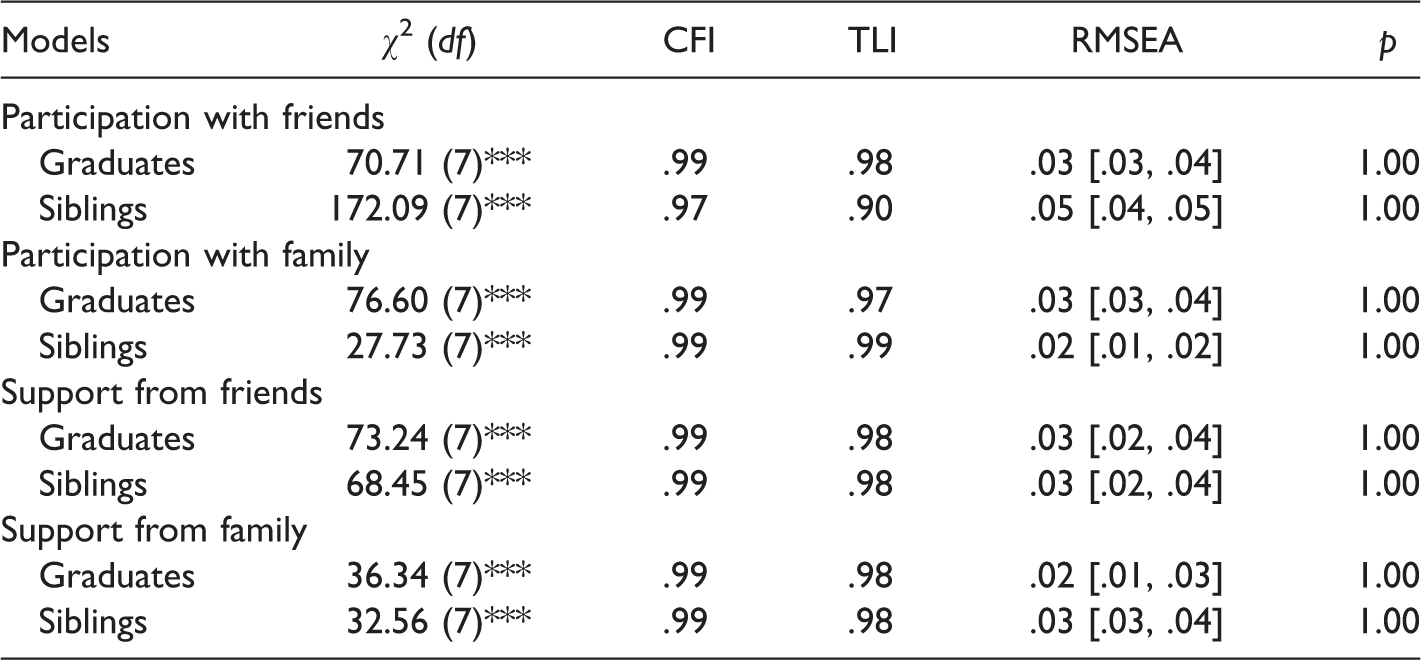
Note. RMSEA = root mean square error of approximation; CFI = Comparative Fit Index; TLI = Tucker-Lewis Index
***p < .001.
Unstandardized Path Coefficients in the Eight Bivariate Latent Growth Curve Models.

Note. I = intercept, s = slope, PWB = psychological well-being.
**p < .01. ***p < .001.
Initially, the longitudinal trajectories of PWB, SP, and SS were examined. For PWB, in graduate and sibling respondents, PWB showed significant variance around the intercept indicating that people varied in their initial level of PWB. In both samples (and across all eight models), the slope of PWB was identical and negative, that is, PWB decreased by 0.11 units per year, contrasting with previous research that showed age-related increases in emotional well-being. In all models, there was significant variance around the slope of PWB indicating that people differed in how they changed over time.
When examining the longitudinal trajectory of SP, the patterns were identical across both sources (family and friends) and thus, are discussed in conjunction. There was significant variance around the intercept demonstrating significant interindividual differences in the initial frequency of SP. There was also—with one exception for SP with friends in the sibling data—significant variance around the slope, that is, persons differed in their change patterns. The mean of the slope of SP for the graduate respondents was nonsignificant. Thus, despite variation around the slope, the frequency of SP did not change on average across the 19-year period for the graduate respondents. The mean of the slope of SP for the sibling respondents was significant and negative. As persons aged, the frequency of SP with friends (−.03) and family (−.02) decreased on average, contrasting with our expectations of increases in SP.
Similarly, SS demonstrated consistent patterns across both sources (friends and family). Across both samples, there was significant variance around the intercept and slope of SS indicating that individuals differed in their initial report of SS as well as changed differently. Across the three measurement points, opposite of our expectations, the slope of SS decreased significantly for both samples and both sources.
SP and PWB
To investigate whether SP acted as a protective factor toward age-related declines in PWB, covariances between the intercepts and slopes were examined. Consistent across both samples and both sources of SP, the intercept and slope of SP and the intercept and slope of PWB were positively correlated, respectively. The intercept of SP was found to significantly predict the intercept of PWB. Greater frequency of SP—with friends and with family—was related to higher PWB initially. Similarly, the positive correlation between slopes means that persons tend to change in the same direction for PWB and SP. When assessing whether SP acted as a protective resource to buffer decline in PWB, the association between the intercept of SP and the slope of PWB was examined. Consistent across both samples and both sources of SP, SP was significantly and negatively associated with the slope of PWB. That is, persons with higher initial SP score showed less decline in PWB
SS and PWB
Similar to SP, the covariances between the intercepts and slopes of SS and PWB were examined to investigate whether SS had a buffering effect on age-related change in PWB. The intercept of SS was found to significantly predict the intercept of PWB for both graduate and sibling samples. Higher levels of SS—with friends and with family—were related to higher PWB at time point one. SS, however, did not show the same relationship between the intercept of SS and the slope of PWB. Across graduate and sibling samples, the intercept of SS did not significantly predict the slope of PWB. Thus, SS did not demonstrate the same buffering effect on decline in PWB as SP did. In addition, for the SS models, the intercept of PWB was significantly related to the slope of SS. Persons with higher initial levels of PWB showed less decline in SS.
Discussion
The goal of this study was to examine age-related change in PWB across the adult lifespan and its relation to social engagement. To do this, we examined data from the WLS for the graduate and sibling respondents. There were four main findings: First, PWB showed small but consistent declines from roughly the mid-50s to the mid-70s. Second, SP acted as a buffer for age-related declines in PWB. Third, SS did not act as a buffer for age-related decline in PWB. Finally, the impact of SS and SP did not vary based on the source of the social engagement (friends and family).
Declines of PWB
Extensive work has examined the age-related trajectory of emotional well-being into older adulthood such as positive and negative affect (e.g., Grühn et al., 2010) and life satisfaction (e.g., Mroczek & Spiro, 2005); however, scarce work has extended this line of research to PWB. Ryan and Deci (2001) argued that well-being is more complex than asking an individual how they were doing, positing the notion that there is more to well-being than the maximization of pleasure and the minimization of pain. Rather, well-being encompasses not only happiness, but feelings regarding one’s purpose in life, room for growth, and connectedness and these experiences of emotional and PWB do not always coincide. Thus, the purpose of this investigation was to help emphasize the importance of examining age-related changes in PWB in adulthood and old age. We found that PWB demonstrated significant—but small—decreases across time. Finding identical values across the graduate respondents and the slightly more age-heterogeneous sibling sample demonstrates the robustness of this effect. This investigation is one of the first to examine the longitudinal trajectory of PWB. Our findings may be an indication that both emotional and PWB may contribute important insight into successful aging in later life.
SP Buffers Declines in PWB
When examining the trajectory of SP across the 19-year period for the original graduate respondents, we found that the frequency of SP did not significantly change across the three time points, whereas SP for the sibling respondents was found to slightly decrease across the three assessments. Stability in SP from middle to older adulthood may be an indication of the importance of maintaining social relationships in the graduate respondents. Older adults are suggested to have chronically activated emotion-focused goals that impact the relative importance of social relationships (Carstensen et al., 1999). This is consistent with previous investigations that found that SP was maintained across time in very old adults (Bukov, Maas, & Lampert, 2002; Isherwood, King, & Luszcz, 2012).
Both a main effect and buffering effect of SP were found across graduate and sibling respondents. That is, individuals high in SP reported higher initial PWB and showed less decline in the slope of PWB. Thus, SP acted as a buffer- to age-related decreases in PWB. This is consistent with previous investigations focusing on the impact of SP on emotional well-being (i.e., Zhang & Zhang, 2015). Specifically, SP has previously been found to be a protective factor to emotional well-being (i.e., Baker et al., 2005; Gilmour, 2012; González-Herero & Extremera, 2010). Persons who are socially engaged tend to have higher well-being and less decline in cognitive and emotional functioning compared to those who are less socially engaged (Hertzog et al., 2009).
This buffer effect may be a function of the psychological benefits and access to resources that SP may provide. SP has been suggested to be an important facet of successful aging because it helps to increase one’s feelings of connectedness with others and helps to increase sense of meaning and purpose in life (Berkman et al., 2000; Betts Adams et al., 2011; Gilmour, 2012) as well as foster a sense of mastery and control due to role obligations that persons must fulfil on a regular basis during social contact with friends and family. Socially participating with others may also foster a self-acceptance due to companionship with others. A person frequently socially participates with others may experience a sense of belongingness within their social group and thus feel increases in self-acceptance (Thoits, 2011). For example, when examining the relationship between SP, sense of community, and social well-being in Italian, American, and Iranian students, Cicognani et al. (2008) found that SP was positively associated with a sense of community. That is, across all cultures, being socially active fostered feelings of belongingness and connectedness with the community and subsequently higher social well-being. SP may also act as a buffer due to the optimization of older adults’ social networks to represent their most meaningful relationships (Carstensen et al., 1999). Thus, older adults who are more socially engaged in relationships that highlight meaningfulness may demonstrate less decline in their PWB in later life compared to individuals who are less socially engaged.
Lack of SS Buffering Effect for PWB
Across the graduate and sibling respondents, SS was found to decrease across waves regardless of whether support stemmed from family or friends. This is consistent with some empirical evidence that found small age-related declines in perceived SS with age (Goodwin, 2006), however, contrasts with a larger body of work that states that older adults’ level of SS remains stable despite changes in roles and social pruning (Ertel, Glymour, & Berkman, 2009; Schnittker, 2007).
When examining the relationship between SS and PWB, we found a main effect of SS. Persons who initially reported high SS also reported high levels of PWB, consistent with previous investigations examining emotional well-being (i.e., Cohen & Hoberman, 1983; Fiori, Antonucci, & Cortina, 2006); however, no buffering effect of SS emerged regardless of the source of the support (friends and family). Although this contrasts with the stress-buffering hypothesis of SS (Cohen & Wills, 1985), this finding coincides with some investigations that also did not find a buffering effect of SS (Bolger & Amarel, 2007; Bolger, Zuckerman & Kessler, 2000; Bozo et al., 2009).
Despite the provision of support being conceived as a way to alleviate distress in friends and family, it may inadvertently come with an emotional cost. For instance, Bolger and colleagues (Bolger & Amarel, 2007; Bolger et al., 2000) identified that when individuals are aware they are receiving SS from others during a stressful time, individuals tend to be more emotionally reactive compared to when no support was provided or when they are unaware of support. It was suggested that the knowledge or awareness that one needs help and is receiving aid might inadvertently cause greater emotional reactivity rather than dampening their responses to the stressor.
Receiving higher levels of SS may contrast with a person’s beliefs about one’s self (Nadler & Fisher, 1986). For example, when examining the relationship between support and well-being in women with breast cancer, Lepore, Glaser, and Roberts (2008) found that women who received high levels of SS had lower self-esteem and, subsequently, greater reports of negative affect.
The emotional cost of SS may be particularly salient for individuals as they get older and may have a diminishing impact on preserving aspects of PWB. SS in older adulthood may signify dependency, decrease feelings of autonomy, and increase feelings of helplessness (Kawachi & Berkman, 2010). SS can be viewed as a compensatory strategy to combat age-related declines in cognitive and socioemotional functioning. This, however, may enhance older adults’ perceptions of their age-related losses, emphasizing the necessity of SS needed to compensate these losses.
Sources of Social Engagement
For both SP and SS, there was no substantial evidence that the effects differed for the social partner—whether friends or family. This contrasts with our hypothesis that support and participation with friends may be more beneficial than with family members that has been found in previous investigations (Larson, Mannell, & Zuzanek, 1986). Despite ideas in the social–emotional aging literature (e.g., English & Carstensen, 2014; Fredrickson & Carstensen, 1990) that age-related changes in the composition of the social network may motivate differential responding to friends and family members, we found no differential impact on PWB. This finding may be due to the relatively young nature of the current sample. That is, most participants were relatively young–older adults. Previous evidence suggests age differences between young–old and old–old adults’ social networks that may impact well-being (Fiori, Smith, & Antonucci, 2007). It may be the case that with later assessments, greater distinction may emerge due to changes in the structure of the older adult’s social network as they age (English & Carstensen, 2014).
Limitations and Future Directions
Although this investigation sheds light on the nature of PWB and its relation with SP and SS, there are some limitations. First, this study utilized longitudinal data from the WLS that currently has three available time points. Although the use of longitudinal data allowed the assessment of age-related change, the use of only three time points does not allow for the examination of nonlinear trajectories of PWB. Similarly, the longitudinal findings may be a reflection of cohort effects rather than age (e.g., cohort effects on an emotional construct, see Grühn, Rebucal, Diehl, Lumley, & Labouvie-Vief, 2008). That is, both subsamples originated from Wisconsin and thus may not generalize to other, more diverse samples. Therefore, further investigations are necessary to disentangle the relationship between age, PWB, and social engagement in more diverse samples.
The lack of buffering of SS on PWB was speculated to be a function of the dark side of support which may foster negative feelings regarding the self. In the current investigation, longitudinal data regarding self-evaluations of self were not available. Future investigations should examine the relationship between self-evaluations such as self-perceptions of aging and the relation to SS in older adulthood. Future investigations should also disentangle the unique dimensions of SS (i.e., instrumental and emotional) which has been previously suggested to be a multidimensional construct (Finfgeld-Connett, 2005).
Further, future investigations should further clarify the quality of SS and SP. The quantity of SP and SS was assessed in this study, and therefore, we could not differentiate between positive or negative social encounters. Previous research has found that negative social interactions can have a detrimental effect on well-being, particularly in older adulthood (i.e., Krause, 1995). Thus, future investigations should not only examine the quantity of SS and SP, but the perceived quality of those resources as well.
In conclusion, we investigated age-related change in PWB and found that PWB decreased from middle to older adulthood. This finding emphasizes the importance of examining both emotional and psychological aspects of well-being when discussing socioemotional change in later life. Although previous research has found gains in emotional well-being, the same may not be the case for other important, but distinct facets of well-being. We also found that different aspects of social engagement may act as a buffer for age-related declines in PWB. This finding may be due to the relative importance and interpretation of SP and SS. It is not only important to know whether older adults have a social network in place, but rather the types of social engagement that are being provided which may differentially impact their well-being.
Footnotes
Declaration of Conflicting Interests
The authors declared no potential conflicts of interest with respect to the research, authorship, and/or publication of this article.
Funding
The authors received no financial support for the research, authorship, and/or publication of this article.