



Abstract
We examined two contradictory views of Erikson’s concept of ego integrity: as an outcome of the tension between integrity and despair, or as a dialogical process of balancing positive and negative life experiences. One hundred sixty-seven Czech older adults participated in the study. Dialogically integrated, outcome-integrated, and outcome-despairing participants were selected based on the Ego Integrity Scale and based on methods mapping life-reviewing dialogue. The three subsamples were compared in their psychological adaptation. The results showed that the dialogically integrated participants scored similarly in well-being and meaningfulness of life as outcome-integrated participants and better than outcome-despairing participants. However, the dialogically integrated participants were also prone to experiencing negative emotions. As they were older than the other two subsamples and reported worse physical health, we concluded that the life-reviewing dialogue helps them maintain a sense of meaning in life and a certain level of well-being. Hence, the results support relevance of the dialogical-process view.
Keywords
This article is concerned with two contradictory interpretations of Erikson’s concept of ego integrity. Successful resolution of the conflict between ego integrity and despair has been acknowledged and researched as a key to adaptation in old age (e.g., Hearn et al., 2011; Torges, Stewart, & Duncan, 2009). However, Erikson’s original description of an ego-integrated older adult is quite complex. For the purpose of empirical investigation, it has been necessary to emphasize only its specific aspects and arrive at narrower definitions that are easier to operationalize. Generally, we distinguish two contradictory types of these narrower definitions of ego integrity: one emphasizing integrity as an outcome of a resolution of the developmental conflict in terms of acceptance of the past, and a different interpretation emphasizing a process of balancing gains and losses in life reviewing.
In this article, we argue for relevance of the process interpretation. First, we conceptualize the process of balancing in life reviewing in greater detail within the framework of the theory of dialogical self. Following this theory, we assume that participants who are ego integrated according to the process view develop an enhanced life-reviewing dialogue (these will be termed as dialogical). We examine this assumption in the empirical study. Furthermore, we demonstrate the relevance of the dialogical-process interpretation. We compare dialogical participants with participants who do not develop an enhanced life-reviewing dialogue and are either ego integrated or despairing according to the “outcome” interpretation. We show that dialogical participants score better than despairing participants and no worse than ego-integrated participants on scales of well-being and meaningfulness of life.
Ego Integrity Versus Despair: Two Lines of Interpretation
In his writings, Erikson (1963; Erikson, Erikson, & Kivnick, 1994) considered older adults as basically concerned with reviewing their lives, trying to evaluate, understand, and balance gains and losses. Ideally, this reviewing should yield a creative integration of diverse life experiences, which is described as ego integrity. In Erikson et al.’s (1994) words, burdened by physical limitations and confronting a personal future that may seem more inescapably finite than ever before, those nearing the end of the life cycle find themselves struggling to accept the inalterability of the past and the unknowability of the future, to acknowledge possible mistakes and omissions, and to balance consequent despair with the sense of overall integrity that is essential to carrying on. (p. 56)
In addition to this basic conceptualization that is focused on the psychological processes of life reviewing, Erikson places emphasis on interpersonal and cultural dimensions of ego integrity. Ego integrity indicates an understanding of an individual’s own life within the context of his or her culture as an individual variation of his or her life story parallel to many other life stories of people sharing the same culture (Erikson, 1963). Hence, “the sense of integration is both intra- and interpersonal” (Hearn et al., 2011, p. 2).
As Santor and Zuroff (1994) conclude, difficulties arise when one seeks to precisely define what ego integrity is and to identify an ego-integrated older person. Erikson’s conceptualization of each stage of his developmental theory is complex, addressing psychological, social, and cultural dimensions of human development in late adulthood. Moreover, Erikson clarified and amplified the stages throughout his writings (Hearn, 1993). However, he did not distinguish the core features of ego integrity and despair from the peripheral features and did not describe precise links between them (Santor & Zuroff, 1994).
Following the conceptual analysis of Torges et al. (2009), we identify two different interpretations of ego integrity. Torges et al. concluded that in the conceptualization of ego integrity, Erikson “emphasizes the individual’s continual effort to balance opposing forces” (p. 67). In contrast, a different influential view of ego integrity has been based on the work of Marcia (1966) and “emphasizes a process resulting in a satisfactory outcome” (Torges et al., 2009, p. 67).
According to this distinction, we will distinguish the “process” view and the “outcome” view of ego integrity. The process view sees an integrated older adult as an individual who has developed a comprehensive view of his or her life and is able to balance naturally occurring feelings of despair. The focus on the process of balancing is apparent particularly in Erikson’s descriptions. As Erikson et al. (1994) assumed, older adults “may be understood as seeking to bring into balance the tension between a sense of integrity, of enduring comprehensiveness, and an opposing sense of despair, of dread and hopelessness” (p. 54). As Westerhof, Bohlmeijer, and McAdams (2017) conclude, “wise [ego-integrated] people are not characterized by a continuous state of ego integrity, but they experience both ego integrity and despair” (p. 401). An integrated person is open to review and acknowledge losses of his or her life, but this reviewing does not result in an overall sense of despair. She or he is able to continuously balance gains and losses. Through this balancing, she or he moves toward a more comprehensive view of own life cycle.
The second interpretation views ego integrity rather as an outcome or resolution of the developmental tension than as an ongoing process. This interpretation is in accordance with the general epigenetic principle of Erikson’s theory that assumes for each developmental stage a certain conflict between opposing forces. Once the conflict is resolved, a person moves to another stage (Erikson, 1963). The positive outcome of the developmental conflict in late adulthood is essentially acceptance of the past. In the interpretation of Santor and Zuroff (1994), an ego-integrated older adult may be viewed as a person who arrives at acceptance of his or her past, regardless of how some negative experiences were painful or troublesome. An integrated person acknowledges these experiences, but they are “no more troublesome or troubling” (Santor & Zuroff, 1994, p. 297). In contrast to the process interpretation, this would suggest that an integrated person is not in a process of balancing; rather, through this process, she or he discovers a final balance or outcome that has a state characteristic: This is either integrity characterized by an overall positive and meaningful view of the past or despair emphasizing losses and failures. In accordance with this interpretation, Torges et al. (2009) introduced the categories “near despair” and “near ego integrity” that indicate processes leading to the “relatively fixed and settled states” of despair or ego integrity (p. 67).
Empirical Examination of Ego Integrity: Relationships With Well-Being and Meaningfulness of Life
The empirical relevance of ego integrity and despair has been examined in a number of studies. Due to the focus of the current study, we mention in particular studies investigating ego integrity as an adaptive state, testing links between the achievement of ego integrity and higher levels of well-being or meaningfulness of life. James and Zarrett (2006) found in a female sample positive correlations between ego integrity (assessed by the scale of Ryff & Heincke, 1983) and subscales of Ryff’s self-report inventory (1989)—self-acceptance, autonomy, mastery, growth, and position relations to others. Rylands and Riskwood (2001) reported a relationship between ego integrity (operationalized as accepting the past) and lower depression. Westerhof et al. (2017) found a positive relationship between ego integrity assessed by the Northwestern Ego Integrity Scale (Janis, Canak, Machado, Green, & McAdams, 2011) and well-being assessed by the Mental Health Continuum-Short Form (Keyes et al., 2008). Torges et al. (2009) found positive correlations between ego integrity (assessed by Ryff’s self-report inventory and a narrative analysis) and an overall measure of well-being and meaningfulness of life. Hearn et al. (2011) assessed ego integrity and despair through analysis of interviews with older people. They found only insignificant negative relationships between integrity and depression but a significant positive relationship between despair and depression. Furthermore, ego-integrated respondents reported better perceived physical health. Last, Dezutter, Wiesmann, Apers, and Luyckx (2013) used the scale of ego integrity developed by Van Hiel and Vansteenkiste (2009) and found that resolution of the conflict between integrity and despair is important for well-being in old adulthood.
Reviewing these studies, we argue that they are based more on the notion of integrity and despair according to the outcome interpretation. The mentioned scales of ego integrity consist of items indicating the participant’s overall satisfaction with his or her life and arrival at a certain point in understanding his or her own life (e.g., “When I consider the ups and downs of my past life, they somehow fit together in a meaningful way” for the Ryff’s self-report inventory; “I have reached a point where I can accept the events in my life as having been necessary” for the Northwest Ego Integrity Scale). However, they do not provide insight into the process of life reviewing, on the balancing gains and losses and arriving at the comprehensive and meaningful view of the life cycle. Strictly speaking, according to the process view of ego integrity, participants who would disagree with some of these items could still be ego integrated as they acknowledge dissatisfaction with some aspects of their lives and may be concerned with the process of their balancing with more positive aspects of their lives.
Other studies use narrative analyses of interviews with older adults. Torges et al. (2009) use a narrative analysis that, in contrast to the mentioned unidimensional scale of Ryff and Heincke (1983), is more suitable to grasp the complexity of participants’ life reviewing. As noted earlier, according to this narrative analysis, participants are assessed in terms of outcomes of integrity or despair; other participants who do not belong to these categories are in a provisional process of leading to integrity or despair. The last category they use is termed struggle, indicating a process of balancing gains and losses when the direction of future resolution is uncertain. Again, according to the process view of ego integrity, at least some of the participants who are “struggling” could be considered as ego integrated because they are open both to positive and negative evaluations of their life and are concerned with their balancing.
In contrast to the reviewed studies, to our knowledge no study has been systematically concerned with examination of the process view of ego integrity. This is also the focus of the current study.
Ego Integrity in the Dialogical Framework
To examine the process view of ego integrity empirically, we reformulate it within the framework of the theory of dialogical self (e.g., Hermans, 2001, 2003) as the “dialogical-process” view. The framework of the theory of dialogical self enables one to analyze in greater detail the process of life reviewing and to define an adaptive life-reviewing dialogue (corresponding to ego integrity) and a maladaptive life-reviewing dialogue (corresponding to despair). Thus, the purpose of using the theory of dialogical self is not to formulate a new developmental conception but to elaborate the process view of Erikson’s ego integrity.
Theory of Dialogical Self and Development of an Adaptive Dialogue
The theory of dialogical self (Hermans, 2003) systematically elaborates the metaphor of dialogue as a basic form of construing self and sense of identity. Basically, it distinguishes two levels of dialogue that are intrinsically connected: external dialogue and internal dialogue. External dialogue involves people as external I-positions who are in social relationships and communicate with each other while taking into account other’s intentions, thinking, and emotions. According to the terminology of the theory of dialogical self, external positions are in dialogical relationships (Puchalska-Wasyl, Chmielnicka-Kuter, & Oleś, 2008).
Internal dialogue involves individual’s internal I-positions (Hermans, 2003). These are partial roles she or he plays in his or her life (e.g., “I as an old man,” “I as a grandmother,” “I as someone who left my partner,” “I as someone who succeeded in career,” etc.). Alternatively, an internal I-position can be individual’s partial identity: A specific way she or he experiences himself or herself (e.g., “I as a dreamer, optimist, lonely,” etc.). Such internal I-positions “populate” the individual’s self. In fact, they are active agents with their specific intentions who think, argue, hold specific values, make decisions, and experience emotions. Metaphorically viewed, these internal I-positions are voiced and engaged in dialogical relationships: They may “discuss,” “negotiate,” “dispute,” “agree,” or “disagree” with each other.
The theory of dialogical self recognizes forms of adaptive and maladaptive dialogue. An adaptive dialogue should be progressive in the sense of arriving at more meaningful views, introducing new perspectives in response to a problem, or creative integration of conflicting positions. These progressive features may in turn be accompanied by a change and further development of the I-positions involved (Hermans, 2003; Lysaker & Lysaker, 2004, 2006).
Regarding the context of this study, we summarize that an adaptive internal dialogue should satisfy two conditions: (a) Differentiation—the dialogue involves a variety of internal I-positions that represent different voices and (b) the positions are in dialogical relationships. If I-positions are not differentiated, they all will assert something very similar, which may in an extreme form be described as a dogmatic and unproductive monologue (Lysaker & Lysaker, 2004). If the I-positions are differentiated but not interconnected through dialogical relationships, the result may be described as an undirected and chaotic “cacophony” of unrelated voices (Lysaker & Lysaker, 2004).
The literature on the dialogical self has been widely concerned with the development of dialogical relationships and enhancing dialogical activity to facilitate adaptive changes. For example, in the context of psychotherapy, the development of an external dialogue between the therapist and client is intrinsically connected to the development of the client’s internal dialogue. To mention one of many case illustrations, Lysaker and Lysaker (2004) described a case of a woman suffering from symptoms of schizophrenia; they showed how a systematic building of dialogical relationships among her internal positions and facilitating internal dialogue helped to turn an initial cacophonous internal dialogue into its more adaptive dialogical form, which in turn led to recovery. In developmental research, Batory (2014) investigated the importance of dialogical activity for identity formation in young adults. So far, no study has been concerned with the importance of dialogical activity in late adulthood.
Life Reviewing and Reminiscence in the Framework of the Theory of Dialogical Self
In accordance with Hermans and Hermans-Jansen (1995), we assume that the process of life reviewing is dialogical. The dialogical nature of life reviewing is primarily apparent at the external (social) level, when an older adult reminisces or reviews his or her life in a dialogue with other people for specific purposes (e.g., to transmit a knowledge, to share unresolved or painful experiences, etc.). In all these situations, an older adult turns to a listener and takes into account a position of a listener: What the listener feels, thinks about the content of reminiscence, his or her intentions, and so on. Conversely, the listener takes into the account the position of the reviewer. Thus, such life reviewing takes the form of dialogical interchange when all involved parties take into account each other.
Simultaneously, life reviewing is dialogical at the internal psychological level as an internal dialogue among various internal I-positions. This reviewing internal dialogue may take various forms, such as negotiation, confrontation, agreement, marginalization of specific I-positions, and others.
Within life reviewing, external I-positions are essentially connected to the individual’s internal positions. For example, an individual’s life partner is a significant external I-positions. Simultaneously, within the development of their relationship, the partner’s way of thinking, values, and intentions become internalized and embedded into the individual’s internal dialogue. They turn to an internal I-position that articulates the partner’s position within the individual’s internal dialogue. In the context of life reviewing, note that significant persons are often not present (e.g., children may move from the parents’ house, a life partner may be deceased); in such circumstances, an internal dialogue that involves I-positions related to these persons may be active and particularly important.
At this point, we apply the general assumption of the theory of dialogical self that building dialogical relationships and enhancement of dialogical activity is adaptive. We assume that the development of dialogical relationships among internal I-positions related to life reviewing and enhancement of life-reviewing external and internal dialogical activity is adaptive as well; it provides an opportunity to reconstrue one’s life cycle and balance positive and negative past experiences.
This assumption is consistent with a large body of research of life review and reminiscence showing that at least some forms of life review and reminiscence play a fundamental role in the integration of past experiences and in creating a meaningful view of one’s life cycle in declining years. One of the widely accepted taxonomies of types of reminiscence (Webster, 1993) distinguishes eight reminiscence functions: identity (helps an older adult to define who she or he is), death preparation (helps to prepare for death), problem solving (helps to place current problems in perspective), intimacy maintenance (helps an individual to keep a memory of one who passed away), teach information (transmission of an individual’s knowledge), conversation (reminiscing to get people talking), bitterness revival (recalling bitter memories), and boredom reduction (helps to reduce boredom). Some of the descriptions of the reminiscence functions directly imply the dialogical nature of reminiscence. For example, intimacy maintenance implies the development of an internal dialogue with an I-position related to a deceased person; conversation implies a development of social relationships and an external dialogue.
Research has shown that reminiscence functions differ from each other in how they help to integrate life experiences. Reminiscence functions that help to accumulate resources are positively related to well-being (e.g., social reminiscence functions, such as teaching information and conversation help to develop positive relationships; identity helps to find a meaningful view of the life cycle; Westerhof, Bohlmeijer, & Webster, 2010). In contrast, some reminiscence functions may be maladaptive. Westerhof and Bohlmeijer (2014) summarize that intimacy maintenance, boredom reduction, and bitterness revival may be maladaptive in the long run because they may “prevent people from making meaningful commitments in life” (p. 109).
Conclusion of the Theoretical Part and Hypotheses
Summarizing the theoretical part, two views of ego integrity are legitimate and presumably associated with adaptation in older adulthood. The first one defines integrity as an outcome of the developmental tension in terms of the acceptance of the past. The second view emphasizes a process of dialogical balancing of positive and negative life experiences.
There are theoretical reasons and empirical evidence that reaching ego integrity either according to the former or latter view is associated with adaptation in terms of well-being and meaningfulness of life. We hypothesize that, if the dialogical-process view of ego integrity is relevant, older adults who develop adaptive life-reviewing dialogical activity will be adapted for late adulthood in terms of well-being and meaningfulness of life no worse than participants who are not so engaged in the development of their life-reviewing dialogue and report an overall acceptance of their past (i.e., who are ego integrated according to the outcome view). Furthermore, we hypothesize that participants with an enhanced dialogical process of life reviewing will score better on these scales than participants who are not engaged in dialogical life reviewing and show an overall dissatisfaction with the past (i.e., who are despairing according to the outcome view).
Goal of the Study
The goal of this study was to examine the relevance of the dialogical-process view of ego integrity by testing the mentioned hypotheses. To achieve this goal, we used a mixed method design (the convergent type; Fetters, Curry, & Creswell, 2013). The study comprised two steps. From a basic sample of participants, we selected subsamples of participants with specific types of ego integrity.Then, we compared these subsamples by using a quantitative analysis.
Sample
Data used in this study were derived from a larger project on successful aging in various cultural contexts (see Hofer et al., 2014, 2016; Hofer, Busch, Poláčková Šolcová, & Tavel, 2017). The sample included 167 community-dwelling Czech older adults (93 females, 74 males) aged 62 to 93 years (median age 70 years). All participants were noninstitutionalized and had not suffered from a mental organic disorder (in particular from dementia). They were recruited in Prague and Olomouc (the Czech Republic) via flyers at local senior centers.
Procedure
Data were collected by trained interviewers who visited the participants in their homes or, if they preferred, in some other place (e.g., in an interviewer’s office). Participants obtained questionnaires 1 week before an interviewer’s visit and were asked to complete them individually in their privacy. However, they were informed that they could wait for the help of an interviewer if they required clarification (no respondent used this option). During the visit, interviewers collected face-to-face sociodemographic information about the family, health, or social activities (a part of them were not considered in this study).
To roughly assess the cognitive abilities of participants and to exclude those with cognitive impairment (which could indicate an organic disorder), the interviewers administered short cognitive tasks. The participants were presented with seven pictures with common objects (e.g., banana and shovel), and after 20 minutes, they were asked to recall these objects; they were required to recall at least four objects. Then, the participants were presented with a sheet of paper with a drawing of a labyrinth and had to find a way out from the middle position. Third, in a modification of the Trail Making Test (e.g., Corrigan & Hinkeldey, 1987), the participants had to connect numbers on a sheet of paper in ascending order from 1 to 30. The time was recorded, and the cut off was set to 2 min and 30 s. All participants passed all three cognitive tasks without difficulties. Finally, the picture story exercise (McClelland, Koestner, & Weinberger, 1989) was administered.
Participation was voluntary, and the anonymity of participants’ data was guaranteed. As compensation for their participation, the participants received gift certificates for local supermarkets. They were informed that they could take breaks for refreshment (one data collection visit lasted about approximately 2–3 h). This opportunity was offered by the interviewers repeatedly throughout the administration, especially when they observed that a participant was becoming tired.
Subsequently, based on the collected data, we used a purposeful sampling strategy to select subsamples of participants who were ego integrated according to the dialogical-process view (dialogical participants) and ego integrated or despairing according to the outcome view (termed outcome-integrated and outcome-despairing, respectively). Each subsample satisfied specific criteria according to the Ego Integrity Scale (see later). Furthermore, we controlled for the validity of this selection by triangulation using two other scales (the Reminiscence Function Scale and the presence of dialogical relationships in narratives; see later).
Methods
Methods for the Identification of Dialogical, Outcome-Integrated, and Outcome-Despairing Participants
Ryff and Heincke’s Ego Integrity Scale
We used items of the Ryff and Heincke’s (1983) Ego Integrity Scale to identify the subsamples of dialogical, outcome-integrated, and outcome-despairing participants. As we argued earlier, this scale primarily assesses ego integrity and despair according to the outcome view. Specifically, the scale consists of 16 items. Seven of them are positively formulated (e.g., “When I consider the ups and downs of my past life, they somehow fit together in a meaningful way.”); the other nine items are negative (e.g., “There are some disappointments in life I will never be able to accept.”). Participants rated their agreement with the items on a 6-point Likert scale from strongly disagree–0 to strongly agree–5. The score of (outcome) ego integrity is given by the sum of the scores for all 16 items (prior to summing, the negative items are recoded to unify the direction of the ratings). Hence, the higher the score, the greater is the level of ego integrity in the sense of outcome; the lower the score, the greater is the level of despairing in the sense of outcome.
To identify ego-integrated participants according to the dialogical-process view, we analyzed the consistency of participants’ ratings on positive and negative items. From the original computation of the outcome ego integrity score, it follows that the participants with the highest scores rate strong agreement with the positive items and strong disagreement with the negative items, and vice versa, participants with the lowest scores (i.e., outcome despairing) rate strong disagreement with the positive and strong agreement with the negative items. Thus, the ratings in both groups are highly consistent as they always manifest agreement with one type of items and disagreement with the other.
However, from the dialogical-process view, the consistent rating patterns may indicate a relatively lower differentiation of participants’ I-positions engaged in the life-reviewing internal dialogue. Specifically, consistent agreement with positive items and disagreement with negative items may indicate that only I-positions that are in accordance in their positive evaluation of the past are involved in the life-reviewing internal dialogue and that different I-positions articulating negative evaluation are marginalized. Consequently, the differentiation of the life-reviewing internal dialogue is reduced.
In contrast, an inconsistent mixture of agreements both with positive and negative items may indicate greater differentiation of participant’s life-reviewing internal dialogue. These participants yield only moderate scores on the original ego integrity scale. According to the outcome view of ego integrity, the inconsistency of their ratings indicate that they are only in the process of balancing gains and losses of their lives and that they have not resolved the conflict between ego integrity and despair. In contrast to this view, the dialogical interpretation implies that inconsistent ratings may correspond to a greater differentiation of I-positions engaged in life reviewing: Some of them evaluate a participant’s life cycle positively and others negatively.
As mentioned earlier, the differentiation of I-positions that are in dialogical relationships characterizes an adaptive internal dialogue. Thus, we consider inconsistent ratings as an indicator of the greater differentiation of participant’s life-reviewing internal dialogue, in contrast to consistent ratings of outcome-integrated and outcome-despairing participants. Although we cannot directly assess whether the differentiated I-positions are in dialogical relationships, we assume that they are and consider the presence of inconsistent ratings as a proxy variable that indicates ego integrity according to the dialogical-process view.
In our sample, the positive items formed the positive scale, with an internal consistency of .74 (Cronbach’s alpha); the negative items formed the negative scale, with an internal consistency .78 (Cronbach’s alpha). Following the described assumptions, we defined three subsamples based on participants’ scores in both scales:
The dialogical subsample includes dialogical participants; these yield high scores in the positive scale and, concurrently, in the negative scale. The outcome-integrated subsample includes participants with high scores in the positive scale and low scores in the negative scale; these are outcome integrated. The outcome-despairing subsample includes participants with low scores in the positive scale and high scores in the negative scale; these are outcome despairing.
To distinguish high and low scores on the positive and negative scale, we used the cut off of the third and first quartiles (for high and low scores, respectively). For example, the outcome-integrated participants yield scores higher than third quartile on the positive scale and lower than first quartile on the negative scale.
Presence of dialogical relationships in narratives
To validate the assumption that dialogical participants satisfy the dialogical-process view of ego integrity, we assessed the presence of dialogical relationships in narratives as another index of mapping participants’ internal dialogue. This index was proposed by Filip and Kovářová (2017) to distinguish the adaptive internal dialogue characterized by interconnected and differentiated I-positions from nonadaptive structures such as cacophony or monologue. In contrast to common methods in research on the dialogical self that are usually focused on idiographic explorations, this index was proposed for a more standardized nomothetic research with larger samples. Filip and Kovářová (2017) show the relevance of this index in terms of its relationship with another method used in research on the dialogical self (the Personal Position Repertory; Hermans, 2006).
The index of the presence dialogical relationships in narratives was assessed by coding of stories created for pictures with more or less ambiguous social situations. It was assumed that a participant projects his or her way of development of dialogue among internal I-positions in a way in which she or he develops relationships among positions (characters) in the stories she or he creates in response to cards that display social situations. Basically, positions in stories may be interconnected by dialogical relationships or the story lacks dialogical relationships.
In the current study, we coded participants’ stories provided for projective cards of the picture story exercise (McClelland et al., 1989). Participants were shown six pictures of various social situations: a couple by a river, two women in a lab, trapeze artists, a man and woman with a horse, four men seated at a table, and boxers; for reprints see Smith, Atkinson, McClelland, & Veroff, 1992). Participants were asked to tell a story for each card. They were told that there were no right or wrong stories. In creating their stories, they were guided by the following questions: What is happening? Who are the people? How did the story begin? What are the people thinking about, what do they want, and how do they feel? What will happen? How will the story end?
Participants’ stories were recorded and transcribed. Two coders who were trained in the mentioned previous study (Filip & Kovářová, 2017) coded participants’ stories for each card for the presence of dialogical relationships in narratives. They followed the guidelines described in Filip and Kovářová (2017). First, specific positions in the story are identified. A position may be a character (e.g., two acrobats on the card “trapeze artists”) or an alternative part of a character (e.g., a boxer who may put his positions “I as loser” and “I as winner” into contrast). Then, the presence of dialogical relationships among positions is assessed. In accordance with the aforementioned explanation of dialogical relationships, the positions in dialogical relationships acknowledge each other (Lysaker & Lysaker, 2001). The acknowledging may be manifested through a real dialogue or communication. Alternatively, the dialogue is not articulated but positions are related to one another and interact with one another based on their mental states and emotions (i.e., a position thinks something or feels something about some other position). Based on their mental states and emotions, positions have their intentions.
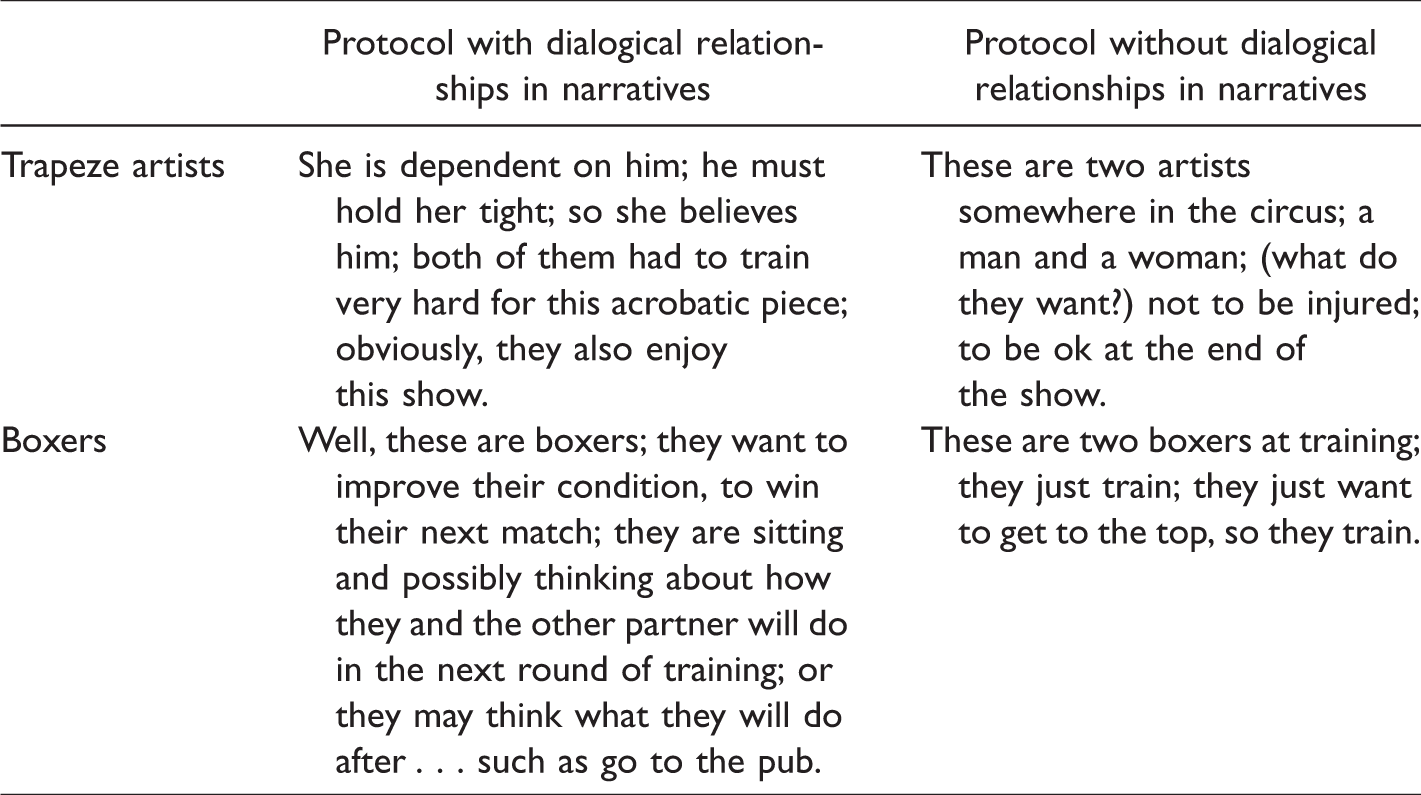
For example, the dialogical protocol for the card “trapeze artists” (Table 1) places emphasis on the dependency of one acrobat on her partner and the condition of relying on each other. Furthermore, the story elaborates characters’ intentions toward the same goal (to manage the acrobatic piece) and emotion (they enjoy the show). In contrast, the story without dialogical relationships provided for this card introduces both artists in a descriptive way without elaboration of their relationship, mental states, emotions, and consequent intentions. Table 1 shows further examples of dialogical and nondialogical stories for the card “boxers.”
Examples of Protocols With and Without Dialogical Relationships in Narratives.
The interrater reliability of the coders’ assessment was 0.68 (intraclass correlation—two-way random-effects model). Stories that were assessed differently were reviewed, and a final code was determined according to the agreement of both coders. In the final results of the coding, four out of six cards appeared to be “too easy” items that did not distinguish the participants efficiently. Thus, most stories (more than 90%) for these items were coded as dialogical. As a result, for further analyses, we used only the stories for the cards “trapeze artists” and “boxers” which yielded more balanced proportions of dialogical and nondialogical stories.
The stories of four participants were not included in further analyses because they could not be assessed meaningfully (e.g., they were too brief or missing). Approximately half of the participants (80) created dialogical stories for both cards. The other 83 participants created at least one nondialogical narrative. Thus, we divided the participants into a subsample “with dialogical narratives” and a subsample “without dialogical narratives” (the former and latter participants, respectively). Then, we examined the proportion of participants of these two subsamples in the three basic subsamples.
If the dialogical participants developed a differentiated internal dialogue with dialogically interconnected I-positions, then these participants should create relatively more frequently dialogical stories for both cards (i.e., they should be included more frequently in the “with dialogical narratives” subsample) in comparison to the outcome-integrity and outcome-despair subsamples.
The Reminiscence Functions Scale
Another strategy for validation of the assumption that participants in the dialogical subsample develop adaptive life-reviewing internal dialogue was to examine participants’ scores on the Reminiscence Functions Scale (RFS; Webster, 1993). This method maps the eight functions of reminiscence introduced earlier. The RFS consists of 43 items. Participants rate on a 6-point Likert-scale (ranging from 0–never to 5–very frequently) how often they reminisce for particular purposes. The items are formulated to cover eight reminiscence functions. In our sample, all RFS subscales yielded high internal consistency (Cronbach’s alpha .80 and higher).
We argued earlier that life reviewing and reminiscence are inherently dialogical. Thus, we interpret average scores on the mentioned subscales as proxy measures of participants’ dialogical activity relating to their reminiscence and reviewing their lives. We expected that dialogical participants will report more frequent reminiscence dialogical activities (i.e., will yield higher average scores on the RFS subscales) in comparison to the outcome-integrated and outcome-despairing participants.
Measures of Well-Being and Openness to the Future
To investigate the relevance of the dialogical view of integrity, we examined whether the involvement in the dialogical subsample is associated with adaptive aging. Specifically, we assessed participants’ well-being by the Mood Adjective Checklist and participants’ meaningfulness of life by two other scales: Meaning in Life Questionnaire and Future Time Perspective.
Mood Adjective Checklist (Matthews, Jones, & Chamberlain, 1990)—On a 5-point Likert scale ranging from very slightly or not at all (0) to extremely (4), participants rated to what extent they generally felt pleased, low-spirited, and so on. Based on the ratings of six positive and six negative attributes, the positive and negative scale were computed. Items on the negative scale were not recoded (i.e., the higher the score, the more intensive was the experience of negative states). In our sample, the positive subscale yielded an internal consistency of .86, and the negative subscale yielded an internal consistency of .81 (Cronbach’s alpha).
Meaning in Life Questionnaire (Steger, Frazier, Oishi, & Kaler, 2006)—On a 7-point Likert scale ranging from absolutely untrue (0) to absolutely true (6), participants rated agreement with items forming two subscales: search for meaning (e.g., “I am seeking a purpose or a mission for my life”) and sense of meaning (e.g., “I understand my life’s meaning”). In our sample, the former subscale yielded an internal consistency of .83, and the latter yielded an internal consistency of .91 (Cronbach’s alpha).
Future Time Perspective (Lang & Carstensen, 2002)—We used this scale in addition to the previous scale mapping the meaningfulness of life. Although the future time perspective is conceptually distinct from life meaningfulness, this particular scale assessed a degree of optimism and a positive orientation toward the future, which broadly corresponds to the sense of life meaningfulness. On a 5-point Likert scale ranging from I disagree a lot (0) to I agree a lot (4), participants rated their agreement with items indicating optimism and openness to the future (e.g., “I’m always optimistic about my future”). In our sample, the scale yielded an internal consistency of .84 (Cronbach’s alpha).
Subjective Health
As health is a factor that plays an important role in the psychology of older adults (e.g., Hearn et al., 2011), participants’ subjective health was assessed in addition to the previously mentioned scales. On three items, participants rated how often they experienced health problems on a 6-point Likert scale from never to always (e.g., “In general, how often do you feel aches and pains?”). Furthermore, they were also asked to rate their health on the scale of the same length ranging from very bad to very good and compared their health situation to same-aged people on the same length ranging from much worse to much better. Ratings of items with inverse directions were recoded so that higher ratings indicated better subjective health. The final index of subjective health was determined as the arithmetic mean of the ratings on all items. In our sample, the scale yielded an internal consistency of .84 (Cronbach’s alpha).
Results
Dialogical, Outcome-Integrated, and Outcome-Despairing Subsamples
Table 2 shows the demographic statistics for the three selected subsamples and participants’ positions on the original Ryff and Heincke’s Ego Integrity Scale (i.e., on the outcome-integrity scale) in terms of the median and range (medians and ranges of outcome-integrity scores were computed from arithmetic means of participant’s ratings on all items after the recoding of negative items as described earlier). The proportion of males and females in dialogical participants was approximately balanced; in the other two subsamples, the proportion of females was higher. Median age in the dialogical subsample was noticeably higher than in the other two subsamples. Outcome-integrity scores corresponded to the aforementioned rationale for the selection of subsamples according to the scores on the positive and negative scales derived from the Ego Integrity Scale (i.e., outcome-integrated participants yielded high scores, outcome-despairing yielded a low score, and dialogical yielded moderate scores).
Descriptive Statistics, Scores on the Ego Integrity Scale, and Subjective Health in the Considered Subsamples.

Due to the relatively small numbers of participants in each subsample, we used nonparametric statistics. Comparing the subsamples in subjective health, participants from the dialogical subsample rated their health similarly to despairing participants; furthermore, they perceived their health as significantly worse in comparison to the outcome-integrated participants (nonparametric Mann–Whitney test; U = 38.5; p = .020).
Presence of Dialogical Relationships in the Dialogical, Outcome-Integrated, and Outcome-Despairing Participants
To examine the assumption that dialogical participants develop a differentiated life-reviewing internal dialogue involving I-positions in dialogical relationships, we assessed the presence of dialogical relationships in narratives. Table 3 shows the proportions of participants with and without dialogical relationships in the three subsamples.
Proportions of Participants With and Without Dialogical Relationships in Narratives in the Selected Subsamples.

According to the assumption, the dialogical participants predominantly created stories with dialogical narratives. In the outcome-integrated subsample, both categories were approximately balanced; the outcome-despairing subsample showed the opposite proportion in comparison to the dialogical subsample.
The proportions in the dialogical and outcome-despairing subsamples differed from each other significantly; Pearson’s chi-square statistics indicated a dependency of the two variables (χ2 = 4.44, df = 1, p = .04). On the other hand, the difference between the dialogical and outcome-integrated subsamples was not significant (Pearson’s χ2 = 1.05, df = 1, p = .30). The proportions in the crosstab also allowed an alternative interpretation. Assuming that the subsamples are ordered categories ranging from a maximum adaptive life-reviewing activity (the dialogical subsample) to a minimum life-reviewing dialogical activity (the despairing subsample) with the outcome-integrated subsample characterized by a moderate adaptive dialogical activity, the proportions of participants with and without dialogical narratives differed significantly (for linear-by-linear-association χ2 = 4.60, df = 1, p = .03).
Reminiscence Function Scale in Dialogical, Outcome-Integrated, and Outcome-Despairing Participants
Another criterion for the examination of enhancement of adaptive life-reviewing dialogue in the dialogical subsample is the RFS. Table 4 shows the medians and ranges of the three subsamples in the subscales of the RFS. The data in the table were computed from the arithmetic means of participants’ ratings on respective RFS subscales.
Reminiscence Function Scale Levels in the Considered Subsamples.
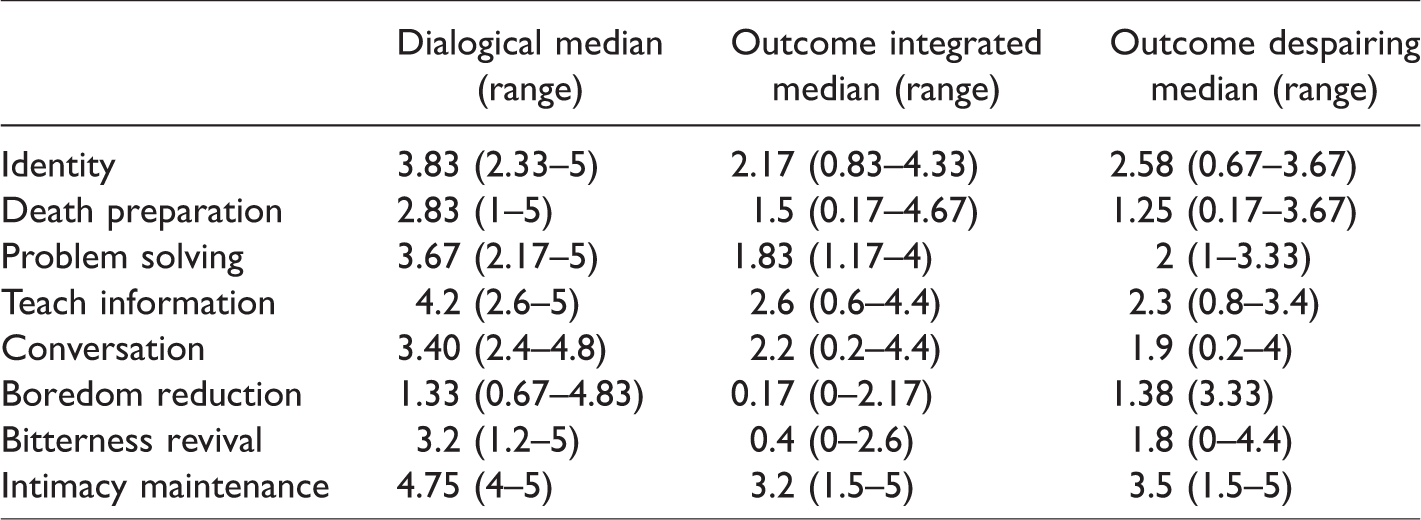
According to the assumption, the median values in the dialogical subsample were higher than in the outcome-integrated and outcome-despairing subsamples (excluding boredom reduction that was also higher in the outcome-despairing subsample). According to the nonparametric Mann–Whitney test, the differences between the dialogical and outcome-integrated subsamples were significant at the level of p < .01; for death preparation, the difference was at the level of p < .05. Comparison of the dialogical and outcome-despairing subsamples showed significant differences at the level of p < .01 in the RFS subscales identity, problem solving, conversation, intimacy maintenance, and teach information. The differences in death preparation and bitterness revival were at the level of p < .05; the difference in boredom reduction was not significant.
Summarizing the median differences, the two maladaptive RFS functions (boredom reduction and bitterness revival) had similarly higher median values in the dialogical and outcome-despairing subsamples in comparison to lower median levels in the outcome-integrated subsample. In all other RFS functions (that have been acknowledged as adaptive, with the exception of intimacy maintenance), median values of the dialogical subsample were higher than in the outcome-integrated and outcome-despairing subsamples.
Well-Being and Meaningfulness of Life in Dialogical, Outcome-Integrated, and Outcome-Despairing Participants
Table 5 shows the median and range values of the described measures of well-being and meaningfulness of life in the considered subsamples. In accordance with the hypothesis that dialogical participants will not yield levels of adaptation lower than outcome-integrated participants, both subsamples had similar median values in the positive subscale of the Mood Adjective Checklist, in the subscale sense of the meaning of the Meaning in Life Questionnaire, and in the scale Future Time Perspective. Dialogical participants scored higher in the search for meaning, but this difference was not significant according to the Mann–Whitney test (U = 58.5; p = .246). In contradiction to the hypothesis, dialogical participants yielded higher median scores in the negative subscale of the Mood Adjective Checklist; however, the Mann–Whitney test yielded p value beyond common significance levels (U = 51.5; p = .092).
Levels of Well-Being and Meaningfulness of Life in the Considered Subsamples.

The hypothesis that dialogical participants will score better than outcome-despairing ones was satisfied for the positive scale of Mood Adjective Checklist and for the sense of meaning of the Meaning in Life Questionnaire (for the former scale, Mann–Whitney U = 25.0; p = .016; for the latter scale, Mann–Whitney U = 29.5; p = .023). In the negative subscale of the Mood Adjective Checklist and in the scale Future Time Perspective, dialogical participants scored better than outcome-despairing ones, but the difference did not reach statistical significance. Finally, the two subsamples scored similarly in the search for meaning subscale.
Discussion
Do Dialogical Participants Develop Adaptive Life-Reviewing Dialogue?
We assumed that participants who highly agreed both with the positive and negative items of Ryff and Heincke’s Ego Integrity Scale developed a life-reviewing internal dialogue that involved differentiated I-positions interconnected by dialogical relationships. This assumption was based on three independent arguments. First, the inconsistent rating on the Ego Integrity Scale should indicate that participants in their life-reviewing employ more differentiated I-positions in comparison to the other two subsamples. This differentiation of I-position is the key condition for the development of an adaptive internal dialogue.
Second, the participants who satisfied the previous condition relatively more frequently created stories with dialogical relationships. The index of the presence of dialogical relationships in narratives was proposed to identify participants who develop internal dialogue with differentiated and dialogically interconnected I-positions (Filip & Kovářová, 2017). As hypothesized, the proportion of participants creating stories with and without dialogical relationships differed in the three subsamples; the dialogical subsample included the highest rate of participants with dialogical narratives (Table 2). This difference was statistically significant only in comparison between the dialogical and outcome-despairing subsample. However, the alternative interpretation assuming ordination of the subsamples from the dialogical subsample (enhanced development of an internal dialogue) to the outcome-despairing subsample (low development of an internal dialogue) was also plausible and supported by the test of significance.
Third, the clearly higher values of the RFS subscales in the dialogical subsample support indirectly the assumption that the dialogical participants develop an adaptive life-reviewing dialogue because they are more frequently engaged in various reminiscence activities.
In contrast, some other reasons limit these conclusions. Two of the criteria used were only proxy variables—the inconsistent rating on the Ego Integrity Scale and the RFS. The only criterion rooted directly in the theory of dialogical self is the index of the presence of dialogical relationships in narratives. Although this index is the most suitable for nomothetic quantitative research from available methods on the dialogical self, decisive evidence for its validity is not available to date.
However, considering the relationships between the three criteria for the selection and validation of the dialogical subsample, we argue that the involved participants probably develop an adaptive life-reviewing internal dialogue. Although the used methods have their limitations, the dialogical subsample selected according to scores on the Ego Integrity Scale satisfies the predicted parameters assessed by two other methods that are completely different in type (the index based on text analysis on the one hand and the RFS as a self-report technique on the other). In other words, the relationships to two independent methods that are different in type make the conclusion more relevant and nontrivial.
Is Dialogical Life-Reviewing Adaptive?
The second part of empirical investigation focuses on how participants in the dialogical subsample scored in measures of well-being and meaningfulness of life in comparison with the other subsamples. In contrast to the outcome view of ego integrity that acknowledges only the successful resolution of the developmental tension as a key to adaptation in older adulthood, the current results show that participants from the dialogical subsample, who are not ego integrated according to the outcome view, yield similar levels on the scales of well-being and meaningfulness of life as outcome-integrated participants. Specifically, participants from the both subsamples experienced similarly positive feelings and experienced a higher sense of meaning in comparison to the outcome-despairing subsample.
In contrast, the higher median score in the negative subscale of the Mood Adjective Checklist in the dialogical subsample in comparison to the outcome-integrated subsample seemed to contradict the hypothesis. This finding together with the higher median score in the maladaptive RFS scale bitterness revival indicated that dialogical participants might be more prone to experiencing negative feelings.
Thus, it cannot be unequivocally concluded that dialogical participants experience similar levels of well-being as outcome-integrated participants. The results suggest that although they do not differ from outcome-integrated participants very much in experiencing positive emotions, they are also open to experiencing negative emotions.
Outcome Versus Dialogical Interpretation of the Results
According to the outcome view of ego integrity, these results would indicate that the participants in the dialogical subsample are in the process of life reviewing, which is considered merely as a transitory condition (e.g., Torges et al., 2009). In their life reviewing, dialogical participants are balancing life gains and losses, sometimes accepting the past and considering it as meaningful, but sometimes considering the past as meaningless and bitter. As they score on measures of well-being and openness to the future similarly as the outcome-integrated participants, the dialogical participants could be categorized as near integrity, on the way to achieving integrity (Torges et al., 2009).
In contrast, the interpretation of the results according to the dialogical view is very different. Contradictory I-positions engaged in life reviewing (indicated by the contradictory ratings on the Ego Integrity Scale) and barely acceptable painful memories (indicated by higher scores on the RFS maladaptive scale bitterness revival) may not necessarily imply an inability to resolve developmental conflict or a provisional process. In the context of further findings (participants’ age and subjective health), the results may indicate that the development of differentiated and integrated internal dialogue related to life review is adaptive in nature. Surprisingly, the median age of dialogical participants is above the median age of the outcome-integrated and outcome-despairing subsamples; moreover, in accordance with the higher age, the dialogical participants perceive their health as worse. Hence, despite the difference in age and subjective health, the dialogical participants still maintain similar well-being as the younger outcome-integrated participants. Moreover, dialogical participants still preserve certain optimism and openness to the future, and in addition to maintaining a certain sense of the meaning of life, they also search more for a sense of life.
In conclusion, dialogical participants do not seem to be in a provisional process of searching for ego integrity. Due to older age and worse health, it may be more difficult for them to see their life-spans as meaningful; it may also be more difficult to deal with painful past experiences and with the critical situation of deterioration in their declining years. The development of a life-reviewing internal dialogue that involves contradictory I-positions may be an adaptive way to cope with this situation.
We speculate that the critical situation when older adults face health problems and nearness of death may partly invalidate an already achieved relatively meaningful view of own life cycle. Older adults belonging to the dialogical subsample may then search more for meaning, which corresponds to the increased dialogical activity that involves more differentiated conflicting I-positions.
Limitations of the Study
The study clearly has several limitations. We have already discussed the limitations of the assumption that participants scoring high both on the positive and negative scale of Ryff and Heincke’s scale develop an adaptive life-reviewing internal dialogue. Furthermore, although the three subsamples in question were selected from the larger basic sample, they are quite small. The critical dialogical subsample has only nine participants. This also limits interpretation of the significance tests. Finally, data were provided by the sample of Czech older adults; the process of their recruitment guarantees neither representativeness in the local population nor intercultural generalizability.
Conclusions and Suggestions for Future Research
Considering the results and their limitations, the study suggests that ego integrity as an outcome of the developmental tension between integrity and despair may not be a unique adaptive condition in late adulthood. The results show that the specific subsample of dialogical participants scored in most measures of adaptation similarly to the subsample of outcome-integrated participants who reported an overall acceptance of their past. Regarding a higher median age and worse subjective health of the dialogical subsample, the results suggest that, instead of the resolution of the developmental tension, the development and maintenance of the life-reviewing dialogical process may be an accurate description of adaptation in old adulthood.
For greater relevance of the dialogical view of integrity in older adulthood, further research with larger numbers of dialogical, outcome-integrated, and outcome-despairing participants is needed. From the methodological perspective, it would be fruitful to use methods that provide deeper insight into internal dialogue of life reviewing of older adults. For this purpose, it would be beneficial to analyze directly older adults’ life reviewing and adopt narrative analyses based on the theory of dialogical self that are concerned with the process of meaning construction through integration of individual’s different I-positions (e.g., Dimaggio et al., 2003).
Footnotes
Acknowledgments
For help in recruitment of participants, we thank REMEDIUM, o.p.s. agency in Prague; with respect to data collection, we thank Professor Peter Tavel of the Palacky University in Olomouc, the Czech Republic. The authors thank Professor Jan Hofer for sharing with us research methodology of his project focused on successful aging (supported by the German Research Foundation, HO2435/5-1).
Declaration of Conflicting Interests
The authors declared no potential conflicts of interest with respect to the research, authorship, and/or publication of this article.
Funding
The authors disclosed receipt of the following financial support for the research, authorship, and/or publication of this article: This research was supported by the Czech Science Foundation (CSF17-02634S) and also by the Czech Republic’s support for long-term strategic development for research organizations (RVO: 68081740).
