



Abstract
This study examined how the accommodative environments experienced from grandparents and grandchildren’s own age-related communication are indirectly associated with grandchildren’s life satisfaction, depressive symptoms, and loneliness, via grandchildren’s self-efficacy with respect to aging. The communication experienced from grandparents was classified as accommodative, ambivalent, and mixed-accommodative chatter. Grandchildren were classified into engaged, disengaged, bantering, and disengaged-joking profiles based on their own age-related communication. Grandchildren who experienced accommodative chatter were likely to be engaged and disengaged communicators about age-related issues; grandchildren who experienced mixed-accommodative chatter were likely to be bantering communicators about age-related issues. Relative to engaged communicators, disengaged-joking communicators demonstrated lower life satisfaction, more depressive symptoms, and greater loneliness, via lower self-efficacy with respect to aging. Patterns of accommodation and nonaccommodation from grandparents may place grandchildren on specific trajectories for communicating about age, and grandchildren’s own communication may be consequential for well-being even at relatively young periods of the life span.
Keywords
Using the communicative ecology model of successful aging (CEMSA; Fowler, Gasiorek, & Giles, 2015; Gasiorek, Fowler, & Giles, 2016), this study explores, for the first time, how grandchildren’s own age-related communication and the patterns of (non)accommodation they perceive from grandparents predict grandchildren’s well-being, via grandchildren’s self-efficacy with respect to aging. Examining grandchildren’s well-being as the product of their own and older family members’ communication is warranted given that people’s well-being is partly in their own control and partly the result of their social relationships (Jopp & Rott, 2006). As Gasiorek and Fowler (2016) argued, a well-established body of research speaks to young adults’ stereotypes of older adults and the dynamics of intergenerational communication shaped by such stereotypes (e.g., Hummert, 2019; Hummert, Garstka, Ryan, & Bonnesen, 2004; Ryan, Giles, Bartolucci, & Henwood, 1986), yet relatively little research has investigated how young adults speak about their own aging trajectories. This is an important gap to fill given that the ideologies people communicatively construct and psychologically internalize about their aging during their younger years may be consequential for how well they age during their later years (Giles, Davis, Gasiorek, & Giles, 2013; Levy, Slade, Kunkel, & Kasl, 2002; Nussbaum & Fisher, 2011).
In addition to examining the implications of grandchildren’s own age-related communication, this study explores how grandparents’ accommodation toward grandchildren predicts the ways in which grandchildren speak about age-related issues as well as grandchildren’s well-being. A robust literature outlines how grandparent–grandchild (GP–GC) connections might influence both parties’ well-being (for reviews, see Hayslip & Fruhauf, 2019; Szinovacz, 1998b). Szinovacz (1998a), for example, reviewed research grounded in life-course theory emphasizing that past GP–GC experiences are integral to understanding current functioning in GP–GC relationships and both parties’ well-being. Thus, grandparents’ larger histories of accommodating toward grandchildren might predict grandchildren’s mental well-being (e.g., Mansson, 2013). Tomlin (1998) also reviewed how grandparents often function as mentors or motivators for their grandchildren, thereby inspiring their grandchildren to age with patience, tenacity, and other virtues. From this perspective, grandparents who are especially accommodative toward grandchildren might inspire grandchildren to communicate about aging in relatively adaptive ways. Consistent with this reasoning, Jopp, Jung, Damarin, Mirpuri, and Spini (2017) found that adults most often mentioned their parents (25.8% of the sample) and grandparents (24.5% of the sample) as their role models for how to age well (see also Holladay, 2002). References to parents and grandparents far surpassed references to other types of people, such as aunts (6.0%), uncles (2.0%), siblings (2.0%), friends (7.3%), and movie stars (6.6%).
Despite the great potential for grandparents to influence their grandchildren’s aging trajectories, many questions remain. For example, Allen, Henderson, and Murray (2019) recently reviewed GP–GC research published from 2010 through 2017 in a variety of family and intergenerational journals. Over half of the published studies (54.55%) focused on grandparents raising grandchildren (either as custodial grandparents or grandparents living in the same household as parents and grandchildren). Many of the remaining studies (29.55%) focused on issues surrounding GP–GC relationship quality (e.g., relational closeness and relational satisfaction). A much smaller number of studies (4.54%) focused on how noncustodial grandparents support grandchildren and provide other resources conducive to grandchildren’s well-being. One of the main premises of this study is that the ways in which grandparents treat grandchildren (as manifested in grandparents’ patterns of accommodation toward grandchildren) might act as communicative resources that facilitate or hinder grandchildren’s aging trajectories.
In the following sections, we first conceptualize successful aging and discuss the study’s focus on three aspects of well-being, namely high levels of life satisfaction, low levels of depressive symptoms, and low levels of loneliness. We then review the CEMSA’s logic and discuss how the accommodation, overaccommodation, and underaccommodation young adult grandchildren receive from grandparents might predict grandchildren’s own age-related communication. Next, we discuss how the accommodative environments grandchildren experience from grandparents and the environments grandchildren construct through their own age-related communication might be indirectly associated with grandchildren’s well-being, via grandchildren’s self-efficacy with respect to aging.
Successful Aging, Defined
Scholars have proposed a variety of definitions to describe successful aging, with no one definition gaining uniform consensus (Depp & Jeste, 2006). Rowe and Kahn (1997) proposed that successful aging involves (a) avoiding disease and disability, (b) maintaining high cognitive and physical functioning, and (c) remaining actively engaged with life by maintaining interpersonal relationships and giving back to society (e.g., by volunteering in a local church or caring for an ill family member; see also Herzog & Morgan, 1992). Garfein and Herzog (1995) similarly defined successful aging with these three components, but they also included affective well-being as a fourth aspect of successful aging. In one study (Cho, Martin, & Poon, 2012), approximately 15% of octogenarians and no centenarians satisfied all three components of Rowe and Kahn’s (1997) successful aging definition. However, roughly 62% of octogenarians and 48% of centenarians were classified as aging successfully according to a set of subjective criteria (e.g., general happiness with life). Synthesizing these different traditions, scholars have recommended that these varying conceptualizations of successful aging be divided into two major strands (Baltes & Carstensen, 1996; Gasiorek et al., 2016; Pruchno, Wilson-Genderson, & Cartwright, 2010): relatively objective variants of successful aging (e.g., avoiding cardiovascular disease, easily walking one-quarter of a mile by oneself) and relatively subjective variants of successful aging (e.g., life satisfaction, self-reported depressive symptoms).
Although a number of factors have been implicated in the process of successful aging, this study selects three variants found to be important subjective constituents of it (Bernhold, Gasiorek, & Giles, 2018): high levels of life satisfaction, low levels of depressive symptoms, and low levels of loneliness. Life satisfaction is frequently mentioned by lay older adults in their open-ended responses of what it means to age successfully, with these responses characterized by a general happiness and contentment with life (Tate, Swift, & Bayomi, 2013). Scholars have also repeatedly included general satisfaction with life as one element of their successful aging definitions (e.g., Nussbaum, 1985; Phelan & Larson, 2002). Depression is one of the most common mental difficulties in the United States, characterized by persistent feelings of sadness, hopelessness, helplessness, and loss of interest in hobbies or other activities once considered enjoyable (National Institute of Mental Health, 2018). In addition to overall life satisfaction, researchers have included low levels of depressive symptoms as another component of successful aging (Montross et al., 2006). High levels of depressive symptoms have been shown to co-occur with more objective aspects of unsuccessful aging, such as the inability to dress oneself or walk across a room by oneself (Livingston Bruce, Seeman, Merrill, & Blazer, 1994).
Loneliness refers to a sense that the quantity or quality of one’s social relationships is inadequate; lonely people often feel alienated from meaningful social interactions and relationships (Wright, Burt, & Strongman, 2006). Examining lay older adults’ perspectives of successful aging across 10 Latin-American and European countries, Fernández-Ballesteros et al. (2010) found that participants endorsed avoiding loneliness and isolation, as well as being able to rely on family members and friends when needed, as key aspects of successful aging. A similar study reported that a large majority (over 75%) of European-American and Japanese-American older adults rated global life satisfaction and low levels of loneliness as two important components of successful aging (Phelan, Anderson, LaCroix, & Larson, 2004). Jopp et al. (2015) found that young, middle-aged, and older adults generally hold similar perceptions of what constitutes successful aging, with frequent references to life satisfaction and feelings of belongingness. Corresponding with these academic and lay definitions, researchers using the CEMSA have treated life satisfaction, depressive symptoms, and loneliness as three variants of successful aging (Bernhold et al., 2018). These aspects of successful aging are also the main focus of this study. We refer to them as aspects of well-being throughout the remainder of the study.
The CEMSA
An Overview of the CEMSA
Building on the foundation that communication is central to successful aging (Giles et al., 2013), Fowler et al. (2015) created the CEMSA with the recognition that people have some control over their own aging trajectories. In this way, the CEMSA joined other theories and models (e.g., the lifespan theory of control: Heckhausen & Schulz, 1995) in holding that people have some agency over the extent to which they age well. However, unlike many other theories and models, the CEMSA proposes that the way in which people realize this agency is through their communication about age-related issues (see also Nussbaum, 1985, 2007; Ryan, Meredith, Maclean, & Orange, 1995). Figure 1 displays a recent visual model of the CEMSA’s proposed interrelationships (after Gasiorek et al., 2016). As the figure illustrates, the messages that people hear about aging (termed environmental chatter) predict people’s uncertainty about aging, own age-related communication, affect about aging, and self-efficacy with respect to aging. People’s uncertainty about aging predicts their own age-related communication, affect about aging, and self-efficacy with respect to aging (see Gasiorek, Fowler, & Giles, 2019). Own age-related communication predicts affect about aging and self-efficacy with respect to aging; affect about aging also predicts self-efficacy with respect to aging. Self-efficacy with respect to aging is then posited as the proximate predictor of successful aging.
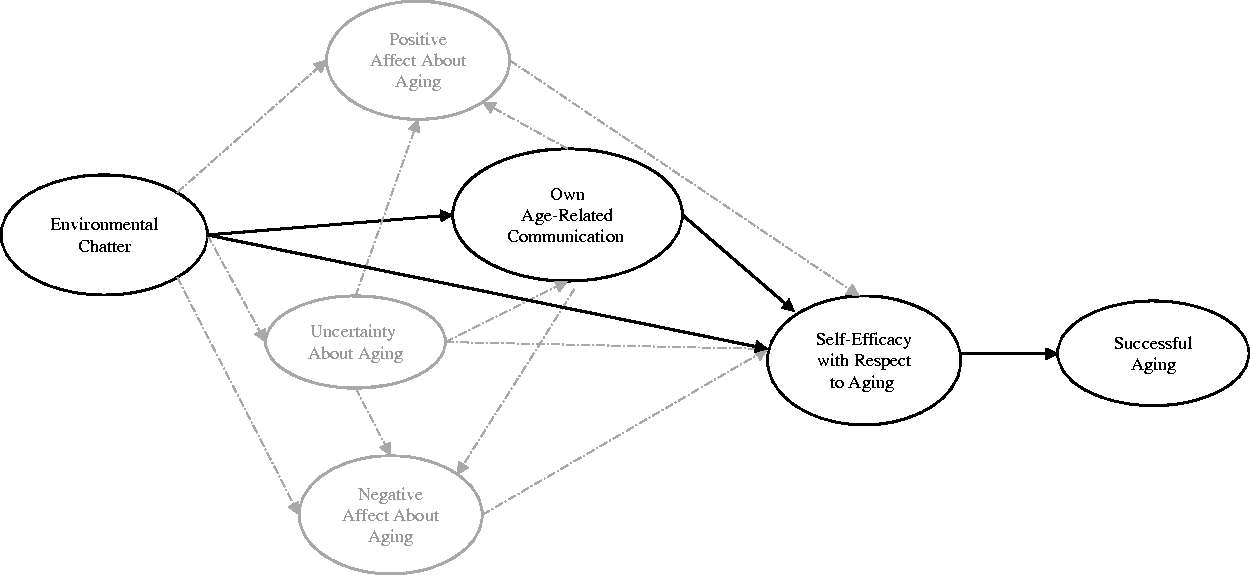
The communicative ecology model of successful aging (CEMSA). Note. In this study, environmental chatter is considered in terms of grandparents’ accommodation, overaccommodation, and underaccommodation toward their grandchildren. Successful aging is considered as three aspects of well-being, namely grandchildren’s life satisfaction, depressive symptoms, and loneliness. Constructs and pathways outlined in black and solid lines are the focus of this study; constructs and pathways outlined in gray and dashed lines are part of the CEMSA, but are not the focus of this study.
Our study here focuses on young adult grandchildren with a subset of constructs, namely environmental chatter (in the form of grandparents’ accommodation and nonaccommodation toward grandchildren), grandchildren’s own age-related communication, self-efficacy with respect to aging, and successful aging (treated here as three aspects of well-being: life satisfaction, depressive symptoms, and loneliness). These constructs and their interrelationships are elaborated in more detail later.
Profiles of Environmental Chatter and Own Age-Related Communication
Environmental chatter
In an extended version of the CEMSA, Gasiorek et al. (2016) formally introduced environmental chatter to describe the messages about aging that people receive from relational partners, strangers, and the media. The term chatter in this concept highlights the possibility that these messages might not always be carefully processed in everyday life yet, over time, the messages might contribute to a larger environment or ecology that influences well-being. Gasiorek et al. argued that at least four types of communication constitute environmental chatter: (a) hearing memorable messages about aging, (b) observing how liked role models behave with respect to aging, (c) receiving (non)accommodative communication from relational partners, and (d) viewing and internalizing media messages about aging. This study seeks to explore further one component of environmental chatter, namely GP–GC conversations as they relate to accommodation.
Communication accommodation theory (CAT: e.g., Giles, 2016; Soliz & Colaner, 2018) addresses how speakers adjust their communication during interaction as well as the consequences of these moves. Accommodation refers to communication that is adjusted to meet listeners’ needs; speakers often accommodate listeners to facilitate comprehension or build relational solidarity (Soliz & Giles, 2014). In GP–GC relationships, accommodation can be manifest by grandparents complimenting their grandchildren or showing affection to them (Harwood, 2000). Nonaccommodation involves communicative moves that are designed to convey or interpreted as conveying dissimilarity, rejection, or disconfirmation (Gasiorek, 2016). From the receiver’s perspective, nonaccommodation can also be apparent in over- and underaccommodative terms. Overaccommodation describes instances when a speaker overshoots or goes too far in adjusting to the listener (N. Coupland, Coupland, Giles, & Henwood, 1988). In the context of intergenerational relationships, overaccommodation often manifests as patronizing speech (e.g., Ryan, Bourhis, & Knops, 1991). Underaccommodation refers to instances when a speaker does not go far enough in adjusting to the listener (N. Coupland et al., 1988). Grandparents could be labeled as underaccommodators with their grandchildren when they adopt painful self-disclosures about their lives (e.g., talking about their health problems, complaining about other aspects of their lives; N. Coupland, Coupland, & Giles, 1991), and grandchildren find such disclosures uncomfortable (Barker, 2007; Fowler & Soliz, 2010).
As Bernhold et al. (2018) discussed, much research has examined how single constructs from CAT (e.g., accommodation) predict various outcomes, such as relational satisfaction (e.g., Speer, Giles, & Denes, 2013). One less-studied topic pertains to the overall accommodative climates that family members experience. For instance, do some grandchildren experience high amounts of accommodation, overaccommodation, and underaccommodation from grandparents (as might be the case, for example, when grandchildren perceive that their grandparents love them, but also that their grandparents are not always aware of which topics grandchildren would prefer to avoid)?
Using a sample of older adults, Bernhold et al. (2018) found that some participants experienced negative chatter environments characterized by relatively low accommodation and relatively high overaccommodation from young adults. Other older adults experienced positive chatter environments characterized by relatively high accommodation and relatively low overaccommodation from young adults. A third subset of older adults experienced mixed-positive environments characterized by moderate amounts of both accommodation and overaccommodation from young adults. However, Bernhold et al.’s study focused on older adults’ relationships with young adults in general rather than a specific type of relational partner. The researchers also did not consider how underaccommodation fits into these environments. This study builds on these findings and contributes to CAT’s development by exploring how participants in a specific type of intergenerational relationship experience accommodation, overaccommodation, and underaccommodation from relational partners. Because we had little basis for speculating the number and types of profiles that would emerge for grandchildren reporting on their communication with a specific grandparent, we asked the following:
Own age-related communication
The CEMSA includes seven types of own age-related communication (for a more comprehensive explanation of each communication component, see Fowler et al., 2015): self-categorizing as old (e.g., making age-related excuses to account for one’s shortcomings; Eibach, Mock, & Courtney, 2010), expressing optimism about the aging process (e.g., mentioning that one is excited about the future; Levy, Slade, & Kasl, 2002), colluding in the teasing of others about their age (e.g., sending ageist birthday cards to relational partners; Demos & Jache, 1981), responding when one is the subject of ageism (e.g., playing along when one is the subject of age-related teasing; Ryan, Kennaley, Pratt, & Shumovich, 2000), engaging with anti-aging media (e.g., being skeptical of anti-aging beauty products advertised on television and in magazines; J. Coupland, 2007), discussing future caregiving preferences (e.g., letting family members know about one’s future caregiving preferences before a need for care arises; Pinquart & Sorensen, 2002), and engaging with new communication technologies (e.g., enjoying keeping in touch with family members and friends on social media; Jung, Walden, Johnson, & Sundar, 2017).
Across studies, people have been classified into three profiles based on their own patterns of age-related communication (Bernhold, 2019; Gasiorek & Barile, 2018; Gasiorek et al., 2015, 2019). Engaged communicators about age-related issues express relatively high levels of optimism about aging and skepticism about anti-aging products; they are also likely to discuss their caregiving preferences in advance and embrace new communication technologies. However, engaged communicators are relatively unlikely to self-categorize as old, tease others about their age, and play along with age-related jokes. Disengaged communicators about age-related issues seem to opt out of the aging process by not discussing many topics related to aging: They score relatively low on six of the seven age-related communication behaviors, but their embracing of new communication technologies is similar to that of people in the other two profiles. Finally, bantering communicators about age-related issues score relatively high on six of the seven communication behaviors, with the exception that their discussions of future caregiving preferences are somewhat less frequent than the caregiving discussions of engaged communicators. Bantering communicators are distinct in their relatively high levels of self-categorizing as old, teasing others about age, and playing along when they are the subject of age-related jokes. Given that these three profiles have repeatedly emerged in previous research (including research on young adults), we hypothesized that we would be able to replicate them:
Environmental chatter as a predictor of own age-related communication
A unique contribution of this study is to explore potential relationships between the two kinds of profiles involved in RQ1 and H1. The direct pathway from environmental chatter to own age-related communication in Figure 1 suggests that the environmental chatter profiles might predict the own age-related communication profiles. Young adults have reported that older adults patronize them and that this patronization has invoked more anger and resentment compared to less condescending (more neutral) statements (Giles & Williams, 1994). They have also reported that overaccommodation and underaccommodation from older adults stimulate negative age stereotypes and adverse feelings and debilitation about growing older (Williams & Giles, 1996). Thus, it seems reasonable that being the recipient of certain kinds of environmental chatter might predict the emergence of certain forms of age-related communication (e.g., a chatter profile characterized by low levels of accommodation and high levels of nonaccommodation might predict grandchildren’s membership in the disengaged profile). As another possibility, grandparents who accommodate grandchildren and avoid nonaccommodation might lift up grandchildren, thereby encouraging grandchildren to become engaged communicators about age-related issues. The following general hypothesis was, thus, proposed:
Own Age-Related Communication and Environmental Chatter as Indirect Predictors of Well-Being
One of the CEMSA’s guiding premises is that people have agency over the extent to which they age well, and they realize this agency through their communication (Fowler et al., 2015). Consistent with this notion, own age-related communication is posited to indirectly predict well-being, via self-efficacy with respect to aging. Using a sample of young adults, Gasiorek and Fowler (2016) found that engaged communicators about age-related issues reported greater self-efficacy with respect to aging than bantering and disengaged communicators about age-related issues. In a sample of middle-aged adults, Gasiorek et al. (2015) found that engaged communicators about age-related issues reported greater self-efficacy with respect to aging and greater well-being compared to bantering communicators about age-related issues. Another study of middle-aged and older adults showed that engaged and bantering communicators about age-related issues demonstrated greater life satisfaction than disengaged communicators about age-related issues (Gasiorek & Barile, 2018). Research has also begun to explore indirect associations involving own age-related communication. Bernhold et al. (2018) found that, relative to engaged older adults, disengaged older adults reported less life satisfaction, more depressive symptoms, and greater loneliness, via lower self-efficacy with respect to aging. Collectively, these findings suggest the following:
Method
Participants and Procedures
This was a single-party study of grandchildren. As such, all demographic information and all responses to the substantive measures in the “Method” section were provided by grandchildren.
A total of 423 young adult grandchildren (MAge = 19.78 years, SDAge = 1.54 years) were recruited from a Communication department’s online research participation system at a large public university in the western United States. Any student was eligible to participate as long as they had at least one currently living grandparent with whom they had a relationship. Grandchildren were grandsons (28.1%) and granddaughters (71.6%), with 0.2% of grandchildren not providing their biological sex. Grandchildren’s ethnicities were African American (2.8%), Asian American (18.9%), European American (52.5%), Latina/o American (13.9%), Multi-Ethnic (7.3%), Native American (0.2%), Other (4.0%), and unreported (0.2%). Grandchildren described their own socioeconomic status (SES) as follows: lower class (11.3%), middle class (72.3%), and upper class (15.6%), with 0.7% of grandchildren not reporting this information.1
Grandchildren were instructed to think about their relationship with one of their grandparents. Consistent with other research (e.g., Kam & Hecht, 2009), they could choose whichever grandparent they wanted as long as the grandparent was currently living. We requested that grandchildren write their chosen grandparent’s initials in the survey, which was similar to requests in other family communication studies (e.g., Mansson & Booth-Butterfield, 2011; Mansson, Myers, & Turner, 2010). The purpose of this request was to further emphasize the salience of a specific grandparent in grandchildren’s minds so that they would not answer the substantive items thinking about how multiple grandparents communicated with them in general. We also explicitly instructed grandchildren to complete the items thinking about the specific grandparent whose initials they wrote rather than considering all of their grandparents in general.
Grandparents were grandfathers (28.1%) and grandmothers (71.6%), with 0.2% of grandchildren not providing this information. On average, grandparents were 76.43 years old (SDAge = 7.77 years). Ethnicities of grandparents were African American (2.8%), Asian American (19.9%), European American (57.7%), Latina/o American (13.5%), Multi-Ethnic (1.2%), Native American (0.2%), Other (4.0%), and unreported (0.7%). Grandchildren described their grandparents’ SES as lower class (12.3%), middle class (70.0%), and upper class (17.0%), with 0.7% of grandchildren not providing this information. The vast majority of grandparents were biologically related to grandchildren (94.8%). Some grandchildren reported on a grandparent in an adopted family (2.4%), some grandchildren reported on a stepparent’s parent (1.7%), and some grandchildren reported on a biological grandparent’s second spouse (0.9%), with 0.2% of grandchildren not specifying their relationship with the grandparent.
Measures
Bivariate correlations between all substantive variables appear in Table 1. The online appendix provides the full list of items used for this study.
Bivariate Correlations Between Study Variables.

Note. Two-tailed.
†p < .10. *p < .05. **p < .01. ***p < .001.
Accommodation
Six items from Harwood (2000) assessed grandparents’ accommodation (e.g., “My grandparent compliments me,” M = 5.89, SD = 1.01, α = .93). The items were answered on 7-point Likert-type scales (1 = strongly disagree, 7 = strongly agree), with higher scores indicating more accommodation.
Overaccommodation
Two items from Harwood (2000) and two items from Bernhold et al. (2018) gauged grandparents’ overaccommodation (e.g., “My grandparent talks down to me,” M = 2.67, SD = 1.30, α = .86). The four items were answered on 7-point Likert-type scales (1 = strongly disagree, 7 = strongly agree), with higher scores indicating greater overaccommodation.
Underaccommodation
Seven items from Harwood (2000) measured grandparents’ underaccommodation (e.g., “My grandparent complains about his/her life circumstances,” M = 3.38, SD = 1.27, α = .85). The items were answered on 7-point Likert-type scales (1 = strongly disagree, 7 = strongly agree), with higher scores indicating greater underaccommodation.
Own age-related communication
A total of 21 items from Fowler et al. (2015) measured grandchildren’s own age-related communication. Three items measured each of the following behaviors: self-categorizing based on age (e.g., “I often hear myself explaining away some event by referring to my age”), expressing optimism about aging (e.g., “I frequently express the fact that I am optimistic about aging”), teasing others about their age (e.g., “I often tease others about their age”), responding when one is the subject of ageism (e.g., “When others make jokes about my age, I usually play along”), demonstrating skepticism to anti-aging media (e.g., “I resent the ads that claim I should work at looking younger”), discussing future caregiving preferences (e.g., “I have talked with my family and friends about my wishes regarding care as I age”), and embracing new technology (e.g., “I enjoy keeping up with new communication technologies such as social media or new smart phone apps”). The items were answered on 7-point Likert-type scales (1 = strongly disagree, 7 = strongly agree). Consistent with past research (e.g., Gasiorek et al., 2015), reliability coefficients are not reported for these items because latent profile analysis treats all 21 items as individual contributors to the latent profiles.
Self-efficacy with respect to aging
Six items from Fowler et al. (2015) assessed grandchildren’s self-efficacy with respect to aging (e.g., “I feel able to cope with things that might happen to me as I age,” M = 4.77, SD = 0.93, α = .79). The items were answered on 7-point Likert-type scales (1 = strongly disagree, 7 = strongly agree). Responses to the six items were averaged, with higher scores indicating greater self-efficacy with respect to aging.
Life satisfaction
Six items from Fowler et al. (2015) measured grandchildren’s life satisfaction. Three items (e.g., “I am happy with the age I am right now”) were answered on 7-point Likert-type scales (1 = strongly disagree, 7 = strongly agree). The other three items (e.g., “How successfully have you aged up until now?”) were answered on 7-point semantic differential formats (e.g., 1 = not at all well, 7 = extremely well, M = 5.61, SD = 0.89, α = .83). Responses to the six items were averaged, with higher scores indicating greater life satisfaction.
Depressive symptoms
Consistent with past research (Bernhold et al., 2018), six items from the Center for Epidemiologic Studies Depression Scale (CES-D Scale; Radloff, 1977) measured grandchildren’s depressive symptoms (e.g., “I felt like I could not stop feeling sad even with help from family or friends,” M = 1.77, SD = 0.62, α = .82). Participants reflected on their experiences over the past week and answered the items on 4-point scales ranging from rarely or none of the time (less than one day) to most or all of the time (five to seven days). Responses to the six items were averaged, with higher scores indicating more depressive symptoms.
Loneliness
Consistent with past CEMSA research (Bernhold et al., 2018), three items from the Revised UCLA Loneliness Scale (Russell, 1996) assessed grandchildren’s loneliness (e.g., “I feel alone,” M = 2.20, SD = 0.86, α = .85). Participants answered the items on 5-point scales ranging from never to always. Responses to the three items were averaged, with higher scores indicating more loneliness.
Covariates
When testing how own age-related communication profile membership and environmental chatter profile membership were indirectly associated with the three variants of well-being, a set of grandparent and grandchild characteristics was controlled. Grandchildren’s sex (0 = male, 1 = female), age, ethnicity (0 = ethnic minority, 1 = European American), and SES (1 = lower class, 2 = middle class, 3 = upper class) were controlled. Grandparents’ sex (0 = male, 1 = female), age, ethnicity (0 = ethnic minority, 1 = European American), and SES (1 = lower class, 2 = middle class, 3 = upper class) were also controlled.
Results
Environmental Chatter and Own Age-Related Communication Profiles
Environmental chatter profiles
RQ1 inquired about the profiles that would emerge based on grandchildren’s experiences of receiving accommodation and nonaccommodation from grandparents. To test RQ1, we ran a series of latent profile analyses (LPAs) in Mplus 7.3 (Muthén & Muthén, 1998–2014). LPA classifies a heterogeneous sample of participants into relatively homogeneous subgroups (or profiles) based on their response patterns to a series of continuous indicators. Participants in the same profile demonstrate similar response patterns to one another, but different response patterns from participants in other profiles. Five LPA models were run, with each model specifying one more latent profile (k + 1 profiles) than the previous model (k profiles). Each LPA model contained the six accommodation items, four overaccommodation items, and seven underaccommodation items as individual indictors. Table S1 (available in the online-only supplemental materials) reports fit indices for these models. Researchers should select the final number of profiles based on a range of statistical and conceptual considerations. Statistically, the loglikelihood, Akaike information criterion (AIC), Bayesian information criterion (BIC), and sample-size adjusted Bayesian information criterion (aBIC) should demonstrate relatively sharp declines in absolute value when moving from the k-profile model to the (k + 1)-profile model in order to justify the additional profile. Relatively flat declines indicate that the additional profile may be unnecessary. Recent simulation work suggests that the BIC and aBIC are especially helpful for identifying the best solution (see Morgan, 2015). Conceptually, profiles should be meaningfully distinct from one another.
A three-profile solution was judged most appropriate to characterize participants’ experiences of environmental chatter (see Figure 2 for a latent profile plot). The first profile (comprising 59.9% of the sample) was labeled accommodative environmental chatter. Participants in the accommodative profile reported high accommodation from their grandparent as well as low overaccommodation and underaccommodation from their grandparent.
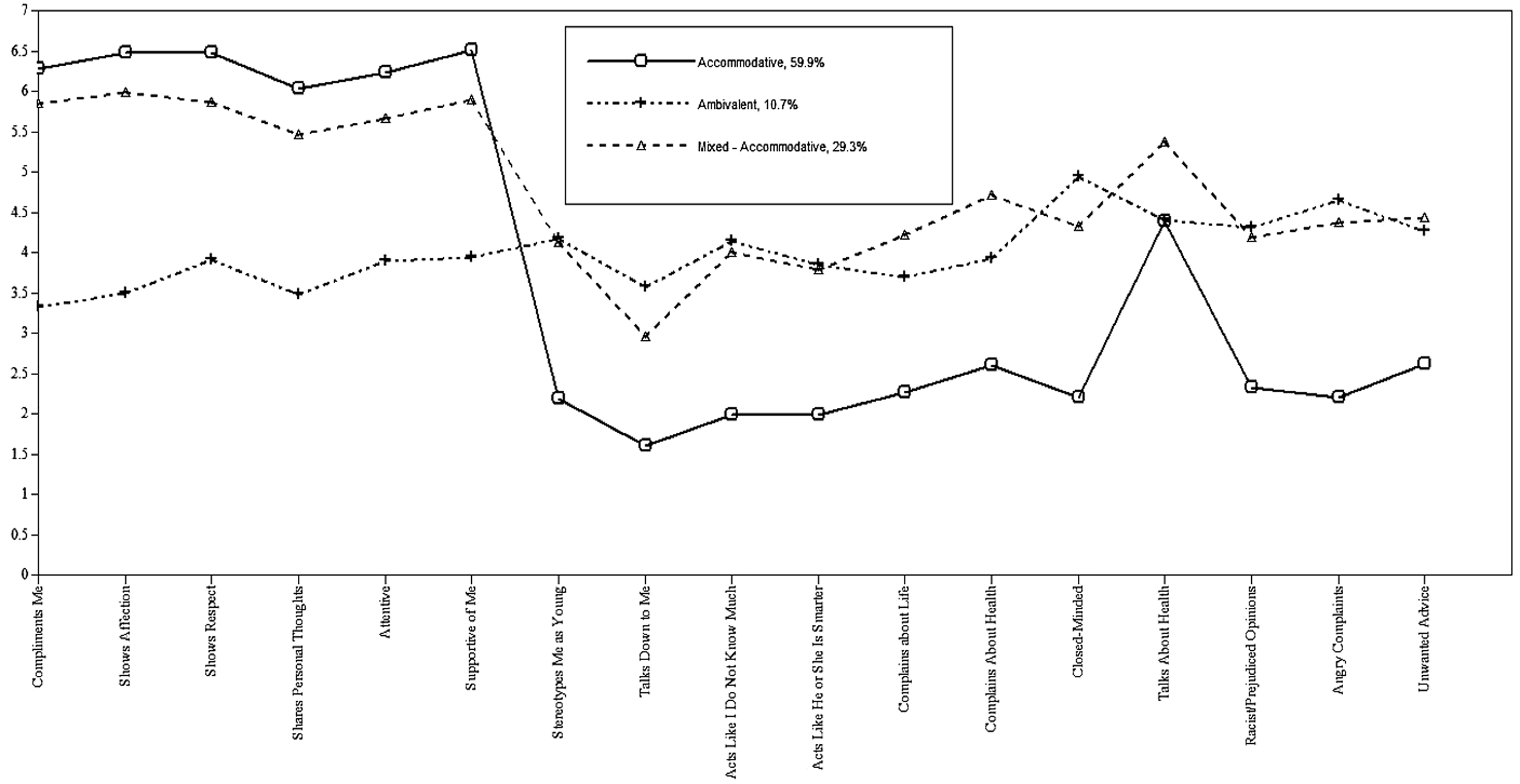
Latent profile plot of grandparents’ (non)accommodation toward grandchildren.
The second profile (comprising 10.7% of the sample) was labeled ambivalent environmental chatter. Participants in the ambivalent profile tended to slightly disagree that they received accommodation from their grandparent. They also fell near the scale midpoint (corresponding to neither agree nor disagree) when asked about their grandparents’ overaccommodation. Further, the ambivalent profile was characterized by slight agreement with grandparents engaging in underaccommodation. Most notably, grandchildren in this profile slightly agreed that their grandparent was closed-minded. The ambivalent label was chosen to name this profile because agreement or disagreement with specific items tended to be relatively slight in magnitude compared to the agreement or disagreement of participants in other profiles.
The third profile (comprising 29.3% of the sample) was labeled mixed-accommodative environmental chatter. Participants in the mixed-accommodative profile were similar to participants in the accommodative profile in reporting that their grandparents generally accommodated them. However, participants in the mixed-accommodative profile were generally similar to participants in the ambivalent profile when asked about their grandparent’s overaccommodation and underaccommodation. Notably, participants in the mixed-accommodative profile reported the highest agreement that their grandparent complains about life, complains about health, and talks about health. The label mixed-accommodative was chosen to highlight that participants perceived their grandparent as accommodating them in many respects, but also as potentially underaccommodating them in other respects.
Own age-related communication profiles
H1 predicted that the engaged, disengaged, and bantering profiles would emerge based on participants’ own age-related communication. To test H1, we ran another series of LPAs in Mplus 7.3. The indicators were the 21 individual items inquiring about participants’ own age-related communication. A four-profile solution was deemed most appropriate for participants’ own age-related communication (see Figure 3 for a latent profile plot). Partially supporting H1, three of the four profiles closely resembled the hypothesized profiles. Engaged communicators about age-related issues (comprising 33.7% of the sample) reported relatively high expressed optimism about aging, discussions of future caregiving, and embracement of new technologies, but relatively low self-categorizing as old, teasing others about age, and playing along when they are the subject of ageism. These features resembled characteristics of engaged communicators from past research. One way in which engaged communicators in this study differed from engaged communicators in previous research is that the engaged communicators in this study were less likely than bantering communicators to report skepticism of anti-aging media. Using a different sample of young adults, Gasiorek and Fowler (2016) found that engaged communicators reported slightly more skepticism of anti-aging media than bantering communicators. The proportion of participants classified as engaged communicators in this study (33.7%) was somewhat higher than the proportion of participants who were engaged communicators in Gasiorek and Fowler’s study (24.5%).
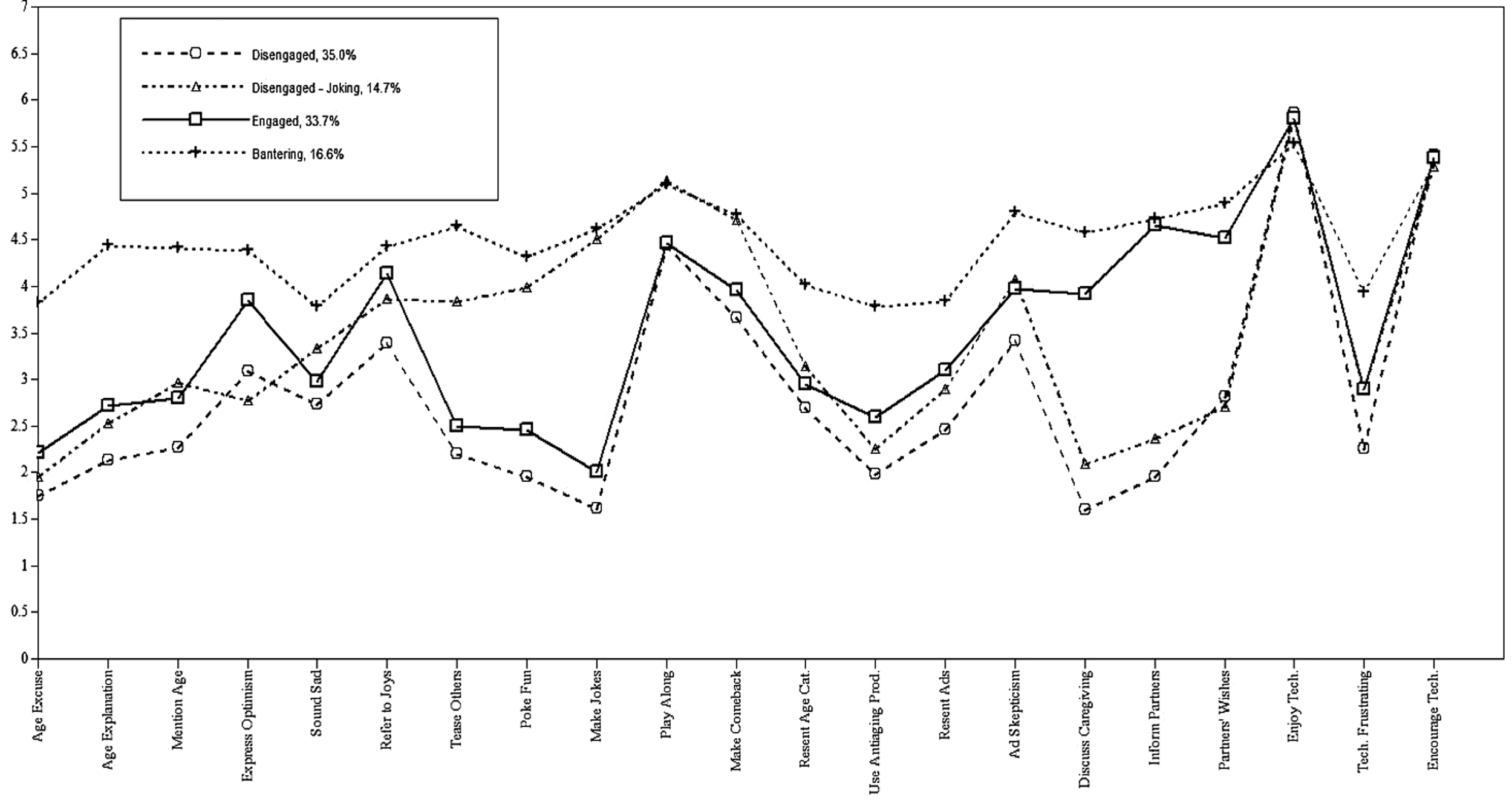
Latent profile plot of grandchildren’s own age-related communication.
Disengaged communicators about age-related issues (comprising 35.0% of the sample) were the second profile. Consistent with Gasiorek and Fowler (2016), disengaged communicators in this study scored relatively low on six of the seven behaviors, but their embracing of new communication technologies paralleled that of participants in the other profiles. The proportion of participants classified as disengaged communicators in this study (35.0%) was very similar to the proportion of disengaged communicators in Gasiorek and Fowler’s study (35.7%).
The third profile consisted of bantering communicators about age-related issues (comprising 16.6% of the sample). Bantering communicators scored relatively high on six of the seven behaviors, but their embracing of new communication technologies was similar to that of participants in other profiles. With two exceptions, bantering communicators in this study were similar to bantering communicators in previous research. In this study, bantering communicators were somewhat more likely than engaged communicators to report skepticism of anti-aging media and discuss future caregiving preferences. Gasiorek and Fowler (2016) previously found that engaged communicators scored slightly higher than bantering communicators on these two considerations. Nevertheless, bantering communicators’ relatively high scores on these two considerations in this study seemed consistent with the bantering theme. The proportion of participants classified as bantering communicators in this study (16.6%) was lower than the proportion of bantering communicators in Gasiorek and Fowler’s study (39.6%).
The fourth profile (comprising 14.7% of the sample) was labeled disengaged-joking communicators about age-related issues. In most respects, disengaged-joking communicators resembled disengaged communicators by scoring relatively low across the communication behaviors (i.e., relatively low levels of self-categorizing, expressed optimism, skepticism of anti-aging media, and discussions of future caregiving). However, disengaged-joking communicators differed from disengaged communicators in two important respects: Disengaged-joking communicators were relatively likely to collude in the teasing of others about age as well as play along when they are the subject of ageism or age-related humor. The disengaged-joking profile was a novel profile not observed in previous research.
Environmental Chatter as a Predictor of Own Age-Related Communication
H2 predicted that the environmental chatter profiles would be associated with the own age-related communication profiles. To test this hypothesis, we ran a latent transition analysis (LTA) in Mplus 7.3. LTA is most commonly used to examine changes in profile membership over time (e.g., the probability that engaged communicators about age-related issues remain engaged communicators over time, versus the probability that engaged communicators transition to disengaged, bantering, or disengaged-joking communicators over time). However, LTA can also be conducted with cross-sectional data to examine participants’ probability of being a member of a certain profile in Series B, given their membership in a specific profile in Series A (see Bernhold, 2019). Table 2 reports all latent transition probabilities for an LTA in which the environmental chatter profiles constituted Series A and the own age-related communication profiles constituted Series B.
Latent Transition Probabilities Illustrating the Likelihood of Own Age-Related Communication Profile Membership, Given Environmental Chatter Profile Membership.
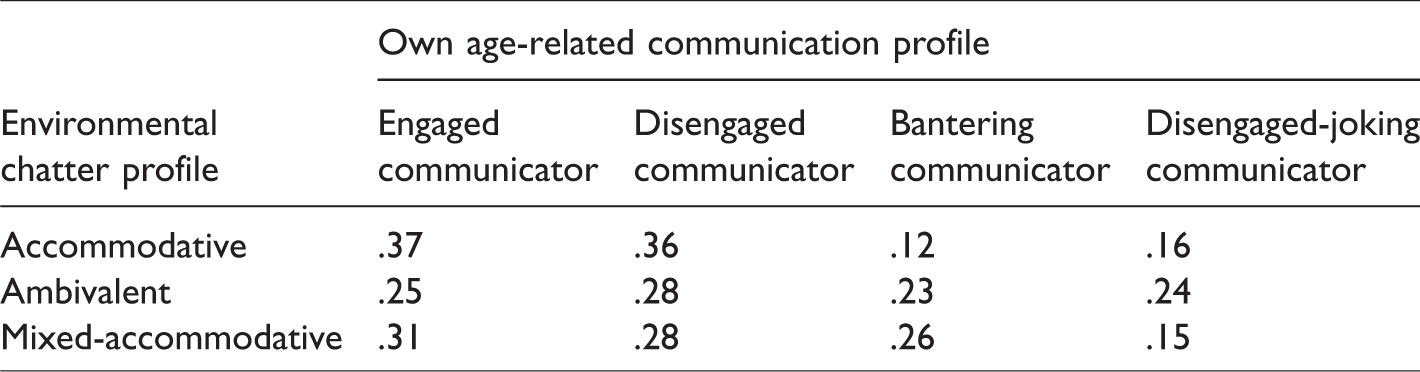
As illustrated in Table 2, grandchildren who experienced accommodative chatter seemed disproportionately likely to be engaged and disengaged communicators about age-related issues, as opposed to bantering or disengaged-joking communicators about age-related issues. More specifically, their probability of being an engaged or a disengaged communicator was more than double their probability of being a bantering or a disengaged-joking communicator. Bivariate correlations in Table 1 suggested similar findings to these LTA results.2 As Table 1 shows, the probability of experiencing accommodative chatter was positively associated with the probability of being a disengaged communicator. The probability of experiencing accommodative chatter was negatively associated with the probability of being a bantering communicator.
Second, the LTA results in Table 2 suggested that grandchildren who experienced ambivalent chatter did not seem to disproportionately fall into a certain type of profile with respect to their own age-related communication. These grandchildren demonstrated approximately a .25 probability of being each type of communicator about age-related issues. Bivariate correlations in Table 1 suggested similar findings to these LTA results. As Table 1 shows, the probability of experiencing ambivalent chatter was not significantly associated with any of the own age-related communication probabilities.
Third, the LTA results in Table 2 suggested that grandchildren who experienced mixed-accommodative chatter seemed disproportionately likely to be engaged communicators about age-related issues rather than disengaged-joking communicators. More specifically, their probability of being an engaged communicator was more than double their probability of being a disengaged-joking communicator. Bivariate correlations in Table 1 suggested a complementary set of findings. As Table 1 shows, the probability of experiencing mixed-accommodative chatter was negatively associated with the probability of being a disengaged communicator about age-related issues and positively associated with the probability of being a bantering communicator.
Own Age-Related Communication and Environmental Chatter as Indirect Predictors of Well-Being
H3 predicted that relative to engaged communicators about age-related issues, all other own age-related communication profiles would be indirectly associated with lower life satisfaction, more depressive symptoms, and greater loneliness, via lower self-efficacy with respect to aging. H4 predicted that environmental chatter would be indirectly associated with the three aspects of well-being, via self-efficacy with respect to aging. To test these hypotheses, we specified a path model in Mplus 7.3. Own age-related communication profile probabilities and environmental chatter profile probabilities were stipulated as parallel predictors of self-efficacy with respect to aging. Self-efficacy with respect to aging, in turn, was stipulated as a predictor of life satisfaction, depressive symptoms, and loneliness. To avoid redundant information in the model, it is necessary to designate one profile for each series as the reference profile and exclude that profile’s probabilities from subsequent modeling. We designated engaged communicators as the reference profile for own age-related communication and accommodative chatter as the reference profile for environmental chatter. The eight covariates from the Method section were specified as predicting each communicative predictor and each well-being outcome. The model demonstrated acceptable fit, χ2 (23) = 52.57, p < .001, comparative fit index = 0.96, root mean square error of approximation = .06, standardized root mean square residual = .02. The model explained 30.5% of the variance in life satisfaction, 20.8% of the variance in depressive symptoms, and 17.8% of the variance in loneliness. Table S2 in the online-only supplemental materials reports path coefficients for the model. Table 3 reports indirect associations (calculated by Mplus).
Unstandardized Indirect Associations Between Communicative Predictors and Well-Being Outcomes, via Self-Efficacy With Respect to Aging.
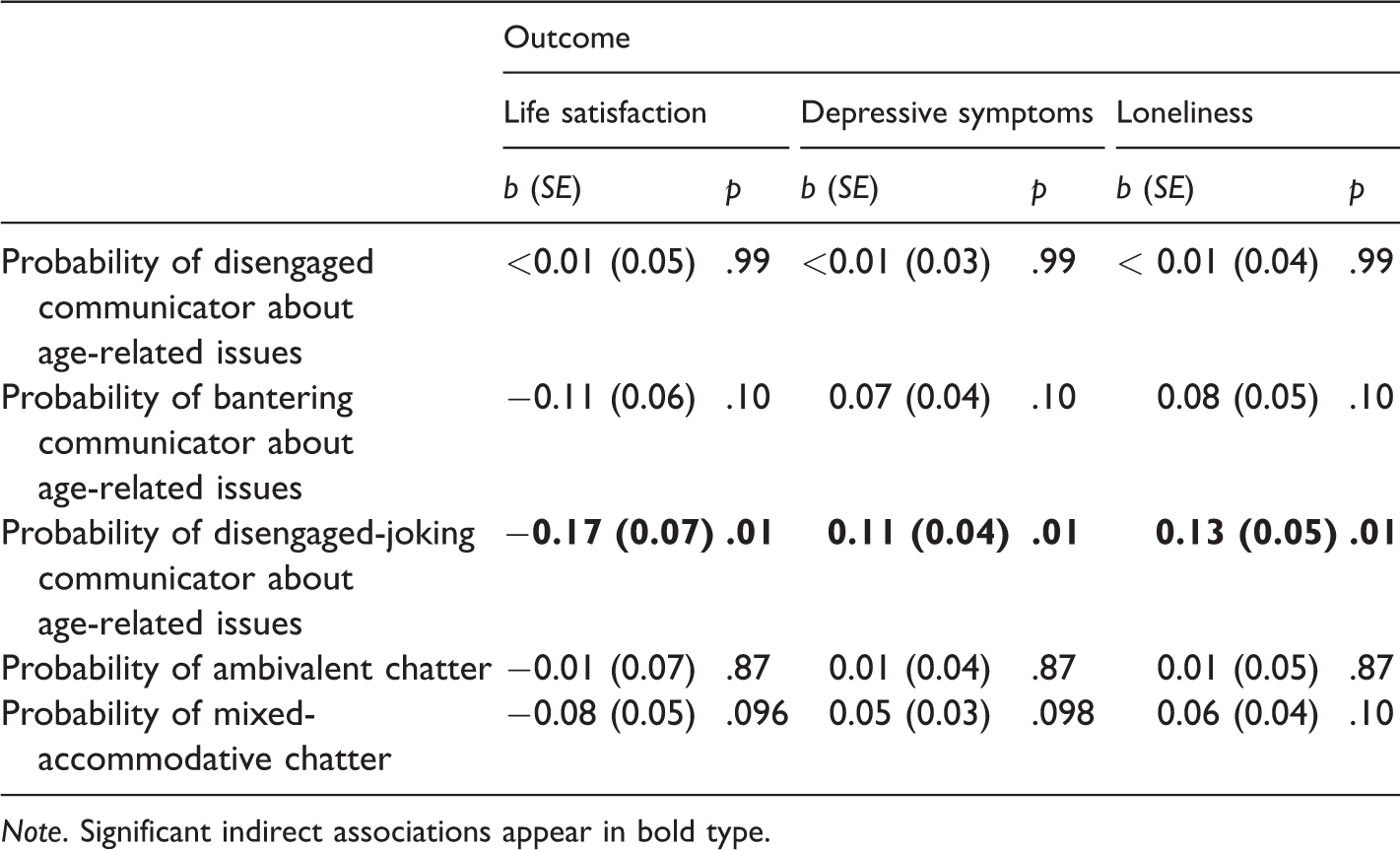
Note. Significant indirect associations appear in bold type.
As shown in Table 3, relative to engaged communicators as the reference profile, disengaged-joking communicators demonstrated lower life satisfaction, more depressive symptoms, and greater loneliness, via lower self-efficacy with respect to aging. This finding partially supported H3. Relative to accommodative chatter as the reference profile, neither of the other two environmental chatter profiles were indirectly associated with well-being, leaving H4 unsupported.
Discussion
This study examined how grandparents’ accommodation toward grandchildren predicts grandchildren’s own age-related communication and well-being. It also considered how grandchildren’s own age-related communication indirectly predicts grandchildren’s well-being, via grandchildren’s self-efficacy with respect to aging. Grandparents’ patterns of accommodation toward grandchildren predicted grandchildren’s own age-related communication. This finding is important because it helps delineate intergenerational dynamics that might place grandchildren on specific aging trajectories at relatively early periods of the life span (e.g., Giles et al., 2013). From a life course perspective (e.g., Allen et al., 2019), the links between grandparents’ accommodative practices and grandchildren’s own age-related communication suggest the merit of future longitudinal research probing the stability with which young and middle-aged adults continue to speak about aging in ways linked to the accommodation they received from grandparents during earlier periods of the life span.
Moreover, given that middle-aged adults’ patterns of own age-related communication have predicted their mental well-being (Gasiorek et al., 2015), the links between accommodation from grandparents and grandchildren’s own age-related communication suggest the merit of longitudinally exploring even more complex questions. For example, researchers can consider whether or not grandparents’ accommodation toward young adult grandchildren serves as a distal predictor of grandchildren’s well-being when grandchildren reach middle adulthood, via the successive links of grandchildren’s age-related communication habits over time and grandchildren’s self-efficacy with respect to aging (i.e., serial mediation). In the paragraphs that follow, we first elaborate on how grandparents’ accommodation toward grandchildren predicted grandchildren’s own age-related communication. We then discuss how grandchildren’s own age-related communication indirectly predicted grandchildren’s well-being.
Implications of Grandparents’ Accommodation Toward Grandchildren
One of the main contributions of this study involved the explication of the accommodative, ambivalent, and mixed-accommodative profiles. Grandchildren who experienced accommodative chatter from grandparents seemed disproportionately likely to be engaged or disengaged communicators about age-related issues. The accommodative profile was characterized by high levels of accommodation and low levels of overaccommodation and underaccommodation. Given that accommodation is typically construed as constructive and nonaccommodation is typically construed as destructive (Ota et al., 2007), grandchildren who experience accommodative chatter might be well-positioned to become engaged communicators about age-related issues as they learn how to proactively approach issues related to aging. For example, by not hearing their grandparents complaining about their health and other life circumstances (i.e., by experiencing low levels of underaccommodation from grandparents), grandchildren in accommodative chatter environments may likewise learn to avoid invoking age as an explanation or excuse for their shortcomings, which is one characteristic typical of engaged communicators. In this way, grandchildren may be using their grandparents as role models for how to communicate about aging (see Gasiorek et al., 2016). As another example, by receiving many compliments and much affection from accommodative grandparents, grandchildren may perceive their grandparents as generally joyful people, which may encourage grandchildren to view older adults as a whole and aging through an optimistic lens (see Harwood, Hewstone, Paolini, & Voci, 2005).
Experiencing accommodative chatter from grandparents might also facilitate disengaged tendencies for other young adults because the lack of overaccommodation and underaccommodation might make any potential difficulties associated with growing older (e.g., potential health difficulties) less salient for grandchildren, thereby allowing grandchildren to disengage from the aging process during young adulthood. Relatedly, grandchildren who receive accommodative chatter may be living relatively comfortable lives without many intergenerational tensions. This security and lack of intergenerational hostility may be conducive to not having to think and talk about age-related issues during young adulthood.
In contrast, grandchildren who experienced mixed-accommodative environments were more likely to be bantering communicators about age-related issues rather than disengaged communicators. Although grandchildren in mixed-accommodative environments received relatively high levels of accommodation, they also tended to receive relatively high levels of overaccommodation and underaccommodation compared to grandchildren in the accommodative profile. Most notably, grandchildren in the mixed-accommodative profile were the most likely to report that their grandparents complained about their lives, complained about their health, and frequently talked about their health. Previous work has shown how young adults often perceive their grandparents as role models for how to age (Jopp et al., 2017). Hearing grandparents complain about various aspects of their lives (e.g., health challenges they experience as they grow older) may suggest to grandchildren that they should also talk about their age in various contexts, such as mentioning their age as a reason for events they are experiencing. Moreover, role models generally have to be liked before people imitate them (Bandura, 1986). By virtue of experiencing relatively high levels of accommodation from grandparents in mixed-accommodative environments, grandchildren may indeed like their grandparents and, thus, be motivated to act like them when it comes to discussing age-related issues.
Grandchildren who experienced ambivalent chatter scored near the scale midpoint (neither agree nor disagree) for many of the accommodation and nonaccommodation items. Several explanations may help account for these findings. Grandchildren in ambivalent environments may see their grandparents only rarely (e.g., on holidays), and grandparents may keep their discussions relatively superficial during these rare occasions. Thus, grandchildren may not experience meaningful accommodation or nonaccommodation one way or another from these grandparents. Consistent with this speculation, Bangerter and Waldron (2014) found that some long-distance grandparents reported consistently low or consistently moderate relational closeness with grandchildren, which may be because distance hinders the two parties from engaging in meaningful interactions. Another possibility is that grandchildren in ambivalent environments regularly interact with grandparents, but do not know how to interpret grandparents’ communication. For example, grandchildren may be unsure whether to interpret their grandparents talking about hardships in their lives as accommodative self-disclosures that help build relational solidarity or as underaccommodative self-disclosures that they would prefer to not hear. Future researchers should probe the extent to which these explanations resonate with the lived experiences of grandchildren in ambivalent environments.
It is also worth considering why the ambivalent profile did not predict own age-related communication or the three variants of well-being. By experiencing ambivalence with respect to their grandparents’ communication, grandchildren may be left with no clear blueprint for how they themselves should communicate about age-related issues. However, this ambiguity may not necessarily be constructive, as grandchildren who experienced ambivalent chatter seemed the most likely to be disengaged-joking communicators about age-related issues compared to grandchildren who experienced accommodative or mixed-accommodative chatter (see the last column of Table 2). If grandchildren only interact with grandparents during special occasions such as holidays, the ambivalent chatter profile might not be consequential enough to indirectly predict the three variants of well-being, via self-efficacy with respect to aging. Conversely, the ambivalent chatter profile might indirectly predict well-being if grandchildren regularly interact with grandparents. Future researchers would benefit from including a measure assessing the frequency with which grandchildren interact with grandparents. This variable might be positioned as a moderator between the ambivalent profile and self-efficacy with respect to aging, with stronger negative associations expected for grandchildren who frequently interact with grandparents as opposed to grandchildren who infrequently interact with grandparents.
Although the environmental chatter profiles were not indirectly associated with well-being, via self-efficacy with respect to aging, they were associated with well-being at the bivariate level (see Table 1). More specifically, grandchildren who experienced accommodative chatter were more likely to report high life satisfaction and were less likely to report that they were experiencing depressive symptoms and loneliness. Conversely, grandchildren who experienced mixed-accommodative chatter were more likely to report that they were experiencing depressive symptoms and loneliness. These bivariate correlations offer preliminary evidence that self-efficacy with respect to aging might not always mediate the associations between environmental chatter and well-being. Future researchers are encouraged to design standalone studies that probe whether or not self-efficacy with respect to aging is a necessary construct in explaining the associations between communication and well-being.
Implications of Grandchildren’s Own Age-Related Communication
Another study contribution involved the replication of the engaged, disengaged, and bantering profiles. However, the profiles operated somewhat differently in this study compared to previous research. The disengaged and bantering profiles (relative to the engaged profile) were not indirectly associated with life satisfaction, depressive symptoms, or loneliness, via self-efficacy with respect to aging. At least two explanations might help account for these findings. First, grandchildren’s disengaged and bantering tendencies may have yet to fully solidify as routine and influential aspects of their lives by virtue of grandchildren still being young adults. As Gasiorek et al. (2019, p. 18) recently argued, thoughts and feelings about aging likely become “calcified” after many years and decades of observing certain forms of environmental chatter and engaging in certain forms of own age-related communication. If true, the disengaged and bantering communicators in this study may be in the midst of their formative years of developing engrained habits of age-related communication, and, as such, the disengaged and bantering tendencies might become increasingly detrimental as grandchildren age into later periods of their life span.
A second potential explanation is that the bantering profile in this study was somewhat different than the bantering profiles of previous research. Although this study’s bantering communicators resembled bantering communicators from previous research in most respects (e.g., relatively high levels of teasing others about age), bantering communicators were different in two respects. Unlike previous studies (e.g., Gasiorek & Fowler, 2016), bantering communicators in this study were somewhat more likely than engaged communicators to report skepticism of anti-aging media and discuss future caregiving preferences. These two communicative tendencies are generally regarded as conducive to well-being (e.g., Pinquart & Sorensen, 2002) and, as such, might have contributed to a healthier overall bantering profile compared to the bantering profiles of previous research.
Nevertheless, own age-related communication may be consequential for grandchildren’s well-being in other ways. More specifically, relative to engaged communicators about age-related issues, disengaged-joking communicators reported lower life satisfaction, more depressive symptoms, and greater loneliness, via lower self-efficacy with respect to aging. The emergence of a disengaged-joking profile and its indirect associations with multiple variants of well-being are noteworthy in several respects. First, with one exception (Gasiorek & Fowler, 2016), all CEMSA research has previously examined own age-related communication profiles with samples of middle-aged and older adults. Gasiorek and Fowler’s (2016) study on young adults did not uncover a disengaged-joking profile, whereas this study did. Because only two studies have utilized samples of young adults, more research is needed before any definitive conclusions can be made about the disengaged-joking profile’s stability. Second, the disengaged-joking profile seems conceptually coherent: It makes sense that there would be a subset of young adults who generally do not speak about age-related issues, except when it comes to making jokes about others’ age, playing along when their age is the subject of jokes, and keeping up with new communication technologies.
Third, Arnett (2000) characterizes emerging adulthood (i.e., the period between ages 18 and 25 years) as a time of feeling in-between adolescence and adulthood, experiencing cognitive and affective instability, and exploring one’s identity. Some emerging adults may also be undergoing a sociolinguistically formative point in their lives in which they are learning to use their voices instead of defaulting to their previous patterns of timidity (Brook, Jankowski, Konnelly, & Tagliamonte, 2018). Applied to this study, disengaged-joking communicators may be starting to form their identity as adults by voicing their amusement about what it means to grow older through teasing others about age and playing along when their own age is the subject of jokes. The CEMSA cautions about the potential dangers of age-related humor (see Fowler et al., 2015). This study’s findings suggest that age-related humor, when accompanied by a larger ecology characterized by disengagement from communicating about other aspects of aging, may indeed be detrimental to the realization of well-being for young adults in this formative period of the life span. Future researchers might consider employing discourse analysis and other methods that examine the actual enactment of age-related humor through language and nonverbal cues (see Giles, 2019; Giles, Bourhis, Gadfield, Davies, & Davies, 1976).
Limitations and Additional Opportunities for Future Research
In addition to the research directions discussed in the previous section, this study also contains limitations that suggest avenues for future research. First, causality cannot be established from these cross-sectional data. The tested associations were in directions consistent with previous CEMSA scholarship, but future longitudinal research will add additional insight into the temporal order of variable interrelationships and other conditions necessary for causality. Second, grandchildren reported on a specific grandparent of their choosing, which was consistent with procedures in past research (e.g., Kam & Hecht, 2009). However, this procedure may have resulted in grandchildren disproportionately reporting on their closest grandparent. Relatedly, grandchildren more often reported on a grandmother rather than a grandfather. Although we situated both parties’ sex as control variables, future researchers could explore how gender norms might play more substantive roles in the CEMSA’s proposed relationships. Future researchers could also randomly assign grandchildren to report on a specific grandparent, with random reassignment for grandchildren initially assigned to a deceased grandparent. This alternative procedure might illuminate additional chatter profiles, such as a profile characterized by lower levels of accommodation and higher levels of nonaccommodation.
Another opportunity for future research is to probe how grandparents experience accommodative and nonaccommodative chatter from grandchildren and the implications of such chatter on grandparents’ well-being. Future researchers could also consider the role of the middle generation (i.e., grandchildren’s parents) as part of grandchildren’s environmental chatter, either by asking grandchildren to report on the accommodation they receive from parents or including parents’ perspectives in dyadic or family-level studies. Finally, this study focused on a subset of relationships in the CEMSA (see Figure 1); future researchers should continue exploring how environmental chatter and own age-related communication are related to uncertainty and affect about aging.
Conclusions
This study applied the CEMSA to intergenerational family relationships and examined grandchildren’s well-being (namely, life satisfaction, depressive symptoms, and loneliness). Grandchildren’s experiences of receiving accommodation, overaccommodation, and underaccommodation from grandparents had implications for how grandchildren communicate about age-related issues. Grandchildren who received accommodative chatter seemed especially likely to be engaged or disengaged communicators about age-related issues, whereas grandchildren who received mixed-accommodative chatter seemed especially likely to be bantering communicators about age-related issues. The links between environmental chatter from grandparents and grandchildren’s patterns of own age-related communication illustrate the interdependence of family life (see Yoshimura & Galvin, 2018) and show the merit of applying the CEMSA to family relationships. Future researchers might continue to examine how parents and grandparents influence grandchildren’s patterns of age-related talk and well-being. Moreover, relative to engaged communicators about age-related issues, disengaged-joking communicators reported lower life satisfaction, more depressive symptoms, and greater loneliness, via lower self-efficacy with respect to aging. The disengaged-joking profile might be especially problematic in positioning young adults on unfavorable aging trajectories and, as such, also warrants sustained attention in future research.
Supplemental Material
Supplemental material for The Role of Grandchildren’s Own Age-Related Communication and Accommodation From Grandparents in Predicting Grandchildren’s Well-Being
Supplemental Material for The Role of Grandchildren’s Own Age-Related Communication and Accommodation From Grandparents in Predicting Grandchildren’s Well-Being by Quinten S. Bernhold and Howard Giles in The International Journal of Aging and Human Development
Footnotes
Acknowledgments
The authors would like to thank the editor and two anonymous reviewers for their constructive feedback on an earlier version of this paper.
Declaration of Conflicting Interests
The authors declared no potential conflicts of interest with respect to the research, authorship, and/or publication of this article.
Funding
The authors received no financial support for the research, authorship, and/or publication of this article.

Notes
Author Biographies
References
Supplementary Material
Please find the following supplemental material available below.
For Open Access articles published under a Creative Commons License, all supplemental material carries the same license as the article it is associated with.
For non-Open Access articles published, all supplemental material carries a non-exclusive license, and permission requests for re-use of supplemental material or any part of supplemental material shall be sent directly to the copyright owner as specified in the copyright notice associated with the article.
