



Abstract
This study aims to examine the mediating role of learning self-efficacy in the relationship between subjective age and memory performance as well as the moderating role of education in these indirect and direct relationships. A study was conducted with 200 older adults aged 60 to 81 years who completed measures of subjective age, learning self-efficacy, education, and memory performance. Analysis revealed that learning self-efficacy partially mediated the association between subjective age and memory performance. Further analysis found that the indirect associations between subjective age and memory through learning self-efficacy vary as a function of education. Implications and suggestions for future research are discussed.
Introduction
Memory functioning and other cognitive functioning are essential components of successful aging with strong implications for engaging in daily activities (Zahodne, Manly, Mackaybrandt, & Stern, 2013), maintaining independence and health-related quality of life in older adults (Seeman, Lusignolo, Albert, & Berkman, 2001). A careful scrutiny of the influence factors and relevant mechanisms for memory performance is needed to enable prevention and intervention efforts. Typically, chronological age, a natural marker of biological basis, is a powerful predictor of memory performance in the normal aging process (Singh-Manoux et al., 2012). In recent years, a growing interest has been directed toward subjective age and its potential effects on memory performance among older adults (Stephan, Caudroit, Jaconelli, & Terracciano, 2014; Stephan, Sutin, Caudroit, & Terracciano, 2015). This study mainly focused on the underlying mechanisms between subjective age and memory performance, which may provide more valuable insights about mechanisms involved in memory functioning among older adults.
Subjective Age and Memory Performance
Subjective age, how young or old individuals perceive themselves to be, is a central component of the aging self. There is accumulating evidence suggesting that majority of older adults feel younger than they actually are (see review by Kotter-Grühn, Kornadt, & Stephan, 2016), which are usually considered an important protective strategy (Weiss & Lang, 2012) and a predictor of markers of successful aging (Choi & Dinitto, 2014; Kotter-Grühn et al., 2016; Montepare, 2009; Stephan, Caudroit, & Chalabaev, 2011). Until recently, some researchers have begun to pay attention to the close association between younger subjective age and memory performance among older adults (Schafer & Shippee, 2010; Stephan et al., 2014, 2015). For instance, studies by Stephan et al. (2014, 2015) found that younger subjective age was associated with better memory performance and slower decline in immediate recall, delayed recall, and global memory functioning. The implicative value of subjective age may differ cross-culturally (Kotter-Grühn et al., 2016; Westerhof & Barrett, 2005). A younger subjective age is typically regarded as a self-protective strategy to resist or reject the threat of on their self-esteem when exposed to negative aging stereotypes (Teuscher, 2009; Weiss & Lang, 2012). Therefore, it is meaningful to explore the relationship between subjective age and memory performance among Chinese older adults in the culture of filial piety.
Subjective Age, Learning Self-Efficacy, and Memory Performance
Despite the finding that individuals who feel younger than their chronological age report better memory performance, such as immediate and delayed recall (Stephan et al., 2014, 2015), few studies so far have focused on the mechanisms through which subjective age could affect memory functioning (Kotter-Grühn et al., 2016). To our knowledge, only the recent studies by Stephan et al. (2014, 2015) have confirmed the mediating role of BMI, frequency of physical activity, or depressive symptoms between younger subjective age and memory performance. However, as these mediators can explain only part of the relationship between subjective age and memory, one possibility is that subjective age drives processes that have a more proximal influence on memory performance (Stephan et al., 2014, 2015). Thus, further research is needed to explore other potential pathways, which may explain the association between subjective age and memory outcomes, such as learning self-efficacy.
As an extension of the self-efficacy theory (Bandura, 1997), learning self-efficacy can be defined as the beliefs about one’s ability to learn effectively to attain certain desired goals in different situations (Tang & Wang, 2012). These efficacy beliefs allow individual to accept challenging tasks, readily participant in cognitive activities, use self-regulatory strategies, and exhibit extensive cognitive processing and persistence. There is evidence suggesting that a higher level of self-efficacy probably contributes to motivation effects in the case of cognitive challenges, resulting in better cognitive performance (Bandura, Barbaranelli, Caprara, & Pastorelli, 2001; Hertzog & Hultsch, 1998; McDougall, 2009; Schafer & Shippee, 2010). When an individual does not develop sufficient level of perceived self-efficacy, he will not exert enough effort to achieve the cognitive results. In this vein, older adults often require more time to learn new materials and also are likely to have less confidence in their ability to learn new materials. Therefore, a decrease in learning self-efficacy may prevent many individuals from pursuing higher cognitive performance, including memory performance (Fisk & Warr, 1996).
Researchers have argued that subjective age may well act as an antecedent of self-efficacy beliefs, rather than serving only as an outcome (Infurna, Gerstorf, Robertson, Berg, & Zarit, 2010). There is empirical evidence that older adults with younger subjective ages are likely to have higher levels of general self-efficacy belief (Teuscher, 2009). In contrast, the older subjective age was prospectively related to a more pessimistic disposition about their ability to maintain memory performance (Schafer & Shippee, 2010). Similarly, a study by Stephan et al. (2011) has demonstrated that subjective age, as a self-enhancing positive illusion, has strong implications for older adults’ memory self-efficacy. Based on the model of information processing, learning and memory are closely connected in cognitive processing because learning necessarily entails acquisition, storage, and retrieval (Zimprich, Rast, & Martin, 2008). Considering the common underlying mechanisms (Zimprich et al., 2008) and neural basis (Okano, Hirano, & Balaban, 2000) that learning shares with memory, it is more likely that an older subjective age may be related to lower confidence in one’s ability to learn effectively among older adults. Taken together, we assume that learning self-efficacy may play a mediating role between subjective age and memory performance.
Education as a Moderator
Although older subjective age may impact older adults’ memory performance through the mediating role of perceived self-efficacy, not all older adults who have older subjective age homogeneously experience decreased self-efficacy and report a worse memory performance. This heterogeneity of outcomes may be contingent upon individual characteristics that moderate the impact of older subjective age on self-efficacy and memory performance, such as education. According to cognitive reserve theory (Stern, 2002), educational attainment is typically identified as a protective factor in cognitive aging or cognitive impairment. As an important interindividual variability, education is likely to buffer the detrimental effect of older subjective age on learning self-efficacy, because education may help develop a wider repertoire of cognitive strategies and the best use of these strategies to assist performance in various memory tasks (Angel, Fay, Bouazzaoui, Baudouin, & Isingrini, 2010). When exposed to older subjective aging situations, older adults with high educational level may produce some new cognitive strategies to counter adverse effects of negative age stereotypes, age-related fears, and stigmas. In this vein, older adults with high educational level may tend to believe they have the ability to learn and memorize new materials (Tang & Wang, 2012), so the detrimental effect of older subjective age on memory through self-efficacy may be greatly reduced or disappeared. In addition, prior studies have shown that education plays a moderating role between chronological age and cognitive aging (Anstey, Hofer, & Luszcz, 2003; Gao, Peng, Wen, & Wang, 2011; Von Gunten et al., 2008). As subjective age is highly correlated with chronological age (Henderson, Goldsmith, & Flynnm, 1995), we hypothesize that the indirect effect of subjective age on memory performance through learning self-efficacy may be moderated by education (first-stage moderation).
The Present Study
This study proposes a moderated mediation model, aimed at examining the direct/indirect relationship between subjective age and memory performance among older Chinese adults. The purpose of this study is twofold: (a) to test whether learning self-efficacy mediates the relationship between older subjective age and lower level of memory performance and (b) to examine whether the direct and indirect associations between subjective age and memory performance through learning self-efficacy are moderated by education. Figure 1 illustrates the conceptual model applied. Specifically, based on the literature, this study proposed the following hypotheses: (H1) older subjective age is negatively associated with memory performance; (H2) learning self-efficacy mediates the relationship between older subjective age and memory performance; and (H3) education attenuates the path between older subjective age and memory performance through learning self-efficacy (first-stage moderation). The answers to these questions would be critical to advance our understanding of memory aging as well as to develop effective interventions to decrease the negative effects of memory level.
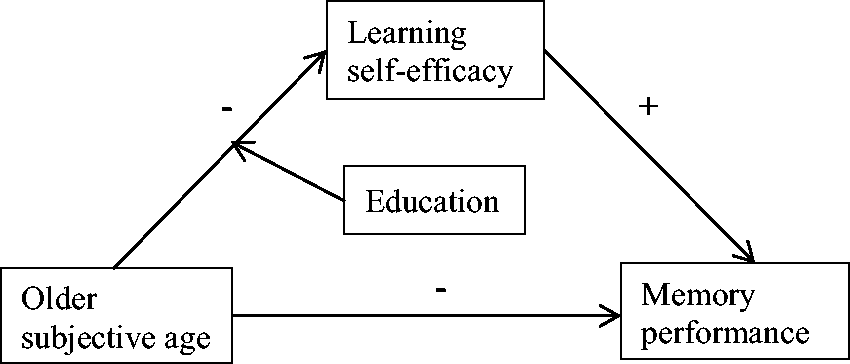
The proposed moderated mediation model.
Methods
Participants
A total of 210 older adults aged 60 years or above were recruited using the convenient sampling method from the Chongqing and Sichuan communities in China. Ten participants were excluded from the analyses because they had incomplete variables of interest and because of multivariate outliers (±3 standard deviations). The final sample consisted of 200 older Chinese adults, aged 60 to 81 years (M = 65.42, SD = 5.60, 133 women and 67 men). In terms of educational attainment, 16.5% had an primary school education, 55.0% junior middle school, 21.0% high school, and 7.5% a junior college or above. Up to 82% of the participants had a partner (i.e., were married, lived as couples).
Data Collection Procedures
All the participants signed a consent form approved by the Institutional Review Boards of the corresponding author’s institution. The investigation was conducted by primary investigators, and all the participants were assessed individually in quiet rooms in a psychological laboratory or a community center at prearranged times. Following the experimental procedures developed by Ofstedal, Fisher, and Herzog (2005), all the participants completed a multisection questionnaire, including demographic variables, subjective age, and learning self-efficacy. Next, they were asked to perform the memory task. One of four possible lists of 10 words was randomly assigned to participants. They had 1 minute to study the list, followed by an immediate recall test. The average time required to complete the questionnaires was 40 minutes. The participants were offered a gift after the study materials were completed.
Measures
Subjective age
According to previous research (Mock & Eibach, 2011; Rubin & Berntsen, 2006; Stephan et al., 2015; Westerhof & Barrett, 2005), felt age was assessed by asking participants to specify, in years, how old they felt. Participants’ chronological age was subtracted from their felt age, and the obtained difference scores were divided by chronological age, thereby obtaining proportional discrepancy scores (Mock & Eibach, 2011). A positive value indicated an older subjective age, and a negative value indicated a younger subjective age.
Memory performance
Immediate word recall was used in this study to measure older adults’ memory functioning. The experimental materials were developed by Ofstedal et al. (2005), which were widely used in the Health and Retirement Study, and the Chinese version of the experimental materials adapted by Wu (2016). A list of 40 highest frequency words (e.g., work, life, country) was extracted from Modern Chinese Frequency Dictionary. According to their frequency of occurrence in daily life, these words were divided into four different lists in order to administer different lists to participants in the same household or community. The results of variance analysis indicated no significant difference in frequency among the four lists, F(3, 36) = 0.283, p > .05. One of four possible lists was randomly assigned to the participants, and the participants were asked to recall as many words as possible from the list in any order. The number of correctly recalled words was indicated as the index of older adults’ memory scores.
Learning self-efficacy
The Learning Self-efficacy Subscale of Intellectual Self-efficacy Scale by Tang and Wang (2012) was used to measure older adults’ perceived self-efficacy for learning cognitive tasks. This subscale includes five items, such as “I’m dying to learn something new.” The participants were required to indicate their agreement with the items on a 6-point scale (ranging from 1 = strongly disagree to 6 = strongly agree). Higher scores indicate a higher level of perceived self-efficacy in learning. Cronbach’s α had a value of .76 in this study.
Education
We measured education on a 4-point scale (1 = primary school, 2 = junior middle school, 3 = high school, and 4 = junior college or above). Educational level was reported by the participants. Taking into account the overall educational level of Chinese older adults based on the data of sixth National Census (Zhang, 2016) and previous research (Gao et al., 2011), we converted this variable into two categories: “less than high school” and “high school or above.” Educational level was dummy coded such that 0 was assigned less than high school and 1 was assigned high school or above.
Covariates
According to previous studies (Kotter-Grühn et al., 2016; Stephan et al., 2014, 2015), demographic covariates were age, gender (coded as 0 for men and 1 for women), marital status (coded as 0 for in marriage and 1 for single), self-rated health, and physical health (i.e., the number of chronic conditions). Self-rated health was assessed by a single question (i.e., in general, would you say that your health is excellent, very good, good, fair, or poor) with a Likert-type answering scale ranging from 1 (poor) to 5 (excellent). Of the participants, 1% indicated poor, 13.5% fair, 57% good, 26% very good, and 2.5% excellent. In addition, the number of chronic conditions (M = 1.68, SD = 0.75) was assessed using the Self-administered Comorbidity Questionnaire (Sangha, Stucki, Liang, Fossel, & Katz, 2013), which refers to the presence of heart disease, high blood pressure, diabetes, and so on.
Data Analysis
We first presented descriptive statistics and bivariate correlations for variables of interest and control variables using SPSS 22.0. Second, we examined whether the mediation process was moderated by education. The analysis of moderated mediation model was performed using Hayes’ PROCESS macro (Hayes, 2013), which has been used to examine whether the magnitude of a mediation effect is conditional on the value of a moderator. The bootstrapping method produces 95% bias-corrected confidence intervals (CIs) of these effects from 5,000 resamples of the data (sample size = 200). CIs that do not contain zero indicate significant effects.
Results
Preliminary Analysis
Descriptive statistics (means and standard deviations) and Pearson’s correlation coefficients among all study variables are presented in Table 1. On average, older adults reported feeling 11% younger than their chronological ages, and approximately 75.5% of the participants felt younger than their chronological ages. Moreover, 19.5% felt the same age as their chronological ages, and only 5% felt older than their chronological ages. The correlation matrix showed that older subjective age was negatively associated with memory performance (r = −.19, p < .01), thereby supporting hypothesis (H1). Older subjective age was negatively associated with the level of learning self-efficacy (r = −.21, p < .01), while learning self-efficacy was positively related to memory performance among older adults (r = .23, p < .01).
Means, Standard Deviations, and Correlation Matrix (N = 200).
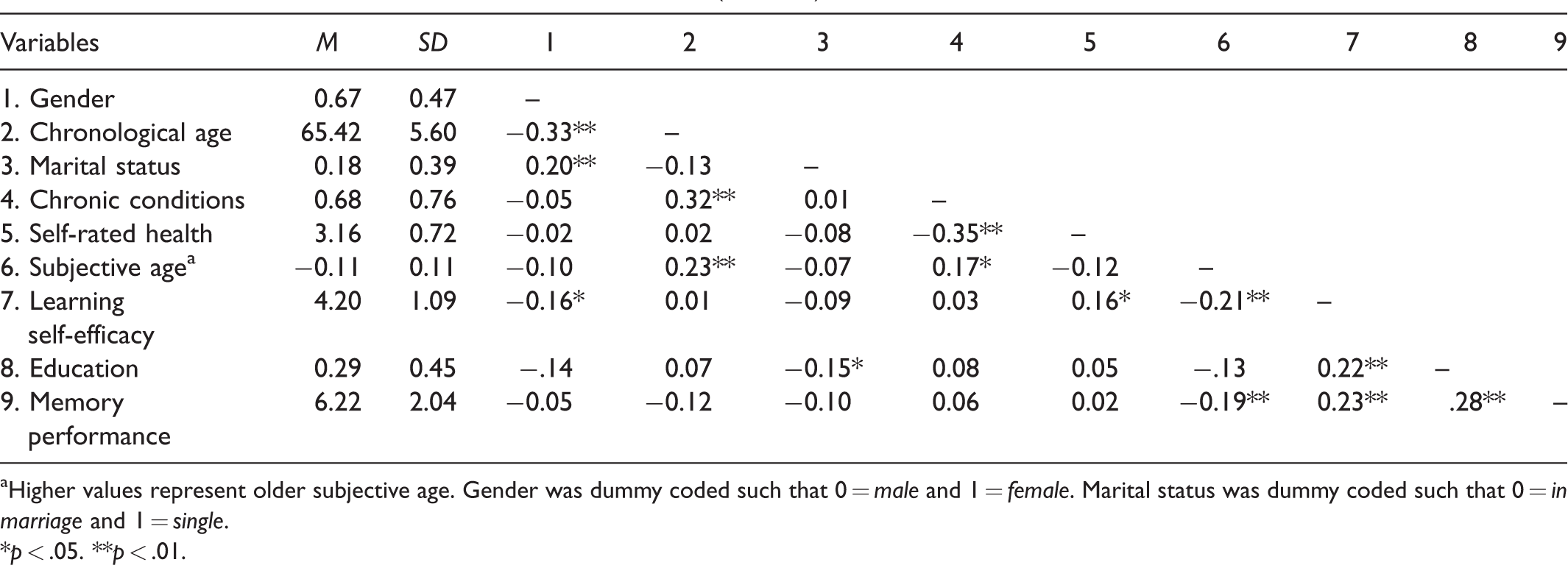
aHigher values represent older subjective age. Gender was dummy coded such that 0 = male and 1 = female. Marital status was dummy coded such that 0 = in marriage and 1 = single.
*p < .05. **p < .01.
Testing for Mediation Effect
The PROCESS macro developed by Hayes (2013) was used to examine the mediating role of learning self-efficacy between older subjective age and memory performance. The bias-corrected bootstrap method showed that the indirect effect of subjective age on memory performance through learning self-efficacy was significant with the index of the mediation effect being −.04 (95% CI = [−0.10, −0.01]), and the mediation effect accounted for 20% of the total effect. Furthermore, the direct effect of subjective age on memory performance was also significant (β = −0.15, t = −2.09, 95% CI = [−0.29, −0.01], p < .05). Therefore, the relationship between subjective age and memory performance was partially mediated by learning self-efficacy, supporting Hypothesis (H2).
Testing for Moderated Mediation: Education
The PROCESS macro developed by Hayes (2013) was conducted to test the proposed moderated mediation model. Specifically, we estimated the moderating effect of education on the relationship between older subjective age and memory performance (first-stage moderation), controlling for relevant covariates. The specifications of the models are provided in Table 2. There was a significant effect of older subjective age on learning self-efficacy (β = −0.18, t = −2.53, 95% CI = [−0.32, −0.04], p < .05), and a significant interaction of subjective age and education on learning self-efficacy (β = 0.33, t = 2.12, 95% CI = [−0.32, −0.04], p < .05). The effect of older subjective age on memory performance was also significant (β = −0.15, t = −2.13, 95% CI = [−0.29, −0.01], p < .05), and learning self-efficacy was positively associated with memory performance (β = 0.20, t = 2.88, 95% CI = [0.06, 0.34], p < .01).
Moderating Role of Education.
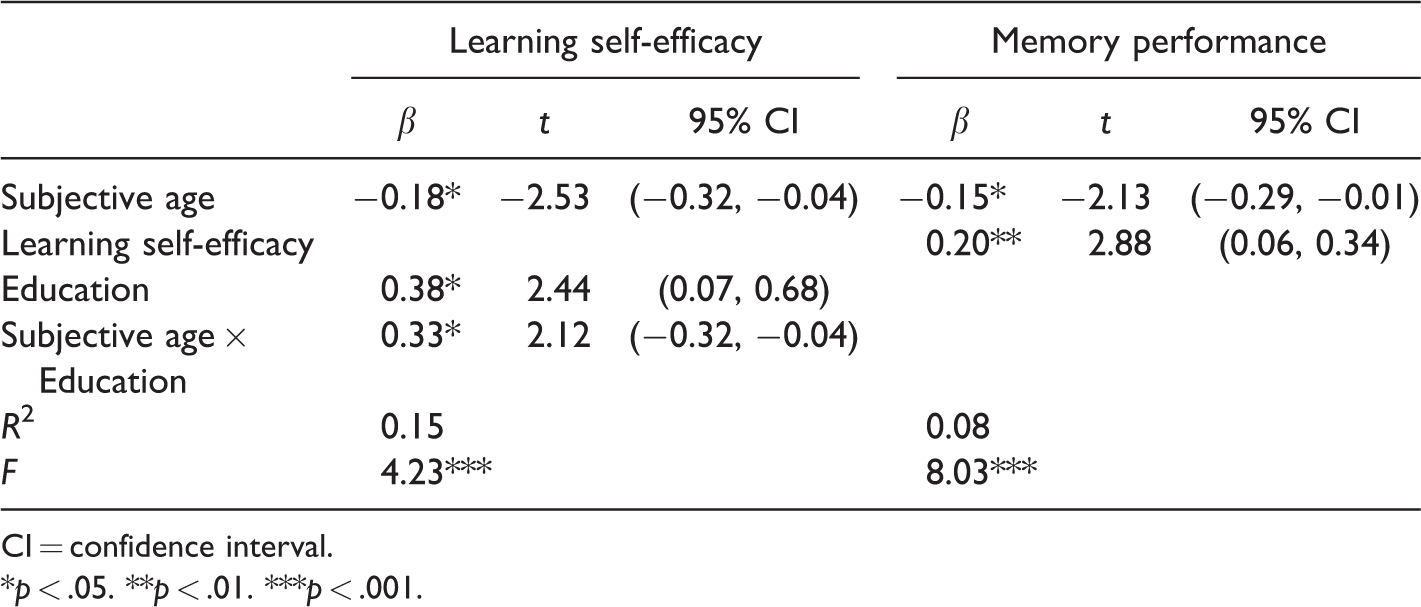
CI = confidence interval.
*p < .05. **p < .01. ***p < .001.
The bias-corrected percentile bootstrap method further indicated that the indirect effect of older subjective age on older adults’ memory performance via learning self-efficacy was moderated by education (index of moderated mediation= 0.07, SE = 0.04, 95% CI = [0.01, 0.18]). For older adults with low education, older subjective age had a detrimental effect on memory performance through decreased learning self-efficacy (point estimate = −0.06, SE = 0.03, 95% CI = [−0.13, −0.01]), accounting for 27% of the total effect. In contrast, the indirect effect was not significant for older adults with high educational level (95% CI = [−0.04, 0.08]). Thus, learning self-efficacy partially mediated the relationship between subjective age and memory performance, and this mediating role of learning self-efficacy was moderated by education (first-stage moderation).
According to Aiken and West (1991), we plotted predicted learning self-efficacy against older subjective age separately for low and high levels of education (lower than high school and high school or above, respectively; Figure 2). Simple slope tests indicated that for older adults with low educational level, relatively older subjective age was associated with lower levels of learning self-efficacy (βsimple = −0.26, t = −3.09, p < .01). However, for older adults with high educational level, the effect of relatively older subjective age on learning self-efficacy was not significant (βsimple = 0.02, t = 0.13, p > .05).
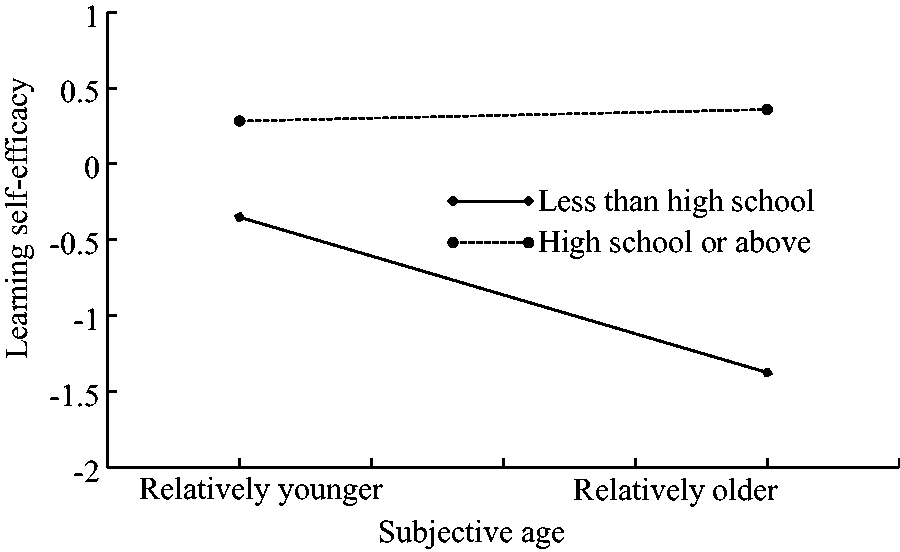
The interaction effect of older subjective age and education on learning self-efficacy.
Discussion
This study found that the subjective experience of aging, as indexed by how old or young an individual feels, significantly associates with older adults’ memory performance beyond chronological age and other risk factors for memory level, which provided empirical support for the subjective age bias and its implication in a non-Western culture. More importantly, our study for the first attempts to examine the mediating role of learning self-efficacy and the moderating role of education between older subjective age and memory performance. Our finding may add to the literature by clarifying how and for whom subjective age is associated with memory outcomes, providing clear valuable insights about the mechanisms involved in memory performance in old age.
This study revealed that older adults who feel older than their chronological age were more likely to show worse memory performance, regardless of their chronological age, which is consistent with and extends the findings of previous studies on the potential of alternative ways of measuring development time to explain older adults’ cognition aging (Stephan et al., 2015). It suggested that subjective evaluations of age may be one of reliable indictors of dispositions toward memory performance. A further analysis revealed that perceiving a higher age than actual age is associated with decrease in confidence in one’s ability to use his or her learning effectively in memory situations, which in turn is related to lower memory performance. This finding is consistent with other literature (Desrichard & Köpetz, 2005). That is, decreased in learning self-efficacy may be one of the explanatory mechanisms for why older adults who feel older are more likely to experience lower memory performance. Moreover, our finding supports the self-efficacy theory (Bandura, 1997), which posits that self-efficacy is an important resource and has beneficial motivational effects in the context of cognitive challenges through motivational, cognitive, and affective intervening process, resulting in higher cognitive performance. An individual’s beliefs about his or her capabilities to exercise control over events that affect one’s lives is the most important and pervasive mechanism of personal agency. Older adults who feel older than their actual ages may hold more negative attitudes towards themselves, deny a sense of control and mastery over life, and doubt their ability to learn new materials, which in turn may affect their efforts, involvement, and perseverance when faced with difficulties, obstacles, or failures. Poor task performance may be the final consequence. For example, Hertzog and Hultsch (1998) found that older adults with lower learning self-efficacy may be unlikely to use effortful but effective strategies, may not attempt to learn new strategies that would otherwise compensate for memory problems, and may also set lower goals for learning something new. Therefore, feeling older may decrease memory performance because it may destroy the self-evaluations in learning domains that could result in some self-limited actions that further reduce memory competence and performance.
Does feeling older necessarily entail experiencing worse memory performance through the leaning self-efficacy? Our study indicated that the indirect associations between subjective age and memory performance through learning self-efficacy vary as a function of older adults’ educations. Specifically, the indirect effect through learning self-efficacy was only significant in older adults with low educational level, while subjective age was no longer associated with learning self-efficacy in older adults with high educational level. Our findings add weight to the cognitive reserve hypothesis of cognitive aging by Stern (2002), which holds that some individual characteristics such as education could buffer the detrimental effects of the aging on cognitive abilities. The possible explanation for the protective effect of education is that education may help develop a broad repertoire of strategies, good vocabulary abilities, and a high level of learning, especially in the domain of memory (Angel et al., 2010; Anstey & Christensen, 2000). Furthermore, education typically involves better crystalized intelligence, working memory, processing speed, and mental states (Anstey & Christensen, 2000). In addition, older adults with higher education may be more likely to engage and persist in some intellectually stimulating activates such as reading/writing, surfing the Internet, handwork, and social activities. For example, previous study has revealed that individuals with higher education may have good performance in self-efficacy, cognitive capability, coping style, and health-related behavior (Koster et al., 2006). In this way, the detrimental effect of older subjective age on leaning self-efficacy was counteracted for older adults with high educational level. Therefore, education seems to be a protective factor that can buffer the deleterious effect of older subjective age on older adults’ memory performance.
However, several limitations should be considered when evaluating the study findings. First, this study used a unidimensional measure of subjective age by asking individuals how old they are. However, scholars have identified the multidimensionality of subjective age construct, such as felt age, look age, act age, and interest age (Kastenbaum, Derbin, Sabatini, & Artt, 1972). Future studies should pay more attention to the multidimensionality of subjective age and explore whether the specific subjective age dimension contributes to memory performance. Second, this study focused only on leaning self-efficacy which can explain only part of the association between subjective age and memory performance, so other potential mediators need to be considered, such as memory self-efficacy. In addition, future studies should also pay more attention to other demographic and psychological variables including income and personality that may impact the outcomes, for previous studies indicating that these variables may influence the aging process (Kim & Kim, 2014, 2016, 2018). Third, owing to the cross-sectional nature of this study, we cannot make any causal inferences about the relationship of subjective age and memory performance. Further studies should use prospective design to better pinpoint the mechanism in the theoretical model.
Despite these limitations, this study supports subjective age as a potential alternative marker of development time and associates with memory aging in older adults. These findings have revealed that learning self-efficacy may serve as one potential mechanism by which subjective age is associated with memory outcomes. Moreover, it addresses the critical issue of “what works for whom,” revealing that the mediation mechanism was moderated by education, and the adverse impact of older subjective age on memory performance through decreased learning self-efficacy appears significant only for older adults who have less than high school level of education. Our findings may provide insights into the mechanisms underlying the relationship between older subjective age and memory performance among older adults and demonstrate the importance of a moderated mediation model.
Footnotes
Declaration of Conflicting Interests
The authors declared no potential conflicts of interest with respect to the research, authorship, and/or publication of this article.
Funding
The authors disclosed receipt of the following financial support for the research, authorship, and/or publication of this article: This work was supported by the National Social Science Fund of China under grant number 16BSH101 and the Key Humanity Social Science Research Institute in Chongqing under grant number 16SKB027.
