




Abstract
This article focuses on satisfaction with the grandparent role at 1 and 2 years after the transition to grandparenthood. Three hundred and eighteen grandparents (male and female) were initially recruited and required to complete a well-validated self-report measure of grandparent satisfaction, together with self-report questionnaires assessing a range of characteristics which might predict role satisfaction. The main finding was that grandparent–grandchild attachment (bonding) was the most powerful predictor. Some predictors (e.g., generativity) appeared to have a direct effect on satisfaction, whereas the effect of others (e.g., grandchild temperament) appeared to be mediated via the grandparent–grandchild attachment relationship. Role satisfaction, aside from its probable relevance to grandparent wellbeing, is also likely to be of relevance to grandparents’ willingness to provide childcare. The latter, besides impacting on well-being of both grandparents and parents, also powerfully influences workforce economics.
Introduction
The Australian First-time Grandparent Study followed a cohort of male and female grandparents across their transition to grandparenthood and for the first 3 years thereafter (Condon, Corkindale, Luszcz, & Gamble, 2013). The first publication from the study reported the amount of contact between the grandparent and the grandchild and quantified the component of that contact which involved childcare (babysitting) (Condon et al., 2013). Grandmothers and grandfathers were performing 7.5 and 5 hours per week of childcare, respectively, for their 12-month-old grandchild. Ten percent had no contact with their grandchild, and approximately one third did no childcare.
The second paper focused on the impact of the transition to grandparenthood on mental health. Surprisingly, on five separate measures of mental health, the transition appeared to have little impact. Importantly, time spent providing childcare at 1 and 2 years was positively associated with good mental health (Condon, Luszcz, & McKee, 2018).
This study focuses on the cross-sectional assessment of grandparents’ satisfaction with their grandparent role at 1 and 2 years after the birth of their first grandchild. We explore the cross-sectional associations between satisfaction and three groups of independent variables: first, grandparent variables (age, gender, and generativity [generative beliefs and generative activity]); second, gender and temperament of the index grandchild; and third, grandparent-to-grandchild emotional attachment or bonding.
Grandparents’ Role Satisfaction
Satisfaction derived from engaging in a particular role is a complex and multifaceted construct, and researchers do not always clearly differentiate it from satisfaction with life in general or quality of life (Ben Shlomo, 2014). The ingredients of role satisfaction include experiences such as enjoyment, meaning, achievement, and goal fulfillment specifically related to that role. All of the latter are challenging to operationalize and measure and potentially influenced by parameters such as mental and physical health, unrelated to the role per se. Thiele and Whelan (2008) have summarized the earlier literature on grandparent satisfaction, and Christiansen (2014) has provided a summary of the literature in 2014.
The large amount of childcare undertaken by grandparents in the first few years of the grandchild’s life has substantial impact on parental lifestyle as well as the national economy, facilitating women’s participation in the workforce (Kanji, 2018). Thus, elucidating the determinants of grandparent role satisfaction has both theoretical and practical significance, since any role which is experienced as enjoyable and satisfying is more likely to be undertaken.
Neugarten and Weinstein (1964) published the earliest research on grandparents’ satisfaction using a qualitative methodology and found that one third of grandparents were dissatisfied with their role. Subsequent quantitative methodologies have allowed exploration of predictors and correlates of role satisfaction, although the rigor of the methodologies varies considerably. Early quantitative studies used only a single item to measure role satisfaction and include that of Peterson (1999) who found a significant positive association between role satisfaction and amount of noncustodial grandchild contact, but not grandparent gender. Another single-item study by Reitzes and Mutran (2004b) surveyed 203 male and female noncustodial grandparents and also found no effect of grandparent gender on role satisfaction. Consistent with the findings of more recent studies, approximately 10% were dissatisfied with their grandparent role (Peterson, 1999).
More methodologically rigorous studies have utilized Thomas’s 15-item grandparent role satisfaction questionnaire (Thomas, 1986). The use of a multi-item measure enables the inclusion of underlying components of the role satisfaction construct rather than an overall unfocussed role satisfaction. Thomas (1989) surveyed 279 grandparents and found that grandfathers expressed less satisfaction with the role than did grandmothers. She subsequently replicated this finding in a study of 301 male and female grandparents. Somary and Stricker (1998), using the same measure of satisfaction, also found that female grandparents had higher satisfaction levels than males in a sample of 152 grandparents with grandchildren aged between 1 and 2 years. However, other studies of grandparent gender and role satisfaction have found no significant gender differences in the levels of satisfaction (Dubas, 2001; Peterson, 1999; Reitzes & Mutran, 2004a, 2004b; Thiele & Whelan, 2006, 2008; Young & Denson, 2014).
Regarding grandparent age, Ben Shlomo (2014) found that older grandparents were less satisfied than younger ones. In contrast, Burton and Bengston (1985) found that older grandparents were more satisfied and attributed this to their having less role conflict (e.g., between employment and providing grandchild care). Peterson (1999) found no effect of age. On the basis of these findings, grandparents’ age appears to have no consistent effect on their role satisfaction.
Another grandparent characteristic which previous studies have considered as having potential relevance to satisfaction is Erikson’s construct of generativity (Erikson, 1950; McAdams & De St. Aubin, 1992). The core concept involves the desire of adults to care for, protect and nurture the younger generation, and pass on their knowledge and skills. The evolutionary implications of such a desire are self-evident. Thomas (1990), using the abovementioned satisfaction measure, found that nurturance (a measure that partially overlaps with generativity) was positively associated with satisfaction with the grandparent role. In a quantitative study of over 1,000 grandmothers, Moore and Rosenthal (2015) also demonstrated a positive association between role satisfaction and both generativity and engagement with the grandchild. One of the most methodologically rigorous studies in the literature is that of Thiele and Whelan (2008) of 149 noncustodial grandparents with grand children aged 1 to 13 years. Using Thomas’s instrument, they demonstrated that grandparent satisfaction appeared to be more powerfully influenced by psychological variables, such as meaning and generativity, compared to age, grandparent gender, and amount of contact.
A distinction can be made between generative beliefs (GBs or concerns) on the one hand and generative activity on the other (McAdams, Hart, & Maruna, 1998). The latter is assumed to be the behaviors driven or motivated by the former. The above studies focused predominantly on GBs. Generative activity is very closely linked to hours of grandchild contact and childcare, which have also been shown to be positively linked to role satisfaction in noncustodial grandparents (Bowers & Myers, 1999; Grundy et al., 2012; Reitzes & Mutran, 2004a, 2004b)
Very few studies of noncustodial grandchildren have researched grandchild variables in relation to grandparent role satisfaction. Three studies have investigated the influence of grandchild gender on role satisfaction. All three found no effect (Dubas, 2001; Peterson, 1999; Thomas, 1989). Most findings on the effect of grandchild temperament come from studies of custodial grandparents (which were excluded from this study). Such grandparents are often caring for children with behavioral disturbances, likely resulting from the circumstances which dictated custodial care. Bowers and Myers (1999), using Thomas’s scale, demonstrated a positive association between role satisfaction and lower levels of grandchild behavior problems in a sample of noncustodial grandparents. This is consistent with the findings of Sprang, Choi, Eslinger, and Whitt-Woosley (2014).
Finally, grandparent role satisfaction would be expected to be significantly influenced by the nature of the grandparent–grandchild emotional relationship. Fingerman (1998) found three characteristics of the grandchild which rendered them salient to the grandparent were special, worrying, and irritating. She found that, if there were multiple grandchildren, each grandparent had a quite distinct and different relationship with each grandchild, depending on their perception of these characteristics. Moore and Rosenthal (2015) found that engagement with the grandchild was associated with high satisfaction, and Silverstein and Marenco (2001) found the same effect of closeness. Further evidence for the importance of the grandparent–grandchild relationship to role satisfaction comes from the German Ageing Survey, which found “relationship quality with grandchildren to be most influential and positively related to the perceived importance of the grandparent role” (p 145) (Mahne & Motel-Klingebiel, 2012). However, most research into the influence of the grandparent–grandchild relationship on role satisfaction has focused only on the amount of time spent with the grandchild and the component of that time involving childcare. This is despite recent findings that, in terms of grandparent mental health, the quality of interaction during time spent with the grandchild may be more important than the actual quantity of time (Young & Denson, 2014).
Hypotheses
On the basis of the above research findings on the correlates of grandparent satisfaction, three sets of hypotheses were formulated for this study. First, in terms of characteristics of the grandparents themselves, we consider age, gender, GBs, and generative activity. Second, we consider two grandchild variables (grandchild gender and temperament). Third, we consider grandparent-to-grandchild emotional attachment. Thus, there are seven predictor variables.
The following are our hypotheses: H1: Grandparents’ age will have no significant influence on role satisfaction. H2: Female grandparents will have higher role satisfaction compared to male. H3 and H4: Grandparents’ GBs (H3) and generative activity (H4) will both be positively associated with grandparents’ role satisfaction. H5: Grandparents’ role satisfaction will be independent of grandchild gender. H6: Role satisfaction will be lower if the grandparent perceives the child as having behavior problems or as difficult. H7: The quality and strength of the grandparent-to-grandchild attachment relationship (or bond) will have a significant and powerful influence on grandparent role satisfaction.
Method
Participants
Details of recruitment procedures, response rates, and sample demography have been presented in previous papers (Condon et al., 2013; Condon et al., 2018). In summary, subjects were recruited via their daughters (or daughters-in-law) who were pregnant with a first grandchild and attending antenatal appointments in a major Australian city. Mean ages were 53 and 56 for grandmothers and grandfathers, respectively. Moreover, 80% of the men and 70% of the women were in some form of employment, and they spanned a range of socioeconomic classes. Three hundred and eighteen grandparents were recruited over the first year and recruitment continued over a 3-year period with 282 and 301 subjects fully completing assessments at 12 and 24 months respectively after their grandchild’s birth. At both assessment points, approximately 60% of the grandparents were female. All data were collected using self-report questionnaires mailed to the participants, with a follow-up reminder if the questionnaire was not returned. Approximately 80% of those recruited completed the 2-year assessment, and there were no significant differences between completers and those who dropped out on baseline measures (age, marital status, lineage, education level, or employment status; (Condon et al.,2013).
Measures
Satisfaction was assessed using Thomas’s 15-item grandparent role satisfaction questionnaire with a 7-point Likert scale for each item (Thomas, 1986). Thomas reported a Cronbach’s α coefficient of .79 in her original study. Thiele and Whelan (2008) reported a coefficient of .83 in a sample of 149 noncustodial grandparents and also quoted a range of .79 to .90 from other studies. In this study, an α value of .86 was found for the combined male and female sample at both the 1- and 2-year assessment.
The Loyola Generativity Scale was developed to quantitatively assess this construct (McAdams & De St. Aubin, 1992, 1998; McAdams et al., 1998). As mentioned earlier, a distinction can be made between GBs (or concerns) on the one hand and generative activity on the other. GBs/concerns were assessed using a subset of five items from the Loyola Generativity Scale (Materne & Luszcz, 2010). McAdams and De St. Aubin (1992) reported an α coefficient for the original 20-item scale of .83 and a test–retest reliability of .73 over a 3-week period. In this study, at 1 year, the 5-item beliefs subscale had an α coefficient of .86. An illustrative example of items in the GB subscale is 'I have important skills that I try to teach others' Strongly agree/strongly disagree (7 levels).
Generative activity was assessed by a subset of six items (with some rewording for grandparents’ activities with the grandchild) from the 50-item Generative Behaviour Checklist (McAdams et al., 1998). The α coefficient of this activity subscale was .94 for the 1-year assessment. The coefficient at 2 years was similar. The correlations between hours per week of grandchild contact/childcare and generative activity were found, as expected, to be high (.47, p < .001 for 12-month contact hours/week and .46, p < .001 for childcare hours/week). Thus, grandchild contact/care is a reflection of generative activity, and it was considered unnecessary to include contact/care in the analyses. Only generative activity was utilized.
A grandparent’s perception of their grandchild’s temperament was assessed using the fussy/difficult subscale of the Infant Characteristics Questionnaire, which was designed to assess parents’ perception of their child’s temperament (Bates, Freeland, & Lounsbury, 1979). These authors reported that this subscale of the instrument had the highest reliability and validity with a Cronbach coefficient of .79 and a test–retest reliability of .92. In this study, Cronbach coefficients for grandparents were .84 and .89 at the 1- and 2-year assessment, respectively.
The grandparent–grandchild relationship has received little attention in the literature, and no scale (observational or self-report) could be located to assess it. However, self-report instruments are available for assessing the parent–child relationship in terms of parent-to-infant emotional attachment for both mothers (Condon & Corkindale, 1998) and fathers (Condon, Corkindale, & Boyce, 2008). These instruments assess the strength of the emotional bond of the parent to the infant using items which enquire about the frequency and intensity of a range of positive and negative parental feelings toward the child. Psychometric properties of these instruments have been published and appear to be very satisfactory. A subset of items was extracted from these two instruments to develop a grandparent-to-grandchild emotional attachment scale. This comprised 14 items and was worded to be suitable for completion by either a grandmother or grandfather. After removal of one item (concerning feelings of guilt about not being more involved with the grandchild), which correlated poorly with the total, the α coefficient of the resultant 13-item scale was .72 and .75 in this study at 1 and 2 years, respectively. Three illustrative examples of items in the attachment scale are “I try and involve myself as much as possible playing with my grandchild”: Agree/disagree; “When I’m with my grandchild, I get a lot of satisfaction and enjoyment”: Always/rarely (4 levels); and “When I have to leave my grandchild, I usually feel”: sadness/relief (5 levels).
Statistical Analyses
It was hypothesized (H7), on the basis of unpublished interview data from this study and previous research summarized earlier, that the grandparent–grandchild attachment (bond) would be a powerful predictor of role satisfaction. Inspection of the correlation matrix confirmed this (Table 3). The question then arose whether the effects of the remaining six predictors were exerted directly on satisfaction or whether their effects were mediated via attachment. For example, it seemed plausible that the effect of grandchild temperament on satisfaction may be mediated via attachment, whereas generativity may influence satisfaction directly. Hence path analysis was chosen as the main analytic approach, since it enabled exploration of direct versus mediated effects. The conceptual model is shown in Figure 1, and SPSS multivariate regression analyses were utilized to estimate the direct and mediated path coefficients following the methods developed by Preacher and Hayes (2004). Previous findings from this study highlighted minimal change in the main variables between the 1- and 2-year assessment (Condon et al., 2013; Condon et al., 2018). Moreover, additional subjects were included in the second assessment (see above). For these reasons, each of the two assessments was analyzed cross-sectionally in a path analysis and no multivariate longitudinal analyses were performed.
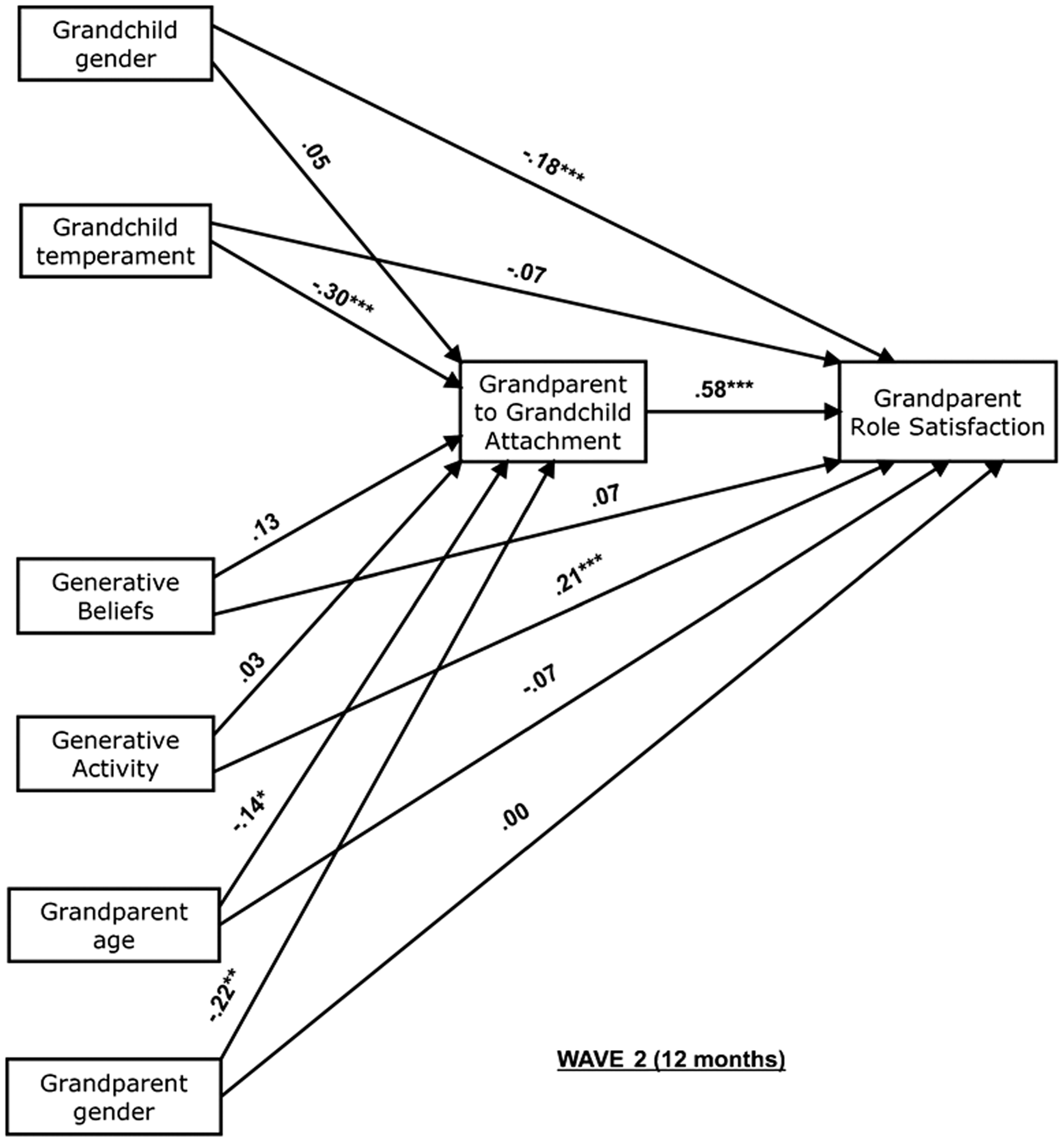
Path diagram for relationships between role satisfaction and other variables at 1 year. *p < .05, **p < .01, and ***p < .001.
Grandparents’ role satisfaction mean scores will be reported separately for male and female grandparents to test hypothesis H2. However, for all further analyses, it was decided to analyze the combined male and female data as a whole and assess the possible influence of grandparent gender as a predictor variable in the analyses. This enabled any direct effects of gender on satisfaction to be differentiated from those which may be mediated via other variables.
Results
There was no significant change in total role satisfaction scores between 1 and 2 years for either gender. As shown in Table 1, grandmothers’ scores were significantly higher than those of grandfathers at both assessment points, confirming hypothesis H2. However, it is debatable whether this difference (approximately five points with an effect size falling in Cohen’s small–medium range) is practically meaningful.
Effect of Grandparent Gender on Role Satisfaction at 1 and 2 Years.

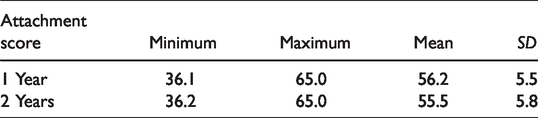
The grandparent–grandchild attachment measure was designed for this study and utilized for the first time (Table 2). Thus, its psychometric properties warrant scrutiny. The Cronbach’s α coefficient of the attachment measure at 1 and 2 years (.72 and .75, respectively) suggests that it is measuring a meaningful construct. In addition, mean scores at 1 and 2 years were 56.3 (SD 5.5) and 55.5 (SD 5.8), respectively, with no significant change over that 1-year period. The Pearson correlation between the 1-year and 2-year score was .76 (p < .001). This would suggest high test–retest reliability of the attachment measure.
Grandparent-to-Grandchild Attachment Scores at 1 and 2 Years.
The correlation matrices for the 1- and 2-year data are shown in Table 3. The very high correlation between role satisfaction and attachment is apparent at both time points. The path diagram, based on the 1-year data, is shown in Figure 1 and confirms the powerful association between grandparent–grandchild attachment and role satisfaction (β = .58; p < .001). Thus, hypothesis H7 is confirmed. The next most significant path involves grandchild temperament, and the influence of this (on satisfaction) is mediated via attachment (β = −.30; p < .001), confirming hypothesis H6. In other words, when attachment is included in the model, the direct relationship between temperament and satisfaction becomes insignificant, and the path via attachment represents the main mechanism. In contrast, the relationship between generative activity and satisfaction is direct and not mediated by attachment (β = .21; p < .001), confirming hypothesis H4.
Correlation Matrix for Variables Accessed at 1 and 2 Years.
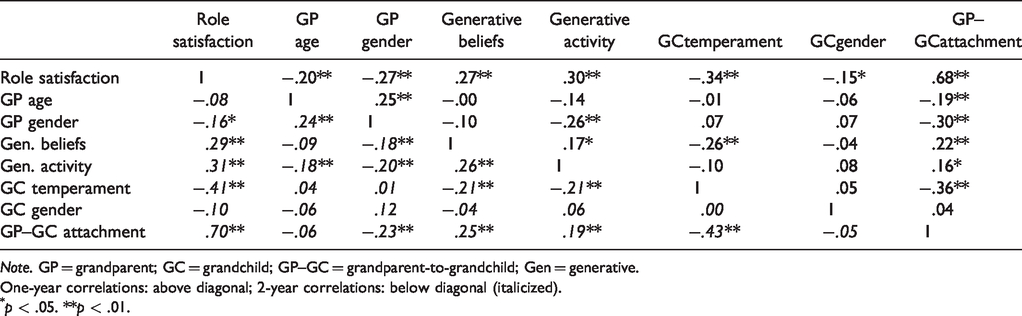
Note. GP = grandparent; GC = grandchild; GP–GC = grandparent-to-grandchild; Gen = generative.
One-year correlations: above diagonal; 2-year correlations: below diagonal (italicized).
*p < .05. **p < .01.
The relationship between GB and satisfaction is more complex in that, although neither the direct nor mediated path attained significance in the path diagram (Figure 1), the correlation between GB and satisfaction (Table 3) was significant (r = .27; p < .01). Consistent with this, a regression of satisfaction on GB yields a β coefficient of .14 (p < .05). We interpret this to mean that the path model with mediation spreads the influence of GB over both the direct and mediated paths, resulting in neither attaining significance in its own right. We conclude that this provides limited support for hypothesis H3, that is, that the GB/satisfaction relationship is significant.
It was not expected that grandchild gender would have a significant relationship with role satisfaction. However, while it has little impact on attachment, male gender appears to be significantly and positively associated with role satisfaction through a direct effect (β = −.18; p < .001), so hypothesis H5 is rejected. The relationship between satisfaction and the two remaining predictors (grandparent age and gender) are both mediated via attachment, with grandparents who are younger (β = −.14; p < .05) and female (β = −.22; p < .01) having higher satisfaction. Thus, hypothesis H1 (age) is rejected and hypothesis H2 (gender) is confirmed.
Analysis of the 2-year data largely confirms the 1-year findings, with similar patterns and path coefficients for attachment, temperament, grandparent gender, GBs, and generative activity. However, there were no significant associations of grandparent age or grandchild gender with satisfaction at 2 years.
Discussion
As far as we are aware, this is the first study of grandparent role satisfaction to include a quantitative measure of the emotional attachment (bond) of the grandparent to the grandchild. The most important finding of this study is the very strong interrelationship between attachment and grandparent role satisfaction. The second important finding is that some variables appear to affect role satisfaction directly, whereas for others the effect is mediated via grandparent–grandchild attachment. The mechanisms involved remain speculative; however, some possibilities are discussed later. It was not unexpected that the effect of having a grandchild with a fussy difficult temperament would directly impact negatively on the attachment relationship. Such a grandchild is likely to be less rewarding in interactions and may require firm limit setting during childcare by the grandparent which, as a result, is likely to be more stressful. Such limit setting could also potentially lead to conflict between parent and grandparent. These findings on temperament are consistent with the two studies mentioned earlier (Bowers and Myers, 1999; Sprang et al., 2014).
Generative activity directly relates to satisfaction, implying that behaviors which express caring, nurturance, etc. are rewarding and satisfying in their own right. GB reflects more a mindset about the importance of such activities and the desire to express those beliefs. Our data suggest that the enactment of generativity (via activity) relates to role satisfaction more strongly than a subscription to generative notions (beliefs). This is consistent with previous research (Thiele & Whelan, 2008), which identified generative activity as a predictor of satisfaction.
It was unexpected to find that male grandchild gender was significantly and directly associated with higher role satisfaction since previous studies had not found this effect. There were no significant grandchild gender differences in grandchild temperament. The literature on parents’ preference for male versus female children comes predominantly from studies of non-Western cultures. Male children tend to be more highly prized in those cultures, female infanticide being an extreme consequence. A Gallup poll in the United States in 2000 found 41% of Americans would prefer to have a male child versus 27% preferring a female one (the remainder had no preference; Anonymous, 2001). No data on grandparents’ gender preferences could be found. In this study, grandparents’ satisfaction was significantly and directly linked to male grandchild gender at 1 year, which may reflect a similar dynamic to that underlying the Gallup findings on parents. However, there was no significant effect at 2 years. One could speculate that the personality of the grandchild has emerged to a greater extent by 2 years, and the grandparent is less swayed by gender stereotypes (as above), which favor male children. Regarding grandparent gender, previous studies have found either no difference or higher satisfaction in females. This study also found females to be more satisfied (Table 1); the gender effect being mediated through attachment. In almost all studies (including this one), female grandparents have been shown to have significantly more contact with the grandchild than male grandparents (Condon et al., 2013), and this greater exposure may enhance attachment, providing more opportunity to develop a strong relationship with the grandchild.
Younger grandparents had greater satisfaction, also mediated via attachment, at 1 year but not at 2 years. As summarized earlier, previous studies of grandparent age and satisfaction have yielded conflicting findings. One could speculate that, being more fit and active, the younger subgroup may have more playful interactions through games and outdoor activities, which might enhance attachment. Higher fitness in younger grandparents might also explain the lack of any age effect at 2 years. By that time, the more physical demands made on grandparents for support may be less than in the first year (when the grandchild’s routines with feeding, sleeping, etc. are less well established). Thus, fitness to meet such demands without undue fatigue may be less of a requirement for role satisfaction in the second year.
The grandparent-to-grandchild attachment measure is derived from items designed for assessing parent-to-child attachment and used for the first time in this study. The stability of scores over the first 2 years and the psychometric properties presented earlier are encouraging, as is the intuitive nature of the path diagram findings. Nevertheless, the validity of this instrument is yet to be fully established.
Conclusion
The satisfaction derived from the grandparent role will influence the extent to which childcare is embraced by grandparents. Provision of noncustodial childcare by grandparents is not only an important issue in terms of grandparents’ quality of life and mental health (Condon et al., 2018) but also parental wellbeing. In addition, it is also a very significant factor in workforce economics in Western countries (Kanji, 2018). This study shows the overarching importance of the grandparent–grandchild bond as a determinant of satisfaction. This relationship domain has been largely neglected in previous research. Future research could aim to refine understanding and assessment of this relationship, as well as its determinants. This, in turn, could lead to interventions (such as grandparent–grandchild playgroups), which may enhance it.
Footnotes
Declaration of Conflicting Interests
The authors declared no potential conflicts of interest with respect to the research, authorship, and/or publication of this article.
Funding
The authors disclosed receipt of the following financial support for the research, authorship, and/or publication of this article: This work was supported by the Australian Research Council (grant numbers DP0664158 & DP 0986226).
