



Abstract
Previous studies indicate that Han and ethnic minority groups in China are not homogeneous. However, little research has examined potential heterogeneity in the association between social support and life satisfaction across Han and ethnic minority elderly. Based on data from the 2014 China Longitudinal Aging Social Survey, this study uses ordered logit models with interaction terms to examine the relationship between social support and the life satisfaction of ethnic minority elderly and of elderly Han Chinese. We find that support from families and friends has a stronger association with the life satisfaction of ethnic minority elderly than their Han peers. For ethnic minority elderly, the patterns of family support varied according to rural or urban residence, with family support being less important to the life satisfaction of ethnic minority elderly living in urban communities than in rural areas. Our findings suggest that social policy should take this heterogeneity between ethnic groups into account.
Introduction
China has the largest elderly population and fastest rate of population aging in the world. In 2017, the population of adults aged 60 and over reached approximately 229 million people (United Nations, 2019). As the proportion of Han Chinese has declined over the years, more than 8% of the elderly population now belongs to an ethnic minority group (National Bureau of Statistics of China, 2010), which constitutes one of the world’s largest ethnic minority populations (Maurer-Fazio & Hasmath, 2015). Like the rest of China’s population, ethnic minorities are aging rapidly. In fact, they are aging faster than the Han Chinese. According to Chinese census data, the average annual growth rates of the population aged 60 and above from 1990 to 2010 were 3.06% in the Han Chinese and 3.17% in the ethnic minority populations, and older individuals make up a larger proportion of the ethnic minority population than of the Han Chinese (Zheng, 2014). Thus, it is important for researchers to explore their living conditions and life satisfaction.
There is a growing body of literature on the relationship between social support and life satisfaction among the elderly in China and elsewhere (e.g., Chan & Lee, 2006; Chen & Jordan, 2018; Newsom & Schulz, 1996; Siedlecki et al., 2014). It is well-known that social support has beneficial effects on the life satisfaction of older adults (Cheng et al., 2015; DuPertuis et al., 2001; Zhang et al., 2012) and that support provided by family members and friends is considered an important source of care and assistance for the elderly (Chen & Jordan, 2018; Dumitrache et al., 2018). However, while previous studies have indicated that Han and ethnic minority groups are not homogeneous (Bowling, 2007), little research has examined potential heterogeneity in the association between social support and life satisfaction across groups of Han Chinese and ethnic minority elderly (Berg et al., 2006). Therefore, comparing the social support received by ethnic minority and Han elders and its relationship to life satisfaction could lead to the development of improved gerontological social policy in China.
In this study, we aim to examine the relationship between social support and life satisfaction of ethnic minority elderly in China, as well as how this relationship differs between ethnic minority and Han majority groups. Within the elderly ethnic minority group only, we will also explore whether this relationship differs across urban and rural settings of China’s dual hukou system. 1
Social Support and Life Satisfaction among Elderly People
Social support is defined as the perception or experience that one is loved and cared for by others, esteemed and valued, and is part of a social network of mutual assistance and obligations, which may involve one person explicitly receiving benefits from another, or it may be experienced as the perception that such help and support is potentially available (Litwin & Landau, 2000; Taylor, 2011). Sources of social support range from close and stable relationships to more distant and unstable ones. Caplan (1974) articulated the construct of social support and observed the role of social ties in the face of crises, life transitions, and other difficult experiences; extensive evidence has suggested that measures of social integration and the perception of emotional support from one’s network of relatives and friends both typically show positive associations with mental and physical health, and with quality of life, including life satisfaction (Krause & Markides, 1990; Pinquart & Sörensen, 2000; Thoits, 1995; Wethington & Kessler, 1986).
Numerous empirical studies worldwide highlight the positive effects of social support on elderly people’s life satisfaction, as it protects against loneliness and delays the onset of ill health (Chen, 2001; Field & Minkler, 1988; Kim & Lee, 2013; Tsuji & Khan, 2016; Yoon & Lee, 2006). For example, using data from 200 Korean immigrant elders in the New York City metropolitan area, Park et al. (2012) found that religiosity and social support were both significant predictors of life satisfaction among elderly Korean immigrants. Researchers have also shown that social support played a significant role in the life satisfaction of elderly people in Iran, Japan, and Korea (Bagheri-Nesami et al., 2013; Golshahi et al., 2014; Tsuji & Khan, 2016), highlighting its importance across diverse cultural contexts.
The research based on Chinese elderly has also grown. Deng et al. (2010) documented that both social support from family members and cognitive function appeared to be key factors associated with life satisfaction among the very old in China. Another study examining the relative contribution of support from family members and friends to life satisfaction among Chinese older adults living in Hong Kong has shown that family-based support contributed more to life satisfaction than other types of social support (Yeung & Fung, 2007). Wang (2016) reported that encouraging more communication between the elderly and their friends and family, thereby providing the elderly with more emotional support, could significantly improve their mental health. In contrast, Li et al. (2018) emphasized that improved social support from friends was not significantly correlated with life satisfaction among the elderly in China. However, Chen et al. (2019) found that support from friends could reduce negative emotions (feelings of loneliness and depression) among Chinese older elderly (age 75 or older), both directly and indirectly. In summary, there is increasing evidence that social support from family and friends has a positive relationship with life satisfaction among the elderly in China, as is also the case in other contexts. However, we know less about the relationship between social support and life satisfaction of Chinese ethnic minority elderly, as previous research tends to focus on the Han majority population. This is an important gap in the literature, given the potential for heterogeneity between the minority and majority groups.
Heterogeneity between Han Chinese and Ethnic Minorities
Ethnic minority status has been viewed as having both positive and negative influences on the aging process in a western context (Browne & Broderick, 1994). On the one hand, minority ethnicity has generally been regarded as a resource and strength, for example, through the provision of familial support and other informal resources (Harper, 1990). On the other hand, ethnic minority elders usually have lower incomes and poorer health than their ethnic majority counterparts, as a result of racial discrimination, oppression, and cultural barriers (Zubair & Norris, 2015). However, the historic dearth of research on the situation of older people from minority groups is being redressed by scholars who argue that research in ethnic minority aging provides a reminder of the complexity of the life-course, and of the diversity of aging as a cultural and social construction (Phillips, 1995; Phillipson, 2015). Despite some important sociocultural and contextual differences, the perspectives mentioned above provide a useful orientation for thinking about the relationship between social support and the life satisfaction of older ethnic minority individuals in the Chinese context.
Ethnic minorities in China form a large and highly diverse group of people with vastly different cultural practices, demographic profiles, and perceptual status (Hasmath, 2010; Maurer-Fazio & Hasmath, 2015). They tend to live in remote or poverty-stricken rural areas of inland China where economic development is hindered because of geographically unfavorable conditions as well as the priority given by governmental policies to developing urban areas (Abebe & Masur, 2008; Li et al., 2007). Minority ethnicity reduces migration probabilities for people registered in rural China (Gustafsson & Yang, 2015). Income growth has also been much slower for minority groups compared to the Han majority group and the income gap has rapidly widened overall (Gustafsson & Shi, 2003). One of the consequences of this socioeconomic developmental gap is its detrimental effect on health, which is manifested in growing health disparities in China (Liang et al., 2000; Liu & Zhang, 2004).
Patterns of social support also vary between ethnic minority and Han Chwinese. Ethnic minorities are more likely to live together in specific areas, to belong to the same religion, and to have stronger social ties with their friends (Mutchler & Burr, 2011). Such groups are often described as having specific ethno-cultural norms, which can serve to minimize the impact of the cumulative disadvantages and social inequalities they experience over the life-course (Dowd & Bengtson, 1978; Norman, 1985; Zubair & Norris, 2015). Family support is likely to be higher among ethnic minorities than their Han counterparts because they are subject to more flexible fertility policies. Ethnic minorities are permitted to have two children, while the Han Chinese have historically only been permitted to have one child. 2 This leads to larger families, which might offer more potential “providers” of social support for ethnic minority elderly people. However, focusing only on cross-group disparities may mask the sometimes-stark disparities within officially designated ethnic groups, particularly across urban-rural and geographical lines (Hannum & Wang, 2010). Therefore, to formulate appropriate and relevant policies and practices that address the needs of those regarded as “ethnic” older adults, a better understanding of ethnic minority older people’s experience is necessary (Torres, 2015), including a consideration of both between- and within-group differences.
Current Study
It is important to note that little of the research addressing the positive association between social support and the life satisfaction of elderly people has explored the different patterns of this association between and within ethnic groups in China. To fill gaps in the existing research, the present study will first examine the association between the pattern of different types of social support and older adults’ life satisfaction, comparing individuals across Han majority and ethnic minority groups. Two types of support are included: from family and from friends. Then, given that there is a remarkably large rural–urban divide in social support and in older Chinese adults’ life satisfaction in general, we will explore this potential source of diversity within the ethnic minority sample, by dividing it into urban and rural subgroups, as defined by the rural–urban type of community they live in (urban community vs. rural community). Here, we will examine the relationship between social support and life satisfaction in these urban and rural subgroups of ethnic minority elderly, while controlling for selected socio-demographic characteristics. Interactions between social support and ethnicity, as well as rural or urban residence, are tested to identify significantly different patterns of social support across subgroups. We also discuss the implications for gerontological social policy and practice, with respect to promoting better quality of life for these elders and their families.
Method
Data
This study uses the data from the China Longitudinal Aging Social Survey (CLASS) collected by Renmin University of China. CLASS is a nationally-representative dataset addressing Chinese individuals aged 60 and above, which adopts a hierarchical multi-stage probability sampling method, and aims to collect social and economic data on the aging Chinese population at both the individual and community levels. In the 2014 baseline survey, CLASS investigated 11,511 individuals in 462 rural villages and urban communities across 29 provinces in mainland China. 3 After removing the cases with missing values, the final simple consisted of 10,034 participants (781 ethnic minorities and 9,253 Han Chinese). This study was also reviewed and approved by Nanjing University ethics review committee.
Measures
Life satisfaction: Participants are asked to report their life satisfaction using the question “In general, are you satisfied with your current life?” Responses ranged from 1 (very dissatisfied) to 5 (very satisfied).
Social support is measured using the following questions: “How many family members/friends do you meet or have contact with monthly?” “How many family members/friends do you think you can share a personal matter with?” and “How many family members/friends can you expect to provide help when you are in need?” The response ranges from 0 (none) to 9 (nine or more). Principal-component factor analysis is employed to extract two common factors from the two sets of questions, namely support from family and support from friends. For the factor on support from family members, the rotated factor loadings are 0.856, 0.774, and 0.855 for each question, respectively. For the factor on support from friends, the rotated factor loadings are 0.844, 0.860, and 0.874 for each question, respectively.
We also include various variables from CLASS as controls: age, gender (male or female), current marital status (married or unmarried), years of education, religious belief (yes or no), number of living children, current employment status (employed or unemployed), monthly income (in thousands of Yuan), ADL 4 (IADL for Instrumental Activities of Daily Living and PADL for Personal Activities of Daily Living, with answers of yes, if respondents cannot do any one of these activities, and no otherwise), participation in social activities (yes, if the elderly person participated at least one social activity in the last 3 months, and no otherwise), number of professional staff per 1,000 residents in a village or community, and community settings (urban/rural and Han/ethnic minority). Descriptive statistics and detailed definitions of all variables are presented in Table 1.
Descriptive Statistics and Definition for All Variables.
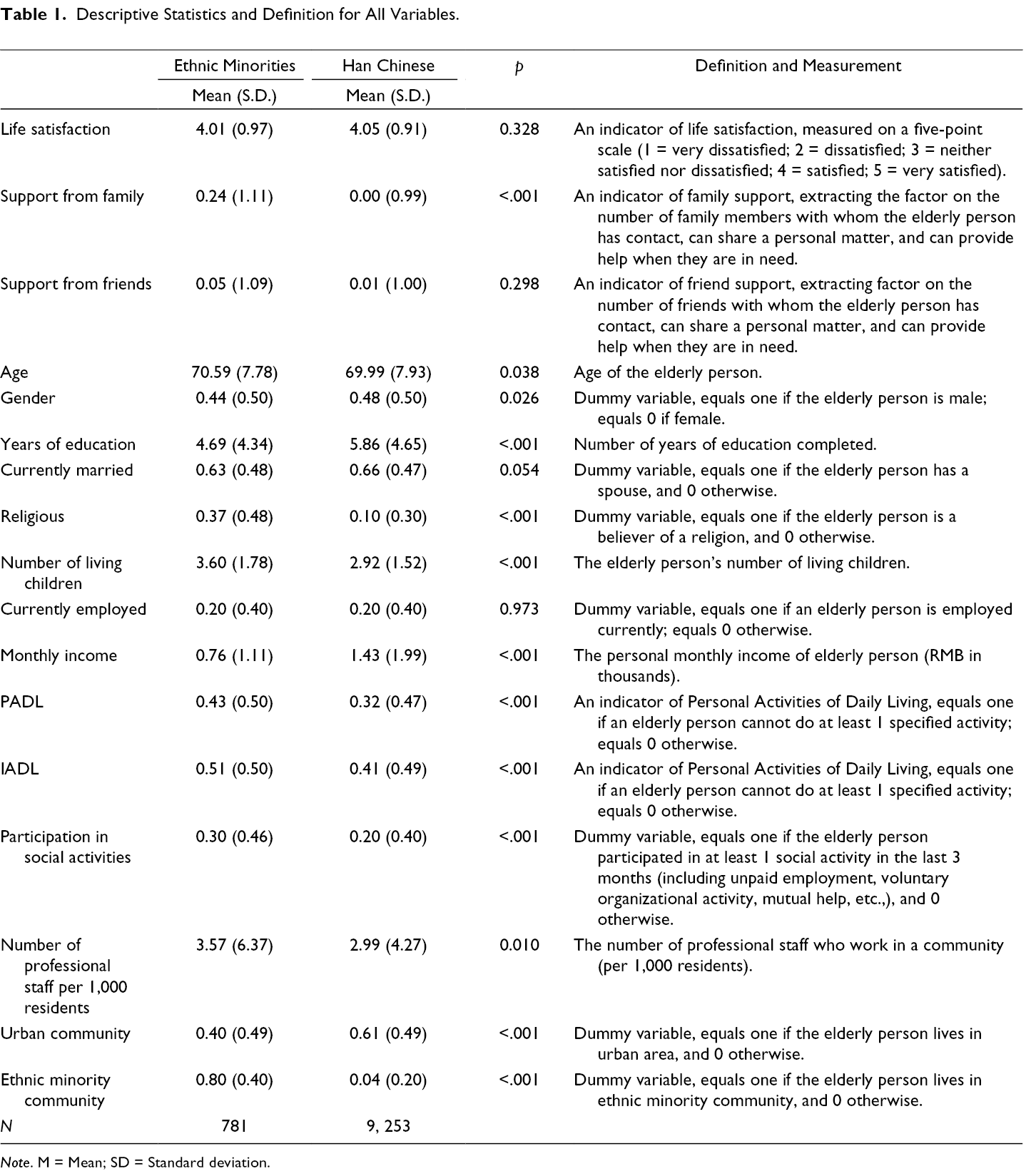
Note. M = Mean; SD = Standard deviation.
Analysis Plan
We use ordered logit models to estimate the following function,

where LS is life satisfaction for individual i measured on a five-point scale (1 = very dissatisfied; 2 = dissatisfied; 3 = neither satisfied nor dissatisfied; 4 = satisfied; 5 = very satisfied). S is a vector of factor variables based on the measures of social network and social support, which were collected in a survey module in the 2014 CLASS. X is a vector of control variables pertaining to individual and community characteristics.
The analysis consisted of two parts: the first part investigated the association between social support and life satisfaction of older ethnic minority and Han majority individuals, whereas the second part addressed the ethnic minority group only, assessing within-group differences across urban or rural residence, according to the divisions defined by the Chinese hukou system. Statistical tests of these different mechanisms were examined using interactions. Interaction terms for ethnic minority and social support (ethnic minority × social support), and community urban-rural classification and social support (urban community × social support) were entered into the models to identify whether there were moderating effects. Due to the survey’s complex sampling design, analytic weights were employed and clustered standard errors were also calculated.
Results
Table 1 presents summary statistics, definition for all variables, and the p value of χ tests for the differences in the means of each variable. The mean life satisfaction scores are 4.01 for the ethnic minority elderly and 4.05 for the Han elderly. There is no statistically significant difference in life satisfaction between Han Chinese and ethnic minorities. With respect to social support, the difference in support from family between the two groups (ethnic minority and Han) was significant, while the difference in support from friends was not.
Model 1 and Model 2 in Table 2 present the results for ethnic minorities and Han, respectively. Both support from family and friends have a significantly positive correlation with life satisfaction of ethnic minority and Han Chinese. When support from family increases by one unit, the probability of having a higher level of life satisfaction will increase 46.2% for ethnic minority and 21.5% for Han, separately. Support from friends can also improve the odds of higher life satisfaction (32.9% for ethnic minority and 11% for Han, separately). The effect patterns are not symmetrical, as both coefficients are higher in ethnic minority elderly than Han elderly. Model 3 in Table 2 shows that, compared to Han Chinese, support from family and friends is more important for ethnic minority elderly: the correlations are 28.3% higher for support from family and 15.2% higher for support from friends, respectively.
Weighted Ordinal Logistic Regression for Life Satisfaction in the Elderly of Ethnic Minorities and Han.
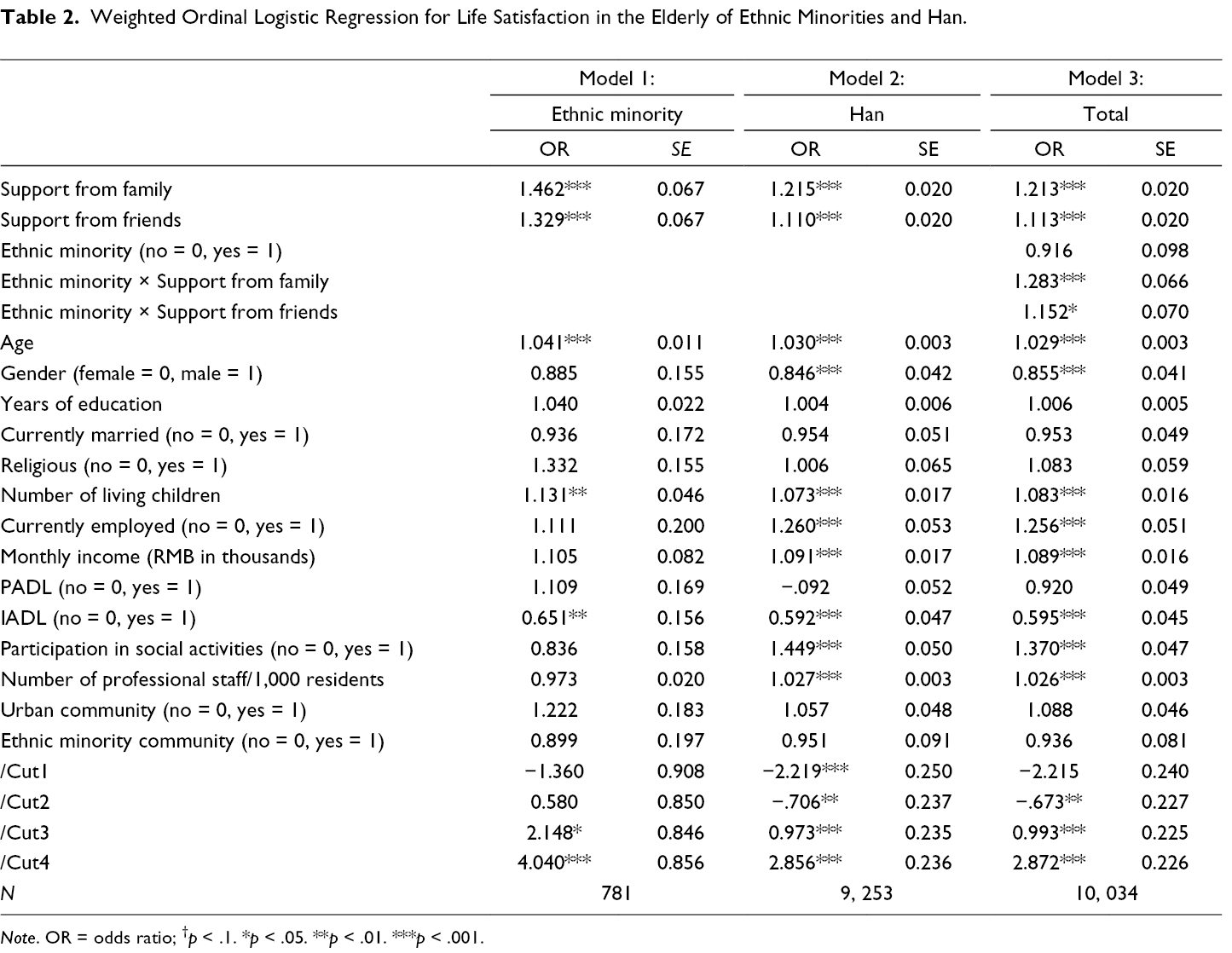
Note. OR = odds ratio; † p < .1. *p < .05. **p < .01. ***p < .001.
Table 3 presents the results of weighted ordinal logistic regression models of the attributes of the different communities in which the ethnic minority elderly lived. Model 4 and Model 5 show the associations between social support and life satisfaction among ethnic minority elderly living in rural areas and urban communities, respectively. Both support from family and friends are significantly associated with higher life satisfaction among older ethnic minorities regardless of whether they live in urban communities or rural villages. The patterns of family support vary, and its correlation with the life satisfaction of ethnic minority elderly is 21.2% weaker in urban communities than in rural areas. However, differences in the pattern of support from friends are not significant.
Weighted Ordinal Logistic Regression for Life Satisfaction in the Elderly of Ethnic Minority Across Urban and Rural Settings.
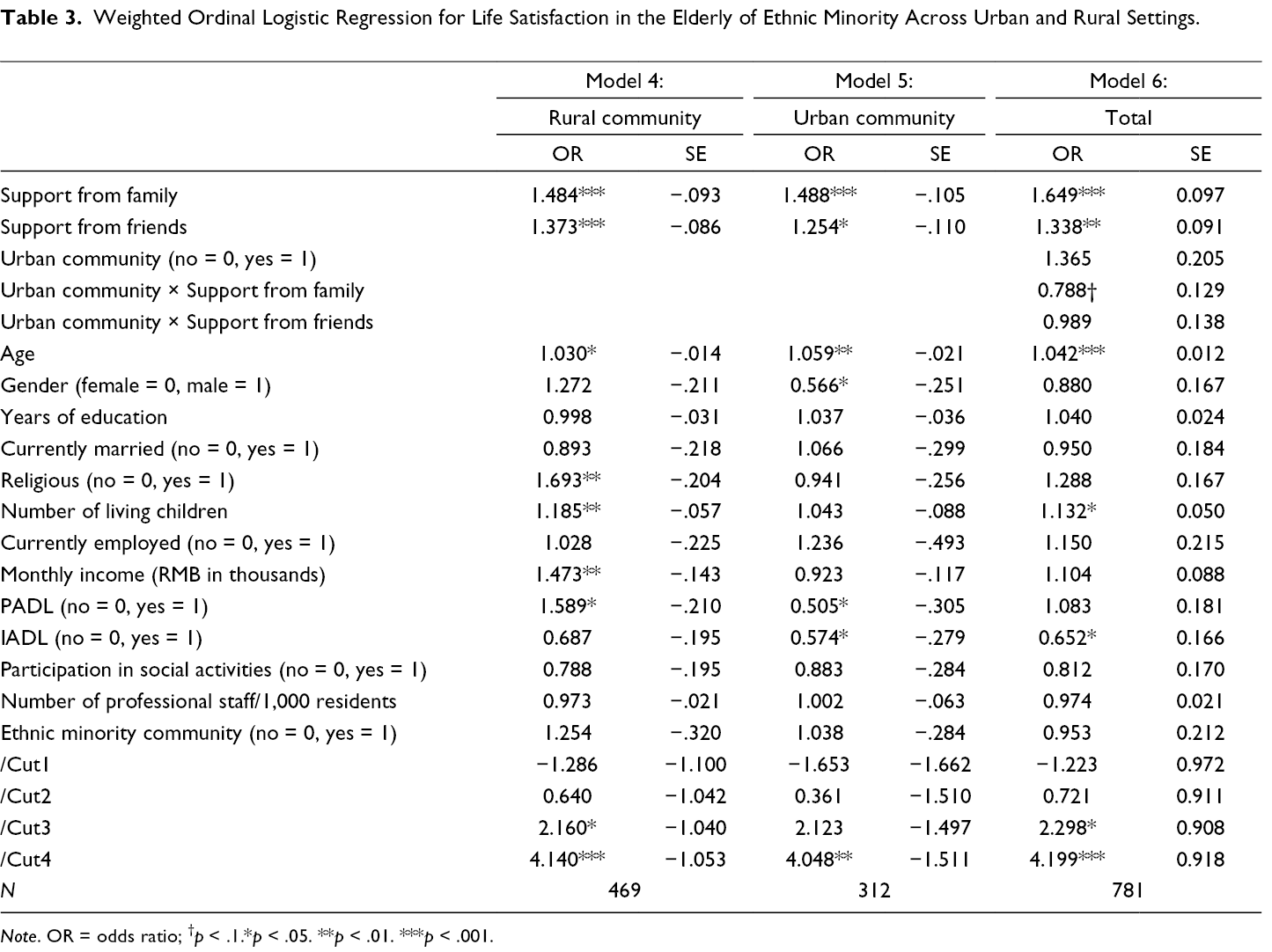
Note. OR = odds ratio; † p < .1.*p < .05. **p < .01. ***p < .001.
Discussion
Throughout Chinese history, many minority groups have interacted with and been assimilated into the Han majority population. However, a study by Wong (2000) demonstrates that most of the current, large minority groups have highly localized geographical distributions and maintain their dominance at a local or regional level, rather than having been absorbed into the Han majority culture. The 2014 CLASS has given us a valuable opportunity to analyze the most recent data regarding social support and its relationship with life satisfaction of ethnic minority older adults in China. We find that the minority group has a comparatively lower life satisfaction than the Han group, but that this difference is not statistically significant. Although the number of related studies is quite limited, researchers have found relatively low life satisfaction among ethnic and racial minority groups, even when relevant demographic and other factors are controlled for (e.g., Michalos & Zumbo, 2001; Verkuyten, 2008). The results of Model 1 and Model 2 indicate that both support from family and friends exhibit a significant, positive association with the life satisfaction of ethnic minority and Han Chinese elderly. This is consistent with Pinquart and Sörensen (2000) who find that the perception of emotional support from one’s network of friends and relatives typically displays a positive association with quality of life, including life satisfaction, among older adults. As previous studies have shown, the provision of informal social support from family members and friends enhances older adults’ life satisfaction by increasing confidence, emotional stability and control, and consequently contributing to a positive sense of well-being (Cohen & Syme, 1985; Kim & Lee, 2013; Yoon & Lee, 2006).
With respect to the different patterns of the relationship between social support and life satisfaction of ethnic minority and Han Chinese elders, as the results of Model 3 indicated, support from family and friends displays a stronger correlation with the life satisfaction of ethnic minority elders than Han Chinese. We believe ethnic minorities’ larger family size and important differences in terms of cultural beliefs and lifestyles may contribute to this result (Bian et al., 2015; Connelly et al., 2015; Sun et al., 2015). Elderly ethnic minorities might have stronger beliefs in the obligatory nature of relationships with their families and friends and might act accordingly. Therefore, when older ethnic minorities face problems, their preferred coping strategy might involve seeking needed help from family members or friends (Bengtson, 2001; Bian et al., 2015; Connelly et al., 2015; Sun et al., 2015). The present study also indicates that family support has a stronger relationship with the life satisfaction of ethnic minority elderly who live in rural communities than those who live in urban areas, as the results of Model 6 in Table 3 indicate. This is concordant with the results of a previous study by Li et al. (2007) who find that the uneven development of health care across urban and rural settings has detrimental consequences for economically disadvantaged older adults, such as minority groups living in rural China, who therefore depend on children and family to provide for their needs.
Limitations and Conclusion
This study also has some limitations. First, the 55 ethnic groups included in the CLASS are heterogeneous in some ways. The degree to which distinct ethnic minorities are integrated with each other and with the majority Han varies significantly from group to group, and, collectively, China’s 55 ethnic minority groups represent highly diverse socioeconomic positions, languages, religions, and cultural, and geographical contexts (Dincer & Wang, 2011). Unfortunately, we cannot test the association between social support and the life satisfaction of older ethnic minorities within each of these ethnic subgroups because the ethnic minority subsample is too small. Second, the way that social support and life satisfaction are measured limits our ability to capture these variables in a more multidimensional and nuanced way, for example, by exploring the effects of different types of social support (emotional, informational, instrumental, etc.). Third, the causal mechanisms between social support and life satisfaction remain to be investigated, as the data used in this study are cross-sectional and therefore cannot be used to infer causality.
Despite these limitations, this study makes important contributions to understanding the relationships between social support and life satisfaction for ethnic minority older adults in a comparative perspective. We have shed light on the different sources of social support and their associations with the life satisfaction of older Chinese adults, extending previous work by distinguishing ethnic minority older adults from the ethnic majority population, rather than treating them as a homogeneous group. Lower life satisfaction is associated with important adverse outcomes, including those related to mental and physical health (McCamish-Svensson et al., 1999). Although China has expanded its current low-level basic old-age insurance and health security system to a wider population, the country still fails to cover the cost of some necessary care for the elderly in these systems due to limited financial resources (Liu & Sun, 2016). Many older ethnic minorities are left to manage their care needs themselves or depend solely on family support (Zhai & Qiu, 2007).
Our quantitative findings, taken together with what is currently known about social support and its effects on the life satisfaction of older people, suggest that policymakers aiming to achieve elderly people’s expectations for “happy twilight years” should tailor government policy and intervention strategies for older people in China to the distinct needs of Han and ethnic minority populations. Compared to the majority Han population, officially designated minorities face many disadvantages with respect to their welfare (Hannum & Wang, 2010), which make them more inclined to seek help from family members and friends to cope with problems. Given the greater welfare disadvantages that many ethnic minorities face, and the fact that support from family and friends appears to play a more significant role in their life satisfaction than among Han Chinese, our research suggests that the government should help elderly ethnic minorities maintain a high level of life satisfaction by empowering (economically or otherwise) their families and friends to continue supporting their elders and providing them with care and assistance (Smith, 2003). The government should promote explicit policies and legislation prescribing family obligations for elderly support, where the support system for the elderly does not exist or is structurally fragile (Liu, 2014). Social support can also be enhanced through programs stipulating day care centers, nursing homes, activity centers, mutual support service centers, and other care services in ethnic minority community settings, since the family size of ethnic minorities has started to shrink.
Footnotes
Acknowledgements
Dr. Wei Guo would like to convey the deep feeling of missing his beloved maternal grandparents, Mr. Chao Wang and Mrs. Zequn Ma, who have gone to heaven from their rural village in western China where aging support systems have been structurally fragile, through remaining true to his original aspiration of writing and publishing research papers on aging and social policy in China.
Declaration of Conflicting Interests
The authors declared no potential conflicts of interest with respect to the research, authorship, and/or publication of this article.
Funding
The authors disclosed receipt of the following financial support for the research, authorship, and/or publication of this article: This work was supported by the China Scholarship Council (CSC) under Grant No.201706195028 and the National Natural Science Foundation of China under Grant No. 71921003.

Notes
Author Biographies