




Abstract
In recent years, a special group of elderly migrants emerged in some developing countries, namely “trailing parents,” who migrated with adult children in their later years. Lots of developing countries such as China have an increasing number of old people using mobile social media for social interaction, information, and entertainment. Based on social capital theory, we developed a research model and investigated the relationship between mobile social media use (MSMU) and social capital, social integration, and life satisfaction of trailing parents. We completed an empirical study by collecting 244 valid samples. The results show that MSMU has a positive impact on trailing parents’ life satisfaction, and bonding social capital, bridging social capital and social integration are all important predictors of trailing parents’ life satisfaction. Furthermore, social capital and social integration play an important chain mediation role in the relationship between MSMU and trailing parents’ life satisfaction.
Introduction
In some developing countries, there are a large number of urban migrants, who migrate from rural areas to cities or from small cities to big cities (Liu, 2011), and China is a typical representative of them. In the past 40 years, with the relaxation of the household registration system, urban migration has been one of the most remarkable social phenomena in China. By the end of 2018, there are about 135 million rural laborers in Chinese cities (China National Bureau of Statistics, 2019), which are an important part of urban migration.
In China, the family has always been the main source of support and care for the elderly. Filial piety is a basic belief in Chinese culture, which emphasizes the duty of children to respect and support their parents (Chou, 2011). However, due to the large number of domestic migrants, the traditional family support system from adult children is now under pressure (Evandrou et al., 2017). Additionally, when adult children get married and have children, the task of caring for grandchildren falls on their parents. In order to maintain family balance, when children migrate to cities for work and settle down there, parents will migrate to live with their children for family reunion, pension, grandchildren care, medical treatment, and other reasons, which forms a special group of migrants—trailing parents. In June 2018, according to data released by the National Health Commission, there are nearly 18 million elderly migrants in China, accounting for 7.2% of the country’s 247 million migrants (National Health Commission, 2019).
These migrants lack social support in the new city and face changes in working and living conditions, which may have a negative impact on their social integration and life satisfaction (Lin et al., 2011). Especially for the elderly migrants, their abilities in health, social cognition, and learning new technologies will decrease with age (Vaillant & Wolff, 2010; Xu et al., 2019), and they will also encounter language barriers (Lu et al., 2019), which increase the difficulty of adapting to the new environment. Additionally, they are considered to be the burden of the new city and become a factor affecting social stability in the new city (Keung Wong et al., 2007). Compared with younger migrants, older migrants face greater challenges in their migration journeys (Chou, 2007). Influenced by the traditional Chinese culture of “relocation in peace,” it is a challenge for them to leave their hometown in later years, and they also have to adapt to new urban life with different values and different lifestyles. Although they migrate with their children, they are often isolated from their families because their children may adapt more quickly to new lifestyles (Chou, 2007). In addition, the decline or loss of social relations and family networks during migration may further reduce social support, especially among middle-aged and elderly people (Aichberger et al., 2010).
In recent years, with the rapid development of mobile communication network technology and intelligent terminal technologies in developing countries, the number of smart phone users has increased dramatically, and the Internet ecology has undergone a transformation from “traditional Internet” to “mobile Internet.” Mobile social media is a platform for users to engage in socially relevant activities on mobile devices. Compared with computer-based social networking sites, mobile social media has more timeliness and convenience features, allowing users to interact with friends at any time and any place, which attract more users to use it (Lavie et al., 2012). According to the 43rd Statistical Report on Internet Development released by CNNIC (China Internet Network Information Center (CNNIC), 2019), as of December 2018, the number of mobile Internet users in China reached 817 million, and the proportion of Internet users using mobile Internet access was as high as 98.6%. Information and communication technology is regarded as an effective tool to help create a successful intergenerational society (Chen & Chan, 2011). Although older adults may experience barriers to online social connection, such as they have a certain degree of decline in their functions of sight, limbs, and even intelligence with the increase of age (Chang et al., 2015), the previous research has shown that they are aware that these technologies have the potential to improve their quality of life and are willing to use them, especially mobile phones (Plaza et al., 2011). Another study shows that older adults use Facebook mainly because of six reasons (keeping in touch, sharing photos, social surveillance, responding to family member requests, convenient communication, and curiosity) (Jung et al., 2017). Mobile social media is a smartphone-based application that has the functions of instant messaging, information sharing, and so forth, and may serve as a good platform by which older adults could stay socially connected (Nimrod, 2014). In China, mobile social media represented by WeChat has become a part of people’s daily life, and has an effect on people’s social interaction, living habits, cultural adaptation, subjective well-being, and so forth (Pang, 2018; Wen et al., 2016).
Given the significant impact of urban migrants on social development and social stability (Knight & Gunatilaka, 2010), their social interaction, social integration, and life satisfaction have gradually become important issues and hot topics in society. Many studies have focused on migration issues and the results show that mobile social media use (MSMU) may influence the migrants’ social integration and life satisfaction (Chen, 2013; Wei & Gao, 2017; Wong et al., 2008). Additionally, some research have proved that MSMU may have a potential effect on older adults’ life satisfaction (Bell et al., 2013; Sinclair & Grieve, 2017). At the same time, some studies suggest that MSMU may also have a negative impact on users. For example, it can make users feel lonely and depressed (Phu & Gow, 2019), especially when overused (Wright et al., 2013), thus affecting their social activities and relationships (Yoo & Jeong, 2017). However, few people investigated the influence of MSMU on social capital, social integration, and life satisfaction of trailing parents, although the group is increasingly relying on mobile social media for news, entertainment, and social interaction. To fill this research gap, this study investigated the potential impact of MSMU on social capital, social integration, and life satisfaction of trailing parents.
Literature Review and Hypothesis Development
Mobile Social Media Use, Social Integration, and Life Satisfaction
Generally speaking, social integration is conceptualized as the degree to which the subject participates in various social relationships (Holtan, 2008). In essence, the concept of social integration emphasizes the intrinsic needs of people, including peer support and subsequent enhanced personal communication (Montoya et al., 2009). Migrants need to leave their familiar hometown and relatives, so migration and mobility are essentially involuntary, and social integration has gradually become an important issue in the restructuring of social relations and the establishment of related personal relationships (Madge et al., 2009; Scuzzarello, 2012).
Shin and Johnson defines life satisfaction as “a comprehensive assessment of people’s quality of life according to the selected criteria” (Shin & Johnson, 1978). Life satisfaction is a cognitive assessment of a person’s life satisfaction, including a comprehensive and specific life area. Applying this definition to migrant groups, life satisfaction is defined as the overall cognitive evaluation of migrants’ lives, and the criteria for evaluation vary with each individual (Neto & Fonseca, 2016). Trailing parents are also migrants, whose life satisfaction refers to their overall cognitive evaluation of their migrant life according to their own criteria.
In fact, the potential impact of MSMU on personal social integration and life satisfaction has attracted the attention of many scholars. The previous studies have provided a great deal of support for this view, that is, how to integrate into mainstream social networks through the use of social media can bring more valuable resources or benefits (Madge et al., 2009; Pang, 2018). For example, a study found that individuals share their inner thoughts and feelings with other contacts through blogs, which could help them get more social support and enhance their sense of social integration (Ko & Kuo, 2009). Additionally, Wei and Gao have confirmed that the intensity of social media use could have a positive impact on the perceived social integration of new urban migrants in China (Wei & Gao, 2017). Further, another research stated that the use of social media could allow older adults to feel more active and assist them in fighting social isolation (Coelho et al., 2017).
Similarly, many studies have shown that MSMU has a positive impact on user’s life satisfaction (Chang & Hsu, 2016; Kim et al., 2019; Wang et al., 2014). For instance, for Chinese students in Japan, the use of social media could enhance their perception of bridging social capital and life satisfaction (Guo et al., 2014). Another study clearly showed that users interact and communicate with other people through social media could help them achieve considerable social benefits and ultimately improve their life satisfaction (Zhan et al., 2016). Specific to the elderly, social media could play an active role in keeping them socially connected and have a potential positive effect on their life satisfaction (Bell et al., 2013).
The positive causal relationship between social media and personal psychological state can be attributed to an interesting fact: over time, the objects of online interaction have changed from almost complete strangers to close friends or acquaintances (Valkenburg et al., 2006). In addition, social media platforms can promote interaction with strong and weak social relationships, so that users can feel that they are concerned, and they can get the necessary resources and support (Chen & Li, 2017; Johnston et al., 2013). Therefore, the use of social media helps to promote social connections and has a positive impact on personal life (Guo et al., 2014). On the contrary, some studies have pointed out that when overuse, MSMU may be associated with several negative psycho-social consequences, including loneliness, depression, and increased stress (Lin et al., 2016; Lup et al., 2015), which may have a negative effect on their life satisfaction. However, we think that mobile social media will have a positive impact on trailing parents’ life satisfaction when they are used reasonably. Based on this, the following hypotheses are put forward:
Mobile Social Media Use and Social Capital
Social capital theory emphasizes the ability of communities to provide opportunities for their members to increase personal and family resources (Coleman, 1988). Social capital is defined as trust, norms, and networks that promote mutually beneficial cooperation (Putnam, 2000), and reflects the availability and usability of resources (material, information, or emotion) through social relations, groups, and organizations (Lin, 2001). Ellison et al. (2007) briefly put forward that the core factor of this concept is interpersonal relationship and reciprocal value. As one of the most commonly used concepts in various academic fields, social capital has successfully extended its scope to online space to emphasize the positive consequences of various online communication tools (Hofer & Aubert, 2013; Petersen & Johnston, 2015). In fact, social media, as an alternative platform, is particularly suitable for cultivating social capital at the individual level, because it strengthens the linkages between different social relationships (Pang, 2018).
Traditionally, based on two basic elements: relationship strength and the form of resources provided, social capital is further subdivided into bonding social capital and bridging social capital (Holtan, 2008; Putnam, 2001). Generally speaking, bonding social capital is a type of social capital that reinforces group identities and closeness (Putnam, 2001). This kind of social capital means strong ties and important emotional relationships in homogeneous groups, including emotional or material help provided by relatives, close friends, and neighbors (Ellison et al., 2007). Bridging social capital is another type of social capital that facilitates linkage to external assets and information diffusion (Putnam, 2001). Unlike bonding social capital, bridging social capital becomes available mainly through one’s weak ties, the social relationships with relatively infrequent interactions, and comparably low levels of emotional closeness (Kim & Shen, 2020), such as the possibility of new ideas and a wealth of information provided by casual acquaintances, colleagues at work, and even complete strangers (Park et al., 2009). From the strong-tie or weak-tie networks, people could not only gain actual resources, but also intangible benefits, such as mutual trust, emotional support, and friendship (Lambert, 2016).
Focusing on migration issues, many studies distinguish between bridging and bonding social capital to investigate the internal and external social network resources owned by minorities in immigrant societies (Lancee, 2010; Laurence, 2011; Li, 2004). In this field, bonding social capital is related to the common ethnic ties of immigrants, such as family members, fellow citizens, or friends who share common interests and hobbies. Bridging social capital includes contacting networks and individuals from immigrant societies, such as social workers and officials, and local friends (Nannestad et al., 2008).
A series of empirical studies have confirmed that social media support loose and close social relationships, which help users establish new connections and maintain the existing relationships. For example, Liu et al. (2013) confirmed that the more users used social media, the more they may gain the perception of bonding social and bridging social capital. Another study explored to identify whether older adults could gain social capital online, and the empirical results showed that they could obtain social capital in a rapidly aging and increasingly online world (Sinclair & Grieve, 2017). Furthermore, Kim and Shen’s (2020) empirical work also verified that older adults could obtain bonding and bridging social capital by engaging in different online networking activities. Following these studies, these two hypotheses are proposed:
Social Capital, Social Integration, and Life Satisfaction
Social media could help users maintain the existing relationships and build new social relationships. Ellison et al. (2007) found that people often use Facebook to keep in touch with old friends, and to establish contact with classmates or friends, they meet in social situations. Yang and Brown’s (2013) research confirms that using Facebook to interact with others could help users adapt to new environments and reduce loneliness. Many studies have shown that social capital can positively influence the social integration of migrants (Aguilera & Massey, 2003; Drever & Hoffmeister, 2008; Lancee, 2016). For instance, a common ethnic network can provide support in securing immigrant housing and employment (Cheung & Phillimore, 2014). In addition, contacts with members of the immigrant community can provide opportunities to learn local cultural knowledge, which may help immigrants integrate into the new community (Cederberg, 2015). For older adults, social contact and support could be as protective factors to help them avoid being socially isolated (Wu & Sheng, 2020).
At the same time, the relationship between social capital and life satisfaction has also been confirmed by many studies. Some studies have reached a consistent conclusion that social capital may affect people’s mental health and life satisfaction (Ellison et al., 2007; Guo et al., 2014; Ishii, 2017; Bano et al., 2019). For example, Ko and Kuo (2009) have found that bloggers’ perceived social capital could significantly affect their quality of life. This is consistent with another study, which pointed out that the emotional and instrumental support which Facebook users receive may affect their overall well-being (Nabi et al., 2013). Pang (2018) has studied the use of WeChat, and the results show that the bonding and bridging social capital acquired by Chinese students in Germany through the use of WeChat has a positive impact on their well-being in life. In a recent study, Kim and Shen (2020) have found that older users could get social capital from social media, which has a positive impact on their life satisfaction, but the benefit is lower than that of young users. At present, this kind of research mainly focuses on the youth group, while ignoring the elderly group, especially trailing parents. After migrating to the city, by using social media, trailing parents can keep in touch with their relatives and friends, and also make new friends, so that they can get emotional and material support, which will help them adapt to the new life and obtain better life satisfaction. Hence, some hypotheses are put forward:
Social Integration and Life Satisfaction
For urban migrants, social integration represents the degree to which they participate in the various social connections in the places of immigration (Cheng et al., 2016). This shows that urban migrants with high degree of social integration usually have a relatively close social network in the place of immigration, and have good social support and social relations. Some studies have shown that social media users’ perception of social integration may have an impact on their life satisfaction (Pang, 2018; Wei & Gao, 2017). In a recent study, Bano et al. have shown that social integration may increase the subjective well-being of WhatsApp users (Bano et al., 2019), and life satisfaction is an important component of subjective well-being (Goswami, 2012). Specifically for trailing parents, their perceived social integration in the place of immigration may help them to improve their life satisfaction. Thereby, the following hypothesis is proposed:
Research Methodology
Research Model
Based on the previous analysis, the research model has been constructed (Figure 1). In this model, MSMU is assumed to be positively related to trailing parents’ social integration, life satisfaction, bonding social capital, and bridging social capital, respectively. Furthermore, the model also tries to investigate whether MSMU would indirectly influence trailing parents’ life satisfaction through the mediation of social capital and social integration.

The research model.
Measures
Mobile Social Media Use
Referring to Wei and Gao’s research (Wei & Gao, 2017), the measures of MSMU intensity included two aspects: hours of use and reliance. To measure MSMU time, trailing parents were asked one question: In the past week, how much time have you spent on mobile social media on average every day? (1 = less than 1 hr; 2 = about 1–2 hr; 3 = about 2–3 hr; 4 = about 3–4 hr; 5 = more than 4 hr). Reliance on mobile social media was measured by 6 items, such as “visiting mobile social media sites is my daily routine” and “I am proud to tell others that I am using mobile social media.” Responses were asked by a 5-point Likert scale, which ranged from 1 (strongly disagree) to 5 (strongly disagree). The Cronbach’s α was .88 in this study.
Social Capital
To measure the social capital on mobile social media, the original scale developed by Ellison et al. (2007) and Williams (Williams, 2006) was appropriately adjusted. The bonding social capital scale contained 4 items: “I can seek advice from others when making significant decisions in this community,” “I have trusted people to help me solve problems in this community,” “Someone would like to talk to me about my personal issues in this community,” and “When I feel lonely, someone can talk to me in the community.” Similarly, the bridging social capital were measured by other 4 items: “Interacting with people makes me want to try new things in this community,” “I can always make new friends in this community,” “I’m interested in what’s going on in the community,” and “I would like to spend time in community activities.” A 5-point Likert scale was utilized, which ranged from 1 (strongly disagree) to 5 (strongly agree). In this study, the Cronbach’s α of the bonding social capital scale and the bridging social capital scale were .79 and .82, respectively.
Social Integration
Based on the previous studies (Herrero & Gracia, 2007; Wei & Gao, 2017), considering the characteristics of trailing parents, a social integration scale for trailing parents was developed, which included 4 items. Items of this scale were “I identified with the community,” “I have acquaintances in the community where I live now,” “I feel like I belong to the community I live now,” and “When I leave for a short time, I will miss here.” Participants were asked for response on a 5-point Likert scale (1 = strongly disagree and 5 = strongly agree). The Cronbach’s α was .81.
Life Satisfaction
Neto’s Migrant Life Satisfaction Scale (Neto & Fonseca, 2016) was used to measure trailing parents’ life satisfaction, including 5 items, which included “In most ways my trailing life is close to my ideal,” “The conditions of my trailing life are excellent,” “I am satisfied with my trailing life,” “So far I have gotten the important things I want in my trailing life,”and “If I could live my trailing life over, I would change almost nothing.” These 5 items also used a 5-point Likert scale (1 = strongly disagree, 5 = strongly agree). The Cronbach’s α was .79 in this study.
Control Variables
The previous studies have shown that MSMU is related to users’ gender and age (Argyris et al., 2016; Valkenburg et al., 2006). Based on this, the study takes gender and age as control variables.
Sample Selection and Data Collection
In the selection of respondents, respondents are required to have at least 2 months of MSMU experience. The research involves the relationship between MSMU and social integration and life satisfaction, which requires that trailing parents have certain experience of using mobile social media. Considering the scarcity of eligible trailing parents, the study sample was obtained by a convenient sampling method. From July to August 2019, with the consent of the community administrative agency, we recruited participants from five communities in Hefei, China. A total of 260 eligible trailing parents were willing to participate in the study, and small gifts, including garbage bags, soap, and other daily necessities, were given to the respondents who finished the survey, worth about $1. After face-to-face interviews with structured questionnaires, a total of 244 valid questionnaires were collected. Meanwhile, 16 unqualified questionnaires were rejected as the interviewers fail to answer some main questions. The effective rate of the questionnaire was 94.57%.
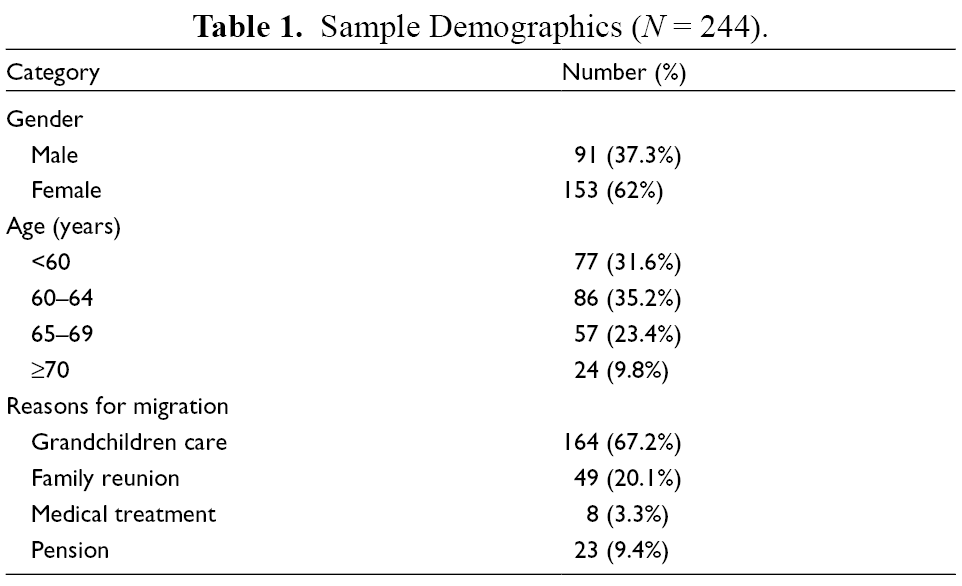
The demographic characteristics of trailing parents in our study are presented in Table 1. Most of the participants were women (62%) and under 70 years old (90.2%). Considering the reasons for immigration, the vast majority of participants chose to take care of their grandchildren (67.2%). Women have a natural advantage in caring for their grandchildren, which explains why more women than men were interviewed.
Sample Demographics (N = 244).
Data Analysis and Results
Reliability and Validity of the Measures
We used IBM SPSS version 22 and Smart Partial Least Squares (PLS) version 3.0 to assess the scales. First, Cronbach’s α, composite reliability (CR), and average variance extraction (AVE) were calculated to verify the reliability of the scales. Results as shown in Table 2, the Cronbach’s α and CR of all constructs are greater than 0.7, and the AVE is greater than 0.5, which mean that the scales and collected data have higher reliability.
Interconstruct Correlations and Average Variance Extraction.

Note. AVE = average variance extraction. Diagonal cells in bold indicate the square root of the AVE of the corresponding construct. Other cells indicate interconstruct correlation coefficients.
Second, the discriminant validity was measured by combining the correlation coefficient of variables and AVE. Table 2 lists the correlation coefficients of the measurement indicators. The results show that the square root of AVE is greater than the correlation coefficient between variables, and the square root of AVE is greater than 0.5, which indicates that the measured constructs have good discriminatory validity and are suitable for path analysis.
Additionally, Harman single factor test was used to check for a common method bias in the collected data (Podsakoff et al., 2003). The primary factor explained 33.35% of the variance, lower than the suggested threshold of 40%, indicating that there exists no serious common method bias in the collected data.
Correlation Analysis
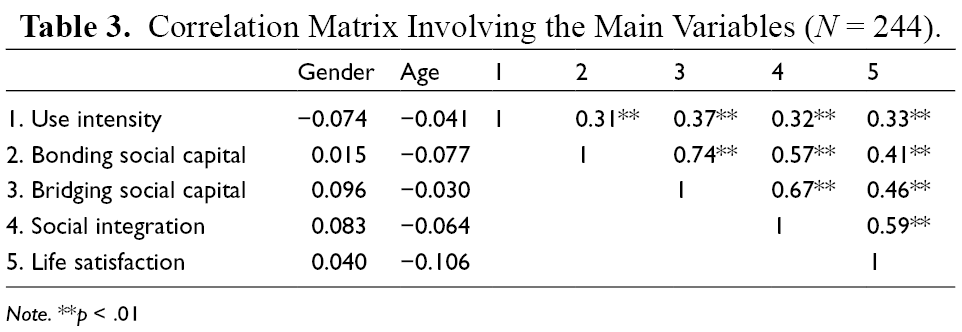
Table 3 shows the intercorrelations among the main variables such as gender, age, use intensity, bonding social capital, bridging social capital, social integration, and life satisfaction. As shown in the table, the relationships between gender, age and use intensity, bonding capital, bridging capital, social integration, life satisfaction are not significant. Use intensity is positively correlated to bonding social capital (r = .31, p < .01), bridging social capital (r = .37, p < .01), social integration (r = .32, p < .01), as well as life satisfaction (r = .33, p < .01), respectively. This denotes that trailing parents with high use intensity may be more likely to obtain social capital, social integration, and life satisfaction. In addition, bonding social capital and bridging social capital are positively related to social integration (r = .57, p < .01; r = .67, p < .01). Finally, as expected, bonding social capital (r = .41, p < .01), bridging social capital (r = .46, p < .01), and social integration (r = .59, p < .01) are all positively correlated with trailing parents’ life satisfaction.
Correlation Matrix Involving the Main Variables (N = 244).
Note. **p < .01
Path Analysis
Partial Least Squares is a parameter estimation method of structural equation model, which has been well applied in the study of social media use in recent years (Argyris et al., 2016). The study adopts Smart PLS 3.0 with a bootstrapping technique (5000 random samples, N = 244). The number of samples 244 is in line with the widely accepted convention, that is, the number of samples in the structural equation model is at least ten times the number of items.
As shown in Figure 2, most of the hypothetical paths are supported. Mobile social media use has a positive impact on the social integration, but it is not significant (β = .071, p > .05), assuming that H1 cannot be fully supported. The impact of MSMU on life satisfaction is positive and significant (β = .168, p < .01), assuming H2 is supported. Mobile social media use has a positive and significant impact on both bonding social capital and bridging social capital (β = .320, p < .001; β = .400, p < .001), supporting H3 and H4, which indicates that trailing parents who use mobile social media are more likely to have access to social capital. Likewise, the impact of bonding social capital and bridging capital on social integration is positive and significant (β = .170, p < .001; β = .526, p < .001), respectively. Assuming that H5 and H7 are supported, they indicate that MSMU has an indirect impact on trailing parents’ social integration mainly through social capital. Although the effects of bonding social capital and bridging social capital on life satisfaction are positive, they are not significant (β = .012, p > .05; β = .072, p > .05), assuming that H6 and H8 cannot be fully supported. Additionally, the path coefficient between social integration and life satisfaction is positive and significant (β = .484, p < .001), supporting H9. This indicates that the perceived social capital of trailing parents may not directly affect their life satisfaction, but mainly indirectly affect it through social integration.

Structural model test results.
The relationship between demographic characteristics and life satisfaction of trailing parents has not been verified. The path coefficients between gender, age and life satisfaction are not significant (β = .007, β = −.066, p > .05). Therefore, the impact of demographic characteristics such as gender and age on the life satisfaction of trailing parents is uncertain.
Discussion
Main Findings
With the development of economy and the acceleration of urbanization, more and more old people move to big cities with their children in the developing countries. Trailing parents have become an important part of the urban elderly population, so it is necessary to study their social integration and life satisfaction in the immigration areas. The purpose of this study is to systematically explore the relationship between MSMU and life satisfaction of trailing parents, including perceived bonding social capital, bridging social capital and social integration. The study argues that two types of social capital play a critical role in the relationship between MSMU and social integration and life satisfaction of trailing parents. Therefore, based on social capital theory and previous research results, this paper constructs an empirical research model, trying to clarify the complex relationship between MSMU and life satisfaction. The results show that MSMU not only directly has a positive impact on life satisfaction of trailing parents, but also indirectly positive influences their life satisfaction through the chain mediation of social capital and social integration.
First, MSMU intensity could directly have a positive impact on trailing parents’ life satisfaction, bonding social capital, and bridging social capital. This implies that the increased MSMU time could improve the connection degree of close and loose social ties. Mobile social media has the functions of communication and interaction, information search, game, and entertainment, which can keep trailing parents in touch with their relatives and friends in different places, and also expand their social circle in the new city and enrich their daily life. The intensity of MSMU was directly proportional to user’s perceived life satisfaction, which was in line with the previous studies (Pang, 2018; Wei & Gao, 2017). Additionally, there is a positive relationship between social media use and perceived social capital (Chen & Li, 2017; Bano et al., 2019), which has also been verified in this study. There is a positive and significant relationship between MSMU and bonding social capital and bridging social capital, respectively.
Some previous studies have shown that MSMU can directly affect the user’s social integration (Pang, 2018), but this is not entirely applicable to trailing parents. Although the correlation coefficient between MSMU and social integration is significant, the path coefficient of the impact of MSMU on social integration is not significant. This study shows that MSMU does not directly affect the social integration of trailing parents, but plays an indirect role through social capital. Trailing parents have the dual characteristics of the elderly and immigrants. They are less proficient in the acceptance and use of new technologies than young people, and need to integrate into the new living environment. Mobile social media operations are relatively simple, trailing parents could use it to interact with friends, and could also play small games on it to pass the time. The use of social purpose can help trailing parents to make friends, accumulate social capital (Pang, 2017), and then help them better integrate into the place of immigration. Conversely, if trailing parents spend a lot of time on the entertainment features of social media and even indulge in the game, it will have a negative impact on their integration into the new environment (Yoo & Jeong, 2017). This difference may be the reason why MSMU cannot directly affect the social integration of trailing parents.
Second, for mobile social media users, they obtained social capital and social integration that may improve their life satisfaction. Compared with those who spend less time on mobile social media, those who spend more time could obtain more social capital, which is consistent with the previous results (Pang, 2018; Bano et al., 2019). Specific to the classification of social capital, bonding social capital and bridging social capital both have a positive and significant impact on the social integration of trailing parents, and the impact coefficient of bridging social capital is greater than that of bonding social capital. This may be due to the fact that bonding social capital mainly comes from the support of acquaintance networks, while bridging social capital comes from the support of relatively unfamiliar social circles. It is more conducive for trailing parents to integrate into the new environment by establishing contacts with various types of friends in the immigration area. However, whether it is bonding social capital or bridging social capital, it cannot directly affect the life satisfaction of trailing parents, but indirectly influence it through the mediation role of social integration. By the use of social media, trailing parents obtain bonding social capital and bridging social capital, which can expand the depth and breadth of their social network, so that they can better integrate into the new living environment, and thus improve their life satisfaction. The findings are consistent with the previous research that social media can indirectly improve people’s well-being by allowing users to interact with loose and close-knit people (Pang, 2018; Raza, 2017; Bano et al., 2019). Therefore, social media has become an indispensable part of people’s daily life (Wen et al., 2016; Yang & Lee, 2018), which could help people to build and expand connections with other members, obtain emotional support and social support, and thus gain better social integration and higher life satisfaction.
Finally, the relationships between gender and age and the main variables are uncertain. Correlation analysis showed that gender and age had no significant relationship with MSMU, bonding social capital, bridging social capital, social integration, and life satisfaction. Additionally, the study added gender and age as control variables to the structural equation model. The results showed that they had no significant impact on the life satisfaction of trailing parents and could not obtain statistical support from the existing samples. That is to say, statistical analysis based on the existing samples cannot prove that gender and age have a significant impact on the relationship between MSMU and life satisfaction of trailing parents.
Theoretical and Practical Implications
This research has made some important contributions in theory. First, the research validates the causal relationship among the important variables such as MSMU, bonding social capital, bridging social capital, social integration, and life satisfaction. Although the existing studies and papers have explored the relationship between MSMU and subjective well-being, and the relationship between MSMU and social capital (Guo et al., 2014; Bano et al., 2019), the study on trailing parents’ MSMU behavior and its impact on their social integration and life satisfaction is very scarce. This study confirms that there is a significant positive correlation between MSMU and the life satisfaction of trailing parents, and further clarifies how the time and energy spent on mobile social media affect their life satisfaction. Second, the study constructs a mediation model. The results show that there is a chain mediation of social capital and social integration on the impact of MSMU on trailing parents’ life satisfaction, which has not been mentioned in the previous studies. Therefore, this study expands the breadth and depth of research in this field.
Furthermore, the current work also has several significant implications for practice. The results show that the time spent on social media can help trailing parents to achieve better social integration and higher life satisfaction. Thus, if designers pay more attention to the social function of social media, and consider the characteristics of information technology acceptance and use of the elderly, social media may improve the quality of life of trailing parents and even the whole elderly group. Additionally, the transaction between individuals through cyberspace could contribute to people’s psychological and social adjustment (Zhan et al., 2016). Therefore, the community organizes diverse and interesting online activities via social media, which may help trailing parents to expand their social network, and then obtain higher life satisfaction. In addition, the study confirms that social integration plays a very important role in the life satisfaction of tailing parents. Accordingly, the government and community should attach great importance to the social integration of trialing parents, and help them integrate into the new living environment by organizing various online and offline activities.
Limitations and Future Study
There are still some limitations in the present work, which should be taken into account in future study. First, trailing parents in Hefei City were selected as the subjects of the survey and the sample was obtained by a convenient sampling method. The conclusions drawn on this basis may not accurately reflect the MSMU of trailing parents. Future studies need to expand the scope of the survey and improve the way of investigation. Second, the use of technology is influenced by cultural backgrounds: cultural diversity and difference within different provinces of China and even within the same province (Al-Emadi & Al-Asmakh, 2006). The study did not fully consider the multicultural attributes of trailing parents, and future research can focus on the correspondence between different cultural dimensions and MSMU of trailing parents. Third, the study selected cross-sectional data (Hu et al., 2017), which may affect the causal relationship between variables. In addition to the path built in the model, there may be other impact paths. Follow-up studies can conduct the longitudinal studies to further validate the research model. Finally, the study added gender and age as control variables to the study model, but did not independently analyze the sample of different gender and age groups. Future studies can group respondents according to gender and age, and systematically analyze whether there are differences among different groups.
Conclusion
Many developing countries such as China have entered an aging society, and trailing parents are an important part of their elderly population. Based on the theory of social capital, a structural equation model of the relationship between MSMU and social capital, social integration and life satisfaction of trailing parents has been established and validated. The results show that MSMU can influence the life satisfaction of trailing parents through the chain mediation of social capital and social integration. Therefore, paying attention to the MSMU behavior of trailing parents and using social media to carry out communication and interaction activities can effectively help them to integrate into the new living environment and obtain higher life satisfaction.
Footnotes
Declaration of Conflicting Interests
The authors declared no potential conflicts of interest with respect to the research, authorship, and/or publication of this article.
Funding
The authors disclosed receipt of the following financial support for the research, authorship, and/or publication of this article: This study is funded by the National Natural Science Foundation of China (71771075, 71771077).

Author Biographies