



Abstract
We investigated gender segregation and its correlates in the friendships of U.S. adults aged 50–74 years (177 women; 52 men). Gender segregation existed in our midlife sample such that 74% of friend nominations were same gender. Similar to research on other periods of the adult lifespan we found that for women, gender segregation was negatively correlated with competitive activity orientation, positively correlated with beliefs about same-gender peers’ communicative responsiveness and negatively correlated with beliefs about other-gender peers’ communicative responsiveness. Women’s gender segregation was also negatively correlated with masculinity and positively correlated with gender-reference group identity. For men, gender segregation was negatively correlated with beliefs about other-gender peers’ communicative responsiveness and positively correlated with gender-reference group identity. Our results suggest that gender segregation continues to exist at midlife and that there is some continuity in the correlates of gender segregation across adulthood.
Keywords
Gender segregation, the tendency for people to primarily spend time with and form friendships with same-gender peers, is a pervasive and well-documented feature of friendships during childhood (Fabes et al., 2003; Hoffmann & Powlishta, 2001; Maccoby & Jacklin, 1987; Martin et al., 2013; Mehta & Strough, 2009; Thorne & Luria, 1986), adolescence (Mehta & Strough, 2010), and emerging adulthood (Mehta & Dementieva, 2017; Mehta, Hojjat, et al., 2017). Little is known, however, about gender segregation in the friendships of those at midlife and beyond.
As people age, social roles change and social networks narrow (Alpert, 2017). Gender segregation may contribute to the narrowing social networks by promoting beliefs that it is only appropriate to be friends with those of the same gender (Werking, 1997). Loneliness, believed to impact older adults’ mental and physical health (Cacioppo et al., 2014; Newall & Menec, 2019; Taylor et al., 2018) tends to be higher among those with limited social networks (Capitanio et al., 2014).
One explanation for this omission is that research on younger, middle-aged, and older adults tends to focus on the formation and maintenance of heterosexual romantic relationships (see Monsour, 2002; Rawlins & Rawlins, 1992, for reviews). Consequently, features of adults’ friendships have been neglected (Blieszner & Ogletree, 2017; Sherman et al., 2000). It is important to better understand features of adults’ friendships, including gender segregation, because changes in traditional heterosexual family structures and increased diversity in adults’ relationships (Jamieson et al., 2006) have led to increased significance of friendships in the lives of adults (Gray, 2009). People often feel less ambivalent about friends than they do family (Sherman et al., 2000) and friendships contribute to adults’ well-being by providing support, increasing happiness, and providing companionship and camaraderie (Rawlins, 2009; Sherman et al., 2000).
Gender segregation is an important phenomenon to understand because of its potential consequences. Gender segregation is associated with beliefs that it is only appropriate to have same-gender friendships (Werking, 1997), something that may be especially problematic when seeking to combat social isolation in later life as friendship pools start to shrink (Mehta & Strough, 2009). In addition, it has been suggested that gender segregation may lead to gender-typing (Mehta & Strough, 2010) and sexism (Keener et al., 2013; Leaper, 1994), which in turn contributes to gender inequality (Mehta & Strough, 2009) and widespread sexual harassment and assault (Fedina et al., 2018). This suggests that the potential consequences of gender-segregated friendships are far reaching and that even in a time of changing gender norms, segregation by gender in friendships and acquaintanceships may serve to maintain beliefs that men and women are fundamentally different, while also sustaining a larger gendered cultural system in which gender-related harassment and sexual assault continue to occur.
In the present study, we investigated gender segregation and its correlates in a sample of midlife and older adults aged 50–74, the age range defined as midlife in the midlife in the United States (Brim et al., 2004) study. Specifically, we explored whether gender segregation exists in this period of adulthood and whether gender segregation is associated with the same correlates that it is associated with in childhood—competitive and co-operative activity orientation, perceived communicative efficacy and responsiveness of same- and other-gender peers, and gender identity.
Gender Segregation in Adulthood
In comparison to research in childhood and adolescence, little research has examined friendship and gender segregation in midlife and the young old (from here on referred to simply as midlife; Cameron, 2005; Monsour, 2002; Roberto & Scott, 1986; Sherman et al., 2000). Research that does exist was conducted in in the 1980s and 1990s. There are likely to be cohort differences in gender segregation and as social networks are shrinking due to increased geographic mobility and less stable family structures it is important to understand whether gender segregation exists in midlife in the 21st century.
Research from the 20th century on gender segregation at midlife suggests that although cross-gender friendships are more common in adulthood than in childhood, midlife adults still segregate by gender and report having more same-gender than cross-gender friends (Bell, 1981; Monsour, 1997; Sherman et al., 2000). A study of adults’ friendships in a housing project found that 73% of the friends reported by participants were of the same gender (Nahemow & Lawton, 1975). Another classic study investigating the friendships of married people at midlife found that almost half of the women (47%) and a third of men (33%) surveyed did not have a single cross-gender friend besides their spouse (Rose, 1985).
While same-gender friendships are far more common in midlife than cross-gender friendships, heterosexual people may form some cross-gender friendships through their cross-gender romantic relationships. The formation of long-lasting romantic relationships often leads to an overlap in friendship networks (Milardo, 1982). Heterosexual marriage has been found to expand social networks, especially for men, who often rely on their spouse to connect them to friends and family (Antonucci, 2001). As the romantic partner also shares the friendship these couple friendships provide adults with an avenue to form and maintain cross-gender friendships in a way that does not threaten the romantic relationship (Bendtschneider & Duck, 1993).
Gender segregation is also common in the friendships of older adults (aged 65 and above; Adams, 1985; Adams et al., 2000; Babchuk & Anderson, 1989; Cameron, 2005; Jones & Vaughan, 1990; O’Connor, 1993). For instance, married older adults and older single women report more same-gender friends than other-gender friends (Akiyama et al., 1996). In a sample of older adults with a mean age of 70, 100% of single and married older women and 90% of married men reported having a best friend of the same gender (Jones & Vaughan, 1990).
Gender-segregated friendships may be more pronounced for older women than for older men (Akiyama et al., 1996; Dykstra, 1990). Gender differences in longevity mean that later in life same-age peers are predominately female. This may limit older womens’ opportunities to form cross-gender friendships. Consistent with this theory, older adult men are more likely than older adult women to report having friends of the other gender (Jones & Vaughan, 1990; Wright, 1989)—unmarried older men are two times more likely to report a close cross-gender friendship than unmarried older women (Akiyama et al., 1996).
Taken together, this research suggests that gender segregation may be a feature of friendships that is developmentally continuous across the lifespan, all the way from childhood to older adulthood. Gender segregation may exist in adult friendships for a number of reasons. First, as cross-gender friendships are uncommon in adulthood, cultural rules, scripts, and role models that may enable or promote cross-gender friendships and interactions are limited (O’Meara, 1989; Werking, 1997). Additionally, in adulthood there may be few opportunity structures in place that facilitate cross-gender friendship formation (O’Meara, 1989). For example, gender divisions in the workplace (see Bureau of Labor Statistics, 2020) and the competing demands of work, home, and leisure (Bianchi, 2011; Keizer & Schenk, 2012) may provide few opportunities for people to interact with and subsequently build friendships with cross-gender peers.
Research on gender segregation in childhood (e.g., Martin & Fabes, 2001), adolescence (e.g., Mehta & Strough, 2010), emerging adulthood (18–29, e.g., Mehta, Hojjat, et al., 2017), and established adulthood (30–45, e.g., Mehta & Smith, 2019; Mehta & Wilson, 2020) suggests that gender segregation may be associated with behavioral compatibility, communication style, and gender identity. In the present study we assessed not only whether gender segregation exists at midlife, but also whether developmental continuity exists in the associations between gender segregation and its correlates in middle adulthood. Research on these correlates using younger samples is discussed in more depth below.
Potential Correlates of Gender Segregation in Adulthood
Behavioral Compatibility
Because gender segregation is such a pervasive feature of childhood friendships, researchers and theorists have posited that girls and boys are ostensibly raised in two separate cultures (Underwood, 2007). These separate cultures then socialize children such that they develop gender-specific activity preferences and interests (Maccoby, 1990, 1998; Underwood, 2007; Underwood & Rosen, 2009). When children select friends, they may choose children that they believe may have similar interests and activity preferences to them—typically same-gender children who have been raised in the same-gender culture (Elsesser & Peplau, 2006; Martin et al., 2005).
Research has supported behavioral compatibility theory in childhood (Martin et al., 2005; Martin & Fabes, 2001), adolescence (Mehta & Strough, 2010), and established adulthood (Mehta & Wilson, 2020). Specifically, this research found that those who endorsed greater gender-typed activity orientations nominated more same-gender friends. To the best of our knowledge, however, no research has investigated associations between gender-typed activity orientations and gender segregation in midlife. If there is developmental continuity in people’s preference for friends with gender-typed activity orientations similar to their own, we would expect to find an association between gender segregation and gender-typed activity orientation in adulthood.
In order for perceived behavioral compatibility to be associated with gender segregation in adulthood, adults, like children, would first have to endorse an orientation toward gender-typed activities. Little is known about gender-typed activity orientation in adulthood. However, there is some evidence that emerging adults, like children and adolescents, demonstrate a preference for gender-typed activities. For instance, emerging adult males report greater participation than emerging adult females in activities that use physical skill, strategy, and chance, such as videogames (Hamlen, 2010; Ogletree & Drake, 2007) and sports (Slater & Tiggemann, 2011). Emerging adult women report greater participation in social activities and spend more time than emerging adult men interacting with friends and family (Blieszner & Adams, 1998; Klonsky, 1985; Mobily et al., 1986). If men continue to show an orientation toward competitive activities and women continue to show an orientation toward co-operative activities at midlife, these differences in activity orientation may contribute to gender segregation in midlife adults.
Perceived Communicative Responsiveness of the Same- and the Other Gender
Gender-typed communication styles have been proposed as potential causes and/or consequences of gender segregation in childhood and adolescence (e.g., Leaper, 1994; Mehta & Strough, 2010). For example, gender segregation may exist in childhood because boys are resistant to girls’ attempts to influence them and girls do not like interacting with those who are unresponsive and do not accept their influence (Maccoby, 1998). Research in adulthood also suggests that much like in childhood, men do not like to accept influence from women (Carli, 2001). Consequently, girls and women may choose to avoid interacting with boys and men and seek out interactions with those who have similar interaction styles—other girls/women. This has been supported in research with established adults. Specifically, beliefs that same-gender peers were more responsive in conversation and beliefs that other-gender peers were less responsive in conversation were associated with gender segregation for both women and men (Mehta & Wilson, 2020).
To date, there is no published empirical research investigating communicative responsiveness and gender segregation at midlife. As such, in the present study we investigated the association between midlife adults’ beliefs about the greater communicative responsiveness of same- and other-gender peers, and gender segregation.
Gender Identity
In the current study we examined the association between gender segregation and two aspects of gender identity conceptualized by Wood and Eagly (2015). These aspects of gender identity are gender identity as gender-typed personality traits, and gender identity as gender self-categorization.
The first aspect of gender identity identified by Wood and Eagly (2015) is gender-typed personality traits. Gender-typed personality traits are gender stereotypical attributes and characteristics that map onto stereotypical feminine and masculine gender roles (Tobin et al., 2010). Feminine gender-typed personality traits, also described as expressive/communal traits, include passivity and sensitivity to others’ needs. Masculine gender-typed personality traits, also described as agentic/instrumental traits, include dominance and aggressiveness (Bem, 1974; Spence et al., 1974).
Little is known about the association between gender segregation and gender-typed personality traits in adults at midlife. However, some research has investigated these associations in emerging and established adult samples. These research findings are inconsistent. For example, while some research has found no associations between gender segregation and gender-typed personality traits in emerging adults (Mehta, Hojjat, et al., 2017), other research has found an association between gender segregation and greater masculinity for emerging adult men (Twenge, 1999). In addition, research has found that emerging adult men who endorsed feminine traits and emerging adult women who endorsed masculine traits had more cross-gender friendships (i.e., less gender segregation) than emerging adult men who endorsed masculine traits and emerging adult women who endorsed feminine traits (Reeder, 2003). To the best of our knowledge, only one study has investigated associations between gender segregation and gender-typed traits in established adulthood. This research found that gender segregation was positively associated with feminine traits for adult women but was not associated with masculine traits for men.
Wood and Eagly’s (2015) second aspect of gender identity is gender identity based on self-categorization. A self-categorization approach to gender focuses on an individual’s identification with a larger gender group. This approach includes gender-reference group identity, defined as the extent to which a person identifies with and feels psychologically connected to their gender (Kulis et al., 2002; Michealieu, 1997; Tajfel, 1981; Tobin et al., 2010; Turner, 1982; Wade, 2008).
Strongly identifying with a group is believed to lead people to positively evaluate that group (Amiot & Aubin, 2013). These positive feelings toward the group then increase the investment and the amount of time a person puts into the group (Arthur et al., 2008; Bigler et al., 1997; Tarrant, 2002). Consequently, those who feel positive about their gender group (i.e., gender-reference group identity) may spend more time with this group, developing close relationships with same-gender group members who are similar to them (Deaux & Martin, 2003; Reicher et al., 2010). To date only four studies have investigated friendships and gender-reference group identity in any age group. This research found that gender-reference group identity is associated with gender segregation in adolescent girls (Mehta & Strough, 2010), in emerging adult women (Mehta et al., 2014, Mehta, Hojjat, et al., 2017) and men (Mehta, Hojjat, et al., 2017), and in established adult women and men (Mehta & Wilson, 2020). Based on this research we expected that gender segregation would be associated with gender-reference group identity in our sample of midlife adults.
The Present Study
We know little about whether gender segregation exists in adults’ friendships at midlife, and even less about whether correlates of gender segregation in childhood, adolescence, and emerging adulthood are correlates of gender segregation in adulthood. In the present study, we investigated gender segregation and its association with gender-related variables in a sample of midlife adults aged 50–74, the range defined as midlife by the MIDUS study. Specifically, we explored whether gender segregation occurs in friendships at midlife and whether there is developmental continuity in the correlates of gender segregation that have been documented in childhood, emerging adulthood, and established adulthood. To this end, we investigated the association between gender segregation and competitive and co-operative activity orientation, perceived communicative responsiveness of the same- and other-gender peers, communication efficacy with same- and other gender peers, gender-typed personality traits, and gender-reference group identity.
Hypotheses
Gender Segregation
Based on prior research conducted with adolescents (Mehta & Strough, 2010), emerging adults (Mehta et al., 2014, Mehta, Hojjat, et al., 2017), and established adults (Mehta & Wilson, 2020), we hypothesized that gender segregation would exist in adults aged between 50 and 74 (H1). Specifically, we hypothesized that both men and women would report associating with same-gender peers at a greater proportion than would be expected by chance. We tested this hypothesis by comparing the proportion of same-gender friends reported by participants to .5—the proportion of same-gender friends we would expect adults to report based on chance. This is the most commonly used approach for establishing the existence of gender segregation (e.g., Mehta et al., 2014, Mehta, Hojjat, et al., 2017, Mehta & Strough, 2010; Mehta & Wilson, 2020).
Associations Between Gender Segregation and Co-operative and Competitive Activity Orientation
Based on behavioral compatibility research in childhood (Martin et al., 2005; Martin & Fabes, 2001), adolescence (Mehta & Strough, 2010), and established adulthood (Mehta & Wilson, 2020) we hypothesized that gender segregation would be associated with activity orientation in midlife adults. Specifically, we hypothesized that gender segregation would be positively associated with co-operative activity orientation (H2a) and negatively associated with competitive activity orientation for women (H2b) and that gender segregation would be negatively associated with co-operative activity orientation (H2c) and positively associated with competitive activity orientation for men (H2d).
Associations Between Gender Segregation and Communication Beliefs
Based on research with established adults (Mehta & Strough, 2010) we hypothesized that gender segregation would be associated with adults’ beliefs about the communicative responsiveness of, and their own communicative efficacy with, same- versus other-gender peers. Specifically, we hypothesized that believing that same-gender peers are more responsive during conversation would be positively associated with gender segregation in adults for women (H3a) and men (H3b). We also hypothesized that believing that the other-gender are less responsive during conversation would be positively associated with gender segregation for women (H3c) and for men (H3d).
Associations Between Gender Segregation and Gender Identity
Based on previous research with established adults (Mehta & Wilson, 2020), we hypothesized that gender segregation would be positively associated with gender-typed personality traits and gender-reference group identity at midlife. Specifically, we hypothesized that for women at midlife, gender segregation would be positively associated with femininity/expressivity (H4a) and negatively associated with masculinity/instrumentality (H4b). For men at midlife, we hypothesized that gender segregation would be positively associated with masculinity/instrumentality (H4c) and negatively associated with femininity/expressivity (H4d). Finally, we hypothesized that gender segregation would be associated with gender-reference group identity for both women (H4e) and men at midlife (H4f).
Methods
Participants
Participants were 177 (77.3%) women and 52 (22.7%) men aged 50–74 years (M = 58.58, SD = 76.26) recruited from Amazon’s Mechanical Turk (MTurk). MTurk is an online survey recruitment platform created by Amazon that brings together ‘‘requesters’’ who compensate ‘‘workers’’ for completing tasks (Buhrmester et al., 2011). All participants were from the United States. The majority of participants were White (87.3%), had a college degree or higher (60.8%), and were employed working 40 hours a week or more (31.4%). Further demographic information is included in Table 1.
Sample Demographics.

Note. M = mean; SD = standard deviation.
Measures
Means and standard deviations for each measure described below can be found in Table 2.
Means and Standard Deviations for Study Variables by Participants’ Gender.
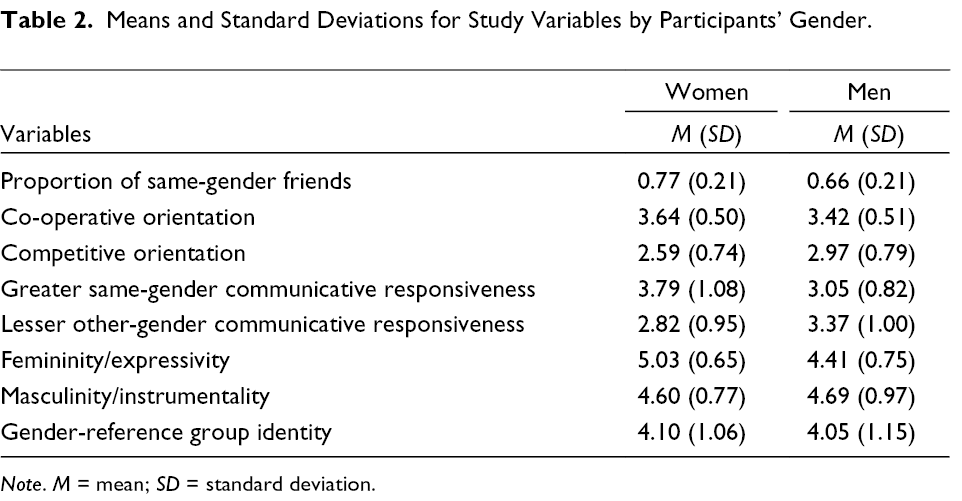
Note. M = mean; SD = standard deviation.
Peer Nomination
To assess gender segregation in adults’ friendships, we used Strough and Covatto’s (2002) peer nomination measure. Participants nominated five people that they considered to be their closest friends and who they would want to “hang out” with. Participants were instructed to list each person in order of preference and to indicate the person’s gender. The proportion of same-gender nominations was calculated by dividing the number of same- gender friends nominated by 5. The average proportion of same-gender friends reported by participants was .74 (SD = .21; women = .77, SD = .21; men = .66, SD = .21).
Cooperative and Competitive Activity Orientation
A 28-item scale assessed adults’ co-operative and competitive orientation. Fourteen items assessed preferences for co-operation (e.g., I try to avoid arguments) and 14 items assessed preferences for competition (e.g., I often try to outperform my friends). Items were rated on a scale from 1 (strongly disagree) to 5 (strongly agree). Scores for co-operative and competitive orientations were computed separately for women and men. Cronbach’s α was .75 for women and .78 for men for the co-operative orientation scale and .90 for women and .92 for men for the competitive orientation scale.
Communication Beliefs
Participants rated six statements related to their beliefs about the responsiveness of same- and other-gender peers during conversation. Three statements referred to beliefs that women are more responsive during conversation (e.g., I would rather talk to females than to males because females are better listener) and three statements referred to beliefs that men are more responsive during conversation (e.g., I would rather talk to males than to females because males are better listeners). Participants rated each statement on a scale from 1 (strongly disagree) to 6 (strongly agree). Scores were computed based on gender and higher scores across the three items referring to same-gender communication indicated that participants felt same-gender peers were more responsive during conversation. Higher scores across the three items referring to other-gender communication indicated that participants felt other-gender peers were more responsive during conversation. Cronbach’s α for this scale was .86 for women and .72 for men.
Gender Identity
The Bem Sex Role Inventory (BSRI; Bem, 1974) assessed midlife adults’ endorsement of gender-typed personality traits (i.e., feminine/expressive traits and masculine/agentic traits). The BSRI is a list of 20 feminine (e.g., sympathetic, tender), 20 masculine (e.g., dominant, competitive), and 20 neutral (e.g., happy, truthful) adjectives. Participants rated how true they believed each adjective was for them on a scale ranging from 1 (never or almost never true) to 7 (almost always true). Cronbach’s α for feminine/expressive traits was .81 for women and .86 for men. Cronbach’s α for masculine/agentic traits was .87 for women and .93 for men.
Participants’ affiliation with their own gender as a gender-reference group was assessed using Michealieu’s (1997) gender identity subscale. Women answered questions about their identification with females and men answered questions about their identification with males. Participants rated four items (e.g., usually, I identify with females more than with males; being a male is an important part of who I am) on a scale from 1 (strongly disagree) to 6 (strongly agree). Cronbach’s α was .76 for women and .84 for men.
Results
Gender Segregation in Adults
We tested Hypothesis 1, that there would be gender segregation in adult’s friendships at midlife, using a one-sample t-test. Specifically, we assessed whether adults at midlife reported a greater proportion of same-gender friends than would be expected by chance by comparing the proportion of same-gender friends reported to .50. The proportion of same-gender friends reported (M = .74, SD = .21) was significantly greater than would be expected by chance, t(1, 228)=17.15, p < .001, supporting our first hypothesis. This proportion was similar for women (M = .77, SD = .21, range = .20–1.00, t(1, 176)=16.94, p < .001) and men (M = .66, SD = .21, range = .20–1.00, t(1, 51)=5.49, p < .001).
Gender Segregation and Gender-Related Variables
To assess the associations between gender segregation and gender-related variables we conducted correlations. Correlations can be found in Table 3.
Correlations Between All Variables.
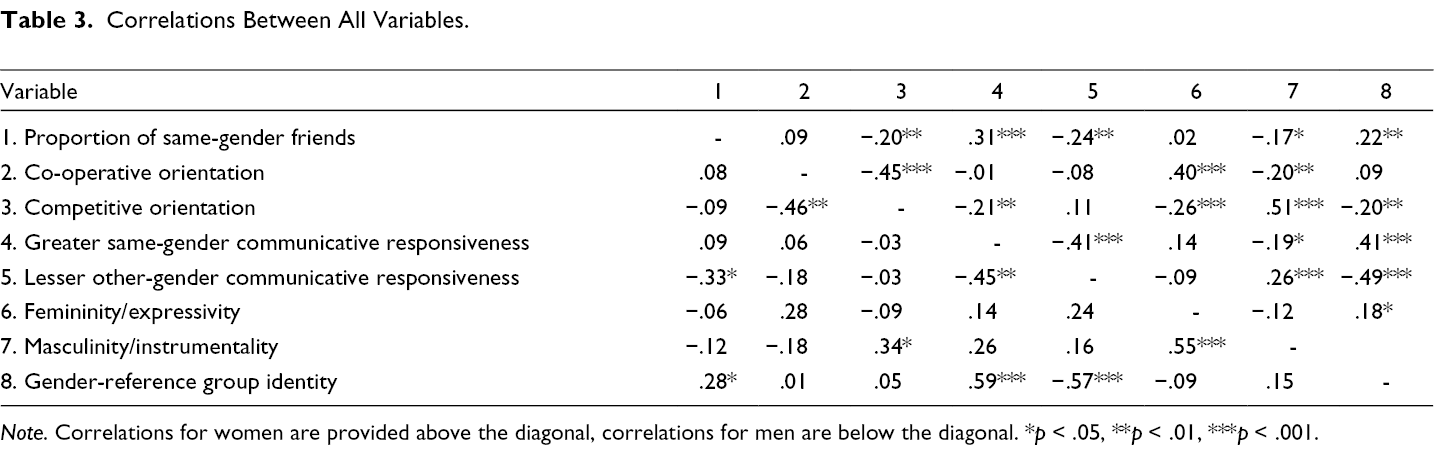
Note. Correlations for women are provided above the diagonal, correlations for men are below the diagonal. *p < .05, **p < .01, ***p < .001.
Associations Between Gender Segregation and Co-operative and Competitive Activity Orientation
Hypothesis 2a, that gender segregation would be positively associated with co-operative activity orientation for women, was not supported. However, hypothesis 2b, that gender segregation would be negatively associated with competitive activity orientation for women, was supported. Hypothesis 2c, that gender segregation would be negatively associated with co-operative orientation and Hypothesis 2d, that gender segregation would be positively associated with competitive activity orientation for men, were not supported.
Associations Between Gender Segregation and Communication Beliefs
Our hypotheses that believing that same-gender peers are more responsive during conversation would be positively associated with gender segregation for women was supported (H3a) but not for men (H3b). However, believing that the other-gender peers are less responsive during conversation was associated with gender segregation in both women (H3c) and men (H3d).
Associations Between Gender Segregation and Gender Identity
Our hypothesis that for women at midlife, gender segregation would be positively associated with femininity/expressivity (H4a), was not supported. However, Hypothesis 4b, that gender segregation would be negatively associated with masculinity/instrumentality, was supported. Gender segregation was not associated with masculinity/instrumentality (H4c) or femininity/expressivity (H4d) for men at midlife. Finally, we found that gender segregation was associated with gender-reference group identity for both women (H4e) and men (H4f) at midlife.
Discussion
Our results build on past research that has documented the existence of gender segregation in childhood, adolescence, emerging adulthood, and established adulthood. That gender segregation also exists in friendships with peers at midlife suggests that gender segregation is a developmentally continuous phenomenon that exists way beyond childhood. Our results also suggest developmental continuity in the correlates of gender segregation across the lifespan. As in other periods of adulthood we found that gender segregation was associated with activity orientation for women and beliefs about communication for women and men. Gender segregation was also associated with gender-typed personality traits for women and gender-reference group identity for both women and men. We elaborate on these findings below.
Gender Segregation in Adulthood
Gender segregation has been widely documented in the friendships of children and more recently in the friendships of adolescents (e.g., Mehta & Strough, 2010), emerging adults (e.g., Mehta, Hojjat, et al., 2017), and established adults (Mehta & Wilson, 2020). We hypothesized that there would be developmental continuity in this phenomenon such that gender segregation would continue to be a feature of friendships at midlife (H1). This hypothesis was supported—both men and women at midlife reported more same-gender friends than would be expected by chance.
Previous research has found that gender segregation exists in emerging (DiDonato & Strough, 2013; Mehta et al., 2017) and established adults’ (Mehta & Wilson, 2020) friendships. That gender segregation also exists in adults aged 50–74 supports theory that gender segregation may be a lifelong phenomenon that occurs from childhood well into adulthood (Mehta & Strough, 2009).
Theoretical work suggests that gender segregation may exist because there is a limited availability of role models and cultural scripts for cross-gender friendships (O’Meara, 1989; Werking, 1997). In addition, there may be fewer opportunity structures for cross-gender friendship formation at midlife (O’Meara, 1989) especially for those who work in gender-segregated professions, or those who are no longer working at all. The homosocial norm—the belief that friendships should only occur between people of the same gender—also inhibits the formation of cross-gender friendships (Monsour, 2002; Rose, 1985), which may especially be the case for older people. In our culture heterosexuality is positioned as normative, leading cross-gender friendships to be met with suspicion and disapproval (Savin-Williams, 2005) especially if one or both of the friends have spouses (O’Meara, 1989). This is exacerbated for older adults who believe that others, including children and their same-age peers, would believe that they were behaving “improperly” and would “talk” if they associated with peers of the other gender (Adams, 1985).
Potential Correlates of Gender Segregation in Adulthood
Behavioral Compatibility: Activity Orientation
Behavioral compatibility theory (Martin et al., 2005; Martin & Fabes, 2001) posits that people select friends with similar activity orientations to them and that because of perceived gender differences in activity orientation, selected friends tend to be of the same gender. Research has suggested that behavioral compatibility is associated with gender segregation in childhood and adolescence (Martin et al., 2005; Martin & Fabes, 2001; Mehta & Strough, 2010). To the best of our knowledge, our study is the first to investigate the association between gender segregation and behavioral compatibility in midlife and older adults.
Behavioral compatibility theory was partially supported in our sample of mid- and older adults. Gender segregation was associated with activity orientations for mid- and older adult women but not for mid- and older adult men. Specifically, for women, gender segregation was positively associated with co-operative activity orientation (H2) and negatively associated with competitive activity orientation (H2a).
This pattern of results is similar to research conducted with adolescents, emerging adults, and established adults. Girls and women are generally believed value co-operation more than men (Eagly, 2009; Maccoby, 1990; Rose & Rudolph, 2006; Schneider et al., 2011). It could be that girls and women across the lifespan have integrated a preference for co-operation into their self-concepts and into their conceptualizations of other women (Eagly & Wood, 2011; Witt & Wood, 2010). These beliefs may then lead girls and women across the lifespan to seek out those with similar co-operative orientations, contributing to gender segregation in friendships.
Research on competition and friendships is rare in adulthood. Research that does exist focuses on competition in the workplace. In this setting women perceive competition as less desirable and acceptable than men do (Lee et al., 2016). In addition, when women are forced to compete, they experience more negative emotions and perceive more negative relational outcomes than men (Lee et al., 2016) If women at midlife do not enjoy competing, they may select primarily female friends based on beliefs that women are less competitive.
While there is an abundance of research and theory suggesting that women are more co-operative and less competitive than men, meta-analyses do not find meaningful gender differences in co-operation or competition (Balliet et al., 2011; Hyde, 2005). Consequently, gender stereotypes rather than actual gender differences may lead people to make judgments about their preferences. Specifically, women at midlife may select same-gender peers as friends based on beliefs that women are more co-operative and less competitive. In this way, gendered stereotypes of women as more co-operative and less competitive do not have to be truthful to influence women’s friendship selections.
Although gender segregation was associated with activity orientation for women it was not associated with gender segregation for men. Research often suggests that men are more competitive than women and engage in competitive activities, such as sport, to a greater extent than women (Slater & Tiggemann, 2014). It is important to note, however, that even competitive activities have co-operative components. For example, members of a sports team work together co-operatively to win a game. Consequently, men’s beliefs about activity orientation may not influence the friends they choose. Men’s friendships are believed to be activity based and have been described as side-by-side while women’s friendships that are largely conversation based have been described as face-to-face (Blieszner & Adams, 1998; Werking, 1997; Wright, 1982). Thus, it could be that men select friends who enjoy participating in activities regardless of whether these activities are competitively or co-operatively oriented.
Perceived Communicative Responsiveness of the Same- and the Other-Gender
We found that gender segregation was associated with perceived communicative responsiveness. Specifically, for women, gender segregation was associated with the belief that other women were more responsive in conversation (H3a) and that men were less responsive (H3b). For men, gender segregation was associated with beliefs that women were less responsive in conversation (H3d).
Gender-typed communication styles have been proposed to be causes and/or consequences of gender segregation in childhood and adolescence (e.g., Leaper, 1994; Mehta & Strough, 2010). This rich literature suggests that girls’ and boys’ communication styles are so different and so pervasive that cross-gender conversation is similar to cross-cultural communication (Maccoby, 1990, 1998; Underwood, 2007; Underwood & Rosen, 2009). Specifically, while girls engage in turn taking, active listening, and express agreement (e.g., Strough & Berg, 2000), boys engage in grandstanding (Maccoby, 1998), compete to control the conversation, and engage in very little active listening (Black, 2000).
People seek out interactions with those who have similar interaction styles—which, given gender differences in communication style, are likely to be those of the same gender (Mehta & Strough, 2010). Recent research has found an association between perceptions of communicative responsiveness and gender segregation in established adults, aged 30–45 (Mehta & Wilson, 2020). Similar qualitative research with established adults shows that people report preferring to talk to peers of the same gender because they believe that they have more in common (Mehta & Smith, 2019). That gender segregation is associated with perceptions of communicative responsiveness in a sample of adults aged 55–74 suggests a continuation, at least in perceptions of differences in communication style, into middle and older adulthood. It also suggests that these perceptions or communicative responsiveness may influence who adults choose to interact and be friends with.
Gender Identity
Our hypothesis that gender segregation would be associated with aspects of gender identity was partially supported. Specifically, gender segregation was negatively associated with masculinity for women (H4b) and with gender-reference group identity for both women and men (H4C and H4D, respectively).
Research on the associations between gender segregation and gender-typed personality traits with emerging and established adults is mixed. For example, some research with emerging adults has found no associations between gender segregation and femininity and masculinity (Mehta et al., 2017) while other research has found as association between gender segregation and masculinity for men (Twenge, 1999). As noted above, in our study masculinity was not associated with gender segregation in men but was negatively associated gender segregation in women. Our findings may differ from studies with emerging and established adults because our sample was composed of midlife and young-old older adults.
Behavioral compatibility theory suggests that people seek out friendships with those who they believe have similar traits to themselves—in this case, other women. That women who score low on the endorsement of masculine traits have greater gender segregation in their friendships provides some support for behavioral compatibility theory. Some of the masculine items included on measures of gender-typing, such as assertiveness, aggressiveness, and competition, may be viewed as negative traits. Consequently, these may be traits that midlife women do not endorse in themselves and also find undesirable in friends and acquaintances. Research suggests that as people get older, they try to maximize positive experiences (Scheibe et al., 2013). Trying to minimize traits that are potentially perceived as negative by women, such as aggressiveness, in oneself and in ones’ friends may reflect this predisposition toward positive affect.
In our sample of men aged 55–74, we found no association between gender segregation and gender-typed traits. This is consistent with research conducted with emerging (Mehta et al., 2017) and established adults (Mehta & Wilson, 2020). This finding suggests developmental continuity in the correlates of gender segregation from emerging adulthood and established adulthood into mid- and later life. Alternatively, in line with degendering theory (Silver, 2003) it could be that for men at least, gender becomes less central to identity with age. As such, gender-typed traits may be related to mid- and older adult men’s friendship selection.
For both men and women in our sample gender segregation was associated with gender-reference group identity—the degree to which a person identifies with and feels psychologically connected to their gender (Kulis et al., 2002; Michealieu, 1997; Tajfel, 1981; Tobin et al., 2010; Turner, 1982; Wade, 2008). This finding is consistent with gender segregation research from other periods of the lifespan—gender segregation has been found to be associated with gender-reference group identity in emerging adult women and men (Mehta et al., 2017) and in established adult women and men (Mehta & Wilson, 2020). That gender segregation is also associated with reference group identity in mid- and older adults highlights the robustness of this finding and provides some evidence for continuity in the correlates of gender segregation, at least in adulthood.
Limitations and Future Directions
To the best of our knowledge our study is the first to examine gender segregation in adults at midlife. However, it is important to interpret our novel results in the context of the study’s limitations. First, our sample was mostly composed of women. Consequently, we may not have had the statistical power to detect associations between gender segregation and gender-related variables for men. Second, our sample lacked diversity. Participants were largely White, highly educated, and had computer and internet access that enabled them to access our survey on Amazon’s MTurk. This means that our findings may not generalize to midlife adults with different ethnic/racial, educational, and socioeconomic backgrounds. To gain a more comprehensive understanding of gender segregation and its correlates at midlife this study should be replicated with diverse samples. Third, we measured gender segregation using a self-report measure. Consequently, participants may have listed friends who they do not see regularly or have lost touch with and/or may have listed acquaintances with whom they spend little time. While experience sampling methodology has been used to measure gender segregation in emerging adults (e.g., Mehta & Dementieva, 2017), such methods may be burdensome for midlife adults. Future research with midlife adults could utilize daily diary methods to measure gender segregation, asking participants to record who they saw and spent time with each day over a period of a week or two. Fourth, similar to many studies in psychology, our data are cross-sectional. As such, we know little about causality or potential reciprocal processes between gender segregation and its correlates. Future research using longitudinal designs can help us determine the direction of these associations and whether and how they influence one another. Despite these limitations, our study makes an important contribution to the literature on gender segregation by lending empirical support to the theoretical proposition that gender segregation occurs not just in childhood but across the lifespan (Mehta & Strough, 2009). Combined with research on gender segregation from other developmental periods, this study provides some evidence of the developmental continuity of the correlates of gender segregation from childhood through to midlife and older adulthood. Our study also contributes to the adulthood friendship literature, which is underdeveloped in comparison to the literature on friendship in childhood and adolescence. We encourage researchers to continue to conduct research on friendships in adulthood and older adulthood as friendships are an important source of instrumental and emotional support and well-being across the lifespan.
Conclusion
Research on gender segregation has largely focused on childhood and adolescence. Our study expands and extends upon this research by suggesting that gender segregation exists in the friendships of people at midlife and that there is consistency in its correlates (e.g., activity orientation, perceived communicative responsiveness, gender-typed traits, and gender-reference group identity). This suggests that there may be developmental continuity not only in gender segregation itself, but also on in the gender-related variables that are associated with gender segregation. It is important to move beyond viewing gender segregation as a childhood phenomenon and to conduct research that will help us to better understand gender segregation across the lifespan. This is especially important when we consider how important friendships are in the lives of adults (Gray, 2009; Rawlins, 2009; Sherman et al., 2000) and how gender segregation may contribute to gender-typing (Mehta & Strough, 2010), sexism (Keener et al., 2013; Leaper, 1994), and a belief that cross-gender friendships are inappropriate (Werking, 1997) across the lifespan.
Footnotes
Declaration of Conflicting Interests
The author(s) declared no potential conflicts of interest with respect to the research, authorship, and/or publication of this article.
Funding
The author(s) received no financial support for the research, authorship, and/or publication of this article.

Author Biographies