




Abstract
In the context of South Korea, characterized by increasing population aging and a changing family structure, this study examined differences in the risk of cognitive impairment by marital status and investigated whether this association differs by gender. The data were derived from the 2006–2018 Korean Longitudinal Study of Aging. The sample comprised 7,568 respondents aged 45 years or older, who contributed 30,414 person-year observations. Event history analysis was used to predict the odds of cognitive impairment by marital status and gender. Relative to their married counterparts, never-married and divorced people were the most disadvantaged in terms of cognitive health. In addition, the association between marital status and cognitive impairment was much stronger for men than for women. Further, gender-stratified analyses showed that, compared with married men, never-married men had a higher risk of cognitive impairment, but there were no significant effects of marital status for women.
Introduction
With the rapid aging of the population of South Korea (hereafter Korea), cognitive impairment and dementia have emerged as serious and growing public health concerns. In the 2018 Korean Dementia Observatory report, the prevalence rate of mild cognitive impairment (MCI) among Koreans aged 65 years or older was estimated at 22.5%, indicating that one in five older adults suffered from MCI, and the corresponding figure for dementia was 10%. Additionally, as of 2018, the number of individuals in Korea with MCI was 1.6 million, and this number is expected to rise to 2.8 million by 2030 and to 4.5 million by 2050 (Nam et al., 2018). Cognitive impairment and dementia are associated with various physical and mental health problems, likely reducing the quality of individuals’ lives, as well as increasing the social and economic burden on caregivers and society (Livingston et al., 2017).
A recent study has demonstrated that more than one-third of cases of cognitive impairment and dementia may be attributable to modifiable risk factors (Livingston et al., 2017), and researchers have devoted substantial effort to identifying the personal, social, and behavioral risk factors of cognitive impairment over the life course. As many countries, especially in the West, have witnessed remarkable changes in family formation behavior (i.e., increases in divorce and a retreat from marriage) over the last several decades, a growing body of the work in Europe, the United States, and Asia has explicitly investigated the potential influence of marital status on cognitive impairment, consistently reporting a beneficial effect of being married (Arai et al., 2004; Fan et al., 2015; Feng et al., 2014; Håkansson et al., 2009; Helmer et al., 1999; Liu et al., 2019; Sundström et al., 2016, 2014; Zhang et al., 2006): Marital status has the potential to affect cognitive impairment and dementia by providing economic benefits and emotional support and by promoting healthier lifestyles and active social engagement (Sommerlad et al., 2018). However, because of social, cultural, and temporal differences in how the unmarried group has been defined in existing studies, there is mixed evidence regarding whether an association with cognitive impairment and dementia is found for all unmarried states (Arai et al., 2004; Sundström et al., 2016) or only certain ones. Specifically, different studies have found increased risk only for never-married people (Feng et al., 2014; Helmer et al., 1999), for divorced and widowed people (Liu et al., 2019), or only for widows/widowers (Fan et al., 2015; Håkansson et al., 2009; Sundström et al., 2014; Zhang et al., 2006).
Similar to many Western countries, Korea has experienced increases in the number of older adults who are unmarried because of divorce or avoidance of marriage. Along with longer life expectancy, divorce rates among Koreans aged 50 years or older have continuously increased since 2008 (KOSTAT, 2019). In addition, with declining marriage rates in Korea (KOSTAT, 2019), the probability of remaining never married rapidly increased beginning in 2009; as of 2015, about one in five unmarried people remained never married until the age of 45 years (Kim & Kim, 2019). This increase in the unmarried population among older adults is partially related to the discrepancy between rapid changes in marriage trends and the rigid social norms regarding women’s obligations within traditional marriage, such as a strict division of domestic labor and a strong expectation of childcare (Tsuya & Mason, 1995). Surprisingly, although studies on mental and general health in Korea have considered various unmarried states (Kim & Woo, 2017; Lee, 2010, 2012), most studies on cognitive impairment in Korea have only included marital status as a covariate, treating it as a binary variable (married vs. unmarried) or have not explicitly examined gender differences in the association between cognitive impairment and marital status. One of these studies found beneficial effects of being married, compared with being unmarried, on cognitive impairment (Bae et al., 2015), whereas another found no significant beneficial effects of marriage (Lyu & Kim, 2016).
In contrast, previous studies on cognitive impairment outside Korea have examined gender differences in marital status effects, asking whether men receive more health benefits from marriage than do women in terms of, for example, emotional support, physical comfort, active social engagement, and the regulation of health behaviors (Lillard & Waite, 1995; Rogers, 1995; Williams & Umberson, 2004). These studies have reported inconsistent results, depending on the degree of gender role ideology and the extent of patriarchal culture in the researched society. Several studies, mostly in Western countries, found no gender differences in the effect of marital status on cognitive impairment (Håkansson et al., 2009; Liu et al., 2019; Sundström et al., 2016). Conversely, a study in China found that the risk of cognitive impairment was five to six times higher among men who were never married or widowed than among married men but identified no significant effect of marital status for women (Feng et al., 2014). As mentioned above, nationally representative studies on gender differences in the effects of different categories of marital status on cognitive impairment and dementia in Korea are very limited.
To address the limitations in previous research on Korea, the present study explicitly investigated the associations between marital status categories and the risk of cognitive impairment, breaking up the “unmarried” category into the subcategories of divorced, widowed, and never married. This study also examined whether or not men are more likely than women to benefit from marriage in terms of cognitive health. Finally, the study explored the extent to which the effect of marital status on cognitive impairment is explained by the benefits of marriage such as socioeconomic resources, health and health behaviors, and social engagement. To accomplish these objectives, the study used event history analysis with data from a nationally representative sample over a 12-year period.
Materials and Methods
Data and Sample
The data for this study came from the Korean Longitudinal Study of Aging (KLoSA), a nationally representative longitudinal survey of non-institutionalized Koreans aged 45 years or older that has been conducted every 2 years since 2006 (N = 10,254). This study used data from seven waves of the KLoSA, conducted from 2006 to 2018, including the most recent wave available. The KLoSA collects information on health, health insurance, health behaviors, the impact of social welfare, and socioeconomic status (KLoSA, 2018). More detailed information on the survey is available on the KLoSA website (https://survey.keis.or.kr/eng/klosa/klosa01.jsp).
For the event history analysis, the analytic sample was restricted to those who had no missing information on cognitive function (excluding 213 respondents) and had not experienced cognitive impairment (excluding 2,473 respondents) at the time of the baseline survey in 2006, leaving 7,568 respondents for analysis. These respondents’ ages in 2006 ranged from 45 to 92 years, with 31% of the respondents aged 60 years or older. The data were then converted into person-years, with observations beginning at the first wave and ending at the onset of cognitive impairment, the most recent interview, or the survey wave where there was missing information on cognitive function (30,414 person-year observations). This study was thus able to examine gender differences in the associations of multiple types of marital status with the transition from normal cognitive function to cognitive impairment during the observation period. This study was approved by the Institutional Review Board of Kangwon National University (IRB approval number: KWNUIRB-2021–02-011).
Measures
Dependent Variable
Cognitive impairment was assessed using the Korean version of the Mini-Mental State Examination (MMSE). The MMSE has been widely used to evaluate global cognitive health status (Folstein et al., 1975) and is better able to measure global cognitive functioning compared with tests exploring specific cognitive domains (Grasset et al., 2016). Total MMSE score ranges from 0 to 30, with higher scores indicating higher levels of cognition. Following previous work (Grasset et al., 2016), in the present study, cognitive impairment was defined as having an MMSE score of less than 24 points (coded as cognitive impairment = 1; otherwise, normal status = 0).
Independent Variables
In each survey wave, marital status was categorized into four groups: currently married (= 0), divorced (= 1), widowed (= 2), and never married (= 3). Gender was coded as men = 0 and women = 1. Several benefits associated with marriage that have previously been shown to be related to cognitive health were included in the analysis as covariates: socioeconomic resources, health, health behaviors, and social engagement. First, education, employment status, and household income were included as indicators of socioeconomic status. Education was modeled using three dummy variables (middle school or below = 0, high school = 1, and college or higher = 2), and employment status was coded to compare those who were currently employed (= 1) with others (= 0) in each survey wave. Total household income was divided into quartiles in each survey wave. Second, for health status, vascular risk factors were considered using self-reported diagnoses of hypertension (yes = 1, no = 0), diabetes (yes = 1, no = 0), cerebrovascular disease (yes = 1, no = 0), heart disease (yes = 1, no = 0), and obesity (yes = 1, no = 0) in each survey wave. Hearing loss, which was treated as a time-varying binary variable identifying whether a respondent had difficulties in daily life because of poor hearing (yes = 1, no = 0), was also included. In addition, the Korean versions of the activities of daily living (ADL) and instrumental activities of daily living (IADL) scales were used to assess whether a respondent had any limitations in activities of daily living (any limitations = 0, no limitations = 1) in each wave. The third group of variables considered were health behaviors, assessed using time-varying variables for regular exercise (yes = 1, no = 0) and never having smoked (yes = 1, no = 0). Fourth, social engagement was included as time-varying participation in socially productive activities in any of the following forms: church or other religious gatherings, friendship organizations, leisure/sports activities, alumni associations, volunteering, and political gatherings. This variable was categorized into three groups: never or almost never participated in any activities (= 0), participated once or twice a month (= 1), and participated almost every week or more (= 2). Finally, living arrangements (living alone = 1, otherwise = 0) and age were included as sociodemographic variables.
Statistical Analysis
Using the person-year data file, a series of event history models were estimated to examine the associations of marital status (married, divorced, widowed, or never married) with the onset of cognitive impairment and to investigate gender differences in these associations. In the first part of the analysis, Models 1–5 predicted the odds of cognitive impairment by marital status and gender, additionally controlling for the variables described above. In the second part of the analysis, the same models were estimated separately for men and women to determine whether the influence of marital status on cognitive impairment differed by gender. For ease of interpretation, odds ratios are presented in addition to regression coefficients in the results. All data analyses were conducted using Stata 15 (StataCorp LLC, College Station, TX, United States).
Results
Descriptive Statistics
Table 1 presents the descriptive statistics as weighted percentages and means for all variables for the total sample and by gender and marital status. In terms of marital status, the majority of the respondents were married at the baseline survey year, and, compared with men, women were less likely to be married and more likely to have experienced a spouse’s death because of women’s longer life expectancy. Men had higher MMSE scores and higher levels of education, whereas women were more likely to participate in social activities.
Weighted Descriptive Statistics of the Analytic Sample in 2006 by Gender and Marital Status (N = 7,568).
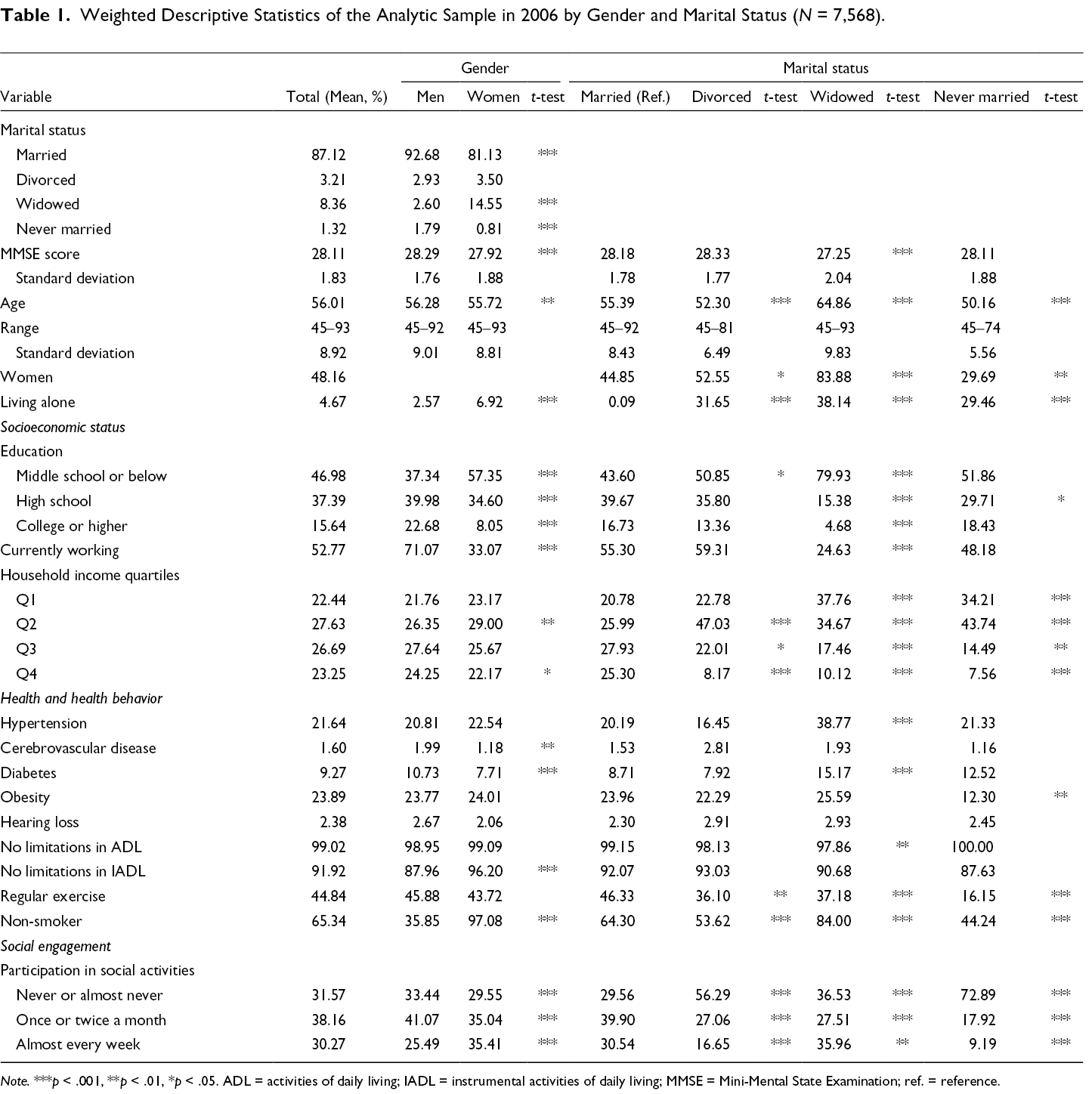
Note. ***p < .001, **p < .01, *p < .05. ADL = activities of daily living; IADL = instrumental activities of daily living; MMSE = Mini-Mental State Examination; ref. = reference.
For both men and women, compared with married persons, those who were widowed tended to be older, had lower levels of education, and more often suffered from diseases such as hypertension and diabetes. Respondents who were unmarried, including those who were divorced, widowed, and never married, had lower levels of household income and were less likely to engage in regular exercise, compared with married people. In addition, never-married people were the least likely to participate in social activities, and those who were divorced were the second least likely to report this kind of participation, suggesting that never-married and formerly married people were the most likely to be socially disengaged.
Association Between Marital Status and Cognitive Impairment
Table 2 presents the results from the event history analysis examining the association of marital status with cognitive impairment and the moderating effects of gender on this association. In Model 1, the basic model showed that the unmarried subcategories of never married and divorced were significantly associated with higher risk of cognitive impairment, compared with the married group: the highest risk of cognitive impairment was observed for never-married people (OR = 2.15, p < .001), and those who were divorced had the second highest risk (OR = 1.53, p < .01). Interestingly, those who were widowed had a higher risk of cognitive impairment than did married people, but this difference was not statistically significant. As expected, women and older people were at higher risk of cognitive impairment, compared with men and younger people, respectively.
Logistic Regression Models Predicting Cognitive Impairment (N = 7,568; 30,414 Person-Years).
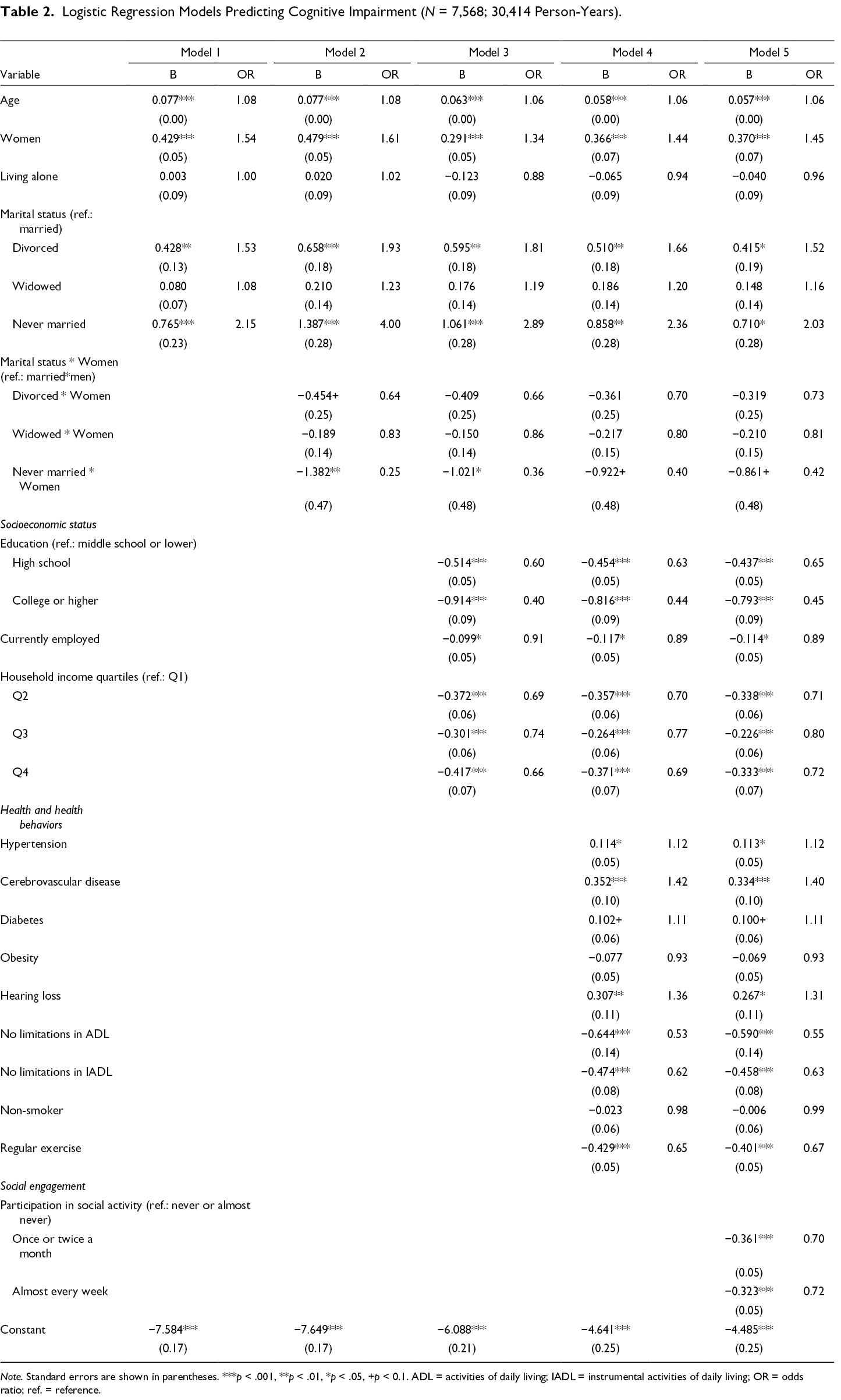
Note. Standard errors are shown in parentheses. ***p < .001, **p < .01, *p < .05, +p < 0.1. ADL = activities of daily living; IADL = instrumental activities of daily living; OR = odds ratio; ref. = reference.
Model 2, which included the interaction terms for marital status and gender, demonstrated that, compared with those who were currently married, both divorced and never-married respondents had significantly higher odds of cognitive impairment and that there were significant gender interaction effects, suggesting that the association between being never married or divorced and cognitive impairment varied by gender. Figure 1 presents the predicted odd ratios of cognitive impairment by marital status and gender based on the Model 2 estimates. As shown in Figure 1, compared with married men, both divorced and never-married men and women were at higher risk of cognitive impairment. Interestingly, compared with married men, the risk of cognitive impairment was four times greater for never-married men, and the corresponding risk for never-married women was 62% higher (1.61*4.00*0.25 = 1.62) than that for married men. Being single was associated with worse cognitive impairment, and this effect was worse for men than for women, suggesting greater marriage benefits for men than for women in Korea.
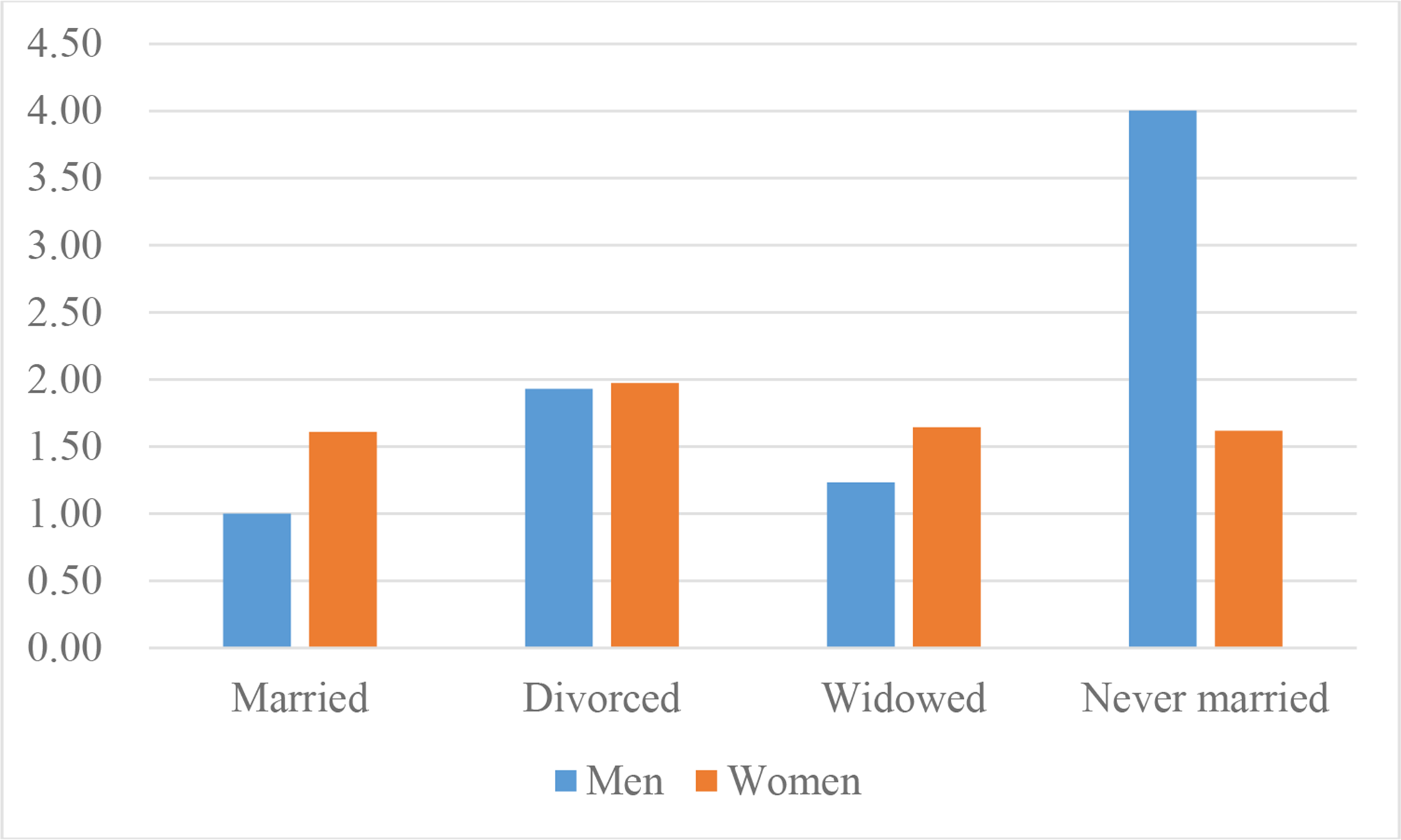
Estimated odds ratios of cognitive impairment by marital status and gender, based on Model 2 from Table 2.
After adjusting for socioeconomic status in Model 3, the significant marital status effects (for divorced and never-married status) remained, and the interaction between never-married status and gender also remained significant, although these effects declined in magnitude compared with the previous models. As expected, being highly educated and/or earning a high income reduced the risk of cognitive impairment. In addition, after adjusting for health and health behaviors in Model 4, cognitive impairment was still observed to be significantly associated with both divorced and never-married status, but the interaction between never-married status and gender became marginally significant. Vascular diseases and limitations in ADL and IADL were also risk factors for cognitive health, whereas regular exercise served as a protective factor against cognitive impairment. In Model 5, which includes all covariates, the interaction between never-married status and gender was marginally significant, and active social engagement had a positive effect on cognitive health.
Association Between Marital Status and Cognitive Impairment by Gender
To further examine whether the associations between multiple types of marital status and cognitive impairment differed for men and women, Table 3 provides the results of the gender-stratified models. First, looking at the results for men, Model 1 showed significant marital status effects on cognitive impairment: Divorced and never-married men had higher risks of cognitive impairment, compared with married men. In Model 2, which adds adjustment for several covariates, the significant effects of never-married status remained constant, indicating that never-married men in mid- or later-life had relatively poor cognitive health, even after taking into account their disadvantages in socioeconomic status, health and health behaviors, and social engagement. In contrast to the findings for men, the Model 1 results for women showed no significant marital status differences in cognitive impairment: compared with married women, the risk of cognitive impairment was not higher for any group of unmarried women—regardless of whether they were never married or formerly married. This may indicate that the marriage benefits for women were not large enough to result in significant differences in cognitive impairment among those aged 45 years or older. These insignificant associations stayed constant after adjusting for several covariates in Model 2.
Logistic Regression Models Predicting Cognitive Impairment Among Men (N = 3,714; 15,130 Person-Years) and Women (N = 3,854; 15,284 Person-Years).
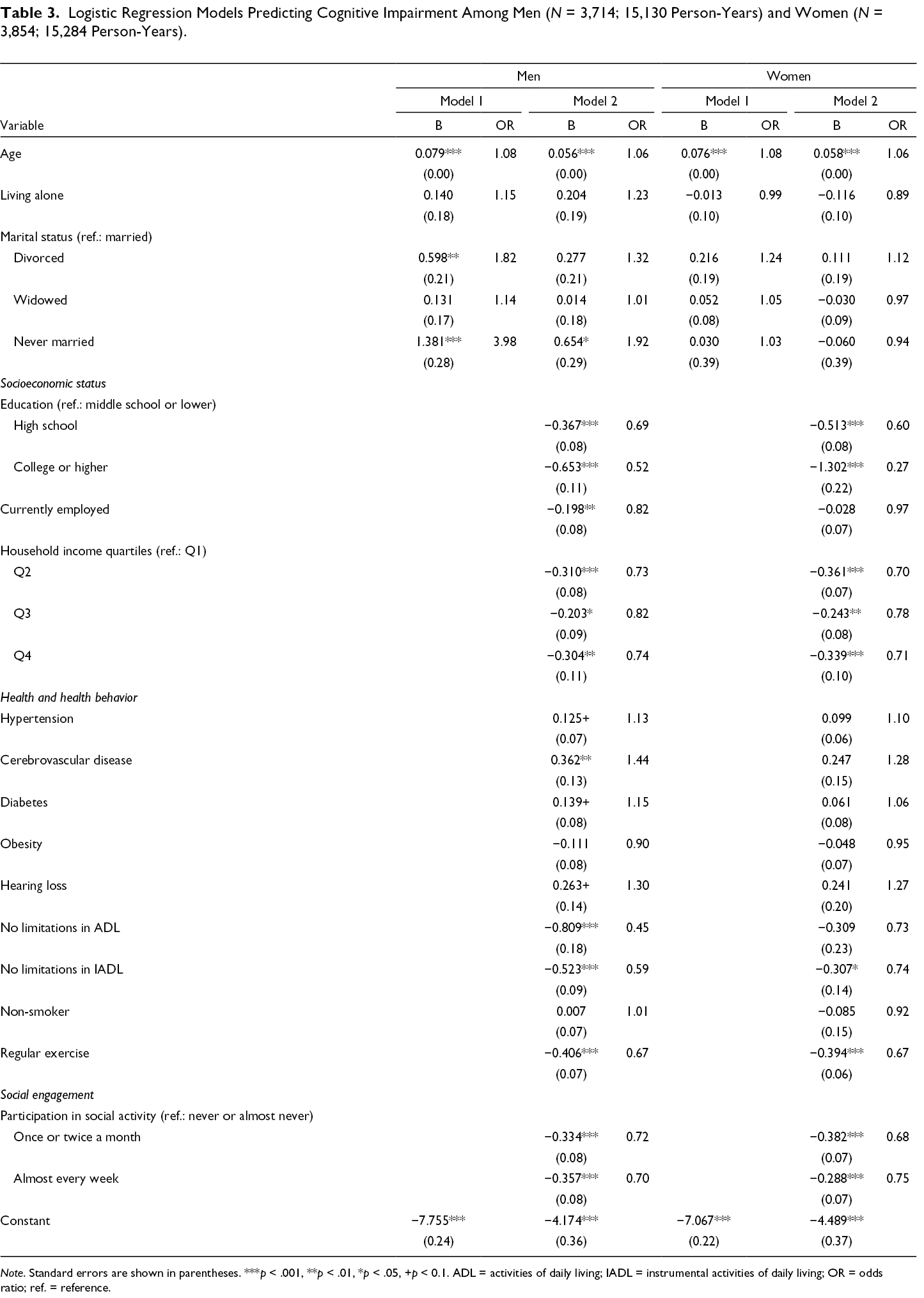
Note. Standard errors are shown in parentheses. ***p < .001, **p < .01, *p < .05, +p < 0.1. ADL = activities of daily living; IADL = instrumental activities of daily living; OR = odds ratio; ref. = reference.
Discussion
Based on nationally representative longitudinal data in Korea, this study has extended the evidence of marital advantages for cognitive impairment and dementia observed in a handful of studies outside of Korea, including in the United States, Europe, and Asia. The results suggest that marital status is an important social protective/risk factor for cognitive impairment and that there is significant heterogeneity in the link between cognitive health and marital status by gender. More specifically, this study found that the never-married and divorced respondents were the most disadvantaged in cognitive health in mid and later-life and that these negative effects were much stronger for never-married men than for others.
The observed associations between marital status and cognitive impairment can be explained more explicitly by the mechanisms of marital protection, stress, and selection. First, according to the marital protection model, married people tend to be advantaged in terms of cognitive health compared with the unmarried because marriage enhances cognitive health via greater socioeconomic resources, more frequent social interaction, a larger social network, and better social and emotional support (Goldman et al., 1995; Kiecolt-Glaser & Newton, 2001; Waite & Gallagher, 2001; Williams & Umberson, 2004). However, these beneficial effects of marriage do not explain the heterogeneity in cognitive health across the different unmarried subcategories, which may be better understood through the stress and selection arguments.
The stress model suggests that the strain of marital dissolution, whether through divorce or the death of a spouse, may increase the risk of cognitive impairment as a result of the detrimental effect of stress on cognition (Johansson et al., 2013; Rothman & Mattson, 2010). In addition, previous work has argued that the negative effect of marital dissolution may persist longer and be stronger following divorce than after becoming a widow because the factors preceding two events are different—people can “choose” to become divorced, but they will likely not have a choice when becoming widowed (Wade & Pevalin, 2004). Furthermore, negative perceptions and stereotypes regarding divorce still exist in Korea (Kim & Woo, 2017). Finally, the selection argument suggests that those who have never married are the most likely to suffer from cognitive impairment because people suffering from health problems are less likely to get married compared with those who are healthy (Fu & Goldman, 1996; Sommerlad et al., 2018). Additionally, in a society such as Korea, where there is a strong normative expectation of marriage, particularly for the older generations (Raymo et al., 2015), remaining never married until mid or later-life may be particularly strongly associated with worse health and lower socioeconomic resources, suggesting that never-married people may be at higher risk of cognitive impairment, compared with those who are married or formerly married.
Another important finding of this study is that never-married status was observed to be significantly associated with elevated risk of cognitive impairment in men but not in women, even after taking the benefits of marriage into account. This finding is somewhat similar to results reported in China (Feng et al., 2014) and in some Korean studies on mental (Kim & Woo, 2017; Lee, 2010, 2014) and general (Lee, 2012) health. However, this finding differs from previous studies in Western countries (Håkansson et al., 2009; Liu et al., 2019; Sundström et al., 2016), which did not find gender differences in the association between marital status and cognitive impairment, potentially because the cognitive health benefits of marriage may not be large enough to show significant gender differences in Western countries because of the convergence of gender roles and power relations within marriage. Unlike the situation in Western countries, in patriarchal societies such as Korea, 1 older women are still likely to take responsibility for maintaining social connections with family members, to perform the majority of the household chores and childcare duties, and to provide physical and emotional support for their spouses (Liu & Waite, 2014; Liu & Umberson, 2008; Simon, 2002; Umberson, 1992; Williams & Umberson, 2004). These behaviors likely reduce the risk of cognitive impairment for married men. Relatedly, marriage becomes more important to men as they age because their social networks narrow with the death of relatives and friends (Carstensen, 1992), and older men increasingly rely on their spouses for building and maintaining social relationships with others, including with their own children (Lee et al., 2001). Conversely, women tend to enjoy larger social networks through their participation in social activities and maintenance of close relationships, which likely compensates for the lack of intimacy and companionship among formerly married or never-married women (Elkins & Peterson, 1993; Lee et al., 2001). Further, the characteristics of those who have never married may differ for men and women because of the mating gradient in Korea: because women prefer to “marry up” in terms of socioeconomic status, it is likely that never-married women are highly educated and/or high-earning workers, whereas never-married men are likely to be less educated and to have relatively low incomes (Lee, 2012; Park, 2011).
The results of the present study should be interpreted in light of several limitations. First, the study excluded people who were cognitively impaired at the baseline survey year; thus, the effect of being unmarried may be underestimated because healthy unmarried people were more likely than unhealthy unmarried people to be included in the analytic sample. Second, it is possible that the associations between the categories of marital status and cognitive health may change depending on the duration of each marital status, but the study could not include these durations. Third, this study included a number of covariates, but it is still possible that unobserved heterogeneity or unmeasured confounders (i.e., psychological and neurological factors) might have influenced the observed associations with cognitive impairment. Fourth, the assessment of cognitive impairment was based on cognitive tests rather than clinical diagnosis. Although the MMSE is used globally to measure cognitive function, misreporting and misclassification are potential issues. Finally, being unmarried does not necessarily mean that an individual has no intimate partner; although the respondents classified as unmarried did not have a marital partner, they could have had a cohabiting partner or another type of serious relationship partner, who would likely provide them with social and emotional support. Although the study controlled for living arrangements (living alone or not), this possibility cannot be completely ruled out because of limitations in the data available in the KLoSA.
Despite these limitations, this study demonstrated that being divorced or never married in mid- or later-life may be a risk factor for cognitive impairment and that never-married men may be particularly vulnerable to cognitive impairment. The numbers of divorced and never-married older adults in Korea are expected to grow continuously as people live longer, marital instability increases, and people increasingly tend to retreat from marriage. The findings of the present study highlight the need for future longitudinal studies to clarify the detailed mechanisms (i.e., division of housework, marital duration, and social support) through which marital status serves as a protective/risk factor for cognitive impairment for men and women. Understanding these mechanisms is necessary to enable the development of customized intervention programs to improve cognitive health among socially isolated groups.
Footnotes
Declaration of Conflicting Interests
The author(s) declared no potential conflicts of interest with respect to the research, authorship, and/or publication of this article.
Funding
The author(s) disclosed receipt of the following financial support for the research, authorship, and/or publication of this article: This work was supported by Kangwon National University under a 2020 Research Grant.

Note
Author Biography