



Abstract
This study investigated the influence of predisposing factors (social support, help-seeking attitudes and help-seeking intentions) on older Australian adults’ use of mental health services for depression and/or anxiety symptoms. Participants were 214 older Australian adults (61% female; aged between 60 and 96 years; M = 75.15 years, SD = 8.40 years) who completed a self-report questionnaire that measured predisposing factors and lifetime mental health service use for depression and/or anxiety symptoms. Higher levels of social support predicted non-use of mental health services. When this relationship was serially mediated by help-seeking attitudes and help-seeking intentions, it predicted mental health service use for depression and/or anxiety. Older adults are less likely to seek help for depression and/or anxiety symptoms unless members of their social support network encourage positive help-seeking attitudes, which lead to positive help-seeking intentions and the subsequent use of mental health services.
Keywords
Although depression and anxiety disorders are not characteristic of normal ageing per se, they are commonly experienced in later life (Bryant et al., 2008; Reynolds et al., 2015; Wiese, 2011) and may be associated with dire outcomes such as increased morbidity and mortality (Kiecolt-Glaser et al., 2002) and lower levels of quality of life (Peel et al., 2007). Among the range of mental health problems experienced by older adults, depression and anxiety are the most common due to the age-related risk factors associated with these mental health problems. These include chronic conditions such as cardiovascular disease (Celano et al., 2018), Parkinson's disease (Fernandez, 2012), dementia (Seignourel et al., 2008; Thomas & O'Brien, 2008), arthritis (Covic et al., 2003), chronic obstructive pulmonary disease (Yohannes et al., 2000), hearing loss (Contrera et al., 2017; Cosh et al., 2018), vision impairment (Heesterbeek et al., 2017), and diabetes (Shinkov et al., 2018). Social risk factors are also associated with late-life depression and anxiety such as social connectedness (Santini et al., 2020).
Despite research demonstrating the effectiveness of psychosocial interventions for depression and anxiety in older people (Sorocco & Lauderdale, 2011) and increasingly positive views being reported by older adults on seeking help from mental health professionals (Woodward & Pachana, 2009), this population typically underuse mental health services for these common mental health problems (Garrido et al., 2011). Given that depression and anxiety are commonly comorbid (Beekman et al., 2000) and are expected to increase among older adults due to population ageing, in addition to the risk of polypharmacy in older adulthood, understanding factors that facilitate mental health service use for depression and/or anxiety is an important area of research.
The behavioural model of health services use (Andersen, 1968) has been modified and adapted to investigate determinants of health care service use across numerous fields including mental health service use for depression (Holvast et al., 2012) and anxiety (Scott et al., 2010). The revised model (Andersen & Davidson, 2007) consists of four major components. These include contextual characteristics, individual characteristics, health behaviours and outcomes. The model suggests that service use is influenced by interrelated factors among these components. The individual characteristics component includes predisposing, enabling and need factors. The current study focused on predisposing factors in the individual characteristics component and how these factors influenced mental health service use for depression and/or anxiety which is in the health behaviours component.
The behavioural model of health services use was adapted for the current study by underpinning it with Fishbein & Ajzen; (2010) Reasoned Action Model (RAM). The RAM proposes that background factors such as social support contribute to the development of an individual's beliefs about performing a specific behaviour. These beliefs form the basis of attitudes about performing a specific behaviour, which in turn influences whether an individual has an intention to perform the behaviour. Having an intention to engage in a specific behaviour is the immediate antecedent of performing that behaviour. Underpinning the behavioural model of health services use with the RAM provided a complex framework, able to (a) guide the investigation of factors that influence mental health service use (b) elucidate mechanisms that influence help-seeking behaviours and (c) enable the development of interventions aimed at improving help-seeking behaviours.
Guided by the adapted model, predisposing factors were investigated in the current study because they may help explain why people choose to use or not use mental health services (Andersen, 1968). Social support is a predisposing factor that enables individuals to give and receive various types of support. In this way, interactions within social networks have the potential to influence where individuals seek help for depression and anxiety symptoms. The literature reflects variation of associations between social support and mental health service use. Andrea and colleagues (2016) found that participants aged 40 years and over with adequate social support who reported moderate to severe levels of depression were significantly less likely to seek help from a mental health provider compared to those with inadequate social support. Nyunt and colleagues (Nyunt et al., 2009) found similarly in a cohort of participants aged 60 years and over with various mental health problems. Conversely, Holvast and colleagues (Holvast et al., 2012) found that lower levels of social support were associated with lower levels of mental health service use in older adults diagnosed with a depressive disorder. Other studies have found no evidence of a relationship between social support and mental health service use in samples that included older adults (Kleinberg et al., 2013). Despite differences across studies, the mixed results may suggest the involvement of other factors that may influence mental health service use.
The RAM (Fishbein & Ajzen, 2010) proposes that social support influences the development of beliefs that form the basis of help-seeking attitudes which may predict mental health service use via the predisposing factors of help-seeking attitudes and help-seeking intentions. Some studies support the relationships indicated by the RAM. For example, Roh and colleagues (Roh et al., 2017) and Tieu and Konnert (Tieu & Konnert, 2014) found that older adults who reported higher levels of perceived social support reported more positive attitudes toward seeking help from a mental health professional. Vogel and colleagues (Vogel et al., 2007) found that individuals who were encouraged to seek help and those who knew someone who had sought help reported significantly higher help-seeking attitudes than those who were not encouraged to seek help and those who did not know someone who had sought help. These studies suggest that having social support in place that either encourages mental health help-seeking when needed, verbally or by example, may contribute to the development of positive help-seeking attitudes. In turn, help-seeking attitudes determine whether an individual has an intention to use a mental health service.
Evidence of positive associations between help-seeking attitudes and intentions to seek help from a mental health professional are accumulating in research with older adult populations (Tieu et al., 2018). Bayer and Peay (Bayer & Peay, 1997) provided evidence that help-seeking attitudes were a strong predictor of help-seeking intentions in an Australian sample that included older adults. Mackenzie, Gekoski and Knox (Mackenzie et al., 2006) also found that the help-seeking propensity subscale on the Inventory of Attitudes Toward Seeking Mental Health Services (IASMHS) significantly predicted help-seeking intentions in a sample of Canadian adults. Psychological openness and indifference to stigma did not make a unique contribution to help-seeking intentions in this sample. Westerhof and colleagues (Westerhof et al., 2008) investigated help-seeking attitudes in an older Dutch sample aged between 65 and 75 years. Results indicated that psychological openness and help-seeking propensity on the IASMHS significantly predicted intentions to seek psychological help for mental health problems, including depression and anxiety. Indifference to stigma did not significantly predict intentions.
The RAM further indicates that help-seeking intentions are the proximal antecedent to performing a specific behaviour such as using mental health services for depression and anxiety. Vogel and colleagues (Vogel et al., 2007) found that undergraduate students who reported higher levels of help-seeking intentions for various psychological problems, including depression and worry, reported significantly higher levels of lifetime mental health service use than nonusers. This remains an underresearched area.
Although the help-seeking literature provides some evidence for relations between predisposing factors (i.e., social support, help-seeking attitudes and help-seeking intentions) and mental health service use consistent with those delineated in the RAM, to date studies have not examined how these factors interrelate to influence mental health service use. In particular, the influence of these predisposing factors on older adults’ use of mental health services for depression and/or anxiety remains an underresearched area. Given the potential dire outcomes of depression and anxiety among older people, insight into factors which may influence mental health service use for these mental health problems is important in an ageing society.
Aims and Hypotheses
The current study aimed to investigate the direct and indirect effects of predisposing factors on older Australian adults’ use of mental health services for depression and/or anxiety. Based on the adapted behavioural model and the help-seeking literature, it was hypothesised that the predisposing factors would predict mental health service use for depression and/or anxiety symptoms in a mediation model. Due to mixed findings in the literature, the nature and direction of the relationship between social support and mental health service use was unknown. It was hypothesised that (a) higher levels of social support would be related to higher levels of help-seeking attitudes (b) higher levels of help-seeking attitudes would be related to higher levels of help-seeking intentions (c) higher levels of help-seeking intentions would be related to use of mental health services and (d) help-seeking attitudes and help-seeking intentions would serially mediate the relationship between social support and mental health service use for depression and/or anxiety symptoms.
Methods
Participants
A total of 221 questionnaires were returned. Seven were deleted due to a high amount of missing data. The amount and patterns of missing data were analysed on the remaining 214 questionnaires. Missing data were found to be missing completely at random (MCAR) or likely missing at random (MAR) and the pattern analysis indicated that missing values across the dataset were 0.81%. Therefore, missing data were imputed using expectation maximisation (EM) following Scheffer (2002).
The total sample consisted of 214 older Australian adults who were aged between 60 and 96 years (61% female; M = 75.15 years, SD = 8.40 years). Of these, 64 participants (30%) reported seeking help from a mental health professional for depression and/or anxiety symptoms. Participants in the subsample were aged between 62 and 90 years (M = 72.39 years, SD = 7.63 years; 66% female). Demographic statistics are presented in Table 1.
Participant Demographics for Users and Non-Users of Lifetime Mental Health Service Use for Depression and/or Anxiety and the Total Sample.

TAFE = Technical and Further Education; 2ATSI = Aboriginal and/or Torres Strait Islander.
The subsample of participants who reported lifetime mental health service use for depression and/or anxiety. bThe subsample of participants who did not use a mental health service for depression and/or anxiety.
Measures
Participants completed a self-report questionnaire. In this study, the individual characteristics component of the adapted behaviour model of health services use included predisposing factors. These were social support, help-seeking attitudes, and help-seeking intentions. The health behaviours component of the model included a measure of lifetime mental health service use for depression and/or anxiety symptoms.
Predisposing Factors
Social Support
Social support was measured with the 11-item Duke Social Support Index (DSSI; Koenig et al., 1993). The DSSI consists of two subscales that measure social interaction (social network size and frequency of contact) and subjective support (perceived satisfaction with quality of social support). Subscale scores are added to provide a total score, ranging from 11 to 33, with higher scores suggesting greater perceptions of social support. The DSSI has demonstrated good reliability (Goodger et al., 1999; Pachana et al., 2008) and validity (Pachana et al., 2008) in other research with older adults. Cronbach's alpha for the total DSSI score in this study was .84.
Help-seeking attitudes
Help-seeking attitudes were measured with the Inventory of Attitudes Toward Seeking Mental Health Services (IASMHS; Mackenzie et al., 2004). The IASMHS measures respondents’ attitudes toward seeking help from mental health professionals for psychological problems. It consists of three subscales, psychological openness, help-seeking propensity and indifference to stigma. The total score ranges from 0 to 96 with higher scores indicating more positive help-seeking attitudes. The IASMHS has been used in research with older adults (James & Buttle, 2008) and good reliability and validity have been reported (Mackenzie et al., 2004). Cronbach's alpha for the total IASMHS score in this study was .82.
Help-seeking intentions
Consistent with Mackenzie and colleagues (Mackenzie et al., 2004), help-seeking intentions were measured by respondent's answering one question on a 7-point Likert-type scale ranging from 1 (very unlikely) to 7 (very likely): “If you were to experience significant psychological problems, how likely is it that you would consider talking to a mental health professional (e.g., psychiatrist, psychologist, counsellor, social worker, mental health nurse)?”
Lifetime Mental Health Service Use for Depression and/or Anxiety
Lifetime mental health service use was measured broadly with the question, “Have you ever sought help for emotional or psychological difficulties?” (yes or no), following Woodward and Pachana (Woodward & Pachana, 2009). Respondents indicated the main issue for which they had sought help from seven categories (family problems, grief, stress/anxiety, depression, memory problems, alcohol/drugs, and other) and indicated the year help was last sought. The focus of the current study specifically aimed to investigate the influence of predisposing factors on mental health service use for depression and/or anxiety symptoms. Therefore, the lifetime mental health service use for depression and/or anxiety measure included older adults who had previously sought help specifically for depression and/or anxiety in the current study. A total of 105 participants (49% of the total sample) reported help-seeking for emotional or psychological difficulties. Of these, 64 participants (30% of the total sample) had sought help from a mental health professional specifically for depression and/or anxiety.
Procedures
The current study received ethics approval from Monash University Human Research Ethics Committee. Older adults aged 60 years and over who lived in Australia and had the cognitive and linguistic (English language) ability to complete the paper-based questionnaire were invited to participate in the study. Participants signed a consent form and returned it with their completed questionnaire. Participants were recruited from community and aged care settings between 2013 and 2014.
Data Analysis
The data were analysed with the Statistical Package for Social Sciences (SPSS, version 22). A power analysis, conducted using the Power Analysis and Sample Size Software (PASS, version 14; NCSS, 2015), indicated the sample size had sufficient power to detect small to large effect sizes. Hayes (Hayes, 2013) PROCESS macro was used to investigate the mediation role of help-seeking attitudes and help-seeking intentions in the relationship between social support and lifetime mental health service use. Mediation of the indirect effect is deemed significant when bias-corrected bootstrap confidence intervals (CI), based on 1,000 bootstrap samples, do not include zero. Preliminary analyses on demographic variables indicated there were no significant differences on study variables for gender. There were significant differences on study variables for age, marital status and education. Therefore, these variables were controlled in the serial mediation analysis.
Results
Older adults reported using a range of mental health services for depression and/or anxiety symptoms. The most common source of help sought was from psychologists (59.4%). Although lifetime mental health service use was reported from 1957 to 2014, the median (2012) and mode (2013) indicated most participants sought help for depression and/or anxiety fairly recently. Means and standard deviations for the predisposing factors for users and non-users of mental health services for depression and/or anxiety and the total sample are presented in Table 2.
Means and Standard Deviations for Study Variables for Mental Health Service Use for Depression and/or Anxiety, Non-Use and the Total Sample.

Note. IASMHS = Inventory of Attitudes Toward Seeking Mental Health Services; DSSI = Duke Social Support Index. aThe subsample of participants who reported lifetime mental health service use for depression and/or anxiety. bThe subsample of participants who did not use a mental health service for depression and/or anxiety. *Significant mean differences (t-tests) between the subsamples (use and non-use) at p < .05.
Haye's PROCESS macro was used in logistic regression analyses to test the mediation hypothesis. Given significant variation across predisposing factors as a function of age, marital status and education, these demographic variables were controlled. Before the mediators were entered into the equation, results indicated a significant negative relationship between social support and mental health service use (b = -0.08, CI = -0.16, −0.008). After the mediators (help-seeking attitudes and help-seeking intentions) were included in the analysis, the negative relationship between social support and mental health service use increased in magnitude (b = -0.11, CI = -0.19, −0.03). However, the indirect pathway from social support to mental health service use via the mediators was positive (b = 0.01, CI = 0.003, 0.03). The stronger relationship between social support and mental health service use after both mediators were included in the analysis, together with negative and positive direct and indirect effects, respectively, suggested a suppression effect (MacKinnon et al., 2000). Given that social support was not significantly related to help-seeking intentions (see Figure 1), help-seeking attitudes performed as a suppressor variable in the analysis, improving the prediction of mental health service use. The unique variance shared between help-seeking attitudes and social support, that was not relevant to mental health service use, was suppressed by help-seeking attitudes in this analysis, resulting in a stronger negative relationship between social support and mental health service use.

Controlling for the effects of age, marital status and education, help-seeking attitudes and help-seeking intentions serially mediated the relationship between social support and mental health service use for depression and/or anxiety in older Australian adults. Beta weights are unstandardised.
The mediation analysis demonstrated two pathways. The first pathway indicated that older Australian adults are less likely to seek help from a mental health service for depression and/or anxiety symptoms when they have greater levels of perceived social support compared to those who report lower levels of social support (total effect). This negative relationship between social support and mental health service use was strengthened when irrelevant variance in social support was controlled by the inclusion of help-seeking attitudes (direct effect). The second pathway suggests that when members of older Australian adults’ social network promote help-seeking attitudes, this leads to more positive help-seeking intentions, which in turn lead to the use of mental health services for depression and/or anxiety (indirect effect). See Figure 1 and Table 3.
Unstandardised Beta Coefficients, Standard Errors, Probability Values and Model Summary Information for the Serial Mediation Model of Predisposing Factors and Mental Health Service Use for Depression and/or Anxiety Among Older Australian Adults.

N = 214.
Note. DSSI = Duke Social Support Index; IASMHS = Inventory of Attitudes Toward Seeking Mental Health Services.
Given the results of the serial mediation model and the differential contribution of help-seeking attitudes to help-seeking intentions reported in the literature (Mackenzie et al., 2006; Westerhof et al., 2008), a hierarchical multiple regression analysis was undertaken to examine the unique contribution of the IASMHS subscales to the variance in help-seeking intentions. The model was significant, F(6, 207) = 11.84, p < .0001 and each of the IASMHS subscales made a significant unique contribution to the variance in help-seeking intentions (see Table 4). Psychological openness contributed 32% (β = .32) of the variance in help-seeking intentions, help-seeking propensity contributed 27% (β = .27) and indifference to stigma contributed 15% (β = - .15).
Hierarchical Multiple Regression Results of the Prediction of Help-Seeking Intentions by Help-Seeking Attitudes, Controlling for Age, Marital Status and Education.
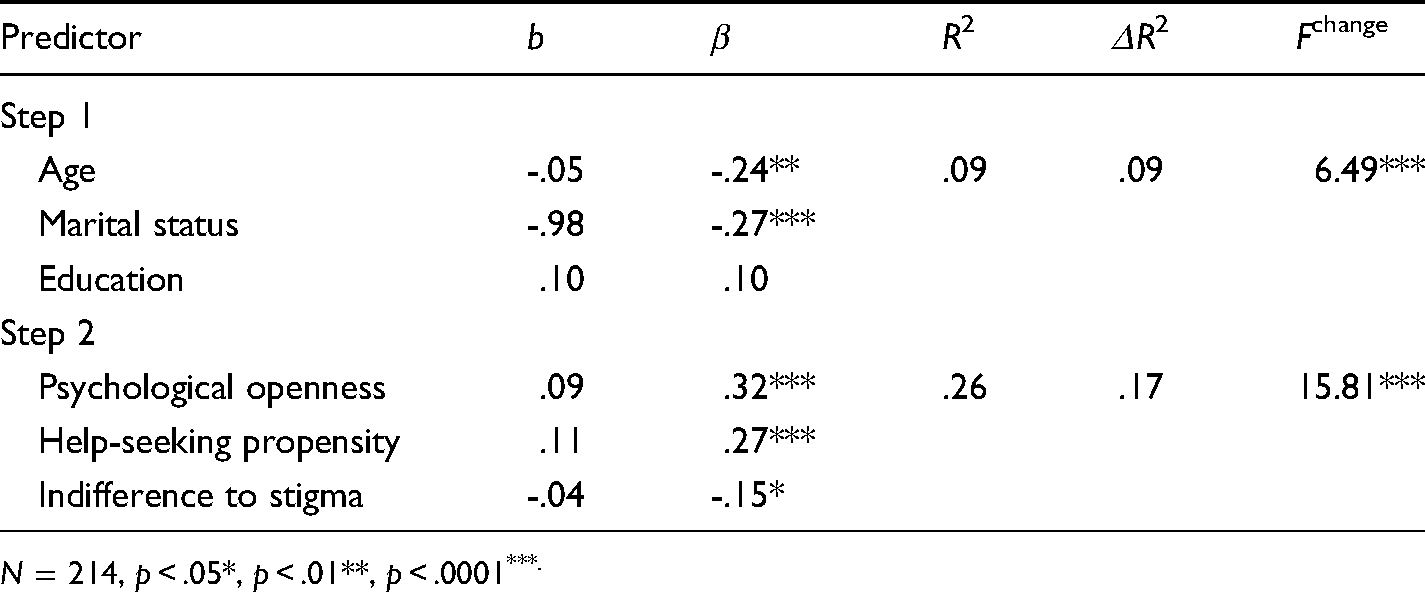
N = 214, p < .05*, p < .01**, p < .0001***.
Discussion
The aim of the current study was to investigate the direct and indirect effects of the predisposing factors, social support, help-seeking attitudes and help-seeking intentions, on older Australian adults’ use of mental health services for depression and/or anxiety. The nature and direction of the relationship between social support and mental health service use was unknown due to mixed findings in the literature. It was hypothesised that higher levels of social support would be related to higher levels of help-seeking attitudes; higher levels of help-seeking attitudes would be related to higher levels of help-seeking intentions; higher levels of help-seeking intentions would be related to use of mental health services for depression and/or anxiety symptoms; and the relationship between social support and mental health service use would be serially mediated by help-seeking attitudes and help-seeking intentions. Higher levels of social support in this study were significantly related to non-use of mental health services and all other hypotheses were supported.
The current study is consistent with the findings of other studies that reported a negative association between social support and mental health service use (Nyunt et al., 2009). Descriptive statistics provide insight into the nature of social support that may influence whether older adults seek professional help for depression and/or anxiety symptoms. Only the subjective support subscale of the DSSI differentiated between those who had used and had not used mental health services. Hence, it appears to be older adults’ perception of the quality of support they receive from others rather than the overall size and amount of interaction they have with their social network that contributes to non-use of mental health services.
As expected, higher levels of social support were associated with more positive help-seeking attitudes in the current study. This is consistent with Tieu and Konnert's (Tieu & Konnert, 2014) study of older Chinese immigrants living in Canada who found that greater perceived social support predicted more positive help-seeking attitudes on the IASMHS. The current study extends the generalisability of these findings to a more culturally diverse population of older adults.
Consistent with other studies (Mackenzie et al., 2006; Westerhof et al., 2008), more positive help-seeking attitudes predicted greater help-seeking intentions as hypothesised. Given the variation reported in the literature on help-seeking attitudes that significantly contribute to the prediction of help-seeking intentions, a follow-up analysis was conducted to determine which of the IASMHS subscales predicted older adults’ intentions to seek help from a mental health professional for depression and/or anxiety. The current study found that psychological openness, help-seeking propensity and indifference to stigma all predicted intentions to seek help from a mental health professional. This is in contrast to Mackenzie and colleagues’ (2006) study who found that help-seeking propensity was the only IASMHS subscale that predicted intentions in a sample of adults aged 18 to 89 years. It is also in contrast to Westerhof and colleagues’ (2008) study who found that psychological openness and help-seeking propensity predicted help-seeking intentions among older adults aged between 65 and 75 years. In the current study, psychological openness was the strongest predictor of the three subscales, followed by help-seeking propensity. Interestingly, the indifference to stigma subscale was negatively associated with help-seeking intentions. This may suggest that even when older adults perceive significant others would not approve if they sought help for psychological problems, if they feel they need professional help, they intend to seek help. Alternatively, it may reflect an aspect of resiliency which is common among older adults (Fry & Keyes, 2010). Older Australians with depression and anxiety symptoms who do not feel it would be stigmatising to seek help, may not perceive they need to seek help.
Consistent with the RAM, the current study found that older Australian adults’ help-seeking intentions predicted lifetime use of mental health services for depression and/or anxiety. Findings of the current study confirm the positive association found by Vogel and colleagues (Vogel et al., 2007) between help-seeking intentions and lifetime mental health service use in an American undergraduate sample and extend this to help-seeking for depression and/or anxiety symptoms in an older Australian population.
Finally, the positive indirect effect from social support to mental health service use via help-seeking attitudes and help-seeking intentions provides an alternative explanation for discrepancies in the literature. When older adults are satisfied with their social support, they are less likely to seek professional help for depression and anxiety symptoms unless they are encouraged to do so. When interactions with social contacts promotes help-seeking attitudes in older Australians, this leads to greater intentions to seek help and subsequently, use of mental health services for depression and anxiety symptoms. This is consistent with the adapted behavioural model of health services use, informed by the RAM. To the author's knowledge, the current study is the first to examine the roles these predisposing factors have in facilitating older adults’ help-seeking behaviours for depression and anxiety. The dual help-seeking pathways provide evidence for the vital role individuals in older adults’ social network have in facilitating mental health care for those experiencing depression and/or anxiety. Given the important interface between those who are ageing and those who provide ageing-related health and community services, this may be an apt segment of an older person's social network to promote help-seeking attitudes.
Limitations and Future Research
The current study made several contributions to the help-seeking literature. However, these need to be viewed within the context of some limitations, such as the cross-sectional and self-report nature of the data. Future research aimed at the development and evaluation of interventions designed to improve the help-seeking attitudes of older adults by members of the ageing-related workforce would be beneficial in a cohort who typically underuse mental health services for common mental health problems such as depression and anxiety.
Conclusions
The dual help-seeking pathways identified in the current study have particular relevance to those working with older adults in community and aged care settings. When members of older adults’ social network encourage help-seeking attitudes, older people are more likely to have greater intentions to seek help and use mental health services for depression and/or anxiety. This may help to improve the underuse of mental health services by older adults and their ability to cope with depression and/or anxiety symptoms commonly experienced in later life.
Footnotes
Acknowledgments
The author wishes to acknowledge and thank Dr Louise McLean and Dr Angelika Anderson for their supervision of this project. Thank you to the participants who willingly gave their time to participate in this study and to the organisations who supported this study. The author has no financial interests or conflicts of interest to disclose.
Ethics Approval
This study received ethics approval from the Monash University Human Research Ethics Committee (Project Number CF13/598–2013000238). The research was undertaken with appropriate informed consent of participants.
Declaration of Conflicting Interests
The author declared no potential conflicts of interest with respect to the research, authorship, and/or publication of this article.
Funding
The author received no financial support for the research, authorship and/or publication of this article.
