




Abstract
The aim of this descriptive study was to investigate the Self-Defining Memories (SDMs) in a large sample of 181 older adults (65–90 years; mean age = 73.0 years) and to target the relationships between their different dimensions. The sampling method was nonprobabilistic, based on voluntary participation. Participants were asked to recall three SDMs. They also completed the Mini-Mental State Examination, the Hospital Anxiety and Depression Scale, and a Self-esteem Scale. Almost half of the SDMs were specific and more than a quarter were integrated. Specificity, tension, redemption, contamination sequences, and affective response varied regarding thematic content. Specificity was positively correlated to tension whereas autobiographical reasoning was positively correlated to redemption and negatively linked to emotional response and depression. This research highlighted that identity is constituted by the main types of events that make up a life: interpersonal relationships, life-threatening events, achievement, and leisure.
Introduction
Substantial increases in the number of older persons in our society pose a challenge for psychological intervention to enhance the proportion of this population ageing successfully. According to the classic concept of Rowe and Kahn (1997), successful ageing is multidimensional, encompassing the avoidance of disease and disability, the maintenance of high physical and psychological and social functioning and life satisfaction. One of the conditions for experiencing successful ageing is to feel a sense of wellbeing (Teater & Chonody, 2020). Many authors highlighted the link between wellbeing and important life experiences (Liao et al., 2021). Autobiographical memory refers to the recollection of events from across one's lifespan (Conway & Pleydell-Pearce, 2000) and is thought to be central to social and emotional wellbeing in older adults (Leahy et al., 2018). Indeed, higher autobiographical memory specificity has a protective effect on mental health in nondepressed older adults (Latorre et al., 2013) whereas poor autobiographical memory specificity is a risk factor for depression (Sumner et al., 2010) and is associated with loss of independence in older adults. Moreover, exploring the past could be a way to relive positive experiences (Spor & Lefèvre, 2021) and also realize personal goals. A subcategory of autobiographical memories, that is, Self-Defining Memories (SDMs), are believed to play an important role in supporting one's sense of identity (Singer & Salovey, 1993) and to be a relevant material to be used in clinical interactions (Wagener et al., 2015). Indeed, psychological interventions on SDMs may help dealing with psychological difficulties that seniors grapple with every day.
Self-Defining Memories
SDMs have been distinguished from other memories to better conceptualize personality processes associated with the sense of identity and continuity in individuals’ personal history (Conway et al., 2004). These memories are so robust and hold such importance that when we recall them, we feel a strong sense of re-experiencing the events. They are emotionally intense, and repetitively recalled memories, which are thematically linked to similar memories and focused on enduring concerns or unresolved conflicts (Singer & Salovey, 1993).
SDMs present salient characteristics including memory specificity, integrative meaning, tension, redemption, contamination, thematic content, and affective responses during memory retrieval.
The level of specificity provides information about the structure of the SDM. This dimension varies from a memory of a single event containing spatiotemporal information and many phenomenological details to repeated, generalized, or summary memories (Singer & Blagov, 2000–2001).
Another essential dimension to explore is the presence of integrative meaning (Singer & Blagov, 2000–2001). An integrated SDM is a memory containing new understandings or lessons about the self or about others or life in general.
Tension was introduced by Thorne et al. (2004). This dimension was defined as an explicit reference to the discomfort, disagreement or unease of any character in the SDM during the narration. Tension refers to stressful events and has been found to be primarily associated with mortality and conflictual relationship events (Thorne et al., 2004). Tension is indicated by an explicit reference to discomfort, disagreement, or unease of any character during the narration of the SDM (Thorne et al., 2004).
Redemption and contamination are two other dimensions that have been explored in SDMs (McAdams et al., 2001). Memories with affective sequences that change from negative to positive emotion in the course of the memory narrative are denoted as redemption sequences. On the contrary, contamination sequences refer to an explicit transformation in the memory narrative from a demonstrably positive affective state to a demonstrably negative affective state.
Thematic content reflects the primary concern emphasized in the SDMs. Seven categories were distinguished using the classification suggested by Thorne and McLean (2001) and were mutually exclusive: life-threatening events (LTEs), leisure or recreation, relationships, achievement/mastery, guilt/shame, drug/alcohol abuse, and “non-classifiable events” (NCEs).
Finally, affective response at the time of retrieval has been explored like in previous studies (Blagov & Singer, 2004; Cuervo-Lombard et al., 2020; Lardi et al., 2010; Singer et al., 2007). As defined by Singer and Moffitt (1992), SDMs should evoke strong positive or negative emotion at the time of recollection.
Most previous studies targeting SDMs have been conducted in a pathological context (for a review, see Wright et al., 2022). In healthy people, main authors have explored the various dimensions of SDMs in young adult samples (Blagov & Singer, 2004; Blagov et al., 2022; Lardi et al., 2010; McLean, 2005; Singer & Blagov, 2000–2001; Singer & Moffitt, 1992; Singer et al., 2007; Thorne et al., 2004; Wang & Singer, 2021). These studies’ results show that the majority of reported SDMs were specific, and that approximately a quarter contained integrative meaning statements. Contents of SDMs were mainly linked to relationships, achievements, and LTEs (Blagov & Singer, 2004; Lardi et al., 2010; Singer et al., 2007; Thorne et al., 2004). In addition, approximately two-thirds of SDMs memories contained a report of tension (Lardi et al., 2010; Thorne et al., 2004). As to affective responses to SDMs memories, most studies showed that SDMs were more negative than positive (Blagov & Singer, 2004; Singer & Moffitt, 1992).
Effects of Ageing and Retirement on SDMs
Ageing is an experience that everyone is brought to in the last part of his life and is characterized by considerable changes on the biological, social, cognitive, and psychological levels (e.g., Amarya et al., 2015). The body and its image change (for a review, see Clarke & Korotchenko, 2011) and retirement constitutes a major life transition leading to narcissistic re-adjustment (e.g. Le Goff & Rexand-Galais, 2018). Cognitive functioning declines in a heterogeneous way, depending on multiple factors (e.g., Salthouse, 2004). Age-related effects are consistently related to a reduced adaptation to environmental variations and thus to an increased vulnerability (Villars, 2017). These changes have an impact on personal identity.
Retirement is generally considered a crucial event for ageing adults as it is often associated with lifestyle changes. On the one hand, according to the rupture theory, retired people lose a part of their identity with the end of work (e.g., Bouteyre & Lopez, 2005) and have to adjust their sources of meaning to maintain their self (Leclerc et al., 2003). As an example, they need to redefine their familial and social relationships (Cierpka, 2012). On the other hand, according to the continuity theory (Atchley, 1989), retirees rely on their past experiences and social roles to adapt to their new status and ensure continuity in their lives. In a study with a large sample, Teuscher (2010) explored the factors predicting self-definition of retired and not-yet-retired persons. She showed that leisure time activities were considered as more important for retirees than for nonretirees but found that there was no difference between both populations for relationships’ domain when controlled for the age of respondents. In addition, retired participants had a higher identity diversity than not-yet-retired participants as they rated more domains of self-description.
Finally, few experiments have targeted the main dimensions of SDMs in elderly participants in comparison to younger ones (Cuervo-Lombard et al., 2020; Singer et al., 2007).
Firstly, Singer et al. (2007), compared the five SDMs in 44 adults aged between 50 and 85 years (M = 64.6 years) to those of 49 college students and they reported that older adults recalled significantly fewer specific memories (45.4% of SDMs in older people were specific vs. 73.8% of those memories in college students). Recently, Cuervo-Lombard et al. (2020) compared the three collected memories of 41 older adults (62–79 years, average age of 70.7 years) to those of 37 middle-aged (31–55 years, average age of 42.4 years) and they did not find a significant difference for specificity in both populations (53% vs. 46%). Moreover, Martinelli et al. (2013) showed that SDMs specificity in older adults did not differ from young adults. However, these authors did not explicitly ask their participants to recall SDMs. Concerning integration, Singer et al. (2007) showed that the SDMs in older participants contained more explicit integrative meaning than those of college students (45.8% vs. 24.6%). Thus, they confirmed that the ability of integrative meaning is more sophisticated in advancing years (Pasupathi & Mansour, 2006). However, Cuervo-Lombard et al. (2020) found that the memories of middle-aged participants were more integrated than those of older adults (47.7% vs. 28%). Tension, redemption and contamination sequences were less frequent in elderly participants than in young adults (Singer et al., 2007). Tension (12.3% vs. 30.7%) and redemption (3.3% vs. 9.0%) were also less present in the SDMs of older adults than in those of middle-aged participants (Cuervo-Lombard et al., 2020), but there was no difference for contamination in both groups (2.4% vs. 0.9%).
For memory content, comparing the previous studies in older people SDMs (Cuervo-Lombard et al., 2020; Singer et al., 2007), LTEs (21% vs. 11.4%) were more numerous in the American than in the French sample but leisure events were less reported (8% vs. 20.3%). Furthermore, achievement events (32% vs. 23.5%) and relationship events (27.5% vs. 20.3%) were more frequent in the American context. Finally, while the number of guilty events was similar (5.5–5.7%), NCEs were more numerous in the French older population (17.9% vs. 6%).
For emotional response, in accordance with positivity effect in ageing (Gallo et al., 2011), older adults reported more numerous positive SDMs than college students (66.6% vs. 50.6%; Singer et al., 2007) and middle-aged adults (50.3% vs. 26.0%; Cuervo-Lombard et al., 2020). Additionally, the percentage of negative memories was lower in older participants than both young adults (17.2% vs. 28.0%; Singer et al., 2007) and middle-aged participants (25.3% vs. 39.7%; Cuervo-Lombard et al., 2020).
Interactions Among Dimensions of SDMs
To our knowledge, relationships between SDMs’ main characteristics (specificity, integrative meaning, tension, redemption, contamination, affective response, and content) have only been studied in young adults (89 participants, Lardi et al., 2010). Lardi et al. showed an association between thematic contents and most other dimensions. They found that SDMs related to LTEs were the most specific ones and contained more tension, redemption, and contamination sequences than other memories. Achievement and NCEs were the less-specific ones and leisure events contained fewer tension, redemption, and contamination sequences. Moreover, they found a negative correlation between specificity and integration and between specificity and redemption. They also observed a positive correlation between specificity and contamination, and between integration and redemption.
Present Study
The aim of the present research was to replicate, in older adults, the study in SDMs that Lardi et al. (2010) carried in young adults. More precisely, as previous studies in older adults were only conducted in small samples of older participants (Cuervo-Lombard et al., 2020; Singer et al., 2007), we used a large sample of participants to examine a wide range of SDMs’ dimensions in French older retired adults. To our knowledge, no prior research has targeted the interactions between the different dimensions of SDMs in older people. A better understanding of these characteristics and of their relationships could highlight how personal identity is maintained in older adults and how it relates to current concerns and goals. SDMs have already been used in couple therapy (Singer & Labunko-Messier, 2010) and in a pathological context (e.g., Singer et al., 2013; Wagener et al., 2015). Working on SDMs could also be pertinent at the time of retirement, which is generally associated with considerable changes (personal, familial, social) and could help develop personalized support for older adults confronted with losses associated with ageing.
Hypotheses
Characteristics of SDMs
According to previous studies (Cuervo-Lombard et al., 2020; Singer et al., 2007), we hypothesized that among one-half of the SDMs in older adults were specific. Based on prior research, we expected approximately one-third of integrated SDMs, 10% of tension sequences and rare redemptive and contaminative SDMs. Moreover, as the participants were retired, we supposed that the main thematic contents were relationship and leisure. Finally, considering the positivity effect in ageing, we expected that older adults would generate more positive SDMs, than negative or neutral ones.
Interactions Among Dimensions
We hypothesized that several dimensions of older adults’ SDMs varied with thematic contents. In particular, we expected that LTEs were related to tension sequences like in college students (Lardi et al., 2010). We also hypothesized that specificity and integrative meaning were not correlated.
Method
Participants
The sample was composed of 181 older adults aged from 65 to 90 years (Table 1). We did not distinguish different categories of older people according to their age. We set the starting age of our participants at 65 to ensure that they were all retired for several years, because retirement is a major developmental crisis, requiring a profound re-adjustment if work was experienced as an important source of meaning (Leclerc et al., 2003). The sampling method was nonprobabilistic, based on voluntary participation. Indeed, older adults were recruited from the general population by personal contacts and through announcements at community organizations, such as the local senior centers or clubs, according to their availability. None of the participants was financially compensated. Participants were noninstitutionalised retirees and managed their own households. They were screened for global cognitive function using the Mini-Mental State Examination (MMSE; Folstein et al., 1975). Their MMSE score showed normal cognitive functioning. Participants with a history of substance abuse according to Diagnostic and Statistical Manual of Mental Disorders (DSM-5) criteria, psychiatric or neurological disorders were not included in the study. All participants were native French speakers with corrected or normal vision and hearing.
Examples of the Thematic Content Coded in SDMs According to Thorne and McLean (2001).
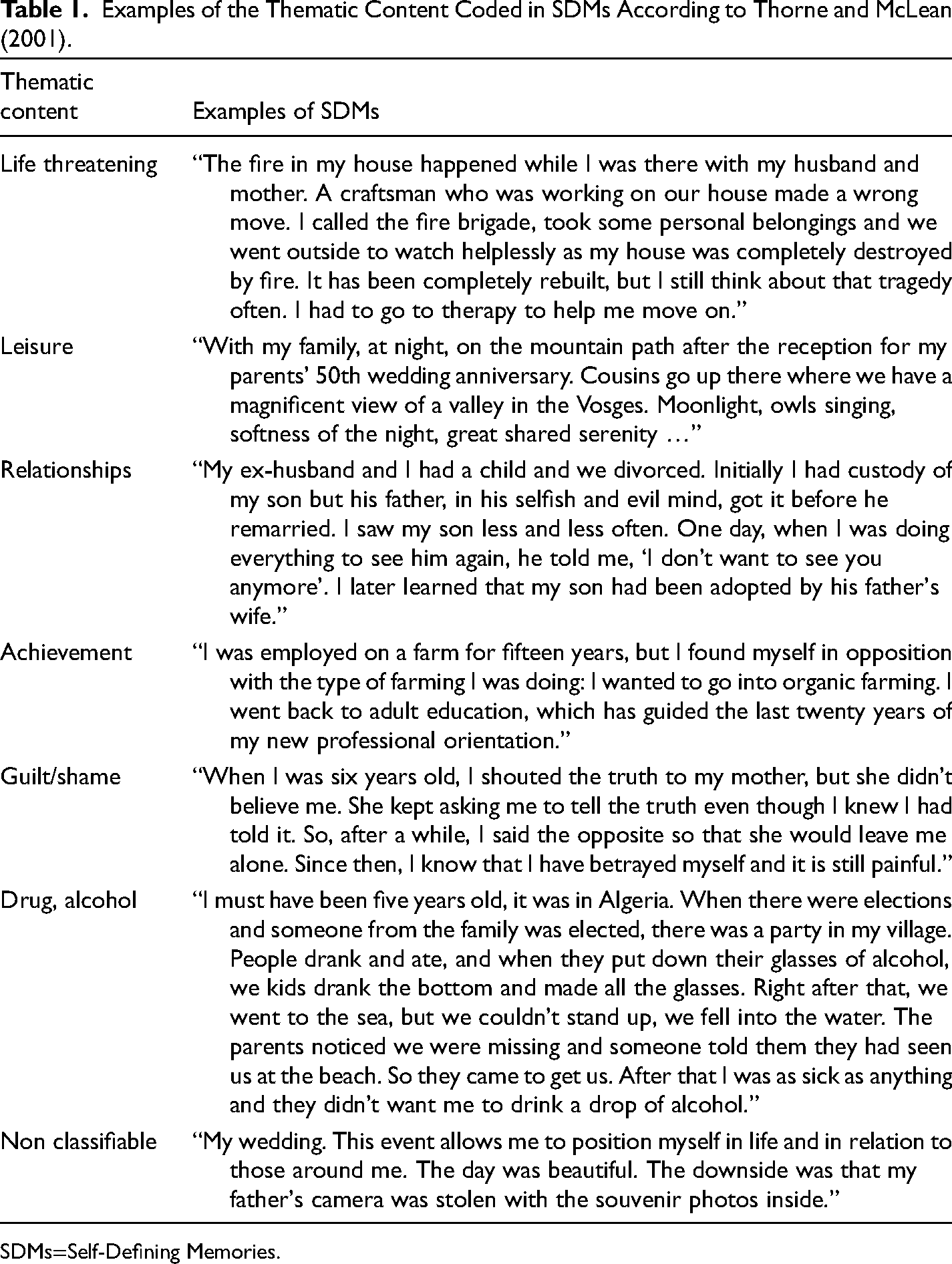
SDMs=Self-Defining Memories.
Measures
Participants were asked to recall three SDMs according to the instructions developed by Singer and colleagues (Blagov & Singer, 2004; Singer & Moffitt, 1992). The interview was fully structured. The task was presented through an oral definition of an SDM event, and its specific attributes. Thus participants were instructed that to be considered as an SDM, recollected events had to belong to one's personal memory event and to display specific attributes: (1) the time frame between the event and present time should be at least 1 year; (2) an SDM should be important for the individual and should be vividly represented; (3) it must be related to an event that helps oneself and others, referring to oneself as an individual with its own characteristics; (4) the event should be related to an important and enduring theme, issue, conflict, or concern from one's life and linked to other events sharing the same theme; (5) it could be either a positive or a negative event—the only important aspect is that it generates strong feelings; and (6) it should be an event that participants have repeatedly thought of. While listening to this description, participants had a sheet of paper in front of them summing up its main points. For each SDM, they had to give a title or a sentence to summarize the event, and provide a description of the event containing enough details (e.g., allow an imaginary friend to visualize the scene of the event and feel what characters felt). Next, participants had to rate on a seven-point rating scale (−3 = very negative, 0 = neutral, 3 = very positive) their emotional response when recalling the event. Finally, they had to estimate the delay between the event and the present time, in order to obtain a measure of the time frame (months between the described event and the retrieval day) for each SDM.
Participants were screened using the 14-item Hospital Anxiety and Depression Scale (HADS; Zigmond & Snaith, 1983) and the 10-item Rosenberg self-esteem scale (SES; Rosenberg, 1965) at the initial interview. In this study, internal consistency (Cronbach's alpha) was good or high: 0.67 for anxiety, 0.62 for depression, and 0.80 for self-esteem.
SDMs Coding
Specificity
A memory was coded as specific (score = 1) if it described an event that had happened at a particular place and time and lasted less than a day (Williams & Broadbent, 1986). Nonspecific (score = 0) SDMs included categoric (summaries or similar repeated events) and extended (events that are longer than a day) memories (Singer & Blagov, 2000–2001).
Integrative Meaning
An event was considered as integrated (score = 1) if the individual stepped back from the event narration and added a statement about the significance or meaning of the event for him or her (Singer & Blagov, 2000–2001). In contrast, if the narrative of the event contained only the event's description (without a meaning), it was considered as nonintegrative (score = 0).
Tension
SDMs were also coded for the presence (score = 1) or absence (score = 0) of tension (Thorne et al., 2004). For example, the following narrative illustrates tension: “I was on vacation and came back the day before my brother died. I knew he was going to die, and I was really sad and angry at the same time, very upset […].”
Redemption and Contamination
Redemption and contamination were subsequently coded as present (1) or absent (0) consistently with McAdams et al.’s (2001) Coding System. The negative and positive states of the event had to be clear and explicit.
Content of SDMs
Seven categories were distinguished using the classification suggested by Thorne and McLean (2001) and were mutually exclusive: (1) LTEs (death or severe illness, accident, serious assault or sexual abuse, etc.); (2) recreation or exploration events (leisure activities, hobbies, travel, sport, festivities, etc.); (3) relationship events (relations with peers or interpersonal conflict, etc.); (4) achievement events (references to one's own or others’ effortful attempts at mastery or accomplishment regardless of the outcome); (5) guilt or shame events (moral choice or one's doing right or wrong); (6) drug, alcohol, or tobacco use events; and (7) NCEs (narratives that do not fit into the six categories above or that involve more than one category). Examples of the seven thematic contents are presented in Table 1.
Affective Response
For each SDM, at the time of retrieval, participants were invited to evaluate their positive and negative emotion, each on a seven-point Likert scale from 0 (not at all) to 6 (extremely intense). The valence (i.e., positive, neutral, or negative) of the memories has been established. A SDM was considered positive when the difference between the values of positive and negative emotions was positive; negative in the opposite case and neutral when there was no difference. The numeral difference between positive and negative emotions value, or global emotional value, was obtained. The values ranged between −6 (no positive emotion and extremely intensive negative emotion) and +6 (extremely intensive positive emotion and no negative emotion).
Temporal Distance and Encoding Age
The temporal distance of the event from the present (in years), and the age of the participant (in years) at the time of the event were also calculated for all memories.
Twenty-seven percent of the memories were scored by two raters. Each SDM was coded by the first author and then by one of the two others. Agreement between the raters was good for contamination (agreement = 98.6%, Cohen's κ = 0.84), for integrative meaning (agreement = 95.0%, Cohen's κ = 0.86), and redemption (agreement = 98.6%, Cohen's κ = 0.86) and very good for content (agreement = 92.9%, Cohen's κ = 0.91), tension (agreement = 99.3%, Cohen's κ = 0.97), and specificity (agreement = 99.3%, Cohen's κ = 0.98).
Procedure
The present research was conducted in accordance with the Helsinki Declaration and was approved by the local ethics committee (CERNI n°2017–044). Participants were individually interviewed in a quiet environment. The experiment was initially explained verbally by informing participants that they would have to retrieve some important personal memories and that they would be asked to fill out some questionnaires. They were also informed that all information collected, both identity and personal, would be encrypted to ensure confidentiality. After giving a full description of the study to the subjects, written consent was obtained. First, demographic data were collected. Then the following tasks were administered in the same order for all participants: MMSE, HADS, SES, and SDM questionnaire. Total administration time was approximately 1 h. Break times have been offered to participants.
Statistical Analysis
Analyses were performed using SPSS®. Frequencies of the 543 SDMs were compared with chi-square tests for both nominal variables and with Mann-Whitney tests or Kruskal-Wallis tests for nominal and ordinal variables. Furthermore, we used student t-tests and Fisher tests for nominal and continuous variables that were normally distributed.
Considering the 181 participants, relationships between some variables (clinical, sociodemographic, etc.) were established using Pearson's or Spearman's correlations depending on whether the distribution of variables was normal or not.
All mean comparisons or correlations were performed separately from others so that we did not apply any correction for multiple testing (α = .05).
Results
The average levels for anxiety (M = 6.6, SD = 3.1) and depression (M = 4.4, SD = 2.8) were representative of no anxious or depressive disorders. The score for the Rosenberg's scale (M = 32.4, SD = 4.6) corresponded to an average self-esteem.
The descriptive characteristics of the 543 SDMs collected among the 181 older adults are reported in Table 2. As no gender differences emerged in the dimensions of SDMs, the data across men and women were collapsed. Among half of the SDMs were specific and a quarter to a third of them contained integrative meaning assertions. Regardless of NCEs, relationship events were the most frequent thematic content, followed by LTEs, leisure, and achievement events. Few memories contained tension, redemption, or contamination sequences and a great majority of them were positive. Finally, the average age of memories was around four decades.
Demographic Characteristics of the Older Adults and Descriptive Analyses of Their SDMs.
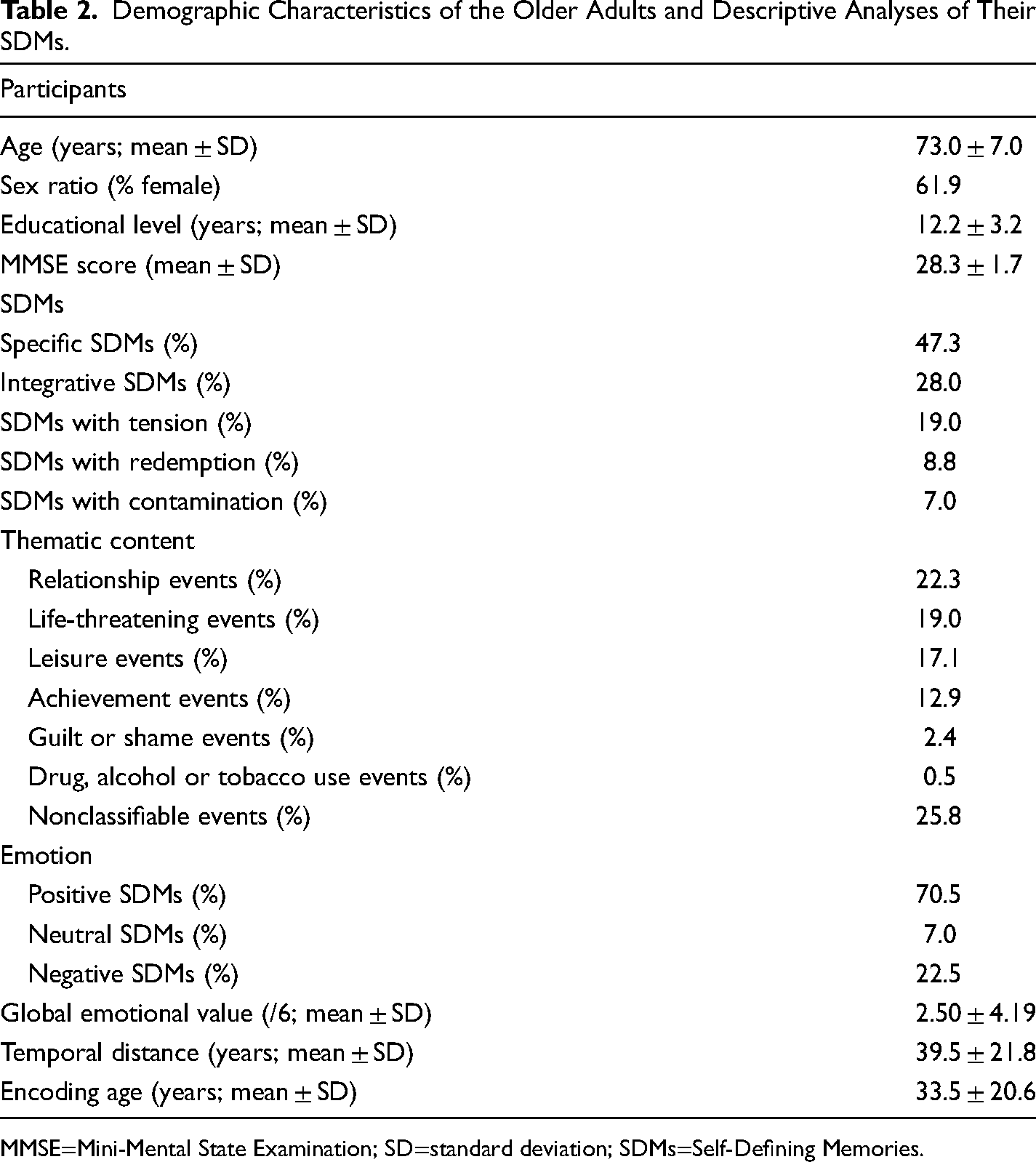
MMSE=Mini-Mental State Examination; SD=standard deviation; SDMs=Self-Defining Memories.
Interaction Among Dimensions of SDMs
Content
The relationships between each thematic content and the other dimensions of the SDMs are presented in Table 3. The frequency of specific SDMs changed regarding thematic content (χ2(6) = 16.74, p = .010). Contents from most to less specific were guilt or shame; drug, alcohol, and tobacco use; life threatening; relationship; leisure; nonclassifiable and achievement. In addition, memories with tension (χ2(6) = 71.37, p < .001), redemption (χ2(6) = 24.32, p < .001), and contamination (χ2(6) = 45.25, p < .001) varied with memory content. More precisely, LTEs contained the highest percentage of tension sequences. For the redemption sequences, guilt or shame were the most frequent content followed by achievement and LTEs. Moreover, guilt or shame and LTEs contained the most important percentage of contamination sequences, while none of the achievement memories contained contamination sequences. On the opposite, relationship and leisure memories contained the lowest percentage of contamination and redemption sequences.
Characteristics (Frequency or Mean) of the 543 SDMs Regarding Thematic Content.
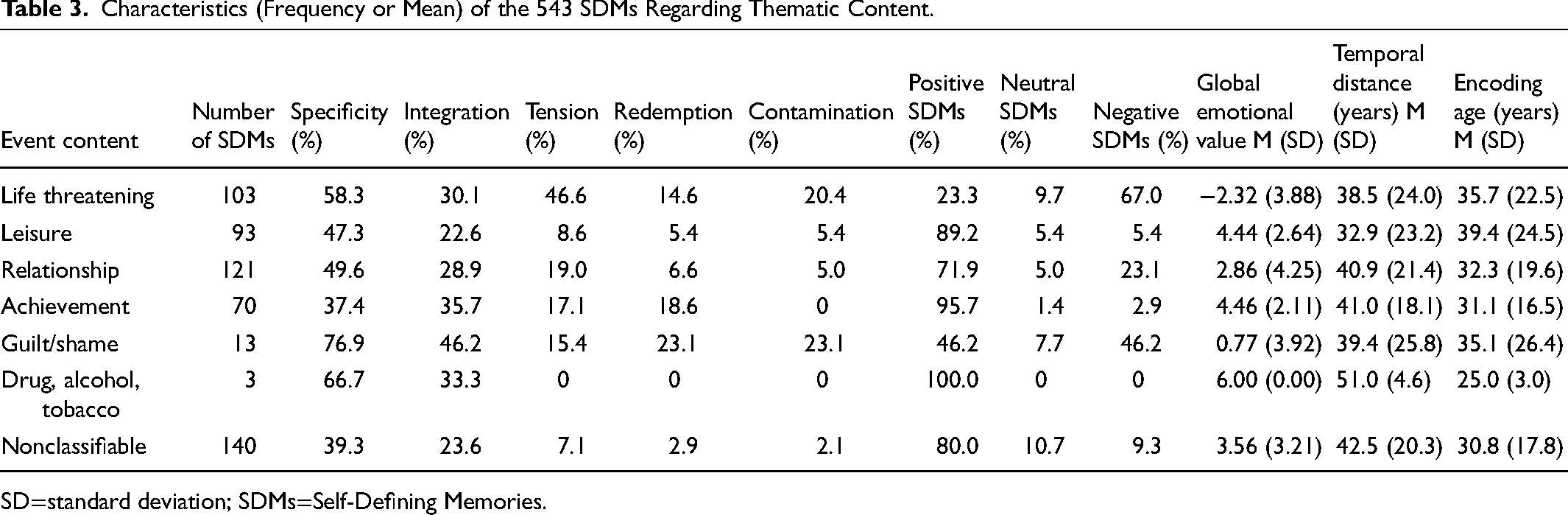
SD=standard deviation; SDMs=Self-Defining Memories.
Another finding was that affective responses varied concerning the thematic content. The percentage of positive (χ2(6) = 156.73, p < .001), negative memories (χ2(6) = 165.03, p < .001), and the mean emotional value (F(6,536) = 46.53, p < .001) varied with thematic content. The most positive memories were drug, alcohol, and tobacco use; achievement and leisure events while life-threatening and guilt or shame events were the most negative memories.
Concerning other dimensions, time frame and encoding age depended on content (F(6,536) = 2.21, p = .040 and F(6,536) = 2.23, p = .039, respectively). More precisely, SDMs representing leisure were the most recent memories whereas those with drug, alcohol, and tobacco use were the oldest. On the opposite, leisure events were the memories collected at the maximal mean encoding age.
Specificity
Specific SDMs were related to thematic content (see above). Moreover, specific events contained more explicit report of tension (28.0%) than nonspecific memories (10.8%; χ2(1) = 25.98, p < .001) and more contamination sequences (10.1% vs. 4.2%; χ2(1) = 7.29, p = .007). No difference was observed for integrative meaning between specific and nonspecific SDMs (p = .246).
Integrative Meaning
Significant differences were observed between integrated and nonintegrated SDMs for some dimensions. Memories with integrative meaning contained more redemption sequences (16.4% vs. 5.9%; χ2(1) = 15.16, p < .001), were more negative (29.6% vs. 19.7%; χ2(1) = 6.17, p = .013) and had a lower emotional value (M = 1.80 vs. M = 2.77; t(541) = 2.46, p = .014).
Tension
Memories with reference to tension were related to thematic content (see above) and specificity (see above). Moreover, significant differences were found between the SDMs with and without tension for some other dimensions. Memories with tension contained more redemption (redemption sequences were present in 17.5% of SDMs with tension and 6.8% of SDMs without tension; χ2(1) = 11.76, p < .001), more contamination (contamination sequences were present in 16.5% vs. 4.8% of SDMs, respectively, with and without tension, χ2(1) = 17.65, p < .001), were less positive (38.8% had a positive emotional valence vs. 78.0%; χ2(1) = 61.46, p < .001), more negative (49.5% vs. 16.1%; χ2(1) = 53.38, p < .001) and had a lower emotional value (M = −0,77 vs. M = 3.27; t(143.85) = 8.93, p < .001). Considering the participants, we also found that tension was positively correlated to temporal distance of SDMs (r = 0.18, p < .05).
Redemption and Contamination
Redemption sequences were related to thematic content, integrative meaning, and tension (see above). Contamination sequences were related to thematic content, specificity, and tension (see above). Moreover, memories containing contamination sequences were less positive than memories without contamination sequences (23.7% were positive vs. 74.1%; χ2(1) = 43.15, p < .001), more negative (63.1% vs. 19.4%; χ2(1) = 38.84, p < .001) and had a lower emotional value (M = −2.24 vs. M = 2.86; t(541) = 7.60, p < .001).
Emotional Response
As mentioned above, significant differences were found between SDMs regarding emotional response (positive, neutral, and negative SDMs) for some dimensions: integrative meaning (χ2(2) = 6.24, p = .044), tension (χ2(2) = 63.43, p < .001), and contamination (χ2(2) = 45.04, p < .001). Negative memories were more integrated (36.9%) than positive (25.6%) and neutral (23.7%). They were related to more tension (41.8% of negative SDMs contained tension, 31.6% of neutral SDMs and 10.4% of positive SDMs) and contained more contamination sequences (19.7% vs. 13.2% for neutral and 2.3% for positive SDMs).
Correlations Between Dimensions of SDMs and Age of Participants
A positive correlation was observed between the age of participant and two variables; depression score (r = 0.22, p < .05) and temporal distance (r = 0.45, p < .001). Moreover, a negative correlation was found between the age and the global emotional value (r = −0.19, p < .05). Concerning clinical variables, a negative association between integrative meaning and depression score was evidenced (r = −0.15, p < .05). However, we did not find any correlation between anxiety or self-esteem and the different dimensions of SDMs.
Discussion
The aim of this study was to characterize SDMs in older adults. As Lardi et al. (2010) did for young adults, we explored the relationships between the different dimensions of these SDMs.
Characteristics of SDMs
We found a similar percentage of specific memories than those reported by previous studies in older adults (Cuervo-Lombard et al., 2020; Singer et al., 2007) and, as we expected, almost half the participants recalled specific SDMs. Moreover, compared to results in young adults (Blagov & Singer, 2004; Lardi et al., 2010; Singer & Moffitt, 1992), we found that SDMs reported by older participants were less specific. This finding is consistent with studies on autobiographical memory which have established that the older persons recollected less episodic memories than younger adults. Indeed, semantization increases with the age of memories and the age of participants (Piolino et al., 2006).
Considering integrative meaning, our sample reported as many SDMs with integration as the older adults included in Cuervo-Lombard et al.’s (2020) research, but less integrated SDMs compared to Singer et al.’s (2007) study. This result could be partly explained by the age difference in the participants of the present study and Singer et al.'s study (mean age of 73.0 vs. 64.6 years). In addition, there might be cultural differences. Indeed, as American culture is anchored around the redemptive self (McAdams, 2006), integrative meaning is higher in American older adults than in French ones. Older adults need coherence and explanation of the self (Cohler, 1993; McLean, 2008), especially after retirement (Leclerc et al., 2003). Integrative meaning might decline with ageing because it is part of the process of directing oneself toward the future (e.g., McLean & Pratt, 2006) and older adults are living in the moment (Carstensen et al., 1999).
As expected, older adults reported fewer SDMs with explicit reference to tension than young adults (Lardi et al., 2010; Thorne et al., 2004) and middle-aged participants (Cuervo-Lombard et al., 2020). This result is in accordance with the percentage observed in the older sample of the previous study (Cuervo-Lombard et al., 2020). We suggested that with age, the tension progressively diminished in SDMs due to the bias toward positivity reported in older persons (Carstensen & Mikels, 2005).
Redemption and contamination sequences were rare in our participants. These findings are also in line with our hypotheses. The percentage of those sequences were similar in our sample and in the recent study in older and middle-aged adults (Cuervo-Lombard et al., 2020). No other studies in older adults examined these affective dimensions. Moreover, redemption sequences might be more common in the narratives of the American population (McAdams, 2001, 2006) than in those of the French population. Hammack (2008) also demonstrated cultural differences as young Palestinians tend to nourish their identities with contaminated narratives whereas young Israeli mostly construct a redemptive self.
Regarding SDMs’ thematic contents, relationship events are the most frequent memories recalled. This finding is congruent with previous studies in young adults (Blagov & Singer, 2004; Lardi et al., 2010; Thorne et al., 2004) and highlighted that identity is first and foremost defined by interpersonal relations: whatever their age, people are social beings. Relationships are still particularly important for retired adults even if they maintain less attachment relationships than younger ones, particularly because of the grief they faced (e.g., Freitas & Rahioui, 2017). Nevertheless, the relationships of older adults would bring them more satisfaction as explained by the theory of socioemotional selectivity (Carstensen et al., 1999). Moreover, LTEs are the second most frequent thematic content as older participants often lived situations of death or health concerns, with a comparable level than in American older people (19.0% in the present study vs. 21.0% in Singer et al.’s [2007] study). We found that leisure sequences were almost as often described as LTEs and more frequent than in American older adults (Singer et al., 2007). Indeed, leisure would help older people to experience successful ageing (e.g., Brown et al., 2008) and feelings of empowerment even in the context of dementia (Genoe, 2010). We can also argue that leisure activities contribute to retired adults to still have personal goals and maintain their social integration and, consequently, their personal identity. Compared to previous studies, achievement events were less provided in our French sample than in older American adults (Singer et al., 2007). More precisely, these authors found that this thematic content was the most frequent in the SDMs of older participants. We can hypothesize that age may partly explain those differences because our participants were older and all retired. Furthermore, previous studies established that Americans work longer and retire later than the French (e.g., Ghilarducci, 2004).
Concerning affective dimensions, as expected, emotional response was more positive than negative in our sample. This finding is in line with previous research (Cuervo-Lombard et al., 2020; Singer et al., 2007) and confirmed the positivity effect largely reported in literature concerning the older persons’ autobiographical memories (Carstensen & Mikels, 2005; Gallo et al., 2011; Kennedy et al., 2004). This positivity bias would be explained by the fact that the narrative identity would transform life's goals to build a coherent identity (Wood & Conway, 2006), accepting oneself and others to give meaning to one's life (Wong & Watt, 1991).
Finally, temporal distance was similar to previous research in older adults (Cuervo-Lombard et al., 2020; Singer et al., 2007). The mean encoding age was toward the end of the reminiscence bump, which corresponds to a large number of autobiographical memories from the period 10 to 30 years of age (for a review, see Munawar et al., 2018). This period is crucial for self-development and intimate relationship formation through marriage, birth of the first child, first professional position (Conway & Holmes, 2004).
Interactions and Correlations Between SDMs’ Dimensions
As expected, thematic content was significantly linked to many SDMs’ dimensions: specificity, tension, redemption, contamination, emotional response, and encoding age. LTEswere mostly specific memories in our sample, as shown by Lardi et al. (2010) for young adults, even if the percentage was lower for older participants. Nevertheless, SDMs related to guilt or shame were the most specific ones. As these two contents effectively contained the most negative and the less positive memories and the smallest global emotional value, this suggests that negative emotion enhances SDMs’ specificity. Contrastingly, outside drug, alcohol and tobacco events that were rare, achievement events were the less-specific SDMs certainly because they were the most positive and contained a high global emotional value. Finally, NCEs were the least specific memories: this result is not surprising, as these events commonly lasted more than 24 h and often combined several events which consequently illustrate more than one content.
Consistently with Lardi et al. (2010), LTEs remained SDMs with the highest percentage of tension and negative events in our sample. They also contained a high frequency of contamination sequences. Those results could be explained by the frequent confrontation with painful events like grief and illustrate the fact positive events described in narratives sometimes turn bad (McAdams et al., 2001). SDMs with relationship events, which are salient to define the personal identity of older adults, were mostly positive and contained many tension sequences but few redemption and contamination sequences. This is not surprising when considering that happy relationship events (meeting, marriage, connection with children and grandchildren, etc.) are probably more frequent than sad relationship events (e.g., conflicts). This result is also consistent with a recent study highlighting that the memories of older adults contained more relationship sequences when collecting positive memories compared to negative ones (Polsinelli et al., 2020).
SDMs related to guilt or shame were linked to the highest level of contamination and redemption; they were also positive and negative in the same proportions. We can argue that a part of those memories permitted participants to draw lessons as confirmed by the high frequency of integration assertions for those narratives. SDMs related to leisure were those with the lowest percentage of tension; they were essentially considered as positive events and corresponded to the most recent narratives. Leisure events are considered to transcend negative life events and buffer them through self-restoration and personal transformation by generating optimism about the future (Kleiber et al., 2002). Thus, leisure is a current concern in older adults.
We did not find that integrative meaning varies with thematic content in older adults, suggesting that they learned lessons for all kinds of memories. Contrastingly, in young adults, integration was the most prevalent in relationship and LTEs (Thorne et al., 2004). In the current study, in accordance with Singer et al. (2007) and as hypothesized, we found no link between integration and specificity in the older participants. These authors suggested that older individuals dispose of a larger store of memories that include recent and more distant ones providing them opportunities to give meaning to both specific and summarized experiences. In line with Lardi et al. (2010), we also highlighted a positive relationship between specificity and two other dimensions of SDMs (tension and contamination) suggesting that negative events are remembered with more details. Results also showed a positive correlation between redemption and integration, suggesting that the change of a negative to a positive situation fosters lesson learning.
Correlations Between SDMs Dimensions and Age of Participants
We found that age was associated with a decrease of global emotional value, which might concern the SDMs of our oldest participants. It is possible that the positivity effect described in increasing age in the socio-emotional selectivity theory (Carstensen & Mikels, 2005) is not observed in late adulthood as “very-old” adults are faced with negative perspectives like health decline.
There was a negative correlation between depression score and integration in our sample. This result is in accordance with Harkness' (2011) study showing that nondepressed status was correlated to integrative meaning, which dimension was a good predictor of depression in a regression analysis.
Limitations
Even if the current study added significant contributions to the understanding of the SDMs in older people, some limitations should be addressed. The first one is the repartition of age of our sample in which the oldest category was less represented. Another one was the absence of detailed cognitive examination, in particular executive functions. Indeed, El Haj and Gallouj (2019) showed that there was a strong positive correlation between updating and the retrieval of SDMs. Finally, we collected only three SDMs by participants to take into account age-related increase of fatigability.
Conclusion
In conclusion, the current study presents, for the first time, further characteristics of SDMs and interrelations between their different dimensions in retired older people living at home. Older individuals are confronted with the need to preserve their identity and maintain their sense of self-continuity despite difficulties associated with ageing. The implications of our main findings are to be considered in clinical interventions in older adults to support them during life transitions (retirement, bereavement, institutionalization, etc.) and promote successful ageing. Thus, to treat psychological disorders such as depression (Spor & Lefèvre, 2021), recall of memories with the highest positive value, such as recent events of leisure and achievement, could be used. Redemptive and integrated memories are probably the most salient in a clinical context as they might improve self-esteem and wellbeing. Moreover, McLean and Thorne (2003) considered that integrated memories can guide future behavior in a similar context. Further research could extend our results by including older adults living in nursing homes, suffering from anxiety or depression or from neurocognitive disorder. Furthermore, the influence of culture on the characteristics of SDMs (in particular redemption) in older adults should be studied. Finally, future research should include participants of all ages to characterize lifelong identity adjustments and examine changes over different periods of adult development in a cross-sectional study.
Footnotes
Acknowledgements
We are grateful to our psychology students from the Master in Gerontology who assisted in collecting the data. We also thank Martial Van der Linden (†) for contribution to the design of the study.
Declaration of Conflicting Interests
The author(s) declared no potential conflicts of interest with respect to the research, authorship, and/or publication of this article.
Funding
The author(s) received no financial support for the research, authorship, and/or publication of this article.
