




Abstract
This article examines the efficacy of volunteering potential regarding actual volunteering at a later point in time. Volunteering potential consists of two components: past volunteering and the intention to do so in the future. Using two-wave panel data from the German Transitions and Old Age Potential (TOP) study with 1,196 respondents born between 1942 and 1958, binary logistic regression estimates reveal significant adjusted average marginal effects of both potential components on actual volunteering at a later stage (intention: +8.4 percentage points, past volunteering: +6.3 percentage points). Considering both components as an interaction term, analyses provide mixed results. By taking greater account of the potential volunteers, scholars and policy-makers will have better insights into how to assess recruitment potential among older adults.
Keywords
Background and Research Question
Due to ongoing low fertility rates and rising life expectancy, Germany belongs to the 10 “oldest” countries worldwide in terms of the old-age dependency ratio in the age groups 20–64 versus 65 years or older (United Nations, 2020). The population aging process is a perennial hot topic with regard to economic welfare and social cohesion (Micheel, 2021). According to current population projections by the German Federal Statistical Office, the share of people aged 65 and older is expected to rise from 21.9% in 2020 to 26.0% in 2030, comprising around 21.6 million people (Statistisches Bundesamt, 2019). In the upcoming decade, the baby boomers, born in the 1950s and 1960s, will steadily face the transition from working life to retirement (Fuchs & Weber, 2020).
Individuals of retirement age, equipped with a significant increase in leisure time, are able to intensify passing their life experience to their younger peers by volunteer involvement (Adams-Price et al., 2018). In this way, older people substantially contribute to social cohesion and welfare for successive generations keeping in mind that a strong and lively civil society sector (including all ages) reflects an essential component of a stable democracy (Carr & Gunderson, 2016; Putnam, 2000). Furthermore, volunteering confers benefits on the individuals engaging in it in the form of connectedness to other people and social participation. Volunteers usually achieve higher levels of subjective well-being, and show fewer symptoms of depression compared to nonvolunteers (e.g., Anderson et al., 2014). An active and meaningful lifestyle through voluntary participation is generally associated with improved health effects and reduced mortality risk (Jenkinson et al., 2013; O’Reilly et al., 2017).
Scholars with an optimistic view on the demographic aging process refer to the third age (approximately between 60 and 80 years) as a collective potential for engagement in productive activities, such as family or community work (e.g., Carr & Gunderson, 2016). This optimism is based on the fact that the older adults today are on average healthier and better educated—the two key enablers for civic involvement (e.g., Musick & Wilson, 2008)—than previous generations (Mahne et al., 2017; Spuling et al., 2019). Generally, increasing potentials among older people in terms of health, educational attainment and discretionary time display an encouraging trend referring to the aging process in the near future. Previous studies report a growing popularity of volunteering among older adults in Germany within the past three decades. For example, participation rates of retired people increased between 1990 and 2017 from 17% to 29%—a growth of 70% (Burkhardt & Schupp, 2019). Still, the share of nonvolunteers remains the largest.
However, this way of looking at the phenomenon “volunteering” brings with it considerable problems. By reporting participation rates of older people in the voluntary sector, the assumption is indirectly made that those who are not currently active are able and willing to do so at any time. In this sense, all nonvolunteers are declared as potentially committed to volunteer activities resulting in an exaggerated recruiting potential. To assess realistic potential in voluntary action, we need to know if older adults show a credible preference to volunteer involvement (Hansen & Slagsvold, 2020). Numerous scholars argue that the empirical analysis of volunteering lacks differentiation, treating it as a binary occurrence, either present or absent (e.g., Dury et al., 2015). Studies that are more recent show a growing interest in nonvolunteers to quantify the inclination to volunteer as a prospective recruiting potential (Hansen & Slagsvold, 2020; Haski-Leventhal et al., 2019; Lockstone-Binney et al., 2022).
Furthermore, empirical findings refer to a strong continuity of volunteering over the life course (e.g., Lancee & Radl, 2014). Older adults who have been active in their younger years may be more interested in (and actually) getting involved in volunteer activities than people who have never volunteered in their lives. This continuity, representing vital experience gained over the life course, might be considered a further potential, which takes the retrospective view. To our knowledge, there are no existing empirical studies that have investigated the interrelation between both potential dimensions with regard to actual volunteering at a later stage.
With these aspects in mind, this article addresses several questions with regard to potential and actual volunteering at a later stage: How large is the share of nonengagers who show an interest in volunteering? How strong is the impact of past volunteering and an intention to do so on actual engagement at a later stage—separately and in combination? By answering these questions, scholars are able to assess valuable information beyond the binary view on voluntary engagement in old adulthood. Understanding the link between potential and actual volunteering at a later stage helps policy-makers to target their policy instruments more effectively.
Previous Research
At the start of this review, clarifications of the terms “volunteering” and “potential” are required. Broadly, volunteering is described as a deliberate and proactive behavior that requires time and effort. This behavior is freely chosen and devoted to supporting other people, groups, or causes. Often, it is embedded in an organizational context. Usually, the individual does not expect a reward or compensation for this activity. The degree of obligation is low compared to family work (i.e., nursing care). In contrast to helping people outside the family (e.g., friends or neighbors), volunteering requires greater personal commitment (Snyder & Omoto, 2008; Wilson, 2000). In this study, the focus is on formal volunteering through an organization, group, or initiative. Furthermore, the terms “volunteering,” “engagement,” “action,” “involvement,” or “participation” in such activities are used interchangeably.
Referring to the online Oxford Advanced Learner's Dictionary, the term potential is generally defined as “the possibility of something happening or being developed or used.” (https://www.oxfordlearnersdictionaries.com/definition/english/potential_2, retrieved on June 21, 2023). To incorporate this general definition within the research question, possibility will be decoded to a probability for a future state or event—in this case current nonengagers with a propensity to actual volunteer involvement at a later point in time—symbolizing a “latent” attachment to volunteering.
A look at research in social gerontology shows that still relatively few quantitative studies exist, which examine potential volunteering in old adulthood (Dury et al., 2015; Hansen & Slagsvold, 2020). They show that the share of potential volunteers is a nonnegligible phenomenon displaying a rather substantial range between one in six persons aged 60–80 in Belgium (Dury et al., 2015) and one third among the 55–70-year-olds in Germany (Micheel, 2017). Generally, older adults who currently do not volunteer but intend to do so share more similarities with actual volunteers regarding individual resources and social context compared to people who are neither involved nor interested in volunteering. Usually, actual and potential volunteers are characterized by a high socio-economic status. This phenomenon is not restricted to the German context and can also be observed in Belgium and in the United States (Micheel, 2021). Moreover, actual and potential volunteers exhibit greater similarity in terms of their motivation to volunteer and their perception of their abilities, such as self-efficacy, compared to individuals who show no interest in volunteering (Lockstone-Binney et al., 2022).
Beyond these consistent patterns among volunteers and potential volunteers, Dury et al. (2015) show that these two groups differ in several characteristics. Actual volunteers report stronger expressions of altruistic and religious values, and they possess, compared to potential volunteers, a larger social network. A comparison of older adults in Germany reveals that men, retirees, nursing carers (providing care at low and medium intensity), and those living in communities with populations up to 200,000 are more likely to be classified as actual volunteers, in contrast to their counterparts who show interest in voluntary activities (Micheel, 2017).
Empirical findings from a longitudinal perspective suggest a high degree of continuity regarding volunteering over the entire life course (Lancee & Radl, 2014); volunteer involvement in the past, symbolizing experience effects in this field, predicts volunteering at a later stage. This finding is of particular importance for the debate on promoting voluntary activities in retirement age since empirical studies show that the influence of earlier engagement on actual volunteering in retirement is stronger than the transition to retirement itself, which is associated with an increase in discretionary time (Erlinghagen, 2010).
Psychological research offers compelling evidence indicating that intentional behavior plays a crucial role regarding actual volunteering at a later point in time. A notable example is a study of older Australians aged 65–74 which revealed that the intention to volunteer shows greater predictive power for actual volunteering compared to perceived behavioral control or attitudes toward volunteering (Warburton & Terry, 2000). Studies with similar designs generally support this prevailing pattern, although the focus was not specifically on late adulthood (Kragt & Holtrop, 2019; Smith et al., 2016). Despite the striking results, Smith et al. (2016) observe that the majority of the psychological studies cited there are based on convenience samples. This sampling procedure bears the risk of limited generalizability of the findings to the population in old age.
To the best of our knowledge, no empirical studies exist that have examined both potential dimensions directly related to each other (either in comparison or in combination). Indirect evidence for the relative importance of past on actual volunteering compared to intentional volunteering is given by Mullan et al. (2021). Analyses show that the influence of habit strength on actual volunteering at a later stage is considerably weaker compared to intentional behavior (Mullan et al., 2021). Thus, the strength of past volunteering on future involvement is supposed to be lower compared with the intention to volunteer.
Also supported by indirect evidence, future intentions to volunteer—which are mentioned above as highly correlated with actual volunteer engagement at a later time—are particularly pronounced among individuals who report a past involvement in volunteering compared to those who report no experience in volunteering (Pavlova et al., 2022). It appears to be a reasonable assumption that the chances of volunteering are highest at a later stage when both potential dimensions are present simultaneously, exhibiting a cumulative pattern.
To sum up this review, the empirical investigation into the significance of potential engagement among the older population and its subsequent manifestation, remains an unresolved matter. The aforementioned studies share weaknesses, which will be resolved in this study; either data are collected in a cross-sectional manner or the sampling procedure (i.e., convenience samples) leads to biased results.
Conceptual Framework and Hypotheses
Combining Established Theoretical Knowledge With New Ideas
The conceptual framework is heavily inspired by the seminal works of Wilson and Musick (1997) as well as Einolf and Chambré (2011). The first authors developed a structural theory in designing the decision to volunteer as a rational choice, where the individual optimizes his or her allocation of free time. This theoretical approach predicts that people with higher amounts of resources are more likely to realize their preferences to volunteer compared to people with less resources, because the efforts (“costs”) of volunteering will be less demanding. In this sense, the “net profit” of volunteering will be higher for the resource-rich (Wilson & Musick, 1997). Human capital involving high educational attainment (which reflects the necessary civic skills for volunteering, i.e., communicating or organizing skills, Brady et al., 1995) or a good health status enables the individual to engage in volunteer activities. The idea of social capital rests upon the premise that volunteering represents a collective action. Social networks are an essential component of volunteering. Social ties, whether formal membership or informal social networks, provide other group members with resources or information, create and foster mutual trust, and establish social norms within this group (Putnam, 2000; Wilson & Musick, 1997). Cultural capital involves a moral component within collective action. It describes the accumulated stock of shared values and attitudes within the group. Religiosity is the most prominent example of cultural capital in the volunteer context (Wilson & Musick, 1997).
The hybrid theory on volunteering by Einolf and Chambré (2011) is considered as an extension of the resource-oriented approach. It goes into more detail about the social capital dimension by addressing different domains of social factors involving social context (i.e., neighborhood-related aspects), social integration (existence and quality of social contacts), and social roles. Being committed to voluntary action is only one of many different social roles an individual holds (in particular with respect to work and family). Insofar, the interplay of these social roles influences the likelihood to volunteer with varying outcomes. Especially in late adulthood, volunteer activities can compensate for the loss of the social role “being employed” when the individual retires. In addition, empirical analyses reveal that former employees in higher occupational positions (which usually correlate with high educational attainment) are strongly attached to volunteering in retirement compared to their peers in less prestigious jobs. The expected loss of status in retirement seems to be a strong trigger for volunteering in retirement (van den Bogaard et al., 2014). On the contrary, very time consuming or emotionally challenging activities like nursing care can cause a role overload with discouraging effects. This problem applies particularly to older women who are usually expected to nurse for family members in need of care (Choi et al., 2007). In addition, the hybrid theory incorporates individual, personality-related characteristics with reference to compelling evidence of psychological investigation (Einolf & Chambré, 2011). In terms of “subjective dispositions” (Musick & Wilson, 2008, p. 37), prosocial attitudes, personal traits, and motives are strong triggers for volunteer intention and actual action, although pure altruistic attitudes are not a necessary condition for volunteer engagement (Snyder & Omoto, 2008).
Potential Volunteering: A Janus-Faced Perspective
The motivation for this study is to provide additional ideas on explaining volunteer behavior by incorporating the factor “potential.” This study draws inspiration from the Roman god Janus, aiming to metaphorically shift the focus in two directions: backward and forward. By considering both past-related and future-related aspects, it seeks to provide a comprehensive explanation of volunteering. Furthermore, adopting this perspective entails an emphasis on the ambiguous aspects within the realm of volunteering by acknowledging that potential volunteers may possess a certain inclination toward voluntary involvement, yet they remain inactive. Wilson (2000) highlighted the continuing (and still unresolved) discourse regarding the inclusion of intention as a crucial aspect to consider in the measurement of volunteering.
The conceptual framework explains volunteer involvement from an interdisciplinary perspective, which acknowledges and unifies different concepts from sociological (Wilson & Musick, 1997) and psychological research (Einolf & Chambré, 2011). The assumptions applied to predicting individual behavior by the two disciplines (with respect to (bounded) rational choice theory in sociology and reasoned action approaches in psychology) are discussed as essentially equivalent (Opp, 2019). The perspective in this study takes the ideas and assumptions of capital-based and hybrid theory and complements them with the indicator “potential engagement.”
Potential volunteering is designed as a Janus-faced social construction consisting of two components taking future and past events into perspective. The first component deals with the intention to participate in voluntary activities. Intentional behavior has several meanings such as a general openness to this option, showing availability (analogous to the support side of the labor market), or as an anchor for subsequent actual behavior through self-binding goal setting (Caro & Bass, 1997; Gollwitzer et al., 1990; Musick & Wilson, 2008; Warburton & Terry, 2000). Intentional behavior also brings a significant contribution at the political level. Expressing an intention indicates a preference for civic involvement reflecting an essential feature of a democratic society. Even if intentional volunteering does not automatically lead to higher participation rates, this information helps us to evaluate the current degree of openness and democratic attitudes in the context of an aging society (Putnam, 2000; Snyder & Omoto, 2008).
The second component is represented by volunteer activities from the past indicating that these individuals gained vital experience across the life course. Experience effects from the individual's life course occur on structural and psychological levels. In terms of civic skills, experience from past volunteer involvement is discussed as a helpful resource in continuing or in taking up a volunteer activity again. Further, relevant social ties (symbolizing accumulated social capital) from past volunteer involvement might help the individual find back into the voluntary sector (Lancee & Radl, 2014; van den Bogaard et al., 2014). In addition, experiencing the shared values and norms (implying reinforcement of cultural capital over time) in volunteer engagement is supposed to be associated with continuity for future involvement (Dury et al., 2015; Musick & Wilson, 2008).
Hypotheses
According to the cited literature above and the conceptual framework on the interplay between potential and actual volunteering, it is proposed that both components of potential engagement have separately a significant impact on subsequent actual volunteer action.
Furthermore, it is assumed that both potential components show a cumulative pattern.
With reference to the empirical finding that the influence of habit strength (indicated by past voluntary action) on actual engagement at a later stage is weaker compared to intentional behavior:
According to the conceptual framework, it is hypothesized that the new theoretical ideas provided in this study complement established theoretical knowledge in explaining volunteer action. Therefore, the final hypothesis evaluates the model fit parameters of the multivariate analyses.
Data and Analytic Strategy
Data Collecting Process and Analytic Sample
Empirical analyses are based on a two-wave panel study that was carried out in the project “Transitions and Old Age Potential” (TOP). The study was conducted in Germany. Data were collected in 2013 (Wave 1) and 2015/2016 (Wave 2). Participants born between 1942 and 1958 were interviewed with a standardized questionnaire via telephone regarding paid work and informal activities, the transition from work to retirement, health status, and selected personality characteristics. To create a representative sample in the first wave, the respondents were selected based on the Gabler–Häder design. For the panel study, 2,501 interviews were completed in 2015/2016 (Mergenthaler et al., 2017; Sackreuther et al., 2016). The scientific use file is available in the GESIS repository at https://doi.org/10.4232/1.13206.
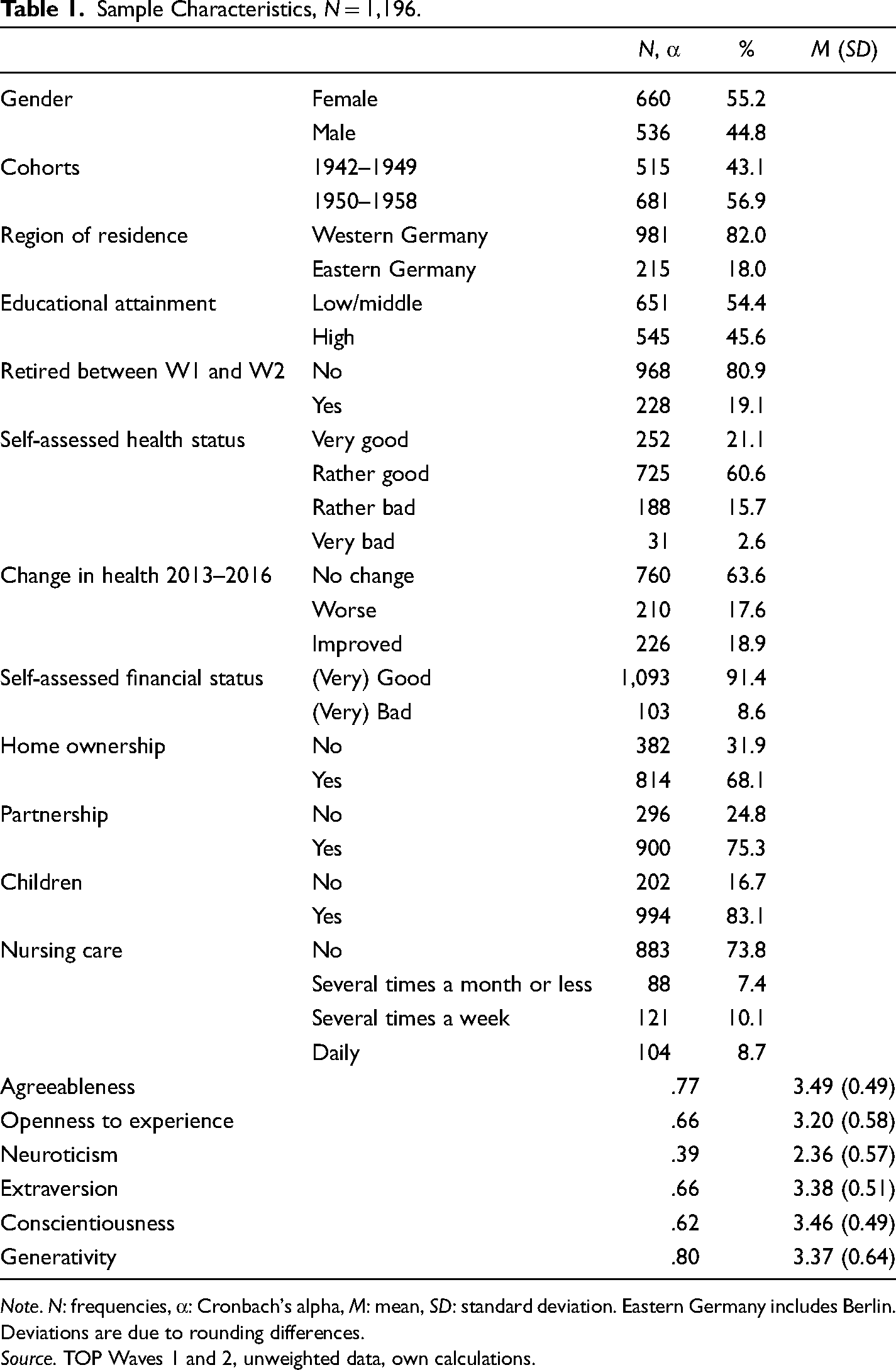
Starting with all respondents who participated in both waves, respondents who volunteered in 2013 or refused to answer this question (N = 1,305) were taken out of the sample. The remaining participants were asked if they are interested in taking up a voluntary activity in the future. Additionally, they were asked if they had been committed before 2013 (N = 1,196). Missing values in the second wave are replaced by information of the same variable in the first wave and vice versa. Actual voluntary involvement in 2015/2016 is taken as the outcome variable. Sample characteristics and selected properties of the psychological scales used in this study are shown in Table 1.
Sample Characteristics, N = 1,196.
Note. N: frequencies, α: Cronbach's alpha, M: mean, SD: standard deviation. Eastern Germany includes Berlin. Deviations are due to rounding differences.
Source. TOP Waves 1 and 2, unweighted data, own calculations.
Most study participants are female (55%), are born between 1950 and 1958 (57%), and live in the Western part of Germany (82%). About 46% have high educational attainment. The odds of being relatively or very healthy are quite high in comparison to those who report (relatively) poor health (roughly 4.5:1). Three quarters of the respondents have a partner (75%), six out of 10 are retired (59%). One in six interviewed persons (16.7%) is childless (Table 1).
Main Effects
The focus of the study is on the interplay among the following three variables: (a) nonengaging respondents in Wave 1 provide information on past voluntary action in response to the following question: “Have you ever participated or been actively involved in volunteering or civic activities?” (Yes/No); (b) intention to volunteer is measured by asking nonengaging respondents “Are you considering participating in volunteering or civic activities in the future?” On a 4-point Likert scale, they can rate this item from 1 = very likely to 4 = very unlikely. This variable has been binary coded (1 = very/quite likely and 2 = quite/very unlikely). Missing values resulting from the answer “don’t know” or without response (N = 7) are coded as “no” because these options indicate that the individual does not show a genuine interest in civic behavior; (c) actual engagement in Wave 2 (2015/2016), which is introduced by the following question: “In the past three months, have you done or been involved in any of the following activities? → Volunteer work, e.g., participation in an association, a civic initiative or a group” (Yes/No).
Control Variables
According to Wilson and Musick (1997) and Einolf and Chambré (2011), control variables are subdivided into different domains:
Personality-related characteristics and individual values: Big Five personality traits (Rammstedt & John, 2007): agreeableness, openness to experience, neuroticism, extraversion and conscientiousness. Generativity is one component of the “meaning of work” scale. It was originally developed by Mor-Barak (1995) and has been transferred to the German-speaking context (Sackreuther et al., 2016). Four statements on a reversed 4-point Likert scale (originally from 1 = fully applies to 4 = does not apply at all) about the meaning of work measure generativity. An exemplary item of this measure is “For me, personally, work means passing knowledge on to the next generation.” Individual key resources for volunteering are represented by human capital (Wilson & Musick, 1997), particularly by educational attainment and self-assessed health status (including change of health status between 2013 and 2015/2016). The measurement of formal education is based on the International Standard Classification of Education (ISCED). Due to the small number of respondents with low education, two categories are classified: low/middle educational level (ISCED-level 1–5) and high educational level (ISCED-level 6–8). Social context: Partnership status and having at least one child represent important features of social capital (Wilson & Musick, 1997). Home ownership represents a considerable stake within the local community (Rotolo et al., 2010). Nursing care (based on four categories for care frequency: “no,” “several times a month or less,” “several times a week,” and “daily”) is used as an indicator of social role conflicts (Choi et al., 2007). Sociodemographic characteristics include gender, birth cohorts (born in 1942–1949 and 1950–1958), region of residence divided into Western and Eastern Germany, self-assessed financial situation and finally the transition into retirement (compared to no transition. This means that the individual is either working or in retirement in both waves).
Analytic Strategy
Besides univariate descriptive statistics, bivariate analyses of the main and control variables assess statistical differences between engaged and nonengaged respondents (using t-tests for continuous assuming unequal variances and χ2 tests for categorical data). The subsequent multivariate analyses involve four binary logistic regression models, with the initial three models being performed without an interaction term. In the first model, the study's two main effects are examined without covariates to obtain the zero-order effect (Table 3, model “Main effect”). The second model investigates variables stemming from resource and hybrid theory (Table 3, model “Control”). This model excludes the main effects to mirror the current research landscape and serves as the reference model. The third model encompasses all variables as indicators (Table 3, model “Complete”). Estimates are represented by average marginal effects including 95% confidence intervals (CIs).
In the final regression model, the two potential components are represented as an interaction term (Table 4). Testing for significance requires the second difference among the estimated probabilities of the main effects on volunteering in 2015/2016 in different combinations (Mize et al., 2019). All analyses are carried out with Stata Version 16.0 (Stata Corp., 2019) using the SPost13 package for interaction analyses (Long & Freese, 2014). The threshold for indicating statistical significance is set at p < .05 throughout the entire study.
Results
Descriptive Analyses
In 2013, roughly two out of three of the 1,196 respondents (N = 783) reported an intention to get involved in volunteering. About one in five (N = 246) actually engaged in 2015/2016. In 2013, a slight majority of 639 respondents reported conducting volunteer action before 2013 (53.4%). With regard to the different dimensions of engagement potential, the combination of past and future volunteering holds the largest share (38%, N = 458) followed by the combination of intentional engagement without past volunteer behavior (27%, N = 325). About one in five respondents (N = 232) reports neither intention nor voluntary participation in the past.
Referring to the bivariate analyses in Table 2, the key observation is that most statistical effects lie in a range between negligible and small, which is not unusual for general social surveys in nonexperimental settings. Among all categorical variables, the main effects of this study—intentional and past volunteering—show the strongest associations represented by Cramer's V = .13 (χ2 (1, N = 1,196) = 20.3, p < .001) and V = .10, respectively (χ2 (1, N = 1,196) = 12.4, p < .001). These findings provide initial indications that hypotheses 1, 2, and 4 are consistent with the data.
Bivariate Descriptive Statistics and Post Hoc Tests (N = 1,196).

Note. V: Cramer's V, d: Cohen's d, df: degrees of freedom, two-sided comparisons of means assuming unequal variances (Welch test). Eastern Germany includes Berlin.
Source. TOP Waves 1 and 2, unweighted data, own calculations.
Furthermore, entering retirement between the waves (compared to respondents who continue either in their working life or in their retirement in both waves) (V = .06, χ2 (3, N = 1,196) = 4.9, p = .03) and self-assessed health status (V = .09 (χ2 (3, N = 1,196) = 9.1, p = .03) show statistically significant associations with volunteering in 2015/2016. Among the continuous control variables, openness to experience (Cohen's d = 0.24, t(387.2) = 3.4, p < .01) and generativity (Cohen's d = 0.21, t(411.6) = 3.1, p < .01) are positively and significantly correlated with actual volunteering (Table 2).
Additional descriptive interaction analyses (considering frequencies of intentional in 2013 and past volunteer engagement before 2013 as well as actual volunteering in 2015/2016; detailed analyses appear in the Supplemental Material) give reason to include past and intentional volunteering as an interaction term in subsequent multivariate models. Moreover, among all possible combinations of past and intentional engagement, the combination “intention to volunteer + past engagement” exhibits the highest engagement rate (28.8%) in 2015/2016. Hypothesis 3 receives preliminary support from this finding.
Multivariate Analyses (Without Interaction Term)
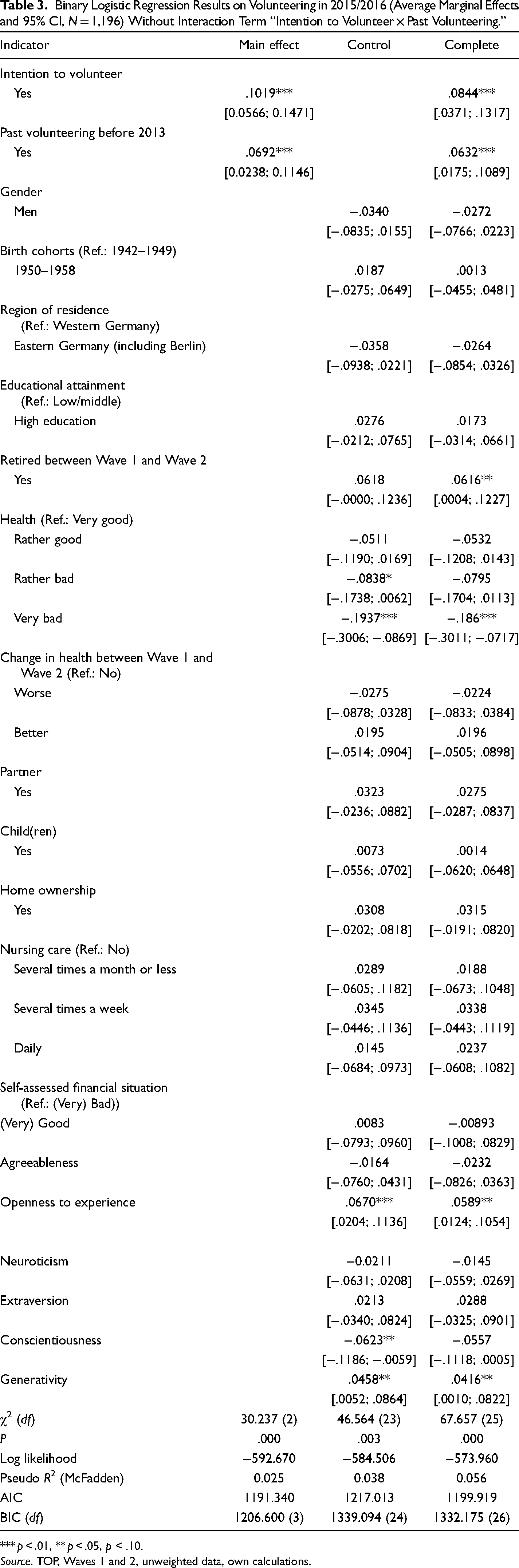
Binary logistic models (Table 3) provide satisfying parameter values regarding model fit. In the first model (Table 3, model “Main effect”), only the main effects are estimated (χ2 (2, N = 1,196) = 30.24, p < .001). The reference model represents the hybrid theory without the main effect (Table 3, model “Control”), and yields significant results as well (χ2 (23, N = 1,196) = 46.56, p < .001). The complete model without interaction term combines the main effect with the parameters of the hybrid theory model (Table 3, model “Complete”), which results in an additional explanation of variance indicated by Δ χ2 (Δ df = 2, N = 1,196) = 21.09, p < .001compared to the reference model.
Binary Logistic Regression Results on Volunteering in 2015/2016 (Average Marginal Effects and 95% CI, N = 1,196) Without Interaction Term “Intention to Volunteer × Past Volunteering.”
*** p < .01, ** p < .05, p < .10.
Source. TOP, Waves 1 and 2, unweighted data, own calculations.
Referring to the complete model, the average predicted probability of taking up a volunteer activity in 2015/2016 is 23.3% (95% CI: 20.4–26.2%) among those who intended to volunteer in 2013. The average marginal effect of this prospective potential dimension amounts to 8.4 percentage points (pp.) with a 95% CI between 3.7 and 13.2 percentage points. A volunteer activity before 2013 yields a predicted probability on a comparable level (23.4%, 95% CI: 20.2–26.6%). This retrospective potential dimension is associated with an average increase in probability of 6.3 pp. (95% CI: 1.8–10.9 pp.).
What is apparent when we consider the control variables yielded by the hybrid theory? The transition to retirement (compared to no change in employment status) raises the likelihood of voluntary activities by 6 pp. (95% CI: 1–12 pp.). Furthermore, very poor health status decreases the probability of volunteering in 2015/2016 by 19 pp. with a markedly wide 95% CI between −29 and −7 percentage points. Finally, two psychological measures—openness to experience and generativity—are positively correlated to actual involvement in 2015/2016: estimates display a 6 pp. (95% CI: 8–10 pp.) and 4 pp. (95% CI: 3–8 pp.) increase in probability, respectively, per scale unit (Table 3).
The Combined Effect of Intention to Volunteer With Past Volunteering
Table 4 displays the predicted probabilities of the main effects when considered as interaction terms within the regression model. Compared to the full potential combination reporting past and prospective volunteer involvement (27.1%, 95% CI: 23.0–31.1%), the analyses show that the probability of volunteering in 2015/2016 decreases when at least one component of volunteering potential is absent. The largest disparity exists between the full and “no” potential groups (consisting of no volunteer action in the past combined with no intention to volunteer; 27.1% − 13.3% = 13.8 pp.).
Logistic Regression Model Enclosing the Interaction Term “Intention to Volunteer × Past Volunteering”—Estimated Probabilities (N = 1,196).

Note. Estimated probabilities are controlled for gender, cohorts, region of residence, educational attainment, retirement between Wave 1 and Wave 2, self-assessed health status, change in health between Wave 1 and Wave 2, self-assessed financial status, home ownership, partnership, children, nursing care, agreeableness, openness to experience, neuroticism, extraversion, conscientiousness, and generativity.
Source. TOP Waves 1 and 2, unweighted data, own calculations.
Within the group without experience from past volunteering, the intention to volunteer makes no significant difference (18.6% − 13.3% = 5.3 pp., p = .093). If, on the other hand, the respondent had been involved in the past, the probability of volunteering in 2015/2016 increases by almost 12 percentage points (.271 − .155 = .116, p = .001). Among those respondents who report no intention to volunteer, past engagement does not make a significant difference (15.5% − 13.3% = 2.2 pp., p = .548). Within the group showing an interest in volunteering, past volunteering raises significantly the likelihood of volunteering in 2015/2016 (27.1% − 18.6% = 8.5 pp., p = .005).
The effect of intentional on actual volunteering at a later point in time is stronger among those respondents who volunteered before 2013 compared to those who did not. The difference between both groups, however, is not significant (second difference: 8.5 − 2.2 = 6.3 pp., p = .179). To sum up, only parts of the interaction term analyses reveal significant associations.
Discussion
In line with other empirical studies on volunteering (Erlinghagen, 2010; Lancee & Radl, 2014; Warburton & Terry, 2000), analyses show that both past and intentional volunteering show positive associations with subsequent actual behavior. These relationships remain stable in the binary logistic regression models in terms of statistical significance and effect size, although by adding the control variables, the adjusted probabilities are lower compared to the zero-order association model (see models “Main effect” and “Complete” in Table 3). Thus, the data support hypotheses 1 and 2.
The comparison of both extreme combinations “full potential” (participants who report both past and intentional engagement) and “no potential” (neither past nor intentional voluntary action) shows a considerable discrepancy by 14 pp. when adjusting for individual and contextual control variables (Table 4). In line with hypothesis 3, the results suggest that past and intentional volunteering are of cumulative nature. Comparing the estimated probabilities of the effects between intentional and past volunteering on actual involvement in 2015/2016 reveals a stronger association between intentional and actual volunteering (AME of +8.4 pp. vs. +6.3 pp., Table 3, model “Complete”). This finding supports hypothesis 4.
In comparison to the reference model (see model “Control” in Table 3), the complete model shows more satisfying model parameters referring to the overall explanation of variance (in terms of Δχ2 or BIC values). Thus, the social construct “potential volunteering” among older adults reflects a reliable predictive factor above and beyond predictors, which have been supported by empirical evidence so far (in particular, Einolf & Chambré, 2011 and Wilson & Musick, 1997). Therefore, the data support hypothesis 5.
Theoretical Implications and Suggestions for Future Research
The Janus-faced perspective expands established theoretical approaches (resource-oriented theory combined with individual dispositions) by looking back and forth regarding past and future events within the voluntary sector. Therefore, this approach contributes to a better understanding of voluntary action in late adulthood referring to theoretical aspects and empirical measurement. Two items about past and future-oriented volunteering are easily implemented and can complement international comparative social surveys particularly with a cross-sectional design (i.e., the European Social Survey).
The study's findings raise new questions that cannot be answered with the available data, creating opportunities for future research. The intention to engage in voluntary activities serves as a starting point for subsequent actions aimed at achieving a chosen goal. Previous research has demonstrated that thorough preparation and planning, encompassing aspects such as timing, location, approach, and duration, significantly increase the likelihood of reaching the desired outcome (Gollwitzer & Brandstätter, 1997; Heckhausen & Gollwitzer, 1987). To develop a comprehensive decision model, it would be beneficial to gather data on establishing contact with volunteer associations, setting timeframes for goal achievement, and accessing information through channels like social media or newspapers. Furthermore, when examining the recruitment potential of individuals in late adulthood, planning activities are supposed to represent an additional aspect of potential engagement beyond past experience and intentional volunteer involvement.
Considering individual experiences of past engagement, it becomes apparent that not all encounters in the voluntary sector are uniformly positive or negative. Measuring individuals’ ambivalence toward past volunteer involvement can aid in understanding the decision-making process, predicting volunteering intentions, and actual engagement. Ambivalent experiences reflect the weighing of pros and cons when making decisions. Notably, perceived quality in volunteering has been identified as a powerful predictor for future intentions (Pavlova et al., 2022). Exploring the conditions under which ambivalence can be resolved to foster commitment among potential volunteers would be of great interest in this context.
Limitations of the Study
Confounding due to selection biases is rather likely, especially when conducting a telephone survey (Groves et al., 2004). The (very) healthy and highly educated composition of the analytic sample might explain the large share of respondents who express an intention to engage (about two thirds). Usually, this share is substantially lower (e.g., Dury et al., 2015). To draw generalized conclusions about older persons who are not so healthy and/or have low educational attainment, we need either larger or clustered random samples with sufficient statistical power. Higher numbers of individuals with these characteristics enable us to examine the links between potential and actual engagement in a more differentiated way.
In addition, the time span between the two waves (around 3 years) is quite long. It appears as a strong assumption that potential volunteering represents a causal event for subsequent involvement. For example, it is unclear if individuals who showed in 2013 an interest in volunteering took up an activity but stopped before the time of the interview in the second wave. Therefore, the results of this study can only be interpreted that intentional engagement indicates an openness to this behavior. Shorter intervals between the interviews enable us to reveal causal mechanisms between intentional and subsequent involvement. Still, the findings of the present study are highly valuable for political implications to estimate a general availability among the older population in Germany.
Implications for Policy-Makers
Within the discussion of how to integrate older people into voluntary activities, the findings support the idea that potential volunteering reflects highly valuable information in addition to (static) sociodemographic aspects such as health and educational attainment. This study provides an extended and differentiated view on the third agers, which have been considered as a collective potential for volunteering (Carr & Gunderson, 2016).
Generally, the intention to volunteer seems to be a stronger trigger for actually taking up a volunteer role than volunteer activities in the past. In this respect, interventions that promote volunteering among older adults are likely to be more cost-effective in the former group than in the latter. Furthermore, interaction analyses reveal that the intention for a future volunteer position is effective on actual volunteering at a later point in time if the respondents already have experience in this area. Experience due to past volunteer involvement is effective when respondents express an interest in volunteering. The simultaneous occurrence of both potential dimensions—having a personal volunteering history with the intention to do so—is associated with the highest chances to volunteer at a later stage. This group might be the most attractive target group when formulating strategies to promote volunteering.
Bearing in mind that in 2016 around 15.9 million people born between 1942 and 1958 lived in Germany, the statistical effects of differences in potential volunteering found here might be quite substantial. Considering the increasingly faster aging population in Germany, the political challenge consists in creating supportive and reliable measures for volunteer involvement among older adults. Breaking up the traditional line between volunteers and nonvolunteers by taking greater account of the potential volunteers is an important step within the debate of how to respond properly to the challenges of the demographic aging process (Dury et al., 2015; Micheel, 2021).
Supplemental Material
sj-docx-1-ahd-10.1177_00914150241235083 - Supplemental material for The Significance of Potential Volunteering in Late Adulthood: A Janus-Faced Perspective
Supplemental material, sj-docx-1-ahd-10.1177_00914150241235083 for The Significance of Potential Volunteering in Late Adulthood: A Janus-Faced Perspective by Frank Micheel in The International Journal of Aging and Human Development
Footnotes
Acknowledgments
The author would like to thank Volker Cihlar, Andreas Mergenthaler, Katharina Micheel, Sebastian Klüsener, Elke Loichinger, and Julie Hicks Patrick for their very helpful comments and suggestions.
Compliance with Ethical Standards
No funds, grants, or other support were received. The author has no relevant financial or nonfinancial interests to disclose. Consent to participate was given by the study participants during the interviews.
Declaration of Conflicting Interests
The author declared no potential conflicts of interest with respect to the research, authorship, and/or publication of this article.
Funding
The author received no financial support for the research, authorship, and/or publication of this article.

Supplemental Material
Supplemental material for this article is available online.
Author Biography
References
Supplementary Material
Please find the following supplemental material available below.
For Open Access articles published under a Creative Commons License, all supplemental material carries the same license as the article it is associated with.
For non-Open Access articles published, all supplemental material carries a non-exclusive license, and permission requests for re-use of supplemental material or any part of supplemental material shall be sent directly to the copyright owner as specified in the copyright notice associated with the article.
