



Abstract
Ageism remains an obstacle to building an age-friendly environment. Although the rise of ageist microaggressions (i.e., subtle discrimination) threatens older adults from maintaining well-being, the mechanism of ageist microaggressions remains understudied. The present study examined ageist microaggressions using a transactional model. Specifically, we examined whether ageing and death anxieties contribute to self-ageism and influence benevolent and hostile ageism. These ageist beliefs might lead to benevolent and hostile ageist microaggressions, respectively. Cross-sectional data from 214 Hong Kong middle-aged adults (Mage = 50.97) were obtained. The results from a structural equation model revealed that ageing anxiety, but not death anxiety, was a significant predictor of self-ageism, hostile ageism, and hostile ageist microaggressions. A revised model further suggested that benevolent and hostile ageism were predictive of hostile ageist microaggressions. The results highlight the importance of defying the conventional perception of ageing to reduce ageing anxiety, ageism and ageist microaggressions for an age-friendly society.
Keywords
Despite the rise of the ageing population worldwide, ageism remains a severe obstacle hindering older adults from maintaining well-being. The Equal Opportunities Commission (2016) found that one-third of the respondents in Hong Kong experienced workplace age discrimination over the past 5 years. While multiple efforts were initiated to stop institutional ageism, ageism at the individual level remains subtle in nature and is often missed or overlooked (Gendron et al., 2016), bringing up the concept of microaggressions. Torino et al. (2018) defined the construct as derogatory slights or insults directed at a target person or persons who are members of an oppressed group, Sue (2010) supplemented that these verbal, behavioral, or environmental indignities are brief and commonplace. Despite growing microaggressions-related studies, the majority concern race, gender or disability, with limited attention on age. To our best knowledge, ageist microaggressions-related papers from Google Scholar are mostly descriptive in nature (e.g., Gietzen et al., 2023) with little focus on its development, thus highlighting the need for further studies. Moreover, studies on ageism are mostly conceived from young adults’ standpoints (e.g., Barnett & Adams, 2018; Donizzetti, 2019). In an ageing society, attitudes of middle-aged and older adults against themselves (a.k.a. self-ageism) have growing importance as these negative attitudes can be self-handicapping (Coupland & Coupland, 1993; David et al., 2009). Besides, the literature mostly explored ageist microaggressions in the Western context. While respecting older adults is considered a part of Eastern cultures (Ng, 1998), North and Fiske (2015) challenged this viewpoint as ageism is linked to the population ageing rate, in which multiple Asian regions are projected to have the largest growth rate (see United Nations, 2020). Thus, studies in non-Western contexts warrant more research attention. Given the lack of a conceptual framework for ageist microaggressions, this paper is unique in exploring the development of ageist microaggressions from multiple ageism-related constructs (1) from the perspective of middle-aged adults, and (2) in the Asian context.
The Interplay of Ageing and Death Anxieties to Ageism and Ageist Microaggressions
Ageing anxiety is the concern of the anticipated adverse physical, mental, and personal losses amid the ageing process (Lasher & Faulkender, 1993). Brunton and Scott (2015) proposed that middle-aged adults’ ageing anxiety is more internally focused because of age-related changes. This is addressed by the stereotype embodiment theory (Levy, 2009) since the information we acquire about ageing constitutes our perception of ageing. If we hold a negative perception, we may have lower life satisfaction in respective domains (Kornadt & Rothermund, 2011). Middle-aged adults may then incorporate their age-related changes, such as the decline in general functioning, with those negative ageing information, leading to the development of ageing anxiety and a hostile attitude towards ageing to protect themselves. This is in line with the findings of Bodner et al. (2015) that ageing anxiety was positively related to ageist attitudes. Although the stereotype embodiment theory provides a direction for the formulation of ageism, it neglects a similar yet distinct construct, death anxiety. People are fearful of ageing possibly due to the fear towards death when both were related to end-of-life courses, as exemplified by Barnett and Adams (2018). Therefore, death anxiety might be another significant contributor towards the development of ageism and ageist microaggressions. However, to date, there was only one research investigating ageing and death anxieties collectively (Bodner et al., 2015). Thus, this study wishes to examine their relationships to ageism and ageist microaggressions.
Death anxiety is individuals’ unpleasant thoughts and feelings about their death (Martens et al., 2004). Martens et al. (2004) suggested that ageism is a mechanism for diminishing death anxiety by separating themselves from any signs of death-related stimulus, including older people. Martens et al. (2005) explained that seeing older people reminds us that our body is fallible and death is inevitable. Older adults, hence, become an existential threat that leads people to develop ageist attitudes to separate themselves from older adults. Bodner et al. (2015) indicated that ageism could only be a sufficient tool to ward off fear when either ageing anxiety or death anxiety is at a high level. Their study displayed a similar effect of the two anxieties on ageism in a comparatively older sample ranging from 50 to 86 years old. In addition, the association of one anxiety and ageism became weaker when the other anxiety was strong, suggesting that only one anxiety can be related to ageism at a time. This effect, however, might not be replicable in middle-aged adults as death remains distinct for them, especially in the era of increasing life expectancy. From an externalizing perspective, the study of Bodner et al. (2015) did not account for the effects of ageing and death anxieties in shaping middle-aged and older adults’ self-perceptions before developing ageist attitudes against others. The social identity theory of Tajfel and Turner (2001) divides social behaviors into interpersonal and intergroup behaviors. Our study focuses on the latter, in which people act on behalf of their reference groups. The theory explains that people develop bias by elevating their in-group status higher than other groups or creating a positive distinction between in- and out-groups to create a positive self-identity (Kite et al., 2002; Tajfel & Turner, 2001). To counter the low self-perception because of fear of becoming a part of the devalued group (i.e., older adults), they would develop a negative attitude towards older adults to separate themselves, manifested as behavioral discrimination (i.e., ageist microaggressions). While the literature examined the interactive relationship between ageing anxiety, death anxiety, and ageism (e.g., Barnett & Adams, 2018; Bodner et al., 2015; Donizzetti, 2019), none included self-ageism in their studies. Consequently, this paper attempts to fill this gap to enhance the connection between theories and build a transactional model of ageist microaggressions. Based on stereotype embodiment and social identity theories, we expect that individuals with stronger ageing anxiety and death anxiety will have stronger self-ageism, which in turn will lead to stronger ageism and subsequently ageist microaggressions.
Subtypes of Ageism and Ageist Microaggressions
The literature often explored ageism and ageist microaggressions in a hostile manner, such as deliberately telling older adults about old age. These hostile expressions are easy to recognize, explaining why many scales measure individual differences in hostile ageist beliefs (e.g., Braithwaite et al., 1993; Palmore, 2001). However, more research attention needs to be focused on benevolent ageism due to its subtle nature. Cary and colleagues (2016) defined benevolent ageism as the well-intentioned but highly condescending stereotypes of older adults. For instance, making decisions for a well-functioning older person without consulting them may convey the idea that their opinions are not worth considering. A recent study revealed that patronizing speech styles toward older adults could lead to worse cognitive and physiological responses (Hehman & Bugental, 2015). The impact of benevolent ageism, hence, cannot be underestimated. Worse, benevolent ageism is more difficult to tackle due to its confusing nature with benevolent behaviors. Some may think they are helping or sympathizing when prejudicing or discriminating against older adults.
Past studies have illustrated the connection between stereotypes, prejudice, and discrimination. The stereotype content model by Fiske et al. (2002) proposed that typical stereotypes of older adults as warm but incompetent. Individuals’ perception of older adults varies based on the level of the two traits. High warmth with low competence contributes to paternalistic prejudice, while low warmth and low competence contribute to hostile prejudice. The behaviors from intergroup affect and stereotype map illustrated that individuals’ stereotypes of older adults drive their behaviors (Cuddy et al., 2007). Paternalistic prejudice is associated with active facilitation with passive harm, while hostile prejudice is related to both active and passive harm. This aligns with Palmore's (1999) view on distinguishing positive and negative age stereotypes. The former is the passive pressure towards older people to live up to a certain expectation due to stereotypical views regardless of the context. The latter is the devaluing ageing with disease, decline, or disability. Given the rising classification of dividing ageism and related behaviors into subtypes, we propose dividing ageist microaggressions into benevolent and hostile types. The concept is present in ageist discrimination in Kydd and Fleming's narrative review (2015). Though no existing literature has suggested this classification, it shall allow a better understanding of the underlying mechanism of ageist microaggressions. Based on the stereotype content model and the behaviors from intergroup affect and stereotype map, benevolent and hostile ageism should lead to benevolent and hostile ageist microaggressions, respectively.
The Present Study
Ageism and ageist discrimination remain an obstacle impacting the well-being of older adults. While institutional ageism is diminishing, subtle ageism on an individual level, known as ageist microaggressions, is overlooked. While microaggressions concerning race or other aspects have received abundant research support, there is still a lack of understanding of ageist microaggressions. The current study thus strikes to fill this gap by being the first to explore the mechanism of ageist microaggressions. We adopt a transactional perspective to study the development of ageist microaggressions via linking ageing and death anxieties, self-ageism, and ageism, serving as the first objective. Ageism and ageist microaggressions are also divided into benevolent and hostile subtypes, serving as the second objective. This classification not only echoes the approach of studying ageism in the literature, but also captures the subtle nature of ageism less studied in the field. Figure 1 presents the summary of the proposed relationships.
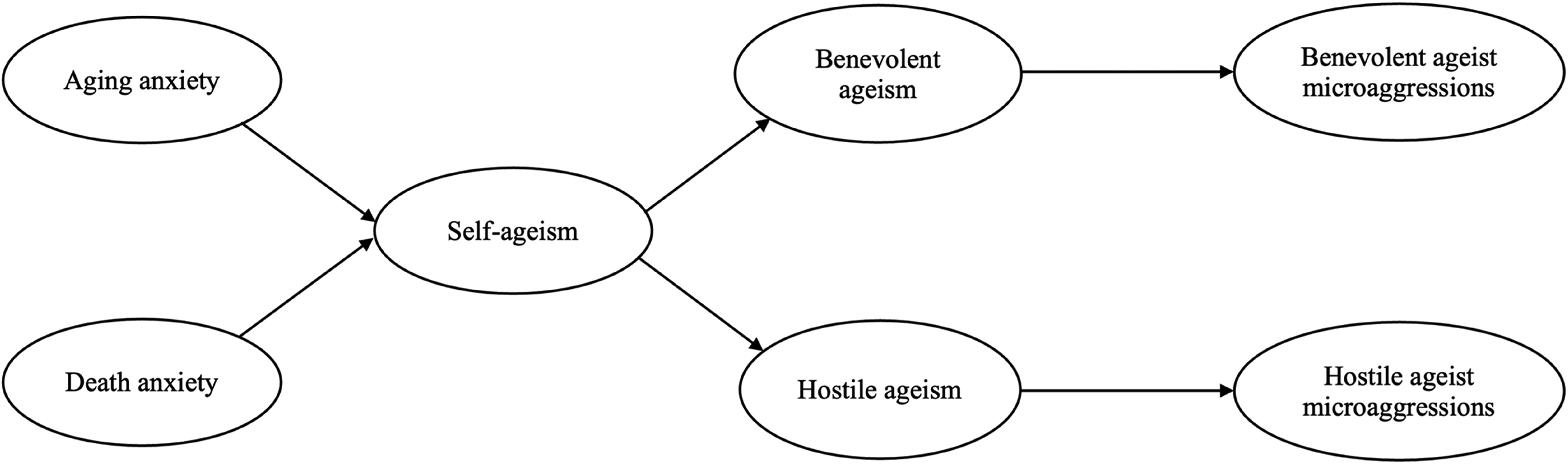
Proposed relationships between ageing and death anxieties, self-ageism, ageism, and ageist microaggressions.
Methodology
Participants and Procedures
The selection criteria for the current study were Hong Kong adults aged 30 to 64 years. Upon ethical approval from the affiliated university (number: SSA4708-202110-30), a cross-sectional self-administered online questionnaire was set up on the platform QuestionPro and distributed to targeted participants using snowball sampling. Informed consent with e-signature was obtained before proceeding to the survey items. Participation was voluntary, and no financial incentives were provided. The final sample included 214 participants, slightly higher than the minimum number of 200 recommended by Boomsma (1982) for structural equation modelling (SEM), which was the planned analytic method for this study.
Measures
Ageing Anxiety
The Anxiety about Ageing Scale from Lasher and Faulkender (1993) was adopted to measure participant's anxiety during the ageing process. The Chinese version by Liu et al. (2014) was psychometrically sound for the Chinese population. Participants rated the 20 items (e.g., “I enjoy being around old people”) on a four-point Likert scale (1 = strongly disagree to 4 = strongly agree). Higher total scores indicate a higher level of ageing anxiety. The scale demonstrated good structural validity across age and gender (Sargent-Cox et al., 2013). The internal consistency was satisfactory (α = .82).
Death Anxiety
Anxiety level toward death was assessed using Templer's Death Anxiety Scale (Templer, 1970). Yang et al. (2016) translated the scale into Chinese. Rating on a five-point Likert scale (1 = strongly disagree to 5 = strongly agree), participants filled in the 18 items like “I fear dying a painful death.” Higher scores denote a greater level of death anxiety. The Cronbach's alpha of the scale was .81 in this study.
Self-Ageism
The Brief Ageing Perceptions Questionnaire was used to measure self-ageism (Sexton et al., 2014). The modified scale displayed good psychometric properties in the Chinese (Wang et al., 2020). Participants rated the 18 items on a five-point Likert scale from 1 (strongly disagree) to 5 (strongly agree). A sample item includes “Getting older makes me less independent.” Higher total scores suggest holding higher ageist beliefs towards themselves. Burton et al. (2020) found the scale with solid psychometric properties. The Cronbach's alpha was .86 in the present study.
Benevolent and Hostile Ageism
The level of ageism was assessed by the Ambivalent Ageism Scale by Cary et al. (2016). Zhang (2020) found the scale culturally valid in the Chinese community. The benevolent ageism subscale contains nine items, while the hostile ageism subscale contains four items, with sample items “Older people need to be protected from the harsh realities of society” and “Older people are too easily offended,” respectively. Participants rated the 13 items on a seven-point Likert scale from 1 (strongly disagree) to 7 (strongly agree). Scores from each subscale were calculated separately, with higher scores indicating a greater level of that type of ageism. The scale displayed high internal consistency and construct validity (Cary et al., 2016; Liu et al., 2021). The Cronbach's alpha was satisfactory for the benevolent ageism (α = .82) and hostile ageism (α = .74) subscales.
Benevolent and Hostile Ageist Microaggressions
Ageist microaggressions engagement was studied by the Relating to Older People Evaluation (Cherry & Palmore, 2008). A Chinese culture adaptable version was developed (So, 2014). Participants rated their engagement in 6 benevolent (e.g., “Hold doors open for old people because of their age”) and 12 hostile ageist microaggressions (e.g., “Avoid old people because of their age”) from 0 (never) to 2 (always). Higher scores in the subscale indicate higher engagement of that microaggressions. Chonody and Teater (2015) found moderate internal consistency for both subscales. The internal consistencies were acceptable for both subscales (benevolent: α = .60; hostile: α = .61).
Covariates
In the mediation analysis, participants’ age, sex (1 = male, 2 = female), and educational level (1 = primary education or below, 2 = secondary education, 3 = post-secondary education or above) were collected for the potential effect on the constructs.
Statistical Analyses
A structural equation model was performed using AMOS 27.0. A confirmatory factor analysis (CFA) was first conducted to identify any misspecification of the measurement model. Random parceling was adopted to enhance the approximation of the distribution of target construct, estimation stability, scale commonality, and model efficiency (Matsunaga, 2008). Latent variables were each identified by three parcels by disturbing the corresponding survey items to one of the parcels using a random algorithm. A serial mediation model was then assessed. Ageing and death anxieties were used to predict self-ageism, which in predict both benevolent ageism and hostile ageism. Benevolent ageism and hostile ageism were used to predict benevolent and hostile ageist microaggressions, respectively. Age, sex and education level were set as covariates regressing on all the endogenous variables. The mediation model was tested with 5000 bootstrapped samples. Maximum likelihood estimation was used.
Results
Descriptive and Correlational Statistics
Table 1 presents the descriptive and correlational statistics of the sample variables. The mean age was 50.39 years (SD = 8.75; Range = 30–64), with 56% being female. Most of the participants (81.02%) completed secondary education. For correlational statistics, self-ageism was positively correlated with ageing anxiety (r = .59), death anxiety (r = .41), benevolent (r = .38) and hostile ageism (r = .36), ps < .001. A significant correlation was found between hostile ageism and hostile ageist microaggressions (r = .47, p < .001), but not between benevolent ageism and benevolent ageist microaggressions (r = .10, p = .16).
Descriptive Statistics, Correlations of All Demographic and Major Variables.
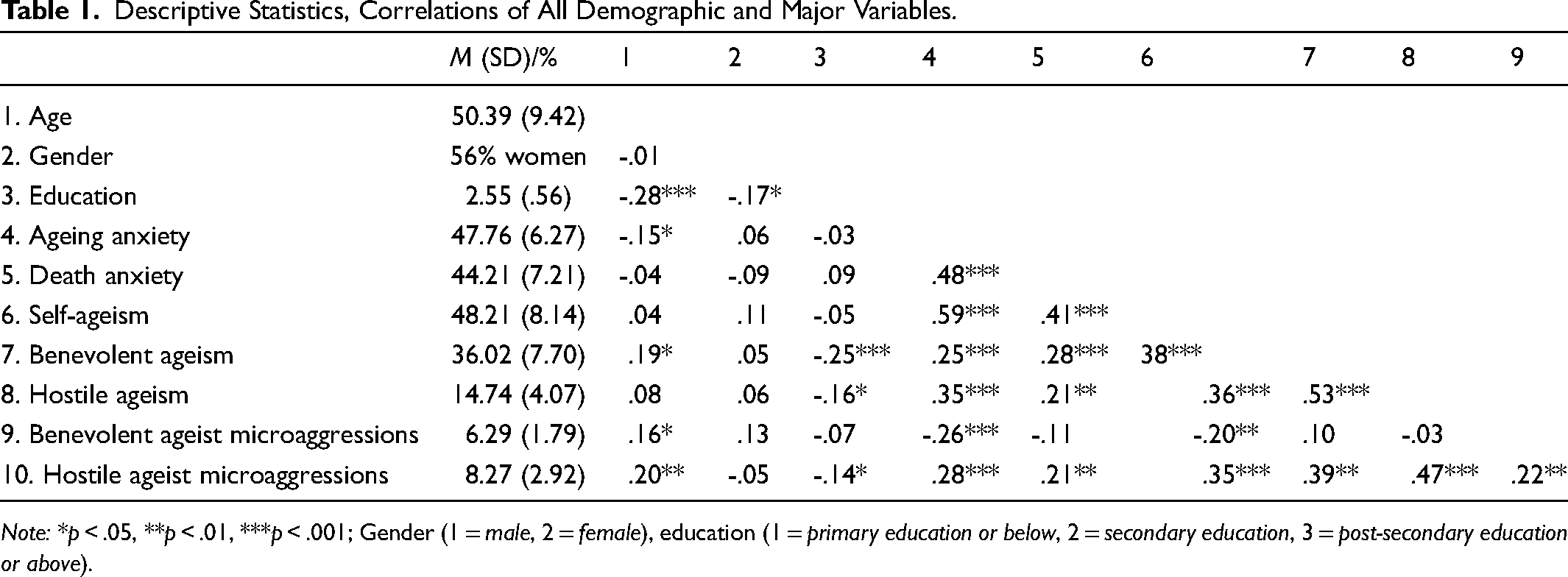
Note: *p < .05, **p < .01, ***p < .001; Gender (1 = male, 2 = female), education (1 = primary education or below, 2 = secondary education, 3 = post-secondary education or above).
Effect of Ageing and Death Anxieties and Ageism on Ageist Microaggressions
The results of the CFA of the measurement model of ageing and death anxieties, self-ageism, benevolent and hostile ageism, and benevolent and hostile ageist microaggressions indicated satisfactory goodness of fit, χ2 (188) = 1.71, p < .001, CFI = .93, TLI = .92, RMSEA = .06, SRMR = .06. All the standardized factor loadings in CFA were significant, ranging from .45 to .88. The mediation model containing above constructs was subsequently tested, with marginally satisfactory, χ2 (233) = 2.00, p < .001, CFI = .88, TLI = .86, RMSEA = .07, SRMR = .09. Figure 2 and Table 2 shows the results of the mediation model and the indirect effects, respectively.
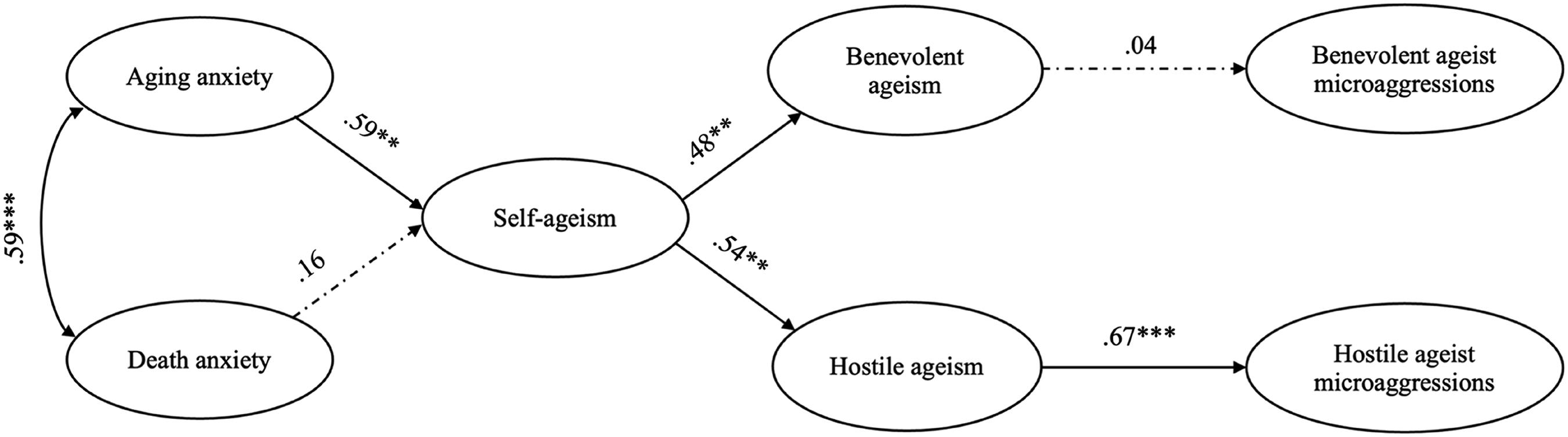
The initial structural equation model on the relations between ageing and death anxieties, self-ageism, ageism and ageist microaggressions. Note: **p < .01, ***p < .001; Values provided are β values. Paths with significant coefficients are showed with solid lines. For simplicity, the observed indicators of the latent variables are not shown in the figure. Age, gender, and education level were regressed on self-ageism, ageism, and ageist microaggressions in the structural equation model.
Effects of the Mediation Model.
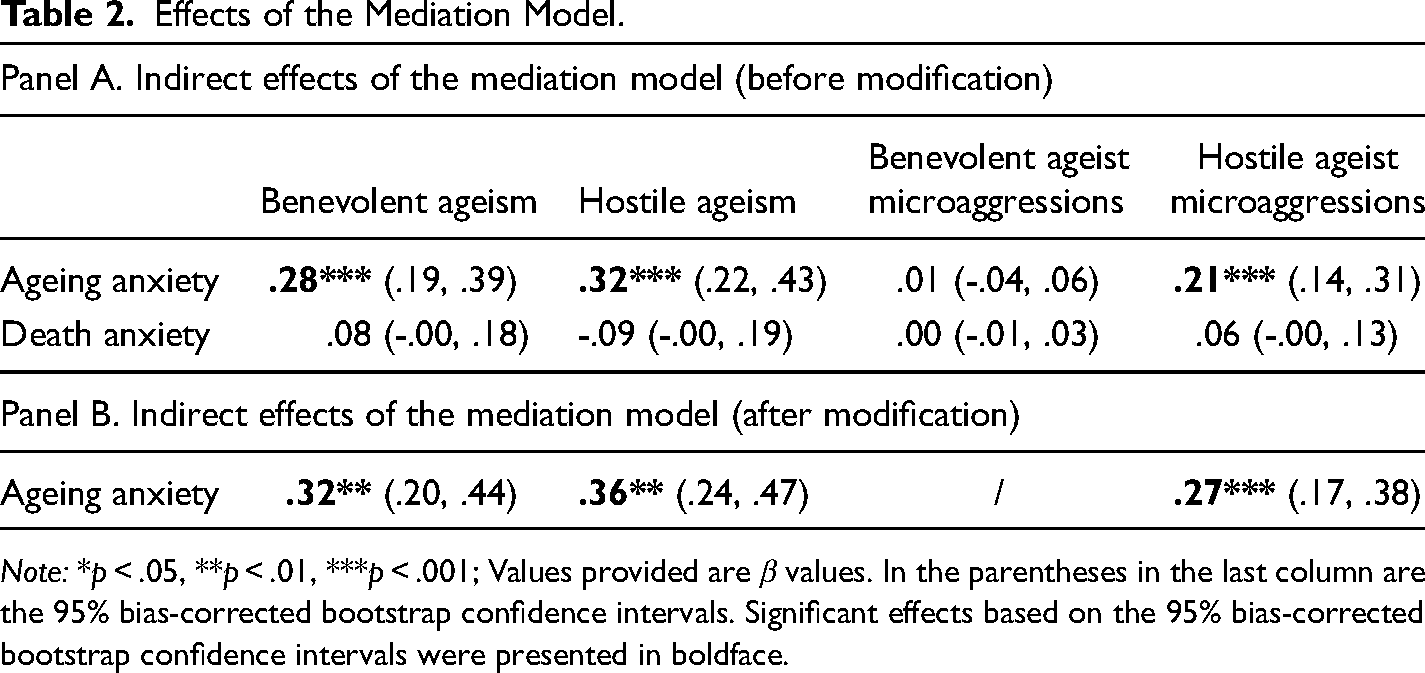
Note: *p < .05, **p < .01, ***p < .001; Values provided are β values. In the parentheses in the last column are the 95% bias-corrected bootstrap confidence intervals. Significant effects based on the 95% bias-corrected bootstrap confidence intervals were presented in boldface.
The results demonstrated that ageing anxiety was positively associated with benevolent (β = .28, 95%CI [.19, .39]) and hostile ageism (β = .32, 95%CI [.22, .43]) via self-ageism, ps < .001. Ageing anxiety was also predictive of hostile ageist microaggressions (β = .21, 95%CI [.14, .31], p < .001) but not for benevolent ageist microaggressions (β = .01, 95%CI [-.04, .06], p = .69). On the contrary, death anxiety was not predictive of any above variables, ps > .05. Benevolent ageism was not associated with benevolent ageist microaggressions (β = .04, 95%CI [-.12, .00], p = .69), while hostile ageism was significantly related to hostile ageist microaggressions (β = .67, 95%CI [.55, .79], p < .001).
Modification of the Mediation Model
To develop a parsimonious model for ageist microaggressions to inform future studies, we modified the mediation by removing death anxiety and benevolent ageist microaggressions. In addition, hostile ageist microaggressions was regressed on benevolent ageism, considering their positive correlation (r = .39, p < .01). The revised model was then about the effects of ageing anxiety on benevolent and hostile ageism and hostile ageist microaggressions indirectly via self-ageism. Model fit of the revised model was satisfactory, χ2 (121) = 1.96, p < .001, CFI = .92, TLI = .90, RMSEA = .07, SRMR = .08. The results of the revised mediation model are presented in Figure 3 and Table 2.
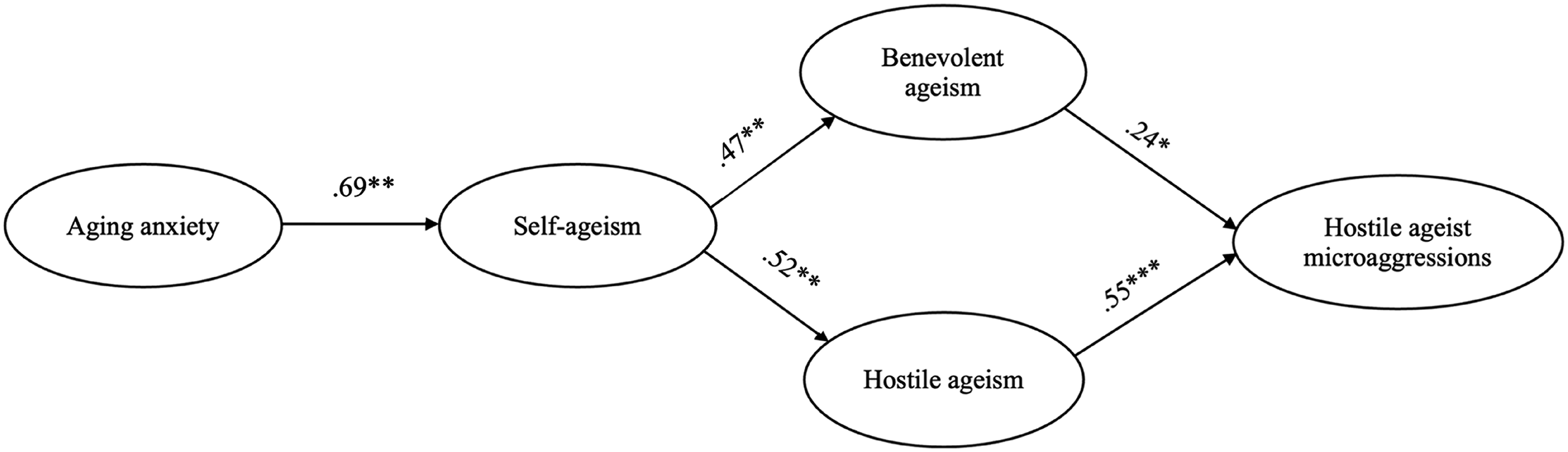
The revised structural equation model on the relations between ageing and death anxieties, self-ageism, ageism and ageist microaggressions. Note: *p < .05, **p < .01, ***p < .001; Values provided are β values. Paths with significant coefficients are showed with solid lines. For simplicity, the observed indicators of the latent variables are not shown in the figure. Age, gender, and education level were regressed on self-ageism, ageism, and ageist microaggressions in the structural equation model.
The revised mediation model supported the predictive relationships suggested in the previous model. Specifically, the revised model further indicated the effects of ageing anxiety on benevolent (β = .32, 95%CI [.20, 44]) and hostile ageism (β = .36, 95%CI [.24, 47]), ps = .001. Ageing anxiety was also associated with hostile ageist microaggressions (β = .27, 95%CI [.17, 38], p < .001). Hostile ageist microaggressions were significantly predictive by benevolent (β = .24, 95%CI [.02, 45], p = .03) and hostile ageism (β = .55, 95%CI [.33, 75], p < .001).
Discussions
The present study delved into developing a transactional model of ageist microaggressions from the viewpoint of middle-aged adults. Adopting an externalizing perspective, we explored the impact of ageing and death anxieties on ageism and ageism microaggressions via self-ageism. Ageism and ageist microaggressions were also divided into benevolent and hostile subtypes. Results from SEM suggest ageing anxiety, but not death anxiety, was predictive of self-ageism, benevolent and hostile ageism, and hostile ageist microaggressions. While benevolent ageism was not associated with benevolent ageist microaggressions, hostile ageism was related to hostile ageist microaggressions.
Understanding Ageist Microaggressions With Ageism
Our study illustrated the development of ageist microaggressions in a transactional model. Ageing anxiety is predictive of self-ageism, leading to ageism and ageist microaggressions. The findings stress the importance of exploring ageist microaggressions. Since the concept of microaggressions was raised by Sue (2010), some doubted the validity of microaggressions as a form of discrimination. Our findings provide empirical evidence by demonstrating the significant relationships between ageism and ageist microaggressions, which aligns with the behaviors from intergroup affect and stereotype map when describing the association between ageist beliefs and discrimination. The results are also in line with the stereotype embodiment theory of Levy (2009) that self-ageism and ageism arise from ageing anxiety when individuals suit themselves to a negative ageing perception.
Modifications Made to the Transactional Model
Two highlights made in the revised model were the deletion of death anxiety and benevolent ageist microaggressions and the additional path from benevolent ageism to hostile ageist microaggressions. Regarding the deletion, the results echo our prediction that death anxiety may not play a significant role in ageism in middle-aged adults as death remains distinct for them. Our findings supplement Bodner et al. (2015) by displaying that the mechanism of ageism varies among different age groups, alerting us to develop suitable interventions to reduce ageism for different age groups. On the contrary, the deletion of benevolent ageism was out of our prediction as it was not related to benevolent ageist microaggressions, contradicting the behaviors from intergroup effect and stereotypes map. One possible explanation was the difficulty in capturing benevolent ageist microaggressions. Other studies using the Relating to Older People Evaluation also encountered difficulties in finding significant correlations with other constructs (e.g., Cherry et al., 2016; Stahl & Metzger, 2013). Cherry et al. (2015) argued that the scale may reflect the social desirability one holds rather than one's implicit attitude against older adults. Such a social desirability effect may be more significant in the Chinese context due to filial piety, in which Chinese are often required to show respect towards older adults (Li et al., 2014). Future studies are advised to examine the possible explanation.
Another modification was the additional connection between benevolent ageism and hostile ageist microaggressions. Although the effect is compartively weaker, results from SEM suggested that higher levels of benevolent ageism are significantly related to hostile ageist microaggressions. The stereotype content model accounted for the difference based on the stereotypes share by benevolent and hostile ageism. Since both types of ageism shared the stereotypes of viewing older adults as incompetent, individuals may engage in certain behaviors common to both ageism. For instance, using simple language when talking with older adults displays the stereotypes of incompetence but not warmth. Therefore, the incompetence perception shared by benevolent and hostile ageism may explain the connection between benevolent ageism and hostile ageist microaggressions. Our findings propose the complex relationships of ageism and ageist microaggressions as types do not distinguish them but the stereotypes of warmth and incompetence instead.
Our findings serve several implications in promoting a welcoming atmosphere for older adults. As our results revealed the critical role of ageing anxiety in predicting ageism and ageist microaggressions, ageing education would be crucial in reducing ageing anxiety by debunking typical stereotypes. This is congruent with McGuire's (2017) suggestion to help individuals across ages prepare for later years and clarify some misunderstandings about older adults. Retirement preparation workshops can be offered, as Jun and Ju (2019) showed that better systematic retirement preparation could help reduce middle-aged workers’ ageing anxiety. Programs in reducing self-ageism are equally crucial as Craciun et al. (2015) proposed that perception of ageing is an important resource for ageing well. Wilson et al. (2023) suggested a remote digital skills program for older adults aged 65 or above. Not only does older adults benefit from digital skills, but also shift their negative perceptions of ageing of incapable of learning. Videos on social media of older adults defying ageing stereotypes or calling out ageism also challenges the conventional perception of ageing among the public (Ng & Indran, 2022).
Several issues should be considered. First, the limited sample size may hinder the analysis. Due to the large number of scale items with a relatively small sample, random parceling was utilized. Thus, we cannot determine which dimension of ageing anxiety is most influential on self-ageism and subsequent constructs. Apart from replicating the results on a bigger sample with different age group, longitudinal studies are equally important to examine the reciprocal effects of ageist microaggressions on ageing anxiety and ageism, as stated by Dovidio et al. (2010). Second, the marginally acceptable reliability of relating to older people evaluation threatens the validity of measuring ageist microaggressions. While this issue also occurred in other studies with a reliability lower than a preferred .80 (e.g., Chonody & Teater, 2015; Chonody & Wang, 2014; Frost et al., 2015), this was not unexpected given the rating of some behavioral items are limited by available opportunities. An ageist microaggressions-specific scale is therefore required to ensure good content sampling in future studies, especially in the Asian context. Since there are cultural differences in ageism, such as the impact of filial piety in collective cultures, this may challenge the validity and applicability of relating to older people evaluation in the Chinese community. Therefore, developing an ageist microaggression scale with cultural consideration can further advance ageist microaggressions-related studies.
Conclusion
The paper is the first to explore the mechanism of ageist microaggressions. We also selected middle-aged adults in Asia as our sample, a relatively understudied target in the literature. Ageism and ageist microaggressions were classified into subtypes for a more detailed understanding. The results revealed that ageing anxiety is highly predictive of self-ageism, ageism, and ageist microaggressions, especially the hostile subtype. While further studies are required for benevolent ageist microaggressions, our paper provides insights into the development of hostile ageist microaggressions. Ageist microaggressions cannot be underestimated as it is interconnectedly related to other ageism-related constructs.
Footnotes
Acknowledgement
This research did not receive specific grant from any funding agencies in the public, commercial, or not-for-profit sectors.
Declaration of Conflicting Interests
The authors declared no potential conflicts of interest with respect to the research, authorship, and/or publication of this article.
Funding
The authors received no financial support for the research, authorship, and/or publication of this article.
