



Abstract
The inner-city area of Inner Vesterbro in Copenhagen, Denmark, houses the largest open drug scene in Scandinavia. Since the 1980s, the area has been a gathering point for people who use, buy, and sell drugs. During the last two decades, urban redevelopments have resulted in marked demographic changes amid concerns about processes of gentrification. The drug scene, however, remains, and the last 7 years have seen the implementation of a new police strategy of “nonenforcement” of minor drug possession offences alongside the opening of two drug consumption rooms (DCRs) in the area. This article presents findings from a study of resident attitudes toward local DCRs and daily experiences of the open drug scene. Specifically, we draw on material generated via an online questionnaire distributed among residents in the area (N = 566) and qualitative interviewing of 33 residents. The article also proposes a change in perspective toward drug scene encounters, one that is not hinged exclusively on a narrow understanding of nuisances understood as negative affective states. This new approach is employed in an analysis of resident experiences of drug scene encounters. The analysis shows that rather than experiencing drug users and the drug scene exclusively as a nuisance or threat to community order, most residents are supportive of DCRs and generally accept the presence of a drug scene in the area. The article concludes with a brief discussion of results and their relation to current debates on urban coexistence, progressive harm reduction initiatives, and public space management.
Introduction
For more than 30 years, legally sanctioned drug consumption rooms (DCRs) have been in operation in Europe, providing a safe, hygienic, and supervised environment for the consumption of preobtained drugs (Houborg & Frank, 2014; Kimber et al., 2003). Seventy-eight DCRs with varying profiles, designs, and regulations exist in Europe today, five of which are in Denmark (EMCDDA, 2018). Two are located within one square kilometer in Copenhagen, in the area of Inner Vesterbro. Aside from the reduction of drug-related risks and harms, a primary objective of DCRs is to reduce drug scene–related nuisances such as public drug use and dealing, loitering, and discarded equipment (Stöver, 2002; Zurhold et al., 2003). This article employs an urban sociological lens in order to explore DCRs as an environmental intervention aiming to mitigate the negative community impacts of drug use and other drug scene–related activities (Kolla et al., 2017, p. 95). DCRs often become key social hubs and drug markets in local drug scenes, and in spite of access restrictions and regulations DCRs should be considered as health and social facilities that are integrated into the wider local community in which they are located. Viewed this way, DCRs and their immediate surroundings can be seen as an example of the social infrastructure in cities, broadly defined as “networks of spaces, facilities, institutions and groups that create affordances for social connection” (Latham & Layton, 2019, p. 3). Public amenity–oriented objectives of DCRs can be understood as pragmatic solutions to problems and concerns surrounding drug scene–related nuisances, but highlighting this aspect can simultaneously be regarded as a strategic argument to be used by authorities and proponents of DCRs to appease and accommodate real or perceived community opposition. Indeed, research from Canada has indicated that DCRs are more favorably viewed by the public if public amenity improvements are stressed as likely effects of their opening (Kolla et al., 2017, p. 92).
Today, open drug scenes continue to influence everyday life across several European cities, and DCRs are increasingly debated here and elsewhere as one possible measure to reduce drug scene–related problems (Barry et al., 2019; EMCDDA, 2015; Zajdow, 2006). In light of these developments, this article explores resident experiences of the largest open drug scene in Scandinavia as well as resident attitudes toward the two local DCRs that figure as central elements in the current local drug policy. It also argues for a novel perspective on resident experiences of drug scene encounters.
Background
We have followed the development of Vesterbro’s open drug scene as well as the responses by public authorities toward it for a number of years (Houborg et al., 2014). The research has included interviewing people who use drugs, police officers, business owners, and social and outreach workers, a rapid assessment study of user experiences of the DCR H17, extensive periods of fieldwork, and, finally, a survey and interview study of local residents’ experiences of the drug scene, on which this article is based. The area has two DCRs. Skyen opened in 2012 on the busy main street of Istedgade. It accommodates 17 visitors at a time, with eight seats for smoking and nine for injecting. The nongovernmental organization (NGO) Mændenes Hjem (MH), which also provides housing, food, and various health and social services in the area, runs the facility. The second DCR, H17, opened in 2016. It is located in a renovated warehouse in the popular and recently transformed abattoir area called Kødbyen (the Meatpacking District), just opposite the local police station. H17 has 20 seats for smoking and 8 for injection. Initially operated by the Municipality of Copenhagen, this task has recently been transferred to MH.
The open drug scene in Inner Vesterbro has existed since the late 1980s. Congregations of people who use drugs, drug-related litter, drug dealing and instances of public drug use are evident in the area. Inner Vesterbro is among the most densely populated areas in Copenhagen, primarily consisting of five-story apartment buildings with predominately upper middle-class residents, situated near the Copenhagen average in income and level of education (Larsen & Hansen, 2008). Located just behind Copenhagen’s Central Station, the area houses numerous hotels, schools, and a vibrant nightlife scene. Sex trade is also present in the area. The visibility of public drug use and dealing fluctuates according to various daily, weekly, and seasonal rhythms. Nonetheless, the scene appears to have stabilized in certain places, particularly near DCRs and outside an entrance of the Central Station nicknamed “the pill trade,” as it traditionally has been a location for the buying and selling of prescription drugs.
The opening of Skyen in 2012 heralded a significant change in the juridical and institutional approach toward the drug scene. After several years of zero tolerance and aggressive policing, a change in legislation that enabled the establishment and official operation of DCRs involved the delineation of a geographical area of nonenforcement, in which the target group of the facility was to be exempted from the law on possession of illicit drugs. The shift from zero tolerance to nonenforcement and the establishment of DCRs has been accompanied by intensified street-cleaning, social outreach work, and new forms of community policing to meet the practical challenges of regulating the drug scene and the daily encounters between members of the drug scene and the neighboring community (Houborg et al., 2014; Houborg et al., 2019; Kammersgaard, 2019). The DCRs should therefore not be seen as isolated public health institutions for people who use drugs. Rather, they are embedded in a wider network of institutions and practices that together play an important role in constituting the social spaces of public encounters. In contrast to zero tolerance or other repressive strategies, where the ultimate purpose is to dispel or remove open drug scenes (Bless et al., 1995; Waal et al., 2014), this new approach can therefore be seen as an ongoing social experiment aiming to cultivate a heterogeneous urban territory where different social groups and practices coexist.
Community Perspectives on DCRs and Open Drug Scenes
Community attitudes have been studied in previous research, both regarding services aimed at marginal populations, such as homeless shelters, as well as DCRs (DeVerteuil et al., 2009; Kolla et al., 2017; Smith, 2010; Tempalski et al., 2007). Research has mostly been conducted in North America, primarily using population survey data. Assessing public support for safe injection facilities (SIFs) in Ontario, Canada, Firestone-Cruz et al. (2007) reported that a small majority (60%) of their sample agreed with the statement that SIFs should be made available to encourage supervised drug injection. A greater percentage (73.8%) agreed with the statement that SIFs should be made available if it can be shown that they reduce neighborhood problems related to injecting drug use. A cross-sectional study from the same region showed increasing public support for SIFs, but the authors also noted the sizable proportion holding mixed opinions (Strike et al., 2014). In a neighborhood-level survey from Philadelphia, PA, a majority of respondents supported the implementation of an overdose prevention site (Roth et al., 2019). Illustrating the contested nature of DCRs, Jauffret-Roustide et al. (2013) have shown how consecutive surveys, framing the issue in different ways, showed differing levels of social acceptability of DCRs among the general public in France.
Three articles stand out by analyzing resident experiences following the implementation of DCRs. First, two related articles based on telephone survey responses reported that local residents and business operators experienced significant improvements on several public amenity indicators following the 2001 opening of the Sydney Medically Supervised Injection Centre (Salmon et al., 2007; Thein et al., 2005). However, the absence of qualitative material inhibited further and more detailed analyses of resident experiences of the DCR and actual encounters with individuals and situations related to the local drug scene. Secondly, an evaluation of the effects of DCRs in Hamburg involved qualitative interviewing of various community stakeholders, including residents. In general, residents were supportive of DCRs as they relieved the burden caused by local drug-related problems such as drug use in public and semi-private spaces (e.g., house entrances; Zurhold et al., 2003, p. 682).
Qualitative research methods have also been used in North America to explore community and stakeholder perspectives on prospective DCRs. Here, the phenomena of NIMBYism (“not in my backyard”) has been a central area of interest. These studies indicate that levels of acceptability appear to be high in areas affected by drug use, but also that attitudes are interwoven with concerns about urban development and neighborhood attractiveness (Bardwell et al., 2017; Strike et al., 2015; Wenger et al., 2011). For example, Kolla et al. (2017) reported that residents and business representatives in two Canadian cities with no centralized, open drug scenes held ambivalent views about such facilities, acknowledging possible public health benefits while expressing concerns about public nuisance. As seen, the majority of existing research has explored the issue in contexts where DCRs or other services for people who use drugs were either prospective or purely theoretical. Despite this, the studies illustrate the ambiguities, mixed opinions, and weighing of different (and conflicting) arguments that characterize general public, community, and stakeholder perspectives.
Studies of the broader issues of resident perspectives on public drug use and open drug scenes have similarly been characterized by an explicit focus on nuisances. A comprehensive survey study of drug scene–related nuisance across six European cities showed that while problems were identified in all cities, types and levels of nuisance as well as levels of tolerance toward the presence of drug users differed markedly (Renn & Lange, 1996). “No go” areas were identified by residents in Van Hout and Bingham’s (2013) study of local stakeholder perceptions of drug scene–related public nuisances in Dublin, Ireland. In the UK, Cusick and Kimber (2007) found that people living and working in four areas affected by drug use primarily described the impact of public drug use in negative terms, but also that a variety of factors, including types of drugs used and concentration of residential and commercial premises, appeared to influence perceptions. In the two latter examples, the use of qualitative methods allowed for detailed discussions of the complexities of local experiences and responses toward urban drug problems.
While these latter studies have highlighted the multidimensional and context-specific character of drug scene–related nuisances, they are limited by the fact that the narrow focus on nuisances tends to rest on the a priori assumption that residents necessarily and exclusively perceive drug scene–related activities and situations negatively as nuisances or threats to public order. This is problematic because it leaves us unable to fully appreciate the dynamic character of encounters between people who use drugs and other people in public space, whether these are perceived to be unpleasant, insignificant, positive, or simply not registered at all. It is important for researchers interested in urban coexistence and conflict to recognize that “people can experience a range of ‘emotions’ about crime (and other threats to their well-being)—emotions which vary in nature, intensity and duration, and from one situation to another” (Bannister & Fyfe, 2001, p. 808). Therefore, we need conceptual and methodological frameworks that enable us to grasp these variations. A central premise of this article, then, is that resident experiences of drug scenes and DCRs should be conceptualized more broadly than is possible within the limited perspective of nuisance and NIMBYism.
Approach
In this section, we briefly present the theoretical approach and key concepts used for the analysis of resident experiences of the drug scene. The decision to analyze drug scene encounters reflects the interest in the questions of how open drug scenes affect the wider sociality of urban areas and how DCRs can play a role in the shaping of the social spaces where people who use drugs and residents encounter each other. We regard DCRs as environmental interventions that influence the dynamics and manifestation of the drug scene. In the analysis, we are particularly interested in how people who use drugs and residents inhabit the area and how the DCRs may have influenced inhabitation. Koch and Latham (2012, 2013) mention inhabitation as one of three heuristics for interpreting public spaces (the others being materiality and atmosphere). Inhabitation concerns the different embodied practices and routines in which people engage in public spaces and how, through this, public spaces become lived spaces. The central idea is that public spaces become public not just through law and discourse but also through everyday use. When we make this a key point in our analysis, it is because we expect that DCRs as environmental interventions can create new affordances for how people who use drugs and other people inhabit public spaces. Quite early in our research we were thus struck by an observation made by a resident. According to this resident, the fact that the drug users she encountered no longer publicly injected drugs enabled the creation of a new social space for relating to them. This directed our interest toward local forms of inhabitation and the question of whether the DCRs had affected the social spaces where residents and people who use drugs meet. In the analysis of the drug scene and DCRs as urban phenomena, we focus on three interrelated dimensions of urban encounters commonly highlighted within urban studies and cultural geography: the material, the social, and the affective.
The material refers to the physical objects and material surroundings that are found in and characterize particular places. These are conceived of as nonhuman actors and configurations of nonhuman actors that affect people and the forms of social interaction and social relations that are enacted in particular places (Kärrholm, 2007). The recent influence of human geography in sociological analyses of urban phenomena has entailed a growing interest in the material, reflecting a view on social action and space as inseparable. In this line of research, space is often seen as something that is continually made “as relations are formed between a range of entities” (Dilkes-Frayne, 2016, p. 29). In the analysis, we are interested in how human and nonhuman actors in different entangled ways affect the residents’ experiences of the drug scene. Examples include staircases, niches, benches, and pavements that provide possibilities for different kinds of inhabitation and social interaction. The focus on materiality also involves drug scene–related traces, not only discarded syringes but also seemingly insignificant traces such as tissues, tinfoil, and fluids that are associated with the drug scene by some residents. Such traces can affect those who encounter them and can therefore be understood as material extensions of the social encounters with difference (Murphy, 2017).
By the social, we mean the social relations and forms of social interaction that exist in a particular place at a particular time between social actors as well as how these affect and are affected by each other. Latham and Layton (2019) use the notion of social infrastructure to describe “networks of spaces, facilities, institutions and groups that create affordances for social connection” (p. 3). Different spaces and facilities have different functions for people, but in addition to this, they represent spaces where people socialize and establish connections with others. DCRs have highly specialized functions and target a narrowly defined population. They are clearly distinct from social spaces where the broader population meet and interact. Nonetheless, DCRs influence the social geography of the wider community in the sense that such facilities influence how drug users use and inhabit public spaces, where they go, socialize, trade drugs, and so on. In this way, DCRs can play an important part in the socio-spatial structuring of the wider public spaces where residents encounter the drug scene. Focusing on social encounters also involves a shift in the understanding of socio-spatial power relations. While a number of macroeconomic, social, cultural, and political factors shape encounters between residents and people who use drugs (the change of Vesterbro from a working class to upper middle class neighborhood, housing, drug and welfare policies, etc.), it is equally important to consider the situational and contingent dimensions of socio-spatial power relations as they play out in everyday life (Kärrholm, 2012, p. 14).
The affective dimension of encounters is another central line of inquiry within cultural geography (Wilson, 2017). In this article, the notion of affects is used to explore how persons affect (and are affected by) other human beings and physical objects and environments (human and nonhuman actors), so that particular kinds of action and practices can be realized (Duff, 2010, 2014). When investigating the experiences and practices of residents, we are thus interested in how they experience themselves as being affected by drug scene encounters and how these shape what they think and do. Encounters and affects are inseparable, with the latter influencing the bodily and cognitive capacity to act in specific instances of the former (Thrift, 2011, p. 112). Affects “constitute action-potential” and are thus never inherently positive or negative (Duff, 2010, p. 885). This indeterminacy, we would argue, is analytically useful for our present purposes, as it enables a transgression of the limitations imposed by a nuisance perspective primarily allowing for a discussion of negative affective states. Experiencing social suffering or unruliness as nuisances might lead to a desire to install fences and surveillance cameras but can equally lead to calls for collective action, with the hope of providing more and better care for vulnerable groups. As argued by Duff (2010), affects “reside neither in individual places nor in individual bodies but rather in the dynamic and relational interaction of places and bodies” (p. 886). Focusing on dynamic and relational interactions between human and nonhuman actors in specific places allows us to investigate how changes transform affective encounters. For example, have the DCRs transformed the character of encounters between residents and drug users in the area? Have the DCRs changed the affects generated in these encounters, in the form of particular feeling states and capacities for action? What is it that leads specific encounters to be experienced in a certain way, and what actions or capacities for action emerge from the encounter? In terms of the latter, we focus on both individual (e.g., responding to the drug scene by adapting certain spatial practices) and collective (e.g., calls for municipal or police measures) action. This final example again illustrates how DCRs can be understood as infrastructural interventions transforming the socio-spatial configuration of drug scene encounters, thereby constituting a space for the construction of residents as a specific type of actor in public space.
Method
This article is based on material generated via an online survey as well as qualitative interviews with residents as part of a larger research project on the open drug scene in Inner Vesterbro. Prior to commencement, the research obtained approval from the Danish Data Protection Agency. The rationales for choosing a mixed methods approach is outlined below, followed by a description of the process of generating the empirical material.
Our aim in this part of the project was 2-fold: First, we wanted to generate material on the extent to which residents were confronted with drug scene–related situations and traces in their daily life, on whether or not such encounters were deemed a nuisance, and, finally, on resident attitudes toward the local DCRs. An online survey was considered a viable method to achieve this aim, while also enabling us to increase the number of participating residents (Onwuegbuzie & Leech, 2006, p. 479). Secondly, as described in the Approach section, the research has been driven by an ambition to explore the “multi-dimensionality” (Mason, 2006, p. 10) of urban inhabitation, coexistence, and nuisances, in particular the role played by the three dimensions of materiality, sociality, and affects. Qualitative interviews with residents was therefore a central component in the research design, as this method allows for an analysis of the local interpretations and meanings of the themes just described (Cho & Trent, 2006). Together, the combination of qualitative and quantitative methods provided us with a large and rich body of material through which to explore the various research interests. In the case of nuisance, for example, the strengths of each method enabled us to assess local levels of nuisance while exploring in greater detail how and why specific encounters are perceived this way (Neale et al., 2005). Overall, then, the integrated design led to a more comprehensive sense of the multiple ways of understanding the complex phenomena under study (Bryman, 2006, p. 106).
Survey
In the summer of 2017, letters containing information on the project as well as a personalized link to an online survey were distributed to the 2,289 households located within the demarcated study area of interest (see Figure 1). The number of households was determined via a data extract provided by the Danish Health Data Inspectorate. In total, 566 residents completed the survey, giving a response rate of 24.77%. A low response rate of around 20%–30% was expected, as we anticipated that residents with no or minimal exposure to drug scene–related activities and traces would consider the study to be of little relevance. As such, our aim was to obtain general information on affected residents’ experiences of the drug scene rather than achieve statistical representativity. Nevertheless, the large number of nonrespondents should be kept in mind when reading the analysis.
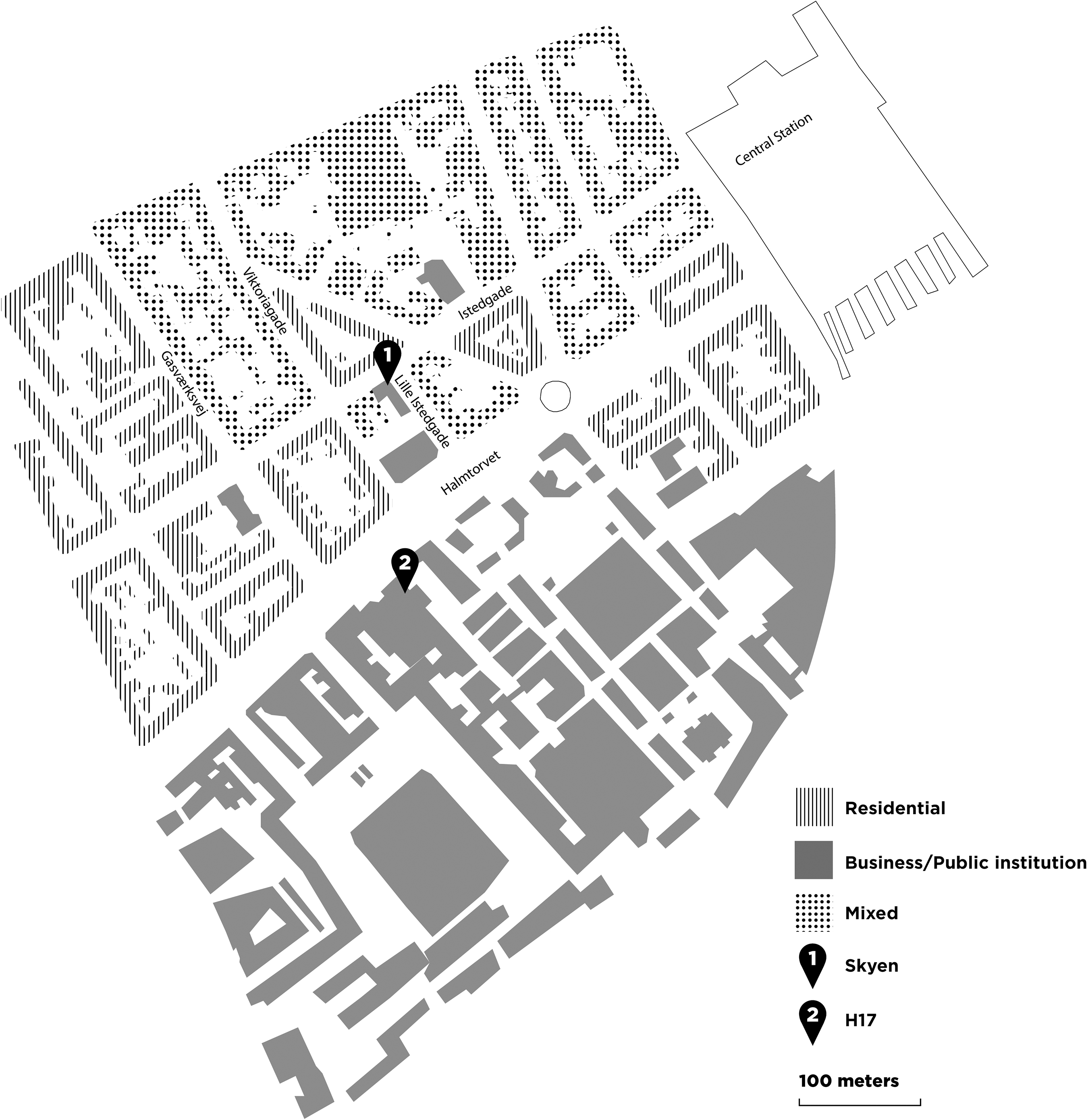
Map of inner Vesterbro. Note that categorization is instructive rather than detailed: Most blocks are mixed, with business primarily found on street-level floors.
We included two main categories of questions in the survey. One set sought to assess self-reported exposure to various drug scene–related activities and traces while another sought to assess the degree to which such activities and traces were perceived to be a nuisance. In the design process, we drew on previous research on the relationship between drug scenes, public drug use, and public order concerns (Cusick & Kimber, 2007; León et al., 2018; Renn & Lange, 1996), including from settings where DCRs have been established (Salmon et al., 2007). The survey also contained questions on attitudes toward Skyen and H17, feelings of safety and sociodemographic information. Descriptive analyses were done in STATA 16. Finally, the survey contained three open-ended questions: two asked residents to elaborate on their experiences and attitudes toward the two DCRs (359 written responses for Skyen; 300 for H17), while the third question allowed residents to provide any further general descriptions of experiences, thoughts, and opinions on the issue. A total of 301 residents wrote such descriptions, thus providing us with additional qualitative material alongside that generated via interviewing. During the subsequent coding process, written survey responses were also categorized according to the overall tone of the response. We distinguished between positive, negative, neutral, or ambiguous statements about the drug scene, people who use drugs, and DCRs. To strengthen the validity and interpretive consistency in this process, this categorization was conducted and discussed by the first and second authors along with two research assistants.
Interviewing
On completion of the survey, participants were asked to provide their contact information if willing to participate in a follow-up interview. We selected residents based on their address, as we wanted to gain information from residents in various parts of the neighborhood and thus of various distance from the DCRs and other drug scene hotspots. Thirty-three residents were interviewed during late summer and autumn of 2017, with interviews ranging from 1 to 2 hr in length. The interviews were conducted using a semistructured interview guide developed concurrent to the survey and focusing on similar themes: residents’ experience of the drug scene, its impact on the area and the everyday life of residents, attitudes toward the local DCRs, and perceived changes following their implementation. We also included questions probing for descriptions of specific drug scene encounters; a printed map of the area was introduced during interviews to engender more detailed accounts of such episodes.
A coding framework informed by our thematic and theoretical interests was constructed in the preparatory phase of the study. This was used for coding both written free text survey responses and transcribed interviews. Coding was done iteratively using NVivo 12 software, guided by theoretically driven concepts while remaining open to emerging themes and aspects (Timmermans & Tavory, 2012). In the following analysis, we use quotations from both the survey and interview material to support and illustrate analytical findings.
Analysis: Resident Experiences of the Open Drug Scene
The analysis is structured according to the main themes of the article. In the first section, we explore resident descriptions of various types of drug scene encounters, including those deemed to be a nuisance. Following this, we explore the question of whether the DCRs have altered the ways in which residents experience the drug scene and its impact on their daily life. In the final section, we analyze residents’ ambiguous statements about public health and public order concerns in the area.
Two Parallel Worlds
In the survey, two thirds (67%) replied that they rarely or never talked to people who use drugs in the neighborhood. When asked how they experienced such encounters when they did occur, nearly half (49%) responded “neither negative nor positive,” one third that they experienced such encounters as “negative” (23%) or “very negative” (11%), while one tenth answered that they experienced the encounters as “positive” (9%) or “very positive” (1%). We interpret both these results as indicating limited and superficial interaction between people who use drugs and residents in the area. This interpretation is supported by free text responses and interview material, wherein residents stated that they experienced people who use drugs and residents as living in two separate and parallel worlds, with some explaining that they sought to keep it this way: I let the drug abusers
1
be and do not attempt to contact them. It is my experience that as long as I do not do anything to them, they do not do anything to me. But I still find it unpleasant to pass a drug abuser. We kind of run on two parallel tracks, you could say: the ones who live here and the ones who come here to use drugs…. They pass by and are oriented toward their thing, we are oriented toward our thing, and it is very rare that we get into direct interaction, unless someone comes up to you to beg for money or for some other reason.
Encountering the Drug Scene
Inner Vesterbro has rather narrow streets that are densely populated by residents as well as people frequenting the area for various reasons. Therefore, it is an area where people often come into close proximity to each other. Describing drug scene encounters, residents often referred to situations where they were more or less “forced” to share a physical space with people who use drugs. This could involve the necessity of moving through one of the central hubs of the drug scene, for example, the pavement outside Skyen or the area near the back entrance of Copenhagen Central Station locally known as “the pill trade.” One nearby resident described an experience of physical proximity and social distance when moving through this area on the way to and from work: It is a subcultural experience. Well, it is like they have their own culture that is happening there. They know each other and have their way of talking and things like that. And I even feel that I am kind of invisible in their world, because I am not part of their group. So, you can walk in the midst of people who talk straight into your ear, because they need to say something to Lars over there. It is as if you are not even present as a person in that world. Very irritating that I can’t go my own way in my own neighborhood, in my own area, without being confronted with it all the time. Don’t get me wrong, if they just stood there and I knew that if I wanted to buy, then I could just approach them and buy—that would be fine with me. I would feel much better about that than being asked [if I want to buy] all the time and having the feeling that I sometimes need to look into the ground because I don’t want those confrontations and being asked. That irritates me. I think most of us signal very clearly: we live here, we are not customers, do not approach. And it does something to an urban space, because you create not just a physical distance but also a mental distance because you pretend that you do not see each other.
In the survey, 7 items were used to measure self-reported exposure to various drug scene–related activities and traces. For each item, respondents were asked to report how often they had been exposed within the 2 months prior to the survey, with options ranging from (1) never to (5) several times a day. The items are listed in Table 1.
Items Included in the Self-Reported Exposure to Drug Scene–Related Activities and Traces Scale.
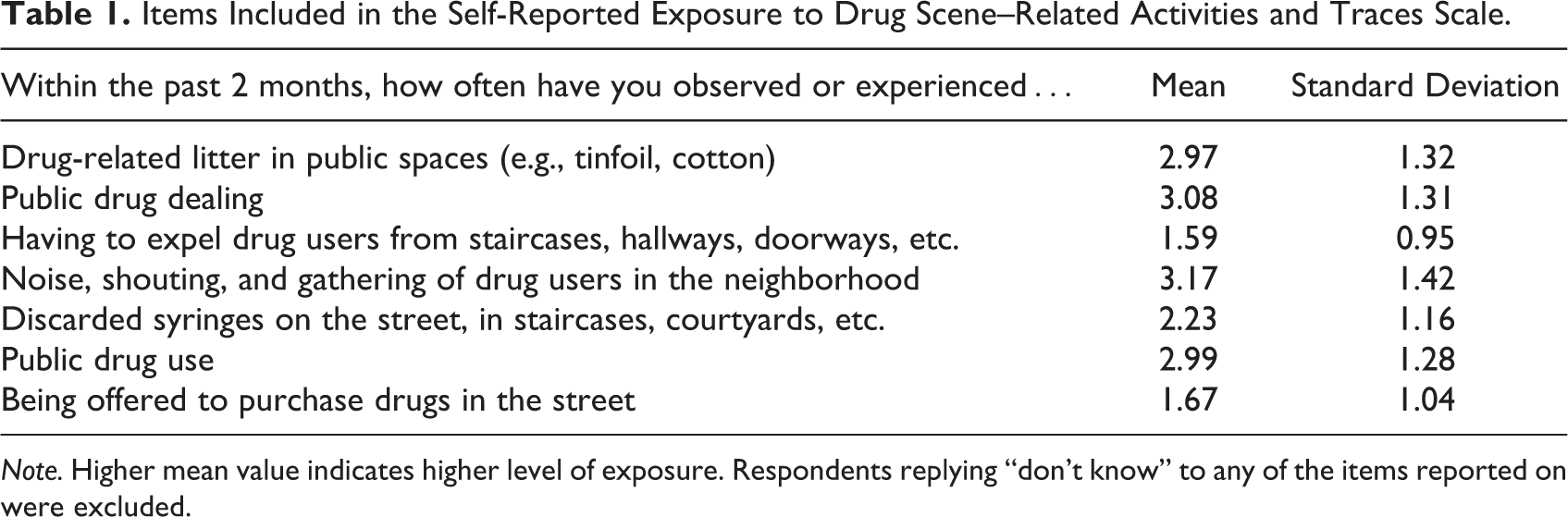
Note. Higher mean value indicates higher level of exposure. Respondents replying “don’t know” to any of the items reported on were excluded.
Table 1 shows that noise, public drug dealing, and public drug use were the three main self-reported activities observed or experienced by residents within the 2 months prior to the survey period. Self-reported exposure varied considerably from street to street. For example, 38% of all residents reported having observed public drug use one or more times a week. In the streets with highest exposure, the percentages were 92%, 77%, and 64%. A similar pattern emerged for other items, including exposure to drug dealing and noise, shouting and gatherings of drug users, all indicating the geographical distribution of drug scene–related activities and traces. That specific streets and places become key locations in the drug scene appears to be affected by not only the placement of services (including DCRs) and the primary routes between these but also spatial and material characteristics such as narrowness of streets and niches providing cover. These results also show that drug scene–related activities, including public drug use, continue to have an impact in the area following the opening of DCRs.
As seen from the examples above, street encounters are the most common way in which residents and people who use drugs interact with each other as they come in contact through the sharing of public spaces. However, there are also other situations where people who use drugs and residents are “forced” into physical proximity to each other. One such situation is instances where people who use drugs occupy the doorsteps of apartment buildings: The typical dialogue you have with drug abusers is when you open the door and somebody sits there. And then you say, “listen, we need to get by, because we live here.” And they say “Oh, yes of course, of course” and then they leave. That is a classic Vesterbro situation.
Experienced Nuisance From the Drug Scene
Following each survey question on exposure, respondents were asked how bothered they had been by the particular type of exposure within the 2 months prior to the survey period. Nuisance was measured using a forced 4-point Likert-type scale with options ranging from (1) not at all bothered to (4) very bothered.
Table 2 shows that noise, public drug dealing, and finding discarded syringes were the three primary causes of nuisance within the 2 months prior to the survey period. Unsurprisingly, respondents reporting more exposure also reported more nuisance. Again using public drug use as an example, 74% of those reporting having observed public drug use daily or several times a day responded that they were “bothered” or “very bothered” by this. Among those reporting having observed public drug use once a month or less, only 14% responded that they were “bothered” or “very bothered” by this. Street-level comparison of responses to both categories of questions also illustrated the spatial distribution of exposure and nuisance, with a higher percentage of residents reporting nuisances in streets with more reported exposure.
Items Included in the Self-Reported Nuisance Caused by Drug Scene–Related Activities and Traces Scale.
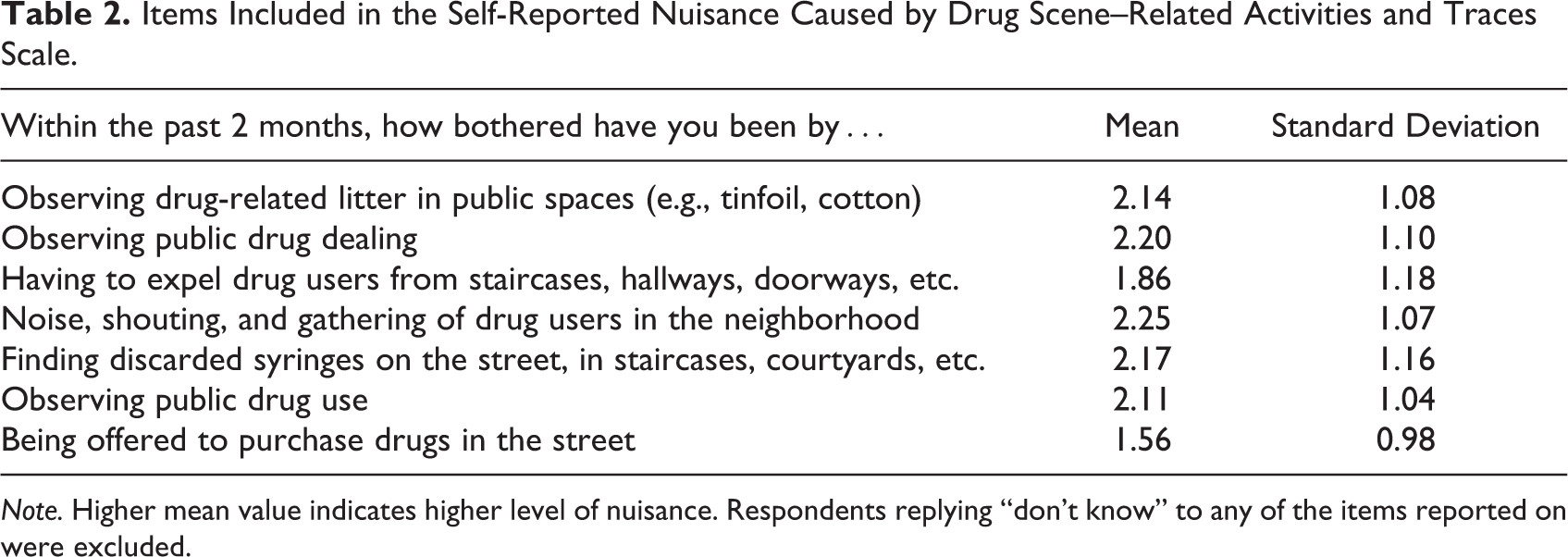
Note. Higher mean value indicates higher level of nuisance. Respondents replying “don’t know” to any of the items reported on were excluded.
Yet not only residential proximity to focal points brings residents into contact with the drug scene. The material configuration of the area also plays a role. For example, some buildings have doorsteps and entrances that, more than others, can be used to sit on and use drugs. In such cases, residents and drug users will be brought into contact with each other and situations such as the one described above may unfold. In that example, the resident encountering drug users on the doorstep described the experience in terms of neutral affects leading to nonproblematic exchanges. This is, however, not the case for all examples in the material. Other residents experience anger, annoyance, and other more explicitly negative affects when encountering the drug scene. While this can result in conflictual interaction, it can also involve residents ignoring people who use drugs, instead carrying bad encounters with them. In such instances, following Duff (2010), residents’ dispositional orientation toward the drug scene can be transformed, whereby affective encounters become “dynamically involved in the production and reproduction” of the parallel worlds described previously (p. 885).
Have the DCRs Transformed Drug Scene Encounters?
A majority of survey respondents held positive attitudes toward both DCRs in the area. Sixty-two percent stated that they had a “very positive” (31%) or “positive” (31%) attitude toward Skyen, while 60% of respondents held such attitudes toward H17 (31%/29%). While these results indicate widespread support for DCRs among local residents, they do not explain why residents hold these views. We have no comparable material on how residents experienced the drug scene prior to the establishment of the DCRs. Nonetheless, both free text survey responses and qualitative interview material showed many descriptions of positive changes that were attributed to the establishment of the DCRs. For example, several residents stated that they had experienced a positive change in terms of public drug use, discarded syringes, and drug-related litter. At the same time, other residents stated that they had not experienced any change, while others felt even more exposed to various aspects of the drug scene than previously. We interpret these differences to be a consequence of changes in the geography of the drug scene following the establishment of the DCRs, as they enable drug users to inhabit the spaces of Inner Vesterbro in new ways. The DCRs have become central locations of the drug scene. People wait in line, socialize, trade, and occasionally use drugs, for example, in case of long queues or temporary shutdowns. Skyen is located in the building of a long-established homeless shelter that for many years has been an important place of sociability for people who use drugs and other street people. The opening of Skyen has meant that there is now more activity in the immediate vicinity of this building. The sidewalk outside Skyen and the small side street of Lille Istedgade often have drug users coming, going, and hanging out. Meanwhile, H17 is located in an old industrial building in the Meatpacking district nearby. While this area has been a popular location for drug use for many years, due to its narrow alleyways and niches, the opening of H17 has led to the creation of a more visible drug scene outside the facility. There is now a steady flow of people who use drugs moving between Skyen in Istedgade and H17 at Halmtorvet, running via the two small streets Lille Istedgade and Viktoriagade. It has also meant that there is a flow of people moving along Halmtorvet between the drop-in center Café D and H17. Near Café D, people using crack cocaine can use a shed in a small, secluded square. Such changes in the geography of the drug scene have meant that while much of the drug use previously taking place in public or semipublic spaces (such as cellars, stairways, and attics of apartment buildings) has moved inside the DCRs, some residents are confronted with the drug scene much more frequently than before. It is therefore not contradictory that some residents experience much less exposure to the drug scene while others experience more exposure or no changes in exposure.
In particular, residents from Viktoriagade and Halmtorvet have experienced a marked change of exposure to the drug scene since the establishment of H17. Some describe feeling very affected by noise, public drug use, litter, syringes, urine, feces, and various other unpleasant situations, such as instances where people enter staircases when automatic doors do not close or do not close quickly enough. One resident living at Halmtorvet expressed support toward establishing services for people who use drugs in the area but simultaneously had ambivalent feelings, as the opening of H17 had had a negative impact on his everyday life: We, as the nearest neighbors, do however experience more nuisance than before the opening. The worst is finding syringes in the yard where children play. We experienced this very rarely before the opening of H17. It creates a traffic through Viktoriagade that creates a sense of unsafety. Since H17 has opened, we more often experience urine and feces in our gateway, litter from drugs and much more noise from the drug users. The singular encounters and forms of inhabitation […] are for the most part “trivial” in themselves, holding little significance and carrying scant consequence for the ongoing individual lives concerned, but taken together their cumulative weight enables us to arrive at “larger” claims […] about the practical conduct of social life within settings affording more or less opportunity for conviviality. (p. 361) It is good that they have a place to use drugs in a safe way, but it attracts an even harder drug scene which “appropriates” the area. […] We experience that it is not our area anymore, but the drug users’. They have become more careless, provocative, are mentally ill, foreign, etc. and are less considerate toward children.
The experience of a majority of residents, however, particularly those living further away from the central hubs of the drug scene, was that they felt less exposed than before, particularly to instances of public drug use, finding discarded syringes and drug-related litter. Others described that other social aspects of the drug scene, such as drug trade or loitering in groups, had not been reduced. Again, this seems to depend partly on where residents live. The following excerpt from a written survey response illustrates these changes: The change has been extremely noticeable on all parameters. We are now to only a very limited extent witnessing people who inject themselves etc. and who are very intoxicated/lying in the street. [Finding] syringes has almost ended. There is still [drug] trade and a lot of street activity, but that is something completely different. It means a whole lot that the unpleasantness for both parties, which is the injection, has disappeared from the public space. It can be taken somewhere else. Then it is not as unpleasant to look at each other.
Ambiguous and Nuanced Statements About Public Health and Public Order
As mentioned, a majority of participating residents held positive views toward the DCRs. Two thirds of the respondents in the survey were “positive” or “very positive” toward the DCRs, between 14% (H17) and 16% (Skyen) were “neither positive nor negative,” and 13% (Skyen) and 11% (H17) were “negative” or “very negative.” Meanwhile, free text survey responses coded as ambiguous contained nuanced articulations of public health and public order considerations. On the one hand, many (whether coded as positive or ambiguous) reflected concerns about the health of people who use drugs and positive attitudes toward DCRs, which were seen as services that could improve health and reduce harms for people using drugs. However, on the other hand, in many statements, such public health concerns were intertwined with concerns about public order. One resident articulated this ambiguity in a very clear manner, pointing to the importance of considering the wider social aspects of the drug scene: We accept all the poor souls that are here [in the area]. But when 20-40 poor souls stand as a group, they are much more threatening than poor and wretched. I think it is fine that they have a place where they can take drugs. But it is not cool that they always stand outside Skyen and shout/make a nuisance of themselves in their intoxication. I avoid passing Skyen, because it is simply too unpleasant to walk past that place. In general, I feel safe living in Vesterbro. But I have definitely adapted my behavior in order to avoid the drug scene affecting my life any more than necessary. I bike most of the time. That way, I avoid close contact with people mistreating themselves, which I find it extremely difficult to be confronted with on a daily basis. I can relax more and I don’t need to be so concerned and worried about the health of the drug users when they have a secure and safe place to use drugs. I think there needs to be a coexistence, and if I start walking the other way, because I feel threatened, then you can create that fear and you can contribute to separating the areas. I am under no circumstances interested in that. I don’t want to live in a segregated street. We should all be able to be there. I would like to say that despite a little bit of nuisance and experience of drug use, drug-related litter, drug trade, noise, smells and other nuisances as well as offers to buy drugs near my home, I do not want my response to become an argument for less help or room for the people who come to the Men’s Home and other places where they can get help […] My experiences of nuisance are true, but should NOT [sic] be seen as expressing a wish that my neighborhood should be cleared from all drug/abuse-related problems—unless the marginalized people get another and better service somewhere else.
Conclusion
Beginning in 2008, a remarkable change has happened in the local policy toward the drug scene in Inner Vesterbro, Copenhagen. This has involved a change from zero-tolerance drug policing to nonenforcement, the establishment of DCRs, the introduction of a number of auxiliary functions like street cleaning and outreach work, and close collaboration between police and municipality. The policy aims to reduce drug-related harms for people who use drugs while minimizing drug scene–related nuisances for the local community. The main question is no longer whether or not there should be a drug scene but rather how to regulate the coexistence between the drug scene and the wider community. There is no final answer to this question, and the policy can therefore be seen as a social experiment involving the development of new ways for people who use drugs and other people to co-inhabit the neighborhood and thus the fostering of an inclusive civic culture (Amin, 2008).
This article has analyzed how residents at Inner Vesterbro experience everyday coexistence with the open drug scene as well as their experiences and attitudes after the establishment of DCRs in the area. No research has been conducted prior to the establishment of the DCRs, and this study can therefore only inform us on how residents experience the drug scene following recent changes in the local drug policy strategy. Residents responding to the survey reported exposure to various aspects of the drug scene. For these residents, encountering public drug use, drug dealing, discarded syringes, and groups of drug users are part of their everyday life in the neighborhood. While some residents are not negatively affected by such encounters, others experience negative affects in different ways and to various degrees. Further qualitative analysis of resident descriptions of such encounters showed that people who use drugs and residents more or less live in two parallel social worlds, but also that the geography and physical layout of Vesterbro means that the two groups often come in contact through the sharing of public spaces. For example, people who use drugs can inhabit niches and staircases of apartment buildings while stretches of pavement that residents need to pass can be central places of sociability for people involved in the drug scene.
Many residents described different negative affects generated from drug scene encounters, many of which were articulated in terms of nuisances and annoyance. However, this does not necessarily lead residents to call for a removal of the drug scene or the shutdown of DCRs. Conversely, around two thirds of respondents held positive views toward the DCRs, with only a small minority holding entirely negative views. Most residents articulated highly ambivalent attitudes, a finding with great importance for wider discussions on urban drug policy strategies. When balancing the public health aim of reducing risk for people who use drugs and the public order aim of reducing nuisances for the wider community, many residents in this study appeared to prioritize the former. This finding indicates that for such residents, experiencing nuisances does not necessarily lead to a stance for or against the drug scene or DCRs, but rather to pragmatic concerns about practical issues of everyday coexistence with the drug scene. It is therefore important for researchers and policy makers alike to unpack the concept of nuisance and consider the many dimensions of this phenomenon, as this allows for more nuanced discussions about DCRs, drug scenes, and urban coexistence. Widening the concept of nuisances is also important given that a better understanding of the material, social, and affective dimensions of urban coexistence can inform the development of measures and practices aiming to enable convivial forms of sociality.
The analysis in this article has shown that much can be gained from seeing DCRs as environmental interventions that influence and facilitate sociality in the urban areas in which they are situated. This is an important consideration whether one is discussing, planning, or evaluating DCRs. DCRs must be seen not just as isolated harm reduction services for people who use drugs but as part of the urban infrastructure that influence the social spaces where residents and drug users encounter each other. DCRs may change the ways that affected residents encounter both individual drug users and various drug scene-related traces, most importantly by reducing the impact of public drug use, discarded syringes, and drug-related litter. This may enhance the possibilities for the generation of more positive affects in drug scene encounters, which in turn may engender or strengthen a local civic culture tolerant toward diversity.
If the local acceptance toward the drug scene and DCRs found in this study is to endure, institutionalized, flexible, and proactive collaboration between multiple stakeholders, including DCR representatives, police, and municipal social services, is of particular importance. Based on the dominant topics among residents participating in this study, demands and expectations from such cooperation can range from socio-material, microlevel forms of governance of sidewalks and doorways through to better care and handling of people experiencing drug-induced psychosis or other mental health crises. In Inner Vesterbro, all apartment buildings have information sheets with direct hotlines to DCRs as well as the local police. Regular information meetings are arranged, allowing residents to obtain information on recent drug scene developments or vent frustrations. NGOs operate in the area, providing opioid overdose reversal training. Taken together, these important measures indicate that local authorities view the local DCRs and the drug scene as integrated parts of the area. They also highlight the importance of establishing and sustaining cooperation between various stakeholders, most importantly DCR staff and police (Watson et al., 2018).
The empirical findings of this study also align with arguments by urban researchers such as DeVerteuil (2014). He has provided a balanced, sympathetic critique of dominant “grammars of urban injustice,” which, according to DeVerteuil, has tended to overlook more solidary and supportive responses and counter currents in urban governance and communities alike. Mainly describing American literature on homelessness and neoliberalist, punitive urban strategies, DeVerteuil argues for a “more balanced, relational view of urban in/justice that privileges co-present and sometimes dependent set of practices” (2014, p. 875). The current situation in Inner Vesterbro appears to divert significantly from developments in countries such as Australia, Canada, and United States, where various restrictive measures such as the prohibition of alcohol consumption in public space and the designation of Stay Out of Drug Areas (England, 2008) have proliferated in recent years. These strategies have been described as creating “geographies of exclusion” through which certain unwanted groups and practices become marginalized from urban spaces (Pennay et al., 2014). While it is important to keep in mind that marginalization can take multiple (and often subtle) forms, it is clear that the example of Inner Vesterbro stands out in terms of the governance and socio-spatial dynamics of daily life on open drug scenes.
DCRs continue to attract controversy and opposition from politicians and communities alike (Jauffret-Roustide & Cailbault, 2018). Despite being highly specialized facilities, DCRs are inevitably nested in a broader local community with all the challenges and oppositions that this entails. At the center of oft-inflammatory and moralized debates surrounding drug policy reform, harm reduction policies, and urban development, the continued success of DCRs appears to rely on continued and indeed increasing community support in places of implementation. Further exploratory research in areas where DCRs have been implemented, ideally using a combination of various methods, will provide both researchers and authorities with a better understanding of the local level complexities that shape situated experiences of coexistence. Such research is vital for the development of novel and flexible strategies for urban planning, policing, and everyday public space management that can ensure that both target groups of DCRs and members of local communities can feel safe, welcome, and thus able to contribute to the production of an urban environment characterized by multiplicity and conviviality. Even in the context of great economic, social, and symbolic inequalities, meaningful and inclusive urban coexistence is possible. Yet in order to become positive, and possibly even generate a social surplus, coexistence needs to be regulated, maintained, and nurtured.
Footnotes
Acknowledgments
We thank the residents participating in this study for sharing their views, experiences, and thoughts. Our research in Vesterbro is made possible only through the willingness of several people and institutions to participate and provide us with access and assistance. In particular, we are grateful to clients, staff, and management at Mændenes Hjem, Skyen and H17, as well as the local police, for their participation and continued engagement in our research. We also thank editor David Moore and two anonymous reviewers for their insightful suggestions and comments on an earlier draft of this article. Finally, we thank our colleagues Morten Hesse, Jonas Wielandt Holdt, and Julie Elizabeth Brummer for invaluable help in conducting this research.
Declaration of Conflicting Interests
The author(s) declared no potential conflicts of interest with respect to the research, authorship, and/or publication of this article.
Funding
The author(s) disclosed receipt of the following financial support for the research, authorship, and/or publication of this article: This work was supported by the Danish Ministry of Justice [Case Number 2016-0021-0092].
