




Abstract
Numerous cities are experimenting with pre-booking diversion programs that allow police officers to divert community members to supportive services in instances that would otherwise result in arrest and prosecution. These programs aim to decrease harmful involvement with the criminal justice system while reducing crime and public disorder. Although previous research has explored the experiences of people receiving diversion referrals and of police officers initiating them, none have examined the perspectives of community members who can offer crucial insights into planning, evaluation, and implementation barriers. We administered a survey to 293 people living in four police districts where the Philadelphia Police Department operates a pre-booking diversion program. The survey explored residents’ perspectives on the program as well as their broader views on associated issues like decriminalization of substance use, sex work, and minor theft. Bivariate χ2 tests and multivariate logistic regression examined differences in responses between subgroups. Perspectives were diverse and varied based on demographic attributes of the respondents as well as on district-level attributes, like crime patterns. Most surveyed community members perceived pre-booking diversion to be a valuable tool for improving the experiences and outcomes of policing. However, residents living in areas with more crime and with more public disorder held significantly less positive perspectives. Their skepticism may reflect the possibility that pre-booking diversion and similar reforms are necessary but not sufficient to transforming individual health and public safety in some areas.
Introduction
Many urban areas in the US are experiencing four overlapping crises: fatal overdose, over-incarceration, crime, and unmet basic needs. In Philadelphia, the fatal overdose rate is over twice the national average, accounting for over a thousand deaths in each of the last 5 years (Philadelphia 2022: The State of the City, 2022). The city has halved the local jail population over the same time-period, yet continues to incarcerate and supervise more of its residents than almost any other large city (Palmer & Melamed, 2021). Racial disparities persist throughout the system; over 90% of the local jail population are people of color, and Black residents are still detained at nine times the rate of white residents (Melamed, 2022). Meanwhile, concerns about public safety are widespread and growing. According to the most recent city-wide polling, less than 50% of residents feel safe in their neighborhood at night and 70% view crime, drugs, and public safety as the biggest local issues—a 30% increase since 2020 (Cann, 2022). Philadelphia is also the poorest large city in the US, with overdose, incarceration, and crime clustering in the same areas where food insecurity and housing instability are common (Philadelphia 2021: The State of the City, 2021).
These crises share key distal causes. Racist housing policies and other social forces have concentrated economic disadvantage in sections of urban areas over the last century (Rothstein, 2017). In the 1940s, the federal government deemed specific Philadelphia neighborhoods unsuitable for economic investment due to their racial and ethnic composition; those exact neighborhoods have the most fatal overdose, violence, and poverty today (Jacoby et al., 2018). Residents living in these areas not only encounter concentrated poverty, but also fewer services and supportive resources. In Philadelphia, residents of historically “redlined” neighborhoods are more likely to lack health insurance and to struggle to access primary and behavioral health services (Swope et al., 2022).
Failure to address these distal causes has exacerbated harm though more proximal causal loops. Responses to safety concerns have often relied too much, if not exclusively, on policing generally, and on prosecution of prohibitionary drug laws specifically. That approach has been implicated in the development of increasingly potent drug supplies (Beletsky & Davis, 2017) and riskier environments for drug use (Rhodes, 2002). Although these phenomena are complex and cannot be extricated from poverty and other contextual factors including drug distribution networks (Mars et al., 2014), Philadelphia seems to fit the general pattern. Arrests for drug-related activity in Philadelphia surged over recent decades, with pronounced increases starting in 1988 with the creation of the local Narcotics Strike Force and in the early 1990s as the city—and especially the Kensington area—became the target of repeated federal interdiction programs often marked by Presidential visits (Smith, 2022). Despite the attention and enhanced enforcement resources, the local drug supply became the most potent on the east coast and the city is now home to one of largest areas of uncontrolled public injection drug use in North America (Mars et al., 2014; Ratcliffe & Wight, 2022). Both developments have contributed to conditions that promote fatal overdose and crime, with the latter tied in important ways to environmental conditions like upkeep of public spaces (Branas et al., 2018).
To address these intersecting crises, Philadelphia has launched multiple initiatives in recent years. One is the implementation of a pre-booking diversion program that enables police officers to link people with immediate social and health services in instances that would otherwise result in the filing of criminal charges. By responding to minor drug-related crime with supportive resources rather than prosecution, this model aims to reduce fatal overdose and other harms by addressing unmet needs in the community at times of acute vulnerability. The potential value of this model was first demonstrated by Seattle's Law Enforcement Assisted Diversion (LEAD) program, which launched in 2011 and has been associated with documented reductions in criminal justice system involvement for people receiving referrals (hereafter “clients”) and small but important increases in stable housing, employment, and legitimate income (Clifasefi et al., 2017; Collins et al., 2017, 2019). Over 40 cities in the US have introduced similar programs (Lattimore et al., 2020).
Evaluations of pre-booking diversion have focused mostly on the experiences of clients, police officers, and other stakeholders involved in the design and operation of programs (Anderson et al., 2022; Joudrey et al., 2021; Magaña et al., 2021; Worden & McLean, 2018). No studies have explored the perspectives of other community members. This is an important gap because residents offer key insights into planning and evaluation activities, and because they can stymie implementation. Oppositional “not in my back yard” (NIMBY) approaches have emerged in response to similar harm reduction measures (Rouhani et al., 2022) based on the belief that they attract more chaotic drug use and criminal activity (Yang & Beletsky, 2020). Such community opposition is typically recorded through public opinion polls over large areas (Rouhani et al., 2022) or journalistic accounts. However, perspectives on these issues are context dependent and likely subject to powerful social and selection biases.
The current study explores community member perspectives about Philadelphia's pre-booking program, known as Police Assisted Diversion (PAD), in the four police districts where it operates. PAD staff meet with potential participants immediately after arrests for drug possession, retail theft involving less than $1,000 of value, and prostitution-related offenses. Participants interested in the program are immediately connected with service organizations providing case management and peer support. Services are offered free of charge based on a harm reduction model, which does not require sobriety or penalize failure to remain engaged in services (i.e. charges are not reimposed). Officers can also enroll interested community members in PAD when no crime is suspected through what are known as “social referrals.” The four police districts encompass two pilot zones. The “North” zone, comprised of the 22nd and 39th districts, is mostly residential and has a predominantly Black population. The “East” pilot zone, comprised of the 24th and 25th districts, includes the city's large open-air drug market along a busy commercial corridor (Mars et al., 2014; Ratcliffe & Wight, 2022; Smith, 2022) and is more racially and economically diverse. Although both areas have similarly high rates of serious violence, including homicide rates that are five times the national average, they differ with respect to drug and prostitution-related crimes, which are substantially more common in the East division (Supplemental Table 1).
Materials and Methods
This survey is part of a larger program evaluation and builds off interviews with 30 PAD clients, 15 police officers, and 12 personnel who designed and implement PAD (Anderson et al., 2022), and a survey of 204 police officers in the districts offering PAD (Shefner et al., 2023). Respondents in both the interviews and survey suggested that differences between the pilot zones present important operational challenges and may influence how community members experience and perceive the program. The current survey instrument explores three dimensions of the program's perceived potential effectiveness—whether it helps individuals with unmet needs, improves public safety, and improves relations between police and residents—and one key programmatic feature: whether people who fail to engage in or complete treatment should have criminal charges reimposed. To contextualize these perspectives, eight items also explore resident views about the effectiveness of traditional enforcement practices. All perspectives were assessed on a four-point Likert scale assessing degree of agreement (strongly agree, agree, disagree, strongly disagree). To explore differences across subgroups, the survey also collected participant age, race, gender, highest level of education, income, and residency tenure.
The instrument was developed and deployed with the support of the Institute for Survey Research (ISR) at Temple University, which has extensive expertise exploring the opinions and behaviors of “hard-to-reach” populations. ISR maintains a database called BeHeardPhilly, comprised of community members who have opted to participate in ongoing governmental and nonprofit research. BeHeardPhilly is the largest existing municipal panel and provides a broadly representative sample of Philadelphia residents. As of February 2022, when the survey launched, BeHeardPhilly had 10,918 members, of which 1,443 members were eligible for this study based on residence in one of the four police districts offering PAD. ISR conducted internal survey pretesting before sending invitations. Ten $30 gift cards were provided as a raffle incentive when ISR provided initial invitations through participants’ preferred mode of communication (phone call, email, text). In mid-March, ISR called everyone in the sample with a listed phone number (regardless of listed preferred communication mode), to encourage participation. Those phone calls were completed via push to email or text distribution. In early May, ISR sent out one final email to the entire panel offering a chance to win one of four $50 gift cards.
This study was approved by the Institutional Review Board at the University of Pennsylvania.
Data Analysis
We first conducted univariate and bivariate analyses to understand the demographic characteristics of survey respondents across and between the two pilot zones. After collapsing the four-point Likert scale into agree and disagree, we conducted bivariate analyses of perspectives across demographic characteristics and residency in the two pilot zones. All bivariate analyses relied on χ2 tests. To understand whether perspectives on the three dimensions of effectiveness varied after adjusting for race, income, age, and zone residency, we conducted three logistic regressions exploring agreement with the propositions that PAD helps individuals, reduces crime and improves relations between police and community members. In these logistic regressions, income and age were dichotomized by median splits. Due to the limited size of our sample, we did not include information about ethnicity in our analysis, which would have resulted in some extremely small cell counts for some subgroups (such as Black-Hispanic), and instead only dichotomized the racial category measure of race as Black and not-Black.
Results
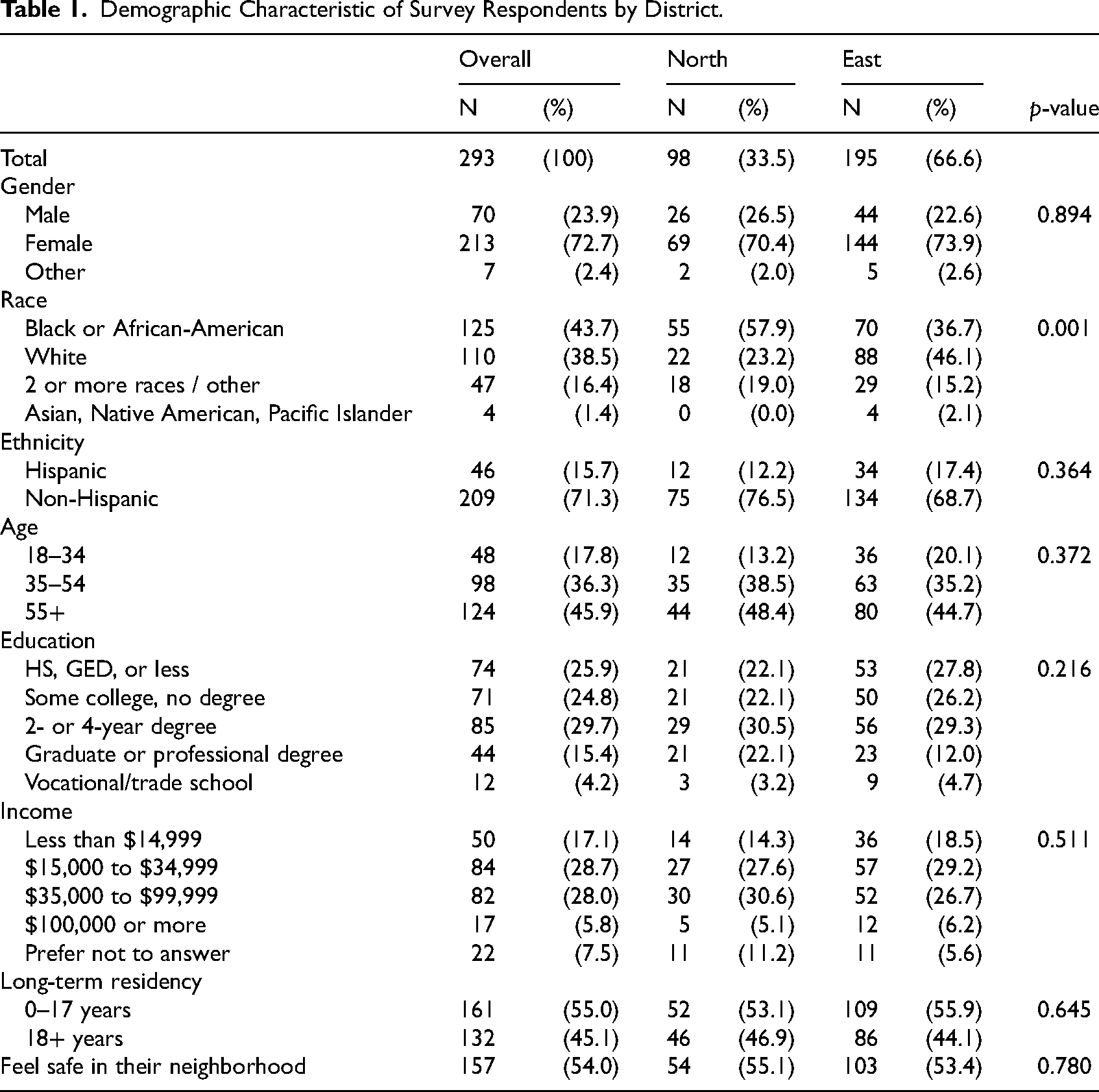
Across the four districts offering PAD, 293 community members completed the survey, a 20% response rate. Of the 293 surveys, 13 (4.4%) were missing at least one response item related to PAD or decriminalization, and 78 (26.6%) were missing at least one demographic field. Table 1 shows the demographic composition of the sample, which closely resembles the composition of the overall Be Heard Philly panel (see Supplementary Table 1 for a demographic comparison). Respondents were mostly female (n = 213, 72.7%) and were more likely to be Black (n = 125, 43.7%) compared with white (n = 110; 38.5%) or 2 or more races (n = 47, 16.4%). Just under half of the respondents were 55 years or older (n = 124; 45.9%); the remainder were more likely to fall into the 35 to 54 age bracket (n = 98; 36.3%) compared to the 18 to 34 age bracket (n = 48; 17.8%). The median time in residence was 17 years (mean = 19.9; STD = 15.3). Educational attainment was spread evenly between high school diploma, GED or less (n = 74; 25.9%), some college but no degree (n = 71, 24.8%), and 2- or 4-year college degree (n = 85; 29.7%). Just over a quarter of respondents reported an income between $15,000 and $34,999 (n = 84, 28.7%) and between $35,000 and $99,999 (n = 82, 28.0%); the remainder reported income of $14,999 or less (n = 50, 17.1%) or $100,000 or more (n = 17, 5.8%). Demographic characteristics were comparable across police districts with the exception that there were significantly more Black respondents from the North zone (57.9% vs 36.7%, p-value: 0.0014).
Demographic Characteristic of Survey Respondents by District.
Only 22.4% of respondents had heard about PAD before being administered the survey. As shown in Table 2, community members favored PAD overall, with the majority agreeing that the program: helps people who use drugs (n = 186; 64.1%); will improve public safety (n = 199; 68.6%); and will improve the relationship between the police and the community (n = 208; 71.7%). However, there was also broad agreement (n = 182; 62.8%) that individuals who are eligible for PAD should be prosecuted if they do not engage with available services. Three-quarters of respondents supported arrest for minor offenses including for possession of heroin or cocaine (n = 208, 72.2%), retail theft (n = 217, 74.6%), and theft from another person (n = 227, 78.6%), and about half agreed that people should be arrested for working as a prostitute (n = 146, 50.7%) (Table 3).
Percentage of Respondents who Agreed or Strongly Agreed on Items Related to PAD.
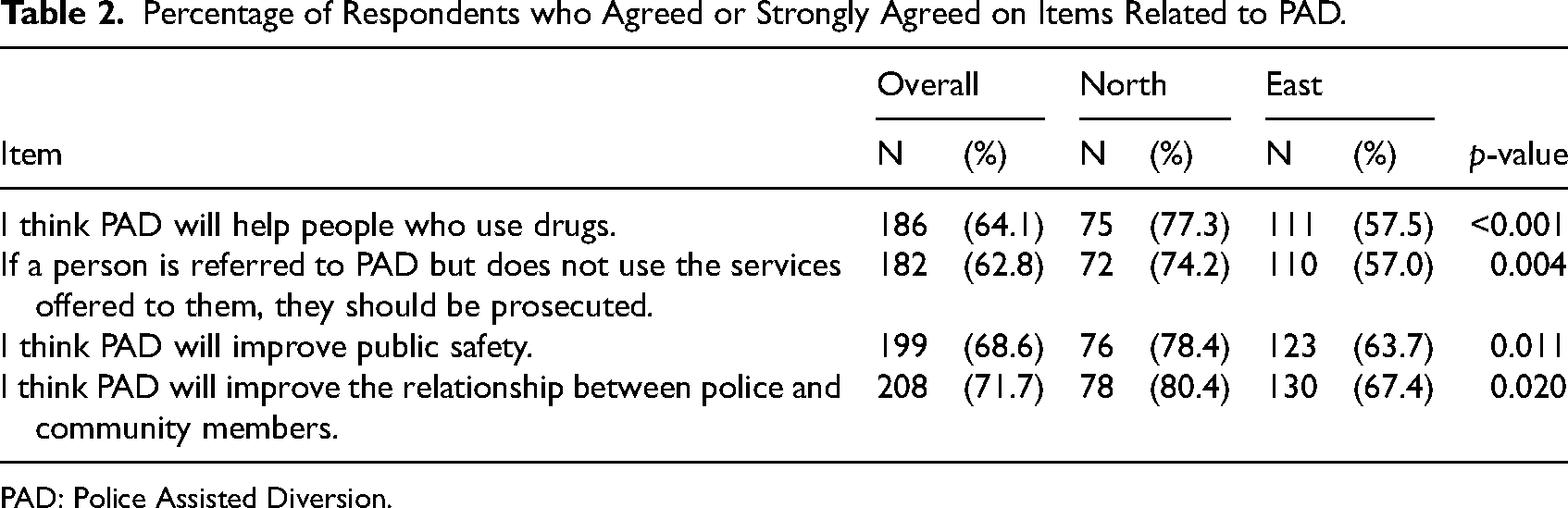
PAD: Police Assisted Diversion.
Percentage of Respondents who Agreed or Strongly Agreed on Items Related to Policing and Crime.

Bivariate analyses revealed important differences in perspectives about PAD's effectiveness between demographic groups and between residents from different zones (Table 4). Black respondents were more likely than non-Black respondents to agree that PAD: helps people who use drugs (70.7% vs. 52.3%; p-value: 0.014); improves public safety (77.2% vs. 54.1%; p-value: 0.002); and promotes better relations between police and community members (81.3% vs. 59.6%; p-value: 0.003). Women also expressed more positive views on these three dimensions of program effectiveness compared to men (68.1% vs. 52.9%; p-value: 0.082; 73.3% vs. 54.3%; p-value: 0.031; 76.7% vs. 57.1%; p-value: 0.019). However, the significance of these associations mostly dissipated in multivariate analyses. After adjusting for race, gender, income, and age, only residence in the East zone remained significant with respect to the first two analyses with East residents 61% less likely to agree that PAD provides important services (OR: 0.387; p-value: 0.005) and 52% less likely to agree that PAD will improve public safety (OR: 0.483; p-value: 0.035). The only factor associated with agreement that PAD will improve relations between the community and police after adjustment was race; Black respondents were 86% more likely than non-Black respondents to express agreement (OR: 1.856; p-value: 0.056).
The Association Between Agreement and Race, age, District, and Perceived Safety.
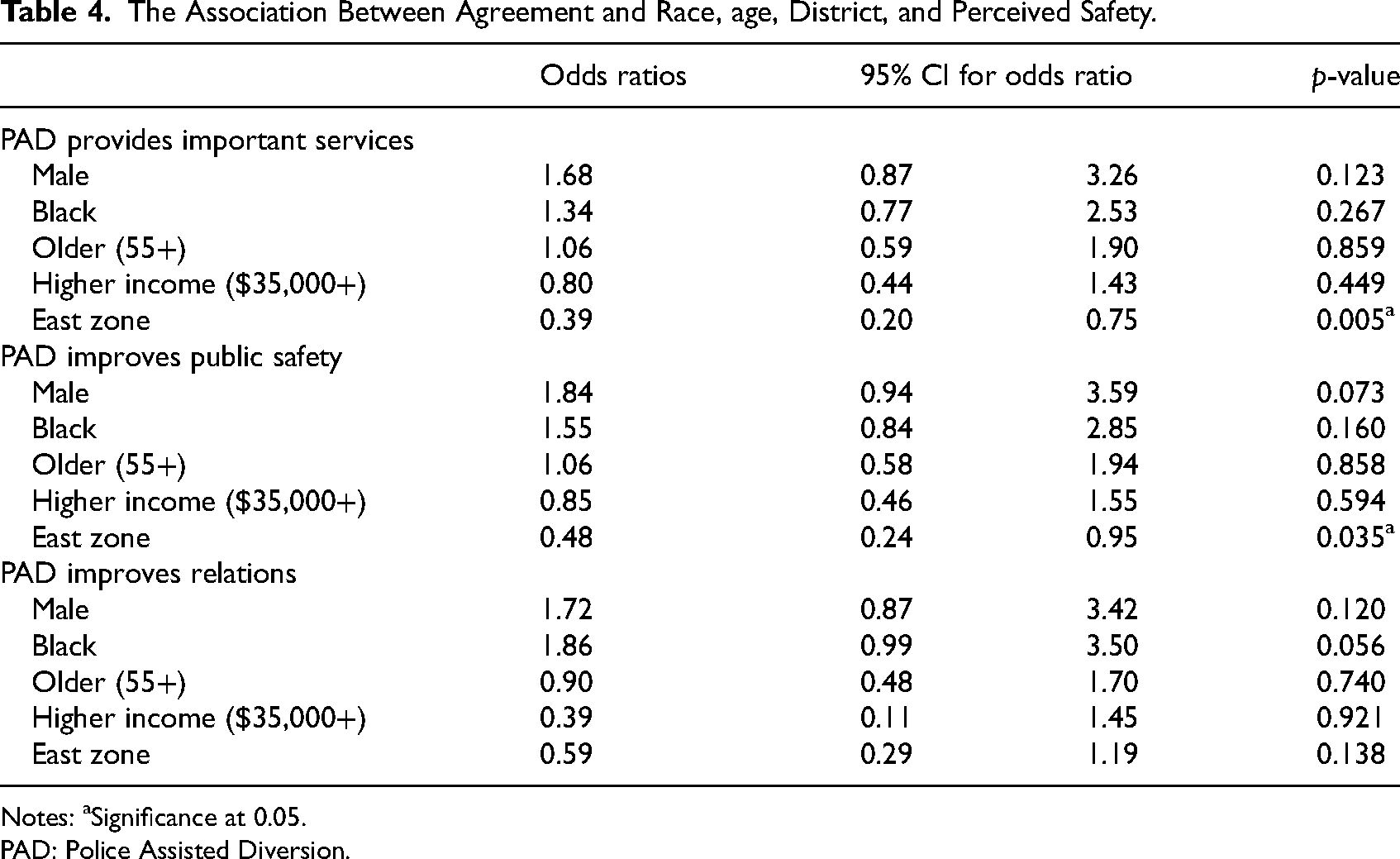
Notes: aSignificance at 0.05.
PAD: Police Assisted Diversion.
Perspectives on arrest and on decriminalization of prostitution followed similar patterns between the zones (Table 3). Residents in the East zone were significantly more likely than those in the North zone to agree that people should be arrested for: possessing drugs like heroin and cocaine (77.4% vs. 62.2%; p-value: 0.007), retail theft (78.8% vs. 66.3%; p-value: 0.021), theft from another person (82.7% vs. 70.4%; p-value: 0.016), and prostitution (56.8% v. 38.8%; p-value 0.004). Residents in the East zone were significantly less likely to support decriminalization of working as a prostitute (46.9% vs. 62.9%; p-value: 0.010) but expressed similarly low levels of support, compared with residents from the North, for decriminalizing possession of drugs like heroin and cocaine (24.7% vs. 26.9%; p-value: 0.688) and retail theft (18.6% vs. 20.3%; p-value: 0.723).
Discussion
This study is subject to some important limitations. Although the research team and ISR staff iteratively revised the instrument for readability, there is a chance that some questions were misconstrued, which would introduce misclassification bias. The surveys were administered during a sharp and highly publicized increase in violent crime in Philadelphia, which could potentially impact responses and limit generalizability to other periods. More importantly, despite ISR's best attempts to achieve representativeness, our sample appears to be disproportionately female. This may be because women are simply more likely to participate in surveys (Becker, 2022). It may also be due in part to the demographic composition of the communities we surveyed, in which there is a notable and racialized gender imbalance created by incarceration and early death, likely exacerbated by high rates of intergenerational poverty in the neighborhoods surveyed (Lubrano, 2019). Other social trends, including that men are more likely to work outside the house, and that women—and especially Black women—vote at higher rates than men (and especially Black men) likely influenced our results (CAWP, 2023; England et al., 2023; Harris, 2014).
Additionally, our sample appears to be older, wealthier, and more highly educated than the population from which it is drawn, and almost surely includes participants with disproportionately longer residency. The four police districts include populations who have been harshly marginalized for generations, resulting in concentrated disadvantage that is likely to undermine their trust in and engagement with institutions like Temple University, which hosts the academic center that recruited the sample. The survey may be best understood, in this sense, as reflecting the perspectives of a cross-section of residents living in very high-need areas who are relatively better situated within their neighborhoods in terms of social and economic resources.
This selection bias undermines any claim that our study represents the views of the communities living in these police districts writ large. Measuring the perspectives of more marginalized subgroups is important ethically—to recognize their voice—and scientifically—to benefit from their insights. Any speculation about the extent to which the perspectives of such groups align or diverge from our observed sample should be done cautiously because a complicated and sometimes counterintuitive set of factors influence perspectives on drug policy (Forman, 2017; Hammond et al., 2020).
The most conservative way to understand the value proposition of our study is as an assessment of the views among community members who are likely to have an outsized role in neighborhood decision making based on their demographic characteristics relative to the overall community (Einstein et al., 2019; Schaffner et al., 2020). In that sense, our findings suggest that the political prospects for pre-booking diversion are positive. Over two-thirds of respondents believed that PAD helps people who use drugs, that it will improve public safety, and that it will improve the relationship between the police and the community. After controlling for other demographic factors, Black respondents were significantly more likely to endorse the view that the program will improve relations between community members and the police department, which is notable given well-documented distrust between Black communities and law enforcement (Macdonald & Stokes, 2006; Schuck et al., 2008). The high level of support for PAD in the largely residential North pilot zone is also important because most pre-booking diversion programs in other cities to date have operated in commercial areas as strategies for managing public disorder.
There are also some troubling findings with concerning implications for the future. Community members disagreed with the harm reduction orientation of the program by often suggesting that criminal charges should be reimposed for clients who fail to utilize available services. Community members also expressed high levels of support for arrest and low levels of support for decriminalization. This fits a long history of vulnerable communities advocating for enforcement of prohibitionary laws in response to serious public disorder and insecurity despite bearing the burden that results from such heavy and exclusive reliance on policing and punishment (Forman, 2017). Such advocacy has often accompanied fervent but unanswered calls for investments in social services and community infrastructure. The local rooting of that dynamic is captured in a historical account that describes how: US senator Arlen Specter held … a “town meeting” in [1991 days after the largest federal drug bust in city history with] City Councilman Angel Ortiz and State Representative Ralph Acosta [and] Herman Wrice, the charismatic father of Philadelphia's Black- and Latinx-led anti-drug movement … at a corner known for its brisk drug business … Wrice called for “jobs and economic development” in the neighborhood, but he also “gave a bellowing ‘put-the-punks-in-jail’ speech” … Ortiz … lament[ed] that the federal government offered only “intimidation and incarceration.” Yet according to Specter, law enforcement money was “one of the few growth items” for broke cities like Philadelphia in “otherwise hostile federal budgets.” Acosta countered that the “jobless kids will come right back from jail and sell drugs.” (Smith, 2022)
The 24th and 25th police districts in the East pilot zone received federal funding that same year from the Department of Justice's Weed and Seed program, which aimed at “‘weeding out’ criminals who participate in violent crime and drug abuse” and “seeding” social services and community resources (Operation Weed and Seed, 2005). Soon, however, protesting community residents would be chanting that the program was “all weed but no seed” which fit the reversed, mistaken, and bipartisan logic that chaotic drug use was the cause of deprivation and not vice versa (Smith, 2022). It is possible that responses in the current study reflect a historically consistent desire for that missing seeding or what James Forman has termed a “domestic Marshall plan” (Forman, 2017). That is, communities may be asking for resources and policing, and see PAD as an avenue towards resources, rather than a replacement for traditional policing. In this scenario, respondents may have been less focused on or attuned to the operational specifics of PAD (despite being explained in the survey).
Police officers and key informants who were interviewed for an earlier qualitative exploration of PAD (Anderson et al., 2022) correctly anticipated that resident support for PAD would be much lower in the East pilot area. That pattern was sometimes explained in terms of the perception that client participants in the East pilot zone are more likely to be perceived as “outsiders” who came to the area only to purchase or use illicit substances whereas client participants in the North are more likely perceived as longstanding residents with intergenerational ties to the neighborhood. The survey findings reported in this paper provide no insights into that explanation. It is notable that pre-booking diversion has often been promoted as a strategy for mediating tension between policymakers and police leadership who want to reduce arrest and prosecution, and community members who perceive non-prosecution as neglect (Morrissey et al., 2019). That mediation only occurs, however, if life improves in ways that are directly observable to community members, which is at best a contested proposition in the East pilot zone where public drug use and minor crime remain a source of considerable and ongoing frustration for many residents (Roth et al., 2019).
Many residents seemed unwilling to embrace—or unable to imagine—intervention in minor criminalized activity and public disorder without the threat of criminal prosecution, and the police authority underlying it. However, resident respondents in this survey simultaneously expressed support for pre-booking diversion as a model for supporting community members with unmet needs and for improving community safety. This contrasts with the perspectives of police officers surveyed in the same areas (Shefner et al., 2023) who were more likely to endorse the view that PAD provides important services to people who use drugs (78% among police vs. 64% among residents) but were significantly less likely to agree that PAD improves public safety (27% among police vs. 69% among residents). Many surveyed officers also questioned whether PAD is “what police should be doing” (Shefner et al., 2023), which aligns with the view among officers in previous qualitative research that civilians should be leading outreach efforts to people with chaotic substance use and other overlapping vulnerabilities (Anderson et al., 2022).
Pre-booking diversion is just one out of a roster of recent initiatives launched by Philadelphia to address the harmful combination of substance use and structural disadvantage, which includes but is far from limited to: expanding hospital-based “warm handoffs” to increase access to supportive services; creating a 24/7 substance use treatment center for immediate stabilization; mobile treatment efforts; and improved treatment for current and former incarcerated individuals (Combatting the Opioid Epidemic: The City's Response, 2022). All are sensible but ultimately “proximal” or “downstream” attempts to unwind problems created and perpetuated by “distal” or “upstream” structural factors. This study provides evidence that a large segment of local residents either believe that the most effective responses to drug-related public disorder rely on policing and the potential for prosecution, or that they have simply lost hope in the possibility that their neighborhood will obtain more transformative investments to address the social causes of drug-related overdose and insecurity. Until the latter is disproven, the former will likely persist.
These are essential albeit dismaying finding with important implications for the sustainability and expansion of PAD. Pre-booking diversion programs in many other cities, including San Francisco and New Haven, have ended as failed pilots, due in no small part to lack of community support. Demonstrating and documenting success that communities can directly observe and feel is essential to sustaining and expanding PAD and other reform efforts. This is especially true given the volatile politics of criminal justice reform. PAD was introduced during a wave of decarceral reform energy in the city of Philadelphia, continued through the reckoning with police and racial violence in 2020, and has continued to expand in the years since—as rates of violent crime and fatal overdose have increased in the city and nationwide. Currently, the city is in the midst of a pendulum swing back towards more traditional approaches to policing. The recently-elected mayor of Philadelphia is clear in her intention to address open-air drug markets and public disorder through police action, including arrest. In the fall of 2023, the city council representative from some of the neighborhoods surveyed for this study led a successful effort to pre-emptively ban overdose prevention centers from her district, and effectively city-wide (Ovalle, 2023). Public support, including for PAD, both drives and is influenced by these changing social discourses around reform.
Conclusion
Around two-thirds of surveyed residents held positive views on a pre-booking diversion program operating in their Philadelphia neighborhood. However, agreement that the program could achieve three of its primary aims—support people with chaotic substance use, improve public safety, and promote better relations between community members and police—differed sharply between the two pilot areas, with more negative perspectives among residents living in the area with more drug-related public disorder. Residents often suggested that criminal charges should be reimposed for client participants who fail to remain engaged in supportive services, which conflicts with the harm reduction orientation of the program.
Supplemental Material
sj-docx-1-cdx-10.1177_00914509241246083 - Supplemental material for Resident Perspectives on a Pre-booking Diversion Program
Supplemental material, sj-docx-1-cdx-10.1177_00914509241246083 for Resident Perspectives on a Pre-booking Diversion Program by Evan McClelland, Ruth T. Shefner, Josephine Johnson and Evan D. Anderson in Contemporary Drug Problems
Footnotes
Acknowledgments
This research was supported by the Pennsylvania Commission on Crime and Delinquency [Grant 28710]. This work was also partially supported by the National Institute on Drug Abuse [RS, grant number R36-DA058062]. The funders had no role in study design, data collection and analysis, decision to publish, or preparation of the manuscript.
Declaration of Conflicting Interests
The authors declared no potential conflicts of interest with respect to the research, authorship, and/or publication of this article.
Funding
The authors disclosed receipt of the following financial support for the research, authorship, and/or publication of this article: This research was supported by the Pennsylvania Commission on Crime and Delinquency [Grant 28710]. This work was partially supported by the National Institute on Drug Abuse, National Institutes of Health [grant number R36-DA058962, RS].

Supplemental Material
Supplemental material for this article is available online.
Author Biographies
References
Supplementary Material
Please find the following supplemental material available below.
For Open Access articles published under a Creative Commons License, all supplemental material carries the same license as the article it is associated with.
For non-Open Access articles published, all supplemental material carries a non-exclusive license, and permission requests for re-use of supplemental material or any part of supplemental material shall be sent directly to the copyright owner as specified in the copyright notice associated with the article.
