



Abstract
Background
Drug policies and interventions require an ongoing understanding of the local demand for illegal drugs. How illegal drugs are distributed to consumers is critical in the demand process. To overcome barriers to purchasing illegal drugs, people utilize their peers to purchase substances for them. These brokered drug sales allow buyers to leverage their peer networks to make purchases. For brokers, this form of exchange allows them to obtain drugs for free. This drug acquisition strategy is underappreciated in understanding how local drug market's function.
Methods
This paper presents findings from a brief survey on brokering collected from a random sample (N = 241) of active illegal drug injectors recruited from two syringe services programs in Ohio, USA.
Results
Findings indicate that 30-day and lifetime brokering behavior is common (71% and 90% respectively). Respondents who brokered in the last 30 days (n = 181) purchased drugs for an average of 7 people and from an average of 4 different sellers. Among this group, over 84% indicated that they used drugs with the person they brokered for, 49% reported often or always inflating the price to the buyer, and 27% indicated they removed some drug before returning to the buyer.
Conclusion
Measuring brokering offers new insight on the dynamics of drug markets, how they operate, and ways to measure their activity. The demand for illegal drugs incorporates the increased use of a drug, changes in the use of different drugs, and/or a novel drug being used. Accessing drugs via brokering accommodates these dynamics. By including brokering in drug market activity, the concept and scope of illegal drug markets transform into networks and not places.
Introduction
With the three waves of the US opioid epidemic generating nearly a million overdose deaths since 1999, (Centers for Disease Control and Prevention (CDC), 2020) and a fourth wave of stimulant use on the rise (Ciccarone, 2021), it is important to consider how illegal drug markets operate to distribute drugs. This paper describes and quantifies illegal drug acquisition behaviors using survey data collected from clients of two syringe service programs (SSP) in Ohio, USA. The data focus on brokered drug sales. Brokering is when a person who uses drugs (PWUD) buys drug(s) for a peer. This article expands the relevance of this transaction by locating it within the context of how illegal drug markets operate, and thereby reimagining the boundaries of these markets. Brokering offers PWUDs connections to illegal drug markets and the ability to buy drugs. The paper describes the implications of this form of exchange, which makes drugs more expensive to buyers but is a saving to the broker. Recognizing brokering as a form of resource distribution and interfering with buyer / seller relations, this manuscript highlights ways brokering can confound econometric studies of supply, demand, and retail price, or modelling the elasticity of demand. However, independent of retail price, the frequency of brokering may hold promise as an alternative early indicator of when local demand for a drug is changing. Although the data presented come from samples of people who inject drugs (PWIDs), brokering is a form of exchange that is a byproduct of transacting illegal products and therefore relevant to all people who use illegal drugs. Brokered sales provide an important strategy to overcome market access and/or barrier issues for people unable or uninterested in engaging in direct sales with a dealer. While mediated exchange occurs in markets for legal goods and services, maybe the most common example being real-estate agents assisting home buyers, its unique and essential importance in illegal drug market operations is emphasized. Brokered drug sales allow PWUDs to leverage their peer networks to make purchases. For illegal drug markets, this specific enhancement in distribution makes them more flexible in meeting the purchasing needs of participants (Hoffer, 2016, 2019). Measuring brokering offers new insight on the dynamics of drug markets, how they operate, and ways to understand and measure their activity.
What is Brokering
Unlike a conventional drug sale whereby a seller and buyer trade directly, brokering is mediated exchange. This transaction begins like any purchase when someone seeks to buy an illegal drug. However, instead of transacting directly with a seller or dealer, the buyer gives their money to a peer (i.e., a broker) to make a purchase for them. It is important to recognize that the “seller” or “dealer” in this instance is the person with a supply of drugs to sell or distribute. In a brokered sale the broker, in effect, is a buyer in this transaction. They make a purchase from a seller/dealer on behalf of their peer. Two unspoken social obligations underwrite this transaction. The broker is buying drug with the understanding that they will deliver what they purchase back to the person who gave them the money—the buyer (Goldstein, 1981; Hoffer, 2016; Johnson et al., 1985). Although there are several ways that a broker can benefit from mediating a drug sale, explained below, it is understood that the buyer “pays” the broker for this service. As cash is converted into drugs in a drug sale, payment to a broker is often accomplished by the buyer giving them some of the drug purchased and/or using the drug with them (Goldstein, 1981; Koester, 1994). PWID commonly refer to this type of transaction as “copping drugs for others.”
In a brokered sale, neither the buyer nor the broker considers the act dealing. The broker does not purchase a drug supply to sell. Once a peer gives them money, they are buying drugs just as they ordinarily would for themselves and usually at the retail price for the drug. Of course, even though participants do not recognize this act as dealing, to law enforcement, brokering is drug distribution. The fact that a broker or buyer does not identify this act as a “dealing” or “selling” is immaterial. Recently, the legal consequences of brokering have been exploited in that if a buyer fatally overdoses from a drug provided by a broker, the broker can be charged with “drug-induced” or “overdose homicide” (Beety, 2018; Carroll et al., 2021; Williams, 2020, February).
Brokering offers people new to using illegal drugs an easy, low-effort way to purchase them. Many neophytes initially connect to the drug market in the same way they start using drugs, with the assistance of their peers. With very little effort, people can leverage their social relationships to make drug purchases (Parker, 2000). The broker is performing all the labor of a drug sale including finding, traveling to, making a sale with a dealer, and traveling back to the buyer with drug. The buyer is providing money to a broker and then waits for them to return with drug. The broker absorbs the risk of arrest for the buyer but as someone already buying drugs, this act does not increase the broker's risk, they are not doing anything extortionary when buying drugs for a peer.
The Literature on Brokering
For illegal substances not manufactured or grown for personal use, it is understood that illegal drug distribution involves transfers through various intermediaries (Adler, 1993; Wainwright, 2016). Historically recognized in the literature as a way drug users acquire drugs (Caulkins, 2007; Finlinson et al., 2005; Furst et al., 1999; Hughes & Jaffe, 1971; Preble & Casey, 1969), brokering involves transfers from consumers to sellers. For many people who use drugs, this is a highly adaptable practice deployed in many everyday circumstances. Some people broker to offset the cost of their own drug use and because anyone with a connection to a dealer/seller can broker, brokering occurs in lots of settings (Parker, 2000; South, 2004). A broker might occupy specific venues, places of business, or open-air drug markets to make sales for people coming into those areas. Brokers also make sales for people who do not wish to be visible, associated with, or connected to the “drug scene” or drug sellers (Parker, 2000).
In physically transferring drugs and money between buyers and sellers, brokers facilitate sales down the hall, around the block, across town, or from town to town. Here broking exponentially expands the boundary and reach of drug sales. Brokering can be both an intermittent, random, or part-time practice, as well as a full-time quasi-occupation, and the extent of this activity is adaptable and can accommodate an individual's drug use patterns or needs (Hoffer, 2016). Because brokering brings business to a dealer, this transaction can also overlap with or lead to a customer working for a dealer as a “runner,” i.e., someone paid to help the dealer make sales and locate other customers.
Brokered drug sales most often occur within preexisting social relations (Hoffer, 2016; Johnson et al., 1985). A person might broker for people they know and have previously used drugs with, such as their associates, romantic partners, friends, and loved ones. However, brokering can also occur between people who might otherwise be strangers, and through the act of brokering develop friendships and/or partnerships. Here brokering operates via the concept of “strengths of weak ties” (Granovetter, 1973), i.e., friends of friends, potentially offering market access to people otherwise not already socially connected. Because a broker acquires and uses drugs without paying for them, its economic relevance has been essential in defining brokering. As an individual drug acquisition strategy (Johnson et al., 1985), it has also been categorized as “hustling” behavior (Goldstein, 1981) implying a certain level of deception or fraud. As brokering often involves PWIDs using drugs together, it has been recognized to increase HIV/HCV risk behaviors through sharing syringes, cookers, cottons, or water, as well as through dividing drug shares using a common syringe (Bryan et al., 1990; Koester, 1994; Zule, 1992). Although sharing syringes and equipment has substantially reduced since the early 1990s, these risk behaviors support occasional disease outbreaks in PWUD populations (DesJarlais et al. 2022). Finally, brokering has been noted as a way PWUDs develop cooperation and trust (Hoffer, 2016; Moeller & Sandberg, 2015), but some avoid this exchange because of the personal conflicts or risk it might introduce into their social relations. People broker and use brokers for a socially complex set of reasons, including friendship, to build community, or out of sincere concern for helping a peer in need (Hoffer, 2016).
Brokering and Drug Dealing
Dimensions of being a customer and a dealer overlap when buying drugs for a peer and the role of a broker does not fit traditional customer and dealer distinctions (South, 2004). A broker is unequivocally not a drug dealer. Importantly, they do not purchase or possess a supply of drug with the intent to sell or distribute. Although they may assist a dealer as a “runner,” this relationship is not required. Most brokers purchase drugs in the same manner as any customer. Unlike drug dealing that involves sellers who have friendships with their customers, this excludes brokering from the concept of “social supply” (Dorn et al., 1991; Hough et al., 2003; Taylor & Potter, 2013; Coomber & Turnbull, 2007). Both social supply and “friendly dealing,” whereby dealers assist or help their customers acquire drugs, undermine assumptions about drug dealing by recognizing that people who “sell drugs” are not always or exclusively profit-oriented. (Coomber & Moyle, 2014, 2016; Coomber et al., 2016). The social, or relational, motives of social supply disrupt conventional and historic ways violence, exploitation, and abuse have framed understandings of illegal drug sales and markets (Moyle & Coomber, 2015). Nevertheless, social dealers or those involved in social supply still sell drugs; they purchase a drug supply and make sales to continue their operations.
As a customer, a broker is not excluded from aspects of “social supply,” meaning they can have close personal affiliations with the people they buy drugs from (i.e., dealers) or for (i.e., buyers) that can benefit the deals they make. However, this sociality is not required of their market role. One key advantage of brokered drug sales, for both the dealer, the broker, and drug market, is that such sales do not necessitate a dealer giving any special preference to a broker. A brokered drug sale does not mandate getting drugs for free or at a discounted price from a dealer because the customer employing the broker is financing the sale. Similarly, people broker sales for people they know socially, and can develop social connections via brokering, but these outcomes are not required or expected of brokering (Hoffer, 2016). As brokering is operationally separated from drug selling, a broker has freedom to respond independently to demand from buyers.
However, because a broker negotiates a drug sale for a peer it makes them a special kind of customer. Specifically, in a brokered sale it is the broker and not the dealer who sets the “price” for the drug being sold. The broker tells the customer how much the drug will cost. With such power, the broker acts like a dealer. But a broker only controls access to a sale and not a drug supply, hence this exchange should not be misinterpreted as dealing or social supply. In fact, unlike a social dealer who may give the customer a break on the price of a drug, in a brokered sale the buyer (i.e., customer) will always pay more. A broker is motivated by the rewards from brokering, specifically free drugs and/or the social capital associated with helping a peer (Goldstein, 1981; Koester, 1994; Moyle & Coomber, 2015). These rewards are generated in relations between customers (i.e., peers) and not in relations with dealers. As part-customer part-dealer, a broker influences elements of illegal drug market that are out of the direct control of drug dealing. Specifically, a buyer is paying the broker's price and not the dealer's.
As noted above, recognizing that brokering drug sales involves economic and social consequences is not new. Yet in understanding how illegal drug markets operate, brokering is understudied and overshadowed by more traditional direct dealer-customer transactions. In this context, a person making an individual drug purchase for a peer falls into a gap between drug dealing and relations between PWUDs. Research that characterizes illegal drug markets as complex adaptative systems has included brokering in market simulations by scaling up ethnographic research on this exchange using agent-based computational modeling techniques (Hoffer et al., 2009). Similarly, simulations have evaluated the actual cost of “retail drugs” when the hidden costs of brokering are considered (Hoffer & Alam, 2013). But one significant limitation in studying brokering has been the lack of survey data on this behavior. Quantified measures of brokering are required to illustrate the frequency and features of this exchange. We fill this gap in knowledge on the prevalence and characteristics of brokering activities among PWIDs in Ohio.
Methodology
We partnered with two SSPs to investigate brokering. A long-term objective of this partnership has been to establish the feasibility of using brokering to measure trends in local drug use, an aim important to the collaborating SSPs. Future efforts will compare brokering frequencies over time and incorporate these data into computational models to forecast demand. This larger effort is intended to build local capacity in our SSP partners to manage, plan, and provision their ongoing harm reduction services.
Sample
To investigate brokering, a one-time survey was administered to two N = 125 samples of PWID recruited from two different SSPs in Ohio. The first SSP recruitment site has continuously operated in a mid-sized city in Northeast Ohio since the mid-1990s (hereafter, the urban site). It operated both mobile and clinic-based exchange services five days-per-week. The second SSP site was located a small town in Southeastern Ohio (hereafter, the rural site). It operated one clinic-based site, one afternoon per week. Although operating in distinct geographic areas of the state, both SSPs were well-established programs.
Participant Recruitment
Both SSP sites employed the same sample recruitment protocol and recruited participants from February through May 2019. After completing their service-related activities, SSP staff informed clients of the opportunity to participate in a confidential and anonymous research study on drug use behaviors. If clients expressed interest, a research team member formally presented the study to the potential participant and verified that they had not previously been interviewed for the study. To meet study inclusion criteria, a potential participant had to be at least 18 years old and a client of the SSP with a valid SSP ID number. Frequency of drug use was not an inclusion criterion.
After establishing eligibility, verbal consent was administered using a standard script. All survey interviews were then conducted in a private room at the respective SSP site. The urban SSP research team included four student researchers, while the rural SSP site included six SSP staff members. All researchers participated in an in-person training on survey interviewing techniques, consent protocols, and other study processes and procedures. Data collection protocols were approved by the Case Western Reserve University Institutional Review Board (#20180384) and there were no protocol deviations.
Procedures to randomize the sample occurred differently at the two sites. Because the urban SSP operated five days per week, from 9am-3pm, the research team randomized recruitment using time clusters, specific days and times that participants were recruited into the study. On a pre-determined day, a team of two researchers recruited and interviewed participants in either a morning or afternoon session. Clients were invited to participate on a first come, first serve basis. The rural SSP only operated on Friday afternoons, from Noon-4pm. During this operation, all participants coming to the SSP were offered an opportunity to participate. Because of the short time-window and large volume of clients coming to the rural SSP, recruitment and interviewing were conducted by all six SSP staff.
The Survey
This study involved a brief one-time survey, with no identifying or personal information being collected. The Illegal Drug Use and Brokering Behavior Survey (BBS) was designed and implemented using RedCap, an electronic web and cloud-based survey platform. At both SSP sites, a unique RedCap database assisted SSP staff to track client services using a unique SSP ID number. Once a potential participant was recruited into the study, a random study ID number was assigned to each participant to ensure SSP client information and survey data were unlinkable. The BBS was then administered as a separate activity from any SSP service provisioning. There were no duplicated PWID in either sample. The interview took between 30–45 min to complete, and participants received $20 reimbursement for their time in the study.
While the BBS collected detailed information about brokering, it also included information on: 1) demographics, 2) drug use history (including poly-drug use and drug use combinations), 3) the places where people used drugs, 4) the people with whom they used drugs, 5) drug overdose history, and 6) engagement with health and drug treatment services. Recency (i.e., “last 30-day” time-window) and lifetime data on drug use behaviors were collected (See Appendix).
Some BBS survey questions were modeled on the US National Institutes on Drug Abuse (NIDA), Risk Behavior Assessment (RBA) (National Institute on Drug Abuse, 1993), and NIDA's Drug Procurement Practices of Out-of-Treatment Drug Users survey (Needle & Mills, 1994). However, these surveys did not include detailed questions on brokering. The authors leveraged data from two prior research studies to develop the BBS brokering measures. The first study was a methodological study (2008–2012, National Science Foundation - BCS0724320), merging ethnographic data (i.e., open-ended interviews and observations) on brokering and agent-based modeling techniques, and the second was a study involving open-ended qualitative interviews about drug acquisition and poly-drug use (2009–2016, National Institute on Drug Abuse - DA025163). In combination, the data from these studies provided considerable in-depth information on the social and economic dimensions of brokering and allowed the authors to develop generalizable survey questions.
In this previous data, PWID informally used “copping,” “hustling,” and “getting a taste” to describe buying drugs for other people. Analyzing participant narratives from these studies allowed crafting survey language that clearly discriminated brokering. For instance, participants talked about “getting in a bag” when, as a broker, they took some drug out of the amount purchased before returning it to the buyer. Open-ended interview data was only one source of information used to develop and validate survey questions. In both prior studies, participant-observations of brokering solidified: 1) how people buy drugs for other people, 2) the strategies they engage in buying drugs for others, 3) the outcomes of brokering, and 4) who people brokered for. This in-depth descriptive data offered an important level of internal validity for the survey questions developed.
After its initial development, the BBS was pilot tested at both research sites before being formally administered. During this testing, interviewers checked-in with the participant after questions on brokering to confirm intent and meaning. Pilot testing resulted in language modifications and refinements to answer sets, as well as additional questions of interest. For instance, questions were added about the time and distance traveled in a brokered sale, as well as how many people a person brokered for were “new” to them (i.e., someone they never brokered for previously). Although formal reliability and validity testing of the BBS is required, based on the process and testing procedures already completed there is a high level of confidence the BBS is measuring the relevant behaviors associated with brokering.
Results
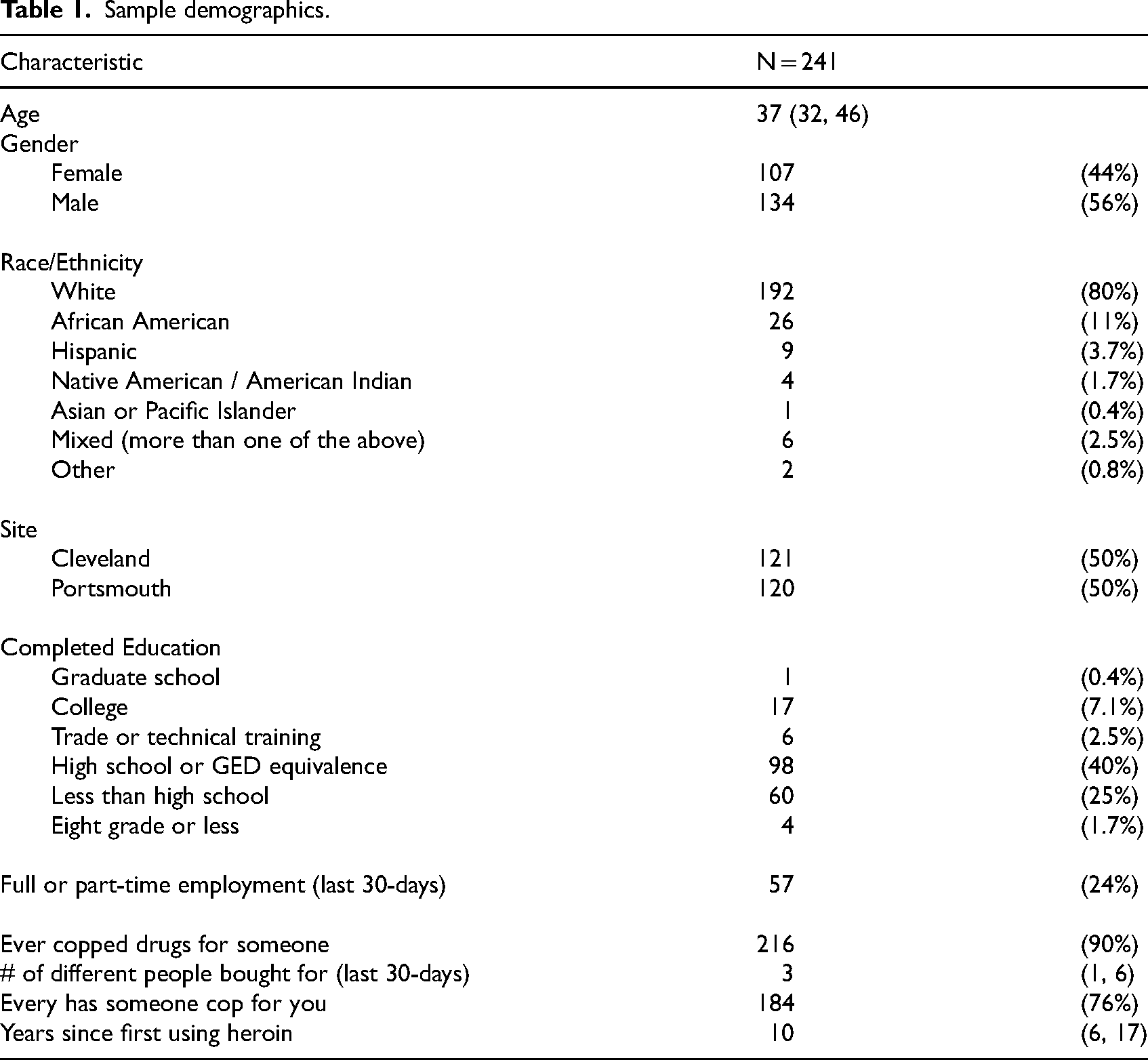
Data. We obtained a sample of 241 completed interviews. The summary of the sample is presented in Table 1.
Sample demographics.
General Brokering Behavior
Overall, brokering was a very common behavior. When asked if they had ever purchased drugs for someone else, nearly the entire sample 216 (89.6%) had acted as a broker. Moreover, 181 (75.1%) had brokered a drug sale in the last 30-days. When asked if anyone had ever purchased drugs for them, 184 (76.3%) reported using a broker, but only 92 (38.2%) reported someone brokered a sale for them in the last 30-days. Respondents reported purchasing drugs from an average of 3.8 (SD = 3.7) different sellers/dealers.
Extracting profits from brokering was also common. First, among those who had brokered in the last 30 days, 152 respondents (84%) used drugs with the person they purchased drugs for. Additionally, 77 (42.5%) reported “almost always” or “often” charging buyers more than what they bought the drug for, and 44 (24.3%) reported “almost always” or “often” taking drug out of the bag (i.e., pinching) before returning it to the buyer. Asking about who paid the broker, among those who had brokered a sale in the last 30-days, 90 respondents (50%) were only paid by the buyer, 9 (5%) were only paid by the dealer, 66 (36%) were paid by both the buyer and dealer, and 16 (8.8%) did not get paid from either the dealer or customer. Here payment from a dealer may imply the broker was working for a dealer (see below). Among brokers being paid by a dealer, 2 (1%) received cash only, 44 (24%) received drugs only, and 28 (15%) received cash and drugs (Figure 1).
How frequently a PWID brokered or had someone broker for them is important to consider. Among participants who brokered a sale in the last 30-days, motives to broker as indicated by seeking someone to broker for were weak with 111 (61%) saying they “never” sought to broker, and 59 (32%) reporting they “sometimes” or “rarely” do this. It is notable that 11 (6.1%) participants reported “almost always” or “often” looking for people to broker for. Seeking someone to buy for them (i.e., seeking a broker) was slightly more prevalent, with 61 (34%) saying they “never” sought a broker, but 109 (61%) reporting they “sometimes” or “rarely” do this. Additionally, 10 (5.6%) participants reported “almost always” or “often” looking for people to broker for them.
As brokering entangles social and economic behavior, participants were asked to characterize this behavior as either a “favor,” implying communal / social relations, a “service,” implying its economic significance, or “both.” We also explored if PWIDs characterize brokering concordantly when they are the broker v. a buyer using a broker. When they broker for others or when others broker for them, respectively 65 (36%) / 59 (39%) considered it a “personal favor,” 44 (25%) / 34 (23%) considered it a “service,” and 63 (35%) / 50 (33%) considered it “both.”
Heroin was the drug most commonly purchased for others in the last 30 days (62% of those who brokered) and had the highest concordance with the drug PWIDs used (43% of people who used heroin, also brokered it). The second most frequently brokered drug was methamphetamine (25%) followed by illegally manufactured fentanyl (19%). Most PWIDs in this sample were polydrug users and most brokered opioids only (78), followed by opioids and stimulants (48), and opioids, stimulants, and other drugs (29.
Drug Acquisition and Brokering Networks
Almost half the total sample (48%) reported never buying drugs from a dealer “working on the street” and 52% reported almost always buying from a dealer working in a “private location.” Nearly 90% of the sample reported acquiring drugs from a dealer and 71% mention that when they buy drugs, they buy them from the dealer “Often” or “Almost Always.” However, drug acquisition via brokering occurred though a variety of social relations. PWID who brokered in the last 30 days reported acquiring drugs from different network affiliates;71% reported buying from “a friend” and 61% reported buying from a “spouse, partner, or family member.” More than a third (38%) reported buying from “strangers,” i.e., people they did not know. Brokering networks also offered new distribution opportunities. Among PWID who brokered in the last 30-days, 98 (54.1%) for someone “new” to them, i.e., someone for whom they had not previously brokered. People brokered in the last 30 days for an average of 6 (SD = 10.5) different buyers.
Discussion
Concisely stated, “…brokerage occurs when one actor serves as a bridge between two other actors who themselves lack a direct connection to one another” (Spiro et al., 2013, p. 131). Despite brokering conflating drug dealing and being a “customer,” data indicates that the distribution of illegal drugs through brokered sales is popular. This implies that understanding about illegal drug markets, how they operate, and how to measure demand within them may require reconsideration. Recognizing the importance of brokering should not be a call to action in support of law enforcement efforts to target brokers. Brokers are everyday people who use illegal drugs and arresting them only serves to increase the misery already experienced in the US war on drugs. Examples of this injustice are already evident in the recent emphasis of US prosecutors charging PWUDs who buy drugs for their peers with “drug-induced homicide” in cases in which use results in a fatal overdose (An Overdose Death Is Not Murder, 2017).
Three quarters of the sample brokered a sale in the last 30-days, purchased drugs for an average of nearly six different buyers, and used an average of nearly four different dealers/ sellers. These data indicate drug distribution is a highly dispersed activity and that brokers performing this distribution are an important element of how drugs reach consumers. Like any market that employs intermediaries, brokering makes the illegal drug sales process more efficient through drastically diminishing the search costs of buyers through the “Baligh-Richartz Effect” (Baligh & Richartz, 1967). However, brokering may simultaneously increase frictions in sales by relocating the transaction within the social relations of PWUDs (Figure 2).
As brokering is a transactional form embedded within naturally existing social relations among PWUD, it is easy to deploy. Although we have understood brokering as an individual drug acquisition strategy, for a drug market brokering separates its distribution from sales. Brokers buy drugs for others but are also engaging in drug distribution by taking the drug from a dealer to a buyer. The aggregated outcome of brokering implies the selling and buying of drugs is dislocated. An illegal drug “market” thereby becomes more of a social network than a structured economic entity operating within a specific geography, place, or location. Much like its modern dark web counterpart, in-person brokering significantly dilutes the importance of place by decorrelating where a drug is sold and where and by whom a drug is used. Too often urban open-air “drug markets” are the target of aggressive local law enforcement tactics seeking to disrupt supply. Including the simple act of buying drugs for their peers, brokering expands the notion of what a drug market is and how it connects people to a menu of drugs they do not have direct access to in the places they live. Connecting localized brokered drug sales with the long-standing notion of “small world” networks (Watts & Strogatz, 1998), no one is ever more than a few degrees of separation from a broker and the variety of drugs they can facilitate the sale of.
Brokering greatly diminishes the importance of any single drug dealer in supplying a buyer with drugs. Relationships between drug buyers and sellers can be difficult for both parties to manage and maintain long-term. Dealers get arrested or otherwise go out of business without warning. But such consequences are less meaningful if buyers can simply access drugs though brokers who already exist in their networks. Here the self-sustaining incentives that brokering offers individual PWUDs acts to stabilize broader market operations when single dealers or their unique distribution networks are removed.
Brokering and Demand
As a form of illegal drug market transaction that is neither direct drug selling nor “friendly” dealing, the objective of this study has been to bring attention to brokering. Presenting the frequency of brokering behaviors, albeit among a specific sample of PWUDs, our aims are perhaps modest. Nevertheless, since the inception of research on illegal drug markets, “copping drugs for others” (i.e., brokering) has been recognized as a common drug acquisition strategy. This is the first study to address how common. It is clear that the popularity of this form of exchange requires attention, and we acknowledge that without more detailed empirical research precisely how meaningful brokering is remains unsettled. Nevertheless, brokering has profound implications on the relationship between price and demand.
A long-standing debate in research on illegal drug markets critical to drug policy pertains to the relationship between a drugs retail price and consumer demand, or the price elasticity of demand (Becker et al., 2006; Caulkins & Reuter, 1998; 2010; Cunningham & Finlay, 2016). If a retail drug price is more elastic to demand, then the supply-reduction interventions of law enforcement can theoretically raise the cost of selling drugs, raise retail prices, and diminish demand. If retail prices are more inelastic, supply-reduction interventions will not increase price or reduce demand and drug use is considered less sensitive to price. However, in meta-analyses of price elasticity studies, elasticity coefficients (i.e., how much a change in retail price effects a change in demand) are highly variable (Gallet, 2014; Payne et al., 2020). Some studies suggest price is elastic to demand (Petry & Bickel, 1998; Caulkins, 2001; Chalmers et al., 2010) while others suggest they are inelastic (Van Ours, 1995; DeSimone & Farrelly, 2003; Dave, 2006). There are also considerable variations in results observed by country, drug, short v. long-term analysis, and studies using different datasets (see Gallet, 2014; Payne et al., 2020).
Recognizing that a drugs retail price and the actual cost PWUDs pay to acquire drugs are different, brokering confounds retail price modeling. Although forms of jointly buying drugs have been noted to reduce drug costs in price elasticity studies (Caulkins, 2007), brokering has not been considered and is qualitatively different. Incorporating brokering means that independent of retail price, there are always PWUDs who pay more than the retail price balanced by others getting drug for free. As brokering occurs in all illegal drug markets, this means a drugs average “retail” price does not reflect its real-world cost. Here effects are not zero-sum as many PWUDs are getting the drug for free, and at no additional cost, when they broker. Additionally, establishing valid retail drug prices data is complicated by how data are collected, the purity of drugs sold, wholesale v. retail sales, price rebates for larger amounts, and non-uniform retail drug unit sales (Caulkins & Reuter, 2006; Coomber & Maher, 2006; Johnson & Golub, 2007). Brokering is less complicated to conceptualize and is unaffected by price or purity. Furthermore, supply-reduction intervention effects are drastically diminished by brokering, making them temporary at best. A broker's job is to distribute sales to sellers not affected by law enforcement (i.e., if a dealer is arrested, a broker simply takes a buyer's business to a different seller). This flexible solution for purchasing is, in fact, a brokers principal function. Combining these effects and recognizing brokers as “price-setters,” it is plausible variations in price elasticity of demand coefficients may be mediated by the amount of brokering occurring in a market, i.e., more brokering in a market = greater price inelasticity.
Brokering as a Measure of Demand
Below we conceptualize how brokering stabilizes retail prices, influences demand signal management, and reflects trends in illegal drug markets. Brokering influences how changes in local demand are signaled by consumers (i.e., from the bottom-up) and provide a contrast to econometric perspectives on demand processes. When more people start using a new or existing illegal drug, buyers seeking sellers increase the frequency of brokering. But brokering diminishes how demand signaling is communicated to dealers as brokers skim the difference (in cash or drug) between the retail price offered and what buyers actually pay. Profits from increased demand go to brokers first, likely reinforcing more brokering. Moreover, dealers do not experience “new customer” sales when demand increases as brokers are not new customers. Brokers further dilute demand signals by distributing potential pressures on supply across the entire range of suppliers in a market (i.e., multiple dealers). Depressing signals of demand, increased brokering artificially depresses retail prices, allowing them to remain static.
Brokering also disrupts market signaling when there are supply shortages as brokering exponentially increases the capacity of making sales of scarce products. Engaging the full network of available sellers within a market, as long as shortages are not uniform across all dealers, brokers are motivated to find dealers and fulfill orders. Under these conditions, brokering can expand the “boundaries” of what is considered the local market via social network processes. Brokers excel at finding dealers with dope and who can make immediate sales, especially when these services are at a premium. Here again, retail prices will remain stable because just as brokering depresses signals of increased demand it also undermines signals to dealers of scarcity. In other words, dealers can still make sales because brokers find the sellers with product. Finally, when demand is low and/or supplies are high, brokers still operate. Yet these market conditions are likely to engage less total brokering relative to the other two conditions, as there is less need for brokering services.
The higher drug prices buyers pay brokers are accumulated across the entire marketplace to buffer short-term price fluctuations. In this model, the added costs of brokering acts as a premium to stabilize retail price. This occurs because brokers, and not dealers, are the real-world “price setters” who correct short-term disequilibria. Such “corrections” are not intentional, but rather a function of brokers simply “charging” whatever they feel an individual buyer can pay. Buyers understand there is a premium in brokered sales but without a direct connection to a dealer, they have no choice but to pay it. Dealers are not as flexible in making spontaneous price adjustments to accommodate short-term changes in supply or demand because of the existential threat of losing buyers to the competition or profits in their sales. Based on these dynamics, brokering helps explain why real-world drug market prices remain stable over long periods of time, and why they are insensitive to short term changes in supply or demand. But can the frequency of brokering predict a trend in drug use?
Brokering is the illegal drug market's short-term solution to price uncertainty. However, if a shift in the market is large and prolonged, market signals to dealers should eventually overwhelm the capacity of brokering to unintentionally correct them, and retail prices should adjust. Nevertheless, based on the above, brokering is most essential, useful, and popular when increases in demand is coupled with periodic supply shortages. These two conditions express when a market is growing and/or expanding because as more people use a drug (increased demand) dealers will periodically have difficulty filling orders (shortages in supply). In other words, as a drug becomes more popular and/or expands into new markets a rapid and significant increase in brokering will forecast this trend.
But there is an important caveat in using brokering as a drug trend forecasting tool. Brokering is also valuable in relocating the commerce of drug sales. When open-air drug selling venues are “closed down,” diminished, or under pressure by law enforcement, there will be more brokering in the short-term as buyers scramble to connect or reconnect with dealers. Such environmental (market) conditions disrupting sales patterns may or may not reflect supply or demand changes but will increase brokering. Bridging buyers and sellers, brokering assists local drug market adaptations. As the Covid-19 pandemic diminished and disordered in-person contacts, restricted travel, closed drug treatment and harm reduction facilities, and/or other places PWUDs congregated, the pandemic may have increased brokering.
Despite the above, as a marketplace signal, monitoring the amount of brokering over time holds promise, and requires consideration. Until more empirical research can establish the specificity and sensitivity of brokering as a market measure, measuring brokering to forecast a drug trend may ultimately be analogous to monitoring barometric pressure to predict changes in the weather. As brokering serves illegal drug markets in different capacities, it may only be useful as a generic early warning of market change. Yet harmonized with other market signals (e.g., retail price, arrest data, overdose incidence, etc.) it is possible to envision measures of brokering supplying unique detail concerning demand processes insufficiently captured by retail price or traditional econometric models. Knowing the frequency of PWUDs buying drugs for their peers is an important behavior to consider in how illegal drug markets function and should not be overlooked because it is scientifically inconvenient, complicated to classify, or potentially incompatible with economic theory.
Conclusion
Brokering provides PWUDs a measure of reliability in acquiring drugs through both their roles as a broker and buyer. This reliability is required for a drug market to function, and adds to their resilience (Bouchard, 2007). Consequently, a baseline level of brokering likely exists in all local illegal drug markets. As brokering “solves” various problems PWUDs might have with dealers and provides a critical choice function in acquiring drugs, it also assists new users with access to the market. Brokering is an efficient process for making marketplace connections and, all other things being equal, increases in the frequency of brokered sales for a drug within a local market will be an early signal of increases in demand (i.e., sales) for that drug. The drugs people broker for others provides a window into what drugs people are seeking to use.
The importance, popularity, and efficiency of brokering calls for the inclusion and integration of this form of exchange into research on illegal drug markets. Because brokering blurs the traditional distinctions made between drug buying and distribution, it also calls into question the long-standing orientation of US drug policy that separates supply and demand-reduction interventions (Hoffer, 2019). Here supporting demand-reduction strategies, such as medication treatment and harm reduction, may in fact act in the same capacity as supply-reduction strategies aimed at diminishing drug access. More immediately, however, our objective is to offer our SSP partners data on brokering to assist them in anticipating the future harm reduction needs of their clients. The opioid epidemic has demonstrated the importance of timely and local data on drug demand. Although work to measure and model brokering is ongoing, by identifying the prevalence of drugs people are seeking to buy using this form of exchange has promise as a predictive indicator of future drug trends. Collecting this data directly from PWUDs may signal demand in drugs that have not yet or may never materialize in traditional indicator data or surveillance epidemiology. As such, our efforts are to emphasize the relevance of this common strategy of drug acquisition and incorporate it into efforts to assist the coordination and planning of services helpful to PWUDs in reducing the harms from whatever illegal drug trends the future may hold.
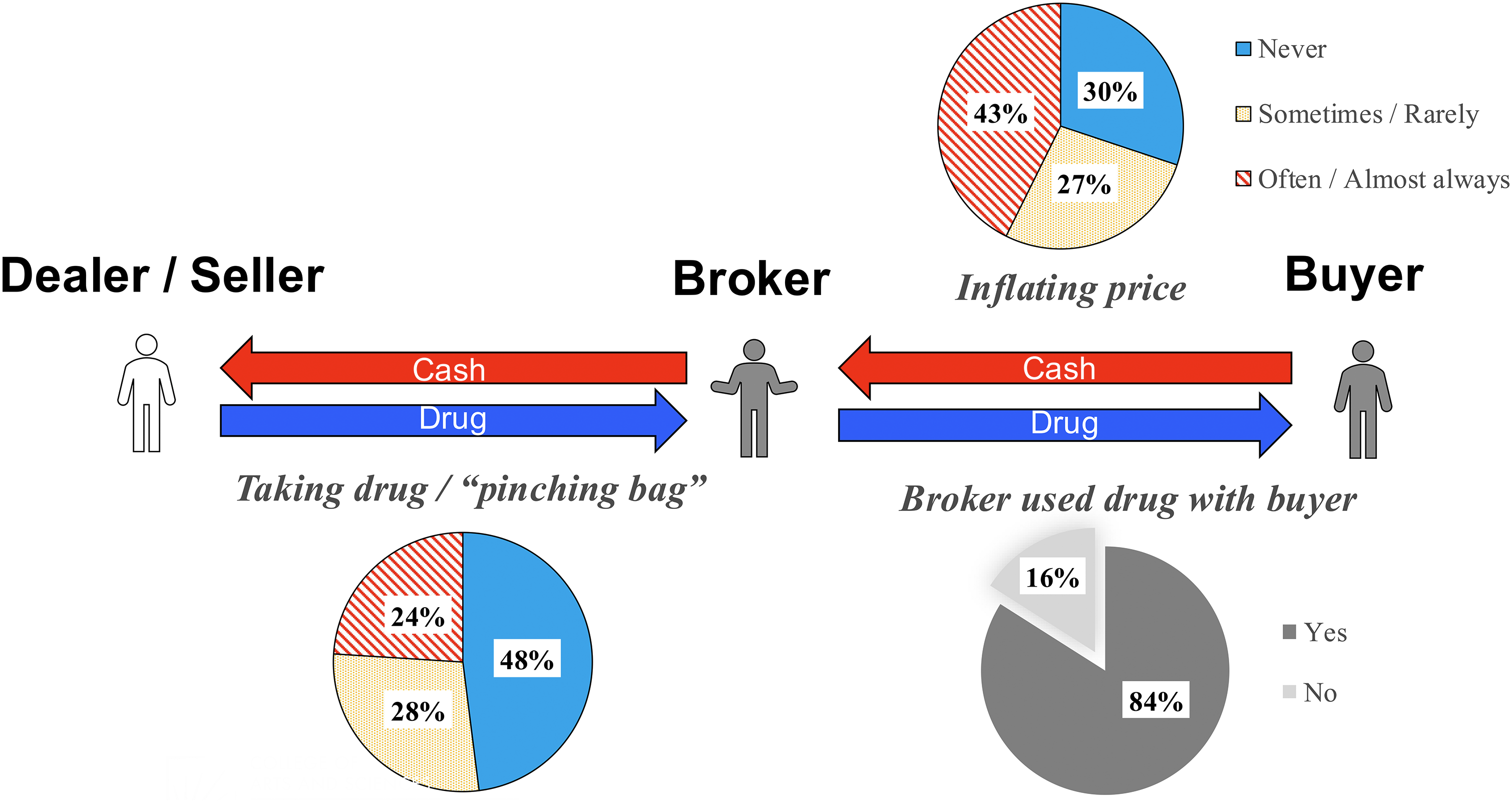
Frequencies of drug profit activities among people who brokered exchanges in the last 30-days (N=181).
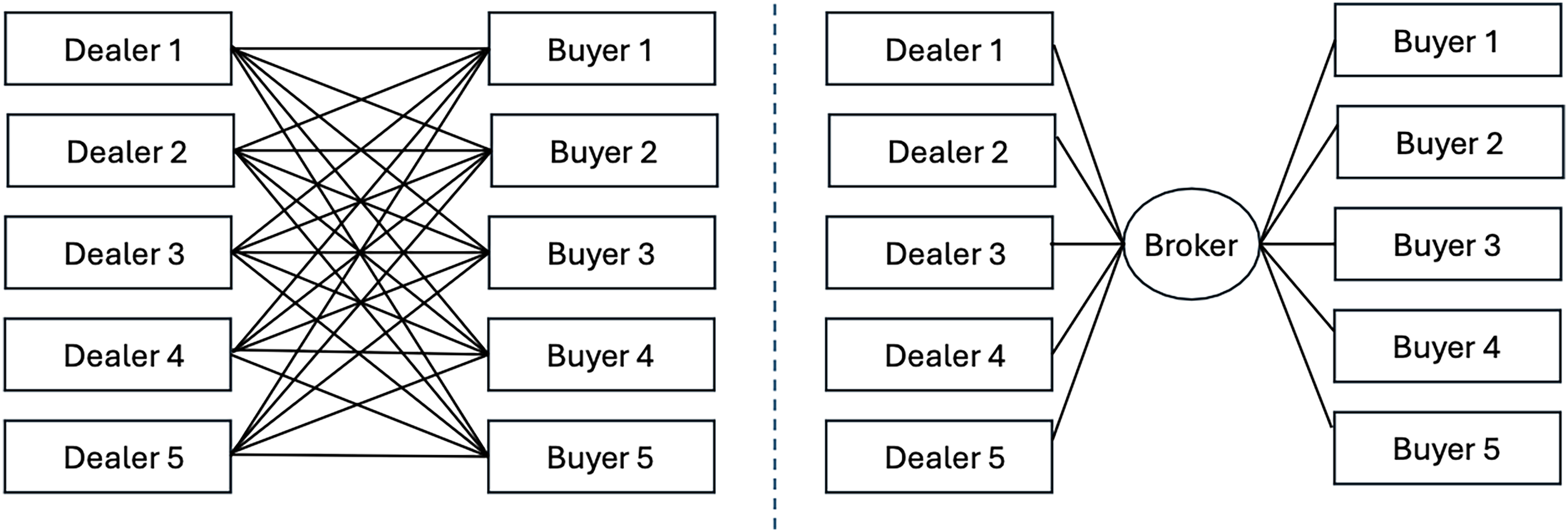
Search costs for buyers in illegal drug markets with and without brokering (e.g., 5 buyers searching 5 dealers). Without brokers (left) buyers make 25 total contacts. With brokering (right) buyers make 10 total contacts, or 40% fewer contacts. Figure adapted from “Baligh-Richartz Effect” (Baligh & Richartz, 1967).
Supplemental Material
sj-docx-1-cdx-10.1177_00914509241289085 - Supplemental material for The Frequency and Characteristics of Brokered Illegal Drug Sales: Reconceptualizing Illegal Drug Markets and Measuring Local Demand
Supplemental material, sj-docx-1-cdx-10.1177_00914509241289085 for The Frequency and Characteristics of Brokered Illegal Drug Sales: Reconceptualizing Illegal Drug Markets and Measuring Local Demand by Lee Hoffer, Allison V. Schlosser, Emily Hadley and Georgiy Bobashev in Contemporary Drug Problems
Footnotes
Acknowledgments
This research project was funded by a Vice President of Research Catalyst Award from Case Western Reserve University (STUDY20180384) and supported in part by a grant from the National Institute on Drug Abuse (R01DA047994). The authors would also like to thank our partner organizations, Circle Health Services, the Hispanic Urban Minority Alcoholism and Drug Abuse Outreach Program, Inc., and the Portsmouth City Health Department for assisting with this research project.
Declaration of Conflicting Interests
The authors declared no potential conflicts of interest with respect to the research, authorship, and/or publication of this article.
Funding
The authors disclosed receipt of the following financial support for the research, authorship, and/or publication of this article: This work was supported by the Case Western Reserve University, National Institute on Drug Abuse, (grant number STUDY20180384, R01DA047994).

Supplemental Material
Supplemental material for this article is available online.
Author Biographies
Dr.
Dr.
Dr.
References
Supplementary Material
Please find the following supplemental material available below.
For Open Access articles published under a Creative Commons License, all supplemental material carries the same license as the article it is associated with.
For non-Open Access articles published, all supplemental material carries a non-exclusive license, and permission requests for re-use of supplemental material or any part of supplemental material shall be sent directly to the copyright owner as specified in the copyright notice associated with the article.
