




Abstract
Due to the decrease in public funding, community colleges are in a position where they need to generate private gifts. Alumni represent the largest untapped pool of prospective donors, and the success of alumni giving at 4-year institutions illustrates the potential that exists for community colleges. To develop effective fundraising strategies, 2-year colleges must understand what affects alumni giving. Guided by social exchange theory, the study develops a predictive model of community college alumni giving, exploring student experiences and demographics. A multistate sample (N = 7,330) suggests predictors consistent with research conducted at 4-year institutions, with the likelihood of giving related to student experience, age, wealth, and giving to other organizations. Other findings unique to community colleges conclude that alumni with an associate’s degree are twice as likely to give as those who did not, and alumni who gave to their 4-year alma mater were nearly four times more likely to give to their 2-year alma mater. The study provides suggestions for future research on community college alumni donors, and new directions for 2-year college administrators and fundraising professionals.
Keywords
Higher education is facing increasing fiscal challenges as federal and state agencies cut college and university budgets. Institutions are searching for ways to bring in external resources to maintain programs and services. Private giving—donations by individuals, private foundations, corporations, and other nongovernment organizations—offers colleges and universities an alternative funding stream. According to the Council for Aid to Education’s annual Voluntary Support of Education survey (VSE), colleges and universities, public and private combined, received $30.3 billion in private giving in 2011 (Kaplan, 2012). The majority of this money came from individuals closest to the institution—alumni. Approximately $6.8 billion, or 27% of private gifts going to higher education in 2011, came from former students (Kaplan, 2012).
Four-year institutions generally capitalize on their connection to alumni to generate private gifts. Their fundraising sophistication includes researching their former students by collecting data on alumni experiences, motivations, and characteristics, and developing predictive models of giving (Lindahl & Winship, 1992). The results allow for more efficient and effective strategies to secure private gifts. By knowing what characteristics affect giving, institutions prioritize their time and efforts to those alumni most likely to give.
The fundraising environment at community colleges is very different. Two-year colleges have placed little significance on private giving, and alumni relations are often underdeveloped (Herbin, Dittman, Herbert, & Ebben, 2006). As a result, 2-year colleges are less successful in generating private dollars, evidenced by their alumni giving levels. The 2011 VSE reports alumni gave $9.5 million to their 2-year institutions, representing less than 1% of the $6.8 billion in total alumni giving (Kaplan, 2012). At the same time, alumni represent the largest untapped pool of prospective donors for community colleges.
The success of alumni giving at 4-year institutions illustrates the potential that exists in generating private gifts from former students. Kaplan (2012) reports that 4-year institutions asked approximately 15 million alumni for gifts in 2011, while 2-year institutions solicited less than 600,000 alumni. Considering the 13 million community college students in America in 2011 alone (“Fast Facts,” 2011), 2-year colleges have an ample pool of alumni to ask. In addition, 4-year institutions realized a 15% solicitation effectiveness rate (defined as alumni donors as a percentage of alumni solicited) in 2011, while 2-year institutions saw a 2% solicitation effectiveness rate that same year (Kaplan, 2012). Community colleges can generate more alumni gifts if they increase the number of alumni contacted and improve the effectiveness of their solicitations.
Alumni giving is possible at community colleges, as evidenced by the few institutions engaging in alumni efforts. Northampton Community College in Pennsylvania has the oldest, continually active 2-year college alumni program (Lyons, 2007), and in 2001, 499 of their alumni gave a total of $142,000 (Kaplan, 2012). People give because they are asked (Bryant, Jeon-Slaughter, Kang, & Tax, 2003), and community colleges need to do a better job of asking. However, to develop effective alumni fundraising strategies, 2-year colleges must first understand their alumni.
The purpose of this study is to develop a predictive model of community college alumni giving. Literature on alumni donor profiles exists only in the 4-year university context (Clotfelter, 2001; Hunter, Jones, & Boger, 1999; Monks, 2003; Okunade, 1993; Sun, Hoffman, & Grady, 2007; Weerts & Ronca, 2009), and it is not clear how the research relates to community college alumni. Two-year college fundraising and alumni professionals have no direction in targeting their efforts to generate private gifts. The findings of this study provide practitioners with a better understanding of which individuals have the greatest likelihood of giving. Through greater insights into community college alumni donors, fundraising and alumni professionals can target their efforts for greater efficiency with limited resources and potentially generate private gifts.
Literature Review
Research on alumni donors comes from the 4-year institution context, as few studies on community college alumni donors exist. The body of literature concludes that many variables increase the likelihood of alumni giving, with demographics and student experience the most common categories explored.
Demographics
Much of the existing research on alumni financial contributions focuses on individuals’ ability to give. Research shows wealthier alumni are more likely to give (Baade & Sundberg, 1996; Clotfelter, 2001; Holmes, 2009; Okunade, 1993). Household income levels in excess of $60,000 show the greatest likelihood of alumni giving (Hunter et al., 1999; Weerts & Ronca, 2009) as these wealthier alumni donors often support other charitable organizations (McDearmon & Shirley, 2009; Okunade, 1993; Weerts & Ronca, 2008). Other key demographic predictors of giving are age and how close alumni live to their alma mater. Older alumni are more likely to give (Clotfelter, 2001; Le Blanc & Rucks, 2009; McDearmon & Shirley, 2009; Monks, 2003), as are alumni living in close proximity to their alma mater (Holmes, 2009; McDearmon & Shirley, 2009).
At the same time, additional research shows that specific donor attributes, such as gender and marital status, are not predictors of giving. There appears to be no correlation between giving and gender (Clotfelter, 2001; McDearmon & Shirley, 2009; Okunade, 1993), or marital status (Okunade, 1993). In addition, most alumni donors are employed (Weerts & Ronca, 2007), and Caucasian (Le Blanc & Rucks, 2009), resulting in little diversity in the demographics of alumni giving. It is difficult then to determine whether race and employment status are statistically related to the likelihood of giving. While gender, race, employment, and marital status are not predictors of giving, the experience alumni had as students is a key predictor of giving.
Student Experience
The student experience, defined by levels of satisfaction, involvement, and relationships with faculty and staff, is a strong predictor of future alumni giving (Hoyt, 2004; Sung & Yang, 2009) The more satisfied alumni are with their alma mater, the more likely they are to give (Clotfelter, 2001; Hunter et al., 1999; McDearmon & Shirley, 2009; Sun et al., 2007; Wastyn, 2009). Monks (2003) found alumni satisfaction with their undergraduate experience the most significant predictor in alumni giving.
Alumni who are able to connect with their institution through relationships or activities, achieve higher academic performance levels, persist, and graduate. Participation in extracurricular activities not only provides additional learning to supplement what is occurring in the classroom but also provides opportunities for students to build relationships with fellow students, staff, and faculty. Students have a myriad of options to get involved, both unstructured and structured, and increased involvement translates to a greater likelihood of giving (Monks, 2003; Weerts, 2010). Clotfelter (2001) found holding a leadership position within a group a key predictor of giving. Moreover, alumni that developed relationships with faculty and staff are more likely to give (Clotfelter, 2001; Monks, 2003; Sun et al., 2007). It is this triad of student experience—relationships, involvement, and levels of satisfaction—that informs the theoretical lens of this study.
Social Exchange Theory
Built on social interaction and relationships, social exchange theory suggests that connections influence giving (Scott & Seglow, 2007). Social exchange theory frames giving as a two-way process, built on social interaction and relationships (Scott & Seglow, 2007). As a social species, the premise of this theory is that people desire to do good through social endeavors (Piliavin & Charng, 1990). People strengthen relationships with organizations in which they feel the exchange is fair and the institution is acting with integrity (Cardona, Lawrence, & Bentler, 2004). Researchers use this theory to acknowledge the relationship between alumnus and alma mater as a reason for giving (Hunter et al., 1999; Weerts & Ronca, 2008). For alumni, the motivation for the altruistic deed of giving comes from positive feelings toward their alma mater, their desire to be a part of something, and the need for the institution to achieve their altruistic desires (Lawler & Thye, 1999). When alumni see their alma mater in a positive light and hold it in high regard, they respond in giving of money (Piliavin & Charng, 1990). As the maintenance of the relationship is the basis for continued giving behavior (Emerson, 1976), institutions use a variety of strategies to keep alumni connected and engaged. Institutions operationalize social exchange theory through cultivation and community-building efforts focused on connecting with alumni to build relationships, as evidenced by events and publications, and through solicitation strategies. As a result, alumni motivation for giving comes from positive feelings toward their alma mater (Hunter et al., 1999; Weerts & Ronca, 2008). Using social exchange theory as the conceptual framework, the study proposes that former students who identify as alumni of their community college alma mater will make the decision to give based on their student experience, with stronger connections resulting in a greater likelihood of giving.
Method
To understand alumni giving at select 2-year colleges, this exploratory study uses a nonexperimental, cross sectional study of community college alumni donors. Quantitative methods and statistical analyses provide the most appropriate method of identifying factors that are the best predictors of giving (Creswell, 2009). Data for the study came from alumni of 18 public community colleges located in California, Iowa, Massachusetts, Michigan, Pennsylvania, and Washington.
Data Collection and Recruitment
To select colleges to participate in the study, a call went out to members of the Council for Resource Development, a professional organization dedicated to fundraising in community colleges. Eligibility requirements for public 2-year colleges to participate included email contact information for alumni, the ability to distribute the online survey, and willingness to serve as the point of contact for alumni throughout the study. With no precedence in the literature for community college alumni donors or community college online alumni surveys, the exploratory study used convenience sampling to attract an adequate pool of participants necessary to run logistic regression (Tabachnick & Fidell, 2000).
The characteristics of colleges in the study are comparable with the national profile of public community colleges in the United States with respect to age, size, and location (see Table 1), contributing to the validity and confidence in the study and the findings. Most of the colleges in the study, 67%, opened their doors in the 1960s. Cohen and Brawer (2003) found that 69% of all public community colleges opened their doors in the 1960s. Of the colleges participating in the study, 17% are small (annualized FTE under 5,000), 55% are medium (annualized FTE 5,000-9,999), and 28% are large (annualized FTE over 10,000). The breakdown is similar to national figures, where Goan and Cunningham (2007) found that of all the public 2-year colleges in the United States, 20% are small colleges, 51% are medium-sized colleges, and 29% are large colleges. Last, most of the colleges in the study resided in urban settings (81%), with two sites located in rural settings, similar to national numbers showing rural colleges make up 8% of all public 2-year institutions (Goan & Cunningham, 2007). While institutional characteristics are comparable, alumni program characteristics are not.
Age, Size, and Location by College.

Alumni programming is a relatively new phenomenon for community colleges (Herbin et al., 2006), and a uniform definition of alumni does not exist. Most colleges in the study define an alumnus or alumna as anyone who took a class (55%). Other definitions for alumni were completion of 15 credits (6%), completion of 30 credits (28%), and graduation (11%). Absent a unified definition, the study uses social exchange theory as a guide to defining an alumnus or alumna: any former student the 2-year college has an identified relationship with, regardless of the number of credits completed.
Survey administration occurred online during the fall of 2010 to all alumni with an email address on file with their respective community college. The decision to use an online instrument to collect data resulted from a need to collect data quickly, from alumni located across the United States, in a manner that resulted in the instantaneous collation of large amounts of data into a single dataset in a cost-effective manner (Dillman, 2007). The population consists of 123,351 2-year college alumni, with 7,330 alumni responding to produce an overall response rate of 6% for this exploratory study. While seemingly low (N = 7,330), the response rate exceeds the standard 2% to 5% rates generally experienced by alumni offices for alumni surveys (Worth, 2002).
Instrumentation
To develop the predictive model of giving for community college alumni, a survey was developed to explore the characteristics of donors and nondonors. The survey assessed predictors of giving to include experiential characteristics related to student satisfaction and involvement, demographics, educational attainment, and giving behaviors. The survey asked alumni whether they had made a gift to their community college alma mater in the past 5 years. The response to this question became the dependent variable “community college donor.” The dependent variable is dichotomous, with alumni donors coded as 1.
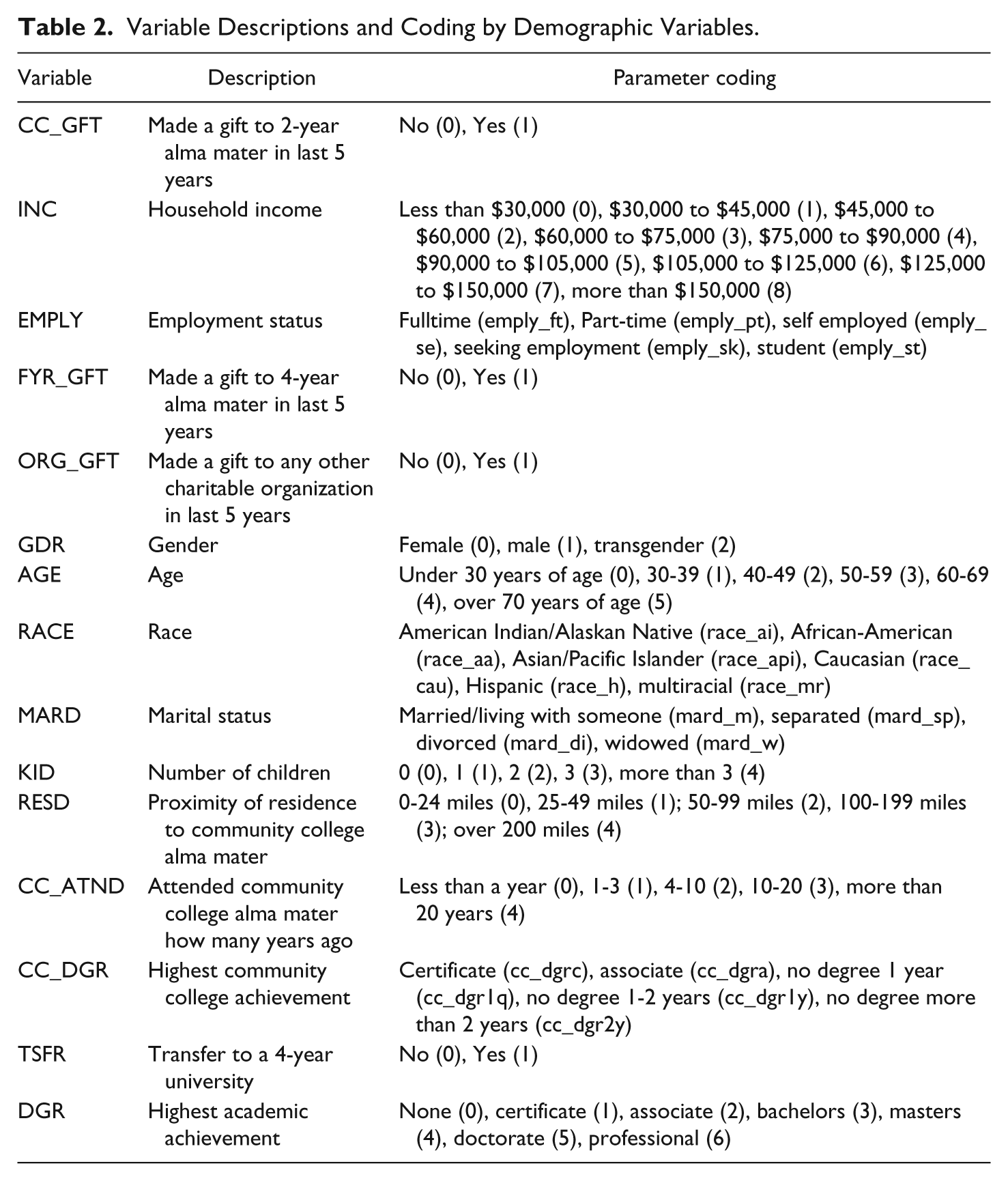
Based on the literature, demographic variables for the study related to wealth include household income, employment status, and giving to other organizations, including their 4-year alma mater. Variables related to personal characteristics explored in the study include how close alumni live to their alma mater, age, gender, race, marital status, and number of children. Variables in the study related to education include how long ago the alumnus or alumna attended the community college, the highest level of community college attainment, whether the alumnus or alumna transferred to a 4-year institution, and the highest level of postsecondary attainment (see Table 2).
Variable Descriptions and Coding by Demographic Variables.
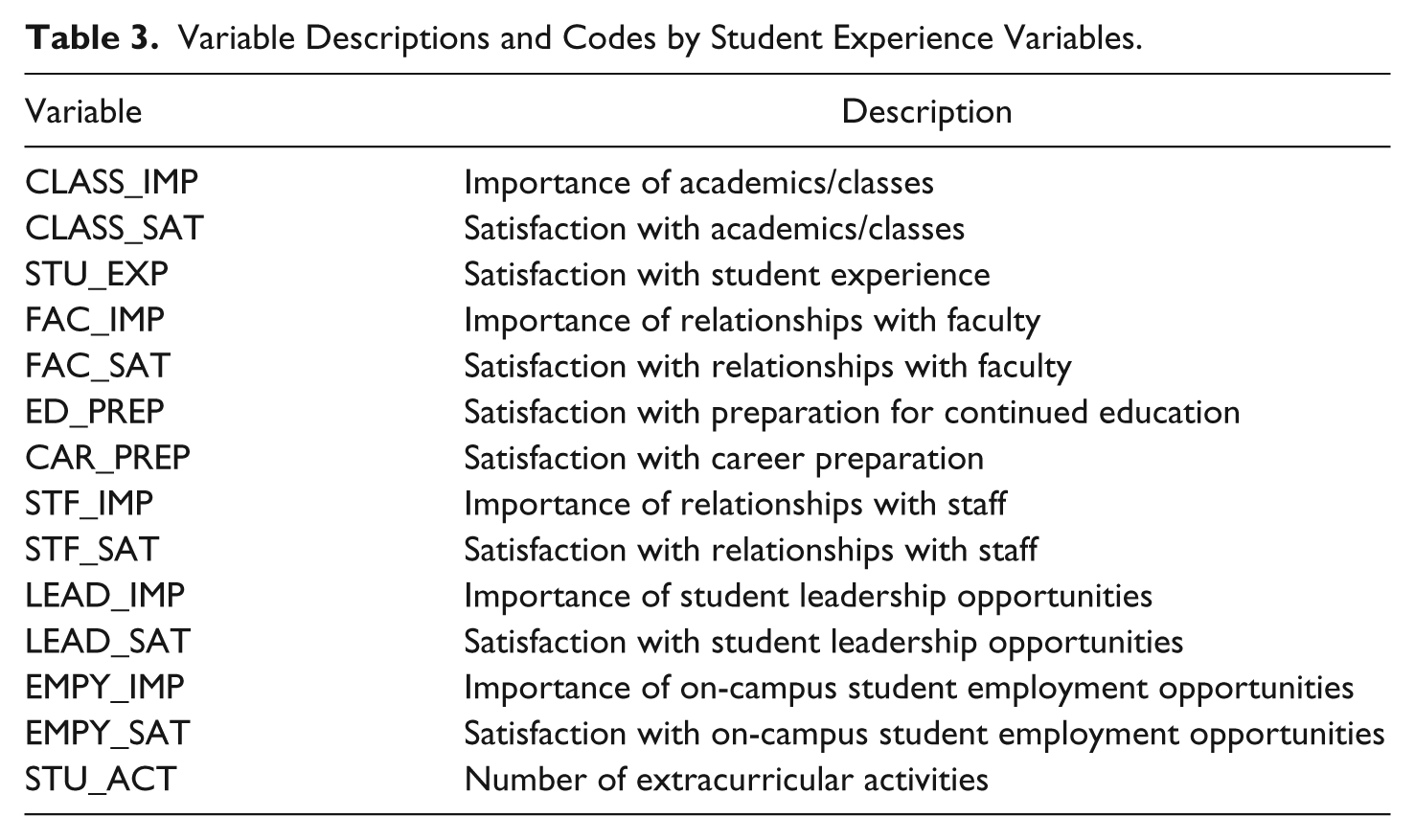
Student experience variables for the study include satisfaction with classes, the student experience, relationships with faculty and staff, student leadership opportunities, student employment opportunities, preparation for continued education, and preparation for careers. Other variables under student experience in the study address the level of importance the alumnus or alumna place on classes, relationships with faculty and staff, student leadership opportunities, and student employment opportunities. The final student experience variable in the study is alumnus or alumna participation in extracurricular activities, described by the number of activities (see Table 3).
Variable Descriptions and Codes by Student Experience Variables.
Reliability and Validity
Reliability and validity of the survey come from best practices in design, outside experts to review the instrument, and a pilot test of the survey. Consistent surveying techniques (instructions, distribution, communications), a large sample size (N = 7,330), clear questions, and appropriate timing for the study aided the instrument’s reliability (Dillman, 2007; Salkind, 2004). To achieve construct validity, survey questions contain exhaustive and mutually exclusive response values (Babbie, 2007), and two alumni professionals from a Research I institution in the state of Washington reviewed the instrument and offered feedback. Last, a pilot test (n = 23) of the instrument prior to its launch supported the instrument’s reliability and validity.
Sample
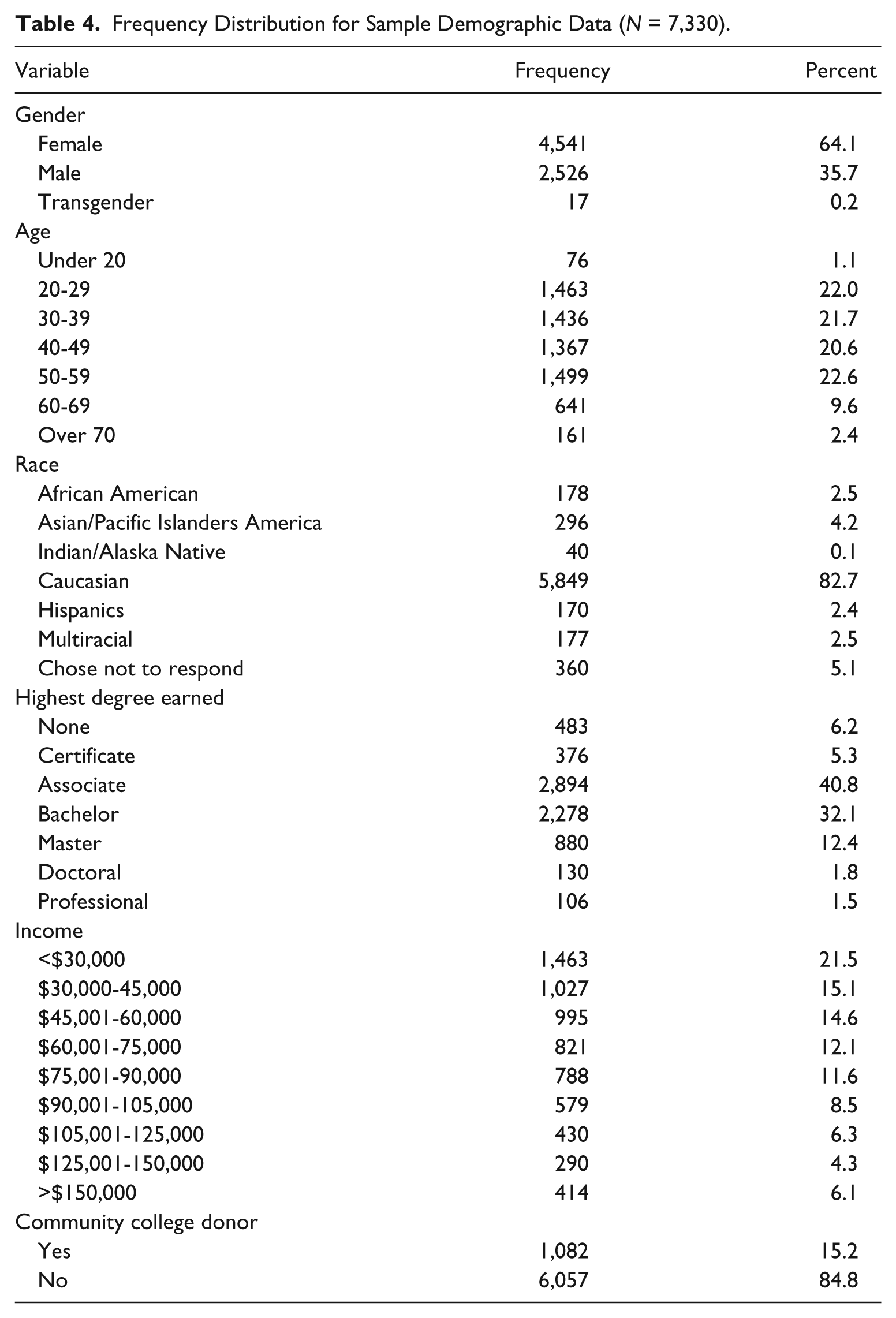
Demographics of the sample show that most community college alumni respondents are female and Caucasian. Age brackets for alumni are evenly dispersed up until age 60, and income levels are split between those earning less than $60,000 and alumni earning more than $60,000. Most community college alumni hold a degree, and nearly 50% hold a baccalaureate degree of higher education. Overall, 15% gave to their community college alma mater in the past 5 years, compared with 85% who did not (see Table 4).
Frequency Distribution for Sample Demographic Data (N = 7,330).
Analysis
Logistic regression serves as the quantitative tool to find the best possible model for a specific dataset. Factor analysis runs were completed prior to logistic regression to address challenges of multicollinearity by collapsing the 14 student experience ordinal variables into a smaller number of uncorrelated factors.
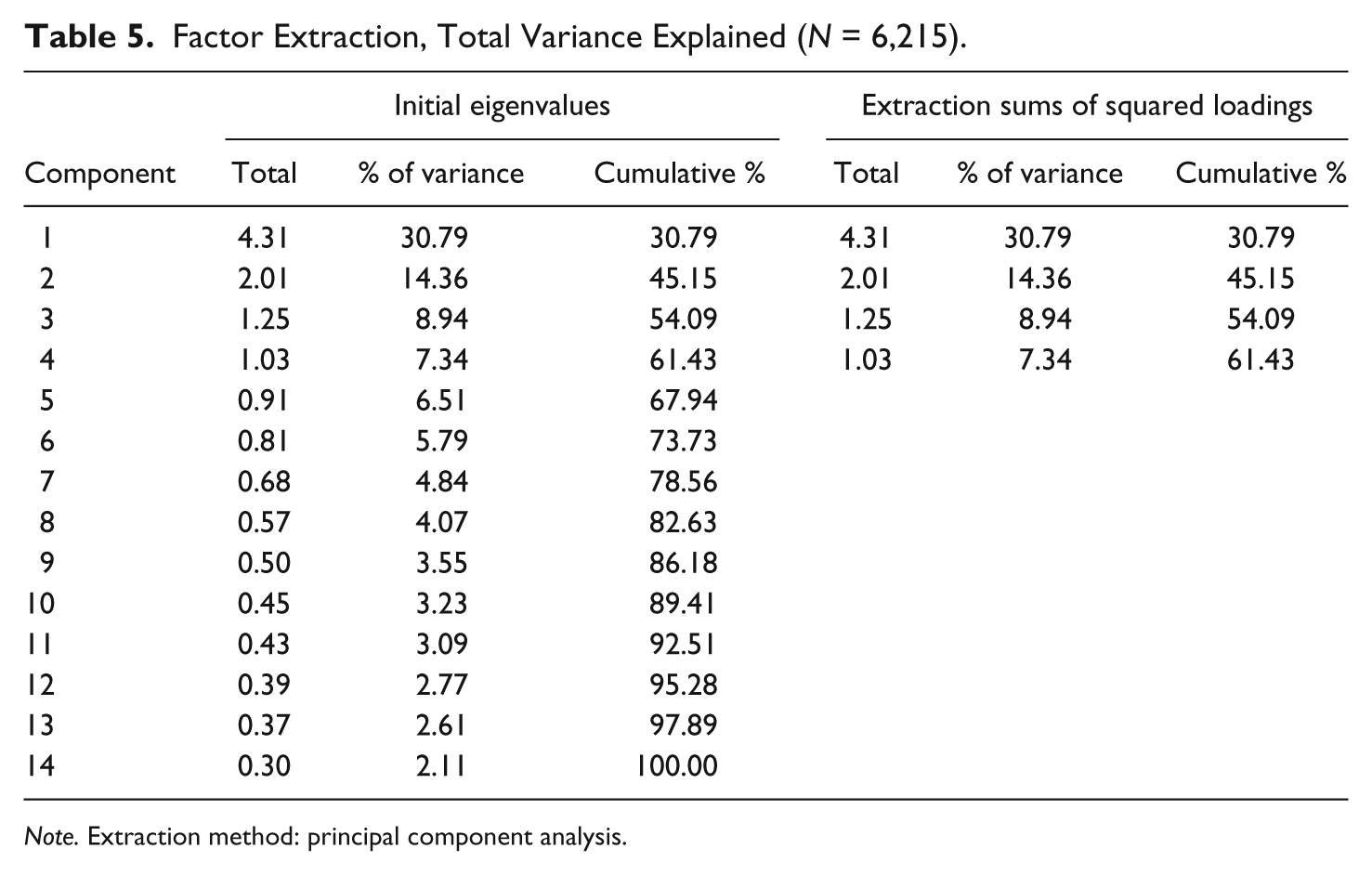
Using principal components factor extraction with a goal of parsimony, the factor analysis explained 50% of the variation and suggested the extraction of three factors (see Table 5). The Kaiser–Meyer–Olkin (KMO) measure of sampling adequacy was .81, indicating unrelated and reliable factors (Field, 2005), while Bartlett’s test was significant, χ2 (91) = 13,500.55, p = .000 (see Table 6).
Factor Extraction, Total Variance Explained (N = 6,215).
Note. Extraction method: principal component analysis.
KMO and Bartlett’s Test (N = 6,215).
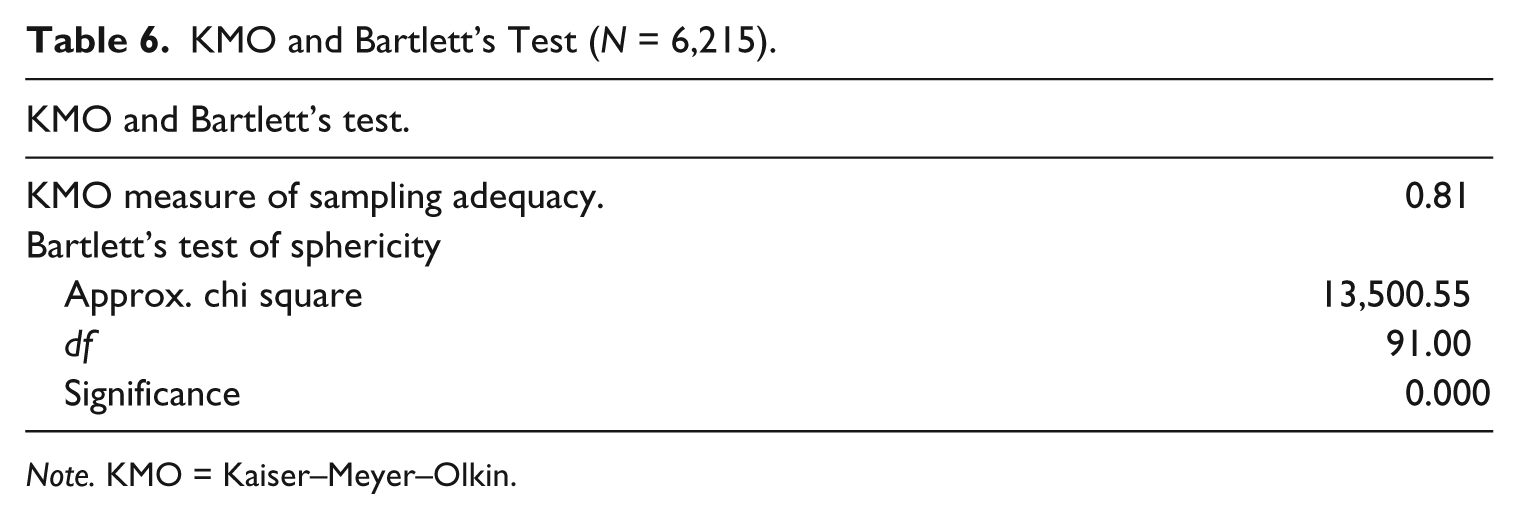
Note. KMO = Kaiser–Meyer–Olkin.
Using a varimax rotation for the final solution produces uncorrelated factors that are easy to interpret and better for subsequent statistical analyses (Fabrigar, Wegener, MacCallum, & Strahan, 1999). The final solution produced three student experience factors: (a) satisfaction with the student experience, (b) value of student involvement, (c) and importance of relationships with faculty and staff. The satisfaction with the student experience factor consists of the level of satisfaction alumni feel toward their academic experience at the community college and relationships with faculty and staff. The value of student involvement factor contains the importance and satisfaction with the student employment and leadership opportunities, and the level of participation in student activities. Last, the importance of relationships factor includes the importance of on-campus relationships with faculty and staff, and employment and leadership opportunities. All three factors have primary loadings over .50 and reliability coefficients above .70 (see Table 7).
Rotated Loads by Student Experience Items and Student Experience Factors a (N = 7,139).
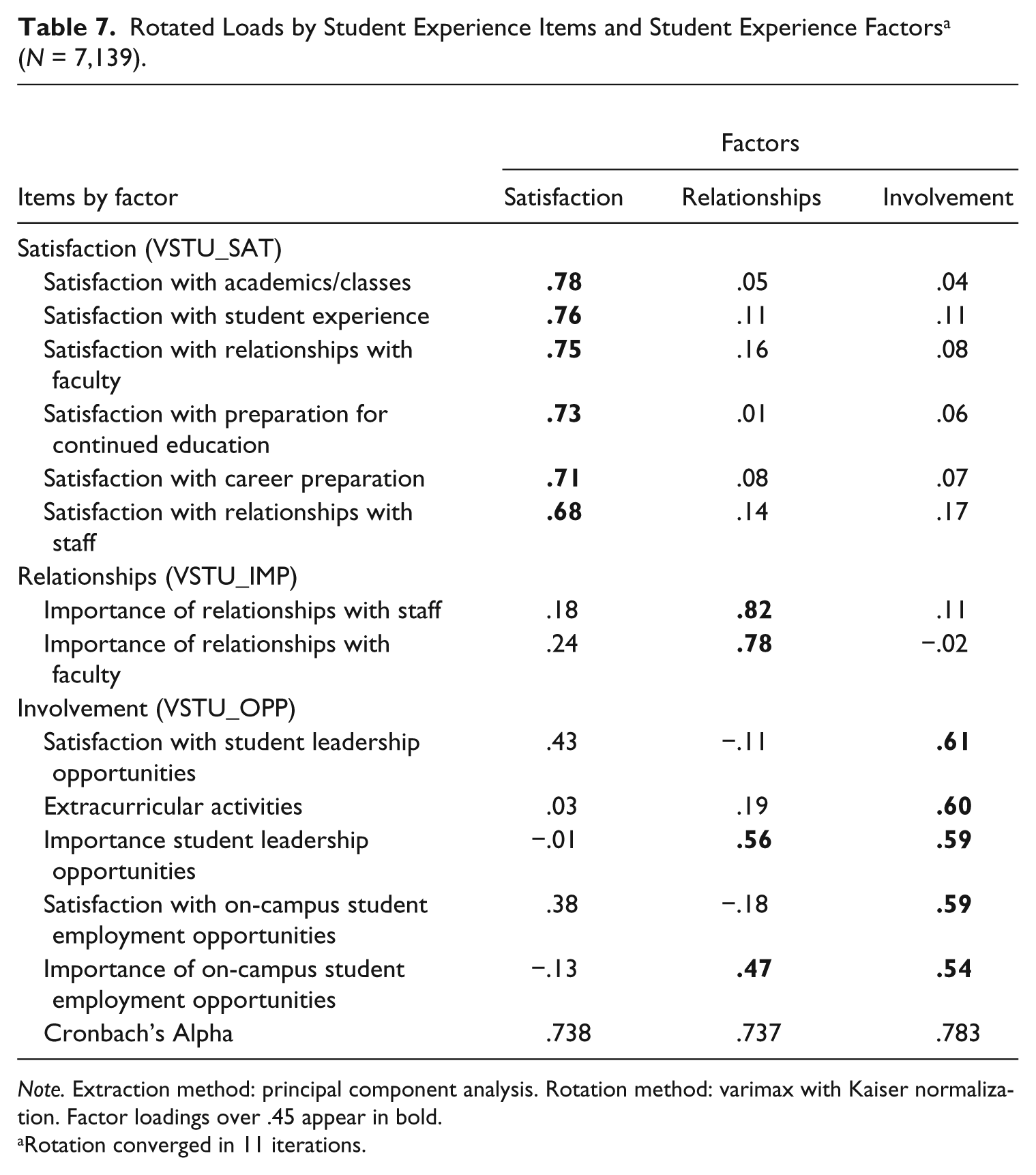
Note. Extraction method: principal component analysis. Rotation method: varimax with Kaiser normalization. Factor loadings over .45 appear in bold.
Rotation converged in 11 iterations.
After reducing the number of variables, the analysis used logistic regression to predict the likelihood of giving (Theijssen, 2010) and reads:

where (p) is the desired outcome of giving, β is the coefficient of the constant in the null model, and X1, X2 … X¡ are the predictor variables associated with student experiences or demographics.
The model building for this study used forward stepwise regression to eliminate unnecessary variables, using a stopping rule based on a score statistic p < .050. In addition, prior to testing the model, further tightening came from including only predictors with a significance threshold of p < .015 for the final model (Tabachnick & Fidell, 2000). With no hypotheses regarding the importance or order of the predictors of community college alumni giving, direct enter logistic regression was appropriate for testing this model and satisfies an assumption of model fit (Tabachnick & Fidell, 2000).
Direct enter regression on the dataset (N = 6,013) and a significance threshold at p < .001 resulted in a model with 11 predictors of community college alumni giving (see Table 8). Model comparisons, such as Nagelkerke’s R2, Hosmer–Lemeshow statistic, and the −2 log likelihood test, evaluated the model. Results show goodness of fit, with the Hosmer–Lemeshow test not statistically significant, χ2(8, 6,013) = 11.53, p = .174. Nagelkerke’s R2 suggests a moderate relationship of 41% between the predictors and the outcome of giving, and suggests that the set of predictors discriminate between donors and nondonors. The −2 log likelihood test indicates statistical significance.
Variables in the Equation, Student Experiences and Demographics (N = 6,013).
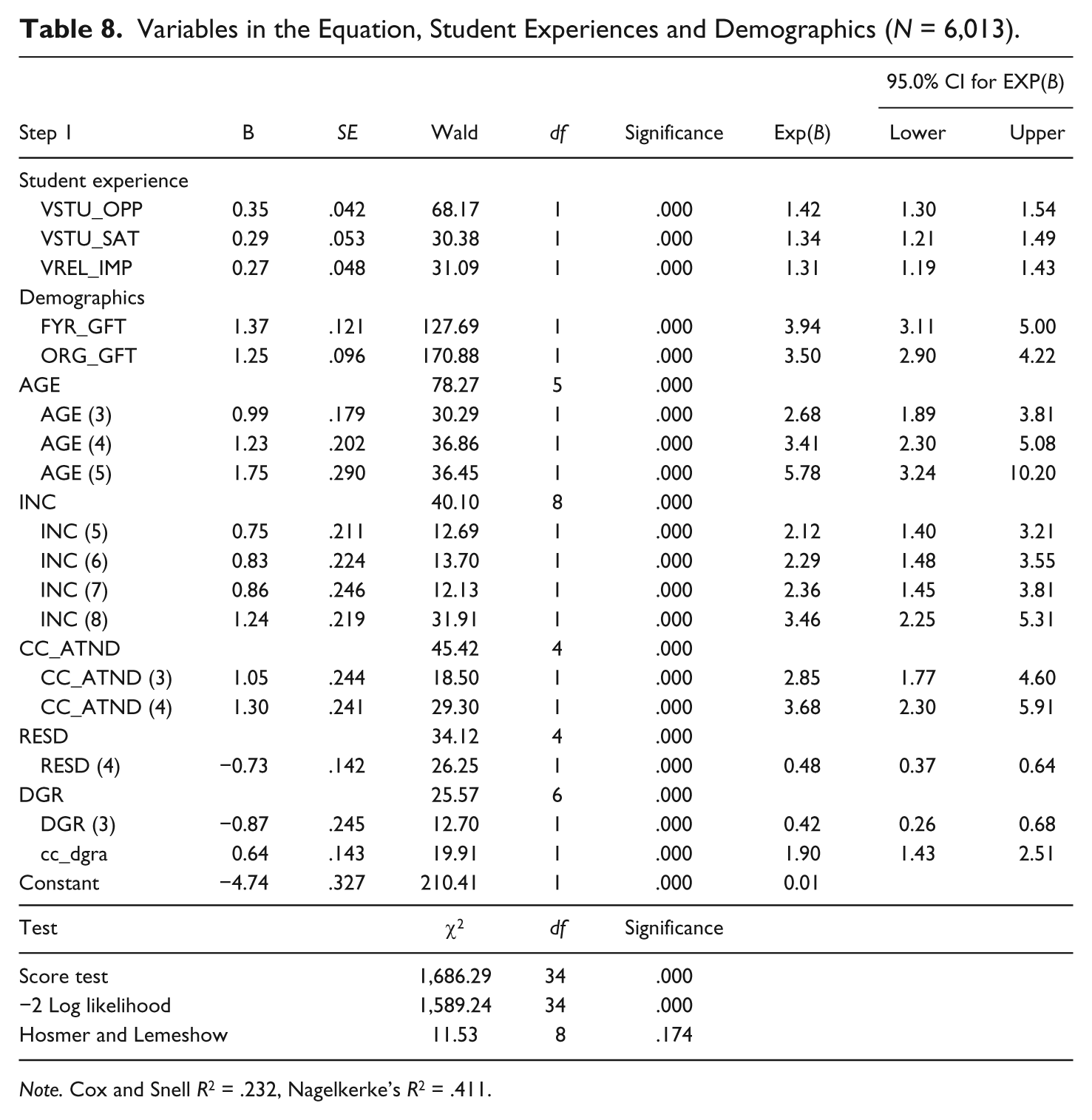
Note. Cox and Snell R2 = .232, Nagelkerke’s R2 = .411.
When tested, the predictor model showed improvement. The constant-only models predicted giving status 85.4% of the time, compared with the predictor model’s success rate of 88.0% (see Table 9). While the improvement in correct classifications appears small, 85% of alumni in the study are nondonors, leaving little margin for correct classification improvement over what would have occurred merely by chance.
Classification Table a (N = 6,013).

Note. Sensitivity = 36.2, specificity = 96.9, false positive = 33.5, false negative = 10.1.
The cut value is .500.
Results
Predictors of Giving
All three factors associated with student experience were statistically significant: (a) satisfaction with student experience, (b) value of student involvement, and (c) the importance of relationships. Eight predictors of alumni giving associated with demographics were statistically significant: (a) gifts to other organizations, (b) gifts to a 4-year institution, (c) income, (d) how close alumni live to their alma mater, (e) how long it has been since alumni attended the community college, (f) age, (g) associate’s degree as the highest level of achievement at the 2-year level, and (h) the highest degree held (see Table 10).
Predictors, by Code, Chi Square, and p Value.

As a result, the logistic regression solution for the Community College Alumni Giving Model is,
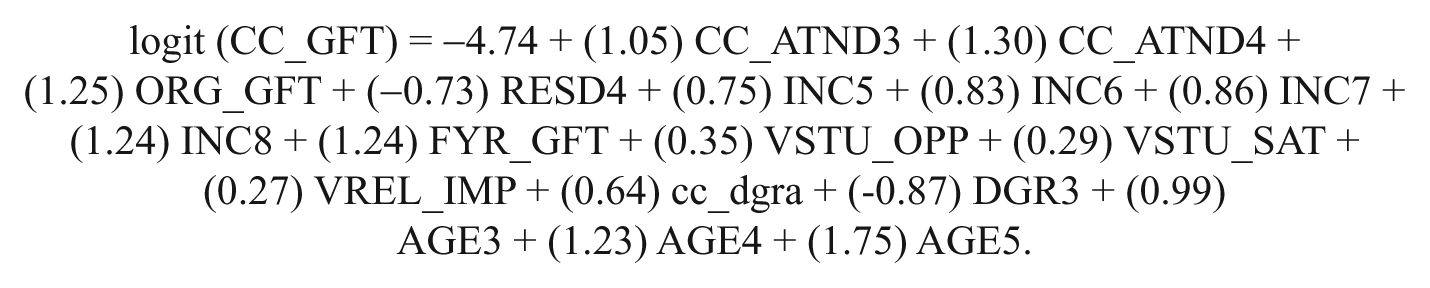
Results suggest that alumni’s positive feelings toward their community college are predictors of the probability of giving to their 2-year alma mater, with student involvement the strongest predictor of giving for the three student experience factors. A 1-unit increase in the value of student involvement at the 2-year college level increases the odds of giving to that institution by 1.4 times. A similar result occurs with the other two student experience factors, with a 1-unit increase in satisfaction with the community college student experience increasing the odds of giving by 1.3 times to that institution and a 1-unit increase in the importance of relationships at their 2-year institution increasing the odds of giving 1.3 times to that institution. Findings suggest that positive feelings toward the community college alma mater are predictors associated with the probability of alumni giving.
With regard to demographics, results demonstrate that wealth predictors strongly associate with the probability of alumni giving to their community college. Giving by alumni to their 4-year alma mater increases the likelihood of giving to their 2-year alma mater by 3.9 times, while giving to any other educational or charitable organization increases the odds of giving to their community college by 3.5 times. In addition, higher levels of income translate to a higher likelihood of giving. The odds of community college alumni giving to their 2-year alma mater increase by 2.1 times for incomes of $95,001 to $105,000; 2.3 times for incomes of $105,001 to $125,000; 2.4 times for incomes of $125,001 to $150,000; and 3.5 times for incomes greater than $150,000.
Age also is a key predictor of giving. Compared with community college alumni under the age of 30, those who are 50 to 59 years are 2.7 times more likely to give to their 2-year alma mater, while those who are 60 to 69 years are 3.4 times more likely to give to their 2-year alma mater. For alumni over the age of 70, their odds of giving to their community college alma mater, compared with alumni under the age of 30, are nearly 5.8 times greater. In addition, alumni who left their 2-year college 10 to 20 years ago had odds of 2.9 that they will give back to that institution, while alumni who left their community college alma mater more than 20 years ago had odds of 3.7 that they will give back to their 2-year alma mater.
Educational attainment also predicts the likelihood of giving. Compared with alumni without a degree, community college alumni who hold a bachelor’s degree as their highest level of education attainment are 2.4 times more likely not to give to their community college. Yet, community college alumni obtaining an associate’s degree, either as the highest degree or one of many, are 1.9 times more likely to give to their 2-year college alma mater. Last, alumni living more than 200 miles away from their community college alma mater are 2.1 times less likely to give to that institution.
Conclusion
In general, the findings on community college alumni donor predictors of giving are consistent with the literature from the 4-year institution context, with student experience, age, income, and giving to other organizations emerging as key predictors of community college alumni giving. It is possible that the characteristics related to the likelihood of giving are independent from the type of institution attended, be it a community college or university. Although additional research is necessary, the findings support a proposition of a philanthropic tendency among community college alumni donors, as giving to other organizations, including their 4-year alma mater, increased the likelihood of giving by up to four times.
In addition, the study suggests that degree attainment at the 2-year level influences the likelihood of giving. Receiving an associate’s degree has a positive impact on giving, although it is unclear as to why. Using the lens of social exchange theory, it is possible that students participating in graduation ceremonies find that the pomp and circumstance of the event create memories that bind them to the institution through a unique connection. It is also possible that the receipt of the diploma serves as a tangible reminder of their student experience, thereby influencing the decision to give. Regardless of the reasons, community college alumni who graduate with an associate’s degree are more likely to give than community college alumni who did not receive a 2-year degree, even if they transferred. Additional research into how degree attainment influences giving would assist community colleges in identifying ways to benefit from completion as part of an overall fundraising strategy.
Along with identifying key predictors of community college alumni giving, the study presents several limitations that offer suggestions for future research. The population for the study included 18 colleges from 6 states but did not account for differences in institutional support for alumni programs. Considering research suggesting that most community colleges do not employ alumni staff and dedicate less than $25,000 to alumni operations (Herbin et al., 2006), it is unclear how institutional factors influence a community college alumnus’ or alumna’s decision to give. An exploration into what institutional constructs correlate with giving would assist community colleges in developing programs and offerings to increase the likelihood of giving.
Another limitation of the study is its narrow focus. Research within the 4-year context suggests that the alumni experience after leaving their alma mater also enhances the likelihood of giving, with more engaged alumni more likely to give to their alma mater (Wastyn, 2009; Weerts & Ronca, 2009). In addition, membership in an alumni association increases the probability of giving (Hunter et al., 1999). Absent research on the alumni experience in the 2-year college context, it remains unclear how elements of community college alumni engagement do or do not influence the likelihood of giving to their 2-year alma mater.
Implications for Practice
Addressing a gap in the literature, the study explores the phenomenon of community college alumni giving and offers implications for practice. Trying to raise money from the entire alumni population is an inefficient use of time and is likely not feasible under current funding levels associated with community college alumni programs. The predictive model narrows the scope of potential donors and allows institutions to prioritize their time and efforts on those alumni most likely to give. Fundraising and alumni professionals may consider focusing efforts on more targeted groups—older, wealthier donors to other organizations—resulting in more effective fundraising and increased alumni gifts.
The study also suggests that institutions can prepare the way for future donors by creating positive educational experiences for students that culminate in graduation. Earning an associate’s degree improves the probability that alumni will give back to their community college. The more positive the alumni perceive their community college student experience, involvement, and relationships with faculty and staff, the greater the chances that they will become donors to their 2-year alma maters. As a result, the community college as a whole—administrators, faculty, and staff—has the opportunity to contribute today to improving the student experience, while generating for tomorrow future alumni gifts. Through reconnecting and giving, community college alumni leave their legacy by providing critical resources to their 2-year alma mater that maintain the mission of access to higher education.
Footnotes
Declaration of Conflicting Interests
The author declared no potential conflicts of interest with respect to the research, authorship, and/or publication of this article.
Funding
The author received no financial support for the research, authorship, and/or publication of this article.