




Abstract
This longitudinal, qualitative study explores developmental English students’ experience of remediation in the context of a first-semester learning community (LC). Conducted at an urban community college in the Northeast, data were collected through semi-structured interviews conducted over a 3-year period with a cohort of 15 students who were placed into a first-semester LC that linked the lowest level of developmental English with Introduction to Psychology and a student development course. Findings shed light on students’ changing perceptions of their placement in remedial English, their insights into LC participation, and reveal implications for community college research and practice. Developmental students’ experiences, voices, and perspectives are the focus of this study and are analyzed in the context of the highly contentious debate over college remediation.
A lot of people are gonna be mad at me for this, but I feel like everyone should start with remedial English . . .
Rochelle, Mahira, and Carlos were all a few years out of high school when failing scores on university-mandated reading and writing assessment exams landed them in remedial English at a local community college. 1 Rochelle sailed through her developmental courses, graduated in 2 years with a 3.3 GPA (grade point average), and transferred directly to a 4-year college. Mahira spent three semesters in developmental English and struggled to pass the university’s writing assessment exam. Though she has not graduated from community college, her journey through remedial English has been a productive one: Mahira completed college composition I with an A− and was able to find work as an English teacher on returning for an extended visit to her native Turkmenistan. Carlos spent five semesters in developmental English courses, repeating the first two levels, before passing the reading and writing assessment exams. Though he failed his first attempt at college-level composition, Carlos successfully completed the required developmental English sequence and accumulated 23 credits toward a degree before leaving the college in his second year.
Though their trajectories in and through college remediation 2 varied, Rochelle, Mahira, and Carlos all began their college careers in a first-semester learning community (LC) that linked the lowest level of developmental English with Introduction to Psychology and a student success course. 3 They are 3 of 15 students who participated in a qualitative, longitudinal study of developmental English students’ experience of remediation in the context of a first-semester LC conducted at an urban community college in the Northeast. This study focuses on developmental students’ experiences, voices, and perspectives. Findings shed light on students’ changing perceptions of their placement in remedial English, their insights into LC participation, and the potential of LCs to enhance students’ experience of remediation.
Background
Remediation and College Outcomes
A plethora of recent studies and policy initiatives question the efficacy of college remediation (Bailey, 2009; Calcagno & Long, 2008; Martorell &McFarlin,, 2011). Reports in the popular media and higher education press declare that “remediation is broken” and decry the placement of close to 60% of our nation’s community college students in non-credit bearing developmental tracks which they contend impede students’ progress to degree (Complete College America, Education Commission of the States, Jobs for the Future, 2012; Mangan, 2012, 2013). However, the research evidence supporting this claim and concomitant policy proposals is inconsistent at best (Goudas & Boylan, 2012).
The most frequently cited studies used to bolster arguments and educational policies against remediation examine its impact on students just above and below the cutoff scores for placement into developmental education 4 (Calcagno & Long, 2008; Martorell & McFarlin, 2011). These findings suggest that remediation has limited benefits and at times even a negative effect on student outcomes (Boatman & Long, 2010; Calcagno & Long, 2008; Martorell & McFarlin, 2011). Martorell and McFarlin (2011) found little or no impact of remediation on most educational outcomes, including years of college completed, academic credits attempted, and degree completion. Calcagno and Long (2008) concluded that while remediation might improve early persistence, it does not promote long-term progress toward earning a degree. Boatman and Long’s (2010) study of remedial education in Tennessee led them to the conclusion that of students on the margin of needing remediation, those who were assigned to remedial courses had lower college completion rates and fewer credits accumulated than similar students who went directly into college-level courses. Furthermore, Jaggars and Hodara (2011) found that students assigned to lower levels of developmental education are much less likely to successfully exit the developmental sequence and ever take an introductory college-level course. In sum, these studies find little evidence that students, especially those who score close to the remediation placement cutoff, benefit from developmental courses.
However, there is evidence that placement into developmental courses has a positive impact on college persistence and degree completion (Attewell, Lavin, Domina, & Levey, 2006; Bettinger & Long, 2005, 2009; Boatman & Long, 2010). Bettinger and Long (2005, 2009) in their study of remediation at public colleges and universities in Ohio found that placement into remediation increased the probability of college persistence in comparison with academically similar peers not required to take remedial courses. Attewell et al.’s (2006) study demonstrates that placement into remediation had no negative effect on community college students’ degree attainment, even among those students who took three or more developmental courses. They conclude that the cause of poor educational outcomes among students placed in remedial education is their underlying weak academic preparation not a result of their placement into developmental courses.
There is further evidence of a positive impact of remediation, particularly for the least academically prepared students, such as those who participated in this study. Boatman and Long (2010) found that remediation had positive effects on student persistence, college-level credit accumulation, and degree completion for students at the lowest end of the academic ability spectrum. Their findings suggest that “remedial and developmental courses help or hinder students differently depending on their level of academic preparedness” (p. 4). While Boatman and Long (2010) questioned the effectiveness of developmental courses for students just at the margin of needing remediation, they acknowledged that more rather than less remediation can be beneficial for students with weaker academic skills. These findings reveal the differential impact of remediation for students at the ends of the developmental spectrum and point out the limits of a one-size-fits-all approach to remediation policy and practice. More fine-grained research on what kinds of remediation work best for the various subpopulations of students placed into developmental courses is in order.
Learning Communities and Remediation
LCs are a popular instructional reform at community colleges in the United States, aimed at improving student experience and educational outcomes. Most often defined as an intentional curricular restructuring in which one or more linked courses are offered to students, LCs foster a sense of academic community among students and faculty, bridge disciplinary boundaries, and promote engaged and active pedagogies (Price, 2005). Since their inception, LCs aim to provide students with “opportunities for deeper understanding and integration of the material they are learning, and more interaction with one another and their teachers as fellow participants in the learning enterprise” (Gabelnick, Macgregor, Matthews, & Smith, 1990, p. 19). Thus, LCs are an intervention with potential to improve the quality and effectiveness of developmental education and ameliorate some of the negative outcomes associated with college remediation (Bailey, 2009; Grubb, 2001; Rutschow & Schneider, 2011).
Despite their popularity, the research on LCs effectiveness for the developmental student population has proven inconsistent across institutions. When one-semester LCs for developmental English students have positive impacts, they tend to be small and concentrated in the semester in which students are enrolled in the program (Visher, Weiss, Weissman, Rudd, & Wathington, 2012; Weissman, Cullinan, Cerna, Safran, & Richman, 2012). One study conducted across a number of community colleges showed only a very modest impact on credits earned—one-half credit overall—and no impact on students’ ultimate persistence (Visher et al., 2012). Basic LCs—those lacking curricular integration and faculty collaboration—in which a cohort of developmental students simply attend two or more classes together demonstrated very limited or no improved outcomes for participants (Teres, 2010; Weiss, Visher, & Wathington, 2010).
Other research shows that LC participation helped move students more quickly through the developmental English sequence (Rutschow & Schneider, 2011; Scrivener et al., 2008). One study found that as developmental reading LCs moved toward a more “comprehensive model” involving greater curricular integration and faculty collaboration there were positive impacts on student outcomes such as credit accumulation (Weiss et al., 2010). However, to date, studies conducted across institutions show minimal evidence of substantial positive outcomes on critical indicators such as college persistence for developmental students in LCs (Visher et al., 2012; Weiss et al., 2010; Weissman et al., 2012).
The community college where this study was conducted is a recognized national leader in LCs (Scrivener et al., 2008; Sommo, Mayer, Rudd, & Cullinan, 2012; Visher & Teres, 2011). On this campus, LCs have been found to have a significant positive impact on student outcomes, including an increase in credits earned and a 4.6% boost in the 6-year graduation rate of LC program participants (Sommo et al., 2012). However, the greatest increases in graduation rate were for those students assessed as “college-ready” in English at admission. For these students, LC program participation led to a 12.6% increase in the 6-year graduation rate to 50.3%. There were also improved outcomes for the lowest level developmental English students, those who failed both reading and writing assessments on entry. LC participants in this category earned an average of 7.3 credits more than their control group counterparts while students who failed only one English assessment showed no improved outcomes from their placement in an LC (Sommo et al., 2012). Thus, it appears that both the least and most academically prepared students on this campus derived benefits from their LC participation.
Quantitative data on both the efficacy of college remediation and the impact of LCs on developmental students’ educational outcomes remain largely inconclusive. What gets lost in the highly contentious, politically charged debate over remediation and its role in guaranteeing college access and outcomes to millions of academically underprepared students, are developmental students’ experiences, voices, and perspectives—the focus of this study.
Method
Research Design
This qualitative, longitudinal study was conducted over 3 years at an urban community college in the Northeast. Data were collected through semi-structured interviews conducted with a cohort of 15 students who placed into a first-semester LC that linked the lowest level of developmental English (English 001) with Introduction to Psychology and a student development course. Student participation in the study was voluntary; all students from the first-semester LC received a letter inviting them to participate. The principal investigators followed up with an in-class presentation about the research project. Fifteen students self-selected to participate by returning signed consent forms (see Table 1 for further information on participants). Students were interviewed once per semester during their first three semesters in college and once per year for the remainder of the study period. Interviews followed a semi-structured protocol and lasted on average between 30 and 90 minutes. Questions focused on students’ perceptions of remediation, their assessment of their reading and writing abilities, experiences of the LC, experiences of college post-remediation, academic challenges and successes, and the evolution of their academic goals. In addition, to triangulate students’ self reports, quantitative data on students’ exit from remediation, credits accumulated, GPA, grades in remedial and college-level English classes, and semester-to-semester persistence were collected from institutional records at the end of each semester for the duration of the study period.
Research Participants.
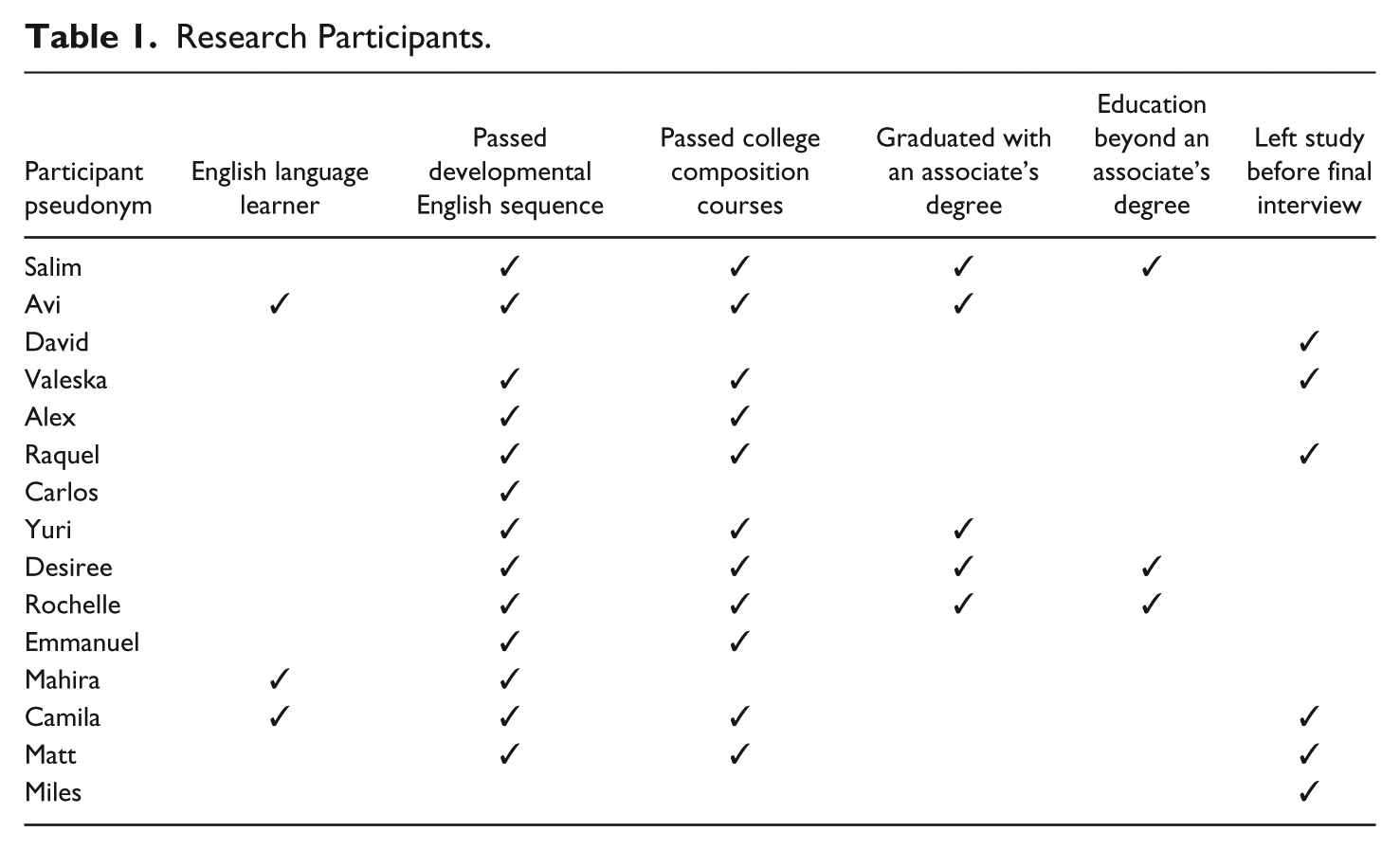
Data were collected and analyzed to answer the following research questions:
Data Analysis
Data were analyzed for emerging themes using a grounded theory method of analysis (Glaser & Strauss, 1967; Strauss & Corbin, 1990). Interviews, which were recorded and transcribed, were coded independently by each of the principal investigators for emerging themes across participants and time. The principal investigators compared findings and reconciled differences of interpretation. Then, interviews were reviewed again for instances of the most important themes and those that appeared with the greatest frequency were documented (Charmaz, 2005; Dey, 1999). This process of emergent coding led to a number of critical themes related to students’ perceptions of remediation over time; students’ experience of the LC; the significance of pedagogy to academic engagement; and the role of peer relationships. Finally, interviews were re-coded to confirm which themes had sufficient evidence of support among the majority of participants (Charmaz, 2005).
Validity
Multiple forms of triangulation were used to certify the validity of the study findings. Qualitative data garnered through semi-structured interviews on students’ academic performance and progress was triangulated against quantitative data collected through institutional records. The principal investigators independently coded all transcripts and validated their findings through a process of review and reconciliation of differing interpretations. Both investigators validated all of the findings reported in this article. Given the iterative nature of longitudinal, qualitative research in which data collection and analysis occur concurrently, the investigators were able to test the interpretive validity of their findings by conducting periodic member checks with the research participants during the ongoing interview process. Participant feedback led to modifications in the interview protocol and the collection of additional data. Taken together, these measures ensure the “trustworthiness” (Guba & Lincoln, 1981) of the findings reported in this study while respecting the power of qualitative research to provide rich understandings of developmental students’ lived experience.
Limitations
As with any qualitative research study in which participation is voluntary, there is the potential for self-selection bias. Though the principal investigators actively recruited students who failed the lowest level of remedial English, these students were not proportionally represented in this study: only 3 of the 15 participants failed the first semester of developmental English, though several more failed in subsequent semesters. 5 While the small sample size allowed for in-depth, rich qualitative data to be collected over a 3-year period, it also hinders the generalizability of the findings. Furthermore, as with any longitudinal study requiring subjects’ active participation, the number of participants diminished over time; by the final interview there was a 60% response rate (see Table 2 for further information). In this case, the participant attrition rate was highest among students who had discontinued their studies at the college without graduating. Of the 9 students who participated in the final interview, 4 had graduated, 2 were still enrolled, and 3 were on hiatus. Of the 6 participants who opted out of the study before the conclusion of data collection, none had graduated and none were enrolled in the college.
Participation in Interviews.
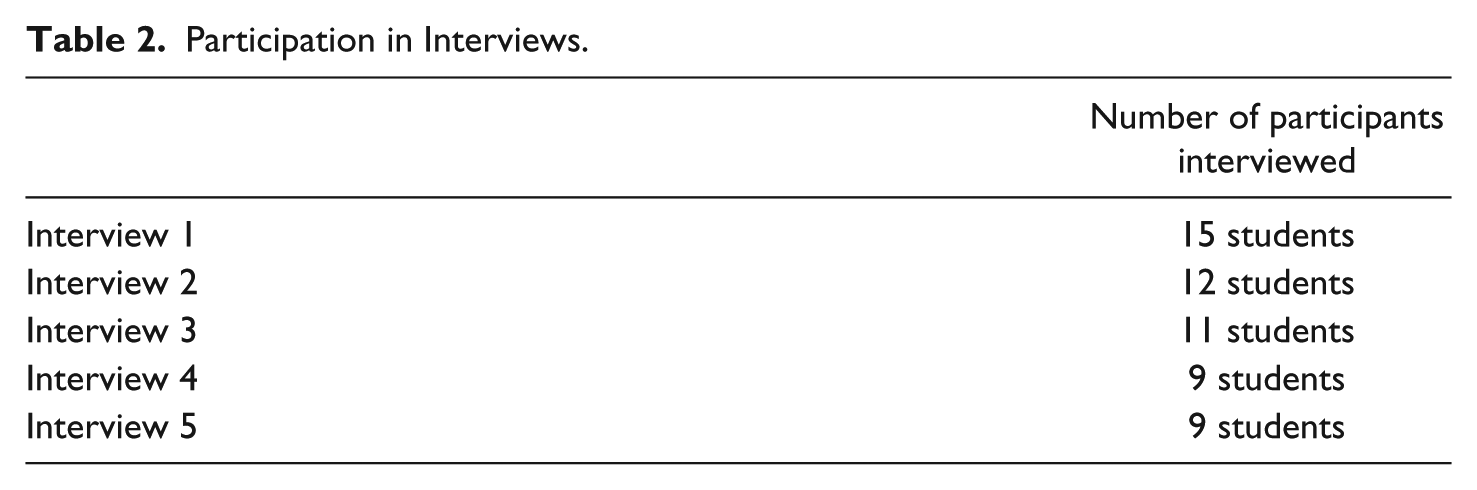
Findings and Interpretations
Perceptions of Remediation
Though they were entirely unaware of the contentious debate occurring nationwide over college remediation, the participants in this study expressed a collective sense of indignation and dismay at their placement in the lowest level of developmental English (English 001 in this college’s parlance). They, like many policy makers, were concerned about the impact remediation would have on their progression to a degree and the time it would take for them to advance through the developmental sequence to college-level composition. Valeska and Miles expressed sentiments echoed by the majority of participants: When I found out I was in English 001 I was like, really devastated, because I didn’t think I could be in two remedials at once. So, when I found out I was in remedial English, then all my friends were telling me, “oh my God, now you have to go to English 001, 002, 003, 004, 005” . . . and I’m like, “oh my God, now I have to stay here for so many semesters, I’m not gonna finish in two years.” (Valeska) Since I’m not familiar with the college thing, at first I wasn’t aware of what 001 really is . . . so when they put me in 001, I was like, all right, I’ll get to start school, that was the main thing. But then I got in, and I’m like, 001 is two classes behind [college level] English composition . . . I was like, “oh man! I should have really passed the writing, the placement test.” So, at first, I wasn’t aware of what it is really. But after knowing, then I was really disappointed . . . (Miles)
Students’ lack of accurate information about the impact of their placement in developmental courses heightened their anxiety and, from the very start of their college careers, led them to question their ability to graduate in a timely fashion.
However, most students’ feelings about having to take developmental English changed substantially over the 3 years they participated in this study, as they became aware of the academic demands of college and developed a more accurate assessment of their own literacy skills. Exposure to college-level coursework, initially in the context of the LC, helped these developmental students to assess their own academic abilities more realistically, recognize their educational limitations and needs, and most significantly, affirm the appropriateness of their initial placement in remedial English. With hindsight, students valued their experience in English 001 and affirmed that they would not have succeeded in college-level composition had they been placed there without the benefit of a foundation in developmental English.
I was really upset [about taking remedial English]. But once again, I’m pretty sure that I said this in the other interviews, that it was just a foundation for something bigger. You know? . . . As a writer, in the beginning, I did have major issues . . . I felt like I just didn’t believe in myself as I was going into college. I was like, yeah, I gotta do this, but I’m so scared . . .. There’s this show Are You Smarter than a 5th Grader? And sometimes I think to myself, am I smarter than a 5th grader? Not at this time, but like, before, I was like, this kid knows how to spell this word, and I would sit there for a couple of minutes and try things out. So that kind of put me down. You know, I was like, “Wow, I’m illiterate. How am I going to get a job? How am I going to do this?” (Yuri) I felt like I came prepared [for Freshman Composition] from [developmental English] class . . . I came prepared. I knew what I was doing. I just felt, I felt proud, I felt really proud of it. I mean, I wasn’t boastful, I wasn’t trying to like, you know, make it noticeable, but, you saw it in my writing. People, a classmate of mine wanted me to write his paper. I refused to. People saw my writing and they were really impressed, so . . . 001. That’s the foundation. That’s the pillar. That’s the foundation. It’s more important than Freshman Composition 1 and 2. 001, I’m telling you, that’s the foundation. Yeah, 001 is the building block. That’s it. That’s the core.” (Emmanuel)
For a small minority of participants, the experience of having to repeat the same level of developmental English and not advance to English 002 was particularly demoralizing. David, a young man with severe learning disabilities, was never able to pass English 001 despite three attempts and left community college after his third semester. Students such as David experienced their failure as deeply unjust and seemed unable to distinguish between putting in substantial effort in remedial classes and achieving the level of academic proficiency necessary for advancement through the developmental sequence into credit-bearing college-level coursework.
Perceptions of LC Placement
In great contrast to the institutional perception of LCs on this community college campus, where they are seen as a boon to students and an incubator of best practices among faculty, the students in this study were initially either quite unhappy about their placement in a first year LC or totally unaware that they had been registered for this program. When they were informed of their LC designation, usually on the first day of class, many assumed that they had been placed in the LC because they were in remedial English. Thus, students transferred the stigma they felt about their placement in remediation to their initial feelings about the LC.
So I wasn’t told I was gonna be in this kind of thing . . . No. “Cause, no . . . I probably would not have chose it. ’Cause I came to school to meet new people, you know, kind of network, you know . . . So when I realized that I’m gonna be with these same students for almost all my classes, I was like, ‘Uch.’” (Alex) I was surprised, and I was a little bit disappointed. I was like, what does this mean? Do they think I’m dumb? It was a little bit discouraging when I found out [that I had been placed in a LC]. It felt very juvenile. I thought that I would be making my own decisions, that I would be picking these things. At first I didn’t feel like a real college student, I was thinking that maybe I wasn’t . . . I don’t know how I got into that program. I . . . [at first I thought] . . . like I really messed up. What did I do? How did I screw up? Did I screw up that bad on the ACT? (Rochelle)
The vast majority of the students did not have a clear understanding of the purpose of the LC, that they were being registered for one and why, or that many students who place directly into college-level composition also participate in the college’s extensive, well-regarded, and effective LC program. Better pre-placement advisement and orientation about the benefits of the LC program could have ameliorated much angst and disgruntlement.
Perceptions of Developmental Peer Cohort
Much of the research on LCs highlights the benefits of the peer cohort model for students’ social and academic integration into college and the importance of this integration to student persistence (Engstrom & Tinto, 2008; Tinto, 1997, 2003; Wathington, Pretlow, & Mitchell, 2010). However, participants in this study had decidedly varied feelings about the cohort model: Some found it supportive and nurturing, but many others found it infantilizing and socially and academically limiting.
Those students with complaints about the cohort focused on the belief that taking classes with the same group of students felt too much like “junior high” and that the familiarity of the developmental LC bred something akin to contempt wherein immature classroom behavior, which derived from students’ weak skills and lack of academic engagement, impeded the more serious students’ learning. Furthermore, many found it challenging to interact with the same set of peers in the intense and sustained way the developmental LC required given that students spent 12 hours a week in classes together. Carlos and Valeska were particularly dismayed about the prospect of spending the semester in the company of the same group of students.
I didn’t like it at all. I felt like I was in high school. I didn’t like that bit at all. (Carlos) As he’s like, explaining it, “you’ll be in the same class with every single person,” I am really hesitant to take it. I was like, I’m gonna know the same people, I’m gonna see these same people’s faces every single day . . . It’s like, junior high. You, you have to go to every class with every single person, and you’re not actually meeting other new people, you know . . . (Valeska)
The participants in this study who were least satisfied with the peer cohort component of the LC were the few students whose identities placed them outside the “mainstream” social environment inhabited by the majority of their classmates. Because of their sexual orientation, religious background, or status as “learning disabled,” several students found themselves isolated in the tight-knit LC social structure and were at times ostracized by their peers due to their difference. Instead of the cohort fostering their social integration, these students found that the “hyperbonding” 6 often associated with LC cohorts highlighted their exclusion. David went so far as to affirm that he felt he had been “bullied” by some of the other male students in the LC who made fun of his severe academic weaknesses. Carlos and Emmanuel were relieved when the semester ended and they could associate with a broader cross-section of the college’s population and find other students who were more like them in terms of religious affiliation and gender identity.
I think it was much better out of it [the LC]. Because you get to experience other students, different personalities . . . And in the learning communities, you might learn about a particular group, but then that’s it . . . [In other classes] you get to get friends like you. You get to know best friends, like, you know, like you. (Carlos) I was trying, even without knowing, I was easing myself into the [LC] class and I was like, trying to, trying to assimilate. And, I got rejected. Boom. Spit right out. Spit right out . . . I learned a lesson. That [laughter] [pause] I should have borders. I shouldn’t get too comfortable . . . The lesson was [pause] I should maintain distance. (Emmanuel)
In contrast to this minority of students who felt stigmatized by their peers and continued to have negative feelings about the LC, most students in the study ended up, in retrospect, having positive feelings about the one semester they spent in the LC. As their memories of the intense peer interaction faded and they experienced the anonymity and disconnection of subsequent stand-alone college-level courses, students’ perceptions of the LC brightened. Rochelle likened her connection to the students in the LC to family. Others students had a less pragmatic and more wholly positive assessment of their peers and the LC.
I actually liked the three linked classes. It’s so sweet. Like, it’s so personal and you get to interact with people at a better level . . . But the best point is to be able to connect with your professors and the other students and you’re more like, I guess, nurtured in a way . . . And with the other classes, having it more independent it’s more, you’re basically like, on your own . . . I think it’s really great as a start up for someone like me who completely didn’t know what I was doing coming into college. I liked that aspect, I need something that is like a nurturing step . . . Like, you start off slow and then you keep doing more . . . So it allowed me to slowly get there. (Raquel) It [the LC] definitely helped me to get situated to the school more . . . it was interesting because I wasn’t in high school for long. I dropped out my freshman year, got my GED and then like, took three years off. Then I came here . . . so, it was definitely cool, it was sort of easy settlement into the school, as opposed to just like, you know, go here and do work . . . and that’s it. [The professors] were like, a lot more involved with our learning, and made, for me, the transition was a lot easier. From, you know, nothing to school every day. (Matt)
Though students’ connection to their peers from the LC quickly dissipated into Facebook exchanges and brief hellos in the college corridors after the end of the semester, what proved enduring, particularly for those students who ended up in small, tightly structured majors, was the strong belief that peer support could be key to their academic success. Avi, one nursing major in the study, spoke passionately about how the intense competition for a seat in this rigorous and highly sought-after program morphed into his recognition that only a strong peer support network would help him withstand the academic challenges of the major.
If you want to get into the nursing program, you have to fight for yourself. And, people don’t help each other, because they want the seat. But, once you get into the nursing program, you switch the mode. You become more friendly. If you want to survive, if you want to survive the nursing program, you have to have friends, and do study groups. And, it’s very important . . . each test we had group studies and nobody failed in group studies. We were really happy. See, people fail. People fail, but those are people I don’t know. Maybe they are outsiders? They don’t share notes . . . they don’t share their knowledge. They don’t, they don’t participate in our study groups. (Avi)
Curricular Integration
LCs at the campus where this study was conducted have been recognized as particularly comprehensive, featuring a high degree of curricular integration, faculty collaboration, and external supports for students such as academic advisement (Rutschow & Schneider, 2011; Sommo et al., 2012). The particular LC in which students in this study were placed fits the criteria for a highly integrative and comprehensive LC (Price, 2005). Students worked throughout the semester on a series of integrative assignments that were jointly developed by the faculty around shared themes and assessed using a common rubric; the developmental English and Introduction to Psychology faculty shared a syllabus and similar student-centered, inquiry-based pedagogical approaches; co-curricular activities were jointly planned and carried out by all LC faculty who met regularly throughout the semester to plan, assess, and advise students. Despite some initial anxiety over being graded by two professors (who students feared might have different criteria) on one assignment, the high degree of curricular integration in this particular LC was a source of academic challenge and satisfaction to the majority of students in the study and helped counteract their sense that the remedial English class was not “real college.” As Yuri explains, this work presented students with a cognitive model for connecting learning across disciplines that they could draw on in future classes, a particularly vital lesson for developmental learners.
All of the materials was kind of put together . . . we read the book, that we had to write the essay [about] for English class . . . and then we had to compare it with psychology. It was pretty good, because it was Flowers for Algernon and I believe there is a lot of psychology going on there . . . So, I could relate a lot of things to psychology, and then I could write the essay in English . . . As challenging as it is . . . I think it’s better because you get to think more . . . on different points. Because you’re not only writing it for English, you’re also thinking of psychology and how that would work for English. That was definitely more challenging . . . but I feel the more challenging it is, the better you get at it. Because then when you’re writing a regular essay, which is, for example, for English class . . . you could then use your experience from your psychology class and say this and that, you know, to put two things together . . . and make them as one. (Yuri)
Pedagogical Dissonance
Given the pedagogical and curricular orientation of the college’s LC program and the student-centered nature of this particular LC, students were often surprised and disheartened by the marked contrast in the social and pedagogical environment in their LC classes and the stand-alone courses they took in subsequent semesters. Raquel and Mahira were not alone in expressing their deep sense of social isolation in the non-linked classes.
Now that I’m actually taking summer courses, actual classes that are separate, it’s ridiculous the connection with the students and the professors, and there, there is no connection . . . (Raquel) I didn’t even know the name of one student. Only like, [student], who was from my last semester. I didn’t know anybody. We didn’t talk, we didn’t, we had only three hours of class on Fridays . . . Everybody sitting and we had like 10 minutes break, and after class finished everybody is running for the bus, and nobody talks, and you know, I didn’t get used to them. And the same thing in [another] class. Because different faces, and it’s a little confusing. (Mahira)
This LC’s emphasis on student–faculty and peer-to-peer interaction, student-centered pedagogies, and curricular integration, left students unprepared for their subsequent experiences in more traditional, lecture-based classes where many participants described struggling with a sense of intellectual and social disengagement. Students reported a decided lack of interest in the material covered in these large, lecture-style classes and often a drop in grades. VanOra (2012) found a similar perception of “inadequate pedagogy” (p. 27) reported by the participants in his study of developmental learners. Students such as Desiree, Salim, and Yuri who were highly engaged in their LC courses, found themselves numbed by the more monologic style of instruction they encountered in other college-level courses.
I don’t know, I just, I never slept in class, you know, I’m always awake and attentive . . . But then when I’m there, when I’m in his class, I’m like, pooped, and I’m out. Like, he just talks and his voice is like that clear eye guy from the commercial [laughs]. It puts me to sleep . . . it’s like a lullaby. And I just try to stay awake . . . but it’s like, a lecture, and then you write . . . and then he gives you an essay and then he tells you, you have to read this and that. (Desiree) I think that a couple of the professors here should really understand more about these students and that . . . every student is different, but I think that we all . . . are kind of like, special needs, like [laughter] I know that sounds silly . . . I feel weird saying it, but we really do need that extra help . . . There is a reason why we’re here [at community college] . . . We’re here because we need that kind of help. This is kind of like a special environment, like, a community college is either you’re totally foreign or you’re just having problems, like, you screwed up in high school. Everyone is different . . . but everyone needs that special kind of understanding . . . (Raquel)
This finding suggests that faculty teaching non-LC classes would benefit from exposure to some of the pedagogical techniques, classroom management strategies, and curricular innovations that have proved successful in the college’s LC program.
Intellectual Engagement
The students in this study entered community college with strong occupational objectives for attaining their Associate’s degree. An unanticipated finding that emerged was that those students who discovered the joy of intellectual engagement, in the process of seeking a degree that would boost their employment potential, found it easier to stay the course than those who were trudging through simply for the sake of the credential and imagined future economic stability. Yuri, Salim, and Rochelle all graduated from community college in 3 years or fewer. Their enthusiasm for learning buoyed them—in the face of unavoidable personal, academic, and financial challenges that could have threatened their commitment to college—despite initially being placed at the bottom of the developmental English sequence.
I’ll be honest with you, I wasn’t always a big fan of education, like, an A+ student that I would wake up every morning and I was “Yes! School!” You know. ’Cause there is kids out there that are like that, and I’m like, I look at them and I’m like, you nerd. I feel a little bit differently right now because I’m actually building this whole education thing for myself and college is more of, I guess, experiencing the world around you, because it’s not only, English, math and science classes. It’s everything . . . I mean, I don’t want to sound like [college] it’s fun like, oh you know, like riding a roller coaster fun. But it’s, educational fun. You know, it’s very interesting. If you’re interested in it, then you’ll have fun. (Yuri) I realized something that, you know, I’ve been learning something new every day, and I, I really, really love learning, and I’m really happy I came here. I’m really happy I decided to come to school . . . (Salim)
Colleges that implement LCs as a way of making developmental education more effective in terms of student outcomes should consider the importance of intellectual engagement to students’ overall college experience.
Discussion
Though much large-scale, quantitative research has been conducted on the impact of remediation and LCs on student success, this study reveals the importance of listening closely to the voices and perspectives of developmental students. The findings implore us to balance the singular focus on educational outcomes of much prior research (Boatman & Long, 2010; Calcagno & Long, 2008; Martorell & McFarlin, 2007) with careful consideration of developmental students’ understandings and experiences.
This study reveals that the broad strokes, sound bite of “remediation is bad for students” on which calls for dramatic policy changes are being made is not always consonant with students’ perspectives. We need more, and more fine-grained, research to determine which programs and policies work for those students who enter higher education most unprepared for college-level courses. Rather than painting all remedial students with the same broad brush, more studies that look specifically at the lowest level, most academically challenged students’ experiences and outcomes as a result of placement into developmental courses and sequences is in order. Further research on which specific curricular and instructional strategies produce the best outcomes for the lowest level developmental learners is urgently needed as well.
These findings also indicate that not only LC placement but the nature of the LC matters as research by Teres (2010) and Weiss et al. (2010) suggested. The LC that students in this study participated in was characterized by a high degree of faculty collaboration, curricular integration, student-centered pedagogies, as well as academic advisement. Further research that disaggregates for the impact of different kinds of LC models on student outcomes is essential. We need studies that look at which features of a LC result in the most positive outcomes for which groups of students to determine the future direction of LC programs. Similarly, further research into the outcomes associated with different academic advisement models is also essential. Studies that examine which kinds of academic advising work best for the lowest level developmental learners could have a profound impact on student success.
Though much LC research highlights the advantages of peer cohorts to students’ academic integration (Engstrom & Tinto, 2008; Tinto, 1997, 2003; Wathington et al., 2010), students’ negative perceptions of the peer cohort model in this study indicate that more qualitative research on the specific social characteristics associated with developmental LC cohorts is in order. Studies that consider the effectiveness of specific interventions directed at ameliorating the negative social dynamics connected with remedial peer cohorts, such as “hyper-bonding,” should inform LC program policy and classroom practice.
Implications for Practice
Findings from this study underscore the urgency of more honest and effective student advisement, especially for developmental students. Students must be counseled proactively about the “high stakes” nature of the university-mandated assessment tests and the implications of failure in terms of placement in mandatory developmental courses. Such advisement must include honest communication with students about what their assessment test scores reveal about their academic literacy skills, what college-level courses require of students in terms of reading and writing expectations, and the advantages of starting college in a developmental course geared toward the needs of academically underprepared students. Effective counseling must also involve a clear explanation of the developmental sequence at the college and what a typical student trajectory through remediation means in terms of time, cost, and potential benefits.
In addition, students must receive clear pre-placement advisement about the LCs program. They must understand both the well-documented positive outcomes associated with LC participation and that the recommendation that they participate in a first-semester LC is not a result of their placement in developmental English. Providing incoming students with accurate information about the LC program, perhaps from former student participants, and inviting them to choose to be part of a LC, would go a long way toward ameliorating some of the initial negative perceptions of LC placement described in this study.
Students’ positive experiences of student–faculty and peer-to-peer interaction, student-centered pedagogies, and curricular integration in this LC suggest that such comprehensive LC models are one way to make non-credit developmental education more palatable for students (who are simultaneously earning credits from the college-level courses that are linked to developmental English) and more intellectually rigorous and engaging. The high level of curricular integration that characterized this LC, evidenced in the multiple joint assignments, pushed students to develop higher order cognitive skills with support and scaffolding provided by the developmental English class. This finding supports Grubb’s (2001) assertion that rote “skill and drill” methods in developmental classes “violate all the maxims for good teaching” and have contributed to the widespread conception that remediation does not work (p. ii).
Policy makers and institutions of higher education that are interested in college completion need to consider more than just how to move academically underprepared students more quickly to graduation. They must also consider how to make higher education a more meaningful endeavor for students–one they want to continue with over time. Most policy initiatives prioritize speed, moving students to degree faster, but developmental LCs can be one way to enhance students’ college experience and make it more satisfying so that students are willing to invest the extra time remediation and the development of college-level academic skills demand of them.
Conclusion
Media reports and higher education policy makers paint a dire picture of college remediation based primarily on the low graduation rate for this student population. The view from our participants’ standpoints is decidedly less grim. Though they began their college careers in the lowest level of developmental English, Salim, Yuri, Desiree, Rochelle, and Avi have all graduated from community college in 3 years or fewer and Emmanuel is poised to graduate next semester. Avi is now a registered nurse, Salim graduated from a 4-year college with a 3.5 GPA, and Rochelle will receive her Bachelor’s degree next semester. Salim aspires to complete a graduate degree in psychology and Rochelle hopes to attend law school. Carlos, Alex, Valeska, Raquel, Matt, Camila, and Mahira all left college before graduation. Yet, all successfully completed the developmental English sequence and accrued an average of 30 credits toward a college degree. All but Carlos, Alex, and Mahira passed both of the required college-level composition courses as well. David left college in his third semester unable to pass even the first level of developmental English, but he has gotten married, is parenting two young kids, and believes that a return to college may lie somewhere in his future. Miles passed English 001 and left the college and our study in his second semester with plans to join the Navy.
Adding the texture and depth of developmental students’ experiences to the statistics allows us to see that for many community college students, as Lax (2012) argued, graduation rates are not the only or best measure of college success. The voices and perspectives of the students directly affected by remediation must be heard by those contemplating dramatic policy changes that will fundamentally alter who can attend college and how. Though none of the participants in this study desired to be placed in remediation, most came to believe, over time, that developmental courses, particularly in the context of a first-semester LC, laid the groundwork for future college success. These students gained college credits, developed their academic reading and writing skills, made intellectual connections across disciplines, and, for better or worse, felt themselves to be part of an academic community. As Yuri reminds us, his experience in developmental English was “a foundation for something bigger.” Though that “something bigger” was not the same for all participants and for many does not yet include a college degree, for all there was value added from the experience of beginning college in a developmental LC.
Footnotes
Acknowledgements
The author is indebted to Jason VanOra and Christian Calienes for their participation in this project.
Declaration of Conflicting Interests
The author declared no potential conflicts of interest with respect to the research, authorship, and/or publication of this article.
Funding
The author received no financial support for the research, authorship, and/or publication of this article.