



Abstract
Nationwide, low percentages of community college students graduate. Although community colleges’ higher percentages of low income, academically underprepared, non-traditional, and minority students are often cited as the reason for low graduation rates, this study sought to examine common characteristics of community college students who do graduate. The qualitative study included interviews of community college graduates from a large, public community college in the Southeastern United States, as well as interviews of faculty and staff members at the institution. The students in this study were found to have the following characteristics in common: clear goals, strong motivation and a drive to succeed, ability to manage external demands, and self-empowerment.
Community colleges are a vital component of the U.S. postsecondary education system serving 45% of all U.S. undergraduates in fall 2012 (American Association of Community Colleges, 2014). These 13 million students attend 1,132 institutions representing diverse population groups and communities—and the population of community college students is growing (American Association of Community Colleges, 2014). Educating this large diverse demographic is fundamental to creating an active and engaged citizenry (Colby, Ehrlich, Beaumont, & Stephens, 2003), providing workers with the tools necessary in the new global economy, and maintaining a strong middle class (The 21st-Century Commission on the Future of Community Colleges, 2012). America needs a large percentage of its general population to possess solid skills taught in high performing community colleges to remain globally competitive.
How are our community colleges performing? At the national level, 46% of current community college students will not graduate from any institution within 6 years and another 20% will still be enrolled without yet having earned a degree, if current trends persist (The College Board, 2012). The federal benchmark for evaluating community college graduation rates is completion within 3 years or 150% of normal time. 1 Community college 3-year graduation rates average around 20%, with many community colleges graduating far fewer than this average (National Center for Education Statistics, 2010). In 2009, close to 400 of the 1,132 community colleges in the United States had graduation rates less than 15% (Schneider & Yin, 2012). Such low graduation rates for such a large segment of our student population have drastic economic and policy implications. Estimates indicate that decreasing the drop-out rate by half would create US$5.3 billion in total taxpayer revenue by increasing lifetime income of graduates (Schneider & Yin, 2012).
Students enroll at community college for myriad reasons including updating skills, job training, personal enrichment, and transfer to 4-year institutions. This study focuses on the students who enroll with the intent of degree attainment and who graduated within 3 years of enrolling at the community college. By interviewing successful community college graduates, as well as community college staff, faculty, and administrators, we gain multiple perspectives into what makes this small percentage of students successful. We hope that an understanding of the characteristics and behaviors of successful community college students will help community colleges foster these characteristics in all students to improve their chances of success. In addition, this understanding may help community colleges perform more positively in measures of institutional accountability and student outcomes by improving their retention and graduation rates.
Literature Review
Community college students are different from undergraduates at most 4-year institutions in a number of ways. First, we will attempt to explain these differences in the context of the mission of community colleges. Then, we will examine persistence theory in light of Tinto’s (1975) seminal work in the area and Braxton, Hirschy, and McClendon’s (2004) critique of Tinto’s theory regarding its application to various types of colleges, including community colleges. Finally, we will examine the impact of the entering student characteristics of cultural capital, college-going plans, and academic preparation on community college student persistence.
Community College Students
Community college students differ in many ways from undergraduate students at 4-year institutions. Students at community colleges vary greatly in their level of academic preparedness, and community colleges enroll a higher percentage of academically underprepared students and students requiring remedial coursework (Townsend & Twombly, 2007). These underprepared students are much less likely to persist (Grimes, 1997). In addition, community colleges enroll a higher percentage of low-income students than 4-year institutions (Horn & Nevill, 2006). In fact, compared with all types of higher education institutions, community colleges enroll most students from the lowest socioeconomic quintile (Horn & Nevill, 2006). This is important because students of low socioeconomic status are much less likely to graduate from college (Walpole, 2003).
Community colleges also enroll larger percentages of non-White students than other types of colleges and universities. In 2003-2004, almost half of community college students were from non-White races (Horn & Nevill, 2006) compared with 39% of all college students (National Center for Education Statistics, 2011). Non-White students generally have lower college graduation rates than non-minority students (Perna, 2000). Another major difference between community college students and other college students is the amount of time spent working. Community college students are more likely to work while attending classes and are much more likely to enroll in classes part-time due to work and home responsibilities (Townsend & Twombly, 2007). Students who enroll part-time take much longer to complete degree programs and are less likely to persist to graduation (O’Toole, Stratton, & Wetzel, 2003). Pascarella and Terenzini (1991), in their extensive review of the literature, concluded that 2-year community college entrants are less likely to persist than 4-year college entrants. This relationship occurs even after holding constant a variety of relevant personal, aspirational, academic, socioeconomic, and family background characteristics (Pascarella & Terenzini, 1991). Even among students with “high qualifications” for college, 69% who begin at a 4-year institution will graduate, compared with only 19% who begin at a community college (The Century Foundation Task Force on Preventing Community Colleges from Becoming Separate and Unequal, 2013).
Persistence Theory
The majority of literature regarding college student persistence focuses on traditional undergraduate students, students aged 18 to 24 who are enrolled full-time, at 4-year universities—students who are demonstrably different than the majority of students enrolled at community colleges. Much of the major research on college student persistence stems from Tinto’s (1975) Interactionalist Model of Student Persistence. In this model, Tinto describes the relationships between student entry characteristics, goal commitment (initial and subsequent), integration (academic and social), and institutional commitment (initial and subsequent) to the outcome of persistence.
Although Tinto (1975) states that each of these portions of the model affect other portions of the model as well as ultimate persistence, Braxton et al.’s (2004) research demonstrates that this model does not fit non-traditional institutions, such as commuter colleges and community colleges. According to this group of researchers, the only relationship in Tinto’s model that holds true for community colleges is that student entry characteristics directly affect the likelihood of students’ persistence in college (Braxton et al., 2004). These student entry characteristics may include such attributes as motivation, control, self-efficacy, empathy, attention needs, parental education, and anticipatory socialization (Braxton et al., 2004). Mulligan and Hennessy (1990) and Halpin (1990) also agree that social integration is not associated with persistence of 2-year college students. However, Victor Saenz’s analysis of Community College Survey of Student Engagement (CCSSE) survey results indicates that institutions can influence students’ engagement with and usage of support services, which results in improved student outcomes (Saenz et al., 2011).
Entering Student Characteristics
The majority of the research linking student characteristics to persistence is based on demographic characteristics or socioeconomic characteristics rather than personality traits and the behaviors that result from those traits (Reason, 2009). However, Barbatis (2010) and Habley, Bloom, and Robbins (2012) identified several entry-level student characteristics that affect persistence, which may be grouped into the categories of cultural capital, college plans, and academic preparedness. Each of these categories will be examined in more detail in the following sections.
Cultural Capital
According to social reproduction theory, “schools socialize students to occupy roughly the same position in the class structure as that of their parents” (MacLeod, 1995, p. 13). Bordieu (1977) argued that education interacts with culture by supporting the dominant, middle class culture and devaluing the culture of lower classes. According to social reproduction theory, parents’ levels of human capital strongly influence their children due to varying levels of parental involvement and parenting styles (Lareau, 1987). These parenting styles, including educational resources in the home, parents’ conversations with children, and disciplinary style create lifelong differences in levels of success between students of varying social classes (Rothstein, 2004).
Barbatis’ (2010) model incorporates cultural capital’s influence on persistence through cultural and racial self-identification and supportive families. According to MacLeod (1995), “Success or failure in school is determined largely by social class” (p. 16). Community college students are typically of lower socioeconomic status than students at 4-year institutions (Horn & Nevill, 2006). Socioeconomic status affects cultural capital because low socioeconomic status tends to decrease educational resources, such as books in the home, access to cultural enrichment activities, and college preparation activities, available to students (Indiana University, 2010). Therefore, many community college students are at a disadvantage in terms of cultural capital and its influence on college persistence.
College Plans
Students of low socioeconomic status are often ill-informed or unaware of requirements for attending college, including both knowledge of the college admissions process and knowledge of financial aid (Perna, 2006). Although access to information about college is available through most high school guidance counselors or college counselors, students of low socioeconomic status continue to face gaps in college-going rates and persistence rates compared with students of higher socioeconomic status (Bowen, Kurzweil, Tobin, & Pichler, 2006). This may be because availability of resources varies within schools. The best students tend to get more resources, and these students are often the ones with the highest income and socioeconomic status (Perna, 2006).
Another explanation for the gap is that more help is required for students with lower cultural capital whose parents are unable to assist their students in the college admissions process (Perna, 2006). According to Bowen et al. (2006), “college preparedness also requires encouraging students to have high educational aspirations, building their confidence, and imparting to them knowledge of how to navigate the application process” (p. 241).
Given the gap in college knowledge, motivation for attending college is a large predictor of persistence, according to Barbatis (2010) and Habley et al. (2012). Both of these studies describe motivation in some form as a factor in college persistence. These attributes align with Braxton et al.’s (2004) research that shows that students’ entering characteristics are the only predictors of community college success and may explain how students from low socioeconomic backgrounds with less access to information about college still find a way to attend.
Academic Preparation
Academic preparation is a part of Habley et al.’s (2012) model that includes the characteristics of academic discipline, study skills, and academic self-confidence. Bowen et al. (2006) describe academic preparedness as “the major determinant of differences in educational attainment” (p. 224). As described previously, community college students are often underprepared for college-level work and require remediation prior to enrollment in college-level courses (Townsend & Twombly, 2007). In addition, community college students are often of lower socioeconomic status (Horn & Nevill, 2006), and students of lower socioeconomic status face an achievement gap in learning when compared with students of higher socioeconomic status (Rothstein, 2004). Students who attended high-poverty primary and secondary schools are likely to be academically underprepared. These students are surrounded by peers with low motivation, parents who are uninvolved in their children’s education, and teachers who are less qualified (Kahlenberg, 2001). Rothstein (2004) described the most effective way to reduce the achievement gap is by changing student background characteristics rather than through school-based reform.
In summary, some of the most commonly cited theories related to student persistence, including Tinto’s Interactionalist theory, may have limited applicability to community college students. Because low persistence rates are a prevalent issue for community colleges, additional exploration of factors affecting community college student persistence is needed. Braxton et al. (2004) demonstrated that community college student entry characteristics directly affect persistence, but additional work must be done to determine which characteristics apply to these students and whether other models, such as Barbatis’s (2010) or Habley et al.’s (2012) models of characteristics, that lead to persistence are applicable to community college students. In doing so, community college administrators will not only better understand their student population but may also be able to foster the characteristics of successful students in the larger student population to increase persistence throughout the institution. This article attempts to describe the characteristics of successful community college students through the undertaking of a qualitative research study.
Study Design and Conceptual Framework
Study Design
Peshkin (1993) describes one benefit of qualitative research as its ability to allow researchers to explore “the many imagined and as yet unimagined outcomes” of a research question (p. 23). The purpose of this study is to determine common characteristics and behaviors of the small percentage of students who persist in community college. The researchers hoped to explore in-depth new themes and behavior patterns characteristic of successful community college graduates, a process that is best suited for a qualitative study, which allows researchers to probe more deeply into participants’ responses to gain a broader understanding of the topic. Although some potential contributing factors to college student success were found in the literature, there is great debate and contradiction on the applicability of these factors to community college students. Community college students are typically quite different from their counterparts at 4-year institutions in a variety of ways (Townsend & Twombly, 2007), and this research aimed to understand and portray student characteristics and behaviors that may lead to success but are outside of typically measured indicators such as socioeconomic status, demographic characteristics, and academic performance (Reason, 2009). This research is intended to provide a description and better understanding of the characteristics of successful community college students and successful patterns of behavior and to verify whether existing research on college student persistence holds true for the population of students at the community college examined.
Conceptual Framework
The conceptual framework for this study is derived from Braxton et al.’s (2004) research, which found that entering student characteristics is the only determinant of persistence for community college students. The framework uses three broad categories of entering student characteristics: cultural capital (including family background, social class, and other non-school related factors), college plans (including goals for attendance and motivation), and academic preparedness (including previous school-related work and performance; see Figure 1).
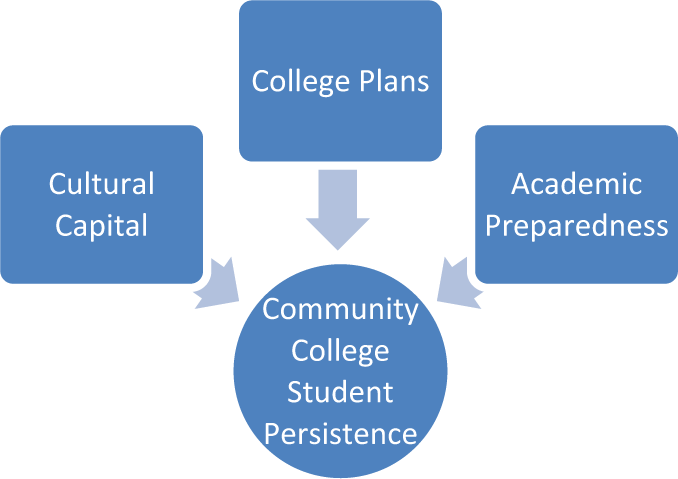
Conceptual framework.
Site Description and Methods
Setting
This research study was conducted at “Big State Community College,” a pseudonym we will use to describe the institution. Big State Community College is classified by the Carnegie Foundation as a large, public, 2-year college and is located in the Southeastern United States 30 miles from a large metropolitan area. The institution serves a designated 12 county area as part of a system of community colleges in its state. Headcount enrollment at the college is approximately 8,500, the majority of whom are enrolled part-time. Half of the students are traditional college students aged 18 to 24, and half are non-traditional students. All students at the college are commuter students. In addition, many students work full- or part-time while attending classes. Approximately 80% of the students are White, and the remainder of the student body is made up of minority races.
The institution offers associate of science and associate of arts degrees, designed for transfer to a 4-year institution, and associate of applied science degrees and technical certificates, designed to lead to employment. The institution awards nearly 1,000 degrees and certificates per year and has an Integrated Postsecondary Education Data System (IPEDS) graduation rate of 11%. The majority of the students enrolled at Big State Community College are academically underprepared; in fact, 60% are required to take remedial coursework prior to enrolling in college-level courses.
This location is appropriate for the study because it is a typical community college in a number of ways. Like most community colleges and unlike many 4-year institutions, the majority of the student body is enrolled part-time. In addition, the institution has a large proportion of non-traditional students, as do most community colleges (Townsend & Twombly, 2007). The school is large, so despite its low graduation rate, which is typical of community colleges nationwide (The College Board, 2012), there is a large pool of graduates from whom information may be gathered. Also, the school offers both transfer degree programs and employment degree programs, meaning that information may be gathered from graduates with varying intents for enrollment and educational goals.
Method
The primary method of data collection for this study was semi-structured interviews using interview protocols developed based on the study conceptual framework described above. Interviews were conducted first with faculty, staff, and administrators at the institution to determine their perceptions of factors that contribute to student success and the college’s role in promoting student success. The faculty, staff, and administrators selected for interviews included a representative from financial aid, two academic counselors, the Director of Retention, the Vice President of Academic Affairs, and three faculty members. These interviews were conducted by one member of the research team in the interview participant’s campus office. Because the purpose of this study was to explore student characteristics that lead to persistence, interviews were conducted using a semi-structured interview protocol, which allowed the researcher to ask participants additional questions or to expand based on their responses to the protocol questions. This type of interview structure was conducive to gathering more in-depth explanation and examples to supplement responses to the interview questions. Interviews with faculty and staff generally lasted 20 to 45 minutes.
During these semi-structured interviews, the interviewees identified former students who persisted against the odds and graduated from the institution. Seventeen of the graduates identified through this process, through random selection, or through recommendations from other graduates interviewed were subsequently interviewed to explore the characteristics, perceptions, experiences, or behaviors they have in common that may have contributed to their success. The graduates were asked about their academic preparation for college, factors relating to their cultural capital, their goals in attending college, and their academic and social behaviors as a student. Every interview participant was given a pseudonym to protect his or her identity. Graduate interviews were also conducted by one member of the research team. These interviews were conducted in a neutral location, such as a community coffee shop or library. Like the interviews with faculty and staff, graduate interviews were conducted using a semi-structured interview protocol, which allowed the researcher to gather more detailed information based on participants’ responses to protocol questions. Interviews with graduates generally lasted 40 to 60 minutes. In addition, the college provided us with recordings of two focus groups conducted with currently enrolled students about their perceptions of student success, as well as data from focus groups conducted with faculty and staff at the institution regarding their perceptions of factors that contribute to student success. The data from these focus groups were used as observational data for triangulation with data obtained through the semi-structured interview process.
Data Analysis and Coding Scheme
The data analysis process was carried out according to Rubin and Rubin’s (1995) model. The first step was to transcribe and summarize each interview. We began our data analysis with a multiple layer review and coding process. This process involved listening to the recorded interviews 3 times.
We listened to the recording of each interview twice while reviewing field notes for familiarity. Transcription took place during the third review of each interview, and we took organized notes using a role-specific matrix (graduate, faculty member, academic advisor, financial aid advisor, or administrator; Patton, 2002), which was based on our conceptual framework-driven interview protocol that included the categories of academic preparation, cultural capital, and college plans. These matrices were then used to discern emerging themes and repeated patterns in the data.
Matrices were summarized by participant role (graduate, faculty member, academic advisor, financial aid advisor, or administrator) allowing us to identify common themes between interviews of the same type and group them together. Summaries were compared to identify themes that were common or variant between each participant group. We also developed a matrix to organize the focus group data provided by the college along the components of the conceptual framework. Finally, we merged the matrices into one matrix clustered by conceptual framework component.
Findings
As we reviewed our observational data, several themes regarding successful community college students began to emerge. Successful graduates have (a) clear goals, (b) strong motivation, (c) the ability to manage external demands, and (d) self-empowerment.
Clear Goals
The first theme that appeared among graduates and administrators is that community college students who graduate have clear goals. “Begin with the end in mind,” or some version of Steven Covey’s (1989) popular phrase was emphasized over and over by graduates, faculty, and administrators. Whether the goal is to transfer to a 4-year college, earn a certificate, or start down a new career path after being laid off, successful students have clear goals. For example, Jessie Short emphasized her goal of graduating by saying, “I’m an all or nothing type person. I was a very serious student. I didn’t mess around or play around. I didn’t make a lot of friends. It wasn’t about that for me. It was about graduating.” Sarah Baird recounted how after high school she “just wasn’t ready” and dropped out after three semesters. She returned to college 15 years later after working in retail sales with the clear goal of becoming a case manager.
With well-defined visions for their futures, and the understanding of how success in college can lead to the realization of those visions, successful students follow distinct academic tracks, as opposed to just experimenting with different course offerings. Both Hernan Sabio and Mary Underwood returned to school to obtain a paralegal certificate after being laid off from their jobs in the hopes of qualifying for a law office job in the future. Hiring managers in law offices had told both of them that the paralegal certificate would be helpful in gaining employment. Both were successful. Goals are connected to personal fulfillment for the majority of interviewees, as expressed by Joy Sanders, “I wanted to do something I enjoyed, and going to school was the only way I was going to get to do that.”
Successful students align their curricular choices with their goals and interests and seek out opportunities for personal growth and development along the way. They are able to use strategic decision making regarding course selections and academic integration with the institution. Advising and financial aid administrators also note these behaviors of successful students. Frank Richardson, Director of Advising, finds that students who don’t have a goal or direction [are] more likely to dropout. There are students who think they know what they want to do, but really don’t. They just declared a major because someone told them that they would be good at this or that. As soon as they hit that first little road block, maybe a math class, they question their choice.
This was further supported by Meredith Smith, Director of Financial Aid, who stated that students who change majors twice or more can run into financial challenges with regard to student aid eligibility. Students with clear goals avoid these obstacles because of their clear academic track and course sequencing. Lorelei Timms agreed. She said, My main challenge was just not knowing what I wanted to do. I changed so many times, and spent so many wasted hours in class trying to figure it out. I think if I hadn’t finally figured it out, I really might have dropped out. But then where would I be? That wouldn’t get me any closer to my goals.
Strong Motivation
The most evident theme demonstrated by every one of the graduates interviewed is their intense motivation to succeed.
My own personal motivation was a factor [in my success]. I think it’s a mind-set. Once you decide that’s what you want to do and you’re on that path to do it, I think that nothing could stop you then,
said Joy Sanders.
Many of these graduates, especially the non-traditional ones, have made great sacrifices to return to school to achieve their educational goals. Others returned to college after being laid off from a job or in attempt to enter a new professional field. Numerous graduates we spoke to faced significant trials prior to or during their college enrollment that could have prevented them from being successful, including homelessness, pregnancy, and job loss. Annabelle Marlin explained her ability to overcome hardship like this: “When I have problems in my personal life, I usually excel academically. It just pushes me a little bit further. Having more responsibility makes me more responsible.” And when these challenges are academically oriented, successful students are highly motivated to overcome the obstacle. This is true even when academic support resources are not available at times when the students can use them. Maria Gonzalez recounted failing a statistics course in a hybrid online/in-class format before eventually passing it in an online format. She recounted, The one class I failed was statistics. I didn’t get the help resources I needed because I was too busy [working]. My advisors advised me to use those resources, but I was too busy. I decided only to take statistics the next semester, and focus all of my attention just on that one course. I struggle passing that.
Laura Black explained that she thinks student motivation comes from within. She stated, “College students should be able to motivate themselves to succeed.” Joshua Milliken agreed, saying, “I just made sure I stuck with it and tried to push myself.” Graduates expressed this innate motivation or desire to succeed against any odds over and over.
While most successful graduates we spoke with found the motivation to achieve from within, some of them also found the motivation from their family’s college expectations; others are motivated by the opportunities that education affords them in the future.
You can make good money just by serving tables. I see many people giving up school because they are more attracted to the money made by serving tables. Not many people are willing to study for a job that will potentially pay you less initially than serving tables, but could offer you the possibility of a career in the future,
stated Maria Gonzalez. As an out-of-state student, Maria also faced the hurdle of paying out-of-state tuition. She held down two or three jobs at all times to make ends meet throughout her studies. In addition, successful students are motivated by and appreciative of the support and encouragement received from faculty, staff, family, and friends. Mary Underwood notes high motivation and high family support enabled her to complete a 2-year program in 1 year. She said, “My parents were definitely supportive as a cheerleader. They co-signed the loans I needed.” Also, every graduate interviewed said faculty and staff were helpful when they sought assistance. Mary Underwood noted, “At Big State Community College you were always welcome; you weren’t just a number there.” Several of the successful students we spoke with described benefitting from positive competition in supportive relationships with peers, regardless of their academic program. Multiple students remembered other students who motivated them, sometimes through personal contact, and other times by inspiring an “if he or she can do it, I can do it” attitude.
Ability to Manage External Demands
Students of all backgrounds and ages face external pressures during the course of their college education. Successful students have or seek out a support system to face challenges related to employment, schooling, and family responsibilities. The majority of the graduates interviewed worked one or more jobs while enrolled at the community college. Almost all of them went to school full-time. Others had the added responsibility of caring for and financially supporting children or other family members. The cost of college is a burden for most students, even at the community college level. All of the graduates interviewed considered the cost of college to be a great concern. In fact, for many, lower tuition cost was one reason, or the only reason, they chose to attend a community college in the first place.
Although students struggled to make ends meet while working toward their degrees, they were also conscious of the consequences of large amounts of debt. Several graduates did not borrow student loans to attend school. All of the graduates using this method of payment stated that they already had student loans from previously unsuccessful attempts at college, and they did not want to add to those loans. Joshua Milliken stated that he used the opportunity to defer payments on his previous student loans while enrolled to enable him to pay them off faster. Others stated that without scholarships or grants, they would have still pursued their education, but over a longer period of time. For example, Joy Sanders said, “I don’t think the cost would have kept me from going. I would have figured out a way.”
Almost all students noted finding a “champion” or supporter. Hernan Sabio, for example, noted his church and a relative gave him non-interest-bearing loans to study. Sarah Baird recounted being the first person from her family to graduate with a degree due to the support of her grandfather.
My grandfather never finished high school, and he wanted me to get a college education, so he sent me $300 to $500 every three months to help me out with bills and car maintenance and things like that. They are on a fixed income, so it was a sacrifice and much appreciated.
Meeting external financial demands such as car maintenance, rent, and mortgage payments was voiced as a significant challenge by nearly all successful graduates.
Almost every graduate we spoke to worked at least part-time while enrolled at Big State Community College, and some graduates worked multiple jobs while enrolled. Several of the graduates mentioned that they balanced work and school responsibilities by obtaining jobs on campus, either as part-time employees or student workers. This helped them meet financial demands while also affording them the opportunity to learn job skills. Jessie Short got an on-campus job that allowed her to do some homework at work. Cameron Blake was awarded a work–study job that he says helped him learn to work in an office environment; it taught him important interpersonal and computer skills. James Turner said, “I learned more doing work–study where I am actually spending time working and using my knowledge, learning how to work in an office environment, even on the menial stuff like filing, than I have in class.”
Child care can be another major issue for students. According to Meredith Smith, Director of Financial Aid, the college does not have day care programs, and that can be an obstacle for students enrolled in on-campus classes, as well as for those enrolled in online classes. All of the students we interviewed who had dependent children while they were enrolled at Big State Community College cited extensive support networks as being integral to successfully managing their school and home lives. For example, Annabelle Marlin’s mother provided child care for her son while she was in class or working, and Jessie Short’s aunt allowed her and her daughter to live with her while she was enrolled at the community college. Both of these graduates stated that they likely would not have been successful without these support networks to help with their child care needs.
Self-Empowerment
Jennifer White described her preparation for college in this way: I did pretty well [in high school], but I know the schools that I went to were below average, so even though I felt like I did well, I don’t think I had accomplished what I should have when I graduated.
Annabelle Marlin had a similar experience in high school: The high school I went to, you had to go in each day and basically ask to learn. I was in the honors program, and I would have to go in and say, “I want to do this. Please teach me something today,”
she said.
Although much of the community college student population is academically underprepared, what matters is how students manage and overcome academic difficulties. Successful students are empowered to do things for themselves. They seek academic and other support services when needed but first, try to solve problems on their own. The majority of the graduates described behaviors such as determining their own course schedules, looking for answers to procedural questions on the college’s website or in the catalog prior to asking for help, or even searching the internet to find answers to questions whenever possible. James Turner summed up this mind-set by saying, “I like to solve my own problems when I can. If there is any possible way I can figure it out on my own, I would rather do that than go ask somebody.”
This was markedly different from the attitudes and behaviors described by currently enrolled students in the recorded focus groups provided by Big State Community College. In these focus groups, students expressed their desires for faculty and staff to resolve problems for them. Comments such as, “It’s pretty sad that I have a teacher I’m paying to teach me, and I’m teaching myself,” “I’ve been forced to make my own schedule the last two semesters,” and “It’s the advisors’ job to tell students what to do,” were pervasive in the focus groups consisting of current students.
Many of the graduates we spoke with were academically underprepared for college-level work. Most had composite American College Testing (ACT) scores below 22, and many were required to take at least one remedial course. However, very few of the graduates we interviewed had used the academic support services that the college offers, and only a few had ever visited a faculty member during his or her office hours. According to the faculty members interviewed, those students who are academically underprepared in general do not take advantage of tutoring services and faculty office hours. It is interesting to note the discrepancy between what faculty and staff at the community college felt was necessary for students to succeed in comparison with the behaviors reported by successful graduates. Faculty and staff members reported encouraging students to visit faculty in office hours; seek out extra advising appointments, tutoring, and supplemental instruction; and visit financial aid officers with questions. However, the graduates we spoke to rarely engaged in these behaviors, and usually only used them as a last resort.
Although the graduates we interviewed did not use academic support services, they did take advantage of the opportunity for a second chance. Several of the students had made mistakes in the past that could have prevented them from obtaining a college degree, such as having a baby in high school or failing in previous attempts at college. Students who experience academic difficulties and persist are those who take advantage of opportunities for help and second chances.
Discussion
Overcoming Academic Preparation Through Clear Goals and Motivation
Faculty, staff, and administrators we spoke with agree with the literature that says that community college students often are underprepared for college-level work, and that being underprepared can make it harder for students to be successful (Townsend & Twombly, 2007). This undoubtedly affects the graduation rates at community colleges. Bowen et al. (2006) described academic preparation as the major determinant of college persistence. However, we found that students with clear goals and high motivation are successful despite poor academic preparation. Without clear goals, student motivation could be diffused in different directions and course majors with little return. Successful students work smarter (clear goals) and harder (motivation) in combination. Having clear goals enables faculty and administrators to steer successful students in the right direction with regard to basic writing and mathematics skills.
Most of the graduates interviewed reported being good students in high school; however, many still had low ACT scores. Because ACT scores are used as a placement test at the college, this meant that the students were required to take remedial classes. These graduates were able to overcome poor preparation. However, unlike these graduates, “a lot of developmental students get discouraged before they even get started,” said Betty Randolph, a faculty member who teaches remedial math courses. She said that the ones who “know what they want and why they want it” are more likely to be successful.
Access Versus Self-Empowerment
The Director of Retention Support Services described at length the many academic support services offered by the college. Despite the fact that the graduates interviewed rarely used academic support services, Big State Community College faculty and staff feel that these services are necessary to support students who are not self-empowered. Faculty member, Betty Randolph, when asked about faculty’s role in affecting persistence at the community college, said “Many of my students are first generation college students, so they don’t know the system, and so if they have someone encouraging them and guiding them, then that helps.” Randolph identifies the faculty role as “contributing to persistence one-by-one.”
Access is often a part of the mission of community colleges (Townsend & Twombly, 2007), and Big State Community College is no different. For faculty and administrators at Big State Community College, provision of support services seems to be perceived as an access issue. Because the college admits underprepared students and hopes to provide all students with an education, it provides services for students who need them to enable them to be successful. Although the graduates we spoke to often did not use the services mentioned above, several did cite ways the college made higher education accessible to them. Almost all of the students were receiving some form of financial aid. Completion of the Free Application for Federal Student Aid (FAFSA) is correlated with persistence among community college students, especially those who attend part-time (McKinney & Novak, 2013). In addition, students who feel their college cares about their success are more likely to persist (Karp, 2011). Joy Sanders explained that the college helped her succeed by being flexible and offering classes at night and online so that she could continue to work full-time during the day. Maria Gonzalez highlighted the English as a Second Language (ESL) program in helping her be successful as well as a just-in-time scholarship in response to an appeal she made to the administration when she was between jobs due to work permit issues. Joshua Milliken said of the college’s support, There are computer labs open, the library is there, teachers are available if you need them to help—they’ll give you their phone numbers . . . The advisors are there to help. Overall, it was great. I don’t know what they could do to improve on it.
Self-empowerment was critical to the success of students interviewed; that being said, these students knew how to tap into support systems at the institution when needed.
Cultural Capital: Managing External Demands
According to MacLeod (1995), “Success or failure in school is determined largely by social class,” (p. 16). However, this did not hold true for all of the graduates we interviewed. Many persisted to graduation despite typical predictors of failure, including low socioeconomic status, varying levels of support for their educational goals from family and friends, and living in very rural areas, characteristics these graduates share with their less successful peers who also enrolled at Big State Community College. The students we interviewed persisted against the odds to graduation.
A few interviewees reported that sometimes students’ families do not want them to attend college. John Brewer, a history professor, said, “some students’ families don’t really want them to be educated because getting educated would mean questioning the family, would mean questioning family values; it would also potentially mean leaving so there would be a conflict there.” James Turner spoke of how his father did not want him to attend college. His father wanted him to take over the family tool and die business and thought college was impractical.
Other students that one might expect to experience family objections to college see quite the opposite scenario. For example, Maria Gonzalez was an international student who came to the United States from Mexico in 2008. After completing her degree, “They told me not to come back. They said I was doing well there [in America].” Mary Underwood spoke of her parents as supportive cheerleaders. Her parents co-signed loans she needed to pay for college. In fact, Meredith Smith, Director of Financial Aid, points out that many students get help from their parents.
Frank Richardson, Director of Advising, acknowledges, “Many women in particular are discouraged by their significant others. At best, not encouraged. Therefore, they stop.” However, numerous graduates we spoke with report that their families influenced them to go to college. Some said that their families did not know much about college but wanted them to attend. Others had college-educated parents who expected them to go to college, as well. Still, several had parents who were not involved in their college process in any way. Social reproduction theory says that these students are unlikely to go to college and are likely to occupy the same level of social class as their parents (MacLeod, 1995). Perhaps a desire to break this cycle is the reason that even the parents who did not attend college themselves were sometimes described as encouraging their children to attend.
External demands, such as employment and family needs, commonly lead community college students to dropout (Karp, 2011). For non-traditional and commuter students, these factors are as important in the decision to leave as academic factors (Karp, 2011). Students who are able to manage these external demands, either on their own or with the help of the college, are more likely to persist (Karp, 2011). Our research supports this, as many of the students we interviewed balanced work and family responsibilities with college enrollment. However, they built support systems of family members or friends to help them balance child care responsibilities, financial needs, and working hours in such a way that they could continue their higher education pursuits.
Persistence—Putting the Pieces Together
As described by Braxton et al. (2004), the community college graduates we interviewed were almost universally uninvolved in extracurricular activities on campus. Tinto’s (1975) social integration component was almost non-existent for these graduates. Although they described regular class attendance, and many cited attending every single class or only missing one class meeting throughout their entire enrollment, few of the graduates ever spoke to faculty members outside of class, met with other students outside of class, or participated in study groups. Therefore, Braxton, Hirschy, and McClendon (2004)’s assertion that Tinto’s academic integration is not related to community college persistence seems to hold partly true for this group as well.
Instead, we found that there are four broad characteristics that graduates of Big State Community College held in common. They had clear goals and a high level of motivation to succeed, and they managed external demands that could have kept them from reaching their goals. Finally, they felt empowered to solve their own problems and remove obstacles that stood between them and graduating from college. Although the portions of the Barbatis (2010) and Habley et al. (2012) models related to entry student characteristics (cultural capital, college plans, and academic preparedness) seem to be applicable to community college students who persist to graduation, in addition to the population of 4-year college students for which they were developed, Braxton et al.’s (2004) assertion that entry student characteristics are the only factors leading to community college student persistence seems to hold true. Students at Big State Community College who demonstrated the ability to manage external demands, clear goals, self-empowerment, and motivation were successful, despite their general lack of integration in social and academic activities while enrolled. Although it is difficult to say whether the students possessed these characteristics at entry or gained them during the course of their enrollment, it appears that most of the students entered Big State Community College with these traits. Numerous students we interviewed had failed at previous attempts at college but entered Big State Community College with renewed resolve to succeed. For others, this was their first attempt at higher education, but they indicated they were determined to graduate from the beginning of their enrollment.
In comparing these characteristics with our conceptual framework, we discovered that all of the students had well-defined college plans. Almost all of them had selected a major at initial enrollment, and few of them changed their major prior to graduation. In addition, they had well-defined postcollege plans, either for transfer to a 4-year institution or for entry into a specific career path. Although the students had varying levels of cultural capital upon entry, they found ways to overcome deficiencies in this area by building new support networks within the institution or with peers or by garnering financial support through financial aid or work. Although the majority of the students we spoke with were academically underprepared for college-level work, they seemed to have overcome this underpreparedness through motivation and determination.
Conclusions
In this study, we found that the typical predictors of low college persistence, cultural capital, academic underpreparedness, and access may be overcome by community college students with the entry characteristics of ability to manage external demands, clear goals, self-empowerment, and motivation. Our results show that for the students in our study who lacked cultural capital or academic preparedness, they were able to compensate with self-direction, motivation, and development of new support systems. In other words, it seems that having a well-defined college plan was the predictive factor in community college student success. In the graduates we interviewed, we found no definitive evidence of the impact of social reproduction theory, which says that social inequalities are reproduced from one generation to the next making it difficult for individuals to move from one social class to another or to improve their lot in life due to differences in family values, such as the value placed on education (Collins, 2009). There were varying levels of parental influence and encouragement to attend college, and student motivation appeared to be independent of cultural capital in our interviews.
In addition, we found that academic and social integration had no effect on persistence of the graduates we interviewed. The graduates we interviewed made very little use of academic or extracurricular activities during their enrollment, and when they did participate in such offerings, they did so judiciously and with an end goal in mind. Although academic preparation is certainly a part of the persistence problem in the community college student population, the graduates we interviewed had varying levels of academic preparation, yet all persisted. Academic preparation may be a critical problem leading to low graduation rates, but our findings indicate that underpreparedness can be overcome by a motivated, self-empowered student. This is in contrast to findings in the literature that motivation is less important to student persistence than academic success (Burrus et al., 2013).
Based on information provided by Director of Retention, the college is working to provide all of the resources faculty and staff deem necessary to help students succeed; however, all interviews indicated underutilization of those services. This supports Braxton et al.’s (2004) theory that the problem may not be social organization of schooling. Although faculty interviews indicated a belief that students might not be fully aware of all of the college’s efforts to help them succeed, graduates indicated a general level of awareness of services available but also a clear desire to avoid using those services unless absolutely necessary. Several of the graduates indicated that these services were important for the college to offer for “other students,” but clearly expressed that they did not need to use these services themselves.
An area of further exploration might be understanding successful students and the impact they can have on other students, particularly those who do not persist. Is there a way that the characteristics of successful students could rub off on others? Perhaps additional supports provided for students, such as orientation, advising, or freshman seminars, could focus, at least in part, on helping students develop clear goals, find motivation and empowerment, and plan for management of external demands, rather than on available campus services and facilities. Additional research, including pilot studies of such programs, may benefit community college student persistence among those students who do not develop these characteristics prior to entry. Student by student, more success at the community college level could strengthen our most vulnerable communities where these students are represented, strengthen our economy at the micro and macro levels, and create a more robust civil society.
Footnotes
Declaration of Conflicting Interests
The authors declared no potential conflicts of interest with respect to the research, authorship, and/or publication of this article.
Funding
The authors received no financial support for the research, authorship, and/or publication of this article.