



Abstract
Using data from more than 2,000 community college science, technology, engineering, and mathematics (STEM) majors in the National Postsecondary Student Aid Study, this research investigates how ethnicity, gender, non-traditional student risk factors, academic preparation, socio-economic status, and English-as-second-language/citizenship status relate to online course enrollment patterns. Even after controlling for other factors, Blacks and Hispanics (Black and Hispanic men, in particular) were significantly underrepresented in online courses, women were significantly overrepresented, and students with non-traditional student risk factors (delayed enrollment, no high school diploma, part-time enrollment, financially independent, have dependents, single-parent status, and working full-time) were significantly more likely to enroll online. However, although ethnicity, gender, and non-traditional factors were all important predictors for both 2- and 4-year STEM majors, at community colleges, ethnicity and gender were more important predictors of online enrollment than non-traditional characteristics, which is the opposite pattern observed at 4-year colleges.
At the same time that the United States faces an escalating need for qualified science, technology, engineering, and mathematics (STEM) graduates, the relative proportion of students majoring in STEM fields is shrinking (Kuenzi, Matthews, & Mangan, 2006; National Research Council, 2007; U.S. Department of Education, 2011). This shortage of STEM degrees is exacerbated by the fact that while the proportion of minority students in the college-going population is steadily increasing, minority and female students do not complete programs in STEM disciplines at the same rates as their White male peers (Anderson & Kim, 2006; Mooney & Foley, 2011; National Science Board, 2008; U.S. Department of Education, 2011). In addition, about half of all undergraduate students begin their studies at community colleges, where students are less likely to complete STEM degrees, in part, because those students who attend community colleges are more likely to come from groups traditionally underrepresented in higher education and to have more disadvantaged backgrounds (American Association of Community Colleges, 2012; Mooney & Foley, 2011; Paying Double, 2006; U.S. Department of Education, 2009, 2011).
Concomitant with the rising need for STEM graduates, the proportion of students taking courses online is growing rapidly, far exceeding the growth of U.S. higher education generally (Allen & Seaman, 2010, 2013; National Science Foundation [NSF], 2005; Parsad, Lewis, & Tice, 2008). This is particularly apparent at community colleges where, since 2010, online enrollment has increased 29% (Community College Research Center [CCRC], 2013). However, whether online offerings actually increase access and success in college remains unclear (Jaggars, 2011). In particular, potential online enrollment differences by student characteristics, such as gender and ethnicity, have been noted (Conway, Wladis, & Hachey, 2011; Wladis, Hachey, & Conway, 2012). Moreover and specific to STEM, attrition rates seem to be significantly higher for online STEM courses. A recent study found that the gap in attrition between the same courses offered online versus face-to-face was larger for STEM than for non-STEM courses, suggesting that there may be factors in the online environment, which impact STEM courses differently or more strongly than courses in other subjects (Wladis et al., 2012; Wladis, Hachey, & Conway, 2013). Thus, there is a strong need to identify factors that might impact STEM student enrollment and success in the online environment.
The literature on face-to-face student retention, small-scale studies of general online learning, and our recent research analyzing undergraduates in all majors who take online courses, together provide significant evidence that gender, ethnicity, and non-traditional student risk factors can impact college persistence (Adelman, 2006; Aragon & Johnson, 2008; Bean & Metzner, 1985; Dupin-Bryant, 2004; K. Moore, Bartkovich, Fetzner, & Ison, 2004; Morris, Wu, & Finnegan, 2005; Muse, 2003). However, because of the distinct features of the community college environment, these previous findings likely cannot be generalized to STEM majors at community colleges without modification, and this leaves a gap in our understanding of the demographic factors related to online STEM enrollment. Thus, this study investigates what differences might exist between community college STEM majors who take courses online and those who do not, with a particular aim to determine whether all ethnicities, genders, and both traditional and non-traditional STEM majors at community colleges are represented proportionally in the online environment.
Throughout this article, we use the term non-traditional to refer to students who fit a specific set of pre-determined characteristics. The most regularly used definition of non-traditional student characteristics is that outlined by the National Center for Education Statistics (NCES; 1996, 2002); a student is classified as non-traditional if he or she possesses one or more of the following characteristics: delayed enrollment, no high school diploma, part-time enrollment, financially independent, have dependents, single-parent status, and working full-time while enrolled. Non-traditional students are increasingly making up a majority of the college population and are particularly highly represented at community colleges: For the NCES 2008 data used in this study, 52% of students at public 4-year versus 88% of students at public 2-year institutions had at least one non-traditional student risk factor.
Literature Review
The Need for STEM Enrollments and STEM Graduates in the United States
Although half of all U.S. economic growth is attributed to STEM fields and STEM-related job openings are projected to grow exponentially in the next decade, there currently is a severe shortage of qualified U.S. STEM workers (Babco, 2004; Lufkin, 2012; NSF, 2005; Obama, 2012; Terrell, 2007). For graduates of the class of 2018, there will be more than eight million STEM job openings (Carnevale, Smith, & Strohl, 2010). Recent trends in college enrollments show an increase in STEM, reversing declines seen in prior decades (U.S. Department of Education, 2011). However, disparities exist among population groups, with minorities and women traditionally underrepresented in STEM undergraduate programs and in the STEM workforce (George, Neale, Van Horne, & Malcom, 2001; Hagedorn & Purnamasari, 2012). The enrollment mix is changing as Black, Hispanic, and American Indian/Alaska Native students are now choosing STEM fields at the same rate as White students (National Science Board, 2008). Majoring in STEM, however, does not equate to graduating with a STEM degree; minority students are less likely than their White student peers to persist, resulting in fewer minority students in graduate STEM programs relative to their proportion in the undergraduate college population (11% vs. 30%; Anderson & Kim, 2006; National Science Board, 2008). In a similar vein, despite increased enrollment of women in college, women are less likely to major in STEM and when they do, they are still less likely to work in a STEM field (Hagedorn & Purnamasari, 2012; U.S. Department of Commerce, 2011).
The underrepresentation of minorities and women in STEM degree programs exists at a time when much of the future growth in U.S. college enrollments is projected to come from minority student groups attending community colleges. Minority groups, often underrepresented in STEM fields, are soon to be the majority of school-age students in the United States. From 2000 to 2050, the Asian and Hispanic college-age populations are projected to more than double, whereas the Black college-age population is projected to rise by 48% (Frey, 2012; National Science Board, 2008). Attracting and retaining minority students to STEM fields are essential to meeting workforce demands.
The Role of the Community College in Educating STEM Majors
Almost half of all bachelor’s and master’s degree recipients in science, engineering, and health attend community college classes at some point (Mooney & Foley, 2011); yet, the pursuit of a STEM degree differs significantly by level of degree. Among degree types, associate’s degree programs are faring the worst, with a decline in STEM degrees conferred between 2000-2001 and 2008-2009 of almost 9% (U.S. Department of Education, 2011). Students who enroll directly in a baccalaureate program at a selective institution, and attend full-time, are more likely to major in STEM disciplines than other students. STEM students are also more likely to come from the highest income quartile, and to have a parent who attended college and/or worked in a STEM field (U.S. Department of Education, 2009). Some of the reasons cited for the failure of students to enroll or persist in STEM degrees include inadequate high school preparation, lack of role models, stereotype threat, implicit bias among faculty and classmates, lower cultural capital, and difficulty of coursework (American Association of State Colleges and Universities, 2005). Certainly, these factors provide a compelling rationale for the lack of STEM success at open enrollment community colleges, where 60% of the students attend part-time, the average age is 28, 45% are first in the family to attend college and 42% of all freshmen need at least one remedial course (American Association of Community Colleges, 2012; Paying Double, 2006).
In a 6-year longitudinal study (U.S. Department of Education, 2009), students who entered an associate’s degree program in a STEM field were far less likely to have attained a degree than their peers who began in a baccalaureate program majoring in STEM. Almost half of all students entering a STEM program at a community college changed majors or dropped out of school 6 years later. Even more problematic, only 7.3% of students who began at a 2-year college received a STEM bachelor’s degree after 6 years, compared with 45% of students who started in a 4-year program (U.S. Department of Education, 2009). In addition, older, independent, Black, or Hispanic students were less likely to attain a STEM bachelor’s degree and were more likely to drop out of college without a credential. The data points to a critical need to improve both the gateway into STEM programs and to provide assistance toward completion, particularly at the community colleges, which have high populations of minority and female students.
Online Learning and Community Colleges
With nearly half of all college freshmen beginning at a community college, one means of meeting the increased demand is to offer classes online (American Association of Community Colleges, 2012). Viewed as providing a means of universal education, online courses are now a central feature of most colleges and universities (Caswell, Henson, Jensen, & Wiley, 2008; Downes, 2005; Larreamendy-Joerns & Leinhardt, 2006; Sutton & Nora, 2008). They are particularly prevalent at community colleges: almost half of all e-learning programs in the United States are hosted by community colleges; community colleges have the highest enrollment rates of all higher education institutions offering online courses. Approximately, 97% of all community colleges have online programs and more than 60% of all community college students today are enrolling in online courses (Obama, 2012; Parsad et al., 2008; Pearson Foundation, 2011; Ruth, Sammons, & Poulin, 2007). The data show that online enrollment growth is far outpacing the growth in overall higher education enrollments (Allen & Seaman, 2010).
The rise in online learning across higher education suggests that it will likely have an escalating impact on STEM course and degree completion. Despite this, little data are available on the number of STEM courses offered online, particularly at community colleges. According to the American Association for the Advancement of Science (AAAS), the major reason that little is known about STEM enrollment, retention, and graduation at the community college level is that the majority of previous studies have been conducted at Research Extensive and Research Intensive universities, with few looking at community colleges, Historically Black Colleges and Universities, institutions serving concentrations of Hispanic Americans, tribal colleges, women’s colleges, or colleges and universities that target or serve persons with disabilities (George et al., 2001). Compounding the issue, currently no national data set specifically for online learning exists; researchers who work with national databases on undergraduate education have lamented their incompleteness (Norris, 2002). A recent study of community colleges in Washington State by Xu and Jaggars (2013) found the proportion of online computer sciences enrollments to be 15%, the proportion of online mathematics enrollments to be 6.6% and the proportion of online natural science enrollments to be 8.4% (there was a wide variation noted within the natural sciences—for example, the proportion for online Astronomy was 33.4%). However, the community colleges that Xu and Jaggars drew from were noted as disproportionately White and with less federal financial aid than national samples, which limits the generalizability of these numbers. A Sloan Foundation study found that the proportion of institutions offering a fully online program in a STEM field ranged from 17% in engineering to 31% and 33% in computer sciences and health professions and related sciences (Allen & Seaman, 2010). The Sloan study captured data only on fully online programs; however, the number of community colleges offering online courses in STEM fields is likely commensurate. For example, at a large, diverse, urban community college in the Northeast, whose student body is likely representative of the 82% of U.S. community colleges located at or on the fringes of large and mid-size cities (U.S. Department of Education, 2003), institutional records indicate that as much as one quarter of the courses offered online each semester are within STEM disciplines.
Student Characteristics as a Factor in Online Enrollment
There is little evidence to support the claim that online courses increase access (Jaggars, 2011), although improved access is often assumed (Allen & Seaman, 2010; Cox, 2005; Epper & Garn, 2003). Some research suggests that online course offerings do not attract new students to college but may aid existing students in attaining a degree (Jaggars & Xu, 2010). The research seems to suggest that students at risk of non-completion of their degree because of work and family commitments show a significantly greater preference for the flexibility and convenience of online courses (Pontes, Hasit, Pontes, Lewis, & Siefring, 2010; Skopek & Schuhmann, 2008). In addition, some research has shown that online education attracts a larger proportion of first-generation students than do traditional university settings (Athabasca University, 2006).
There is tentative evidence that online learners may be more likely to possess non-traditional student characteristics (Pontes et al., 2010; Rovai, 2002; Wladis, Hachey, & Conway, n.d.).
In another study using national data, moderately or highly non-traditional students were more likely than either traditional students or minimally non-traditional students to participate in online education (Choy, 2002). Furthermore, there is evidence that non-traditional students are more likely to be non-White and to be female (NCES, 1996, 2002; Wladis et al., n.d.); this implies that non-traditional characteristics may serve as a mediating variable for differences in online participation by ethnicity and gender. Non-traditional student characteristics have historically been associated with higher rates of college attrition (Adelman, 2006; Bean & Metzner, 1985; Berkner, He, & Cataldi, 2002; Horn, Cataldi, & Sikora, 2005; NCES, 1996; Rovai, 2002); however, data on the effect of non-traditional characteristics on online enrollment and persistence generally have been incomplete and inconsistent, and for community college STEM majors specifically, non-existent.
Research has found online learners (not STEM specific) are more likely to have the following characteristics: female, older, married, and with other responsibilities (Dutton, Dutton, & Perry, 2002; Guri-Rosenblit, 1999; Halsne & Gatta, 2002; Jaggars & Xu, 2010; M. Moore & Kearsley, 2005; Qureshi, Morton, & Antosz, 2002; Xu & Jaggars, 2011); thus, they can be identified as non-traditional based on the NCES criteria used in this article. Some studies have also found that online students tend to have higher levels of academic preparation and higher grade point averages (GPAs), to be White, native English speakers, and more likely to have applied for or received financial aid (Jaggars & Xu, 2010; Wladis et al., n.d.; Xu & Jaggars, 2011). Some of these student characteristics are correlated with lower rates of persistence and success in degree attainment (e.g., work and family obligations; Adelman, 2006; Bean & Metzner, 1985) and part-time attendance (King, 2002), and have been cited specifically in studies of online course withdrawal (A. Ashby, 2004; Yorke, 2004). However, some of these characteristics are correlated with higher rates of enrollment and success (e.g., female gender; Chee, 2005; Conway, 2009; Freeman, 2004; Voorhees & Zhou, 2000) and higher levels of academic preparation (NCES, 2005). In addition, part-time attendance has also been suggested as affecting the enrollment and persistence of online students (Aragon & Johnson, 2008; Dupin-Bryant, 2004; K. Moore et al., 2004; Morris et al., 2005; Muse, 2003). In general, much of the research on the impact of demographic variables on enrollment and persistence in the online environment is conflicting (Jones, 2010).
Some student characteristics significant in traditional models of face-to-face enrollment and retention have also been identified for the online student: GPAs, Math SAT score, class rank, and attending full-time (Aragon & Johnson, 2008; Dupin-Bryant, 2004; K. Moore et al., 2004; Morris et al., 2005; Muse, 2003). However, some of these factors may be less relevant for community college students who are more likely to attend part-time and who attend open admissions institutions that rely on neither class rank nor SAT scores in admissions. Furthermore, little research focuses on issues of academic preparation, socio-economic status (SES), ethnicity, or English language skills among online community college students, either generally or specific to STEM majors. This is essential information because open admission results in large numbers of underprepared, low-income, minority, and English as a Second Language (ESL) students (Allen & Seaman, 2010; J. Ashby, Sadera, & McNary, 2011).
Overall, a review of the literature on the impact of student characteristics on online enrollment finds that previous empirical studies have concentrated on just a few student characteristics and/or utilized single institution or limited state/regional data sets, rather than analyzing nationally representative data. Hence, the generalizability of previous findings is limited. Furthermore, the majority of the literature focuses on online learners generally and at 4-year universities, rather than seeking specific information on community college STEM majors. But there is evidence that patterns of online enrollment differ for STEM versus non-STEM students. In particular, in a previous article (Wladis et al., 2012), which focused on all STEM majors in the National Postsecondary Student Aid Study(NPSAS) 2008 data set, we found that there were significant differences in the way that ethnicity, gender, and non-traditional student characteristics impacted online enrollments for STEM versus non-STEM majors. While non-traditional risk factors were significant predictors of online enrollment for both STEM and non-STEM majors, they were significantly more important for STEM majors.
The purpose of this study is to determine what differences exist between community college STEM majors who take courses online and those who do not; in particular, the aim is to determine whether all ethnicities, genders, and both traditional and non-traditional community college STEM majors are represented proportionally in the online environment. In addition, this study also aims to determine to what extent disproportionate representation among STEM majors in the online environment at community colleges can be explained by mediating variables such as non-traditional student characteristics (delayed enrollment, no high school diploma, part-time enrollment, financially independent, have dependents, single-parent status, working full-time while enrolled), academic preparation (GPA, remedial courses ever taken, high school GPA, college credits earned in high school), SES (adjusted gross income [AGI], Pell recipient, Temporary Assistance For Needy Families [TANF] recipient, parents’ highest education level), and ESL/citizenship status. We begin by testing the extent to which models that hold for 4-year STEM majors need to be significantly altered if they are to be used with community college STEM majors.
Method
Data Source and Sample
This study uses the NCES NPSAS 2008 data set, 1 nationally representative on both an institutional and student level. The data contain information on student characteristics, academics, educational history, institutional characteristics, employment, finances, and parent characteristics, and the data come from several different sources, including institutional records, government databases, and student interviews. In particular, the study focuses primarily on a sub-sample comprised of the approximately 2,300 undergraduate STEM majors who were enrolled at community colleges. An additional sub-sample consisting of the 18,400 undergraduate STEM majors who were enrolled at 4-year public and not-for-profit colleges was also included for the sake of comparison with the community college sub-sample. We excluded 1,900 2 STEM majors who attended for-profit colleges and 3,200 STEM majors who attended more than one institution type during the 2007-2008 school year from the analyses in this study, because for these groups it could not be determined whether online courses were taken at 2- or 4-year institutions. This data set does not contain course-level information which would allow us to assess online versus face-to-face course outcomes; however, it does include information on a student’s online course taking during the 2007-2008 school year, which allows us to explore the relationship between certain student characteristics and online enrollment.
Measures
This study spotlights community college student characteristics which may correlate with online course enrollment for STEM majors, with a particular interest in ethnicity, gender, and non-traditional student characteristics. As a dependent variable, we used the variable in the NPSAS data set that corresponded to whether or not a student took an online course during the 2007-2008 school year. To filter out only students who were STEM majors, we also used the student’s major to limit the sample. For this, we employed the NSF’s definition of STEM, including math, computer, science, engineering, technology, and social and behavioral science majors. 3 In addition, because the focus is community colleges, we used a measure of institution type to identify subsets of the data for analysis; this measure identified students as having attended public 2-year institutions, public or not-for-profit 4-year institutions, for-profit colleges, or a mixture of different institutions types during the 2007-2008 school year.
Gender and ethnicity were also used as independent variables. We used a measure of race/ethnicity that combines both race and Hispanic status into a single measure, and students of mixed race/ethnicity were included in the “other” category because of relatively small numbers in the sample. In some models, ethnicity and gender were combined, so that the effects on gender and ethnicity could be analyzed simultaneously. For example, results for Black females and Black males were significantly different in some analyses.
The study also uses as an independent variable, the non-traditional student risk index, which is a part of the NPSAS data set. The characteristics in this risk index (delayed enrollment, no high school diploma, part-time enrollment, financially independent, have dependents, single-parent status, and working full-time while enrolled) have been historically associated with non-traditional students and further, there is evidence that this particular set of characteristics correlates with lower persistence and completion rates in college (NCES, 1996, 2002). We utilize this risk index because it allows us to see how the number of non-traditional risk factors may influence the likelihood of online enrollment, which is essential because observational studies (e.g., Jaggars & Xu, 2010; Xu & Jaggars, 2011) that have attempted to control for self-selection into online courses have typically used only a few non-traditional student characteristics (e.g., working full-time) as controls; however, if the likelihood of enrolling in an online course goes up significantly as the number of non-traditional risk factors increases, this suggests that selection into online courses cannot be adequately controlled with only one or two non-traditional characteristics. We also include models that incorporate these non-traditional risk factors separately. In these models, we include individual factors in the non-traditional student index of risk, in addition to separate characteristics that determine whether a student is financially independent, and we also modify the measure of whether a student has dependents, by replacing it with a variable that measures whether the student has at least one dependent child under the age of 6 years old, to adjust for collinearity with age and financial independence.
Additional factors included in this study were selected because they are most often posited as possible mediating variables for differences in college enrollments and/or outcomes for minorities, female students, and non-traditional students at community colleges. These other factors include (a) academic preparation, including GPA, high school GPA, whether college credits were earned in high school, and whether the student ever took a remedial course (Aragon & Johnson, 2008; Dupin-Bryant, 2004; K. Moore et al., 2004; Morris et al., 2005; Muse, 2003); (b) SES, including AGI, whether the student was a Pell grant recipient, whether the student received federal benefits, and the parent’s highest level of education (Adelman, 2006); and (c) ESL and citizenship status (Erisman & Looney, 2007; Lopez, Gonzalez-Barrera, & Patten, 2013).
Data Analyses
This analysis used multivariate binary logistic regression models, with online course enrollment serving as the binary dependent variable and independent variables of ethnicity, gender, non-traditional student characteristics, academic preparation, SES, and ESL/citizenship status. To compare 2- and 4-year STEM majors, ethnicity, gender, and the NCES non-traditional student risk index were used along with institution type (2- vs. 4-year) as independent variables and the interaction between each of these variables and institution type was assessed with respect to its ability to predict online enrollment. Then, this analysis focused on individual models on 2-year students only. First separate models were run for each set of independent factors, and then a set of nested multivariate models were run to build up the final model step-by-step. The first model included ethnicity and gender to obtain baseline differences for all ethnic and gender groups before covariates were added. Next, non-traditional student characteristics were added because there is strong evidence of these as a mediating variable for ethnicity and gender, and because these characteristics are also of principal interest in this study (see, for example, NCES, 1996, 2002; Wladis et al., n.d.). Following this, academic preparation and SES were added as covariates in the third and fourth models, respectively, and ESL/citizenship status was added in the fifth and final nested model (added last because evidence for this set of factors as mediating variables was the least supported in the literature at the time of this study). In addition, regression was used to model the correlation between a community college STEM major’s score on the non-traditional risk factor scale with their likelihood of enrolling in an online course.
Results
Ethnicity, Gender, and Non-Traditional Student Characteristics as Predictors of Online Enrollment for STEM Majors at Community Colleges Versus 4-Year Colleges
While our goal is to build a model of online enrollment for STEM majors at community colleges, we first analyze the extent to which models of online enrollment may be significantly different for 2- versus 4-year STEM majors. If models that have already been explored for all STEM majors (Wladis et al., 2012) will work equally well for community college students, then there is little motivation for studying community college STEM majors specifically. If there are significant differences in the ways that particular factors predict online enrollment for 2-year STEM majors compared with 4-year STEM majors, then further exploration of models that can accurately predict online enrollment for community college STEM majors specifically becomes essential.
Binary logistic regression models were run separately on the 2- and 4-year STEM majors in the NPSAS data set, and the odds ratios 4 and other relevant statistics are reported in Table 1. Then, a model on the full set of 2- and 4-year STEM majors was run, this time including an interaction term between institution type (2- vs. 4-year) and each of the independent variables; those interactions that were significant in the full model are indicated in Table 1 as well. From Table 1, it is clear that while Hispanic STEM majors were significantly less likely to enroll online in both 2- and 4-year colleges, Hispanic ethnicity was a much stronger predictor of lower rates of online enrollment for STEM majors at community colleges than at 4-year schools. Similarly, female STEM majors were significantly more likely to enroll online than their male counterparts at community colleges, but this trend was not true at 4-year colleges, and this difference in gender as a predictor variable for the online enrollment of STEM majors at 2- versus 4-year colleges was mildly significant. It is also evident that while STEM majors with more non-traditional student characteristics were significantly more likely to enroll online at both 2- and 4-year colleges, the increasing odds of online enrollment as the number of risk factors increased was significantly stronger for STEM majors at 4-year colleges than at 2-year colleges. These findings suggest that non-traditional risk factors, while still important, may not be as relevant to online enrollment at community colleges, perhaps because the prevalence of non-traditional students at these institutions is already so high, as they are to online enrollment at senior colleges.
Logistic Regression Models for Online Course Enrollment, for 2- Versus 4-Year STEM Majors (Odds Ratios Reported).

Source. U.S. Department of Education, National Center for Education Statistics, NPSAS:08.
Note. Standard errors are in parentheses. Variance estimation was computed using Balanced Repeated Replication with 200 replicates. The weight variable used in this table is WTA000. STEM = science, technology, engineering, and mathematics; AIC = Akaike information criterion; NPSAS:08 = 2007-2008 National Postsecondary Student Aid Study; NCES = National Center for Education Statistics.
This column indicates whether the interaction between the factor and institution type (2- vs. 4-year) was significant in the overall model including 2- and 4-year STEM majors. A test of overall model fit, by testing the model with the interaction of institution type with all of the other independent variables was significant: Using the weighted deviance difference method for comparing the F statistic of both the model with the interactions and the one without, the model with the interactions was a significantly better fit with p = .0004.
This index measures how many of the following seven characteristics apply to a given student: Delayed enrollment, no high school diploma, part-time enrollment, financially independent, have dependents, single-parent status, and working full-time while enrolled.
Per NCES Standards, the true sample size has been modified to minimize disclosure risk of individual survey responses.
p < .10. *p < .05. **p < .01. ***p < .001.
Full models were then run for both 2- and 4-year colleges, with online enrollment as the dependent variable, ethnicity/gender groups (e.g., Hispanic male), the non-traditional student risk index, academic preparation variables, SES variables, and ESL/citizenship all added to the model. For the sake of brevity, these models are not reported here (more comprehensive models will be presented in the next section); however, these models were used to generate probabilities of online enrollment for STEM majors at 2- and 4-year colleges by ethnicity, gender, and number of non-traditional risk characteristics for the reference group. 5 The predicted probabilities from these models of online enrollment for different subgroups of STEM majors at 2- versus 4-year colleges can be seen in Figures 1 and 2, respectively. The relationship between non-traditional student risk factors and online enrollment seems to be quadratic (peaking at three to four risk factors) for 2-year STEM majors, but strongly steep and linear for 4-year STEM majors. For example, fitting quadratic and linear regression curves to the predicted probability of online enrollment for White male STEM majors gives the following results: For community colleges, the R2 value for the quadratic regression is .9393 (vs. .6840 for linear regression); whereas for 4-year colleges, linear regression yields an R2 of .9896. The linear regression equations for each of these groups allows us to estimate the average increase in the probability of taking an online course for each additional non-traditional student risk factor: For 4-year STEM majors, each additional non-traditional characteristic increases the probability of online enrollment by five percentage points, compared with only two percentage points for community college STEM majors.

Predicted probability of taking an online course (CommunityColleges, Table 1) by ethnicity, gender, and risk index.

Predicted probability of taking an online course (4-year, Table 1) by ethnicity, gender, and risk index.
We also note that other patterns in Figures 1 and 2 are quite different when comparing 2- to 4-year STEM majors. Specifically, for 4-year STEM majors, non-traditional risk factors are the strongest predictor of online enrollment, with race and gender contributing little extra information once the number of risk factors is controlled; in contrast, for 2-year STEM majors, race and gender are very strong predictors of online enrollment, with the number of non-traditional risk factors having less of an impact on online enrollment than they do for 4-year STEM majors. For example, among 4-year students with zero risk factors, the probability of online enrollment is tightly clustered around 10%, while for 2-year students with zero risk factors, the probability is spread widely across a range of about 5% to 18%, based on race and gender.
Models of Online Enrollment for Community College STEM Majors
As there are significant differences in the ways that ethnicity, gender, and non-traditional risk factors correlate with online enrollment for 2- versus 4-year STEM majors, we now proceed to investigate a model of online enrollment for 2-year STEM majors specifically. First, we consider a model containing only ethnicity/gender groups (e.g., Hispanic males), which will allow us to determine which subgroups are underrepresented online. Then, we consider a fuller model that includes a combined measure of ethnicity/gender, non-traditional student characteristics, academic preparation variables, SES measures, and measures of ESL/citizenship. For the non-traditional student characteristics, each of the seven factors included in the NCES index of risk of non-traditional students is included, with the following modifications:
Because financial independence is itself a combination of a number of other factors, 6 we have disaggregated financial independence into the following individual factors each tested separately: age, marital status, dependent status, and military status. Status as an orphan could not be included in the model because there were fewer than 30 students in this category.
Because all students with dependents are by definition financially independent, and because having older dependents is highly correlated with age, we have re-operationalized the variable “has dependents” as students who have dependent children below the age of 2. This definition relates more strongly to the theoretical justification for student parents having higher online enrollment rates, as infants/toddlers may require more hours of direct child care from the parent.
As all single parents by definition have dependents, and as single-parent status was not a significant predictor of online enrollment once having dependents was included in the model, this factor has been removed from the final model.
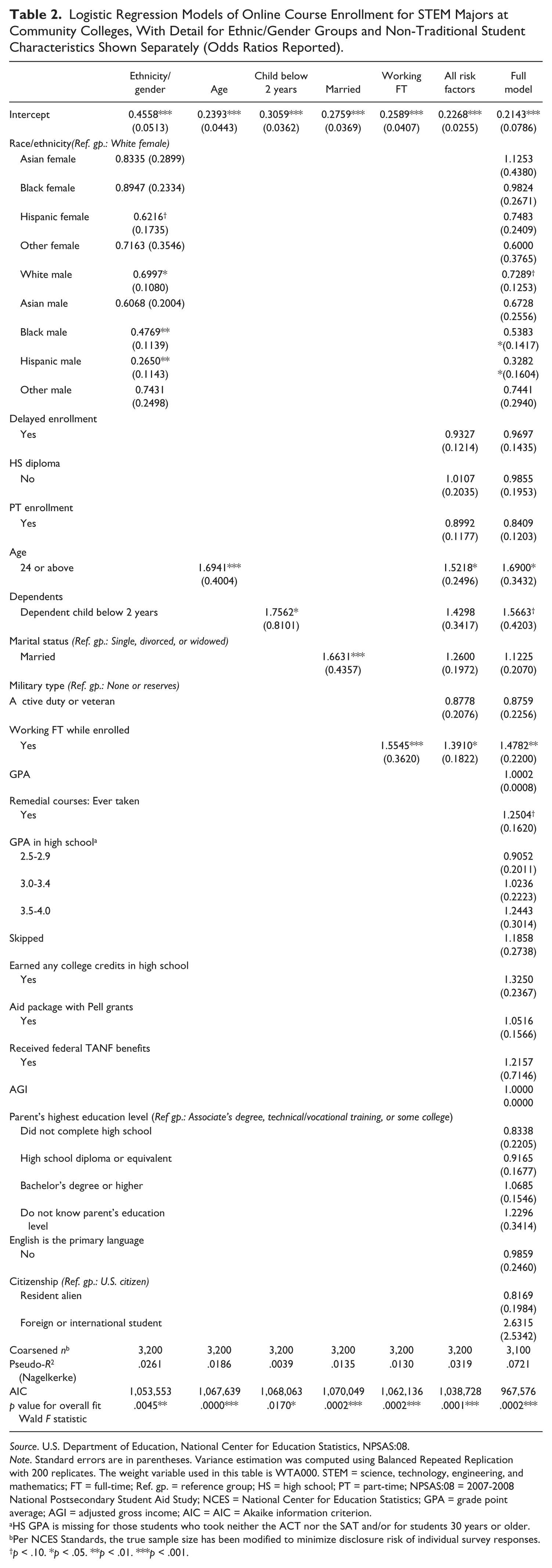
The odds ratios, standard errors, and tests for significance for several models can be seen in Table 2. Individual models for each risk factor alone as a predictor of online enrollment are presented in the cases where such models were significantly different from the null model; this allows us to consider the predictive power of that individual predictor alone, without yet controlling for other variables. Then, a model incorporating all of the non-traditional characteristics as predictors of online enrollment is included in Table 2; this allows us to see the relative predictive power of each individual non-traditional characteristic when all other non-traditional student characteristics are controlled. And finally, a model is presented that includes all of the non-traditional student risk factors along with ethnicity/gender, academic preparation, SES, and ESL/citizenship status; this allows us to determine which of these factors are significant predictors of online enrollment for community college STEM majors when all other factors are controlled.
Logistic Regression Models of Online Course Enrollment for STEM Majors at Community Colleges, With Detail for Ethnic/Gender Groups and Non-Traditional Student Characteristics Shown Separately (Odds Ratios Reported).
Source. U.S. Department of Education, National Center for Education Statistics, NPSAS:08.
Note. Standard errors are in parentheses. Variance estimation was computed using Balanced Repeated Replication with 200 replicates. The weight variable used in this table is WTA000. STEM = science, technology, engineering, and mathematics; FT = full-time; Ref. gp. = reference group; HS = high school; PT = part-time; NPSAS:08 = 2007-2008 National Postsecondary Student Aid Study; NCES = National Center for Education Statistics; GPA = grade point average; AGI = adjusted gross income; AIC = AIC = Akaike information criterion.
HS GPA is missing for those students who took neither the ACT nor the SAT and/or for students 30 years or older.
Per NCES Standards, the true sample size has been modified to minimize disclosure risk of individual survey responses.
p < .10. *p < .05. **p < .01. ***p < .001.
Specifically, the following patterns become apparent: Black and Hispanic male STEM majors are highly significantly underrepresented online in comparison with White female STEM majors at community colleges. To a lesser extent, White males and Hispanic females are also underrepresented. Once controlling for non-traditional student characteristics, academic preparation, SES, and ESL/citizenship, Black and Hispanic males remain significantly underrepresented. The non-traditional characteristics, which individually are significant predictors of online course enrollment for community college STEM majors, are an age of 24 or older, being married, working full-time, and having dependent children below the age of 2. However, when all non-traditional characteristics and other factors are simultaneously controlled, only being above the age of 24, working full-time while enrolled, and having dependent children below the age of 2 remained significant predictors of online enrollment for community college STEM majors. In addition, having taken a remedial course at some point in college was also a mildly significant predictor of online enrollment for community college STEM majors. To find the most parsimonious model, we did backward elimination on the full model given in Table 2, using α = .20 as the threshold for retaining variables in the model; because of space constraints, we do not report detailed model coefficients for the most parsimonious model here, but the variables that were retained in this model are ethnicity/gender, age, dependent children below the age of 2, and working full-time while enrolled.
Predicted probabilities for the most significant risk factors, based on the full model, can be seen in Figure 3. Once all other factors are controlled, only about one fifth of younger students without full-time jobs and younger children enroll in online courses, while in contrast almost half of all older students with full-time work and young children enroll in online courses. Even when controlling for age (and other factors), having small children at home and working full-time while enrolled remain significant predictors of online enrollment for STEM majors at community colleges.
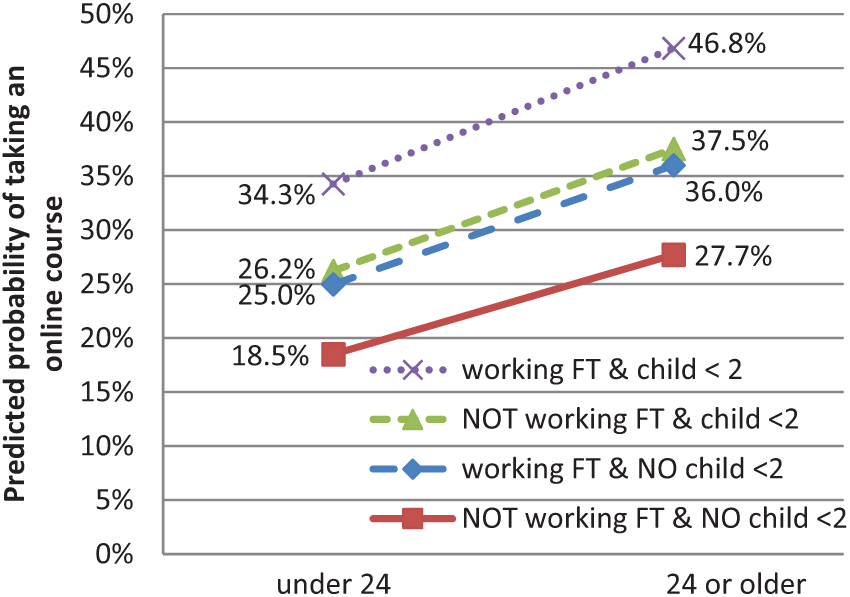
Predicted probability of taking an online course (CommunityColleges, Table 2) by age, full-time (FT) employment while enrolled and dependent child below 2 years.
Limitations
This study only looks at the probability that a student majoring in STEM took an online course. However, the individual courses taken by each group of students, and the extent to which the courses taken were in their major discipline, were not available in the national data set. In addition, some subgroups of interest in this study were relatively small, and thus it was not possible to draw firm conclusions about every factor; this suggests that further studies with larger samples sizes could assist in explicating the significance of some of these factors.
Also, while this analysis controlled for a number of different student characteristics that may predict online enrollment, it did not control for them all. This study focused in particular on student characteristics; however, there are other factors, such as institutional-level policies and resources relevant to online learning (e.g., which courses are offered online, what resources are available for online students), which likely also impact student decisions to enroll online. Future studies that explore these factors in addition to the ones explored here, may shed more light on factors that affect online enrollment for community college STEM majors.
Discussion and Implications
When modeling online enrollment at 2-year in comparison with 4-year colleges, the impact of ethnicity and gender as predictor variables was stronger than the impact of non-traditional risk factors. For 4-year college STEM majors, non-traditional student risk factors were strongly positively linearly correlated with online enrollment, with each additional risk factor increasing a STEM major’s probability of enrolling online by five percentage points, whereas for 2-year STEM majors, each additional risk factor increased the likelihood of online enrollment by only three percentage points, and the impact of non-traditional risk factors peaked around three to four risk factors for this group, instead of steadily increasing in a linear fashion. This suggests that models of online STEM major enrollment which are based largely on 4-year college students may be insufficient to model student behavior at community colleges and that further research on larger samples of community college students is needed to determine what differences may exist between the factors, which influence online enrollment at community colleges and 4-year colleges.
In particular, this study shows that not all groups of STEM major students are equally represented in the online environment at community colleges: Black and Hispanic males, in particular, are not proportionally represented in the online environment even after controlling for non-traditional student characteristics, academic preparation, SES, and ESL/citizenship status. This reinforces patterns observed more generally in online courses, in which non-White minorities are underrepresented in comparison with Whites online and in which women are represented in higher proportions than in the general college population (Angiello, 2002; Jaggars & Xu, 2010; Xu & Jaggars, 2011; Wladis et al., n.d.). Also reinforcing patterns observed in general online courses, female STEM majors are represented in higher proportions in online courses than in face-to-face courses at community colleges, suggesting that documented issues such as female stereotype threat and implicit bias may play out differently in online STEM courses because of the higher representations of women. Online STEM courses may provide a good opportunity for recruiting and retaining female STEM majors at community colleges. Further research is needed to explore this possibility.
Community college STEM major students with non-traditional student characteristics were significantly more likely to enroll in online courses, even when ethnicity, gender, academic preparation, and SES were controlled. This suggests that general patterns of non-traditional students enrolling in online courses at higher rates (Pontes et al., 2010; Wladis et al., n.d.) also hold for STEM majors at community colleges, where a larger proportion of students are non-traditional. In particular, community college STEM majors who were 24 years of age or older, those who worked full-time while enrolled, and those with dependent children below the age of 2 were particularly likely to take online courses, and these factors remained in the most parsimonious model of online enrollment for STEM majors. This suggests that non-traditional students, who are not enrolling or persisting in college (and in STEM degrees) at the same rates as their more traditional peers, may be more likely to enroll in courses if they are offered online. This is an additional key area for future research to explore.
Until more research is available which clarifies the extent to which online course access impacts student decisions to enroll in college courses, institutions should be cautious about limiting access to online courses because of the potentially disproportionate impact this may have on certain non-traditional groups of students such as older students, students working full-time, and students with small children. For example, many community colleges, concerned about documented higher attrition rates in online courses, have instituted screening procedures that allow only certain students to enroll online (e.g., by barring or discouraging certain students from enrolling online), have limited which courses can be offered online (e.g., prohibiting developmental courses from being taught online), or have limited the number of courses that a student may take online (Liu, Gomez, Khan, & Yen, 2007). If STEM students who work full-time or have small children are enrolling in online courses because they are the only types of courses with the flexibility needed to meet their schedule, then these same students may not enroll in an alternate face-to-face course if the online course they need is not available—they may simply choose not to enroll in college at all that semester, or they may choose to enroll in fewer courses. If this occurs, it could have serious implications for college persistence and STEM degree completion for this group, as academic momentum (e.g., the rate at which students complete course credits toward a degree) has been shown to be a significant predictor of college completion (Attewell, Heil, & Reisel, 2012). Until more research is available about the impact of these policies on student enrollment decisions online, colleges may need to be cautious about implementing rules or procedures that limit the availability of online courses. Institutions will need to carefully consider how to balance concerns about online retention with concerns about potentially restricting access to college courses for the older students, full-time employees, and parents of small children who are most likely to take courses online.
This research also suggests that any observational studies which aim to determine the effect of the online environment on course outcomes for STEM majors at community colleges will need to include a number of factors as covariates to control for hidden self-selection bias. It seems particularly important for many of the non-traditional student risk factors such as working full-time, having young children, and being financially independent, as these factors are often not routinely collected by institutional research departments and are often not included in statistical analyses of online versus face-to-face course outcomes. In particular, including just a single one of these non-traditional student characteristics, as many studies who attempt to control for these factors have done, may not be sufficient to capture all of the bias due to non-traditional factors that are impacting online student enrollment; the rate of online course enrollment increases significantly as the number of non-traditional student characteristics increases, at least for the first three or four risk factors. Furthermore, certain academic preparation characteristics that are also common among non-traditional students, such as a history of remedial course taking, may also be significant sources of self-selection bias.
The data set used in this study was not appropriate for assessing online course outcomes, because it did not include course-level data on online and face-to-face courses. However, future studies could be conducted on data sets that include student grades in comparable online and face-to-face sections of specific STEM courses, in addition to student characteristics. If many of the non-traditional student characteristics cited as significant predictors of online course enrollment for STEM majors in this study were included as covariates or used in a matching procedure, then resulting differences in online versus face-to-face course retention or passing rates could be more accurately estimated.
Footnotes
Authors’ Note
The opinions reflect those of the authors and do not necessarily reflect those of the granting agencies.
Declaration of Conflicting Interests
The authors declared no potential conflicts of interest with respect to the research, authorship, and/or publication of this article.
Funding
The authors disclosed receipt of the following financial support for the research, authorship, and/or publication of this article: This research was supported by a grant from the American Educational Research Association (AERA), which receives funds for its “AERA Grants Program” from the National Science Foundation (NSF) under NSF Grant DRL-0941014.