



Abstract
Objective:
The proportion of high school students taking college courses (e.g., dual credit) is increasing and state and local policies are expanding, yet little is known about the effect of dual credit policies on key educational outcomes, including the effects for low-income students and students of color. The purpose of this study was to examine how dual credit policies differentially influence college access and completion.
Method:
This study used propensity score matching to examine the impact of community college dual credit policy in Illinois using a large sample of students (n = 41,727) who completed high school in spring 2003. Drawing from Perna and Thomas’ Conceptual Model of Student Success and Rawls’ notion of justice as fairness, the study examined effect heterogeneity to determine differential effects for low-income students and students of color on two educational outcomes: college enrollment and college completion.
Results:
The analyses showed that dual credit policies positively affect all students, but smaller effect sizes were detected for low-income students and students of color compared with average estimates suggesting that existing dual credit policies are inequitable.
Contributions:
Policy implications and recommendations include assessing state policies and integrating non-cognitive and psychosocial supports into dual credit programs to support underserved students.
The practice of high school students earning college credit in the United States is a growing phenomenon as more colleges and high school partnerships provide students with an accelerated pathway to college. Referred to as dual credit, dual enrollment, or concurrent enrollment, 1 the National Center for Education Statistics (NCES) surveys of public high schools show that the number of high school dual credit enrollments increased from 1.16 million in 2002-2003 to 2.04 million in 2010-2011 (Thomas, Marken, Gray, & Lewis, 2013; Waits, Setzer, & Lewis, 2005). A companion study of colleges and universities reveals that nearly all (98%) of public 2-year colleges and the majority (84%) of public 4-year colleges offer dual credit to high school students, suggesting the practice is widespread in higher education (Marken, Gray, & Lewis, 2013). A similar level of growth is observed in Illinois during a similar time period as the enrollment of high school students in college-level courses grew from 11,809 students in 2001 to 75,989 in 2008 (Andrews & Barnett, 2002; Illinois Community College Board [ICCB], 2010). Dual credit state policies have also expanded, and research shows that most states have state-level policies that regulate dual credit (Borden, Taylor, Park, & Seiler, 2013).
As dual credit expands to more institutions and a larger number of students, there is little rigorous evidence about the impact of dual credit participation on students’ access to and success in college, and there is less evidence about how dual credit policies affect different groups of students. Despite insufficient evidence, some policymakers and scholars advocate dual credit as a promising model for students who historically have not accessed college at high rates such as students of color and low-income students (Boswell, 2001; Hoffman, 2005; Hugo, 2001). That is, dual credit is perceived and promoted as a policy mechanism to reduce educational inequities in college access and ultimately college completion.
There are at least two compelling explanations that lead one to this conclusion. First, there is some evidence suggesting that dual credit participation has a warming-up effect—dual credit can increase students’ aspirations to attend and complete college (Howerter, 2011; Karp, 2012). Using this logic, underserved students’ participation in dual credit can have psychological and motivational effects that promote access to college for students who, had they not participated in dual credit, might not have attended college. Second, dual credit may reduce educational inequities by providing more opportunities for college-level learning to high school students. Because research indicates that the rigor of students’ high school curriculum and the accumulation of college credits in high school are strong predictors of college access and success (Adelman, 1999, 2006; Attewell & Domina, 2008), participating in dual credit may increase underserved students’ likelihood of college enrollment and success. The purpose of this study is to determine the potential differential effects of dual credit on postsecondary access and success for low-income and students of color. Using data from a longitudinal dataset in Illinois, I concentrate my analysis on 12 Illinois community colleges that are predominantly providers of dual credit activity during the observation period. The following research questions were answered in this study:
To answer these questions, I used propensity score matching (PSM), a quasi-experimental approach, to estimate the average treatment effect on the treated (ATT) and used sensitivity analysis to determine whether the results were robust to unobserved variable bias.
Educational Inequity and Community Colleges
Postsecondary educational opportunities in the United States have historically been and continue to be unequal for different groups of students. On average, the NCES estimates that the proportion of high school students who immediately transition into college increased from 50.7% in 1975 to 70.1% in 2009 (Aud et al., 2011), but these transition rates vary greatly by race/ethnicity and income. The 2009 college enrollment rate was 71.3% for Whites and 90.4% for Asians; yet, the rate was 62.6% for Blacks and 61.6% for Hispanics. When disaggregated by income, 84.2% of high-income students enrolled in college immediately after high school graduation, but only 66.8% of middle-income students and 54.1% of low-income students immediately enrolled in college. Similar disparities are observed when examining college completion outcomes. Based on data from the Education Longitudinal Study of 2002, Lauff and Ingels (2014) found that the bachelor’s degree completion rate for White students 8 years after their anticipated high school graduation was 39.8% but was only 19.8% for Black students and 18.7% for Hispanic or Latino students. Similarly, the bachelor’s degree completion rate was 60.7% for students whose parents were in the highest socioeconomic status (SES) quartile but only 14.5% for students in the lowest SES quartile.
Despite these inequities in educational access and success, community colleges have historically been the gateway to higher education for many underserved students, providing access to populations who otherwise would not attend higher education (Cohen & Brawer, 2008). In the last decade, the discourse on equity in the community colleges is shifting from equitable access to concepts of outcome equity as a way of “revitalizing the democratic mission of the community college” (Dowd, 2003, p. 92). Dowd (2003) contends that higher education institutions should result in equal outcomes for different socioeconomic groups, and higher education accountability systems should be designed to be equity-inclusive.
Dual Credit Impact Studies
Although dual credit programs and policies have operated in some states and localities since the 1950s, there is relatively limited evidence on the impact of dual credit on postsecondary access and completion at the state or national level. In one of the first major dual credit impact studies, Karp, Calcagno, Hughes, Jeong, and Bailey (2007) examined the impact of dual enrollment in Florida using logistic regression and accounted for students’ demographic characteristics, student achievement, and several high school–level variables. Using a large sample of high school students from 2000 to 2001 and 2001 to 2002, they found that dual credit students were 16.8% more likely to enroll in college immediately after high school graduation compared with non-dual credit students. In a more recent study, Struhl and Vargas (2012) examined the impact of dual credit using a sample of Texas high school students who were seniors during the 2003-2004 year and followed these students’ educational pathways through 2011. They used PSM and a relatively robust set of control variables (e.g., demographic variables and academic history and performance variables) to determine the impact of dual credit on college enrollment. They found that dual credit students were 2.21 to 2.3 times more likely to enroll in college than the matched group of students who did not participate in dual credit.
Only one study to date used a quasi-experimental design to examine differences in dual credit outcomes based on race/ethnicity. Speroni (2011) used longitudinal data from Florida and examined the impact of dual credit on college enrollment and completion. She used a fixed effects and difference-in-difference design to estimate the causal effect of dual credit participation. Her fixed effects model accounted for demographic and academic performance variables, and she found that dual credit students were 11% more likely to enroll in college relative to non-participants. Unique to Speroni’s study was her examination of effect heterogeneity where she examined the outcomes of Black and Hispanic dual credit students relative to dual credit students of other races/ethnicities. She found that dual credit minority students were equally as likely to enroll in college as non-minority dual credit students. However, her examination of effect heterogeneity for minority students suggests that dual credit minority students have a slightly smaller likelihood of completing a bachelor’s degree (6%) compared with similar dual credit non-minority students (8%).
Research also shows that dual credit influences the longer-term outcome of college completion. Struhl and Vargas’ (2012) data from Texas also found that 6 years after high school graduation, dual credit students were 1.66 to 1.78 times more likely to complete college relative to non-dual enrollment students. In one of the only studies that used nationally representative data, An (2013) examined the effect of dual enrollment on bachelor’s degree completion for low-income students using the National Educational Longituindal Study of 1988 (NELS), PSM, and a comprehensive set of control variables (demographic, college aspirations and expectations, academic preparation, counselor and parent interaction, and school-level contextual variables). His results showed that 8 years after high school graduation, dual enrollment participation increased the probability of earning a bachelor’s degree by 7% and earning any college degree by 7%. An also found that first-generation dual enrollment participants were 8% more likely to earn a bachelor’s degree than non-dual enrollment first-generation participants. In an additional analysis, An used decomposition analysis to determine the role of dual enrollment in reducing SES differences in college. An found that after controlling for other factors, “dual enrollment accounts for less than 1% of the gap in degree attainment between first-generation students and students whose parents attended at least some postsecondary schooling” (pp. 65-66). His results suggest that when accounting for other factors, dual enrollment has little influence on reducing and remediating existing inequities.
Conceptual Model
The conceptual basis for this study is Perna and Thomas’ (2008) Conceptual Model of Student Success and John Rawls’ Theory of Justice. Perna and Thomas’ model suggests that multiple academic disciplines (e.g., economics, education, psychology, and sociology) and theoretical approaches provide a more comprehensive understanding of the factors that influence student success relative to an individual disciplinary lens. Their model is grounded in Perna’s (2006) work on college choice and draws from vast body of literature that attempts to explain the college choice process and factors that influence college choice (Hossler, Schmit, & Vesper, 1999; Paulsen, 1990; Perna, 2006; Stage & Hossler, 1989). The model hypothesizes that four embedded layers contribute to student success along a longitudinal continuum of success indicators ranging from college readiness to college enrollment, college achievement, and postcollege attainment.
Layer 1 is the internal context and is defined as students attitudes, motivations, and behaviors. Layer 2 is the family context and suggests that family factors influence student experiences and subsequently student success. Layer 3 is the school context (e.g., context for any educational institution) defined by “educational resources, academic preparation, and educational orientations” that relate to student success (p. 44). The fourth layer is the social, economic, and policy context that encompasses the external factors that influence student success. Perna and Thomas’ (2008) model provides the conceptual basis for determining which variables to use in the creation of the propensity score.
This study also draws on John Rawls’ (1999) Theory of Justice. Rawls’ (1999) theory provides a moral framework for educational policy and practice that can be used to assess policy outcomes. The fundamental premise of Rawls’ theory, which he calls justice as fairness, is that individual rights and liberties should be equally distributed unless unequal distribution also favors the least advantaged groups in a society—that is, if unequal distribution favors all. If education is a basic liberty and access to higher education is not equal (St. John, 2003), then higher education policy and practice should at least benefit equally those students who do not have equal access to higher education. Levin (2007) applied Rawls in his study of non-traditional community college students and argued that “we can judge a nation’s or a state’s educational apparatus by how well it facilitates actual, not merely formal, equal opportunity for the worst-off citizen” (p. 47). Rawls’ theory rejects a utilitarianism philosophy whereby policies maximize the benefit for all (i.e., the average) and argues that policies must at least be of equal benefit to those who are among the most marginalized and disadvantaged in society.
Research Design
Policy Context
The policy framework for dual credit in Illinois is the Dual Credit Quality Act (DCQA) passed by the Illinois legislature in 2009. The legislation articulates many purposes including, “to offer opportunities for improving degree attainment for underserved student populations” (Illinois DCQA, 2009, n.p.), but the legislation does not explicitly articulate how this goal is accomplished. The legislation mostly defines criteria for how institutions must adhere to quality standards such as faculty credentials, course rigor, and student placement testing. A short section of the law addresses student access by charging the state agencies to develop a policy for differentiated assessment for student eligibility, but to date, no such policies have been developed.
In addition to the DCQA, the ICCB has administrative rules that regulate the provision of dual credit. The rules, which have been in place since the 1990s, on which the DCQA were loosely based, provide a framework for delivering dual credit related to quality standards, placement and testing, instructor qualifications, and course offerings, for example. Although the DCQA suggests that dual credit should provide increased opportunities for degree attainment for underserved students, there is no evidence to suggest the policy is meeting this intended goal.
Data Sources and Sample
The dataset used in this study was obtained from the Illinois Educational Research Council (IERC) at Southern Illinois University at Edwardsville and contained all Illinois public high school students (n = 115,677) who took the ACT exam in their junior year in 2002 (referred to as the Illinois High School Class of 2003, hereinafter). The dataset includes ACT self-reported survey responses, ACT scores, and matched records from the National Student Clearinghouse (NSC). The NSC data include college enrollment and completion records for all students from fall 2001 through fall 2010.
I used a purposeful sampling strategy within this population. The sample begins with a population of 115,677 students, 15,041 of which participated in community college dual credit or dual enrollment during their junior and senior years of high school. I applied the following two conditions to construct the sample for this study: First, a requirement of using PSM is that matching variables should not include confounding variables that may influence outcomes after the treatment (Rosenbaum & Rubin, 1983). Some students participated in dual credit during their sophomore and junior years of high school (prior to ACT administration). I restricted the sample to only those students who participated in the treatment (dual credit) during senior year to satisfy this PSM assumption (12,800 of the 15,041 students). Second, I made a substantive distinction between dual credit and dual enrollment based on Illinois’ policy definitions. In Illinois, dual credit represents an administratively facilitated program (most often on the high school campus), whereas dual enrollment is not administratively facilitated and students independently enroll in college courses. The dataset did not include a measure of this, but I used aggregate data (Barnett, 2003) to identify community colleges whose students mostly participated in dual credit rather than dual enrollment. I identified 12 community college districts whose proportion of high school students taking college courses was at least 80% dual credit (the average was 95% dual credit). After limiting the sample to students from these 12 colleges and eliminating 22 students with missing degree completion records, 5,315 dual credit students remained in the treatment group.
To construct the control group, I identified 246 Illinois public high schools in which the 5,315 dual credit students were enrolled and selected all non-dual credit students who attended these high schools as potential students for the control group. There were 36,422 non-dual credit students with complete outcome records that formed the control group. Within this full analytical sample (n = 41,737), I created two sub-samples of students of color, defined as all non-White students, that represented approximately 34% of the sample (n = 14,152) and low-income students, defined as students whose parents were in the lowest income quartile, that represented approximately 23% (n = 9,392) of the sample. These two sub-samples are not mutually exclusive (i.e., some low-income students are students of color), but these two sub-samples were created to test the effect of the independent sub-samples. After conducting PSM (described below), the matched sample for the full group included 4,727 dual credit students and 17,639 non-dual credit students. The matched sample for low-income students included 668 low-income dual credit students and 2,159 low-income non-dual credit students, and the matched sample for students of color included 684 dual credit students of color and 4,379 non-dual credit students of color.
Variables
The 26 independent variables used to generate the propensity score are organized according to the first 2 layers of Perna and Thomas’s (2008) model representing the Internal Context and Family Context layers, respectively (see Figure 1). With the exception of students’ ACT scores, all independent variables were based on students’ self-reported items from the ACT Student Information Survey. The Internal Context layer included 20 variables associated with the following four categories: (a) academic preparation and achievement, (b) demographics, (c) high school extracurricular activities, and (d) academic and career expectations and aspirations.

Variables aligned with Perna and Thomas (2008) model.
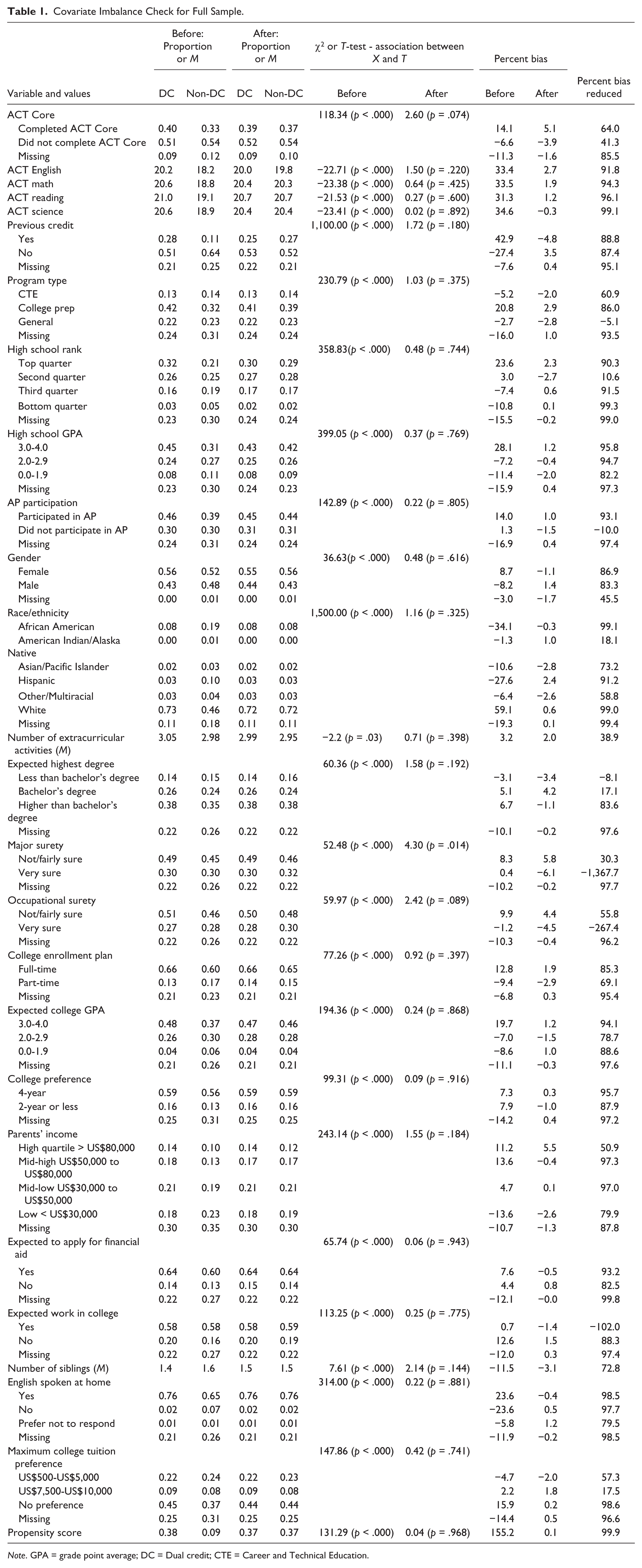
The second layer, Family Context, included six categorical or ordinal variables: (a) parents’ income quartile, (b) expected to work in college, (c) expected financial aid, (d) number of siblings under 21, (e) English spoken at home, and (f) maximum annual tuition preference. Specific variable definitions and codes are provided in Table 1, but it is useful to comment briefly on how income status and race/ethnicity variables were coded. Researchers measure and examine SES and income distributions in several different ways (Hauser, 1994). I elected to distribute students’ self-reported parental income into quartiles and established US$ 0 to US$30,000 as the lowest quartile, consistent with ACT researchers’ categorization of low-income status (Lorah & Ndum, 2013). I created relatively equal income quartiles (based on 10k increments as measured by ACT survey). For race/ethnicity, students of color included all students who self-identified as African American/Black, American Indian/Alaskan Native, Mexican American/Chicano/Latino, Asian American/Pacific Islander, Hispanic, and Multiracial/Other. Although grouping all non-White racial/ethnic categories together is problematic, I elected to group in this way because some racial/ethnic categories were too small to examine independent effects. Also, as Table 1 suggests, a larger proportion of all non-White groups did not participate in dual credit compared with White groups suggesting similarities in dual credit participation among the non-White racial/ethnic groups.
Covariate Imbalance Check for Full Sample.
Note. GPA = grade point average; DC = Dual credit; CTE = Career and Technical Education.
Descriptive statistics for the full analytical sample are provided in Panels 2 and 3 in Table 1 and disaggregated by dual credit participation. These data show that on average, dual credit students had higher levels of academic preparation and achievement, were more likely to be female and White, participate in more extracurricular activities, and had higher academic and career expectations and aspirations than non-dual credit students. Similarly, dual credit students were more likely to have parents in the upper income quartiles, more likely to apply for financial aid, and more likely to speak English at home compared with non-dual credit students.
Two dependent variables were examined in this study: college enrollment and degree completion. The first variable, college enrollment, was coded as a binary variable that indicates whether students (a) ever enrolled in college during the observation period (fall 2003 to fall 2010), or (b) never enrolled in college during the observation period. Degree completion was also coded as a binary variable indicating whether students (a) completed any certificate or associate’s or bachelor’s degree, or (b) did not complete a certificate or associate’s or bachelor’s degree.
Treatment
Student participation in dual credit (e.g., the treatment) was measured using NSC enrollment data. The treatment variable was a binary variable indicating students’ enrollment in 1 of the 12 community colleges during the 2002-2003 academic year (e.g., students’ senior year of high school). It is important to note that data were not available on the type of dual credit course, students’ completion or performance in dual credit courses, or the number of credits attempted or earned via dual credit. Thus, participation in the treatment represents students’ participation in one or more academic or technical course, most likely taught at the high school location. We know from other studies that about half of dual credit students were enrolled in career and technical courses, and about half were in academic courses or transfer courses (ICCB, 2010); it is reasonable to extrapolate this to the sample in this study. The absence of rich descriptive data on the nature of the treatment is a limitation of this study that is an artifact of inadequate data and reporting at the state level.
Analytic Strategy
The primary analytical strategy used in this study was propensity score matching (PSM). Rosenbaum and Rubin (1983) introduced PSM as a way to reduce biased estimates using observational data under non-experimental conditions by modeling the selection process and reducing selection bias (Morgan & Winship, 2007; Shadish, Cook, & Campbell, 2002). My analytic approach to PSM included six steps in the following sequence: (a) Create the propensity score, (b) check for common support, (c) conduct matching using caliper matching, (d) check for covariate imbalance, (e) estimate the ATT, and (f) conduct sensitivity analyses. These steps were conducted on the full sample and the sub-samples of students of color and low-income students.
Logistic regression analysis was used to create the propensity score using the 26 covariates. The following equation generated the propensity scores for the sample:

where

where
I visually analyzed the distribution of propensity scores for a region of common support to ensure there was overlap in propensity scores between the treatment and control group (Caliendo & Kopeinig, 2008). I then used Stata’s nnmatch program that used nearest neighbor matching with replacement. Because I had a large control group, I applied a caliper of .01, meaning that a control unit was not matched with a treatment unit unless the difference in propensity score was less than .01. I also used 1:many matching, meaning that a control unit could have been matched to a treatment unit more than once; weighting was used in the final estimate for the 1:many matches.
Finally and importnatly, I accounted for Perna and Thomas’ (2008) third and fourth layers by matching within high schools, which accounted for high school, community college, social, and policy-level differences that research suggests may influence students’ selection into the treatment and college outcomes.
To determine whether matching was successful, I tested for covariate imbalance by checking for statistical differences between the treatment and control group post-matching using ANOVA and chi-square tests and by assessing the reduction in standardized bias (Caliendo & Kopeinig, 2008). Table 1 demonstrates that covariate balance was achieved for the full sample, meaning there were no differences between the treatment and control groups on all 26 variables. Balance was similarly achieved for the sub-samples of students of color and low-income students (data not included but available by request). Once balance was achieved, I estimated the average treatment effect of dual credit participation on college enrollment and college completion using logistic regression.
Finally, I used sensitivity analysis to strengthen the strongly ignorable treatment assignment assumption. This assumption suggests that assignment to the treatment is independent of the outcome based on the observable baseline covariates and that there are no unobserved variables. Sensitivity analysis tests the latter aspect of this assumption and determines the extent to which the estimates were susceptible to hidden bias (Rosenbaum, 2002). Sensitivity analysis assumes that treatment assignment is not ignorable given
The intention of this stuyd and analysis was to apply Rawls’ theory to Illinois’ dual credit policy whereby the average effect of dual credit is estimated not just for the entire sample (i.e., average policy effect), but for sub-samples of low-income students and students of color. Thus, a fair and just dual credit policy in Illinois would be one in which the outcomes of low-income students and students of color would at least be equal to the average effect for the entire sample.
Limitations
The most significant limitation of this study was the inability to make a causal estimate due to unobserved variable bias. For example, data on parents’ education, interactions with peers, and interactions with counselors, for example, are variables important to the college choice process (Hossler et al., 1999) that likely influence students’ selection into the treatment and the dependent variables. These variables were not in the dataset, and I do not make a causal inference in this study. However, the sensitivity analysis results counter this limitation by providing an estimate of how large the unobserved variable would need to be to significantly affect the results. As reported below, the results suggest that any unobserved variable would need to have a relatively large effect (approximately as large as the treatment effect) in the model to significantly influence the results. A second limitation is the reliance on students’ self-reported data and the implications for key demographic variables such as parents’ income. Self-reported data may be subject to error, but in the absence of financial aid or other income data, self-reported income is a reasonable alternative that is widely used in higher education research. A third limitation of this study was that an impact study such as this does not answer critical questions about the mechanisms by which dual credit affects student outcomes. Explaining how dual credit relates to the outcomes is equally important research that other scholars have studied (Karp, 2012; Karp & Hughes, 2008) and should continue to be explored by researchers. Related, because the dataset used in this study has limited information on students’ experience in dual credit, this study is somewhat of a “black box” policy evaluation in that the results only explain the effect of the policy but do not provide an explanation for the effect. However, the study contributes to the literature and to practice by providing estimates on the overall impact of state policies.
Results
Descriptive results for the research questions are summarized in Table 2. Dual credit students outperformed their peers who did not participate in dual credit. Ninety-one percent of dual credit students enrolled in college and 52% completed college. These results compare with 63% of non-dual credit students who enrolled in college and 29% who completed college. Although these are descriptive results, and no correlation or causation can be assumed, there were strikingly large differences between the success of dual credit and non-dual credit students on college access and completion, and these results were consistent with previous literature (Karp et al., 2007). Table 2 also includes descriptive results for the sub-samples of low-income students and students of color. Ninety-one percent of dual credit students of color enrolled in college and 43% completed college compared with the 62% of non-dual credit students of color who enrolled in college and 23% who completed college. For the low-income sub-sample, 85% of low-income dual credit students enrolled in college and 34% completed college, whereas 58% of non-dual credit students enrolled in college and 18% completed college.
Descriptive Comparison of College Enrollment and College Completion Rates Across Samples.

The descriptive results suggested that dual credit benefits all students, including students who are historically underrepresented in higher education. However, the results also showed that college enrollment and completion rates of the full sample of dual credit students were higher than the sub-samples of students of color and low-income students who participated in dual credit.
Matched Samples and Effect Heterogeneity
Although these descriptive data convey a compelling story, it is unclear whether the observed differences in college enrollment and college completion are due to participation in dual credit or due to students’ self-selection into dual credit (i.e., selection bias). That is, the observed differences in outcomes between the dual credit and non-dual credit students may be a result of pre-existing characteristics and not student participation in dual credit.
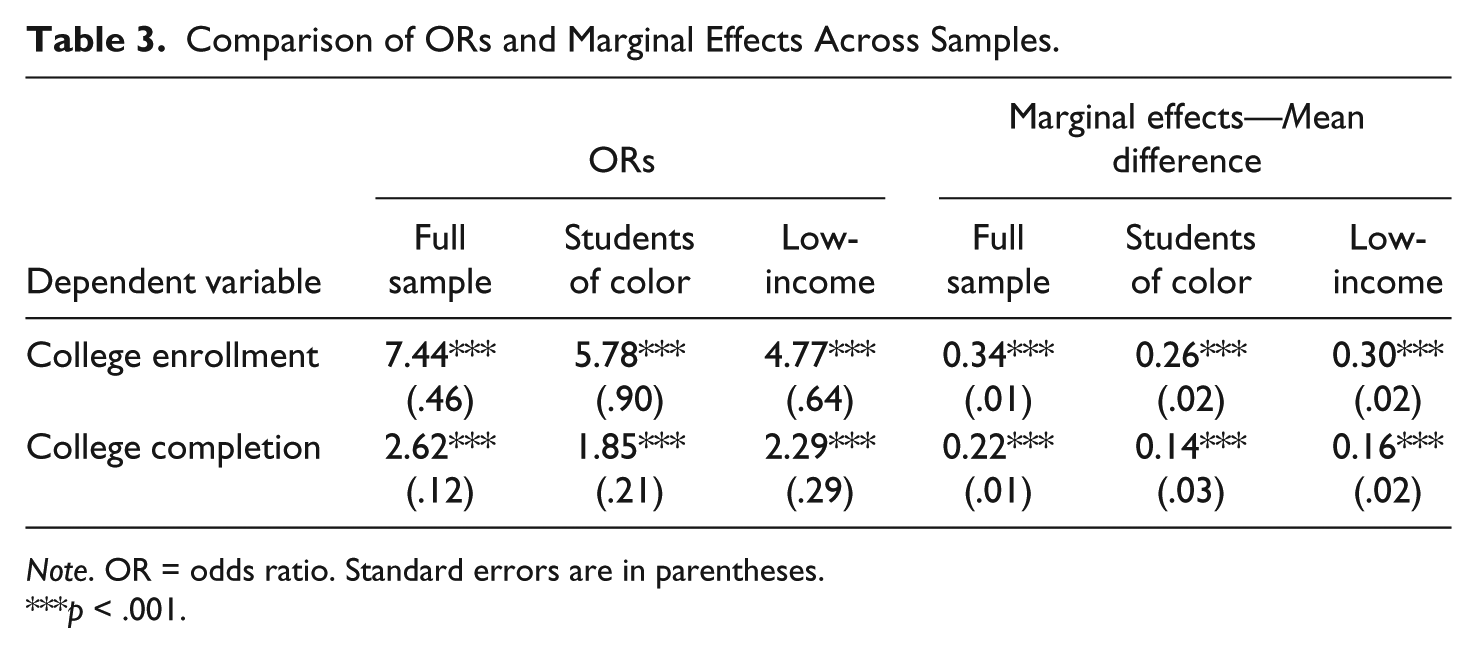
Table 3 reports the odds ratios and marginal effects for the PSM models. Similar to the descriptive data, the data showed that the matched samples of dual credit students of color and low-income students both enrolled in college and completed college at rates much higher than their non-dual credit peers. For the matched sample of students of color, 92% of dual credit students enrolled in college and 43% completed college, whereas only 66% of non-dual credit students enrolled in college and 29% completed college. The odds ratios of the logistic regression model were 5.78 (p < .001) for college enrollment and 1.85 (p < .001) for college completion, suggesting the odds of success for dual credit students of color were higher than students of color who do not participate in dual credit. The mean difference in college enrollment and college completion rates between the matched sample of dual credit students of color and non-dual credit students of color (i.e., the marginal effect) was 26% and 14%, respectively. This means that dual credit students of color were 26% more likely to enroll in college and 14% were more likely to complete college than non-dual credit students of color. Results from the sensitivity analysis revealed significant
Comparison of ORs and Marginal Effects Across Samples.
Note. OR = odds ratio. Standard errors are in parentheses.
p < .001.
For the matched sample of low-income students, the data showed that 86% of dual credit students enrolled in college and 34% completed college compared with 56% of the non-dual credit students who enrolled in college and 18% who completed college. The logistic regression models produced an odds ratio of 4.77 (p < .001) for the college enrollment model and a 2.29 (p < .001) for the college completion model. The mean difference in the college enrollment and college completion rates between low-income dual credit and non-dual credit students were 30% and 16%, respectively. That is, low-income dual credit students were 30% more likely to enroll in college and 16% more likely to complete college than low-income students who did not participate in dual credit. Similar to the sample of students of color, the sensitivity analysis showed that the college enrollment estimate was relatively robust to hidden bias with a significant
The significance of these results relative to the average effect for the full sample should not be understated. As Table 3 displays, the effect for the full sample showed that, on average, dual credit students were 34% more likely to enroll in college and 22% more likely to complete college relative to their non-dual credit peers. Comparing the effects of the full sample with the sub-samples of students of color and low-income students, the data suggested that dual credit does have a positive effect on college enrollment and college completion for all students and for students of color and low-income students. Despite this finding, Table 3 also shows that the odds ratios and marginal effects for students of color and low-income dual students were substantially smaller than that of the full sample suggesting inequitable effects. The gap in the difference in the probability of enrolling in college and completing college was between 4 and 8 percentage points lower for students of color and low-income students, respectively, compared with the full sample. Stated more succinctly, the data showed that community college dual credit policy in Illinois had a significant and positive effect on students’ chances of college enrollment and completion, but the effect of the policy is inequitable. What follows is a discussion of these results and implications for policy, practice, and future research.
Discussion and Implications
College access and success have long been the subject of scholarly inquiry in higher education, particularly in the contemporary policy climate of college completion. A significant portion of the college access literature focuses on college choice (i.e., access) and pre-college factors that predict success in college (Adelman, 2006; Attewell & Domina, 2008; Hossler et al., 1999; Perna, 2006). Among the salient pre-college factors that predict students’ subsequent success in college is the intensity of students’ high school preparation (Adelman, 2006; Attewell & Domina, 2008), and students’ participation in dual credit and dual enrollment is increasingly an element of students’ pre-college matriculation preparation. Evidence from this study supports the claim that high school students’ participation in college courses has a meaningful effect on college outcomes such as college enrollment and completion. Dual credit students were 34% more likely to enroll in college and 22% more likely to complete college compared with non-dual credit students. The evidence from Illinois is consistent with the literature in other states such as Florida (Karp et al., 2007; Speroni, 2011), New York (Karp et al., 2007), and Texas (Giani, Alexander, & Reyes, 2014; Struhl & Vargas, 2012), as well as estimates from national data sets (An, 2013) that show that students who participate in dual credit/enrollment are more likely to transition into college and be successful in college compared with students who do not participate.
Unlike some prior studies, this study explicitly examined effect heterogeneity and found that the effect estimates for students of color and low-income students are smaller than the average effect size. The rationale for comparing the average effect for all students with the average effect for the sub-samples of students of color and low-income students in this study was based on Rawls’ (1999) notions of justice as fairness. Rawls’ theory rejects a utilitarian philosophy that suggests policies should maximize the benefit of the greatest number of people; rather, it argues that policies should at least be of equal benefit to those who are among the most marginalized and disadvantaged in society. Extending this logic to dual credit and early college policies, a fair and just policy would show policy effects for students of color and low-income students to be at least equal to the average policy effect. Instead, this study found a 4 to 8 percentage point gap in the probability of enrolling in college and completing college between the average effect and the effect for students of color and low-income students. Dual credit students of color were 26% more likely to enroll in college and 14% were more likely to complete college than non-dual credit students of color. Similarly, low-income dual credit students were 30% more likely to enroll in college and 16% more likely to complete college than low-income students who did not participate in dual credit.
The two existing quasi-experimental studies that estimated effect heterogeneity for students of color and/or low-income students (An, 2013; Speroni, 2011) provide some conflicting and consistent evidence as compared with this study. Speroni’s (2011) data from Florida found that students of color who participated in dual credit were just as likely to enroll in college as non-minority dual credit participants, a finding that is inconsistent with data from this study. However, Speroni (2011) found that students of color who participated in dual credit were less likely to earn a bachelor’s degree than non-minority dual credit participants, although the difference was only 2%. Similarly, An’s (2013) study used NELS to examine the effect of dual credit on low-SES students and found that first-generation dual credit participants were 7% more likely to earn a bachelor’s degree compared with first-generation students who did not participate in dual enrollment.
The results of this study also shed light on the utility of Perna and Thomas’ Conceptual Model of Student Success. Few studies have applied their model to examine student success or outcomes, but the model provided a useful analytical framework to examine the effect of this dual credit policy while accounting for multiple factors that may influence students’ selection into dual credit and their potential outcomes.
Policy Goals and Priorities
Overall, results from this study present a fundamental dilemma for policymakers insofar as dual credit policy has a positive effect for underrepresented students, but the effect size for underrepresented students is smaller than the average effect. The results suggest that state and local dual credit policies do not equally benefit students, and the states’ dual credit policy will likely have little impact on reducing existing educational inequities in college access and completion (Aud et al., 2011; Lauff & Ingels, 2014). The resolution to this dilemma should be to enhance current policies to ensure higher success rates for low-income and students of color.
It is important to understand the inequitable policy effects in Illinois in the context of the states’ policy goals and priorities. Despite DCQA’s articulated policy of providing opportunities for underserved students, data from this study show the policy is not achieving the intended objective of equal access to college or to a college credential. It is important to note that the DCQA was not enacted until 2009, but it does not differ significantly from the ICCB’s dual credit administrative rules that were in effect in 2002-2003 during the time in which students in this study participated in dual credit. Thus, it is unlikely that major changes in practice occurred as a result of the legislation that would have actually improved the experiences and outcomes for underserved students. The evidence from this study suggests that policymakers should reassess state dual credit policies and consider how they can better meet the objectives of the DCQA of providing greater opportunities for underserved students. This extends to many other states with dual credit policies whose community colleges deliver college courses to high school students with minimal support, few resources, and an absence of an equity focus (Taylor, Borden, & Park, 2015).
Beyond “Credit-Only”
One significant implication for state policy is to consider how dual credit and dual enrollment can be conceptualized beyond a credit-only model. A commonly articulated premise of dual credit and dual enrollment programs is that exposure to college courses will enhance students’ academic preparation for college and make for a smooth transition into college (Bailey, Hughes, & Karp, 2002). Students’ academic preparation in high school is a key predictor of college success (Adelman, 1999, 2006; Attewell & Domina, 2008), and evidence from this study suggests that dual credit participation, as a dimension of students’ academic preparation, is related to students’ access to and success in college. What emerges from this study, however, is that for low-income students and students of color, the academic knowledge and skills gained through dual credit are likely inadequate to esnure their future success. If policymakers expect low-income students and students of color to experience a smooth transition into college and experience success in college equal to their more affluent and White peers, one policy solution is to conceptualize and design dual credit policy and practice in ways that go beyond the mere attainment of college credit and the academic knowledge and skills associated with the dual credit courses.
The literature increasingly shows that non-cognitive and psychosocial knowledge and skills are important indicators of college readiness and success (Byrd & Macdonald, 2005; Conley, 2005, 2012; Sedlacek, 2004; Strayhorn, 2010, 2014), and this may be especially true for students of color and low-income students whose experiences prior to college do not adequately provide them with the cultural and social capital needed to transition into and be successful in college. Dual credit programs and courses would better support students of color and low-income students if designed with these factors in mind. For example, Early College High Schools (ECHS) provide a “comprehensive support system to develop academic and social skills and behaviors needed for college success” (Jobs for the Future, 2008, p. 2), particularly for underserved students, and could be a valuable model for dual credit programs. These models are intentionally designed to support underserved students who otherwise would not attend college, and initial experimental and non-experimental evidence of these models is very promising (Berger et al., 2013; Miller, Fleming, & Reed, 2013).
Because ECHS are essentially high school redesign models, they are not necessarily applicable to all secondary settings, but they are instructive. State dual credit policies could require and/or fund colleges to integrate into dual credit courses activities such as college transition workshops, mentoring opportunities, financial aid workshops, and other similar programs that explicitly support students of color and low-income students’ acquisition of college knowledge and skills, develop their self-efficacy and college student identity, and support their transition into college. Programs and policies such as Michigan’s Enhanced Dual Enrollment program, which is a scaled-back version of ECHS models that provide structured supports to students and a limited number of college-level credits, are viable options and potentially more scalable than ECHS (Barnett, Maclutsky, & Wagonlander, 2015).
Conclusion
As high schools and colleges partner to provide more students with accelerated pathways to college via dual credit, the potential to do so equitably remains to be seen. Many policy advocates argue that dual credit and dual enrollment are an effective strategy to support college access and completion for underserved students (Boswell, 2001; Hoffman, 2005; Hugo, 2001), but the credit-only model of dual credit is unlikely to yield results that make any significant impact on disparities in educational outcomes. Similar to how community colleges have been criticized for providing inadequate supports to their underserved students (Beach, 2011), this study underscores the need for community colleges to provide more robust support to underserved high school students taking community college courses. This is particularly important for dual credit to have a meaningful impact on reducing overall educational inequalities.
Footnotes
Acknowledgements
I am grateful to the Community College Review editorial staff, anonymous reviewers, and Debra Bragg for helpful comments on earlier versions of this article. I also want to acknowledge the support of the Illinois Education Research Center, the Illinois Board of Higher Education, and the Illinois State Board of Education for providing the data to execute this research.
Declaration of Conflicting Interests
The author declared no potential conflicts of interest with respect to the research, authorship, and/or publication of this article.
Funding
The author received no financial support for the research, authorship, and/or publication of this article.