




Abstract
Innovative advances in science, technology, engineering, and mathematics (STEM) improve our way of life, promote growth in the economy, and protect national security (Committee on STEM Education [CoSTEM], 2013; U.S. Congress Joint Economic Committee, 2012). With recent technological developments, the need for workers trained in these fields is projected to increase by 13% between 2012 and 2022, faster than any other occupation in the country (Vilorio, 2014). Despite increasing demands for professionals in these fields, the United States is losing its competitive advantage in these areas because few high school students are interested in STEM fields and few college students are graduating with STEM degrees (U.S. Department of Education, n.d.). To remain globally competitive and respond to this need, the federal government recently established CoSTEM (a national committee on STEM education), developed a strategic plan, and proposed other K-12 STEM initiatives to support teaching and learning (U.S. Department of Education, n.d.). The focus of these efforts is to increase the number of STEM graduates by one million within the next decade (White House Office of Science and Technology Policy, 2014).
An important strategy to increase the number of STEM graduates is to promote the community college transfer pathway for obtaining a STEM baccalaureate degree. Community colleges have great potential to affect the growth and diversification of the STEM enrollment and workforce, as they have a long history of enrolling underrepresented students, including students of color, first-generation students, and non-traditional aged students (Cohen, Brawer, & Kisker, 2013). As indicated by the Digest of Education Statistics, students who were aged 25 or older consisted of more than 40% of all students enrolled in 2-year institutions in the fall of 2011 (National Center for Education Statistics, 2012). Given the large proportion of the non-traditional aged students in community colleges, their participation in STEM education can offer critical support in achieving the national goal of graduating more STEM majors. Scholarship surrounding STEM education (Dougherty, 1987, 1994; Leigh & Gill, 2003; Long & Kurlaender, 2009; Reynolds & DesJardins, 2009; Wang, 2015) has investigated the influence of attending a community college on degree attainment; however, little research has examined differences between age groups among community college transfers, and the unique experiences of non-traditional aged students who transferred to STEM programs in 4-year universities remains unclear. Taking a qualitative approach, this study represents one of the first efforts to explore educational experiences of this unique student population.
To gain a nuanced perspective of students in STEM majors, we specifically focus on adult learners in engineering programs, as prior researchers reveal the need to disaggregate STEM majors to distinguish specific influences on student persistence or attrition (Kokkelenberg & Sinha, 2010; Rask, 2010). In the current study, we utilized the six core principles of adult learning (Knowles, Holton, & Swanson, 1998), or andragogy, to explore adult learners’ motivations for pursuing engineering degrees, the challenges they confronted, as well as opportunities they perceived when navigating STEM pathways from 2-year to 4-year institutions.
Literature Review
Community Colleges as Pathways to STEM Baccalaureate Degrees
The community college transfer function is vital for students pursuing baccalaureate degrees in STEM fields, as approximately 50% of students use community colleges as an entry point to higher education (e.g., Malcom, 2010; National Academy of Engineering, 2012; Starobin & Laanan, 2010). The importance of the community colleges pathway to STEM education is widely recognized. Numerous researchers (e.g., Brazziel & Brazziel, 2001; Laanan, 2001; Starobin & Laanan, 2008; Tsapogas, 2004) pointed out that, without access to community colleges, students of low income, first-generation, ethnic minorities, female students, and other underrepresented student populations may not otherwise have access to higher education. For instance, Tsapogas (2004) found that, among science and engineering bachelor’s and master’s graduates, Hispanic, African American, and American Indian or Alaskan native students were more likely to attend community colleges in their academic journey. The study also indicated non-traditional aged students, students whose parents have lower educational attainment, and female students tended to pursue science and engineering degrees through community colleges. Focusing on female students only, Starobin and Laanan (2008) indicated that community colleges offered a unique academic culture that enhanced female students’ confidence and self-esteem and encouraged them to take a leading role in their learning.
However, other researchers found that attending community colleges has a negative impact on students’ baccalaureate attainment (Dougherty, 1987, 1994; Long & Kurlaender, 2009; Reynolds & DesJardins, 2009; Sandy, Gonzalez, & Hilmer, 2006). In a recent study, Wang (2015) found that STEM-aspiring students who began at a community college were disadvantaged in their educational pursuits when compared to students beginning at public 4-year institutions. The inconsistency in research findings about community college roles in STEM education can be attributed to different techniques of sample selection and statistical analysis conducted, but it may suggest that qualitative research is needed to obtain deeper and more thorough understanding of students’ experiences in pursing STEM degrees beginning at a community college.
Definitions and Experiences of Adult Learners
Although non-traditional aged students are often referred to those who are 25 or older in literature and National Center for Education Statistics (NCES) reports, a consistent definition of “adult learners” has yet to emerge in adult education (Paulson & Boeke, 2006). For instance, Wolfgang and Dowling (1981) referred students who are 23 years of age or older as adult learners, while Kasworm (2008, 2010) defined adult learners as those who are 25 and above. Focusing on a community college context, Hagedorn (2005) provided chronological labels and categorized students who are older than 21 years of age into three groups of adult learners: young adults (22-30 years old), prime timers (31-45 years), and last chancers (≥46 years). Despite disagreement about its definition, researchers consented that adult learners should be explored separately from other student populations about their college life as age differences can lead to unique educational experiences (Compton, Cox, & Laanan, 2006).
Scholars (Kasworm, 2008; Laanan, 2001; Ross-Gordon, 2011) have identified several challenges as adult learners traverse the post-secondary pathway and transition from a community college to a 4-year institution. For example, adult learners encounter emotional challenges in their transition to college, which may cause them to feel invisible or isolated (Kasworm, 2008). Furthermore, adult learners undergo a variety of academic, social, and psychological adjustments as they transition from community colleges to 4-year institutions (Laanan, 2001). Adult learners typically consider themselves to be more mature than their “traditional” undergraduate peers, who they perceive to be immature and not fully dedicated to their degree (Berger & Malaney, 2003; Kasworm, 2010).
For decades, adult learners have been found to delay their entry to college and work full-time, which can negatively influence their persistence and success (Kasworm, 2008; National Center for Education Statistics, 1995; Ross-Gordon, 2011). Balancing work responsibilities and multiple family obligations further limits the amount of time adult learners can allocate to learning (Kasworm, 2008) and developing relationships with professors and peers (Silverman, Aliabadi, & Stiles, 2009). Although adult learners value and appreciate personal relationships with faculty members (Kasworm, 2010) and in-class engagement fosters student success (Chickering, 2000), outside roles and responsibilities can limit faculty–student interactions (Silverman et al., 2009). Peers can also offer support (Chickering, 2000) and they greatly influence students’ out-of-class experiences and learning (Clark, Walker, & Keith, 2002), but adult learners are best able to relate to other adult students because of similar backgrounds and experiences (Kasworm, 2010; Zhang, Lui, & Hagedorn, 2013).
Theoretical Framework
Knowles (1980) contended that andragogy provides a set of assumptions for understanding the learning process and needs uniquely attributed to adult learners. Knowles, Holton, and Swanson (2005) identified and described the six key principles of andragogy, which is used as a theoretical framework for the present study. The first principle is the adult learner’s need to know, which means the learner needs to know what they must learn, how they will learn it, and why they are required to learn the material (Knowles et al., 2005). The second principle relates to the learner’s self-concept and their ability to take ownership over their lives and to be self-directed in their learning (Knowles et al., 2005). Third, adult learners draw on prior experiences as they learn (Knowles et al., 2005). Next, adult learners are most motivated to learn when presented with a life change or a need to complete a specific task (Knowles et al., 2005). The fifth principle explains that adults are oriented toward learning when it revolves around life, and they perceive learning to be necessary for skills and competency development (Knowles et al., 2005). Finally, adults are internally, not externally, motivated to learn (Knowles et al., 2005). Knowles et al. (2005) further maintained that adult learning is influenced by individual and situational differences as well as the learner’s goals and purposes in learning.
Over the years, scholars have critiqued andragogy and called into question whether andragogy is a theory or a set of best practices for adult education (Davenport & Davenport, 1985) and whether andragogy provides an avenue to measure learning (Pratt, 1993; Rachal, 2002). Yet others have utilized critical and feminist perspectives (Sandlin, 2005) to reveal that andragogy reinforces Western, middle-class White ideals in learning, and it does not demonstrate a commitment to context or “otherness” (p. 28). Despite these critiques, andragogy and its contributions to understanding how adults learn remain central to adult education (Merriam, 2001).
Andragogy is particularly appropriate for this study because we attempt to understand adult learners’ motivations for pursuing an engineering degree and their approaches to learning while in engineering programs. Principles 1 through 3 focus on the students’ approaches to learning. Prior research has examined adult learners’ strategies to learning in online education and distance learning (Conrad & Donaldson, 2004; Eastmond, 1998), but this study uniquely examined these students’ experiences in engineering. Principles 4 through 6 describe what motivates adult learners. Andragogy was also used in previous research to advance understanding of adult learners’ intellectual engagement and motivation to pursue higher education (Kasworm, 2010; Puccio, 1995). This study explored what prompted the students to enroll in engineering. Although this theoretical framework emphasizes instruction for adult learners, it also presents the qualities that characterize these students’ approaches and motivations to achieve academic success. We found these principles to be most helpful in investigating the students’ motivations and strategies to pursue an engineering baccalaurate degree.
Method
We adopted a qualitative, phenomenological research design (Creswell, 2014) to explore the lived experiences of adult learners after they transferred from a community college to an engineering program at a 4-year research university. The study was conducted at Southern Metropolitan Research University (SMRU, a pseudonym) in spring 2014. SMRU receives thousands of transfer students every year, and it was reported as one of the top public institutions in total number of new transfer students, many of whom are adult learners (U.S. News Ranking, 2014). It is also recognized for its engineering programs and attracts students in the college of engineering nationally and internationally. The purpose of this study was to explore adult learners’ motivations for pursuing engineering degrees and to further understand their approaches to learning. The research questions that guided this qualitative study were as follows:
Participants
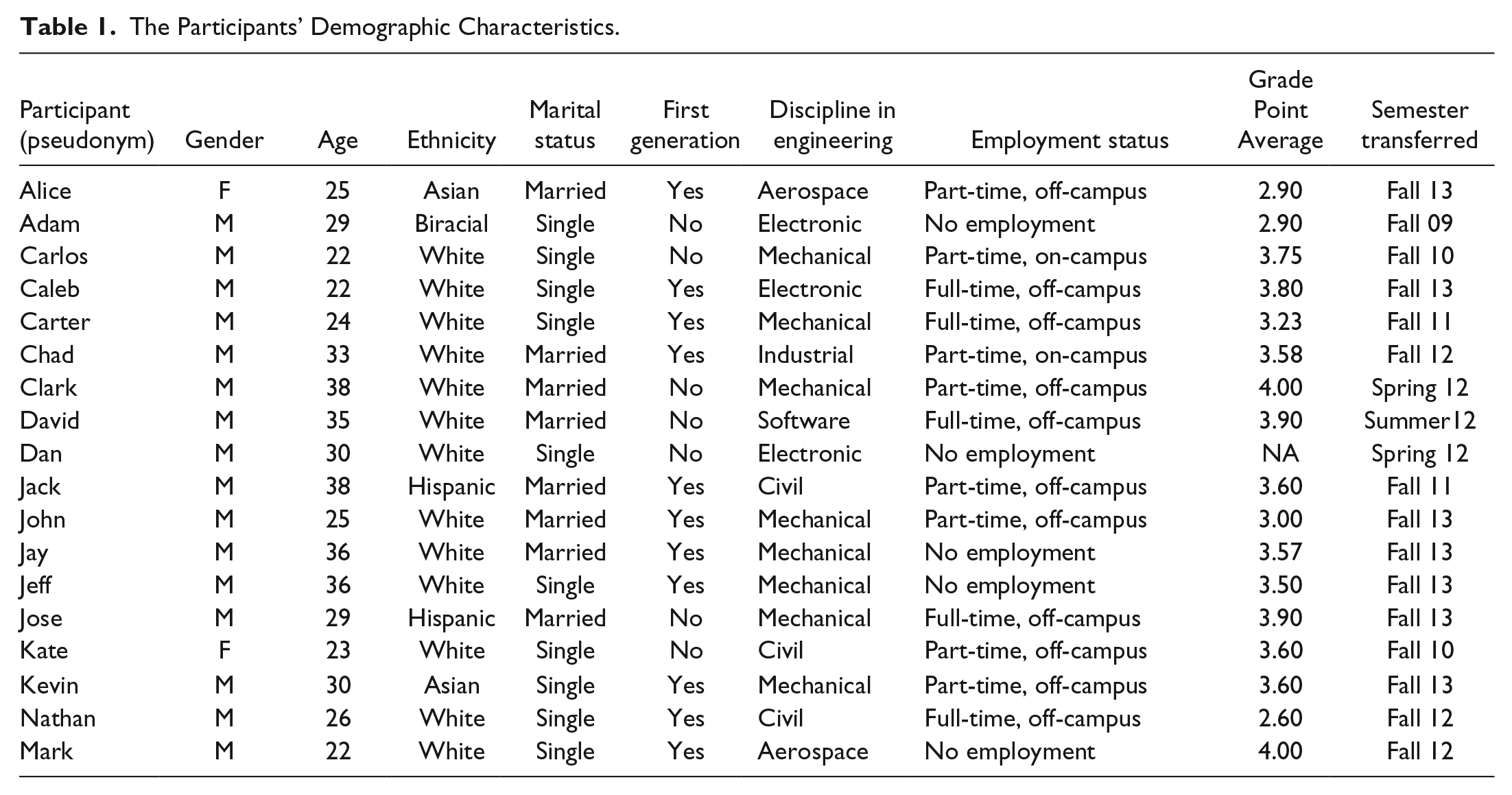
This study is a part of a larger, ongoing research project on engineering transfer students’ experiences and issues. For the larger study, we invited more than 300 engineering transfers via email and finally conducted two individual interviews with 21 volunteers. Adopting Hagedorn’s (2005) classification of adult learners, we utilized purposeful sampling (Creswell, 2014) for this study to select participants from the larger study whose ages qualified them as young adults (22-30 years) and prime timers (31-45 years). As a result, only 18 participants, who were identified as young adults or prime timers, were included in the analysis. The majority of the participants included in the study were White males, which reflected the demographics of engineering transfer student population at SMRU. Table 1 provides detailed information about the background characteristics of the participants.
The Participants’ Demographic Characteristics.
Data Collection
All the participants were interviewed using Seidman’s (1998) phenomenological approach to in-depth interviewing. Seidman (1998) recommended a three-part interview process to gather a thorough perspective on participants’ lived experiences. When presented with time constraints or scheduling challenges, however, previous researchers have truncated this model to include only two interviews (Martinez, 2010; Ozuna, 2012; Reddick, 2011). Using this approach, we conducted two in-depth, one-on-one interviews that lasted between 20 and 40 minutes. The first interview was used to establish rapport with the participants and to understand their backgrounds and pre-college experiences, such as motivations for learning and pursing an engineering degree, rationale of attending a community college, and preparation for study at a 4-year research university. Sample interview questions include “How do you perceive the field of engineering?” “What motivated you to choose engineering as your major?” “What motivated you to attend a community college?” and “How well do you think you were prepared for study at SMRU?” The second interview included follow-up questions and focused on students’ transitions and post-transfer experiences. Sample interview questions include “What motivated you to pursue a bachelor’s degree in engineering?” “What went really well as you transferred to SMRU?” and “How would you describe your relationship with professors, advisors, and peers?” The interview questions were open-ended and semi-structured.
Data Analysis
The interviews were digitally recorded and transcribed verbatim for analysis. We used the six learning principles of andragogy (Knowles et al., 2005) and our research questions to guide the data analysis. Through open and axial coding, we reviewed the transcripts to identify findings that aligned with the six principles of andragogy and distinguished the relationships between themes and sub-themes (Strauss & Corbin, 1990). We also used matrices of coding to organize and finalize the themes and sub-themes (Miles, Huberman, & Saldana, 2014). To promote data reliability, we conducted member checking (Lincoln & Guba, 1985), gathered “rich” data through intensive interviews (Maxwell, 2005), and debriefed with peers (Lincoln & Guba, 1985) throughout the data analysis process.
Findings
Our analysis revealed two key themes. First, participants were motivated to learn because of their perceptions of the engineering field as well as their interest in a “hands-on” program. Interviews with the participants suggested these adult learners clearly understood the significance of engineering and had the motivational fortitude necessary to pursue an engineering degree. The conversations also demonstrated these participants were highly motivated and self-directed learners. More specifically, these adult learners possessed positive attitudes toward being an engineer and believed in the importance of creative and practical aspects of engineering. When asked about their long-term academic and career goals, these adult learners were committed to excelling after graduation and actively planning for graduate school or internships.
Second, the participants’ approach to success was supported by their personal sense of responsibility to learn. Adult learners in this study demonstrated an intentional approach to academic success and viewed themselves as responsible and active learners. These students were also strategic in their engagement with student organizations as well as peers. The participants’ strategies for learning prompted them to consider the peers carefully with whom they would invest time. To achieve success, they sought peers with similar life experiences, backgrounds, and interests.
Motivation to Pursue Engineering
The participants identified several key influences driving their motivation to pursue an engineering degree. First, the adult learners identified their perceptions of the field initiated their interest. These perceptions varied among the participants, however. In one regard, the participants viewed engineers as those who have incredible imagination and revolutionary visions on new innovations to benefit society. Engineering was a way to make a difference, change the world, and build the future. For instance, Kevin indicated, It’s very noble like educators and, um, and doctors. You make a difference. It sounds very jaded, but I didn’t want to go into the business route simply because I think a lot of that has to just do with, you go into business you’re doing it for yourself. It’s all about the dollar. Most of it. And, um, that’s all you do. I don’t want to fall into that trap where one day I wake up I’m like what am I doing last ten years.
Conversations with the participants revealed they were inspired to pursue an engineering degree because they believed, as future engineers, they could improve local and global communities and translate groundbreaking ideas to practical realities.
In addition, engineering was viewed as a constantly growing field that provides higher salary and better job security than almost all the other majors. Some participants recognized that engineering provides economic benefits. For example, David shared, The nice thing about engineering is you generally will not have trouble finding a job. And that’s pretty much because the, the world will always need people that know how to do things, and that’s, that’s one thing engineers know is, you know, how to fix stuff.
Other participants viewed engineering as an opportunity to pursue diverse career paths and directions. Kate, for instance, considered engineering a really “cool job,” because “there’s so many different little ways, directions you can go.” Similarly, Clark described engineering as a career that is very diverse and wide open to different possibilities.
In addition to their perceptions of engineering, the participants were motivated to obtain a bachelor’s degree in engineering primarily because of their intrinsic desire to construct, create, and understand how machines operate. Alice shared that she “wanted to know how the machine work and stuff like that,” and Carter said he “really like working with [his] hands and doing mechanical things” and thought engineering would be a “fun challenge.” Carter further shared, “I liked building things. I like the project mentality, and engineering just seemed challenging and rewarding.” According to Jeff, engineers are “people who figured out how to do things, whatever it may be.” Caleb described a similar intellectual and practical curiosity when he revealed, I’ve always really enjoyed building stuff, taking stuff apart, learning how things work, understanding how things interact with other—other objects or other systems. I’ve always wanted to do that, but I didn’t have a name for it until I got into high school.
One of the key reasons the participants sought an engineering degree was because it offered intellectual stimulation and academic challenges coupled with a “hands-on” approach.
Overall, adult learners established engineering as their career goal because it requires knowledge and skills as well as imagination and creativity. As Adam indicated, engineering is a combination of “arts and sciences” where people “get to design things and bring to life things that you can think up.” Jose stated that engineering is “the art of design” and a process of “creating new materials.” Caleb also recognized both aspects of engineering, There’s the paper aspect where you’re designing, you’re planning, you’re putting things together on paper. . . . And then there’s the actual building where you’re working, you’re testing, you’re putting a product out. And then there is going out and actually testing it in the field, which is also really fun.
Many adult learners highlighted the importance of creativity to the field of engineering, and they approached their program as an opportunity to test new ideas, express their imaginations, and be inventive.
Finally, the participants sought engineering programs after periods of career exploration and careful reflection. After pursuing other areas of employment and then enrolling in the community college, however, they ultimately realized they needed to attain specific goals to achieve their engineering aspirations. When asked about their future plans, many students were determined to obtain a master’s degree in engineering and some even thought about a doctoral degree in the future. For instance, Caleb was considering his graduate program options and shared “I want to get a doctorate eventually.” Mandy also focused on pursuing a graduate education. She said, “I would prefer to go back to school, then find a job, because I think not only do you get more experience . . . you gain more knowledge.”
For those students who intended to enter the job market immediately after graduation with a bachelor’s degree, they were intently focused on seeking internships or employment opportunities. Internships offered practical work experience and an opportunity to build relationships with potential future employers, and full-time employment could help fund their long-term academic aspirations. For example, Dan shared, “I would love to find a job that would pay me to get a master’s. I do intend to go on and get a master’s.” The participants perceived post-baccalaureate work experiences as assets for their long-term employment. They saw the long-term benefits to advancing their academic career and set forth goals beyond their undergraduate degrees, thus demonstrating their internal motivation and self-directed behavior. This college-going pathway might be common for traditional-aged students who are more aware of college-going resources or who possess college-going knowledge, particularly for the field of engineering; however, most of the participants in this study only realized their specific academic and career goals after years in other careers.
Approach to Success
To accomplish their goals, the participants acknowledged they were responsible for their own academic success. For these transfer students, being self-motivated and persistent was instrumental to their professional careers. Many of the participants described themselves as “self-sustained,” “active learners,” “independent learners,” and “problem solvers.” These traits supported the participants and motivated them to assume ownership for their educational endeavors.
These qualities also helped the participants overcome advising challenges because they independently investigated the transfer process to counter any communication issues. For instance, Caleb stated that he looked up transfer requirements and organized his application materials when he transferred. David also shared he went to the university website and consistently communicated with his advisors. He said, I did the research myself and said, “OK, this is the track. What am I bringing in? What can I take this semester?” So, each semester I figured out what I had to take because it was sequenced, and these are classes I have a choice of.
Because of their personal initiative, Caleb and David were able to continuously make academic progress toward earning their degrees, which highlights the ability to proactively solve problems.
The participants’ approach to success was also demonstrated in their selective academic and social interactions with traditional-age students in the engineering programs at SMRU. They indicated their maturity, age, and work responsibilities presented unique challenges because of dissimilar life experiences and different perspectives. Participants also perceived their traditional-age peers to struggle with critical thinking skills and identified their advanced analytical skills as a barrier to connecting with younger students. For instance, Kenny described his freshmen peers as “less open-minded,” but himself “more flexible with thinking.”
To strategize for success, the participants interacted with others in engineering programs but their interactions were mostly centered on academics and limited to peers in their age group (i.e., young adults and prime timers). The participants created their own study groups, enrolled in the same courses, and collaborated on class projects together. Clark indicated most of his friends were adult learners, who “have the same stories or have gone through the same thing.” As adult learners, the participants sought out peers with congruent academic backgrounds, and further, initiated the development of a support system with older engineering students. David highlighted his experience, I’ve got a core group of about five people . . . in summer is where we hit the, um, one of the core classes, and we all got together around that, and then we, we kinda progressed through the track together . . . It’s been great.
Finally, adult transfers in this study believed their academic success was best supported by not engaging in campus activities or student organizations, even though they understood the benefits they would obtain from their participation. The students perceived most of the campus activities to help traditional-age students with interpersonal and communicational skills, but they were confident they had acquired these skills through prior life experiences. Chad shared his perspective on students’ activities for adult learners, I don’t really feel that those things are really meant for people like me. One, because I’m so much older than a lot of the students that are in these organizations and I kind of feel that those organizations are important learning tools for people that age, learning how to cooperate and work in team settings and get them prepared for what awaits them in the real world.
Other barriers to participation included work and school schedules. When asked why Nathan was not active in student organizations, he directly responded, “I wouldn’t mind being, I just don’t have the time for that . . . because I work full-time and I am a full-time student.” In a scenario similar to Nathan, Adam only joined in the Robotic Boat Competition, as it was directly related to his major and it worked for his schedule. Mostly the participants chose to remain removed from out-of-class engagement opportunities, and it seemed their plan promoted their academic learning, but left them disconnected from younger students in class.
Discussion and Implications
Using andragogy (Knowles et al., 2005) as a theoretical framework, this study explored adult learners’ motivations and approaches to learning in engineering programs. The participants in this study sought careers in engineering because they viewed the field as an opportunity to make a difference and to bridge arts and science disciplines. This study also highlights the students’ sense of personal responsibility and strategic approach to attaining success. The findings suggest the adult transfers’ experiences reflected all the principles of andragogy, often overlapping with one another.
Knowles et al.’s (2005) second principle states adult learners assume responsibility for their lives, and they are self-directed in their learning. When confronted with advising challenges, these adult learners worked independently to ensure their courses aligned with their respective degree plans. Similar to Shillingford and Karlin’s (2013) research on academic achievement of non-traditional students, this study found participants to be autonomous and self-determined in their approach to learning. Given the recurrence of transfer challenges in aligning community college and 4-year institution coursework, state policy makers must continue to collaborate with post-secondary institutions to promote student mobility (U.S. Government Accountability Office, 2005). Future research should explore 2-year and 4-year administrators’ perceptions of the transfer process to develop best practices for facilitating communication to students and collaboration between institutions and policy makers.
The findings of this study revealed the adult learners in the study were internally motivated and intently focused on completing their degree and beyond, thus exhibiting Knowles et al.’s (2005) fourth principle (students are motivated to learn when presented with a life change or specific task) and sixth principle (students are internally motivated to learn) of andragogy. Participants were interested in positively affecting society and acquiring useful skills to address real-world issues. To achieve these goals, they were extremely strategic about their learning, engagement, and professional goals. Echoing Aslanian’s (2001) research, we found that adult students were very clear about their career goals, which were key motivators for them to transfer to the 4-year university. These findings might encourage 4-year universities to adopt different strategies to engage this group of students in learning. These students may not need as many opportunities to receive information from structured programs; rather, they may enjoy more self-paced learning activities, which could be not only challenging but also rewarding. Future research should investigate adult students’ career goals to understand if they remain in their intended degree program or change over time. This additional research can influence vocational opportunities to help transfer students reach their goals.
Traditionally, institutions have implemented campus programming or supported student organizations to address adult learners’ needs. However, the students in this study lacked the time to participate in, or were skeptical of the long-term benefits of, these programs. Their behavior reflects Knowles et al.’s (2005) first principle (students need to know) and fourth principle (students are motivated to learn when they need to complete a specific task), as they wanted to know how participating in campus organizations would help them specifically learn, grow, or complete their degrees. We recommend additional research examining adult learners’ use of student and campus technology to understand the needs of this unique student population and create a learning environment that benefits all students.
Finally, as Kasworm (2003) indicated, adult learners are in a different place in life and hold different worldviews and career goals when compared with their younger colleagues. Their prior experiences serve as resources of information, but may also create biases or limit their approach to learning (De Vito, 2009). In this study, biases emerged through the participants’ approach to strategically developing relationships with other adult learners because they perceived traditional-aged college students to be immature or unfocused. These findings are in line with prior research (Kasworm & Pike, 1994) that has found older adult students are less inclined to interact with younger peers. Despite the lack of older to younger peer interactions, connections between the two age groups are beneficial for both sets of students and can help adult learners build confidence (Zhang et al., 2013). Additional research should explore adult learners’ relationships with older and younger peers to examine the influence of these relationships on learning as well as academic and professional goals.
Limitations
Although this study makes numerous contributions to the understanding of the college experiences of adult learners in engineering, it is limited in certain respects. First, the majority of the participants were White males. We did not explore gender differences or the extent to which students’ college experiences were different between the gender groups. We did not identify differences between ethnic groups, nor did we focus on a particular racial group of adult learners. Therefore, our findings may not reflect the different experiences among students of different genders and ethnicities. The second limitation is that we studied experiences of both young adults and prime timers but did not distinguish possible differences between the two groups of adult learners. Thus, the findings of our study may lead to a conclusion that these two age groups have the same experiences in the 4-year research university. Next, this study explored experiences of all engineering students without differentiating their specific disciplines. Motivations, learning experiences, and transfer processes may vary by engineering programs (i.e., mechanical vs. industrial). Finally, our analysis relied only on data collected from adult learners who have successfully transferred to a 4-year research university. These students provided important information about their experiences in the 4-year setting, but it might limit our understanding of the challenges and obstacles of adult learners who stopped out (i.e., temporarily withdraw from college) or transferred to non-engineering majors.
Conclusion
The current study sought to understand the lived experiences of adult learners who transferred from a community college to an engineering program in a 4-year research institution. By utilizing Knowles et al. (1998) andragogy as a guiding framework, this study offered insight into adult learners’ motivations for pursuing an engineering degree, and it also shed light on their approach to academic success. As demonstrated in the study, the participants pursued engineering careers because they welcomed the opportunity to address societal challenges by bridging art and science and to creatively solve problems. The adult learners did participate in activities that would advance their academic or professional interests. These students favored interactions with other adult students but often found it difficult to relate themselves to the younger peers. With an increasing need to promote degree completion in STEM fields, more empirical research is needed to better support adult learners’ needs during their transfer process and while they were pursuing engineering baccalaureate degrees.
Footnotes
Declaration of Conflicting Interests
The authors declared no potential conflicts of interest with respect to the research, authorship, and/or publication of this article.
Funding
The authors received no financial support for the research, authorship, and/or publication of this article.