




Abstract
Much of the research uses sense of belonging to explain the experiences of minority students in U.S. institutions (Ostrove & Long, 2007); however, sense of belonging is only one of the four elements of sense of community. McMillian and Chavis (1986) define sense of community as “a feeling that members have of belonging and being important to each other, and a shared faith that their needs will be met by their commitment to be together” (p. 9). In other words, sense of community refers to feelings of ownership and belonging through emotional connections with others and meaningful partnerships (Schreiner, 2013). This case study identifies factors associated with student retention with emphasis on sense of community in a 2-year technical degree program at a tertiary institution serving low-income students in Bogotá, the capital city of Colombia. This study uses an ecological framework of student retention to examine the sense of community among students who are marginalized from the broader social context but who are not a numerical minority at their institution. The results of this study have implications to student retention in technical careers across national contexts and in cases where students are not a minority at their institutions but, instead, marginalized from the broader social context similar to Tribal Colleges or Historically Black Colleges and Universities in the United States.
Recently, Colombia experienced an economic boom after decades of chronic violence and economic hardships. The “Colombian Miracle” (Forero, 2012) is the result of enhanced macro-economic policies, a commodity boom, and better security conditions. Today, Colombia has the third largest population at 47 million and is the fourth largest economy in Latin America. Moreover, Colombia is in the process of becoming the third country in Latin America to join the Organization for Economic Co-Operation and Development (OECD), along with Chile and Mexico. As Colombia continues growing, signing new trade agreements around the world, and attracting foreign investment, it is also experiencing an education revolution (OECD, International Bank for Reconstruction and Development, & The World Bank, 2012). Although education enrollment, outcomes, and equity are improving at all levels in Colombia, these are still well behind those of OECD peers (OECD et al., 2012). Thus, significant challenges are still ahead, as exemplified by massive student protests of 2011, triggered by the government’s attempt to pass a reform higher education bill. The student movement was successful, and the reform bill was withdrawn from the parliament on November 16, 2011; however, through democratic dialogues and incremental changes, the government is still committed to meeting the educational demands necessary to sustain the rapid expanding of Colombian economy and in preparation to join the OECD.
Colombian tertiary education consists of 288 public and private tertiary institutions that, as of 2014, offer various levels of degrees: professional technician, technologist, professional, specialization, master, and doctoral. The Colombian government recognizes the importance of technical education (professional technician and technologist) for social mobility and economic development and, thus, has implemented programs that have increased the number of graduates from technical degrees from 17% of all tertiary education graduates in 2001 to 30.6% in 2010 nationwide. This goal has important implications for equity and social mobility, given that 59% of graduates with professional technician degrees and 75.9% with technical degrees were employed within a year of graduation. Furthermore, students with such degrees are likely to come from the lowest income percentiles (Colombia Ministry of Education, 2012). Enrollment expansion, however, is only the first step toward successful degree completion and social mobility. The second step is to increase persistence. In 2014, 55% of students had dropped out of technical education in Colombia (Colombia Ministry of Education, 2015). Recognizing the low persistence rates, in 2009, the Ministry of Education launched a national program to promote persistence based on a comprehensive student-tracking system and institutional support programs. Despite these efforts, persistence and retention remain problematic across all postsecondary sectors.
Bogotá is the financial and political center of Colombia and the fourth largest city in South America, with more than 8 million habitants. Although Bogotá has largely escaped decades of Colombia’s armed conflict, it has been affected adversely through massive rural migration, kidnappings, and bombings in addition to rampant organized crime throughout the 1980s and 1990s (Beckett & Godoy, 2010). In the last decade, thanks to the leadership of several mayors, the city has seen positive change, including significantly improved security and infrastructure as well as an economic boom (Gutiérrez, Pinto, Arenas, Guzmán, & Gutiérrez, 2013).
The purpose of this case study was to study the reasons for high attrition rates with focus on sense of community among students enrolled in a 2-year degree in international trade at a technical institution in Bogotá, Colombia. This institution is called EPS for the purpose of this article. Our interest in this particular institution is due to its mission to provide opportunities for social mobility for the low-income youth in Bogotá, who are deeply affected by severe social issues. This institution provides a case study that has the potential to provide practical knowledge to improve student retention in such challenging social environments. We chose students enrolled in international trade due to its positive employability prospects based on a number of new treaties signed by the government, including the United States–Colombia Trade Promotion Agreement, and due to the program’s high attrition rates, which fluctuate significantly every term, from as low as 4% to as high as 34%, with an average of 20%.
College Student Retention
The most common conceptualizations in the literature are adaptations of Tinto’s (1997) interactionist theory of student retention, which assumes that students’ pre-entry characteristics determine their motivation to enroll and that, once in institutions, students continuously evaluate their commitment to stay enrolled based on their expectations, as fostered through academic and social integration. Academic integration has a structural component, which is the degree to which students meet academic standards, and a normative component, which is the degree of fit that students feel with the norms and values of their academic community or profession. Social integration refers to the relationships with and sense of belonging to the college community (Bean & Eaton, 2000; Braxton, Hirschy, & McClendon, 2004). Ostrove and Long (2007) and Rubin (2012) found that social-class background (i.e., students’ pre-entry characteristics) was strongly correlated with sense of belonging, which, in turn, predicted social and academic integration, quality of the overall college experience, and academic performance.
Social and cultural capital play a critical role in both academic and social integration (Wells, 2008). Social capital refers to the personal connections that allow individuals to advance in social fields, and cultural capital refers to the knowledge, culture, and dispositions often inherited from one’s family that define an individual’s class. Accumulated social and cultural capital influences students’ decision to enroll and stay enrolled in different types of colleges and to pursue certain degrees (Berger, 2000; McDonough, 1997). Social and cultural capital have significant implications for students from lower socioeconomic status (SES) or for minorities, who are likely to enroll in colleges with lower levels of such capital. Through social and academic integration, however, these students acquire critical knowledge and dispositions necessary to succeed in college, which their parents and school environment did not provide.
Student Thriving and Sense of Community
So far, we have focused on theories related to student retention, that is, theories explaining why students stay enrolled. However, other studies have looked beyond retention to understand why some students thrive and others do not while staying enrolled. Thriving students are those who are not only successful academically but also experience a sense of community and a high level of psychological well-being, both of which enable proper social and academic integration and contribute to their commitment to stay enrolled and graduate (Bean & Eaton, 2000; Braxton et al., 2004; Schreiner, 2013). Although sense of community on campus is the strongest predictor of a student’s thriving (Schreiner, 2013), scholars in higher education have studied mainly students’ sense of belonging, particularly that of students from minority groups (Ostrove & Long, 2007). Sense of belonging, however, is only one of the four elements of sense of community (Schreiner, 2013). In particular, membership, the first element and a commonly studied concept in higher education, refers to a sense of belonging to a group or of feeling of being at home. Membership is the first condition needed to develop a sense of community, as it signals whether an individual fits in the campus. Research on U.S. students has shown that minority students feel alienated in their campus due to low sense of belonging (Strayhorn, 2012). Related to this, low-income students are more likely to attend technical colleges, in part, because their sense of belonging may be stronger at these institutions (Ostrove & Long, 2007).
McMillan and Chavis (1986) provided the conceptual underpinnings for the next three elements of sense of community. In particular, students experience ownership, the second element, when they have a voice and are valued for their contributions to the campus community. This means that faculty and administrators take students’ concerns and input into account in their practice and through policies and initiatives. Schreiner (2013) views this element as related to the notion of institutional integrity and commitment to student welfare put forward by Braxton et al. (2004). When leadership incorporates students’ concerns into their practices, institutions demonstrate integrity and commitment, which translates into a sense of worthiness among student populations. The third element, as explained by McMillian and Chavis, is positive relationships with others on campus, which enables the development of strong emotional bonds. Students need emotional connectedness with others to feel part of a community. Student involvement in meaningful events, tailored to the diversity of students and their needs, facilitates the development of positive relationships. Finally, partnership concerns the mutual goals of members of the community and the necessity of working together to achieve those goals. This working together can include students’ being involved in team-based learning, performing service learning, leading student organizations, planning events, and engaging in projects with faculty. These partnerships allow students to experience a sense of worthiness as members of a team (McMillan & Chavis, 1986).
Retention in Technical Degrees
An important caveat about student retention theories is that they have been developed primarily for students who pursue 4-year or professional degrees, mainly in the United States, and are not necessarily applicable to students who pursue technical degrees, particularly in countries outside of the United States. However, it is worth noticing that two thirds of U.S. students in community colleges leave their programs after having completed a year or less of coursework over a 5-year period (Bailey, Calcagno, Jenkins, Kienzl, & Leinbach, 2005).
According to Hirschy, Bremer, and Castellano (2011), retention in community colleges in the United States depends on (a) academic readiness from high school and test scores; (b) psychosocial aspects, such as personality, motivation, self-regulation skills, social adjustment, aptitude, and effort; (c) sociodemographic characteristics, including gender, SES, and race/ethnicity; and (d) situational circumstances, such as enrollment intensity, work and family obligations, finances, and distance from home.
To understand how conventional theories of student retention apply to students in technical careers in U.S. community colleges, Deil-Amen (2011), through a large qualitative study, found that academic integration takes precedence over social integration, given the limited opportunities for these students to engage socially. Nevertheless, academic integration can take a social form, and social integration has academic utility. In this regard, Deil-Amen discusses the interconnectedness of the two forms of integration. For example, interactions with faculty in the classroom become a mechanism of socio-academic integration through one-on-one exchanges that reinforce students’ sense of belonging and self-efficacy.
An additional aspect of students’ integration in technical careers is the need for activities outside of the classroom that relate to vocational goals. Hirschy et al. (2011) explain that, given the emphasis on the application of skills in occupational programs, including 2-year technical degrees, students seek direct practical links to their intended vocation. This leads to the need for career integration in addition to the structural and normative integration commonly used in 4-year or professional degrees. These authors define career integration as the level of commitment to a specific type of job and the degree of fit that students experience with career-related activities in or outside the classroom and on or off campus. As can be seen, in technical education, clinical practicums, internships, job shadowing, and employment in a career-related position are significant for the integration and, thus, retention of students.
Theoretical Framework: The Ecology of Student Retention in Technical Degrees
The theoretical framework of this study is based on the ecological retention model developed by Mendoza, Malcolm, and Parish (2015), as adapted to technical education. This framework locates Tinto’s (2010) institutional conditions of student retention within the environmental layers of Bronfenbrenner’s (1993) Ecological Systems Theory (EST). It also considers career integration by Hirschy et al. (2011) and the role of social and cultural capital in the integration of students in technical and career programs, as described by Deil-Amen (2011) and Wells (2008). Given our interest in an institution outside the United States, which has been the basis of most of the theoretical advances in student retention, we argue that an ecological perspective allows us to identify factors unique to certain nations and regions, to account for potential influences related to the economic, political, and cultural contexts. Next, we discuss Tinto’s (2010) institutional conditions for student retention, followed by an overview of EST to located Tinto’s conditions within the layers of EST.
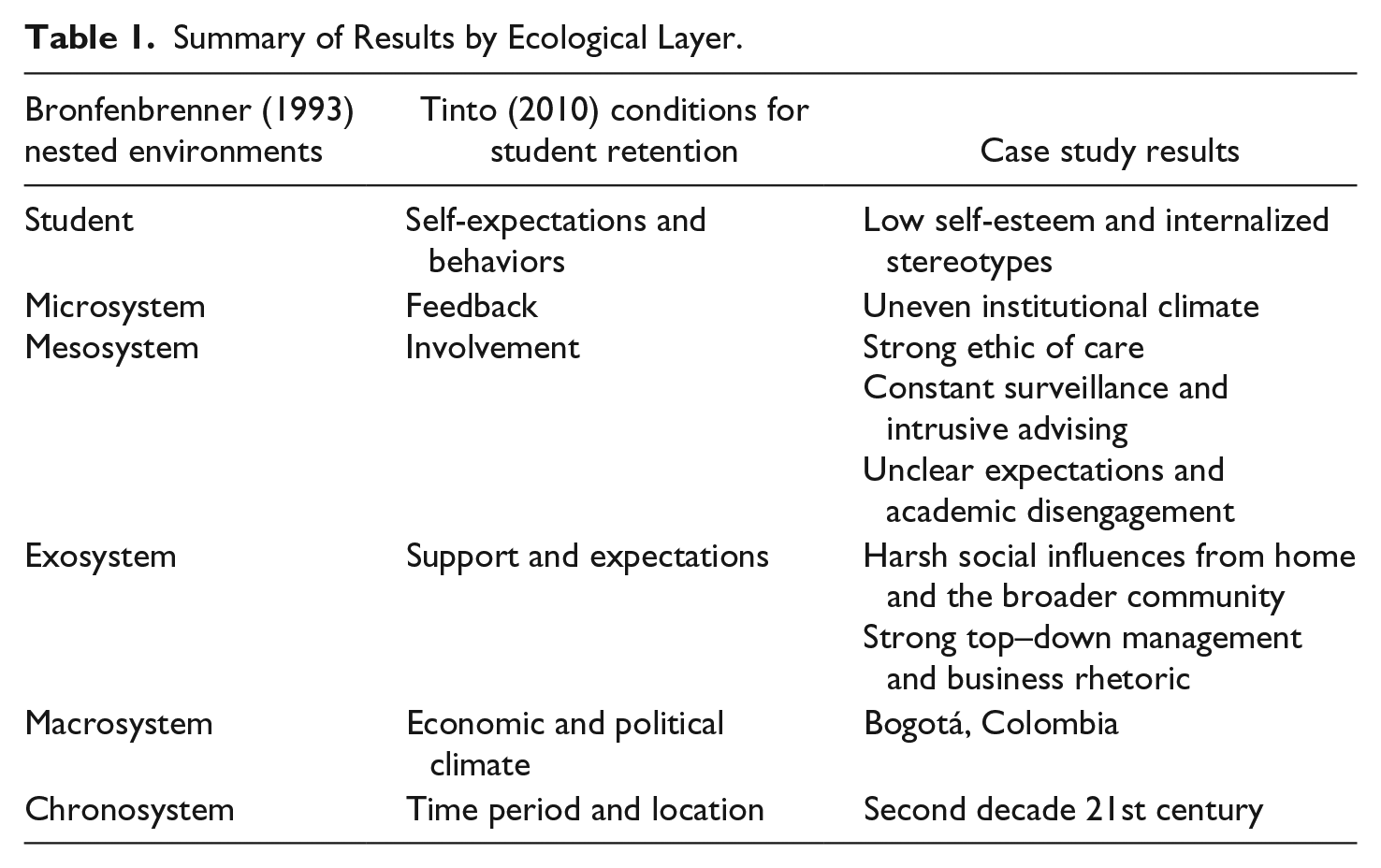
Tinto (2010) focuses on the environmental conditions of student retention. He begins with the premise that students’ success depends on how much they believe that they can succeed and on the environmental conditions that enable students to realize their own expectations of success. According to Tinto, four institutional conditions are associated with student retention: (a) students’ expectations of their environment and of themselves in those environments, which are shaped by individual characteristics and by the formal (orientations, syllabi, advising) and informal (social networks, interactions with faculty) mechanisms that transmit those expectations; (b) level of feedback that students receive formally (examinations, monitoring, classroom learning assessment strategies) and informally (peer interactions, informal feedback from faculty) in relation to their progress; (c) support, including academic (remedial instruction, tutoring, learning communities), social (counseling, mentoring, faculty and peer advising, social groups), and financial (loans, grants, fellowships, waivers, work study); and (d) amount of students’ involvement and engagement. Involvement is students’ time and psychological energy devoted to becoming integrated (and includes social, academic, and career integration, as discussed above). To become integrated, students need to learn and to adopt the norms of the environment, and, thus, engagement focuses on creating environments for students to be involved (Wolf-Wendel, Ward, & Kinzie, 2009).
EST posits that human experience and growth exist within nested environments that include the elements of person, process, context, and time. In the college environment, this perspective yields five nested systems (Renn & Arnold, 2003): (a) microsystem, the physical settings of classes, student organizations, employment settings, social events, church, family, and community; (b) mesosystem, the normative pressures that emerge from the microsystem; (c) exosystem, the indirect influences on students, such as institutional policies, financial aid, and students’ family labor and economic conditions; (d) macrosystem, the broader political, economic, social, and cultural context of students; and (e) chronosystem, the specific moment in history and in localities, including historical events, social movements, and cultural trends. The chronosystem also accounts for life transitions, including graduation, first full-time job, marriage, and childrearing. Tinto’s (2010) conditions for retention are located in the students’ microsystem, mesosystem, and exosystem levels.
The person–process–context of EST accounts for the individual attributes, decisions, and actions of Tinto’s (2010) premise related to students’ aspirations and self-confidence. From these perspectives, the agency of individuals is critical as they engage with their nested environment. Of particular importance for administrators and policymakers is the exosystem, which includes institutional policies and practices that affect students’ retention. At this level and beyond are elements that contextualize the experience of students, such as the social, political, economic, and cultural conditions of the environment. The research design, analysis, and presentation of results were guided by Tinto’s (2010) conditions for student retention applied to technical careers (Deil-Amen, 2011; Hirschy et al., 2011; Wells, 2008) and organized by the ecological layers of EST (Bronfenbrenner, 1993).
Research Design
Based on the work of Stake (1995) and Yin (2013), we utilized a descriptive and embedded case study whereby students were the unit of analysis. Data collection and analysis were conducted in Spanish by a team of researchers, all of whom are native Colombians. We used multiple sources of data, including semi-structured interviews, focus groups, field observations, and institutional documents. The protocol for interviews and focus groups was based on open-ended questions for each of the ecological layers of the theoretical framework. We used stratified purposeful sampling to select participants and focused on cohorts of students with the highest attrition rates, specifically, cohorts from the first two terms in the program (each term is 10 weeks long), who attend classes from 7 a.m. to 10 a.m. and from 6 p.m. to 10 p.m.
Although the unit of analysis was students, we also selected other various types of participants as a means to capture several perspectives related to students’ experiences in the program. Thus, the participants interviewed included seven administrators (rector, vice rector of academic affairs, vice rector of student affairs, dean of the college in which the program resides, counselor coordinator, admissions coordinator, and curriculum development and job placement director), four instructors (two in general education and two in the major), in addition to five students from the morning cohort and seven from the night cohort. In addition, eight students from each cohort who did not participate in the interviews were part of the focus groups.
We collected data in two stages. First, we conducted 45- to 90-minute semi-structured interviews with the seven administrators and the four instructors and led two focus groups, which lasted 50 to 60 minutes. We also administrated a short demographic survey to students in the focus groups that concerned their socioeconomic background, previous education, and plans to re-enroll next term. Second, after preliminary analysis of the data in Stage 1, we conducted 35- to 45-minute follow-up interviews with five students from the morning cohort and seven students from the night cohort. All interviews and focus groups were recorded, and interviews were transcribed. Additional notes were taken during interviews and focus groups. In addition, we conducted field observations through field notes and photographs throughout the institution. Finally, we collected relevant documentation, such as internal reports, brochures, institutional statistics, and information from the institution’s website.
We used typological analysis (Hatch, 2002) followed by pattern matching (Stake, 1995; Yin, 2013) to map the coded data to the environmental layers. More specifically, we followed the steps in Hatch (2002) to code the data into typologies. First, all researchers open-coded representative interviews selected based on the richness of information provided. These interviews were the ones with the rector, vice rector of student affairs, dean, one instructor of general education in math, one instructor in specific subjects of the major, notes from the focus groups, and institutional documents, such as the description of the program and strategic planning of the institution.
Second, the research team met to determine the main typologies found in the first step and then split the remaining data equally among researchers to continue coding the data into those typologies. Third, each researcher developed descriptive summaries of his or her respective coding for each typology. Fourth, researchers met and compared the summaries and looked for common themes, patterns, and relationships within typologies across all of the data. Fifth, once common themes, patterns, and relationships were identified, researchers went back to the data to look for representative and misrepresentative patterns. Sixth, the team constructed short generalizations and data excerpts that represented the patterns. Seventh, the team selected representative data excerpts to support generalizations. Finally, pattern matching was used to map the typologies into the layers of the ecological model of student retention. At this point, it became obvious that the findings were clearly related to the various elements of sense of community. One final analysis across all layers was conducted to unpack how students’ sense of community determined their retention.
The trustworthiness of this study rests on several aspects of the study. First, we used multiple sources of data. Second, the analysis was conducted by a team of researchers who worked closely together but who also independently confirmed results uncovered through an established system of crosscheck procedures. Third, we kept an audit trail with all data and stages of data collection and analysis.
Results
The macrosystem and chronosystem for this case study are the characteristics of Bogotá, Colombia in the second decade of the 21st century briefly described in the introduction. In this section, we offer a thick description of the typologies found by the rest of the ecological layers to gain a deeper understanding of students’ experiences and perceptions at EPS. A summary of finding can be found in Table 1. Then, we present a discussion of how these themes relate to students’ sense of community and the subsequent implications for student retention.
Summary of Results by Ecological Layer.
Exosystem
Home, work, and the broader community
The majority of students at EPS are traditional college students: single, without dependents, between 16 and 22 years of age, living with their parents, and financially dependent. Nevertheless, we found that 14% of the students had dependents and 57% were engaged in outside employment and earned between one and two minimum wages. Two students reported being displaced as a result of Colombia’s long-lasting civil conflict. EPS is strategically located, with easy access to public transportation, to attract low-income students. The rector proudly stated, “We are at the door of Ciudad Bolivar,” and pointed at the hill less than a mile away that was covered with illegal self-constructed homes—an urban slum. Ciudad Bolivar is a settlement with the worst social conditions in Bogotá, with more than 700,000 habitants in 2012, of whom 58% are younger than 26 years old. It hosts generations of families who have fled decades of violence and, more recently, widespread flooding. Residents of these areas experience poverty, domestic violence, health issues, and teenage pregnancy as well as street violence from gangs and guerrillas. Extended families normally live in one single residence, sharing rooms and helping each other financially. EPS students come from this neighborhood and others with similar conditions.
Safety continues to be an issue in several parts of the city, including the surrounding areas of EPS and the neighborhoods of its students. Here, an administrator talks about security measures that EPS has put in place around the school’s premises; however, students have to still navigate crime in their own barrios, as one administrator put it: “I can’t get home after 7 at night because of my neighborhood.” This was the first wall I hit because what can I do about it? [I could] ask the institution [to] put security dogs, a guard, cameras, but [it] turns out that the guy lives far away in Ciudad Bolivar, [and] he can’t get there after [a] certain time.
An administrator talked about the basic needs and struggles that EPS students face on a daily basis: Is a kid that comes hungry many times . . . who comes walking from home . . . who had to drop her son at school and run here . . . or is a kid whose parents don’t have food for dinner tonight. . . . They come here crying and tell me that they want to continue studying, but they don’t have cash for the bus. A high percentage have single mothers, for many, the grandmother takes care of them, not even father and mother, but a third relative: a grandmother, an uncle, an aunt. I have asked a few . . . “Do you live alone?” And it is like, “My mum left to another town, and I live alone here” . . . and so they have to find money to pay rent . . . they have to work . . .
It is common for students to bear heavy family responsibilities, such as having to work and helping with childcare. According to an administrator, Turns out that the family problems can be that the mother asks him to look after his two little siblings, and so he is embarrassed to say he has to look after his little siblings or that, if there is money to pay for the tuition for one sibling, there is none for the other one, or that they just incarcerated their father.
We also found students, however, who beat the odds and who lived in stable homes with married parents and financial stability. In these cases, parents were likely to own a successful business and have a higher level of education, likely a technical degree. Nonetheless, the vast majority of parents barely finished high school and struggled to help their children with financial aid applications and with general guidance on how to navigate college. Most students’ families rely on the informal sector and its associated instabilities and risks, which, in many cases, involves selling goods in the streets and offering labor for cash. According to an instructor, The job instability . . . so if you work in a temporary job for a while and then it ends . . . then the guys do not have income to pay for their studies, or say their job ends, and they find another one with a different schedule that conflicts with their studies.
Personal finance was the number one reason for attrition cited by faculty and administrators and by some students. An administrator stated, You see a student who paid the first installment but could not pay the second installment and so could not enter the building any longer. . . . And then, suddenly, he found the money in Week 8 and could return, but now we have to help him catch up with his peers and put together a series of strategies so that he doesn’t lose momentum. Nevertheless, he already failed a few classes.
Although there is some flexibility in payment policies, such as grace periods and payment plans as well as financial aid and assistantships, students are not allowed into the building if they do not comply with payment schedules, even if they are late only one day or forget the payment receipt. According to an administrator, this has been effective in forcing students to pay tuition: If students don’t pay, we use several strategies, such as denying them entrance to the classroom that day, and that has worked because the next day students have paid. Also, if they missed class one or two days or whatever amount of time they missed, we give them opportunities to catch up with instructors. We always talk to instructors to help them catch up.
Here, we see that the administrator attempts to present this policy in a favorable light by saying that special help is given to students who were denied entrance for not paying tuition but who eventually pay and return. Nonetheless, this harsh treatment at the door has created resentment among students and supports their perception that all that the institution cares about is money. Notably, administrators are proud of the financial aid options offered to students; unfortunately, many students were unaware of these options despite efforts to communicate these programs to students through orientations, social media, and bulletin boards. One student stated, The truth is that I did not know that here they have those types of loans. . . . In the orientation, they introduced the faculty, talked about the vision, the mission, all that blah blah blah, but no information about financial aid.
Another student expressed high debt aversion and an unwillingness to seek loans: Because I am working at a bank, I know all about getting a bank loan . . . so I would not take the risk, to be honest. . . . In the bank, you see many cases of the bank taking away homes from people; they take away many things because they could not repay the loan. . . So I would not take the risk of losing my home. . . . Or they report you and then you cannot get another loan.
College readiness is another major barrier for EPS students, who come from schools with poor funding and facilities, unqualified teachers, and dated pedagogy as well as a student body with deep social, economic, and psychological developmental issues. An administrator stated, I used to ask a student, “Why are you leaving?” and he would say, “The thing is that this is not for me.” And I would ask, “But, why?” . . . He was embarrassed to tell me that he was having problems understanding in class, but, in talking to him, I realized that was the problem. These are kids from the lowest income strata that come with difficulties in basic communication skills . . . they . . . do not bring good math skills. When they take their classes, they fly away, they escape, they go away . . . they do not confront it.
An instructor explained, It is difficult . . . because of the Colombian education and maybe because the context in which we are . . . all the students come with very big predispositions. . . . For example, in mathematics, they don’t see its utility; they don’t see its applicability in real life. . . . The majority come somehow tired, unmotivated from their experience with math in high school . . . where math was very abstract, with no connections to real life.
Finally, we found gender-based attitudes that also could have an impact on students’ success. An administrator noted that low-income women in Colombia are more likely to become single mothers at a young age. In fact, many students have very young single mothers and single grandmothers. Young and single motherhood has become common and even a goal for some. An administrator spoke about students who like to hang out by the EPS daycare: You have been there for a while, what’s up? “No, it’s just that I would like to be a young mother” But why? Don’t you want to study first, get skills, work and then be a mother, because being a mother is a big responsibility. And so the answer is, “My mom was very young when she had me, my grandmother had my mom at a young age.” So I realized that these girls want to get pregnant very young, before thinking about finishing college. . . . It is cultural . . . here you find the girl who tells you, “We all live in one house with two bedrooms and we are just fine . . . three generations . . .”
This administrator further explained that there have been a few cases of newborns from EPS student couples. In these cases, the fathers ended up not taking any responsibility for their children and graduated from their programs while the mothers left without a degree.
Key institutional influences
EPS, which offers nine technical degrees, opened its doors in 2011 and doubled its enrollment to 1,533 students in just 3 years. EPS is one of the four branches of EP, a private non-for-profit institution that enrolls approximately 6,700 low- and middle-income students in Bogotá. EP prides itself on its high job placement rates (87%). This fact is presented in recruitment campaigns, which include radio commercials. EP was founded by a group of influential bankers in Colombia, and, thus, its administrators generally come from the business sector. In fact, we found a generalized business culture. According to an administrator, “For us, the student is a client . . . we have to realize that . . . think that students have to be served like a client, although we would not let them demand too much.” Retention programs are framed as “customer loyalty programs” or “fidelity programs.” When referring to the issues that students face due to their upbringing and prior school experiences, this administrator noted, “The raw material is defective.” In this rhetoric, graduates become products who have competitive advantages in the labor market as an administrator noted: “We want to obtain a product with a competitive advantage . . . so that, before sending students to a job interview, we train them to have an excellent job interview.”
The organizational structure of EP resembles the hierarchical, top–down structures of most businesses, with a centralized vision, mission, pedagogical model, and institutional management for all branch schools; shared governance and academic freedom do not exist. The central office dictates curriculum (including content and readings), hiring and promotion practices, budget, tuition, and admissions. The academic calendar consists of four terms of 10 weeks each. The reasons for the quarter-based system include the ability to adapt to the dynamic labor market through timely curriculum adjustments, smaller tuition payments at a time, and more internship opportunities. Ironically, instructors and students noted that the 10-week term system is a very short period of time for students to learn properly and to pay tuition.
Instructors tend to be relatively young and are required to wear a white coat, in part, to be distinguished from students, as one administrator described it. They are subjected to rigorous performance and conduct evaluations and are expected to follow a certain pedagogical model aimed at the development of core transferable competencies and specific technical skills. This model emphasizes teamwork, communication, interpersonal skills, and critical thinking. To assist in the alignment of instructors with the institutional pedagogy, EP created the Center for Technical Education Training (CTET). CTET offers, free of charge, a 9-month graduate certificate, with the support of an elite private university in Bogotá. All faculty are expected to participate in an orientation and are encouraged to receive training through CTET. Nevertheless, we found that many faculty, especially adjuncts, do not participate, which generates a cadre of “wayward faculty,” in the words of one administrator. The short periods of the quarter system also hinder the proper socialization of faculty. According to an administrator, Sometimes we hire instructors, and then there isn’t sufficient time to tell them what it is that we want and what is that we are doing, and so we have to wait until the end of the term to analyze how the new instructors did . . . so then I have to intervene. . . . “Come, let’s see what is going on, why are students not understanding your classes, why your class is boring, how are you connecting with the other courses.”
Periodically, CTET staff interview potential employers to determine the knowledge and skills that they need for new hires. These meetings are also opportunities to establish relationships with businesses in an effort to open both employment and internships for students. At the beginning of each term, the dean meets with instructors and provides them with the adjusted syllabi, curricula, and pedagogy as well as with detailed policies on attendance, grading, and conduct. CTET offers modules to train faculty in critical areas related to class content and teaching skills. However, the exponential growth of the student body, increasing number of adjuncts, high faculty and administrative rotation, and short terms have brought difficulties in implementing effectively the ever-changing curriculum. An administrator stated, There is an implementation program written, but we have to execute it, multiply it, and understand it all. We have grown so fast. . . . I am hiring new instructors . . . who have not been trained by CTET, for example.
These problems are aggravated by the fact that some adjuncts spend just a few hours a week at the premises. According to one instructor, Instructors might . . . come just one night a week, come in the morning, come all day, or have a big break in the morning . . . so not all the instructors are here all the time, and this makes the information not flow as it should.
In addition, it is challenging for adjuncts to come to meetings, given the heavy traffic and long distances in Bogotá. As one instructor stated, When we have a meeting with an instructor, she might not show up, so there is no sense of ownership. When we work full-time, we obviously have the time, but if it is an adjunct, they might come just at night or for a couple of days.
Proper socialization of faculty is complicated by the high rotation of adjuncts, who complain of low salaries, interrupted basic benefits, and struggles to find outside employment to supplement their income due to the spotty teaching schedules assigned to them. According to one instructor, You can’t make a living off a salary like that, but you cannot find another job either to compensate. . . . If we had block schedules, it would allow many adjuncts to get another job and so stay working here longer. Contracts should be at least six months . . . that is my suggestion . . . because at least six months gives you some stability. . . . The truth is that, with two-month contracts, you end up having health care for two months, and only for emergencies for the next two.
The cumulative effect of these institutional policies and practices has fostered unfavorable students’ viewpoints about EP. For them, the rapid growth, generalized business narrative, perceived high tuition, and high volume and rotation of adjuncts mean that EP’s main goal is to profit financially. One student stated, “Their mission right now is to make money. They want to enroll 20,000 students, and they don’t care about quality.” As EP grows, it becomes increasingly more difficult to fulfill the goal of educating well-rounded professionals to fulfill the immediate needs of employers through personalized instruction and of “making dreams come true for the youth,” as per the mission statement.
Mesosystem and Microsystem
Institutional climate: Day and night
EPS consists of a small three-story renovated building with state-of-the-art laboratories for programs such as dental mechanics as well as adequate kitchens for the culinary arts program. In addition, classrooms contain instructional technology. There is a small library, a computer lab, a small daycare facility, a coffee kiosk, a small social area, and a field for sports and cultural events. In addition, there is a small parking lot that usually has only a handful of cars, as most students and employees rely on public transportation and bicycles. Inside the institution, the climate in the hallways is busy, friendly, and collaborative, as noted by an administrator: In this south branch, you can see the difference from the other branches because, here, all are very united; all instructors talk to each other. I don’t know if it is because of its size . . . we are small. . . . When a teacher from a program has a problem, other instructors from other programs ask how they can help.
An exception is the tight security at the entrance, where all belongings and identification are checked. Visitors need a special invitation to enter the premises. These are common practices at public buildings throughout the city.
The offices of administrators, counselors, deans, and faculty are just a few steps away from each other, which creates a busy hallway of personnel who move back and forth and talk to each other. The offices of the vice rectors of student and academic affairs are adjacent, facilitating the alignment of academic and non-academic student support, as one administrator reported. Constant face-to-face communication leads to strong teamwork among faculty and administrators. One administrator explained, “We all help each other; we all work together. But this is something very natural here; we all row in the same direction.” Another administrator noted, If I see an instructor that is not being fair or something . . . I talk with the vice-rector and tell him. We pay attention to details; we help each other. If he sees something that is not right from student affairs or admissions, he informs others.
Furthermore, policies are flexible and leave room for new initiatives. According to an administrator, “If somebody has a new idea or is thinking about implementing something, it is always like, ‘Okay, let’s listen, contribute, and, if it is allowed, we do it, and we institutionalize it.’”
Actions occur quickly, due in part to the short periods in the quarter system, and include referring students to counseling, designing individualized payment plans or tutoring programs, addressing issues in the classroom with faculty, and confronting conflicts when they arise. An administrator explained, We were giving a level of math too high for students who don’t have the skills for that level, so we informed the academic department, and they implemented a plan of action, including tutoring and remediation classes to help students understand what they were studying.
An instructor stated, A young woman who is a single mother and did not have a job . . . she was going to leave, and so, right away, I called financial aid, looked all the scholarships, and asked, “Can we do something?” and so we managed to find her a job as a tutor of mathematics.
Despite these efforts, there is a significant unevenness of experiences between students in the morning cohort and students in the night cohort, as implied by an administrator: “I love to walk around at 10 in the morning when a cohort ends its classes because I see students happy, motivated, talking about what they learn in class. . . . I want this to happen in all cohorts.” Night students likely work full-time, which limits their opportunities to participate in programs, events, and services, most of which happen during business hours. Thus, there is a generalized feeling among these students of institutional neglect. As one student stated, Most of the time, they don’t take into account students in the night cohort because of things like we lose too much class time, because of this, because of that. . . . For example, on October 31, they did a party but not for us.
Unlike day students, night students do not have multiple interactions with staff and administrators, including counselors. One student explained, “I have seen, about four times, the vice-rector and rector since I have been studying here, but I haven’t had much face-to-face contact with them.” This lack of interaction contrasts with the warm and busy climate during the day, when administrators and full-time instructors are present.
Strong ethic of care that leans toward protectionism
We found a genuine desire among administrators and some faculty to assist students to the point that, for some, students are seen as the faculty’s own children. One instructor stated, “EPS is a house . . . big, with many children; all students are like children for us.” One administrator explained, “The same love I would like others to give to my children, I give to others’ children . . . but, nevertheless, I am strict in the way it is important to be with children.” Another stated, “They receive so much support . . . and we go as far as we possibly can. . . . The only thing missing is paying tuition for them.”
On instructor describes how she balances protectionism with high expectations: It is a very affectionate relationship. . . . I get quite attached to the cohorts, but I am not maternalistic in the classroom. . . . I have high expectations. . . . I like to be clear in my expectations, establish parameters and very clear criteria at the beginning of classes.
Compared with other branches of EP, faculty expressed that EPS is very nurturing to its students. One instructor noted, I feel students here are very nurtured . . . they get a lot of attention. . . . Normally, students are more free in college, more independent, and if they are doing well, good, and if not, it is their problem . . . but here they monitor who came, the ones who are going to graduate, why they are not graduating, why they failed, that they have financial problems. . . . Here they do a very detailed student monitoring, step by step, and they feel nurtured, and I think this helps to keep many students enrolled. They let them go and what happens? They do not develop independently. . . . It is better to give them responsibilities and let go gradually because that is college . . . but many students here expect, all the time, to have somebody nearby telling them what’s next.
Several faculty members criticized this protectionism as damaging for the proper development of students by inhibiting their independence and self-initiative. An instructor explained, I criticize the protectionism a lot because I think we need to have higher expectations, because we should not be taking them so much by the hand . . . it is too much . . . we should expect more, pressure more up to certain point.
Students, however, offered a more balanced view. One student stated, The dean helped me to pass some courses, she gave me advice . . . she made me realize that I was not in high school anymore . . . that instructors were not going to be after me, so to speak . . . now I have to be after them. So she helped me to see the difference.
Despite the school’s desire to help, students are reluctant to openly express the true reasons behind their difficulties. Thus, administrators and faculty strive to establish individualized relationships with students, especially those at risk, in an effort to gain their trust and understand their needs. An administrator explained, The student might be having a serious problem at home—domestic violence, a difficult situation . . . but it is very rare that the student sits down and right up front tells you, “The thing is that I have these concrete problems at home.” They go off on a tangent: “The thing is that I have family issues, and they are asking me to work.” They have so many issues that they are embarrassed to talk about them. If you take the time and sit down with them, they slowly start to open up, and then you really learn what is happening to them.
In a quest to learn about students, administrators are constantly finding ways to communicate with them. According to an administrator, We have constant communication with students . . . we try to be “their friends” . . . if it is not the instructor, then the counselors at the dean’s office . . . all are ready to listen to them. They always find support. . . . This approach with students is what allows us to help them.
Another administrator explained, I like to sit down with students. I like to sit down with the children of students, at the day care, why? Because if I am holding a child, the mother eventually shows up, and she notices that I am giving love to her child, and so she starts talking to me.
Some instructors in the classroom intentionally generate rapport with students as a way to improve student learning. An instructor stated, That significant learning took place because I came in and sat down with him and did not say, “I am the instructor,” but “I am going to share with you.” So the guy identified with me and told me, “You know, I can talk with you.”
Constant surveillance and intrusive advising
There is a strong culture of monitoring and surveillance. Cameras are present around the building, and classrooms have long windows that face hallways, with the specific purpose of facilitating class monitoring by deans and administrators, who have the policy of walking into classes unannounced to monitor both students and faculty. They even go as far as interrupting the class and asking instructors and students about how the class is going. One administrator explained, One policy we have is to go inside the classroom in the middle of lessons any day and talk to them, talk to the instructors on the side and ask them, “How are you doing, how are the grades, are there any problems?”
In addition, CTET conducts two evaluations per term using a protocol that concerns the progress of the class and the areas in which instructors may be in need of training. According to an administrator, CTET drops by in the middle of class sessions and asks faculty, “Do you know what the objective of the class is? Do you know how to meet that objective? What are your expectations for this class, for this term?” And then they come back later, in Weeks 8–9, and ask, “Were your expectations met? Was the objective achieved? Are you doing what you planned to do?”
Administrators observe, walk around, and initiate conversations with employees and faculty at all levels. One administrator noted, I talk to the janitors . . . to the security guards. . . . I arrive at 5:30 in the morning to talk. The security guard is another person that knows about what is happening to students. . . . The administrative chair has a different perspective of what is happening to students. . . . What has she seen? What has she seen in the cameras? The other thing that I do a lot is to sit down in the faculty lounge to listen.
Recently, administrators began a comprehensive program of student retention called the Godfather Plan, in which all students in the first two terms are assigned to selected instructors and counselors as mentors, who are expected to help each student with any difficulties that he or she might encounter that affect his or her academic standing. Mentors are charged with the task of actively checking on students’ academic and personal well-being. They have to report in a shared Google document any absence or suspicious behavior immediately and to comment on students’ progress and behaviors that might indicate issues. If more than three absences are noticed, students or their families start receiving phone calls. According to an administrator, So I teach mathematics, and, wow, I see that a student is falling asleep in class, so I immediately highlight his name in yellow and write a comment. Then the counselor sees the comment and calls the student and tells him, “Look, I know you were sleeping in class. What is happening?” “No, I have been working the night shift, so I am coming to school tired.” So she writes that in the spreadsheet. We all have access to that information.
Students have mixed feelings about the monitoring of phone calls. One student stated, “Personally, I don’t like them to call me because it seems like we are in high school: ‘Why didn’t you come to class? What happened?’ This and that. . . . But is good that they care about students.” Other students found little value in these calls and portrayed them as disingenuous. One such student explained, “If we don’t come to class, we fail it. The institution is not going to do anything. They only call when we haven’t paid and for recruitment.”
Unclear expectations and academic disengagement
In general, students are unclear about the overall objectives of the program in terms of career prospects, curriculum, and expectations. According to one instructor, We need better communication between the institution and students about expectations. . . . Students come and don’t know what they want, so EPS must give them the tools to show them why and what we are providing: Look, there are companies that are interested in our students; we want you to get ready to work for them.
Some students have unrealistic expectations about the international trade program related to traveling overseas and learning languages. In reality, their career prospects are more likely to be jobs at domestic ports, airports, and companies for which they assist with the paperwork involved in international commerce. The vast majority of students are first generation, which contributes to their lack of knowledge related to higher education, careers, and the job market. One instructor explained, They see it on television, and they like it, they think it is cool, but they get the message wrong on what the career is about. So, for example, in oral hygiene, they think it is to become a dentist . . . so they come and hit a wall. . . . For example, there is a lot of attrition in software development because students come and think that it is related to Facebook, the Internet, but not about programming.
Furthermore, interviews with instructors and students revealed unevenness in the quality of instruction. An instructor stated, Students write very nice things in the evaluations, that they have enjoyed the class a lot, that beyond having been taught mathematics, they also have gained the confidence to continue advancing. I was telling you that many come here guarded . . . that the only thing they want is to pass the class, no matter how, but they finish with the feeling of “yes I can, I am happy, it is not as bad as I thought, I am not as stupid as I thought.” . . . That is very, very nice.
A student, however, noted, There are good and bad instructors, but the quality is not good. The instruction that they are giving us is too short. I am gaining more from browsing the Internet at home than what I am getting here. We have two weeks left, and we haven’t learned anything. There is no articulation among the terms. In this moment, we have all the connections broken among classes.
Another student stated, “It changes from instructor to instructor. There are instructors who are very good, and there are others that, with all due respect, are bad. Really, they don’t have the necessary skills to teach so that it produces learning.”
The ever-changing curriculum and students’ lack of understanding of the overall program of study have an impact on students’ satisfaction. One student noted, “We have different curriculum plans, and some students know more things than others.” Many students perceive their classes to be too theoretical and express a desire for a more practical application of theory, real-world examples, and field trips. According to one student, There is too high an expectation on the part of the instructor, and he doesn’t understand that we are just in the second term. Classes are too theoretical; it is just defining terms, and that’s it. It becomes boring. One understands classes that have practical applications.
Another student stated, “We need to see more physical documents to really learn how is it done, how they are filled out and all that.” A third student noted, “To do something more practical, field trips, go to companies, learn about real-world environments where we will work. That EPS can invite guest speakers who work in our field to guide us to focus on where to go.” Many students have difficulty seeing the utility of classes, especially during the first terms. Administrators recognized these challenges. One administrator stated, “The steep challenge is that students really gain the competencies that we expect of them and that the instructor in the classroom teach them properly.” According to one instructor, The challenge is to have students come with the readings due done, get them excited, to have them say, “Professor, I researched this, I read that, I understood this, and I did not understand that.” This is a challenge for me because of the lack of engagement and interest that we sometimes encounter . . . from their gestures, postures, for everything that happens in the classroom. . . . This makes me say to myself, “I have to improve this and that.”
Overall, we found faculty to be committed to inspiring and engaging students, while recognizing the challenges involved. An instructor noted, I have to come earlier and change the seats, so that we were this way, and now we are going to face that way. I always make sure that I can move around and that students have easy access to the board, that we can get up, and that everything is calm and relaxed.
Another instructor explained, “I have studied . . . every day I have to keep researching pedagogy, technological tools so that I can provide them with more activities, so that they like it and find meaningful associations with other classes.”
Low self-esteem and internalized stereotypes
Faculty and administrators perceive a generalized students’ lack of ambition or desire to build a career as well as apathy, skepticism, and even lack of trust or hope for a better future. They blame students’ attitudes on low self-esteem, intimidation, and internalized stereotypes as a result of their low SES. Nevertheless, the vast majority of students reported that they received strong support from their families to obtain a higher education degree. This support translated into a strong desire to do better in life than did their parents: “My aspirations are to get ahead, to be somebody in life.” Thus, the lack of ambition, as described by faculty, could be due to broader social influences. We found evidence of micro-aggressions that students face as the result of social prejudice and stereotyping, which is internalized as notions of inferiority, mirroring the class divide between the low-income (South) and higher income (North) areas of Bogotá. An administrator explained, Here, they think that because they are from the South, they get the bad stuff. They have in their heads that what the government student loan system does is to rob them . . . they always have the uncle, the cousin, the friend that were victims. They are always very guarded. You talk to students, and they tell you, “But are they going to give me here the same as that in the North?” And I tell them, “Of course, we are the same instructors; it is the same institution, but we have different branches.” I love to invite everybody to see the building; it is a nice facility . . . there aren’t buildings with these characteristics in this part of the city. . . . I like parents to come and see where their children are going to be, that our walls are clean, that there is toilet paper in the bathrooms . . . because they come with the idea that, because it is in the South, it must not be as good.
Students at the north branch, which enrolls the majority of students of higher SES, have internalized notions of superiority. They also have the perception that employers prefer to hire students from EPS branches located in higher income neighborhoods due to the students being perceived as having better education and dispositions. One administrator stated, So the student from the North comes and says, “Oh, and why did they ask you to come to this interview, given that this company is in the North, and you study way far in the South? . . . and the ones [students] in the South believe that because of being in the South, they don’t have the same opportunities.”
An administrator who worked in job placement had a different perspective: What I have perceived so far is that the employer doesn’t have that type of discrimination. The employer is interested in people that can execute the processes well, and they hire the best ones, independently of where they come from. . . . The students, both from the North and the South, are the ones who have those paradigms in their heads.
Nevertheless, administrators are well aware of notions about class divides. According to one administrator, The population in the South has different characteristics from the population in the North, and that is higher needs, socioeconomic conditions much more extreme than students from this branch, and so that is reflected in the level of performance, which is very different from students in this branch. The conditions and contexts are completely different . . . the socioeconomic status is much lower than the ones from here.
Discussion
The theoretical framework for this study locates Tinto’s (2010) environmental conditions for retention in the inner layers of Bronfenbrenner’s (1993) EST. The first environmental condition deals with students’ expectations and the expectation on them determined by their individual characteristics as explained by Hirschy et al. (2011). Accordingly, EPS students have a host of challenges affecting their retention brought by their SES including low academic readiness, financial hardships, work and family obligations, and transportation and safety issues in their barrios as well as social barriers manifested in internalized stereotypes. EPS is unable to meet the expectations of students due to uneven quality of instruction, a generalized business rhetoric, and unclear programmatic expectations regarding the curriculum and career prospects as well as lack of practical instruction related to the day-to-day duties of the trade.
The expectations on students as well as the feedback they receive about their progress (Tinto’s second environmental condition), formally and informally, are possible through their social and academic interactions. However, EPS students lack sufficient social and cultural capital (Wells, 2008) to properly read from the environment the informal cues about their expectations and progress in the program. Thus, students have unclear expectations and even romanticized ideas about the program and career prospects. Tinto’s third element concerns with institutional support systems to help students realize those expectations. In this regard, EPS has developed extensive programs and initiatives to support students such as tutoring, financial aid, counseling, and intrusive advising and surveillance. Moreover, it has developed a protectionist culture that some view as damaging to the development of students. This protectionist culture is manifested in the intrusive advising and constant surveillance at EPS, both generated from the genuine desire on the part of administrators and some faculty to see students succeed.
The last environmental condition deals with students’ time and psychological energy devoted to integrate academically and socially. Students need to exhibit high levels of integration to assimilate and internalize the expectations of Tinto’s (2010) first element and the feedback of the second element. For students in technical careers, integration also encompasses career integration (Hirschy et al., 2011), and these three types of integration (social, academic, and career) tend to blend through classroom experiences (Deil-Amen, 2011). EPS students have uneven socio-academic integration in their classes, depending on the level of engagement of the instructor. Also, their career integration is weak due to the lack of practical applications in the curriculum. Integration is even more problematic for evening students who do not have the same level of access to student support services and opportunities to socialize in general.
Students’ Sense of Community at EPS
Sense of community is the strongest predictor of student thriving (Schreiner, 2013). Students who thrive are intellectually, socially, and emotionally engaged. These students exhibit high levels of academic performance as well as a strong commitment to their programs and community, healthy relationships, optimistic attitudes about their future, and a deep desire to make a difference (Schreiner, 2013). Below, we discuss EPS students’ sense of community by considering its four components (membership, ownership, positive relationships, and partnerships) in view of the ecology of students’ experiences and perceptions, as described above. Sense of community is directly related to Tinto’s (2010) fourth environmental condition for retention.
Membership
Membership refers to the investment that individuals make to become members of a group. The greater their investment, the stronger their sense of right to belong and expected returns from their efforts. An important characteristic of membership is that it has boundaries that separate those who are part of the group from those who are not. These boundaries provide individuals with a sense of emotional safety, allowing individuals to expose their feelings and needs and, thus, develop intimacy with other members inside the boundary. Sometimes, these boundaries become visible through group language, dress, and rituals (McMillan & Chavis, 1986).
Students in this study make significant investments in staying enrolled and in attending classes every day. They are likely to come from families who live on a daily budget, many of whom rely on the instabilities of the informal sector for income. Thus, most of these students and their families make earnest financial efforts every day to pay tuition. In fact, many students struggle to meet basic needs. Many find the resources to pay tuition for one term but are unable to continue for the next term. Many also invest their time and effort after long hours of work and commuting or deferring employment and, thus, income. In addition, students must overcome issues of safety in their neighborhoods and face transportation challenges to make it to class. Last but not least, students usually face a number of struggles at home, likely to take an emotional toll.
Therefore, for many, coming to class every day becomes an important personal investment. As such, students expect high returns from their high investment. In particular, students expect high-quality education and good employability prospects. EPS often is unable to meet expectations, and, thus, students do not feel valued, which weakens their sense of belonging. In particular, EPS is not meeting high academic expectations due to the unevenness in the quality of instruction as well as lack of clarity about the purpose of the curriculum and career prospects.
Although EPS advertises impressive overall job placement rates, students in this study were unclear about their particular career prospects in international trade. Students’ lack of knowledge about careers, in general, is due in part to lack of role models in their families and communities who can guide them through the college process and their career prospects; they have low social and cultural capital. Thus, students come with romanticized ideas of what to expect in the program and of future labor opportunities, such as travel abroad. When students’ expectations about classes and job prospects are not met, they question whether their high personal and financial investments are worthwhile and whether they belong to EPS and will have a technical career in international trade, which affects their overall integration. In addition, students feel devalued as individuals when they are denied entrance due to financial reasons.
This lack of integration may be aggravated by the protectionism and constant surveillance culture at EPS. Thus, students might not be given enough independence to grow and find their own paths to meaningfully engage with the EPS community and as members in the field of international trade. Rather, they are taken by the hand and told what to do and how to behave.
At EPS, there are obvious, differentiated boundaries between students, faculty, and administrators. The constant monitoring of students is a manifestation of the lack of intimacy that exists between students and the faculty and administration. Most administrators have a higher SES than do the students, and, thus, these boundaries can be a manifestation of the broader societal boundaries across class. In addition, the generalized business rhetoric of the faculty and administrators suggest to students the subtle identification on the part of faculty and administrators with the business class, a class that is not germane to the students. Thus, students are likely to see faculty and administrators as those who belong to a higher class, the educated and better-off class. Their use of language around financial struggles as the main reason why they leave could be merely an excuse to avoid going deeper into their struggles while setting boundaries.
Ownership
Individuals are more attracted to communities in which they can be influential. This influence is balanced with the normative pressures of the group. A two-way interaction of influence and conformity reinforces the bond between the group and members. This push–pull between influence and conformity reinforces consensual validation (McMillan & Chavis, 1986). Students who experience a sense of ownership believe that they are valued by the community and that their input is influential. This sense of worthiness is further based on the perception that the institution cares for the well-being of students and is congruent and dependable in delivering such well-being. This construct is parallel to the idea by Braxton et al. (2004) of institutional commitment to student welfare. A congruent message of care throughout the institution influences the level of ownership among students.
We found a strong commitment to student welfare among top administrators and some faculty at EPS. They constantly find ways to help students, improvising new initiatives when needed. In other words, per Tinto’s second condition, EPS has plenty of support systems for students. Administrators and committed instructors are on the move, talk to each other, observe students, and eagerly try to understand students’ needs, with a sense of urgency, so that students stay enrolled. Because a large part of the curriculum is taught by adjuncts, however, who are not part of this culture of care and who come and go with little involvement, students encounter incongruent messages of how much the institution cares. This is exacerbated for students in the night cohort, who have the additional challenge of coming to EPS when most of the events, attention, and services are unavailable to them.
In sum, although there is a high level of commitment to student welfare, adjuncts end up teaching much of the curriculum, and, thus, students perceive a lack of institutional integrity in meeting their needs. As a result, the commitment to student welfare loses credibility in the eyes of students, who then feel unvalued by the institution, especially when it comes to quality of instruction as well as services and attention for all cohorts. In this scenario, students feel that they are not influential, and, as a result, there is no consensual validation, which damages students’ sense of ownership. In addition, students’ needs are far greater than what EPS can address, including issues of acute college readiness and financial and personal struggles. Even with many programs and services in place, the broader societal boundaries still exist, limiting even further what EPS can do for its students.
Positive Relationships
Strong, positive relationships with others in the community foster emotional connection and are rewarding for all members. Groups that offer rewards are more attractive to individuals because these groups can fulfill more needs. This points to the notion of fit. Individuals need to fit in the community and to develop positive relationships as a means to experience integration and fulfillment of needs (McMillan & Chavis, 1986).
There appears to be good relationships among students. This is facilitated by students coming from similar backgrounds and their shared SES. Students in the night cohort, however, tend to be older, bear greater responsibilities, and have little outside classroom time for nurturing relationships. Nonetheless, there is a friendly and easygoing overall climate among students, which speaks of positive relationships. The overall relationships between students and administrators and faculty are cordial and even friendly, but mostly distant, due to the perceived barriers between them, as explained above. Thus, from the evidence collected, we cannot conclude that relationships are strong and rewarding for all. In fact, we found a general aversion among administrators and faculty to establish genuine relationships with students. Therefore, it is likely that students do not experience a good sense of integration or fit in the classroom. Furthermore, career integration needs to occur as part of their program of studies. If the relationships with those who provide the academic and technical content and skills are weak or superficial, then students might not be integrated properly into their careers. This is exacerbated by the expressed lack of opportunities for field experiences and lack of understanding of the on-the-job daily life of their career.
Partnerships
Partnerships are needed to enable the students to work collaboratively on team-based projects, to plan and conduct events, and to engage in meaningful actions, including research and service learning projects with faculty. Being part of a group of individuals in the community who work for a common goal gives students a sense of being an integral, valued, and meaningful member. This also imparts a shared history, which reinforces emotional connectedness.
We did not find evidence of opportunities for students to get involved in planning and executing events, programs, or activities. In fact, morning students who were finished with classes by 10 a.m. expressed having “nothing else to do.” Furthermore, we found a lack of a sense of working for a common goal. Students see themselves as passive receivers of an education for their own personal advantage and the goal of the institution as mainly financial profit. This view is reinforced by the constant business rhetoric among administrators and faculty as well as the weight placed on tuition payments and rapid institutional growth. In fact, the practice of not allowing students to enter the building if they get behind in their payments is interpreted by students as a clear sign that all that matters to the institution is money. Even when administrators have a genuine interest in helping students, for example, calling home when they have more than three absences, this is seen by students as a management strategy to make sure that they pay their tuition. Furthermore, students perceive their goals to be divergent from those of the institution and that there is no opportunity to partner for a common goal.
Conclusion
We have presented a case study of student retention using an ecological approach at a 2-year-degree private institution that serves low-income students in Bogotá, Colombia. The ecology approach to the students in this study has shown that there are powerful forces that affect students’ integration in each ecological layer. The broader socioeconomic conditions of the context in Bogotá, in which this institution is located, have deep consequences for the inner layers of students’ ecology. At the same time, this broader context shapes the institutional culture and climate, including leadership style, policies, and practices. As a result, the strong ethic of care and social mission among administrators and faculty has stalled in the face of a generalized business rhetoric, rapid institutional growth, and uneven quality of instruction as well as students’ internalized stereotypes, social and financial difficulties, low academic readiness, and lack of knowledge about college and career prospects.
Some institutional practices, however, are well aligned with the conditions of student retention put forward by Tinto (2010), including academic, social, and financial support as well as feedback. Others related to expectations and quality of instruction as well as support for the evening cohort need alignment. The high rotation of instructors and rapid growth is endangering the ability of EPS to stay true to its mission, vision, and pedagogy. Notably, we found an overall lack of mainly academic and career integration and, thus, low commitment to stay enrolled.
In addition, this study provides insights into the nuances of using a sense of community as a lens to study student experiences in college, with implications for modern models of student retention. Students with a strong sense of community experience meaningful connectedness with others in ways that matter; they consider themselves members of a community that is making a difference for the members of their community and for others; they see themselves as contributing to the community and being cared by the community; and they feel that the community is meeting their needs. We conclude, however, that students enrolled at EPS are not thriving and are at risk of leaving the institution, due in part to a weak sense of community.
The international educational community views technical education as a cornerstone of economic development, especially in developing economies. Little research on student retention in technical education, however, has been conducted (McGrath, 2012). This study contributes to the understanding of student retention in contexts foreign to most of the previous research on student retention. It provides an ecological conceptualization of student retention useful for similar study across a variety of contexts internationally as well as types of institutions and levels of degree. This knowledge is significant for guiding policies and practices for the retention of students worldwide based on adaptation rather than adoption of knowledge from developed countries, mainly the United States.
Footnotes
Declaration of Conflicting Interests
The authors declared no potential conflicts of interest with respect to the research, authorship, and/or publication of this article.
Funding
The authors received no financial support for the research, authorship, and/or publication of this article.