




Abstract
Stimulated by pressures of an increasingly global, knowledge-based economy, educational researchers and policy makers in the United States continue to focus on improving postsecondary completion. In 2009, the Obama Administration set a national goal to have the highest proportion of adults (ages 25-64) with postsecondary degrees by 2020 (The White House, 2009). The Lumina Foundation, an organization influential in shaping U.S. higher education policy, created a similar goal by targeting a 60% higher education completion rate by 2025 (Lumina Foundation, 2015). Despite the additional emphasis on college completion, persistence through postsecondary education continues to be a significant issue. Postsecondary attainment rates in the United States remain tepid, particularly when compared with the rest of the world. Currently, the U.S. ranks sixth among nation-state peers with 45.7% of working adults holding a postsecondary credential (Organisation for Economic Cooperation and Development, 2017). Although the attainment rate in the United States increased 5 percentage points in the last decade, peer nation-states averaged a 9% increase over the same period. At its current pace, the United States will continue to drop in global comparison rankings and fall woefully short of goals set by the postsecondary completion agenda.
A key barrier to increasing attainment rates is the stratification of postsecondary pathways by demographic background, notably race and family income (Carnevale & Strohl, 2013; Perna & Jones, 2013). Students of color and students from low-income backgrounds remain stymied by structural, institutional, and economic forces that uniquely shape their transition into and through the higher education system, reifying disparate attainment outcomes across populations (Bowen, Chingos, & McPherson, 2009; Kezar, 2010; Winkle-Wagner & Locks, 2013). Rather than serve as vehicles for mobility, stratified opportunities in higher education exacerbate social inequalities. Furthermore, masked by traditional meritocratic ideology, attrition among nontraditional students is often treated as a reflection of individual deficits rather than systematic disadvantage (Bourdieu & Passeron, 1998; Guinier, 2016; Kezar, 2010).
College transition programs, particularly those designed to support postsecondary enrollment and persistence among students from underrepresented populations, serve as a valuable bridge between access and completion (Baber, 2014; Lee & Barnes, 2015). Previous research stresses the importance of a comprehensive approach toward college transition: financial aid resources, academic tutoring, navigational information about formal structures and policies, and insights into sociocultural norms and practices (Rendón, 1994; Trent, Orr, Ranis, & Holdaway, 2007). However, scholars note that research on college transition is often misused to support cultural-deficit ideology (Castro, 2013; Kezar, 2010; Welton & Martinez, 2014). Administrators tend to focus on repositioning traditionally underrepresented students closer to dominant forms of cultural capital with little validation of their unique strengths and motivations for success. Furthermore, programs often reify, rather than challenge, dominant educational practices, including adhering to traditional readiness measures, engaging in culturally neutral pedagogy, and limited activities around healthy psychosocial development.
This study extends understanding of postsecondary transitions by examining validating experiences among underrepresented students participating in a nonprofit college transition program during their postsecondary matriculation. The context for the study a community-based, nonprofit organization, One Million Degrees (OMD). Through private philanthropy, OMD was established in 2006 to address growing inequalities in postsecondary attainment rates in Chicago, Illinois. Specifically, this study focuses on describing, from student perspectives, program activities most influential in shaping enrollment and persistence decisions—from initial entry at their community college through degree completion. Centering individual narratives from program participants, this study amplifies the voices of students who provide valuable insight on strengths and limitations of current programmatic approaches. Perceptions from student participants provide in-depth understanding of supportive elements most critical for successful transition and completion among population underrepresented and underserved students in postsecondary education. Furthermore, individuals who have experienced nonlinear pathways through postsecondary education, from historically marginal positions to successful attainment of a postsecondary degree, are critical sources for developing practices and policies focused on improving national college completion rates. The experiences of these individuals, in many ways, reflect what the noted narrative poet and City College of Chicago graduate Gwendolyn Brooks (1991) offers in Speech to the Young, Speech to the Progress-Toward:
Say to them, say to the down-keepers, the sun-slappers, the self-soilers, the harmony-hushers, “Even if you are not ready for day it cannot always be night.” You will be right. For that is the hard home-run. Live not for battles won. Live not for the-end-of-the-song. Live in the along. (p. 7)
Living in the along requires internal aspirations for success and clear pathways toward structural opportunities that allow for progress—comfort through experiences of struggle and amplification in moments of success. For postsecondary students from underrepresented backgrounds, validation may serve as a valuable connector between evolving measures of academic and personal self-efficacy and successful educational outcomes. The connection is critical during the process of college transition as underrepresented students are particularly sensitive to practices that send inaccurate messages of academic and cultural deficiency.
Relevant Literature
For the last several years, issues related to college transition have topped the list of critical state policy issues in education (Harnish & Lebioda, 2016; National Conference of State Legislatures, 2015). College transition is defined as a student’s ability to successfully “prepare, apply, enroll, finance, and graduate from college” (Trent et al., 2007, p. 2215). Unlike concepts of college readiness and college-going, which focuses on preparation for postsecondary education as students matriculate to a college or university, college transition includes college-level preparation while also considering factors related to enrollment pathways, matriculation, and credential attainment.
Previous scholarship on college transition examines a myriad of factors that uniquely shape postsecondary transitions for underrepresented students who begin at community colleges. For example, evidence suggests that student academic experiences before college, as well as delayed enrollment after high school graduation, influence persistence outcomes (Crisp & Nora, 2010; Mamiseishvili & Deggs, 2013; Porchea, Allen, Robbins, & Phelps, 2010; Wood & Williams, 2013). These precollege experiences, shaped by both individual decisions and structural constraints, tend to lead toward needs for developmental coursework for underrepresented students during initial community college enrollment. Among a sample of community colleges, Bailey, Jeong, and Cho (2010) found that two thirds of entering students are referred to at least one developmental education course. Furthermore, about 30% of the students placed in remedial education do not enroll in any remedial course. Previous studies examining patterns among students enrolling in developmental education courses offer mixed conclusions. For example, Crisp and Delgado (2014) found that while enrollment in developmental coursework is not a significant predictor of short-term persistence decisions, it does negatively influence student transfer to a 4-year institution. In contrast, Melguizo, Bos, Ngo, Mills, and Prather (2016) found that initial placement in developmental education math courses increased the time to degree. However, the study found no significant differences in long-term completion outcomes, including transfer to a 4-year institution. Assessment tests for college readiness are particularly complicated. Even across a cohesive community college system, there is inconsistency in the type of tool and cut-off score used to determine course placement (Baber, Castro, & Bragg, 2010). Similarly, the formal academic environment may influence individual participation, progress, and aspirations particularly among students from underrepresented backgrounds (Arbona & Nora, 2007; Wood & Harris, 2013).
Research has also investigated nonacademic factors related to college transitions among underrepresented students initially enrolled at community colleges, notably the influence of noneconomic forms of capital on the affective and behavioral outcomes related to persistence and completion (Sandoval-Lucero, Maes, & Klingsmith, 2014; Sommerfeld & Bowen, 2013; Wells, 2008). Evidence suggests that forms of cultural and social capital positively influences a sense of belonging, particularly for underrepresented students attending traditionally White institutions (Davidson & Wilson, 2017; Rosenbaum, Deil-Amen, & Person, 2006; Strayhorn, 2012a). Social capital measures include resources related to aspirational support from extended family, faculty interaction in formal and informal settings, navigational support from peers, and community-focused pedagogy (McDonough, 1997; Perna, 2006). Valuable forms of cultural capital include knowledge about financial aid opportunities, information about hidden campus norms and practices, and, unfettered, consistent access to holistic forms of support (Goldrick-Rab, Carter, & Wagner, 2007; Nora, 2004). Echoing concerns from Yosso (2005) and Winkle-Wagner (2010), community college scholars have largely avoided aligning noneconomic forms of capital possessed by students to cultural competencies rooted and reproduced from dominant culture norms (e.g., White, male, wealthy-class). Instead, community college scholarship tends to connect knowledgeable actions and behaviors of individuals to valuable resources emanating from nondominant cultural identities and communities. Seminal studies from Weis (1985), Bean and Metzner (1985), and Rendón (1994) established a theoretical-based frame for understanding the importance of community-based resources for traditionally marginalized student populations attending community colleges. Contemporary studies have expanded knowledge on nondominant positionality within the community college contexts with recent attention given to men of color (Sáenz, de las Mercédez, Rodriguez, & García-Louis, 2017; Urias & Wood, 2015), Latino students (Tovar, 2015), and immigrant students (Wood & Harris, 2013; Katsiaficas, Suárez-Orozco, & Dias, 2015; Terriquez, 2015)
Moving beyond an examination of individual experiences and behaviors, scholars have also examined the influence of institutional environments on postsecondary transitions among underrepresented students beginning at community colleges (Crisp, Reyes, & Doran, 2017; Rosenbaum et al., 2006; Urias & Wood, 2014). Research has focused on identifying campus norms and practices aligned with high-impact influences on transition experiences including a critical mass of underrepresented students and faculty at the institution, targeted support for underrepresented students, professional development for faculty around issues of diversity, and use of institutional research to disaggregate and assess student outcome data for continuous improvement. As Núñez, Crisp, and Elizondo (2015) noted, many of these institutional traits align with the demographics and mission of community colleges designated by the federal government as a Minority-Serving Institutions (MSI). Nearly a quarter of all community colleges have MSI designation, including almost half of all Hispanic-Serving Institutions (HSIs) and two thirds of all tribal colleges and universities (TCU) (The Penn Center for Minority Serving Institutions, 2015). In general, research in this area supports institutional models that warm up educational aspirations of students rather than cool out (Clark, 1960; Rosenbaum et al., 2006).
In summary, research on postsecondary transitions among students from traditionally underrepresented populations identifies multiple factors that influence persistence outcomes. Factors include both individual responses to academic and nonacademic experiences and structural characteristics of both secondary and postsecondary educational institutions. Less examined in the literature is the influence of community-based, nonprofit organizational contexts on educational aspirations and personal self-efficacy. Less constrained by established academic policy, practice, and culture, nonprofit organizations may provide valuable leverage for individual persistence and completion.
Conceptual Framework
This study extends previous research on college transitions among community college students by exploring the role of validation theory in shaping individual experiences and outcomes within a community-based, nonprofit college transition program. Rendón (1994) presents validation theory as a framework for understanding student departure decisions among “a tapestry of differentiation” (p. 33), challenging the dominance of traditional student perspectives (e.g., White males from privileged backgrounds) within student development literature. Unlike previous research, Rendón focuses on a variety of educational settings (community colleges, liberal arts colleges, MSI) as the primary contexts for understanding the structural influence on individual academic and social outcomes. In addition, Rendón centers the unique perspectives and experiences of traditionally underserved student populations in navigating institutional contexts as contested sociopolitical spaces rather than value-neutral environments. Through validation theory, this study continues the focus on perspectives from traditionally underserved student populations while shifting contextual focus from postsecondary institutions to a nonprofit, community program.
Validation theory posits that while traditional students experience few concerns about their academic capabilities and social belonging on campus, students from traditionally underserved populations are often doubtful about their academic potential and social connections on campus (Rendón, 1994). As such, traditional students are more likely to become involved in their own within an institutional context, while traditionally underserved student populations perceive involvement as an action that begins with an institutional actor taking an active interest in their academic and social transition. Informed by student development literature, Rendón Linares and Muñoz (2011) define validation is as supportive and confirming process initiated by validating agents (mentors, teachers, professionals, peers) that foster academic and interpersonal development. There are two forms of validation—academic and interpersonal. Academic validation represents actions that support academic development. Examples include learning opportunities that empower students, meaningful feedback on academic work, and individualized tutorial attention. Interpersonal validation represents actions that support personal and social adjustment to institutional settings. Activities include encouraging involvement in campus events and informal conversations with supportive agents. Validation theory aligns with Bandura’s (1997) concept of self-efficacy, defined as “people’s beliefs about their capabilities to produce designated levels of performance that exercise influence over events that affect their lives” (p. 171). A strong sense of efficacy boosts personal well-being and allows individuals to approach difficult tasks as challenges to master. Rendón Linares and Muñoz (2011) suggested active intervention in the form of validation is needed to encourage traditionally underserved students to connect with the institutional environment and enhance their self-efficacy. Validation theory has been used previously to explore persistence and completion outcomes among community college students (Barnett, 2011; Jain, 2009; Lundberg, 2014; Tovar, 2015). This study uses validation theory to examine transitional experiences of community college students from low-resource communities in an urban setting.
Context
The contextual background for this study is OMD, a college transition program based in Chicago, Illinois. With 45% of working adults holding a postsecondary credential (associate’s degree or higher), Chicago ranks 29th among metropolitan areas in postsecondary attainment rate (Lumina Foundation, 2015). However, similar to most urban cities, postsecondary attainment rates in Chicago vary widely by neighborhood location and demographics. Analysis of data from the Social IMPACT Research Center (2016) shows that neighborhoods with the lowest educational attainment rates (between 9% and 15%) are all majority underrepresented communities (Latino or Black) concentrated in the west and south parts of the city. Conversely, the Chicago neighborhoods with the highest educational attainment rates (between 61% and 84%) are majority White communities located in the east and north parts of the city. Unfortunately, this association between racial demographics and educational attainment in Chicago is an extension of historical racial tension first examined seven decades ago by anthropologists St. Clair Drake and Horace Clayton (1945). In contemporary times, educational stratification in an increasingly knowledge-based economy threatens to stimulate further conflict and hostility in the city of Chicago.
Founded by the Illinois Education Foundation in 2006, OMD provides a multifaceted program to support transitional experiences for students from underserved communities in Chicago. Funded through individual philanthropic donations and private foundation grants, OMD serves students attending one of the multiple community colleges in the Chicago metro area. Since the time of this study, through a formal partnership with the City College of Chicago, OMD has grown from serving an average of 20 students per cohort year to over 150 students per cohort year. OMD represents a growing number of nonprofit, community-based programs emerging as declines in state support for higher education threaten institution-based college readiness and transition programs, particularly at community colleges (Bragg & Durham, 2012; Cahalan & Perna, 2015; Oliff, Palacios, Johnson, & Leachman, 2013). Previous scholarship on student experiences in college transition programs has primarily investigated outcomes within traditional, institution-based contexts. A focus on community-based programs like OMD provides an opportunity for additional insight on these emerging programs. Specifically, from student perspectives, this study explores ways in which program structures validate academic and interpersonal development during the college transition period.
Four critical components make up the OMD program. Academic supports include academic advising and tutoring to ensure students stay on track to earn an associate’s degree within 3 years. For students interested in transferring to a 4-year institution, OMD provides additional guidance through the process. Personal support includes academic coaches who help students move through nonacademic challenges that may inhibit potential success. Conversations include financial literacy related to postsecondary attendance and individual counseling for personal issues. OMD also offers tuition assistance by providing last-dollar tuition scholarships, as well as small stipends (US$500 a semester) to cover academic-related costs. To be eligible for the OMD program, students must be a first-time, full-time community college students enrolling at one of the 10 community colleges in the Chicago metropolitan area. Furthermore, students are required to be Pell-eligible and have at least a 2.0 high school grade point average. Before participation, students are required to provide one recommendation, attend an information session, and complete a personal essay.
Between 2006 and 2011, OMD served over 150 students with annual cohorts averaging approximately 20 students per academic year (OMD, 2016). Seventy-one percent of OMD participants completed a credentialed program within 3 years of entering the OMD program. Furthermore, over half of those completing the program successfully transferred to 4-year institutions. Demographically, over 90% of OMD participants are non-White, including 58% African American and 28% Latina/o. The average age of participants is 26 years old, and 31% of students are responsible for a dependent. Sixty percent of OMD participants are female, and 66% are the first in their family to attend any postsecondary institution.
Method
To examine the experiences of individuals participating in a college transition program, I used qualitative methods. The purpose of a qualitative inquiry is to understand the individual meaning of events, experiences, and actions related to a specific phenomenon (Creswell, 2013; Maxwell, 2012). Qualitative inquiry is grounded in an interpretive approach to social science research and centers descriptive narratives during data collection and analysis. This study focuses on the interpretation of individual and collective experiences within the bounded context of a college transition program in Chicago, Illinois.
Sample
In January 2014, as part of an annual survey emailing, 110 OMD participants from 2006 to 2011 cohorts were informed about the research project and invited to participate. Study participants were compensated US$25 for transportation costs to the interview site and the time commitment. In total, 19 students responded to the invitation and participated in the study. Study participants represented five of the seven city colleges and one suburban community college. All study participants had successfully earned an associate’s degree and successfully transferred to a 4-year institution. Most students (14 out of 19) transferred to either a private (7) or public (7) college located in or near the metro Chicago area. At the time of the study, four of the participants had already graduated from the 4-year institution. The remaining students were currently enrolled with projected graduation dates within the calendar year. Seventeen of the study participants (90%) were non-White, 12 (63%) were female, and seven (37%) were returning adult students. Fifteen participants (79%) were the first in their family to attend college (Table 1).
Participant Demographics.
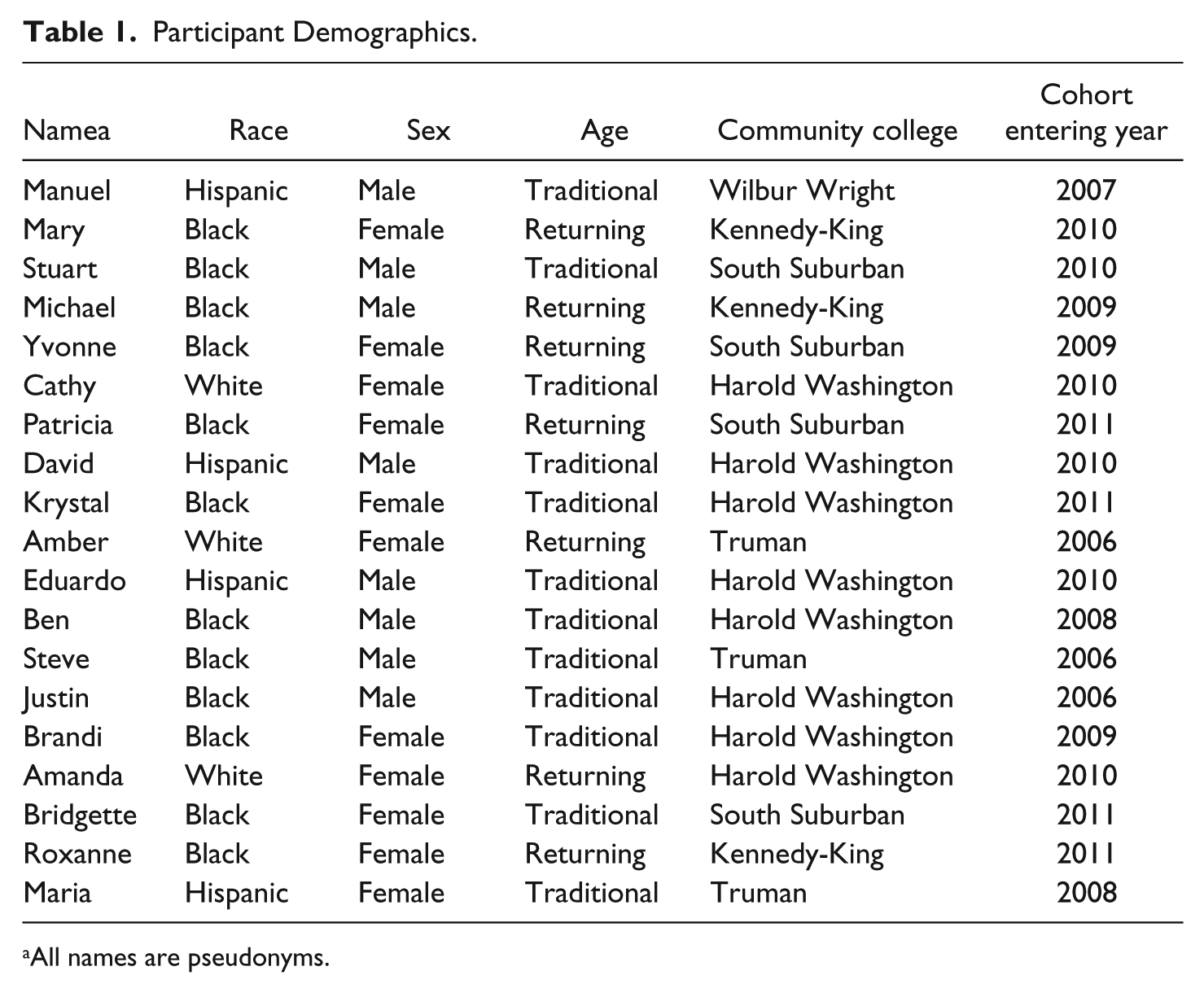
All names are pseudonyms.
Data Collection
As an independent researcher, I collected data through six focus group interviews conducted during the summer of 2014. Specifically, I used a social psychological approach to guide this focus group study (Ryan, Gandha, Culbertson, & Carlson, 2013). From this perspective, the information gathered derives from a range of opinions based on an individual’s thinking and reasoning which is prompted and elaborated in a focus group setting. The role of the researcher is to structure group interaction through a consistent protocol with semistructured questions. The protocol for this study was based on the validation framework, as well as questions about experiences before OMD participation and post OMD participation. The size of focus groups ranged from two to five participants. Focus group discussions ranged from 60 to 90 minutes.
Data Analysis
With permission of participants, I audio-recorded focus-group conversations. Interviews were transcribed verbatim and sent to participants for review, offering an opportunity for participants to add further insights and clarifications. As an independent researcher, I entered demographic information about the participant (gender, race, ethnicity, etc.); I did not use real names in reporting of data.
I organized participant narratives through a systematic, two-step coding process (Bogdan & Biklen, 2007; Saldana, 2013). During the first round of coding, I reviewed interview transcripts, noting rich insights and information from participants. Next, I developed a list of appropriate codes to capture emergent themes from each focus group interview session. After developing a list of emerging coding schemes, I compared codes across all interviews to examine overall thematic patterns from participants. Using a qualitative software program, I applied specific quotations from participant narratives to the comprehensive set of themes. Although the main data collection instrument, a semistructured interview protocol, was informed by validation theory, the first cycle of coding focused on capturing all the consistent codes and themes that emerged from the six focus groups. During the second cycle of coding, I used a pattern-matching logic technique (Yin, 2015) to compare themes that emerged from the six focus groups with conceptual underpinnings of validation theory outlined in previous scholarship. This article presents description and analysis of three thematic patterns discerned through the second coding cycle.
Limitations
A few cautions should be noted when considering findings and analysis. Foremost, this study was part of a collaborative research partnership between OMD and the College of Education at the University of Illinois, Urbana–Champaign. Although, as lead researcher, I worked independently from OMD program activities and organizational leaders, study participants may have viewed my research as being a part of OMD. Therefore, data collected are susceptible to response bias. In addition, because I collected data at one point in time, participant reflections may not completely capture more nuanced experiences in the program. Although the use of focus group interview techniques and semistructured protocol aimed to elicit collective interpretations of the OMD program through participant discussion, the range of perceptions is limited to the sample population. Finally, the study is limited to student experiences from August 2006 (entry of initial OMD cohort) through May 2014 (graduation of last OMD cohort before the study).
Findings
In alignment with phrases from Gwendolyn Brooks’ poem, I offer three themes that reflect the validating experiences of students during the college transition process: (a) proactive support for aspirations, (b) affirmation of agency and persistence, and (c) development of collectivist perspectives.
Elevating Above “Harmony Hushers”: Proactive Support for Aspirations
Across focus groups, participants described an attraction to multiple aspects of the program. The scholarship award was the initial piece that caught the eye of many participants as they came across OMD material during a search for additional financial aid. For many, the additional scholarship alleviated the need of taking on a part-time job or jobs to pay for tuition and books. The scholarship and stipend offered by OMD boosted personal or family budgets, allowing participants to focus on academics or add additional classes. Amber, a returning adult graduate from Truman College, stated, “We didn’t have money for daycare so [before joining OMD] I was afraid I was going to have to squeeze in my class in here or there and be able to take one or two [classes].” Stuart, a traditional-aged graduate from South Suburban, stated that before enrolling,
I had this job at UPS. I worked [the] overnight [shift] and I had school sometime in the morning, sometimes at 8 o’clock. So sometimes I had sleepless nights for four days. When I got into One Million Degrees, I got to stop that job because I got a scholarship that can support when I was trying to figure it out. So that way I was able to get more sleep, more healthy, and [maintain] my grades.
Among OMD alumni participating in focus groups, the financial incentive offered by OMD was critical in reducing stress loads, allowing them to refocus on academic work. The financial burden attached to postsecondary education is increasing even for students attending community college. Students from nontraditional backgrounds are more sensitive to the cost of attendance that includes both direct costs (tuition, fees, books) and indirect costs (daycare, transportation, limited availability of employment opportunities). Although the OMD scholarship did not cover all costs, participants expressed the positive impact of the award in pressures both internal and external to their academic pursuits. Hence, participants were able to dedicate more time and energy to their studies.
Although conversations about initial attractions first focused on the scholarship, participants also discussed being attracted to the expressed goal of OMD to connect students to academic and professional support. This observation supports validating agents who actively “reach out to students to offer assistance, encouragement, and support, as opposed to expecting students to ask questions first” (Rendón Linares & Muñoz, 2011, p. 17). Recalling initial conversations with OMD, participants were aware of the unique aspects of the program through OMD advertising. Mary, a returning adult graduate from Kennedy-King College, stated,
I thought that was interesting that they took an interest in city college students . . . for them to go out and reach out to be a helping hand to aid them into continuing on from the two-year into the four-year . . . that kind of struck a core with me.
For Justin, a Harold Washington College graduate, the financial support was secondary:
What originally attracted me to [One Million Degrees program]? I think it was just the idea of having a support system outside of the school, and maybe even outside of my home. . . . I was really attracted to the idea of just having a group of people who are genuinely interested in helping me advance academically, all the people I met there seemed to be truly focused and truly interested on students and the people around them.
The personal relationships that were attached to OMD enrollment also served a critical draw for students. During group dialogue, participants fondly shared details about their first interactions with OMD, including names of individuals. These positive interactions with OMD staff at the initial stages were critical to students, particularly those who may not have experienced healthy communications with educators. Again, Amber provides some additional insight on the application process:
I thought “Wow, I’m going to have somebody who knows my situation, will remember my face, remember my case, my name, and will help me choose the right things to do. I will have someone to like, take my hand a little bit.”
Initially, OMD was unique compared with other college transition programs in that there was no significant pressure from financial supporters of the program to demonstrate immediate outcomes. Evidence from participants in later cohorts, however, suggest that the OMD application process is becoming more complex as the organization moves toward sustainability and scalability. In comparison to Justin and Steve, members of first OMD cohort in 2006, Stuart, a 2010 cohort member, describes a complex application system that included group work and individual interviews:
You work in groups—group of five scholars—for one this section, another section, and another section. And then, you have a judge foreseeing that group [to see] how they work together, and they want to see how well you work with people you’ve never worked with before to do this one task. Then, you have to present that task on your findings. Based on that, they want to see how well you present yourself. And then, after that, you have the one-on-one interview.
The process described by Stuart remains focused on nonacademic measures and appear to avoided deficit-based evaluations. Furthermore, Stuart and others from more recent cohorts highlighted the broad, holistic application process for OMD. However, the degree to which increasingly complex small group activities capture and validate various expressions of aspirations remains unclear.
“It Cannot Always Be Night”: Affirmation of Agency and Persistence
Discussions with participants revealed that the confidence exhibited from OMD leveraged existing agency among participants as they entered the program. Several heads around the table nodded in agreement when Brandi, a Harold Washington graduate, stated that before OMD, “We were all dedicated to our studies and that was because of us and our love for our education.” Fitting with the OMD mission to find highly motivated students, participants expressed various inspirations for pursuing further education. Participants, particularly those of traditional college age (18-24), mentioned that they were looking for additional support to persist through potential challenges to completing their studies. For example, Ben, also a Harold Washington graduate, stated that his OMD interest stemmed from a desire for focused attention on academics:
Simply just kind of having a safety net . . . [a] kind of support lane system. They would help you keep on track. That’s something that I needed because there were so many distractions left and right that I kind of wanted a big brother in a way to [guide] me forth and achieve my game plan.
For many adult students participating in focus groups, change in personal status (e.g., becoming a parent; losing employment and benefits) sparked motivation. Roxanne, a Kennedy-King College graduate attending a public in-state institution, shared that a major health scare reignited her desire,
It was crisis moment for me because time is ticking. I’m in my 50s, so it was definitely . . . I wanted something better for myself. I wanted to make more money, I wanted to actually have a degree and a career.
For Mary, having college-aged children inspired her return to school, “My kids were my motivating force. They mentioned it to me, ‘Mom, aren’t you a little old to be going back to school [laughter]?’” Mary also mentioned that she engaged with her children in supportive competitions for best grades. For Ann, the turning point was self-reflective:
I felt like I was just taking up more space than I was offering, and I really wanted to do something that mattered. I wanted to have a talent. I wanted to do something and since the stuff that I used to do I couldn’t do anymore, it was this huge void in my life.
Participants also shared that they initially viewed the OMD program as an opportunity to elevate role model status for their community and family, confirming the productive role of interpersonal validation. David, for example, discussed his developing desire to be a role model as he entered OMD, asking “Okay, how can I see myself as a match for others? Especially starting [from] the community that I started [from], that kind of inspired me to go forward.” Maria, a graduate of Truman College currently attending a public in-state university, emphasized her stature as a first-generation college student and was looking for navigational guidance to match her determination to finish:
I mean, I think with or without OMD, I would still keep doing . . . it’s just that OMD, they provided me—they help you more, like even though you had the motivation inside you . . . I think it was more that OMD also helped you.
Examples from both David and Maria suggest that, as they entered the program, the strengths and motivations of OMD Alumni were firmly rooted in a commitment to community and family.
Alumni also discussed how OMD activities supported individual persistence through a balance of high expectations and supportive encouragement. For example, students described the value of conversations with OMD staff, notably the program advisors and mentors who provided a proactive approach to academic counseling. This approach included an honest dialogue about the steps necessary to meet academic requirements of the program. Manuel, a Wilbur Wright College graduate, provided a comprehensive example:
That was one thing that I really liked. They made sure . . . you had to give them your mid-term grades. If they saw a possible C, they told you, “You know what? I want you to pick up that B. Pick it up even higher.” “Okay, okay. I’ll pick it up even higher.” They were just on you with that. That’s one thing that I really loved because that’s one thing that I really needed. It was the motivating factor. “Have you registered yet? What’s your mid-term grade? Did you submit your final grades? How are things going with your classes? Are there any classes that you think you may need tutoring with?”
Some study participants suggested that the added academic requirements of OMD also increased levels of stress during their experience. Brandi stated,
It felt sometimes like it was extra work on top of what I was doing . . . I’m really grateful to OMD and to be a part of the family, but I was also really relieved when I kind of got through the program.
Others felt that program administrators did not consider extenuating circumstances when completing semester evaluations. Cathy suggested,
It seems like maybe there should be like some kind of individualized pace—like where you can talk to somebody personally and say, “This happened to me and for these reasons I think that I should still receive my [stipend money].”
However, in another focus group, Roxanne stated,
I know that we all do have personal issues come up and a lot of times we can’t tell them . . . or don’t know how to express or maybe it’s just not the right time or you don’t have time to at least let them know ahead of time, and I found it . . . I think they were a little bit more understanding than I thought they would be, yeah.
Overall, most participants expressed appreciation for the required steps and deadlines of OMD. Conversations with alumni suggest that high academic expectations from OMD further validated academic aspirations and capabilities. Alumni reflected on the supportive conversations that challenged them while also offering a range of strategies to meet academic goals. Participants mostly described conversations around academic progress as nonpatronizing dialogues that acknowledged individual strength while developing strategies for improvement, although some inconsistency across all participant experiences was expressed. However, a few alumni expressed some issues with the academic rigor of OMD and felt that a unique circumstance was not given appropriate consideration in their evaluation of progress.
“Live Not for the End-of-Song”: Development of Collectivist Perspectives
The most discussed aspect of the OMD experience among alumni was the sense of community and personal development from a collectivist perspective. Participants used familial metaphors repeatedly to describing the supportive characteristics of OMD. Alumni stated that the relationships with other OMD scholars, from a variety of backgrounds and positions in life, fostered a supportive environment. In describing her experience, Mary stated,
I learned that I wasn’t alone. You know, everybody that I may have a different story, but we kind of was on the same path. We all had a goal. We were all trying to meet one goal. We were like family who was trying to meet that one goal. It’s just interesting how, you know, everybody has their own story, [but] we all bond. We build relationships that were like that.
In the same focus group, Manuel followed up on Mary’s insights, stating that he felt inspired by his cohort peers:
[The] main thing I learned from seeing other people’s situation [is] if they can do it, then I can do it. If they did it working two jobs, single parents, and being away from so long, what’s stopping me from achieving my goals?
The community aspect was most apparent among those alumni who participated in the program recently. OMD alumni from older cohorts felt community development among peers missing. Justin, a 2007 cohort member, recalls that there was not much interaction among students:
I never really got to interact with them very much. Later on, I was able to develop a relationship . . . and I really enjoyed that. Those relationships are still pretty strong, even to this day, but yeah, I would’ve liked to interact more.
Participants discussed how engaging with OMD community and interaction with peers interaction adjusted their perspective on education. Alumni recall how the positive collectivist experience at OMD facilitated the pursuit of collaborative opportunities on campus. Stuart states,
I think it made me see education as not just going to college or getting a degree. It’s about building a relationship so that’s one big thing that One Million Degrees . . . I thought I would just be going to school, get your degree, start your career, and start making your money and make your own family. But it’s a little bit different for me now.
With support from OMD, alumni avoided isolating educational experiences that often lead to delaying continued enrollment or permanent departure from the institution. Furthermore, the diversity of the cohorts—across age, neighborhood community, ethnicity, gender, parental status—provided students with an opportunity to engage with others with different backgrounds but similar education pursuits. The value of having a collective experience with a cross-cultural group of peers fostered both personal aspirations and sense of responsibility for supporting the success of others.
For participants in this study, the sense of connection and responsibility included both their neighborhood community and the college transition program. Furthermore, they viewed themselves as connectors to both environments and sought to solidify this position as part of their academic and social success. Alumni described frustration that, despite the development of collectivist perspectives, OMD did not have a formal process for former program participants to remain actively involved in the program after completion. Some alumni attribute the lack of postprogram connection the increasing growth the program. For example, Ben stated,
I know they’re kind of scaling large. It kind of feels like too corporate from where I’ve started. I feel like they have the best interest of the students, and they just want to do more for the community . . . their vision is huge now.
Ben’s comment reflects a concern, especially among members of early cohorts, that the initial vision and mission of the program has been lost as the sizes of cohorts increase. As OMD has grown, there is a perception that unique individual attention has been lost to efficiency trends. Yvonne, a South Suburban graduate, confirmed that her experience with OMD ended at the point of her transfer to a 4-year institution, “They could’ve reached out to me [and] send me an email how everything is going. I don’t recall it. I feel like I kind of was dropped [and] done.” Ben’s observation and Yvonne’s experience highlight the desire for a personalized validation process which continues beyond the formal completion of a program. Furthermore, participants want to remain active in the development of the program, including opportunities to serve as an empowering example for others, especially those from their community neighborhoods.
Discussion
Overall, themes from the six focus groups with 19 OMD alumni suggest that the program served as a validating vehicle for both short-term and long-term aspirations of students from traditionally underserved populations. Among the Alumni participating in this study, the OMD experience served to affirm existing motivations for success in school and work. Furthermore, OMD stimulated affective and behavioral development among students, elevating previously established levels of self-reflection and social responsibility.
Narratives from participant focus groups support Rendón Linares and Muñoz (2011) suggestion that validating agents should be authentic and caring as they research out to students. During conversations, it was clear that both the genuine concern for students and the personable recruitment process attracted participants to the program. Participants articulated feelings of connection to the holistic commitment expressed by OMD via advertising and recruitment strategies. OMD’s initial approach to recruiting and enrolling participants appeared to avoid cultural-deficit language that, consciously or unconsciously, attach stereotypical at-risk labels to students participating in college transition programs. Furthermore, initial interactions provided participants with a comforting combination: support for aspirations and confidence in eventual success. Study participants also described an appreciation for the nonpatronizing tone of conversations with OMD advisors, suggesting that style of communication is just as important as the information received. The holistic engagement and supportive interactions appeared to solidify a sense of belonging in postsecondary education and buffer participants from many of the environmental pull factors influencing transition and perspective (Crisp & Nora, 2010; Núñez, 2009; Strayhorn, 2012b).
Findings from this study also support the recognition of existing individual strengths as part of the validation process (Rendón, 1994; Rendón Linares & Muñoz, 2011). Two types of students seemed to be attracted to the OMD program: (a) students who acknowledge the upcoming challenges that may impede their path to achieving their long-term educational goal and (b) students focused on educational attainment after a shift in personal status or added responsibility. Both types of students have strengths grounded in internal motivation and recognition that such motivations may not be enough to accomplish postsecondary goals. Although individual agency is a critical component for student success, participants recognized larger structural issues that may influence individual persistence in higher education. For participants, the college transition program served as an accessible bridge to valuable information about the less visible norms, customs, and rules in postsecondary education. This validation of individual agency during the transition to less familiar organizational structures appears critical for supporting academic self-efficacy and interpersonal confidence.
The recognition and validation of participants existing strengths is critical for supporting both social capital and cultural community wealth perspectives as part of the validating process (Sandoval-Lucero et al., 2014; Winkle-Wagner, 2010; Yosso, 2005). Although college transition programs provide social capital resources (e.g., access to financial aid literacy; insights on academic policies; deconstruction of sociocultural practices), equally important is the recognition of wealth students bring with them to the program (e.g., educational aspirations; experience persisting through challenges). Isolating organization practices to social capital may foster cultural-deficit thinking. In contrast, simplifying success to the presence of particular dispositions underestimates the influence of privilege (e.g., racial, gendered, and socioeconomic) ingrained in postsecondary structures.
As Rendón Linares and Muñoz (2011) suggested, findings from this study support the concept that validating agents with consistent presence and availability are critical for transition, persistence, and success within socio-academic spaces of an institution. Despite high levels of self-confidence and community wealth, participants enter the OMD program with various levels of academic self-efficacy, especially in postsecondary contexts. Although some participants responded immediately to the challenging motivations from validating agents, other students expressed the need for more supportive persuasion before tackling academic goals. From student perspectives, OMD advising staff took adequate time to develop attentive relationships and accurately assess the developmental position of students. Furthermore, personalized attention offered support for congruency of identity as participants navigate between multiple contexts, including school(s), community, and family.
Narratives from this study suggest that successful participants of college transition program will eventually seek to further develop congruency of identity by becoming validating agents themselves. The process of moving from the recipient of empowering activities to a source of empowerment appears to be a valuable part of the validation process. This goal is part of a collectivist purpose of education—part of success is supporting the advancement of others from one’s community (Allen & Bagozzi, 2001; Carson, 2009). Collectivism is a core feature of historically marginalized communities who proactively seek to buffer consequences of social and economic inequality by creating spaces for emotional support and well-being. College transition programs, particularly those that focus on serving historically marginalized communities, that do not include collectivist perspective as a core organizational feature may be compartmentalizing their influence in less meaningful ways. Indeed, the lack of opportunity for this transitional experience among OMD alumni served as a disappointing disconnection from a valued community while also reproducing a one-direction concept of validation. Furthermore, as an organization, OMD may have lost an opportunity to add validating agents who have unique authenticity within local communities.
Implications
As college transition programs consider both scalability and sustainability efforts, findings from this study of OMD supports several implications for future policy and practice. First, the populations targeted by college transition programs have a broad range of strengths and circumstances not easily captured through traditional assessment methods. The current selection process at OMD includes a written essay and multiple interviews, providing a holistic review for each student who applies to the program. In addition, the highly motivated criteria are broad enough to encompass a wide range of diversity (both demographic and interpersonal). Growing visibility of the program will likely stimulate an increase in applications, challenging current assessment processes. In balancing student complexity and selection efficiency, college transition programs such as OMD may consider incorporating identifying measures that are both fair and comprehensive. For example, William Sedlacek (2004, 2011, 2017) has developed quantitative assessment tools that connect to the strengths of students from traditionally underserved communities. Variables include measures of positive self-concept, realistic self-appraisal, successfully handling of systems reflecting inequality (racism, sexism, classism, etc.), preference for long-term goals, availability of strong support systems, leadership experience, and community involvement. In reviewing findings from focus group studies, many of these constructs parallel experiences of OMD alumni. Furthermore, noncognitive variables support an asset-based form of assessment rather than an evaluation that is deficit-based.
Conversations with OMD alumni revealed the importance of shaping an individualized OMD experience that incorporates all forms of identity held by participants. With adequate time to develop attentive relationships, the OMD advising staff can assess the developmental position of students. Future policies should support identifying and maintaining an appropriate student-advising or coaching ratio to avoid regressing to a sterile, one-size-fits-all approach that could replicate previous student experiences in school settings and other college transition programs. Rather than creating nonpersonal processes that may force students to abandon one set of cultural norms for another as a condition for academic and social success, dual socialization allows for participation in multiple cultural environments. Furthermore, this process supports possibilities for transforming academic cultures, including college transition programs, from assimilationist ideology to multicultural perspectives on the values, beliefs, and norms that shape academic success.
As OMD enters a new period, the first cohort of scholars is now several years removed from program participation. As grateful alumni, they are eager to give back to the program in meaningful ways. OMD and other college transition programs in similar situations should consider fostering these relationships by creating a formalized postprogram experience that begins immediately after successful completion. For example, college transition programs may encourage most recent alumni to represent the program in their neighborhood community (particularly those with low postsecondary attainment rates) as they have a level of credibility that goes beyond any degree or job position. College transition programs may also consider privileging applications that include a recommendation from successful alumni (or solicit recommendations from alumni for targeted recruitment). Finally, college transition programs should consider identifying alumni who can serve as additional mentors for current student participants, perhaps fostering connections to professional mentors. The continued interest of former OMD participants aligns with collectivist perspectives toward success that individuals from underrepresented communities hold as a core value (Carson, 2009; Chang, 2015). For participants in this study, the sense of connection and responsibility included both their neighborhood community and the college transition program. Furthermore, they viewed themselves as connectors to both environments and sought to solidify this position as part of their academic and social success.
Finally, findings from the study suggest that experiences in the college transition program contributed to a sense of place for students, allowing for the investment of significant meaning and value. As such, socio-academic communities like OMD become a space for negotiation as participants process the socio-structural contradictions between various contexts (e.g., academic events, neighborhood, work, school, or family). Future practice should consider best ways to support the emerging tensions of identity that emerge from validated social status. Frameworks such as validation theory are often used to support psychosocial concepts of identity formation (Jones & Abes, 2013; Pascarella & Terenzini, 2005), including self-efficacy and intersectionality. However, in both practice and research, sociological perspectives on identity development, specifically the concept of attributed identity (Goffman, 1959; Kaufman & Feldman, 2004) are addressed less significantly. The social construction of various forms of identity (race and ethnicity, gender, class, religion, sexuality, or citizenship status) uniquely bound American society, fostering stigmas and stereotypes that participants will face, unfortunately, in various contexts. Future research on college transition programs could build upon literature on sociological perspectives on identity development by presenting relevant research in this area directly to participants and collect narratives on the social interactions and experiences that influence their identity development.
Conclusion
Despite a near decade-long public discourse on the importance of the college completion agenda for economic mobility and social equity, pathways for postsecondary access and transition remain dangerously narrow, particularly for students from traditionally underserved populations. This continuing trend is particularly evident in the city of Chicago where postsecondary attainment rates vary widely across racially segregated neighborhoods. Insight from participants remind us of that extending the range of choices for individuals widens perceptions about what is possible—in education, career, and life. Furthermore, the current success of OMD demonstrates that hope is an essential element of the educational experience, one that is contagious when nurtured consistently. Although the challenge of creating more equitable systems of opportunity in local and national context remain, parallel to the words of fellow Chicagoan Gwendolyn Brooks, OMD Alumni demonstrate the power of optimism, commitment, and change.
Footnotes
Declaration of Conflicting Interests
The author declared no potential conflicts of interest with respect to the research, authorship, and/or publication of this article.
Funding
The author received no financial support for the research, authorship, and/or publication of this article.