




Abstract
Background:
Most community college students from low-income families have ambitious educational degree goals, but only a small fraction attains them. For many decades, sociologists have primarily attributed this problem to a cooling out process in which college practitioners diminish students’ educational ambitions using academic reorientation processes that encourage the least-promising students to lower their degree goals. The cooling out explanation focuses exclusively on the actions of institutional community college actors rather than other factors affecting student decisions and thus has been used to vilify community colleges as engines of inequality.
Objective:
This article addresses an alternative hypothesis, considering whether student financial aid, the ubiquitous and multifaceted system that community college actors mainly do not control, influences students’ educational goals.
Method and Results:
Using data from an experimental study of need-based financial aid in Wisconsin, I find that a private grant program, which triggered a repackaging of students’ financial aid awards, decreased the educational degree aspirations and expectations of 2-year college students, on average.
Contributions and Implications:
Although counterintuitive, this finding is consistent with the idea that the complex manner in which aid is delivered creates confusion and uncertainty about the actual costs of college. While these lowered degree goals persisted over time, they did not affect degree attainment rates, suggesting students’ expectations may be more malleable and less consequential than prior research suggests. This article demonstrates that the observed cooling out phenomenon is not necessarily the result of a meritocratic sorting system and involves processes previously neglected by sociological theory. A more robust model of college choices is needed.
Over the past 40 years, college enrollment has grown substantially, but the percentage of entrants who complete college has been stagnant (Bailey & Dynarski, 2011). Educational expansion has been fueled by greater inclusion of historically disadvantaged groups and largely accommodated by the community college sector (Dougherty, 1987; National Center for Education Statistics [NCES], 2015; Rosenbaum, Deil-Amen, & Person, 2006). Today, nearly half of all undergraduates attend a community college (NCES, 2015), including approximately half of all Pell Grant recipients (Mullins, 2011). But the opportunities created by community colleges are accompanied by significant challenges for their students, as evidenced by their high rates of noncompletion (Bound, Lovenheim, & Turner, 2010; Brand, Pfeffer, & Goldrick-Rab, 2014). By one estimate, just 29% of community college students earned a certificate or associate degree within 3 years (NCES, 2014). Among degree-seeking students starting at a community college, just 14% went on to complete a bachelor’s degree within 6 years (Jenkins & Fink, 2016).
To improve the sociological understanding of noncompletion in the community college sector, this article reports on an empirical test of a central piece of the status attainment model that emphasizes the role played by students’ educational degree plans and goals for educational and occupational attainment (Domina, Conley, & Farkas, 2011; Jacob & Linkow, 2011; Sewell, Haller, & Portes, 1969). These individual attributes lie squarely between origins (e.g., levels of parental education) and destinations (e.g., educational attainment). Today, nearly all high school students expect to attend college and most expect to earn a bachelor’s degree or higher, regardless of socioeconomic background (Jacob & Linkow, 2011). Over time, however, some students scale back their educational ambitions. These negative changes in students’ plans or goals are posited to help account for the decision to leave college; for this reason, they have long been common covariates in statistical models of college choices and outcomes (e.g., Manski & Wise, 1983). 1 But why these negative changes occur—what drives them—has rarely been studied and is not well understood (Rosenbaum et al., 2006). For over 50 years, sociologists of education have largely ascribed to a theory known as the cooling out hypothesis that points directly to the organizational practices of community college actors (Clark, 1960, 1980). In this article, I investigate whether cooling out might stem from a different factor—student financial aid, a popular policy and practice that community college actors mainly do not control (U.S. Department of Education, 2015). If a private need-based financial grant contributes to declining educational ambitions among community college students, extant theory may require revision to include factors outside of the direct control of community colleges.
Background and Literature Review
Inequality in Higher Education
Community colleges are often viewed as a democratizing force in higher education, providing an equalizing opportunity and avenue to upward mobility, especially for students with limited academic preparation or financial resources (Bailey & Morest, 2006). These beliefs are deeply intertwined with meritocratic ideals in America’s contest mobility system that cultivates a sense of ambition and futuristic orientation among youth (Brint & Karabel, 1989; Turner, 1960). Today, the relationship between family background and college completion is stronger than ever (Haveman & Smeeding, 2006). Students from high-income families are now 6 times more likely to earn a bachelor’s degree than those from low-income families (Bailey & Dynarski, 2011). Low college completion rates, along with rising student debt burdens, have led some scholars to argue that community colleges reproduce or exacerbate social inequality (The Chronicle of Higher Education, 2012). The cooling out theory, in particular, has added to an understanding of community college actors as active contributors to inequality, which has supported the vilification of this institution (Brint & Karabel, 1989; Dougherty, 1994; Karabel, 1972; Schudde & Goldrick-Rab, 2015).
There is a large and growing body of work by sociologists of education on the college departure phenomenon, but when it comes to explanations for why community college students reduce their educational goals and leave that sector, one explanation is overwhelmingly popular. Researchers and practitioners alike ascribe, at least in part, to Burton Clark’s (1960) cooling out theory, which posits that community college actors systematically work to discourage the least academically promising students from pursuing education beyond that provided at their community colleges and as a result students reduce their educational goals (Clark, 1960, 1980; emphasis added). Clark borrows the term cooling out from Goffman’s (1952) explanation of a conman cooling out his mark or the intended target of his swindle. Because the mark has lost his investment and may feel cheated or want to shut down the swindle, a cooling out process is necessary to assuage feelings of exploitation. In Clark’s (1960) reconception, the mark is a community college student with little chance of success, and the college employs a systematic response to “ameliorate the consequent stress” and “mollify those denied” while still sustaining motivation and interest in postsecondary education more broadly (p. 569). More specifically, Clark argues that the inconsistency between culturally encouraged aspirations and the reality of limited institutional opportunities leads the least academically promising students to fail. Using case study methodology of a single institution, he documents an elaborate process of “soft denial,” which he terms “cooling out” (Clark, 1960, p. 569). He asserts that academic reorientation processes sort students into various meritocratic tracks (i.e., terminal associate or 4-year college transfer), and these processes occur to avoid publicly or more assertively failing less-promising students, which is unacceptable given societal norms promoting college access. According to Clark, institutional processes including placement testing, remedial coursework, counseling sessions, and orientation classes are explicitly designed to help students reflect on their interests and abilities and sidetrack those with less academic potential. The intention is that these students will come to realize that they are not college material on their own and thus reduce their educational expectations to an associate degree.
Empirical Evidence on Cooling Out
While it is not disputed that some students lower their educational goals, the source of that change as the cooling out process described by Clark has long been debated (e.g., Rosenbaum et al., 2006; Scott-Clayton & Rodriguez, 2012). In 1971, for example, Baird set out to empirically test the cooling out hypothesis by surveying and studying the academic records of students at 27 community colleges. In direct opposition to Clark’s (1960) theory, he reports, “students who cooled out were not lower in academic aptitude, high school grades, or nonacademic achievement” and concludes that community colleges are not “discouraging those lacking in ability” (p. 170). More recent research indicates that advising—one of the key “reorientation processes” according to Clark (1960, p. 575)—is associated with increasing students’ chances of successful remediation and transfer to a 4-year institution. Moreover, these results do not significantly differ by level of academic preparation, which directly contradicts Clark’s meritocratic conclusions (Bahr, 2008). If community colleges’ reorientation processes are not cooling out the least-promising students, then which students are lowering their educational degree goals and what might explain their change in plans?
Some scholars argue that structural factors and knowledge of the “real world,” including discrimination and bias, influence students’ educational goals and attainment, regardless of individual merit (e.g., Kerckhoff, 1976, 1984). To test this theory, Hanson (1994) studied a group of academically talented students and found that low socioeconomic background was the largest and most consistent factor associated with reducing educational expectations. More recently, Alexander, Bozick, and Entwisle (2008) undertook a holistic investigation of why community college students change their education aspirations by drawing on additional insights from the expectations formation literature, which typically focuses on younger students. That body of research argues that familial, individual, and institutional factors influence students’ education expectations (Bozick, Alexander, Entwisle, Dauber, & Kerr, 2010; Jacob & Linkow, 2011; Uno, Mortimer, Kim, & Vuolo, 2010). The authors find that community college attendance does not lead to cooling out, net of other considerations. Instead, students with limited socioeconomic resources are more likely to give up their bachelor’s degree expectations. The researchers conclude that a more comprehensive understanding of the college experience, including family obligations and financial problems, is central to understanding changes in expectations and should be reflected in future research (Alexander et al., 2008).
Alternative Frameworks Incorporating Today’s Cost of College
Among community college students, warming up or the raising educational expectations is nearly as common as cooling out (18% vs. 22%, respectively; Rosenbaum et al., 2006). In fact, economists Manski and Wise (1983) treat changes in students’ plans and goals as a normative part of the educational process, occurring as they explore higher education and experiment with college life. According to their formulation, when a student determines that the costs of college, including opportunity costs, exceed the benefits, they rethink their plans and lower their goals or drop out. Similarly, Bayesian theory suggests that as students gain more complete knowledge over time, they update their expectations accordingly (Zafar, 2011). While institutional actors may play a role in determining costs, rational choice frameworks accommodate, but do not require, their participation (Morgan, 2005). That framing also easily integrates alternative explanations for rising costs, such as student financial aid. If a student’s financial aid shifts during college, which could have nothing to do with the actions of community college actors, this could also promote discouragement and cool them out. But as such alternatives have not been explicitly investigated, Clark’s college-level explanation dominates the literature (Rosenbaum et al., 2006). 2
When the cooling out hypothesis originated over 50 years ago (Clark, 1960), the community college landscape was very different. Namely, America’s college-for-all ethos had yet to take hold and the price of college was relatively low. While community college remains more affordable than 4-year institutions, on average, students from low-income families still face significant unmet financial need. For example, a student from a family in the lowest annual income quartile earning US$21,000 must pay over US$8,000 to cover the full cost of attendance at a community college for 1 year, after all grants are taken into consideration (Goldrick-Rab & Kendall, 2014). Thus, paying for college has become a significant factor in students’ educational decisions (Scott-Clayton, 2012).
Due to the rising price of college, the majority of community college students turn to the financial aid system—perhaps the most ubiquitous, costly, and influential policy and set of practices in American higher education (Goldrick-Rab, 2016; Goldrick-Rab, Harris, & Trostel, 2009). Research indicates that need-based scholarships for students from low-income families positively impact college completion (e.g., Castleman & Long, 2016; Dynarski, 2003, 2008; Goldrick-Rab, Kelchen, Harris, & Benson, 2016), but researchers know little about the mechanisms through which those effects arise (for an exception, see e.g., Broton, Goldrick-Rab, and Benson, 2016). This article is the first to investigate the relationship between a private need-based grant and students’ educational degree plans, a critical pathway to educational attainment in the status attainment model (Sewell et al., 1969).
Although the financial aid system is notoriously complex, most community college financial aid officers have little flexibility in administering aid (U.S. Department of Education, 2015). Instead, their charge is to comply with a bundle of federal, state, and local regulations regarding the proper administration of financial aid. In this way, financial aid officers are primarily instruments of the financial aid system rather than autonomous community college actors (U.S. Department of Education, 2015). Students experience this complexity firsthand and report that the financial aid process is confusing and daunting. Scholars argue that such complexity exacerbates students’ uncertainty about their ability to pay for college, undermining the efficacy of aid programs (Dynarski & Scott-Clayton, 2013; Dynarski & Wiederspan, 2012). Reducing that complexity has demonstrable benefits as well. For example, Bettinger, Long, Oreopoulos, and Sanbonmatsu (2012) describe a field experiment in which some families were randomly assigned to a simplified financial aid application process in which they received direct assistance. Results indicate that students from these families were significantly more likely to attend college and the effect sizes were similar to several thousand dollars of grant aid (Dynarski & Wiederspan, 2012). Thus, both the receipt of financial aid and the process through which students obtain that aid have bearing on students’ educational decisions and outcomes. Studies of financial aid, however, cannot disentangle the effects of receiving additional money from the impact of experiencing the financial aid system or a particular financial aid program (Goldrick-Rab, 2016).
One study has examined the relationship between the financial aid system and students’ educational ambitions (White & Wall, 2013). The authors argue that the structure of financial aid policies and practices is so inadequate and confusing that it serves a cooling out function. Community college students in the study report that their financial aid packages take a long time to be configured and then the package may change without warning or clear explanation. This creates a scary and stressful situation for students, particularly for those from families with limited financial resources or experience with college. Students also explained that they found information about their financial aid packages difficult to decipher and were uncertain about different eligibility requirements for different aid programs or the impacts of certain aid decisions. For example, one student used financial aid for summer classes without understanding that doing so rendered her ineligible for financial aid during intersession. The timing of students’ financial aid packages was also variable and unpredictable, further inhibiting students’ ability to plan for college expenses. Rather than attributing cooling out to the institution’s financial aid officers, the authors point to the structure of the financial aid system as the source for cooling out otherwise ambitious and motivated students (White & Wall, 2013).
Data and Empirical Approach
The Wisconsin Scholars Grant (WSG)
The WSG was established in 2008 by philanthropists seeking to support the college degree goals of Wisconsin students from low-income families. The WSG offers students attending 2-year colleges a US$1,800 grant, renewable for up to 5 years. 3 To be eligible for the grant, students had to have attended a Wisconsin public high school during the last four semesters prior to graduation, earned a high school diploma or equivalent, and enrolled in a Wisconsin public college within 3 years. In addition, students had to be first-time full-time enrollees in fall 2008 and, after filing the Free Application for Federal Student Aid (FAFSA), received a federal Pell Grant and were determined to have at least US$1 of unmet financial need (excluding loans). Eligible students were identified using administrative records after they had enrolled in college and entered into a lottery, and then 477 two-year college students were randomly assigned an offer of the WSG. These students are referred to as the treatment group. Only those chosen to receive the grant offer were notified of the program via a letter that they had to sign and return to receive the funds. Nine in 10 students offered the grant received in 2008. The WSG was packaged according to financial aid regulations and disbursed through the colleges’ financial aid office by the end of students’ first semester in college. Because the WSG was administered after students had enrolled in college, and received and accepted a financial aid package, it caused students’ existing first-year financial aid package to change.
For research purposes, a control group was selected from the remaining pool of eligible nonrecipients. Using stratified random sampling, blocked by college to facilitate the oversample of non-White students, an additional 623 two-year college students were selected to participate in the study. Therefore, the full study sample includes 1,100 students, 4 generalizable to the specific population of low-income college students described above with the appropriate use of design weights (for more details, see Goldrick-Rab, 2016).
Although 4-year college students were also eligible to receive the WSG, this article focuses exclusively on students who initially enrolled at a 2-year college. Prior research on cooling out focuses on community colleges, and variation in educational degree goals is also expected in this population. In addition, the degree goals of 2-year college students are particularly relevant for policy issues related to transfer and attainment.
Research Questions
This article integrates sociological literatures on cooling out, formation of educational expectations, and financial aid to examine the relationship between need-based grant aid and students’ educational degree ambitions after college enrollment. Specifically, what are students’ stated educational degree goals when they enroll in 2-year college and how do they change over 3 years? This question is aimed at establishing whether cooling out—or warming up—is a pattern present among students in this study. It improves on prior studies by measuring students’ educational aspirations and expectations annually rather than waiting several years to measure degree goals (e.g., Alexander et al., 2008; Hanson, 1994; Jacob & Linkow, 2011) or, as other studies have done, assumed students’ degree goals (e.g., based on enrollment in an academic program) rather than explicitly measure them (Rosenbaum et al., 2006). Moreover, the study includes students’ full range of ambitions extending from sub-baccalaureate to doctoral degrees rather than distinctions between 2- and 4-year degrees only (e.g., Alexander et al., 2008).
Second, is there a causal relationship between an offer of additional grant aid and students’ educational degree goals? This question aims to bring additional information to bear on the cooling out hypothesis and offers an alternative explanation of changes in educational ambitions. I hypothesize that if additional need-based financial aid causes students to have higher educational ambitions relative to the control group, then cooling out is at least partly attributable to economic constraints and can be stemmed with more financial aid (Kerckhoff, 1976; Morgan, 2005). If the aid offer results in treatment group students having lower educational ambitions than those in the control group—which I hypothesize as unlikely—several explanations might be at work. First, help paying for college might reduce students’ investment in or motivation to persist in their path to degrees. Second, the grant might be provided in a manner that frustrates or discourages students, thus diminishing their educational degree plans. Importantly, regardless of whether the effects of the aid program are positive or negative, any difference between the treatment and control groups indicates that educational degree plans are, at least partly, a function of factors other than the reorienting processes used by community college actors. While this does not eliminate the possibility of an institutional explanation for cooling out, it would indicate there are additional processes at work that change students’ degree goals and encourage revision and expansion of the traditional cooling out explanation.
Measures
The longitudinal study includes several measures of students’ self-reported educational degree goals over time. Educational degree goals is operationalized using two measures, one of educational aspirations and another of educational expectations, because they are both relevant and commonly used in the literature (e.g., Alexander et al., 2008; Rosenbaum et al., 2006). Educational aspirations are understood as students’ hopes about what type of degree they wish to earn, while educational expectations are thought of as students’ plans about the type of degree they will more realistically earn. Prior studies lead us to expect students’ educational degree aspirations to be higher than their expectations (Beal & Crockett, 2010; Goyette, 2008; Jacob & Linkow, 2011).
In this study, students were asked about their lifetime educational degree aspirations immediately after they enrolled in college in fall 2008 (i.e., the treatment group had been notified of the WSG offer, but not received payment). One year later, in fall 2009, the research team invited a subsample of study participants to complete a second survey that also included a measure of degree aspirations. Students could indicate that they aspired to an associate, bachelor’s, master’s, or other professional or graduate degree. 5 In addition, students were surveyed about their lifetime educational degree expectations in spring 2009, spring 2010, and spring 2011, which corresponds to their first, second, and third years of college, respectively. Response options included high school degree or General Equivalency Diploma (GED), vocational certification, associate, bachelor’s, master’s, or other professional or graduate degree. The study surveys were designed and carefully branded as general surveys of college experiences and financial aid—not as part of the WSG program. Any questions about the WSG were part of a larger battery of questions about several financial aid programs.
Finally, a subsample of study participants who took the ACT exam also completed a survey of educational expectations during high school, and the research team obtained that information via administrative records. While this subsample is not representative of the full study sample, it provides the only pretreatment estimate of students’ educational goals.
In addition, a stratified random sample of study participants (based on treatment status, race, ethnicity, gender, and financial aid) were selected to participate in in-depth semi-structured interviews. Thirteen 2-year college students were included in the sample 6 and interviewed every 6 months between 2008 and 2010, regardless of their college enrollment status. Because educational degree plans were not part of the interview protocol, the topic only came up in some interviews, thus limiting the ability to conduct a formal mixed-methods analysis. However, I repeatedly read, coded, and analyzed the interview transcripts in an iterative process to aid in the interpretation of the survey data. Insights from the student interviews are included in the “Discussion” section. 7
Analytic Samples and Descriptive Statistics
This article includes two analytic samples: one based on students’ aspirations and the other on expectations. Information about students’ aspirations comes from fall surveys, while information about students’ expectations comes from brief spring questionnaires, resulting in different sample sizes. Due to resource limitations, the research team invited subsamples of study participants to participate in follow-up survey and questionnaire waves. Participants were invited based on past survey participation, and invitation was independent of treatment status. Thus, the aspirations analytic sample is a constant composition sample of 445 students who completed the aspirations question on both the fall 2008 and fall 2009 surveys. This represents 62% of the 713 eligible study participants who were invited to take the survey and 41% of the overall study sample. The differential response rate between treatment and control groups is very small (1%), suggesting high levels of internal validity (What Works Clearinghouse, 2014). Indeed, comparisons between the treatment and control groups on 14 pretreatment characteristics reveal no statistically significant differences (see Table 1, Aspirations sample panel, Control and WSG columns).
Pretreatment Characteristics of 2-Year College Students by Sample.
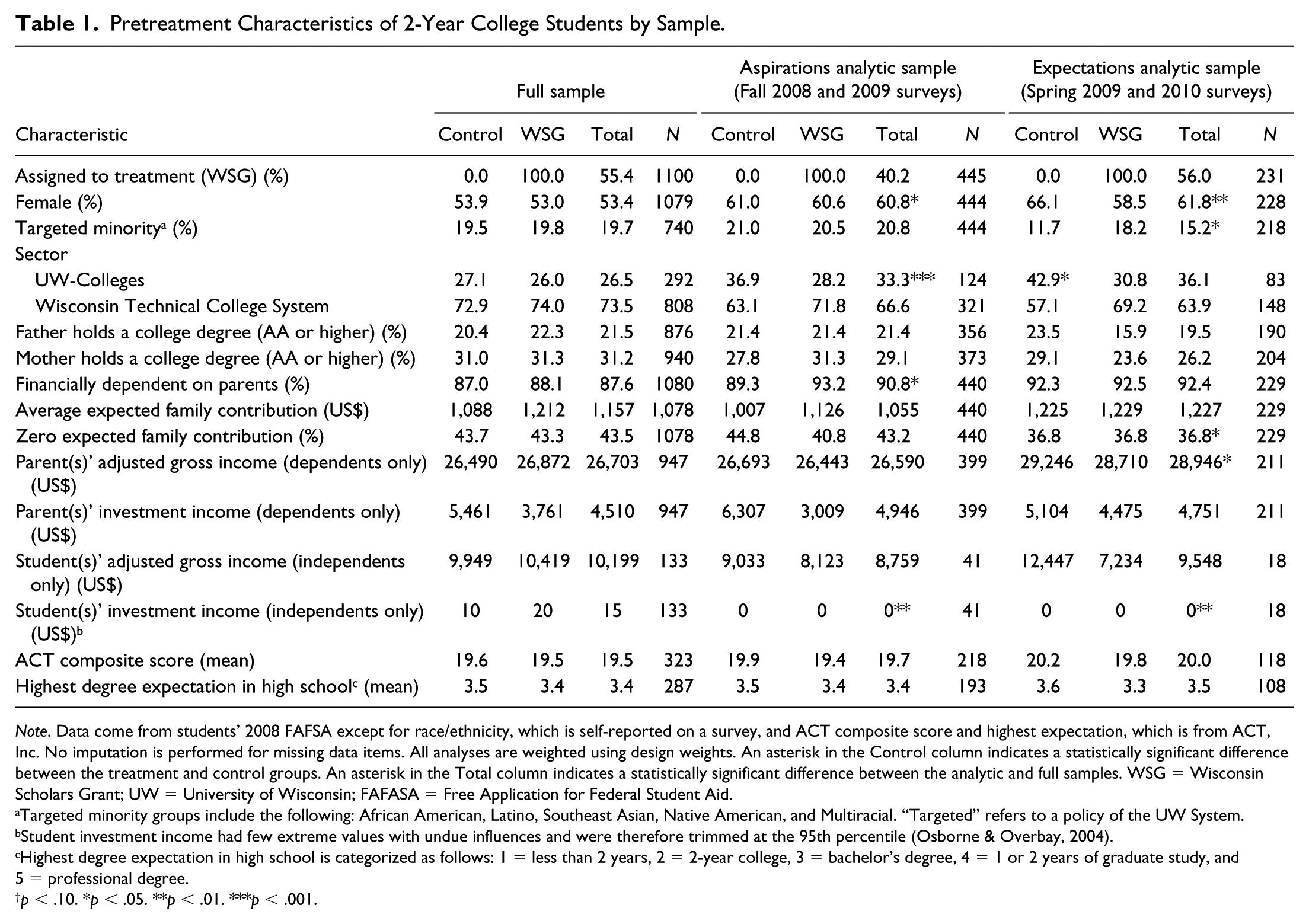
Note. Data come from students’ 2008 FAFSA except for race/ethnicity, which is self-reported on a survey, and ACT composite score and highest expectation, which is from ACT, Inc. No imputation is performed for missing data items. All analyses are weighted using design weights. An asterisk in the Control column indicates a statistically significant difference between the treatment and control groups. An asterisk in the Total column indicates a statistically significant difference between the analytic and full samples. WSG = Wisconsin Scholars Grant; UW = University of Wisconsin; FAFASA = Free Application for Federal Student Aid.
Targeted minority groups include the following: African American, Latino, Southeast Asian, Native American, and Multiracial. “Targeted” refers to a policy of the UW System.
Student investment income had few extreme values with undue influences and were therefore trimmed at the 95th percentile (Osborne & Overbay, 2004).
Highest degree expectation in high school is categorized as follows: 1 = less than 2 years, 2 = 2-year college, 3 = bachelor’s degree, 4 = 1 or 2 years of graduate study, and 5 = professional degree.
p < .10. *p < .05. **p < .01. ***p < .001.
In the aspirations sample, six in 10 students are female and one in five identify as a targeted racial or ethnic minority according to University of Wisconsin System policy. 8 Two thirds initially enrolled in a 2-year college in the technical college system. Most students (91%) are financially dependent on their parents who earn on average US$27,000 and are expected to contribute approximately US$1,100 toward their student’s college costs. However, 43% of families are not expected to contribute anything toward their child’s education expenses because of limited family financial resources. Among those who took the ACT college entrance exam in high school, the average score was 19.7 and the average degree expectation was a bachelor’s degree or higher. Regarding external validity, the aspirations analytic sample differs from the full study sample in several ways. Specifically, it includes a higher proportion of female (61% vs. 53%) and financially dependent students (91% vs. 88%), a smaller share of students initially enrolled in the technical college system (67% vs. 74%), and the independent students who have less investment income, on average (US$0 vs. US$15) (see Table 1, Aspirations and Full sample panels, Total columns).
The expectations analytic sample is a constant composition sample of 231 students who were eligible and completed the expectations measure on both spring 2009 and spring 2010 questionnaires. The 2009 questionnaire had a 58% response rate and the 2010 questionnaire had a 45% response rate among those eligible to participate. Again, the differential response rate between treatment and control groups is very small (0.1%), suggesting high internal validity (What Works Clearinghouse, 2014). The expectations analytic sample includes just one statistically significant difference between the treatment and control groups: there is higher proportion of students in the University of Wisconsin college system in the control group (43% vs. 31%; see Table 1, Expectations sample panel, Control and WSG columns). 9 The expectations and aspirations analytical samples are distinct, but overlapping. Specifically, 199 students are included in both samples.
In the expectations analytic sample, 62% of students are female and 15% identify as a targeted racial or ethnic minority. Nearly two thirds initially enrolled in a technical college and 92% are financially dependent on their parents who earn US$29,000, on average. The average expected family contribute is US$1,200, but 37% of families are not expected to contribute financially to their child’s educational expenses. Among those who took the ACT college entrance exam in high school, the average score was 20 and the average degree expectation was a bachelor’s degree or higher. The expectations analytic sample is statistically different from the full study sample on several characteristics, limiting generalizability. Respondents in the analytic sample are more likely to be female (62% vs. 53%), less likely to identify as a racial or ethnic minority (15% vs. 20%), and less likely to have a zero-dollar expected family contribution (37% vs. 44%). In addition, dependent students’ average annual family income is higher (approximately US$29,000 vs. US$27,000) and independent students have less investment income, on average (US$0 vs. US$15; see Table 1, Expectations and Full sample panels, Total columns). 10
Finally, to further understand changes in expectations over time and as robustness checks, I leverage two additional measures of educational expectations for those in the expectations analytic sample (N = 231). The first is a pretreatment measure of educational expectations for the subsample of students who took the ACT entrance exam and related questionnaire (N = 102). The second is a measure of educational expectations from the study spring 2011 questionnaire (N = 165). These supplemental analyses are not generalizable, but have high internal validity.
Analytic Approach
Survey data are used to conduct (a) descriptive analyses that illustrate changes in students’ educational aspirations and expectations over time and (b) causal analyses that indicate whether the grant offer induced students to change their degree goals. To address the first research question, descriptive analyses illustrate students’ educational aspirations and expectations after initial college enrollment and how they change over 3 years. Using design weights to account for the inverse probability of selection into the sample, 11 I report the percentage of students aspiring to an associate, bachelor’s, master’s, or graduate or professional degree in 2008 and 2009 and the proportion expecting an associate degree or less, bachelor’s, or graduate degree in 2009-2011. 12 I report these estimates for the full analytic samples as well as separately by treatment status and test for statistical difference between the groups using a chi-square test.
This approach allows me to understand the distribution of students’ educational ambitions at different points in time, but it obscures individual-level movement if equal proportions of students move into and out of certain categories. To better understand students’ movement through the entire range of educational degree plans, I also track the proportion of students who report no change in their plans over time as well as the proportions of those who move up or down one or more levels (e.g., shifting from an associate degree to a master’s degree represents an upward two-level change). I track changes over 1 year for both analytic samples. For a subsample of students and as a robustness check, I also track changes in expectations between high school and the third year of college to better understand stability of plans over a longer period of time.
To address the second research question, I conduct an intent-to-treat analysis of the experimental effect of the WSG offer on students’ educational degree aspirations and expectations. Specifically, multinomial logistic regressions are used to predict the relative odds of students’ educational ambitions given an offer of the WSG. 13 The base outcome is a bachelor’s degree due to practical and policy implications. Pretreatment covariates that are significant predictors of attrition are included to increase model precision (Angrist & Pischke, 2008). The covariates come from students’ 2008 FAFSA records and survey responses and include gender, race, ethnicity, parents’ education level, financial aid dependency status, expected family contribution, adjusted gross income, and investment income. Due to the debate regarding the salience of institutional factors as predictors of educational degree goals, all models are presented with and without college fixed effects based on students’ initial college of attendance. Imputation is not performed for missing variables (What Works Clearinghouse, 2014). Design weights are used in all analyses to compensate for the oversample of students at institutions with higher proportions of racial or ethnic minority students in the control group. To aid in interpretation, I report average marginal effects in addition to relative odds ratios.
Limitations
There are several limitations in this study. First, small sample sizes limit the power available to detect differences between treatment and control groups, as well as subgroup variation. Thus, differences at the p < .10 statistical level are reported to aid in interpretation of findings. Next, the sample is not nationally representative of community college students and only includes full-time traditional-age students from low-income families in Wisconsin. Finally, the analyses are limited to intent-to-treat estimates to cleanly exploit the experimental design. The larger causal chain of relationships between need-based aid, educational ambitions, and educational outcomes is beyond the scope of these data and manuscript.
Results
Trends in Educational Aspirations
When this sample of students entered college in fall 2008, the treatment and control groups had statistically equivalent degree aspirations. Two in 10 hoped to earn an associate degree, four in 10 indicated they wanted to earn a bachelor’s degree, one quarter aspired to a master’s degree, and the remaining 14% wished to earn a professional or doctorate degree in their lifetime (see Table 2). While these aspirations are high compared with the average 2-year college student, this is not surprising as the sample is limited to first-time full-time traditional-age students, who are more advantaged than the typical community college student. In fact, their distribution of aspirations is similar to the degree plans of a nationally representative sample of high school students (Jacob & Linkow, 2011).
Educational Aspirations of Two-Year College Students.

Note. Column percentages shown. Chi-square tests (with use of design weights). WSG = Wisconsin Scholars Grant.
p < .10. *p < .05. **p < .01. ***p < .001.
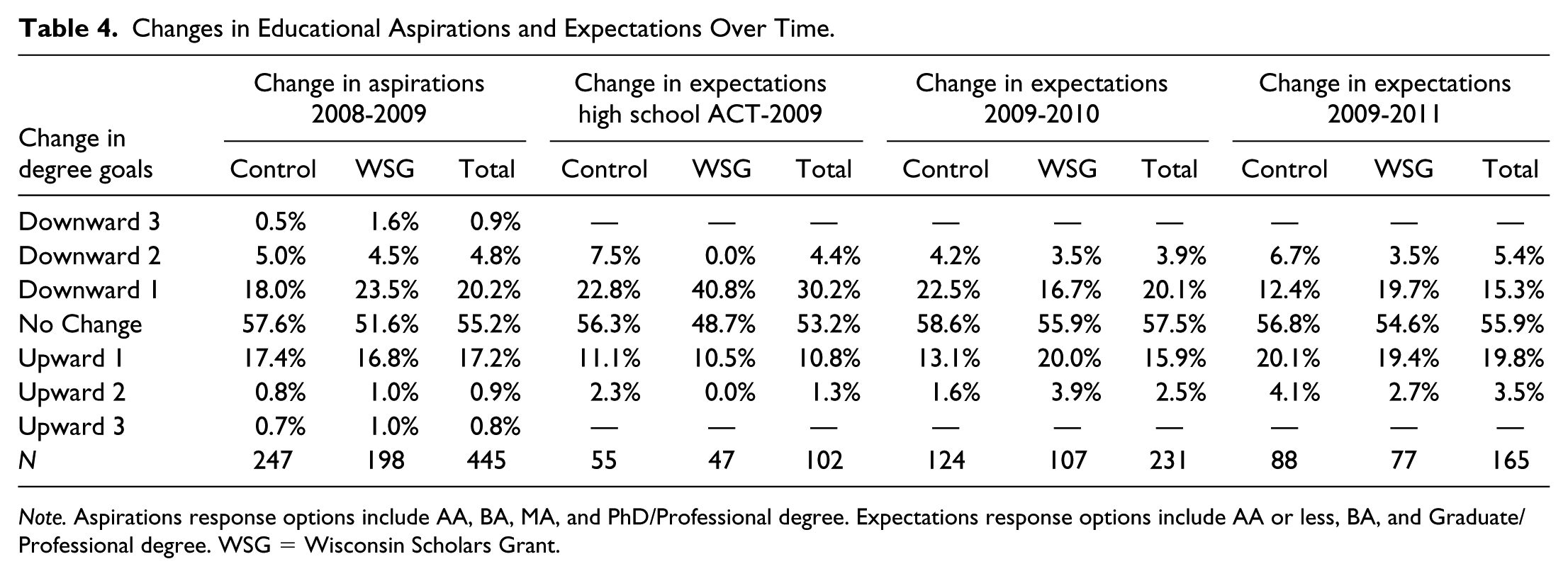
Between students’ first and second year of college, 42% of those in the control group and 48% of those in the treatment group altered their degree aspirations. Among both groups, reducing aspirations (24% control and 30% treatment) was more common than increasing aspirations (19% control and treatment; see Table 4). Despite these changes over time, the distribution of educational aspirations in 2009 did not statistically differ by treatment status: 22% aspired to an associate degree, 45% hoped for a bachelor’s degree, 23% wished for a master’s degree, and the remaining 11% aspired to a professional or doctorate degree (see Table 2).
Trends in Educational Expectations
Students’ educational degree expectations changed in similar ways over the early college years. Among those who reported their educational expectations on an ACT entrance exam questionnaire in high school, the treatment and control groups had statistically equivalent pretreatment educational expectations of earning a bachelor’s degree or higher, on average (see Table 1). Between high school and spring semester of students’ first year of college (2009), 44% of students in the control group and 51% of students in the treatment group changed their educational expectations. Again, cooling out (30% control and 41% treatment) was more common than warming up (13% control and 11% treatment; see Table 4). In spring 2009, the control and treatment groups had statistically different educational expectations distributions. Among the control group, 35% expected to earn an associate degree or less, 44% expected a bachelor’s degree, and the remaining 22% expected a graduate degree. Among the treatment group, 51% expected to earn an associate degree or less, 33% expected a bachelor’s degree, and 16% expected to earn a graduate degree (see Table 3).
Educational Expectations of 2-Year College Students.

Note. Column percentages shown. Chi-square tests (with use of design weights). WSG = Wisconsin Scholars Grant.
p < .10. *p < .05. **p < .01. ***p < .001.
Between spring 2009 and 2010, 42% of students altered their degree expectations, including 41% of those in the control group and 44% of those in the treatment group. Among those in the control group, 27% decreased their educational expectations and 15% increased their expectations, while 20% of those in the treatment group cooled out and 24% warmed up (see Table 4). These changes led to expectations distributions that were statistically similar between groups in spring 2010. On average, 45% of students expected to earn an associate degree or less, 41% expected to earn a bachelor’s degree, and 15% expected a graduate degree (see Table 3).
Changes in Educational Aspirations and Expectations Over Time.
Note. Aspirations response options include AA, BA, MA, and PhD/Professional degree. Expectations response options include AA or less, BA, and Graduate/Professional degree. WSG = Wisconsin Scholars Grant.
Finally, between 2009 and 2011, 43% of students in the control group and 45% of those in the treatment group changed their degree expectations. A greater proportion of students in the control group raised their expectations (24%) than lowered them (19%). Among those in the treatment group, similar proportions raised (22%) and lowered (23%) their educational degree expectations (see Table 4). By spring 2011, six semesters after initially enrolling in college, 32% of those in the control group expected to earn an associate degree or less compared with 49% in the treatment group. Forty-two percent of control group students expected to earn a bachelor’s degree and the remaining 26% expected to earn a graduate degree. Among those in the treatment group, 35% expected to earn a bachelor’s degree and 16% expected a graduate degree (see Table 3).
Wisconsin Scholars Grant and Degree Aspirations
To better understand the causal impact of the WSG program on students’ educational ambitions, I model the relative odds of students’ educational ambitions using multinomial logistical regression. Findings indicate that treatment students are approximately half as likely to aspire to a master’s degree rather than a bachelor’s degree in comparison with control group students (p < .05). This finding is consistent with and without college fixed effects (see Table 5). Average marginal effects indicate that WSG assignment caused the expected probability of aspiring to a master’s degree to decrease by 8% (p < .05) and increased the probability of aspiring to a bachelor’s degree by 8% (p = .10). There was no statistically significant treatment impact of aspiring to an associate or doctorate or professional degree rather than a bachelor’s degree.
Relative Odds of Educational Aspirations as a Function of the Wisconsin Scholars Grant Offer.
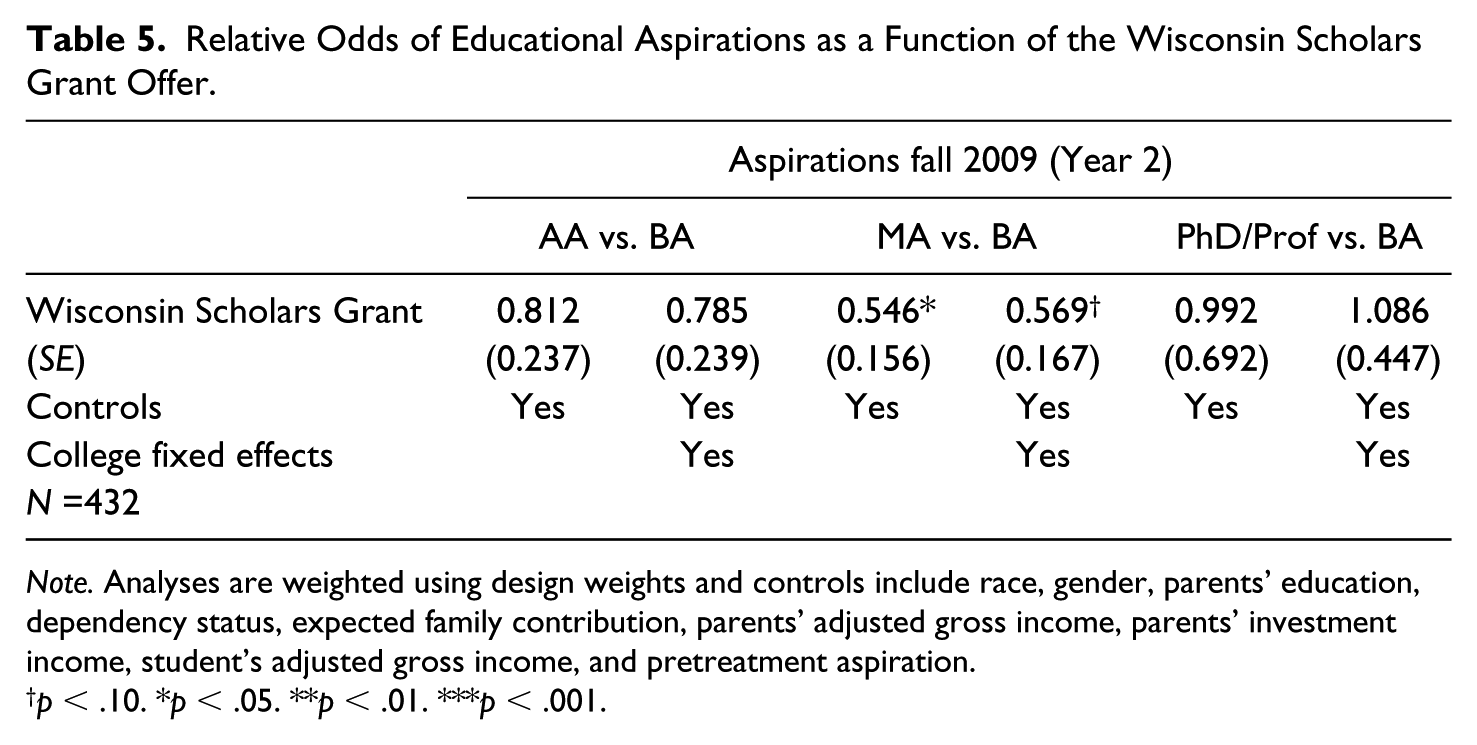
Note. Analyses are weighted using design weights and controls include race, gender, parents’ education, dependency status, expected family contribution, parents’ adjusted gross income, parents’ investment income, student’s adjusted gross income, and pretreatment aspiration.
p < .10. *p < .05. **p < .01. ***p < .001.
Wisconsin Scholars Grant and Degree Expectations
Findings from spring 2009 indicate that treatment students are approximately twice as likely to expect to earn an associate degree or less compared with a bachelor’s degree in relation to the control group (p = .05). The finding is substantively and statistically consistent with and without college fixed effects (see Table 6). Assignment to the WSG caused the predicted probability of expecting an associate degree or less to increase by 15% (p < .05) and decreased the probability of expecting a bachelor’s degree by 11% (p = .11). There are no statistically significant differences in the odds of expecting a bachelor’s degree rather than a graduate degree by treatment status.
Relative Odds of Educational Expectations as a Function of the Wisconsin Scholars Grant Offer.
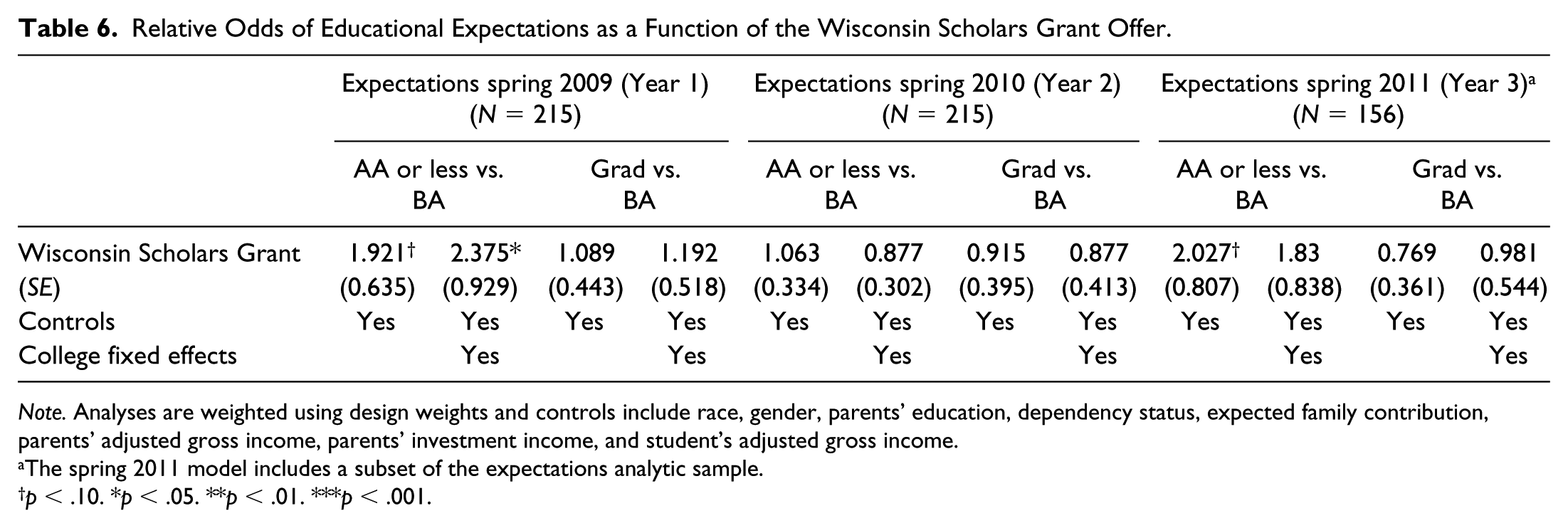
Note. Analyses are weighted using design weights and controls include race, gender, parents’ education, dependency status, expected family contribution, parents’ adjusted gross income, parents’ investment income, and student’s adjusted gross income.
The spring 2011 model includes a subset of the expectations analytic sample.
p < .10. *p < .05. **p < .01. ***p < .001.
In spring 2010, there was no statistically significant treatment impact on students’ educational expectations. In spring 2011, however, the pattern remerges. Findings indicate that treatment students are approximately twice as likely to expect to earn an associate degree or less compared with a bachelor’s degree in relation to the control group (p < .10). This finding is not substantively sensitive to college fixed effects. The effect of being assigned the WSG caused the predicted probability of expecting to earn an associate degree or less to increase by 17% (p < .05). There was no statistically significant treatment impact on the odds of expecting to earn a graduate degree rather than a bachelor’s degree (see Table 6).
Discussion
Community college students often begin college with high aspirations. In this sample, 80% of first-time full-time students from low-income families started community college hoping to earn a bachelor’s degree or higher credential. Regardless of the grant offer, however, nearly half of the students changed their educational aspirations and expectations each year. Students both increased or warmed up their ambitions and decreased or cooled out over time, although the latter is more common given high initial goals. Thus, measurement of students’ educational ambitions captures a snapshot in time and may not be as stable as prior research implies.
Offer of the WSG appears to have cooled out students, causing them to report lower educational degree aspirations and expectations than peers in the control group over time. Students offered the grant were approximately twice as likely to aspire to a bachelor’s degree rather than a master’s degree. Similarly, treatment students were approximately twice as likely to expect to earn an associate degree or lower credential rather than a bachelor’s degree. By the end of students’ first year of college, about one third of students in the control group expected their highest lifetime degree earned to be an associate degree or less compared with half of those in the treatment group who were assigned an offer of the WSG. This difference in break points is not particularly surprising because students’ degree aspirations are typically higher than their expectations. These analyses indicate that processes related to the financial aid system have the ability to influence students’ educational ambitions.
Possible Explanations
Though counterintuitive, there are several explanations for this downward treatment effect. It may be that helping students pay for college reduces their personal investment in persisting in their original degree path, but there was no evidence of this type of response in the interview data. It may be that the US$1,800 per year grant was not large enough to offset the financial barriers faced by college students from low-income families. Some students report that this is the case and financial aid packages show that the average net price of college before the WSG was approximately US$6,400 (Anderson & Goldrick-Rab, 2018). But for this gap in financial need to create negative impacts as illustrated above, treatment students would have to have experienced some type of disappointment effect (e.g., Bell, 1985). Perhaps receiving the WSG award letter in the mail led some students to have the high expectation that they would now be able to afford college, whereas in reality the grant offer reduced, but did not fully eliminate, out-of-pocket costs, resulting in discouragement. Or perhaps the lottery design and random selection award wording discouraged students entering a system often portrayed as meritocratic. Indeed, previous research suggests, “subjective interpretations may be more important than objective realities in triggering disengagement” from educational goals (Uno et al., 2010, p. 51). There are no interview data to support this hypothesis, however.
The more likely explanation is that the grant was administered in a manner that frustrated and ultimately discouraged students, thus diminishing their educational degree goals. The process through which financial aid, including the WSG, is delivered does not allow students to fully understand or anticipate their financial situation (Dynarski & Scott-Clayton, 2013; Dynarski & Wiederspan, 2012), and uncertainty regarding financial aid has been associated with decreased educational degree aspirations (Rodriguez, Guido-DiBrito, Torres, & Talbot, 2000). Indeed, some students reported that they thought the WSG was a “scam” when they received the award letter in the mail. Interviews with financial aid officers responsible for administering the grant revealed that they find the program complicated and time-intensive to administer. Moreover, they indicated that it is common for private aid programs, in general, to be idiosyncratic and for grants to have strings attached (see Goldrick-Rab, Harris, Kelchen, & Benson, 2012, for more information).
In related research on the same sample, analysts find that students explained that their financial aid packages changed over time and they were often not aware of how or why they received different amounts of money from semester to semester. This led some students to express frustration, as the financial aid system seemed to have an arbitrary component. The WSG may have contributed to this confusion by telling students that they were randomly selected to receive additional funds (Rebane, 2012).
To better illustrate the complexity and uncertainty of the financial aid system and how it might affect degree plans, I share the story of a young Hmong man we call Pao, who was offered the WSG.
14
During his first year of college, Pao stated that his estimated financial aid package was
. . . close to $3,000, but then when I got my financial aid letter they gave me $2,500. But then I only received $2,000 because $500 was still pending and I asked the financial aid office and they told me the grant is still pending. I probably won’t get it because they probably ran out of money . . . so I went to register and they told me I got to pay $500 and financial aid probably won’t cover me . . . so I really need the money.
He explained that finances would be a primary reason for lowering his degree plans and constituted a barrier to staying in school. Pao is a bright young man, earning a 3.6 GPA in his first semester, maintaining his grades, and persisting in college. Survey records show that as a high school student, Pao expected to earn a bachelor’s degree, and he aspired to a graduate degree in his first semester of community college. However, by spring semester of his first year of college, he had reduced his expectations to an associate degree, which he has since maintained. Pao is not necessarily a typical student, but his story highlights the potential volatility of financial aid packages and shows how unmet financial aid remains a barrier even after the Wisconsin Scholar Grant. Especially because students were not explicitly asked about their educational degree ambitions or reasons for changing their goals in the semi-structured interviews conducted by the research team, further research is needed to test these explanatory hypotheses.
Implications of Lower Degree Goals
Students’ educational ambitions have gained the attention of researchers ever since the Wisconsin model of status attainment argued for their importance as a predictor of educational attainment (e.g., Domina et al., 2011; Jacob & Linkow, 2011; Sewell et al., 1969). Over 3 years, however, there is no detectable impact of the WSG offer on 2-year college students’ rates of continued enrollment, credit completion, or degree attainment (Anderson & Goldrick-Rab, 2018). This finding lends support to prior research indicating that downward changes in ambitions do not necessarily reduce attainment in the short term (Rosenbaum et al., 2006).
Implications for the Cooling-Out Theory
Although community colleges have changed dramatically over the past 50 years, scholars continue to cite the cooling out theory as the predominant explanation for understanding why students reduce their educational goals and drop out. Despite Clark’s argument of cooling out as a necessary and meritocratic process, it has also been used to label community colleges as engines of inequality rather than mobility. This article tests an alternative theory of cooling out, one which hypothesizes that experiences with the financial aid system can serve as a critical factor in changing and shaping students’ educational ambitions. The financial aid system was not as prominent or consequential during Clark’s study, but today’s financial aid practices and policies are complex and often opaque. Indeed, the analyses show that students assigned an offer of an additional private need-based grant had lower educational aspirations and expectations than otherwise similar peers. Thus, these findings indicate that cooling out is not necessarily a meritocratic sorting system required to assuage the tensions between college access and poor academic preparation. 15
Conclusion
Prior research indicates that those from low-income backgrounds are more likely to reduce their educational ambitions than their more advantaged peers (e.g., Alexander et al., 2008; Hanson, 1994). This experimental study allows for the investigation of cooling out among students from low-income families. The analyses examine how one factor—that is primarily outside of the control of community college actors but common to the experiences of most students—affected educational ambitions. In this case, an offer of a private need-based grant reduced students’ educational expectations and aspirations, likely due to the complex way in which it was disbursed as part of the financial aid system. However, there are likely other cooling out processes that could be identified in future research. These findings lend support to the idea that students’ educational ambitions are malleable and shaped by multiple individual, familial, and institutional practices throughout the early college years. Moreover, the results further the call for a more holistic investigation of the development of college students’ educational goals.
Footnotes
Author’s Note
The author thanks Sara Goldrick-Rab, Adam Gamoran, and the Wisconsin Scholars Longitudinal Study reserach team for feedback and support. All opinions and errors are those of the author. Questions and comments should be directed to the author at
Declaration of Conflicting Interests
The author declared no potential conflicts of interest with respect to the research, authorship, and/or publication of this article.
Funding
The author disclosed receipt of the following financial support for the research, authorship, and/or publication of this article: The author thanks the Institute of Education Sciences Grant R305B090009 and National Science Foundation Graduate Research Fellowship Grant DGE-1256259 for research support. The Bill and Melinda Gates Foundation, Great Lakes Higher Education Guaranty Corporation, Institute for Research on Poverty, Spencer Foundation, William T. Grant Foundation, Wisconsin Center for the Advancement of Postsecondary Education, and an anonymous donor provided funding for this study, conducted in partnership with the Fund for Wisconsin Scholars, the Higher Educational Aids Board, the University of Wisconsin System, and the Wisconsin Technical College System under the direction of Dr. Sara Goldrick-Rab.
