



Abstract
Keywords
Community colleges are a critical point of access to higher education, particularly among students who are historically underrepresented on college campuses (Kolbe & Baker, 2018). Compared with 4-year colleges, community colleges enroll a higher proportion of underrepresented students, including first-generation college students (Thayer, 2000), students of immigrant origin (Teranishi et al., 2011), and students from racial and ethnic minority backgrounds (Provasnik & Plenty, 2008) and low-income backgrounds (Horn et al., 2006). Despite providing opportunities for access to higher education, community colleges have significantly lower completion rates (Bailey et al., 2006) than 4-year institutions. Although much research on community colleges has focused on institutional challenges or student academic deficits, emerging evidence suggests that student–instructor relationships have the potential to support student success (Bailey et al., 2006; Barbatis, 2010; Hatch & Garcia, 2017). The majority of literature on student–instructor relationships comes from 4-year institutions, and little research has explored how relational factors may influence student engagement and achievement in the context of community colleges. This study provides insight into factors that may influence the development of student–instructor relationships as well as how those relationships, in turn, may influence academic achievement in community colleges.
Background
The positive impact of instructor relationships on student success has been well documented in primary and secondary education (Goldrick-Rab, 2010), as well as at 4-year institutions (e.g., Baker, 2013). Close relationships with instructors both inside and outside of the classroom are associated with increased student self-efficacy (Garriott et al., 2015), learning (Frisby & Myers, 2008), academic achievement (Ullah & Wilson, 2007), and engagement (Komarraju et al., 2010). In a recent review of meta-analyses examining variables associated with academic success in higher education, a subset of studies examined variables related specifically to instructional approaches. Within the category of instruction, results demonstrated that students’ social interactions with instructors were more frequently associated with positive effect sizes than other categories such as stimulating meaningful learning, assessment, presentation skills, and use of technology (Schneider & Preckel, 2017). Although higher education literature emphasizes the importance of these relationships for student success, little research has devoted attention to factors that influence the development of such relationships and how relational factors and contexts can influence academic outcomes in community colleges.
Benefits of Student–Instructor Relationships for Community College Students
Research on student–instructor relationships in community college settings suggests that students would benefit from increased student–instructor interaction. For example, Thompson (2001) found that community college students who had higher perceived levels of informal interaction with instructors outside the classroom had more positive educational gains in science and math education. McArthur (2005) found that instructor support was associated with higher student integration and retention, and that students who received less support indicated a desire to develop closer relationships with instructors. A qualitative study among ethnically diverse community college students emphasized the importance of connections with instructors in contributing to persistence among diverse community college students (Barbatis, 2010). Using narrative analysis, another study found that college instructors influenced successful transfers of community college students to selective universities (Dowd et al., 2013).
Similarly, Barnett (2011) used quantitative methods to investigate the relationship between experiences of validation and community college persistence. Findings indicated that students receiving validation from instructors were more likely to feel academically integrated and to express their intent to continue their education. Several subconstructs of validation were identified in the study as a specific form of student–instructor interaction, including students feeling known and valued, caring instruction, appreciation for diversity, and mentoring. All four of these subconstructs were associated with increased academic integration and stronger intent to persist. Similarly, Hatch and Garcia (2017) noted that during the first weeks of college, engagement factors related to academic and social support, especially from instructors, were the best predictors of community college students’ academic and social integration and persistence intentions. Other research has shown that students’ interactions with instructors significantly contributed to learning outcomes, including general education intellectual skills, science and technology, personal development, and career preparation (Brown & Burdsal, 2012; Lundberg, 2014).
Factors Influencing Student–Instructor Relationship Development
Despite the clear benefit of supportive student–instructor relationships, the limited research in these settings has documented a dearth of close relationships between students and instructors in community colleges (Bailey et al., 2015). For example, Hagedorn et al. (2000) found that students at a middle-class, primarily blue-collar, suburban community college reported having little interaction with instructors of the classroom. Chang (2005) also found a lack of student–instructor relationships in a study on the Los Angeles Community College District. Thus, existing evidence indicates limited opportunities for optimal instructor–student relationships to flourish on community college campuses. At the institutional level, limited opportunities for building close relationships may be associated with poor funding and inadequate resources for instructional costs and instructor development (Bailey et al., 2006). For example, community college instructors have fewer resources compared with instructors at 4-year institutions, often leading to shared offices or even having no office space for students to come seek help. Some community colleges have limited departmental administrative support; thus, instructors must attend to additional administrative tasks themselves (Bohn et al., 2013). Community colleges also typically depend on adjunct instructors (Wyles, 1998) who spend less time on campus, and instructors often teach five courses per term to students with a wide range of academic needs (Morest, 2013), making it difficult to offer course material that is interesting and accessible to students at different levels. Both high- and low-engaged community college students perceive that their instructors are unwilling to invest more than the minimum effort in their students and teaching (Suárez-Orozco et al., 2019).
Community college students also face unique challenges that pose barriers to developing close relationships with instructors. Many community colleges students are academically underprepared and enroll in community college to develop basic skills in remedial courses (McCabe, 2000). Students in community college may be managing multiple roles, such as employment and family responsibilities (Cohen & Brawer, 2003) and, as a result, are more likely than students at 4-year colleges to attend on a part-time basis (Cohen et al., 2013). Furthermore, students often commute to campus, as community colleges are not designed to have strong residential life programming; thus, many students are only on campus for short periods of time (Stewart et al., 1985). Both part-time students and commuter students typically return to environments that have many competing demands, leaving less time available for campus involvement (e.g., Lundberg, 2003). This tightrope of balancing home, work, and academic demands can interfere with optimal engagement with instructors and coursework (Barbatis, 2010; Center for Community College Student Engagement [CCCSE], 2017; Deil-Amen, 2015).
Despite these challenges, some students are effectively able to access the support they need and experience success in community college. Studies have demonstrated that older students have developed self-regulatory skills to know when and how to seek support (Radovan, 2010), helping them achieve more positive academic outcomes and hold clearer career goals than younger students (e.g., Luzzo, 1993; Spitzer, 2000). Chang (2005) also found that although older students and students with more highly educated parents were more likely to develop relationships with instructors, Asian American or Pacific Islander (AAPI) and Latino/a students were likely to report particularly low levels of student–instructor interaction. More broadly, a number of studies at 4-year colleges suggest that first-generation or racial and ethnic minority students are less likely to form close relationships with instructors (Museus, 2010; Rios-Aguilar & Deil-Amen, 2012).
Beyond demographic factors, student relational characteristics could also contribute to whether students develop close and supportive relationships with instructors. Students bring with them different relational skills and experiences—particularly related to accessing support—and vary in terms of their likelihood to seek out more interactions with instructors (e.g., Karabenick, 2004). Some research from 4-year college contexts suggests that students’ cultural backgrounds and class differences influence their perceived norms and expectations around seeking support (e.g., Collier & Morgan, 2008; Lareau & Cox, 2011). Little is known, however, about student factors that influence instructor–student relationships and academic engagement in community college settings.
Immigrant-Origin Students
For more than half of all immigrant-origin students, the first step toward higher education is through the community college system (Teranishi et al., 2011). In the period 2007 to 2008, nearly a quarter (23%) of the approximately 22.3 million undergraduates in U.S. postsecondary education were first- or second-generation immigrant-origin students (Knapp et al., 2009). Indeed, nearly a third of the college-age population is of immigrant origin—nearly 30% of all young adults between the ages of 18 and 34 were born abroad (the immigrant first generation) or had parents who were foreign born (the second generation; Rumbaut & Komaie, 2010).
The population of immigrant-origin students is far from monolithic and needs to be understood in terms of the contours of its heterogeneity (Erisman & Looney, 2007; Teranishi et al., 2011). Although some students are exceptionally well prepared to compete in higher education, others are not. On one end of the spectrum, some groups enter with parents with higher rates of bachelor’s and advanced degrees than those of the U.S. native-born population; at the other end, immigrants also arrive with parents who have very low levels of educational attainment (Teranishi et al., 2011; Zong & Batalova, 2017). Furthermore, many who immigrate to the United States as adolescents enter low-quality, highly segregated schools and are often ill prepared to apply to competitive colleges or universities (Suárez-Orozco, Suárez-Orozco, & Todorova, 2009). Therefore, community colleges offer a prospective and affordable pathway to opportunity to higher education.
The first generation (foreign born) and second generation (born in the United States to immigrant parents) share in common immigrant parents (Suárez-Orozco et al., 2015) and together make up a quarter of children below the age of 18 years and nearly a third of 18- to 32-year-olds (Rumbaut & Komaie, 2010). The first-generation immigrants are a complex group that includes naturalized citizens, lawful permanent residents (LPRs), certain legal nonimmigrants (e.g., persons in the United States on student or work visas), those admitted under refugee or asylum status, and persons residing without authorization in the United States. Broadly speaking, immigrant-origin students typically face acculturative challenges including learning a new academic language and the characteristics of the new culture, while learning and maintaining their family’s culture of origin (Marks, Godoy, & García Coll, 2013; Oppedal & Toppelberg, 2016). Although many immigrant-origin students do well and even thrive educationally, others encounter difficulties (Masten et al., 2012; Suárez-Orozco & Osei-Twumasi, 2019; Suárez-Orozco et al., 2015). To date, however, despite their increasing presence on community college campuses, immigrant-origin students are typically underconsidered in the research literature (see Bailey & Weininger, 2002, for an exception).
Current Study
Considering the growing literature suggesting the role instructor relationships can play in community college students’ success, it is crucial to understand the context in which these relationships develop and the factors that contribute to the development of such relationships. We sought to explore which student factors are associated with the development of relationships with instructors, and whether student–instructor relationships would account for the association between student demographic and relational characteristics and academic outcomes among community college students.
Specifically, we hypothesized that the quality of students’ relationships with instructors would significantly predict academic engagement (i.e., behavioral and cognitive engagement) and academic achievement as measured by grade point average (GPA; e.g., Komarraju et al., 2010; Ullah & Wilson, 2007). Consistent with prior research, we also sought to understand how student demographic characteristics, institutional characteristics (Kuh et al., 2006), and relational characteristics (Karabenick, 2004) may contribute to the development of close relationships. For student demographic characteristics, we utilized the following from the literature: (a) immigrant-origin status (Peguero et al., 2015; Suárez-Orozco, Pimentel, & Martin, 2009), (b) age (Chang, 2005), (c) race or ethnicity (Museus, 2010), (d) first-generation college student status (Rios-Aguilar & Deil-Amen, 2012), and (e) student enrollment status (CCCSE, 2017; Crisp, 2010). Finally, we investigated whether instructor relationships would partially mediate the association between student characteristics and academic outcomes. That is, we expected that specific student characteristics would be associated with better relationships with instructors, which, in turn would be associated with higher academic engagement and higher GPA (e.g., Brown & Burdsal, 2012; Creasey et al., 2009; Hearn, 2006). For those student characteristics that significantly predicted instructor relationships, we explored the indirect associations of these characteristics to student academic engagement and achievement via instructor relationships.
In sum, our research questions were as follows:
Method
We drew data from the Research on Immigrants in Community College (RICC) Study—a multiphase embedded mixed methods study (Plano Clark & Creswell, 2011) of three urban community college settings varying in contexts (Hernández et al., 2019; Suárez-Orozco et al., 2015). The overarching aim of the study was to understand the experiences of immigrant-origin students on community college campuses. We were particularly interested in considering the role of classrooms as well as settings outside of the classroom with implications for (a) fostering relational engagement, (b) accessing social capital, and (c) fostering academic engagement, among immigrant-origin young adults (age 18–25) in community colleges. Data collection took place in three phases: Phase 1 included campus ethnographies (60 structured classroom observations and nine focus groups), Phase 2 included 646 student surveys matched to student records, and Phase 3 consisted of 60 semistructured interviews with students (drawn from 10% of surveyed students) and 45 interviews with instructors and administrators.
To answer the research questions posed, we draw upon data collected in Phase 2 as well as from administrative data. The study presented here employed a between-subjects, cross-sectional design.
Participants
All survey participants attended community college classes in a Northeastern city on the campus from which they were recruited and were enrolled in a degree-seeking program. The 646 survey respondents were between the ages of 18 and 25 years (M = 20.27 years, SD = 1.90 years), the majority were female (54%), and many were first-generation college students (44.6%). Efforts were made to stratify the potential sample pool to represent each of the participating colleges, immigrant generations, as well as gender. The participants were evenly distributed across campuses. Approximately 32.9% reported being first-generation immigrants (born abroad), another 42.3% were second generation (born in the United States with foreign-born parents), and 23.1% identified as third generation or higher (self and parents were born in the United States). The sample was ethnically and racially diverse, including 8.9% Asian, 26.5% Black, 38.6%. Latino(a), 12.5% White, and 11.8% Other (including mixed, Other, and Native American). Table 1 summarizes all participant characteristics as means or percentage of the sample.
Participant Characteristics as Percentage of the Sample or Mean.

Note. GPA = grade point average.
Campus settings
All participating community colleges offer 2-year public associate degree programs and serve underrepresented (i.e., low-income, ethnic minority, and immigrant-origin) commuter populations.
Taino (all campus names are pseudonyms) is a 2-year, public, open admissions, and bilingual college, located in the one of the poorest congressional districts in the nation. The campus has long-served Latino(a) students and many of the faculty are Latino(a) themselves. This college serves predominantly Latino(a) and Black students, and more than 90% of the students reported speaking a language other than English at home. In the public community college system, Taino has the highest rates of remediation and lacks the physical and material resources to serve the rise in number of applicants from 2000 (3,000) to 2010 (6,500), so there is a wait list of prospective students.
Domino, located in the expanding downtown section of a large urban center, began as a trade school in a previously industrial neighborhood and has an emphasis on technological education. The campus includes multiple disconnected specialized buildings covering a half mile of city blocks; many had been under construction for years and the campus had been cited for a number of health code violations. The college reported serving 11,000 associate degree program students. The racial and ethnic backgrounds of students are highly diverse, with the majority of students reporting as non-White. Roughly 40% of students were born outside of the United States and 62% reported speaking a language other than English at home.
Oakmont has the greatest resemblance to a 4-year university campus and is located in an affluent suburban county. The college serves more than 12,000 students with abundant material and physical resources, including a large student center, state-of-the-art technology centers, and more than 60 associate and certificate programs. A little less than half (49%) of students are White. The college currently has the highest percentage of minority students in the state system with the largest growth happening in the low-income Black (21%) and Latino/a (28%) student population. Students born outside of the United States represent approximately 42% of the student population.
Procedures
Institutional review board (IRB) approval was obtained from the three participating colleges and from the affiliated research university. Students completed online surveys after class in a designated setting overseen by graduate research assistants utilizing Qualtrics, an online survey-hosting site. Some students, due to time constraints opted to take the survey offsite; these students were given a unique link to the survey via email. To increase our numbers of participants in a second wave of recruitment, flyers with contact information were distributed on site and on campus listservs. Students who contacted the researchers directly were sent unique links to the survey. In the last wave of recruitment, to meet our goals to stratify the sample, research assistants from a variety of racial and ethnic groups approached potential participants passing out flyers on campus; surveys were then administered similar to the initial administration approach. Participants received US$25 cash or an Amazon gift certificate after completing the survey.
Rather than relying on self-report GPA, student survey data were linked to student administrative records. GPA was collected from college administrative data and then linked with the survey responses using unique identifiers. Once the student records were linked, the identifying data were destroyed to guard student confidentiality. Although there was minimal missing survey data (4%), due to challenges linking student records to surveys, 14.7% of the cumulative GPA was missing. Missing GPA was missing at random and was unrelated to any of the students’ observed or unobserved characteristics, confirmed by Little’s missing completely at random (MCAR) test, χ2(51, 650) = 65.25, p = .087. Although there was higher missingness for GPA, of the 646 total participants, 416 participants (64%) were not missing any values on any variables included in the analyses.
Measures
Given the lack of standardized protocols for this population (underrepresented emerging adults, many of immigrant origin), surveys were developed by the research team to address constructs of interest. Some items were derived and adapted from standard measures in the field and others were developed specifically for the study. Scale development was informed through focus groups, ethnographic fieldwork, and grounded in emerging findings, building upon the mixed-methods synergetic foundations of the larger study protocol (Creswell & Plano Clark, 2011). The protocol development teams included a cultural–developmental psychologist, an educational sociologist, an anthropologist, a community college instructor, and bicultural immigrant college students from a variety of origins. The team discussed wording for each item of every scale included in the protocol until there was agreement that the items were appropriate and meaningful. The survey was administered through Qualtrics online software and was made available in Spanish, Mandarin Chinese, and English. Survey items were translated and then checked for back-translation. Following are details of each of the survey items.
Demographic information about participants was self-reported including age, gender, race, ethnicity, immigrant generational status (first generation, second generation, or third generation or higher), and first-generation college student status (based on maternal and paternal reports that both parents’ highest level of education was either high school or General Education Development [GED]). For race and ethnicity, students were instructed to choose from the following categories: Asian, Black, Latino/a, Native American, White, mixed race, Other.
Mentor was a single-item question asking students whether students had a mentor: “Other than your parent(s) or whoever has raised you, do you have a role model or mentor who you go to for support?” This item has been used in a number of studies on natural mentoring (e.g., Schwartz et al., 2013; Zimmerman et al., 2002).
Help-Seeking Attitude was measured using a self-created scale based on the scholarly work of Rickwood et al. (2005) and its conceptualization of help-seeking orientation as “behavior of actively seeking help from other people” (p. 4). This scale assessed help-seeking orientation in the context of four problems on a continuum of informal to formal help seeking. Participants were asked to rank on a scale from 1 (the first choice) to 5 (the fifth choice) whom they would seek help from if presented with any of the four problems. Options included (a) “I would handle it myself,” (b) “I would talk to a friend or family member,” (c) “I would seek help from a religious person or clergy member,” (d) “I would seek help from an outside professional person,” and (e) “I would seek help from the counseling center.” For the purposes of this study, participant rankings of “I would handle it myself” for each of the four problems were used as a measure of help-seeking attitudes given our interest in understanding how likely or unlikely individuals were to seek help from others. Sample items included, “If I had problems at school, I would handle it myself”; and “If I had a personal problem (feeling stressed, sad, depressed, anxious, etc.), I would handle it myself.” The scale demonstrated excellent reliability (α1 = .94).
Instructor relationships were measured by a nine-item self-reported scale adapted from an earlier relational engagement measure (Suárez-Orozco, Pimentel, & Martin, 2009) focusing on students’ perceptions of having instructors who can provide them with support and advice and who care about and respect them. This measure used a 5-point Likert-type scale, with student ratings ranging from 1 = strongly disagree to 5 = strongly agree. Sample items included, “I can approach [my instructors] if I have a personal problem,” “[My instructor] advises me on what classes to take,” and “[My instructor] supports me in the decisions I make.” The scale demonstrated excellent reliability (α1 = .93).
Academic Engagement included both self-reported behavioral and cognitive aspects of students’ academic engagement. This measure used a 5-point Likert-type scale, with student ratings ranging from 1 = strongly disagree to 5 = strongly agree. Cognitive engagement was measured using a six-item measure adapted from Martin’s (2012) nine-item measure focusing on the extent to which students were interested and intellectually engaged in their learning. Sample items included, “I feel good when I learn something new even if it is hard,” “I listen carefully when others talk about topics I’m interested in,” and “When I have a clear goal, I can really focus.” The scale demonstrated acceptable reliability (α1 = .80). Behavioral engagement was measured using a six-item measure adapted from a scale used by Suárez-Orozco, Pimentel, and Martin (2009) focusing on the extent to which students engaged in effortful behaviors for the class. Sample items included, “I turned in my assignments on time,” “I paid attention in my classes,” and “If I didn’t understand something in a class, I asked questions.” The scale demonstrated acceptable reliability (α1 = .80).
Cumulative GPA was collected from campus administrative data and linked to the survey data using unique identifiers.
Data Analysis
Data analyses were conducted using IBM SPSS Statistics (Version 25) and Mplus software (Version 8.0). Initially, all variables were assessed for skew, kurtosis, and normality in SPSS. In addition, all measures were examined for reliability, and exploratory factor analyses (EFAs) were conducted in Mplus to explore the factor structure of the created help-seeking scale and all adapted scales to replicate findings from previous studies (Martin, 2012; Suárez-Orozco, Pimentel, & Martin, 2009) that have assessed the underlying relationships between measured variables to identify the latent constructs. Latent variables were created for the following self-reported measures: help-seeking attitudes, instructor relationships, cognitive engagement, and behavioral engagement. The use of latent variables is recommended for self-reported data because it allows for estimates that are adjusted for measurement error (Royall et al., 2014). Cumulative GPA was obtained directly from university records, and the presence of a mentor was based on a single dichotomous self-reported variable.
Structural equation modeling (SEM) was employed to investigate instructor relationships as a potential mediator between (a) mentoring relationships and academic outcomes and (b) help-seeking attitudes and academic outcomes (see Figure 1). To examine the measurement and structural properties of all latent variables, a measurement model was constructed first, as suggested for best practices in SEM (Weston & Gore, 2006). Using confirmatory factory analyses, measurement models were tested to assess fit to the data prior to testing the full structural model. Model fit was assessed based on chi-square test of model fit, root mean square error of approximation (RMSEA), comparative fit index (CFI), and the standardized root mean square residual (SRMR). In determining model fit, we followed the recommended guidelines for each model fit index (see Kline, 2011): nonsignificant chi-square value, RMSEA less than .05, CFI greater than .90, and SRMR less than .10. Mediation was tested using Preacher and Hayes’s (2008) bootstrapping method, which is the preferred method for mediation analysis because it does not violate assumptions of normality and controls the Type I error rate (MacKinnon et al., 2007). Bias-corrected bootstrap confidence intervals (CIs) were estimated based on 1,000 random samples.
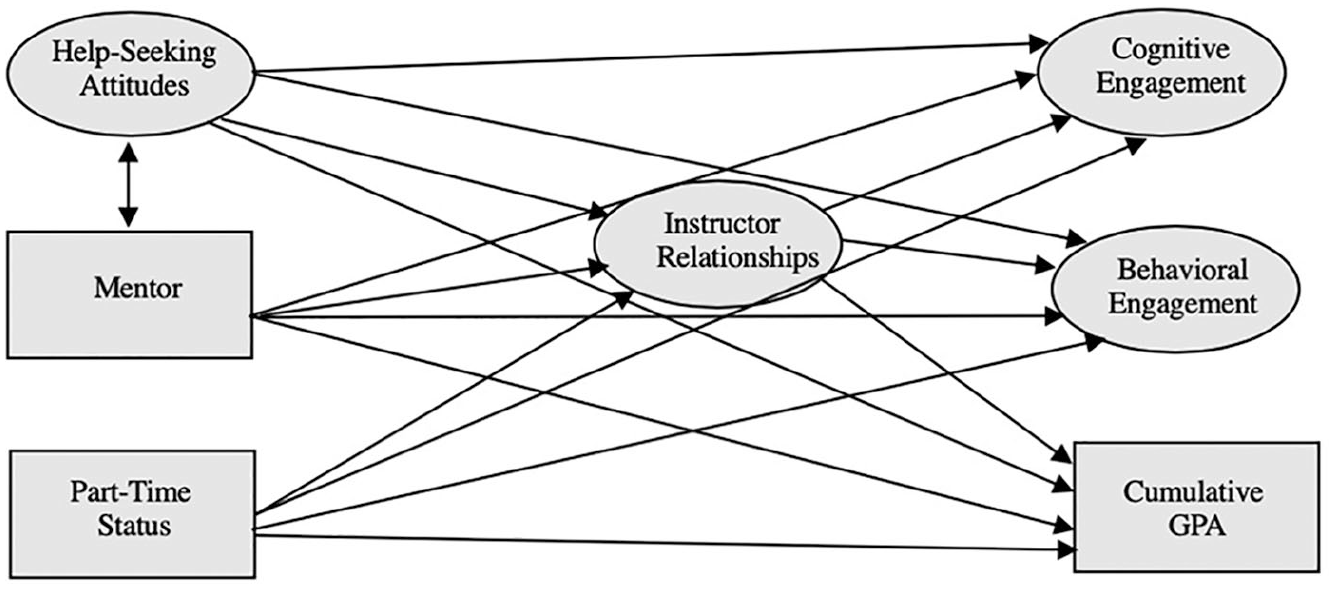
Conceptual Model.
To test the main study hypotheses of mediation, a series of path analysis models were conducted using syntax for estimating mediation models in Mplus (Stride et al., 2016) that are based on Hayes’ (2012) PROCESS models. We included the following covariates: gender, age, race, immigrant generational status, first-generation college student status, part-time or full-time student, semester in college, and campus attended. We ran a series of regressions and analyses of variance (ANOVAs) in SPSS to assess the potential impact these student factors may have had on the relationship students developed with instructors.
Results
Results of analyses assessing normality indicated that several variables were nonnormally distributed. Specifically, cognitive engagement was negatively skewed, with a skewness of −0.72 (SE = 0.10) and positive kurtosis of 1.43 (SE = 0.21). Help seeking was severely positively skewed, with a skewness of 1.57 (SE = 0.10) and positive kurtosis of 1.83 (SE = 0.21). However, behavioral engagement was normally distributed with a skewness of −0.52 (SE = 0.10) and kurtosis of −0.23 (SE = 0.21), and relationships with instructors was normally distributed, with a skewness of −0.69 (SE = 0.10) and kurtosis of 0.83 (SE = 0.21). Given that some of the variables demonstrated nonnormality, missing data were accounted for using the robust weighted least squares means and variance (WLSMV) adjusted estimation method, but no variables were transformed or excluded from analyses. There were no issues of multicollinearity among any study variables (see Table 2).
Zero-Order Correlations Among Study Variables.
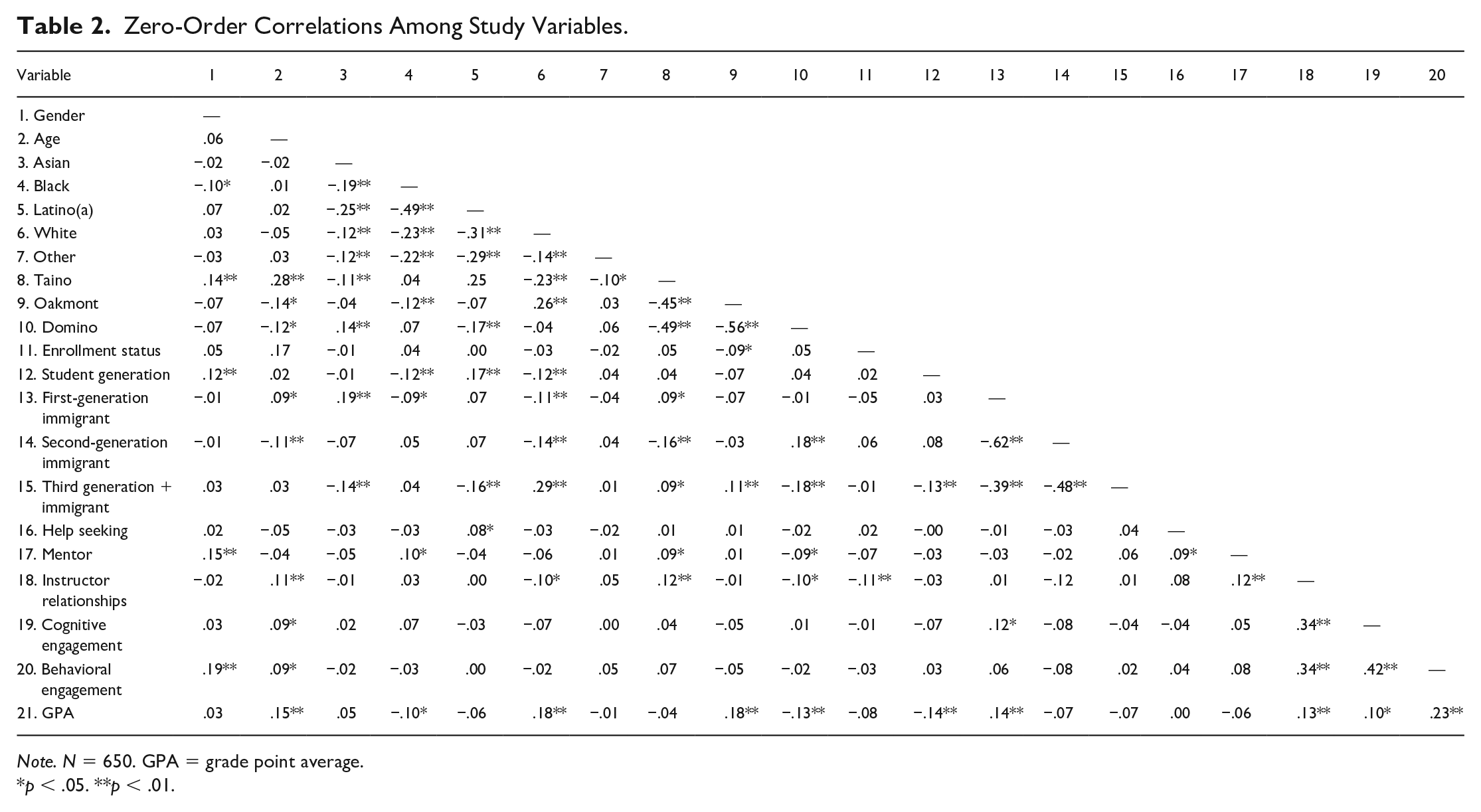
Note. N = 650. GPA = grade point average.
p < .05. **p < .01.
Prior to testing our model, we examined descriptive characteristics related to students’ ratings of their relationships with instructors, their willingness to seek help, and whether they reported having a mentor. There was substantial variation in responses about instructor relationships, with scores ranging from 1, the lowest possible score, to 5, the highest possible score. The average score was 3.86 (with a standard deviation of 0.76), indicating that, in general, students were more positive than negative in rating their instructor relationships, but there was also substantial room for improvement in most of the students’ self-reported relationships with instructors. There was also variation in responses regarding students’ willingness to seek help, with scores ranging from 1, the lowest possible score, to 5, the highest possible score. The average score was 1.85 (with a standard deviation of 1.04), suggesting students were less likely to handle problems themselves indicating a willingness to seek help. The majority of students (69%) reported having a mentor; of those participants with mentors, most named either extended family members (24%) or friends (21%), with many fewer reporting mentors from more formal roles such as teachers (4%), counselors (3%), coaches (1%), and religious leaders (1%).
Results of initial regressions and ANOVAs suggested that several demographic and situational factors influenced the relationships students developed with instructors. Specifically, the results of a linear regression indicated that students at the higher end of the sample’s 18 to 25 age range (e.g., 24- to 25-year-olds vs. 18- to 19-year-olds) reported better relationships with instructors than younger students, β = 0.10, t(636) = 2.64, p = .009. A one-way ANOVA revealed that full-time students (M = 3.89, SD = 0.74) reported better relationships with instructors than part-time students (M = 3.67, SD = 0.84), F(1, 635) = 7.41, p = .007. Further analyses indicated that campus attended influenced the relationships students developed with instructors, F(2, 635) = 5.00, p = .007. Least significant difference (LSD) post hoc tests revealed that students who attended the Taino campus (M = 4.00, SD = 0.70) had significantly better relationships with instructors than those who attended the Domino campus (M = 3.77, SD = 0.81). Moreover, there was a marginally significant difference in relationships with instructors between the Taino campus and Oakmont campus, such that students’ relationships with instructors were slightly better for students who attended the Taino campus compared with the Oakmont campus (M = 3.85, SD = 0.74). Surprisingly, within the current study sample, instructor relationships did not differ based on student gender, race, semester in college, immigrant generational status, or first-generation college student status. In contrast, relational characteristics played an important role in predicting better instructor relationship: specifically, students with higher support-seeking attitudes (B = 0.07, β = 0.10, SE = 0.05, p = .033) and students with a mentor (B = 0.16, β = 0.10, SE = 0.04, p = .019) reported closer relationships with instructors.
Given these findings, we chose to explore the indirect effects of instructor relationships on the associations between student characteristics of enrollment status, help-seeking attitudes, and reports of having a mentor and students’ academic engagement. Based on data from student self-reports, approximately 15.2% of participants were enrolled in community college part time. The majority of students (68.8%) reported having a mentor, and reports of student help-seeking attitudes (M = 4.15, SD = 0.79) suggested that on average students reported they would ask for help rather than handling problems on their own. In addition, student ratings of instructor relationships (M = 3.86, SD = 0.76) indicated that on average students reported having close relationships with instructors.
We then turned to exploring the role of these instructor relationships on students’ academic success. Results indicated the model tested was a good fit to the data, χ2(662, N = 650) = 1,287.25, p < .001, CFI = .93, RMSEA = .038 (90% CI = [0.035, 0.041]), SRMR = .035. Analyses showed that instructor relationships were significantly associated with all cognitive and behavioral aspects of academic engagement and college GPA (see Figure 2). There was no significant direct effect of having a mentor on cognitive engagement (β = 0.01, SE = 0.04, 95% CI = [−0.062, 0.082]), behavioral engagement (β = −0.01, SE = 0.05, 95% CI = [−0.088, 0.061]), or GPA (β = −0.06, SE = 0.04, 95% CI = [−0.135, 0.003]). However, significant mediation by instructor relationships was observed for the associations between having a mentor and cognitive engagement (β = 0.04, SE = 0.02, 95% CI = [0.011, 0.068]), behavioral engagement (β = 0.04, SE = 0.02, 95% CI = [0.013, 0.074]), and GPA (β = 0.01, SE = 0.01, 95% CI = [0.004, 0.028]). Similarly, no significant direct effect was observed for the associations between help-seeking attitudes and cognitive engagement (β = −0.06, SE = 0.05, 95% CI = [−0.131, 0.032]), behavioral engagement (β = 0.02, SE = 0.05, 95% CI = [−0.070, 0.018]), or GPA (β = −0.03, SE = 0.05, 95% CI = [−0.103, 0.053]). However, significant mediation by instructor relationships was also observed for the associations between help-seeking attitudes and cognitive engagement (β = 0.04, SE = 0.02, 95% CI = [0.010, 0.070]), behavioral engagement (β = 0.04, SE = 0.02, 95% CI = [0.010, 0.075]), and GPA (β = 0.01, SE = 0.01, 95% CI = [0.004, 0.030]). Finally, there was no significant direct effect of part-time student status on behavioral engagement (β = −0.02, SE = 0.04, 95% CI = [−0.106, 0.036]) or cognitive engagement (β = 0.04, SE = 0.04, 95% CI = [−0.028, 0.146]); however, there was a significant direct effect of part-time student status on GPA (β = −0.08, SE = 0.03, 95% CI = [−0.117, −0.048]). Significant partial mediation by instructor relationships was observed for the associations between part-time student status and all academic outcomes, including cognitive engagement (β = −0.05, SE = 0.02, 95% CI = [−0.076, −0.018]), behavioral engagement (β = −0.05, SE = 0.02, 95% CI = [−0.082, −0.018]), and GPA (β = −0.02, SE = 0.01, 95% CI = [−0.033, −0.006]). These results suggest that part-time student status, support-seeking attitudes, and having a mentor may indirectly influence students’ academic success through their association with instructor relationships.
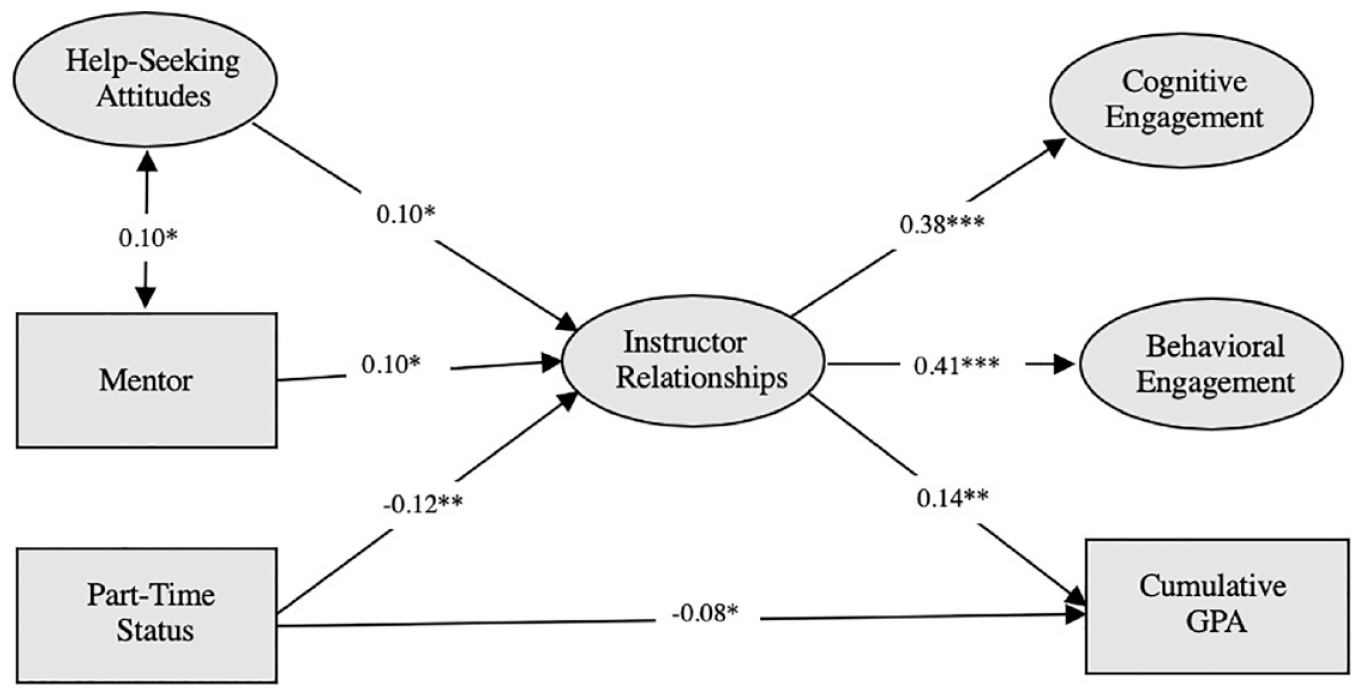
Standardized parameter estimates of structural equation model.
Discussion
This study highlights the importance of developing strong relationships with instructors in the academic success of community college students. Instructor relationships were significantly associated with all student outcomes we assessed, including both behavioral and cognitive academic engagement and GPA. These results support previous research demonstrating the role of instructor relationships in academic success among students in community college settings, especially related to student retention and persistence (e.g., Barbatis, 2010; Hatch & Garcia, 2017; McArthur, 2005).
The college campus students attended was significantly associated with students’ relationships with instructors. Specifically, students who attended the Taino campus, the lowest resourced campus with the highest rates of remediation, reported significantly more positive relationships with instructors than students attending the Domino campus and marginally significantly more positive relationships with instructors than students attending the Oakmont campus. This may be, in part, due to the fact that the Taino campus had the smallest student body and the campus was comprised of very few, connected buildings, suggesting that instructors may have had more time to invest in developing relationships with students and were more accessible to students on campus. Furthermore, this campus has a long history of serving immigrant-origin students; the diverse faculty there might have been most skilled in fostering relationships with their diverse students and their students may have been more comfortable reaching out to them. These students are also the most in need of support, with a significant portion of students failing college readiness exams; thus, instructors may devote more time to helping these students develop remedial skills. Close instructor relationships are a resource that can be cultivated even at the most financially underresourced of campuses.
Contrary to previous research in 4-year colleges and in secondary school settings that has found differences in relationships with instructors based on immigrant status (e.g., Peguero & Bondy, 2011; Peguero et al., 2015; Suárez-Orozco, Pimentel, & Martin, 2009) and college student generational status (e.g., Collier & Morgan, 2008; Engle & Tinto, 2008), we did not find significant differences in instructor relationships between first-generation and second-generation immigrants, or between first-generation and continuing-generation college students (Parnes et al., 2019). In part, this may be a result of limited opportunities within the community college context for any students to engage in instructor relationships, regardless of demographic characteristics, given both significant work and home responsibilities outside of campus life (Cohen & Brawer, 2003; Katsiaficas et al., 2015) and the limited of availability of instructors on campus due to adjunct schedules, providing less time to invest in students (Wyles, 1998).
Age was the only student demographic characteristic found to be significantly associated with instructor relationships, with older students reporting more supportive relationships with instructors. This finding is consistent with prior research findings that older students show more active participation on college campuses and have greater motivation and self-regulation than younger students (Spitzer, 2000). Self-regulated learning skills and motivation have also been associated with greater ability for support seeking (Pintrich, 2000); thus, older students may enter college with stronger help-seeking skills, clearer goals for what they want out of college, and may feel more comfortable seeking support from instructors.
Part-time versus full-time student status was also significantly related to instructor relationships. Specifically, part-time students reported less supportive relationships with instructors than full-time students, which indirectly contributed to part-time students’ lower GPA, as well as lower cognitive and behavioral engagement. Although there are many reasons that part-time students may show lower academic success and engagement than full-time students, including having competing responsibilities that may affect their ability to fully take advantage of the college experience, part-time students’ weaker relationships with instructors may also account for differences in academic outcomes. Part-time students could benefit from interventions designed to foster stronger relationships with instructors, which, in turn, increase their academic engagement and success.
Finally, this study also examined how students’ orientation toward seeking help and their experiences with supportive adults or mentors may influence their capacity to develop supportive relationships with instructors in community college. Specifically, our results suggested that more positive support-seeking attitudes and mentoring relationships indirectly influenced students’ academic achievement and engagement through their impact on students’ relationships with instructors. This supports previous research and theory on consistency in relationship patterns, specifically with regard to vertical relationships, or relationships with others who have greater knowledge and power (Hartup, 1989). That is, students may be more willing to develop relationships with more experienced adults when they have prior positive experience to draw on; for example, students with positive mentoring relationships may be more likely to develop similar relationships with instructors. Similarly, research on formal mentoring programs suggests that strong relationships with mentors may influence youth to develop higher quality relationships with instructors (Chan et al., 2013; Herrera et al., 2011).
Notably, mentoring relationships did not have a significant direct effect on academic outcomes, perhaps, in part, because few mentors in this sample were in academic roles (i.e., teachers). Although having a mentor may directly influence other psychosocial outcomes, these data suggest that in a community college context, having a mentor may be beneficial to academic success primarily based on the extent to which they can influence instructor relationships. In part, this may be because the majority of named mentors were peers or family members who may have limited social capital to assist students in their pathway in higher education (Pérez & McDonough, 2008). The experience of having supportive mentors and turning to others for help may allow students to bring those relational skills with them in the community college setting. Students with these positive mentoring experiences may be more likely to seek out or effectively engage with their instructors. These more positive relationships with faculty, in turn, have an indirect effect on student engagement and achievement.
Similarly, this research suggests that when students try to solve their problems on their own rather than reaching out to others for support, this may indirectly have a detrimental effect on their academic success. Different expectations and comfort levels around self-advocacy and seeking help from instructors may influence students’ capacity to connect with instructors (Collier & Morgan, 2008; Jack, 2016; Stephens et al., 2015). At the same time, this research suggests that targeting students’ willingness and skills to seek help may be one way to influence students’ relationships with instructors as well as their academic success.
Although this study focused primarily on student factors, campus and instructor factors also play a critical role in the development of supportive student–instructor relationships. As noted earlier, there were some significant differences in students’ report of instructor relationships based on the campus they attended, which may be partially due to structural differences across campuses, such as differences in class size, reliance on adjunct versus full-time instructors, scheduling and campus layout, and campus culture. Future studies should examine the role of the instructor-level factors that may contribute to the development of student–instructor relationships, as well as how instructor characteristics, attitudes, and behaviors may interact with student characteristics. For example, research has documented differential responses from professors and employers to students’ attempts to reach out based on the students’ perceived demographic characteristics (e.g., Milkman et al., 2015; Rivera & Tilcsik, 2016). In one study, professors at colleges and universities across the country were less likely to respond to identical emails when the students’ name was perceived to be of a racial or ethnic minority or of a female student (Milkman et al., 2015). This highlights the need for considering how instructor characteristics and response to students influence the relationships they form with students.
Implications
On community college campuses, with few extracurricular activities, clubs, and events, classes and instructors are often the main point of connection for students with the college. Given the key role instructor relationships play in student success, it is critical that community colleges create strategies to enhance the development of student–instructor relationships, especially for students who are less likely to cultivate these relationships on their own. Ideally, strategies would be implemented at the campus-, instructor-, and student levels. For example, smaller class sizes, scheduling times when instructors and students are not in class and available to meet with each other, and strategies that provide opportunities that keep students on campus (such as work study opportunities or welcoming study spaces) might increase the likelihood that students will connect with instructors on campus.
In addition, as there is increasing recognition of the time and effort it takes to be available to students and to develop student–instructor relationships, some universities are including mentoring and advising as part of the criteria by which instructors are evaluated, thereby incentivizing instructors to make time for and to invest in such relationships. At the same time, many instructors may need additional training and support in how to build these relationships, including strategies they can use both within and outside the classroom to build relationships with students, particularly those from marginalized backgrounds and those who may be less comfortable approaching instructors for support. Observation of relatively common incidences of instructor microaggressions on community college campuses (Suárez-Orozco et al., 2015) indicates the need for explicit training in these issues as well as more general training on how to effectively teach diverse students. Workshops could be developed for instructors not only to highlight the importance of their relationships with students in promoting students’ academic success but also to sensitize instructors to how their own behaviors may pose barriers to or facilitate the development of instructor–student relationships. Of course, such strategies face challenges, particularly in the context of underresourced community college settings that often rely on staff who are already stretched thin, indicating the importance of greater financial investment in community colleges.
Although systemic support plays a critical role in overall climate and individual relationships within community colleges, student-level interventions can also be designed to encourage students to connect with instructors. Student mentoring programs are a commonly employed strategy to help students build relationships with instructors and staff on campus. Research suggests that these approaches, particularly mentoring programs, can be effective in improving academic performance (e.g., Crisp, 2010). Unfortunately, these programs are limited in the number of students they can reach by their capacity to recruit sufficient number of mentors, particularly when relying on staff and instructors.
The current study’s findings suggest that interventions designed to promote help-seeking attitudes and students’ capacity to reach out to instructors may be a particularly promising approach. Indeed, the current study’s findings that younger students tend to have less supportive relationships with instructors suggest that these students may lack some of the skills and attitudes conducive to connecting with instructors that their older peers may have already developed. Preliminary research on an intervention designed to explicitly teach students the skills and attitudes to identify, recruit, and maintain relationships on campus suggested that the intervention may increase students’ willingness to seek support, improve their relationships with instructors, and increase their first-year college GPAs in the context of first-generation college students at a 4-year public commuter (Schwartz et al., 2016, 2017). This approach could be adapted to address unique challenges to connecting with instructors faced by community college students. Similarly, because our data indicate that part-time students are less likely to form supportive relationships with instructors, workshops or targeted mentoring programs could be developed specifically for part-time students.
Limitations and Future Directions
Although this study has a number of strengths, including the use of quantitative data drawn from a large sample of students generally underrepresented in research studies, there are significant limitations of the study that should be noted. Most importantly, given that the data were drawn from a cross-sectional survey and the use of SEM does not establish causal relations, we cannot make any causal conclusions about the associations observed in the data. Longitudinal data measuring students’ baseline characteristics when they first enter college and subsequently measuring their relationships with instructors and their academic outcomes over time would allow for a deeper understanding of the results of this study. In addition, as noted earlier, studies would ideally include both instructor and campus characteristics, and characteristics of the broader community and sociohistorical context, to better understand how these factors interact with each other to influence students’ experiences and success in community college. Similarly, it would be beneficial to combine student-report surveys with other sources of data, for example, including instructor reports of relationship quality. Nevertheless, this study provides an important step toward better understanding the role of instructor relationships in the experiences of community college students. More broadly, this study helps us move beyond focusing primarily on the academic outcomes of community college students to examining the processes that lead up to such outcomes and potentially identifying key points of leverage where intervention may be possible.
Footnotes
Declaration of Conflicting Interests
The authors declared no potential conflicts of interest with respect to the research, authorship, and/or publication of this article.
Funding
The authors disclosed receipt of the following financial support for the research, authorship, and/or publication of this article: This work was supported by the W.T. Grant Foundation under grant 10604 and the Ford Foundation under grant 1110-0617.