




Abstract
Currently, more than one million international students are studying at U.S. higher education institutions (Institute of International Education [IIE], 2018a); more than double the number from the last decade. Of these international students, about 8.6% or 94,562 students are attending community colleges (IIE, 2018b). While some international students use a community college as a stepping-stone to a four-year university (Bohman, 2009; Hagedorn & Lee, 2005); others attend a community college for other reasons. Although rarely discussed or studied, some international students arrive in the United States to study at four-year colleges and universities but subsequently transfer to a community college (Hagedorn et al., 2016; Zhang, 2015b). Transfers from the four-year sector to the two-year is termed “reverse transfer” (Townsend & Dever, 1999, p. 5). International reverse transfer students have rarely been identified, counted, or studied.
The reasons for reverse transfer are as diverse as the students themselves. Some students transfer due to significant academic challenges at the four-year institutions; others may earn additional credits during the summer thus expediting academic progress toward a bachelor’s degree (Hagedorn & Castro, 1999; Townsend & Dever, 1999). Yet another group of students already holding bachelor’s degrees may subsequently enroll in a community college for career or technical education (Friedel & Friesleben, 2017; Quinley & Quinley, 1999). Previous studies have focused on different aspects of reverse transfers and implications to institutions for serving this population (e.g., Hagedorn & Castro, 1999; Hossler et al., 2012; Townsend & Dever, 1999). However, with only a few exceptions (i.e., Hagedorn et al., 2016; Zhang, 2015b), studies have been limited to domestic reverse transfers.
Although international reverse transfers may share similarities with their domestic counterparts, they have unique backgrounds and characteristics. For example, culture adjustment may play a critical role in international students’ learning experiences within the four-year institutions and subsequently influence their decision making of reverse transfer. Furthermore, since most international students aspire to achieve a bachelor’s degree (IIE, 2018b), it might be that fewer of them would consider attending a community college after obtaining a bachelor’s degree; or international students may consider postbaccalaureate reverse transfer for reasons other than professional development. To better understand this unique but growing group, it is crucial to examine the reverse transfer experiences from the perspective of the international students themselves. This study fills a gap through firsthand, in-depth qualitative data from international students to understand their perspectives and lived experiences regarding reverse transfer.
Literature Review
We collected and examined relevant literature in three areas: (a) studies on reverse transfer among domestic students, (b) studies on international students’ adjustment to U.S. colleges, and (c) international students’ learning experiences within community colleges.
Domestic Reverse Transfer Students
National statistics indicate that 10% to 15% of the initial four-year students will reverse transfer to community colleges at some point in their educational journey (Hossler et al., 2012; Kalogrides & Grodsky, 2011). Townsend and Dever (1999) identified three types of reverse transfers:
Undergraduate reverse transfer students (URTS) who transfer to the two-year college without immediate plans for a bachelor’s degree.
Temporary reverse transfer students (TRTS) who attend community college for a short period of time (i.e., summer only) and transfer the credits back to the four-year college to be applied toward a bachelor’s degree.
Postbaccalaureate reverse transfer students (PRTS) who attend the community college after earning a bachelor’s degree.
Recently, a new type of reverse transfer has emerged in some states and programs allowing traditional transfer students (i.e., attend a two-year and transfer to the four-year) to earn an associate degree by transferring credits earned at the four-year institution back to the community college (Friedel & Wilson, 2015; Taylor, 2016, 2017). These programs contribute to the college completion agenda by providing postsecondary credentials (Taylor, 2016, 2017). In this study, however, we focus only on the three types of reverse transfers as identified by Townsend and Dever (1999): URTS, TRTS, and PRTS.
A variety of previous studies focused on reverse transfers. The most common reasons for reverse transfer among URTS are changes in education plans, poor academic performance, social and familial challenges, or financial concerns (Hillman et al., 2008; Hossler et al., 2012). URTS may feel forced to reverse transfer due to the failure of maintaining the minimum Grade Point Average (GPA), academic probation, suspension, or expulsion (Hagedorn & Castro, 1999; Hillman et al., 2008). National statistics, unfortunately, indicate that only about 15% of the URTS will return to a four-year college (Hossler et al., 2012). Despite the low likelihood of reverse transfers earning a bachelor’s degree; reverse transfer provides an opportunity for those who would otherwise have no other option than to drop out of the postsecondary system (Kalogrides & Grodsky, 2011).
TRTS present a different picture. TRTS may be attracted to the community college by its lower cost, convenient class locations, smaller classroom sizes, and a chance to improve GPAs (Hagedorn & Castro, 1999; Yang, 2006). Due to their unique course-taking patterns (i.e., typically taking courses during only summer months), they have also been called “summer sessioners” (Hagedorn & Castro, 1999, p. 16). TRTS almost always return to their original four-year institution with earned credits and have a higher completion rate than four-year students who never took any courses from two-year institutions (Hossler et al., 2012).
Finally, PRTS generally enroll in community college courses for professional training requirements and needs. These students enroll to earn a particular certificate to fulfill job requirements or are in search of a new career (Friedel & Friesleben, 2017; Quinley & Quinley, 1999). In all instances the findings from these previous studies focused on domestic students. It is unknown if these findings hold true for international reverse transfers.
International Students’ Adjustment
Responding to the rapid increase of international enrollment during the last decade, previous studies focused on international students’ adjustment and transition to U.S. postsecondary institutions. Some common topics include (a) engagement and campus involvement (e.g., Glass & Gesing, 2018; Mamiseishvili, 2012); (b) psychological challenges and adjustment (e.g., Li et al., 2014; Young, 2011); (c) interaction with American and international peers (e.g., Rose-Redwood & Rose-Redwood, 2013; Trice, 2004); (d) academic challenges (e.g., Adhikari, 2018; Durkin, 2008). We focus on academic challenges because it is the top reason international students reverse transfer (Hagedorn et al., 2016).
A language barrier is one of the most important factors contributing to academic challenges for most international students. The effects of poor English proficiency include the need to take English remedial classes which require time and attention, and academic difficulties due to poor listening and reading fluency (Hung & Hyun, 2010; Sato & Hodge, 2009). In addition, many international students must culturally adapt to a Western learning style (Durkin, 2008; Kim, 2008).
The rapid increase of international enrollment was due in large part by international undergraduate enrollment from East Asian countries. For example, as the top sending country, China was the home country for 33.2% (363,341 students) of international students in the 2017 to 2018 academic year (IIE, 2018c). When aggregating the international students from East Asian countries (i.e., China, South Korea, Vietnam, Taiwan, Japan, Indonesia, Malaysia, and Hong Kong) the proportion swells to 46% of all international students (IIE, 2018c). The inherited cultural norms of East Asian international students, namely, the cultural norms of Confucianism and collectivism, greatly influence their academic experiences. For example, in Confucian East Asia, enrolling in a high-prestige university brings honor to the entire family (Choi & Nieminen, 2013). Non-acceptance into a prestigious university may cause the whole family to “lose face,” which should be avoided at any price in a collectivist society (Hofstede & Hofstede, 2005, p. 118; Kirkbride et al., 1991). Therefore, East Asian students may strongly feel “the duty to succeed” in a U.S. university (Dundes et al., 2009, p. 135).
East Asian international students often find themselves challenged by Western learning-styles. For example, some students viewed as excessively quiet or not adequately participating in the classroom may be exhibiting behaviors taught in Confucian cultures that stress teachers must always be respected and never challenged (Choi & Nieminen, 2013; Nguyen et al., 2006). Non-participation may also be related to the concept of face. Culturally, face relates to an individual or a group’s reputation, honor, social standing, and prestige. East Asian students often do not express their opinions in the classroom to avoid losing face of themselves or saving face to others (Nguyen et al., 2006; Triandis et al., 1988). While the vast majority of the literature and studies involved university students, the academic and cultural issues highlighted here also affect the international students at community colleges. However, we have no knowledge of the experience and effect of the intersection of international and reverse transfer.
International Students in Community Colleges
In an era where community colleges face underfunding and program reduction, international students can contribute to tuition income and a higher retention rate (Raby et al., 2015). Currently, 17.8% of the international student enrollments (or 78,819 students) are within community colleges (IIE, 2018b). Responding to these numbers, researchers have taken notice of international students enrolled in community colleges.
Some literature discusses the rationale, historical background, and philosophical premise of including international education into community colleges’ missions (Raby et al., 2015; Raby & Valeau, 2007). Other empirical research focuses on examining various aspects of international community college students. For example, previous studies examined the reasons why international students attend community colleges. These reasons include lower college entry requirements, lower tuition costs, and the opportunity to transfer to a four-year university (Bevis & Lucas, 2007; Bohman, 2009, 2014; Hagedorn & Lee, 2005). In addition, since many foreign countries do not have any higher education institutions that are similar to the community colleges in U.S., prospective international students’ perceptions about community colleges may influence their choices (Zhang & Hagedorn, 2014).
The majority of international community college students plan to transfer to a four-year university (Bevis & Lucas, 2007; Hagedorn & Lee, 2005). Despite the academic and social challenges they face (Mamiseishvili, 2012; Slantcheva-Durst & Knaggs, 2019), international students often display high academic performance (Hagedorn & Lee, 2005; Zhang, 2016) possibly due to high aspirations for a bachelor degree, fewer financial concerns, and mandatory full-time enrollment status (Anayah & Kuk, 2015). After transfer, international students continue to outperform domestic transfers academically (Zhang, 2016).
In general, there is a lack of scholarly research focusing on international students attending community colleges (Zhang, 2016). Even fewer studies have focused on international students who reverse transferred from a four-year university to a community college. As one of the exceptions, Zhang (2015a) studied Chinese English language learners who reverse transferred to a community college for lower tuition rates, better interaction with instructors, and the potential to earn transferrable college-level credits. Hagedorn and colleagues (2016) further identified several ways that international students utilized community colleges in ways they labeled “rescues” (p. 63). For example, some internationals transferred to the community college when their GPAs were low or they were placed on academic probation. Others needed to transfer due to issues of academic misconduct. Anayah and Kuk (2015) reported that some international students attended community colleges to maintain a legal status while waiting for their permanent residency. Although these studies reveal some potential reasons for reverse transfer among international students, more empirical studies are required to better understand and interpret the international reverse transfer phenomenon.
Purposes and Research Question
Simply stated, there is a dearth of studies on international reverse transfer students. To fill this gap, this study seeks to understand the unique experiences of international reverse transfer students. In particular, this study examines why and how international students reverse transferred to a community college and, more importantly, how these students perceive the reverse transfer process as part of their college journey in the United States. The following research questions guided this study:
Theoretical Framework
The theoretical framework for this study was adopted from Bourdieu’s (1973, 1985, 1986) theory of field, habitus, and social and cultural capital. In particular, we utilized Bourdieu’s theory as “an analytical approach” rather than “a static formal system” (Martin, 2003, p. 24). As an analytical framework, Bourdieu’s theory can help interpret why international students struggle with unexpected challenges and experiences and choose to reverse transfer.
Social and Cultural Capital
Bourdieu identified the critical role of social and cultural capital as the invisible mechanism allowing children from the dominant classes to maintain inherited advantages in the school system (Bourdieu, 1973, 1986). Social capital refers to the connections, social networks, circles of friends, and group memberships. Cultural capital refers to one’s knowledge, credentials, and experiences. These two forms of capital, along with the economic capital contribute to social reproduction and ultimately inequity within the society. For example, college educated parents who know how postsecondary institutions function may also have the economic capital to send their offspring to college. On the other hand, children coming from families with “predispositions” not compatible with a college-going culture (e.g., first-generation students, low-income students, etc.) might suffer in this educational, or social classification process and are less likely to succeed (Bourdieu, 1993, p. 179).
Using the social and cultural capital concepts, previous higher education studies have illustrated how first-generation, low-income, underrepresented racial minority, and other disadvantaged students may acquire a limited amount of knowledge about college through families and their nearest social contacts (McDonough, 1997; Moschetti & Hudley, 2015; Museus & Neville, 2012). For international students, previous studies primarily focused on how social networks and social interaction influence their adjustment to a U.S. campus. For example, interacting with American peers and participating in co-curricular activities were helpful in the adjustment process (Glass & Gesing, 2018; Trice, 2004). Interaction with other international students can contribute to creating a sense of belonging for international students (Rose-Redwood & Rose-Redwood, 2013). Nevertheless, none of the above-mentioned studies utilized social and cultural capital to examine experiences among international reverse transfers. In this study, we aimed to address this gap by using social and cultural capital theories and two additional concepts, social field and habitus.
Social Field and Habitus
In his theoretical discussions, Bourdieu referenced the role of social and cultural capital within a social field (Bourdieu, 1985). A social field consists of a field of forces in which various agents assume their positions and play (or struggle) a game. Each social field has its own game complete with a set of rules. Social and cultural capital play a critical role in conserving an existed structure or the rules of a field (Bourdieu, 1985).
Each social field has distinctive variations. Thus, when entering a different social field, an individual must understand the distinctions and have a compatible habitus (Bourdieu, 1985; Reed-Danahay, 2005). Habitus consists of personal tastes, thoughts, beliefs, interests, and understanding of the world. It is created through one’s family, culture, and education background (Reed-Danahay, 2005), or it is accumulated through the forms of social and cultural capital. If someone’s habitus is not recognized by a new field, they might have difficulty understanding the rules of the game and to eventually be successful in that particular field.
If we perceive higher education institutions as a new field, the process of understanding the rules of the game in this new field may be more difficult to certain student subgroups than others. As such, international students may be disadvantaged in learning the new rules. While many international students are from middle or upper-class families in their home country (IIE, 2019), their inherited social and cultural capital (or, their habitus) does not directly translate to the appropriate skills and knowledge for success in a U.S. postsecondary institution. This may explain why some international students with high academic backgrounds may still encounter academic and social difficulties ultimately leading to reverse transfer.
Incorporating Critiques of Bourdieu’s Theory
In the higher education literature, Yosso (2005) argued that Bourdieu’s theory assumes a deficit model in which the White middle-class culture is standard, leaving all communities of color lacking the requisite cultural capital. This deficit model overlooks the valuable capitals that students of color possess and implies that it is the family and community’s fault for not preparing a student for the standard school culture (Yosso, 2005). Through the lens of critical race theory, Yosso (2005) summarized various valuable but yet often neglected capitals nurtured within the community of color, including the aspirational, navigational, social, linguistic, familial, and resistant capitals.
In this study, we utilize Yosso’s theory as a supplement to Bourdieu’s theory. Similar to Yosso’s arguments, we believe that international students possess valuable but often overlooked capitals that can help them to achieve success. Our goal is to identify capitals and interpret their roles in encouraging international students to pursue their original goals despite various barriers and challenges.
Methodology
The Phenomenological Approach
We adopted a phenomenological approach to examine the lived experiences of international reverse transfers highlighting reverse transfer behavior as the focused phenomenon. We collected data through individual interviews from international students who participated in the reverse transfer process. We adopted a hermeneutical phenomenology approach to highlight the interpretation of the reverse transfer phenomenon. In addition to describing the what of the phenomenon (the textural description) and the how individuals experienced this phenomenon (the structural description), we also brought an “interpretive process” to interpret “the meaning of the lived experiences” (Creswell & Poth, 2018, p. 78).
Research Sites and Participants
Participants were recruited from one research-intensive public university and two large public community colleges located in the state of Iowa. The two public, multi-campus community colleges are located in different cities. Each institution is close to a large public university in a nearby city (one of the four-year institutions was our research site). According to the institutional reports, the community colleges had 230 and 280 students identified as nonresident alien, respectively. Both nearby public universities enrolled approximately 1,800 international undergraduates.
This study is part of a mixed-method research project where all international students enrolled in the research sites were invited to participate via a survey or interview. In this paper, we focus solely on the interviews. Through a purposeful sampling process, we recruited the participants in the following ways. First, all international students enrolled in the research sites were invited to participate in a survey for the larger mixed-method project. Survey respondents claiming reverse transfer experiences were asked to participate in a follow-up interview. Second, we contacted potential participants based on a student list provided by international advisors at the two community colleges. Finally, we conducted a snowball process to see if the participants could identify another international student who had similar experiences. We provided $15 bookstore gift cards as incentives to all interviewees.
We defined international reverse transfers as international students who transferred from a four-year institution to a two-year community college. Ten international reverse transfer students participated in the interviews. All had valid student visas (F-1 or J-1 visa) and reverse transfer experiences associated with at least one of the research sites. We categorized them into the three groups according to Townsend and Dever’s (1999) identification: four participants were URTS who transferred to the two-year college without immediate plans for transfer back; five students were temporarily enrolled in a community college and planned to transfer the earned credit(s) back to their respective four-year institutions (TRTS); and one student attended the community college after earning a bachelor’s degree (PRTS). Eight of the ten participants were from East Asian countries (five from China and three from Malaysia). The remaining two were from India. Detailed background information of all participants is summarized in Table 1.
Background Information of the Participants.
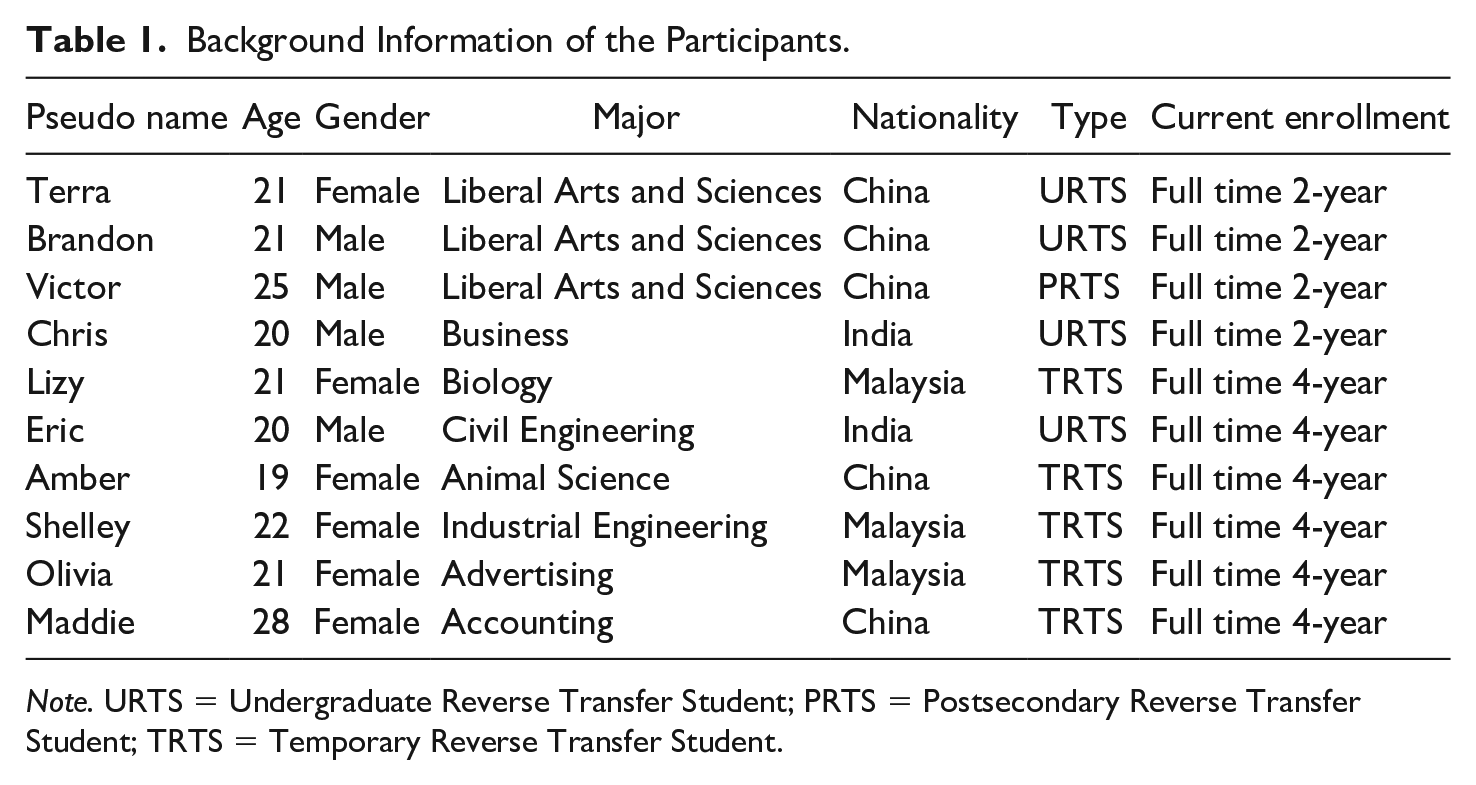
Note. URTS = Undergraduate Reverse Transfer Student; PRTS = Postsecondary Reverse Transfer Student; TRTS = Temporary Reverse Transfer Student.
Data Collection
We conducted individual, face-to-face interviews with each participant using a semi-structured interview protocol. Each interview lasted approximately 45 to 60 minutes. Interviews were audio recorded and transcribed. To provide a more comfortable environment, some interviews were conducted in Chinese by a native speaker.
Data Analysis
Analysis included open and axial coding of the transcript data (Creswell, 2014). First, we performed an initial open coding process to obtain a general understanding of the reverse transfer phenomenon from the perspectives of the interviewees. Two researchers open-coded the transcripts independently and compared their codes for inter-rater reliability (Marshall & Rossman, 2014). Second, we conducted axial coding among different codes. We identified repeating patterns to form underlying categories. Finally, we adopted both deductive and inductive approaches to generalize themes that present international reverse transfer students’ perceptions and experiences.
Trustworthiness
We conducted member checks with the interview participants during the study. Two bilingual scholars (Chinese and English native speakers) who were not involved in the interviews reviewed the translation of the data. In addition, we triangulated the data through different sources such as the international student office website and university or college policies. We also interviewed international student advisors at one of the community colleges for triangulation purposes.
Researchers’ Role in this Study
We advocated the researchers’ identification and embraced the subjectivity it brings to this qualitative study (Creswell, 2014). The lead researcher identifies as a Chinese international scholar. She was a graduate international student in a four-year university. Her own experiences shaped how she interpreted the participants’ stories. The second researcher is also a Chinese international scholar. His research focuses on international comparative higher education. The third researcher is a native English speaker who is a senior administrator and professor in a four-year university. Her working experiences with international undergraduate students have shaped her perceptions and biases.
Results
This study confirmed that the Townsend and Dever’s (1999) categorization of the three-type reverse transfers holds true for international students. We discovered (a) international URTS, students who were compelled to leave the original four-year institution and study in a community college; (b) international TRTS, students who enrolled in community college courses during the summer and transferred earned credits back to their four-year institution; (c) international PRTS, students who attended a community college despite a previously earned bachelor’s degree. The three types of international reverse transfers have both similarities and differences in terms of their experiences. Specifically, the three types share similarities in terms of their learning experiences within community colleges as well as influential factors of the reverse transfer processes. However, they also had distinctive reasons for reverse transfer.
Reasons for Reverse Transfer: Differences Among the Three Types
URTS: Community college as a safety net
Four international URTSs (Brandon, Chris, Eric, and Terra) had poor academic experiences leading to failing grades at their original four-year institutions and reverse transferred to a nearby community college. Brandon and Terra left their original institutions due to academic misconduct. Chris and Eric’s GPA were too low for them to continue at their four-year institutions. These four students turned to a community college for a rescue that would hopefully allow them to maintain legal student status and remain in the United States while continuing to earn eligible college credits that could ultimately be credited toward a bachelor’s degree. These students struggled with the concept of reverse transfer, and all four URTSs faced the difficult decision of whether to tell their parents about their predicament. Only one of the URTSs, Eric chose to do so.
It was needed at that time, I would say, shifting to a community college wasn’t as hard as telling someone [my parents] to understand that I am shifting from a four-year to a community college. . . . That was more difficult than actually [transferring] to there.
So, did you tell your parents?
I did. Eventually, I did. . . . I mean, I took a week to go through myself, but I did.
For Brandon and Terra, the greatest barrier preventing them from telling their parents was related to the issue of academic misconduct. Terra described her situation as follows:
They [parents] don’t know. I am planning to tell them when I transfer back [to the original four-year university].
Interviewer: So why not tell them the truth?
This will make them worry. It is all my fault. I also do not want them to know that I made such a mistake. Just like when I was little, I don’t want my parents know about the mistakes I made.
For Chris, who had to reverse transfer due to failing grades, telling the truth meant that he would have to explain to his father who “doesn’t know anything about community college.” Chris did speak to his mother, but both decided to hide his attendance at a community college from his father.
No matter what URTSs chose, their parents were far away and could only provide limited support. Friends were relied upon to provide the social and emotional supports needed during difficult times. Brandon described how his best friend helped him through the hardest time.
I had so much pressure and stress. . . . All of my friends knew. One of my good buddies, he was studying in the UK and visited me during the break. I was planning to go to a tour here and there with him. But then this [academic misconduct and subsequent expulsion] happened, he just stayed here. . . . Ten plus days, he was here, drinking beer with me.
With the emotional support from their peers, URTSs in this study were rescued through reverse transfer. Meeting the timeline of the original graduation plan was very critical. They all planned to graduate with a bachelor’s degree within four years. They did all they could to minimize the damage resulting from their academic issues. For example, Eric took 11 courses from two community colleges within three consecutive semesters. After being accepted by another four-year university in the spring, Brandon took four additional courses in the following summer to expedite obtaining his bachelor’s degree.
At the time of interview, Eric had successfully transferred back to the original four-year university. Brandon and Terra were accepted by another four-year university and were ready for transfer. Chris significantly improved his GPA. For these four URTSs, the community college provided a safety net and rescue when they had unexpected failing experiences in their four-year institutions. The community college system and the reverse transfer experiences provided them a second chance to succeed.
TRTS: Community college as a helping tool
The five international TRTSs (Lizy, Shelly, Maddie, Amber, and Olivia) were at a better stance academically compared to the URTSs. None of them officially left their four-year institution. Instead, they chose to take some courses from a community college during the summer semesters or in an on-line format and count these credits into their original bachelor degree programs.
Clearly TRTSs also faced challenges in their four-year institutions, especially during the first year. For example, Lizy recalled that she “blindly picked” the most challenging professor for her first-year English class. She believed that this was the main reason for her low grade in that class. Lizy wished she had checked “ratemyprofessors.com” before selecting that class, just like many domestic students do. On the other hand, Maddie described the challenges caused by language barriers and classroom culture differences.
If you really want to talk about any difficulties, it is in the classroom. . . . I can barely understand at the beginning. And, yes, I took four courses in the first semester, so I was stressed, too. . . . It’s only got better after the midterm. Because of my major [education], my language ability was not able to manage the class discussion. Sometimes my language ability limited myself from fully presenting my thoughts. When that happens, I feel very awkward.
The main reason TRTSs took community college courses was to cope with academic challenges at the four-year institution and improve their overall GPA. In addition, TRTS appreciated the flexible community college’s course schedules. For example, Amber worked from 8 a.m. to 4 p.m., Monday through Friday, during the summer. Only the community college’s on-line courses fit into her tight schedule. Similarly, the flexible course schedule helped Maddie to complete multiple prerequisite courses in time to take the required core courses in her program as planned.
The third reason TRTSs took community college courses was lower tuition. All institutions included in this study had a tuition structure that charged international students a higher rate than both Iowa residents and nonresident citizens. Shelley shared her calculation of the tuition differences and reported that she saved about $2,000 by taking 9 credits at a community college.
In sum, TRTSs took community college courses to help them obtain a bachelor’s degree faster, more economically, and possibly with a better GPA. These students used community colleges as tools to help them overcome challenges and reach goals.
PRTS: Non-academic purpose
Only one participant (Victor) was classified as a PRTS, as he was a bachelor’s degree recipient prior to attending the community college. Victor attended a local community college because he needed legal status to stay in the United States while waiting for the approval of his permanent residency (green card).
After my graduation in 2015, I worked one year under OPT
1
status. And during that year, my family helped me to apply for the green card. My OPT would expire during that waiting time [of the green card application]. And it actually expired last November. . . . I have to maintain my legal status! And I don’t want to go back to where I just graduated because it is expensive and I do not need another diploma. And here [the community college] is cheaper and you can also get a certificate if you want.
This was a reason for community college attendance that did not fit the domestic PRTS definition. However, the community college again provided a rescue from a situation that would be very detrimental.
Factors Influencing the Reverse Transfer Process: Similarities Among the Three Types
Limited resources from the family
Before making any decisions related to reverse transfer, international students must understand the community college system, transfer, and reverse transfer mechanisms. In most foreign countries, there is no community college system. It is therefore understandable that international students obtain little to no related information from parents, family, or friends in their home country. In fact, it is not uncommon for international students to educate their parents about the U.S. community college system. Brandon shared his experiences of “educating” his parents.
They both know now. You can come to a community college to take some easier courses and then take the credits back to the four-year university.
They now know this because you educated them?
Yes, I educated them.
So I guess they don’t understand that at the beginning?
No, they for sure don’t understand. . . . They will think why you are going to a technical college. Just like back in China, we have universities and technical colleges. They would feel like why you travel this far to attend a technical college.
Similarly, Terra’s mother worried that community colleges would not be considered respectable among higher education institutions. Before Terra came to the United States, she and her family inquired of an education agency for the U.S. college application. One education agency company recommended community colleges in California. But Terra’s mom, like many other Chinese parents, felt the community colleges sound “not very trustable.”
Not all international parents lack knowledge about community colleges, but our only exception was Olivia’s mom, who graduated from a university in Texas. She told Olivia that if the math courses were too overwhelming, she should take them from a local community college.
Roles of an academic advisor
Most of the international students in our sample made the reverse transfer decision without the benefit of an academic advisor. It was only after the reverse transfer decision was made that they met with an advisor for specific resources such as course offerings and necessary paperwork. The reason for not seeking advice from an academic advisor varied. For example, Terra, a URTS who had to leave the original university due to academic misconduct, indicated that timing did not allow her to seek help from an advisor.
It was May when I was reported [for academic misconduct]. It was almost the end of the semester. I did not meet the advisor or an international advisor. When I finally met one, I already decided to go [to the local community college]. I already had my materials ready, like the financial proof, the official transcript, . . . so I just directly told them what I have decided. I did not ask them for any advice.
Maddie, one of the TRTSs, had neither the timing nor academic misconduct issues. She needed a series of community college courses to fulfill prerequisite requirements. Maddie decided by herself that she would take the prerequisite courses from a local community college rather than the four-year institution. Amber, another TRTS, also did not seek suggestions from an academic advisor. She learned from information found online and figured out the transfer requirement herself.
Roles of peers
Compared to family and academic advisors, the students found friends and peers as more important resources regarding reverse transfers. When asked “where did you learn about community colleges and reverse transfer,” most participants mentioned roommates, friends, and classmates. They learned from others who had transfer or reverse transfer experiences. Brandon, one of the URTSs who was expelled from his original university learned about reverse transfer from a friend.
It was a Chinese friend. He did not study hard enough in the first year and was suspended. He then came to [the community college]. . . . That’s how I got to know this. Then I gradually learned a lot. I even went to [the community college]. I don’t want to fail a course anymore, so I thought I can take a couple of courses here and transfer the credits back [to the university] . . . like some English courses. I was applying to attend here as part-time. I was admitted. Before I start to take course, I was expelled [from the original four-year university]. So I decided to become full-time.
Lizy, a TRTS from Malaysia, also learned the benefits of taking community college courses from a friend.
I have a friend who attended a community college in the United States after graduating from high school. He studied two years at that community college and then transferred to a very good university. He said that first of all, this is easier; second, if you have a good grade, you can transfer to a very good university which is much easier than applying for that university directly out of a high school.
In sum, most of the international reverse transfer students learned about community colleges and reverse transfer from their peers. Through transfer and reverse transfer examples and personal experiences, international reverse transfers learned the benefits of taking courses in a community college, online or on campus, full- or part-time. When there was a need due to prerequisite requirements, a challenging English course, or academic misconduct, international reverse transfers choose the community college for aid and assistance.
Learning Experiences in Community Colleges: Similarities Among the Three Types
Class instruction
Both international URTSs and TRTSs reported positive learning outcomes from community colleges. They benefited from smaller class sizes and in some instances, more attention from instructors. For example, Terra, one of the URTSs, shared her experiences as follows: One thing that is better than the four-year university is the smaller class size. It is not like the four-year, just lecture and some discussion. I feel we had more interactions with the professor. Because you know, sometimes you cannot concentrate during the big lecture. Many professors [in the four-year university] do not care if you are using cellphones. In a small class, the instructors gave lectures better. . . [it was] just like listening to the teachers back in China.
Eric, a URTS who had already transferred back to his original four-year university, further highlighted the importance of interactions with the instructor.
Here [in the community college] we only have 30 students. So, that makes the difference, because this one-to-one thing that happened, at any time, professor knows every student and whether you are struggling. It is a better way [for the student] to understand the subject.
Increased knowledge about U.S. higher education system
Through their reverse transfer experiences, the international reverse transfer students obtained important knowledge about the American postsecondary system and the role of community colleges. Both international URTSs and TRTSs indicated that their perceptions of community colleges were changed due to their experiences. Terra, a Chinese URTS, described her changing thoughts as follows: When I first came here, I still have the perceptions from my home country. I thought the community college is like the technical college in my home country. Because it is two-year. [I thought] it is for the professional skilled workers, or someone who want to pursue the workmanship. But after I enrolled in one, I realized that it is not the case. Many people view community college as a bridge to four-year institution.
Shelley, a TRTS, gave a contextual explanation of her perceptions of community colleges.
I feel it [the community college] is the buffer zone between the junior and the senior. It has all the adjusting-to-the-four-year stuff. And it is more like an undeclared major stage; it is more relaxed. . . like a student only has a general direction, for example, engineering, applied science. He can take some general courses in that broad area. And he does not have to worry about which way to go just yet.
Eric, a URTS who transferred due to a low GPA, felt that the community college is a “really friendly and really nice” institution. He believes that a community college experience could be helpful to everyone who is working on a bachelor’s degree. He further illustrated his opinion: It is mostly in the sense of the feedback. It is the first step how to study and when to study, how to make schedule, how to record about it. Because for me, the high school, we didn’t have much thing in India, I was 17 when I came here [to the United States]. So, going to a community college kind of brought me back to high school [but] also offered something for the university. I did benefit from it.
In addition, Brandon reported knowledge growth in searching and applying to a four-year institution. His application to the original four-year university was largely done by an education agency in China. This time, Brandon had to do the entire college application by himself. When he had to find a new four-year transfer institution, he was able to navigate the process and find the institution that fit his needs.
Discussion
This study applied Bourdieu’s theory as a theoretical framework to analyze international students’ decision making and experiences regarding their reverse transfer from a four-year university to a community college. Many international reverse transfer students in this study came from middle to upper class families in their home country. According to Bourdieu’s theory of social and cultural capital (Bourdieu, 1973, 1986), their parents should have been able to transfer the knowledge and skills regarding how college works and provide the economic capital to send their children to study abroad. It would be expected that these international students would have inherited the social and cultural capital to provide a privileged position with respect to college attendance. However, the international reverse transfers in this study, especially the URTSs, experienced unexpected negative experiences in their original four-year universities. Stories from the four URTSs, Brandon, Terra, Chris, and Eric inferred that they lacked a specific segment of social and cultural capital that is essential for success in a U.S. four-year university.
Based on Bourdieu’s discussion about social field and habitus (Bourdieu, 1985; Reed-Danahay, 2005), these international students may possess inherited social and cultural capital that can help them adapt to a college life in their home country. But the same social and cultural capital may not be equally valuable in a new field, namely, a U.S. four-year university. Their habitus, or their beliefs, values, tastes, and cultural preferences that were nurtured back in their home country appear not to be compatible within this new field. For example, as observed in some of our interviews, international students (e.g., Brandon and Terra in this study) may not understand the American definitions and rules regarding plagiarism, academic misconduct, and dishonesty (Bamford & Sergiou, 2005; Bista, 2011). Similarly, many international students (e.g., Lizy and Maddie in this study) face challenges within the classroom due to their unfamiliarity with the Western-style of teaching and learning. Students from Confucian cultural heritage countries often see instructors as a guru to respect and would therefore never challenge or present negative behaviors toward the instructor (Choi & Nieminen, 2013). These students are taught to never present ideas that may oppose the views of others because this may cause someone to lose face and cause disharmony within the group (Hofstede & Hofstede, 2005; Kirkbride et al., 1991). For these reasons, East Asian international students may feel uncomfortable and not know how to respond in a discussion section within the four-year classroom.
While the above discussion refers to the academic challenges international students face at four-year institutions, it also relates to why international students tend not to seek help from student service professionals (i.e., making the reverse transfer decision without consulting with advisors). In particular, student services staff may be viewed as individuals with higher positions in a structured hierarchical power system by many international students. A student, who is often placed on a lower position in such a system must show respect to the academic advisors, counselors, administrators, etc. rather than actively seek suggestions and help from them. Therefore, international students may rely on other resources (i.e., peers, online resources) to get the information they need. In sum, the beliefs, cultural preferences and worldviews (or, the habitus) might create barriers, both in and outside of classrooms, to international students.
Although some inherited social and cultural capitals were not as helpful as expected for international students, other capitals may be critical for them to be resilient and eventually successful in the new field. For example, all the international URTSs in this study had a strong and consistent motivation to improve their situation and transfer back to a four-year institution. They all have high aspirational capital, which refers to “the ability to maintain hopes and dreams for the future, even in the face of real and perceived barriers” (Yosso, 2005, pp. 77–78). This aspirational capital might be rooted in international students’ cultural norms. For East Asian students, typically the academic success of international students is a victory for the whole family (Dundes et al., 2009). International students strongly felt that they must keep the promise of earning a U.S. bachelor degree in four years. The cultural norms stemming from Confucianism and collectivism played a role in not telling the truth about the reverse transfer to parents. On the other hand, it also pushed international students to consistently pursue their original goals.
International reverse transfer students quickly learn the rules in the new field and find the helping tool or the safety net at a nearby community college. The reverse transfer experiences were part of an important learning process. International students were able to learn essential knowledge and skills to navigate the U.S. higher education system—a set of new capitals that can help them win the new game. For example, Brandon was able to apply to a different four-year university without the help of an education agency. Eric learned better time management skills. Other students in this study gained new understandings and use of the bridge function of a community college.
Although the essence of value of cultural and social capital still apply to international students, there is a nuance of whose culture that must be considered. Despite their middle to upper class origin, many international students do not possess the compatible social and cultural capital to be successful in a U.S. university. Hence, Bourdieu’s (1985, 1993) field and habitus theory were used to reveal the lost values of the inherited social and cultural capital among international students. Yosso’s (2005) theory added another layer to the discussion: instead of focusing on international students’ adjustment or assimilation to a U.S. culture, it is important to acknowledge the often overlooked strengths of international students’ cultural wealth and advocate the cultural diversity they bring to U.S. campuses.
Implications for Policy, Practice, and Further Research
International reverse transfers have been given little attention in the community college literature. This study explored the decision-making process and learning experiences among international reverse transfer students. Findings of this study are particularly important to international programs and offices, instructors, academic advisors, and administrators at both four- and two-year institutions.
Implications for Policy and Practice
This study generates direct implications for community college administrators and professionals working with international students. Our findings indicate different experiences and needs of the three types of international reverse transfers. It is critical that community college professionals understand the nuances among these three types and provide specific services to meet students’ needs. For example, many international URTSs come to the community college in need of a rescue (Hagedorn et al., 2016). They encounter challenges in their four-year universities and need increasing knowledge and skills to navigate and eventually succeed in the U.S. higher education system. They are determined to transfer back to a four-year institution and obtain a bachelor’s degree within the original four-year time frame. They need information about the transfer process and guidance in course selection. It is important for them to take courses that can count toward their bachelor’s degree and help them maintain an improved overall GPA. More critically, these international students may lack general knowledge of the college application process since an educational agency may have helped them in their previous applications. We suggest that community college professionals provide official, practical, and clear guidance on applying and transferring back to a four-year institution. International URTSs may also benefit from the growth in non-cognitive skills such as multi-tasking and time management. We suggest community college professionals or community college international offices create special orientations and workshops that are intentionally designed to nurture these skills. Finally, it is likely that international URTSs have little to no family support regarding the reverse transfer decision (i.e., keeping it secret from their families). Hence, community college professionals should be aware that these students may highly benefit from counseling services.
Second, it will be beneficial for community college professionals and university international offices to work together to educate new international students about the community college system and the transfer/reverse transfer mechanism. International freshmen often encounter multiple challenges upon their entrance to a U.S. four-year institution. In addition to the transition from a high school to college, they must overcome challenges from language barriers, cultural differences, and adjustments to a new learning style. Attending a community college in a non-traditional format (i.e., part-time, online, during the summer) may be the needed rescue during difficult times. The international TRTSs made the intentional and optimized choice to take community college courses and accrue credits toward their bachelor degrees. This may be an appropriate strategy for international students who want to ease stress during the initial transition period, improve their GPAs, and complete a degree in a shorter time period. We believe all international students should receive official information and resources about community colleges early during their journey. This can be incorporated in a number of ways, including an international student event, a pamphlet introducing a local community college, a featured guest speaker from the local community college international office, or a special panel discussion that involves senior international students who have taken community college courses.
Third, student affairs professionals at both two and four-year institutions should be aware of the cultural differences and the subsequent support necessary for international students to be successful. International students (especially those from East Asian countries) may be perceived as upper- or middle- class individuals with previous academic success and thus needing minimal support. This study revealed that their educated parents were not able to pass along the appropriate knowledge and skills for achieving academic success in a U.S. four-year institution. Rather than relying on their family, these students relied on peers to be the critical sources to access knowledge and to bridge habitus. They turned to peers for advice, often ignoring advisors, counselors, and instructors. For these reasons, it is critical that both community colleges and four-year institutions provide training or workshops for administrators, staff, and instructors who interact with international students to challenge existing stereotypical views and to proactively reach out when help is needed. Finally, professional development about inclusion and diversity should also include international students.
Implications for Future Research
To provide implications for future research, several limitations of this study should be considered. First, findings of this study cannot be generalized to colleges and universities outside of the research sites, or higher education institutions outside of Iowa. Further exploration in other states and geographical locations is necessary. For example, in some locations, a growing number of international spouses may be enrolled in community colleges. Some can be classified as PRTS if they hold a bachelor’s degree from their home country, but their experiences and stories are largely unknown.
Second, we recognize the presence of selection bias in our study. For the URTS in particular, this study collected data only from those who had successful experiences through reverse transfer. Those who are less or not at all successful might be reluctant to share their stories. Therefore, we recommend future studies highlight the voices of international URTSs who are less or not successful. It is equally important to learn from these students in terms of why their situation did not improve through reverse transfer.
Third, it should be noted that all participants who volunteered to be interviewed are from Asian countries (East Asia and India), and some students had the advantage to be interviewed in their native language (i.e., Chinese). We recommend that future studies include more international reverse transfers from other Asian and non-Asian countries.
Footnotes
Declaration of Conflicting Interests
The authors declared no potential conflicts of interest with respect to the research, authorship, and/or publication of this article.
Funding
The authors disclosed receipt of the following financial support for the research, authorship, and/or publication of this article: This research is funded by the National Institue for the Study of Transfer Students (NISTS) Research Grant program.
