



Abstract
Keywords
Community college faculty, who represent 20% of all postsecondary faculty (National Center for Education Statistics, 2018), with two-thirds employed part-time (Heuer et al., 2006; Wang, 2015), play a vital role in shaping their students’ learning experiences and educational outcomes. Despite the significant policy and empirical attention community colleges have garnered in recent years, research on their faculty continues to represent a prominent gap in the literature (Bailey et al., 2015; Eddy, 2010; Eddy & Khwaja, 2019). A key missing element is how community college faculty with industry backgrounds utilize this experience in teaching. This is a significant gap in the literature because a substantial portion of community college faculty—at least 50% who teach part-time—have held positions in industry (Bickerstaff & Chavarín, 2018). As key programmatic and instructional areas that represent the workforce development focus of the community college missions, vocational and technical education largely relies on faculty to draw upon their industry experience to inform teaching (Fugate & Amey, 2000 ; Twombly & Townsend, 2008).
The influence of industry experience on community college teaching is significant, as it is associated with several forms of student engagement and learning. In science, technology, engineering, and mathematics (STEM) areas of study, prior scholarship focusing on faculty at baccalaureate institutions pinpoints the importance of further exploring the influence of industry experience on community college faculty members’ teaching. More specifically, several studies (e.g., Ankrah & Omar, 2015; Sabin et al., 2016; Tener, 1996) indicate that faculty–industry partnerships lead to professional learning opportunities for students. In light of this finding, examining industry experience’s influence on faculty members’ teaching practices (through industry backgrounds) at community colleges would yield great insights into how these important faculty–industry partnerships and learning opportunities can be integrated into the classroom. Furthermore, 4-year-based studies (e.g., Burns, 2012; Fairweather & Paulson, 1996) uncovered that faculty with industry backgrounds devote more time to instructional activities, drawing on their field experience as a primary reference point for classroom discussion and activities. Since community college students and faculty are strongly oriented toward professional and occupational learning (Levin et al., 2010), these types of connections between faculty industry experience and teaching practices may play out in more prominent ways at community colleges that impact student learning, which warrants focused inquiry.
To date, the community college research field has little to no empirical evidence in regard to how faculty tap into and leverage their industry experience when they teach. Addressing this gap in the literature is critical in revealing approaches and strategies to support faculty coming from industry backgrounds in community colleges, where they serve as the main source of knowledge delivery on workforce education and vocational training. Our study set out to examine how teaching practices of community college faculty with industry experience are shaped by this experience. To situate our inquiry, we focused on faculty who teach mathematics 1 or mathematics-oriented courses at a community college and asked the following question: How do the faculty draw upon industry experience in their teaching?
Background Literature
Moving and Transitioning Into Community College Teaching
Potential challenges associated with transitioning from industry into academia can be found by examining prior research about those who have done so before. Within the limited research base on community college faculty, a few scholars focused on the pathway to landing a faculty position. By and large, this line of research has shown that most faculty had not considered teaching at the community college as their first career choice (e.g., Eddy, 2010; Fugate & Amey, 2000; Twombly & Townsend, 2008) and that the pathways into teaching are diverse (Wallin, 2004). For example, based on survey data collected from faculty across 33 postsecondary institutions who had transitioned from industry, Garrison (2005) found that the desire to teach is the primary reason for moving into an academic career. Other reasons include wanting a lifestyle or career change, needing a job at the time of an available opening, wanting more challenge, family, and to give back/improve society/mentor students.
Regardless of the reasons for leaving the industry for academia, this transition poses some challenges for new faculty. Not only must they learn students’ expectations, but they also need to adapt to new routines and responsibilities (Jensen et al., 2006), which is further compounded by other responsibilities around balancing heavy workloads, maintaining industry contacts, and interacting with administration, often without a support system (Jensen et al., 2006; Twombly & Townsend, 2008). Those who teach on an adjunct or part-time basis face additional challenges such as unpredictable teaching schedules, less access to key information and resources on campus, and feeling disconnected from their department or college (Bickerstaff & Chavarín, 2018; Grubb & Byrd, 1999; Wyles, 1998). Those without prior pedagogical training learn how to teach as they do it, making adjustments along the way. For example, in their study on occupational instruction, Grubb and Byrd (1999) attest that while faculty may be experts in their field and are able to “show and tell” course content to their students, it can complicate, thus posing a huge obstacle to, facilitating opportunities for students to think for themselves and formulate their own knowledge. Given these challenges, uncovering how faculty use their industry experience in their teaching will generate research evidence to inform our understanding of how they push through and how to promote optimal use of industry experiences.
Community College Faculty Development
In light of the challenging nature of becoming a community college instructor, previous literature has illuminated the importance of faculty development opportunities that allow institutions to equip instructors with skillsets and resources to improve their teaching. Eddy’s (2005, 2007) earlier research established a broad basis of what community college faculty development looks like and where it is heading. In a survey of community college vice presidents and faculty development directors at nearly 500 institutions, Eddy (2005, 2007) found that faculty interest serves as the primary influence on programming decisions, and there are unique challenges and strategies for faculty across institutional and individual contexts (Eddy, 2007). Eddy’s findings reinforce that faculty development is fluid based on contextual factors, underscoring the value of prioritizing faculty members’ situated contexts and needs. Thus, the needs of faculty who have spent a majority of their careers outside academia, such as many of the participants in our study, will be different from the needs of faculty who have always taught.
Improving faculty experiences and meeting their needs composes a large and important thread in the community college faculty development literature (e.g., Eddy, 2005, 2007, 2010; Seidman, 1985; Wallin, 2004; Wallin & Smith, 2006). Eddy (2010), for example, pointed to community college leaders as shouldering the responsibility for enhancing the faculty members’ ability to facilitate the improvement in students’ outcomes. At the same time, the institution must prioritize individual faculty members’ identification of their roles as both instructors and colleagues, provide support through travel grants to attend professional development workshops, and use such opportunities to broaden their networks and bring knowledge back to the institution. These approaches could be essential for integrating and supporting the community college instructors with industry backgrounds who are newer to teaching and whose career identities have been largely built in their respective industries.
Work by Fugate and Amey (2000) and Bickerstaff and Chavarín (2018) shed further light on the kinds of development opportunities that particularly appeal to community college faculty. Based on interviews with 22 faculty who were in their first six years of teaching, Fugate and Amey (2000) found that those who were new to teaching or community college instruction especially valued development opportunities for course preparation and learning about community college students’ needs. Other key areas that foster faculty members’ motivation to remain in academia include development offerings that address the changing needs of students, teaching strategies, classroom management, research, delivery and testing methods, syllabus construction, and burnout. The authors’ findings suggest that faculty development and support demonstrate the institution’s value of individuals’ professional growth and serve as a “vehicle for retention” (p. 17). Based on their research on part-time faculty across six community colleges, Bickerstaff and Chavarín (2018) highlighted a few promising approaches to developing part-time faculty. These include providing clear and accessible information about resources and policies, creating collaborative opportunities, and providing platforms for part-time faculty to provide feedback. Given the value of faculty development as documented by prior work, our in-depth analysis of faculty members’ application of industry experience in their teaching sought to unravel the ways that institutions can work together with their faculty to cultivate development opportunities that capitalize upon these individuals’ unique needs and expertise.
Benefits of Industry Exposure
Prior research has demonstrated the benefits of industry exposure for both teaching and learning, and the bulk of this research concentrates on faculty and students at 4-year universities. While distinct in specific institutional contexts or programmatic areas, these studies offer larger empirical grounds to situate our study within the community college context. A number of studies have indicated the benefits of providing internships to faculty that help them maintain their connections to industry (Harris & Zhao, 2004; Nasab & Lorenz, 2003). Professional development opportunities such as these resulted in positive outcomes for faculty, students, and industry partners (Hynds, 2000). Other collaborative opportunities between universities and industries can be generated through research relationships, which provide give-and-take outcomes for both parties (Lam, 2007; Lee, 2000). All of this prior inquiry indicates the value of maintaining ties to industry so that faculty can stay up to date in their fields, enabling them to continue developing relevant opportunities that benefit students. Previous 4-year-based research also renders compelling reasons for our focus on faculty teaching contextualized math. For example, in their study about using virtual field trips in the classroom, Cox and Su (2004) found that teaching and learning experiences are enriched by exposing students to practitioners in their field of study. While Cox and Su’s study focused on public speaking courses at 4-year institutions, their findings serve as a compelling justification for our study on faculty with industry experience who teach contextualized math courses in a community college setting. Students who struggle with math at community colleges learn better and more confidently when there is a tight connection between math content and real-life, workplace contexts (Wang et al., 2017)—a condition that can be constructed through exposure to faculty with industry backgrounds and experiences that they can draw upon when applying math. These 4-year-based studies demonstrate the larger educational value of industry connections that translate into a community college context, where such connections are often embodied in faculty who came into academia with already established ties to industry. In the case of contextualized math instruction, which is often challenged by the abstract nature of the subject matter, these existing industry connections can be all the more valuable by offering concrete venues of application.
Conceptual Grounding
We grounded our study in a set of studies by Eddy (2005, 2007, 2010), all of which illuminate contextual and individual factors that situate faculty development opportunities at community colleges. A cross-cutting theme is that institutional offerings are limited by a wide array of contextual factors (e.g., Eddy, 2007), thus positioning the resourcefulness of faculty, often independent from constraints of institutional contexts, as a unique asset when conceiving development activities. We proposed that faculty members’ industry backgrounds constitute rich working knowledge and professional experience in their field. Unpacking such experiences and their role in shaping faculty teaching has unearthed nuanced strategies that inform community colleges in cultivating viable development opportunities that appeal to and maximize extant assets that faculty bring. Therefore, our study centered on how faculty arrive to academia from industry, how they develop themselves as teachers, and the ways that their industry knowledge is utilized in the classroom.
Method
Basic Qualitative Approach
We adopted Merriam’s (1998) basic qualitative approach to answer our research question. Specifically, we sought to “discover and understand a phenomenon, a process, or the perspectives and worldviews of the people involved” (Merriam, 1998, p. 11). We centered our inquiry on the experiences and perspectives of community college faculty with industry backgrounds to illuminate the processes through which they use their industry background to inform their teaching. We drew upon interviews as our primary data source, with the goal of identifying recurring patterns across the data and individuals to fully describe how faculty transfer their industry background into the community college classroom.
Study Sample and Data Collection
Sample and data
Our data consisted of in-person interviews with 14 faculty members who participated in the second wave of an ongoing longitudinal, mixed-methods study following faculty who engaged in professional development activities centered on contextualizing mathematics instruction at two large 2-year institutions in a Midwestern state. The institutions were selected based on their comprehensive math course offerings and shared interest in the faculty development opportunity. All faculty participants teach mathematics in their math department or mathematics-oriented courses in technical education programs, including advanced manufacturing, engineering technology, biotechnology, construction technology, transportation technology, advanced manufacturing, and engineering technology.
Data collection
The semi-structured interviews included in this study were conducted in fall 2018, with a focus on faculty development around math contextualization and what they draw upon when teaching in the classroom. Interviews took place at a location chosen by the participant—often in the classroom or shop where they teach. Each was recorded and transcribed verbatim by a member of the research team. Interviewers asked a series of open-ended questions, which began by asking participants to talk about their role at their college along with their professional experience before teaching. Following those questions, we asked faculty about their experiences engaging in professional development activities, working with other faculty, and their teaching experiences and practices, among others. Our research question emerged as data collection for the larger study continued, and it became clear that aspects of faculty members’ industry experience connected to their teaching. In line with qualitative research, newly emerged, relevant questions can and should be pursued independently as a focused inquiry that is welcomed by the open-ended characteristic of qualitative research (Denzin, 2016). Of the 23 total interview participants in the larger project, for this particular study, we selected 14 faculty members due to their demonstrated industrial backgrounds as they shared with us. See Table A1 in the appendix for details about our participants and their programs, areas of instruction, and backgrounds.
Data Analysis and Trustworthiness
Merriam’s (1998) basic qualitative approach also guided our data analysis procedures. We developed a descriptive account of our findings and adopted the constant comparative method to identify recurring patterns and themes. Often used in grounded theory research, the constant comparative method involves looking within and across data sets, finding relations between categories, and then comparing the data on hand with new material (Boeije, 2002). The units of data we compared were meaningful codes related to community college faculty experiences in industry and teaching. We coded individually and collectively using the following process.
Operating within the MAXQDA 2018 software program, we first conducted a round of open coding, the goal of which is to remain open to any theoretical direction, allowing the researcher to reflect on the context and nuances of the data (Saldaña, 2016). We identified initial codes related to teaching and industry experience and constantly compared new codes with all previous codes to ensure all segments were accurately named. We then categorized all initial codes by returning to and reviewing all coded segments, capturing each category’s meaning through continuous discussion and reflection to ensure consistency in our logic. To demonstrate this process, when one participant described assigning his students a project involving working with an actual client, the initial code we developed was “finds actual client for project-based learning.” Later, as other codes sharing similar contexts and content emerged, this and other similar segments were described at the level of categories, which were “employers” and “bring the outside in.” In many cases, data segments were initially analyzed and assigned two or more initial codes and then one or more categories, allowing us to iteratively analyze data from multiple perspectives.
Based on the codes and categories that emerged from the previous step, we reviewed all data segments and quotes that fell under the same category, relating each to the others to determine commonalities in generating the larger themes. In addition to thorough discussions and constant revisiting of the data, we kept an ongoing hand-written list of potential themes based on the emergent categories and associated significant quotes. Broadly, we deliberated on and generated themes related to transitioning into academia and what encompasses “teaching” beyond just classroom instruction, ways in which faculty connect students to the “real” world, and how faculty operate within and across the campus environment and industry.
Our final step was to construct the structure of our findings. We conducted a final round of exchanging ideas, discussing, and finalizing our three themes to ensure our alignment with the research question. This investigation and peer debriefing served as part of our validation process. Finally, all researchers generated the final structure of the findings, which we present in the findings and subsequent discussion sections. Described in full in the following section, our themes include (1) changing careers and associated challenges, (2) bringing the outside in—using industry-related content and technical expertise, and (3) past experience as a roadmap— mentoring students for their future.
To ensure trustworthiness, we engaged in a multiple-coder approach. Saldaña (2016) notes that “multiple minds bring multiple ways of analyzing and interpreting the data” (p. 36). We first independently coded the transcripts, making it possible for all team members to compare codes, parent codes, and themes using the same data. At the end of each round of coding, we cross-checked the codes and discussed questions that arose. Each researcher had the opportunity to demonstrate their coding process, including inclusion and exclusion of certain data, until all were in agreement over which segments to keep.
Limitations of the Study
We should note the limitations of this study. First, we did not include longitudinal data from the larger study, which would allow us to observe participants’ changing perspectives or experiences over time. Second, our faculty participants were all instructors who teach mathematics or mathematics-oriented courses, thus restricting our findings and interpretations to this distinct group. Third, with the focus on faculty, we were not able to gain deep insights into how faculty members’ industry backgrounds shape students’ learning. Any inferences made about student experiences came directly from the faculty, which may or may not align with students’ own experiences or interpretations.
Findings
Three large themes emerged from our analysis that provided insight into the ways community college faculty members’ industry experiences inform their teaching. The first theme provided a picture of why faculty chose to change careers and the resulting challenges and strategies used to improve their teaching skills. The second theme described how faculty transform their industry knowledge into course content. The subthemes indicated how they demonstrate practical applications and use real-life examples; how they use their networks as an instructional and program resource; and how they replicate workplace settings in their courses. Finally, the third theme demonstrated how faculty use their industry experience to mentor students for their futures.
Theme 1: Changing Careers and Associated Challenges
Considering the array of programs represented in our study, we wanted to establish a clear picture of the various reasons our faculty participants chose to take on their teaching roles. Highlighting this information helped us better understand their current perspectives as faculty members. The following sections outline their reasons along with some of the challenges they experienced as a result of their new roles.
Reasons for changing careers
Faculty who came into academia from the field reported a number of reasons for making the change. Giving back to their college or to their trade was a major motivation. As an example, Aaron, who teaches industrial welding technology, worked in the welding industry for 30 years and was not actively looking for a teaching position. When he came across the opportunity, he realized that teaching would be a great way to give back—especially having graduated from the same program. Aaron shared, I wasn’t looking for it, but when the opportunity came up, I was certainly interested in it. ’Cause I had spent all these years doing very similar work at different companies. . . not that I was bored with it, but this was something different. And I thought it’s a great way to—especially having graduated here—it’s a great way to come back and give back, so to speak. It just seemed like a neat opportunity.
Others chose to leave the industry due to job requirements becoming too physically demanding. For instance, Kevin, Aaron’s colleague in the welding program, remarked on the physical differences between industry work and teaching. He explained that “Now I get to still do something I like without killing myself anymore. I mean, after 33 years, the back issues—sore, tired. Teaching’s physically less demanding.” Similarly, Audrey, who teaches in construction, initially transitioned because of the physical toll caused by handling equipment such as “a couple-hundred-pound compressor.” She started teaching when a night course opened and eventually transitioned into full-time instruction.
Challenges after transitioning to academia
The faculty we included in our study have diverse training in their field, but none previously received formal training in education pedagogy. This reason, among others, contributes to various challenges to navigating academia, such as lacking the confidence to guide students through their program, being nervous that students will question the instructor’s expertise and teaching ability, and estimating their students’ abilities.
Faculty often find strategies on their own to overcome fears and obstacles associated with teaching. For example, Robin, a math instructor, transitioned into teaching from engineering. Although she had always wanted to teach, she found it to be really difficult once she started. She expressed that teaching was “way harder than being an engineer” and that it “requires a lot of people skills which I do not naturally possess. And it requires you to do homework, and I’ve always hated homework.” William, who teaches industrial welding technology, expressed how technical people do not lack for context in their field, yet they are challenged with figuring out how to drive that context into teaching required content. Pete, from an automotive technology program, had to overcome pride and nerves associated with successfully preparing students to persist to graduation. It took years before he felt comfortable: If you’re a teacher that’s, I think, what you’re here for, is to see how a student comes from the beginning to the end. And there are some other humbling times where you’re like, “Well, I could’ve done that a lot better.” You know, or something just didn’t go right. You know, certain things just don’t necessarily flow every day. But what I’ve learned from the beginning to now, my first four years I went- The first day of class, my stomach was in knots . . . I was just all nervous.
Pete seeks opportunities to further his development as an instructor, such as peer observations and participating in a summer camp geared toward preparing both students and teachers for academic work. Despite his resource-seeking and involvement in professional development to enhance his teaching practices, he shared that it always takes him a few days to settle down and find his own teaching patterns. He became more comfortable with his lack of formal experience after realizing his students are likely unaware of his concerns. He said, I feel sorry for the first two years of my students that I had. Because it’s like, I’m just, “I’m learning this too, man.” . . . After the fifth year it was like, “You don’t know if I know anything or not.”
He also described how students recognize when instructors pretend to know what they are doing, suggesting instead to show them you care and prove your expertise by sharing your own experience.
Our findings also illustrate what sets instructors with backgrounds in the industry apart from their counterparts without such a background who have primarily been trained to teach. In many cases, these instructors have had to find alternative methods (e.g., professional development workshops, training courses, conferences, peer observations) to prepare themselves for teaching and to find continuous opportunities for improvement. A common challenge among faculty was misjudging students’ foundational knowledge of a subject. Both Rachelle and Walter learned through trial not to make assumptions about students’ experiences and knowledge and have had to adjust their teaching approaches. Rachelle explained, I think sometimes we come into a classroom thinking students know more than they do, beyond what our subject matter is. Granted, they’re going to school to learn, but, I thought that they knew how to do a lot of things that the formula was requiring them, and they didn’t. So I think I had to step back and say, “Okay, we need to cover some basics before we go into this,” and make it relatable to them. And something they can understand, something they’ve dealt with in the past.
In Walter’s case, he often reminds himself to step back and remember not to assume students know even the most basic concepts, such as fractions and decimals, or how to use tools needed in his courses: I run into those situations as well, where many students don’t understand the difference between metric and standard. “It’s a wrench. It’s the size that fits.” No, it doesn’t. And even from that perspective, stepping back, you’re making the assumption—like I said—even with the fractional stuff that this is all stuff you would think in most cases people would know by now.
Although not trained in teaching per se, faculty use prior experiences training others in their profession in their teaching. After rising into his leadership position in manufacturing, Walter applies his training abilities in the classroom using techniques from his former workplace. As a welding apprentice who trained older journeymen to use new mathematics methods, Kevin uses his experience to advise students to take math courses that will be useful in the metal fabrication industry. He also trains current welding apprentices on similar equipment and training techniques that he used on the job, indicating that his comfort in teaching comes from his role in industry: I did a lot of training. When I was at [Company 1], I pretty much trained everything on all the equipment. When I went to [Company 2] . . . I did all the welding training for the apprentices. So it’s just something I’ve always done.
Seeking opportunities for ongoing improvement
Seeking professional development to improve their teaching was common across all participants. The instructors in our study all participated in a contextualization workshop to acquire strategies to teach math concepts with real-life examples. Some offered their perspective on this workshop and other continuous professional development opportunities. Arthur, a part-time math instructor, found that the contextualization workshop helped him to “knock off some of the rough edges of [his] instructional approach.” He added that the contextualization workshop was particularly useful, given its timing between the summer and fall terms and that his part-time status leaves him with limited time to become fully immersed in the actual “pedagogical stuff” relating to his courses. He said, “I have a ways to go, certainly, but I do try to take advantage of the training that is offered, when I can fit it in . . .” Although some were skeptical at first, most faculty gained huge takeaways from that workshop. Walter expressed that although he was not sure he would come away with anything, he joined the contextualization workshop because he was open to learning opportunities. He found that “it was kind of neat to see the way that they were addressing some of the situations,” and how he could “possibly alter the way I may be currently doing something.”
In addition, faculty described the advantages of learning from others, especially more experienced teachers. Arthur observes other instructors and analyzes how they teach to “get some idea of how the full-timers conduct their operations.” Similarly, Pete recognizes that although he may not be “able to implement them whole-heartedly,” he is “always up for new and different things that others are doing” that can help him.
Theme 2: Bringing the Outside in—Using Industry-Related Content and Technical Expertise
With a clearer picture of why faculty become teachers, we can describe in more detail how faculty use their unique skills and training to teach. In particular, they demonstrated the ways “bringing in” industry knowledge and technical expertise shapes their academic programs and courses. In this section, we show how faculty demonstrate the practical application of course content and use real-life examples, how they use their networks as an instructional and program resource, and the ways they replicate the workplace in their classroom.
Demonstrating practical application and using real-life examples
An obvious advantage of having an industry background is the ability to share firsthand knowledge, stories, skills, and technical expertise. Not only will faculty have a deeper understanding of the curriculum itself, but their perspectives help them know when to move away from traditional instruction and translate that information by describing how it is actually applied in the field. Drawing up and applying their experiences occurs both during course planning and on-the-spot when it becomes clear that a real-life example would further illustrate a key point.
Sharing what they know from experience is a common strategy to justify why students need to learn a certain concept or why something needs to be done a certain way. In architectural technology, Greg explains that “being able to use your own experiences as a way to rationalize [the reason you want them to do something] by telling them this is the way it is being done in the office.” Similarly, Charley teaches her ACDC students that math will help them think critically and solve problems on the job. She stresses this point by demonstrating how to calculate the appropriate amount of current through an electrical circuit to avoid blowing up a capacitator. Aaron also demonstrates math applicability by using algebraic procedures in a real-world example. He shared, I always tell them, as you say in algebra, “You can build a space shuttle and fly it out of here. But if you don’t follow all the procedures and all the steps in building your project, you’re not going to get a good grade.” I don’t care about the project; I care about the work that you put in.
When possible, instructors relate concepts to jobs students are working in or trying for. Audrey incorporates students’ experiences by having them contribute to class activities: [In cabinetmaking], I can actually bring the drawing of a set of cabinets or whatever they are making into the classroom and kind of work from that to get numbers off of. Same thing with the print. You know, if he has a print from a job they are working on. So sometimes it’s helpful, kind of, to get them to understand when they get familiar with the print from a job they are working on, it makes more sense.
Also critical to students’ learning and career preparation, faculty from the industry can impart job-specific knowledge, such as the actual terms and language used in work settings. For example, Walter shared how numbers and measurement references are different in the actual job: You can go through a math class, but when you’re inside the trades, the way we speak is a little different. So, [students] are kind of learning different methods as well. Such as, the way that we name the numbers to the right of the decimal point.
This example demonstrates the importance of learning and the necessary vocabulary to do a job correctly. This point is further confirmed by Kevin who suggested that “coming up with some type of program that we could use to just explain the fractions and decimals” would be helpful.
Sometimes, an instructor will think beyond the text and share stories or situations from their work to emphasize a point. For example, Pete tells his students a story about maintaining long-term, positive relationships with coworkers by strategically splitting auto repair jobs according to everyone’s preference—often with the goal of avoiding conflict. It is fair to say that such an example is more convincing when it is shared by an instructor who has actually spent time in the field. In other words, professional examples are used as a method for achieving buy-in and trust from students because they prove the instructors’ knowledge of the field.
Faculty often use examples from real life beyond the field as a useful strategy to relate to students on a personal level or to apply concepts common to all students regardless of discipline, which serves to simplify concepts that may be intimidating or scary. Rachelle related course concepts such as percentages to calculating sale prices, for example. Similarly, upon discovering that his students lacked knowledge about basic terms, such as annual percentage rate and lending money, Kevin altered course content to help catch them up: Just a basic understanding of lending money. You know, understanding an annual percentage rate—what does that mean? Calculate to divide and multiply to change a numeric value into an annual, or a monthly equation. Those are kind of the things that I found out that they couldn’t do.
Using networks as an instructional and program resource
Community college faculty often utilize their industry-based network to provide practical resources to facilitate students’ learning and contribute to program improvements. For example, Walter invited employers to an open house in his machine shop, providing students with chances to demonstrate how they operate equipment. This gave students the opportunity to connect with potential employers and demonstrate their accomplishments in the program.
Some instructors turn to employers to gain insight into what they are seeking in future employees and then create applicable course content for students’ careers. Walter uses employer recommendations to create applied projects and develop students’ professional skills. He explains, I talk to a lot of employers from my own perspective—asking them what they’re looking for. And what that allows me to do is to bring that element into the classroom as well. . . it’s not only necessarily the shop application, as far as how to do something. But it’s critical-thinking elements as well.
Burt also made use of his employer network, describing how he learned that they were looking for employees with versatile skills. He explained, “They wanted an employee that could do more than just weld. They want them to be able to build things, measure, lay-out, assemble, and then run specialized forming equipment, and cutting equipment.” With this knowledge, Burt was able to develop curriculum and projects accordingly, providing students with opportunities to practice those skills.
Greg started using his network when he shifted his architecture course toward project-based learning, receiving requests from friends and clients who were interested in having students apply their skills toward real projects. In one of these, students designed and presented a real-life renovation of a local curling club. Greg expressed his excitement about the results: I think [the client] was very impressed with what the students did. I think they presented themselves professionally. And their presentations were organized and clear and on-point. And their graphics, I thought, were very nice and clear. It went nice.
Although he indicated the challenge of finding partners for future course projects, the students’ enjoyment of presenting work to a real client motivated Greg to continue prioritizing such projects in his class.
Replicating the workplace
Continuing the idea of working with real-life scenarios, another method instructors use to “bring the outside in” is to replicate workplace settings within learning contexts, thereby preparing students to be good employees and teaching them how to navigate on-the-job situations. Greg described how early in his program instructors teach students the skills needed to move from semester to semester. In later terms, they focus on transitioning students “into what it would be like in an office” by replicating work settings as much as possible.
Similarly, in Rachelle’s Microsoft Programs course, students have the opportunity to practice specific skills used in their field, including entering information, codes, and billing statements into computer software, creating claims, and developing writing and math skills. Students also practice customer service skills. All of these skills are incorporated into the classroom with the purpose of preparing students for situations they will encounter when they enter the field.
In the welding program, Kevin understands that many students balance their courses with their outside jobs and lives. To help students become used to balancing their obligations and be responsible employees, he fashioned his shop to replicate a real shop setting. He described some of the elements of his shop’s operation: I keep track of their hours, and it’s just like work. I give them, “Okay, you can miss two days.” Just like work. You get sick days. And now you have an excused day if you’re in the hospital or something. Obviously, you’re gonna cut ’em some slack. But, if it’s just “’Cause I don’t want to come,” it’s [shrugs]. It’s like 10 percent of the grade too, their attendance. Trying to get it where we have a time clock where we can just do that—punch them in.
Greg also believes in providing students with realistic work experiences by moving away from exam-based activities and creating projects that answer, “What do I need to get this done?” which, he explains, is something he asked of himself when he was first starting a job.
Theme 3: Past Experience as a Roadmap—Mentoring Students for Their Future
Our third theme centered around faculty and student relationships in which faculty are positioned to prepare students holistically inside and outside their work. Having training and working experience in the fields that students are working toward, faculty can relate to their students’ circumstances and are suited to serve as guides and mentors. This includes advising students in areas such as interpersonal skills, overcoming challenges, balancing life circumstances, and making well-informed employment decisions. Thus, gathering lessons learned from past experience, these faculty try their best to prepare their students for their future success. Arthur, a math instructor, requires his students to follow two basic tenets to teach responsibility: Rule number one: show up for class. Rule number two: do the work. It’s all it takes. The ones who falter are the ones that don’t do the work. They start missing class, they get behind, then they don’t do the work, you know, online, they don’t meet the deadlines, and pretty soon they got a whole bunch of zeros and they’re beyond help.
Pete offered many examples about guiding his students toward success and happiness. Relating job satisfaction to success, he explained, . . . If you’re working somewhere and you’re happy, compared to you have to get up and go to work, you know. How much money are you gonna make? How successful are you gonna be? How happy are you gonna be? Because sooner or later, money doesn’t matter to me.
Other skills Pete imparted were the ability to work alongside others and to ask for help. Regarding students working together during class time, he explained, I don’t mind if they talk to each other and help each other, because I think you’re building important job skills by doing that because you don’t want to send somebody out into the working world and they think they have to be isolated and can only do things without asking others for help and guidance.
Pete also prepares his students to make smart decisions about their employment, sharing a story about his own experience navigating car dealership positions and choosing to take a job he wanted despite being offered a higher salary to stay where he was. Pete weighed his chances of success and told his students that it is not always about the money, “It’s about my success, and where I want to be.” He remarked on transferring that notion to his class: If we can give them those situations here, and those situations so they have a couple tools in their toolbox to get them through some tough times and stick it out, and learn what the avenues are for success, that’s a big deal.
Pete continued to provide examples of how he prepares students to be good people and to handle tough situations. After an altercation between two of his students, he pulled them aside and talked about their frustrations, using his 15 years of industry experience to relate to them. He told them, “There’s always somebody. You change a job, you go somewhere else, there’s always gonna be somebody that you can’t get along with no matter what. No matter what you do, no matter how hard you try.” He followed up by explaining that you could end up being “un-hirable” if you cannot figure out how to get along with other people and that “sooner or later you’re gonna have to figure out your own people skills and how to get along with other people.”
Incorporating life lessons into instruction sometimes required instructors to be flexible and adjust the planned curriculum. Walter adjusted his manufacturing course to accommodate for and prioritize what his students lacked, adding pressure to both catch students up and make sure they meet the course requirements. With the respect and understanding that every individual’s situation is unique, Kevin makes adjustments for his student as well, doing his best to help them balance their life and responsibilities and finish things on time. He said, “It’s tough. Most of them do a pretty decent job of it. We are somewhat flexible with it. But they still gotta get their work done.”
Discussion
This study is grounded within previous literature around community college faculty career and professional development (Eddy, 2005, 2007, 2010; Fugate & Amey, 2000) as well as benefits of industry exposure primarily within the context of 4-year and baccalaureate institutions (Cox & Su, 2004; Lam, 2007; Lee, 2000; Nasab & Lorenz, 2003). As discussed below, our study’s findings both resonate with and complicate prior research in several ways, thus adding to the extant scholarship surrounding community college faculty, especially those with industry backgrounds.
Our study offers a fresh perspective and deeper understanding of how faculty who have industry backgrounds utilize their experiences in their teaching. Similar to other studies (e.g., Eddy, 2010; Twombly & Townsend, 2008; Wallin, 2004), many faculty shared the diverse pathways and reasons for taking up their current positions, with some mirroring Fugate and Amey (2000), who discussed faculty members’ unpreparedness for instruction and teaching being an unforeseen career path. Aaron, for example, had never envisioned becoming a teacher until coming across the opportunity and discovering a desire to give back to the program that trained him. Although faculty like Aaron may not have spent years preparing for teaching careers, their lack of training by no means implies that they are able to perform their teaching role any less proficiently than a trained educator. Our findings support the notion that community college faculty who come from industry are extremely well-suited to be instructors, which is why they had risen to the leadership positions they held by the time they were considered for their teaching posts.
The challenging nature of college-level teaching was prominent in our findings as well as among literature related to faculty experiences (e.g., Bickerstaff & Chavarín, 2018; Jensen et al., 2006; Townsend & Twombly, 2007). In particular, Jensen et al. (2006) refer to challenges such as balancing workloads, maintaining industry contacts, and interacting with administration. The faculty in our study pointed to nerves associated with guiding students through their program, constructing meaningful lesson plans based on content knowledge, and wrongly assessing students’ abilities. It rings true, then, that there is a difference between being a teacher and being a content expert (Eddy, 2010). Yet, despite such challenges, it became clear that community college faculty possess the gumption to confront those challenges head-on. First, they tap into available resources, such as workshops, online trainings, and observing more experienced peer teachers. Second, making up for reservations over their abilities, they achieve buy-in from students—both as legitimate teachers and as experts in their field—by incorporating industry knowledge into the classroom, whether through sharing personal experiences, developing realistic course projects, or demonstrating practical application of the curriculum. This leveraging of resources and background knowledge exemplifies that although challenges exist, community college faculty capitalize on their years of invaluable experience in the field to find creative solutions in the classroom.
Exposure to the industry is a proven strategy for preparing students for the field and for preparing faculty to teach their trade (Cox & Su, 2004; Hynds, 2000; Nasab & Lorenz, 2003). The numerous methods faculty employ to interact with industry demonstrate that by nature, those with industry experience are truly suited to lead future employees to success. Not only are they able to directly relate their personal experiences to course content, but they are able to help students navigate job settings and scenarios by bringing work experiences to them. Some even model the operations of their on-campus teaching spaces (i.e., classrooms and shop floors) and projects after real workplaces. By incorporating these elements into courses, faculty are finding ways to indirectly expose their students to jobs while remaining active in the trades themselves.
Given that community college faculty with industry experience are largely left out of empirical research, our study offers a major contribution. This contribution is even more noteworthy when considering the continuous expansion of college completion initiatives to increase college completion rates (Kilgore & Wilson, 2017 ) and the increasing need to fill various technical positions (National Association of Colleges and Employers, 2019). With vocational education being core to their mission, community colleges shoulder the responsibility of preparing competitive graduates. In order to achieve that goal, understanding faculty with industry experience and how they transfer their experience into deliverable knowledge is crucial. This work highlights a large and active sector of higher education teaching, an area that is traditionally reserved for baccalaureate level faculty. Although the faculty in our study humbly described their achievements in both the field and their teaching roles, they showcase the hard work and expertise that factors into their positions. Most importantly, their modest approach to teaching allows them to recognize their weaknesses, remain open-minded to learning opportunities, and help them absorb new material. Finally, instead of waiting for help and guidance from the institution, they forge ahead and partake in all possible sources of knowledge for constant improvement.
Implications
As our findings indicate, community college faculty use their industry backgrounds in various ways to inform their teaching both inside and outside the classroom, impacting their students, programs, institutions, and the greater community. In addition, the increasing demands of technical positions underscore the need for greater connections between education and industry. With this in mind, it is important to consider how community colleges can support faculty members with industry backgrounds so that their impact is long-lasting, as well as consider the future directions of related research.
Although lack of training in instruction does not indicate an inability to teach, offering formal opportunities for faculty to develop their teaching skills is clearly very important, and colleges should continue thinking creatively about alternative methods for improvement. Moreover, institutions should be responsible for assisting faculty to overcome any fears associated with teaching or interacting with students. Thus, it is critically important to expose faculty to established and successful models. Faculty should be incentivized to observe experienced teachers in other disciplines to witness different modes of instruction, particularly in general education courses with students from various disciplines. At the same time, to support part-time faculty who might not have the opportunity to spend much time on campus, community colleges may consider creating mechanisms for instructors to document and share effective teaching practices and strategies. One such example could resemble a video library composed of recordings of course activities and lessons by experienced faculty. Faculty should also be encouraged to establish connections across programs and trades so that they may observe other techniques and working skills that may help prepare their own students for a greater variety of workplace settings. Even more, instructors with all ranges of teaching experience should be invited to gather to share strategies and techniques.
Beyond the institution, community colleges should expand their partnerships across sectors. Amey et al. (2010) recommend partnering with other local institutions, including high schools, 2-year colleges, and 4-year universities, to find ways for teachers in all to come together. Expanding on this recommendation, such partnerships could open opportunities to observe and learn from a greater number of teachers. For example, a new faculty member could shadow a high school technical education teacher, which may be especially useful given that many community college students will be closer to high school age than the employees they have previously worked with.
An additional strategy that would be both effective and cost-effective would be to build field trips into the curriculum. There was no mention of visiting worksites in our study, but faculty are undoubtedly familiar with local companies. They could use their networks and spend allotted course time taking tours of students’ potential work sites. To overcome budget or transportation obstacles, faculty could instead offer virtual field trips, as described by Cox and Su (2004). This might require becoming more proficient in teaching with technology, which brings the conversation back to the need of supporting faculty in their professional development.
Our study clearly demonstrated the impact community college faculty can have on students’ futures, including preparing them to be both technically skilled in their trade and being a good employee and person. Given that they would have been in their students’ shoes at one time, colleges should invest in mentorship training and designate time for faculty to meet with students to discuss their experiences inside and outside the shop. They could therefore build lasting relationships and expand students’ networks right out of the gate.
Future research will benefit from additional studies to further extend our knowledge on the development of faculty from industry backgrounds and the optimal ways in which industry experience augments and amplifies learning in the community college classroom. For example, in what ways do community college faculty apply and integrate their industry knowledge in designing their courses and lesson plans? What is the impact of teaching practices involving industry elements on student learning, and how do students describe those experiences? These questions could be answered through in-depth narrative or phenomenological studies, which would emphasize the personal experiences of those who have lived through the decision-making process and successfully navigated their way through the challenging “re-tooling” of their careers. Related, quantitatively comparing educational outcomes of students taught by instructors with and without industry backgrounds could offer generalizable results pertaining to the influence of faculty members’ industry backgrounds.
Conclusion
Our study contributes new insight into how community college faculty utilize their industry experiences to inform their teaching. This appears in various ways related to applying course content and using real-life examples, using industry networks in advantageous ways to make course and program improvements, and preparing students for both academic and professional success. It is clear from our data that although faculty may not have years of training as academic instructors, they bring unique expertise to their teaching that cannot be easily replicated by faculty who worked solely in academia. Their perspectives can help community colleges reexamine efforts around faculty professional development, recruitment, and engagement at the institution. Furthermore, the study illuminates the need for building and maintaining collaborative and supportive relationships between faculty, administrators, and constituents among industries. Based on our findings, additional research and practice should continue to delve into specific strategies for supporting and preparing faculty from industry to becoming successful instructors.
Footnotes
Appendix
Description of Participants.
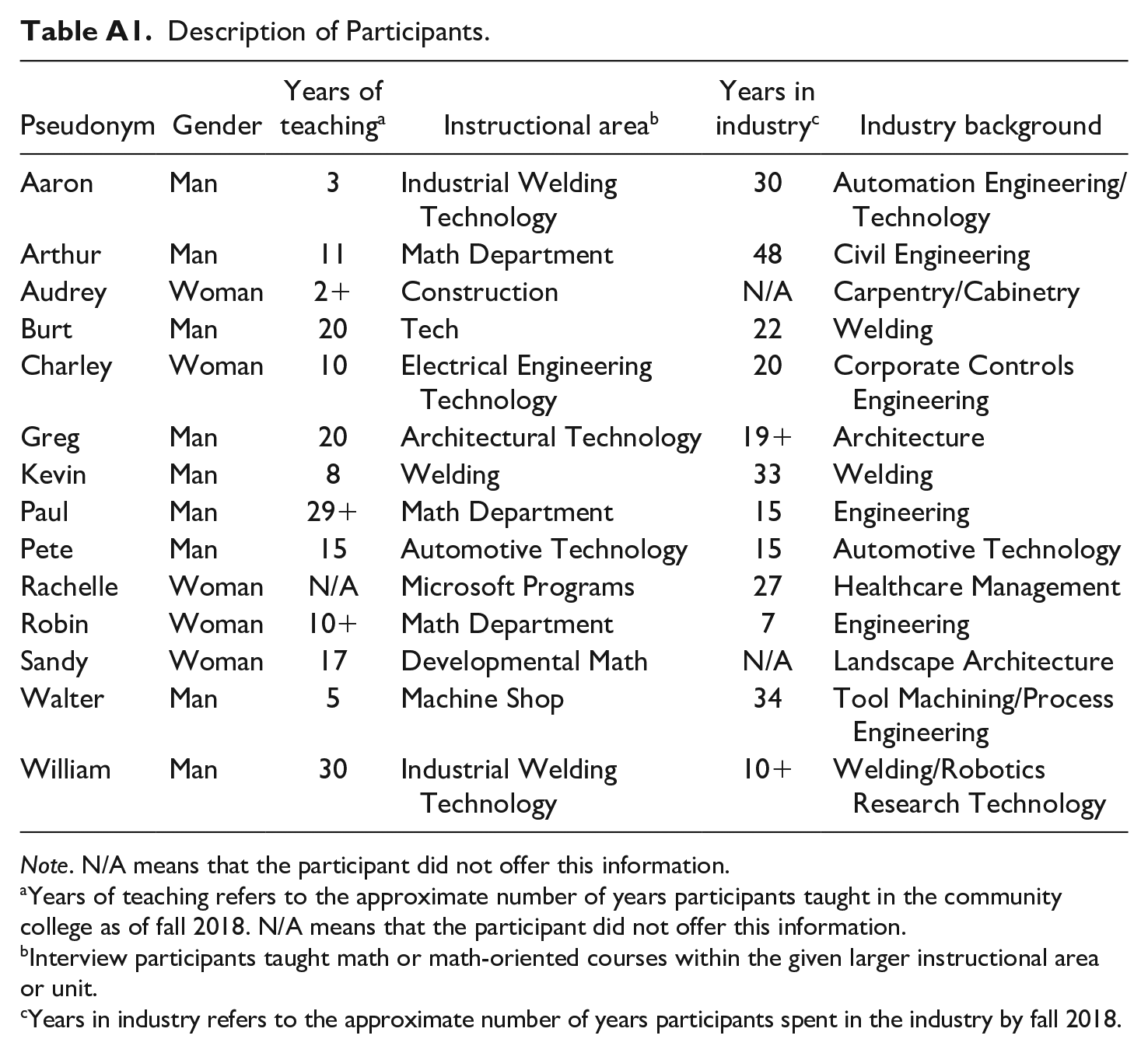
| Pseudonym | Gender | Years of teaching a | Instructional area b | Years in industry c | Industry background |
|---|---|---|---|---|---|
| Aaron | Man | 3 | Industrial Welding Technology | 30 | Automation Engineering/ Technology |
| Arthur | Man | 11 | Math Department | 48 | Civil Engineering |
| Audrey | Woman | 2+ | Construction | N/A | Carpentry/Cabinetry |
| Burt | Man | 20 | Tech | 22 | Welding |
| Charley | Woman | 10 | Electrical Engineering Technology | 20 | Corporate Controls Engineering |
| Greg | Man | 20 | Architectural Technology | 19+ | Architecture |
| Kevin | Man | 8 | Welding | 33 | Welding |
| Paul | Man | 29+ | Math Department | 15 | Engineering |
| Pete | Man | 15 | Automotive Technology | 15 | Automotive Technology |
| Rachelle | Woman | N/A | Microsoft Programs | 27 | Healthcare Management |
| Robin | Woman | 10+ | Math Department | 7 | Engineering |
| Sandy | Woman | 17 | Developmental Math | N/A | Landscape Architecture |
| Walter | Man | 5 | Machine Shop | 34 | Tool Machining/Process Engineering |
| William | Man | 30 | Industrial Welding Technology | 10+ | Welding/Robotics Research Technology |
Note. N/A means that the participant did not offer this information.
Years of teaching refers to the approximate number of years participants taught in the community college as of fall 2018. N/A means that the participant did not offer this information.
Interview participants taught math or math-oriented courses within the given larger instructional area or unit.
Years in industry refers to the approximate number of years participants spent in the industry by fall 2018.
Declaration of Conflicting Interests
The authors declared no potential conflicts of interest with respect to the research, authorship, and/or publication of this article.
Funding
The authors disclosed receipt of the following financial support for the research, authorship, and/or publication of this article: This study is based on work supported by the National Science Foundation (NSF) under Grant No. DUE-1700625. Any opinions, findings, and conclusions or recommendations expressed herein are those of the authors and do not necessarily reflect the views of NSF.
