



Abstract
Objective:
This study examined the statistical association between net tuition and changes in degree aspirations among community college students. In addition, the study explored the moderating influence of unmet financial need.
Method:
Analyses relied on data from the most recent iteration of the Beginning Postsecondary Students Longitudinal Study. Estimates were derived from a series of robust multinomial models controlling for student, institutional, and state-level covariates.
Results:
Net tuition was consistently associated with decreased risks of experiencing a “cool out,” regardless of model specification. Yet, this main effect of net tuition was moderated by unmet need, such that net tuition increased cool out risks among students with greater unmet need.
Conclusions:
The results of this study suggest that net reductions in tuition alone may not fully reduce or eliminate barriers to college access and student success. Future financial aid policies should focus on the full cost of college attendance.
Introduction
Community colleges are the cornerstone of postsecondary access in American higher education. Their open enrollment philosophy, relative affordability, and geographical dispersion across urban and rural regions provide a population of diverse and aspirational students with a pathway to higher learning and economic mobility. Yet, while community colleges have succeeded in increasing access to higher education, these institutions are not necessarily structured for student success (Bailey et al., 2015). National Student Clearinghouse data show that just 13% of the 2010 cohort of first-time community college students who successfully transferred to a 4-year institution carried on to earn a bachelor’s degree (Shapiro et al., 2017). Of the 2012 cohort of first-time community college students, just 40% earned any credential after 6 years (Shapiro et al., 2018).
One compelling—if not controversial—explanation for the low success rates of community college students came from Clark (1960), who argued that community colleges actively dispirit and divert students away from baccalaureate degrees in favor of substitutes with “lower status in both the college and society in general” (p. 572). In Clark’s (1960) words, community colleges serve a “cooling out function.” And while Clark’s (1960) original assertions have been challenged over time (Alexander et al., 2008; Bahr, 2008; Deil-Amen, 2006; Leigh & Gill, 2003), there is little denying that community college students face a number of impediments on their paths toward completion (Calcagno et al., 2008; Goldrick-Rab, 2010).
One such impediment is the increasing cost of higher education. According to the College Board’s (2019) most recent analysis of college pricing, the average published tuition and fee price for public, 2-year colleges stood at $3,730 in 2019–2020. Tuition and fees represent just a fraction of the total cost of community college attendance, however. Students must also find the means to cover costs associated with transportation, books and supplies, parking, food, and housing. The costs of housing alone often exceed students’ tuition and fees (Jackson, 2017). There is also the incurred cost of forgone wages students could have earned through work (Kane, 1995). Consequently, while many community college students receive enough grant aid to cover their tuition and fees, the majority of them have sizable unmet financial need (The College Board, 2019). Unsurprisingly, many community college students leave school highly indebted and emotionally distraught (Walsemann et al., 2015).
The extent to which the total cost of college attendance is sufficiently offset by financial aid is increasingly relevant. First, the returns to postsecondary credentials have never been higher, especially for baccalaureate degrees (Carnevale et al., 2018). It is increasingly critical that students have affordable pathways to postsecondary education. Second, decades of research has shown that students are sensitive to college pricing and that the availability of financial aid influences both college access and success (Bettinger et al., 2019; Denning et al., 2017; Dynarski, 2003, 2005; Dynarski & Scott-Clayton, 2008; Kane, 1995; Long, 2008; Seftor & Turner, 2002). After averaging 75 effect estimates reported across 43 studies employing a causal design, Nguyen et al. (2019) recently concluded that grant aid increases the probabilities of persistence and degree completion by approximately two to three percentage points.
What is less clear from the existing literature is the degree to which tuition, grant aid, and unmet financial need are associated with Clark’s (1960) notion of cooling out. The documented price sensitivity of students suggests that college pricing would influence their degree aspirations. For instance, by reducing financial barriers to entry and alleviating some of the stress of incurring debt, grant aid may increase or “warm up” degree aspirations because aid could offset the opportunity costs of college attendance. On the other hand, a lack of sufficient grant aid or high levels of unmet financial need may decrease or “cool out” degree aspirations. Unfortunately, just one study to our knowledge has examined the role of tuition and grant aid in influencing community college students’ degree aspirations (Broton, 2019). In light of this important research gap, the current study asked the following research question: controlling for other factors, how does community college tuition, grant aid, and unmet need influence changes in community college students’ degree aspirations?
Literature Review
We review two bodies of literature in the buildup of our analysis. First, we review literature related to college tuition, grant aid, and college access and success. Second, we review the literature on community college student degree aspirations and, in particular, Clark’s (1960) theory of cooling out.
Tuition, Financial Aid, and Financial Need
The cost of college continues to rise across all sectors of higher education. The College Board reports that published tuition and fees at public community colleges climbed from $2,540 to $3,730 between 1999–2000 and 2019–2020 (in 2019 dollars; The College Board, 2019). The availability of federal, state, and institutional grant aid means that students often pay far less than published tuition and fee prices. In fact, net tuition (tuition and fees minus the sum of grant aid and tax benefits) among full-time community college students in 2019–2020 was −$430, on average (The College Board, 2019). Yet few students attend community college for free; factoring in costs associated with room and board, The College Board (2019) set the average published price of community college attendance at $12,720 in 2019–2020. Subtracting grant aid, the average net price (tuition and fees plus room and board minus grant aid and tax benefits) for full-time community college students in 2019–2020 was $8,560. Importantly, this estimate does not include additional costs of going to college, such as books, other learning materials, and transportation.
There is a large body of academic literature related to college access, completion, and the availability of financial aid (Dynarski & Scott-Clayton, 2008; Long, 2008; Nguyen et al., 2019). Regarding college access, Kane (1995) found that states with higher public tuition levels have lower rates of college entry and that the gaps in college enrollment between high- and low-income youth were greater in high-tuition states. Dynarski (2003) reported that the availability of financial aid increased college attendance by over 20 percentage points. Indeed, the overall body of empirical literature utilizing natural experiments is “remarkably consistent” (Dynarski, 2002, p. 281): grants and subsidies increase college access.
The research literature indicates that financial aid also supports college student persistence and completion. For example, Dynarski (2003) found Social Security student benefit program eligibility increased the probability of completing at least 1 year of college by 16%. In another analysis using data from Arkansas and Georgia, Dynarski (2005) found that merit-based grants led to a sizable increase in the share of young people with a college degree. In their analysis of West Virginia’s merit-based PROMISE scholarship, Scott-Clayton and Zafar (2016) found that grant recipients were more likely to attain bachelor’s degrees. Denning et al. (2017) used Texas administrative data to explore the long-term effects of state aid and found that eligibility for state grant aid substantially increased students’ postsecondary attainment and earnings. Interestingly, a recent large-scale experimental analysis of a need-based grant program in Wisconsin found that grant receipt had a little overall effect on postsecondary success and even decreased associate degree completion rates among community college students by three percentage points (Carlson et al., 2019).
Even with substantial grant aid available, many students have unmet financial needs. This is to say that many students cannot fully cover the total costs of college attendance even after factoring in grant aid. Some students and their families are able to cover a portion of the remaining net price of attendance; however, many students in the lowest income brackets have expected family contributions (EFCs) of $0. It is not uncommon for these students to have thousands of dollars in unmet financial need (Choitz & Reimherr, 2013). Long and Riley (2007) documented increasing levels of unmet financial aid among college students. They reported that higher levels of unmet financial need are predictive of decreased college persistence (Long & Riley, 2007). Bresciani and Carson (2002) also reported decreased odds of term-to-term persistence among students with unmet financial need. More recently, Benson (2018) reported that average levels of unmet need were higher among community college students than they were among students attending 4-year universities in the state of Washington, despite community colleges having lower tuition and fees. Benson (2018) found that students with greater amounts of unmet need were less likely to continue attending college and to graduate.
To summarize, the overall body of research related to tuition, financial aid, and college success indicates that the availability of grant aid boosts postsecondary access and completion, especially among low-income students. On the other hand, increased higher education costs, including higher levels of unmet financial need, have been shown to decrease student success.
Aspirations and cooling out
Horn and Skomsvold (2011) assessed first-time community college student aspirations over multiple administrations of the Beginning Postsecondary Students (BPS) Longitudinal Study in 1989–1990, 1995–1996, and 2003–2004. They found that the percent of first-time community college students who aspired to a bachelor’s degree or higher was 71%, 81%, and 81%, respectively. Degree aspirations are not static, however. Deil-Amen (2006) reported that 21.6% of a national sample of community college students adjusted their aspirations from a baccalaureate to a sub-baccalaureate level degree over a 3-year period. Just over 18% of the same sample changed their aspirations in the opposite direction, from the sub-baccalaureate to baccalaureate level.
A significant body of research has documented factors that influence students’ pre-college aspirations. These include factors such as prior academic preparation and achievement, encouragement from parents or family, family background and resources, school context and guidance processes, and K-12 policies (Cabrera & La Nasa, 2000; Hamrick & Stage, 2003; Hossler et al., 1999; Kao & Tienda, 1998; McDonough, 1997; Perna, 2016; Perna & Titus, 2005; Schneider & Stevenson, 1999; Venezia et al., 2003).
It is unclear what factors account for changes in degree aspirations after college entry. In the community college literature, Clark (1960) is often credited with first documenting the cooling-out process in his seminal case study of San Jose Junior College. Clark (1960) outlined five steps of the cooling-out process: (a) pre-entrance testing and assignment to remedial courses that slows students’ progress into college-level and transfer courses; (b) counseling meetings that allow counselors to guide students based on students’ prior performance; (c) transition and orientation courses that expose students to vocations and vocational options based on their own skills and interests; (d) a record of academic failures and warning signals that indicate students are not doing satisfactory work; and (e) academic probation placement. Through these multiple processes, Clark argued that community college students are redirected toward goals more “realistic” than baccalaureate attainment.
Clark’s (1960) cooling-out hypothesis has been researched and critiqued over the years. For instance, Alexander et al. (2008) analyzed longitudinal data on degree aspirations and found that instead of cooling down, community colleges actually helped students to increase their degree aspirations, a phenomenon they called “heating up.” Using California state community college data, Bahr (2008) found no evidence of “direct, active, counselor-driven cooling out as a general phenomenon of transfer-seeking community college students, nor as a specific phenomenon of the academic underprepared segment of the larger transfer-seeking group” (p. 724). Contrary to what Clark (1960) argued, Bahr noted that academically underprepared students benefited from academic advising and counseling. This is not to suggest that community college students have an easy pathway to completion; many institutional practices and barriers impede student success (Bailey et al., 2015; Deil-Amen, 2006; Goldrick-Rab, 2010). And even though Clark (1960) did not discuss college pricing as a potential mechanism for cool out, we suspect college pricing factors into students’ decisions to adjust their degree aspirations. Consequently, the current study looks to Clark (1960) more for a potential mechanism to explain the positive relationship between degree completion and access to financial aid reported in the literature than for theoretical grounding.
We suspect college pricing to impact degree aspirations for at least two reasons. First, given students are sensitive to college pricing and the availability of grant aid, it follows that students would moderate or change their postsecondary plans based on cost calculations. Opportunity costs to students decrease as college becomes more affordable. Therefore, we hypothesize that students confident they can shoulder the cost of college attendance by receiving more aid will maintain their degree aspirations or even increase them. Students less certain about their abilities to pay for college by receiving less aid will adjust their aspirations downward, toward a more affordable degree or credential. We would expect this to be particularly true for students in the lowest income levels since these students have lower EFCs and higher levels of unmet need (Choitz & Reimherr, 2013).
Second, the cost of college increases steeply as students move from 2- to 4-year institutions. Overall, 4-year colleges have higher published tuition and fees as well as costs of room and board (Chingos et al., 2017; The College Board, 2019). The act of transferring to a 4-year institution itself can be costly if transferring requires students to geographically relocate or to leave their current places of employment. Therefore, the availability of generous grant aid may encourage community college students to realize they can take on the additional costs of transferring to a baccalaureate-granting institution; a lack of aid may lead students toward the opposite determination and toward a sub-baccalaureate degree.
Unfortunately, just one existing study has empirically studied the impact of college pricing and financial aid on community college students’ degree aspirations (Broton, 2019). This study reported causal evidence of decreased academic aspirations among community college students who received a need-based financial award. More specifically, Broton (2019) found that 1 year after receiving the Wisconsin Scholars Grant (WSG), students were twice as likely to decrease their aspirations and expectations compared with students who did not receive the grant. Broton (2019) offered several potential explanations for these downward effects. One explanation was that grant receipt led to decreased personal investment and commitment among students, though Broton (2019) found no evidence to support this claim in follow-up interviews. A second explanation was that the grant did not sufficiently offset the full cost of college attendance, in effect leaving students with (unexpected) unmet financial need that then diverted their aspirations to something more practical or affordable.
Collectively, the existing literature indicates that students enter community colleges with determined degree aspirations but that many of these students change their aspirations after college entry. Institutional policies and practices can explain some variation in changes to degree aspirations, but certainly not all. As the cost of college attendance climbs, along with levels of debt, and the “free college” movement expands, much more research is needed to explore the degree to which college pricing and financial aid assistance may explain changes in community college degree aspirations. Broton (2019) hypothesized that a lack of sufficient financial aid may explain decreased degree aspirations among WSG recipients. We wanted to test this hypothesis in the current study. Specifically, we wanted to assess the degree to which the relationship between net tuition and changes in degree aspirations is moderated by unmet financial need—an important, yet previously unexplored topic.
Data and Method
The purpose of the current study was to investigate the relationship between levels of first-year net tuition, unmet financial need, and changes in the degree aspirations among first-time community college students. Given this purpose, data capturing community college pricing, financial aid, and students’ reported degree aspirations were needed. Furthermore, it was important to access data from multiple locations in the nation given the wide variation in both tuition levels and financial aid policies across states (Perna & Leigh, 2018).
We chose to leverage data supplied by the National Center for Education Statistics (NCES) to address our empirical questions. More specifically, we elected to use the restricted version of the Beginning Postsecondary Students Longitudinal Study (BPS) which is a spin-off from the National Postsecondary Study Aid Study (NPSAS). The most recent iteration of BPS (BPS:12/17) tracked a cohort of first-time postsecondary students across the 2011–2012 and 2016–2017 academic years. The study design called for an initial round of data collection in 2012, and a first follow-up wave of data collection in 2014. Another final wave of data collection was completed in 2017. 1
The BPS:12/17 study captured a wide range of information pertaining to sample participants’ demographics and academic behaviors along with characteristics of the community college institutions they attended, supplied by the Integrated Postsecondary Education Data System (IPEDS). The scope of the BPS:12/17 investigation made it possible to explore the potential relationship between net tuition, unmet financial need, and degree aspirations while controlling for a range of important student and institutional factors. Because BPS is a nationally representative sample, it was possible to control for between-state variation. Roughly 24,000 students who participated in NPSAS 2012 were selected for participation in the BPS:12/17 study. Of this sample, roughly 30% began their postsecondary study at a 2-year, public community college. We delimited our sample only to include these students since first-time community college students were the central focus of our investigation.
Three variables in the study had missing values (2011–2012 net tuition, 2011–2012 unmet need, and 2011–2012 GPA). Of these, the percentage of missing values ranged from 2% to 9%. To maintain sufficient statistical power while also controlling for the potential influence of missing observations, we chose to use multiple imputation (McCleary, 2002; Royston, 2004). Specifically, we estimated 10 sets of plausible values, which were then imputed back to the sample for cases in which NCES-provided sample weights were set to nonzero. These weights were used for imputation and during all empirical analyses. Throughout the current study, sample sizes have been rounded to the nearest tens digit per NCES guidelines. After multiple imputation, the final analytic sample was composed of approximately 6,860 first-time students enrolled in 320 public community colleges across 44 states.
Measures
Outcome variable
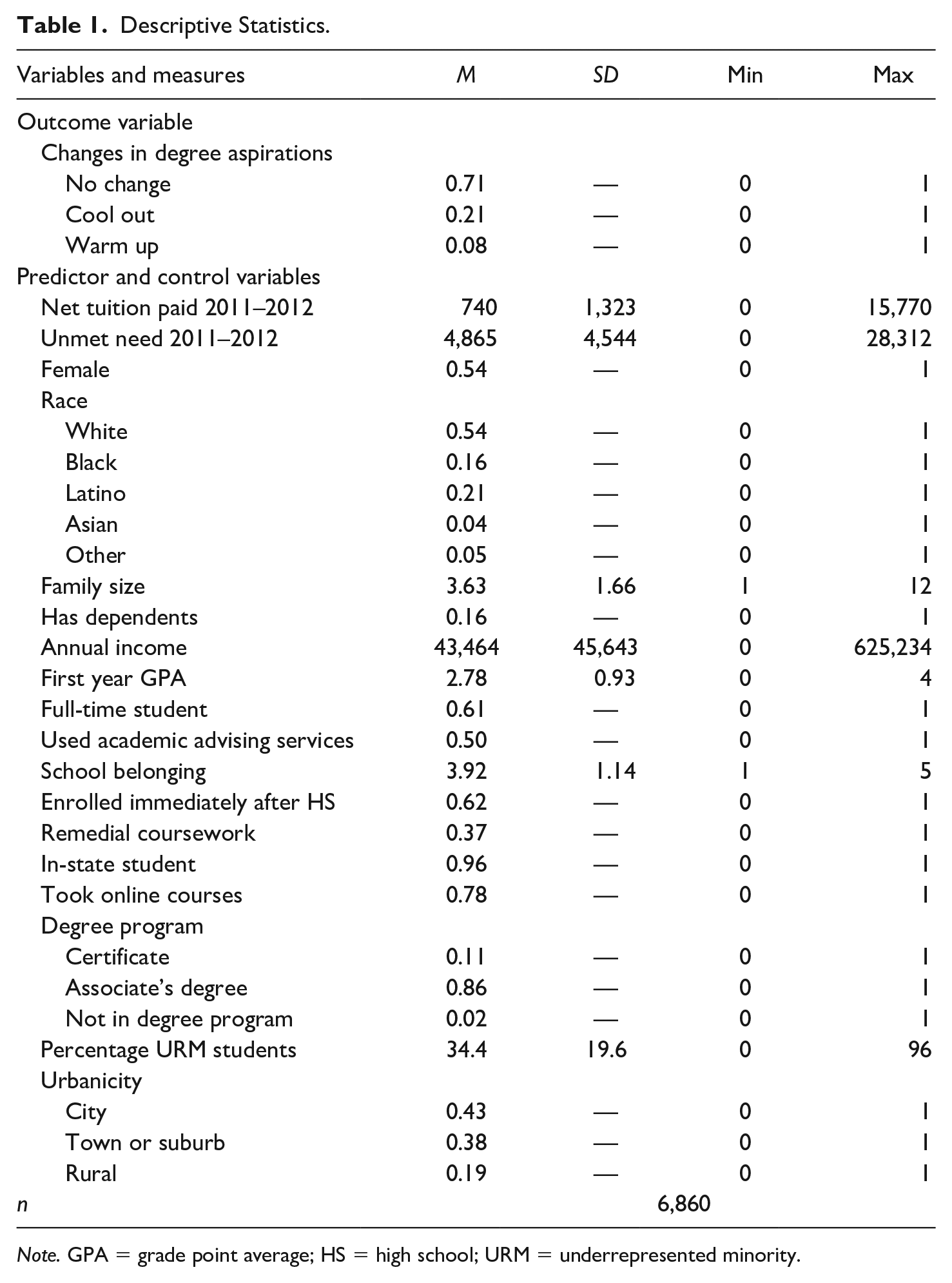
The primary outcome variable used in the current study was a polytomous measure of changes in BPS students’ degree aspirations between their first and third year of postsecondary study. In both data collection waves (i.e., 2012 and 2014), students were asked to list “the highest level of education that the student ever expect[ed] to complete.” We used data collected in both waves to create our outcome measure. Using Clark’s (1960) original conceptualization of cooling out, we considered a student to not have a change in degree aspiration if that student aspired for a baccalaureate degree or higher in 2012 and remained at the baccalaureate level or above in 2014. A student was also considered to not have a change in degree aspiration if that student aspired for a sub-baccalaureate degree in 2012 and remained at the sub-baccalaureate level in 2014. If a student aspired for a baccalaureate degree or higher in 2012 but reported aspirations for a sub-baccalaureate degree/credential in 2014, the student was classified as experiencing a cool out. If a student aspired for a sub-baccalaureate degree in 2012 but reported aspirations for a baccalaureate degree or higher in 2014, this student was classified as experiencing a warm up. All told, there were three potential values on the primary outcome of interest. Table 1 shows the distribution of values on this constructed measure. As one can see, approximately 4,860 students (≈71%) in the BPS community college sample did not experience a change in degree aspirations that crossed the sub-baccalaureate/baccalaureate threshold. Roughly 1,430 students (≈21%) experienced a cool out, and around 560 (≈8%) students experienced a warm up.
Descriptive Statistics.
Note. GPA = grade point average; HS = high school; URM = underrepresented minority.
Predictor variables
Students’ first year net tuition was the primary predictor variable of interest in the current study. The BPS study made a number of “net price” variables available to researchers, each of which was calculated differently using NPSAS 2012 student records. Ultimately, we elected to operationalize net tuition as the tuition students paid in the 2011–2012 academic year, net of the sum of all federal, state, institutional, and outside grant aid, including employer tuition reimbursements and private sources of grant aid. Students’ loan amounts for the academic year were not factored into the calculation of net tuition. Our reasoning for this decision was simple; while loans may provide short-term financial reprieve and a sense of independence for students, they can represent substantial long-term financial and psychological burdens—the sorts of burdens that financial aid initiatives around the country aim to ameliorate. Figure 1 shows there is a marked difference between the published tuition and fees of college attendance (i.e., tuition) and what students actually paid in 2011–2012 (i.e., net tuition) after grant aid was factored in. More specifically, Figure 1 shows that many students paid little net tuition in their first academic year. In fact, over half of all students in the BPS community college subsample paid $0 net tuition during their first year of academic study. This aligns with national estimates of public community college net pricing (The College Board, 2019).
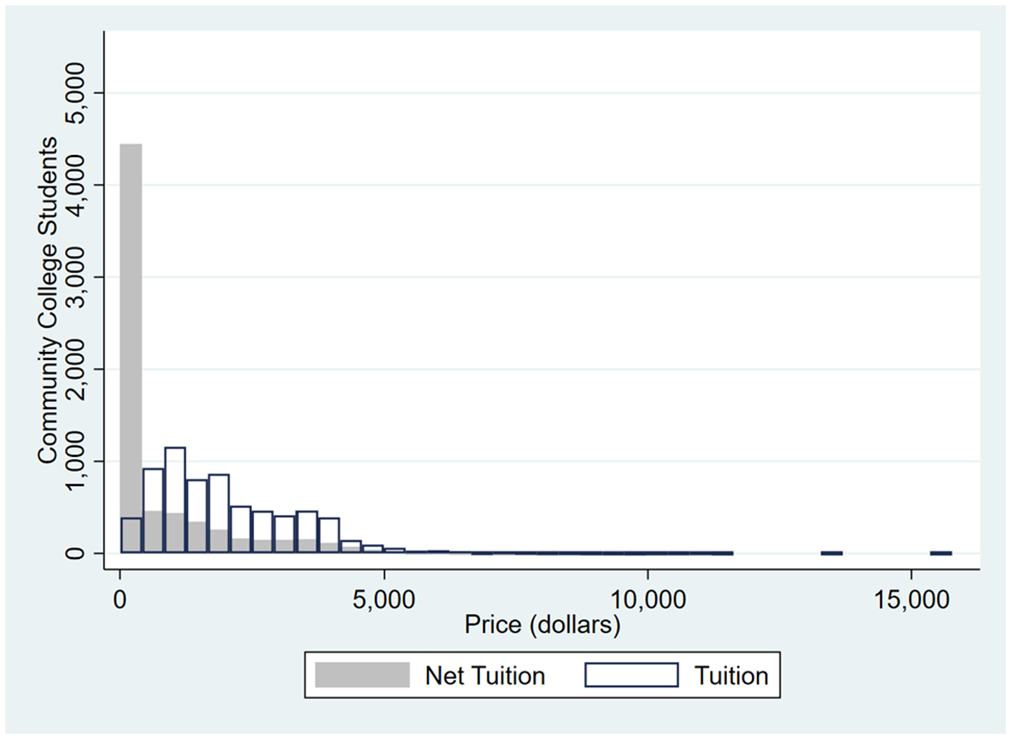
Tuition and net tuition, 2011–2012.
Of greater interest, however, is Figure 2, which shows the average net tuition paid by students in the BPS:12/17 community college subsample disaggregated by the outcome categories. As the figure illustrates, students who experienced a cool out in their degree aspirations between 2012 and 2014 paid net tuition and fees that were, on average, much lower than students who experienced no change in their degree aspirations, and just slightly lower than students who experienced a warm up.

Net tuition by changes in degree aspirations.
Of course, net tuition represents just one of the costs of attending college. To attend college, students must also shoulder the costs of transportation, books and supplies, room and board, personal expenses, as well as the opportunity costs of participating in the labor market. While Figure 1 illustrates many community college students paid little in net tuition, national estimates suggest these students had additional financial needs even after accounting for grant aid and EFC. We refer henceforth to this additional financial need as “unmet need,” which we operationalize in the analyses that follow as the total cost of attendance (i.e., tuition and fees plus any and all non-tuition expenses, including costs of books and supplies, room and board, transportation and all other personal expenses) minus all grant aid and EFC (Choitz & Reimherr, 2013).
Table 1 shows that students in the BPS community college sample had an average of $4,865 in unmet financial need. There was considerable variation around this average, however; nearly 22% of the students in the sample had $0 in unmet need. Among the students with some amount of unmet financial need, the amounts ranged from $10 to over $28,000. 2 Given these additional costs of attendance, we wanted to explore the possibility that the downward effects of grant receipt reported in Broton (2019) could be moderated by students’ unmet financial needs. In other words, we wanted to see if the relationship between net tuition and changes in degree aspirations was dependent on the amount of unmet financial need a student had in his or her first year of college.
Control measures
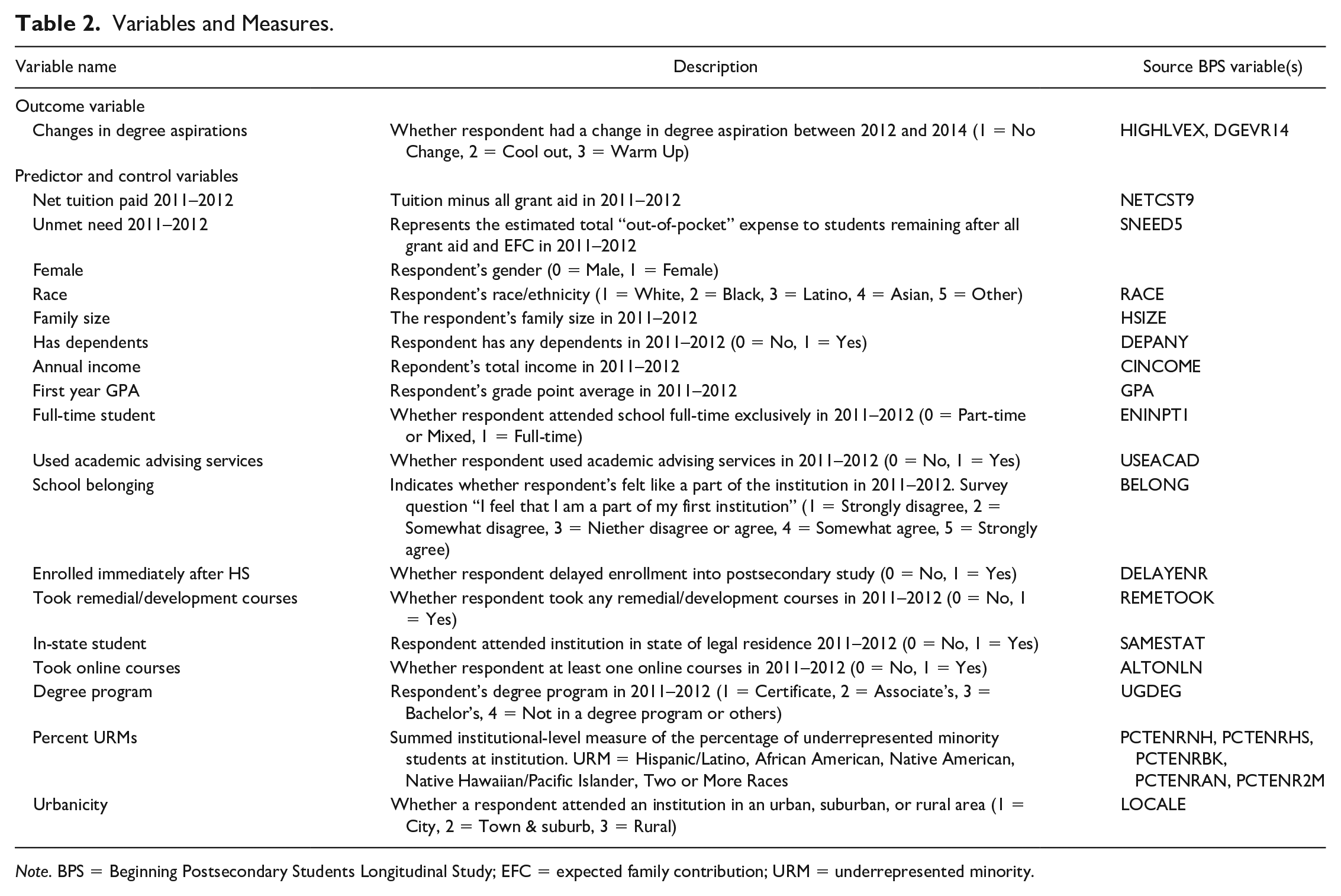
To reduce the potential threat of omitted variable bias and to improve the precision of our model estimates, we sought to control for a number of covariates (see Table 2). Our review of the academic research literature suggested we account for demographic factors consistently found to predict postsecondary experiences, including race/ethnicity, gender, and income. Existing research also suggested we account for prior academic preparation and achievement, family background and resources, school context, and guidance processes (Cabrera & La Nasa, 2000; Calcagno et al., 2008; Hamrick & Stage, 2003; Hossler et al., 1999; Kao & Tienda, 1998; McDonough, 1997; Perna, 2016; Perna & Titus, 2005; Schneider & Stevenson, 1999; Venezia et al., 2003). Table 1 lists the descriptive statistics for the full set of control variables used in our empirical specifications. Table 3 reports these descriptive statistics disaggregated by the three categories of the outcome variable.
Variables and Measures.
Note. BPS = Beginning Postsecondary Students Longitudinal Study; EFC = expected family contribution; URM = underrepresented minority.
Variables and Measures by Changes in Degree Aspirations.

Note. GPA = grade point average; HS = high school; AA = associate degree; URM = underrepresented minority.
Analytic technique
We used multinomial logistic regression to model the observed variation in changes in degree aspirations among students within the BPS community college subsample. As an extension of binary logistic regression, multinomial logistic regression uses maximum likelihood estimation to determine the probability of an unordered categorical variable y being equal to any one of

where β represents vectors of coefficients for every possible outcome category relative to the base category b. Hence, in the case where

where
Results
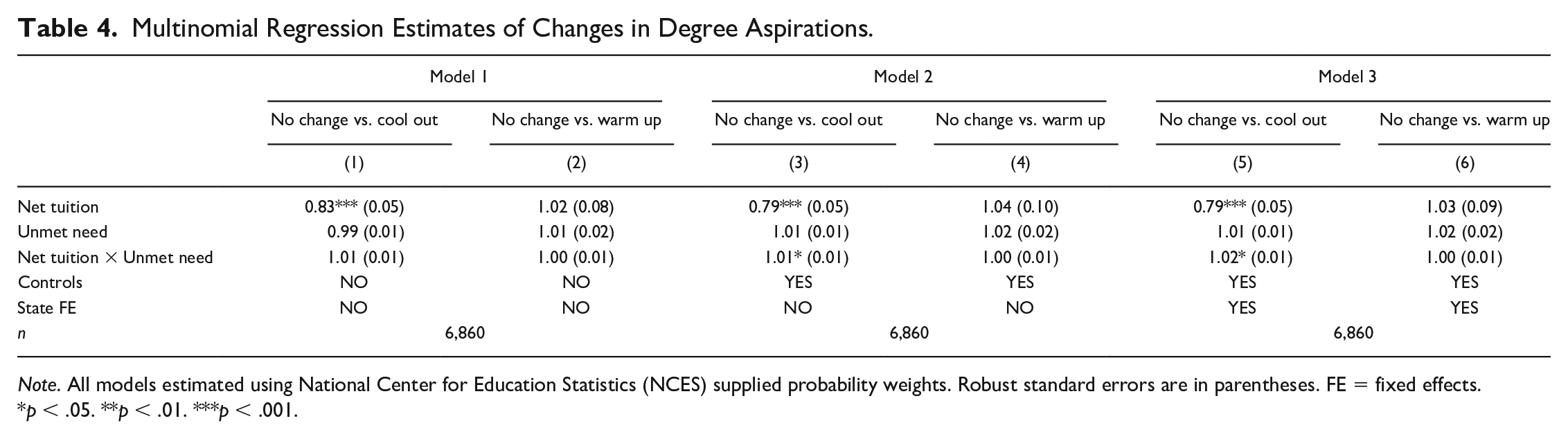
Table 4 contains the estimates produced by Models 1 to 3. To facilitate interpretation, coefficients expressed as logits have been exponentiated and are reported as relative risk ratios, which can be understood as fluctuations in the risks of a student experiencing a cool out or warm up (comparison categories) relative to the risks of experiencing no change in degree aspiration (the reference category). Relative risk ratio coefficients greater than 1 signify increased likelihood relative to the reference category; relative risk ratio coefficients less than 1 signify decreased likelihood relative to the reference category. While Models 1 and 2 were estimated using the control variables listed in Table 1, we do not report estimated coefficients for these variables in Table 4 to focus interpretation on the primary variables of interest. Complete regression tables are available by request.
Multinomial Regression Estimates of Changes in Degree Aspirations.
Note. All models estimated using National Center for Education Statistics (NCES) supplied probability weights. Robust standard errors are in parentheses. FE = fixed effects.
p < .05. **p < .01. ***p < .001.
Model 1 estimated the unadjusted association between net tuition, unmet need, the interaction of these two and changes in degree aspirations. Results in column 1 of Table 4 show that increased net tuition was associated with decreased risks of experiencing a cool out among students who had $0 in unmet need relative to experiencing no change at all. More specifically, given a $1,000 increase in first-year net tuition, the relative risk of cooling out compared with not changing would decrease by a factor of 0.83. Put more simply, students who paid higher rates of net tuition during their first year of community college study and who had no additional financial need were less likely to cool out. There was no association between unmet need and cooling out. Similarly, estimates did not suggest that unmet need moderated the relationship between net tuition and decreased probabilities of cooling out. Results in column 2 of Table 4 indicated that net tuition and unmet need were statistically unrelated to warming up.
Regression estimates produced by Model 2 were conditioned on the full set of individual- and institutional-level controls previously described and listed in Tables 1 to 3. As displayed in column 3, the estimates produced by Model 2 closely resembled those produced by the unconditional model (Model 1) such that even after controlling for a range of factors plausibly related to the outcome, increased net tuition was still associated with decreased risks of cooling out among students with $0 in unmet financial need. The magnitude of the coefficient altered slightly; given a $1,000 increase in net community college tuition, the risk of a student experiencing a cool out between 2012 and 2014 would decrease by a factor of 0.79, holding all other model covariates constant. As with Model 1, there was no “main effect” of unmet need and experiencing a cool out for students. This said, the interaction coefficient was statistically significant, an indication that the relationship between net tuition and cooling out was moderated by students’ unmet financial need. In other words, the degree to which net tuition was predictive of cooling out was dependent on the amount of unmet need a student had remaining after factoring in grant aid and EFC. The magnitude of the coefficient was modest; given a $1,000 increase in unmet need, students’ risks of cooling out increased by a factor of 1.01, or 1%, as net tuition went up. As before, results in column 4 of Table 4 indicated that net tuition and unmet need were unrelated to warming up.
Model 3 sought to improve upon Model 2 by controlling for all observed and unobserved time-invariant state-level factors that could have influenced students’ decisions to change in their degree aspirations. Estimates produced by these state fixed effects models were very similar to estimates produced by Models 1 and 2. Results again suggested that a $1,000 increase in net tuition was associated with decreased risks of cooling out among students without any unmet financial need. Yet, as with Model 2, results in the third row of column 5 suggested that the relationship between net tuition and cooling out was a function of students’ unmet financial need, such that increased net tuition actually increased cool out risks among students with higher levels of need. Figure 3 illustrates this relationship.
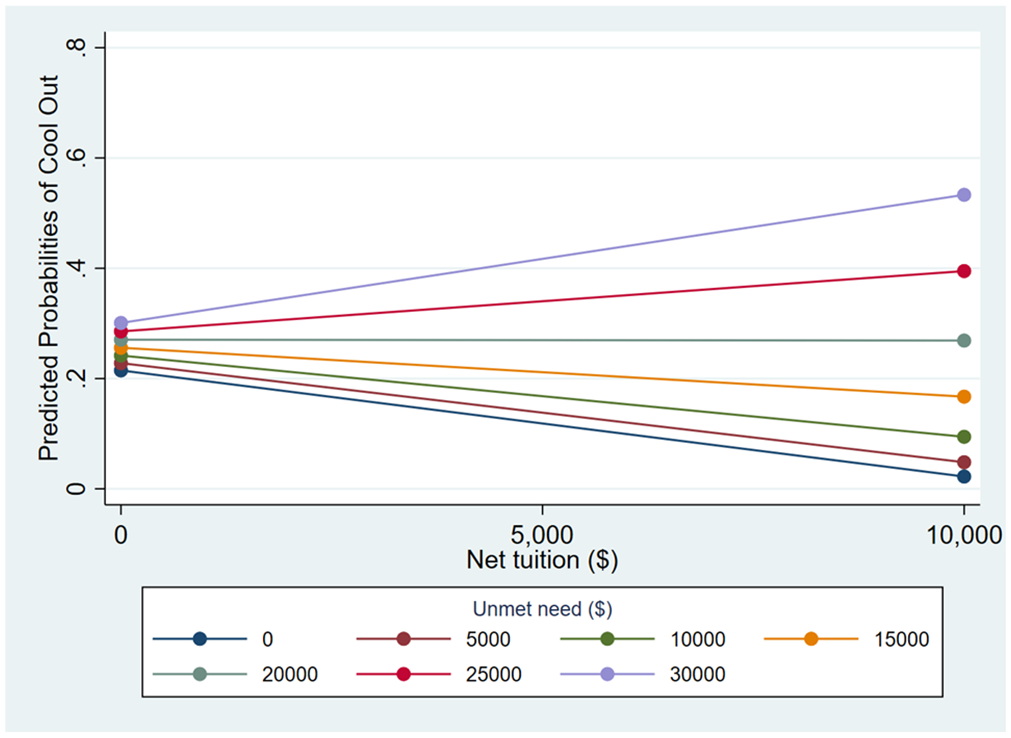
Predicted probabilities of cool out.
Looking on the left side of Figure 3, the predicted probabilities of experiencing a cool out among students who paid $0 in net tuition were lowest among students who also had $0 in unmet need. Holding net tuition constant at $0, one can see that the predicted probabilities of cooling out increase as unmet financial need increases. One can also clearly see that the net tuition slope is a function of unmet need. For example, the predicted probabilities of experiencing a cool out decrease as net tuition increases to $10,000 among students who had $0 in unmet need. However, the net tuition slope flattens as unmet need increases. Looking on the right side of the figure, one can see that the predicted probabilities of experiencing a cool out among students who paid $10,000 in net tuition were highest among students who had upward of $30,000 in unmet need.
Discussion
The current study reports that first-time community college students who paid higher levels of net tuition had lower risks of cool out but that this relationship was moderated by unmet need. What might account for the findings reported in this study? First, that increased net tuition was associated with decreased risks of cooling out among students without unmet financial need suggests that unobserved factors related to socioeconomic advantage may hold explanatory power. Students able to pay higher net tuition levels and who were also without unmet need are students who either did not apply for, qualify or receive grant aid. These students had higher EFCs and were plausibly more economically and socioculturally advantaged relative to students who paid lower net tuition levels. Given the long documented connection between income, class, economic advantage, and postsecondary success (Goldrick-Rab, 2010), it is likely that unobserved advantages correlated with income accounted for the net tuition effect.
Another possible explanation can be derived from the “sunk cost fallacy,” which holds that psychological commitments are driven by prior investments (Arkes & Blumer, 1985; Sweis et al., 2018; Thaler, 1999). Put differently, the sunk cost fallacy asserts that individuals will persist in efforts they have “sunk” time or money into even when those efforts are counterproductive. Sweis and colleagues (2018) argued that the sunk cost effect is a cognitive bias that evolved to help humans predict future valuations based on past effort. In the context of the current study, the sunk cost fallacy suggests that community college students who paid more in tuition, on net, would maintain their degree aspirations (evaluation of future value) because these students have made greater, irrecoverable past investments.
This said, the current study found that the impact of net tuition was moderated by an unmet need. Practically speaking, then, there was not one “main effect” of net tuition on students’ changes in degree aspirations; the effect of net tuition was dependent on levels of unmet financial need. As Figure 3 illustrated, higher levels of net tuition were associated with higher risks of experiencing a cool out as unmet need increased. This may be for several reasons.
First, students’ postsecondary behaviors are sensitive to college pricing. Research has shown consistently that the availability of grant aid increases college access, persistence, and completion. Given this prior research base, it is expected that students in the sample with both high levels of net tuition and unmet financial need would struggle to maintain lofty degree aspirations relative to students who had no unmet financial need. The pressure to downwardly adjust aspirations would be particularly acute for low-income students—students who have low EFCs, who work, attend part-time, and who also may need to support their families or dependents. For these students, the costs of attaining a baccalaureate degree may have been too great, even though they entered with baccalaureate aspirations.
Another possible explanation was offered by Broton (2019), who suggested that insufficient grants may have left students with unexpected unmet financial need that then diverted their aspirations to something more practical or affordable. Broton (2019) referred to this as a “disappointment effect.” Yet another possible explanation may be that students became more alert to added costs of transferring to a 4-year school in their second and third academic years. Students’ evaluations of these added costs, in combination with already high levels of tuition and unmet financial need, may have led them to downwardly adjust their aspirations to a sub-baccalaureate alternative.
This study contributes to the literature on community college student success in several ways and has important implications for policy and practice. First and foremost, this study extends Broton’s (2019) study and shows that unmet financial need is a critical component of the relationship between community college students’ tuition costs and their degree aspirations. Second, this study contributes to an important body of work that aims to understand what factors influence community college students’ degree aspirations, suggesting that unmet financial need and tuition are critical to understanding what influences students’ degree aspirations, alongside counseling and advising processes, academic policies and procedures, and other support services and processes advanced by Clark (1960), Deil-Amen (2006), and others. Third, research on the success of community college students broadly must consider the role of non-tuition costs. Research shows that students’ non-tuition costs represent the largest share of the costs of college (The College Board, 2019), and community college research and practice must consider how students’ unmet financial need contributes (or not) to their success. Although tuition and financial aid play an important role in understanding student success, so does the role of unmet needs and costs affiliated with attending college (Goldrick-Rab, 2010).
This study also has several implications for community college policy and practice. The first relates directly to how community colleges provide financial support to students to help them pay for college. Although community college tuition continues to increase, recent developments in local and state policies related to free college and promise programs now means that many community college students attend tuition-free. However, research shows that many of these programs and policies are last dollar (Perna & Leigh, 2018), meaning that they might reduce net tuition to zero, but they do not address students’ financial needs beyond tuition; that is, they do not address the costs that lead to higher levels of unmet financial need. Community college leaders and state policymakers who are trying to improve college affordability must help students finance non-tuition related expenses if we want to see community college students access the baccalaureate degree.
Social distancing measures stemming from the COVID-19 pandemic have disrupted the U.S. economy. Consequently, many state systems of higher education must now contend with unsparing budget realities. In the state of California, the Governor’s May 2020 budget revision reduced funding to the state’s 115 community colleges by 17% or $1.3 billion. Additional cuts are expected. California’s Legislative Analyst’s Office (LAO), for example, suggested the Legislature eliminate California funding for California Assembly Bill 19 (AB19), the California College Promise. California’s largest source of State financial aid, the Cal Grant Program, has largely been spared by the Governor’s budget revision, but the future is uncertain given the pandemic is ongoing. One immediate policy implication stemming from finding that students’ degree aspirations are associated with net tuition and unmet financial need is that state governments and systems of higher education will need to find creative solutions to address the economic realities brought on by COVID-19 without restricting access to financial aid. This will be a challenge, given community college enrollments are expected to increase in the coming academic years (Jenkins & Fink, 2020).
The current study is not without a number of important limitations. First, financial aid data for students in the sample were only available during students’ first year of college attendance. Students’ first years of college-going are crucial to their eventual success, yet later academic experiences and supports also influence student outcomes. It is possible that changes to students’ net tuition and/or unmet financial needs fluctuated from year to year. Schudde and Scott-Clayton (2014) illustrated that many students lose their Pell eligibility because they fail to demonstrate satisfactory academic progress. These students were found to have lower persistence rates compared with students who maintained their access to Pell funding. The current study was unable to account for year-to-year fluctuations in financial aid.
Another limitation of the current study is the researchers only had access to the first two collection waves of BPS:12/17 data. This is an important limitation because while a student may have experienced a cool out in their aspirations between their first and third year of study, these students could have warmed up between their third and sixth year of study, as demonstrated in previous iterations of BPS. This also meant that the researchers were unable to assess the degrees students actually earned.
Conclusion
Community colleges represent a uniquely American institution (Beach, 2011). Standing in stark contrast to elite and—by definition—exclusionary universities in the nation, public community colleges provide access to higher learning to all aspirants, including many low-income, minoritized students. Returns to postsecondary credentials are at an all-time high (Carnevale et al., 2018). It is imperative that students have access to affordable postsecondary options. Efforts in recent years have focused on reducing the financial barriers that prevent students from attending. The findings of the current study suggest that net reductions in tuition alone may not be sufficient to offset the total costs of higher education. Similar concerns were voiced by Broton (2019). Building on Broton (2019), however, this study found that the relationship between net tuition and changes in students’ degree aspirations depends on how much unmet financial need a student has. It is imperative, therefore, that financial aid policies aiming to lessen the financial burdens of paying for college account for their full weight to the students shouldering them.
Footnotes
Declaration of Conflicting Interests
The authors declared no potential conflicts of interest with respect to the research, authorship, and/or publication of this article.
Funding
The authors received no financial support for the research, authorship, and/or publication of this article.
