




Abstract
Introduction
Collaboration among higher education institutions is increasingly recognized as an essential strategy to improve student outcomes as well as institutional effectiveness. Greater attention is being devoted to understanding how people and groups collaborate, both within and across different institutions as well as educational sectors (Amey et al., 2007; Eddy, 2010; Eddy & Amey, 2014; Hora & Millar, 2011; Kezar, 2006, 2014). Collaboration is especially relevant to transfer processes due to the movement of students between institutions. National data show that while approximately 52% of students begin at community colleges, only 37% of those students actually transfer to a 4-year institution, and 42.2% of those transfer students successfully complete a baccalaureate degree (Shapiro et al., 2018). The vertical transfer process poses numerous and complex challenges for students ranging from credit transfer issues and curricular misalignment, to confusion, isolation, and transfer shock (Grites, 2013; Jabbar et al., 2019; Laanan, 2007; Monaghan & Attewell, 2015; Schudde & Grodsky, 2018, Taylor & Jain, 2017). Many of these barriers could be mitigated by community colleges and 4-year institutions strategically working together to reduce confusion about transfer policies, requirements, and procedures, as well as to more seamlessly support transfer students both in the pre- and post-transition process (Bahr et al., 2013; Handel & Williams, 2012; Jain et al., 2011).
Some examples of collaborative efforts between community colleges and baccalaureate-granting institutions have been described in the literature on vertical transfer. The majority highlights specific curricular or programmatic partnerships (Caron, 2013; Messinger, 2014), as well as pipeline programs (Lockwood et al., 2013; Wilson & Lowry, 2017), undergraduate research programs (Phelps & Prevost, 2012), shared space or concurrent use models (Mobelini, 2013), and other forms of institutional collaboration (Roggow, 2014). Beyond descriptive accounts of particular collaborative initiatives, less research has been conducted on the concept of transfer partnerships and their use as a broad, institutional strategy for improving transfer outcomes. Several empirically-based publications describe promising practices (Dowd et al., 2008; Fink & Jenkins, 2017; Kisker, 2007) and a few studies also present recommendations for collaboration between community colleges and baccalaureate granting institutions (Dolinsky et al., 2016; Handel & Williams, 2012), either by studying multiple institutional pairs or conducting in-depth case studies. We add to this body of work by more deeply investigating the processes involved in creating and sustaining these collaborative institutional relationships.
Study Background and Context
This article draws upon qualitative findings from a larger mixed-method study on institutional partnerships between community colleges and baccalaureate-degree granting universities that promote more equitable transfer outcomes, including higher than predicted retention and transfer rates, for racially minoritized students (Bragg, 2020). Data from this study were previously used to examine high-performing transfer partnerships and learn more about what made them successful, how their partnerships were structured, and how they evolved over time (Yeh & Wetzstein, 2020). Using the lens of organizational collaboration (Bailey & Koney, 2000), the researchers described the variation in the observed partnerships. Findings suggested that transfer partnerships, rather than being dichotomously high-performing or low-performing, fell along a continuum of collaborative arrangements. A framework was developed that described their complexity and characteristics along four different levels: (1) cooperation, (2) coordination, (3) collaboration, and (4) alliance (Yeh & Wetzstein, 2020). But what remained unclear were the forces that influenced movement along this continuum. The goal of the current research is to shed light on these influences and provide a framework for improving transfer partnerships.
Extant literature tends to identify desirable components of transfer partnerships as they exist at a particular point in time, but has not yet provided a comprehensive look at the factors that influence the navigation of those partnerships across months and years. This study examines transfer partnerships as “living systems” that require energy to continue and evolve due to environmental forces, resulting in their continual change over time (Amey et al., 2007, p. 7). In their work on institutional change, Kezar and Eckel (2002) argue that much of the literature on change in higher education offers strategies that are either too generalized or too specific to be helpful in practice, stating that “the challenge is to chart a middle ground and identify findings informative at a level that can be used to guide change processes” (p. 436). This paper aims for that middle ground by investigating factors that can cause transfer partnerships to move both forward and backward along a continuum over time (Yeh & Wetzstein, 2020).
Literature on Transfer Collaboration
The following sections provide a brief overview of research that has examined collaborations between sending and receiving institutions that support transfer students. This review is not exhaustive of the literature on transfer partnerships; instead it focuses on work that describes factors impacting collaborations focused on vertical transfer, and is organized according to three broad themes that emerged from our analysis: culture, policy, and practice.
Culture
Institutional culture is widely viewed as playing a critical role in how colleges and universities function (Tierney & Lanford, 2018). We define culture as the set of values, assumptions, and beliefs shared by many or most members of an organization, which shape “deeply embedded patterns of organizational behavior” (Peterson & Spencer, 1991, as cited in Kezar & Eckel, 2002, p. 438). Various facets of institutional culture can impact transfer student outcomes in general and transfer partnerships in particular. For example, research suggests that institutional mission and leadership are important to transfer partnership formation because they can signal the prioritization of collaborative practices (Fink & Jenkins, 2017; Handel, 2011; Kisker, 2007; Wyner, et al., 2016. Some researchers have also observed that partner institutions with strong relationships share accountability for transfer outcomes, rather than placing responsibility or blame on their partners when concerns arise (Fink & Jenkins, 2017; Handel, 2011; Miller, 2013). Moreover, the establishment of non-hierarchical, collaborative relationships between staff at partner institutions has been shown to build the cultural trust necessary for partnerships to flourish (Dolinsky et al., 2016; Kisker, 2007). Additionally, the presence of transfer-sending and transfer-receptive cultures at both partner institutions can create the preconditions necessary for transfer students to feel supported and to succeed by strategically providing resources and guidance for transfer students (Dowd et al., 2008; Jain et al., 2011; Senie, 2016).
Policy
Previous studies indicate that some of the most prevalent types of collaboration between community colleges and baccalaureate-granting institutions involve policy strategies such as formalized credit arrangements to promote course alignment and credit transfer. The creation and improvement of transparent transfer credit policies, program maps, articulation agreements, and rigorous, aligned curriculum have all been described as components of solid transfer partnerships (Fink & Jenkins, 2017; Handel & Williams, 2012; Wilson & Lowry, 2017; Wyner et al., 2016). With respect to transfer admissions and financial aid, some researchers suggest that institutional partners should set specific transfer targets and give admissions preferences to transfer students from community colleges above those from other baccalaureate-granting institutions, and also develop shared practices to help students with the financial aid process across both institutions (Dowd et al., 2008; Handel, 2011). Many transfer partnership studies also indicate that extensive and frequent data sharing between partners about transfer outcomes is critical for the improvement of policy and practice, as well as for accountability purposes (Dolinsky et al., 2016; Fink & Jenkins, 2017; Handel & Williams, 2012; Miller, 2013; Wyner et al., 2016).
Practice
If culture refers to a set of shared institutional values, practice refers to the organizational behaviors that shape and are shaped by that culture. Institutional practices are the most commonly described and studied aspect of collaborative efforts to improve transfer. Some practices associated with strong transfer partnerships include consistent communication and collaboration between academic and student services staff at all levels of the institution, ranging from admissions, advising, and financial aid counselors to faculty and senior administrators at both of the partnering institutions (Dolinsky et al., 2016; Dowd et al., 2008; Wyner et al., 2016). Collaborative programing and the physical presence of staff on partner campuses are additional components of transfer partnerships that researchers consider effective (Miller, 2013; Wilson & Lowry, 2017; Wyner et al., 2016). Studies also indicate that faculty investment and involvement in multiple aspects of institutional transfer processes including the admissions process, course articulation, and design and implementation of partnership practices lead to more successful transfer partnerships and outcomes (Dowd et al., 2008; Kisker, 2007).
Conceptual Framework: Traditional Versus Strategic Partnerships
While these previous studies on transfer collaboration outline a wide range of practices associated with successful partnerships, less is known about the challenges facing institutions as they attempt to work together. This body of research could benefit from a comprehensive account of the components that are critical to creating and sustaining transfer partnerships. Partnerships rarely flourish overnight; thus, adopting a process-oriented perspective on how collaborative transfer relationships are developed, maintained, and improved contributes to the current research on these types of alliances. To explore these processes, we draw upon the work of researchers who studied various forms of partnerships involving community colleges, including partnerships with universities and K-12 institutions (Amey et al., 2007, 2010; Eddy, 2010; Eddy & Amey, 2014; Hora & Millar, 2011). In their book on strategic partnerships, Eddy and Amey (2014) highlight the difference between traditional partnerships, which “form by happenstance,” and strategic partnerships, which are “intentionally formed based on goal alignment among partners” (pp. 1 and 2). Their strategic partnership model describes the developmental process for creating educational partnerships, broadly defined, and what allows for their sustainability over time. The model involves three phases, starting with the preconditions and motivations for partnering, moving through the formal process of creating structures for collaboration, and ending with the creation of partnership capital to sustain the relationship through conflicts and barriers. A main premise of this work is that partnerships that are developed strategically have a greater chance of success and longevity than traditional collaborations.
Along this line of argument, Eddy (2010) describes the “push-pull factors of partnerships” and their impact on partnership sustainability throughout the developmental process (p. 52). Based on Lewin’s (1951) widely used model of force field analysis that illustrates the driving and restraining factors impacting organizational change efforts, Eddy (2010) describes forces that can operate for and against change within educational partnerships. Force field analysis involves systematically identifying opposing forces that can either encourage or restrict change, and Eddy (2010) argues that naming and analyzing these forces is critical to the formation and sustainability of educational collaborations. This concept has not yet been used to empirically examine transfer partnerships between community colleges and universities. Thus, we contribute to the current literature by utilizing the notion of push-pull factors, or catalysts and barriers, to deepen the study of transfer partnership development. The research questions addressed in this paper are: (1) What factors promote the development and maintenance of strategic transfer partnerships? (2) What factors negatively impact the functioning and sustainability of these partnerships?
Methods
This paper reports on qualitative data from a larger mixed method research project to both identify and explore high-performing transfer partnerships in several states. For the purposes of the research project, high-performing transfer partnerships were defined as institutional pairs of community colleges and universities that perform better than their peers in transfer, retention, and completion for all students, and particularly underserved students. By adopting a mixed methods approach, we were able to draw upon large scale data to identify high-performing pairs and then conduct site visits to develop a deeper and more nuanced understanding of how transfer partnerships function (Creswell & Plano Clark, 2011).
Data Sources and Sample
A multi-step, purposeful sampling strategy was utilized to identify both the institutional pairs and individual participants for this study (Patton, 2015). In order to gain the most informative insights into ways that high-performing transfer partnerships are structured, developed and maintained, it was important to select pairs that not only reported more positive transfer outcomes, but also were intentionally engaged in collaborative efforts together.
The initial, quantitative phase of this study utilized data from three states participating in the Credit When It’s Due (CWID) initiative, which focused on reverse credit transfer policies and practices across 15 states (Taylor et al., 2017). Analysis of state-level data for this study focused on institutional pairs whose students had higher than average rates of retention or baccalaureate degree completion between 2008 and 2012. Three states located in the midwest and west were chosen because of the completeness of their student demographic and transfer outcomes data for students who had matriculated to baccalaureate-granting institutions, as well as the relative sameness of variables available in their datasets. We then ran a logistic regression model utilizing the outcome variable of “earned baccalaureate or still enrolled” 2 years after transfer, and controlling for underrepresented student of color status, 1 age, gender, Pell recipient status, and whether the student had taken remedial courses at the community college. High-performing institutional pairs were those where the odds ratio of having graduated or still being enrolled was higher than average, as compared to other pairs in their state.
These pairs were examined to ensure variation in the institutions visited, based on overall diversity of the student body and geography. Seven institutional pairs were selected for site visits, consisting of seven community college (sending) institutions and five baccalaureate-granting (receiving) institutions. 2 Four pairs were located within large cities (over 200,000), and three were located in midsize cities (100,000–200,000).
We asked leaders from each institution to identify key transfer-focused administrators and faculty, as well as transfer students, for site visit interviews (Patton, 2015). Because this article examines factors impacting transfer partnerships, the data sources for this paper consist of interviews with senior and junior level administrators (e.g., presidents, provosts, registrars, and directors of admissions) as well as student support staff (e.g., advisors, admissions officers, and student life staff) within the selected partnerships (N = 119). We also interviewed academic deans and faculty who are or have been directly involved with transfer policy and/or students (N = 51).
Data Collection
We conducted site visits to each institutional pair to interview staff and faculty about their understanding of transfer partnerships and gather relevant artifacts about the structure and implementation of their collaborations. Site visits lasted 1 to 1.5 days at each campus. Semi-structured interviews were conducted on each campus and lasted between 45 and 75 minutes. The semi-structured interviewing approach ensured that we pursued the same basic lines of inquiry with all participants, while also allowing for flexibility in probing and further questioning (Merriam & Tisdell, 2016). Interview questions explored how participants described and defined transfer partnerships, how they described the process and evolution of engaging in these collaborations, what factors influenced the partnerships, and the perceived impact of the partnership on transfer outcomes for students. We asked primarily about their work with the partners in the identified pairs, but also inquired about other institutional partnerships in which they may have been involved.
Data Analysis
This study was grounded in the constructivist tradition, meaning the authors assumed that participants constructed understanding, meaning, and knowledge through human interactions. Thus the goal was not to describe one objective experience or reality. We as researchers provided an avenue for participants to share their perspectives to help increase our understanding of the complex phenomena of transfer partnerships from multiple perspectives (Jones et al., 2013).
The qualitative phase of data collection took place over 12 months, and data analysis was conducted concurrently (Merriam & Tisdell, 2016). After each site visit, interviews were transcribed and the researchers drafted memos, compared observations and created a summary document to be shared with the primary contact at that institution.
Using the constant comparative method, team members conducted iterative rounds of open and focused coding to generate broad categories, discover recurring patterns, and identify the most important themes that emerged (Emerson et al., 1995). At the beginning of the code development process, team members blind coded the same transcripts, compared code labels, and came to consensus about any codes where there was disagreement (Saldaña, 2013). For this article, we isolated excerpts that were coded as partnership catalysts and barriers and conducted a second round of focused coding to identify salient themes. The coded excerpts were then analyzed a third time to assess whether these codes corresponded with the categories identified in the literature, namely culture, policy, and practice. The vast majority of codes corresponded with these areas, and remaining codes were considered “contextual factors.”
Trustworthiness
Several techniques were employed to strengthen the trustworthiness and credibility of the study. Multiple types of data, including website and document analysis, were collected to triangulate with the interview data (Merriam & Tisdell, 2016). In addition, we created institutional memos to summarize the main findings from each site and conduct member checking with our primary contact at each institution. We also utilized data source and site triangulation by including the perspectives of faculty, students, staff, and administrators, and by collecting data from multiple institutional pairs. Having several researchers on the team enabled investigator triangulation during the data collection and analysis stage as well (Patton, 2015).
Limitations
Although we were interested in studying factors that influence the process of developing and sustaining transfer partnerships over time, we were only able to conduct single site visits to each institution. Thus, we relied on participants’ descriptions of their experiences collaborating with various institutional partners over multiple years. In cases where description of an event or situation differed across participants, we utilized multiple data sources to check for accuracy.
Results
To answer our research questions, we examined the data to identify both positive and negative factors that influenced the process of developing and maintaining high-performing transfer partnerships over time. Although the sites in this study were engaged in high-performing partnerships, each pair had their own strengths and weaknesses, as well as a dynamic history of collaborative wisdom from which to draw. Through investigation of their collaborative relationships, we discovered that influential factors aligned with the broader categories that were used to organize our literature review (culture, policy, and practice). More specifically, our findings suggested that the factors were not associated with a single category, but instead operated in conjunction with one another to influence partnership development. These factors are presented as catalysts and barriers, and are organized into sections based on the following intersectional categories: (1) culture and practice, (2) policy and practice, and (3) policy and culture. Based on our earlier definitions of culture, policy, and practice, several factors can fall in more than one category. In such cases, we described them in the section that is most broadly relevant. For example, although the actions of leaders could be considered practices, we placed them in culture if those actions appeared to influence institutional culture. Following these sections, we describe findings about the influence of partnerships on equity.
Culture and Practice
There is a popular saying in the management world that “culture eats strategy for breakfast,” and it aptly describes a predominant issue among the institutions in this study. The vast majority of themes that emerged from our analysis fell within the intersection of culture and practice, suggesting that institutional culture often influenced the implementation of practice within transfer partnerships. Below we describe the catalysts within each theme, as well as their corresponding barriers.
Leadership that prioritizes partnerships
The importance of leadership to the functioning of transfer partnerships is undisputed in the literature (see again, e.g., Handel, 2011; Kisker, 2007). Our data suggested that leaders influenced organizational culture by setting both explicit and implicit priorities for institutions, which subsequently influenced practice. In cases where leaders created a culture that supported working with other institutions to improve transfer outcomes, the practices necessary for collaboration were possible. For example, one institutional pair struggled to collaborate for 5 years, until a change in leadership enabled them to move forward as one administrator shared:
We’re often cited in [our state] as having the best transfer relationship. It didn’t just happen. . . . It took something called senior leadership to open doors. . .They [made] a commitment that they were going to have the best transfer relationship in the state between these two institutions. Then all of a sudden, people who hadn’t returned my phone calls at [our partner institution] started returning phone calls.
Conversely, conflicts between institutional leaders could lead to a competitive or distrusting culture, which also influenced the practices of faculty and staff. Here, an administrator at a different institutional pair described the changes in their partnership over time:
I feel that things trickle down. Sometimes there has been conflict between leadership, between the institutions that has created an ‘us & them’. . . .Instead of a partnership, sometimes it feels like we’re an intrusion. . . But that has been on and off, and it really depends on who the leadership is.
Multiple working relationships across institutions
Relationships across institutions were crucial for communication and on-the-ground implementation of practices. When asked about their partnership, one staff member responded, “the first thing that comes to my mind is the actual partners - the names of people. . .So we all know who specifically to contact if we hit a snag.” At another institution, an administrator stated that the partnership could not exist without positive or productive relationships: “It is all about relationships. If we have bad relationships with our community college partners, they are not going to send their students to us, even if we are the best deal in town.”
Along this theme, staff turnover - from leadership to administrators to advisors - was consistently described as a major influence on transfer practices. In cases where strong working relationships had been built, turnover disrupted formal but especially informal processes that developed over time. One person who administered a very complex partnership explained,
It’s about the people, and that’s scary because when the people are gone, then what? It’s important that the people that are in place continue to foster that. . .philosophy about what we have going on. . .so you’re not losing the institutional knowledge.
Trust and respect between partners
The level of trust and respect between institutions and individuals was another aspect of institutional culture that impacted relationships, communication, and the ability to discuss and solve issues across campuses. Related to the issue of turnover, when people left a unit or institution, trust had to be rebuilt as this staff member shared: “It always takes time when there’s a new representative. . .So, I’m still in that phase, like, I need to learn to trust him. I know I will, but it’s not there yet. . .I don’t feel like we’re partners yet.”
Trust also influenced the creation and improvement of transparent transfer credit policies, program maps, articulation agreements, and rigorous, aligned curriculum, which have all been described as components of solid transfer partnerships (Fink & Jenkins, 2017). Some data sharing took place between deans or chairs at the paired institutions who already had strong relationships with each other, but few partnerships had figured out how to share data at the institutional level, both because of technical barriers as well as lack of full trust. Administrators knew that data sharing would improve their partnerships, but many indicated that they had not yet implemented it to the degree that they were hoping for, as illustrated by a community college administrator discussing an attempt to obtain state-level data on students after they transferred:
We were told those data are only given to the universities, and that we need to work with the universities to get that information. Some have been very forthcoming in sharing that with us, and others. . . haven’t yet. . .It goes back to having a good relationship between someone at the community college and someone at the university.
Trust and respect were especially crucial for faculty because turnover of tenured faculty is generally low, and institutional memory can sometimes impede change. Findings showed the impact of faculty culture was greatest on implementing transfer pathways agreements and aligning instruction. While clear transfer agreements are an admirable goal in theory, many participants struggled with implementing them in practice, as this community college administrator shared: “I find the lack of departmental faculty cooperation to be often a missing part of transfer. Because we just say we negotiate these agreements, put them on the website, but do faculty really talk to each other?”
Some of the study sites had very strong relationships between a few departments across the paired institutions, which enabled them to maintain strong course alignment between programs and help students transition more smoothly through the transfer process. For example, the psychology faculty at one baccalaureate-granting university regularly shared their course outcomes data with the psychology faculty at their partnering community college, from which the majority of their transfer students came. They discussed equity gaps driven by math requirements for the Associate in Arts degree that prevented many students of color from graduating and identified community college courses that promoted success at the 4-year institution. Through these efforts, a new Associate in Applied Science degree was eventually created, with a statistics math requirement that better supported students’ upper division coursework. This level of collaboration would not have been possible if the faculty at both institutions did not have mutual trust and respect for each other.
Another common underlying concern was the perception that baccalaureate-granting institutions might lure students away from community colleges before completing an associate degree. However, we found that the high-performing partnership pairs utilized certain policies and practices, such as only accepting students with associate degrees or creating 2 + 2 co-branded degrees, to prevent competition.
Decision-making that prioritizes students
A focus on doing what is best for students was also evident throughout the high-performing pairs. Many people felt passionately about a “students-first” philosophy, and drew upon it to inform their decision-making with respect to partnerships, such as this community college staff person: “How can we make this work? We might not agree completely, but can we get there in the best interest of the student? The student is my compass.” In some cases, interviewees described feelings of conflict because what was best for the student was not necessarily best for their institution. For example, some would advise students to take a course at the partner institution, either because it was cheaper or would help them graduate earlier even though it meant that their institution would lose tuition dollars. A majority of participants believed that putting students’ needs first would lead to more equitable and successful student outcomes, and that institutions needed to move away from a “possessive” view of students, as noted by an associate dean at a community college who stated, “Our structure is of each college being quite independent, so we have to have a change where we see. . .more of a shared commitment to this group of students, and not your students. . .or my students.”
Culture of collaboration
Colleges with an institution-wide commitment to collaborating had more well-developed and integrated partnerships than those where only some units or people were interested in working together. One staff member at a 4-year institution described their partnership this way: “It’s just about people, and building the culture of collaboration. That’s so important to getting anything to work. You also have to have people on both sides who will make stuff happen. . .who are willing to push to get stuff done.” In some pairs, only a few people talked about the partnership from this perspective whereas in other pairs, almost everyone espoused this collaborative philosophy. For example, a university administrator explained their view of the partnership and their shared approach to solving problems:
I don’t think either institution could be as successful without each other. If somehow the relationship would sour, it would harm both [our institution] and [our partner]. . .But whenever there’s any issues. . . it’s addressed quickly. That’s what a partnership is all about. You don’t let things fester. . .you’re always trying to be progressive and not being competitive with each other, but supporting each other.
In contrast, cultural barriers to collaboration included the tendency for some people to focus on benefits for their own institution, often manifested in an unequal investment in the partnership. External factors such as local economic and employment contexts also influenced partnership investment, as illustrated by this community college administrator’s description of other institutions they have worked with (outside of the high-performing pair):
Quite frankly, we are often the solution to their enrollment challenges, and when they are flooded with students and things are really good, they don’t answer our phone calls or emails. When things are tough for them or they really need us, they suddenly show up.
With high-performing partners however, the relationship is more equitable and consistent over time, as this same participant goes on to explain: “Some schools are better or worse than others. There are certainly some that have been. . .good partners all along. We don’t ever have that problem with [our partner in this study] - they’ve always been kind of right there with us.”
Frequent and open communication between partners
Whereas the themes described previously are examples of culture impacting practice, communication emerged as an essential practice that influenced culture. When communication behaviors are open, frequent, and occur at multiple levels of the institution, positive relationships, and trust are built. In particular, open and honest communication was most important when the partners encountered problems, as described by this administrator who compared their high-performing partner with other institutions that they have worked with:
The willingness to communicate and work through differences [is critical]. They’ve been much more open to. . .call us and say, “Hey, this isn’t working. How can we fix this?” And then likewise being open to feedback where we would say, “Hey, our location isn’t working. . .how can we make this work better?” I think a lot of that has opened doors.
The practice of naming problems and collaboratively finding solutions rather than avoiding difficult conversations served to strengthen partnerships over time.
Policy and Practice
Within the context of transfer partnerships lies the backdrop of policies that govern practice. Among our institutional pairs, three types of policies appeared to have the greatest influence on practice: (1) partnerships institutionalized via personnel or structure; (2) state level articulation and/or pathways policies; and (3) institution level policies associated with various types of formal partnership agreements.
Partnerships institutionalized in position or structure
Eddy and Amey (2014) highlight the important practice of having a partnership champion, defined as a person or group who believes in and advocates for the partnership, to promote collaborative efforts. Many pairs employed a person in this role, although some were informal whereas others held a formal position in the partnership. Where present, a formalized champion is critical to the functioning of strong partnerships, as described by this administrator:
Having [our partnership position] focus 100 percent of her time on this has taken us so much further. And she has a counterpart at [our partner institution]. They talk weekly, they’re sharing and working on things and meeting. . .That has really helped to have a distinct, defined person to really be a champion. . .To have somebody that’s really taking the leadership of moving the agendas forward [is crucial].
Several interviewees alluded to the fact that partnerships that depended solely on informal champions were somewhat fragile, because they could fall apart if the champion left. Conversely, institutions with formalized partnership positions or institutionalized processes appeared to be more stable and sustainable. A staff person explained,
Normally you have a champion with a vision on the other campus, and they are the ones that are driving it from their end. When you see disruption occur in staffing, then sometimes it’s picked up, and sometimes it’s not. So, that’s why I think it’s important that it’s enculturated, and it’s part of the strategy.
State level directives to collaborate
Most states have implemented some form of articulation agreement policy between community colleges and baccalaureate-granting institutions, and in more recent years, states have moved toward even more specific transfer pathways models (Anderson, 2018). Whereas all of the institutions we visited felt that pathways policies made sense in theory, they also reported problems with implementation. In the following case, a community college faculty member explained that all of the teacher education programs at nearby receiving institutions were different from each other because each had special strengths and filled distinct needs within the teaching field. However, this diversity in program requirements complicated their pathways implementation with the baccalaureate-granting institution:
The bigger challenge to developing partnerships is the uniqueness of individual programs. . .They [four-year institutions] all have different requirements and different programs, and our little general program kind of filters into all of it, but. . .not exactly. Finding the matches. . .has been just a huge task for the department chair to make it work.
Across all institutional pairs, faculty and administrators also spoke to the complications that can arise when states continually revise transfer and articulation policies. Macro-level policy adjustments that may seem insignificant to state or institutional leaders can have far-reaching implications for students, as described by a university administrator:
The state adds new things all the time, and changes even the [transfer agreements]. . .The state has come back and forth two or three times about how we count that here. Does it count as a lower-level course, or an upper-level course? And that matters because students have to have so many upper-level courses to graduate. . .So the state is an actor that, even when we have the process going well, throws monkey wrenches in all the time.
To create more stability, several more long-standing partnerships developed strategies with one or two specific partners to facilitate particular program and course alignment. Sometimes this involved serving on program review boards or curriculum committees for their partners.
Institutional policies and structures that guide partnership
The most frequently cited issue with institution- or partnership-specific policies was their absence. Lack of clear policies and guidelines led to ambiguity about staff roles and responsibilities, financial contributions, data-sharing, student services, and other logistical arrangements. This theme arose across multiple pairs as they described some initial challenges they faced in developing their partnerships, and it was particularly prevalent with arrangements that involved some form of cost-sharing (e.g., 2 + 2 programs and co-located programs associated with university centers offering upper-level courses or bachelor’s degrees on the community college campus). Most pairs had since moved through these obstacles and were now able to offer reflections and suggestions based on their experiences. For example, one staff person at a 2-year college shared, “One of the things I found particularly difficult was that we launched the partnership without necessarily having dotted all the I’s and crossed all the T’s.” The people responsible for implementing these partnerships saw the effects of policy gaps most directly, and offered suggestions to other institutions exploring partnerships, as described by this 2-year college administrator:
In the beginning, it was very clear that we wanted to get programs on our campus and that everything else would come later. That was probably the worst mistake. . .we moved incredibly fast to launch these programs with nothing. If I were to do it again and I were to create this on another campus, it would be, “What does our financial plan look like? What does our student support services look like? Where are we going to house this?”
Interviewees stressed the importance of strategic planning rather than rushing into arrangements or making promises they could not keep. Whether discussing financial aid agreements, physical space sharing, or data and evaluation processes, people retrospectively recommended anticipating questions and problems beforehand as preferable to fixing issues later. In the following example of data sharing that enables tracking transfer students between institutions, an administrator explained:
I would really encourage anybody trying to embark upon partnership that they consider how they’re really going to be able to track the success of these students and nurture those relationships in a way that’s really accomplishing what the partnership is designed to do. . .So, if we’re able to track the students and we know there’s a cluster of majors where the students are struggling. . .we can know that and implement some initiatives.
When asked to describe their experiences with transfer collaboration overall (including but not limited to their high-performing partners), financial ambiguity was one of the most significant barriers to partnership development and sustainability. Even when colleges were genuinely committed to working together, they struggled with the inherent conflict in goals between individual institutions. As one interviewee described it, “when so much of it seems to be financially-driven versus student-driven, that changes the dynamic of the partnership that you can have.” Overall, study participants emphasized the importance of developing policies and structures before launching into partnerships in order to clarify resource and data-sharing expectations as well as roles and responsibilities of everyone involved.
Policy and Culture
Funding and accountability policies promote collaboration
The primary theme that arose within the intersection of policy and culture was the notion of competition. Whereas pathway- and institution-specific policies had consequences for practice and implementation regarding course and program articulation, state-level performance funding and accountability formulas seemed to have a substantial impact on the institutional culture within transfer partnerships. Interviewees across all three states indicated that state governing entities sent mixed signals to institutions about collaboration and partnership with regard to transfer. On the one hand, state-level leaders strongly encouraged institutions to partner with each other, usually by recommending or mandating articulation agreements. On the other hand, funding structures promoted competition, as this community college administrator explained:
There was some concern initially. . .that the universities would actually try and poach students from the community colleges before they completed their associate degrees, because it’s based on milestone completions. . .Once again, you run into this situation where the state says we want you to collaborate and do what is best for the student, but then the funding says, hey there is a fixed size of this pie. . .You are competing. . .the performance-based funding does create an interesting dynamic that can work against doing the right thing for students.
The competition for resources can negatively impact institutional culture, which ultimately serves as a barrier to transfer partnerships, as another staff person reflected: “It always comes down to money. All of our entities are reliant upon state subsidy and there is a financial model. If they created a financial model that rewarded partnerships, I think that would entice people to be better partners.”
To mitigate this source of conflict, many high-performing institutional pairs we visited were in the process of collaborating to develop formal arrangements designed to reduce competition. For example, several pairs had established scholarships or other incentives for community college students to complete their associate degree before transferring to a bachelor’s degree program. In some cases, these programs were supported by state policy that only guarantees course transferability if the student completed the associate degree first, but in other cases, these agreements were specific to an institutional pair. In either case, devoting time and energy to solving these issues in a way that was beneficial for both partners helped to build trust and strengthen their partnerships.
Partnerships and Equity
Beyond the catalysts and barriers to forming transfer partnerships, we were also interested in the ways that participants viewed the relationship between partnerships and equity. The primary strategy for high-performing transfer partnerships to improve equitable outcomes involved paving a path and removing barriers for underserved students to transfer and earn a bachelor’s degree. One community college administrator described their target population:
Being able to continue on [in college] in your community is more of a draw for some groups of students than others. . .it’s probably more of a draw for your non-traditional students, a student that’s more place-bound, a student with economic restrictions, a first-generation student.
All of the institutions in the study valued equity, yet they varied along a spectrum of how explicitly they were able to articulate this value. Those institutional pairs that clearly held shared values around equity described this as a goal which focused and strengthened their partnership, as shown in this quote from a community college leader:
[Our college] is really recognizing the importance of the success of our first-generation students, our students of color who still are underperforming. So, that’s a gap that all institutions are working very hard to close, and is even part of our new strategic planning. Equity is something that we’re all keenly invested in here. It’s just a fabric of who [we are] really, because of the population that we serve. . . .both institutions recognize their role of serving students who may not have been given a chance at other institutions. It’s one of the reasons I think the partnership between our institutions works so well.
Moreover, when the focus on equity was shared between leaders and administrators at multiple levels within and between institutions, the partnership work was strengthened, as described in this anecdote about a new partnership that was proposed to a community college by a nearby 4-year college to reduce equity gaps:
They approached us three or four years ago. . .and it got support from the top down. Their provost was on board, their VPs were on board, deans, chairs, faculties, staff all were. We had a series of meetings between counterparts, between the two institutions, all levels of the organization meeting, talking about various components of it. That really helped move this along very quickly. It grew in scale pretty quickly within three years.
In our analysis, equity was not classified into one of the three intersectional categories because we found examples that permeated across all three, but at varying degrees. For example, some partnerships shared a culture that centered equity, while others focused on developing practices and policies that were intended to promote equitable outcomes. Additionally, in some cases equity served as a motivation or driver for partnership creation, while in other cases it benefited from strong partnership practices.
Discussion
The factors described in the findings were synthesized into a diagram listing the primary catalysts and corresponding barriers that acted as countering forces to each other, and emerged as being critical to the productivity and success of the institutional partners in this study (Figure 1).
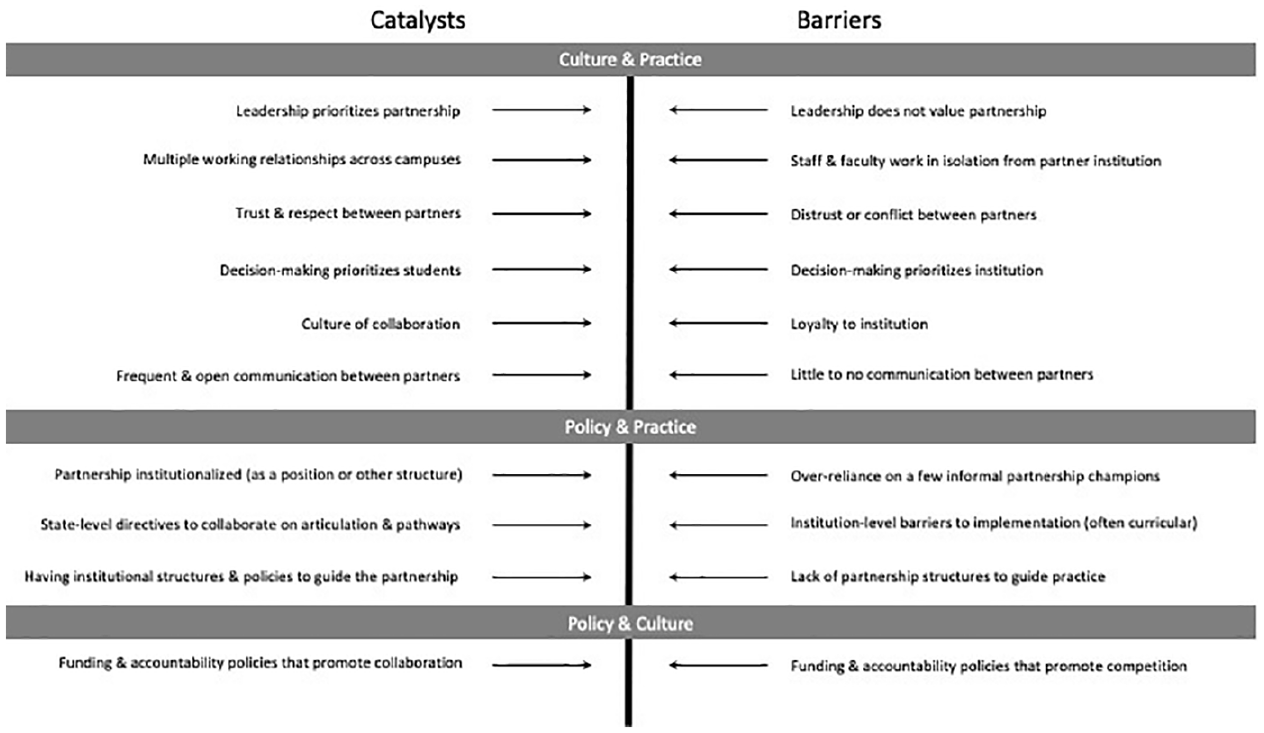
Catalysts and barriers impacting transfer partnerships.
These findings offer several insights into the development and implementation of transfer partnerships. In building upon Eddy’s (2010) use of force-field analysis to identify the concept of the push-and-pull factors of educational partnerships, we saw evidence of virtually all of Eddy’s factors within our transfer partnership data, including trust, strong relationships and communication, a collaborative culture, and a focus on the partnership. Yet, we also found additional factors that were critical to the longevity of transfer partnerships, including leadership, decision-making that prioritizes transfer students, institutional and state-level policies that institutionalize partnerships, guidelines for partnership implementation, and funding or accountability structures that encourage collaboration on transfer. Some of the above catalysts for transfer partnerships have been noted as important in previous literature including leadership and trust (Kisker, 2007), collaborative transfer culture (Jain et al., 2011), and data sharing and mutual accountability for student outcomes (Fink & Jenkins, 2017).
By utilizing force-field analysis to examine transfer partnerships, we also highlight the fact that transfer partnerships are dynamic and living systems that are constantly in flux. The current literature provides a well-documented list of the elements and essential practices of collaborative transfer efforts but stops short of describing how institutions can reach these endpoints (Dolinsky et al., 2016; Fink & Jenkins, 2017; Kisker, 2007). Our research extends this work by providing a clearer picture of the organizational forces behind transfer partnerships as they change over time. Eddy (2010) proposes that identifying push-pull factors is necessary for the long-term sustainability of educational collaborations, and we present a catalyst-barrier framework which describes the contextual conditions necessary for transfer partnerships to evolve along a continuum of collaboration (Yeh & Wetzstein, 2020). These findings suggest that in order to strengthen transfer partnerships and move further along this continuum, catalytic factors require support while barriers must be reduced or removed. The value of this framework lies in its ability to highlight the ways in which institutional partners can either be encouraged or obstructed in their efforts to enact effective practices and policies which can impact student transfer experiences and outcomes.
Similar to Eckel and Hartley (2008) in their study of academic strategic alliances, we also found that organizing these factors into the thematic groups of culture, policy, and practice created broader conceptual categories that more clearly illuminate micro- and macro-level factors that can influence transfer partnerships. But more specifically, our results demonstrate that culture, policy, and practice are inextricably tied to each other in transfer partnership creation, growth, and dissolution. The intersections of these three constructs were places that created the conditions that could complicate or stall partnerships from moving forward, or conversely, could support partnerships to grow and thrive.
With respect to equity, our findings suggest that effective transfer partnerships can improve equitable outcomes by driving changes at the intersection of culture, practices, and policy. We also found that equity can serve as a philosophical driver to facilitate transfer partnership formation, growth and sustainability. In a recent publication, Shared Equity Leadership: Making Equity Everyone’s Work (Kezar et al., 2021, p. 6), the authors describe the need for a “critical mass of leaders” to work on their own personal journeys and collectively represent the values and practices of equity in order to create transformational organizational change. The shared responsibility of leadership throughout an institution, they argue, is imperative to make the institutional changes that can lead to more equitable student outcomes. Participants noted that shared responsibilities and multiple engaged leaders within and between partner institutions were a critical part of their success. Our research suggests that if transfer partnerships share the same equity values and goals, then shared equity leadership across partner institutions could be an effective way to impact change, while also reinforcing the partnership.
Recommendations
Findings from this study point to a number of recommendations to improve transfer partnerships. Postsecondary institutions can use this framework to analyze their own contexts for the push-pull factors that most deeply impact their collaborative relationships. Although it would be ideal to prioritize the issues that require greatest attention, it is also important to consider the levers over which institutional actors have the most control. For example, if their institutional leaders do not prioritize transfer partnerships, then departmental or unit-level relationships may be the place to focus. Developing a web of relationships rather than relying on a few individuals to sustain a partnership will be important at institutions with high staff turnover, and incorporating transfer partnerships into strategic plans can help to institutionalize these relationships.
In addition, state agencies and leaders need to rethink policies that inadvertently create competition between institutions, and instead provide financial incentives for partnerships. Future research could more closely examine such policies and their impacts on collaboration to provide alternatives to current funding models.
Transfer partnerships can also help reduce persistent racial equity gaps in baccalaureate attainment by scrutinizing the practices, policies, and cultural norms that disadvantage racially minoritized students (Bragg, 2020). By working together to make visible and dismantle systemic barriers at each partner institution, there is an opportunity to improve transfer outcomes. Much could be gained if transfer partnerships coalesced around specific equity goals and actions, and focused on creating shared equity leadership roles within and across institutions.
Conclusion
Traditionally, research has often focused on culture, policy, and practice as individual dimensions, yet this study demonstrates that each does not exist in a silo. Thus, it is necessary to consider each dimension simultaneously and examine how they affect each other by focusing on their intersections. The proposed catalyst-barrier framework can be used as an analytical tool to better understand one’s own institutional context, and what forces might be at play in their transfer partnerships. Engaging in this type of organizational analysis can be useful to practitioners and leaders who hope to enter new collaborative relationships or strengthen existing partnerships, enabling them to be more strategic about their collaborations. Most importantly, developing sustainable transfer partnerships with a focus on equity can ultimately benefit underserved transfer students by helping to remove barriers to transfer and baccalaureate attainment.
Footnotes
Acknowledgements
The authors would like to acknowledge Debra Bragg for her extensive feedback and contributions to this manuscript. We also thank Elizabeth Meza, Katie Kovacich, and Grant Blume for their work on this study.
Declaration of Conflicting Interests
The author(s) declared no potential conflicts of interest with respect to the research, authorship, and/or publication of this article.
Funding
The author(s) disclosed receipt of the following financial support for the research, authorship, and/or publication of this article: This work was supported by the Bill & Melinda Gates Foundation grant (OPP1136274).

Data Availability Statement
Due to the nature of this research, participants of this study did not agree for their data to be shared publicly, so supporting data are not available.