




Abstract
International students make up 5.5% of all university students in the United States. In addition, international students consist of approximately 4% of the student population in Christian higher education. Although there is a significant number of international students enrolled in faith-based institutions, this population remains underrepresented in multicultural psychological literature. Thus, applying the intrapersonal-interpersonal-spiritual framework, we interviewed 15 international students from a Christian university to investigate their unique and shared experiences with the general international student population in the United States. The Consensual Qualitative Research method (CQR) was employed, and seven principal domains were identified: (a) religiousness, (b) reactions toward international students, (c) social support and acceptance, (d) hopes and expectations, (e) cultural adaptation, (f) cultural differences, and (g) international student identity. Similar themes to those present in the existing international student literature were established, but differential themes related to religiousness were discovered as well. Implications for Christian campuses are discussed.
International students are a significant presence in US campuses. In the 2018/2019 academic year, 1,095,299 international students (including those under Optional Practical Training) were enrolled in higher education institutions in the United States, making up 5.5% of university students (Institute of International Education [IIE], 2019a). Of this number, 431,930 were undergraduate students (IIE, 2019a). International students globalize our campuses (Quinton, 2018) and make substantial financial contributions to the US economy (Collier & Hernandez, 2016). Given the educational contributions and numbers, it is important to examine the psychological experience of international students during their academic sojourn in the United States. Consequently, educators and mental health professionals can gain a better understanding of how to optimally support our international visitors.
Although international students have shared experiences with domestic students (e.g., academic and social difficulties), they also face culture-specific stressors during their time in the United States. These include challenges such as navigating language barriers (Slaten et al., 2016), having a temporary visa status (Wang et al., 2007), lacking relevant cultural knowledge (W. Tsai et al., 2017), and managing relationships with both domestic students and students of the same ethnicity (Slaten et al., 2016).
“I have been a sojourner in a foreign land” (The English Standard Version Bible, 2009, Exodus 2:22)—this was spoken by Moses in the Bible, and it referred to his experience as an Israelite living in Egypt. Similarly, international students journey through a foreign land that is the United States during their educational career. It is essential for researchers to continue identifying the experiences of international students that are culture-specific, as well as those that can be generalized to the typical college student experience. Consequently, such efforts will help provide a more comprehensive support to international students who are visiting the United States. Therefore, the first aim of our study is to qualitatively identify the specific and generalized experiences of a group of international students enrolled in a US institution. The second aim of our study is to highlight the experiences of international students against the backdrop of a religious or faith-based institution.
Faith-Based Institutions
According to the National Center for Education Statistics (n.d.), there were 60,078 international students in the United States during the 2018/2019 academic year under the categories “private non-for-profit (religious affiliation)” and “non-resident alien total.” This means that approximately 4% of students enrolled in faith-based institutions are international students. Based on these numbers, it is evident that international students are a critical part of the Christian higher education community in the United States. The psychological literature on the experience of these students enrolled in faith-based institutions, however, remains undeveloped, and hence, we sought to address this gap in the literature.
The Council for Christian Colleges and Universities (CCCU, n.d.-a) is an association of Christian colleges and universities around the world, and their website notes that there are over 150 higher education institutions that are part of the CCCU in the United States and Canada. Christian institutions under the CCCU umbrella have their own cultural norms based on a Christian worldview. For example, Christian institutions typically integrate Biblical teachings into the courses they provide (CCCU, n.d.-b) and emphasize Christian-specific values like vocational calling (Philips, 2011). For some international students, a Christian academic setting may be one that they were intentionally seeking after. For others, the Christian setting might present expected and unexpected challenges during their sojourn, especially for those who may be acquainted with a different religious norm than US domestic students. Christianity is the most common religion in the United States, as 70.6% of Americans identify themselves as Christians (Pew Research Forum, 2018). However, Christianity is a far less common religion in countries such as China (Wei, Ku, et al., 2012), which also happens to be the number one sender of international students to the United States (IIE, 2019b). Faith-based institutions, typically private universities, attract non-Christian international students due to a myriad of reasons such as small class sizes and quality of education (Balz & Esten, 1998). International students may have varying experiences with religion in comparison with domestic students; hence, we think it is important to consider the intersection between religion and the international student experience. This brings us back to the second aim of the study, which is to highlight the psychological experiences of international students enrolled in a Christian university. Next, we present the intrapersonal-interpersonal-spiritual framework that we employed for this study.
Study Framework: Intrapersonal-Interpersonal-Spiritual
In the international student literature, the intrapersonal and interpersonal aspects of the international student experience are commonly featured. Prior literature has highlighted several intrapersonal aspects of the international student experience (e.g., mental health among international students; Auerbach et al., 2018), as well as interpersonal aspects (e.g., international-domestic student relations; Hechanova-Alampay et al., 2002). However, a gap in the literature is the examination of religious dimensions of the international student experience. This is imperative to consider, given the significant number of international students enrolled in faith-based institutions as noted earlier. In these settings, their experiences may be shaped by the religious context around them. In addition, they may have unique expectations surrounding a religious experience. Since contextual factors can help us understand the psychological experiences of international students, we did not want to forgo the study of one such context—faith-based institutions.
Intrapersonal experiences
In this study, we examined factors within international students that might have varying impact on their academic sojourn in the United States. For example, we were interested in cultural identity as an intrapersonal factor. Research indicates that identification with one’s culture positively impacts psychological well-being (Iwamoto & Liu, 2010), health behaviors such as diet (Moise et al., 2018) and personal fulfillment (C. Lu & Wan, 2018). Furthermore, Wei et al. (2012) discovered a negative association between cultural identity and psychological stress among Chinese international students. Thus, we anticipated that our participants would reveal themes related to cultural identity.
Interpersonal experiences
We were also interested in international students’ interactions with others. Thus, we inquired about various forms of social support that they utilize. Prior research has shown the beneficial effects of social support on mental health (Haverfield et al., 2019). In addition, social support has been found to be a protective factor against the effects of stress (Cobb, 1976). Further studies have shown that social support aids acculturation (Y. Lu et al., 2018) and reduces acculturative stress experienced by international students (Ra & Trusty, 2017). We expected that themes reflecting experiences of utilizing various forms of support and their effectiveness would also arise.
In addition, we considered the variable of mistreatment from others, such as racial discrimination. Discrimination has been correlated with poor physical and mental health outcomes (Carter et al., 2018; Weeks & Sullivan, 2019) and stress levels (Ellis et al., 2019). We expected that our participants would report experiences of contemporary forms of racism during their academic sojourn in the United States.
Finally, we investigated international students’ cultural adaptation. International students tend to have greater difficulty adjusting to college life, compared to domestic students (Hirai et al., 2015). Research indicates that international students’ adaptation is associated with life satisfaction and academic achievement (Poyrazli & Isaiah, 2018). Furthermore, higher levels of cultural adaptation aid an individual’s ability to cope with acculturative stress (Ra & Trusty, 2017). We expected that participants in our study would likely report themes related to cultural adaptation to the United States.
Religious experiences
Religious factors in mental health are a growing area of research. From a scientific perspective, there are multiple benefits of religion. For instance, it leads to improved physical and mental health (Hsu et al., 2009), offers social support (Morton et al., 2017), alleviates stress (Whitehead & Bergeman, 2020), and even promotes participation on campus (Felicilda-Reynaldo et al., 2019). Furthermore, religious coping has also been found to be an effective tool that international students use to manage the stress of acculturation (Chai et al., 2012). Given these advantages and that college is a time especially for students to navigate their spirituality (Black et al., 2019), we thought it more than appropriate to include questions on international students’ faith experience in our study.
In summary, we set out to qualitatively investigate the specific and generalized experiences of some international students currently studying in a US institution, in addition to highlighting the international student experience in religious higher education.
Method
Participants
Participants were 15 international students (12 female, 3 male) enrolled in a Christian liberal arts institution located in the Pacific Northwest region of the United States. Fifteen was a reasonable number of participants for our qualitative method, Consensual Qualitative Research, as the recommended sample size is between 8 and 15 (Hill et al., 2005). Two participants were from South Korea, two from Vietnam, and one from each of the following countries: Australia, Canada, China, Hong Kong, Indonesia, Japan, Malaysia, Pakistan, Peru, Taiwan, and Taiwan/England/Hong Kong. Eleven participants had a Christian background: four identified themselves as Christian, two as Catholic, two as Lutheran, two as non-denominational, and one as Baptist; one participant identified as agnostic, one as Buddhist, one as Muslim, and one as unknown. Participants were two first-years, two sophomores, seven juniors, and four seniors, ranging from ages 18–23 (M = 21.13, SD = 1.64). Of the 15 participants, five were transfer students. The number of years participants had lived in the United States range from 0 to 6 (M = 2.90, SD = 1.63). Two participants were General Studies majors, two were Psychology majors, and there was one participant for each of the following (group of) majors: Business Administration, Computer Engineering, Computer Science, Computer Science and Applied Mathematics, Dietetic Nutrition, Economics, Human Development, Integrated Studies, Journalism, Political Science, and Pre-nursing and Food Consumer Science. Seven participants were living on campus; of the remaining eight, five had lived on campus before. All participants had completed at least one quarter of studies at the institution.
Procedure
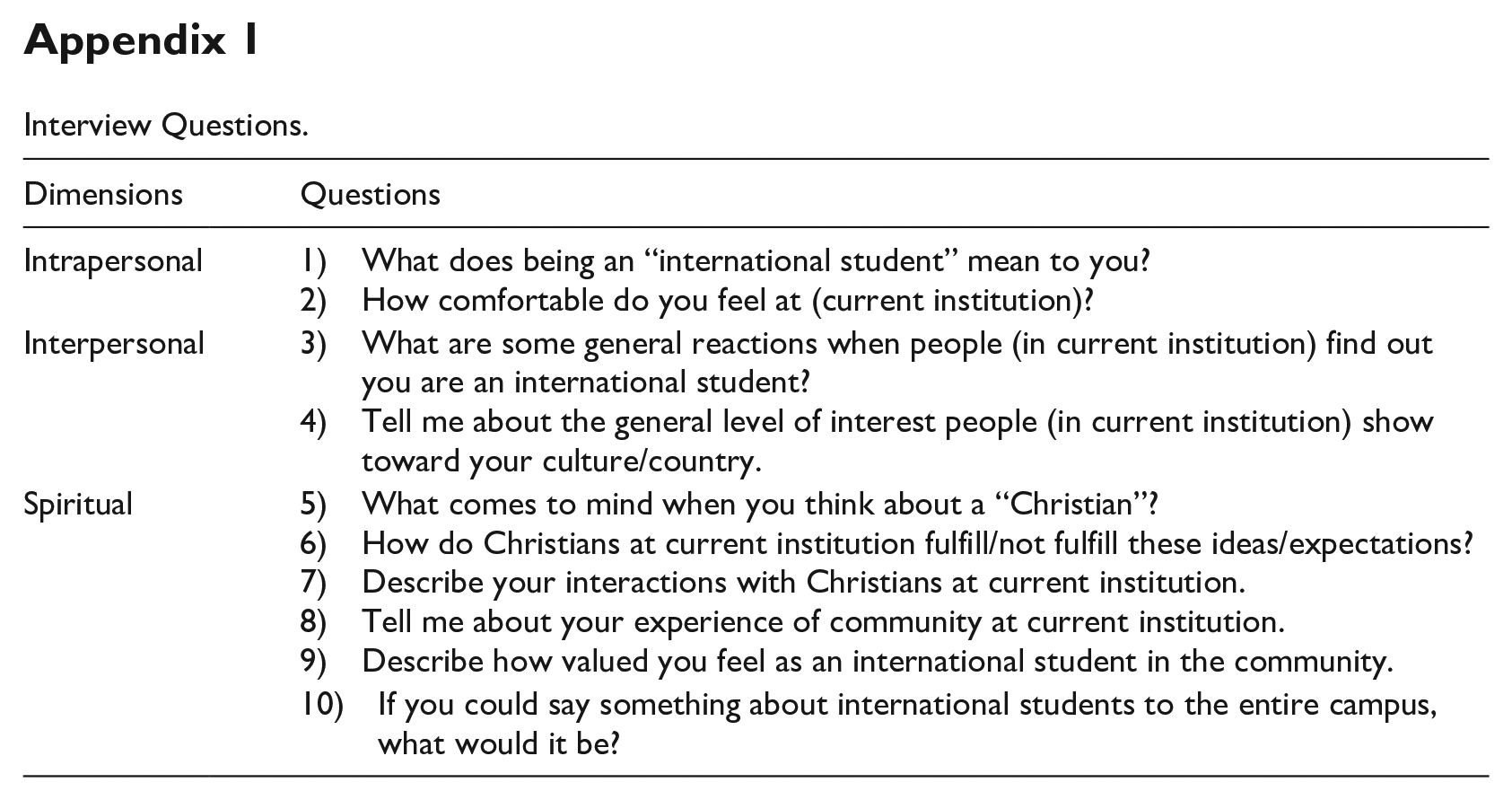
Participants were recruited through an email sent out by the International Student Office. Potential participants contacted the first author to set up a semi-structured interview. The interviews were held in a quiet room for 30 minutes to 60 minutes per participant. Consent and demographic information were also collected from the participants. All interviews were audio-recorded. At the end of each interview, participants were given a US$20 gift card. All interviews were transcribed by the research team for data analyses. All participants were treated according to the standards of the American Psychological Association. Appendix 1 includes the interview questions.
Qualitative data analyses
We used the Consensual Qualitative Research method (CQR; Hill et al., 1997, 2005), a postpositivist approach to qualitative inquiry (Ponterotto, 2010), to explore intrapersonal, interpersonal, and spiritual aspects of the international student experience. The CQR approach was chosen because of the unexplored nature of our topic and the well-accepted rigor of CQR as a qualitative research method (see B. S. K. Kim et al., 2003). In addition, there were other benefits to using CQR, such as the use of open-ended questions, semi-structured interview format, and collaborative data analysis for increased validity of the findings (Hill, 2012). Below, we describe the CQR steps that we took to analyze the data.
Discussion of potential biases and power differential
The research team consisted of a faculty member and three students in Undergraduate Psychology. In CQR, it is important that researchers discuss their biases upfront and monitor them throughout data analyses (Sim et al., 2012), so we took time to do that as a team. Some biases that we discussed included wanting to emphasize international students’ difficulties, having pre-existing notions of the international student experience in faith-based institutions, and seeing through the lens of a domestic student.
Two of the team members (first and fourth authors) were female and male international students respectively, and the second author was a male faculty member who had studied as an international student at a Christian university for his undergraduate studies. The third author was a male undergraduate member of the second author’s research team, and he was experienced in conducting research with diverse populations and received sufficient training in the CQR method prior to participating in the data analysis. Thus, three out of the four authors brought their personal experiences as international students (current or former) into the CQR process, and so it was important to monitor these tendencies and how these might interfere with an accurate processing and organizing of the participants’ narratives. Related, as an international student on a small campus, it was inevitable that the first author knew some of the participants. To the degree it was possible, participant names were removed from the interview scripts, so that identifying information was not included when analyzing the data. Furthermore, the first author disclosed this issue of dual relationship upfront with the research team members, and we monitored any potential bias and revisited the issue whenever it was needed.
Finally, we were also aware of the power differential that existed in the research team, as the second author is a faculty member and a mentor to the first, third, and fourth authors. We acknowledged this fact prior to beginning data collection, and the second author made it clear to the research team that he was participating in the CQR process in a collaborative process. The team agreed to monitor the power differential and how it might detrimentally impact the data analysis, and we periodically revisited the issue to remind each other that we were analyzing the data collaboratively.
Identification of domains
Domains are “meaningful and unique topic areas examined in the interview” (Thompson et al., 2012, p. 104) and should be identified from the data as a first step. For the first several transcripts, all research team members read over each transcript individually to come up with the domains and assign chunks of data to each domain. Weekly team meetings were held to discuss our individually identified domains and to arrive at a consensus regarding our domain list and data corresponding to the domains. We repeated these steps for several transcripts until all members were comfortable with the task. We modified our approach after that, so that members would be assigned transcripts to do the domain coding on their own time; each transcript (and domain list from that transcript) was closely reviewed by another team member, and as needed, any disagreements were brought to the weekly group meeting for more discussion. In all the steps involved, we followed the guidelines and principles specified by the CQR method for identifying domains (Hill et al., 1997, 2005; Thompson et al., 2012).
Identification of core ideas
Within each domain, core ideas were identified. Core ideas “capture the essence of the participant’s statement in fewer words” (Thompson et al., 2012, p. 111) and are identified following the creation of the domain list. For the first several transcripts, all research team members read over each transcript individually to formulate the core ideas under each domain. In weekly team meetings, we discussed our individually identified core ideas to arrive at a consensus regarding our core ideas. We repeated these steps for several transcripts until all members were comfortable with the task. We modified our approach after that, so that members would be assigned transcripts to do the core ideas coding on their own time; each transcript (and the core ideas for that transcript) was closely reviewed by another team member, and as needed, any disagreements were brought to the weekly group meeting for further discussion. In all the steps involved, we followed the guidelines and principles specified by the CQR method for identifying core ideas (Hill et al., 1997, 2005; Thompson et al., 2012).
Cross-analysis
After the research team identified and agreed on the core ideas, we conducted the cross-analysis. Cross-analysis involves placing the core ideas into categories based on “identifying common themes across cases” (Ladany et al., 2012, p. 117). Based on a single document containing all of the domains and core ideas, the first and second authors first formulated their categories individually and then met together to discuss and arrive at a consensus regarding the categories. After the list of categories was formulated, the rest of the research team closely examined the categories, and any disagreements were discussed as a group. Based on guidelines from Hill et al. (2005), we labeled the categories as general (all participants represented in the category, or all but one participant represented; 15–14 participants), typical (greater than half of the participants in the category, up to the number for general; 8–13), or variant (two or more participants in the category, up to the number for typical; 2–7).
Role of the auditor
Consistent with the CQR method (Schlosser et al., 2012), an auditor was involved in our data analysis. Specifically, we consulted with an auditor after the domain identification and again after the cross-analyses. Even though the auditor did not have the experience of being an international student in the United States, as a staff member at the university where the data were collected, he did have experience coordinating opportunities for students to pursue global engagement, such as service trips to other countries. Any suggestions were seriously considered by the team and as needed, incorporated into our discussions.
Results and Discussion
As displayed in Table 1, we found seven domains (religiousness, reactions toward international students, social support and acceptance, hopes and expectations, cultural adaptation, cultural differences, and international student identity) and categories within the domains that arose from our data. Knox et al. (2012) recommend the inclusion of “novel findings, those that yield practical or theoretical implications, or those that challenge existing ideas” (p. 156). Based on this recommendation, we have selected the three largest domains to present in the “Results and Discussion” section. Within each domain, we present the three most frequently endorsed categories (in case of a tie for the third most endorsed category, we deliberated and chose the category that was most compelling in its implications for international students); within each category, we utilize some core ideas 1 and participant quotes for illustration. For some categories, we chose to combine two categories to present and discuss them. Each category (or combined categories) is followed by a brief discussion. Similarly, each domain concludes with a brief discussion.
Domains and Categories.
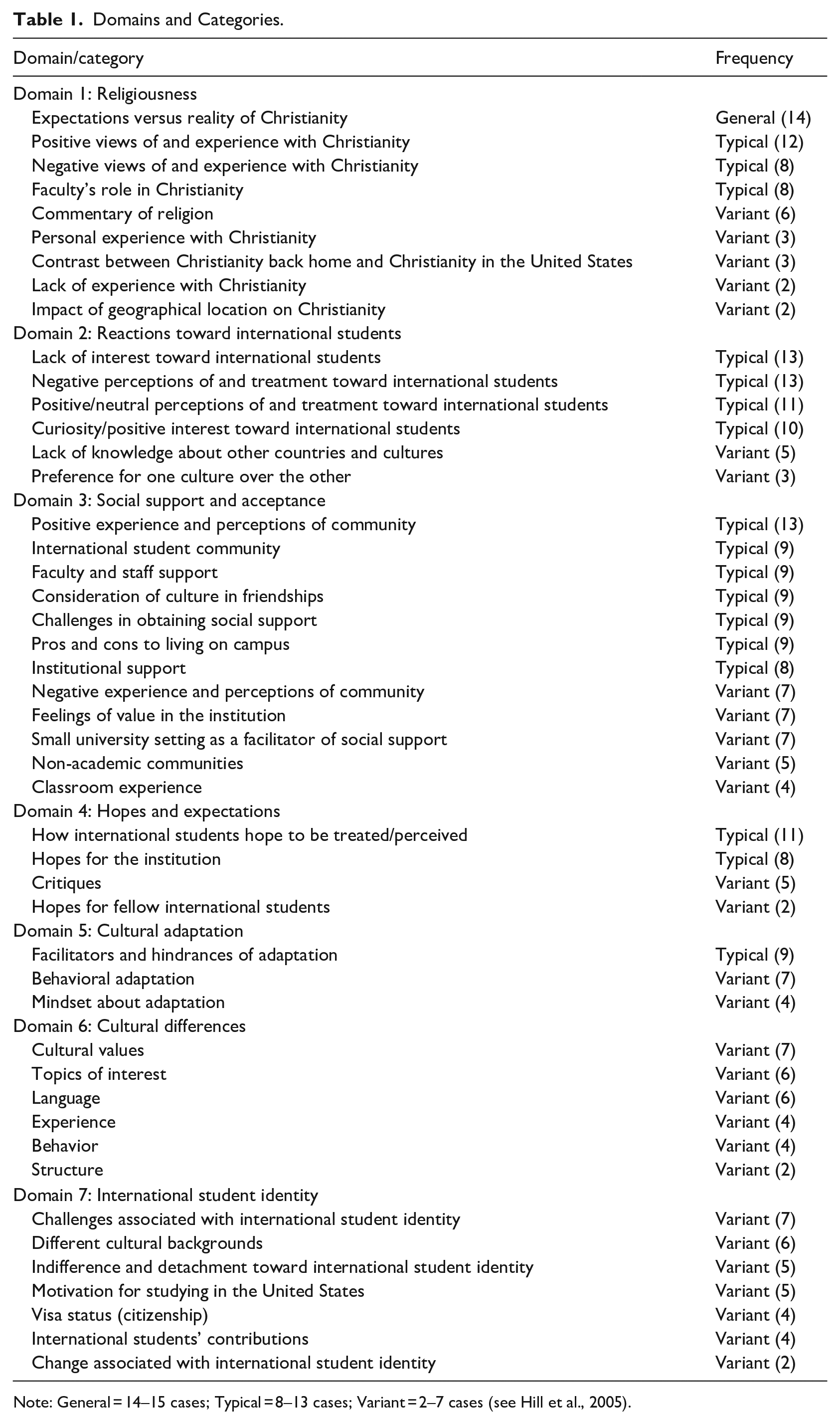
Note: General = 14–15 cases; Typical = 8–13 cases; Variant = 2–7 cases (see Hill et al., 2005).
Domain 1: religiousness
The religiousness domain included the most frequently endorsed categories, which consist of expectations versus reality of Christianity, positive and negative views of Christianity, and faculty’s role in Christianity.
Expectations versus reality of Christianity
With general frequency, participants (14) discussed their expectations of Christianity in comparison with what they had actually experienced during their academic sojourn. Participants provided descriptions of how Christians should be like or behave, such as being accepting, believing in God, and reading the Bible. Most participants felt that Christians in their institution fulfilled their expectations, with one participant stating that “they fulfill my expectations . . . in terms of what I am seeing and what I’m experiencing.” While some participants spoke about character traits associated with Christianity (e.g., “kindhearted”), others made their evaluation based on the way Christians live. For example, a participant described Christians at their institution as people who “fulfill the love your neighbor and that community aspect.”
Several participants observed a discrepancy between their expectations and their observed reality of Christianity. One participant commented that there was a gap between Christians’ beliefs and the way they lived: “They were more concerned with being the perfect Christian than actually living out beliefs.” Another participant felt that their peers who identified as Christians were not necessarily religious: “That was one of the surprising things, they go to our church, but they are not really religious.”
In summary, participants discussed how their expectations of a Christian university were met or unmet within this category. This type of a gap between perception (or stated institutional stance) and actual experience has been discussed in the multicultural psychological literature in the context of US students of color adapting to universities and colleges (e.g., Harper & Hurtado, 2007; Malaney & Shively, 1995), but we are not aware of existing studies that intentionally describe the discrepancy between the participants’ perception of how things ought to be at a Christian university versus how things actually are.
Positive and negative views of Christianity
With typical frequency, participants (12) shared positive views of and experience with Christianity during their academic sojourn. Participants identified Christians on their campus as genuine believers, describing them as having “good faith” and that “the way they speak and the way they treat each other, I see that it really comes from their heart.” Others also noted that Christians in their institution were accepting of other faiths: “they want to . . . show [us] the love of Christ . . . but they’re very cautious and they’re making sure that we feel accepted as who we are.” Another participant commented, “I have never experienced like, ‘Oh you should change and be Christian’ never, never.”
With typical frequency (8), participants expressed negative views of and experience with Christianity. Participants disapproved of the lack of religiousness from Christians on campus, stating that “they won’t go to church or . . . keeping the Sabbath doesn’t work for those people.” One participant was also shocked that “people were making fun of Christianity.” In addition, several participants suggested that Christians were not open to differences. Some observed that there was a social pressure to conform to the Christian context, noting that “if you don’t really fit in that Christian mold at [the current institution], then it is harder to feel like you’re part of a community.” One participant even described Christians on campus as “a little too zealot.” Participants also made poignant observations about Christians in their institution. A participant felt that some Christians had a “white savior complex” which might be attributed to “the demographics and the location of the school.” In addition, another participant felt frustrated by the oversimplification of answers in the classroom by using “Christianity or God or Jesus as the only answer, as the answer to all questions.”
To summarize, this category shows that international students perceive and experience Christianity on both ends of the spectrum, mostly through their observations of their Christian peers. Interestingly, international students who identified themselves as Christians did not necessarily have a positive view of the religiousness reflected in the institution. This could be because their observations of Christianity did not match with more conservative standards. It is important to note that culture provides the context from which Christianity is practiced, thus informing international students’ views and practices within Christianity. From an institutional standpoint, it is therefore crucial to recognize that Christian international students do not necessarily see through the lens of Western Christianity. Workshops that explain the intersection between culture and religion could help promote cultural awareness, thus equipping university staff to better understand and support international students who identify as Christians.
Faculty’s role in Christianity
With typical frequency, participants (8) generally agreed that their faculty positively represented Christianity. Professors were described as integrating faith into the classroom through ways like “sharing their faith,” “[praying] in class before a test,” and quoting Scripture. A participant shared that professors in their institution have “compassion towards students and want to . . . help them grow in academic and spiritual field.” In addition, professors were depicted to have open conversations with their students about religion outside of Christianity: “He actually listens to what I have to say about stuff from the Quran, and I listen to him about what he has to say from the Bible perspective.”
In this category, participants noted the importance of faculty in shaping their faith or views toward Christianity, and generally described these interactions with faculty as positive. Past research has shown that faculty plays a critical role in international students’ sojourn, such as facilitating an inclusive learning environment and aiding their sense of belonging (Glass et al., 2015). Although the literature has shown that faculty make an impact on international students academically and socially (Glass et al., 2015), our study also shows that faculty influence the religious views of international students, whether Christian or non-Christian.
Overall, the first domain of religiousness illustrated some of the important ways that international students experience religiousness, and in particular, Christianity, during their academic journey in the United States. Although much of the literature focuses on the broader international student experience (Hayes & Lin, 1994; P. C. Tsai & Wei, 2018), little research analyzes the views of international students toward faith or religion, specifically Christianity in the context of this study. The first domain primarily addresses this gap, while capturing the perspectives of both Christian and non-Christian international students.
Domain 2: reactions toward international students
Participants described a range of reactions they had experienced during their time in college, mostly from peers. The three largest categories within this domain included lack of interest toward international students, negative reactions toward international students, and positive or neutral reactions toward international students.
Lack of interest toward international students
With typical frequency, participants (13) shared that most people did not ask them about their culture or background. Participants described others’ interest in their culture as superficial, similar to a “What’s your favorite ice cream flavor?” kind of an inquiry, and short-lived, not extending far beyond where international students are from. Participants attributed this lack of curiosity to “people [having] too much going on to care so much about the background.” The lack of interest was also translated by international students as “me wanting to share, and less of people curious to know.”
This category suggests that international students might experience disappointment due to the lack of interest in their backgrounds from their American peers. Past research has shown that engaging in conversations relating to diversity contributes to international students’ social and personal growth (Glass & Westmont, 2014). The lack of interest toward international students, which consequently leads to a lack of engagement surrounding their culture and background, might thwart opportunities for both domestic and international students to experience critical development.
Negative and positive/neutral perceptions of international students
With typical frequency, participants (13) described negative perceptions of and treatment toward international students during their time in college. Notably, participants had a shared experience of being stereotyped. They described conversations where peers had generalized views of their country, such as only knowing “Vietnam War, or Pho, spring roll . . . or Bánh mì” in relation to Vietnam, or complimenting them on their English—“wow your English is really good”—due to the likely assumption that international students do not speak English well. In addition, participants experienced obstacles in their communication with domestic students. For example, domestic students asked questions that international students deemed to be offensive in their culture.
With typical frequency, participants (11) articulated positive perceptions of and treatment toward international students. Participants described their peers as expressing interest and excitement toward their culture. For example, domestic students asked participants about “dancing . . . holidays and food” in their culture, as well as famous landmarks or cities in their countries. Participants also shared that domestic students were interested in their personal lives despite their differences: “oh, it doesn’t matter if you’re different . . . tell me about your life.”
A notable component of this category is the racialized experience of international students. Similar to international students, domestic students of color also experience being stereotyped during their undergraduate education (Chin & Kameoka, 2019). Nonetheless, it is important that the international student experience not be lumped together with the experiences of US students of color. Past research has demonstrated that international students are susceptible to experiencing various types of microaggressions (e.g., mocked for accent, others avoiding and excluding them; Houshmand et al., 2014), and our findings also reflect the contemporary forms of racism that international students on a Christian campus might experience. Furthermore, we wonder if the impact of these experiences on the well-being of international students might be exacerbated by the fact that international students do not arrive in the United States with a pre-existing knowledge of racial issues, whereas students of color would have a better idea having grown up in the United States (Fries-Britt et al., 2014). Also, international students whose native language is not English are further strained, having to recognize and interpret these microaggressions in their second language (Ee, 2013). Thus, while paying attention to the negative reactions toward international students, it is important to keep in mind that these reactions are different from that which students of color experience.
Overall, our second domain revealed that there are both favorable and unfavorable experiences on the part of the international student stemming from the context of a Christian university. This too is consistent with the existing literature that reports on both the positive and challenging experiences of international students in the United States (e.g., Poyrazli & Isaiah, 2018; P. C. Tsai & Wei, 2018).
Domain 3: social support and acceptance
Finally, participants shared their experiences relating to social support in the institution, and how these were facilitated by living on campus. Participants also described challenges they had faced in obtaining social support.
Positive experience of community and challenges in obtaining social support
With typical frequency, participants (13) expressed that they felt comfortable at their institution. Participants indicated that they had experienced inclusion in their academic community and described their peers as friendly and accepting. One participant explained, “I don’t feel left out because I’m an international student. I don’t feel different in any kind.” In addition, participants also brought up their friends and described positive interactions with them, such as being looked out for by them. Participants mentioned having friends who were domestic students, as well as friends who were international students.
With typical frequency, participants (9) described different obstacles that they faced in establishing deep connections with others in the community. Participants lamented the difficulty in developing meaningful relationships with others due the busyness of academic life. They also pointed out international students’ unique circumstances, which domestic students may have difficulty relating to: “It’s harder to understand what international students are going through. Because it’s a brand-new country . . . most of us don’t really have family with us here and it’s like we’re far away.”
In sum, while participants experienced positive interactions with their community, they also faced challenges in gaining social support. Past research has highlighted the importance of obtaining support from domestic students (e.g., Olaniran, 1993; Surdam & Collins, 1984). University staff should be more intentional about caring for international students, since they are a population that is easily missed and often lacking in community. Interventions that connect domestic and international students purposefully might be helpful to better integrate international students into the community.
Pros and cons to living on campus
With typical frequency, participants (9) listed the benefits and downsides of living on campus. On one hand, participants spoke of not feeling included or having a sense of belonging while living on campus. For example, one participant described their apprehension toward living with domestic students: “I don’t have a lot of experience living with a lot Americans. So I got kind of really scared I guess.” On the other hand, several participants felt that living on campus facilitated the formation of friendships. International students who identified as commuters felt distanced between students who lived on campus. In addition, they felt that living in dormitories was how their peers established friendships.
In short, participants in our study described both the positive and negative sides of living on campus. Since international students face increased barriers to gaining social support as compared to their domestic peers, it is important to consider the role that residence staff can play in integrating international students into the campus community. Residence staff can be more strategic in how they place international students in the dormitories, such that international students may experience minimal apprehension toward their environment.
Overall, our third domain revealed the critical role of social support in the lives of international students enrolled in a Christian university. This finding is consistent with prior literature that has shown that social support is pivotal to international students’ welfare and contentment during their time in the United States (Lian et al., 2020).
General Discussion
Our study provided an in-depth examination at some of the common experiences of international students at a Christian university. Specifically, our participants discussed experiences that were intrapersonal (e.g., identity as an international student), interpersonal (e.g., social support), and religious (e.g., perceptions of Christianity). Given the unique context of Christian higher education, our study points to the utility of applying an intrapersonal-interpersonal-spiritual framework in better understanding the perceptions and experiences of international students.
Implications of findings for research
Our findings suggest that it is a worthwhile research endeavor to empirically examine the psychological experiences of international students within the context of a Christian setting. For example, nearly all (14) of the participants discussed how the institution met or failed to meet their prior expectations of Christianity. At the same time, participants also discussed favorable experiences within their institution. This suggests that there are ways in which the academic sojourn experience is complex for international students enrolled in Christian institutions when it relates to the faith context, and researchers should continue to identify and relate these experiences to various psychological outcomes. We were struck by how participants differed in their description of how they perceived Christianity; some participants from a Christian context described their current US campus as practicing a version of Christianity that was too progressive or liberal, whereas other participants from Christian traditions or non-Christian backgrounds described the same campus as integrating too much of the Christian faith. This demonstrates that international students’ religious experience at Christian institutions is not monolithic, and it behooves researchers at Christian institutions to recognize this nuance and develop empirical investigations accordingly. For example, it seems promising to investigate how cultural forces might influence the religious experiences of international students studying in the United States. Consistent with this notion, Cook and Sim (2015) reported some intriguing findings suggesting that bilingual Korean students tended to express their faith in a communal or collective way, compared to American students who tended to express their faith on a more personal level. We encourage researchers to continue to develop this line of research on the interaction of culture and faith, and its impact, among international students enrolled in Christian universities.
We also found themes reflecting inadequate support from various resources. For example, many (13) international students reported that they perceived no interest or negative perceptions from domestic students. This implies that despite their resilience, international students also have detrimental experiences that may shape their adjustment. Further research may examine the effects of domestic students’ attitudes and behaviors toward international students on those international students’ school performance, mental health, and other outcomes.
Implications of findings for Christian colleges and universities
Our findings suggest some implications for Christian colleges and universities in the United States. Specifically, our findings imply that social support and acceptance are critical factors for a favorable international student experience. By showing intentional interest and providing social support for international students, Christian colleges and universities will increase the likelihood of a positive experience on the part of the international student. In particular, improving the resources on campus so that there are better academic, financial, and social services may help international students better adapt to their academic settings. Institutions might also think about courses designed to connect international and domestic students and create an environment where topics like religion, adaptation, challenges, and well-being may be discussed. Prior research has suggested that international students are likely to turn to churches for social support (e.g., Yu & Moskal, 2019), and Christian institutions might try creatively and effectively partnering with local churches to provide culturally relevant social and intercultural support.
Our study also suggests that the faith-based educational context triggers unique experiences on the part of the international students, both positive and challenging aspects. Institutions should be aware of these elements (e.g., difference in how Christianity is practiced in their culture of origin versus in the United States) and train their staff and faculty to provide a meaningful context where spirituality can be explored. To do this well, institutions will have to engage in deep conversations about some of the ways in which cultural biases and assumptions underlie how Christianity is practiced in their educational context.
Limitations and future directions
There are limitations of the study that should be addressed in future studies. As our study was a qualitative endeavor, it does not capture the differences that might exist across Christian colleges and universities. Future studies might find it helpful to employ a quantitative methodology that includes multiple Christian colleges and universities, so that the shared experiences of students across faith-based contexts might be captured quantitatively. Related, our data collection site, a Christian higher education institution located in the Pacific Northwest region of the United States, might have its own characteristics that call for a cautious approach to generalization to other Christian campuses; for example, this institution does not require its students to hold a Christian faith, which might not be the case in other Christian institutions. Similarly, this study was necessarily broad in scope due to the lack of prior studies on the psychological experiences of students enrolled in a Christian institution, but that also meant that we did not delve as deeply into their religious struggles. Future studies should focus on a specific religious theme and see how the international student experience influences and is shaped by these religious aspects. Finally, most of our sample was Asian, which reflected the international student demographic at the institution. Future studies should be more intentional about recruiting a diverse group of international students or focus on one international student group, so that the findings might be even more nuanced. For example, missionary “kids” who are also international student status in the United States have multilayered experiences (P. Y. Kim et al., 2016) that need to be highlighted and developed more in the international student literature.
Conclusion
International students are an important part of the undergraduate student landscape. Similar to domestic students, there are widely varied experiences within the entire international student population in the United States. This study aimed to examine the shared experiences of international students, while highlighting specific challenges that international students face in a faith-based institution. Consequently, administrators, faculty, and staff can utilize these findings to better support and understand their international students.
Footnotes
Appendix
Interview Questions.
| Dimensions | Questions |
|---|---|
| Intrapersonal | 1) What does being an “international student” mean to you? 2) How comfortable do you feel at (current institution)? |
| Interpersonal | 3) What are some general reactions when people (in current institution) find out you are an international student? 4) Tell me about the general level of interest people (in current institution) show toward your culture/country. |
| Spiritual | 5) What comes to mind when you think about a “Christian”? 6) How do Christians at current institution fulfill/not fulfill these ideas/expectations? 7) Describe your interactions with Christians at current institution. 8) Tell me about your experience of community at current institution. 9) Describe how valued you feel as an international student in the community. |
| 10) If you could say something about international students to the entire campus, what would it be? |
Acknowledgements
The authors would like to thank Lori Tongol for her assistance with participant recruitment, and Paul S. Kim for his helpful feedback on our data analysis.
Authors’ Note
This article is based on the first author’s independent research project completed under the guidance of the second author and in collaboration with the third and fourth authors.
Declaration of Conflicting Interests
The author(s) declared no potential conflicts of interest with respect to the research, authorship, and/or publication of this article.
Funding
The author(s) disclosed receipt of the following financial support for the research, authorship, and/or publication of this article: Research for this article was supported by a research grant from the School of Psychology, Family, and Community at Seattle Pacific University.
