



Abstract
Recent research has demonstrated that egalitarian gender role ideologies are associated with higher marital satisfaction and higher psychological well-being. However, there has been little research investigating whether gender role ideologies in Evangelical populations follow these same trends. The current study examined how gender role ideologies in an Evangelical population are related to marital satisfaction and eudaimonic well-being, as well as the role of locus of control in these relationships. Three hundred sixty-three Evangelical Christian women were administered a survey containing measures of gender role ideology, marital satisfaction, eudaimonic well-being, and locus of control. No bivariate relationship was found between marital satisfaction and gender role ideologies. However, locus of control significantly moderated this relationship, such that the relationship was only significant for women with a more external locus of control. Specifically, externalizing women evidenced a significant positive relationship between egalitarian gender role ideologies and marital satisfaction, whereas the relationship was not significant for internalizing women. Moreover, egalitarian gender role ideologies were found to be positively related to eudaimonic well-being. The results of this research expand the current body of literature surrounding gender role ideologies within religious populations, specifically regarding outcomes that are associated with holding specific gender role ideologies.
Research has established a connection between religiosity and gender role ideologies, with higher religiosity being related to more traditional gender roles (Ali et al., 2008; Burn & Busso, 2005; Glick et al., 2002; Mikołajczak & Pietrzak, 2014). Traditional gender role ideologies are defined as beliefs that men and women have opposing traits, and typically suggest that men are better suited to work outside the home and to hold positions of leadership (Fitzpatrick et al., 2004). These beliefs are contrasted with egalitarian gender role ideologies, which are defined as beliefs that traits are not based on gender, and typically suggest that men and women may be equally suited for work and leadership roles. While the past several decades has seen an overall societal shift from more traditional gender role ideologies to more egalitarian gender role ideologies (Moen, 1992; Sweeting et al., 2014; Thornton & Young-DeMarco, 2001), these beliefs have shown slower change in religious populations (Burn & Busso, 2005; Glick et al., 2002). Specifically, many within the Evangelical population continue to hold to forms of traditional gender role ideologies, including beliefs that women are more suited for child-rearing and should not be involved in leadership or political roles (Ali et al., 2008; Bishop, 2019). This tendency toward traditional gender role ideologies is concerning because complementary gender differentiation is a form of benevolent sexism. Benevolent sexism, as defined within Glick and Fiske’s (1996) larger theory of ambivalent sexism, consists of beliefs and behaviors toward women that are subjectively positive (e.g., protection, idealization, and affection), yet reflect that women are inferior and therefore subordinate to men. In particular, the aspect of benevolent sexism that is linked to the prescription of traditional gender role ideologies, complementary gender differentiation, is defined as beliefs that suggest that women’s traits are positive in nature (e.g., sensitive, caring, and emotional), but are most suitable for subordinate roles, thus supporting male dominance (Glick & Fiske, 1996). Furthermore, traditional gender role ideologies are problematic because research has shown that they are associated with negative outcomes for women (Black & McCloskey, 2013; Bookwala et al., 1992; S. N. Davis & Pearce, 2007; Fitzpatrick et al., 2004; Sanchez et al., 2012; Stark, 1991). In fact, with the exception of a handful of earlier studies on marital satisfaction, reviewed below, our thorough review of the literature on traditional gender role ideologies has not found studies documenting associations between traditional gender role ideologies and positive outcomes for women.
In the present study we examine the relationship between gender role ideologies and two constructs, marital satisfaction and eudaimonic well-being, in an online sample of Evangelical women. Marital satisfaction is of particular interest because the impact of traditional gender role ideologies may be most observable within marriage relationships. In addition, we focus on eudaimonic well-being, a more comprehensive variable that encompasses not just the marriage relationship, but all domains of life. Furthermore, we explore the role of locus of control in these relationships, in that traditional gender roles are more prescriptive and thus imply that external forces (e.g., traditions, certain biblical interpretations, or the husband’s choices) should primarily influence gender role choices. In the following sections we review existing studies on gender role ideologies and their impact on marital satisfaction and eudaimonic well-being, as well as locus of control as a possible moderator of those relationships.
Gender Role Ideologies and Marital Satisfaction
Research on the relationship between gender role ideologies and marital satisfaction has yielded inconsistent results. Older research found a positive relationship between traditional gender role ideologies and marital satisfaction (Amato & Booth, 1995; Greenstein, 1995; Lye & Biblarz, 1993; Wilcox & Nock, 2006). More specifically, women who held egalitarian gender role ideologies were more likely to report decreased marital satisfaction compared to those who held traditional gender role ideologies (Amato & Booth, 1995; Lye & Biblarz, 1993). Further research indicated that these findings were explained by the relationship between gender role ideologies and the division of household labor. Non-traditional working women reported significantly decreased marital stability and greater stress while trying to resolve household labor conflict compared to working women who held traditional gender role ideologies (Greenstein, 1995; Wilcox & Nock, 2006). Traditional women had lower expectations about the division of labor and therefore had lower marital conflict due to perceived fairness over this division.
However, much of the research done in the last several years has shown the opposite to be true, such that traditional gender role ideologies are related to lower marital satisfaction. More specifically, studies have found that African American newlywed couples reported lower marital satisfaction when husbands held traditional gender role ideologies (Stanik & Bryant, 2012). Mexican American couples rated lower marital satisfaction when the couple held traditional gender role ideologies and the wife was unemployed (Hengstebeck et al., 2015). Mexican American couples also experienced lowered sense of warmth, connection, and intimacy, which in turn related to lowered marital satisfaction, when their partner held sex-typed gender role beliefs (Helms et al., 2019). In addition, Chinese-Canadians reported lower intimacy in marriage and decreased marital satisfaction when the couple held traditional gender role ideologies (Marshall, 2008). Finally, and in regard to the population of interest for this study, J. M. Davis et al. (2018) found that Evangelical egalitarian women tended to have higher levels of marital satisfaction. However, this relationship was conditional upon women having lower levels of sanctification of their marriage (i.e., how they experienced God’s presence within their marriage), suggesting that greater sanctification of marriage would override any negative consequences of more traditional gender role ideologies on marital satisfaction.
Gender Role Ideologies and Eudaimonic Well-being
Another construct that is related to gender role ideologies is eudaimonic well-being. Eudaimonia, as theorized by Aristotle, has a broad focus on personal values, virtues, and living life according to one’s own needs and desired goals (Peterson et al., 2005; Waterman, 1993). Positive psychologists have distinguished the concept of eudaimonia from a conceptualization of happiness that is primarily focused on positive affect and satisfaction with life. Many refer to eudaimonic well-being using the term “flourishing” to differentiate it from common conceptions of happiness (Crespo & Mesurado, 2014). Flourishing, as conceptualized by VanderWeele (2017) includes happiness and life satisfaction, mental and physical health, meaning and purpose, character and virtue, and close social relationships. Prior research has indicated that holding traditional gender roles ideologies is related to decreased mental health (opposing flourishing; Read & Grundy, 2011; Sweeting et al., 2014) and that holding egalitarian gender role ideologies is related to higher well-being and mental health (engaging in flourishing; (Grieve et al., 1988; Kulik, 2006; van de Vijver, 2007; Weiss et al., 2012).
Specifically, Weiss et al. (2012) looked at subjective well-being for young and middle adults during transitional periods. The researchers found that participants who were high in openness to experience had the strongest relationship between egalitarian gender role ideologies and subjective well-being. Kulik (2006) found that among Israeli married couples, the couples that scored lowest in traditional gender role ideologies (i.e., high in egalitarian gender role ideologies) had the most adaptive personality profiles. These personality profiles were characterized by high self-esteem, low anxiety, and high tolerance for ambiguity. These couples also scored significantly higher on life satisfaction than couples who endorsed a more traditional gender role ideology. van de Vijver (2007) studied five distinct cultural groups within the Netherlands and looked at gender role beliefs and well-being among these groups. The results were that, for all five cultural groups and for both genders, egalitarianism was associated with higher well-being.
Locus of Control
While the relationships between gender role ideologies and both marital satisfaction and eudaimonic well-being have been established in the literature, important underlying variables for better understanding these relationships are not well studied. Specifically, locus of control is a potential moderator, as it addresses how individuals experience a sense of control and power in their lives. Rotter (1966) introduced the concept of locus of control and proposed that people held either an external locus of control or an internal locus of control. External locus of control refers to the belief that experiences are contingent on external forces (e.g., luck or fate). Conversely, internal locus of control refers to the belief that experiences are contingent on one’s behavior and characteristics. Research has consistently demonstrated that an internal locus of control is positively correlated with marital satisfaction (Bugaighis et al., 1983; Camp & Ganong, 1997; Ganji & Navabinezhad, 2012) and well-being (Klonowicz, 2001; Kopp & Ruzicka, 1993; Noor, 1995; Singh & Choudhri, 2014).
Moreover, a recent study by Iles-Caven and colleagues (2020) demonstrated that individuals with an internal locus of control tend to believe in a divine power, engage in religious activities, and identify that their help comes from a divine power. This study helps to clarify that religious beliefs, such as those held by the Evangelical population, are not equivalent to an external locus of control (e.g., seeing God in control does not necessarily reflect external control). Rather, it appears that being able to draw upon a source of power larger than oneself might bolster a sense of having control over one’s life. As such, locus of control is a particularly relevant experience to address in Evangelical women, given that locus of control appears to interact with religiosity.
Moreover, locus of control also appears to be relevant to gender beliefs. Namely, the relationship between stereotypically gendered traits and gender role ideologies can be helpful in understanding how gender role ideologies are related to locus of control. Researchers have described an internal locus of control as being characterized by personal mastery and other instrumental traits (Lefcourt, 1982). Instrumental traits are usually considered stereotypically masculine traits (Bem, 1974, 1981; Stake, 1997). Research has validated this relationship between gendered traits and locus of control such that the relationship between cognitive appraisal and masculine traits is mediated by locus of control (Sarrasin et al., 2014). More specifically, when women adopt masculine traits (in addition to their feminine traits), they have an internal locus of control. Similarly, Moore (2007) found that androgyny was related to both higher internal locus of control and increased life satisfaction. Specifically, for women, adopting instrumental traits (masculine traits) was shown to be the most significant predictor of internal locus of control and internal locus of control was the greatest predictor of life satisfaction.
According to gender schema theory, the more androgynous a person is, the more egalitarian his or her gender roles ideologies tend to be (Bem, 1981). Therefore, the results of these studies begin to highlight how locus of control may play a role in the relationship between gender role ideologies and eudaimonic well-being. Specifically, women who are able to express traits that fall outside of what is traditionally expected for their gender—which is in line with an egalitarian framework—feel a sense of control and mastery in their life, which in turn relates to increased well-being. However, regardless of that experience, Evangelical women might also feel a sense of control, given their connection to a higher power (Iles-Caven et al., 2020). As such, having an internal locus of control might ameliorate the negative impact of traditional gender role ideologies on well-being in this population. However, it should be noted that life satisfaction was operationalized by only two items in Moore’s (2007) study. Furthermore, this study did not directly look at the relationship between gender role ideology and well-being, but looked at gender role orientation.
In addition, marital satisfaction appears to follow a similar pattern. Specifically, internal locus of control has been found to be related to increased marital satisfaction (Bugaighis et al., 1983; Camp & Ganong, 1997; Ganji & Navabinezhad, 2012). When individuals are in more hierarchical relationships, they may feel that their behaviors and decisions are dictated by those above them in the hierarchy, decreasing their satisfaction in that relationship. Therefore, with the same aforementioned idea, locus of control could potentially moderate the relationship between Evangelical gender role ideology and marital satisfaction, ameliorating the predicted negative relationship between traditional gender roles and marital satisfaction. Overall, studying locus of control in regard to these outcomes will provide additional understanding of people’s beliefs about power and control, which could clarify the relationships between gender role ideologies, and well-being and marital satisfaction.
The Present Study
The above literature indicates that holding more egalitarian gender role ideologies is beneficial for women, specifically for marital satisfaction (Helms et al., 2019; Hengstebeck et al., 2015; Marshall, 2008; Stanik & Bryant, 2012) and eudaimonic well-being (Grieve et al., 1988; Kulik, 2006; van de Vijver, 2007; Weiss et al., 2012). However, these relationships have not been adequately established in an Evangelical population, where the religious influences on these variables may affect the relationships between them. Thus the purpose of the current study is to examine how gender role ideologies are related to marital satisfaction and eudaimonic well-being in Evangelical women, as well as to understand how locus of control influences these relationships. It is hypothesized that (a) more egalitarian gender role ideologies will significantly predict higher marital satisfaction; (b) more egalitarian gender role ideologies will significantly predict higher eudaimonic well-being; (c) locus of control will moderate the relationship between gender role ideology and eudaimonic well-being, as well as gender role ideology and marital satisfaction, such that having an internal locus of control will ameliorate the negative impact of traditional gender role ideologies on the outcomes.
Method
Participants and procedure
After receiving human subjects ethics approval, 363 Evangelical married females were recruited through in-person solicitation at non-denominational and Baptist churches and conservative Christian organizations in California, as well as through social media and snow-ball sampling. As an incentive for participating in this study, participants were entered into a drawing to win a $50 gift card. The questionnaire was administered online. Measures were presented in randomized order. Participants identified as European American (35.3%), mixed ethnicity (2.2%), Asian (1.9%), African American (1.1%), Hispanic (0.6%), other (0.3%), or did not indicate ethnicity (58.7%). Participants ranged in age from 21 to 88, with an average age of 38.38 (SD = 14.41). In addition to recruiting in evangelical populations, we verified affiliation in the survey. The sample consisted of Protestant Christians; Orthodox, Catholic, and other religions were excluded from this study. Within Protestantism, all participants indicated affiliation with a conservative Christian denomination. Participants were also excluded if they had been married for less than 6 months, were under the age of 18, or did not regularly attend church services (less than once a month).
Materials
Traditional/egalitarian gender role ideology
Larsen and Long’s (1988) Traditional/Egalitarian Sex Role Scale assessed participants’ adherence to a traditional or egalitarian gender role ideology. Participants respond to 20 items on a 5-point Likert-type scale ranging from 1 (strongly disagree) to 5 (strongly agree). Sample items include, “Having a job is just as important for a wife as it is for her husband” and “The man should be more responsible for the economic support of the family than the woman” (reverse scored). Items were appropriately reverse scored and averaged. A lower score indicates a more traditional gender role ideology and a higher score indicates a more egalitarian gender role ideology. Internal consistency for this measure was .81 in the current study.
Marital satisfaction
Norton’s (1983) Quality of Marriage Index (QMI) assessed participants’ satisfaction with their marriage and spouse. This scale is a global measure of marital satisfaction. Participants are asked to respond to six items. Five items are ranked on a 7-point Likert-type scale ranging from 1 (very strong disagreement) to 7 (very strong agreement). Sample items for the first five include, “Our marriage is strong” and “My relationship with my partner makes me happy.” The sixth item asks participants to rank their overall happiness with their marriage on a ten-point Likert-type scale ranging from 1 (very unhappy) to 10 (perfectly happy). Following the author’s instructions, the items were standardized into z-scores and summed, with a high score indicating high marital satisfaction. Internal consistency for this measure was .94 for the current study.
Eudaimonic well-being
Ryff’s (1989) Scales of Psychological Well-Being assessed positive psychological functioning and eudaimonic well-being, which is operationalized using six dimensions. These dimensions of well-being are: Autonomy, Environmental Mastery, Personal Growth, Positive Relations with Others, Purpose in Life, and Self-Acceptance. Participants respond to 84 items (14 items per dimension) using a 6-point Likert-type scale ranging from 1 (strongly disagree) to 6 (strongly agree). Sample items include, “I have confidence in my opinions, even if they are contrary to the general consensus” (Autonomy), “I am quite good at managing the many responsibilities of my daily life” (Environmental Mastery), “I think it is important to have new experiences that challenge how you think about yourself and the world” (Personal Growth), “I feel like I get a lot out of my friendships” (Positive Relations with Others), “Some people wander aimlessly through life, but I am not one of them” (Purpose in Life), and “When I look at the story of my life, I am pleased with how things have turned out” (Self-Acceptance). Items were appropriately reverse scored and averaged for the dimensions and for a total well-being score, with higher scores indicating higher eudaimonic well-being. This measure has demonstrated adequate internal consistency, with alpha levels for the dimensions ranging from .86 to .93; they ranged from .78 to .88 for the dimensions and .95 for the total score in the current sample.
Locus of control
Rotter’s (1966) Internal-External Control Scale assessed the degree to which one believes outcomes are contingent on the self or contingent on external forces. This measure contains 29 forced-choice statements, which include 6 filler items to keep the purpose of the scale unknown. A sample item is, “a. Many of the unhappy things in people’s lives are partly due to bad luck. b. People’s misfortunes result from the mistakes they make” (choice “a” reflects an external locus of control). Items were appropriately reverse scored and averaged. A high score indicates an external locus of control and a low score indicates an internal locus of control. The measure demonstrates adequate internal consistency, with an established alpha level of .73 and an alpha of .87 in the current study.
Results
Preliminary analyses
Data were analyzed using SPSS. Before testing the hypotheses, preliminary analyses were conducted to ensure normality of the data. The original non-transformed means and standard deviations for all measures are shown in Table 1. All measures were assessed for skewness and kurtosis. The Quality of Marriage Index was found to be negatively skewed. A transformation recommended by the author was utilized for this variable, as skewed data were reported to be likely with this measure (Norton, 1983). After the raw scores were transformed into z-scores and summed, the absolute value of the lowest summed z-score was added to each score to eliminate negative numbers. These values were raised to the third power and divided by 1000 to yield the final transformed scores. The transformed scores for Quality of Marriage were utilized in all subsequent analyses.
Original Means and Standard Deviations for All Measures.

SD: standard deviation.
Hypothesis 1
It was hypothesized that egalitarian gender role ideologies would significantly predict higher marital satisfaction. No significant relationship was found between the Traditional/Egalitarian Sex Role Scale and the Quality of Marriage Index (r = .07, p > .05; see Table 2).
Correlations Between All Variables.

LOC: Internal-External Control Scale; QMI: Quality of Marriage Index (transformed); WB: Ryff’s Scales of Psychological Well-Being; WBa: Well-being subscale: Autonomy; WBem: Well-being subscale: Environmental Mastery; WBpg: Well-being subscale: Personal Growth; WBpr: Well-being subscale: Positive Relationships with Others; WBpl: Well-being subscale: Purpose in Life; WBsa: Well-being subscale: Self-Acceptance; TES: Traditional/Egaliarian Sex Role Scale.
p < .05, **p < .01.
Hypothesis 2
It was hypothesized that egalitarian gender role ideologies would significantly predict higher eudaimonic well-being. It was found that the Traditional/Egalitarian Sex Role Scale was significantly positively correlated with Ryff’s Scales of Psychological Well-Being total scale (r = .19, p < .01; see Table 2). Therefore, the participants with more egalitarian gender role ideologies were likely to have higher eudaimonic well-being. Further examination of the correlations with the well-being subscales indicated significant correlations with two subscales. The highest correlation was with Personal Growth (r = .25, p < .01), with a smaller correlation with Purpose in Life (r = .16, p < .05).
Hypothesis 3
It was hypothesized that locus of control would moderate the relationships between gender role ideology, and both marital satisfaction and well-being, such that locus of control would ameliorate the relationships. The PROCESS macro for SPSS was used to test the moderating role of locus of control (Hayes, 2013). This tool estimates the regression coefficients and associated statistics for a moderation model, as well as the proportion of variance in the criterion variable uniquely attributable to the moderation effects. As recommended by Hayes (2013), the non-transformed variables were entered into the models.
With regard to marital satisfaction, the relationship between gender role ideology and marital satisfaction was conditional upon locus of control, as evidenced by the significant coefficient for the interaction term involving locus of control (see Figure 1). Analysis of the simple slopes showed that for women with an external locus of control, gender role ideology strongly positively correlated with marital satisfaction, B = 2.42, SE = 1.06, (95% CI = .32, 4.52), t(169) = 2.28, p < .05, indicating that egalitarian gender role ideology was linked to greater satisfaction with marriage. However, for women with an internal locus of control, gender role ideology was not significantly associated with marital satisfaction, B = -1.08, SE = .93, (95% CI = -2.92, .75), t(169) = -1.17, p > .05. The complete regression model (including all predictors, interaction terms, and covariates) explained a small proportion of variance in marital satisfaction, R2 = .06, F(3, 165) = 3.26, p < .05. Results are summarized in Table 3.
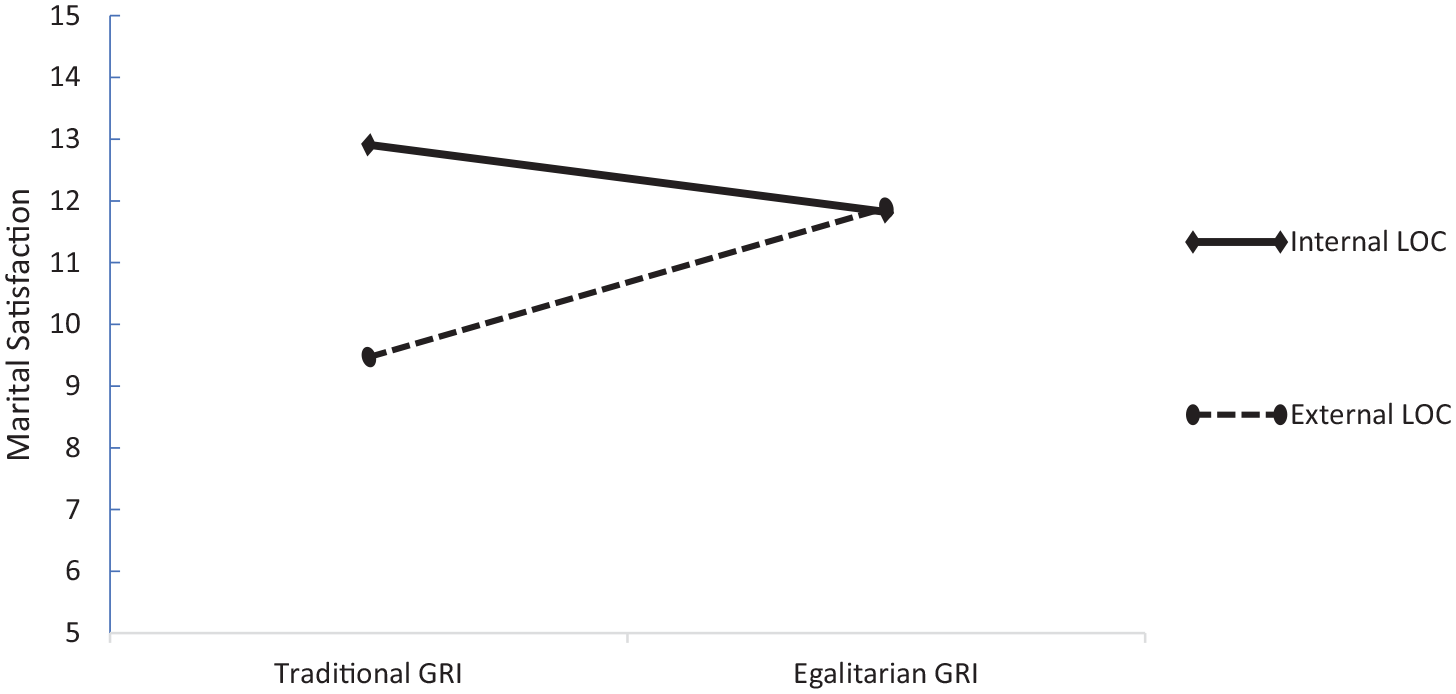
Moderation of marital satisfaction and gender role ideology by locus of control.
Summary of Regression Statistics showing Locus of Control Moderating the Relationship Between Traditional/Egalitarian Gender Role Ideology and Outcomes.

SE: standard error; CI: confidence interval; LL: lower limit; UL: upper limit; LOC: external locus of control; GRI: egalitarian gender role ideology.
With regard to well-being, the relationship between gender role ideology and eudaimonic well-being was not conditional upon locus of control. The complete regression model explained 14% of variance in eudaimonic well-being, R2 = .14, F(3, 153) = 8.55, p < .001.
Results are summarized in Table 3.
Discussion
The current study explored how married Evangelical women’s gender role ideologies are related to marital satisfaction and eudaimonic well-being. While the relationships between gender role ideologies and both marital satisfaction and well-being have been assessed (Amato & Booth, 1995; Grieve et al., 1988; Kulik, 2006; Lye & Biblarz, 1993; Read & Grundy, 2011; Sweeting et al., 2014; van de Vijver, 2007; Weiss et al., 2012; Wilcox & Nock, 2006), findings have been mixed, and few studies to date have examined how gender role ideology in Evangelical women might function differently than in more general populations, given important religious influences on gender ideology (Ali et al., 2008; Bishop, 2019; Burn & Busso, 2005; Glick et al., 2002; Mikołajczak & Pietrzak, 2014).
The first hypothesis surrounding gender role ideologies and marital satisfaction was not initially supported. A significant bivariate correlation was not found for the relationship between gender role ideology and marital satisfaction. This finding was congruent with recent research on this relationship with the Evangelical female population (J. M. Davis et al., 2018) and is in contrast to recent literature in nonreligious populations, which has found that higher marital satisfaction is positively related to egalitarian gender role ideologies (Hengstebeck et al., 2015; Marshall, 2008; Stanik & Bryant, 2012). However, assessing the moderating variable of locus of control helped to nuance the understanding of how this relationship functions in this population. Namely, the third hypothesis, regarding the moderating role of locus of control, was supported, in that locus of control ameliorated the relationship between gender role ideology and marital satisfaction. This finding evidenced that a relationship between these two variables does in fact exist, yet it is conditional upon locus of control. Specifically, it was only for women who endorsed having a more external locus of control that the relationship between gender role ideology and marital satisfaction was significant. For these externalizing women, the more egalitarian the gender role ideology, the higher the marital satisfaction. However, for women with an internal locus of control, this relationship was not significant.
These finding offer additional clarity for understanding the complex relationship between gender role ideology and marital satisfaction, in that women with an internal locus of control appear to have higher marital satisfaction, regardless of their gender role ideology. This suggests that having a sense of control and power in one’s life, which—for Evangelical women—might be rooted in their connection to a higher power, could positively impact satisfaction with marriage, regardless of role ideology. Perhaps for these women, having a sense of control over their life might also extend to feeling control over the role they occupy in their marriage. Specifically, research has indicated that religious populations tend to sanctify their marriages and that sanctification of marriage can facilitate marital satisfaction (Baker et al., 2009; J. M. Davis et al., 2018; Rusu et al., 2015; Stafford et al., 2014). Therefore, Evangelical women might sanctify their gender role ideology (e.g., see their traditional or egalitarian marriages as a manifestation of God’s will), which could therefore ameliorate the negative effects—namely experiences of being controlled and not having power—that are related to traditional gender roles.
Yet, for women with an external locus of control, who believe they have a lesser degree of power and control over their life, the experience of gender role ideology seems to become more important for marital satisfaction. Perhaps, for the traditional women, the restrictive nature of these gender roles might be particularly impactful, given the a more general sense of not being in control of one’s life. Conversely, egalitarian women’s lived experience of sharing control and power—whether recognized or not—might protect the marriage against the negative impact of having an external locus of control. Overall, these findings illustrate the complex nature of the relationship between gender role ideology and marital satisfaction.
The second hypothesis, surrounding gender role ideologies and eudaimonic psychological well-being, was supported. Specifically, higher eudaimonic well-being was related to a more egalitarian gender role ideology. Prior research has suggested a relationship between egalitarian gender role ideologies and well-being (Kulik, 2006; van de Vijver, 2007; Weiss et al., 2012). However, the majority of the studies that have directly examined well-being have not measured this variable with a eudaimonic conceptualization. Thus the current study highlights how gender role ideologies interact with Christian women’s flourishing, indicating that egalitarianism within this population is related to greater flourishing. In particular, the subscale of Personal Growth had the strongest relationship with well-being, while Purpose in Life had a smaller relationship. Personal Growth is conceptualized as an openness to new experiences, a sense of actualizing one’s potential, and a knowledge of improvements in the self over time (Ryff, 1989). As egalitarianism reflects that men and women share common traits and therefore are free to pursue any familial and societal roles (Bem, 1974), it can be hypothesized that the ability to actualize one’s potential and seek novel experiences is greater for egalitarian women. This is likely due to the capacity to make choices based on personal characteristics as opposed to predetermined gender prescriptions.
In regard to the moderating role of locus of control, a significant moderation effect was not found for the relationship between gender role ideology and eudaimonic well-being. Specifically, this relationship was not conditional upon women’s having an internal or external locus of control. This finding is dissimilar to the finding that locus of control moderates the relationship between gender role ideology and marital satisfaction. This difference might be due to the fact that marital satisfaction is a relational variable and well-being is more personal. Specifically, relationships are a place where control and power are played out experientially and therefore one’s locus of control might be a particularly important aspect of one’s satisfaction in that relationship. However, having restrictions on one’s ability to express traits or live out experiences—as a traditional gender role ideology does—might have an impact on Evangelical women’s flourishing, even if it is their choice.
There were several limitations in the current study, suggesting promising directions for future research. The first is that this sample was gathered using a convenience sample, which could have influenced ethnic homogeneity within the sample. Specifically, of those who responded to the demographic questions, the majority identified as European American. In addition, this approach could have led to a self-selecting bias, as this study explicitly recruited married Christian women. Furthermore, this research was restricted to women who identify as Evangelical and attend church regularly, and as such, the full spectrum of religious beliefs and gendered experiences were not examined. Moreover, specific faith practices of this group were not addressed in this study, which might contribute to a more nuanced understanding of these variables. As religion in general is found to be associated with the espousal of traditional gender role ideologies (Ali et al., 2008; Burn & Busso, 2005; Glick et al., 2002; Mikołajczak & Pietrzak, 2014), it would be interesting to examine if other religions followed the same trends for the outcomes of marital satisfaction and psychological well-being. Furthermore, it would be beneficial to explore and assess a greater number of explanatory variables surrounding gender beliefs and outcomes that might be unique to religious populations.
In addition, the experience of marital satisfaction was measured using a short, global measure of satisfaction. The current study found that regardless of beliefs concerning gender ideology, all participant scores were in the high range on this measure (First five items: M = 6.27, SD = 1.19; Final item: M = 7.44, SD = 1.7). One reason for this finding could be a self-selecting bias, which would indicate that participants who chose to complete a study on marriage might be participants who have higher marital satisfaction to begin with. Moreover, these results could be due to the universal nature of the Quality of Marriage Index, meaning that it captures only a broad sense of overall satisfaction (e.g., “Our marriage is strong” or “We have a good marriage”). The comprehensive nature of this measure restricts participants from nuancing specific areas of their marriage that might be unsatisfactory and instead categorizes marriage quality globally. While the measure has sound psychometric qualities, the author does note that skewed data are often a problem when utilizing this measure and thus could explain the ceiling effect found in this study. It should be noted that we were able to obtain significant findings in spite of the ceiling effect, which could have decreased the strength of the findings due to a restricted range. A comprehensive measure that highlights various ways that a participant could be satisfied and dissatisfied with her marriage could build a nuanced conceptualization of marital satisfaction. The population from this study might also benefit from a measure that is less face valid, as marital satisfaction is highly valued in this population. Participants were also not asked for the length of their marriage, whether it was a first marriage, or whether the spouse was also a Christian; more details on the marriage could help to better understand the nuances in experiences of marital satisfaction.
Furthermore, the majority of research surrounding gender beliefs in religious populations assess outcomes for women. It would be interesting to see how gender beliefs for this population impact men. Specifically, assessing eudaimonic well-being, which looks farther than the presence or absence of pleasure, could highlight ways in which gendered beliefs influence both men and women in their well-being.
Finally, causal relationships cannot be drawn from cross-sectional studies such as the current one. Longitudinal studies assessing the impact of gender role ideologies on marital satisfaction and eudaimonic well-being, and establishing any moderating or mediating variables, would be a necessary next step in the study of the outcomes of gender role ideologies.
In conclusion, this research adds to the small body of literature that exists surrounding gender role ideologies within an Evangelical population. Both marital satisfaction and eudaimonic well-being are prominent aspects of quality of life and therefore this research highlights the ways in these ideologies might be impacting this population. Greater knowledge of how these beliefs influence outcomes for Evangelical women may hopefully bring about important change for this population.
Footnotes
Declaration of Conflicting Interests
The author(s) declared no potential conflicts of interest with respect to the research, authorship, and/or publication of this article.
Funding
The author(s) received no financial support for the research, authorship, and/or publication of this article.
