




Abstract
Constructs regarding attachment to God and differentiation of self (DoS) have a robust foundation in the literature; however, studies regarding other cultures, specifically, second-generation Christian Korean Americans (SGCKAs), are limited. This study examined attachment to God, individualism, collectivism, and DoS in SGCKAs. Secure attachment with God statistically significantly predicted DoS scores in SGCKAs, R2 = .087, F(1,143) = 13.704, p < .001. Statistically significant differences on horizontal/individualism scores when compared based on attachment to God categories also existed. Furthermore, statistically significant differences existed on DoS scores when compared based on secure/insecure attachment to God categories. Implications for the church, mental health professionals, counselor educators, and the Korean American community are discussed.
Keywords
The “lost generation” is a term that has been known to describe second-generation Korean Americans, as their immersion within a unique sociocultural context, namely the juxtaposition of the American and Korean culture, can cause confusion toward their construction of self (Kang, 2002; J. Y. Lee, 1995). Embedded within this cultural context is an impetus toward “hyo” or filial piety, which is an expression of responsibility, respect, sacrifice, and family harmony, synergized with a deep commitment toward religious and spiritual values that can reinforce conservative values related toward obedience toward authority (Chong, 1998; Sung, 2000). Voices from this population communicate struggles such as “I don’t speak Korean so I am fully aware of the fact that I can never be ‘fully’ Korean” and “in church you play by Korean rules, not God’s rules” (Chong, 1998, p. 282; Park, 2015, p. 99). The intrinsic value of filial piety joined with spiritual piety relates both religious and cultural values toward ethnic identity (Chong, 1998). It is within this context where perhaps an attachment to God can create a positive impact for the individual within the unique context of the second-generation Christian Korean American (SGCKA), where the church acts as a context for transmission between cultures and the obligation to adhere to the spiritual values of their parents as an act of filial piety is intrinsically embedded (Kang, 2002; Koh et al., 2015; McGoldrick et al., 2005; Sung, 2000; Yoo & Kim, 2010).
Murray Bowen postulated that his theory of differentiation of self (DoS) was applicable to cross-cultural contexts, although some researchers have posited that DoS may be a reflection of White cultural values and not linked positively to psychological functioning in other cultures and societies (Bowen, 1978; Gushue & Constantine, 2003; Kerr & Bowen, 1988; S. H. Lee, 1998). In addition, research on attachment to God, along with DoS, has been well studied, producing a model of differentiation-based spirituality, although cross-cultural applications are limited (Jankowski & Sandage, 2012, 2014; Sandage & Crabtree, 2012; Sandage & Harden, 2011; Sandage & Jankowski, 2010; Sandage & Jensen, 2013; Sandage & Morgan, 2014; Sandage & Williamson, 2010; Williamson & Sandage, 2009). Recent literature has been synthesized regarding DoS in Asian American cultures; however, studies focusing on a specific subset of this population, namely SGCKAs, are lacking (Noh & Chow, 2019). The limitation exists partly due to faulty ethnic classification in past studies, as well as the population being statistically insignificant in the past (Alumkal, 2001; Chun, 2002). This study adds to the literature by exploring the role of attachment to God, DoS as well as individualism and collectivism within SGCKAs.
Second-Generation Korean Americans
The 1965 Immigration Act was a catalyst for Korean immigration, peaking in the mid-1980s and resulted in a count of over 1.2 million Koreans in the United States, according to the 2000 census (Kang, 2002; U.S. Census Bureau, 2001; Yoo & Kim, 2010). The majority of these Korean Americans (78%) were first generation, and these Korean immigrants who experienced shifts in traditional cultural ideologies are now approaching or moving into retirement age, leaving those who are in the second generation, in their young adult years (Yoo & Kim, 2010). These second-generation Korean Americans grew up in a complex sociocultural context, where they were encouraged to learn and internalize the value system of American culture while being pressured to also maintain Korean heritage and traditional values (Kang, 2002). Along with assimilating both Korean and American cultures, many Korean immigrants carried religious values into their expression of culture, and second-generation Korean Americans sought to adapt these values into a “hybrid third space” within American Christianity, where the church became a context for explorations of identity and new expressions of Christian faith (S. Kim, 2010; Yoo & Kim, 2010). The inherent value within the Korean American family is collectivist in nature, although the bicultural dynamic lends itself toward individualistic characteristics (Chung & Gale, 2009).
DoS, Individualism & Collectivism in Asian Americans & Korean Americans
Murray Bowen proposed DoS as one of the eight interlocking principles utilized to conceptualize the family as an emotional unit, where within the interplay of family dynamics, a counterbalancing dynamic of togetherness and individuality exists, which can be described as a pull to be connected and behave like others along with a need to feel and think for oneself (Kerr & Bowen, 1988). The terminology of DoS seeks to balance these two dynamics which exists in both intrapersonal and interpersonal domains and is a central theme of Bowen’s family systems theory (Bowen, 1976, 1978) A healthy level of differentiation is achieved when an individual is able to navigate the paradoxical nature of togetherness and separateness (Kerr & Bowen, 1988). Bowen (1976, 1978) offered a framework to understand the paradox of both wanting individuality and maintaining filial duty and cohesion, by proposing four dimensions: (1) emotional cutoff (EC), (2) fusion with others (FO), (3) the ability to take an I-Position (IP), and (4) emotional reactivity (ER). These constructs designate a spectrum where the individual can attain healthy boundaries within their family (Bowen, 1978; Kerr & Bowen, 1988).
DoS has been well studied; however, studies are limited mostly to samples that are predominantly White, middle class, and highly educated (Erdem & Safi, 2018). A dichotomy that exists within Western and Asian cultures is the value dimension of individualism and collectivism, where with a worldview toward individualism, a family’s goal is toward individuation, independence, and self-sufficiency where each member develops a distinct and unique self-concept that is separate from other family members (Chung & Gale, 2009). An Asian family then moves toward connectedness, interdependence, conformity, and harmonious interpersonal relationships that may indicate a movement toward emotional fusion (EF; Hung, 2006). Through a Western cultural lens, Asian families may be interpreted as displaying lower levels of differentiation in their lack of emotional autonomy (Noh & Chow, 2019). Collectivist cultures display A social pattern that consists of closely linked individuals who see themselves as parts of one or more collectives (family, co-workers, tribe, nation); are primarily motivated by the norms of, and duties imposed by, those collectives; are willing to give priority to the goals of these collectives over their own personal goals; and emphasize their connectedness to members of these collectives. (Triandis, 1995, p. 2)
It is important to note that, individualism and collectivism have been previously conceptualized in pure dichotomies, and Triandis and Gelfand (1998) proposed that the definition of self can emphasize personal or collective aspects and be independent or interdependent. Therefore, Triandis and Gelfand (1998) proposed four domains of collectivism/individualism: vertical collectivism (VC), or seeing the self as a part of a collective and being willing to accept hierarchy and inequality within that collective; vertical individualism (VI), or seeing the self as fully autonomous, but recognizing that inequality will exist among individuals and accepting this inequality; horizontal collectivism (HC), or seeing the self as a part of a collective but perceiving all the members of that collective as equal; and horizontal individualism (HI), defined as seeing the self as fully autonomous and believing that equality between individuals is ideal.
As noted, the ethnic classification of second-generation Korean Americans as well as the data related to this population are limited; therefore, studies relegated to this particularized population are embedded within sample populations related to first-generation immigrants or other Asian American ethnic groups (Alumkal, 2001; Chun, 2002). Within a Western cultural view, EF with family members can be interpreted as an unhealthy dynamic, although it can be a potential benefit from a collectivist cultural view (Noh & Chow, 2019). This highlights the need for studies that contextualize phenomenon within cultural contexts. There is a gap in literature particularly when studying the unique bicultural dynamics of SGCKAs.
Attachment to God and DoS
The theory of attachment with God takes its conceptual framework from both Ainsworth (1979/1989) and Bowlby (1969/1982), and Granqvist and Kirkpatrick (2008), in reviewing the literature regarding attachment to God, posited that perceived relationships with God fit the defining criteria of attachment relationships reasonably well. As previously mentioned, a differentiation-based spirituality exists, which is a relational spirituality framework that interprets spiritual experience and development through the capacities of self-regulation and balancing intimacy and autonomy in relationships (Jankowski & Vaughn, 2009; Kass & Lennox, 2005; Majerus & Sandage, 2010; McCullough & Willoughby, 2009; Sandage et al., 2010; Sandage & Jankowski, 2010; Shults & Sandage, 2006). Differentiation-based spirituality posits its framework of relational spirituality from Bowen’s concepts of intrapersonal and interpersonal differentiation, and intrapersonal differentiation can be seen as the capacity for affect regulation, while interpersonal differentiation is conceptualized as the capacity to negotiate balanced self-in-relation or interdependent relating (Shults & Sandage, 2006; Skowron & Dendy, 2004; Skowron et al., 2003). A differentiated view privileges the notion that spirituality is embedded within relational contexts of interpersonal and sociocultural systems, and this relational spirituality is influenced by the relational conceptual framework embedded within attachment theory as well as the systemic and sociocultural views emphasizing family, community, and social contexts (Tomlinson et al., 2016).
Present Study and Hypotheses
The goal of this study was to explore the relationships between attachment with God, collectivism/individualism, and DoS particularly in SGCKAs. Four main questions are included in this study: (1) Are there differences between individualism/collectivism scores between attachment to God categories? (2) Are there differences in DoS scores between secure/insecure attachment to God categories? (3) Does secure attachment to God have a positive relationship with DoS? (4) Are there predictive relationships between collectivism/individualism and DoS?
The following hypotheses are included in this study:
H1. It is hypothesized that there are statistically significant differences in Ind/Col (HC, VC, HI, VI) scores when compared based on attachment to God categories (secure/insecure) in SGCKAs.
H2. It is hypothesized that there are statistically significant differences in DoS (IP, ER, FO, EC) scores when compared based on attachment to God categories (secure/insecure) in SGCKAs.
H3. It is hypothesized that there is a statistically significant predictive relationship between secure attachment to God on DoS full score.
H4. It is hypothesized that there is a statistically significant prediction of DoS domains by collectivist/individualism dimensions.
Methods
Participants and procedures
SGCKAs (n = 145) participated in this study. After gaining approval from the Human Subjects Review Committee of Regent University, a web-based survey was created through SurveyMonkey with an embedded informed consent, and pastors from churches, as well as leaders from non-profit organizations who served mainly Korean Americans were contacted across the United States to disseminate the survey. The snowball method was utilized to pass the survey through networks. Specific geographic data were not collected to preserve the confidentiality of participants. All participant data recruited were anonymous, and there was no way to trace the data.
Demographic information is included above in Table 1. Exclusion criteria for participants were determined in part by defining SGCKA as those who were born from two Korean parents. In addition, generational affiliation was determined by how long the participant lived in the United States as second-generation Korean Americans were defined as those who were born in the United States or immigrants who came to the United States before the age of 12 years (Chun, 2002; Rumbaut, 1994).
Summary of Demographic Information for Second-Generation Korean American Participants.
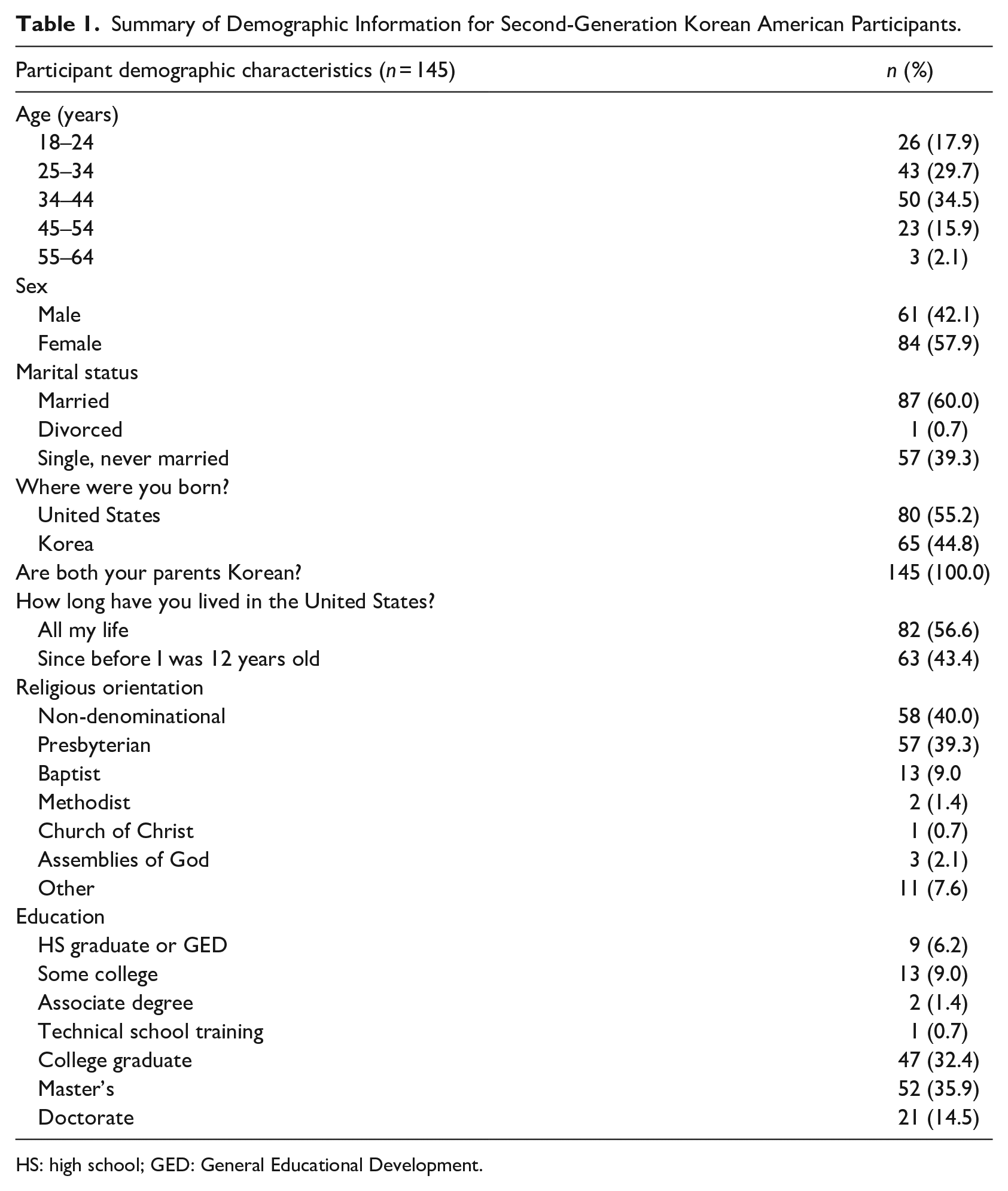
HS: high school; GED: General Educational Development.
Measures
Differentiation of Self Inventory—Revised
The Differentiation of Self Inventory—Revised (DSI-R) was utilized, which consists of 46 items that are used to create four subscales: ER, IP, EC, and FO (Skowron & Friedlander, 1998; Skowron & Schmitt, 2003). A full score for DoS can also be calculated. Subscale scores are calculated by reverse scoring all items on the ER, EC, and FO subscales and one item on the IP subscale. Scores are then summed on all items and divided by the numbers of items on the subscale, representing a range from 1 (not at all true of me) to 6 (very true of me), where high scores reflect greater DoS. Internal consistency reliabilities were calculated using Cronbach’s alpha for the full scale and subscales: DSI-R full scale = .92, FO = 0.86, ER = 0.89, IP = 0.81, EC = 0.84 (Skowron & Friedlander, 1998; Skowron & Schmitt, 2003).
H. Lee and Johnson (2017) sought to explore the psychometric properties of the DSI-R for Asian American bicultural adults as the research suggests, the FO subscale may be problematic for ethnic minorities and may not hold for Asian Americans. Utilizing a four-factor model of the DSI-R, the four-factor structure of the DSI-R did not hold for their sample, and rather a three-factor structure was proposed as a viable alternative: emotional distancing, maintaining identity, and relational sensitivity with Cronbach’s alpha of .88 (overall), .91 (emotional distancing), .84 (maintaining identity), and .85 (relational sensitivity). For the purposes of this study, the DSI-R was chosen, as it has been more widely used.
Attachment to God Scale
Rowatt and Kirkpatrick (2002) developed the Attachment to God Scale (AGS) that is a nine-item self-report measure of relationship with God with two subscales representing two dimensions of attachment to God: avoidance and anxiety. Participants rate the extent to which items match their experiences in relating to God based on a scale from 1 (disagree strongly) to 7 (agree strongly). The scale demonstrates construct validity and internal consistency, and Rowatt and Kirkpatrick (2002) interpreted their finding of a moderate positive correlation between adult and God attachment as evidence of discriminant validity between the measures of adult and God attachment relationships. In addition, Cronbach’s alphas of .92 for avoidance and .80 for the anxiety subscale were found.
An 11-item Korean Attachment to God Inventory (KAGI) also exists that demonstrates readiness for cross-cultural applications (C. Y. Kim et al., 2017).The sample utilized for this measure consisted of 263 Korean Catholic and Methodist immigrants, and the KAGI had high coefficients, with Cronbach’s alpha = .80 and .90 for anxiety and .87 and .91 for avoidance, respectively.
Ind/Col Scale
The Ind/Col scale (Triandis & Gelfand, 1998) is a 16-item scale designed to measure four dimensions of collectivism and individualism: horizontal/vertical individualism and horizontal/vertical collectivism. Cronbach’s alphas are .81 (HI), .82 (HC), .73 (VC), and .80 (VI). All items are answered on a 9-point scale, ranging from 1 (never, definitely no) to 9 (always or definitely yes). In the original study, 27 items are noted; however, as Triandis and Gelfand (1998) only reported factor loadings on 16 of the 27 item, other researchers have tended to use 16 items (Cozma, 2011). This study utilized 16 items. The creation of the scale included Korean participants, as the theoretical basis for this measurement was that individualism/collectivism can look differently in other cultures as well (Triandis & Gelfand, 1998).
Results
Individualism/collectivism and attachment to God
The first research question sought to examine differences between individualism/collectivism scores between attachment to God categories, named insecure and secure. The median score for secure attachment was utilized to categorize the population into secure and insecure categories (Table 2).
Two Categories of Attachment.

Utilizing IBM SPSS 25, a multivariate analysis of variance (MANOVA) was performed with the grouping variables of insecure and secure attachment, and the independent variables of VI, HI, VC, and HC. There was a statistically significant difference between attachment styles on the combined dependent variables, Pillai’s trace = .101, F(4,139), p < .05.
There was a statistically significant difference in VI, F(1,142) = 10.493
DoS and attachment to God
The second research question sought to examine difference in DoS scores between attachment to God categories. Utilizing IBM SPSS 25, the grouping variables of insecure/secure attachment were utilized as well as the dependent variables of IP, EC, ER, and EF. There was a statistically significant difference between attachment styles on the combined dependent variables, Pillai’s trace = .146, F(5.964,140), p < .001. There was a statistically significant difference in both IP scores, F(1,143) = 11.213, p < .05,
Secure attachment with God and DoS
The third research question sought to examine if secure attachment to God would have a positive relationship with DoS. A linear regression analysis found that secure attachment to God accounted for 8.7% of the variation in DoS scores with adjusted R2 = .087, a medium size effect according to Cohen (1988). Secure attachment with God statistically significantly predicted DoS scores R2 = .087, F(1,143) = 13.704, p < .001.
Collectivism/individualism and DoS
The fourth question sought to examine if there were predictive relationships between collectivism/individualism and DoS. Results of a multivariate multiple regression revealed that the overall proportion of variance in the four DSI subscales accounted for by the four Individualism and Collectivism Scale (INDCOL) subscales was significant, specifically on the HI scale, Pillai’s trace = .145, F(4,137), p < .001, partial
Discussion
The goal of this study was to explore the relationships between attachment with God, individualism/collectivism, and DoS in SGCKAs. Results indicated that (1) there were statistically significant differences in both individualism/collectivism and DoS scores when compared against attachment to God categories, (2) that secure attachment to God predicts DoS in SGCKAs, and (3) that several domains of horizontal/individualism predict DoS domains
One of the main findings of this research provides evidence that secure attachment to God significantly predicts DoS scores in SGCKAs. Principally, DoS is understood as a counterbalance of the two dynamics of intrapersonal and interpersonal domains, and a healthy level of differentiation results from the navigation of both togetherness and separateness, within a family system (Bowen, 1976, 1978; Kerr & Bowen, 1988). This means, that essentially, a secure attachment, or relationship with God, in SGCKAs may aid in the navigation of their family dynamics and help them move toward healthier family functioning. It is possible, then, that there exists another “domain,” primarily embedded in relationship, that does not emphasize hierarchy, nor does it exalt the individual over the group or vice versa; it is primarily relational. As Scripture notes, “the Kingdom of God is neither here nor there, the Kingdom of God is already among you” (Luke 17:21, NLT). It is true that “to bear the image of God is to live in reciprocating relationships with God and our fellow human beings” (Balswick et al., 2016, p. 48). The terminology of attachment to God privileges the notion of relationship, moving beyond the domains of collectivism/individualism toward the domain of the Kingdom where “even the Son of Man came not to be served but to serve others and to give his life as a ransom for many” (Matthew 20:20, NLT). Both aspects of celebrating the individual and collective whole exist in the triune God as “the Trinity can be understood as differentiated relationality—distinct Persons who always exist in intimate and cooperative relationship” (Majerus & Sandage, 2010, p. 42). The goal for the individual then is a DoS that is also holy, in the sense that an individual is able to maintain an autonomous identity while closely relating to other relationships, through a loving relationship with God (Grenz, 2000; Holeman, 2012). This is essentially the first and second commandment (Matthew 27:37–40). With reciprocal relationality (Balswick et al., 2005) as the focus, three implications are given: (1) to the ekklesia or the church, (2) to counselors/counselor educators, and (3) to the Korean American community.
Implications for the Church
The constructs utilized in this study, in principle, are meant to be applied across cultures. Attachment to God, in principle, is meant to be offered to “every nation, tribe, people and language” (Rev. 7:9, NIV). Although the terminology of “attachment to God” has its history in the world of psychology, spiritual formation, or Christlikeness by way of relationship with God, it is not a new concept. Dallas Willard, in a conversation with Dr Jim Wilder, expressed a need in the church at the end of his life, “I know of no soteriology [doctrine of salvation] based on forming a new attachment with God” (Wilder et al., 2020, p. 1). The implication of this research for the church, translated simply, is that a close relationship with God can help you grow and build relationships with others. This evidence undergirds any attempt to foster relationship with God, as the impact of cultivating a relationship with God has potential to build healthier relationships, specifically in a family context. This study moves the current research forward in contextualizing this simple truth to SGCKAs.
Furthermore, this study reveals that both individualism and collectivism can be positive indicators toward DoS and that for SGCKAs, they have tendencies toward both. The Western culture has often been cited as individualistic, while Asian cultures have been noted as collectivist, with values placed on one or the other (Triandis & Gelfand, 1998). In the church context and beyond, at times, we over-value differences or over-emphasize homogeneity. In other words, we are who we are not because we are separate from the others who are next to us, but because we are both separate and connected, both distinct and related; the boundaries that mark our identities are both barriers and bridges. (Volf, 1996, p. 66)
The SGCKA encapsulates two distinct cultures, and in particular, the research has shown that the absence of a value toward hierarchy marks the movement toward healthier relationships. These values can be connected to exhortations such as “giving preference to one another in honor” and “loving your neighbor as yourself” (Mark 12:31 NIV; Romans 12:9–11 NIV). The findings of this research help us to move beyond our own understanding of culture and, if it is married to a proper theological context, it can serve the ekklesia. The hope is that this knowledge can further encourage pastors to engage in spiritual formation practices that produce greater loving relationships with God and therefore impact the fruitfulness of pastoral care.
Implications for mental health professionals and counselor educators
Counselors should keep in mind that the image of Asian Americans as a model minority has created a veil that conceals their continual struggles with discrimination, prejudice, and micro aggressions at individual, institutional, and cultural levels (R. H. Kim, 2013). Counselors and counselor educators have supported multiculturalism as part of the American Counseling Association (ACA) code of ethics and in CACREP curriculum; however, from this “fourth force,” a “fifth force” is emerging, which is social justice and advocacy (Ratts & Pedersen, 2014). We must move beyond multicultural competencies and become agents of social change for our clients and evaluate critically how system barriers such as racism “shape the therapeutic modalities we use with clients, the research agendas we pursue, and the training for which we advocate” (Singh et al., 2010, p. 768). Specifically, Korean American clients are more likely to terminate treatment after one session compared to Caucasian clients, and it is important to assess client expectations in terms of what he or she expects from the therapist and adapt their methods to meet clients’ needs (J. E. Kim et al., 2016). A common discussion among mental health professionals should be that of culture as context. A particularized culture such as the culture of SGCKAs provides a context for counseling. With the research presented in this study, clinicians can be confident in moving toward interventions that foster secure attachments with God, although the culture must be accounted for as well. This study also provides the evidence that it is important to distinguish that although collectivism and individualism do provide a path toward DoS, it is with the absence of a value toward hierarchy which is often connected with a Western culture worldview.
A culturally sensitive or peaceable psychology (Dueck & Reimer, 2009) seeks to encompass the multiplicity of dynamics occurring within the counseling relationship, and “if a peaceable psychology is tradition sensitive then the foundation that will shape the mental health worker is the person of Jesus Christ” (p. 226). Both the findings that second-generation Korean American horizontal orientation toward both individualism and collectivism contributing to higher scores on DoS measures as well as the evidence that secure attachment positively predicts overall differentiation of scores can be utilized to guide assessment and treatment. The results regarding secure attachment are particularly of use to counselors who are interested in spiritual formation, and the research undergirds the importance of spirituality in the treatment of the client, where the addition of a fourth dimension from the conventional bio-psycho-social view is needed. The evidence provided not only gives credence to the work that licensed mental health professionals provide but also extends to lay ministers at the church, including pastoral counselors, spiritual directors, and any other domain that involves fostering a relationship with God. Moreover, those who are in leadership capacities such as counselor educators can continue to advocate for the diversity represented in their classrooms, which certainly impacts clients as well, through the information provided. In addition, those programs that are looking to create a context for Christians to engage in spiritual formation now have evidence that cultivating relationship with God leads to greater DoS within a particularized cultural context, as well as past research presenting evidence of the merits of a secure attachment with God (Jankowski & Sandage, 2012, 2014). For helping professionals and educators, this research gives further credence for utilizing interventions that would move an individual toward deeper secure attachment with God.
Implications for the Korean American community and beyond
Much has been written around the intergenerational conflict between first- and second-generation Korean Americans, and as mentioned before, many times, differences or homogeneity is lauded one over the other (M. Kim & Park, 2011; Park, 2012; Ying & Han, 2007). The findings of this particular study show that the horizontal aspects of individualism or collectivism, or the absence of a hierarchical structure, lead toward a healthy sense of self and have an ability to stay engaged and not reactive in family contexts. These come through both domains of individualism and collectivism, not one or the other. There are those SGCKAs who have, in some way, navigated their bicultural status and have healthy relationships with their families. As with any marginalized group, whether it is the outer group or the ingroup, there is an innate need for justice when pain has been tolerated. Perhaps “in the presence of God our rage over injustice may give way to forgiveness, which in turn will make the search for justice for all possible” (Volf, 1996, p. 124). Within this study is the evidence that a secure attachment with God will lead to higher DoS, which allows each person to find autonomy or a sense of self within the family’s emotional system while maintaining connection with others interpersonally (Bowen, 1978; Kerr & Bowen, 1988).
Higher levels of differentiation have been shown to be significantly associated with healthier family functioning in previous studies with Koreans and Korean Americans (Kim et al., 2015). This study substantiates the notion that a secure attachment with God will, in essence, produce healthy family functioning in SGCKAs. The safety and security offered through a relationship with God allows for the individual to manage their anxiety in high-pressure situations. The pressures that are put upon second-generation Korean Americans, especially in light of family expectations, including educational status, are a known dynamic within this culture (Sung, 2000; Yoo & Kim, 2010). The fact that a secure attachment with God, which offers healthy functioning in family, has the potential to mitigate these pressures is a finding that would be readily accepted in the Christian Korean American context.
For second-generation Korean Americans, there exists a need to acknowledge the blood, sweat, and tears of the first generation. For the first-generation Korean Americans, this sacrifice must be a gift to the second-generation Korean American to go beyond their culture and values, rather than to let it be a limitation. All generations should be celebrated in their own unique expression of their culture. As many in the Korean American community have accepted the culture of the Kingdom of God, a relationship with God provides a pathway toward healing and wholeness, as substantiated in this research.
Limitations and future direction of study
The results of this study allude toward a developmental trajectory for SGCKAs, although the statistical analyses and methodology do not allow for this particular research question to be answered directly or indirectly. Qualitative studies regarding the lived experience of this population may offer more insight into the area of development. As this study was a cross-sectional, survey-based design, qualitative studies may have merit in adding breadth and depth to the literature. In addition, path analyses may be a possible route toward confirming a theoretical framework. It is noted that the constructs utilized may have limitations toward cultural adaptability as they were used utilizing predominantly White samples, and utilizing measures such as the DSI-R for Asian American bicultural adults, KAGI, or other such constructs may aid in further study of this population (Kim et al., 2017; H. Lee & Johnson, 2017). Identifying specific regions or locations to study this population may also hold merit as there are limitations to the generalizability of this particular study.
In addition, the consensus of many researchers is that the majority of research contexts should use continuous measures; however, clinical decision-making contexts typically require the use of categorical measures (DeCoster et al., 2011). Further study of the AGS measure as well as other attachment to God measures will be useful in propelling research regarding attachment to God forward. Unified models that encompass both culture and spirituality are also limited.
Finally, the limitation of expanding the theological language of attachment is included in this section. The current literature lacks support for how an attachment relationship with God might arise and continue to meet human needs for safety and security, specifically in the counseling literature, although efforts have been made (Miner, 2007). The phenomenon of integrating religious beliefs and practices into therapeutic techniques predates to the inception of psychology as a science, although the nomenclature of “inner healing” has been described as a method toward bridging relationship with God through prayer (Entwistle, 2004; Hathaway, 2009). For example, researchers have recently tested an inner healing protocol called Sozo and found evidence that this prayer intervention promoted change in perceived attachment with God (Monroe & Jankowski, 2016). Even more recently, efforts are being made to test a multi-modal approach to therapy utilizing inner healing prayer called the Life Model (Wilder et al., 2020). This particular study adds to the literature in a particularized population regarding attachment with God. It is also important for studies that explore attachment to God from a psychological lens to include discourse from theology as a “contemporary social theology of the Trinity…allows for a fully inter-subjective attachment relationship between a person and God in which there are circular and reciprocal relationships involving the individual, parents, partners, the Christian community and the Trinity” (Gunton, 1993; Miner, 2007, p. 121).
Despite the limitations mentioned, this particular study adds significantly to the literature by focusing on the relationship between secure attachment with God as a predictor of DoS, within the particularized context of SGCKAs, who are navigating dual cultural identities (Chan, 1991; Hurh & Kim, 1990; Jang et al., 2016; Koh et al., 2015). There is a gap in literature concerning second-generation Korean Christian Americans, as this population uniquely represents a minority that is navigating a bicultural status in a continually changing cultural landscape.
These findings have implications toward the church, counselors/counselor educators, and the Korean American community as a whole at one primary level where a close relationship with God can help grow and build relationships with others. Relationships should be composed of intimately knowing others and being known, and the relational reciprocity embedded in intimately knowing God leads to interdependence (Balswick, 2016). Essentially, this is the first and second commandment: love God, love others. As we pursue the Kingdom of God and approach the day where “every nation and tribe and people and language stand in front of the throne and Lamb,” our role in this present age is to herald the “coming of His government and its peace that will never end” through endeavors that include advocacy of people groups that may not currently have a voice (Rev. 7:9; Is. 9:7 NASB).
Footnotes
Declaration of Conflicting Interests
The author(s) declared no potential conflicts of interest with respect to the research, authorship, and/or publication of this article.
Funding
The author(s) received no financial support for the research, authorship, and/or publication of this article.
