




Abstract
This article explores how Christian visual artists perceive and represent the divine and faith through inner visual imagery and art-making. Based on qualitative interviews and collaborative art processes with 10 UK-based artists, the study investigates the cognitive, emotional, and embodied dimensions of religious imagination. Rather than focusing on traditional iconography, the research reveals how artists engage the divine through inner images, metaphors, and material explorations shaped by lived experience. The findings suggest that faith and divine presence are often perceived not as fixed theological objects but as dynamic, felt realities emerging in artistic processes. By shifting focus from depictions of faith to the perception and embodiment of faith through imagery, this study offers new insight into theological cognition and artistic epistemologies.
Keywords
Introduction
This article investigates inner visual imagery related to meaning-making, faith, and the perception of the divine, as described and rendered by artists who practice or identify within a Christian tradition. The focus lies on active inner imagery: visual content that appears spontaneously yet coherently when people are asked (prompted) to think visually about abstract spiritual concepts. A central question arises: is this imagery merely invented, or does it emerge from existing patterns of thought, embodied experience, and prior belief?
This kind of imagery resists easy categorization. It is not hallucinated or imagined in the sense of fictional storytelling, nor is it a direct recollection of sensory experience. Rather, it sits in a space between perception and memory, between belief and imagination. As Kind and Kung (2016) note in the introduction to Knowledge Through Imagination, philosophers continue to debate whether imagination is more perception-like or belief-like (p. 4), and yet it remains epistemically powerful. They distinguish between transcendent and instructive uses of imagination: the former aims to escape the bounds of what is, while the latter helps us explore or uncover truths about reality, often within self-imposed or contextual constraints (pp. 1–3). It is this instructive imagination that best captures the process observed in this study.
The conceptual framework was informed by theories of embodied cognition, which emphasize how bodily experiences inform thought and imagination, and suggest that meaning-making emerges from the body’s interaction with the world: gestures, materials, perceptual habits, and affective states (Sigurdson, 2016; Varela et al., 2017; Tanton, 2023). Tanton (2023), in particular, argues that imaginative processes are not abstract constructions but situated, affective, and bodily, meaning they emerge through and are shaped by how individuals feel, move, and perceive (p. 127).
Tanya Luhrmann’s (2020) cognitive model in How God Becomes Real offers a related lens. She suggests that spiritual presence is made real not primarily through propositional belief but through practice-based attention to internal imagery and sensory cues (pp. 57–58). Through learned spiritual practices such as imaginative prayer, believers become attuned to subtle internal sensations, which, when interpreted within a shared religious framework, are experienced as evidence of divine presence (Rizzuto, 1979, as cited in Luhrmann, 2020, p. 120). While Luhrmann’s emphasis on cultural and psychological “kindling” 1 offers insight into how people come to treat internal imagery as spiritually real, this study departs from her more constructivist or critical reading. Neither is the purpose to base the imagery as private visions, infused insight or “received messages” inserted into people’s minds by an external divine entity or intelligence. Instead of framing imagination as either a tool that makes God seem real or the product of extraordinary religious experiences, I propose that imagination functions as a form of perceptible meaning: a way of encountering and articulating something already present in one’s internal landscape. In a similar way, Sigurdson, influenced by Merleau-Ponty, writes: the task is not “to reflect on a truth that exists before reflection. Rather, it is a matter of, like art, allowing the truth to enter into existence” (Merleau-Ponty, 1962, as cited in Sigurdson, 2016, p. 334).
Perceptible meaning, in this context, refers to meaning that is intuitively or affectively perceived rather than verbally constructed, similar to Terrence Deacon’s reinterpretation of Charles Sanders Peirce’s (1931/1978) theory of the nature and cognitive foundation of symbols and signs (Deacon, 1997, as cited in Dubreuil & Henshilwood, 2013, pp. 150–152). It is also informed by methodology from hermeneutic constructivism emphasizing an expressive account (meaning of the world perceived primarily within a language) forming personal experience (Peck & Mummery, 2018, pp. 389–390). However, “language” in a broad meaning covers all types of expressivity, not only its verbal forms.
This thesis posits that these inner images arise not as decorative additions (illustrations) to thought but as embodied symbols/signs/language, grounded in memory and experience, that help people locate spiritual knowledge. This resonates with aesthetic and phenomenological traditions, in which perception is not neutral or passive but always already meaningful (Dewey, 1934; Merleau-Ponty, 1962). The images that people perceive internally are, therefore, felt understandings: sensed, visualized, and partially ungraspable – they are visualizations. When linked to the theme of the divine and faith, they can be called theological visualization.
This project also situates itself in dialogue with, but distinct from, several cognitive approaches to religious experience. It shares ground with the Cognitive Science of Religion in treating agency detection and symbolic thought as natural features of the mind, but it rejects the reductionist framing of religious belief as a cognitive by-product. It draws instead on image-schema theory (Johnson, 2007), theories of affective embodiment (Tanton, 2023), and theological accounts of imagination and the imago Dei, which hold that human creativity and attentive perception or reflection are themselves (although not exclusive) participatory acts in divine meaning. Rather than imagining to believe, the artists in this study believe through imagining, using theological visualization (visual perceptions of inner imagery in a reflective way) to make sense of spiritual realities that cannot be otherwise grasped.
Contextually, theological visualization relates to what the literature on the psychology of religion discusses as “God images” and “God concepts” (Davis et al., 2012; Rizzuto, 1979). While God concepts refer to consciously held theological beliefs (often verbal, abstract, and doctrinal), God images are shaped by implicit relational knowledge, affective memory, and experiential cues. These images are emotionally mediated, context-sensitive, and often arise outside of conscious control (Davis et al., 2012, pp. 34–36). Although this article does not directly categorize such internal representations, it presumes that both forms of knowing shape the artists’ inner imagery. Also, the verbal prompts and reflective aspect of the interview may have activated implicit spiritual knowledge that Davis et al. describe as “intrapersonal and situational cues” (p. 36), allowing previously internalized God concepts and images to emerge in visual form.
Moreover, visual theological approaches guided the interpretation of artworks as generative spaces for meaning-making and dialogue, not simply understanding or representations of theological doctrine. This process resonates with theological visualization in its perception of the divine and faith through internal imagery that is not simply invented but remembered, felt, and materially rendered. In this sense, the project occupies a middle ground between psychological and theological accounts: it does not measure God representations or test them against normative belief structures, but it does take the affective, relational, and perceptual nature of inner imagery seriously as a site of theological reflection. The work thus offers a material and imaginative lens for observing how implicit and explicit God representations are negotiated through creative practice.
A theological foundation for this study is the doctrine of the imago Dei, that human beings are created in the image of the divine and share in the Creator’s capacity for imagination, creativity, and symbolic expression, specifically merged and magnified in the life of artists through the “vocation to art” and Christ as the ultimate Artist (Kašparová, 2022, pp. 124–126). Within this paradigm, imagination becomes not a secondary or lesser faculty, but a participatory act through which humans co-create meaning with the divine. Theologically, this aligns with traditions that understand creative expression and visual imagination as reflections of our God-given capacity to perceive and shape meaning, echoing the incarnational motif where God became visible in Christ (Johnson, 2007; Kašparová, 2022; Tanton, 2023). Hence, when artists describe inner imagery of “divine” and “faith,” they are not merely producing fiction but engaging in a mode of theological knowing through theological visualization (Kašparová, 2022, pp. 133–135). This is rooted in both embodied cognitive processes and a theological anthropology that insists upon human creativity as essential for meaning and knowledge making.
Methodology
The study received approval from the Institutional Committee of the Margaret Beaufort Institute of Theology, which also functions as its institutional review board (approval number 20230927, from 27 October 2023). It was determined to align with the research standards of the Margaret Beaufort Institute, including ethical considerations, and conforms to the ethics policies of Anglia Ruskin University and the Cambridge Theological Federation. Informed consent was secured from all participating artists prior to their involvement. All artists signed documentation regarding intellectual property, image use, and voluntary involvement. The project adhered to collaborative research ethics, ensuring that participants could withdraw at any point. The artists retained full creative and intellectual rights over their work and agreed to be identified in public presentations of the research.
This study employed a practice-based methodology combining qualitative research tools from the psychology of religion with artistic practice and theological reflection. Its central aim was to explore how Christian artists perceive and materially render abstract spiritual concepts such as the divine and faith through the process of art-making. The project was grounded in a multidisciplinary framework drawing on theories of embodied cognition, religious imagination, and visual theology.
The research was structured across five interconnected stages, combining periods of close collaboration with phases in which either the artist or the researcher worked independently.
Stage 1: Initial interviews (March–April 2024)
Semi-structured interviews were conducted with 10 Christian artists recruited through an open call distributed via professional networks in art and theology. The call specified inclusion criteria: participants had to self-identify as Christian, be based in the United Kingdom, and have an active art practice of at least 2 years. They also needed to be able to digitally document their artistic process, commit to weekly submissions of the documentation, and be available for at least 5 (ideally 7) hours per week for the duration of the project (a month). Initial responses reduced the pool to 12 eligible individuals, and after further clarification of time commitments, 10 artists confirmed their participation. Although a 20% withdrawal rate was anticipated, all participants remained actively involved throughout the project.
Interviews took place in person, when possible (two interviews were conducted online via Zoom), at a location chosen by the artist. Lasting approximately 90 minutes, the interviews were divided into three thematic areas: (1) the artist’s current practice and engagement with visual thinking, (2) personal spiritual experiences, and (3) the role of spirituality within their artistic expression. All interviews were recorded, transcribed, and archived for analysis.
Stage 2: Independent art practice (March–June 2024)
Following the initial interview, each artist entered a 4- to 5-week period of independent work, during which they created an original artwork engaging with the themes of divine and faith. Artists worked in their preferred medium and setting, without direct intervention. To support reflective insight, each artist kept a journal consisting of weekly submissions. These included a combination of written reflections, sketches, photographs, or videos of the work in progress, and excerpts of texts, inspirations, or related material. Journals were submitted via email and served as a window into the unfolding creative and spiritual process.
Stage 3: Reflective reading interview (aka second interview) (April–June 2024)
A second semistructured interview was conducted shortly after the completion of the artwork, always in person, mostly in the artist’s studio. This conversation focused on reflecting back on the recent experience of art-making. Among others, topics included: (1) changes in perception during the process, (2) the emotional and spiritual journey involved, and (3) interpretive insight into the completed work. These interviews were similarly transcribed and included in the analytical dataset.
Stage 4: Transcribing, coding, and analysis (March–November 2024)
The combination of a focused theme and an open framework facilitated the emergence of shared patterns while allowing unexpected insights, yielding a wide variety of data. Therefore, all transcripts and journal entries were analyzed using a thematic coding grid. This analytical phase was conducted independently by the researcher and developed iteratively, such that the coding grid evolved with each interview, adding new themes as they emerged or grouping existing themes into more general or more specific categories (see below in “Recurring themes in imagery of the divine and faith” in the section Findings for further detail).
The coding grid for this article was created from a specific section of the initial interview (as discussed in the Findings section). Although this article focuses on a particular part of the interviews, it was at times necessary to review other sections for themes addressed there when the artists explicitly linked them.
The grid captured patterns across several dimensions: symbolic and emotional content, embodied or sensory experiences, shifts in theological or spiritual interpretation, and the relationship between visual imagery and internal meaning. Themes were identified both across cases (shared motifs) and within individual narratives (unique theological emphases or personal resonances).
While the project was not designed to achieve thematic saturation in the traditional sense, the depth and diversity of participants’ engagement provided a rich foundation for identifying recurring patterns and refining the interdisciplinary methodology. The aim was not to produce merely generalizable data but to test and develop a new research framework that could accommodate complexity while remaining repeatable in future studies.
Stage 5: Public exhibition and dissemination (May–September 2024)
The final artworks were presented in a curated public exhibition, accompanied by a printed brochure and an online platform. The exhibition served not only as a dissemination tool but also as a final collaborative space in which the artists encountered one another’s work for the first time. The exhibition provided an opportunity for artists to discuss their work and experiences with those who had undergone the same process, thereby concluding the phase of artists’ involvement in the research project. Although not a focus of this research, exhibiting work is vital for artists in supporting their careers and professional development, and therefore, the exhibition can be considered as a good practice between the researcher and the involved artists.
The opening attracted over 60 visitors, with additional attendance in the following days. Photo documentation and digital materials extended the project’s reach through social media and professional networks. No new data was collected from this event apart from photographs, which were later shared with the public via the research project webpage in the form of an online exhibition that has been accessible. The photographs taken during the live event help to establish the spatial dimensions and impact of the artworks for virtual visitors.
Positionality
As a scholar trained in both theology and fine art, I assumed a reflective and participatory role. Rather than acting as a detached observer, I functioned as a facilitator, curator, and interlocutor. Similarly, artists were not treated as research subjects but as co-investigators, shaping both the content and interpretive direction of the study. When preparing the thematic coding grid and interpretative account, I put the emphasis on the artists’ expressions and points of notice. However, I am aware that the decision to group and generalize themes was subject to my preferences and decision-making, which were, among other factors, limited by language, expertise, and experience, and might have yielded different results if made by other researchers. When possible, I applied the language introduced in the interviews, both by the researcher and the artists. At other times, I employed terms from the theoretical framework of this article.
For the purposes of this article, I will focus in detail on the verbalized results of the inner imagery described at the beginning of the collaboration. Specifically, I examine how the artists, when prompted to think visually, were able to articulate inner imagery in relation to abstract concepts such as divine and faith. I will also identify recurring themes and symbolic parallels across participants and briefly compare these early verbalized images, which I term “Embodied Divine” and “Embodied Faith” (Table 1). The following thematic discussion will address the porous character of the recurring themes in relation to the embodied experiences of the artists as they expressed them.
Embodied Representations of Divine and Faith Among Artists.
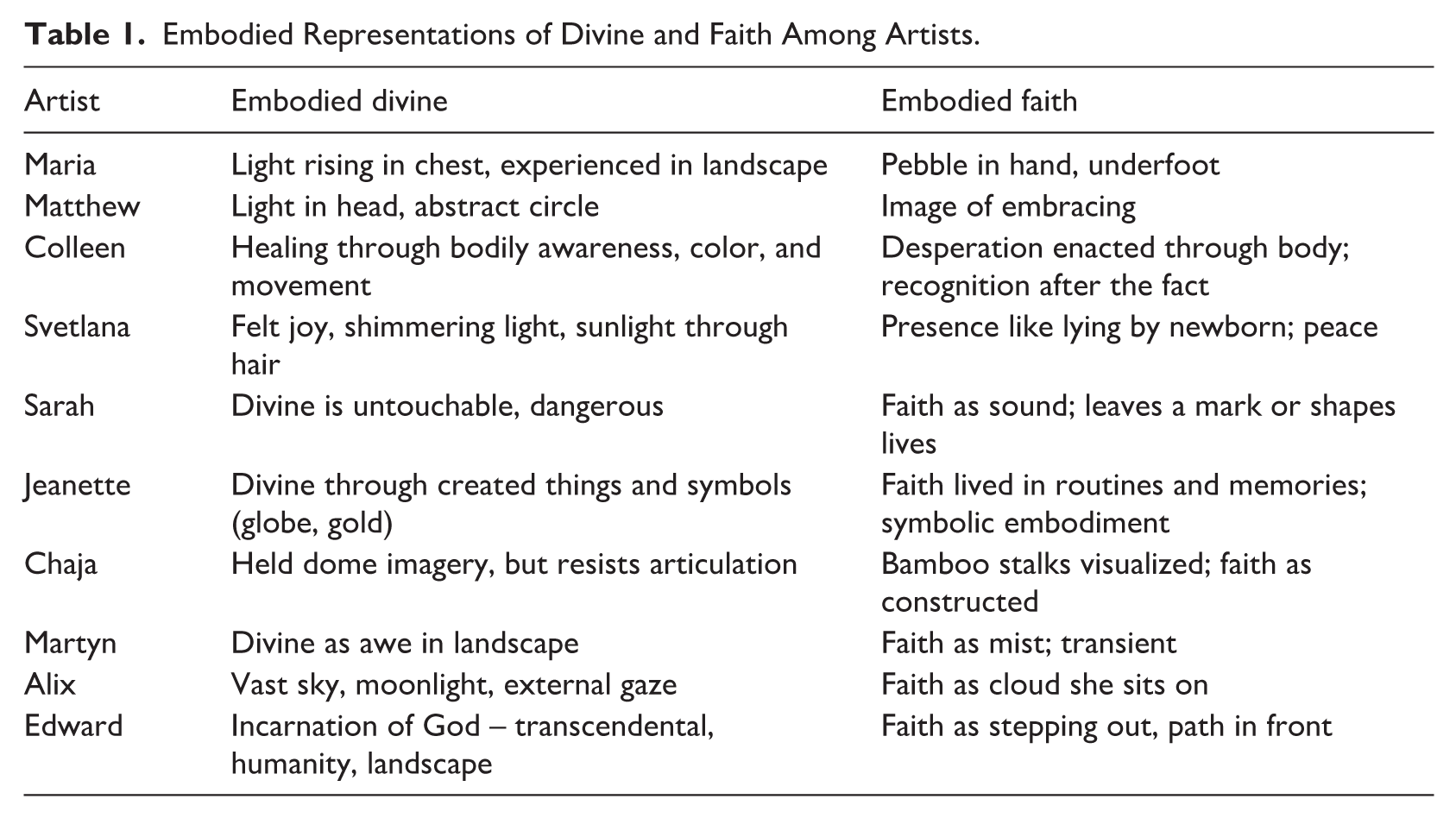
Although the gradual development of these visualizations throughout the creative process is rich and worthy of further study, the scope of this article does not allow for a full analysis. At the end of the Findings section, I will include three case studies that offer brief insights into how the initial imagery unfolded through lived, material, and artistic processes in the practices of three participating artists. These case studies illustrate the interwoven character of reflective and art practice methodology, which was more prominent in the following four research stages, and show how the initial imagery links to the final artworks produced by those artists.
Findings
Recurring themes in imagery of the divine and faith
This section presents the key themes that emerged during interviews in which artists were prompted to visualize the concepts of divine and faith. The analysis focuses specifically on the verbalized inner imagery shared in response to two prompts prior to the creative process or final artworks: (1) How do you define “divine” and “faith” in your own words? (2) What kind of imagery was running through your mind when we talked about God/divinity and your faith?
The selection of themes was carried out through an iterative process that refined an initially more detailed coding framework. In the first phase of analysis, individual themes were directly identified from the interview material, including: Light; Nature/Creation; Embodiment/Body; Mystery/Unknown; Trust; Space/Place; Journey/Path; Beauty; Healing; Everyday life/Ordinary; Silence/Stillness; Joy; Community/Relationality; Tenderness/Care; Struggle/Doubt; Art/Creativity; Memory; Sound; and Sacredness. During the second phase, these themes were examined for overlap, conceptual closeness, and relevance to the verbalized inner imagery of the divine and faith. Several themes were grouped into broader categories: Mystery/Unknown, Space/Place, and Silence/Stillness merged into Mystery and Space; Healing, Beauty, Presence, and Embodiment/Body formed a combined group; Joy, Fear, and Struggle/Doubt were clustered as Awe, Fear, and Joy; and Trust and Community/Relationality were combined as Trust and Community. Nature/Creation and Light remained separate because of their specific concepts and frequent occurrence. Sound was kept as a separate category despite its lower frequency, as it represented a distinct mode of inner imagery.
Three themes were removed from the final grid. Art/Creativity, although central to the project, served as a methodological condition rather than an element of inner imagery. Memory could not be clearly distinguished from the interview framework and risked being misinterpreted as a standalone theme. Sacredness, though it could serve as an overarching theme, was intentionally excluded to highlight more specific experiential descriptors from the artists’ accounts, and it was also avoided for its thematic proximity to “divine.” The final grid thus offers a focused synthesis of themes most directly rooted in the artists’ verbalized inner imagery at the beginning of the collaboration.
Although many of these themes evolved or deepened during the month-long collaboration, this section captures the immediate and spontaneous imagery produced during the first interview.
Light
Light was the most frequently mentioned image, appearing in the responses of at least 7 of the 10 artists (Maria, Matthew, Alix, Colleen, Edward, Svetlana, Sarah). 2 It emerged as both a symbolic and sensory motif used to describe divine presence, emotional states, and even artistic processes.
Artists described shimmering light, golden glow, transparent threads, and radiance that passed through or emanated from the body. For some, light was strongly embodied (e.g., Svetlana’s experience of sunlight moving through hair), while others saw it as metaphysical or symbolic (e.g., Sarah’s reference to a “shiny” black hole as the opposite end of light). Several associated it with specific colors: yellow, sky blue, gold, and orange. Matthew, reflecting on its role in his painting, described light as central to both perception and presence: “Light with a capital L.”
Creation and nature
Five artists (Edward, Martyn, Matthew, Jeanette, Maria) drew on imagery from nature or creation to express aspects of the divine or faith. These references ranged from landscapes (Martyn’s cliff and sea, Edward’s “landscape of humanity”) to flora and natural growth (Jeanette’s flowers, Maria’s hilltop, Chaja’s bamboo imagery).
Nature was often treated as a setting for divine presence or as a living symbol of spiritual truth. Edward linked creation directly to the incarnation, while Martyn described the natural world as a place where “the real” becomes visible. Jeanette associated God with the complexity and creativity of microorganisms, the planet Earth and the ability to do science.
These images were often tied to memory, emotion, and personal experience, such as Maria’s sensation of release on the hill, or Jeanette’s understanding of the natural world that can be enhanced by medicine (e.g., fertility treatment).
Healing, beauty, presence, and embodiment
These interwoven themes were strongly represented by six artists (Colleen, Edward, Svetlana, Maria, Sarah, Martyn). Their reflections emphasized the body as a site of spiritual knowing, the aesthetic as a channel of divine presence, and healing as a mark of grace or transformation.
Colleen, for example, described the movement from “hopelessness of the one who has nothing left” to “spirit passing through a body” as central to both divine presence and artistic practice. Maria described faith through hand gestures that shaped and smoothed a small, pebble-like form. Edward associated divinity with the embodied nature of Jesus, while Svetlana used the metaphor of lying beside a newborn to describe the experience of peace and clarity.
Beauty was not treated as surface or decoration, but as something morally or emotionally meaningful, a sign of coherence, value, or sacredness. Colleen’s recurring use of gold in her work, tied to the idea that “God doesn’t make junk,” exemplifies this. Edward described his encounter with the divine as “beautiful but not necessarily safe” and the imagery as “color of creation – the beauty of creation.”
Mystery and space
All 10 artists engaged in some way with themes of mystery, and 9 (not Edward) with vastness, or ungraspable scale. Alix described a cosmic scene filled with stars and dark blue space. Chaja imagined herself gazing through a dome toward the sky. Sarah described the divine as a “black hole” – a place that resists perception and disrupts ordinary understanding. Edward spoke of stepping into a darkness that reveals only the next step.
These images conveyed the limits of human comprehension, but not in a negative sense. Mystery was seen as part of the divine, and space as something that both holds and humbles the viewer. Faith, in this context, was often imagined as the means by which one moves through or remains within this ambiguity.
Awe, fear, and joy
Emotional responses to the divine and faith, especially awe, fear, and joy, appeared in the accounts of at least six artists (Sarah, Martyn, Matthew, Colleen, Jeanette, Edward). These were not isolated feelings but were entangled with visual and physical experience.
Awe appeared in descriptions of scale, presence, and power, such as Edward’s encounter with divine “flame-like” beauty, or Martyn’s moment on a cliff. Fear was often relational: fear of inadequacy (Matthew’s discomfort being the subject of discussion), fear of damaging what is sacred (Sarah’s fingerprints on the divine), or fear of stepping into the unknown (Edward’s darkness metaphor). Joy, by contrast, surfaced in narratives of human connection: Martyn’s story of childbirth, Jeanette’s commitment to community, or Svetlana’s feeling when experiencing “shimmering light all around.”
Trust and community
Themes of relationality and support were noted by five artists (Jeanette, Edward, Matthew, Chaja, Svetlana), particularly in their responses to the idea of faith.
Chaja imagined faith as a structure of trust that she “can lean on,” while Matthew spoke of faith as a vulnerable act of embracing the unknown. Jeanette emphasized the role of her church community as a place where faith is sustained, even during “gray years.” Svetlana evoked the collective sense of prayer in a church, describing the divine as present in communal harmony. Edward’s position toward the divine was purely relational, as seen in humanity itself, and he explicitly explored the theme of trust through the metaphor of stepping out into darkness.
Sound
Although not significant thematically, sound appeared as a motif in two artists “imagery” (Sarah and Svetlana), offering a distinct perspective on how spiritual realities are perceived.
Sarah described faith as a purring sound that is ambiguous, healing, and physically resonant. Svetlana recalled moments in church when listening to choir practice or communal prayer created a shared sense of presence beyond words. Since sound was vital for Sarah’s expression of “faith,” I chose to include this theme in the grid as a specific article.
Imagining the divine and faith: Entangled concepts, distinct traces
Although the interviews addressed faith and divine as distinct concepts, the verbal imagery generated by the artists suggests a strong interdependency. The two terms were often entangled as artists spoke of the divine through the lens of faith and vice versa. Still, the act of prompting them to visualize each concept revealed telling differences in how these abstract ideas were made present, named, and described.
The divine was most often associated with luminosity, space, and presence. Seven of the 10 artists described the divine in terms of light or shimmering color, ranging from Maria’s warm red light on hilltops 3 to Alix’s star-filled sky and yellow moonlight, to Edward’s silent presence, glowing candle and landscape. While many associated the divine with vastness or beauty, they rarely offered fixed representations. Instead, the divine emerged as movement, resonance, or radiance – a presence both intimate and ungraspable. Sarah evoked the divine as a shiny black surface or black hole, entirely resistant to comprehension. Svetlana described shimmering morning light passing through strands of hair, associating the divine with joy and atmosphere more than image.
By contrast, faith was rendered in terms of relation, structure, and physicality. Several artists responded with grounded metaphors: Maria held faith as a small green-gray stone in her hand, heavy and earthy. Chaja visualized faith as a self-built bamboo scaffold offering support and lift. Edward described walking on path that appeared only when he moved, an act of trust. These descriptions suggest that faith was understood less as a fixed belief and more as a personal act and relation.
Some artists struggled to visualize faith at all. Colleen, for example, described acting from desperation rather than belief during moments of healing. Her understanding of faith came only in retrospect, tied to narrative coherence more than image. Sarah resisted visual metaphors altogether, offering instead a sound – the purring of a cat – as her image of faith: comforting, ambiguous, and not fully explainable. This non-visual approach highlights that even when prompted to “think visually,” the artists sometimes relied on other senses or symbolic frameworks to express their interior perception.
The differences between the divine and faith also emerged in scale and intimacy. The divine was frequently expansive, seen in cliff sides, universes, domes, skies, while faith was small, intimate, and held. Jeanette offered a symbolic series: a thurible, a chain, and rising smoke tracing how faith moves from earth to heaven. For Matthew, faith was not about understanding but embracing: a vulnerability, a gesture. Alix described sitting on a bright white cloud, feeling supported but not overwhelmed, combining weight and levity in a single image.
What this collection of imagery shows is not simply how these artists define abstract concepts, but how they perceive them: through materials of memory, metaphor, body, and sensory trace. In these interviews, imagination functioned not as an invention of unreal things, but as a vehicle for perceptive meaning. Artists made use of what was already embedded in them (memories of landscapes, tactile sensations, devotional objects, sound, and spatial perception) to render visible something they already sensed as meaningful.
Together, these findings reveal that while faith and the divine were entangled in experience, they remained distinct in their modalities of imagination. The divine appeared as a transcendent presence: often ineffable, luminous, or ungraspable. Faith, meanwhile, was constructed as a human act: relational, grounded, and maintained through trust, motion, or ritual. Yet both were accessed and communicated through visual thinking, shaped by perception, and offered in language that, while symbolic, remained deeply personal.
Thematic discussion
This discussion examines the interconnectedness and fluid nature of the themes, which a basic thematic grid cannot adequately represent without missing the original artists’ connections. While the headings highlight some of these connections, they cannot entirely convey the complexity and interrelatedness, making them seem somewhat artificial. Nonetheless, this is an effort to identify the links or clusters of ideas in depth.
Cognitive and embodied aspects in divine representation
Throughout the interviews (and artworks), it becomes evident that the artists perceive and express the divine not as an abstract theological concept but as something apprehended through embodied, cognitive, and affective means. For example, Maria described the divine as beauty “above the mundane” yet deeply present in the earth, her chest, and the hills she walked. Her final artwork Hallowed Ground (see the case studies below) reflects the fusion of gestures, circular shapes, and earth-bound textures that situates the divine in grounded, bodily ways.
By contrast, Sarah envisioned the divine as untouchable, like a black hole or shining surface that resists comprehension. Her final sculptural work, Bone Phase (see the case studies below), embodies this paradox. Though deeply physical, made of bones and latex, the divine is portrayed as something that cannot be fully seen or touched and in whose presence one cannot exist. This tension reflects her inner sense that the divine is both real and resistant to encounter, an idea expressed more through material than metaphor.
Edward, on the other hand, consistently framed the divine relationally, something encountered on the way, in movement, silence, and hindsight. His series of images named Journey (see the case studies below) presents spaces of spiritual importance and invites viewers into a landscape of pilgrimage and vocational discernment. His cognitive understanding of faith as “stepping into darkness” is grounded in spatial movement and memory, bringing together visual, emotional, and narrative forms.
Emotion, symbolic imagination, and religious cognition
The use of metaphor and symbolic thought is essential to the artists’ approach to the narrative, revealing how spiritual insight is linked to emotional intensity and memory. Martyn, for instance, connected the divine to awe during childbirth when his son was born in the “fluid sac” – a moment both deeply embodied and symbolically rich, such that he decided to incorporate it into his final artwork.
Sarah’s use of the sound of a cat’s purring to describe faith adds another dimension to symbolic imagination. It is ambiguous, comforting, physical, and yet not visible. This sonic metaphor, while not made explicit in her artwork, reflects the subtlety of her understanding and the difficulty of translating such impressions into linguistic and visual form.
Finally, Jeanette combined symbolic religious imagery with personal struggle. Her references to incense, the silver thurible, and rising smoke symbolized a faith lived consistently, even through the “gray years.” These metaphors carry emotional and spiritual weight, revealing how symbols mediate between inner uncertainty and external ritual continuity. Although she did not use this specific imagery in her final artwork, she turned to another traditional symbol – a cross.
On the other hand, some artists preferred to describe faith and the divine as abstract concepts apprehended through concrete reflection, yet still rooted in emotional or bodily experience. Alix, for example, described faith as a light cloud that is both substantial and freeing, an image that grounds abstraction in sensory metaphor, eventually emerging in the final artwork as a rising yellow female figure with the original imagery of moon and dark blue sky. Svetlana evoked shimmering light, dew, and harmony in the church as visual and auditory cues for the divine, grounding transcendence in sensory immediacy, which directly inspired her artwork showing golden dots united in a frame – community with its diversity and harmony.
Chaja’s bamboo stalks visualized faith as a structured, built thing – a scaffold of belief requiring effort and maintenance. Although she resisted theological definitions, her visual language was tactile, material, and emotive, suggesting that abstract beliefs are maintained through continuous sensory engagement. The actual bamboo stalks were a constitutive element of her art submission.
Embodied experience of the creative process
In several cases, embodied experience catalyzed the creative process. Colleen, for instance, described her turn to making art in the midst of illness, not as a deliberate expression of faith, but as an act through which something sacred emerged. Her piece The Healing was a reflection of how spirit moves through the body and restores it, which for her was a theology of transformation revealed in visual and material language.
Maria’s process involved walking, collecting bones, sketching, and evolving the visual motif of a pebble surrounded by roots. This bodily engagement of feet on the ground, hands gesturing, and breath in the hills, mentioned in the interview and reflective journal, manifested in the energetic strokes of her painting. Her description of “conversing with the page” speaks to the intuitive, bodily dialogue between self and medium in the search for understanding.
Edward moved from an internal image of stepping into darkness to a pictorial journey through sacred spaces. His piece integrated market squares, vocational sites, and religious symbols. The movement of the body (walking, sitting, choosing a path) becomes central to his visual theology of trust and personal calling.
Even in artists whose practice does not foreground the body directly, the narratives and symbols they choose arise from moments of intense physical or emotional presence. This suggests that creative expression of the divine is not a disembodied act of imagination but one fundamentally linked to sensation, memory, and interaction with the world. Figure 1 illustrates how frequently various embodiment themes were referenced across the participant group, highlighting the centrality of sensory and bodily engagement in divine and faith perception.
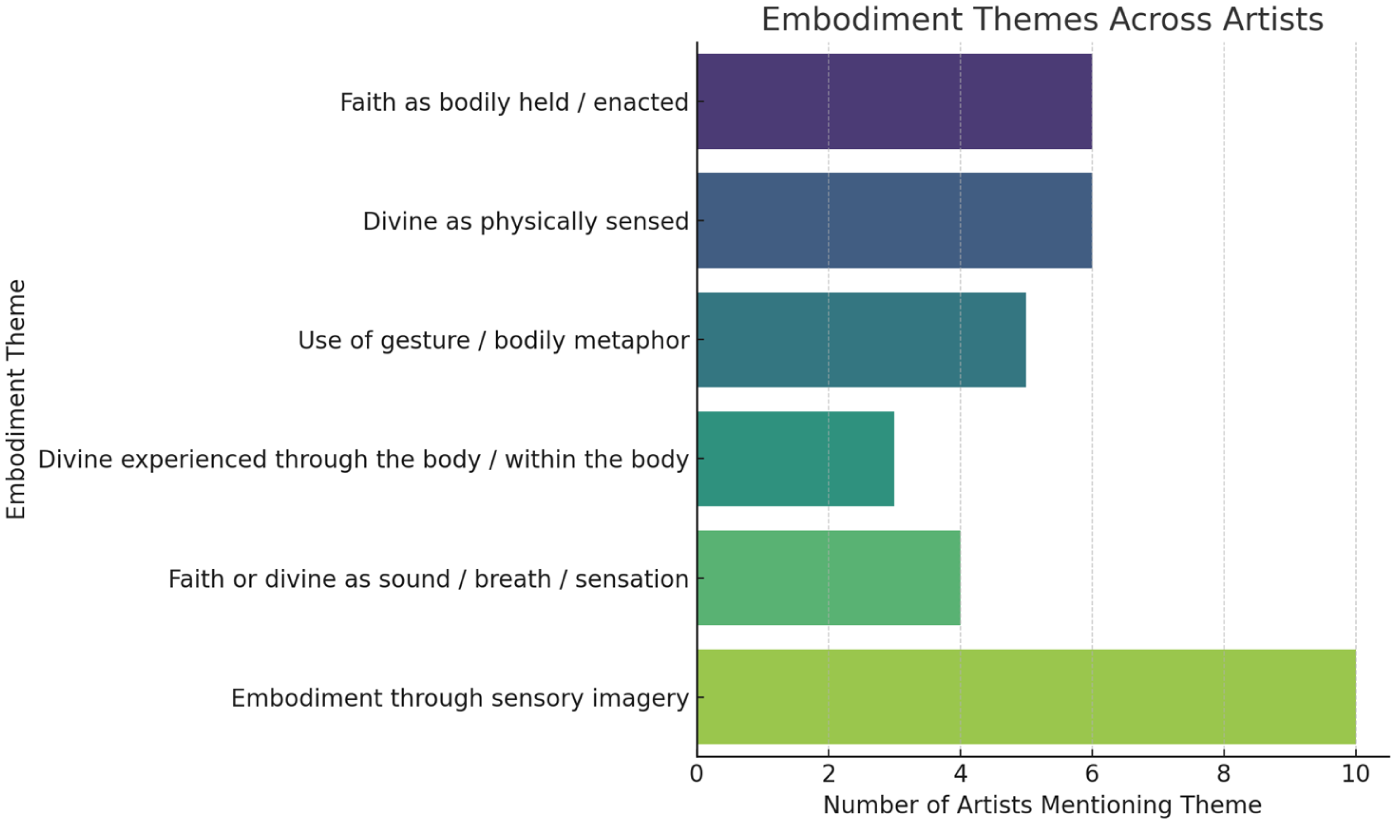
Frequency of Embodiment Themes Mentioned Across Artist Interviews.
The body as a site of divine encounter and human–divine interaction
Although few of the artists used theological language explicitly, many expressed ideas resonant with Christian incarnational thought. Edward explicitly stated: “Divine for me is incarnational,” and spoke of a creative spirit that flows through humanity. Matthew painted and sketched endless series of his self-portrait and the image of partly deflated ballon – the attempt to capture a breath – demonstrating his fascination by the inability to capture physically the reality of divine through his physical body, although it is the place of its experience.
Even in Sarah’s resistant stance, where touching the divine is taboo and leaves a mark, there is recognition that the divine is felt through the body. Her bones, masks, and natural materials express a somatic theology of boundaries, risk, and exposure.
Across these mentioned examples, divine–human interaction is depicted through spatial, physical, and relational dynamics. Matthew spoke of being seen by the divine, a reversal that emphasizes vulnerability and relationality. Chaja and Alix described perceiving the divine through bodily posture (looking up, being lifted, sensing presence), and Jeanette’s spiritual life was carried by habit, communal and liturgical rituals, and sensory symbols even when belief wavered.
In all these narratives, the divine is not encountered in abstraction alone but through what cognitive science would term embodied cognition – meaning-making grounded in perception, emotion, and physical space.
Cognitive and embodied personhood: Implications for incarnation and Imago Dei
Together, these artists suggest a model of human personhood as both cognitive and embodied. Their accounts imply that imagination, memory, emotion, and the senses are not obstacles to divine encounter but pathways into it. Their creative processes reflect theological concepts not as rigid doctrines but as lived perceptions that are tentative, evolving, and deeply felt.
Faith is seen, held, stepped into, doubted, and remembered in the body. The divine is present in echo, shimmer, gesture, and breath. This integrated perspective supports a reimagined theology of the imago Dei, in which the ability to imagine, perceive attentively, and create is one among many ways in which humans can reflect the divine image. Other forms of perception, expression, and faithfulness – including those shaped by different cognitive, sensory, or embodied experiences – also contribute to the richness of being made in God’s image. Here, the artists’ work affirms the Incarnation not only as a historical belief but also as a lived process: the divine perceived and made material through the embodied life of the believer.
In the following section, I will offer a brief insight into how the initial imagery developed and appeared in the final artwork submitted by three artists.
Case example 1: Edward
Edward’s final artwork, titled Journey (Figure 2), comprises a series of four mixed-media pieces reflecting on his spiritual path, vocation, and relationship to sacred spaces. The central image, rich in figurative symbolism and reminiscent of a postcard, features the scallop shell of St James – a traditional emblem of pilgrimage to Santiago de Compostela, that was positioned over a map of significant locations from Edward’s life.
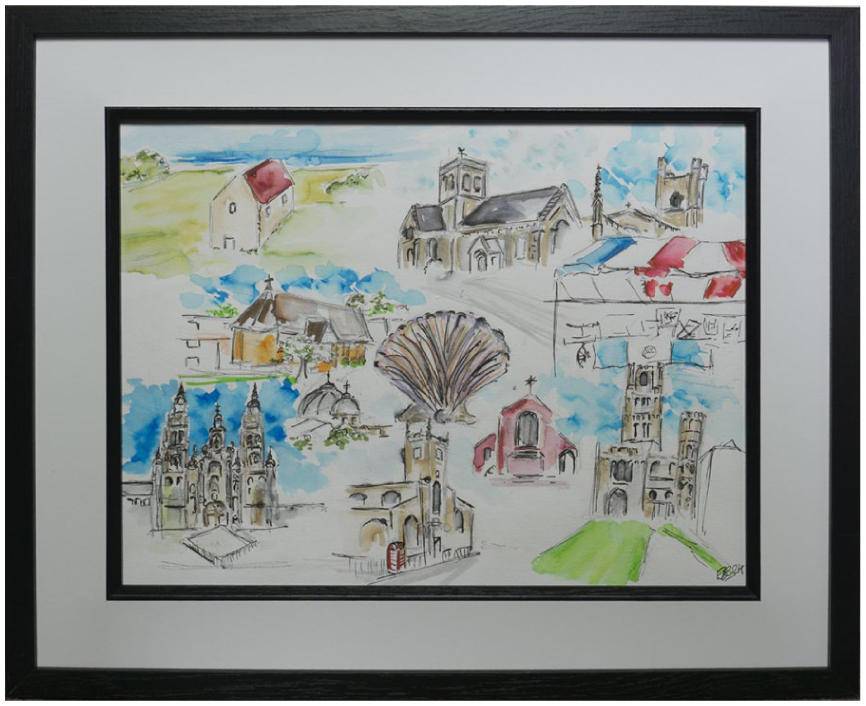
Edward Cearns: Journey (final artwork), 2024.
The accompanying three works expand the theme. One depicts a solitary figure seated on gray rocks, facing the viewer, with rays of yellow light emanating from a cross in the background. Another shows a figure walking toward green hills beneath a sky suffused with warm golden tones. The last piece depicts a crossroads directing to four symbols/signs. Each path is rendered in distinct textures: the “heart” and “smiley face” paths are green, the “cross” is muddy and uneven, and the “money” path has a smooth, concrete-like look. In the background, red and black colors suggest a more ambiguous atmosphere.
These works engage directly with Edward’s expressed sense of faith as “stepping into darkness,” a process that requires trust and openness but includes the element of personal engagement with the divine, which is relational. He mentions that it is like stepping forward, not knowing what is ahead, but believing something will appear because he has a lantern to see the next step.
In the second interview, Edward described that after our first meeting he was thinking about the image of an overflowing chalice (a liturgical symbol of priesthood), which he made as a watercolor drawing during Lent. The overflow of the chalice later transformed into a waterfall and eventually disappeared from the final piece as Edward returned to the central imagery of path and journey.
The work still holds the question of faith as journey but is now grounded in an emerging sense of call and relationality with the divine and humanity, experienced through his vocation to priesthood and art.
Case example 2: Maria
Maria’s final submission, titled Hallowed Ground (Figure 3), emerged from a process of sustained engagement with a series of evolving visual responses. Although she ultimately submitted only one painting, her body of work around the theme was expansive and deserves contextual mention. Maria’s imagery was clear and figurative from the outset – she imagined herself within hills that she described as sacred. Following our initial interview, she documented in her diary a walk in a heavy rain into the hills to sketch, during which she encountered small bones, later drawn and reflected upon. She also described a smooth pebble she modeled with her hands and eventually described as surrounded by roots – imagery that became central in the earlier stages of her exploration.
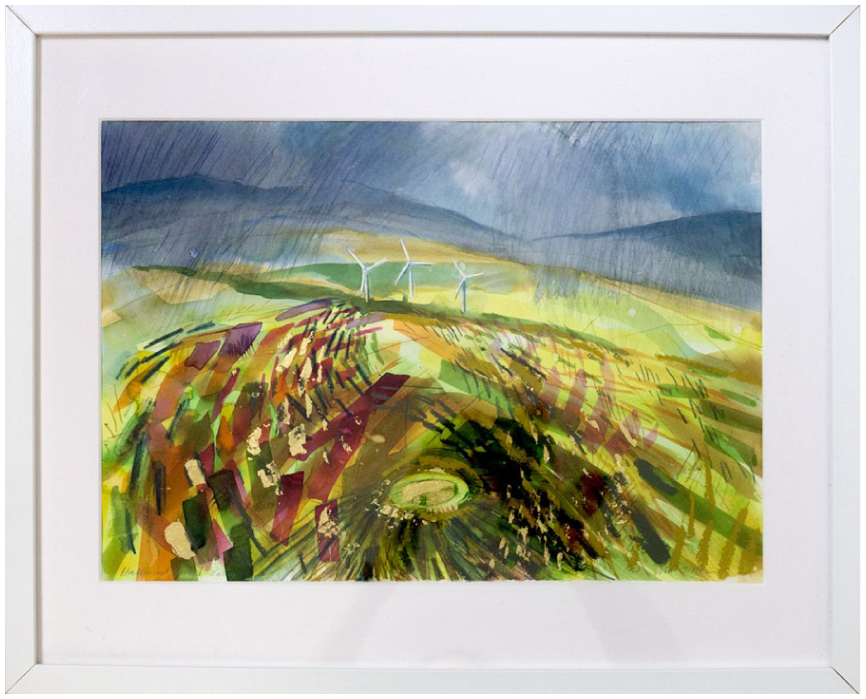
Maria Hayes: Hallowed Ground (final artwork), 2024.
The final image, Hallowed Ground (the third version of this theme), preserved many of these early elements through transformed composition. It presents a semi-aerial view of a layered landscape. Strokes by brushes, oil pastels, and pencil in earthy greens, oranges, ochres, and reds are combined with golden leaf patches that lend a shimmering quality to the terrain. In the upper section, the placement of three wind turbines resembles a scene of the Crucifixion. Behind them, more distant hills in muted blue, purple, and gray tones fade into a backdrop streaked with pencil lines reminiscent of heavy rain. In the foreground, a circular form filled with gold occupies the base of the painting. Maria later noted that this circular space, whether a crater, sacred site, or tomb, symbolically holds the pebble from her original imagery. In her notes, Maria reflects: “I am not unhappy with the image though and enjoyed the conversation I had with the page as I worked. The colours are coming from the previous work. The feeling is about how it was up there. It feels very good to be working with these ideas and the visual language that is evolving.”
Maria often spoke of her bodily relationship with faith: “It’s like the rocks in the . . . the uprooted tree.” For her, faith was something held and carried physically, deeply grounded – “under her feet” as she once described it.
Other visual iterations involved drawings of bones and, eventually, a triptych that placed human figures around the circular form. These works were less resolved but demonstrated a strong commitment to the evolving visual language of the project. Maria comments: “13th April. In the evening, I was relaxing when I suddenly felt the need to draw . . . I reached for my sketchbook and began asking myself what else did the images need? What was missing? I decided it was the human element. Composing images in this way is new for me . . . but I seem to be finding it exciting.”
Maria’s bodily experience – gestures of holding, sensations of weight and grounding – clearly influenced the composition. Though she did not directly name the image of the pebble as synonym for faith in her later notes, it remained a recurring motif. The hills also stayed constant, and the sense of sacredness they evoked did not waver throughout the process. Her work reflects a deep continuity between inner imagery, bodily perception, and the visual outcomes that are rich in symbolism, responsive to place, and open to spiritual meaning.
Case example 3: Sarah
Sarah’s final piece, Bone Phase (Figure 4), stood out within the exhibition both materially and emotionally. Presented as a sculptural mask, the artwork was constructed from painted and dyed latex, real animal bones, and casts of animal head bones and jaws. It was mounted on a mannequin head, surrounded by clear vertical strips, giving it a 360-degree presence that invited viewers to walk around and engage from multiple angles. The rawness of the materials, the stark visibility of “naked bones,” brought a somehow visceral, even uncomfortable element into the conversation on the divine and faith.
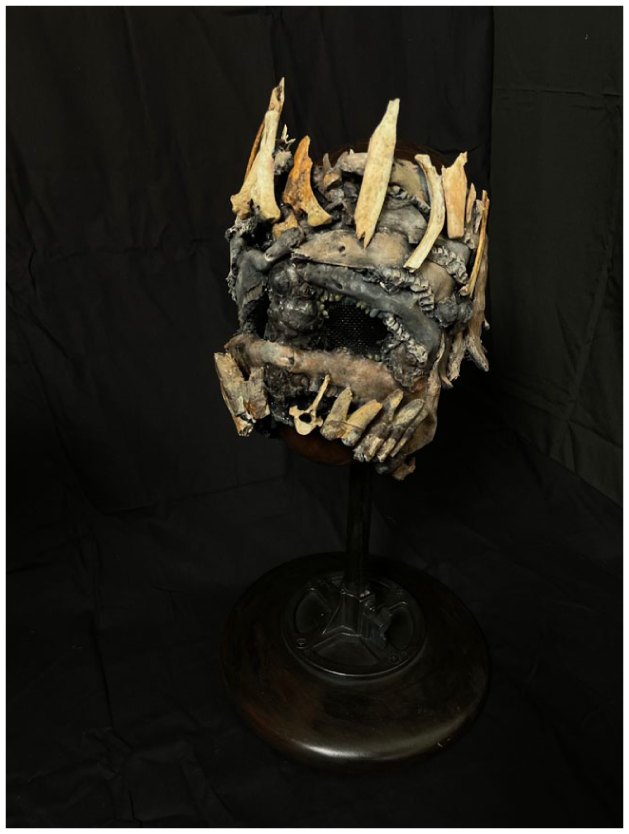
Sarah Fortais: Bone Phase (final artwork), 2024.
The reception of Bone Phase revealed its power: it generated strong affective responses, including discomfort and confusion. Some viewers struggled to relate the imagery to conventional representations of the divine. However, Sarah’s intention was never to provoke or to unsettle for its own sake. Her approach was deeply rooted in personal memory and embodied relationship to nature. In earlier conversations, she described her childhood in rural Canada, walking through forests and collecting bones from the remains of animals – an experience she spoke of as normal, even “cool.” She described her connection to bones as part of life’s natural cycle and as revealing something profound: “Decay of material but more in . . . Not that it’s gross or like scary but more like how it reveals a complexity of an organism, so, like it’s actually you.”
While the piece’s form (a mask) evoked associations with ritual, identity, and concealment, Sarah was very clear in rejecting these interpretations. She specifically distanced her work from references to superhero imagery, negative ritual practices, or death symbolism, emphasizing that these were not her intentions. The mask, instead, emerged from her exploration of the organic reality of life and its passing, without the need to spiritualize or dramatize death. There was no explicit sound element included in the piece, and her earlier description of faith as a “purring” sensation, something ambiguous, healing, and physically resonant, was not directly translated into the final work, though one might consider the mask’s quiet materiality a kind of tactile echo of this.
Sarah also acknowledged, during our second conversation, that this was the first time she had used bones in a work that took a human-like form. The mask, with its rib-like protrusions and anatomical references, was not intended to reference Christian iconography directly, but she noted that some might inevitably see the image of the Crown of Thorns emerging from the structure. She neither confirmed nor pursued any other connection to existing religious imagery as an inspiration, apart from her research on masks and the intention of working with this topic further.
What remains in Bone Phase is an embodiment of Sarah’s earlier visualizations of the divine: her black hole image, her metaphors of complexity and unknowability, and her view of faith as something that becomes real only through previous relationships. Though the piece does not explain or define that relationship, it invites the viewer to enter a space where decay, mystery, and physical presence speak on their own terms.
Conclusion
This article set out not merely to illustrate what Christian artists believe but also to explore how they perceive – how faith and the divine are seen, felt, and held in inner imagery before they are ever rendered in paint or clay. In doing so, it challenges the traditional framing of theology as a system of articulated doctrines and instead affirms it as a perceptual and imaginative act.
What emerged from these interviews is not a catalog of beliefs but a living visual theology: one in which faith does not reside in fixed propositions or even in external religious symbols (although present), but in the dynamic, inner space of perception. The artists’ descriptions of glow, shimmer, purring, light, and stone reveal that faith is not always visualized as something, but often resides in the act of visualization itself. This subtle shift from an image of faith to something we can call faith in an image is a central insight of this study.
By prompting artists to attend closely to their inner imagery, we uncovered a form of theological knowledge grounded in bodily awareness and creative intuition. In many cases, the visual became the site where contradictions could be held, where affect and cognition met, and where lived faith was rendered visible sometimes even for the first time and to the surprise of the artists themselves. This suggests that perception itself is not merely a by-product of belief, but an active medium through which people come to know and relate to the divine.
Such findings extend conversations in both theology and cognitive science. While cognitive models have rightly emphasized metaphor and embodiment in religious thought, this study shows that visual imagination and theological visualization play a more constitutive role than is often acknowledged. Likewise, theological reflection can benefit from a deeper appreciation of perception, not just as a way of interpreting doctrine, but as a formative process through which faith becomes thinkable and sharable and constitutive for theology.
Moreover, recognizing inner imagery as a source of spiritual knowledge offers new opportunities for theological education, faith formation, and community reflection. Visualization bypasses the need for doctrinal precision or eloquence, making space for those excluded by traditional theological language. Its ambiguity encourages shared exploration instead of fixed conclusions, fostering a more participatory approach to encountering the divine. Incorporating such practices into spiritual direction, catechesis, or liturgical arts can help communities embrace complexity and deepen faith.
Collaboration with visual artists from a Christian background was a central component of this study, raising the question of whether this methodology could be applied more broadly. Further research may be necessary to explore these insights with individuals who are not specifically trained to attend to their inner visual worlds. Nevertheless, the interview prompts are broadly applicable, as imagination is not exclusive to artists, and both creativity and bodily experiences are common to most individuals, albeit experienced differently. Ultimately, this article argues that faith and belief are fundamentally personal rather than solely doctrine-based, a theme explored in depth throughout.
In short, this study suggests that if we are to understand religious imagination, we must pay attention not only to what people say they believe, but also to the images they hold and how those images move, resist, comfort, or disturb them. For these artists, the divine is not only a subject of belief but also an event of seeing. And it is through this personal, partial, and embodied seeing that faith takes form.
Footnotes
Acknowledgements
The opinions expressed in this publication are those of the author and do not necessarily reflect the views of the John Templeton Foundation or the University of Birmingham. I would like to thank Felicity Parker for proofreading of this article.
Declaration of Conflicting Interests
The author declared no potential conflicts of interest with respect to the research, authorship, and/or publication of this article.
Funding
The author disclosed receipt of the following financial support for the research, authorship, and/or publication of this article: This publication was made possible through the support of the Psychology Cross-Training Fellowship Programme for Theologians at the University of Birmingham, funded by the John Templeton Foundation (Grant 62699).
Ethical Considerations
This research was conducted in accordance with institutional and collaborative ethical standards. Approval was obtained from the Institutional Committee of the Margaret Beaufort Institute of Theology (approval number 20230927, from 27 October 2023), which functions as its institutional review board.
Consent to Participate
All participating artists have signed a written consent form to take part in the event.
Consent for Publication
Participants provided informed consent for publication in writing, including their names, text, video, and photo recordings.
