



Abstract
Among the consequences of conflicts between missionaries are a reduction in ministry effectiveness and an increase in the likelihood of missionary attrition. In contrast to perspectives of conflict management in Christian contexts which tend to focus on power (condemning the other party as sinful, enforcing submission to the hierarchical superior, or separation of the conflicting parties), the dual concern model of conflict management views conflict as an opportunity to understand each party’s concerns so that the two parties may cooperate and find solutions that correspond to the interests of both parties (Phil. 2:4). The dual concern model also predicts conflict behaviors (i.e., forcing, submission, or avoidance) when the interests of both parties are not considered. A qualitative analysis of data collected from present and former missionaries describing power issues (N = 34) indicates that the dual concern model of conflict management can be used to predict conflict behaviors and outcomes, even when conflicts are initially framed in terms of power. Recommendations for increasing cooperation between missionaries include better training in conflict management, the creation of mediation systems, and the development of an organizational culture that promotes cooperation.
Conflict between missionaries is one of the most common and most difficult phenomena encountered in mission work (Carter, 1999; Dunaetz, 2016; Hale, 1995; Hay et al., 2007). It is an especially perplexing problem because missionaries are generally committed to living in accordance with the gospel which emphasizes love, humility, service, and unity. However, these lofty ideals often fall into disuse and are transformed into jealousy, backbiting, accusations, and abuse when one missionary feels threatened by another and conflict ensues (Dunaetz, 2010a; Hale, 1995).
Our initial goal is to examine and compare conflict management perspectives that missionaries can use to constructively resolve conflict, both traditional perspectives that focus on power and that have been used by missionaries more or less successfully for generations, as well as an empirically tested model of understanding conflict—the dual concern model of conflict behaviors and tactics (Ben-Yoav and Pruitt, 1984; Pruitt and Kim, 2004; Sorenson, Morse, and Savage, 1999)—which has biblical support at least as strong as the other approaches. We will then examine data from actual missionary conflicts showing how the dual concern model can be used to analyze and resolve conflict constructively.
Traditional power-focused perspectives of missionary conflict
Missionary conflict is often approached using one of three perspectives which tend to focus on power, all of which have value.
The conflict as sin perspective
Missionaries (and many others involved in Christian ministries) often interpret conflict as a sign of sin (Sande, 1997). Based on the authority of scripture, one missionary may believe he or she has the power and justification necessary to correct or even condemn the other. A missionary’s internal (and potentially unconscious) reasoning may go something like this when experiencing a conflict with a coworker: “I’m doing God’s will. This other guy is doing something that impedes me. If I’m on God’s side, it’s clear whose side he is on. Therefore his behavior is sinful and must be stopped.” Such a situation may encourage a missionary to condemn the other missionary in the spirit of Matthew 18:15–20, “If your brother sins against you, go and tell him his fault” (ESV).
However, a potential problem with this approach is that the other missionary may very well be thinking the same thing. In such a situation, the missionary with the most power, typically the one highest in the organizational hierarchy, gets to decide who is right (Dunaetz, 2016; Hale, 1995). Such a decision may be viewed as oppressive and abusive by the missionary having less power. One of the reasons for this phenomenon lies in our tendency to have self-serving biases (Forsyth, 2008; Miller and Ross, 1975). When we have incomplete or ambiguous information (as is often the case in conflicts), we fill in the missing information with material that makes us and our position seem justified.
A second problem with this perspective is that not all conflict is sin. Interpersonal conflict in missionary contexts can be defined as the “process that begins when an individual . . . perceives differences and opposition between [himself or herself] and another individual . . . about interests and resources, beliefs, values, or practices that matter to them” (de Dreu and Gelfand, 2008: 6). Conflict is essentially a perception of differences and opposition. The existence of such perceptions may be due to incomplete information, misperceptions, or fear of not achieving one’s goals. It is not necessarily due to sinful behavior by the other party. For example, if a junior missionary desires to be placed in a ministry where he would be primarily working with university students, while a senior missionary wants him to be placed in a ministry maintaining a bookstore started by a previous generation of missionaries, the senior missionary may view the junior missionary as being in opposition to him. Such a conflict is not necessarily sin. It results from different concerns. The junior missionary may be primarily concerned about touching the younger generation while the senior missionary may be primarily concerned about the loss of established ministries. Thus, the conflict as sin perspective may be completely irrelevant for many, if not most, missionary conflicts.
The submission as solution perspective
A second common power-focused perspective found in missionary circles views submission to authority as the key to resolving conflicts (Dunaetz, 2016; Hale, 1995). In this view, even when a missionary’s supervisor makes a decision which seems uninformed or abusive, submission is expected because it is God’s will. “Submitting to such decisions is the only sure way we have of ultimately knowing what God’s will is. . . . We need to start out with the attitude of accepting our leaders’ decisions as from God” (Hale, 1995: 233). Hebrews 13:17a is often provided as the scriptural basis for this perspective: “Obey your leaders and submit to them” (ESV).
The difficulty with this approach is that the author of Hebrews presupposes godly leaders who are primarily concerned about the interests of those whom they lead (Heb. 13:7, 17b). This might not always be the case. Leaders who try to enforce submission appear to be carrying out the defining behavior of a leader who enjoys lording it over their people, rather than the servant whom Jesus described as the model leader (Mat. 20:25–26; see Dunaetz, 2016, for a detailed discussion of the dangers associated with this perspective).
The separation as solution perspective
When Paul and Barnabas had a conflict they could not resolve concerning John Mark, they separated and went their own ways (Acts 15:36–40). This passage is sometimes cited in missionary contexts as a way of resolving (or avoiding) conflict (Deffinbaugh, 2004; Steen, 1973). Although the New Testament seems to indicate that all turned out well for Paul, Barnabas, and John Mark, missionary conflicts that result in separation are often accompanied by continued mistrust and damaged relationships (de Dreu and Weingart, 2003; Langfred, 2007). Although separation might be appropriate in intractable conflicts (Coleman, 2000), many times better solutions can be found that result in superior solutions and improved relationships (Johnson, Johnson, and Tjosvold, 2000; Rahim, 2001; Runde and Flanagan, 2007).
Each of these three perspectives (conflict as sin, submission as solution, and separation as solution) may serve as a useful tool for a limited number of situations. However, their usefulness may be limited by the damage done by their typical implementation. In contrast, another perspective, the dual concern model of conflict management (Rahim, 2001, 2002; Rubin, Pruitt, and Kim, 1994; Sorenson et al., 1999), may be useful in understanding virtually all missionary conflicts. Whereas these first three perspectives have all focused on power (the power to condemn the other, the power to enforce submission, and the power to separate), the dual concern model of conflict management focuses on finding solutions that correspond to the concerns or interests of both parties.
The dual concern model of conflict management
If interpersonal conflict in missionary contexts is defined as a process that results from the perception of difference and opposition between two parties, each missionary has a set of concerns that involve his or her resources, beliefs, values, or behavior (de Dreu and Gelfand, 2008). When differences appear that prevent one or both missionaries from achieving their goals, conflict occurs. The dual concern model of conflict management (Rahim, 2001; Rubin et al., 1994; Sorenson et al., 1999) describes tactics and behaviors that are likely to be used by each party, based on the importance they place on responding to their own concerns and to the concerns of the other party. Although a power differential may exist between the parties, power is not the focus (as it is in the previously described views of missionary conflict).
The dual concern model of conflict presents a way of viewing conflict that is very similar to the one presented by the Apostle Paul to the church at Philippi: “Let each of you look not only to his own interests, but also to the interests of others” (Phil. 2:4, ESV). Paul views each party as having different interests, but not necessarily incompatible interests. From Paul’s perspective, the best solutions are found by considering each party’s interests, which is the same conclusion that is drawn from the dual concern model of conflict (Rahim, 2001; Rubin et al., 1994; Wilmot and Hocker, 2011).
The dual concern model of conflict is represented in Figure 1 (Dunaetz, 2011; Rubin et al., 1994; Wilmot and Hocker, 2011), illustrating the relationship between concern for each party’s interests and behavior. The two axes represent the degree to which one is concerned about his or her own and the other party’s interests.
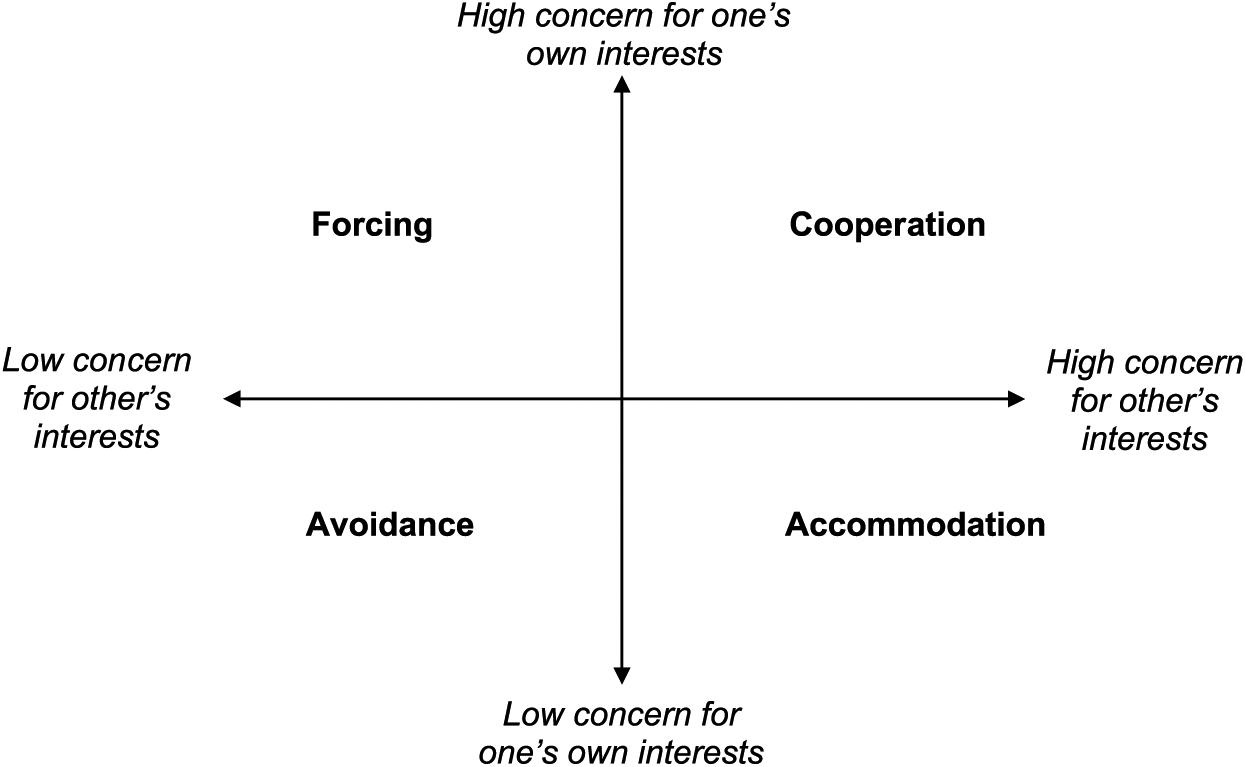
The Dual Concern Model of Conflict (Dunaetz, 2011; Rubin et al., 1994; Wilmot and Hocker, 2011).
The vertical axis represents how concerned one is about his or her own interests. It is easy to assume that in a conflict both parties are equally concerned about their own interests and that the party with the most power will emerge victorious. However, research indicates that the strength of one’s concern for his or her own interests varies extensively between individuals and between contexts (Gabrielidis et al., 1997; Kilmann and Thomas, 1977; Rhoades and Carnevale, 1999; Sorenson et al., 1999). The ability to vary one’s concern for one’s own interests is an underlying assumption of Jesus’ call to serve others (Mt. 23:11, Mk. 9:35) and his prayer before the crucifixion (Lk 22:42).
For missionaries, these interests can include a wide variety of issues such as their support or other financial concerns, being assigned to a ministry to which they feel called, and the quality of their relationships with people whom they value. In a given conflict, a missionary may have high concern for his or her interests, being willing to spend much effort to get what he or she desires. Or the contrary may be true; a missionary may have low concern for his or her interests, believing that it is not appropriate to expend effort to seek them out.
The horizontal axis of the dual concern model represents how concerned a missionary is for the interests of the other party in the conflict, who may be a team member, a local Christian, a mission leader, or anyone else with whom the missionary may have a conflict. Just as concern for one’s own goals varies from conflict to conflict, concern for the other party also varies between individuals and contexts (Janssen and Van de Vliert, 1996; Kilmann and Thomas, 1977). In a given conflict, a missionary may have low concern for the other party’s interests, being either ignorant of them or believing that they do not matter or that they are not valid. Or, a missionary may have a high concern for the other party’s interests, perhaps because he or she believes that they are legitimate, perhaps because he or she is afraid of the consequences of ignoring them, or perhaps simply because he or she believes such an attitude is more Christ-like.
The dual concern model predicts that each of the four combinations of concerns (high vs. low concern for self’s interests, high vs. low concern for other’s interests) leads to specific types of behavior or approaches to conflict, as labeled in the four quadrants of Figure 1 (Dunaetz, 2011; Rubin, et al., 1994; Wilmot and Hocker, 2011). A combination of high concern for one’s own interests and low concern for the other party’s interests is associated with forcing, using one’s psychological and physical resources to obtain what one wants, with little or no attention to how this affects the other party (de Dreu et al., 2001). This approach to conflict is sometimes called competition (Sorenson et al., 1999). If both parties choose forcing, the conflict becomes destructive very quickly (de Dreu et al., 2001; Rahim, 2001). Resources are expended to counteract each other’s efforts, feelings are likely to be hurt, relationships are often damaged, and unfair tactics are often used in order to get what one wants (Wilmot and Hocker, 2011). Typically the party with more power (Dunbar, 2015; French and Raven, 1960) wins such conflicts while the party with less power loses. Such conflicts are often the most spectacular in terms of damage on both the personal and organizational level. However, power-based tactics are not the only way to resolve conflicts.
A second combination of concerns, low concern for one’s own interests and for the interests of the other party, promotes avoidance, a behavior characterized by not engaging the other party with the issues at hand. Similar to the separation as solution perspective, such a strategy prevents conflicts from being resolved constructively, but may also, at least temporarily, prevent the negative outcomes that come from forcing. Empirical studies of avoidance (Sorenson et al., 1999; Tjosvold and Sun, 2002) indicate that the reasons for this strategy are actually broader than those predicted by the dual concern model. A high-power person may prefer avoidance to prevent a low-power person from having a voice and thus being able to influence the conflict process. Others may prefer avoidance to maintain the relationship, often with a hierarchical superior, by not bringing to light issues which might cause the person to have a negative emotional reaction (Rosen and Tesser, 1970; Tourish and Robson, 2006). Others may use avoidance when they have indirect ways of achieving their conflict-related goals (Tjosvold and Sun, 2002).
A third combination of concerns, low concern for one’s own interests and high concern for the other party’s interests, leads to behavior and strategies that are characterized by accommodation, a decision to not use one’s resources to obtain what one desires (Janssen and Van de Vliert, 1996; Sorenson et al., 1999). Accommodation often occurs when there is a power differential between the parties and the high-power party is willing to use a forcing approach to obtain what he or she wants. Realizing that the situation is futile, the low-power party accommodates to the high-power party, limiting any damage to the relationship or the organization. But accommodation may also be chosen as a strategy, even by the party with the greatest power, because of the absence of clear desires concerning the conflict topic. If the other party has a clear desire and the first party has no specific view on the topic, accommodation is the easiest way to resolve differences. Another reason for accommodation is that one person, regardless of power status, may simply want to preserve or develop the relationship by pleasing the other, so he or she will do what the other person wants, regardless of his or her own desires (cf. Jesus’ interpretation of the Old Testament law, especially on retaliation, in Mt. 5:33–48).
A fourth combination of concerns, in contrast to the other conflict approaches, consists of high concern for both one’s own interests and the other party’s interests, regardless of the power held by each party. This leads to behavior that promotes cooperation, working together to find solutions that correspond to each party’s interests (de Dreu et al., 2001; Janssen and Van de Vliert, 1996). When cooperation occurs, there is no winner or loser. Instead, both parties profit from finding a solution that maximizes the achievement of the two parties’ interests. Empirical studies have indicated that high concern for both parties’ interests yields superior results in conflicts by producing solutions that are characterized by both greater joint individual outcomes and superior organizational outcomes (Ben-Yoav and Pruitt, 1984; Gelfand et al., 2012; Rahim, 2001; Tjosvold, Wong, and Feng Chen, 2014).
With the introduction of cooperation as an approach to conflict, the dual concern model becomes prescriptive (Janssen and Van de Vliert, 1996; Pruitt and Carnevale, 1993; Wilmot and Hocker, 2011). In the majority of situations, cooperation will be the preferred strategy because it will produce the best organizational outcomes and respond to the greatest number of concerns of both parties. In some situations, accommodation (e.g., when one party truly has no preferences) or forcing (e.g., when defending foundational beliefs such as those found in doctrinal statements) might be the preferred strategy, but in most conflicts that missionaries experience, cooperation will produce superior outcomes.
The dual concern model is thus a useful tool for analyzing conflict and for constructively managing such conflicts. To demonstrate that the dual concern model of conflict management can be used in missionary contexts to predict conflict outcomes, this study examines what missionaries have said about conflicts they have experienced. However, when the data and examples used in this study were collected, missionaries were asked to provide examples from a power-oriented perspective. A second goal, therefore, is to demonstrate that the dual concern model can be used in circumstances even when the conflict is initially framed in terms of power, rather than concerns.
Method
Painful and destructive conflicts between missionaries (Dunaetz, 2010b, 2016; Hale, 1995; Palmer, 2013) suggest that mutual concern for the interests of both parties (Phil. 2:4) is often absent in such conflicts. The first goal of this qualitative study is to examine empirical evidence to see if the different behaviors and strategies of the dual concern model of conflict, as well as their predicted consequences, are present in the conflicts experienced by missionaries.
Data used for this study came from a broader phenomenological study carried out to explore the extent of inappropriate use of power in evangelical missionary circles (Greenham, 2016). A secondary data analysis (Glass, 1976; Vartanian, 2010) focusing on the conflict behaviors and strategies used by missionaries was undertaken for this present study. All the respondents in the original study answered questions specifically concerning the abuse of power, not questions concerning conflict (Greenham, 2016). An analysis of their experiences, however, does not need to be limited to the original focus. These missionary accounts reflect perspectives on multiple aspects of reality as they perceived it. And such perceptions can provide insight into phenomena not directly linked to the specific questions which spawned them. In fact, an “important strategy for [qualitative] inquiry is to employ multiple methods, measures, researchers, and perspectives—but to do so reasonably and practically” to describe various phenomena (Patton, 2002: 247). In this case, a reanalysis of the data collected provides clear examples of the conflict approaches used by missionaries. So a second purpose of this study is to show that, even in situations that seem to be completely focused on power, the dual concern model of conflict can be used to understand what has occurred and what can be done to manage the situation.
Greenham (2016) sent a questionnaire to 60 individuals or married couples with missionary experience, most of whom were serving with a large North American missions organization. Participants responded to questions concerning whether they had ever felt they were the victims of an inappropriate use of power or control on the part of a co-worker or supervisor, as well as how such situations could have been avoided or better handled. Specifically, these missionaries responded to the following questions:
Have you ever felt you were the victim of an inappropriate use of power or control on the part of a co-worker or supervisor? (In addition to overt cases of inappropriate control, examples could include the use of authority or the semblance of authority to discourage debate, to assert that certain subjects should not be discussed, or to create a culture where it is inappropriate to question or complain.)
If so, please describe what happened in a few sentences. Please do not reveal names or otherwise identify the persons or organization involved.
How do you feel this situation could have been avoided or better handled; by the other party, yourself, or both?
From the 60 questionnaires emailed to missionaries, 34 were completed and returned. Of these, 17 said they had experienced no abuse of power issues, but the other 17 said they had indeed experienced an inappropriate use of power or control. In addition, one person heard about the survey from others and wished to provide a description of his experiences. Thus 18 participants provided data about their experiences. For this study, the data was analyzed and classified according to the conflict behaviors and strategies defined by the dual concern model of conflict management (Ben-Yoav and Pruitt, 1984; Pruitt and Kim, 2004; Sorenson et al., 1999): forcing, avoidance, accommodation, and cooperation.
Results
The following analysis demonstrates that all four conflict behaviors and tactics described by the dual concern model, as well as their expected consequences as predicted by the model (Pruitt and Kim, 2004; Rahim, 2001), occur in missionary contexts that might otherwise be primarily interpreted in terms of power.
Forcing
The use of force to achieve one’s interests at the expense of another’s interests is the conflict behavior or tactic most likely to cause pain and damage relationships. Such a tactic was described by the missionary who presented a conflict with his supervisor as follows: Requests for godly [counsel] from stateside pastors and fellow laborers were not permitted, and refusal to comply with these inappropriate restrictions would be treated as “insubordination.” . . . This was viewed as an attempt to silence us while we were on the field, and greatly hindered our ability to seek reconciliation and resolution. We viewed this as an attempt to protect our supervisors from honest criticism and scrutiny from higher field and stateside leadership. This treatment left us feeling alone, isolated from teammates and fellow laborers, and victimized with no potential recourse of action.
Although this missionary’s supervisor perhaps obtained the submission he desired, the missionary and his spouse were severely hurt by his use of forcing tactics. In fact, these behaviors resulted in the resignation of this missionary family from the mission.
Another missionary reported a similar use of a forcing tactic, illustrating the limitations of the “conflict as sin” perspective: During one particularly difficult year of working under my [Team Leader]’s leadership we were told by our [Regional Leader] that we should follow the Matthew 18:15–20 model for sending in any negative feedback on our [Team Leader]. This principle had not been applied to the formal review process before and I questioned my [Regional Leader] on using these verses in the review process. In essence, I was concerned that my [Regional Leader] was misusing these biblical principles that should be applied in the case of “sin” inside the church, and applying them in a formal review process. His responses to myself and another concerned co-worker (who worked under my [Team Leader]) was that he wanted us to only inform him of the positive aspects of my [Team Leader]’s leadership. If we had anything negative to say about our [Team Leader], then we should handle it directly with our [Team Leader].
This missionary felt the Regional Leader’s method of handling conflict would ensure that he would be in a losing position whenever conflict of any kind might arise with his Team Leader. The behavioral norms enforced by the Regional Leader gave the missionary little voice in the conflict with his Team Leader.
One cross-cultural missionary provided another illustration of conflict behaviors characterized by force, where the interests of the low-power party were not considered: Leadership held numerous meetings regarding their personnel, making decisions about their future, work, trajectory etc., and then we were told after the fact what we would be “doing.” We did not ever have voice in these meetings and only heard about them through the grapevine. . . . Those who were quiet and reserved were said to be “humble” and those that questioned the systems were “prideful.”
From this missionary’s perspective, when conflicting views on a missionary’s activities arose, the conflict would be settled by prioritizing leadership’s interests over the interests of the missionary by preventing the missionary from being heard. Conflicts were managed this way because missionaries in non-leadership positions were expected to submit without question. Leaders used spiritual language to impose their will at the cost of others’ concerns.
In Christian circles, forcing often takes the form of “submission as solution” as illustrated by the responses above. As would be expected in conflicts characterized by the forcing approach, the parties with the most power (typically a supervisor) won the conflicts in question, but in such a way that relationships were damaged. Unfortunately, damaged relationships are a common consequence of forcing. These examples cited indicate that high concern for one’s own interests, coupled with low concern for the interests of others, can have very destructive effects, ranging from discouragement to attrition.
Avoidance
While avoidance may sometimes be appropriate, such as when both parties believe that the issues are not important enough to risk discussing any differences in perspective, reports from several respondents suggest that avoidance in other situations often has important negative consequences.
One missionary who served in Africa recalled his experience: When I arrived on the field I encountered a hands off approach from my mentor. . . . I went to my mentor asking for help and expressing curiosity over how to deal with beggar children and he told me that beggar children were a way of life and I had to get used to them. He offered no help or advice. . . . As long as I was out of my house during the day and with the people [he] did not care what I did.
This missionary was frustrated by his mentor’s unwillingness to address a problem commonly encountered by missionaries working among the poor. His mentor’s avoidance of the issues left him feeling abandoned, experiencing a lack of concern from the one he hoped would help him in this new cultural context. The mentor dismissed the missionary’s concerns for the poor (and apparently his own as well). If the missionary had been satisfied with the suggested strategy of simply “being with the people,” avoidance on the part of his mentor would not have been problematic, at least not concerning the relationship between the missionary and his mentor. However, this missionary legitimately desired to become more effective in ministry and thus found his mentor’s avoidance painful, if not destructive.
Another missionary reflected on a difficult interpersonal conflict where a supervisor encouraged the use of avoidance as a strategy in a conflict with another missionary: My wife . . . and I were having frequent conflict with another couple on the team, and as our culture shock was mounting, the conflict was growing increasingly bitter. . . . [We] approached our supervisor—let’s call him Adam—because we felt we needed to resolve the tension, but weren’t able to without outside help. He told us to leave them alone, to essentially withdraw our friendship and give them space. As our team was small, this essentially put us on an island, and it was months before we were able to have a meaningful conversation with this other couple. Of course, his cutting the ties between us only made [it] worse. We did (finally) talk it out, but it was literally years later. . . . On his part, he should have followed up with us after a week or two to see if his “solution” was working. As it was, he gave the order and then washed his hands of the situation.
In this case, the supervisor presented avoidance as a simple, short-term strategy to calm a conflict. However, as the counseled avoidance became the long-term strategy by default, it seems to have amplified the interpersonal conflict, adversely affecting the missionary team’s ministry. Although the short-term benefits of avoidance may be tempting, this strategy is more effective in insignificant matters than in situations that need to be resolved for long-term success, especially in teams where missionaries need to work closely with one another. In this case, a strategy of avoidance ensured that neither missionary couple could bring up their concerns in order to propose a solution that would have benefited both couples.
Accommodation
The conflict strategy of accommodation may be used either by a person with less perceived power than the other person who fears the consequences of disagreeing, or by a person who believes his or her interests are less important than the other person’s interests in the given situation. When people use accommodation to resolve conflict because they feel they have no other choice but to respond to the other party’s concern while denying their own, they tend to feel dissatisfied, if not abused, as the following examples illustrate.
One missionary described a past conflict where he responded with accommodation because he thought it was appropriate at the time, assuming that it was the best way to work within the organizational system: At the time I didn’t feel like there was further room for debate in the matter. Looking back on the situation now, I could have explained myself in better terms or asked for a face-to-face conversation (we were speaking on the phone) in which I would have felt more comfortable to form my ideas. I have also come to realize that this person, although seemingly intimidating, is actually quite reasonable and does want to serve those he is in leadership over. . . . It seemed, however, that leadership had decided firmly upon the structure and there was no examining or discussing it. We are not very argumentative, so we never really attempted to buck against the system. Looking back now, we should have initiated a conversation about things that bothered us, at the very least to let them know of our discontent.
Although a power differential existed, this missionary later realized the person in leadership would most likely have taken his concerns into consideration. However, this was not possible since the missionary did not voice them, choosing instead a strategy of accommodation.
Similarly, another missionary noted that he was afraid of expressing his concerns but chose accommodation instead: I don’t think that our supervisors were malicious in their intent, but rather I feel that they were ill equipped to lead a team. Their desire was to get us up and running in [the] country quickly, but their methods were not helpful to us. . . . They threw us into certain situations that were difficult and probably unnecessary. . . . Unfortunately, our team dynamics were such that we did not feel that open communication and discussion [were] welcomed. . . . My besetting sin of the fear of man also contributed to my inability to press issues that should have been pressed. Secondly, I think our organization should have done a better job at placing leaders in their positions. It seemed that if someone had a passion for a people or a particular work, and they had been there the longest, they would automatically be placed in a position of leadership.
Both of these missionaries pointed to systemic weakness in the mission’s leadership structure. Accommodation is encouraged (if not required) by organizational norms which expect newcomers to fit into a structure without having a voice or the ability to question the status quo. The damage caused by such norms can be compounded if a supervisor uses a conflict strategy of forcing or avoidance.
Missionaries who choose to deal with conflict by responding with accommodation may experience outright abuse. The following missionary who chose to respond with accommodation reflected upon a conflict which led the local director of the ministry to confiscate the missionaries’ passports and to reduce their pay. In addition, the director accused them of lacking dedication and “eating too much”: I think that the hardest part was that scripture provided no guidelines with how to handle an abusive leader other than the NT’s guide to submit to our masters. Agreed, there is the example of Saul and David forced to live with his enemies but that was not very helpful. Having uprooted our family to live in a war zone, we felt very vulnerable and abused by submitting.
Another respondent (who heard about the survey from others) explained his feelings of helplessness in a similar situation: Throughout the entire time, our team leader treated us extremely rudely, bullied us, and constantly threatened us. We then tried to report him to our director for bullying but were told that by making such a report we were breaking the policy (that we had signed) by saying something negative about another member’s character. We were told we had no option other than to submit. My wife spent many nights crying herself to sleep and our marriage was quite strained as we tried our best to cope with living in such a degrading, bullying atmosphere—giving us no time to truly deal with the additional stress of having moved to a new culture and country, etc.
These experiences illustrate the danger of the “submission as solution” perspective of conflict resolution that often leads to a strategy of accommodation. Missionaries are expected to show high concern for the interests of those in power and little concern for their own interests. Such a structure may work fine when those in power are loving, godly, and wise, but if any of these qualities is missing or limited, the risk of abuse is elevated.
Cooperation
A high concern for both the other party’s interests and one’s own interests prepares the way for cooperation, the conflict resolution strategy that has both empirical (Ben-Yoav and Pruitt, 1984; Gelfand, et al., 2012; Rahim, 2001) and biblical (Phil. 2:4) support as being the best approach in many, if not most, situations. Cooperation as a conflict strategy typically results in constructively resolved conflicts becoming a normal phenomenon of missionary life, as in one missionary’s case, where he reported that his “supervisor was approachable and regularly solicited honest feedback.” This supervisor both expressed his concerns and actively sought to learn the concerns of those under him.
Sometimes, missionaries may experience cooperation only after a difficult process. One missionary recalled: Upper leadership was quite hands-off on their appraisal of who should fill the [Team Leader] role, and we were basically left to ourselves to decide which of us would take the lead. As a side note, this is apparently not company policy, but it certainly did set us up for a disastrous power-struggle. Happily, however, we did not crash and burn. While [a certain missionary] is a gifted, mature believer who has leadership abilities and a desire to lead, he was sensitive enough to the Spirit to withdraw his “hat from the ring” as he sensed that he was not supposed to take on the [Team Leader] role. Where he easily could have put himself forward—being the male representative on the ground, desiring to be in leadership and having identifiable gifting in the area of leadership—he chose instead to seek the Lord and even to make the difficult decision to withdraw his name from consideration. It was his humility and maturity that saved our team from having to vote or potentially finding ourselves divided and embittered. I, on the other hand, sensed that the Spirit was calling me to step into the role, despite having less desire than [the other missionary] to “climb the ladder” or enter into leadership officially and was able to take on the role without the sense of competition that very easily could have soured the experience.
In this situation, the missionaries chose to express their concerns and selected a solution that responded to the concerns of all the parties, apparently avoiding all destructive consequences that could have occurred.
In a similar vein, another missionary, reflecting on her European experience, described the process that eventually led to cooperation: Some (not all) individuals on our home office management team were overly concerned with trying to force us into the usual model, heedless of what we said [God] had told us we should do. They felt that we could not succeed without support from a [mission organization] and the pressure was often aggressive. We cooperated in talking to some [other mission organizations] to see if we were missing something and on one occasion were dismayed at the hard-sell and dismissiveness toward what we knew we had heard from [God]. It took a while, but everyone on the home office team came around to accepting the wisdom of following [God]’s guidance [which entailed working under the leadership of a local group]. That he has the best ideas was evident in the productive and often unique experiences we had in our labor precisely because of the way it was undertaken. Recently, that same home office management team sent other laborers to a different location under the same arrangement we used. So, there was learning and openness to new ways of laboring!
In what was undoubtedly a series of very tense interactions, the parties chose to understand the concerns of one another, reaching what appears to be a solution that responded to all of the concerns.
Both of these examples of cooperation led to mutually beneficial outcomes on both the relational level and in terms of ministry, especially in contrast to the negative consequences of forcing, avoidance, and accommodation cited by other missionaries. In addition, these examples illustrate that not only a willingness to listen to the other party is necessary for cooperation, but the willingness to consider creative options is necessary, in order to find solutions that respond to both parties’ interests.
Such is what the following missionary experienced: “Early on during our time on the field, we had some communication issues with our supervisor, but once we both learned how each other communicated, things got better.” Apparently, after some initial conflict, both parties made the necessary effort to understand the other’s perspective, enabling them to find solutions that corresponded to the interests of both parties. Such an effort, although perhaps time consuming in the short term, has long-term positive effects on missionaries’ ministry and relationships. Cooperation, as a means of resolving conflict, encourages, rather than discourages, missionaries who seek to serve the Lord even in the most difficult situations.
Discussion
This study has demonstrated that the dual concern model of conflict (Rahim, 2001; Rubin et al., 1994; Wilmot and Hocker, 2011) can be used to describe many types of conflicts that missionaries experience, even when they are initially portrayed as power struggles. Depending upon whose concerns the missionaries in conflict were focused, strategies characterized by forcing, avoidance, accommodation, and cooperation all occurred in the cases examined in this study. Cooperation resulted in the most satisfying solutions while accommodation, avoiding, and especially forcing resulted in less satisfying solutions.
These results do not imply that the people involved were consciously choosing any of the less satisfying approaches to conflict, that is, forcing, accommodation, or avoidance. Rather, the concerns of the participants, either conscious or unconscious, were the driving forces that led to the use of these approaches. Only when both parties attended to one another’s concerns was cooperation possible.
The dual concern model of conflict management (Figure 1), which predicts the conflict strategy that will be used depending on high or low concern for one’s own interests and the interests of others, provides outside observers and participants with a way of analyzing the conflict and, potentially, choosing the most appropriate strategy to resolve it. In most situations, this would be cooperation because it tends to produce the best organizational outcomes, improves relationships, and is congruent with the gospel.
In contrast to cooperation, forcing typically leads to damaged relationships and other difficulties, even to the point of causing missionary attrition. Nevertheless, forcing can be very time efficient and effective from the point of view of the person with the most power. Similarly, avoidance has apparent short-term benefits by preventing the escalation of a conflict, but often has the long-term consequence of preventing missionaries from working closely with each other. Accommodation, a potentially loving response in issues of little importance, can engender feelings of helplessness or enable abuse, both emotional and physical, of the accommodating party. So, although cooperation may be time-consuming, emotionally demanding, and, for the person with greater power, risky, it is usually the best option in missionary contexts, typically resulting in mutually satisfying solutions when there is a willingness to listen carefully to the other party and to consider creative solutions.
Missiological applications
Missionaries at all levels within a sending organization can work more effectively toward their goals when they cooperate with one another, even if each individual does not immediately see the value of such cooperation. To encourage this cooperation, better conflict management training than is typically provided by mission organizations needs to occur. This training needs to be thorough, regular, and focused on realistic scenarios encountered by the organization’s missionaries. Such training can be theoretically based on the dual concern model of conflict (Pruitt and Kim, 2004) and focus on developing the desire and ability to cooperate. However, power dynamics (Kipnis, 1976, 1984) or organizational justice (Colquitt et al., 2001; Dunaetz, 2010c, 2016) could also serve as a theoretical basis. In any case, the training should include role playing and interactive activities involving negotiation (Lewicki, Saunders, and Barry, 2006) and creative problem solving (Van Merriënboer, 2013).
Additionally, missionaries in leadership roles should be trained in mediation and helping missionaries reframe conflict (Dunaetz, 2010b; Moore, 1996). In mediation, a mutually trusted third party helps the conflicting parties listen to each other and develop possible solutions that respond to both parties’ interests. The intervening mission leader may very likely need to help each party reframe his or her perceptions of the other party. Rather than seeing the other party as working against God’s purposes (as is commonly the case in Christian organizations; Dunaetz, 2016), each party needs to see the other as having legitimate concerns and a perspective that contributes to an optimal solution. Mission leaders acting as mediators can help bring this about, especially by reframing each party’s concerns within the overarching mission of the organization. Such reframing opens the door for greater cooperation and makes a constructive resolution of the conflict more likely (Dunaetz, 2010b).
However, training mission leaders to act as mediators is not enough. Mission organizations need to establish policies and procedures which ensure that mediation is available to anyone who desires it. Although some Christian organizations have conflict resolution policies that have been designed by lawyers to limit possible liability, these are not sufficient (and often not implemented) to resolve conflict in a Christ-honoring way. Mission organizations should have procedures that effectively bring about conflict resolution, reconciliation, and healing. This may require the creation of a specific position within an organization, such as an ombudsman or designated mediator. Such a position would need to be filled by a respected and senior leader who works independently of organizational disciplinary and career advancement procedures.
The success of such a policy depends on each party’s willingness to participate in mediation. In general, only the low-power party desires mediation. The high-power party, without third-party involvement, can usually obtain his or her desired goals through forcing or avoidance. A missions policy must therefore guarantee that any person in the organization may request the services of a mediator and that the other party, regardless of how powerful he or she may be, cannot refuse to participate in the mediation process.
Because of the distance between home offices and missionaries on the field, it is often difficult for mission leaders to serve as mediators when missionary colleagues are in conflict. Third-party interventions are difficult with email due to slow response time, difficulty in communicating when emotions are strong, and frequent miscommunication. However, interventions led by mission leaders in the home office might be slightly more effective if carried out through video conferencing which allows for visual cues to aid in communication and instantaneous feedback that can promote mutual understanding (Dunaetz, 2010b; Dunaetz, Lisk, and Shin, 2015). However, it is also possible that a third party who lives near the missionaries in conflict and who is trusted by both could effectively serve as a mediator, especially if he or she has received the necessary training.
A final application of these results would be the intentional development of a culture (Martin, 2002; Schein, 2004) within mission organizations which values cooperation over the other approaches to conflict. Organizational leaders must not only model cooperation when involved in conflicts, but they must openly promote this approach to conflict in training, vision casting, goal setting, internal publications, budget setting, and leadership selection. Habits and procedures which indicate that individuals have been heard (e.g., responding to emails within 24 hours) and that their input is welcome and respected (e.g., practicing active listening, providing feedback to the person sending a message, indicating that the person has been understood) should also be incorporated into the mission culture both by modeling and by policy. Such elements of organizational culture create a climate where cooperation as a conflict strategy can become the norm.
Conclusion
The dual concern model of conflict management can be used to accurately describe how conflicts are handled or mishandled in missionary contexts, even in conflicts which are initially framed as power struggles or abuses. Cooperation, in contrast to forcing, accommodation, and avoidance, typically yields the most satisfying and constructive outcomes in missionary conflicts. By developing training, mediation systems, and an organizational culture that values cooperation, mission leaders can help bring about the vision foreseen by the Apostle Paul where missionaries “look not only to [their] own interests, but also to the interests of others” (Phil. 2:4, NIV).
Footnotes
Funding
This research received no specific grant from any funding agency in the public, commercial, or not-for-profit sectors.