




Abstract
The development of Christian leaders is a key need in much of the Global South. Research has shown that churches that have a contextualized pattern of leadership are more likely to grow and less likely to be perceived as foreign. This article describes a process that missionaries can use with local leaders to define a God-honoring, culturally appropriate pattern of Christian leadership. It does this by drawing on research on Millet Christians’ perceptions of what makes a good leader as well as literature on cross-cultural variability in leadership. Three practical steps that cross-cultural workers can take to work with local leaders to define a contextualized pattern of leadership are outlined.
Keywords
One of the most urgent needs in missions today is the development of appropriate leadership for rapidly growing churches. Even a cursory perusal of Jason Mandryk’s prayer manual Operation World reveals that the lack of trained leaders is a problem in many countries. Commenting on the situation across the world, Mandryk states, “Leadership development is the crucial bottleneck to Church growth” (2010: 17). Church leaders in almost every region of Asia, Africa, and Latin America say that their number one need is leadership training (Livermore, 2006: 41; David, 2002: 5). The lack of leadership development programs that are accessible to current and emerging leaders is especially critical in areas where the church is growing rapidly.
The struggle to develop good leaders is not only felt in places where the church is growing rapidly. Even in places where leadership training programs have been operating for a long time, there is often a shortage of trained leaders. After nearly 50 years of theological education being available to the Highland Quichua churches in Ecuador, for example, there is a ten to one ratio of churches to pastors (Hunter, 2018: 41).
The need for leadership development in contexts of rapid church growth and multiplication usually cannot be met by the resources of national churches alone. Cross-cultural missionaries still play a vital part in this training, especially in the first few decades after the beginning of a people movement to Christ.
One example of this critical need for leadership development occurred among Turkish-speaking Roma (who call themselves the Millet) in Bulgaria following the fall of Communism. During the 1990s, thousands of people from this marginalized minority group left Islam to follow Christ. By the mid-1990s there were about 10,000 Millet in about 150 churches across Bulgaria. Most of the new believers had been attracted to the churches through an experience of divine healing when Christians prayed for the sick. Most church leaders had been believers for only a few months before they started to pastor a church. Hardly any of the leaders had had any kind of training for this task, and many of them expressed a desire for this.
In such situations, it is difficult to resist the temptation to simply import a leadership development program that has been established, and even successful, in another context. Often, this is even done using translation. In the case of the Millet, leadership training was offered through the Bulgarian majority church, seminars run by overseas visitors, video programs (in English), as well as by visiting teachers who knew Turkish. As no formal evaluation was made of these efforts, it is difficult to provide evidence of their effectiveness (or otherwise). However, over the period that these programs were offered, the rapid church multiplication faltered, and many believers left the churches.
A contextualized pattern of leadership is a significant ingredient in church health and growth. Robert Priest’s (2013) study of 142 congregations from every region of the world convincingly demonstrates that the better a church is contextualized to the local culture, including having a contextualized pattern of leadership, the more likely it is to grow numerically and spirituality, and the less likely it is to be perceived by unbelievers as foreign. Therefore, in the early stages of church planting and development, it is important for cross-cultural missionaries to help local church leaders lead in a contextualized way. This is a long-term task that requires missionaries to spend a lot of time with local believers and emerging leaders to research and define what culturally appropriate biblical leadership looks like in that particular context. In this article, we use our experience and research in training leaders among the Millet as a foil for exploring the process of defining culturally appropriate biblical leadership.
The dilemma of authoritarian leadership in the Millet churches
From early 1992 until 2001, we worked with a team of five people (from Australia, Britain, Spain, and Germany) to develop and run a leadership training program for Millet leaders. Early on in this endeavor we discovered that most Millet leaders practiced and thought about leadership in a significantly different way than we did.
One of the most significant challenges to the health and growth of the Millet church movement was the quality of its leadership. As we observed and talked with Millet leaders and congregation members, we discovered a pattern of leadership that seemed, to our eyes, overly authoritarian, and which was causing a lot of hurt among believers. A study we later conducted revealed that several thousand Millet had left the church and were not part of any church any more even though they still claimed to believe in Christ.
We interviewed twenty believers who no longer belonged to a church and had not attended any church for several years to try and work out why they left. All but one of them still had a strong, clear faith in Christ. They were confident that Jesus had died for their sins and they continued to pray in his name and to read or listen to the Bible. Some continued to meet with one or two other believers to pray. But they had left the church feeling hurt and disillusioned. The most frequent cause of hurt and disillusionment among those who had left the church was the overly authoritarian behavior of church leaders. Many had been deeply hurt when their pastor had accused or shamed them in front of the congregation, or when they had been prohibited by their pastor from visiting and praying for the sick, or when they had been had been excluded by the leader from having a voice in making decisions about things such as church finances (Hibbert, 2013).
Most churches were, at least during the 1990s, continuing to grow slowly but steadily. Our dilemma was, Should we as trainers ignore or support this apparently indigenous model of leadership? Or should we seek to challenge and modify it? And if we should do something to address it, how should we do that? The authoritarian nature of the leadership style of many pastors seemed wrong to us, but we were not sure how much our culturally shaped assumptions about leadership, rather than biblical principles, were influencing our assessment.
In order to answer these questions, we needed to think through, together with local leaders, what leadership that is both God-honoring and appropriate in a Millet context looks like. The ever-present danger was that we, as expatriate developers of leaders, might impose our own culture-bound understanding of leadership on local leaders and churches. This would introduce a foreign pattern of leadership that would negatively impact the health and growth of local churches.
A process for working towards contextualized leadership
Overcoming the tendency to impose a culturally alien pattern of leadership requires leader-developers serving cross-culturally to make every effort to nurture a truly contextualized pattern of local leadership. An important starting point is to recognize that there will be some ways in which the local culture’s and our home culture’s values concerning leadership accord with biblical principles of leadership, and other ways in which they will be at odds. This is visually represented in Figure 1. The set of contextualized leadership values and practices we want to promote are in the zone in which biblical principles and the local culture’s values overlap. The values and resulting practices in this zone will already be contextualized, meaning that they will express God-honoring principles in culturally appropriate ways.
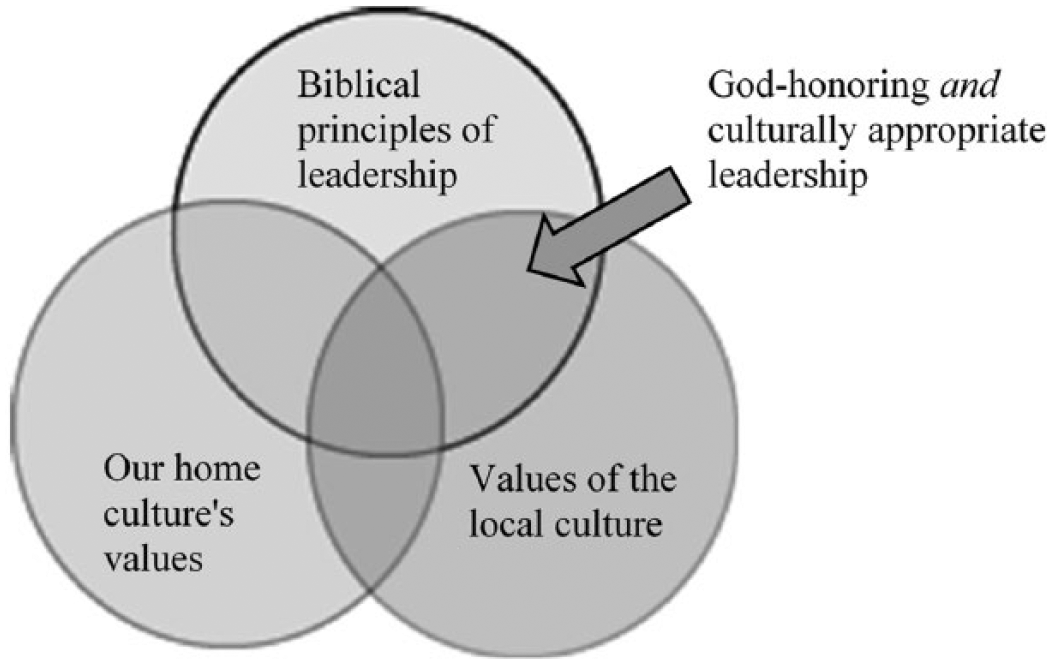
The relationship between biblical principles, the values of our own culture, and the values of the local culture concerning leadership (adapted from Plueddemann, 2009: 64)
To discover what a healthily contextualized pattern of leadership looks like, we need to do three things (Plueddemann, 2012: 64–66). These are to reflect on our own cultural values, investigate the host culture’s values, and examine biblical teaching on leadership together with local believers.
First, we need to reflect on our own cultural values and unconsciously held assumptions about leadership. This is easier said than done and requires us to reflect on our own culture in the light of our immersion in the local culture. Being open to the way things are done in the local culture can help us to reflect on and overcome our ethnocentric assumptions about the “right” way of leading.
Another important thing for cross-cultural leader-developers to do is to investigate the values of the host culture concerning leadership. An understanding of these values is an essential prerequisite for determining which of these oppose, which support, and which are neutral in relation to biblical values. Each culture reinforces some biblical values, opposes others, and includes many other values which appropriately vary from one culture to another. This results in differing expressions of the same biblical principle in different cultures (Priest, 1997: 130–137). For example, different cultures will have differing definitions of what it means for a leader to lord it over others compared to the legitimate use of authority for the good of the people (cf. Matt 20:25–27; 1 Pet 5:3).
Next comes the vital step of searching the Scriptures, together with local believers and leaders, to discover what the Bible has to say about leadership. As we do this, we will notice areas of the local pattern of leadership that should be strengthened because they reflect God’s desires for leadership. We will probably also discover things that oppose biblical values. These need to be challenged. Then there will be other aspects of the local pattern of leadership that support biblical values and should be encouraged and strengthened. Finally, we need to identify and appreciate the many aspects of the local leadership pattern that are neutral so that national believers can develop a truly indigenous leadership pattern. It is these “neutral” values that are the key to a contextualized model of leadership.
In the next section of this article, we explore the implementation of these three steps as a reflective case study of Millet leadership.
Reflecting on our assumptions about leadership
Leadership researchers have recognized “paternalistic leadership” as a style that is prominent across much of the non-Western world. This style of leadership is usually seen as negative in most of the West, where followers expect more participation in decision-making. In contrast to this negative evaluation by Westerners, paternalistic leaders are positively viewed in many non-Western societies. Such leaders are seen as strong and caring. They create a family environment which provides a sense of security, protection, and guidance to followers in every aspect of life. Paternalistic leaders expect followers to show unwavering loyalty and to comply with their wishes (Aycan et al., 2013: 963; Gupta and Van Wart, 2016: 84).
People across much of the Majority World who are comfortable with paternalistic leadership generally do not think that leaders should involve followers much in decision-making. In other words, paternalistic leadership is significantly more authoritarian and autocratic than the preferred leadership style in North America, Australia, Scandinavia, or the UK (Brodbeck et al., 2007: 1040).
There is little doubt that this style of leadership is prominent among the Millet. In itself, it is not wrong. Jackson (2016) points out, however, that there is a form of paternalistic leadership that, even in the countries which embrace this overall pattern, is viewed negatively. This kind of leadership is benevolent or exploitative depending on whether or not the leader is motivated by genuine care for those he or she leads.
In the benevolent form of paternalism, followers show loyalty and deference towards the leader because they respect and appreciate the leader’s genuine concern for their welfare. In the exploitative form of paternalistic leadership, which is one that is more obviously marred by human sin, the leader’s overt behavior is nurturing, but the care that is expressed towards followers is solely for the purpose of getting them to do what the leader wants them to. Jane Overstreet, who has been working for over two decades with Christian leaders from around the world, calls this “big boss leadership.” Big boss leaders effectively tell those they lead, “Since I have the leadership, I can do whatever I want to do, and you have to do whatever I say because you are under me.” Overstreet sees this as “an ugly perversion of what God intends leaders to be” (Overstreet, 2012: 10). The question we had to answer was whether or not what we were observing in Millet leaders was “an ugly perversion” or a healthily contextualized expression of Christian leadership.
The extent to which followers should be allowed a voice in decision-making and the extent to which leaders should be directive, seemed to be contested issues in many Millet churches. Concerning participation in decisions, the GLOBE series of studies, probably the most comprehensive study of leadership across cultures to date, found that Australians, along with North Americans, Scandinavians, and people from the UK generally want their leaders to involve them in decision-making. In contrast, most people from Latin Europe, Latin America, Eastern Europe, Middle East, Confucian Asia, Southern Asia, and Sub-Saharan Africa were much less concerned that their opinions be taken on board in the process of making decisions. They expected leaders to be somewhat autocratic and directive, and are usually uncomfortable with leaders who expect followers to be highly involved in decision-making (Brodbeck et al., 2007).
Identifying biblical principles of leadership
A surprising spectrum of ideas on what constitutes good biblical leadership exists, even among Christian authors just from North America. Henri Nouwen (1991) and David Lundy (2002), for example, stress servanthood, humility, brokenness, and deep relationships involving vulnerability, teachability, confession, and forgiveness. Others, such as Peter Wagner (1981) and Bill Hybels (2009), stress the need for strong visionary leaders who set clear goals and manage well. The diversity of emphases concerning Christian leadership among authors from just one cultural background suggests that we need to approach the task of discovering God’s view of leadership with humility. We all have a tendency to distort what we read in Scripture. Nevertheless, since God has revealed everything we need to live for and serve him (2 Pet 1:3; 2 Tim 3:16), including developing Christian leaders, we can assume that he wants us to do our best to understand what makes a good leader by prayerfully examining Scripture.
Whatever culture or structure they serve in, Christian leaders are marked by four characteristics: Christian character, clarity of purpose, care for their people, and confirmation of their leadership by their community. First and foremost, Christian leaders are good examples of what it means to follow Christ because of their Christian character qualities of integrity, self-control, gentleness, faith in and devotion to God, purity, faithfulness to their spouse and way they relate to their family (1 Tim 3:1–12, 4:11; Tit 1:6–9). Godly Christian leaders genuinely care about and for the people God has entrusted to them. They work for the welfare of those in their care not because of what they can get out of it, and not by lording it over them, but out of a genuine desire to serve the Lord (1 Pet 5:2–3). Good leaders also have a clear understanding of the task or purpose which God has entrusted them and their community with. Whatever specific ways this purpose is expressed in their context, in broad terms their purpose is to make disciples by helping believers grow in knowing, loving, serving, and becoming more like Jesus, and by equipping them to build up the church and make more disciples (Matt 28:19; Eph 4:11–12). Finally, good Christian leaders are well respected by those inside the church and in the wider community (1 Tim 3:7, 13).
The New Testament gives us several examples of good leadership. One of these is the apostle Paul’s leadership. His style seems directive and even dictatorial at times, and could be characterized as paternalistic. It may be that his role as pioneering apostle to the Gentiles meant that he needed to be highly directive, especially early on in the lives of churches. But Paul’s intent was never to coerce. His letters reveal his fatherly concern for the churches and individual Christians, and his patient instruction and encouragement even when situations and people in those churches grieved him (e.g., the Corinthian and Galatian churches). He also seems to have adjusted his leadership style to match the maturity of the churches he helped establish (Elliston, 1992: 15). Paul’s practice and his teaching are congruent with James Means’s statement that “Continual use of authoritarian methods is inconsistent with spiritual guidelines for servant-leadership, for church leaders are not to be ‘lords’” (1989: 89).
Robert Clinton defines a leader as “a person with a God-given capacity and God-given responsibility to influence a specific group of God’s people toward God’s purposes for the group” (1988: 127). Church leaders influence others through the model of their lives in relationship with others, their teaching, exhorting, counselling, encouraging, and use of other spiritual gifts. Sometimes strong words will be used, as in some preaching and prophecy, but there will always be a recognition that Christ is the Head of the Church and that change in people comes through His work in human lives, not by the coercion of leaders, whose primary function is that of equipping, empowering, and enabling.
Researching Millet leadership values
In order to discover the values that Millet culture holds about leadership, I (Richard) interviewed five Millet leaders who had a leadership role in either their church or extended family, and five congregation members. There were equal numbers of men and women among them. I asked them what they felt were the most important qualities of an extended family leader (which typically is comprised of between 15 and 40 people) and a church leader, as well as how leadership operates in each context.
Qualities that were highlighted by two or more of the church leaders and members as most important for an extended family leader and a church leader are listed in Table 1. We found many similarities between the two lists. These are displayed in the table and grouped according to the four key characteristics of Christian leaders described in the previous section.
Ideal qualities of an extended family leader and of a pastor.
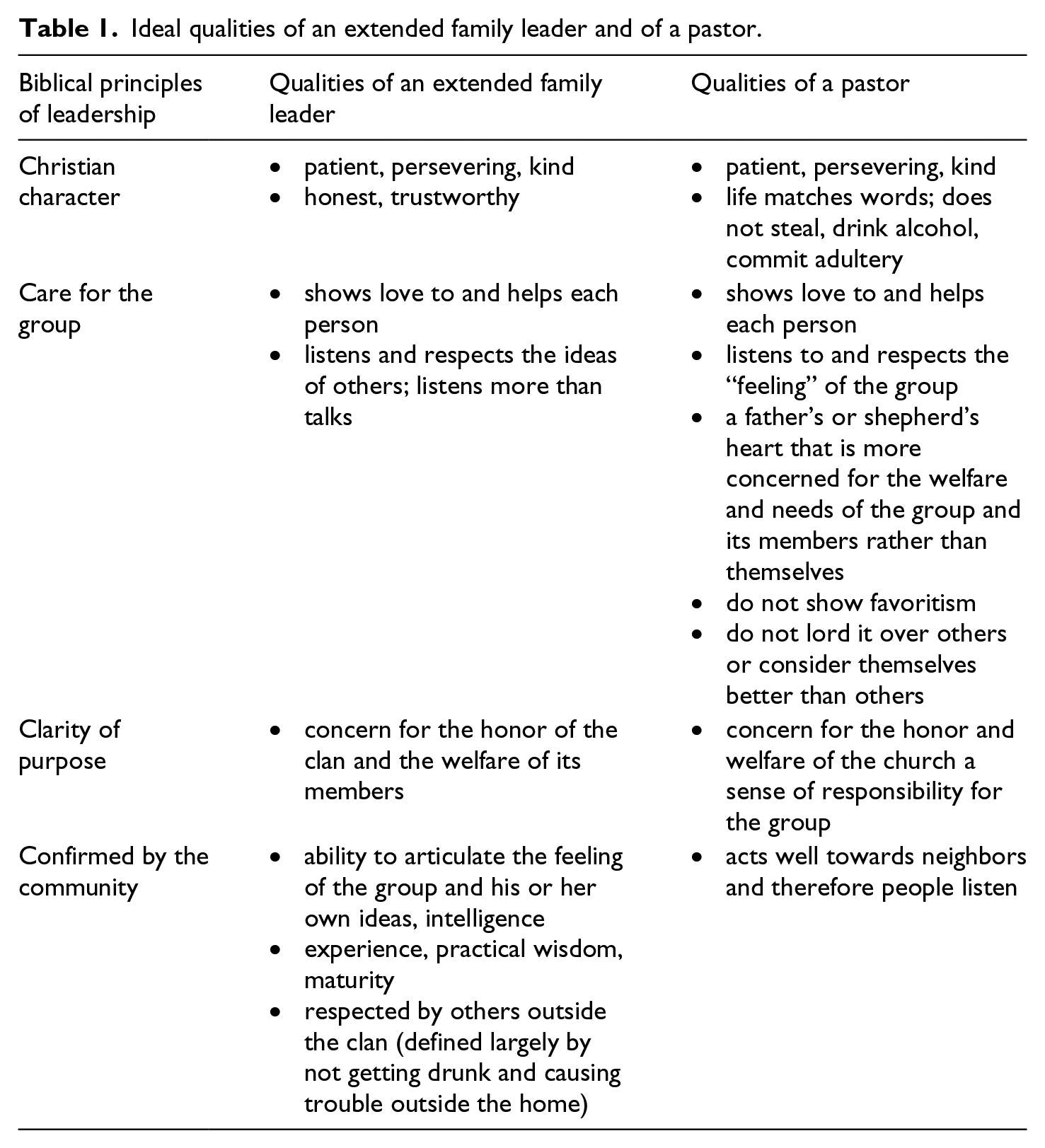
From these interviews we discovered that Millet leaders demonstrate Christian character by being patient, persevering, and kind, and by being people of integrity who live lives free of the dominant sins in Millet society of drunkenness, stealing, and adultery. Leaders show their care for people by “showing them love” and “helping each person.” They show they care for people in their churches by listening to and respecting their ideas.
According to these interviewees, the overarching purpose of leadership in a Millet extended family and in a church is to maintain the welfare and honor of the group. Family leaders do this especially by facilitating decision-making in extended family meetings in a way that preserves the family’s welfare and honor. The main way that interviewees understood church leaders to do this is by showing care and respect for each individual member.
Millet leaders are confirmed by their community when they are respected by the wider community. People both inside and outside the church respect leaders who listen to people so that they are able to articulate what people are feeling, who have life experience, wisdom, and maturity, who behave well towards their neighbors and who avoid major sins such as drunkenness and adultery.
The ideal leader among the Millet is like a good father—someone who has strong authority but also demonstrates benevolent care. The Millet are comfortable with church leaders who exercise their authority quite strongly as long as they also show genuine love and concern for congregation members and help them reach decisions in a way that makes everyone feel their view has been respected.
Strikingly, interviewees spent a disproportionate amount of time talking about just one quality of pastors—that pastors should not lord it over others or consider themselves better than others. They saw this as the biggest problem among Millet church leaders. Interviewees characterized pastors like this as being people who no longer respect or listen to the views of people in their congregations, but instead often get angry, are impatient, and fall into sins like drunkenness and adultery.
Essential steps for defining culturally appropriate leadership
The process described in this article of uncovering our own assumptions about leadership, examining biblical leadership principles, and researching Millet leadership ideals about leadership by interviewing church leaders and members helped us to realize that: (1) nearly all the Millet’s leadership values echo biblical principles; (2) most other Millet leadership values, such as decision-making by consensus, are best seen as neutral with regard to biblical precedents and should be encouraged as they contribute to a contextualized and effective leadership style for Millet; (3) some of our own assumptions about leadership, such as our resistance to paternalistic leadership, are more a product of our own culture than a biblical requirement concerning leadership.
We discovered that Millet pastors’ practice of leadership falls short of both the biblical and Millet ideals by being overly autocratic, suppressing the ministry of others, and closing themselves off from the accountability available in the group. This is the result of human sinfulness rather than a fault in Millet values concerning leadership.
Based on our experience with the Millet of working out how to define a culturally appropriate pattern of Christian leadership, we offer the following suggestions about how missionaries can work together with local believers towards defining a contextualized pattern of Christian leadership.
1.Establish a relationship of trust and rapport with local leaders. It is easy to jump to negative conclusions about culturally different leadership practices based on an ethnocentric viewpoint. Duane Elmer has rightly pointed out that we tend to attribute negative motives to the actions of others when those actions are unfamiliar to us or we find them difficult to understand (1993: 19–20). Instead, it is important to take the time necessary to understand local cultural values concerning leadership, and to build a relationship based on mutual respect. This kind of relationship is built on right attitudes. As developers of leaders, it is important to identify, confess, and ask God for help to overcome any negative attitudes we hold towards those we train.
Other important elements in establishing mutual trust are to behave in a culturally appropriate way as a leader oneself (e.g., wearing a tie in meetings if that is what local leaders do), to ask about and be sensitive to felt needs (e.g., by praying with a pastor concerning the need for a church building, and by responding to leaders’ expressed felt needs in the area of training such as teaching on family life), and most importantly, by spending time with the leaders.
2.Help local church leaders reflect on their leadership values and compare these with biblical values. One way of doing this would be to ask a group of local leaders to list the ideal qualities, functions, and purposes of leaders. These could be written up for everyone to see. Alongside these, in a second column, their ideas on the ideal qualities, functions, and purpose of church leaders could be written. Next, the leadership qualities of 1 Timothy 3, Jesus’ teaching on humility and servanthood in leadership in Matthew 18:1–6; 20:20–28; 23:1–12, the functions and attitudes of elders in 1 Peter 5:1–4, and the purpose of leadership in Ephesians 4:11–16 could be examined in the group and the key points be written in a third column. The congruence between local cultural and biblical values can be highlighted, and the “neutral” values encouraged. Any values that conflict with or potentially undermine the biblical set can thus be discussed and challenged.
It is possible that some of the conflicting values of leadership informing Millet leadership practice have been imported from denominational structures. These structures are often imported from ethnically Bulgarian churches that often have oversight of Millet churches. These structures seem to be built on the assumption that the pastor is the sole leader who makes the final decision in all matters.
This situation resembles that in Nida and Wonderly’s (1978) study of leadership patterns in Indian fields. Their research revealed a dissonance between traditional Indian patterns of leadership and those introduced from the majority people. These researchers saw this dissonance as a conflict between two value systems, one that was more individualistic and the other which was group-oriented. The traditional group-oriented approach was far more appreciated by the Indian community. The missionary trainer in this situation should affirm indigenous values (where they do not conflict with biblical values) and help minority believers establish more culturally authentic patterns of church leadership.
Some aspects of biblical patterns of leadership, such as plural shared church leadership, already exist as values and practices within indigenous Millet culture. Leadership in the clan group is plural and shared and includes women as well as men. Everyone’s opinion is held to be extremely important, and decision-making is by consensus. By comparing to the biblical model and the model of clan group leadership, a case could be made for a new style of leadership. This new style could be more effective than the present one, since it draws from existing cultural values and practices rather than imported denominational ones. It could lead to a reduction in the conflicts between pastors and the incidence of church splits and result in a renewal of church health and vigor.
3.Sensitively raise the possibility of different ways of leading. There may be some aspects of leading churches or Christian organizations which are outside the normal experience of local leaders, or ways of doing things which might be helpful but which would not normally be considered. Plueddemann (2009: 199) suggests that by modelling and teaching alternative ways of doing things, such as low-context leadership attributes in a high-context, collectivist setting, a leadership style which fuses strengths of local and other approaches could be facilitated. It is important to remember not to be coercive in this, but to allow local leaders to make their own choices about what is helpful for their own context.
Conclusion
As leader-developers serving cross-culturally, missionaries cannot identify or nurture a contextualized pattern of leadership on their own. They must work together with local Christians, including local church leaders where these already exist.
Weaknesses in the expression of local Christian leadership do not necessarily represent cultural values that are in opposition to biblical principles. Just as Western Christian leaders’ abuse of their power does not mean that all Western Christian leadership values are bad, so missionaries need to be careful not to quickly dismiss local values on the basis of sinful leaders’ practices.
It takes time, research, and sensitivity to determine culturally appropriate leadership, and this should be the basis on which leadership development is designed. As long as both missionaries and local leaders depend on the Bible as their authority, biblical practices can be identified and corrected, and authentic leadership patterns that result in healthy, multiplying indigenous churches will be nurtured.
Footnotes
Funding
The author(s) received no financial support for the research, authorship, and/or publication of this article.
