



Abstract
Milk and milk tea occupy a special place in Mongolian hearts. Historical writings of Roman Catholic missionaries confirm the sacredness of milk and its abundant use for Mongolians. Milk offerings, sprinkled into the air, are offered to Tenger (Sky/ Sky God), Buddha, ancestors or nature spirits, and are an everyday part of traditional Mongolian worship, nearly always in the morning. This ceremony traditionally is performed alone by women, mothers praying in a supplication of blessing and protection for their families. Yet in recent times a few men have been doing this ancient ritual. Are possible Mongolian Christian responses to reject this traditional custom as being syncretistic, or to see it as being a potential form of Christian expression of devotion to God? May there be analogies from milk offerings to better engage in discipleship or worship? If this ancient practice is not addressed, there is the risk, especially for women, of this ritual being driven underground, of split-level living among Christians.
Keywords
Milk esteemed
In 2001, while UBTC (Union Bible Theological College) students and I were on a student practicum bouncing around in a 4WD Russian Furgon van over a dirt road in the countryside, we enjoyed sucking on some aruul, a sour hard cheese given to us by nomads we had visited. I accidentally dropped a piece of aruul down on the dirty floor by our feet. I picked it up and was not about to put it back in my mouth. So I casually tossed it out the window. “Teacher, Mongolians never throw away tsagaan idee” a bold student chastised me. Tsagaan idee means “white foods.” I reflected on when Mongolians eat yogurt out of a bowl, it is rude to leave any yogurt behind. You are expected to put down your spoon, pick up the bowl and lick it clean. Immediately I realized that there was something very precious about milk to Mongolians.
In working over two decades here in Mongolia, I have observed ceremonial elements of milk. Sometimes a Mongolian element is integrated into Christian weddings, of having the parents of the bride and groom drinking milk out of a silver drinking bowl (mungun ayag) over a sacred blue cloth, or khadag, blue representing the revered Khukh Tenger, which means “Blue Sky” or “Blue Heaven.” A variant meaning of Tenger is “God” (Palussière, 2008: 95). On a flight to Mongolia, my fellow passengers included the Mongolian Women’s Wrestling Team, which was returning from the World Wrestling Championships held in 2018 in Hungary, and a few wrestlers had medals. At Chinggis Khaan International Airport in Ulaanbaatar, 1 capital of Mongolia, an older man wearing a Mongolian deel (traditional garment), probably the father or grandfather of silver medalist O. Nasanburmaa, greeted this athlete with a khadag cloth and a silver bowl into which he poured some airag (koumiss, or fermented mare’s milk). She lifted the silver bowl and drank the airag to the cheers of those around. Former Mongolian President Ts. Elbegdorj caused a stir when instead of toasting the nation on Mongolian National TV with customary Mongolian vodka, he toasted the nation with a glass of Mongolian milk to initiate the “Vodka Free Mongolia Campaign” (Mendee, 2012). Elbegdorj chose a culturally appropriate beverage, wholesome and close to people’s hearts. A beloved folk song often sung at gatherings, “Minii Saikhan Eej” (My Beautiful Mother) begins with the emotive lyrics “The scent of milk flowing” (Suunii uner shingesen) (Уужим [Uujim], 2013).
Milk is offered in life, and in death. I have been to more than one funeral where milk sprinklings are performed. Sometimes milk is sprinkled on the casket. In October 2019 at a Christian funeral, an older Buddhist woman on her own initiative quietly circled the funeral party as men were busy burying the coffin and women were standing around solemnly talking, huddled together in the morning cold. Out of a plastic Coca Cola bottle she sprinkled pure milk up into the air, the milk falling on the ground to protect from evil and to create a sacred space for the deceased.
Milk mentioned in Mongolian history
Milk being not merely sustenance, but also a venerated liquid liturgy appears in Mongolian history. Founder of the Mongolian Empire (Mongol khaant uls) Genghis Khan, 2 whose life is central in the 13th-century epic The Secret History of the Mongols, performed milk sprinklings. When Uelen, the wife of Temujin (later titled “Genghis Khan”) was captured by the Mergid Tribe, Temujin prayed for her return as follows: “With this he hung his belt on his neck, grabbed his hat in his hand put his hand on his chest and facing the sun knelt down nine times, bowing toward Burkhan Khaldun mountain and sprinkled milk” (Battsengel, 2018: 42). The illustration in the Secret History (p. 43) has Temujin sprinkling the milk in a manner I have witnessed countless times, of the worshipper using a special wooden ladle called a tsatsliin khalbaga, literally a “spilling/ sprinkling spoon” to sprinkle the milk up into the air.
Moreover, Roman Catholic merchants and missionaries who went to Asia noted the importance of milk for Mongolians. The writings of Marco Polo include milk offerings (Valenze, 2011: 39), and the “feast of the milk libation at the summer solstice” (Heissig, 1980: 65). Thirteenth-century Franciscan missionaries Giovanni da Pian del Plano Carpini
3
and William of Rubruck detailed the importance of milk for Mongolians (Valenze, 2011: 38–43). Historian Deborah Valenze (2011) notes that “the reader is struck by a common recurring fixation: both men report that the Mongolians, unlike themselves, were avid drinkers of milk” and that “milk drinking made for noisy pleasure” (p. 38). These missionaries noted that yurts had “felt replicas of udders, cows on one side (representing the female realm) and horses on the other (indicating the male)” (Valenze, 2011: 38). Felt replicas are a part of ancient Mongolian shamanic practice (Heissig, 1980: 13), and most likely the felt cow udders were physical incantations the supplication of milk. In the fascination of Carpini and Rubruck of Mongolians and milk, Valenze summarizes, In these mystifying moments of early culture contact, milk glittered with power and value. Everywhere Carpini and Rubruck went, they found Mongols sprinkling mare’s milk. Forced into the role of anthropologists, they carefully recounted bewildering rituals. Carpini showed little patience with the seemingly endless interdictions punishable by death (“they have many things like this which it would be tedious to tell of”), yet he hopefully noted disrespect for milk on the laundry list of offenses. (2011: 38)
It is clear from the above passage that an important part of Mongolian culture is venerating milk.
The prominence of milk has continued in Mongolian society for centuries. In the early 20th century, Mongolian soldiers of the White Russian Baron von Ungern-Sternberg, who briefly led Mongolia in 1921, restoring the Tibetan Buddhist monarchy of the Bogd Khan 4 (Bawden, 1989: 188, 216), often brought “airag (fermented mares’ milk)” into the camp (Palmer, 2009: 140). Ungern was “feared as a demon” and “worshipped as a god” (Palmer, 2009: 1) and the Bogd Khan, considered a living Buddha, conferred upon him the Buddhist deity title of Jamsarang (Bawden, 1989: 216). Ungern “must also have seen the regular devotions of the Mongols, sprinkling offerings to the spirits and praying to the gods and the Buddhas” (Palmer, 2009: 42).
Milk sacred and savored
Milk sprinkling (suun tsatsal) is included in the research of Mongolian microbiologist R. Indra, who has written extensively about milk production and also the cultural and religious aspects of milk. She describes: Since milk and milk products are so vital for survival in Mongolia, they have come to be steeped in cultural and ritualistic significance. For example, ritual milk sprinkling is practiced each morning. Harnessing the numerological power of the number 9, the supplicant, using a tsatsal—a long, wooden, spoon-like device having 9 indentations at the end to hold milk—spreads the life-giving liquid in the air 9 times. Before leaving on a journey to any distant destination, a sprinkling must be performed while facing in the direction one is to travel. (2012: 84)
This milk sprinkling is most often done with milk tea. Milk tea (suutei tsai) is a favorite beverage, hot, rich, akin to Mongolian comfort food. Indra asserts, “Milk tea is an integral part of every meal, and is served to guests as a demonstration of hospitality. Tea served without milk, however, is a sign of poverty and ill-luck” (2012: 84). Claire T. C. Chong asserts, “Memories and sentiments can be etched in food and when resurfaced, can evoke powerful emotive responses” (2019: 74) even as she describes Cambodian ancestral rites.
In a harsh, cold, sparsely populated land like Mongolia, travel can be fraught with difficulties and danger. So not surprisingly, a woman may offer a milk sprinkling for travelers as they are departing. In 1997 as we left Mongolian friends in Khuvsgul Province, the mother of the household sprinkled the back of our Toyota Landcruiser with milk tea in blessing as we began to drive away, for journey mercies.
Milk and its closely related beverage, tea, are found in the wisdom of Mongolian proverbs. One simply states, Цай ч үгүй [Tsai ch ugui] Царай ч үгүй [Tsarai ch ugui] Not even tea Not even warmth. (Raymond, 2010: 346)
“Warmth” includes hospitality. Or consider the following: Цай хэдий шингэн боловч идээний дээж [Tsai khedii shingen bolovch ideenii deej] Цаас хэдий шингэн боловч номын хуудас [Tsaas khedii nimgen bolovch nomiin khuudas] Even though tea is liquid, it is an important part of food Even though paper is thin, it still makes a page in a book. (Raymond, 2010: 346)
Mongolians value education and esteem tea, which in Mongolia is very milky. The following is worth pondering: Сүү гордьсон муур шиг [Suu gordison muur shig] Сүүл долоосон чоно шиг [Suul dolooson chono shig] Like a cat who hoped for milk Like a wolf who licked his tail. (Raymond, 2010: 239)
Of course a wolf would rather eat prey instead of licking its tail. Here a cat longs for milk but has none. This proverb denotes the lack of milk, a symbol of poverty. Thus serving “black tea” 5 (khar tsai), tea without milk, is looked upon with disfavor; perhaps the host is poor or worse, inhospitable. When somebody does serve “black tea,” it is given a euphemism of “bor tsai” (Bamana, 2015: 202), “bor” meaning “brown” or dark.” The color black is “taboo,” “bad,” and “negative” (Bamana, 2015: 202–3). However, the stigma of not serving milk tea is not there in the urbane practice of offering tea such as Lipton. Modern tea is not called “black tea,” but “pure tea” (baikhuu tsai).
For Mongolians, the color white symbolizes purity. Mongolian milk tea is white. Another proverb says, Сэтгэл цагаан бол [Setgel tsagaan bol] Үйлс цагаан [Uils tsagaan] If the heart is white The deed is white. (Raymond, 2010: 241)
A proverb linking white, milk, and goodness, contrasting with bad states, Сайн санааны үзүүрт [Sain sanaanii uzuurt suu] Муу санааны үзүүрт зүү [Muu sanaanii uzuurt zuu] The end of the good heart [literally “good intention”] is milk The end of the bad heart [literally “bad intention”] is a needle. (Raymond, 2010: 218)
So it is not surprising that black tea is not used in milk offerings. Democratic Republic of Congo anthropologist Gaby Bamana concurs, “One must not offer black tea to guests or sprinkle it in a libation” (2015: 203). Yet Mongolist Walther Heissig describes in the time of Genghis Khan a sprinkling against enemies, a “libation of black tea with a many-pointed arrow,” and another dark libation ritual of “flour, butter, milk and black tea” mixed with “blood of a man who had been killed [with] shavings from iron used to kill a man” (Heissig, 1980: 87).
Other than arcane rituals of cursing recorded in ancient Mongolia, ritual milk sprinkling for blessing is the domain of women. Bamana observes, In rural Mongolia, it is common to witness the following scenario: in most households, the woman gets up early, before anyone else, to prepare tea for breakfast. Therefore, Mongol folk knowledge describes a housewife as a person who gets up early, prepares tea for the household, and performs certain tea practices (for example, tea libation, tea services). . . . In the ger (гэр, yurt), tea preparation breaks the silence of the night, and the function of the morning tea rituals is to mark the starting point of the day. (2015: 198)
Bamana mentions “the woman” performing tea sprinklings, which of course are white with milk, going as far to say that this ritual asserts “female power” (2015: 193) in a society where “ritual power is predominately patriarchal” (2015: 199). A prominent Ulaanbaatar Mongolian Christian pastor of one of the first churches in Mongolia was dismissive of milk sprinklings, saying that they were done by “old women in the countryside” and that “people today drink coffee and black tea—baikhuu [pure] tea I mean” (2018, personal communication). His opinion may reflect the conclusion of Bamana that “tea practices are marginalized from the mainstream cultural discourse because of their association with women and the domestic domain” (2015: 210). I asked the pastor if milk sprinklings were done in Ulaanbaatar and he replied that it was done “by some widows” (2018, personal communication).
I have observed women doing milk sprinklings not only in rural Mongolia, but also here in the city of Ulaanbaatar. Moreover, I have seen not only older women, but also middle-aged and a few young women performing milk sprinklings. In 2018 I witnessed a woman pharmacist in her white uniform doing a milk sprinkling with an ordinary spoon and a copper bowl in front of her pharmacy as the sun was rising. I interviewed a 38-year-old woman, J. Otgontsetseg (pseudonym), who I had met in November 2018 as she was performing a milk sprinkling, throwing milk up into the sky with an ordinary spoon from a large silver bowl (mungun ayag) in front of her Ulaanbaatar apartment building.
Otgontsetseg, an accountant by profession, presently selling cabinets in a hardware store, said that only women performed milk sprinklings, and milk tea most of the time. Each morning she offers the deej suu (upper milk) that rises to the top when she boils tea; yet sprinkling pure milk and koumiss (fermented mare’s milk) is also done by some (2018, personal communication). She was familiar with the “nine indentations” (yesun nud, literally “nine eyes”) of the afore-mentioned Indra (2012) on the traditional wooden tsatsliin khalbaga (sprinkling spoon [for milk offerings]), but she did not know the significance of the number “9.” And in contrast to the account of Indra (2012: 84), Otgontsetseg does not sprinkle nine times. She begins by honoring the rising sun, facing south. Then she sprinkles her milk tea southward, turning slightly clockwise and then offering toward the southwest. Then she turns toward the west to sprinkle milk tea. So in all she sprinkles “eight times toward the eight directions” (2018, personal communication).
Libation and tradition
I asked Otgontsetseg which religion this was, to what god she was sacrificing, and she merely explained that this was “Mongolian tradition.” When I pressed further if this were a part of Buddhism or Shamanism, she replied, “whatever religion, it’s Mongolian tradition.” She went on to say that this ritual was for “life insurance” (amidraliin daatgal), to protect her family. Moreover, it was “tradition from the ancestors.” She performed milk sprinklings for the Eternal Sky / Heaven (Munkh Tenger) and for the ancestors and for “pretty mountains” (2018, personal communication). She began doing this from the age of 30 for the sake of her children. Indeed, this ceremony is performed for the sake of their families by mothers, who also are the ones who typically make the household milk tea. I asked Otgontsetseg if single women performed milk offerings, and she simply answered “I don’t know” (2019, personal communication). By “ancestors,” I queried if she meant that this sprinkling benefitted the ancestors, or if the ancestors blessed her through the sprinkling, and she replied that the ancestors helped her. I asked her what she prayed for, and she recited a prayer by heart. I asked her if she learned this from her mother or grandmother, and she replied no, that she learned this prayer through a milk-sprinkling group on Facebook. She agreed to write the prayer in Mongolian; I include the English translation done for me by A. Khongorzul: Мөнх наран ээждээ Мөнх хөх тэнгэртээ Уул ус, ургамал амьтаддаа Өвөө эмээ, өвөг дээдэстээ Охин нь сүүн цацлаа өргөж байна. Хань ижил болоод үр хүүхдийг минь ивээлдээ багтааж Эрүүл саруул, энх тунх, аз жаргалтай, элгэн хангалуун амьдруулж өгөөрэй. To eternal mother sun To eternal blue sky To mountains, rivers and to plants and animals To our grandparents and ancestors I am, the daughter of you offering milk by sprinkling. Please bless my spouse
6
and children Let them live in healthy, peaceful, happy and prosperous lives. (Otgontsetseg, 2018, personal communication)
The sun and blue sky, both call “eternal,” are revered even before the family who has gone before her. Nature is also revered in worship, as this woman says this prayer in front of her drab Soviet-era apartment. This middle-aged urban woman smiled as she said that she performed the milk sprinkling every morning, and if she traveled to the countryside, that she would do the sprinkling toward a mountain. I asked her if women ever did the milk sprinkling at night, and she said “Some do this for the moon” (Otgontsetseg, 2018, personal communication). Another difference from the normal pattern of women performing milk sprinklings outside early in the morning I have observed in Uvs Province, western Mongolia. Bamana observes in “western Mongolia” that “part of this first sample of tea is also offered to the fire by pouring drops on the four corners of the stove” (2015: 199). So, fire, the sun, blue sky, nature and even the moon are objects of worship in milk sprinkling. “In a libation, tea is also exchanged with nature and earth and with the spirits of the land and water” (2015: 206). This concurs with Mircea Eliade who wrote in his classic The Sacred and the Profane, “For religious man, space is not homogenous; he experiences interruptions, breaks in it; some parts of space are qualitatively different from others” (1987: 20). Milk reaches the sacred, even as it is an everyday beverage. The holy and the ordinary are intertwined in milk.
Men and milk offerings: Anomalous or ascendant?
A recent observable trend is men performing milk sprinklings in Mongolia. In August 2018 I observed a young man in the morning in a city park to the four directions of south, west, north, and east, and an older man right outside of a “City Shop,” like a 7 Eleven, doing this ritual toward the morning sun, toward the south as I walked past. I asked Otgontsetseg about men performing milk offerings, and told her of how in remote Gobi-Altai Province I saw a nomadic herdsman performing this ritual in the morning. I added that his wife was away traveling. I asked, “Do men do milk sprinkling if their wives are away?” She perceptively explained, “this was ‘pious worship’ [suseg bishrelt]. He was a lama.” Indeed, the man I saw perform this, though a nomadic herder, was a kind of lama, a “yellow shaman” (shariin buu), 7 a Buddhist shaman. I also told Otgontsetseg about the young man and also the older man who I saw last summer doing milk sprinklings in Ulaanbaatar, and she repeated the words, suseg bishrelt (pious worship) and added, “sometimes a lama tells a man to do this ritual for a special reason” (2018, personal communication).
I interviewed the young man S. Tugsbaatar (pseudonym) who I had seen in the park offering a milk offering to the four directions, and when I asked him why as a man he performed milk offerings he replied, “Milk offerings are for women and for men, since Mongolian ancient times” (2019, personal communication). He also said that he was a “shaman,” more specifically a “black shaman” (khariin buu) of the ancient pre-Buddhist Mongolian animistic and nature religion, not a Buddhist.
As noted earlier, Genghis Khan engaged in milk sprinkling, and so it appears an ancient practice among men is reemerging in a sphere regarded traditionally as female worship. I described the recent observable though uncommon phenomenon of men performing milk offerings to Magnus Alphonce, a respected former missionary to Mongolia who arrived here in 1991, shortly after the “Democratic Revolution” of 1990 which opened up Mongolia to the world outside of the Soviet bloc, whose church planting was prominent in There’s a Sheep in My Bathtub (Hogan, 2008: 32) and whose work is featured in Perspectives on the World Christian Movement (Hogan, 2009: 682). He was very surprised that men are performing milk offerings. In his serving in Mongolia for over a decade, Alphonce never once witnessed a man performing this ceremony (2019, personal communication). In June 2019, at the edge the departure terminal drop-off lane at Chinggis Khaan International Airport, I observed somebody performing a milk sprinkling toward the direction of the runway as a jet took off in the distance, and it was a man. Interestingly, as of October 2019, there is a new sign at that airport spot that reads in Mongolian, “Milk offerings prohibited here!!!” (End suu urgukhiig khoriglono!!!).
In a Tibetan Buddhist monastery in Zuunmod, near Ulaanbaatar, I spoke with a 60-year-old retired soldier, L. Enkhsaikhan (pseudonym), now a security guard at a mining company in South Gobi Province, coming for a special ceremony, asking him about men performing milk offerings. He explained that lamas and shamans do perform milk offerings, and noted that lamas do instruct men to perform special milk offerings. He reflected, “It is not wrong for men to do offerings; it is for women, for men, it does not matter. In recent times men are doing this” (2019, personal communication). Enkhsaikhan noted men doing milk offerings in “recent times.” Yet centuries ago, besides Genghis Khan performing milk sprinklings, Мönghe Khan (Munkh Khaan) his grandson, in order to “ensure Heaven’s backing,” honored his grandfather at his grave by “scattering milk from his heart of white mares” (Man, 2014: 189). Whether or not ordinary men in history performed milk offerings merits further investigation.
One man who wrote about a milk offering is well-known Mongolian iconoclastic poet D. Uriankhai, who penned “Fresh milk in a bag: On the banks of the Selbe [River]” in 1990, which runs through Ulaanbaatar: I rose and poured out the fresh milk, fermented in a bag, I tipped half way. And, though everywhere feasted upon the scent of airag— what a shame—dammit—the container was a bag! (2013: 83)
The poem uses a humorous form of irony. Since the milk was in an ordinary bag, what should have come out is ordinary milk. Instead, he found he was pouring out precious airag, or koumiss, fermented milk from a mare, the making of which requires careful preparation. It is effervescent, lightly alcoholic, and prized in Mongolia and much of Central Asia. The poet calls it a “shame,” to pour out this delightful drink. Of course, he would have rather drunk the airag himself!
Offerings in an urban age
Here is another example of this ancient reverent ritual and present-day Mongolia. Former Member of Parliament and respected statesman B. Batbayar, who goes by the name “Baabar,” features respected scholars and politicians as columnists in his news website. One columnist, however, goes by the name “Gump,” with a photo of Forrest Gump. “Gump” could be Baabar himself. “Gump” describes how during the morning of Tsagaan Sar (White Month, or Mongolian Lunar New Year), he sees something white and strange (khachin) on his car. At first, he is pleased, thinking it is from a milk sprinkling, calling it nandin erdene, or “sacred precious.” But later he realizes that this was from a drunk person who threw up milk on his car. He laments, “slimy scary, isn’t it” (lag uu ain?) (Gump, 2009). So Mongolian society will produce its pious as well as its Monty Pythons.
But unlike “Gump,” city people, according to teacher of biblical languages B. Ulziijargal at UBTC, “do not like milk on their cars” (2018, personal communication), and the UBTC Academic Dean D. Javkhlan added that the paint on his car was “burned that the milk stain will not come out” (2018, personal communication). Laughing, a systematic theology teacher explained how there was a sign put up at the entrance of an apartment building by the homeowners association stating that an “apartment window is your tono (the central roof opening of a yurt). People do not perform milk offerings through a tono. People go outside the ger [yurt, or traditional round felt tent] [to perform their milk sprinklings]. So do not do milk offerings out of your window. Go outside to do your milk sprinklings” (G. Tumenbayar, 2018, personal communication)! In a sense, the homeowners association was translating, or contextualizing, an ancient rural ritual for contemporary urban Mongolia.
Possible Christian responses to milk offerings
May there be any Christian contextualizing of milk sprinkling, or may this ritual be used in instruction of the Christian life? Missiologist Daniel Shaw, in discussing the possible use of two-thirds world religious rituals, sees the possibility of “using ritual and ceremony as a means to worship God” (Shaw and Burrows, 2018: loc. 524), while questioning if “traditional worship” is “dangerous syncretism or necessary hybridity” (2018: loc. 24). So I asked the senior pastor of one of the major churches in Ulaanbaatar about the possibility of milk offerings being used in Christian worship or private devotion, and he replied “no need for contextualization” (2018, personal communication). He was dismissive of milk offerings having anything to do with the Christian faith.
I asked the same question to the director of a Bible school, and he replied, “I’ve never thought about it” (2018, personal communication). When I told of the nomadic herdswoman I saw give a milk offering for Jesus in a rural province in April 2018, one Christian leader sighed, “I don’t know,” and another commented, “maybe.” I asked H. Okhio, Chair of the Board for Mongolia Theological Education by Extension (TEE), if Christian women could perform milk sprinklings to Jesus and he replied, “they may; they may not. This is not easy” (2018, personal communication).
True, the question is not easy. For a Christian nomad out on the open range far from any church, would offering milk be the equivalent of giving a monetary offering in church? Would the sprinkling be for thanksgiving, or for manipulation of God (or the gods), for supplication? Would worshipping the Lord in this manner be adding Jesus to the worship of the sun, mountains, ancestors, or other gods? Would people believe that somehow God is sustained by this milk, or would this influence people to think of God as female? If the matter of Christians and milk offerings is not addressed, then people, particularly women, may hide this folk religious practice from church leaders, resulting in what Hiebert would call “split-level Christianity” (Shaw and Burrows, 2018: loc. 554), worshipping one way in front of Christians and another way when alone or with people from the old ways.
Christians should examine Christian life in relation to old ways. A well-known example is that of Chinese, Korean, and other Asian Christians wrestling with ancestor veneration. David Lim gives a history of responses, highlighting the “Second Conference” of Protestant missionaries in 1890 in which Hudson Taylor’s view of “ancestor worship” being “idolatrous” overcame the accommodationist view of Timothy Richard (2015: 112). Lim points out that “no Chinese representative was at those two conferences,” neither in the 1890 Conference nor in the 1877 First Conference where the issue of ancestors was first raised (2015: 112). Serious discussion by Asian participants came a century later with “98 participants from nine Asian countries” in 1983 in Taiwan; the ATA (Asia Theological Association) held the “Consultation on the Christian Response to Ancestor Practices” (2015: 113). Lim seems dismayed that while the participants were “open to contextualization,” the consensus was to “maintain the rejectionist view,” as shown in the ATA “Working Document [towards a Christian Approach to Ancestor Practices]” (2015: 113). This ATA document was published as Christian Alternatives to Ancestor Practices (Ro, 1985), with this compendium being more conservative than the expressed view of Lim. From what he sees around him, Lim does not seem impressed with ad hoc “piecemeal” attempts to “show love and respect to the deceased” during All Saints Day but not during the Chinese traditional Qing Ming Festival of remembrance and Christian devotion at ancestral graves. He indicates that he would like to see more “appropriate contextualization of ancestor veneration” (2015: 114).
Mongolian Christian pastors and leaders, whether out of seeking to be “biblical” or being reluctant to move away from Christian practices that they have experienced, may not agree with Lim’s approach to embracing local traditional practice, yet at least Lim, and before him Ro and other Asian Christians, have been talking, attempting to relate the Christian faith to life, to death, to everyday issues that matter. Among Mongolian Christian leaders, consultations or robust discussions of Mongolian old ways, including milk offerings, need more consideration. The approach of “critical contextualization” of Hiebert (1987), though not the latest thinking on contextualization along the lines of Insider Jesus (Dyrness, 2016) or others, may offer Mongolian Christians a non-threatening and careful path to examine culture, in this case milk offerings, in light of Scripture.
Meanwhile, I believe that milk-sprinkling rituals may be used as an analogy in Christian discipleship. Peter instructs us, “Like newborn infants, long for the pure spiritual milk, that by it you may brow up into salvation” (1 Peter 2:2, ESV). As milk is pure, we are to live pure lives. We may imitate Paul, of “being poured out as a drink offering” (2 Timothy 4:6, ESV). The daily example of milk sprinkling may be used as a way to spur on morning devotions. People often complain that they are too busy to pray or read their Bibles in the morning. But countless busy women and a few men across Mongolia perform milk sprinklings daily early in the morning. If people can do their morning traditional devotion, even rising early, cannot Christians rise to pray and read the Bible? Would it be possible, echoing the musing of Chong about the potential transformation of a Buddhist ritual in another context, to “demonstrate continuity with the original ritual, yet [have enough] discontinuity so as to stimulate worldview transformations” (2019: 82)?
In Mongolian Buddhism and Shamanism, nomads as well as settled people must go somewhere, often far, for worship, blessing, or divination. They travel to a Buddhist temple, to an ovoo (sacred cairn on a mountain top or pass), or to a shaman. Yet milk offerings are done just outside of people’s yurts or homes or nearby. So milk offerings may serve as a stimulus for promoting Christian worship where nomads live in remote encampments.
Instruction about the Lord’s Supper, or Communion or the Eucharist, may be enhanced by teaching about milk sprinklings as an illustration, albeit an imperfect analogy due to bloodshed being associated with death, and because of the Mongolian psyche of eschewing the mixing of milk with blood. However, looking to the practice of milk offerings may help in pointing to the reality of sacred sacrifice. And just as milk and tea are ordinary ingredients consumed by people yet transformed into elements of worship, so the ordinary elements used in Communion are transformed into worship of the Lord. People offer to the divine that which is precious, milk tea or milk even as the divine, the Lord God, offers the ultimate gift, the life blood of His Son in sacrifice for our sins (Romans 3:25).
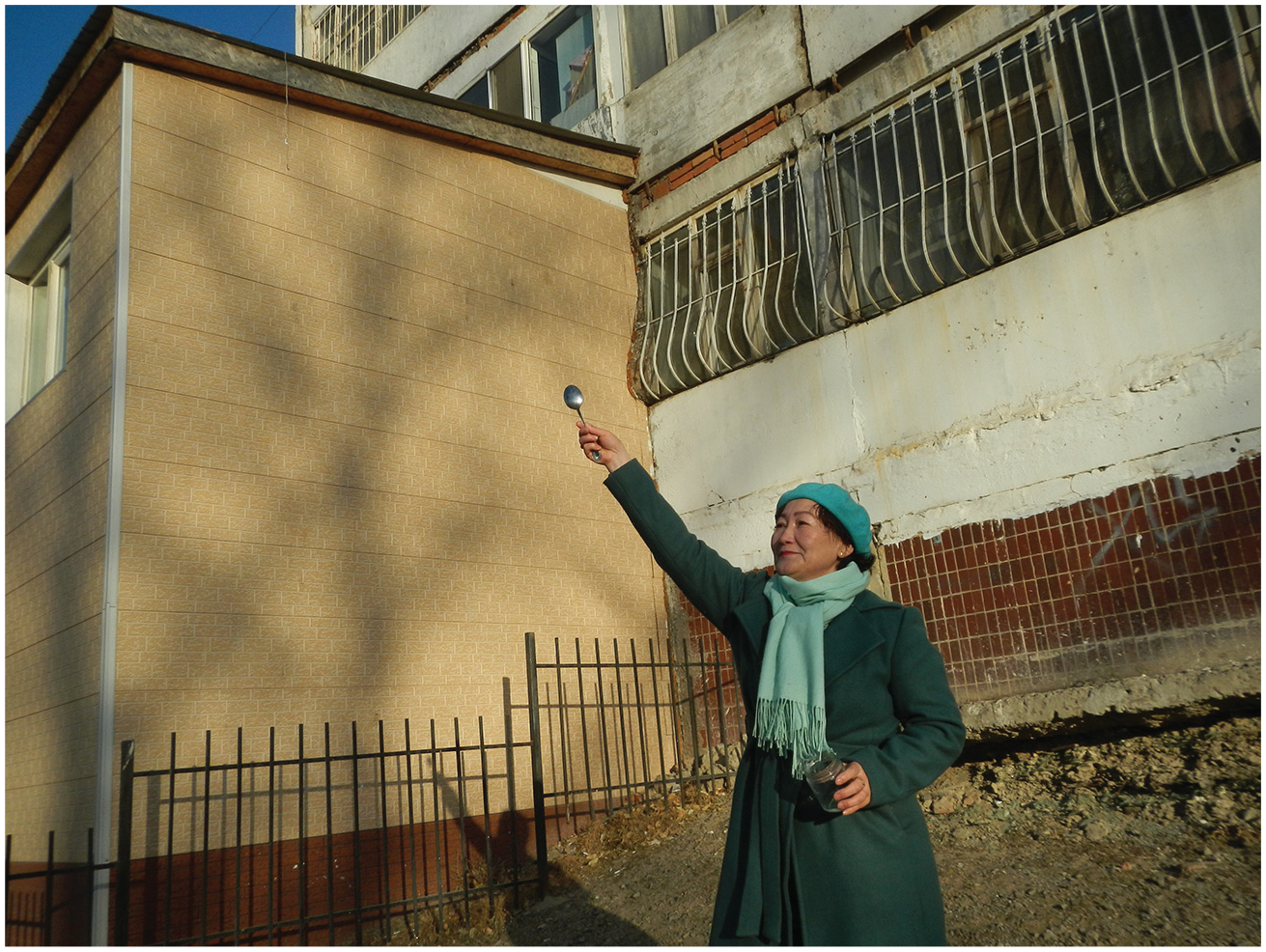
Urban woman performing a milk offering.
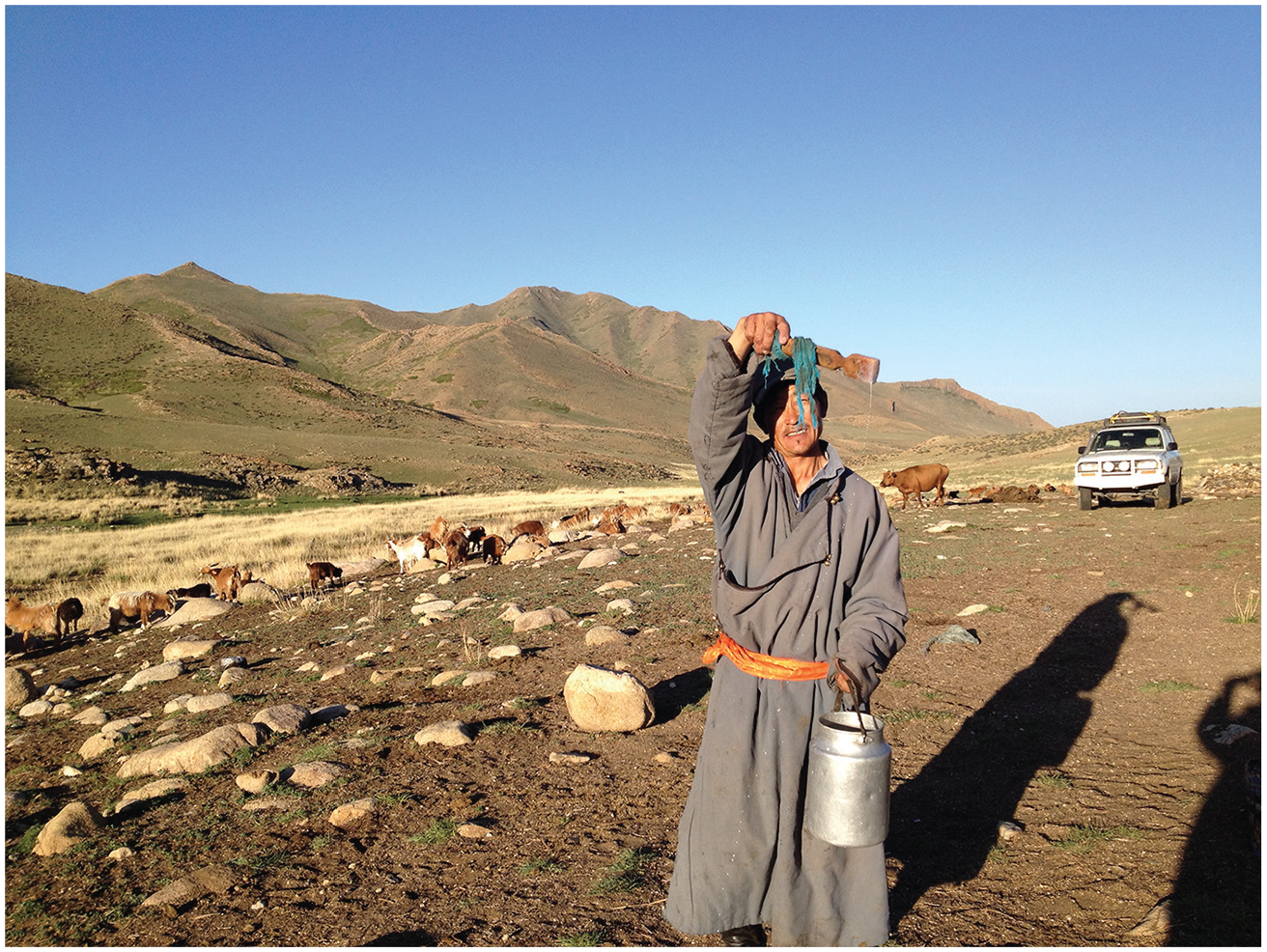
Nomadic herdsman performing a milk offering.
Footnotes
Funding
The author received no financial support for the research, authorship, and/or publication of this article.
