




Abstract
“Business as mission” (BAM) was introduced to the Christian missions community during the 2004 Lausanne conference in Pattaya, Thailand. Since then, interest in BAM has grown exponentially, and with it, demand for support services, training, and financing. For all the attention, however, scholarly research in this area has not kept pace, and there remain many unknowns about the personal and contextual factors that contribute to the impact and sustainability of a BAM enterprise. Seeking to address that gap, this paper builds on insights from the social entrepreneurship literature that enables us to construct a typology that distinguishes between four basic types of BAM practitioner. While all four seek to advance the cause of Christ using business, and thus fit the basic definition of BAM, each brings a different combination of motivations, backgrounds, and practices. The relevance of those differences is then explored using survey data collected from 119 self-defined BAM practitioners around the world. We also identify several essential business practices that are correlated with strong economic and social impact. Implications for further research are discussed.
Keywords
Introduction
Christians have a long history of creating socially beneficial businesses. “Business as mission” (BAM), however, is a relatively new concept that has not been extensively researched. Coined in the late 1990s to describe intentionally missional businesses seeking to advance the cause of Christ in the less-developed or less-reached parts of the globe, the terminology was legitimized and popularized during the 2004 Lausanne conference in Pattaya, Thailand (Albright et al., 2014). In the words of the Lausanne Occasional Paper #59, “God is raising up a new work force of men and women from around the world [who] are on a mission for God’s glory in and through business” (Tunehag et al., 2005: 7).
Enterprises that simultaneously pursue financial, social, and environmental objectives are often called “social enterprises.” The key difference between a social enterprise and a BAM enterprise is the latter’s inherently religious impetus (Albright et al., 2014; Johnson, 2009). Other terms that are often used synonymously are “business for transformation” (Lai, 2015), and faith-based social entrepreneurship (Albright, 2015; Alderson, 2012; Borquist and de Bruin, 2016; Kimura, 2021). The idea of using business to simultaneously achieve multiple objectives, also called “bottom lines,” appeals to Christians and non-Christians alike. However, scholars caution that merging potentially conflicting goals can create internal dissonance that can paralyze organizations (Battilana et al., 2015; Pache and Santos, 2010) or cause mission drift (Cornforth, 2014; Ebrahim et al., 2014). If that is true, then how much confidence can we have that BAM is fulfilling its promise? Extant research is silent on this question.
Seeking to address that gap, this paper draws from two key theoretical constructs from social entrepreneurship theory to examine factors that can influence the behaviors of individual BAM practitioners (Fauchart and Gruber, 2011; Simms and Robinson, 2008). We then introduce a typology that distinguishes between four basic BAM identities: “BAMers,” “Evangelists,” “Explorers,” and “Faith-Driven Entrepreneurs.” In a broad sense, all four seek to make Christ known through business. However, they each bring different combinations of backgrounds, motivations, and practices. For example, Faith-Driven Entrepreneurs (FDEs) have prior business experience, they see business as a legitimate Christian calling, and are unapologetic about setting ambitious financial goals and being held accountable to those goals. The primary experience of Evangelists, on the other hand, is in the nonprofit sector (e.g., church ministry), and they care principally about the spiritual impact. 1 As such, they consider any time spent working on business-related matters as a diversion from their ultimate purpose. Explorers bring neither a strong business background nor a comprehensive theology of mission, but are inspired to join the BAM movement out of passion for the gospel and they want to explore God’s calling as they experience BAM in the field. Finally, BAMers bring experience from both business and nonprofit ministry contexts, and are able to hold multiple objectives in a balanced and productive tension.
Our typology is then applied to a set of survey data collected from 119 self-defined BAM practitioners around the world. The survey was exploratory in nature, asking questions related to the structure and governance of the enterprises, the backgrounds and motivations of the practitioners, and the observed outcomes in each of the four bottom lines of economic, social, environmental, and spiritual impact. A cursory review of the sample confirms that there is a wide variety of backgrounds, motivations, and practices that exist under the BAM umbrella. For instance, some practitioners have formal ties with a mission agency and others do not; some care almost exclusively about evangelism while others prioritize all the “bottom lines” equally; and some have extensive business experience while others spent their formative years in the nonprofit world. Compounding matters is a long list of contextual and institutional differences—economic, political, cultural, and so on—that complicate the performance and assessment of a BAM enterprise (Lee and Rundle, 2021; Miao et al., 2022). Our dataset therefore offers an excellent opportunity to examine some of those factors and to formulate predictions that can provide a foundation for additional theory building and empirical study.
This paper makes several contributions to the academic literature. First, it is a response to calls for more theoretical and empirical analysis of BAM (Albright et al., 2014). We take up that call by developing a theoretical framework and typology built on identity theory, and formulating testable hypotheses. Second, this study draws the attention of missiologists to an overlooked example of cultural hybridity (Dale, 2021; Jones, 2021); that is, the blending of corporate and missionary cultures. As demonstrated by Russell et al. (2006: 292), business people and missions people not only have different skillsets, but they are “trained to work in fundamentally different ways which can lead to conflict when they work together.” Third, the study contributes to a quickly growing stream of entrepreneurship literature that looks at how religion shapes the identity, values, and behavior of entrepreneurs (Mongelli et al., 2019; Smith et al., 2021).
This study is organized as follows. In the following section, which serves as the background to the whole study, we introduce and situate BAM within the broader SE literature, and make a case for using SE research as a source for insights about BAM. The next two sections introduce our core theoretical constructs of identity and rationalization and situate them in our typology. Next, we introduce the data and methodology used, followed by an analysis of the statistical results. Lastly, we conclude with a discussion of our findings as well as suggestions for future research.
Literature review
Defining social entrepreneurship and business as mission
A “social enterprise” generally refers to innovative, entrepreneurial ventures that combine the social objectives of a charity or public sector organization with the incentives and practices of a for-profit, “commercial” business (Busenitz et al., 2016; Dacin et al., 2011; Miller et al., 2012; Nicholls, 2006). One commonly cited example is the Grameen Bank, which, since issuing its first microloan in 1976, has disbursed billions of dollars and is credited with lifting millions of people out of poverty. “Fair trade” jewelry and coffee are two more examples of hybrid enterprises finding innovative solutions to poverty. 2 Social enterprises come in a wide variety of forms, even including for-profit companies like Ben and Jerry’s Ice Cream, Tom’s Shoes, and Honest Tea. Ultimately what distinguishes a social enterprise from other organizations is not its location, size, or structure, but rather its “embedded social purpose” (Austin et al., 2006).
Christians are no strangers to SE. For example, Guinness Brewing Company was started by Christian entrepreneur Arthur Guinness during the late 1700s in response to a chronic shortage of drinkable water and social problems stemming from stronger alcoholic drinks in his native Ireland. In addition to its reputation as the country’s leading brewer, the company soon became known for its progressive views on workers’ rights and its concern for the poor at home and abroad (Mansfield, 2009). Similarly, William Carey—regarded by many as the father of the modern missionary movement—not only launched successful enterprises like a college and printing business, but he was a tireless advocate for prison reform, and the abolition of the caste system, slavery, Sati (widow burning), and infanticide (Latourette, 1974; Mangelwadi and Mangelwadi, 1999).
Given the obvious parallels between SE and BAM, it is surprising that there has not been more cross-pollination of the two literature streams. Space limitations prevent us from giving a complete treatment of the similarities and differences here; instead, we will limit the remainder of our discussion to questions related to the motivations, backgrounds, and practices of SE and BAM practitioners.
The identities of BAM practitioners
Jesus famously said that “no one can serve two masters” (Matt. 6:24). The basic premise of SE and BAM, however, is that entrepreneurs can and do manage the tensions of multiple, sometimes competing, objectives. Theoretical and empirical work that explains how this happens is in its early stages. One approach that has attracted a great deal of interest is a construct called identity theory. An “identity” is defined by psychologists as a person’s choice of self-image (Stets and Burke, 2000; Tajfel, 1982). Whether consciously or unconsciously, people internalize identities based on a sense of who they are and who they want to be (Stryker and Burke, 2000). For example, a person might perceive herself as a teacher, a Latina, a Dodgers fan, and/or a Christian. These can all be true simultaneously, although which identity is most salient at any moment will depend on the context, and on the person’s level of commitment to the identity (Besharov, 2012).
Over time, identities get fine-tuned as individuals gain experience and engage in more self-reflection (Jones et al., 2019). The resulting identity “hierarchy” will reflect a person’s values and aspirations (Murnieks et al., 2014), and will motivate and guide a person’s behavior (Cardon et al., 2009; Fauchart and Gruber, 2011), including their work behavior (Kistruck et al., 2013). For example, someone who is widely regarded as a “good teacher” will prepare for class every day, even though in a strictly economic sense preparing for class is difficult to monitor, costly, and ripe with opportunities to shirk her responsibilities. She will nevertheless prepare because she experiences a sense of self-worth and pride when her behavior is congruent with her identity, and unhappiness and stress when her behavior is inconsistent with expectations (Akerlof and Kranton, 2000, 2005; Heinle et al., 2012).
SE scholars have taken great interest in identity theory’s potential to explain entrepreneurial behavior and performance. Among the more widely cited papers in the SE literature is one by Fauchart and Gruber (2011), who propose a typology consisting of three types of entrepreneurial identities. The “Darwinian” identity is associated with entrepreneurs who are energized by the challenge of growing a successful business and they have a single-minded focus on the financial outcome. At the other extreme are those with a “missionary” identity who are passionate about solving a social problem, and treat the business’s financial concerns as secondary at best. The third identity is essentially a blend of the two that they call “communitarian” entrepreneurs. These people are part of a community or professional group, and their interest is in creating value for the group, which makes them in effect both self-interested and others-interested. Identity theory in general, and the Fauchart and Gruber model in particular, has proven to be a useful framework for explaining things like why different entrepreneurs are drawn to different opportunities, why they prefer one organizational type or structure over another (Simms and Robinson, 2008; Whetten and Mackey, 2002), or one market over the other (Fauchart and Gruber, 2011; Wry and York, 2017).
While BAM scholars have not specifically employed identity theory, there are tantalizing hints of systematic differences in identity and its effect on practices among BAM practitioners in recent field studies by Russell (2009) and Bosch (2017). For example, after spending six months in Thailand studying 12 BAM businesses and their stakeholders, Russell (2009) concluded that there are two basic types of BAM practitioner. One is transparent about their Christian faith and their desire to share their faith with others, and they define their goals holistically in terms of “blessing” the Thai people. The other type tended to be relatively secretive and focused mainly on the single goal of seeing Thais convert to Christianity. Russell concluded that those with a holistic and “open” orientation had a greater impact in the community, and that those with a secretive orientation had relatively little success—even in the one bottom line that mattered most to them; the spiritual impact.
Similarly, Bosch (2017) conducted a field study of BAM practitioners in an unnamed “restricted access” nation in Central Asia, and found a similar dichotomy. Examples of comments he heard from some practitioners include:
“I try to have limited time commitments to work so [that] I leave plenty of time for evangelism . . .”
“Business can take away from the main thing.”
“I do not consider the business itself to be a ministry.”
Meanwhile, other practitioners in the same country had a more holistic understanding of ministry, expressing things like:
“My business is a place where people can experience the grace of God in its various forms.”
“Our ministry model is to do legitimate work in a way that [blesses] the oppressed in the community.”
“The business allowed us to develop relationships with customers, suppliers, and government people . . .”
We believe the studies by Russell (2009) and Bosch (2017) reveal something significant about BAM practitioners’ choice of self-image (i.e., identity), which, in turn, shapes their understanding of what they value and how they make decisions. This raises the question of how the identities of BAM practitioners are formed. In one influential study of social entrepreneurs, Lee and Battilana (2020) argue that an entrepreneur’s identity is shaped by a process called “imprinting.” Imprinting is the internalization of specific values, competencies, and behavioral expectations that occurs during formative periods in a person’s life (Shane, 2000; Wry and York, 2017). One of the most significant sources of imprints is an individual’s prior work experiences (Burton et al., 2002; Lee and Battilana, 2020; Sharir and Lerner, 2006). For example, those whose primary work experience is in the commercial sector will be imprinted with the values and practices of the marketplace, and those from the nonprofit sector will be predisposed to the values and practices of that sector (Lee and Battilana, 2020; Zur, 2020).
Another major source of imprinting can be a person’s formal education. This was demonstrated nicely in a paper by Russell et al. (2006). As an anthropologist who regularly taught a senior-level economic anthropology course, Russell always assigned group writing projects. One semester she formed a group with two business students and two intercultural studies students. The resulting clashes revealed significant differences in cultures arising from fundamentally different ways the students were being prepared for their careers. The authors maintain that business people and missions people operate according to fundamentally different views about things like how authority is determined, how conflicts are to be resolved, and even the purpose of property. For example, in the corporate world, office space is often a symbol of a person’s status, whereas missions professionals often have a more utilitarian view about property, believing that it should be used by whoever needs it most at the time. In the corporate world, it is understood that a manager has authority to make decisions independently of those who are below, if they choose. By comparison, the culture of the missions profession is much more consensus-driven.
Towards a typology of BAM practitioners
While dichotomous typologies like those suggested in Russell (2009) and Bosch (2017) are helpful, we believe a more nuanced and comprehensive typology can be created that more fully reflects the diversity of BAM practitioners. We use two dimensions to create our typology, the concepts of: (1) missional identity salience and (2) business identity salience. By missional identity we mean the congruence of their identity with the spiritual/missional goals. Similarly, business identity salience means a certain comfort level with the business processes and objectives. We now explain the role they play in our study.
A person’s missional and business identity salience are obviously private matters. It is our contention, however, that practitioners make decisions early in the start-up process that reflect their views on these matters. One is their decision to formally affiliate, or not, with a mission agency. As tax-exempt charitable organizations, mission agencies specialize in providing expertise, training, and member care in support of missionaries and their evangelistic goals. For those relying on donors for financial support, mission agencies also help aggregate and manage the incoming donations, and provide tax receipts for the donors. However, joining a mission agency is not a trivial decision. It often takes two years or more to be fully vetted, trained, and to raise the necessary financial support. This is a costly and time-consuming process that appeals mainly to those who identify with the ethos, practices, and goals of the agencies. Furthermore, in the extensive onboarding process, the participants are socialized even more into the mission and culture of the agencies through training and repeated social interactions. Thus, we believe that affiliating with a mission agency is a good proxy for a missional identity that places greater weight on spiritual goals.
The second identity-revealing choice is something organizational theorists refer to as “rationalized business practices,” or “rationalization” for short. Broadly speaking, rationalization is the process of adopting the norms, values, and expectations of the business world by charitable or public-sector organizations. This is manifest by formalizing the management practices and governance by, for example, setting clear and ambitious goals, implementing a transparent process of assessing impact, and accountability from a board of advisors or directors (Drori et al., 2009; Townley et al., 2003). People whose identities are congruent with the business world will naturally implement rationalized business practices, which makes rationalization a good proxy for business identity salience. We now turn to how these two identities relate to each other, and how they are captured in the data.
Figure 1 categorizes the four types based on the two dimensions of missional or business identity salience. From this we will also examine the implications of the identities in terms of the practitioners’ background, risk propensity, and their social and economic impacts.
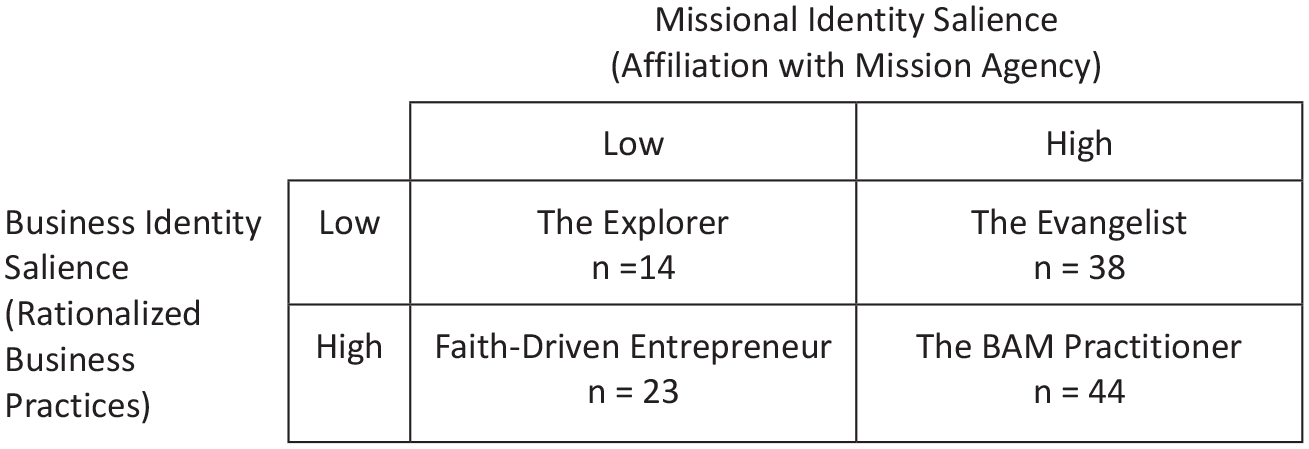
Typology of BAM businesses.
Figure 1 bottom right—The BAMer: This is the personification of BAM. For this person, BAM is a holistic missional endeavor that embraces God’s concern for all the world’s problems, not only the spiritual ones (Tunehag et al., 2005). They understand that the multiple “bottom lines” of BAM are not mutually exclusive, but are interdependent; that overemphasizing one objective at the expense of the others is often counterproductive (Lee et al., 2016; Miles, 2013; Rundle, 2000). The BAMer has been imprinted with a business mindset through their previous work experience(s) and/or education, and they unhesitatingly implement rationalized business practices with the intention of creating a financially self-sustaining business. This person also affiliates with a mission agency in order to receive the mentorship and resources needed to achieve the spiritual objectives. They are willing to locate in a country that has few, if any, Christians. Donor support, if any, will be short-lived and for the purpose of providing the business time to get established. Start-up funds come from a variety of sources; donors, investors, and personal funds. BAMers know that they must hold both missional and business identities in productive tension and maintain a balance. In time, their businesses have a significant economic and social impact on the surrounding communities.
Hypothesis 1a (Priorities): BAMers’ priorities will reflect a balanced and holistic perspective about mission.
Hypothesis 1b (Work Experience): BAMers will have relatively more business experience compared to nonprofit experience.
Hypothesis 1c (Risk Propensity): BAMers will be more likely to be located in countries that are Muslim majority.
Hypothesis 1d (Funding): For start-up capital, BAMers will draw from a combination of personal and charitable sources
Hypothesis 1e (Economic and Social Impact): BAMers will be more likely to have strong economic and social impact.
Figure 1 bottom left—The Faith-Driven Entrepreneur (FDE): FDEs reflect the salience of their business identity. They will have more marketplace work experience than their peers, and will be imprinted with a business mindset that implements rationalized business practices. Spiritual outcomes are important, but secondary, and they place greater weight on the business’ financial sustainability. The choice of location is driven by economics, not spiritual objectives, which leads them to locate in countries that are more stable, market oriented, and open to Christianity. This person does not feel a need to affiliate with a mission agency or draw donor support. They are relatively transparent about their faith, and start-up funds come from investors and personal funds, not donors.
Hypothesis 2a (Priorities): FDEs will prioritize economic outcomes over other outcomes.
Hypothesis 2b (Work Experience): FDEs will have predominantly business experience and very little nonprofit experience.
Hypothesis 2c (Risk Propensity): FDEs will be least likely to be located in countries that are Muslim majority.
Hypothesis 2d (Funding): For start-up capital, FDEs will mostly draw from personal savings and private investments.
Hypothesis 2e (Economic and Social Impact): FDEs will be more likely to have strong economic and social impact.
Figure 1 top right—The Evangelist: An Evangelist is someone whose missional identity is the most congruent. Their primary work experience is in the nonprofit world, and their university education was probably not business. Their first priority is gospel proclamation and other traditional expressions of evangelistic ministry. They may appreciate the importance of problems like poverty, human rights, or environmental concerns, but they are not animated by them. They would rather not be doing business, but circumstances require it because they are in a country that does not offer missionary visas and is less than welcoming toward evangelical Christians. For them, the business is simply a means to an end. Their chief concern about BAM is that it can distract a person from their ministry goals. They are affiliated with a mission agency and draw their full salaries from donors. They are cautious about revealing their faith to locals, and less likely than their peers to implement rationalized business practices. Financial success is unlikely, and to the extent that a business exists, it is sustained by the charitable gifts of donors.
Hypothesis 3a (Priorities): Evangelists will prioritize spiritual outcomes over other outcomes.
Hypothesis 3b (Work Experience): Evangelists will have predominantly nonprofit experience and very little business experience.
Hypothesis 3c (Risk Propensity): Evangelists will be more likely to be located in countries that are Muslim majority.
Hypothesis 3d (Funding): For start-up capital, Evangelists will mostly raise from donors.
Hypothesis 3e (Economic and Social Impact): Evangelists will be least likely to have strong economic and social impact.
Figure 1 top left—The Explorer: Explorers are people who are in an early stage of identity formation. They are exploring who they are as they experience BAM in the field. This person has been inspired to join the BAM movement out of passion for the gospel and they want to explore God’s calling. They bring more experience from the nonprofit world than from business. Their passion for missions enables them to raise some donor funding, but they have neither a board of advisors nor a mission agency to help set realistic expectations or to provide counsel or accountability. They have a holistic but vague theology of mission. Unlike the BAMer who maintains a healthy tension between the different objectives, the Explorer struggles with mission drift and is relatively unsuccessful in all areas. Their business rarely reaches a point of financial sustainability.
Hypothesis 4a (Priorities): Explorers will have relatively balanced priorities about business and mission.
Hypothesis 4b (Work Experience): Explorers will have predominantly nonprofit experience and very little business experience.
Hypothesis 4c (Risk Propensity): Explorers will be more likely to be located in countries that are Muslim majority.
Hypothesis 4d (Funding): For start-up capital, Explorers will mostly raise from donors.
Hypothesis 4e (Economic and Social Impact): Explorers will be less likely to have strong economic and social impact.
Data and methodology
The data for this study come from a 59-question survey that was administered online using Survey Monkey. The cover page included a definition of a BAM practitioner as a person involved in a business—we allowed both for-profit and not-for-profit businesses—that sells a product or service to paying customers. Organizations that give away their product or service for free (hospitals for the poor, for example) or those involved in training or mobilizing BAM practitioners were excluded from the study. Also excluded were those working for organizations that did not have an “expressly Christian purpose.” For example, a Christian accountant working for Intel in Malaysia would not be considered a BAM practitioner because the company itself does not have an expressly Christian purpose, and his or her influence within the company is probably limited.
One major hindrance for BAM scholars is a lack of any publicly available lists of BAM enterprises. Instead, we sent invitations to participate in the survey to several prominent BAM networking organizations and asked them to forward the survey directly to their members. While this means that the sample is not a scientific one, it nevertheless offers a rare, close-up look into the mysterious world of BAM. The survey was completely anonymous and did not ask for any contact or identifying information. Participation was purely voluntary, and no incentive was provided for participation. It was administered in English only, which is one limitation that we will discuss shortly. Of the 190 surveys that were collected, 71 were discarded for various reasons, such as incompleteness or an insufficient time in business. (In some cases, the businesses were little more than an idea.) The final sample contained 119 enterprises that conducted commercial activities and self-identified as BAM.
The descriptive statistics in Table 1 reveal that as a whole, BAM companies tend to be young (40% are less than 5 years old) and small (56% employ fewer than 10 people). The size of the firms varies, but about half of them have fewer than 10 employees. The sample also represents all the major continents of the world except for North American and Australia, and the firms come from a variety of industries.
Firm characteristics.

The identity table in Figure 1 assumes that a person’s missional identity salience and business identity salience are observable based on that person’s voluntary actions and affiliations (Tajfel, 2010). As a proxy for one’s missional identity salience, we use the respondents’ decision to affiliate, or not, with a mission agency. For business identity salience, we use a combination of six variables that are examples of rationalization: (1) establishment of formal board oversight, (2) drawing at least some income from the business, (3) measurable goals in economic performance, (4) measurable goals in social performance, (5) profitability, and (6) overall economic performance. We used the factor analysis method to test whether they are closely related. The factor analysis results returned one factor with the eigenvalue of 1.56. We used the factor score as a measure of rationalization of business practices. Based on the scores, we put them into four categories. The number of respondents in each category are provided in Figure 1.
Priorities
To get a sense of how respondents prioritize the four bottom lines, we asked them to assign weights to each category in such a way that, when added, the total score equaled 10. For example, a person who puts equal weight on all four bottom lines—economic, social, spiritual, and environmental—would provide scores of 2.5 + 2.5 + 2.5 + 2.5. Someone with a single-minded focus on one bottom line would have scores 10 + 0 + 0 + 0. This enabled us to rank the priorities for each respondent and for each category.
Work experience
For this variable we used the number of years they spent working in either for-profit or nonprofit sectors. We used five years as the minimum threshold for significant experience in either of the sectors.
Risk-propensity/location
While all BAM practitioners take significant risks by moving overseas to start a missional venture, they differ in terms of how much risk they are willing to take. To gauge this we used the business’ location as a proxy variable for a person’s missional risk propensity. Specifically, we consulted the Global Religious Landscape report by the Pew Research Center’s Forum on Religion and Public Life (2012) to determine whether or not they were located in a country with a Muslim majority. If located in such a country, we assigned a value of 1, and 0 if they were not.
Funding
For the source of funding, we asked respondents where they received their initial start-up capital. If the majority of start-up capital came from personal investment, we assigned a value of 1, and 0 otherwise.
Economic and social impact
In order to measure each organization’s economic and social impact, we used a subjective benchmarking approach taken by previous studies (Coombes et al., 2011; Kalleber and Moody, 1994). Subjective benchmarking measures each enterprise’s performance based on the respondent’s perception of economic impact. We asked respondents about their perception of their economic impact. They were asked to choose which of the following best describes their economic impact in the community.
We are a major employer in the community. Also, we are well known and appreciated by the local government and community leaders for the economic benefits we bring.
We hire some locals and have had a relatively modest yet meaningful impact in the area of economic benefit.
We offer occasional employment for locals, but beyond that the economic benefit is marginal.
We never employ locals, but benefit that local economy in other ways.
We never employ locals and apart from our own rent payments and living expenses, have had little impact on the local economy.
The answers were treated as an ordered scale of economic impact. Social impact is measured by directly asking the respondents to rate their past three years’ social impact in a Likert scale. Table 2 presents the descriptive statistics of the variables created. The numbers under each of the identity category are the mean scores for each of the variables.
Descriptive statistics of the key variables.

Note: The numbers under each category of BAM practitioners are the mean scores for the category.
Analysis
Priorities
Figure 2 presents a comparison of the weights respondents gave to the bottom lines of spiritual and economic impact. 3 The grey bar (left) shows the average score for the spiritual goals, and the black bar (right) shows the economic scores. The most significant difference is between Evangelists and FDEs. As predicted with Hypothesis 3a, Evangelists place much greater emphasis on spiritual outcomes, and much less on the economic goals. The reverse is true for the FDEs, as predicted in Hypothesis 2a. Interestingly, we can also see that, as predicted in Hypothesis 1a and 4a, BAMers and Explorers have more balanced perspectives with a slightly, but statistically insignificant emphasis toward spiritual goals.
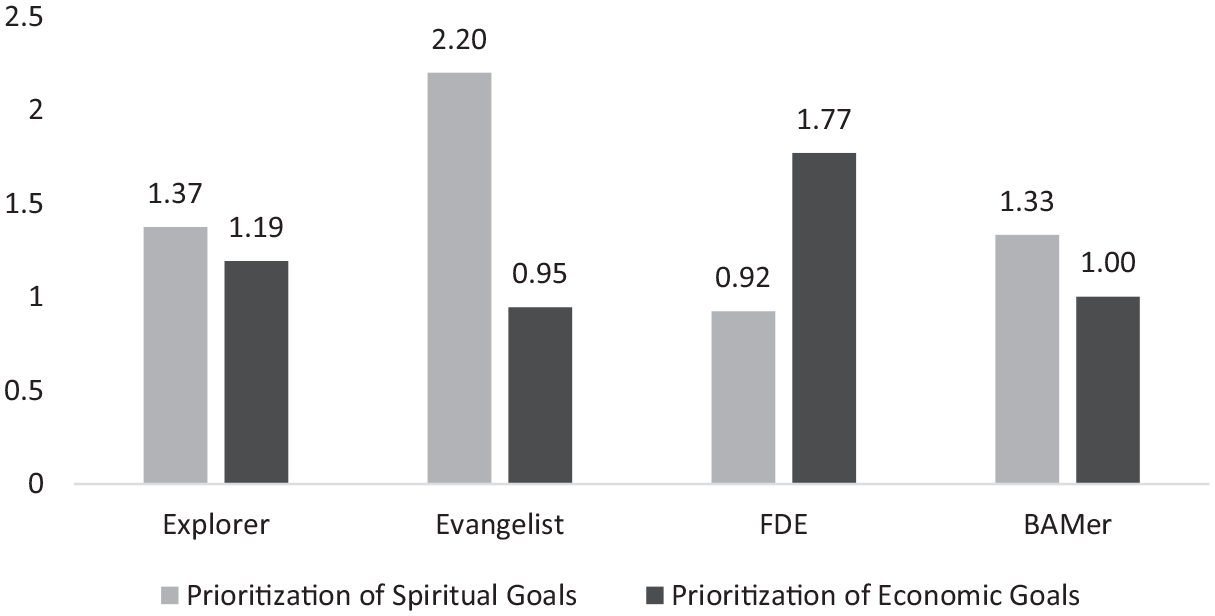
Prioritization of spiritual vs. economic goals.
Work experiences
Figure 3 shows that, consistent with Hypotheses 2b and 4b, the vast majority of Explorers and Evangelists enter the field of BAM with extensive experiences in the nonprofit industry (e.g., church ministry). By comparison, a very small percentage of FDEs have had any significant nonprofit experience. Interestingly, the work experience of BAMers is evenly split between the sectors. In contrast, over 95% of FDEs and BAMers have had more than five years of experience in the for-profit business sector, confirming Hypotheses 1b and 3b.

Work experience.
Risk-propensity/location
The results of our test of Hypotheses 1c to 4c are shown in Figure 4. Evangelists are twice as likely as FDEs to be located in a Muslim-majority country, which is assumed to be less welcoming to evangelical Christians. In actual numbers, just 3 out of 22 (13.6%) FDEs were operating in a Muslim-majority countries, whereas 13 out of 38 (34.2%) Evangelists were located there. The percentages of BAMers and Explorers are slightly lower than Evangelists but similar. The results point to the fact that Evangelists, BAMers, and Explorers are more willing to locate their business in countries that may be resistant to their Christian identity.

Working in a Muslim-majority country.
Personal start-up capital
Figure 5 shows the percentage of BAM practitioners who made significant personal investment in starting the business for each identity category. For Explorers and Evangelists, fewer than a quarter of them made significant personal investment for starting the business. Much of their start-up capital came from either donations or grants from various supporters. In particular, 65% of Evangelists received donations or grants to start the business. On the contrary, for FDEs, three-quarters of them made significant personal investment to start the business. In fact, among FDEs, more than half of them drew 100% of their start-up capital from personal funds.

Personal start-up capital.
Economic and social impact
Figure 6 shows the difference in perceived economic and social impact among the four types of BAM practitioners. Based on the ANOVA test, the difference between the categories is statistically significant. The results show that the average score of the perceived economic impact for FDEs is about 20% higher than that of the Evangelists. BAMers also reported significantly higher economic impact than Evangelists or Explorers. An important caveat for the higher economic impact scores for FDE is that they generally operate in countries that are less hostile to Christian organizations. Interestingly, BAMers operate in similar contexts as Explorers and Evangelists, yet their economic impact is still significantly higher than their counterparts. The social impact score shows almost identical patterns. Given that BAMers are more likely to operate in a challenging environment, their similar impact scores with FDEs is quite impressive. In fact, if we control for the basic characteristics of firms such as size and location, BAMers had even greater social impact than FDEs.

Economic and social impact.
Discussion
Given how much interest there is in BAM, surprisingly little is known about the characteristics, best practices, or impact of BAM practitioners and businesses. This study took a step toward addressing that gap by introducing a theoretically grounded typology of four distinct types of BAM practitioners. We labeled them BAMers, Evangelists, Explorers, and FDEs. The typology predicts systematic differences in how BAM practitioners “do mission” and “do business” based on their social identity, work experience, and management practices. We then tested those predictions using a dataset of 119 BAM practitioners from around the world, and found strong support for the model.
The most significant finding is that BAM practitioners with different social identities have correspondingly different views about the priorities that should be given to each of the four “bottom lines” of economic, social, spiritual, and environmental impact. For example, we found that FDEs prioritize economic outcomes, and Evangelists favor the spiritual bottom line (see Figure 2). That much was to be expected. The study also found systematic differences between their work experiences (Figure 3), risk propensity/location choices (Figure 4), funding strategies (Figure 5), and impacts (Figure 6). Specifically, we found that—after controlling for the firm’s size, age, industry, and location—BAMers generate higher impact in both economic and social spheres, despite the challenging circumstances.
Nearly all the work experience for FDEs is in the marketplace, and they raise start-up funding from private investors, which may explain why they are less likely to locate in economically and spiritually more challenging locations. Evangelists, on the other hand, have much less business experience on average, are more willing to serve in the difficult places, and draw their start-up funds and salaries almost exclusively from donors. Interestingly, as the theory suggests, BAMers appear to be a cross between FDEs and Evangelists. They have the most balanced and holistic orientation toward the four bottom lines (Figures 2), are more inclined toward difficult countries than FDEs, have a greater impact and more business experience than Evangelists and Explorers, and raise funding from both private and charitable sources. Lastly, Explorers have a holistic outlook about the quadruple bottom lines, but they lack marketplace work experience and do not benefit from having a board of advisors or a mission agency supervisor, which likely explains their mediocre performance.
While these are interesting findings that offer a rare glimpse inside this amorphous group, we must acknowledge that there are limitations to our study. First, the population we set out to study is very difficult to define. There is no publicly available list of BAM enterprises around the world. Therefore, we did not have a clear sampling frame to draw our samples. Instead, we used existing networks of international BAM enterprises to collect non-probabilistic samples of BAM practitioners. We diversified the sample by including firms from many regions of the world and a wide variety of industries. However, limits remain to the generalizability of our findings. We are hopeful that more datasets will become available for future scholars.
Second, we know anecdotally that the population of BAM practitioners is much more diverse than what is represented in this study. The survey was only available in English and was sent through our personal networks, which are heavily weighted towards English speakers, particularly from England and America. We are aware of major BAM mobilization efforts happening in other countries like Brazil and South Korea that could well have different perspectives on the importance of the four bottom lines. Third, our measurements are based on self-assessments, not observed behaviors, so we cannot rule out the possibility of endogeneity bias. Consequently, we cannot make any definitive conclusions about causality. More studies are needed that use different samples before we can place more confidence on this study’s findings.
Future research and conclusion
Regarding future research, it is our sincere hope that this study provides theoretical scaffolding upon which a more comprehensive and nuanced understanding of BAM can be built. There are many potentially fruitful avenues for future research. For example, how generalizable are these findings? Do they hold up with a more demographically diverse sample? And what can be learned about the makeup and performance of teams? Given that most BAM ventures are team-managed, does that make teams, rather than individuals, the more appropriate unit of analysis? What is the optimal size or combination of skills needed to maximize team effectiveness? Another avenue for more research is the bewildering problem of impact measurement. Thankfully, many new tools have been introduced in the SE arena, such as the B Lab Impact Assessment tool, the Global Impact Investing Network’s IRIS+ system (Impact Reporting & Investment Standards), and the Outcomes Matrix, to name a few. Longitudinal studies that investigate questions like how impact changes over time, or how identities evolve over time, would be another avenue for more research. Finally, this study took the theoretically grounded approach to creating the categories based on identity theory. There is also a need and opportunity for more grounded-theory models that would allow the categories of BAM practitioners to arise from the data. The grounded-theory approach can help us see how the practitioners conceptualize their own identity. These are many more possibilities.
One thing is clear: as interest in BAM continues to grow, the need for more rigorous, applied research will also increase. This study represents a step in that direction. It examined the link between the motivations, backgrounds, and practices of BAM practitioners and their outcomes in terms of the quadruple bottom lines of economic, social, spiritual, and environmental impact. We hope the findings not only stimulate further research, but that current and future BAM practitioners will find this research to be valuable.
Footnotes
Funding
The author(s) disclosed receipt of the following financial support for the research, authorship, and/or publication of this article: This study was supported in part by a networking grant from the Council of Christian Colleges and Universities.
