



Abstract
This article draws on personal narrative and art along with disability and the Bible to challenge who is able to witness. Disability creates barriers in how people imagine witness to God taking place. Personal narrative paints a picture of this reality. Yet the gospel flips expectations with ultimate beauty as Jesus on the cross. Accordingly, a damaged body points to God working through brokenness to bring blessing. In light of frailty, brokenness, and troubles in this world, this article intersects art, disability and Christian mission to demonstrate how art subverts norms of human strength, and highlights how beauty flows through brokenness. With Paul’s weakness language in 2 Corinthians, disability becomes the showplace for God’s glory.
Keywords
Introduction
In Planet Telex (1995), Radiohead blasts their crunchy guitars and ethereal synth pulling their listeners into introspection. In their chorus, Tom York melancholically sings:
But still, everything is broken
Everyone is broken
Everyone is, everyone is broken
Everyone is, everything is broken
These words from an artist speak to the reality that life is full of cracks, flaws, fragility and the futile chase for something ideal. While not theology in the strictest sense of the term, York’s lyrics paint a picture of humanness, vulnerability and frailty. This utterly human way of understanding creatureliness and a dependency on God similarly comes across in Frances Young’s (2007) monograph Brokenness and Blessing. Young reflects on God and human limitations, fragility and disability. For Young early church fathers understood humanness in terms of frailty and the need for God. Today, artists like York help underscore brokenness inherent in the human condition: we live in a world of frailty.
But art does not just leave us with an understanding of frailty. In art, beauty emerges from brokenness. For example, consider Kintsugi art and how it portrays a new beauty through the fractures of material coming back together again. Kintsugi art repairs broken ceramic with a Japanese lacquer called urushi and the joints are painted with gold and silver powder making the ceramic more beautiful than the original piece. As Kintsugi contends, ‘There is strength in vulnerability, and beauty in embracing our brokenness’ (TFI Global News Desk, 2023).
In this article, issues of disability paint a landscape where humanity fits or does not fit. Reflecting on frailty, brokenness, and troubles in this world, this article intersects art, disability and mission. Drawing from the ways in which art subverts norms of human strength, and highlights how beauty flows through brokenness, this essay challenges norms and expectations of who can witness to God’s beauty and goodness. Are Gospel proclaimers dependent only on words, or do lived realities of a Gospel witness also speak to God’s glory?
Disabling expectations
In today’s success-driven mission strategies, who can serve or witness is often based on ableist ideals of competency or ability which leaves some out. This article draws on Benjamin Conner’s (2018) work Disabling Mission which plays with the term ‘disabling.’ On the one hand, disabling speaks to how people are excluded by barriers to work, education, transportation and housing as society organizes around ableist norms. However, on the other hand, Conner uses this term to undo ableism within structures, imaginations, systems or ideas that include those with particular capacities while excluding those who lack them. In terms of mission, Conner asks for a disabling, or taking away, of ableism imbedded in consideration of who is capable of witnessing. This article approaches the topic from a first-person perspective.
Disability shocks our system. For some in the time of the early church, grotesque images of so-called ‘monsters’ pushed disability out of their imaginations (Caspary, 2012: 24). People thought those with disabilities as hideous or monsters, so they were avoided. Harsh and outdated language is no longer here to shock our systems, but the same forces that dehumanize and discard people still exist. In terms of mission or participation in the work of God, issues of disablism prevent some from meaningful engagement in God’s mission. With some disabilities what makes one different is all too visible. In blindness, a white cane symbolizes difference. The white cane provokes some to move out of the way which often leads to a metaphoric chasm between ‘the blind’ and those with sight. Interactions between sighted people and those strange ones with a white cane are infrequent.
In my own situation as one with blindness, I could share unending stories of how people discounted my contribution to God’s work. For me, 20 years of ministry both inside and outside the US speaks to the pervasive disregard of those with disabilities. The complexities compound when cultural differences are considered. When I was asked to pastor a church in Bangkok that was in crisis, my wife and I had lived in Thailand for several years. Being sent as a missionary with blindness stands out as exceptional in and of itself. Even though I was an ordained minister with our church, I was more of an add-on to my wife, who was also ordained. We were sent to serve in a ministry, which among other evangelistic and missional endeavors, ran an English school for Thai children, youths, and adults. As my wife was also a credentialed schoolteacher, the ministry leaders in Thailand thought highly of her potential. They were willing to figure out something for me. Soon my contributions came across, and I began to be incorporated into the life and ministry of the church.
After some years in Thailand, the church asked us to step into a difficult moment. The church needed help. No one else was willing, so they asked me. The people knew me and loved me as a member. However, my leading as a disabled person invoked suspicion amongst this Thai church. The church was going through a challenging season, and they wondered why God gave them a person with his own challenges. They wanted somebody with abilities to lead them through their tribulation. I did not find this out right away. In Thailand, people communicate indirectly, often talking to someone else in order for the message to get to the person through an intermediary.
Through this system, they said, ‘let Andy go with the Spirit.’ In other words, how can we follow a blind person? There were other hurts and troubles within the heart of the church members, but they could not imagine God giving them a person with a clear defect to lead them out of the difficulties that had consumed them.
Little by little we kept working with the people and loving on them. Things got worse before they got better, but eventually they started to turn around. We worked with some young Thai leaders and poured into them. After a year of what we thought might be 10 years of intervention, these young leaders were ready to be installed as pastors. This took place at a pastors’ meeting for our denomination in Thailand.
One thing about ordination sticks out from this ordination service. The speaker was preaching on the kingdom of God in Luke 10. He described signs of the kingdom, including God bringing life from death. At this point, one of the church leaders up for ordination turned to us to say, ‘I know God raises the dead. This church was dead, and now it is alive.’
A little while later as the transition concluded, one of the leaders told my wife a story that juxtaposed with their initial hesitance to follow a blind pastor. Again, Thai culture usually does not say things directly to the person, so they told my wife. They said the people did not know how to follow me. The previous pastor could see. By this they meant he had charisma, talents, skills, and everything needed to run a church and church-led business initiatives. He did have savvy and business skills but did not have the character God asks for in a leader. The church leader went on to tell my wife how this person left trouble in his wake for the church. Then God gave them someone who literally could not see. The people did not understand why. But over a couple of years, they watched how God worked through the midst of my life and others in the church to bring reconciliation, healing, restoration and more. Through these instances, Paul’s claim in 2 Cor. 12:10 became a life verse. Whenever I am weak, I am strong (my paraphrase).
Disability: A category
My story describes disability in terms of discrimination and exclusion, or the discounting of one’s contribution to ministry. Yet disability, as understood, is a bit more complicated. Two primary models work in tension to articulate disability: the bio-medical and social models. A medicalized model expresses disability as an impairment to be fixed or cured. Some push against the bio-medical model because it does not account for social barriers or the disabling of a person due to stigma or physical barriers in housing or the environment. This is the social model. These models fall into tension with one another when lived realities complicate the story. 1 Locating disability as an individual problem due to physical or cognitive deficiency or only focusing on social barriers fails to account for lived realities of those with disabilities.
Instead, I agree with those who argue disability is a confluence between social barriers to work, education, transportation, and housing, discrimination, and the lived experiences of those with impairments (Shakespeare, 2006; Thomas, 2007). In light of these realities, language around disability continues to change, though the reality of othering persists. Ableist norms and imagination tend to categorize people — leaving some with differentiated bodies or cognitive impairments in a space of not fitting in. Disabled people are dehumanized by being placed in categories of ‘other’ through the binary terminology of ‘we’ and ‘they.’ Early iterations of polarizing terms included the ‘fit’ and ‘unfit’ (Kirchner, 2010), with these labels classifying people according to who does and does not fit within society. Solutions for those deemed unfit included rehabilitation, professional care, or institutionalization.
Evolving language has leaned on Irving Goffman’s term ‘normal,’ which contrasts normal and abnormal (Goffman, 1963), Especially with regards to the ways disabled people work out moral and social access within society. In the narration of his journey into experiencing disability, Jay Chaskes (2010) employs the word ‘walkies’ to designate those who walk with non-walkers. These terms undergird how society creates ways to include certain people while excluding ‘others,’ like people with disabilities.
Other binary terms include ‘superior’ and ‘inferior’ (Berger and Lorenz, 2015), ‘handicapped’ and ‘capable’ (Barnartt, 2010), and ‘functioning’ or ‘nonfunctioning’ (WHO, 1980). 2 Each of these terms fits into an ableist perspective, disenfranchising disabled people by drawing distinctions between ‘able’ and ‘disabled.’ Disability studies call this discrimination ‘disablism’ (Thomas, 2010: 37). Through othering and discrimination, disabled people are pushed to the margins of society. Reflecting on these issues, Rosemarie Garland-Thomson identifies misfit or ‘Disability, then, [as] the attribution of corporeal deviance—not so much a property of bodies as a product of cultural rules about what bodies should be or do’ (Garland-Thomson, 1997: 6).
With my experiences, I find that an old way of talking about disability still pervades our practice even if we use supposedly nicer language. What I mean is this, living with so-called disabilities—or what used to be simply viewed as ‘unfit’ or not fitting into the model of society—shocks one on a daily basis. Sometimes I grow numb to the shocks as one buffeted by social barriers. Other times, the tables are turned as so-called abled people demonstrate surprise when they see me engage in work, transportation, or education, much less other mundane aspects of life.
Art disability and witness
In light of othering and marginality, the intersection of art and disability challenges ableist limits on how Gospel witnessing takes place. By Gospel, this essay refers to the power of God at work bringing beauty from ashes, life from death, and glory from suffering. Additionally, in light of disability, concepts of art suggest a Gospel-witnessing person may embody Gospeling in expansive, creative expressions that God would be experienced and known more in this world. For some, societal expectations may detract from the fullness of all participating in the mission of God. One might ask, what does disability teach us about beauty, or how does disability draw us to see the beauty of God in surprising ways? If, as Hans Urs von Balthasar (2009) posits in his Theological Aesthetics, the truest form of beauty is found on the cross—then disability may draw us back to the damaged body on the cross and the unsettling beauty it offers.
Pushing the conversation further, theological reflection has led some to observe God at work in disability. Nancy Eiesland (1994) brought a liberatory perspective to a God who became disabled through the cross; that is, a God who identifies with human disabilities. This groundbreaking work continues to spur further reflection on several dimensions. One such angle discusses a trinitarian understanding of disability, as Lisa Powell (2023) advances Eiesland’s thoughts and contribution in The Disabled God Revisited. In another turn, Deborah Creamer (2012) discusses disability in terms of limits, as all people have limitations, some more than others. At the same time, Martin Albl (2007) identifies ἀσθένεια as the closest word in Greek to a modern concept of disability. As disability theology extends the conversation, one notes historical theology that exemplifies the church wrestling with disability through the years. Meanwhile, Amos Yong’s (2011) The Bible, Disability and the Church challenges ecclesiological barriers to disabled people in faith communities. 3 Disability theology helps identify disability as part of being human. With this in mind, let us consider the clay jar metaphor in 2 Corinthians and discover how this metaphor elucidates how God works through people with cracks or brokenness.
Disability as a motif in 2 Corinthians
If clay jars symbolize frailty and limitations among other aspects of weakness, one wonders why Paul highlights this metaphor in light of complaints against a weak messenger. Nevertheless, clay jars work to illustrate how God shines through the cracks of one’s life (Fitzgerald, 1988; Young 2002) In a surprising wonder, and similar to how art displays beauty through brokenness, the Gospel displays the power of God in human lives.
Through ordinary people, God works in the messiness, brokenness and limitations of life to bring the glorious work of his good news to shine in the world. One who lives this Gospel reality is Paul, ‘a Disabled Apostle’ (Soon, 2023: 11-13). Since he is ‘weak in appearance’ (2 Cor 10:10), this raises questions of Paul’s beauty: was he ugly or did he simply have a damaged body? In reconstructing Paul, it is unclear whether he had a disability (Soon, 2023: 11-13; Yarbro Collins, 2011: 165-183). However, Paul’s critics claimed to have been repulsed by his strange bodily appearance. Presumably the Corinthians knew the exact nature of Paul’s bodily ailment; but those who know of his infirmity only through his epistles suffer the paradoxical frustration of a puzzle difficult to solve. Additionally, Paul’s ambiguous language affords sufferers of every kind the opportunity to resonate with his assertion that human weakness is the showplace where God’s beauty shines. In Corinth, opponents and even the young church fathered by Paul criticized him as unable to teach, preach or lead them any longer (2 Cor 10-11). 4
In terms of his weak appearance, some scholars claim Paul’s appearance and interactions left Corinthians questioning his masculinity. According to Jennifer Larson (2004: 85), for the Corinthians, ‘physical unattractiveness or disability detracted from one’s ability to lead and persuade others’. Here disability simply means not manly enough. Candida R. Moss (2012) develops this masculinity theme by interpreting Paul’s bodily shortcomings as disability per her interaction with disability and illness in the ancient world. Paul is disabled and does not fit norms of masculinity due to a damaged body. In light of a clear instance in which Paul’s body did not open doors for him, in keeping with the above complaints, his deficient body led to Christians tuning him out or muting him.
Additionally, Isaac Soon extends the argument by saying Paul’s disability provoked estrangement. 5 By estrangement he means confusion toward an appearance which comes up short on ideals of what a masculine body looks like. For the Corinthians, a beautiful message flowed out of a messenger with a beautiful body (Minor, 2009: 87). Paul’s argument flipped this on its head with the beautiful message of the Gospel breaking forth through the brokenness of human stories and damaged or impaired bodies. For Paul, the power of the Gospel belonged to God. Overall, as Paul sought to articulate the Gospel as the reason for his work as well as how his life was both the medium and the message for the Gospel, he subverted his criticisms (Bowens, 2017: 50).
In leveraging a concept like clay jars, Paul foreshadowed an argument for weakness that unfolded later in 2 Cor 10-13. Timothy Savage (1996), Paul Barnett (1997), and Sze-Kar Wan (2000), among others, observe weakness woven throughout Paul’s correspondence. Further, the link between weakness for Paul connected to Jesus crucified in weakness (2 Cor 13:4). Paul shaped his life and work according to the example of Jesus crucified. For Paul, the cross is central to his argument on power through weakness. This gets at the heart of the Gospel, which must be seen in terms of cross and resurrection. In linking God’s power to weakness, Paul rested in weakness in order that the power of God would dwell on him. In the clay jars metaphor, Paul demonstrated how an unworthy container reveals the power belonging not to a person but to the Gospel and to God.
Weakness refers to human finitude found in frailty, vulnerability, and limitations. This includes weakness in relation to human ingenuity; furthermore, weakness is understood through the categorizing of some people as more or less valued than others. For example, as Shakespeare declares in Hamlet, ‘Frailty, thy name is woman’ (Shakespeare, 1905: 83). By this admission ‘weakness’ is a dehumanizing way of comparing one’s strength against another person’s perceived limitations.
In reading Paul, one wonders if this is the same person mythologized in current literature as a church planter, an apostle par excellence, or a theologian. Sometimes Paul seems like a legend. In current literature he often becomes a superhero far different than how he talks about himself. It is almost as though those who reflect on him forget to put him in his situation and instead read back into him all the supposed successes of churches planted throughout the Roman world. Would Paul have written of these successes in his CV, like people today write their cover letter and resume?
In Corinthians, the Paul who is seen by 20th and 21st-century authors confounds 1st-century Christians. They say he has a ‘weak’ appearance and ‘contemptible’ speech (2 Cor 10:10). ‘What is it that is so weak?’ one might ask. This is where beauty and image clash with expectations, and where art allows for a subversion of what is elevated. In a recent work, Isaac Soon (2023) captures this irony between art and power in contrast to A Disabled Apostle. In a number of depictions of masculine potency, Soon highlights what a Greco-Roman perception of an ideal body looks like. Yet Paul falls short of this image. He is ugly or physically impaired. Soon goes on to discuss a number of theories of Paul’s impairments from epilepsy to malaria (Soon, 2023: 11-13). Whether or not one can know Paul’s actual impairment, the reality of Paul’s weakness in bodily image is clear to the Corinthians.
Therefore, Paul’s bodily presence, as it were, raises questions related to the Gospel and Christian witness. One might wonder why bodies matter at all. For some, the content of the Gospel is not subject to situatedness and is instead disembodied truth. For others an embodied Gospel subjects realities of God’s work to human means. Hence one asks, why do images and presuppositions create such a picture in the mind of an audience? And why does Paul’s presentation in Corinth flip this on its head? Space prevents all the textual evidence of Paul’s disability or his theologizing on what frailty and limitations mean. 6 Still, art helps create pictures that capture or disturb our imagination. Before returning to Paul and his message, a turn to look at art will fortify this discussion.
A picture is worth 1000 words: Paul and art in the Greco-Roman world
If, as one maxim claims, a picture is worth a thousand words, one wonders if the wrong image provokes some to close their ears. An image that misfits preconceptions disturbs and misrepresents one thousand words. For Paul, his audience appreciates his writing, but wonders about his appearance. Today, we cannot speak to his bodily presence, but Pauline metaphors and concepts capture our imagination. One wonders: Why a clay jar and not a golden vessel or unbreakable container for God to use in carrying his message? The painting of pictures to display the story of the Gospel as portrayed on the cross reminds us that God comes to us in our imagination before our propositions. As Makoto Fujimura (2021: 7) affirms, God the artist shows up before God the theologian.
This begs questions in terms of mission. As people who participate in God’s work in this world, what are we bringing to people who do not yet know God? What do people see first from Gospel workers? What are the dimensions of Gospel proclamation that include artistry? If art evokes emotions and implicit thoughts, what does this say about the Gospel presentation as we know it? On the flipside, what does this say about ableness? Do we only wish to present the Gospel or promote the Gospel through the bodies of those who speak well or look beautiful or handsome? Alternatively stated, is there room for others who do not fit our expectations of charismatic or competent Gospel workers? To draw this out, a picture which begs questions of what a person can or cannot do helps make this point.
Before moving along, pause and reflect on this picture (see Figure 1). Who is Christina? No, really: pause for a moment.
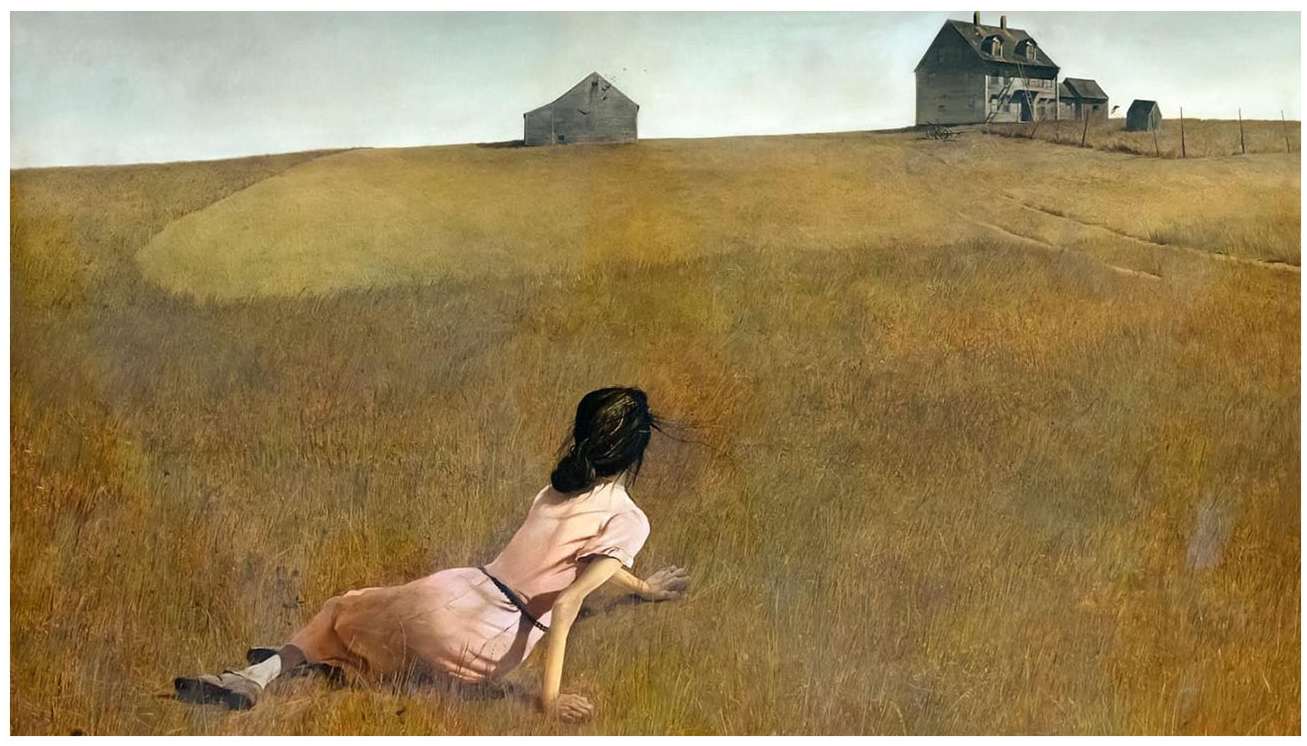
Christina’s World, Andrew Wyeth, 1948; www.moma.org/collection/works/78455.
This picture arrests our gaze as we behold this girl whose face is hidden from view. We might wonder: is her face grimacing in pain, or is she smiling in pure joy? If beauty is in the eye of the beholder, are we beholding a beautiful girl or a damaged body? Andrew Wyeth, who painted this picture, takes care to portray this neighbor of his with dignity.
At first glance, one might perceive Christina as merely laying on the ground. She might be seen as limited, frail, or lacking. But as one takes in this painting, it becomes evident that Christina may be pulling herself along the ground or crawling across the yard. This picture renders a strength in the struggle, even though she is unable to do all the things other children can do. The artist who paints her lives next door, however, and he sees her for who she is. He knows her and portrays her with kindness. She is getting down on the ground to explore what she can see. We are watching her live and move in her world. It is our first impression that haunts us more than what this art conveys upon further reflection. One might ask: what does this say about God, beauty and wonder? Does Christina, a person made in the image of God, sense the awe and glory of God’s world? Additionally, one might ponder if a disabled girl communicates God’s goodness to others.
Between reflection on Paul, whose body disturbed his audience, and my own story of a white cane that prevents others from seeing God at work in me, images speak volumes. If God is at work in all humans, art helps disrupt norms that elevate some bodies above others as worthy to witness to God’s truth. The unsettling work of art reminds the church to look for how God is working through all humans in surprising and beautiful ways.
Michaelangelo and beauty
Let this conversation take one more turn to another glimpse of beauty, yet again in an unanticipated way. Maybe the story of an Italian master from the 15-16th century contrasts Christina too starkly. Yet it is the human body that captivates Michaelangelo (Ramsey, 2022: 26). For Michelangelo, sculptures or paintings highlight bodily beauty while noting weaknesses and strengths inherent in humanness. This text describing Michaelangelo’s work on David (see Figure 2) and bodies in general speaks to beauty from brokenness.

Michaelangelo’s David, Photograph taken by author at Galleria dell’Accademia.
The focal piece of Michaelangelo’s creative expression was the human form. He was captivated by the human body—the male body in particular. In his depictions of people, we see his struggle to portray a beauty that is both sensual and divine, powerful and vulnerable, masculine and feminine. Most of his subjects are male, many of them nude, and almost all are specimens of physical perfection. Even his women bear the musculature of the male form.
Perhaps Michaelangelo capitulated to the ideal of the flawless human body. Yet this artist grasps the power and vulnerability which exist simultaneously in all humans. Disability theology connects these realities to discussions on anthropology. If one takes Michelangelo’s observations of humanness and extends them into discussions of ableness, one sees Michaelangelo highlighting the reality of human limitations. If the focal point is human bodies, the goal is to reflect God at work in humans. This is Paul’s polemic in clay jars containing a glorious Gospel power that all might know the power that belongs to God. One could say the beauty belongs to God as one pauses to be impressed not with God’s creation but rather with the creator himself (Ramsey, 2022: 26).
When art disables expectations
Because his body repulses Corinthian expectations, Paul responds by saying, Since you desire proof that Christ is speaking in me, he is not weak in dealing with you but is powerful in you. For he was crucified in weakness but lives by the power of God. For we are weak in him, but in dealing with you we will live with him by the power of God. (2 Cor 13:3-4)
These verses draw from the climax of his argument on weaknesses and limitations. Whenever I am weak, I am strong (2 Cor 12:10b). Or rather, as I interpret Paul to be saying, when I am weak, God is strong. Or perhaps whenever I am weak, the Gospel is strong.
These weaknesses or cracks in our life or broken fragments get pulled back together and reshaped into something beautiful in God’s eyes and for God’s glory. These flaws turn into the showplace where God shines. Let me be clear: disability is not a flaw in the sense that those without disabilities lack flaws. Rather, a disability lens helps identify the humanness in all people (Brock, 2012: 9).
Whether by age, sickness or accident, all will find themselves disabled, goes the old adage (Kafer, 2013: 25-26). This means that all humans intersect this lived reality, some just get to discount others as their so-called abilities outshine others’ so-called inabilities or impairments. Tapping into the humanness common to all, Henri Nouwen argued for a form of ministry and servitude that resists current practices that formulate success in terms of a scientific method. For Nouwen (1999), the way of Jesus and downward mobility demonstrate another path. When church men buy into methods that lead to repeatable excellence, Nouwen argues for a return to humanity and becoming less to serve others, the world, and the church (Nouwen, 1989: 49-70).
As Nouwen, who specializes in theology, contends for this identification with limitations and weaknesses as part of the human condition, artists tend to find ways to let beauty flow from brokenness. It is human to be broken, and artists help us capture humanness in this way as they tap into the creatureliness or fragility common to all. Artists stand apart in a world chasing success and achievement. As Fujimura (2021: 44) contends, we forge the beauty of new creation out of the shattered pieces of our lives.
At this juncture a return to Michaelangelo’s David helps illustrate the point. When Michaelangelo found the 24-ton marble slab, previous attempts to sculpt David left the slab marred from chisel marks and the first attempt to carve the legs. Despite limitations and scars, something beautiful emerged. Ramsey (2022: 36) observes, ‘Living with limits is one of the ways we enter into beauty we would not have otherwise seen, good work we would not have chosen, and relationships we would not have treasured’. Disabling art allows one to see true beauty, a beauty which points to the divine.
Conclusion
Through a profound mystery the Gospel brings life from death, exaltation from humiliation, and beauty from ashes. In reflecting on beauty, one wonders if ashes become something altogether new and beautiful, or if God radically reconfigures ashes into a thing which lets the beauty of his goodness captivate. For Paul, one who was ‘weak in appearance’ (2 Cor 10:10), his life emanated the Gospel in word and deed. This raises questions of Paul’s beauty, asking if he was ugly or simply had a damaged body. Disability theology contests Paul’s disability. However, disability for Paul can be as much as the debilitating nature of his work, and the scars and wounds of his beatings. Nonetheless, in responding to Paul’s disabled body, the Corinthians were willing to exchange the Gospel which calls one into death to gain life, and humiliation to gain exaltation, for a Gospel that fit with Corinthian expectations of beauty and personal glory. Today, in determining who is able to present the Gospel based on a criterion of charisma and human capacities, there are some who do not fit into people’s imagination of witnessing to God’s glory or who simply do not qualify. Paul’s theologizing on weaknesses and weak appearances as a place for God’s glory to become visible speaks to issues of disability. In similar ways to Brian Brock’s (2020: 9-16) assertion that a consumeristic and materialistic world leaves behind those who do not fit ideals of beauty and productivity, one wonders how the church’s witness of those with damaged bodies on a spectrum of abilities communicate the transformative power of the Gospel to this world. If Corinthians allowed themselves to be repulsed by images of the less-than-ideal communicator, are there ways that today’s church limits mission possibilities for some due to their bodies not fitting the supposed ideals of the Gospel worker?
In considering repulsive images, Irving Goffman articulates disability as a stigma drawn from an ancient Greek term that marked ‘slaves, criminals or traitors’ with visible signs to repel others from their presence (Goffman, 1963: 11). This comes back to the picture of a white cane and how people stigmatize what one person cannot see by what another person sees in that symbolism. If seeing is believing, some see a person who does not see and make assumptions about what that person can or cannot do.
In my own story, encounters of being dismissed, discarded or disregarded due to preconceptions based on a white cane limit my opportunities. Yet Paul’s language on weaknesses, limitations, and frailty has connected me to a beautiful story of a God who works through vulnerability. In his brokenness, Paul reminds the Corinthians (and through them all who read his letters) of what it means to have a life formed by the cross. The cross presents ultimate beauty. As Fujimura (2021: 117) claims, ‘To me, all art resonates from the aroma of Christ, as he hung on the cross.’
Footnotes
Funding
The author received no financial support for the research, authorship, and/or publication of this article.
