



Abstract
The study examined detection of deception in unsanctioned, consequential lies between either friends or strangers using an ultimatum game. The sender was given an amount of money to divide with the receiver. The receiver did not know the precise amount the sender had to divide, and the sender had the ability to deceive the receiver about the monetary amount. Not surprisingly, senders were more likely to deceive strangers than friends, and receivers were more suspicious of strangers than friends. When senders lied, they stated their offer more times and gave more supporting statements for their offer. Receivers had a strong truth bias, although the majority of senders were truthful, and friends had more of a truth bias than strangers. Receivers were not able to detect deception at a rate above chance. Friends were not better at detecting deception than strangers. However, because most participants were truthful and there was a strong truth bias, a high percentage of participants were able to detect when their partner was truthful, in confirmation of the veracity effect.
People are sometimes motivated to deceive those with whom they interact. Motives for deception range from impression management concerns, to benevolent concerns for the other party, self-enhancement, and monetary gain (Levine, Kim, & Hamel, 2010). In strategic interactions, such as negotiations, many or all of these motivations may induce one party to lie, or knowingly misrepresent or omit information, to the other. Deception for monetary gain is often a tempting and viable strategy for negotiators (Olekalns & Smith, 2009).
Whereas some deceptions may be of little consequence, others provide clear benefit to the deceiver at the cost of the deceived (Malhotra & Bazerman, 2007). As a result, the ability to detect lies may be a useful skill for one to acquire. Unfortunately, most studies peg the average person’s ability to detect deception versus truth at slightly better than chance (for review, Bond & DePaulo, 2006) and find that people have a truth bias when judging whether a communication is truthful or deceptive (Anderson, Ansfield, & DePaulo, 1997; McCornack & Parks, 1986; Miller, Mongeau, & Sleight, 1986; O’Sullivan, Ekman, & Friesen, 1988; Zuckerman, DeFrank, Hall, Larrance, & Rosenthal, 1979; Zuckerman, DePaulo, & Rosenthal, 1981). This “bias” refers to the tendency people have of assuming that statements made by others are truthful more often than not. Research has found that people who are in close personal relationships with those whom they are judging tend to exhibit a greater degree of truth bias (McCornack & Parks, 1986; Stiff, Kim, & Ramesh, 1992). McCornack and Parks (1986) suggest that this is because people in close relationships begin to operate under a presumption of honesty that carries through to all types of communication between them and their relational counterparts.
However, whereas most deception researchers have found that individuals (particularly those who are untrained) are poor lie detectors, and there is much evidence that suggests people exhibit truth biases, particularly when they are in close personal relationships, the research exhibits some consistent methodological and statistical issues that have raised concerns (Bond & DePaulo, 2006; Burgoon & Levine, 2010; Levine, Kim, & Blair, 2010). This article uses an experimental design that mitigates some of these concerns in evaluating deception detection, truth bias, and the role of personal relationships.
Previous research has followed a fairly consistent experimental paradigm with which to study the ability of people to detect deception. Burgoon and Levine (2010) state that “the vast majority of deception detection research is . . . truth-lie detection research” (p. 202). The prototypic study involves a series of statements made by one person (sender) that the other (receiver) views through either videotape, online chat, or in face-to-face interaction. Typically, the sender is told (by the experimenter) to be truthful exactly 50% of the time (i.e., in half of the statements) and to lie 50% of the time. The receiver, who must judge whether each statement made by the sender is truthful or a lie, is usually told that the sender “may not be completely truthful” or “may lie” on occasion. Burgoon and Levine (2010) remark that this 50-50 base rate is a “common design feature of 40 years of deception detection experiments” and “has led to meta-analysis results with very narrow generality” (p. 211).
Receivers view each statement and judge it as being either truthful or a lie. Receivers are provided no base rates regarding propensity to lie in the given context—that is, they are not told the ratio of truths to lies. Once all judgments have been made, the “accuracy score” for the evaluator is computed as the percentage of all judgments that were accurate (summing across truths and lies). It is the accuracy score that is compared with the chance probability (50%) of accurately judging a statement in determining whether people are good at detecting deception. Across numerous studies, results suggest a mean accuracy score of 54% to 57% or slightly better than chance (Bond & DePaulo, 2006; Kraut, 1980; Vrij, 2000). Any time a receiver labels significantly more statements as truths than as lies (i.e., more than 50% of the statements as truthful), this is evidence of a “truth bias.”
Methodological and Statistical Concerns With Prior Research
While this research method has added considerably to our understanding of deception, researchers have pointed out some problems with this method and have been examining new ways of studying deception (Bond & DePaulo, 2006; Burgoon & Levine, 2010). We hope to add to this research by addressing some of the issues that have been raised about research in deception.
Arbitrarily high base rate of lies
The 50/50 ratio of truths/lies imposed by many researchers may not correspond to the base rate at which deception would occur in a naturally occurring situation. Researchers note that most people report only telling one or two lies a day (DePaulo, Kashy, Kirkendol, Wyer, & Epstein, 1996; George & Robb, 2008; Hancock, Thom- Santelli, & Ritchie, 2004). In fact, Serota, Levine, and Boster (2010) found that one or two lies a day may overestimate the amount of lying a typical person does because most lying is done by a few people who skew the distribution and raise the mean. Lowering the base rate of lies, by not instructing participants to lie on half the interactions, should increase accuracy given the evidence that participants have strong truth biases (Levine, Kim, Park, & Hughes, 2006; Levine, Park, & McCornack, 1999; Park & Levine, 2001; Serota et al., 2010).
Given the low base rate of deception people report in their actual life, it is perhaps not surprising that receivers tend to assume that the sender is telling the truth. This is presumably why researchers often “warn” receivers that the sender may lie. Even so, there is no reason to think that receivers will imagine that the number of lies could be as high as 50%. Levine, Kim, & Blair (2010) speculate that people have mental models about the probability of deception in different situations based on the motives of the sender. These mental models affect whether a receiver chooses to use a truth heuristic or decides to scrutinize the message more carefully for deception. The existence of a truth bias, then, reflects the general tendency for people to assume that people are honest in contexts where there is no clear expectation of or reason for a high base rate of lying, and in situations without a high base rate of lying, the truth bias is a good strategy.
Lack of motive
As the sender is asked to lie in the typical study (for exception, see Levine, Kim, & Blair, 2010), there is often no discernable motive underlying the lies and truths. Certainly, some studies provide the sender an incentive not to get caught, but there is no motive to lie on certain items over other items. Bond and DePaulo (2006) note that “researchers bypass naturally occurring correlates of deceptiveness by compelling lies from every experimental participant—even those who are loath to lie” (p. 233). As such, receivers have no “motivational contingencies surrounding deceit” and they cannot take the context and situation into account. Levine, Kim, and Blair (2010) note that lies in “the typical deception detection experiment are often de-contextualized” (p. 82) from the situation and sanctioned by the experimenter. What is needed is a situation in which participants can decide on their own whether they want to engage in deception.
Receivers have no incentives
Most research does not provide an incentive to receivers for making accurate judgments. For example, in their meta-analysis, Bond and DePaulo (2006) found that only 12% of studies in their sample provided receivers with a motivation. Some research suggests that when receivers have an incentive to correctly judge the statements of a sender, they may be less prone to the truth bias (Stiff et al., 1992). However, two studies by Hubbell, Mitchell, and Gee (2001) found that outcome involvement increased the tendency to perceive the sender as truthful. However, in their studies increased motivation to scrutinize the sender was confounded with the prestige of the sender’s credentials.
Lack of research examining deception through omission
Furthermore, the research on deception detection has concentrated on stated falsehoods or “bald-faced lies” and not on other types of deception such as deception by omission. According to information manipulation theory (McCornack, 1992; McCornack, Levine, Solowczuk, Torres, & Campbell, 1992; Yeung, Levine, & Nishiyama, 1999), deceptive messages derive from violations of one or more of Grice’s (1989) conversational maxims (for review, see McCornack, 1992). Violations of quality involve deliberate falsification, whereas violations of quantity involve omitting information to create a misleading impression. Messages violating the conversational maxim of quantity were rated as more deceptive than messages not violating this maxim (Jacobs, Dawson, & Brashers, 1996; McCornack et al., 1992).
While deception by omission has not been studied extensively, it is a widely used technique recognized in study of religion, philosophy, and law (Bennett, 1983; Chisholm & Feehan, 1977). Tenbrunsel and Messick (2004) argue that is easier to self-justify an omission. Moreover, research in judgment and decision making has found that harmful omissions are viewed as less deceptive and more socially acceptable than harmful commissions (Ritov & Baron, 1990; Spranca, Minsk, & Baron, 1991; Tenbrunsel & Messick, 2004; for exception, see Levine, Asada, & Massi, 2003). This discussion suggests that although research on deception detection tends to study overt lying, deception through omission may in fact be very prevalent in actual interaction.
Proposed study
In summary, much of existing research creates an artificially high base rate of deception, entails no real motivation for deception, provides no incentives for accuracy in deception detection, and fails to consider the possibility of deception through omission. The current study uses monetary incentives for senders to deceive without being caught, entails a context in which senders would realistically consider deceiving their partner, creates incentives for receivers to accurately detect deception, avoids asking senders to deceive their partners, and examines both lies and deception by omission.
Participants in our study engage in a “decision-making exercise” that is a modification of the traditional ultimatum game (Guth, Schmittberger, & Schwarze, 1982), in which an allocator (sender) is given a sum of money and asked to distribute this money between herself and the recipient (receiver). In our game, the recipient does not know the exact amount of the allocator’s endowment but knows the range of possible values. Once the allocator has announced the distribution, the recipient can either accept or reject it. If it is rejected, the allocator receives nothing, but the recipient receives a default amount, which is always equal to 25% of the allocator’s actual endowment. Both parties in the interaction know all of the above rules. Both parties also know the range of possible values for the allocator’s endowment, but only the allocator knows the actual endowment. It is up to the allocator to decide whether to truthfully reveal her endowment amount at the time she makes the offer to the recipient. A real-life example of this is Steve Jobs’ negotiation with Steve Wozniak. When Jobs was at Atari, he was offered US$100 for each chip that he reduced in the Atari machine. Jobs made a deal with Steve Wozniak to split the bonus between them if Wozniak could reduce the number of chips, and Wozniak reduced the number of chips by 50. Jobs told Wozniak that Atari had only given him US$700 and Wozniak’s share was 50% (US$350). In reality, Jobs received the full US$5,000 (“Breakout,” n.d., para. 3; Kent, 2001; Wozniak, 2006).
The design of the experiment is a two (low vs. high stakes) by two (friends vs. strangers) mixed design. Each person plays the game twice—once with a friend and once with a stranger. Also, each person plays one low- and one high-stakes game. In the low-stakes game, the range of possible values for the allocator’s endowment is US$0 to US$5. In the high-stakes game, the range is US$0 to US$30. In reality, the recipient is always endowed with the maximum value in the range (i.e., US$5 or US$30).
In this game, allocators have a clear monetary incentive to deceive recipients. Prior research shows that recipients in an ultimatum game will reject offers that they see as unfair (Guth et al., 1982; Pillutla & Murnighan, 1996). Thus, an allocator with an endowment of US$30 who wishes to send only US$5 is more likely to have that offer accepted if she can convince the recipient that the endowment is actually only US$10. If, however, the recipient thinks the allocator is lying, she may be tempted to opt for the default option which is equal to 25% of the allocator’s actual endowment. The recipient, in this case, would be monetarily better off rejecting the offer. In addition, recipients have been shown to reject offers that are perceived as deceptive even if the default option is expected to be lower than the offer (cf. Pillutla & Murnighan, 1996). As this example suggests, allocators in this game have an incentive to deceive and to not have their deception detected, whereas recipients have an incentive to accurately gauge whether the allocator is deceiving.
We expect that in the high-stakes game, where more money is available, allocators will have a greater incentive to deceive the recipients about the size of their endowment. Arguably, recipients should expect this and hence be more suspicious of allocators when stakes are higher. In addition, recipients have a greater incentive to accurately detect deception in the high-stakes game, although prior research does not allow us to predict whether such incentives can actually improve accuracy. The following hypotheses are proposed:
Hypothesis 1: Allocators will be more likely to use deception in the high-stakes game.
Hypothesis 2: Recipients will be more likely to suspect deception in the high-stakes game, regardless of whether they can accurately detect deception.
We also expect allocators and recipients to behave differently when interacting with friends rather than with strangers. Not surprisingly, people are more likely to care about the gains of close others vs. strangers, making it less likely that an allocator will deceive a friend (Knapp, 2006). More generally, we would expect people to feel less comfortable lying to a friend than to a stranger. Likewise, recipients are more likely to trust their friends than a stranger (Burgoon, Buller, Dillman, & Walther, 1995). However, prior research suggests that this trust may be blinding, such that recipients are less capable of detecting deception when the deceiver is a friend (Knapp, 2006; Levine & McCornack, 1992; McCornack & Parks, 1986). This suggests the following hypotheses:
Hypothesis 3: Allocators will be more likely to deceive when interacting with strangers.
Hypothesis 4: Recipients will be less likely to suspect deception when interacting with friends, controlling for the level of actual deception.
Hypothesis 5: Recipients will be less likely to detect a deception from a friend.
It is important to note that we do not propose hypotheses regarding the overall ability of people to detect deception. Rather, our hypotheses predict when people are more (or less) likely to deceive and when people are more (or less) likely to detect deception. We feel that prior research does not provide a strong basis with which to predict detection of deception with naturally occurring deception in monetary interactions. In fact, we hope that our study is able to provide some answers to this question.
Furthermore, it is important to assess the truth bias and whether friends exhibit a greater level of truth bias. We have predicted that recipients will be less suspicious when interacting with friends and have more of a truth bias with friends. However, we also predict that allocators are less likely to deceive their friends. Therefore, it is perhaps quite rational and accurate for recipients to judge their friends with less suspicion. Finally, this research examines omissions and how they are perceived both by the allocators, the recipient, and an outside observer.
Method
Participants
A total of 104 people participated in this study. There were 50 interactions between strangers and 52 interactions between friends. Which of these two interactions involved the US$5 condition (vs. the US$30 condition) was counterbalanced across participants. Participants were recruited with fliers posted around the campus of a private, Midwestern university and were asked to come to the experiment with a “friend.” Two friendship pairs were scheduled for each experimental session, allowing us to have each person interact with their friend as well as with a stranger. In two instances, only one pair showed up for the experiment, so only the friendship dyad was run. Participants were told in the recruitment flier that they could earn between US$5 and US$35. If a participant made less than US$5 in the two allocation games, they were given a default amount of US$5.53 participants (51%) were female; 43 (43.8%) were male; 8 participants (7.7%) did not report this information.
Procedure
When a friendship pair arrived at the laboratory, they were provided with consent forms and then one participant was randomly assigned to the role of allocator of money (“Player 1”) and the other to the role of recipient (“Player 2”). Next, participants were asked to fill out a questionnaire indicating how well they knew the person with whom they were about to interact (see appendix). This questionnaire was filled out twice, once for each person with whom they would interact. For half of the experiments, participants interacted with their friend first and for the other half with the stranger first. When the person with whom participants were about to interact was their friend, participants were told this. However, when the person was someone from the other friendship pair (a stranger), the experimenter had the two participants see one another and say hello, so that the two participants could judge how well they knew the person from the other dyad in order to fill out the questionnaire.
After filling out the form, participants were given instructions regarding their role in the upcoming interaction. For half the experimental sessions, allocators were given US$5 to allocate when interacting with their friend and US$30 to allocate when interacting with the stranger, and in the other half they were given US$30 to allocate when interacting with their friend and US$5 to allocate when interacting with the stranger. Allocators were told that they would receive between US$0 and US$30 (or US$5) to allocate between themselves and the person with whom they were about to interact. Allocators always received the full US$30 (or full US$5). Allocators were then told as follows:
Player 2 will not be told the exact amount of money that you were given, but they will be told that it is some amount between $0 and $30 ($5). That is, only you will know exactly how much money you have to allocate. Once you have decided how much to give to Player 2 (and how much to keep for yourself), you will write down your decision on a form. You will then meet with Player 2 for 2 minutes and announce to them your decision. The only thing that you have to tell them is the amount of money you are offering to them. You are not required to tell them the total amount of money you were given. Once you have told Player 2 how much they are being offered, the two of you are free to talk about whatever it is that you wish. After the 2 minutes are over, you will return to your own (separate) rooms. Once you are separated, Player 2 will choose whether to “accept” or “reject” your offer. If Player 2 “accepts” your offer, then the money will be distributed between the two of you according to the distribution you specified. If Player 2 rejects your offer, Player 2 will receive $7.50 [or $1.25], and you will receive $0.
Allocators were told that what they had just been told was common knowledge. Then, allocators were told that they had been “randomly assigned” to the full allocation condition and would receive the full US$30 (or full US$5) to allocate. Allocators were told that the recipient was not aware of the amount of their allocation.
Recipients were told,
You will not be told the exact amount of money that Player 1 was given, but it is an amount between $0 and $30 (or $5). . . . Once Player 1 has decided how much to give to you . . ., they will meet with you for 2 minutes, during which time they will announce their decision. The only thing that we require them to tell you is how much money they are offering to you.
Recipients were then told that they had the option to reject the allocator’s offer and receive a default amount of US$7.50 (or US$1.25). They were also told that they could ask the allocator any questions that they wished, including questions about the allocator’s endowment.
After participants read their instructions, they were asked if they had any additional questions regarding the instructions, and these were answered. After the allocator made his or her decision, the allocator was brought to the recipient’s room to announce his or her allocation decision and answer any questions for about 2 minutes. Allocators were videotaped. After about 2 minutes, the experimenter asked if they were finished. If they indicated they were not (only two dyads ever indicated that they were not), they were given another minute to finish talking. After the interaction, the allocator was brought back to his or her original room, and the recipient was left alone to decide whether to accept or reject the offer.
After the recipient made a decision, the participants engaged in another allocation interaction, this time with the other partner. All participants retained the same role (allocator or recipient) for both interactions. Participants again filled out a questionnaire indicating how well they knew the person with whom they were about to interact and then received instructions about their role. For the second interaction, the amount of money was different (US$5 vs. US$30).
After participants completed the second interaction and were brought back to their original rooms, they were given two questionnaires to complete. The first questionnaire asked questions about their behavior in the two interactions, and the second questionnaire provided manipulation checks. While participants filled out the questionnaires, the money allocations were computed by the experimenter. Participants were given their cash in envelopes when they were alone in their rooms. They were assured that no other participant would know how much cash they received unless they chose to reveal it themselves. After receiving their cash, the participants were individually debriefed, thanked, and dismissed.
Results
The results are broken up into several sections. First, we evaluate manipulation checks. Second, we explain how we coded “no deception,” “deception by omission,” and “lies.” Third, we analyze the level of deception across experimental conditions and the level of suspicion across conditions and across types of deception. Fourth, we examine differences in how lies and deception by omission are communicated. Fifth, we assess whether recipients exhibit a truth bias and, if so, whether it is greater for friends than for strangers. Finally, we examine whether recipients were accurate in judging truths and deception.
Manipulation Checks
For each interaction, each participant filled out a 10-item questionnaire that measured intimacy with their interaction partner on a scale from 1 (never socialized, never talked, don’t know at all, etc.) to 7 (socialized a lot, will see frequently, know very well, talked often, etc.). The 10 items had a Cohen’s alpha of .83 for interactions with friends and .95 for interactions with strangers. The mean of the 10 questions was compared for interactions with friends (M = 5.53, SD = 0.87) and interactions with strangers (M = 1.25, SD = 0.63) using a paired-samples t test. Partners in the stranger condition and friend condition differed significantly on intimacy, t(99) = 42.00, Cohen’s d = 4.25, p < .0001. To evaluate perceptions of the stakes involved in each interaction, participants were asked how many hours they would be willing to work for US$5 (M = 0.78, SD = 0.97) and US$30 (M = 3.87, SD = 3.78), t(102) = 10.91, Cohen’s d = 3.73, p < .0001. The significant difference confirms that participants viewed the amounts of money differently.
Also, to examine any practice or learning effects between Interactions 1 and 2, we looked at the amount of recipients’ suspicion in the first interaction (13 suspicion, 39 no suspicion, 52 total) and the second interaction (14 suspicion, 34 no suspicion, 48 total). We also examined allocator deception between the first interaction (11 omission, 5 lies, 36 no deception, 52 total) and the second interaction (15 omission, 2 lies, 33 no deception, 50 total).
Categories of Deception
Two coders, blind to the hypotheses and experimental conditions, watched the videos to code for the amount of money the allocator gave to the recipient; there was 100% agreement between the coders about the offer amount. They also coded whether the allocator explicitly stated an amount for the initial endowment. Coders disagreed only six times out of 102 interactions (94.34% agreement; Cohen’s κ = .87). Disagreements were resolved by one of the authors. Allocators’ offers were coded into three different categories. If the allocator truthfully stated her endowment, this was coded as no deception (n = 24). If the allocator did not state the endowment size, but offered the recipient 50% or more of the endowment, this was also coded as no deception (n = 45). If the allocator did not state the endowment but offered the recipient less than half of the endowment, this was coded as deception by omission (n = 26). Generally, offers of less than half of the endowment are viewed by the recipient as unfair in ultimatum games (Bearden, 2001; Huck & Oechssler, 1999). Therefore, concealing that one’s offer is less than half by not offering information about the endowment amount could be a violation of Grice’s (1989) conversational maxim of quantity (McCornack, 1992). If the allocator falsely stated their endowment, this was coded as a lie (n = 7; see Table 1).
Frequency of Deception Type by Partner Relationship and Endowment Amount (N = 102)

One problem with deception by omission is judging the intent to deceive. Therefore, deception by omission was compared with lies and to no deception from the perspective of the allocators, the recipients, and outside judges to determine how deceptive it was perceived to be. To determine whether allocators who were coded as deceiving by omission felt their omission constituted a lack of honesty, we conducted an ANOVA with deception type on self-reported honesty (as reported on a scale from 1 to 5). There was a significant main effect for deception type, F(2, 98) = 76.99, η2 = .61, p < .0001. Additional post hoc tests using Fisher’s LSD revealed significant differences between each deception type. Allocators coded as engaging in no deception reported higher honesty (M = 4.91 out of 5) than those coded as deception by omission (M = 3.19) or as lying (M = 1.14). Deception by omission was also rated significantly higher in honesty than lying. In addition, allocators were asked, “Do you believe you deceived your partner?” and answered yes (1) or no (0), F(2, 99) = 38.20, η2 = .44, p < .0001. Additional post hoc tests using Fisher’s LSD revealed lies (M = 0.86, SD = 0.38), omissions (M = 0.38, SD = 0.50), and no deception (M = 0.01, SD = 0.12) all significantly differed. Thus, allocators perceived omission as significantly more deceptive than no deception but significantly less deceptive than lies.
To evaluate recipients’ perception of omission, recipients were asked to rate the statement “My partner was completely honest with me” from 1 (true) to 5 (false). There was a significant effect by deception type, F(2, 97) = 6.34, η2 = .12, p = .003. Additional post hoc tests using Fisher’s LSD revealed lies (M = 2.43, SD = 0.98) and omission (M = 2.15, SD = 1.01) did not significantly differ from each other, but both did significantly differ from no deception (M = 1.57, SD = 0.80). Receivers did not perceive omission and lies as significantly different.
Finally, two coders, blind to the experimental results but aware of how much money was given to the allocator, read transcripts of each interaction and rated the deceptiveness of the allocator (1 = deceptive to 5 = not at all deceptive). The intraclass correlation (ICC) between the coders, using two-way mixed-effects model, was significant, ICC = .83, p < .0001. The mean difference score between the average of the two coders was small, M = 0.24, SD = 0.71. Therefore, there was good reliability between the coders. The average of the two coders’ rating was used as a dependent variable in an ANOVA with the independent variable of deception type, F(2, 99) = 263.65, η2 = .84, p < .0001. Additional post hoc tests using Fisher’s LSD revealed that lies (M = 1.07, SD = 0.19), omission (M = 3.34, SD = 0.96), and no deception (M = 4.99, SD = 0.12) all significantly differed in coder ratings of deceptiveness. The coders’ perception of the three categories was similar to the allocators’ own perception. Therefore, from the perspective of the allocators, recipients, and outside judges, the category of omission should be examined separately from both lies and no deception.
Deception and Suspicion
We predicted that allocators would use more deception with US$30 than with US$5 (Hypothesis 1) and with strangers than with friends (Hypothesis 3). For no deception, a chi-square comparing the US$5 and US$30 condition was not significant, χ2(1, N = 102) = 0.01, p = .94, but a comparison of friends and strangers was significant, χ2(1, N = 102) = 13.96, p < .0001. Contrary to Hypothesis 1, there was no significant difference in the tendency for truthfulness between the US$5 (68%) and US$30 conditions (67%), but people were more truthful with friends, supporting Hypothesis 3. For omission, a chi-square comparing the US$5 and US$30 condition was not significant, χ2(1, N = 102) = 0.33, p = .57, but a comparison of friends and strangers was significant, χ2(1, N = 102) = 10.87, p < .001. People used less deception by omission with friends, again supporting Hypothesis 3, but there was again no significant difference between the US$5 (28%) and US$30 conditions (23%). For lies, a chi-squared comparing the US$5 and US$30 condition was not significant, χ2(1, N = 102) = 1.26, p = .26, and a comparison of friends and strangers was not significant, χ2(1, N = 102) = 1.51, p = .22. Possibly because there were few outright lies, especially in the friendship condition, no significant effects were found for stakes or relationships. Notably, however, 10% of allocators lied to strangers, whereas only 3.85% lied to friends (see Table 1 for frequencies). Thus, there was no support for Hypothesis 1: Deception did not increase with the stakes involved in our study. There was strong support for Hypothesis 3: Participants were more truthful with friends than with strangers and engaged in more deception by omission with strangers than with friends.
We analyzed whether participants were differentially suspicious in the face of different types of deception (lie, omission, none) in a one-way ANOVA. When the allocator did not disclose the amount of her endowment, suspicion was coded as recipients thinking they received less than half the endowment. When the allocator stated an amount of their endowment, suspicion was coded as whether the recipient thought the amount the allocator actually had to allocate was different than the amount the allocator stated. There was a main effect of deception type, F(1, 97) = 11.81, η2 = 0.20, p < .0001. Post hoc Scheffe tests found that there was a significant difference (p < .0001) in suspicion between omission (58% were suspicious, SD = 0.50) and no deception (13%, SD = 0.34). However, there was no significant difference between lies (43%, SD = 0.53) and no deception (p = .19) and or omission (p = .69).
Communication and Deception
Next, we assessed if allocators communicated differently when using no deception, deception by omission, or lies. Prior research shows that liars produce more words when lying than telling the truth, possibly to decrease suspicion by providing detail and elaboration (Hancock, Curry, Goorha, & Woodworth, 2008; Zhou, Burgoon, Nunamaker, & Twitchell, 2004). Based on this, two analyses were conducted. The first evaluates the number of times the allocator repeats her offer. The second evaluates the number of justifications the allocator provides in support of the offer.
Two coders coded how many times the allocator stated the offer to the recipient. The ICC between the coders, using two-way mixed-effects model, was significant, ICC = .88, p < .0001. The mean difference score between the average of the two coders was small, M = −0.14, SD = 0.42, indicating high reliability between the two coders. A two (suspicion/no suspicion) by three (deception type) ANOVA found a significant main effect for deception type, F(2, 93) = 10.93, η2 = 0.19, p < .0001. Allocators stated the offer—that is, the amount being given to the recipient—more times when they lied. There was no effect of suspicion, F(1, 93) = 0.03, η2 = 0.00, p = .87, nor a significant interaction, F(2, 93) = 0.61, η2 = 0.01, p = .55 (see Table 2 for means).
Descriptive Statistics of Times Offer Stated and Supporting Statements Given for Deception Type by Amount of Suspicion

Note: Superscript indicates that values are significantly different from unlabeled values, but not significantly different from others labeled with the same superscript.
The coders also coded the number of statements the allocator made in support of the offer (e.g., “This is a fair offer”). The ICC between the coders, using two-way mixed-effects model, was significant, ICC = .93, p < .0001. The mean difference score between the average of the two coders was small, M = 0.10, SD = 0.46. A two (suspicion/no suspicion) by three (deception type) ANOVA found a significant main effect for deception type, F(2, 92) = 7.57, η2 = 0.149, p = .001. Allocators made more supporting statements when they lied. There was also an effect of suspicion, F(1, 92) = 4.89, η2 = 0.05, p = .03. Allocators made more supporting statements when the recipient was suspicious (see Table 2 for means). There was also a significant interaction, F(2, 92) = 3.99, η2 = 0.08, p = .02. Additional analyses aimed at unpacking the interaction effect revealed that allocators gave significantly fewer supporting statements for deception by omission, regardless of whether the recipient was suspicious. Allocators also gave significantly fewer supporting statements when not using deception if the recipient was not suspicious. Allocators gave significantly more supporting statements with lies, regardless of suspicion, and with no deception when the recipient was suspicious.
Truth Bias
We analyzed whether recipients were more suspicious of deception from strangers than friends (Hypothesis 4) and with US$30 than US$5 (Hypothesis 2). As there was more deception in the stranger condition, level of deception was used as a covariate. There was a significant main effect for friend/stranger, F(1, 95) = 4.74, η2 = 0.05, p = .03. People were suspicious 42% of the time with strangers and 22% of the time with friends. Neither was there any significant difference between the US$5 (28%) and US$30 conditions (26%), F(1, 95) = 0.01, η2 = 0.00, p = .91, nor was there a significant relationship by stakes interaction, F(1, 95) = 0.46, η2 = 0.01, p = .50. Hypothesis 2 was not supported: Suspicion did not vary with stakes. Hypothesis 4 was supported: Participants were less suspicious of friends, even after controlling for the fact that less deception was used among friends. Thus, people had more of a truth bias for friends than strangers. To test for an overall truth bias, the percentage of time recipients were not suspicious (73%) was compared with the percentage of time recipients were suspicious (27%) in a paired-sample t test, t(99) = 5.16, p < .0001. Therefore, recipients were significantly more likely to believe the allocator, and there was a truth bias.
However, given that most allocators were truthful, it was understandable that more recipients would have a truth bias. Therefore, another way to examine the tendency to believe senders is to take the base rate of truth into consideration (Burgoon, Blair, & Strom, 2008). This method defines truth bias conditionally on the base rate of truth, rather than the more traditional method of defining truth bias as the general tendency to believe the sender, regardless of the base rate of actual truth. A variable was created that measured conditional truth versus lie bias. Conditional lie bias was defined as the tendency for recipients to suspect that allocators lie or allocate less than half, in situations where allocators actually tell the truth or allocate half or more. Conditional truth bias is the tendency for recipients to presume that the allocators tell the truth or allocate half or more when allocators actually lie or allocate less than half (see Table 3 for frequencies).
Type of Conditional Bias by Friend or Stranger and by Type of Endowment
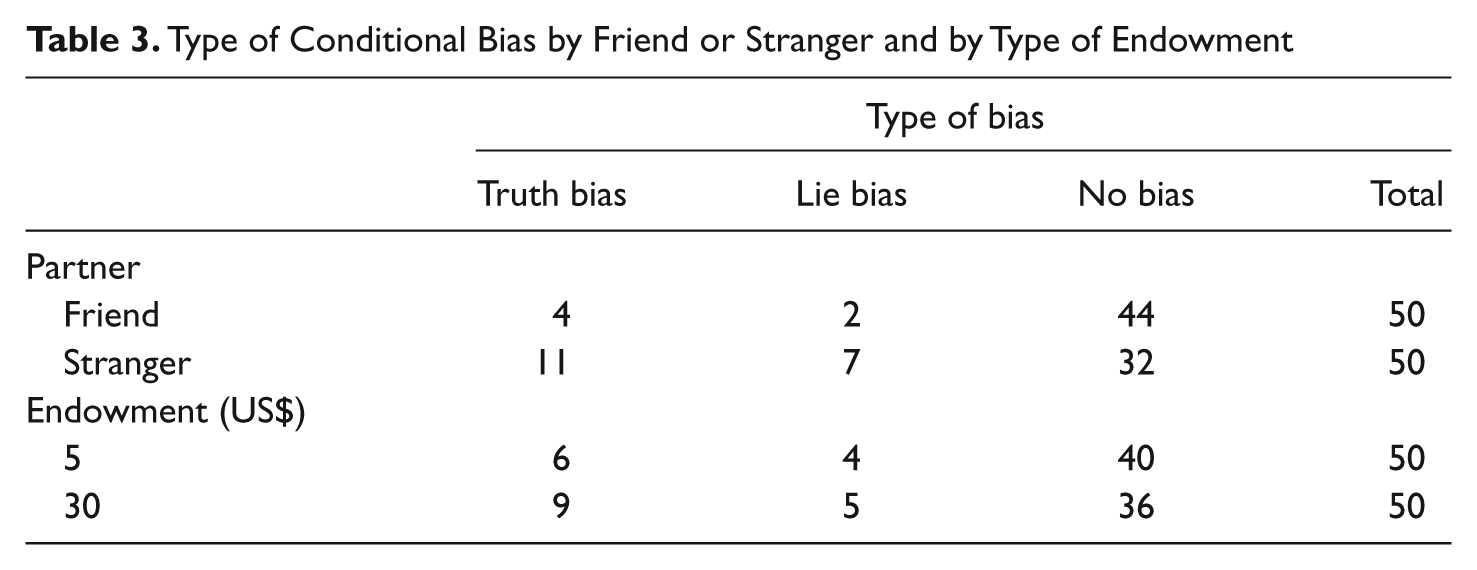
We found no significant differences between the propensity of participants to exhibit a conditional truth bias (15%) versus a lie bias (9%), t(99) = 1.23, p = .22.
Detection of Deception
Receivers were suspicious 13% of the time for no deception, 58% for omission, and 43% for lies. This means they were correct 87% of the time for truth, 43% for lies, and 58% of the time for omission. The base rates of no deception, lies, and deception by omission were 67.65%, 6.8%, and 25.49%, respectively. To measure detection averaged across truths and deception, we used Park and Levine (2001) model that was designed to measure detection accuracy when there are different base rates of deception and truth. Using their model, we calculated 77.38% total accuracy across truth and deception.
Another way to measure detection is to compare detection to the base-rate or probability that a lie, truth, or omission occurred in this experiment. By this standard, when receivers were deceived, they were suspicious at rates much higher than the base rate of deception.
We also tested whether there were differences in detecting deception between friends and strangers and between the stakes conditions. There was no effect of relationship, F(1, 29) = 0.17, η2 = 0.01, p = .68. Friends (M = 0.50, SD = 0.53) were no better at detecting deception when it occurred than strangers (M = 0.56, SD = 0.51). There was also no effect of endowment amount, F(1, 29) = 0.00, η2 = 0.00, p = .98. Therefore, Hypothesis 5 was not supported: Recipients were not more likely to detect deception by a stranger than a friend.
Discussion
To summarize the conclusions, the study examined detection of deception for unsanctioned, consequential deception between friends and between strangers. Allocators were more likely to deceive strangers than friends, but they were not more likely to deceive when there was more money at stake. Recipients were more suspicious for interactions between strangers than friends, but they were not more suspicious for interactions involving more money. Recipients were most suspicious when the other party engaged in deception by omission. When allocators lied, they stated their offer more times and gave more supporting statements for their offer. Participants had a strong truth bias and had more of a truth bias for friends than strangers. However, most allocators were truthful, especially with friends. Recipients detected less than half the lies and just a little bit more than half of omissions. However, because participants had a strong truth bias and because the majority of allocators were truthful, participants were accurate in judging truth at a high level. Friends were not better at detecting deception from their partner than strangers.
Communication in the Context of Deception
Liars acted differently than other allocators. They stated their offer more times and gave more supporting statements to back up their offer. When allocators lied, they may have wanted to justify their offer more to increase acceptance of the lie. Overall, suspicion did not interact with deception type for elaboration and did not seem to drive the greater elaboration for lies. With deception by omission, allocators gave fewer supporting statements than with lies and stated the offer fewer times. This suggests that these different types of deception lent themselves to different strategies. With omission, the allocator would often state their offer and then offer no other information, unless asked. They were trying not to elaborate because more elaboration would probably entail the need to say something about the offer and endowment amount. Hancock et al. (2008) stated that “it may be the case that when it is safe to do so, deceivers will pepper their lies with more detail; but when they are at risk of being discovered they will be more hesitant to provide detail” (p. 16). Elaboration could be used to provide persuasive statements to increase the acceptability of the lie, but elaboration is avoided with omission in order to avoid risking the strategy of omission being questioned or found out by the receiver.
Deception by Omission
Previous research in the detection of deception has generally not studied deception by omission. This study attempted to study deception by omission and determine how it differed from both lies and no deception. One problem with omission is determining whether there was deceptive intent with the omission. However, ratings by allocators, recipients, and outside judges confirmed that deception by omission was perceived as significantly more deceptive than no deception, yet not as deceptive as lies. This confirms research in judgment and decision making on how harmful omissions are perceived in comparison with commission (Ritov & Baron, 1990; Spranca et al., 1991; Tenbrunsel & Messick, 2004).
Notably, allocators’ perceptions were very similar to how the outside judges viewed omission.
We found that people were most suspicious of omission. This may be an artifact of the experimental task and instructions. Receivers were told that allocators received some money, and if the allocator did not provide an endowment amount, then receivers knew allocators were omitting. Omission occurred within imposed rules of the ultimatum game where recipients knew when omission was occurring and allocators knew that omission was allowed within the boundaries of the game. Therefore, omission was not covert. McCornack (1992) has argued that in order for omission to be deceptive, it must be covert. This reduces how much one can generalize our results with omission and suspicion to settings where omission may be covert or not defined within the rules of a game.
Deception and Suspicion
As expected, allocators deceived their friends less, and recipients were less suspicious of friends, even after controlling for the fact that people were less deceptive with friends. Contrary to what was expected, neither were allocators more deceptive with higher amounts of money nor were recipients more suspicious. The difference between US$5 and US$30 may not have been big enough to cause differences in temptation to deceive. While we found that participants perceived these amounts differently, it is also the case that neither amount is likely to significantly affect the participants’ lives. We equated stakes with monetary amount of endowment. However, lying to get a greater amount of money may be different from lying to avoid punishment, embarrassment, jail, divorce, and the like. For naturally occurring deception outside the lab, “high stakes” lies often involve avoiding punishments and other negative consequences associated with hiding a transgression. Our stakes were defined as either gaining a little or gaining a moderate amount, rather than losing anything, as may be the case with some high stakes lies. The framing literature suggests that gain and loss frames are often not equivalent (Kahneman & Tversky, 1979). Therefore, while there were clearly different stakes in this experiment, the stakes were not that different in absolute sense.
Truth Bias and Detection of Deception
We found that participants had a strong truth bias, especially with friends. However, because about two third of people told the truth, the strong truth bias helped increase accuracy. This confirms research on the veracity effect (Levine et al., 1999) which predicts that, due to the truth bias, the truthfulness of the sender is the best predictor of the accuracy of the receiver. Indeed, accuracy rates for truthfulness were quite high, but accuracy rates for lies were below 50%. This research helps generalize the veracity effect to a monetary interaction. Accuracy rates for omission were above 50%, but this could be an artifact of omission not being covert. Receivers knew when the allocator was omitting information, and this may have raised suspicions that there was a reason for the omission. Although accuracy for lies was below 50%, lies were infrequent in this experiment and occurred at a base rate of only 6.8% of the time. Given that any interaction only had a 6.8% chance of being a lie in our experiment, one could argue that 43% rate of suspicion for lies is not a bad record for detection.
In their meta-analysis, Bond and DePaulo (2006) found that people were better able to detect deception with those they had interacted before. However, we found that recipients were not better at detecting deception from friends than strangers. Although, it is possible that many people did not have a baseline exposure with their friends on negotiations over money. Therefore, whereas they might have been better at detecting deception over issues that were more relevant toward their friendship, the experiment was a new situation in which they were less able to use their friend’s past behavior as a guide.
Limitations
There were several limitations to this study. Participants only had one item about which they could lie. This limited the length of the conversation between participants to less than 2 minutes. Previous deception research has often had participants discuss several items over the course of a longer conversation. The length of our experimental conversations limits any speculation about the effects of interaction and the ability of deceivers to improve their ability to deceive over the course of the conversation, as predicted by interpersonal deception theory (Buller & Burgoon, 1994, 1996; Burgoon, Buller, & Floyd, 2001).
Also, Park, Levine, McCornack, Morrison, and Ferrara (2002) found that outside the laboratory, most people make judgments about deceptions over longer spans of time using information from third parties to discover deception or uncovering deceit through the consistency of people’s stories. It is likely that one could uncover deceit in negotiations in similar ways. Indeed from our previous example, years later, Steve Wozniak did discover Steve Jobs’ allocation lie through a third-party source, and it contributed to Wozniak quitting Apple (“Breakout,” n.d., para. 3; Wozniak, 2006). However, also in the case of Wozniak, decisions about negotiations may have to be made quickly, and one does not have the luxury of finding out how honest an offer is in a negotiation. Therefore, people may use the context of the interaction, such as the temptation to lie, as a basis for making attributions of deception.
A methodological limitation is that recipients knew the range of values that the allocator had to allocate (either 0-5 or 0-30). Therefore, when the allocators gave recipients half or more of the endowment or stated they were given US$5 or US$30, recipients could easily determine that allocators were being truthful. When they were not deceived, recipients were very accurate in determining that they were told the truth, and allocators did not have to worry about not being believed. However, in a naturally occurring situation, it is often easier to tell if someone is telling the truth than engaging in deception due to the structure of the situation. If someone is telling you something that is against their self-interest or relates a negative impression about that person, the receiver can be more confident that the sender is telling the truth (Walster, Aronson, & Abrahams, 1966). For example, Levine, Kim, and Blair (2010) found that confessions were believed more often than denials because a confession went against self-interest. Future research could have receivers in the dark about the endowment range, making it impossible to tell when the allocator was being truthful. Under these circumstances, a truthful allocator would have an increased motivation to appear truthful because the recipient could not determine truthfulness by knowing the maximum allocation amount.
Another limitation is with our characterization of omission. According to information manipulation theory (McCornack, 1992), omission occurs when the sender reduces the quantity of pertinent information in order to mislead. However, information manipulation theory defines violations of quantity as omission only when they are covert. With omission in our study, receivers knew that the allocator was not stating an endowment amount, and according to the way information manipulation theory characterizes deceptive omission, receivers cannot know that pertinent information is being omitted.
In the posttask questionnaire, we operationalized perceived deceptiveness and perceived honesty on a continuous scale. Although we measured suspicion as a binary construct and used suspicion to measure detection of deception, conceptually, deception is a binary construct because the allocator is either deceiving or not deceiving. Researchers have argued that continuous scaling of deception can confound deceptive intent with moral judgments, perceptions of lie severity, or judgmental confidence and have called for a dichotomous judgment of truth or lie (Levine, Shaw, & Shulman, 2010). However, other researchers (Buller & Aune, 1987; Buller, Comstock, Aune, & Strzyzewski, 1989; Buller, Strzyzewski, & Comstock, 1991; Buller, Strzyzewski, & Hunsaker, 1991; Burgoon et al., 1995) have used more continuous measures of perceived deceptiveness. Burgoon (Burgoon & Levine, 2010) states, “To obtain a good measure of detection accuracy, continuous as well as dichotomous measures are needed to tap into the subtleties of judgments” (p. 208).
Another limitation is that some of the causality analysis may be flawed because of endogeneity in the interaction. For example, while it is plausible that liars repeated their offers more and offered more supporting statements to increase acceptance of their deceptive offer, it is also possible that aspects of the interaction, such as suspicion, caused them to do so. Also, whether an allocator used a strategy of deception by omission may have depended on whether the recipient asked questions.
Unless they explicitly lied, all the allocators who gave less than half the endowment tried to avoid stating their endowment amount. However, upon questioning from the recipient, some would give up on their strategy of omission. Of the lies, four allocators lied straight-out about their endowment without being questioned about it (e. g., “I was given $20, so I’m splitting it and giving you $10”), whereas the other three lied only after being asked how much they were given. Also, in all the cases (n = 8) where participants allocated less than half of the money to their partner but were truthful about their endowment, allocators only disclosed their endowment amount when asked by the recipient. So, no one said, “I was given $30, I’m giving you $12.” Rather, they would only disclose the US$30 endowment upon questioning. Of the cases of deception by omission (n = 26), 13 of the recipients asked no questions, and the other 13 asked questions such as “Is this fair?” but were not told an endowment amount. Thus, in this study, there were 24 cases where the allocator gave less than half the endowment without initially disclosing an endowment amount and was subsequently questioned by the recipient. Of these 24 cases, the allocator responded by lying 12.5% of the time (n = 3), continuing to use omission 54.16% of the time (n = 13), and telling the truth 33.33% of the time (n = 8). Although we cannot determine the intent of omission, these numbers give a good indication that omission was generally meant to conceal. Even when the allocator initially used omission and then truthfully told the endowment, the allocator sometimes would respond by apologizing (“I’m sorry, I was being shady”), providing a justification for giving their partner less than half (“I would assume you would do the same thing”), or minimizing their lower offer (“I don’t think we actually get this money anyways”). Thus, whether a strategy of deception by omission was used by the allocator sometimes depended on the behavior of the recipient as well.
Finally, we had a low percentage of lies in this study. This makes sense given that past research has found that people self-report low levels of deception (DePaulo et al., 1996; George & Robb, 2008; Hancock et al., 2004; Serota et al., 2010). However, this limits how much we can generalize our findings. Future research should try to replicate our findings with a larger sample to try to increase the amount of lies.
Conclusion
This study differed from previous deception research. We used a monetary negotiation to study deception in a context replete with incentives for deceivers and detectors. We also examined deception by omission and found that omission differed from lies on several measures, including the way allocators communicated; allocators elaborated with lies but not with deception by omission. Our results found that participants had a large truth bias, especially with friends. Furthermore, we confirmed the veracity effect.
Footnotes
Appendix
Acknowledgements
The authors thank Gerald Stoecklein for transcription and Suzi Sutton, Natalie Fairbanks, Brittany Dorland, and Cara Ludutsky for coding the interactions.
The authors declared that they had no conflicts of interest with respect to their authorship or the publication of this article.
The authors disclosed that they received the following support for their research and/or authorship of this article: This article was supported by a grant from the Dispute Resolution Research Center at Kellogg School of Management, Northwestern University.