



Abstract
This study examines how individuals perceive gains and losses through message framing and reference anchoring, focusing on social problems from the prospect theory perspective. The results indicate that message framing has a significant effect on agreement. In terms of framing the outcome, loss-framing messages are more effective than gain-framing messages in influencing agreement on the Korea–U.S. FTA (Free Trade Agreement). Furthermore, with respect to experimenter-provided and self-generated anchor inducements, the participants with experimenter-provided anchor values are more likely to agree with suggestions in messages than those with self-generated anchor values. The results have several practical implications.
This study examines how people perceive gains and losses through message framing and reference anchoring, focusing on social problems from the perspective of Kahneman and Tversky’s (1979) prospect theory.
Korean society has experienced many public controversies involving various interest groups. Social conflicts caused by public policies not only cause unnecessary social costs but also create negative ripple effects. Public policies cannot satisfy everyone, and disagreement causes frequent and serious public controversies, which lead to social conflicts. Public relations experts work to strategically resolve social conflicts and engineer public consent through two-way communication between organizations and key stakeholders. Achieving public consent is not simple because key interest groups may be reluctant to negotiate. Often, interest groups avoid making sacrifices during negotiations and thus do not support public policy issues unless they are guaranteed some benefits.
For example, since 2008, the Korea-U.S. Free Trade Agreement (FTA) has been a serious public issue that has drawn resistance from key interest groups such as farmers, laborers, and NGOs. Many key interest groups have perceived the potential social, economic, and political losses that could result from the FTA. In this regard, the Korean government has been making efforts to mitigate key public resistance and garner public understanding and support for the policy by persuading key interest groups with strategically managed communication messages.
A given policy decision cannot satisfy all interest groups. However, some groups refuse to suffer any losses, as evidenced in the process of policy implementation and communication. Gains and losses are said to be a matter of perception than of objective facts. The perception of gains and losses depends on how messages on social problems are framed and presented to the public by the government or the organization involved. According to Kahneman and Tversky’s (1979) prospect theory, because people tend to place greater emphasis on losses than on gains, persuasive messages should be strategically adapted with consideration for subconscious dispositions.
Prospect theory provides a useful theoretical background for explaining the effects of message framing on decision making. According to prospect theory, people commonly experience discordance between perceived values and actual values, which may lead to illogical decisions. The manner in which messages are framed and presented may significantly influence the response of the recipient.
The reference point of decision making also affects the public’s attitudes and behaviors regarding social issues. According to Tversky and Kahneman (1974), an anchor comprises the values and faith of the decision maker, which then become the basis for a decision in volatile situations. Tversky and Kahneman assumed the effects of reference points through anchor inducements but did not verify these effects and processes through practical research. In this regard, the current study investigates the effects of anchoring inducement on decision making by following Tversky and Kahneman’s assumption.
This article consists of discussions on the effects of message framing as it relates to prospect theory and the anchoring effect in decision making.
Literature Review
Framing of Outcomes and Contingencies Based on Prospect Theory
According to utility theory (Kahneman & Tversky, 1979; Simon, 1979), people choose the alternative offering the greatest expected utility when presented with a decision. However, there has been serious concern about the validity of expected utility theory (Schoemaker, 1982). In this regard, Kahneman and Tversky proposed their prospect theory as an alternative in which the characteristics of the value function and the decision-weighting function are discussed.
The value function in prospect theory forms an S-shaped curve; that is, the risk-aversion trend is drawn with a concave curve in the gain area, and the risk-taking trend is drawn with a convex curve in the loss area. Consequently, the value function shows a steeper inclination in the loss area than in the gain area (see Figure 1). Unlike the utility function, this value function places greater weight on the value of losses than on the value of gains (Kahneman, Knetsch, & Thaler, 1990, 1991; Tversky & Kahneman, 1991).
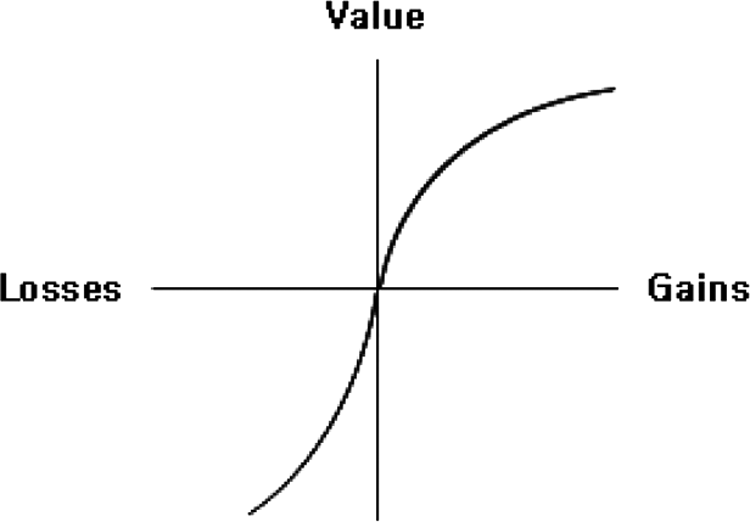
Value function of prospect theory.
The decision-weighting function is another component of prospect theory (Tversky & Kahneman, 1981). According to prospect theory, the outcome of a decision is the product of the utility, the probability of the outcome, and the decision weight π(p). The decision weight is evaluated subjectively and takes a nonlinear form. Therefore, an event with a low probability is overweighted, whereas those with a moderate or high probability are underweighted (see Figure 2).
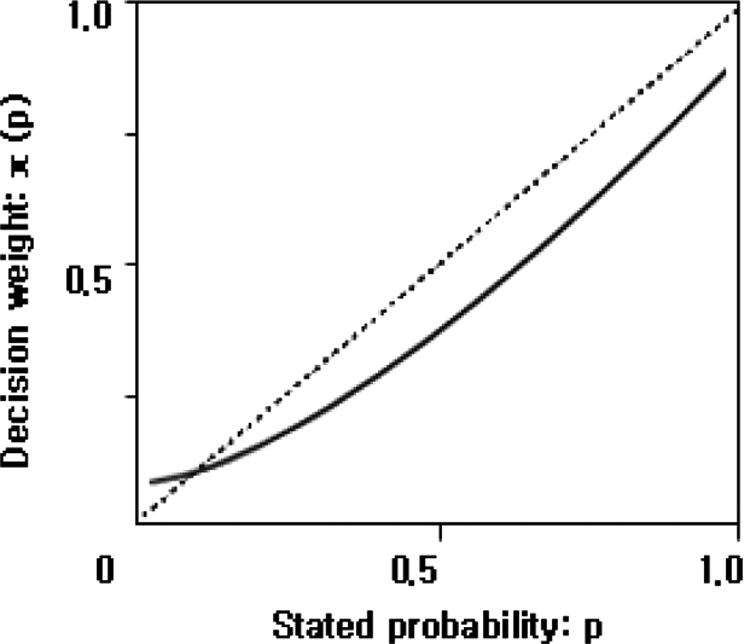
Decision-weighting function of prospect theory.
Based on the nonlinear characteristics of the value function and decision-weight function of prospect theory, it is assumed that the framing of outcomes and contingencies may induce different decisions. As people tend to place greater weight on the value of losses than on the value of gains, as assumed in prospect theory, in gain-framing scenario decision makers are likely to choose risk-aversive alternatives, but in loss-framing scenario they are likely to opt for risk-taking alternatives. As discussed in the following, a number of previous studies have verified these assumptions.
Tversky and Kahneman (1981) proposed that decision outcomes vary depending on whether messages are framed as a gain or a loss. Their study showed that given two alternative plans with the same utility, the participants chose the plan framed as a gain; that is, the participants preferred Plan A, which indicated that 200 people out of 600 would definitely survive, to plan B, which indicated that the probability that everyone would survive was 1/3 and the probability that no one would survive was 2/3. In contrast, when the message was framed as a loss, more participants chose Plan D, which indicated that the probability that no one would die was 1/3 and the probability that everyone would die was 2/3, than plan C, which indicated that 400 people out of 600 would definitely die; that is, the participants tended to avoid risks in situations involving gains and vice versa. Ganzach and Karsahi (1995) observed similar results through an experiment that exposed research participants to two differently framed messages emphasizing the gain of using credit cards and the loss of not using credit cards. The respondents placed greater weight on the loss of not using credit cards and thus showed more positive attitudes toward using credit cards.
The framing of contingencies is a way to frame the possible value of an outcome in terms of certainty (p = 1) or uncertainty (0 < p < 1). Prospect theory assumes that a decision maker prefers certainty-framing alternatives to uncertainty-framing alternatives. The certainty effect means that the probability of an outcome is reduced by a constant factor and has a greater impact when the outcome is initially certain than when it is merely probable. Prospect theory proposes that people evaluate options conditionally, as if the second stage had been reached (Tversky & Kahneman, 1981). This sense of certainty is illusory and is, therefore, called pseudocertainty because the gain is in fact contingent on reaching the second stage of the options. For example, Quattrone and Tversky (1988) showed that the participants preferred the certainty-framing alternative to the uncertainty-framing alternative.
Decision making with respect to many public issues such as health, safety, the environment, and technology development often creates volatile situations. In uncertain and risky situations, decisions often do not follow the predictions of utility theory but instead follow the tendencies suggested by prospect theory. To achieve consent on public issues, effective public relations messages can be framed according to the assumptions proposed by prospect theory. The goal of this article is to verify prospect theory by proposing several hypotheses and research questions.
In sum, an alternative to expected utility theory, prospect theory proposes an alternative descriptive theory in which (a) the objects of choices are prospects framed in terms of gains and losses; (b) the value function is concave for gains, convex for losses, and steeper for losses than for gains; and (c) the nonlinear transformation of the probability scale places greater emphasis on low-probability events than on moderate- or high-probability events (Tversky & Kahneman, 1992).
Based on the assumptions about the framing of outcomes and contingencies, we propose the following hypotheses:
Hypothesis 1: In terms of the framing of outcomes, framing messages as a loss is more effective than framing them as a gain in achieving agreement on policies.
Hypothesis 2: In terms of the framing of contingencies, framing messages as a certainty is more effective than framing them as an uncertainty in achieving agreement on policies.
Hypothesis 1 and Hypothesis 2 replicate previous findings. This theory is based on the idea that individuals decide and act according to their bounded rationality (Etzioni, 2010; Kahneman, 2003); that is, when faced with a complex problem, individuals employ a variety of heuristic procedures to simplify the representation and evaluation of various prospects. These procedures include computational shortcuts and editing operations such as eliminating common components and discarding nonessential differences (Tversky & Kahneman, 1992). Such judgmental heuristics based on bounded rationality have typically been tested and verified in laboratory environments, not in natural environments (Piore, 2010). Recent studies have identified systematic deviations from the assumption of narrow, self-interested behavior in laboratory environments, thus focusing mainly on issues related to individual beliefs, opinions, or emotions (Piore, 2010).
However, critics (e.g., Gigerenzer, 1991; Hogarth, 1981) have argued that many of these judgmental heuristics tested in laboratory environments are more apparent than those tested in natural environments in that they disappear in information-rich natural environments and are thus limited to psychological laboratory environments (Mussweiler, Strack, & Pfeiffer, 2000). In natural environments, individuals become exposed to a diverse range of information as well as other opinions and beliefs, which can help them to establish their own reference points for making judgments on various issues. Once individuals establish their own reference points based on information, social relations, or self-interest, they tend to process issues both deliberately and rationally; that is, they tend to employ rational cognitive processes, not judgmental heuristic bias processes. Consistent with the critics, the present study determines whether such judgmental heuristics become less apparent or remain robust in natural environments in which individuals are exposed to a diverse range of information, opinions, and beliefs, which makes the processing of systematic judgmental biases less likely.
Most of the previous studies have applied prospect theory to simulated issues, not to real ones, and thus, the present study contributes to the literature by applying this theory to a real issue of pressing concern in Korea. The results are expected to have practical implications for government officials and public relations practitioners who need to design effective campaign messages.
Anchoring: Self-Generated Versus Experimenter-Provided Anchor Values
In the evaluation of outcomes, the reference point serves as a boundary that distinguishes gains from losses. This way of making judgments under uncertainty involves anchoring on information that comes to mind and adjusting until a plausible estimate is reached (Kahneman & Tversky, 1996). Individuals anchor on a readily accessible value and adjust to estimate the true value, which is referred to as the anchoring-and-adjustment process (Kahneman & Tversky, 1996). This anchoring-and-adjustment heuristic is assumed to underlie many intuitive judgments, and insufficient adjustments are widely used to explain judgmental biases. Insufficient adjustments refer to the intuitive judgmental bias in which individuals, when making judgments under uncertainty, terminate exploring for better options once a plausible value is reached, unless they are able and willing to search for more accurate estimates.
Previous studies on the anchoring effect on decision making have been verified by research in a wide variety of areas such as gambling (Carlson, 1990; Chapman & Johnson, 1999; Johnson & Schkade, 1989), probability (Plous, 1989; Wright & Anderson, 1989), judgments based on information (Jacowitz & Kahneman, 1995; Joyce & Biddle, 1981; Russo & Shoemaker, 1989; Tversky & Kahneman, 1974), judgments based on self-efficacy (Cervone & Peake, 1986), and future expectations (Switzer & Sniezek, 1991).
Much of the evidence for insufficient adjustments comes from the laboratory paradigm developed by Tversky and Kahneman (1974), in which participants are first asked to make a comparative assessment (e.g., “Is the number of residents in New York City under or over 5 million?”), followed by an absolute estimate (e.g., “How many people reside in New York City?”). Most of the previous studies following this paradigm have demonstrated that the individual’s absolute estimates are biased in the direction of the initial comparison value, a finding that has long been considered to be clear evidence for insufficient adjustments (Epley & Gilovich, 2004).
However, despite extensive research on anchoring effects, the causes of insufficient adjustments remain unclear and uneven. Efforts to identify the mechanism of adjustments through the use of process-tracing procedures have provided no evidence of adjustments under the standard anchoring paradigm (i.e., the selective accessibility approach; Epley & Gilovich, 2006). Epley and Gilovich (2001, 2004, 2005, 2006) argued that most of the responses in previous studies using this anchoring-and-adjustment paradigm are not the product of adjustments but that of semantic priming and the accessibility of consistent information; that is, anchoring effects under the standard anchoring paradigm are produced not by insufficient adjustments but by the enhanced accessibility of anchor-consistent information, as suggested by the selective accessibility model (see Mussweiler & Strack, 1999). Mussweiler and colleagues’ (Mussweiler & Strack, 1999; Mussweiler et al., 2000) selective accessibility model assumes that individuals selectively retrieve knowledge from memory to generate the final numeric estimate and postulates that anchoring effects are mediated by selective increases in the accessibility of anchor-consistent semantic knowledge about the target.
Epley and Gilovich (2001) argued that this kind of standard anchoring paradigm does not indicate anything about the nature or limitations of mental adjustment heuristics that Tversky and Kahneman (1974) originally postulated. Furthermore, they proposed that anchoring effects are produced by insufficient adjustments, not by selective accessibility, when the anchor is self-generated. To examine insufficient adjustments, Epley and Gilovich compared the anchoring effect on individuals in a self-generated anchor situation with that on those individuals in an experimenter-provided anchor situation. They assumed that self-generated and experimenter-provided anchors activate different mental processes. When questions activate self-generated anchors, individuals adjust those anchors to obtain final estimates, which are the product of insufficient adjustments of such self-generated anchors. On the other hand, when individuals are exposed to experimenter-provided anchors, they tend to retrieve the most recent and accessible information provided by the experimenter to make an assessment under uncertainty, which is likely to be the product of selective accessibility, not insufficient adjustment heuristics.
Unlike experimental conditions, people are not fully informed on all public policy issues, particularly if the issues are complex, which makes it difficult for people to form their own reference points in their decision-making process. Public policy issues are socially constructed by many agenda builders such as mass media, journalists, public relations specialists, government officials, and nongovernment organizations, among others (Berger, 2001; Blumer, 1971). Not only journalists but also public relations specialists are important participants in the process of agenda building because they set the agenda for people to consider and frame the agenda to guide people’s decision-making process (Best, 1995; Hilgartner & Bosk, 1988). Issues achieve visibility through agenda setting (Hallahan, 2001). The formation of public opinion on an issue is influenced by the way the issue is framed. Framing an issue provides the public with a common frame of reference to interpret the issue and to make a judgment. In terms of the anchoring effect on decision making around a public issue, the agenda-building process provides people with selective and easily retrievable reference points to anchor their judgmental decision making, which supports the selectivity and accessibility hypotheses.
Public relations specialists should establish common frames of reference (i.e., assimilating the reference point into the anchor value) so that the public could store selective knowledge and easily retrieve the knowledge whenever needed. It is important for public relations experts to create accessible and reasonable common reference point zones around issues before they announce messages to the public; that is, if the public’s reference point regarding a public policy were established around an anchor value provided in advance by public relations experts before the public’s exposure to the message, then the public would be more likely to agree with the issue.
In other words, from the theoretical perspective, it would be important to examine some evidence of insufficient adjustments and accessibility heuristics when considering a real issue, not a simulated one. Anchoring through the insufficient adjustment process is likely to be induced by self-generated anchor values, resulting in low levels of agreement on public issues. On the other hand, anchoring through the accessibility heuristic process is likely to be induced by experimenter-provided anchor values, resulting in more consistent and high levels of agreement on public issues, which reflect the aim of agenda builders in natural environments. To examine these anchoring inducement types, we propose the following hypothesis:
Hypothesis 3: Individuals with experimenter-provided anchor values are more likely to agree with the given issue than those with self-generated anchor values.
In addition, this study examines the interaction effects between message types (the framing of outcomes and contingencies) and anchoring.
Research Question 1: Is there an interaction effect between message types (the framing of outcomes and contingencies) and anchoring?
An experiment was performed to investigate the hypotheses and the research question.
Methods
Experimental Design and Participants
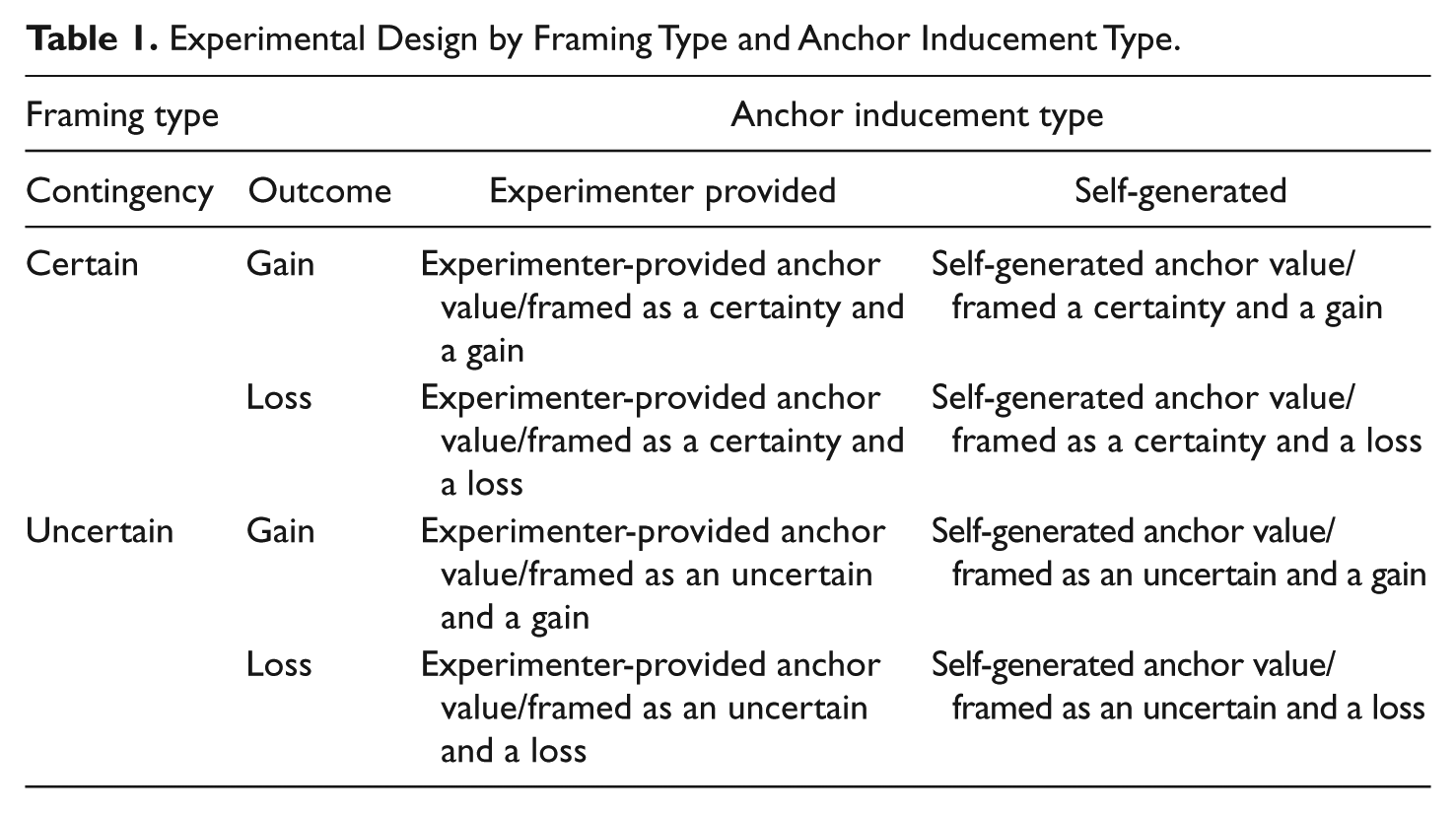
This study employed a 2 (framing of outcome: gain/loss) x 2 (framing of contingency: certainty/uncertainty) x 2 (self-generated anchoring/experimenter-provided anchoring) experimental design. Eight experimental groups were formed (Table 1). Students who were enrolled in introductory public relations, communication, journalism, and humanities courses at several large universities in Seoul, Korea, were recruited. The experiments were conducted from May 13 to May 16, 2008. A total of 560 students participated; men accounted for 46.7% (n = 262), and women accounted for 53.3% (n = 298). The age of the students ranged from 19 to 27; the average age was 21.9
Experimental Design by Framing Type and Anchor Inducement Type.
Experimental Message
The subject of the experimental message was the Korea–U.S. FTA (Free Trade Agreement) issue. This issue caused considerable public discourse and became a high-profile social and political public issue. The results of a survey conducted in January 2008 showed that 53.5% of the respondents supported the agreement and that 25.9% opposed it (CBS, 2008). However, these results changed drastically throughout the year. As of May 2008, because Korea–U.S. beef negotiations had become a major sociopolitical conflict, 28.3% of the respondents supported the Korea–US FTA, and 55.4% opposed it (CBS, 2008).
The Korea–U.S. FTA issue caused considerable concern among Korean interest groups, including university students. The Korea–U.S. FTA’s potentially negative impact on the job market was perceived as a disadvantage for university students.
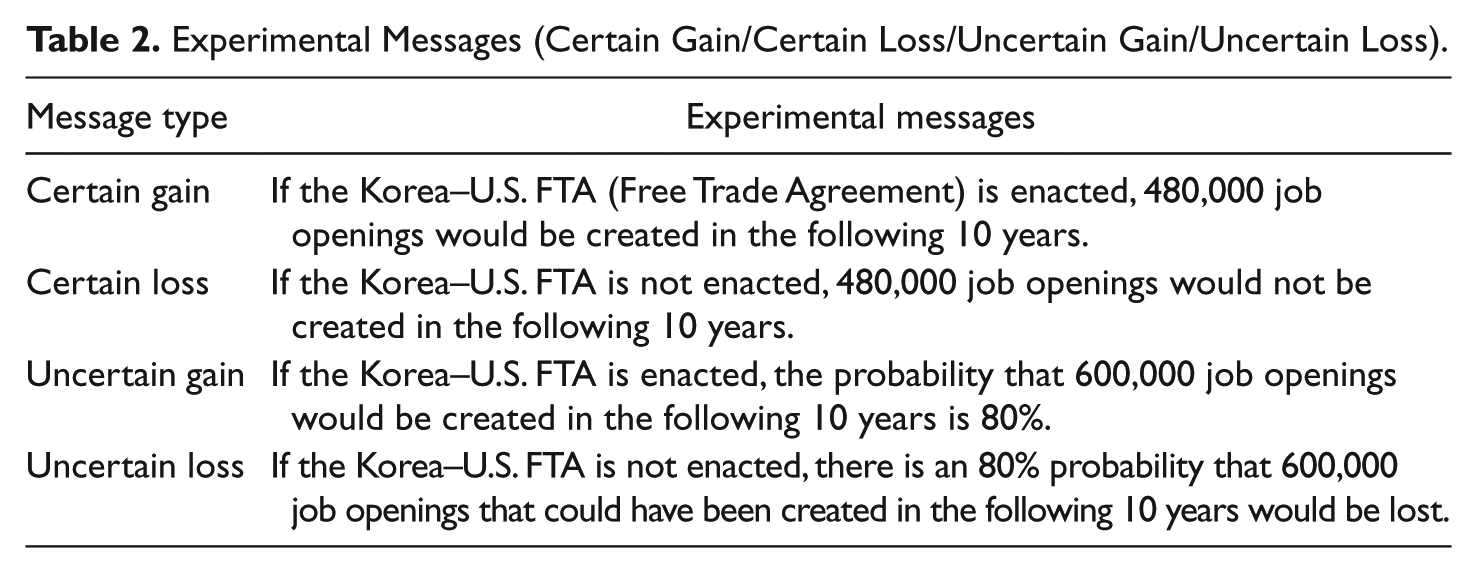
The experimental messages were produced from the data presented by several professional economy research institutions (Korea Institute of International Economic Policy [KIEP], 2007; LG Economy Research Institute [LGERI], 2006). According to the data, if the Korea–U.S. FTA were implemented, one economic advantage for Korea would be the creation of an estimated 480,000 jobs, ranging from a minimum of 340,000 to a maximum of 620,000 job openings in the following 10 years. Based on the average estimate, four types of experimental messages in the form of short news reports were framed (certain gain/ certain loss/uncertain gain/uncertain loss; see Table 2).
Experimental Messages (Certain Gain/Certain Loss/Uncertain Gain/Uncertain Loss).
Experimental Procedure
The participants were randomly assigned to eight experimental groups and informed that the survey was intended to elicit their opinions regarding a public issue. Prior to completing the questionnaire, a balanced message exploring the advantages and disadvantages of the Korea–U.S. FTA issue was provided to the participants.
To induce the accessibility heuristic process, we exposed the participants to the experimenter-provided anchor value, that is, the message that “a minimum of 340,000 and a maximum of 620,000 jobs can be created over the next decade if the Korea–U.S. FTA is enacted.” Then they were asked to indicate whether they agreed with the FTA and whether they knew how many jobs would be created. On the other hand, to induce the insufficient adjustment heuristic process, the participants in the group with the self-generated anchor value (i.e., those who were not given any reference point by the experimenter) were asked to indicate whether they agreed with the Korea–U.S. FTA.
Measurements and Analyses
In this study, the independent variables were types of messages (the framing of outcomes vs. contingencies) and types of anchoring inducements (experimenter-provided vs. self-generated inducements). The dependent variable was the level of support for the issue. For random assignment, the participants’ involvement in and prior knowledge of the Korea–U.S. FTA were measured. According to Hallahan (2001), the individual’s involvement in and knowledge of the issue can affect his or her information processing and behavioral tendencies toward the issue.
Involvement was measured by asking the following three questions scored on a 7-point scale (1 = do not agree at all, 7 = agree completely): (1) The Korea–U.S. FTA is an important issue for me, (2) the Korea–U.S. FTA is closely related to my life, and (3) the Korea–U.S. FTA is a valuable issue to me. Prior knowledge was measured by asking the following three questions: (1) I know the Korea–U.S. FTA very well, (2) I often sought out information about the issue through the media, and (3) I know a lot about the Korea–U.S. FTA. Cronbach’s alpha was .80 for involvement and .85 for prior knowledge; thus, the composite measures were created for use in the analyses. An ANOVA was conducted to examine the differences among groups in terms of involvement and prior knowledge; the results showed that there were no statistically significant differences among groups (involvement: F = .285, p =.960; prior knowledge: F = .392, p = .907).
The degree of each participant’s consent in support of the issue was measured on a 7-point scale (1 = strongly oppose, 7 = strongly agree). The consent question was, “According to a prestigious economic research institute in Korea, the Korea–U.S. FTA would create 480,000 job openings in the following 10 years. Do you agree with the implementation of the Korea–U.S. FTA?”
To investigate the hypotheses and the research question, a three-way ANOVA was conducted with message types (framing of outcomes and contingencies) and type of anchoring inducement as the independent variables and the degree of agreement with the issue as a dependent variable.
Results
Hypothesis 1: Effects of Framing an Outcome (as a Gain or a Loss)
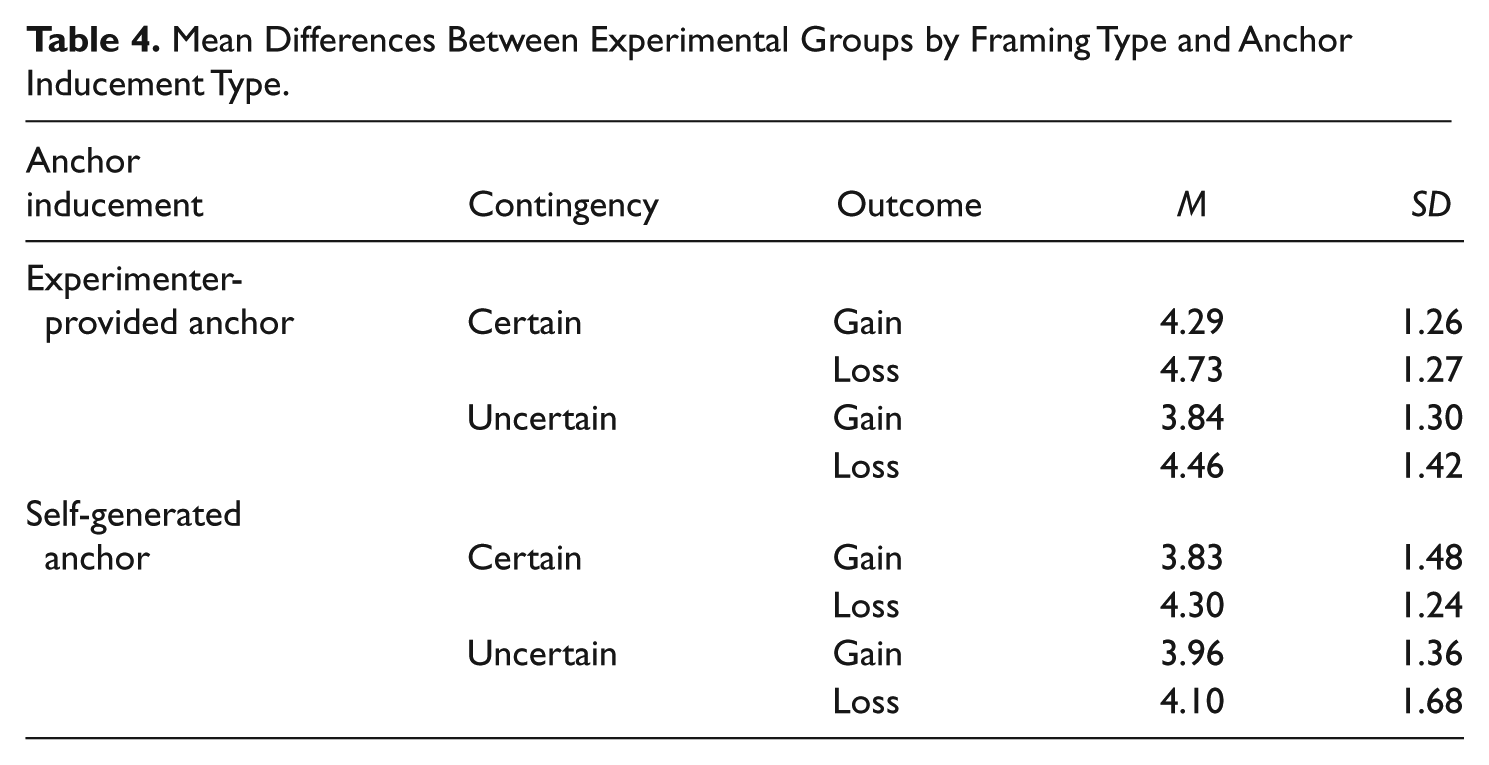
Hypothesis 1 predicted that a message framed as a loss would be more effective than that framed as a gain in achieving public support. The results indicate that the manner in which a message is framed has a significant effect on the level of support (F = 12.747, p < .001, eta = .023; see Table 3). The participants who were exposed to the message framed as a loss (M = 4.40, SD = 1.43) showed higher levels of agreement than those who were exposed to the message framed as a gain (M = 3.98, SD = 1.36; see Table 4). Thus, Hypothesis 1 was supported.
Effects of Types of Framing and Anchor Inducements on the Level of Agreement: ANOVA.
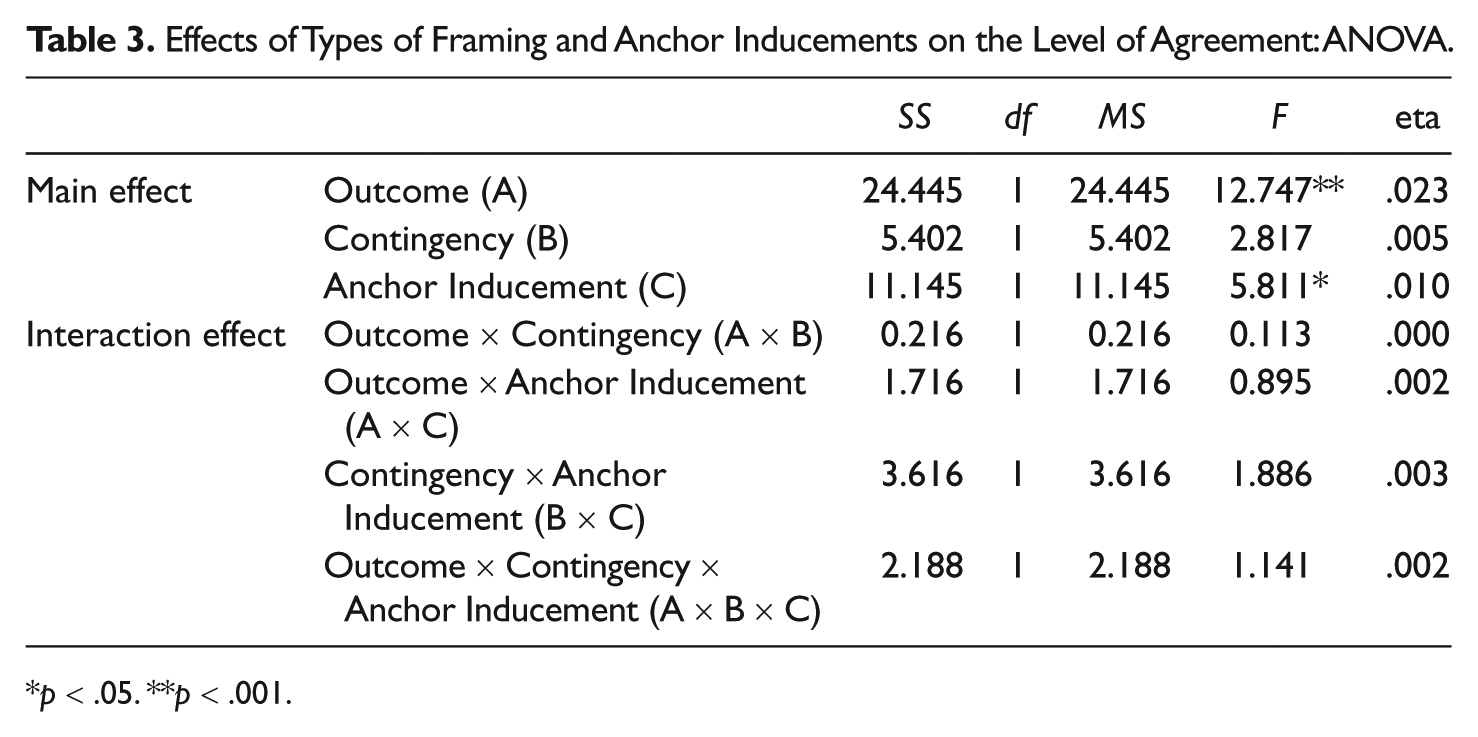
p < .05. **p < .001.
Mean Differences Between Experimental Groups by Framing Type and Anchor Inducement Type.
Hypothesis 2: Effects of Framing Contingencies
Hypothesis 2 predicted that a message framed as a certainty would be more effective than that framed as an uncertainty in achieving public support. The results indicate that the difference between the two types of messages was nonsignificant (F = 2.817, p = .094, eta = .005; see Tables 3 and4). Thus, Hypothesis 2 was not supported.
Hypothesis 3: Anchoring: Experimenter-Provided Versus Self-Generated Inducements
Hypothesis 3 predicted that individuals with experimenter-provided anchor values would be more likely to agree with the issue than those with self-generated anchor values. The results indicate a significant difference between the two conditions. The participants in the group with an experimenter-provided anchor, which induced selective accessibility heuristics (M = 4.33, SD = 1.35), showed higher levels of agreement than those in the group with a self-generated anchor, which led to insufficient adjustments (M = 4.05, SD = 1.45; see Table 4). Thus, Hypothesis 3 was supported (F = 5.811, p < .05, eta = .010; see Table 3).
Research Question: Interaction Effects
In terms of the research question, which addressed the existence of interaction effects between types of messages and types of anchoring inducements, the results indicate no significant interaction effect (see Table 3).
Discussion
The results indicated that message framing had a significant effect on agreement. In terms of framing an outcome, the loss-framing message was more effective than the gain-framing message in influencing agreement on the issue. This result is consistent with that of other studies (e.g., Ganzach & Karsahi, 1995; Kahneman & Tversky, 1979; Quattrone & Tversky, 1988). As predicted by prospect theory, the participants placed greater weight on a loss than on a gain and were thus more likely to take a risk and agree with suggestions provided through the message. This result indicates that prospect theory is robust not only for laboratory environments but also for natural environments, as many critics have suggested. Unlike simulated issues, which are typically unrealistic, unrelated to self-interest, and neutral in attitudes or opinions, thus inducing individuals’ dependence on the message framing itself, real social issues (e.g., the Korea–U.S. FTA) are likely to encourage individuals to assess their judgments more on the basis of their predispositions, emotions, and self-interest with respect to various opinions (e.g., those associated with the U.S. or Korean government) than on the basis of message framing itself. Thus, social issues were expected to induce a controlled, effortful, and rational reasoning process (Kahneman, 2003). However, the results indicate that the participants’ cognitive process remained within the area of intuition characterized by fast, automatic, and effortless systematic heuristics, as suggested by Kahneman and Tversky.
In terms of types of anchoring inducements, the participants who were induced to create a common range of reference points by using the experimenter-provided anchor value showed higher levels of agreement on the suggestions in the messages than those who were not. This result indicates that the experimenter-provided anchor value provided the participants with easily retrievable and accessible information and that they made judgments based on anchor-consistent knowledge, resulting in high levels of agreement on the issue. Furthermore, the result provides some evidence of an insufficient adjustment process through which the participants generated their own values to make their judgments but did not adjust them until they reached optimal reference points. The range of reference points induced by self-generated anchoring was too wide to elicit common reference points for high levels of agreement on the social issues.
The issue of the Korea–U.S. FTA is very complex in terms of the range and depth of its socioeconomic and political implications. Thus, the general public is not likely to make a fully informed decision on the issue. Consequently, inducing accessibility heuristics (i.e., assimilating the public’s reference point in the anchor value) by providing useful information (anchor value) for decision making may be more effective in producing public support than in generating insufficient adjustment heuristics.
Although the interaction effect among the framing of outcomes, the framing of contingencies, and types of anchoring inducements was nonsignificant, the results suggest that outcomes may vary depending on different cognitive processes of insufficient adjustments and accessibility heuristics; that is, when asked to set their own self-generated anchor value, which was expected to induce the process of insufficient adjustment heuristics, not accessibility heuristics, the participants showed higher levels of agreement on the message framed as a certain loss than on that framed as a certain gain. This result provides strong evidence of value and weighting functions, which form the basis of prospect theory, in that under the inducement of the insufficient adjustment process, the participants placed greater emphasis on a certain loss than on a certain gain when they were induced to engage in the selective accessibility process. This finding has not been reported in previous research on prospect theory. In other words, as Epley and Gilovich (2001, 2004, 2005, 2006) argued, the anchoring-and-adjustment process in prospect theory can be better explained by the insufficient adjustment heuristic paradigm than by the selective accessibility paradigm.
Although establishing a common range of reference points through accessibility heuristic process that is assumed to be induced by the experimenter-provided anchor value may lessen the salience of loss framing, it still has practical implications for policy makers and communication experts during decision making. Furthermore, the lack of significant differences in the degree of agreement/disagreement on the issue might have been caused by a situation where participants’ reference points were set around similar anchor values; future research is warranted to examine this further.
The utilization of a loss-framing strategy is more effective than the gain-framing strategy in increasing public acceptance regarding an issue. Rather than persuading the public to agree with a public policy proposal by emphasizing the benefits of its implementation, it would be more effective to persuade the public by presenting the benefits that would be lost if the policy were not approved.
The participants preferred certain values to uncertain values. Thus, presenting a public issue message as a certainty rather than an uncertainty would be more effective.
If a public issue is too abstract or complex for the general public, public relations experts should provide adequate information so that the public could weigh the advantages and disadvantages of the issue. If a public issue has the potential to cause sociopolitical conflicts, public relations experts should help the public to establish acceptable anchoring points with respect to the issue prior to taking opinion polls, cultivating public consensus on the issue, or implementing the public policy.
This study has some limitations. In particular, the study simply assumed, not scrutinized, the real processes of the two different heuristics (i.e., the selective accessibility and insufficient adjustment paradigms). In addition, the study did not measure the range of self-generated anchor values induced by the participants, and thus, we could not verify whether the message was recognized as a loss or a gain on the basis of their own anchor values. In this regard, future research should examine the self-generated anchoring effects on judgments under uncertainty.
The participants were university students; thus, they were not meaningfully and immediately affected by the Korea-US FTA. Therefore, any generalization of the study findings to groups outside the sample profile should be implemented with caution. In addition, there may be some ambiguities regarding what the study participants were considering when they considered the loss frame because the participants could have understood the loss in two ways; that is, what happens if they would never talk about the policy and what happens if they would talk about the policy but fail to enact it. It should be noted that the situation tested in this study is not exactly reflective of the classic vaccine option study. In addition, the value expectation regarding the study’s issue was evaluated not by a single factor (i.e., job opportunities employed by this study) but by several factors separately or collectively. To enhance the practical implications of this research, future research is warranted to determine the many factors that are embedded in public issues and that may affect the design of public campaign messages by public relations experts.
Furthermore, in measuring the level of the participants’ support for the issue, we did not provide a simple and clean question addressing their agreement. Instead, we included a well-known source of information for the anchoring inducement and a specific figure for jobs in the question, which may seriously limit the external validity of this study and its generalizability to other issues and areas. Thus, the results of this study should be applied only to those situations in which support (e.g., a public opinion poll or a voting situation) is specifically induced in this way.
Footnotes
Declaration of Conflicting Interests
The authors declared no potential conflicts of interest with respect to the research, authorship, and/or publication of this article.
Funding
The authors received no financial support for the research, authorship, and/or publication of this article.
