




Abstract
Based on gender schema theory, social role theory, and social-cognitive theory, this study investigated whether biological sex and gender conformity (femininity and masculinity) predict selective exposure to gender-typed magazines and whether this exposure, in turn, reinforces gender conformity. Participants browsed full issues—three women’s magazines, three associated with male readers, and three news magazines—while being taped. Before and after browsing, participants indicated their femininity and masculinity. Results show a strong impact of biological sex on selective magazine reading, resulting in gender-typed media use. However, gender conformity also influenced exposure. Moreover, mediation analyses showed that selective exposure to gender-typed magazines had a reinforcing effect on the gendered self-concept.
Throughout the history of communication research, selectivity in media use has been viewed as a crucial factor for reinforcement of socially relevant attitudes (Klapper, 1960; Lazarsfeld, Berelson, & Gaudet, 1944). Among those attitudes, gender role attitudes may be among the most influential ones for our perceptions and behavior—for instance, gender strongly affects personal career interests and life path choices (e.g., Barone, 2011; Su, Rounds, & Armstrong, 2009) as well as everyday interpersonal perceptions (e.g., Eagly & Mladinic, 1989). The factors that reinforce gender norms in modern society are thus of high relevance. The present work examines how gender norms may be subject to selective reinforcement through media use. Specifically, we are interested in how selective media use may serve to bolster gender conformity of the self-concept, even though media users probably remain largely unaware of motivations along these lines (Zillmann, 1985).
Gendered media preferences have consistently been found in empirical research. Women are more likely to watch tragedies, soaps, dramas, medical series, and romances; men prefer horror, sports, and action and adventure movies (e.g., Oliver, 2000). These preferences emerge already at a very young age (Haynes & Richgels, 1992; Valkenburg & Janssen, 1999). Boys prefer violence and vigorous action, whereas girls favor more nurturing and romantic content (Knobloch, Callison, Chen, Fritzsche, & Zillmann, 2005). Likewise, news consumption is influenced by gender (Pew Research Center, 2004)—men seek out newspapers, radio news, cable television news, and online news, whereas women favor “light news” outlets such as network morning shows.
Such observations of gender-typed preferences do not explicate origins of these choice patterns. The present study aims to tackle the question of how recipients’ own selections of media messages might be motivated by as well as reinforce adherence to gender roles. In the following, notions of gender schema and gender role as well as gender development and differentiation are explained. Then related empirical work on origins of gender-typed differences in selective media exposure is reviewed—children’s gender-typed entertainment choices, research on preferences for news about same-sex individuals, gendered news topic preferences, and gender-based choices of news with positive or negative valence as a function of social circumstances. Hypotheses for the present investigation will be derived from the social-cognitive framework as well as prior empirical work and tested in a quasi-experimental design.
Notion, Importance, and Origins of Gender
Gender is a key characteristic that molds people’s daily lives, as well as their entire biographies (e.g., Eagly, Beall, & Sternberg, 2004). The term gender is used here to refer to the socially constructed sets of attributes that are associated with the sexes, in contrast to the physiological sex of a person. What talents and occupational opportunities someone pursues and how people view themselves and others is shaped to a great extent by a person’s sex and gender-typed socialization. From birth on, people are differentiated by their sex, resulting in gender-typed norms. Extensive research has investigated how socialization along the lines of gender-typed expectations affects achievement-related personal choices regarding education and occupation (e.g., Eccles, 1994). This research focuses on socialization patterns in families, schools, and among peers. However, clearly the media also function as an important socialization agent (Bandura, 2001; Gerbner, Gross, Morgan, Signorielli, & Shanahan, 2002). The media also convey society’s perceptions on gender and even exaggerate gender stereotypes in their representation of male and female media personae (Bussey & Bandura, 1999).
Gender schema theories (e.g., Bem, 1981a, 1985; Martin, 1989; Martin & Halverson, 1987) provide a fruitful framework to examine connections between biological sex, gender, and media preferences. These theories propose gender schema as a cognitive construct around which individuals organize information. Gender-related information is arranged in the form of a schema—an abstract knowledge structure that serves as implicit lay theory including expectations that guide attention, retrieval, behavior, and social judgment (Martin & Halverson, 1987). According to Bem (1981b), ‘‘sex-typing is derived, in part, from a readiness on the part of the individual to encode and to organize information [. . . .] in terms of the cultural definitions of maleness and femaleness that constitute the society’s gender schemata’’ (p. 369). Furthermore, Bem (1981a) argued that male-typed attributes intercorrelate into one factor and that female-typed attributes intercorrelate into a second, orthogonal factor. Thus, masculinity and femininity are considered independent dimensions rather than opposite ends of a single continuum. The readiness to apply gender as a primary schema is closely connected to self-concept (Bem, 1985). Hence, some individuals are more prone to selecting messages in gender-typed ways than others are. Although gender schema theories emphasize individuals’ cognitive constructs related to gender and do not specify origins of this learned schema (e.g., Bem, 1981a), the following approach differs in that socially constructed norms serve as basis for the conceptualization of gender, that gender stereotypes are thought to originate in the distribution of women and men into social roles, and in the emphasis on normative aspects of gender. To specify the notion of gender, social role theory has been applied to the construct of gender role (Eagly, 1987). Social roles are socially shared expectations pertaining to individuals with a certain social position or from a particular social category. Related perceptions originate in the proportions of women and men in these social sets (Eagly & Steffen, 1984). According to Wood and Eagly’s (2002) biosocial model of the origins of sex differences, “Physical sex differences, in interaction with social and ecological conditions, influence the roles held by men and women” (Eagly, 2002, p. 702), which in turn leads to said proportions, ultimately resulting in gender roles as consensual beliefs about characteristics of women and men. “These beliefs are more than beliefs about the attributes of women and men: Many of these expectations are normative in the sense that they describe qualities or behavioral tendencies believed to be desirable for each sex” (Eagly, 1987, p. 13). A central proposition of social role theory is that most of the beliefs about the sexes concern communal and agentic characteristics (Eagly, 1987). Communal characteristics, more strongly ascribed to women, pertain to being concerned with others’ well-being (e.g., helpful, kind, sympathetic). In contrast, agentic attributes, ascribed more strongly to men, refer primarily to an assertive, dominating, and self-assured disposition (e.g., aggressive, independent, acting as a leader). This proposition actually aligns very well with Bem’s (1981b) operationalization in her Sex Role Inventory used later in our empirical study. Another key proposition of social role theory is that roles comprise two kinds of expectations or norms—descriptive norms, consensual expectations about the behavior of members of a group, as well as injunctive norms, consensual expectations on what members of a social group ought to do or ideally would do. Descriptive norms are, hence, equivalent with common definitions of stereotypes of group members, whereas injunctive norms go beyond stereotypes by adding a prescriptive element. Accordingly, gender role thus relates to the set of both descriptive and injunctive expectations associated with women and men.
The two approaches explained above stress individual or social conceptions of gender, whereas the following perspective emphasizes modeling as a key factor in gender development and differentiation of gender. In their social-cognitive theory on gender, Bussey and Bandura (1999, p. 676) addressed the “psychological determinants and mechanisms by which society socializes male and female infants into masculine and feminine adults.” Social-cognitive theory sees gender development neither as entirely formed by environmental forces, nor by intrapsychic processes that are independent of the social environment. Instead it stresses interactions between personal factors, behavior patterns, and environment. The environment that people experience depends in part on how they behave and which of the potentially available environments they choose. Bussey and Bandura (1999) speak of a “selected environment” (p. 685). This phenomenon applies especially to the symbolic environments provided by the media. In today’s Western societies, media users are free to choose from an enormous variety of media messages and spend ample time with the media. In egalitarian social systems, where environmental dictates are low, social-cognitive theory “considers personal factors, including gender-linked conceptions, behavioral and judgmental standards as major influences in the self-regulation of gender development” (Bussey and Bandura, 1999, p. 685). Bussey and Bandura highlight personal agency, the power of the self to select environments, by which the self, in turn, is influenced.
The outlined theoretical perspectives did not pertain to affective experiences. But propositions on gender conformity specifically (e.g., Good & Sanchez, 2010; Wood, Christensen, Hebl, & Rothgerber, 1997) have suggested that gender norms may be integrated into ideals for the self and, as a result, greater adherence to these norms produce positive affect. “consensually held sex-typed norms may be adopted as personal standards against which people judge their own behavior [. . . .], and people are likely to feel good about themselves when they conform to these valued personal standards” (Wood et al., 1997, p. 523). Thus gendered behavior may not only be rewarded by the social environment but also through the resulting positive affect, if gender norms are relevant to the individual and judgments of the self. Hence, gender-typed media choices may be experienced as rewarding and as reinforcing notions of the self.
Taken together, gender denotes socially created meanings attached to sex, while gender schema is a related term that refers to a knowledge structure that integrates these meanings and beliefs about women and men. Gender roles are culturally defined sets of behaviors performed differentially by men and women. They consist of norms for gendered behavior, identifying which roles women and men should hold. Finally, gender conformity of the self-concept refers to the extent to which an individual adheres to gendered norms. Selective attention to same-sex role models in the actual or symbolic environment is likely to result in reinforced gender conformity, assuming that role model exhibits gender-typed behavior. Research on gender-typed media selections thus investigates an important part of the influence that the individual plays in acquiring and reinforcing gender-typed perceptions and conduct. When choosing media information and role models from the media, the recipient becomes an agent of his or her own socialization environment. Given that notions of gender are acquired very early in life and guide selective attention (Slaby & Frey, 1975), it should be expected that both children and adults exhibit gendered patterns in their media use, even though their motives may differ along the lines of self-socialization for children (Bussey & Bandura, 1999) versus deriving positive affect for adults (Wood et al., 1997). In the following, studies on gendered patterns of media use are reviewed for both children and adults.
Children’s Preference for Gender-Typed Entertainment
Societal concerns that media may perpetuate gender stereotypes have instigated ample research activity. Several studies have explored media use and the socialization of traditional gender roles (Signorielli, 2001). Both the sex of the children as media users and of media characters have been shown to influence preferences and expectations. Children of both sexes tend to favor media characters of their own sex, with boys showing a stronger preference for same-sex characters than girls. For instance, Miller and Reeves (1976) and Hoffner (1996) found that almost all the boys and about half of the girls surveyed reported to have favorite media characters of the same sex.
However, many studies derive their data from survey reports of children or parents and do not necessarily reflect the children’s actually exerted choices. Empirical evidence based on concrete choices and in settings that rule out confounding influences (e.g., genres or proportion of male and female characters) is rare, however. Two publications that aimed to address these methodological issues will be discussed in the following.
Collins-Standley, Gan, Yu, and Zillmann (1996) were interested in gender-typed preferences for picture books among toddlers and preschoolers. Seventy-two children were shown three sets of fairy-tale books, one set at a time. Each set consisted of three books that displayed the same protagonist in different contexts. Images and titles on the covers (titles were read to the respondents) suggested romantic, violent, and scary contents. Respondents saw the unopened books and selected from each set the one book they would most like to have read. While girls exhibited a preference for romantic but no interest in violence, boys favored violence and, even more so, scary content. Hence, children’s picture book choices converged with gender roles.
Knobloch et al. (2005) conducted two studies that focused on factors that influence self-guided selective media exposure of children in different cultures. They applied a method that provided immediate evidence of actual choices of the children, rather than asking them or their parents for reports of media use. Preschoolers in China, Germany and the USA were asked to select children’s videos that they would like to see most. The children could choose either between pairs of cartoon videos presenting aggressive versus peaceful, nurturing content, with sex of story protagonists held constant (Study 1), or between pairs of videos featuring male versus female protagonists, with aggressive or peaceful story content held constant (Study 2). The first study, examining effects of sex, age, and country on choice between violent and nurturing content, showed a uniform preference of young boys for violent content. More than two thirds of boys’ choices featured violent content, compared to less than a half of the girls’ choices of nurturing content. The second study gave children the choice between tapes with male and female characters within the same aggressive or peaceful story context to examine effects of sex, age, and nationality on gender-typed choices. In all three countries, children strongly favored movies with same-sex protagonists.
In short, children generally exerted gender-typed choices with regard to genres (Collins-Standley et al., 1996; Knobloch et al., 2005, Study 1) and preferred same-sex characters (Hoffner, 1996; Knobloch et al., 2005, Study 2; Miller & Reeves, 1976). The reviewed research investigated preference for same-sex characters under the premise of children’s selection of role models to learn from. Adults also may use the media as a source of information on social roles, as Bandura (2001) proclaims, possibly to sustain their own gender-typed behavior. This approach could explain why adults choose media content in remarkably gender-typed fashion.
Adults’ Preference for Gender-Typed Entertainment and News
Social-cognitive theory of mass communication suggests that similar role models will be preferred, as “people are motivated by the successes of others who are similar to themselves” (Bandura, 2001, p. 274). Even though shared sex seems like a very rudimentary criterion for similarity, it might be sufficient to exert significant influence on selective media use. A few studies pertaining to selective exposure examined this notion. In the following, two investigations on entertainment messages will be reviewed first and then one on news.
Trepte (2004) investigated with a German sample how social identity based on gender influences evaluations of TV series synopses and corroborated that media users prefer TV series featuring same-sex characters, although males only did so after gender was rendered salient. Trepte (2004) argued that, given the predominance of male media characters, women may be more prone to selectively favor content featuring female protagonists.
The preference for same-sex media characters has also been observed for music-listening choices. Knobloch and Zillmann (2003) were interested in young adults’ listening choices of happy and sad love music as a function of their personal romantic satisfaction. Embedded in many distractor items, American participants responded to questions about their romantic situation, based on which they were later categorized as “unhappy roamers,” “happy daters,” and “happy steadies.” The “unhappy roamers” strongly preferred sad over happy love music, compared to the “happy steadies.” Moreover, they catered toward such music performed by a same-sex singer. In this study, the same-sex character preference was stronger among males.
Knobloch-Westerwick and Hastall (2006a) examined preferences for news about same-sex characters and recruited adult participants (18-65 years). They were asked to browse an online magazine featuring eight manipulated articles and two distractor articles. The manipulated articles focused on individuals, who were portrayed in the text and in a picture. Biological sex of the portrayed individual was varied in the stimuli such that the same article was shown as featuring a female or a male character when displayed to different participants. Selective exposure to specific news reports was unobtrusively logged by the software. Results revealed that both men and women preferred reading about same-sex individuals and spent about equal time on articles about news personae of their own sex. The sexes clearly exhibited different interests in reading about opposite-sex individuals, although, the men were significantly less inclined to read about opposite-sex individuals than women. Although the women looked more at news about men, the men spent more time on the distractor articles, which did not portray individuals.
Going beyond the preference for same-sex characters, further research explored the origins of the often-noted gender differences in news interests of adult women and men while drawing on psychological research on gender-typed personality and gender schema theory.
Knobloch-Westerwick, Brück, and Hastall (2006) and Knobloch-Westerwick and Alter (2007) hypothesized that news consumers with a more masculine self-concept would spend more time reading about achievement or performance-related issues, while news consumers with a more feminine self-concept would spend more time reading about social or interpersonal issues. This reasoning was based on the fact that, in Western cultures, men are expected to focus on achievement and performance in the professional world or sports, whereas women are expected to emphasize social relationships and lend support to others, including their professional lives (e.g., Cross & Madson, 1997). Both studies, in the United States (Knobloch-Westerwick & Alter, 2007) and in Germany (Knobloch-Westerwick et al., 2006), used experimental online news magazines, with articles manipulated on the dimension of achievement/performance-related or social/interpersonal topic. Selective exposure times for articles were unobtrusively logged. After the news browsing, participants completed Bem’s (1981b) Sex-Role Inventory (BSRI) and other measures.
The studies showed that in both cultures, the sexes differed in news interests. Men both in the United States and Germany allotted about the same time for both topic realms, but women read significantly more articles on social/interpersonal topics than achievement-/performance-related articles. They spent more time on the social/interpersonal articles, and less time on the achievement/performance articles than the male readers. Thus differences between men and women in the exposure times to achievement-/performance- or relationship-related articles were due to the discriminatory fashion with which the women selected their reading fare. Gendered aspects of the self-concept also affected news selections. Readers with a more masculine self-concept were drawn to achievement-/performance-related news, while a more feminine self-concept was linked to longer exposure to social topics articles. These impacts of gendered self-concept were weak, though, compared to the impact of sex. When biological sex was included as a predictor in the regression model, it emerged as strongest predictor.
In short, similar to the findings for children, adults were shown to prefer same-sex media characters (Knobloch & Zillmann, 2003; Knobloch-Westerwick & Hastall, 2006; Trepte, 2004) and also exhibited gender-typed content genres (Knobloch-Westerwick & Alter, 2007; Knobloch-Westerwick et al., 2006) in the contexts of news and entertainment.
Current Research
This review of prior research demonstrates recipients’ preference for same-sex media characters, independent of recipients’ age. Apart from the preference for same-sex characters, the reviewed research has investigated sex and gender differences in content preferences and offers some initial insight on the importance of gendered self-concepts. The present work aims to extend the existing research by examining selective exposure for a media use context that has not been studied before: magazine reading. Content analyses have shown that magazines consistently feature gendered portrayals (e.g., Mager & Helgeson, 2011); thus magazine readings should be very suitable for testing our hypotheses. Furthermore, the present study utilized a realistic setting that allowed recipients to sample from real-life media. Specifically, full magazine issues were displayed on a table as in a natural waiting room situation.
Given that social role theory (Eagly & Steffen, 1984) suggests that gender roles are consensual beliefs about characteristics of women and men and that many of these expectations entail norms about behavioral tendencies thought to be desirable for each sex, we expect biological sex to be a strong predictor for selective magazine reading. Indeed, in prior investigations, biological sex explained more variance in selective news exposure than the tested personality traits did. We thus propose the following first hypothesis.
Hypothesis 1: Biological sex influences magazine selection, such that men will spend more time with male-typed magazines, and women will spend more time with female-typed magazines.
Furthermore, gender schema theory (Bem, 1981a, 1981b) proposes that individuals’ readiness to organize information based on cultural definitions of masculinity and femininity varies. Moreover, this readiness is thought to be closely connected to an individual’s self-concept. Hence, we propose Hypothesis 2 based on gender schema theory.
Hypothesis 2: Individuals with a more gendered self-concept (i.e., women with a higher level of femininity, men with a higher level of masculinity, individuals with greater differentiation between femininity and masculinity, respectively) spend more time with magazines associated with their gender relative to those with a less gendered self-concept.
In addition, we expect that the impact of biological sex hypothesized in Hypothesis 1 in part results from gender role conceptions and in part emerges indirectly through self-concepts pertaining to gender schema, as hypothesized in Hypothesis 2. This reasoning is based in Wood and Eagly’s (2002) biosocial model of the origins of sex differences. Our proposition will be tested with Hypothesis 3 (see Figure 1 for an illustration).
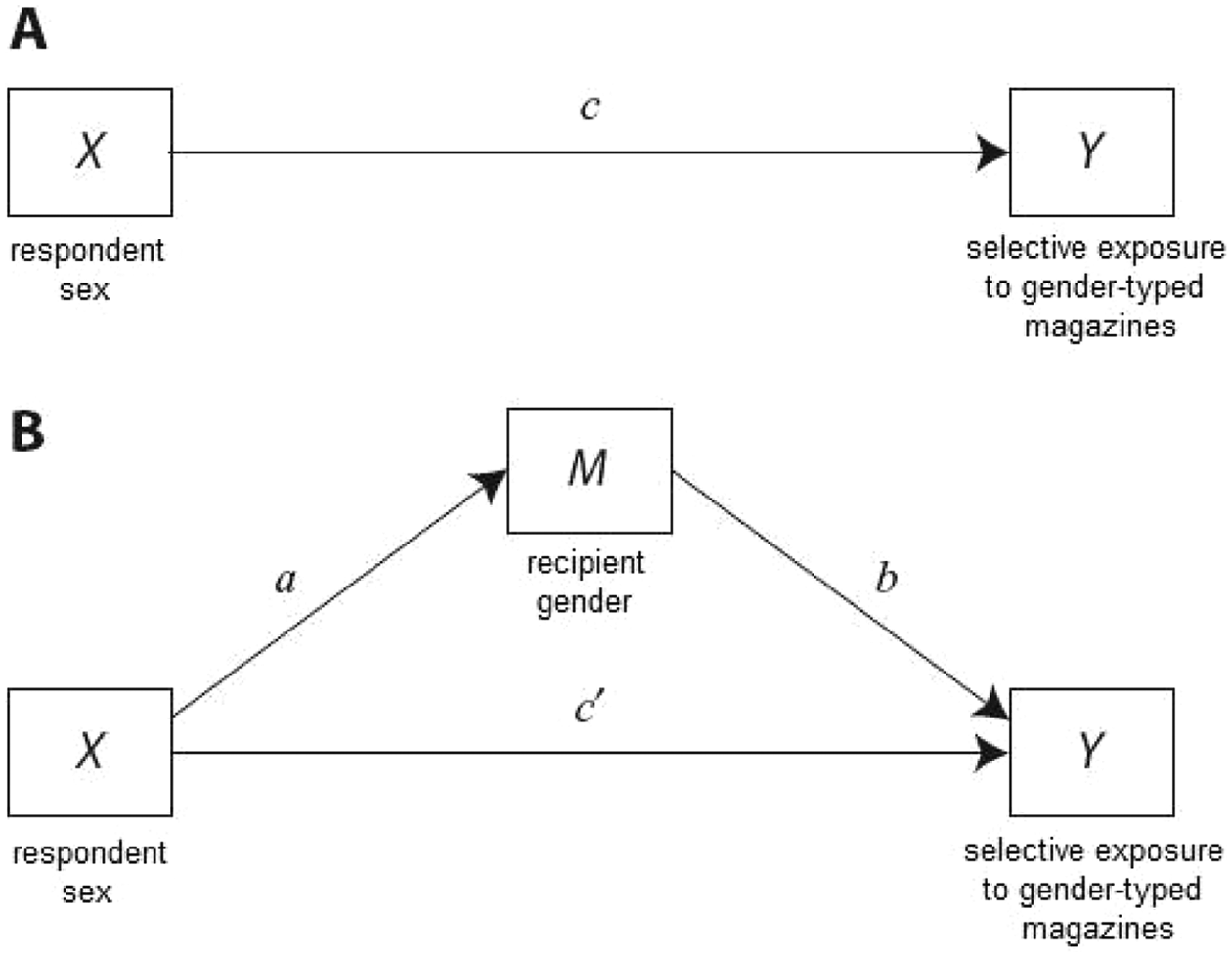
(A) Illustration of a direct effect. X affects Y. (B) Illustration of a mediation design. X is hypothesized to exert an indirect effect on Y through M
Hypothesis 3: Biological sex affects selective magazine reading both directly and indirectly through the gendered self-concept.
More importantly, a crucial gap in the existing research is an actual demonstration of reinforced gender conformity due to gender-typed media selections. Such reciprocal, self-reinforcing media effects processes have been outlined by a number of authors (e.g., Früh & Schönbach, 1982; Klapper, 1960; Knobloch et al., 2005; Slater, 2007). The studies reviewed above built on the assumption that selections foster adherence to gender norms but did not test if that outcome actually occurs. The present investigation aims to address this void with the hypothesis stated below. This hypothesis can be specifically derived from frameworks on gender socialization and conformity: Bussey and Bandura (1999) and Wood et al. (1997) suggested the incorporation of gender norms into self-regulation norms, which in turn should foster gender-typed selections of symbolic media environments.
Hypothesis 4: Selective exposure to magazines associated with an individual’s gender reinforces gender typing of the self-concept (i.e., for women a higher level of femininity, for men a higher level of masculinity, greater differentiation between femininity and masculinity).
In addition to levels of gender conformity, we will draw on accessibility measures, which are frequently used in attitude research (e.g., Fazio, 1995). Many parallels exist between attitude strength and strength of self-concepts, in particular with regard to accessibility (DeMarree, Petty, & Briñol, 2007). Thus the attitude object does not have to be outside of the perceiver—indeed, the self is the object of many attitudes. Hence, we utilize accessibility of the gendered self-concept as another indicator of reinforcement.
Hypothesis 5: Selective exposure to magazines associated with an individual’s gender increases accessibility of the gendered self-concept.
Method
Overview
Young adults (n = 253) were brought into a multiroom lab to view and respond to popular magazine content. Participants first completed a computerized questionnaire in privacy, which consisted of a gender-based self-concept measure with 20 items embedded in 78 distractor questions. Participants were then led to separate tables in a larger reading room, with nine current magazine issues on each table, and instructed to browse the magazines at their leisure. Browsing lasted 10 minutes and was unobtrusively videotaped to be later coded for time spent on the various magazine issues (in 5-second intervals). Participants were then escorted back to private computer stations to rate the magazine content, followed by another measurement of gender-based self-concept and demographic questions. Finally, participants were debriefed and thanked.
Respondents
The participants, 93 (36.8%) males and 160 (63.2%) females, were recruited from undergraduate communication courses at a large mid-western university. Participants were notified of the study through their classes and went to a lab setting on campus to take part in the study. Mean age of the sample was 20.4 years (SD = 1.8). The sample was approximately 80% White, 12% Black, 5% Asian, and 3% Latino.
Stimuli
The magazines available for browsing were selected to represent three male-typed, female-typed, and gender-neutral choices. All participants were presented with the magazines in the same arrangement and orientation. From left to right, the three female-typed magazines were Shape, Us Weekly, Glamour; the three gender-neutral magazines were Newsweek, National Geographic, Time; and the three male-typed magazines were Men’s Health, Game Informer, and Sports Illustrated. The most recent issue of each magazine was used. The specific magazines selected were chosen based on high circulation, and to represent a range of interest options within each category (i.e., health/fashion, entertainment, special interest).
The categorization of the magazines into female typed, male typed or gender neutral was established based on readership statistics. Table 1 lists the percentages of female readers for the nine magazines based on the magazine audience data from Spring 2009 (GfK MRI, 2009). Furthermore, a content analysis of the individuals displayed in the magazines (conducted by two independent coders, one male and one female, with reliabilities at .99 or higher for Krippendorff’s alpha) showed that women were especially frequently displayed in the female-typed magazines with a male-to-female ratio of 1:3.83. Although the gender-neutral magazines showed more men than women, with a male-to-female ratio of 1:0.53, the discrepancy was much greater for male-typed magazines, with a male-to-female ratio of 1:0.18.
Characteristics of the Magazine Stimuli

Experimental Procedure
Preexposure part. On entering the lab setting, participants first signed a consent form for the study and waited for all session participants to arrive (maximum of four). Once all participants were present, they were informed the study consisted of multiple parts. Specifically, they were told “The session combines different study parts where you will: a) describe yourself along various dimensions, b) browse popular magazines and indicate your enjoyment of them, and c) view and rate photographs.” Participants were then led to small rooms containing only a desk and computer where they could complete a computerized questionnaire free of distractions. They were informed to follow the instructions on the screen and to exit the room when finished, at which point the door was closed behind each participant.
The computerized questionnaire was based on MediaLab and DirectRT software and began with a start trial to help respondents become familiar with the first task (see details under “Measures”). Then items to measure the gender-typing of individuals’ self-concept were presented. It took participants on average 23 seconds (SD = 3) to complete this task, which included six distractor items at the beginning and 10 distractor items interspersed in the 20 items of interest.
Before the magazine browsing part, several distractor tasks were presented to prevent gender-related responses and attitudes from being most salient and accessible. Participants answered 56 questions (from the Jackson, 1967 Personality Research Form and the state self-esteem measure by Heatherton & Polivy, 1991), which took on average 121 seconds (SD = 20). Furthermore, they saw a series of 10 landscape images and were asked to rate overall liking of each image on a 9-point interval scale. Each image appeared on the screen for 5 seconds, followed by a screen to rate the image—thus this task took about 1 minute.
After rating the photographs, instructions appeared on the screen informing participants that the first part of the research session was complete, and that they would now browse through some magazines. Participants were told time would not allow them to read everything, and to browse for material that interested them just as they normally would. They were informed that they would be asked questions about their impressions of the magazine content later in the session. They were also informed that they would be taped during the magazine browsing, ostensibly to prevent any theft of research materials (i.e., the magazines). Finally, participants were told to step out of their computer room and meet with the session supervisor before moving on to the next task. After completing this part, participants waited in a common room until all session participants were finished.
Selective exposure part
Next, participants were read instructed about the second part of the study by the research assistant. They were told:
You will now get to read and browse through some magazines. You can choose a magazine and read whatever you’re interested in. You can pick another magazine at any point. Time will not allow you to read everything—so pick and choose, just as you normally would. Please stay focused on the magazines during this period, and do not read any other materials. We’ll later ask you about your impressions of the magazine content.
Then participants were led into a reading room where they sat at separate desks, one in each corner of the room, for privacy. The reading room was designed to resemble a waiting room, where magazines were arranged on a table adjacent to where participants were seated. Each participant had their own table of magazines to choose from, allowing them to make their selections without other participants watching. The magazine selections were identical at each reading station, and nine magazines were arranged in the same order at each station.
After 10 minutes had elapsed, the session supervisor stepped back into the room to inform participants that the browsing period was over, and asked them to return to the computer room where they had taken the first part of the study. Participants were again told to follow the instructions on the screen and to come back outside when finished. The room doors were again shut to allow participants to complete the measures without noise or distraction.
Postexposure part
The second computer questionnaire began by having participants rate eight attributes about the overall magazine content they read (i.e., enjoyable, well-written, biased, boring, informative, objective, relevant, believable), which took 21 seconds on average (SD = 5). These items were included to maintain the cover story that this part of the research session was primarily interested in responses to magazine content, rather than issues of gender and gender conformity. Then, presented as a separate part of the session, respondents again completed Bem’s (1981b) sex-role inventory as in the preexposure part. Finally, demographic information including sex, age, and ethnicity were recorded. After completing the demographic items in the second computer session, participants were instructed to exit the room and meet with the session supervisor. Participants were then debriefed and asked if they had any questions about the study. They were then thanked for their participation and told they had completed the study.
Measures
Gendered self-concept
The measure of the gendered self-concept was based on Bem’s (1981b) sex-role inventory and Markus and Kunda’s (1986) approach to measure self-concept facets. Participants were first presented with a practice trial, in which single positive or negative adjectives appeared on the screen, and were asked to press a corresponding key on the keyboard to classify this word as positive or negative (e.g., Marvelous, Painful). The instructions stated “This task requires that you classify items as quickly as you can while making as few mistakes as possible. Going too slow or making too many mistakes will result in an uninterpretable score.” After six practice words, participants were informed they were moving on to the main task, and would be asked to classify words appearing on the screen as “Me” or “Not Me,” followed by the same time-response instructions. Next, 30 abridged items from Bem’s (1981b) Sex Role Inventory were presented on the screen in random order. These items contained ten distractor items adopted from the Inventory and were furthermore preceded by six filler items such as “coffee drinker” (also randomized) to help mask the nature of the items. Participants responded to each word by pressing a key to classify the word as “Me” or “Not Me.” Sample items include “Assertive” and “Forceful” as masculine items, and “Sympathetic” and “Warm” as feminine items. The same procedure was applied after the browsing period to measure gendered self-concepts again. Femininity and masculinity levels were measures as the number of times a person categorized the items from the Sex Role Inventory as “Me,” with a potential range of 0-10 for both dimensions. In addition to the pre and postexposure levels of femininity and masculinity, an index for gender differentiation of the self-concept (Bem, 1985, referred to this concept as “androgyny”) was computed as the difference between femininity and masculinity levels. More specifically, two variables on gender differentiation of the self-concept were created, one for preexposure and one for postexposure. These variables were created by subtracting participants’ masculinity scores from their femininity scores to achieve a single score indicating the distance between these two constructs.
Accessibility of the gendered self-concept
The use of MediaLab and DirectRT allowed capturing the response times for the abridged Sex-Role Inventory (Bem, 1981b) items in milliseconds. As mentioned in the preceding paragraph, participants completed a practice trial before responding to the Inventory items of interest and were instructed to respond as quickly as possible while avoiding mistakes. Accessibility of the gendered self-concept was thus measured both in the pre and postexposure part and will be reported in milliseconds per item (averaged across all femininity items or masculinity items, respectively).
Selective exposure times
When participants arrived at a reading station, they found nine magazines available for their perusal. Participants were left alone to read the magazines for a period of 10 minutes, during which their magazine selection and reading was unobtrusively recorded and saved to a DVD for later review. Two trained coders later recorded how much time participants spent reading each magazine, using video editing software. Each digital video was broken down into 5-second intervals, resulting in a total of 120 intervals for each participant’s browsing period. For each interval coders indicated which magazine was being read, or else indicated that the participant was viewing magazine covers to make a selection. To ensure the coders were providing reliable data, 10% of the video files were randomly selected and analyzed by both coders. Analysis utilizing Hayes and Krippendorff’s (2007) SPSS macro for calculating intercoder reliability revealed the coders were highly consistent in determining selective reading for the nine magazine issues in 5-second intervals (Krippendorff’s alpha = .99).
Results
Preliminary Analyses
Selective exposure
All participants picked up at least one magazine during the 10-minute magazine browsing period. Participants typically browsed one (69%) or two (26%) of the magazine issues. On average, participants spent 4.31 (SD = 2.30) 5-second intervals, thus roughly 20-25 seconds, on viewing the magazine covers. Seventeen participants were excluded from further analyses, as they represented outliers regarding the time they spent on just viewing magazine covers with nine or more 5-second intervals, thus 40-45 seconds, and did not appear engaged in the task.
Gender-typing of self-concept
Four indices for gender-typing of the self-concept (femininity and masculinity, before and after exposure), were created based on the number of times a participant categorized an abridged item from the Bem Short Version Sex-Role Inventory (1981b) as “Me.” The reliabilities for these sum indices, based on dichotomous variables, per Kuder-Richardson formula 20 were .70 and .83 for femininity (before and after exposure) and .57 and .69 for masculinity (before and after exposure).
An ANOVA with the two gender dimensions of femininity and masculinity and the two measurement points (before and after exposure) as within-group factors and respondent sex as between-group factor served to clarify differences and changes for gender-typing of the self—independent of selective exposure impacts. The between-group factor had no main effect, showing that the sexes did not differ in the total number of times they categorized any of the sex-role inventory items as “Me.” The pre/postexposure within-group factor had a significant main effect, F(1, 244) = 70.51, p < .001, η2 = .224, as participants used the “Me” category more often after exposure than before (M = 15.68, SD = 2.67, vs. M = 16.80, SD = 2.31). This increase was stronger for femininity, as shown by an interaction between the two within-group factors, F(1, 244) = 24.81, p < .001, η2 = .092. Both females and males reported a significant increase in the number of femininity words categorized as “Me” after exposure (M = 9.27, SD = 1.70 and M = 9.02, SD = 1.70, respectively) compared to before exposure (M = 8.38, SD = 1.89 and M = 8.18, SD = 1.61, respectively). However, females and males did not categorize more masculinity words as “Me” after exposure (M = 7.37, SD = 2.01 and M = 8.06, SD = 1.66, respectively) compared to before exposure (M = 7.18, SD = 1.83 and M = 7.69, SD = 1.50, respectively).
Both sexes categorized the items for femininity significantly more often as “Me” than the items for masculinity, F(1, 244) = 53.41, p < .001, η2 = .180, probably due to the fact that some of the masculinity items such as “aggressive” or “assertive” had a negative connotation (M = 17.48, SD = 3.25, vs. M = 14.99, SD = 3.35). Of course, the sexes differed in how many items from each of the two dimensions were categorized with “Me,” as was evident by an interaction between respondent sex and gender dimension, F(1, 244) = 7.00, p = .009, η2 = .028. The means reported in the prior paragraph show that women reported more “Me” responses for the femininity items both before and after exposure compared to men, while men reported more “Me” responses for the masculinity items both before and after exposure compared to women. Thus women were more likely to categorize “feminine” items with “Me” than men were, while men were more likely to categorize “masculine” with “Me” than women were.
Furthermore, an ANOVA with the gender differentiation of the self-concept scores before and after exposure as within-group factor and respondent sex as between-group factor showed that the sexes of course differed in this gendered self-concept differentiation and did so before and after exposure, F(1, 244) = 7.00, p = .009, η2 = .028. Before exposure, women on average categorized 1.20 (SD = 2.35) more femininity items as “Me” than masculinity items, while men on average did so for .48 (SD = 2.10) items. After exposure, women on average categorized 1.90 (SD = 2.87) more femininity items as “Me” than masculinity items, while men on average did so for .97 (SD = 2.56) items. The within-group factor was also significant, F(1, 244) = 24.81, p < .001, η2 = .092, as the difference score went up for both sexes.
Accessibility of gendered self-concept
An ANOVA with accessibility of femininity and masculinity at the two measurement points (before and after exposure) as within-group factors and respondent sex as between-group factor served to examine differences and changes for gendered self accessibility—independent of selective exposure impacts. It yielded a between-group factor impact of respondent sex, F(1, 244) = 6.66, p = .010, η2 = .027, as women were faster in responding than men were (M = 1,085, SD = 202, vs. M = 1,160, SD = 248). The time point of the measure also had a significant impact, F(1, 244) = 56.97, p < .001, η2 = .189, as response times generally decreased with the second measurement (M = 1,144, SD = 258, vs. M = 1,081, SD = 244). Furthermore, participants generally responded faster to masculinity items, F(1, 244) = 56.99, p < .001, η2 = .189 (M = 1,091, SD = 239, vs. M = 1,154, SD = 232). An interaction between respondent sex and the within-group factor of gender facet resulted from the fact that women were particularly fast to respond to masculinity items, F(1, 244) = 9.69, p = .002, η2 = .038. No other effects approached significance.
Impact of Biological Sex on Selective Exposure to Gender-Typed Magazines
To examine Hypothesis 1, an ANOVA with selective exposure (in 5-second intervals) to the three magazine types (female-typed magazines, male-typed magazines, and news magazines) as within-group factor and respondent sex as between-group factor was conducted. The within-group factor yielded a significant impact, F(2, 486) = 38.33, p < .001, η2 = .136, as the gender-neutral newsmagazines were far less likely to be read than both the female-typed and the male-typed magazines (see details in Figure 2). Moreover, an interaction between magazine category and respondent sex emerged, F(2, 486) = 184.33, p < .001, η2 = .431, given that the magazine readers showed an overwhelming preference for magazines associated with their own gender. Both sexes spent about three quarters of the magazine-browsing time on “gender-appropriate” magazines, even though this category accounted for only a third of the available choices (see Figure 2).

Selective exposure to gender-typed magazines as a function of readers’ biological sex
Impacts of Biological Sex and Gender on Selective Magazine Exposure
To address Hypothesis 2 and Hypothesis 3, mediation analyses with bootstrapping were conducted because this method does not impose the assumption of normality of the sampling distribution, which is unlikely to be met with relatively small samples (Preacher & Hayes, 2008). Figure 1 illustrates the setup of the applied mediation models and how they go beyond simple direct effects. Because mediation analyses were conducted for several different indicators, the illustration in Figure 1 is generic and the detailed results are reported in tables due to space limitations. A point estimate for an indirect effect (total or specific) was considered significant if zero was not included in the 95% bias-corrected confidence interval. For an easier comparison of the coefficients, we divided the selective exposure measure (in 5-second intervals, potentially ranging from 0 to 120) by 12, so that it could range from 0 to 10 as the femininity and masculinity measures did.
A first mediation analysis (see Table 2, Model A) was conducted with respondent sex (male = 0, female = 1) as independent variable (X), preexposure femininity (M1) and masculinity (M2) as mediators, and selective exposure to female-typed magazines (in minutes) as dependent variable (Y). Respondent sex had no significant impact on preexposure femininity; yet higher preexposure femininity led to longer exposure to female-typed magazines (coefficient = .261, p = .027). Preexposure masculinity was higher for males (coefficient = −.512, p = .024) but, unsurprisingly, did not influence exposure to female-typed magazines. Respondent sex had a significant impact on exposure to female-typed magazines, as being female led to 7.035 min longer exposure (p < .001), but had no indirect effect through preexposure femininity. Thus biological sex (being female) and preexposure femininity both increased exposure to female-typed magazines, but did so independently.
Mediation Analysis on Biological Sex and Gender on Gender-Typed Magazine Exposure
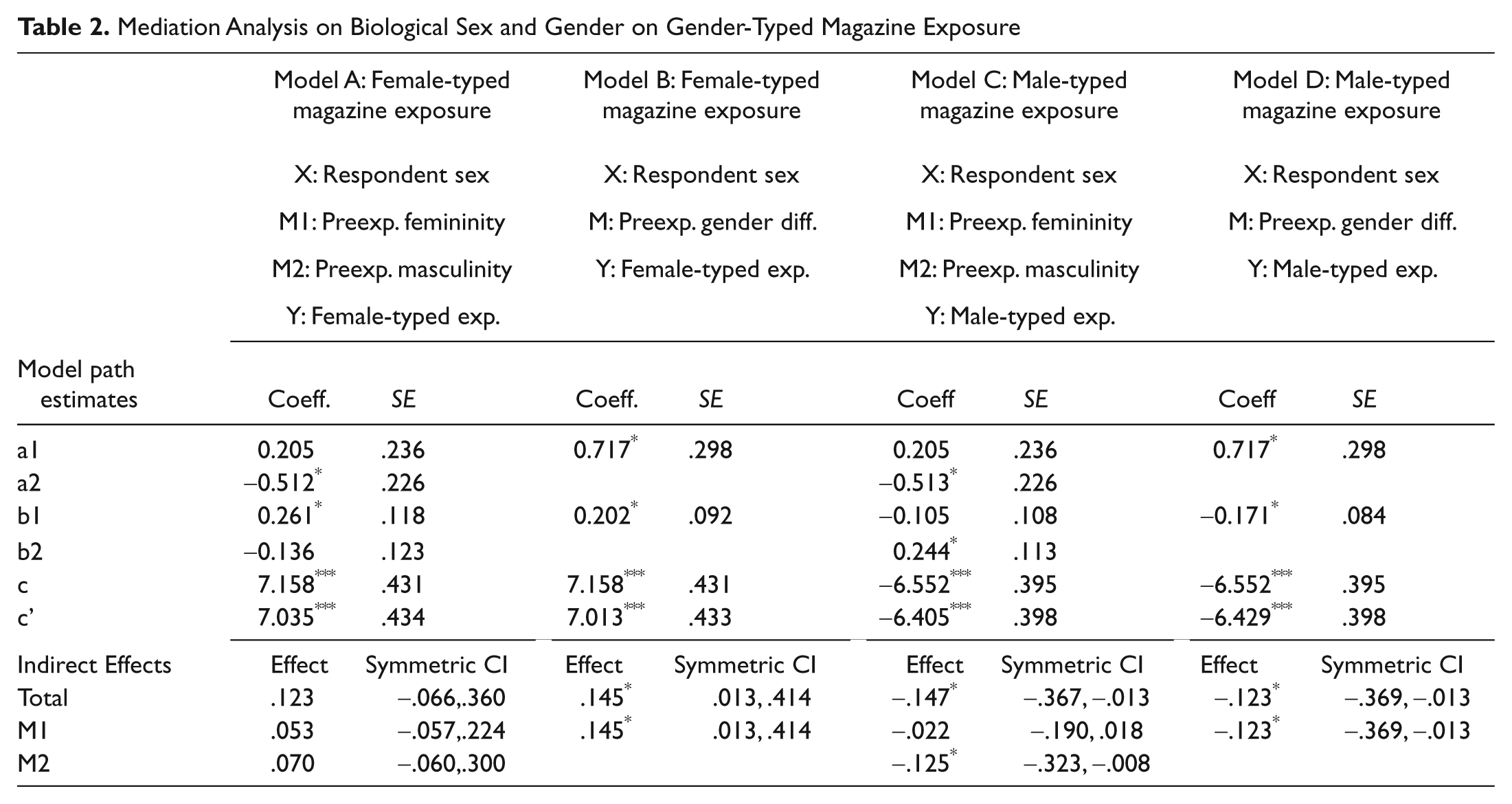
The second mediation analysis (see Table 2, Model B) overall followed the model of the first but used individual gender differentiation of self concept—the difference between preexposure femininity and masculinity—as one mediator (M1), instead of using preexposure femininity and masculinity as two separate mediating variables. Recipient sex influenced this difference score, with being female increasing the difference score by .717 (p = .017). The difference score, in turn, increased exposure to female-typed magazines (coefficient = .202, p = .029). Respondent sex had a direct effect on female-typed magazines as well, as being female increased exposure (coefficient = 7.013, p < .001). Furthermore, recipient sex influenced exposure to female-typed magazines indirectly, mediated by the gender differentiation score, with a point estimate of .145 and a 95% BCa (bias-corrected and accelerated) bootstrap confidence interval of .013 to .414. Thus, selective exposure to female-typed magazines was affected by respondent sex, individual gender differentiation of self-concept, as well as indirectly by respondent sex through individual gender differentiation of self-concept.
The third mediation analysis (see Table 2, Model C) utilized respondent sex (male = 0, female = 1) as independent variable (X), preexposure femininity (M1) and masculinity (M2) as mediators, and selective exposure to male-typed magazines (in minutes) as dependent variable (Y). Impacts of the independent variable on the mediators were of course as already reported for the first mediation analysis. Preexposure masculinity, but not femininity, influenced exposure to male-typed magazines (coefficient = .244, p = .032). Being male increased this exposure significantly by almost six and a half minutes (coefficient = −6.405, p < .001). Respondent sex had also an indirect influence on male-typed magazines exposure through preexposure masculinity, with a point estimate of −.125 and a 95% BCa (bias-corrected and accelerated) bootstrap confidence interval of −.323 to −.008.
The fourth mediation analysis (see Table 2, Model D) was parallel to the third but again used individual gender differentiation of self concept—the difference between preexposure femininity and masculinity—as one mediator (M1), instead of using preexposure femininity and masculinity as two separate mediating variables. The additional insights from this model were that gender differentiation of self-concept was linked to exposure to male-typed magazines, as a smaller difference led to longer reading of these magazines (coefficient = −.171, p = .044), and that being male also fostered this exposure indirectly through gender differentiation of the self-concept, with a point estimate of −.123 and a 95% BCa (bias-corrected and accelerated) bootstrap confidence interval of −.369 to −.013.
Impacts of Selective Exposure to Gender-Typed Magazines on Gender Conformity
Next we addressed Hypothesis 4. To examine how respondent sex, gendered self-concept, and gender-typed magazine exposure affected postexposure gender conformity, multiple-step mediation models were applied (Hayes, Preacher, & Myers, 2011). Figure 3 (based on Hayes et al., 2011) illustrates this approach in generic form while Table 3 summarizes the findings for the various indicators utilized in several mediation analyses. Parallel to the analyses addressing Hypothesis 2 and Hypothesis 3 above, the first two models pertained to female-typed magazines exposure while the last two examined male-typed magazines exposure—however, exposure was now a mediator.
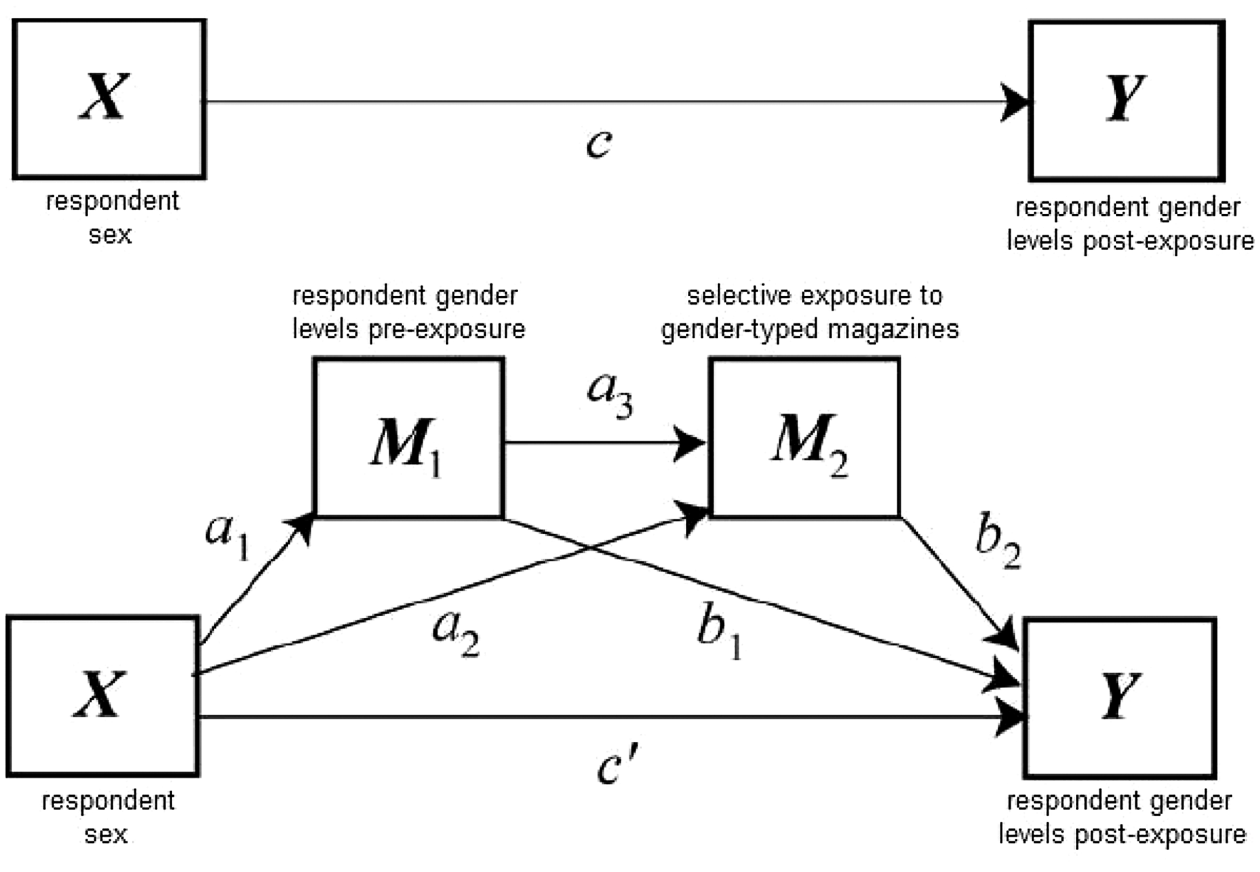
Illustration of a multiple-step indirect effect. X is hypothesized to exert an indirect effect on Y through M1, M2, and/or M1 and M2
Multiple-Step Mediation Analysis on Biological Sex, Gender, and Gender-Typed Magazine Exposure on Gender Conformity
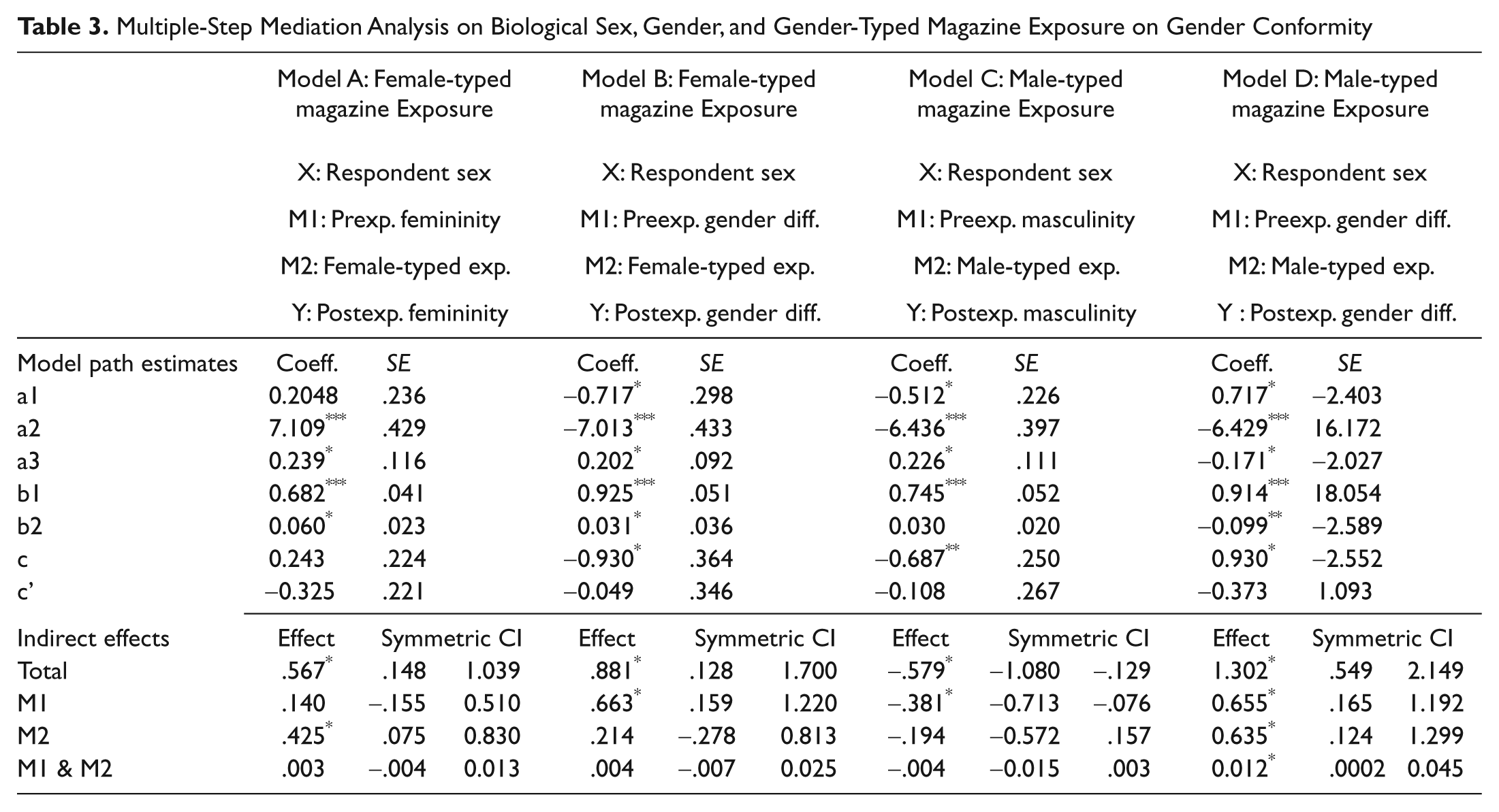
In Table 3, the rows for a1, a2, and a3 reiterate findings from the mediation analyses reported in the prior section. The row for b1 merely shows the extent to which preexposure femininity, masculinity, or gender differentiation of the self-concept influenced the postexposure levels of the same concepts.
The row for b2 is much more relevant, as it shows the impacts of selective exposure to gender-typed magazines on postexposure femininity, masculinity, or gender differentiation of the self-concept, respectively. It reveals that selective exposure to female-typed magazines increased femininity levels (Model A) and the difference between femininity and masculinity (Model B), while exposure to male-typed magazines reduced the difference between femininity and masculinity levels (Model D). The row for c shows that respondent sex had no significant impact on postexposure femininity, masculinity, or gender differentiation of the self-concept, respectively, when considering the mediators.
Furthermore, the row for M1 reports indirect impacts of respondent sex on postexposure femininity, masculinity, or gender differentiation of the self-concept, respectively, through preexposure levels of the same variables. More importantly, the row for M2 shows whether respondent sex affected postexposure levels of femininity, masculinity, or gender differentiation of the self-concept, respectively, through selective exposure to gender-typed magazines. Significant indirect impacts occurred for exposure to female-typed magazines on postexposure femininity levels, with a point estimate of .425 and a 95% BCa (bias-corrected and accelerated) bootstrap confidence interval of .065 to .816, and male-typed magazine exposure on gender differentiation of the self-concept, with a point estimate of .635 and a 95% BCa (bias-corrected and accelerated) bootstrap confidence interval of .124 to 1.299.
Finally, the row for M1 & M2 shows whether respondent sex affected postexposure levels of femininity, masculinity, or gender differentiation of the self-concept, respectively, through preexposure levels of these variables and selective exposure to gender-typed magazines. Such a multiple-step mediation impact occurred through gender differentiation of the self-concept and exposure to male-typed magazines, with a point estimate of j.012 and a 95% BCa (bias-corrected and accelerated) bootstrap confidence interval of .0002 to .045.
Impacts of Selective Exposure to Gender-Typed Magazines on Gendered Self Accessibility
Last, we examined impacts of selective magazine exposure on gendered self accessibility through various regression analyses and moderated mediation analyses (Preacher, Rucker, & Hayes, 2007) but no impacts involving selective exposure measures emerged as significant.
Discussion
This investigation examined patterns that converge with lay observations on selective exposure to media content—women prefer women’s magazines, men prefer magazines that target men. Moreover, our analyses examined origins and consequences of these patterns.
We found an overwhelmingly strong alignment of readers’ exposure with gender-typed expectations regarding magazine preferences. In line with Hypothesis 1 derived from Eagly’s gender role theory (1987), readers of both sexes spent about three quarters of the browsing time on magazines associated with their gender, even though this category accounted for only a third of the available choices. Yet selective exposure was not determined by biological sex only—gender-typing of self-concept also influenced reading behavior, with greater femininity linked to longer reading of female-typed magazines and greater masculinity linked to longer reading of male-typed magazines. Thus Hypothesis 2 derived from gender schema theory (Bem, 1981a, 1981b) was supported as well. Furthermore, biological sex affected selective magazine reading indirectly through preexposure levels of gender, in line with Hypothesis 3 that built on Wood and Eagly’s (2002) idea that both biological as well as social aspects contribute to sex differences, with the former preceding the latter.
Overall, the results show that biological sex influences selective exposure to gender-typed magazines directly but also through an indirect effect via gender. More specifically, femininity but not masculinity influenced exposure to female-typed magazines, and masculinity but not femininity influenced exposure to male-typed magazines. When considering the gender differentiation of the self-concept (the difference between femininity and masculinity), both exposure to female-typed and to male-typed magazines was affected by gender. It is important to note that gender also influenced magazine exposure independently from biological sex. Possibly even more interesting than the origins of gender-typed media exposure is the question whether this exposure in turn increases gender conformity, as had been suggested in Hypothesis 4 based on social-cognitive theory (Bussey & Bandura, 1999). Indeed, the analyses showed that longer exposure to female-typed magazines increased postexposure femininity levels. Furthermore, longer exposure to male-typed magazines led to lower scores for gender differentiation of the self-concept, indicating a shift toward masculinity. It is worth noting that biological sex had an indirect influence on postexposure gender levels through selective exposure to magazines. Hypothesis 5 regarding increased accessibility from gender-typed media use, however, was not supported.
In brief, four hypotheses were supported. Not just biological sex but also self-concept influences what magazines are consumed and what are ignored. These choices, in turn, affected gender-typed perceptions of the self. These findings give credence to the application of gender schema theory, gender role theory, as well as social-cognitive theory to gender-typed media use. These findings attest to the importance of the media as a “socialization agent” beyond childhood, as even adults show greater norm conformity after a brief media exposure period. Interestingly, the young adults in our sample engaged in a media use behavior that could be characterized as “self-socialization” in the sense that selective media exposure resulted in fostering one’s own conformity with ascribed social roles and norms. Similar selection patterns were found for preschool children (as mentioned above), but this earlier research did not examine subsequent effects of selective exposure. The demonstration of consequences of selective exposure for the self-concept is the most important contribution of the present work.
Limitations to the present work need to be acknowledged. The exposure to gender-typed media content may have been heightened in the present study by using newsmagazines as gender-neutral choice, because the sampled population of college students tends to have low interest in print news (e.g., Diddi & LaRose, 2006). An important challenge is the adequate operationalization of a gendered self-concept. While Bem’s sex-role inventory (1981b) is the most commonly used measure for gender-typing others or the self, it has been developed almost 40 years ago and may be dated in light of changing gender roles (Holt & Ellis, 1998). It has been subject to criticism for featuring more than two factors, with masculinity in particular being more multi-faceted than captured by the inventory (Choi & Fuqua, 2003; Choi, Fuqua, & Newman, 2009). Desirability of the attributes has also been raised as an issue (Choi et al., 2008), especially for self-descriptions as in our case. Indeed, we found surprisingly low scores for masculinity and attributed this to some items with a negative connotation. Yet alternatives to Bem’s measure are very lengthy (e.g., Mahalik et al., 2003) and would have induced strong salience of gender as a research topic and thus a strong demand characteristic, resulting in a threat to the ecological validity of our findings. Even implicit measures of gender (e.g., Greenwald & Farnham, 2000) utilize clearly gendered terms (man, boy, woman, girl) that would have rendered the research topic salient. Thus spontaneous categorizations of Bem’s (1981b) items into “Me/Not Me” were the most viable approach. As participants took only about a second to respond to each of the abridged sex role inventory items, which in addition were embedded in plenty distracter items and presented as separate from the magazine browsing, we believe that it is unlikely that they reflected much on the target concept of gender or the overall purpose of the study while completing this task.
Future research should extend the present work to examine if more specific facets of gender are reinforced through selective exposure to more specific magazine types. For instance, Mahalik et al. (2003) suggested aspects of masculinity that are likely to get reinforced by reading certain magazines— “Primacy of Work” and “Pursuit of Status” may correspond with reading business magazines as, “Playboy” and “Power Over Women” may correspond with reading lad magazines (Aubrey & Taylor, 2009), and “Winning” and “Violence” may be linked to magazines on violent video games. Of course, not only magazines may have such gender-facet reinforcement effects, as TV, music, or Internet-based communication can produce the some impacts.
Moreover, future research should aim to specify what psychological processes are involved in the demonstrated reinforcement patterns. Which specific processes are at work is difficult to discern with the present data, which only seem to rule out priming. The lack of support for Hypothesis 5 reflects on the processes involved in the reinforcement process—it appears to occur on a relatively salient level, possibly through social learning and behavioral modeling (Bandura, 2001; Bussey & Bandura, 1999) rather than bringing gendered cognitive notions simply to the forefront through priming (Roskos-Ewoldsen, Roskos-Ewoldsen, & Carpentier, 2009). Future studies could explore if gender-typed media use among adults leads to more positive affect (Wood et al., 1997), greater ease in information processing (Bem, 1981a, 1981b), possibly enhanced self-esteem from greater identification with social roles and groups (Eagly, 1987; Good & Sanchez, 2010), or a stronger sense of self-efficacy (Bussey & Bandura, 1999) to shed light on the processes involved.
The present study was able to demonstrate one of the probably very common reinforcement effects of media exposure. As Klapper (1960) had argued, most mass communication impacts may consist of reinforcing the status quo. Despite gender being an extremely stable aspect of the self-concept that is likely to be subject to ceiling effects with little room to increase, a brief media use period could still heighten its strength. Thus, the fact that consequences of selective exposure on gender conformity could be demonstrated suggests this may be a continuous phenomenon in people’s everyday media use. Not only does the social environment provide relatively clear signals on what is appropriate for one’s gender, we also seek out messages that help us to comply with such social expectations.
Footnotes
Acknowledgements
The authors wish to thank Laura Willis and Steven Kleinman for coding the magazines for frequency of female and male individuals shown.
The authors declared no potential conflicts of interest with respect to the research, authorship, and/or publication of this article.
The authors received no financial support for the research, authorship, and/or publication of this article.