



Abstract
The present study compared and contrasted American and Chinese college students’ responses to advice by examining the impact of perceived advice content features (response efficacy, feasibility, absence of limitations) and source characteristics (expertise, trustworthiness, liking) on recipient’s evaluation of advice quality and intention to implement advice in each cultural group. American (N = 262) and Chinese college students (N = 319) completed questionnaires reporting on a recent instance of receiving advice with regard to a personal problem. Across both cultural groups, each of the perceived content and source features was positively associated with participants’ evaluation of advice quality and intention to follow advice, and perceived content features had stronger and more direct influence on responses to advice than source characteristics did. Perceived content features had a stronger impact on Americans’ intention to implement advice than they did for Chinese, whereas perceived source characteristics had a stronger impact on Chinese’ intention to implement advice than they did for Americans.
Keywords
Introduction
Advice is a common component of supportive interactions—interactions during which one person makes the effort, or is perceived as making the effort, to assist someone else with a problematic situation (Burleson & MacGeorge, 2002; Sarason, Pierce, & Sarason, 1990). People regularly encounter new, challenging, or problematic situations, and others respond to their problems and stress by telling them what to think, feel, say, or act in the situation. As common as it is, giving advice is a communication act that requires skill and can elicit widely varied responses from recipients (e.g., Goldsmith & Fitch, 1997; MacGeorge, Feng, Butler, & Budarz, 2004). The growing body of research on advice has offered considerable insight into how people respond to advice (for a review, see MacGeorge, Feng, & Thompson, 2008). However, a noteworthy limitation with the existing body of research on advice is that with very few exceptions (Heritage & Sefi, 1992), advice research has relied almost exclusively on the use of European-American samples and, as a result, we know very little about the mechanisms through which people from other cultures respond to advice in supportive contexts.
Substantial research shows that there are noteworthy cultural differences in a variety of communication practices (e.g., Gudykunst et al., 1996; Ting-Toomey & Korzenny, 1991). If communication is a process that is necessarily influenced, to a greater or lesser extent, by participants’ cultural norms and practices, people from different cultures may differ in the processes through which they seek, provide, and respond to social support, including advice. However, as some scholars have pointed out, because most examinations of social support have adopted a primarily Western perspective, and relatively few studies have considered cultural differences in the use and effect of social support, there is no clear understanding of how social support may operate among individuals from different cultural backgrounds (Kim, Sherman, & Taylor, 2008; Mortenson, 2009). As the frequency and intensity of intercultural communication in various realms of social life increase, studying advice from a cross-cultural perspective has both theoretical and applied utility.
The current study aims to fill this gap in our knowledge by testing an integrated model of advice response, which is derived from the advice response theory (Feng & MacGeorge, 2010; MacGeorge, Feng, & Burleson, 2011), with individuals from the United States and China. This study presents the first cross-cultural examination of the model by assessing how Americans and Chinese are both similar and different in their responses to perceptions of two major aspects of advice: content features of advice and characteristics of the advice giver. In the following sections, we first review extant literature on how perceived advice content features and source characteristics can influence recipients’ responses to advice. We then present the integrated model of advice response that describes the connection between these two sets of predictors of advice responses. Afterwards, we discuss the cultural dimension of individualism-collectivism that guides our examination of differences between Americans and Chinese in their responses to advice.
Predictors of Recipient Responses to Advice
Two core aspects of advice responses have been identified and highlighted by prior research (Feng & Burleson, 2008; Feng & MacGeorge, 2010; MacGeorge et al., 2004): Recipient’s evaluation of advice quality and intention to implement advice. Extant research shows that several groups of factors tend to influence these responses to advice (for reviews, see Bonaccio & Dalal, 2006; Feng & MacGeorge, 2010; MacGeorge et al., 2008). In a nutshell, research suggests that the valence of an individual’s reaction toward a piece of advice is largely influenced by (a) perceived features of advice messages, including the manner in which the advice is delivered (e.g., politeness) and what the advice says or implies about the recommended behavior (e.g., the recommended behavior’s effectiveness in solving the problem), (b) perceived characteristics of the advice giver and his or her relationship with the recipient (e.g., expertise, liking), and (c) characteristics of the advice recipient (e.g., gender, thinking style). In the current study, we focus our examination on three content features of advice (response efficacy, feasibility, and absence of limitations), three characteristics of the advice giver (expertise, trustworthiness, and liking), and two features of the advice recipient (nationality, individualism-collectivism value orientations). Each of these factors is discussed further in the following sections.
Perceived features of advice content
Although commonly categorized as a form of informational support (Cutrona & Suhr, 1994), the communication of advice can also be conceptualized as a persuasion process (Cody, Canary, & Smith, 1994; Wilson, Aleman, & Leatham, 1998). Seen in this light, the perceived features of an advised course of action should play an important role in influencing advice recipient’s evaluations of advice quality and intention to implement the advice. Drawing upon argumentation theory (e.g., Inch & Warnick, 2002; Lee & Lee, 1989), researchers have identified three content-related characteristics of advice that tend to influence recipient’s responses to advice (Feng & Burleson, 2008; Hung & Feeley, 2005; MacGeorge et al., 2004). The three content characteristics are: response efficacy (i.e., the extent to which the advised course of action is capable of solving or alleviating the recipient’s problematic situation), feasibility (i.e., the extent to which the recipient can perform the advised course of action), and lack of limitations (i.e., the degree to which the implementation of the advised action has minimal drawbacks or negative consequences). Past research has produced strong evidence indicating that these content features tend to exert stronger and more proximal effects on recipient responses to advice than other aspects of advice (Feng & MacGeorge, 2010)—a point we will discuss in more detail later.
Perceived characteristics of advice giver
Like other forms of communication, advice giving and receiving is a relational process: How one responds to a piece of advice from another person should be a function of not only what is said but also who says it. A positive feature of an advice giver can be used as heuristic cue that prompts a target to make a positive decision about the recommended course of action (Petty, Rucker, Bizer, & Cacioppo, 2004; Todorov, Chaiken, & Henderson, 2002). Extant research on advice has identified several characteristics of the advice giver that tend to influence recipient’s responses to advice, including expertise, trustworthiness, and liking of the advice giver.
Research shows that individuals are more likely (and willing) to seek advice from people they see as experts (e.g., Feng & MacGeorge, 2006). Also, individuals tend to judge advice more positively (e.g., as “helpful” or “caring”) when they believe that the advice giver has expertise, and more negatively (e.g., as “butting in”) when they believe that the advice giver lacks expertise (Goldsmith & Fitch, 1997; Sniezek, Schrah, & Dalal, 2004; White, 2005). In addition to expertise, extant research shows that the perceived trustworthiness of an advice giver is also an important factor influencing an advice recipient’s evaluation of advice quality and his or her decision to follow the advice (Feng & MacGeorge, 2010; Sniezek & Van Swol, 2001; Van Swol & Sniezek, 2005; White, 2005). Another source characteristic that can influence a recipient’s responses to advice is the degree to which the recipient likes the advice giver. It is a well-established idea that people tend to interpret the behaviors of liked others in positive ways (e.g., Byrne, 1997; Heider, 1958; Silvia & Duval, 2001). Correspondingly, many studies showed that people are more likely to be persuaded by sources they like (e.g., Silvia, 2005; Sinclair, Moore, Mark, Soldat, & Lavis, 2010). Hence, to the extent that an advice giver is liked by the advice recipient, the recipient may respond more favorably to the advice.
An integrated model of advice responses
Given that most prior research on source characteristics of advice has been conducted independently of research on advice content features and vice versa, there has been little theorizing about how advice source characteristics and content features jointly influence advice responses. Recently, Feng and MacGeorge (2010) outlined a theoretical framework, which they later called the advice response theory (MacGeorge et al., 2011), that helped to fill this gap. Advice response theory describes (a) the connection between message features (both content and stylistic) and source characteristics of advice and (b) the conditions under which message features and source characteristics will have a stronger or weaker impact on advice responses. A major proposition of the theory is that perceived characteristics of advice giver affect recipient’s responses to advice through their impact on recipient’s perceptions of advice message features. In other words, when perceived characteristics of an advice giver influence an advice recipient’s responses to advice, they do so via the activation of heuristics that drive the advice recipient to make inferences about the message features of advice (e.g., “the advice giver is an expert in this area, so the advice he gave must be effective, feasible, and has few drawbacks”). Initial testing of the advice response theory has produced some strong empirical support for this proposition (Feng & MacGeorge, 2010).
Cultural Similarities in Responses to Advice
Although many of the findings reviewed above have been relatively well established, it should be noted that they were drawn primarily from research in the United States. It is thus an empirical question whether, and if so, to what extent, the influence of those message and source features on recipient responses to advice is the same in other cultures. Meanwhile, in light of the increasing amount of research evidence documenting broad patterns of transcultural similarities in other forms of social support (Burleson & Mortenson, 2003; Mortenson, Liu, Burleson, & Liu, 2006), it is reasonable to expect that those content features (response efficacy, feasibility, and absence of limitations) and source characteristics (expertise, trustworthiness, and liking) would have some impact on an individual’s evaluation of advice quality and intention to follow advice, regardless of the individual’s cultural background. Therefore, the following hypotheses were proposed:
Hypothesis 1 (H1): Content features of advice (response efficacy, feasibility, and absence of limitations) will positively influence recipient’s evaluation of advice quality and their intention to implement advice in both American and Chinese samples.
Hypothesis 2 (H2): Source characteristics of advice (expertise, trustworthiness, and liking) will positively influence recipient’s evaluation of advice quality and their intention to implement advice in both American and Chinese samples.
Hypothesis 3 (H3): Content features of advice will mediate the effect of source characteristics on recipient’s evaluation of advice quality and intention to implement advice in both American and Chinese samples.
Cultural Variations in Responses to Advice
Cultural differences can be examined at many different levels—from the physical, the cognitive, to the social and the behavioral. Within the realm of intercultural and cross-cultural communication research, shared and distinct value orientations exhibited by a group of people have been emphasized as core elements of culture (Spencer-Oatey, 2000). Of particular relevance to the current study is the notion that culture not only influences its members’ behavior but also their interpretations of and responses to other people’s behavior and messages. Consistent with this view of culture, the current study employs a well-established cultural construct—individualism-collectivism—to predict differences between Americans and Chinese in how they respond to advice.
Individualism-collectivism (Hofstede, 1991) is perhaps the most frequently used construct to describe differences between cultures. Different nations are often characterized as being predominantly individualistic or collectivistic; for example, the United States is typically categorized as an individualistic culture whereas China is typically labeled as a collectivistic culture (Adler, Brahm, & Graham, 1992; Markus & Kitayama, 1991). Individualistic cultures tend to emphasize autonomy and independence whereas collectivistic cultures tend to emphasize relational harmony and conformity to group norms (Schwartz, 1990). People from individualistic cultures tend to perceive themselves as more independent of others and place higher priority on individuals’ goals, needs, and interests. In contrast, people from collectivistic cultures often see themselves as deeply embedded within situations and relationships and put greater emphasis on status and role authority (Gudykunst, 1987). Research has also shown that people from individualistic cultures tend to engage in low-context communication (Hall, 1976) by relying more heavily on explicit verbal utterances, whereas people from collectivistic cultures tend to exhibit a high-context communication style by relying more heavily on relational context to perceive and understand others’ messages (Gao & Ting-Toomey, 1998; Kim, Pan, & Park, 1998; Triandis & Suh, 2002; Wu & Rubin, 2000).
The dimension of individualism-collectivism can serve as a useful theoretical framework for predicting cultural differences in responses to advice in supportive interactions. With its focus on the individual, individualism implies that one’s judgment, reasoning, and causal inferences are likely to be oriented toward the person himself or herself rather than the situation or social context. Conversely, one plausible consequence of collectivism with regard to communication is that social context, situational constraints, and social roles figure prominently in perception and causal reasoning (Morris & Peng, 1994), and meaning is contextualized (Oyserman, Coon, & Kemmelmeier, 2002). More specifically, being more oriented toward the accomplishment of their personal goals (e.g., solving the problems they are experiencing) and more sensitive to explicit verbal messages while communicating with others, people from individualistic cultures, such as the United States, may be more influenced by perceived content features of advice when evaluating advice and making a decision about whether to follow the recommended behavior. Accordingly, the following hypothesis was proposed:
Hypothesis 4 (H4): Culture will moderate the influence of perceived content features on advice responses, such that perceived content features will have a stronger impact on Americans’ evaluation of advice quality and intention to implement advice than they do for Chinese.
However, because people from collectivistic cultures like China are more relationship oriented and tend to rely more heavily on relational and contextual cues when communicating, there is reason to suspect that they may be more influenced by the perceived characteristics of the advice giver when responding to advice than their American counterparts. Therefore, we proposed the following hypothesis:
Hypothesis 5 (H5): Culture will moderate the influence of perceived source characteristics on advice responses, such that perceived source characteristics will have a stronger impact on Chinese’ evaluation of advice quality and intention to implement advice than they do for Americans.
Above, we have categorized Americans and Chinese into cultural groups by using the culture-level dimension of individualism-collectivism. However, assuming value orientations based on participants’ country of origin and using nationality as a “catch-all” variable (Singelis & Brown, 1995) in cross-cultural comparisons does not provide us with much empirical evidence to explain why observed cultural differences in communication exist. To empirically assess the mechanisms through which culture might influence how people respond to advice, it is necessary to introduce corresponding individual-level constructs into the study. Doing so would serve three purposes. First, it allows us to empirically assess whether Americans and Chinese differ on the culturally inspired construct; in this case, individualism-collectivism. Second, it can reveal the more basic causes behind observed cultural differences in responses to advice. Third, by measuring value orientations at the individual level, we can explain within-culture, individual differences in responses to advice. We thus proposed the following set of hypotheses:
Hypothesis 6 (H6): Americans will report higher individualism than Chinese, and Chinese will report higher collectivism than Americans.
Hypothesis 7 (H7): Levels of individualism will moderate the influence of perceived content features on advice responses, such that content features of advice will have a stronger influence on evaluation of advice quality and implementation intention for people with high individualism than they do for people with low individualism.
Hypothesis 8 (H8): Levels of collectivism will moderate the influence of perceived source characteristics on advice responses, such that source characteristics of advice will have a stronger influence on evaluation of advice quality and implementation intention for people with high collectivism than they do for people with low collectivism.
Method
Participants and Procedures
Undergraduate students from a large university and a mid-sized college in northern China (N = 319; 53% females; age: 20 to 25 years, M = 23.16, SD = 2.04) and undergraduate students from a large Midwestern university in the United States (N = 262; 65.6% females; age: 18 to 39 years, M = 20.89, SD = 2.17) participated in this study.
The research design employed in the current study was similar to that implemented in several previous studies of advice (MacGeorge et al., 2004, 2008). Participants were instructed to recall a recent (within the last month) conversation in which they talked with someone about a problem they were upset about and the person gave them advice about the problem. Participants then filled out a questionnaire packet that contains questions about their demographics, the problem they recalled, the person who gave them the advice, and their perceptions and responses to the received advice.
Two versions of the questionnaires were used: the version completed by American participants written in English and the version completed by Chinese participants written in Mandarin Chinese. To ensure accuracy and appropriateness in translation, the Chinese version of the questionnaires was back-translated into English by a bilingual Chinese graduate student who was proficient in both languages and had professional experience in conducting translation between the two languages. Cross-examination of the two translations indicated that the Chinese version of the questionnaires was appropriate. Participants from both cultural groups participated on a voluntary basis. American participants received one extra credit for their participation, and Chinese participants were given a small token of appreciation (a pencil and a postcard) for their participation.
Measures
Perceived response efficacy
Participants’ perception of advice efficacy was measured with three Likert-style items (e.g., “I believed that the advised action could help to solve my problem”) on a 5-point scales (1 = strongly disagree, 5 = strongly agree). Confirmatory factor analyses using structural equation modeling (SEM) were conducted separately for American and Chinese data sets and confirmed the single-factor structure of this instrument for each cultural group. The scale exhibited acceptable internal consistency (α = .75 for Chinese and α = .86 for Americans).
Perceived feasibility
Participants’ perception of the feasibility of the advised course of action was measured with six Likert-style items (e.g., “The advice given was something I could do”) on a 5-point scales (1 = strongly disagree, 5 = strongly agree). Confirmatory factor analyses confirmed the single-factor structure of this instrument for each cultural group. Reliability of the scale was acceptable (α = .78 for Chinese and α = .76 for Americans).
Perceived absence of limitations
Participants’ perception of the limitations of the advice they received was measured with three Likert-style items (e.g., “I could tell that the advised action would have undesirable effects”) on a 5-point scales (1 = strongly disagree, 5 = strongly agree). Confirmatory factor analyses also confirmed the single-factor structure of this instrument for each cultural group. The three items formed a reliable scale (α = .78 for Chinese and α = .84 for Americans). Confirmatory factor analyses suggested that the three factors—perceived response efficacy, perceived feasibility, and perceived absence of limitations—measured the latent variable of perceived content features of advice. The American sample fit the data well (comparative fit index [CFI] = .97, normed fit index [NFI] = .95, root mean square error of approximation [RMSEA] = .07; χ2 = 54.78; df = 24), as did the Chinese sample (CFI = .95, NFI = .93, RMSEA = .08; χ2 = 68.10; df = 24). Subsequent multigroup structural equation modeling (MSEM) analysis exhibited model equivalence across the two samples.
Perceived expertise
Nine items on 5-point Likert-style scale (1 = considerably less than mine, 5 = considerably greater than mine) were used to assess advice recipient’s perceptions of expertise of the advice giver. These items assess the advice giver’s general expertise through items that ask about the advice giver’s wisdom, knowledge about the “way things are” and the like, as well as the advice giver’s problem-relevant expertise. Confirmatory factor analyses confirmed the single-factor structure of this instrument for each cultural group. The scale exhibited good internal consistency (α = .84 for Chinese and α = .85 for Americans).
Perceived trustworthiness
Wheeless and Grotz’ Individualized Trust Scale (1977) was used to measure participants’ trust of the advice giver. The scale consists of 14 items measured on 7-point semantic differential scales (e.g., 1 = is trustworthy, 7 = is untrustworthy, 1 = is unreliable, 7 = is reliable). Confirmatory factor analyses confirmed the single-factor structure of this instrument for each cultural group. The items constituted a reliable scale (α = .93 for Chinese and α = .91 for Americans).
Liking
Rubin’s (1970) liking scale was used to measure participants’ liking of the advice giver. The scale consists of 13 items (e.g., “This person is the sort of person whom I myself would like to be”) measured on 5-point Likert-style scales (1 = strongly disagree, 5 = strongly agree). Confirmatory factor analyses confirmed the single-factor structure of this instrument for each cultural group. The items formed a reliable scale (α = .88 for Chinese and α = .92 for Americans). Confirmatory factor analyses revealed that perceived expertise, perceived trustworthiness, and liking measured the latent variable of perceived source characteristics of advice. The American sample fit the data well (CFI = .96, NFI = .93, RMSEA = .06; χ2 = 124.09; df = 62), as did the Chinese sample (CFI = .95, NFI = .92, RMSEA = .08; χ2 = 176.26; df = 62). MSEM tests showed model equivalence across the two groups.
Evaluation of advice quality
Five items measured on 5-point Likert-style scales (1 = strongly disagree, 5 = strongly agree) were used to assess participants’ evaluation of the overall quality of the advice message. The scale has been used in many previous studies of advice (e.g., Goldsmith & MacGeorge, 2000; MacGeorge et al., 2004; MacGeorge, Lichtman, & Pressey, 2002), and it assesses participants’ perceptions of message helpfulness, appropriateness, sensitivity, supportiveness, and effectiveness. Confirmatory factor analyses confirmed the single-factor structure of this instrument for each cultural group. The five items exhibited good internal consistency (α = .81 for Chinese and α = .88 for Americans).
Intention to implement
Three items on 5-point Likert-style scales (1 = strongly disagree, 5 = strongly agree) were used to assess participants’ intention to implement the advised action (e.g., “I would probably follow the advice I was given”). Confirmatory factor analyses confirmed the single-factor structure of this instrument for each cultural group. The scale exhibited good internal consistency (α = .91 for Chinese and α = .92 for Americans).
Individualism-collectivism
Participants’ individual level individualism and collectivism value orientations were measured with a simplified version of Leung and Kim’s (1997) self-construal scale. In recent years, there has been some controversy over the measurement of self-construal (Bresnahan et al., 2005; Gudykunst & Lee, 2003; Kim & Raja, 2003; Levine et al., 2003). In particular, some scholars have criticized various widely used measures of self-construal for containing items that measure constructs other than self concept and thus being multidimensional (Levine et al., 2003). In an effort to improve the assessment of self-construal, the current study employed a simplified version of Leung and Kim’s (1997) self-construal scale that clearly focuses on and reflects conception of the self as independent from, or interdependent with, others. Specifically, five items were identified to assess independent self-construal (“my personal identity, independent from others, is important to me,” “I prefer to be self reliant rather than dependent on others,” “I act as a unique person, separate from others,” “It is important for me to act as an independent person,” and “I enjoy being unique and different from others”). Another five items were identified to assess interdependent self-construal (“my relationships with my friends and family are more important than my personal accomplishments,” “I am careful to maintain harmony among my friends and family,” “I would sacrifice my self-interests for the benefit of my family and friends,” “I try to meet the demands of my group, even if means controlling my own desires,” and “It is important to consult close friends and get their ideas before making decisions”).
Results of confirmatory factor analysis revealed that each set of the five items was unidimensional for both cultural groups. In each cultural group, the latent factors of independent and interdependent self-construals were not correlated (α = .00 for Chinese and α = .02 for Americans), indicating that the two subscales are conceptually independent of each other. Each subscale also exhibited acceptable internal consistency (independent self-construal: α = .75 for Chinese and α = .84 for Americans; interdependent self-construal: α = .66 for Chinese and α = .73 for Americans).
Results
Power
With a sample of 319 Chinese and 262 Americans and a two-tailed α = .05, the power of the present study to detect a significant association between variables was .67 for small effects (r = .10) and in excess of .99 for moderate effects (r = .30) and large effects (r = .50). With a two-tailed α = .05, the power to detect cultural differences in associations was .22 for small effects (q = .10), .94 for moderate effects (q = .30), and in excess of .99 for large effects (q = .50).
Descriptive Data on the Advice Episodes
Approximately 64% of Chinese participants and 77% of American participants described the topic on which they received the advice. Participants in both samples reported receiving advice on a variety of topics; the largest quantities of described topics involved personal relationships (45% in Chinese sample and 47% in American sample), followed by academic matters (19% in Chinese sample and 16% in American sample) and career (16% in Chinese sample and 13% in American sample).
Nearly 86% of Chinese participants and 96% of American participants reported how long it had been since the recalled supportive interaction occurred. Among those Chinese participants, 90% indicated that the interaction took place within the previous month, and 69% of those interactions occurred within 2 weeks prior to their participation in the study. Among those American participants, 97% indicated that the interaction took place within the previous month, and 62% of those interactions occurred within 2 weeks prior to their participation in the study.
Of the 88% of Chinese participants and 94% of American participants who described the type of relationship they had with the advice giver, the majority of them reported receiving advice from close or intimate personal relationships, including family members, romantic partners, and friends (85.6% in Chinese sample and 88.6% in American sample). A small portion of participants in each sample reported receiving advice from roommates (9.4 % in Chinese sample and 8.1% in American sample) or professional relationships such as coworkers and teachers (2.9% in Chinese sample and 2.4% in American sample). Overall, the descriptive data indicate that the advice episodes recalled by participants from the two cultural groups are comparable in several important aspects.
The Influence of Perceived Content and Source Features on Advice Responses
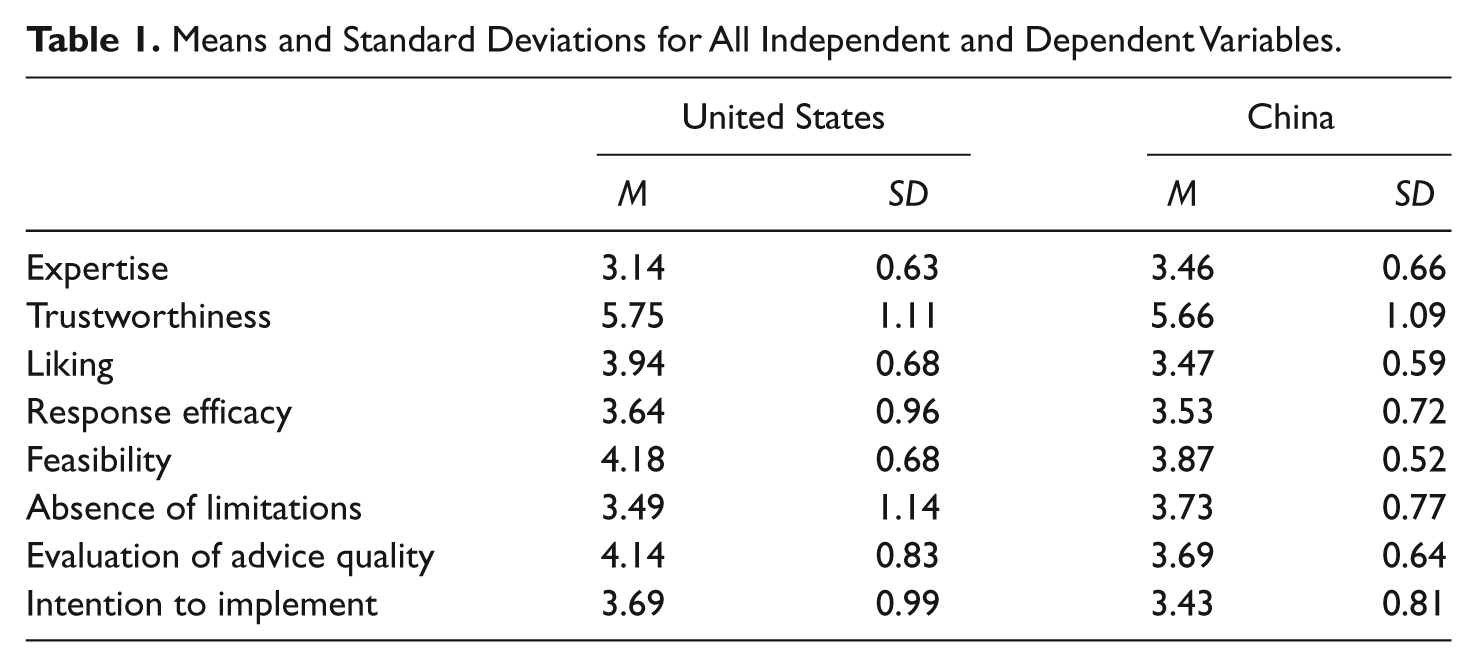
H1 and H2 predicted positive associations between the predictor variables and recipients’ evaluation of advice quality and intention to implement advice. These two hypotheses were examined by computing zero-order correlations between each of the predictor variables and the dependent variables with the American sample and the Chinese sample (see Tables 1 and 2). All the bivariate correlations between the predictor variables and the dependent variables were positive and statistically significant in both samples. Therefore, H1 and H2 were supported.
Means and Standard Deviations for All Independent and Dependent Variables.
Correlations Among Predictor and Dependent Variables in the United States and Chinese Samples.
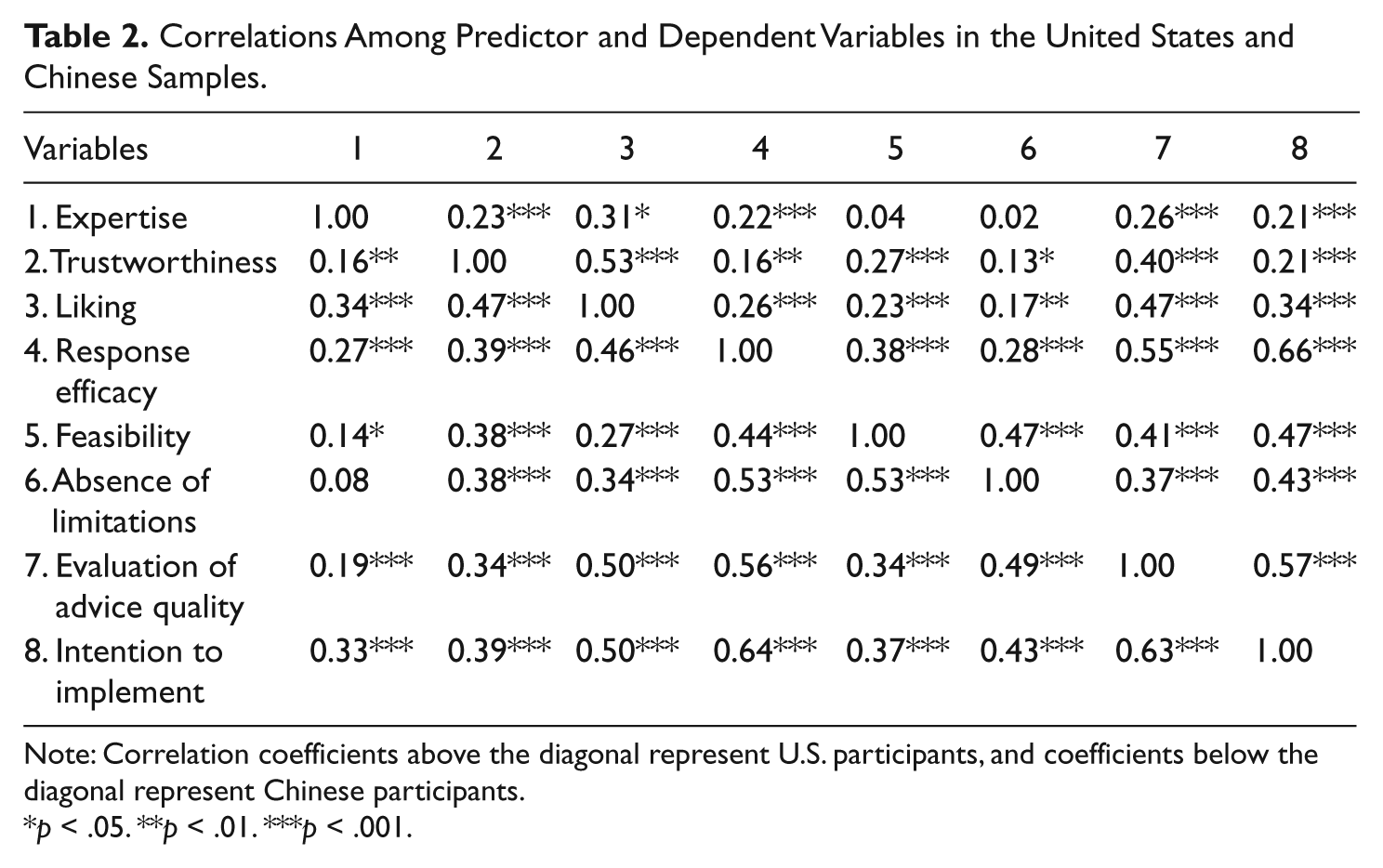
Note: Correlation coefficients above the diagonal represent U.S. participants, and coefficients below the diagonal represent Chinese participants.
p < .05. **p < .01. ***p < .001.
H3 predicted that perceived content features of advice would mediate the effect of perceived source characteristics on recipient’s evaluation of advice quality and intention to implement advice in both American and Chinese samples. Bootstrapping procedures have been advocated as an approach that is well suited for testing hypothesized mediating effects (MacKinnon, Lockwood, & Williams, 2004; Preacher & Hayes, 2008; Shrout & Bolger, 2002). Therefore, bootstrapping procedures developed by Preacher and Hayes (2008) were employed to test this hypothesis. Results of the bootstrapping tests, along with estimates for effect magnitudes using the index proposed by MacKinnon and Dwyer (1993), are summarized in Table 3. The indirect effects for perceived source features on each of the two dependent variables were significant (ps < .05), indicating that perceived content features mediated the effect of perceived source characteristics on advice responses. Therefore, H3 was supported.
Summary of Bootstrapping Tests of the Mediating Effects of Content Features.
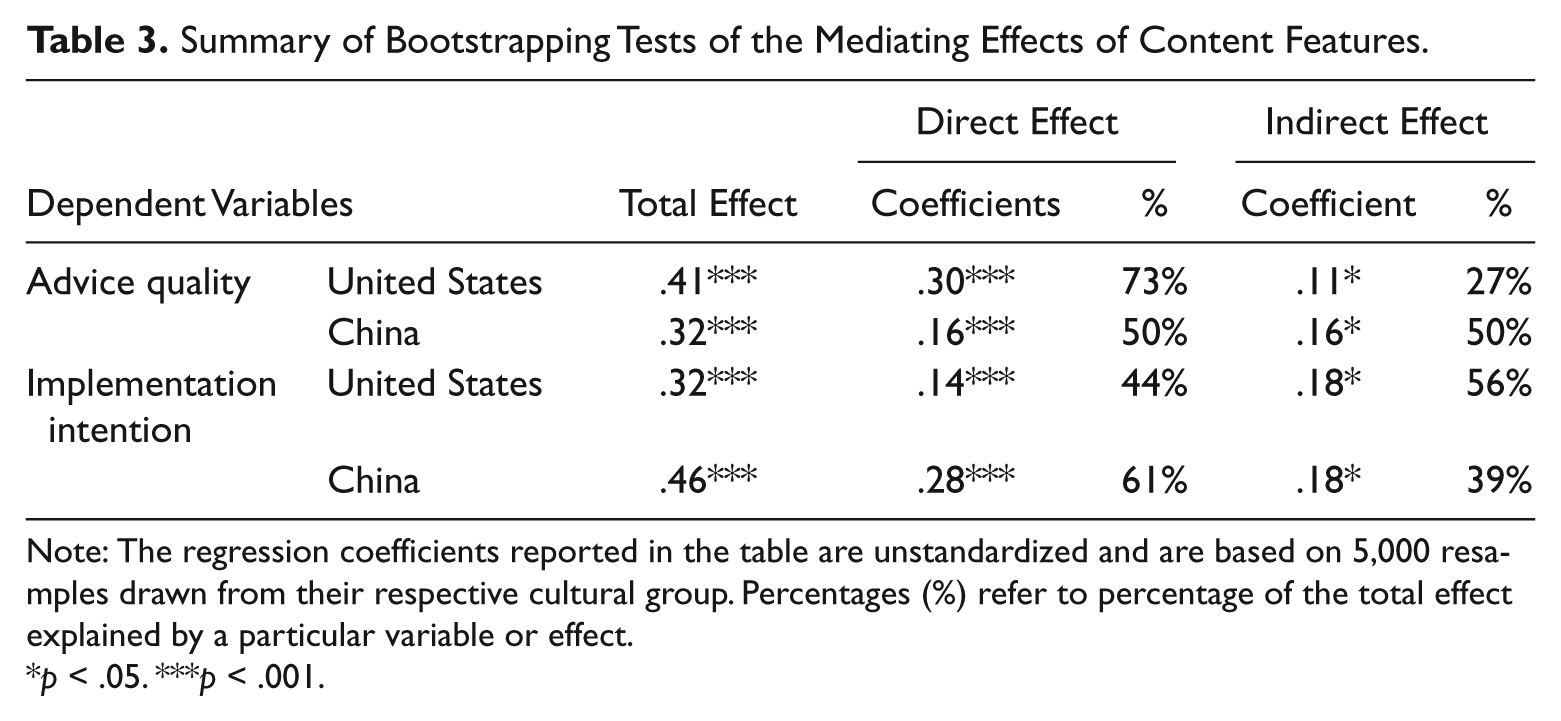
Note: The regression coefficients reported in the table are unstandardized and are based on 5,000 resamples drawn from their respective cultural group. Percentages (%) refer to percentage of the total effect explained by a particular variable or effect.
p < .05. ***p < .001.
SEM analysis was employed to assess the robustness of the overall advice response model in each cultural group. The structural model was constructed based on variable relationships outlined in the advice response theory. Figure 1 and Figure 2 display the structural model for the American sample and Chinese sample, respectively. Fit indices were good for the American sample (χ2 = 38.89, df = 17, CFI = .97, NFI = .95, RMSEA = .07) and were acceptable for the Chinese sample (χ2 = 68.04, df = 17, CFI = .95, NFI = .93, RMSEA = .09), indicating that the integrated model of advice response applies in both cultural groups.
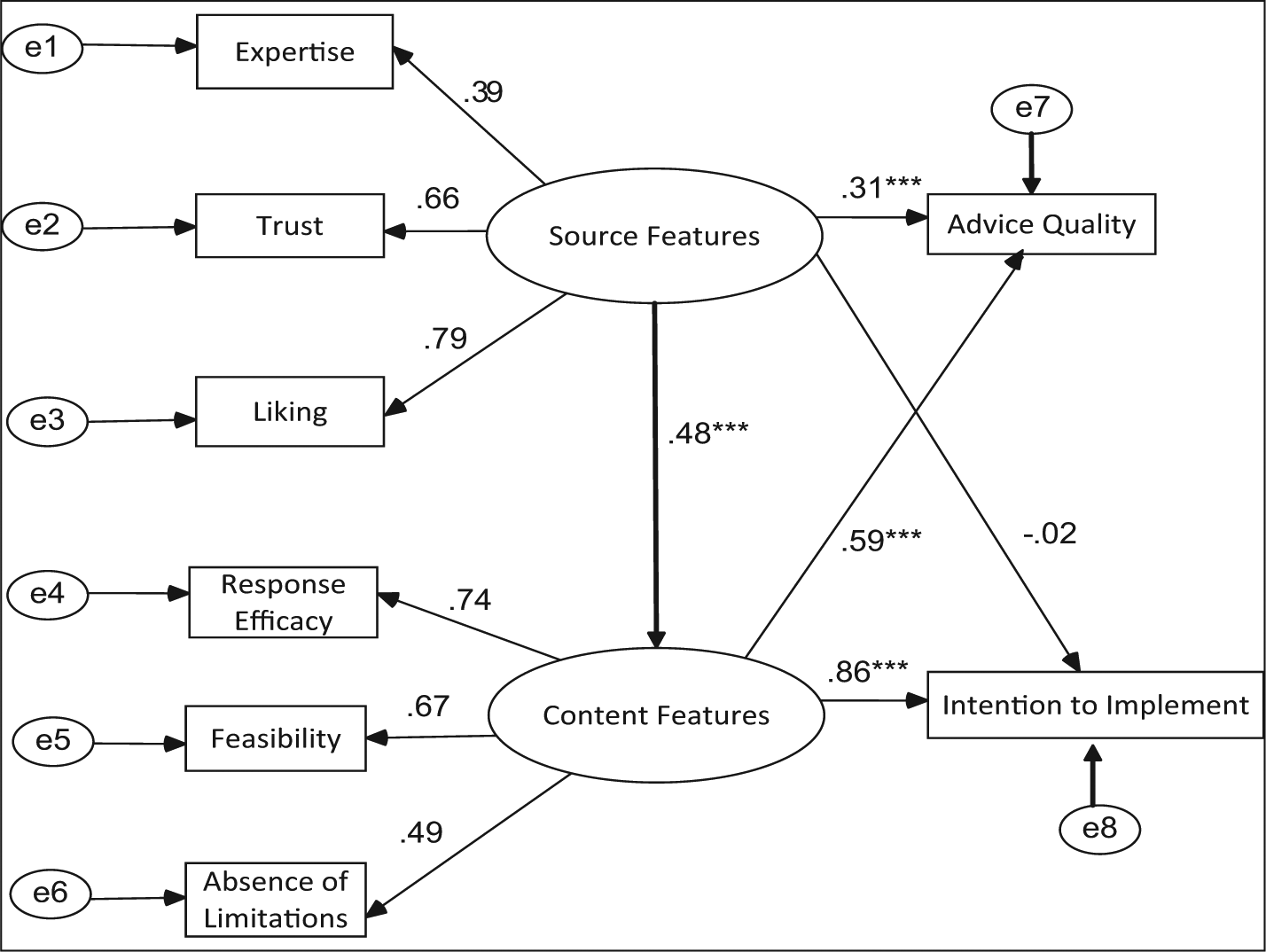
American model.
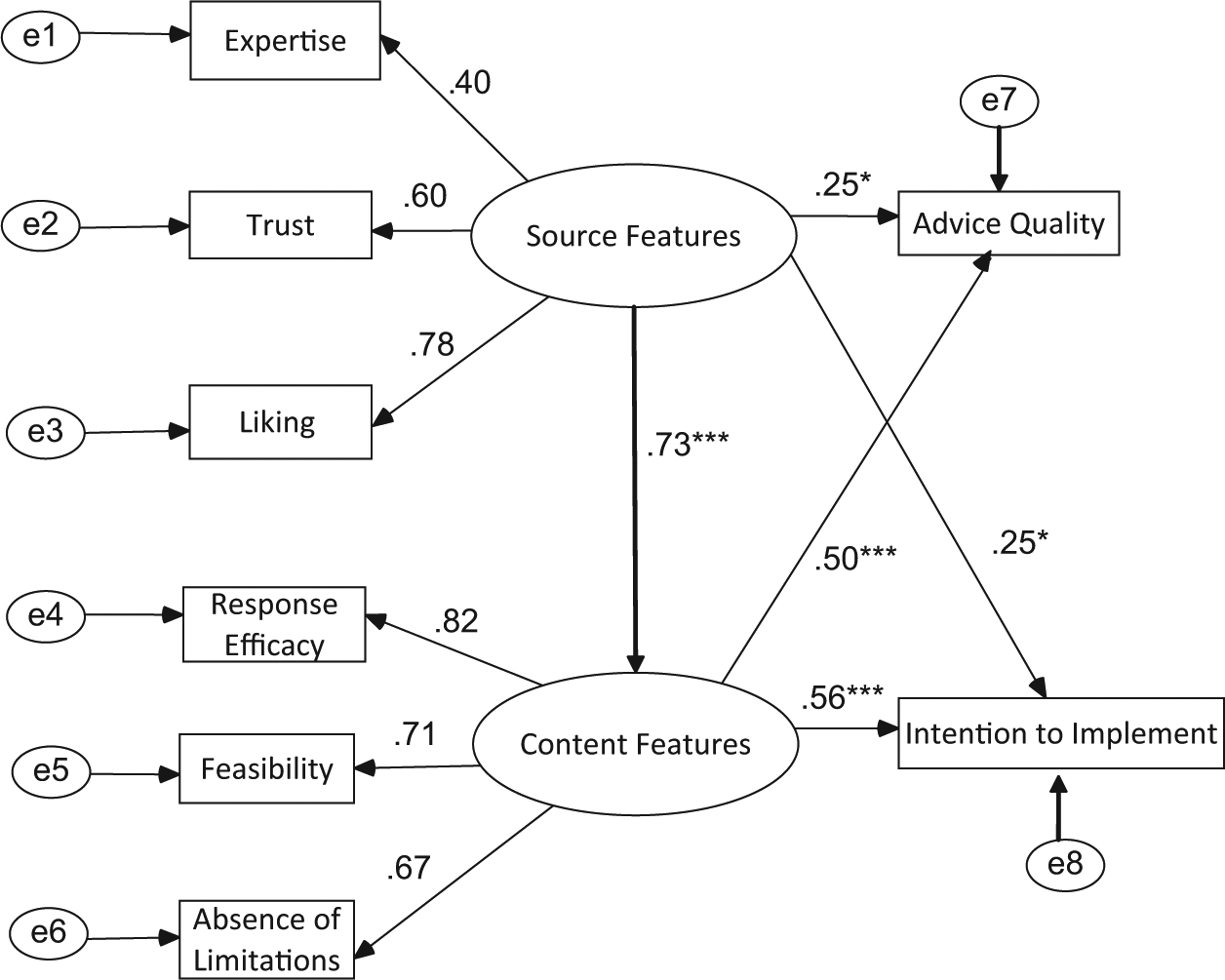
Chinese model.
H4 predicted that perceived content features of advice would have a greater impact on Americans’ evaluation of advice quality and their intention to implement advice than they would for Chinese. H5 predicted that perceived source characteristics of advice would have a stronger impact on Chinese evaluation of advice quality and intention to implement advice than they would for Americans. These hypotheses were each evaluated through MSEM. To find out whether the links between perceived content features of advice and each of the two dependent variables differed across the two cultural groups, equality constraints were placed on the path from perceived content features to advice quality and intention to implement advice, respectively. Multigroup tests produced significant differences in chi-square values for intention to implement advice (Δ2c [1] = 5.93, p < .05), with the American data showing stronger association between perceived content features of advice and intention to implement advice (β = .86, p < .001) than the Chinese data (β = .56, p < .001). However, the two cultural groups did not differ with regard to the association between perceived content features of advice and evaluation of advice quality (Δ2c [1] = 1.10, p = .294). Thus, H4 was partially supported.
Multigroup analyses with constrained models were also performed to asses if the influence of perceived source characteristics of advice on advice response differed across the two cultural groups. The analyses produced significant differences in chi-square values for the link between perceived source characteristics and intention to implement advice (Δ2c [1] = 4.19, p < .05), with the Chinese data revealing stronger direct association between perceived source characteristics and intention to implement advice(β = .25, p < .05) than the American data (β = –.02, ns). However, the two groups were not different in terms of the association between perceived source characteristics and evaluation of advice quality (Δ2c [1] = 1.33, p = .249). Thus, H5 was also partially supported.
H6 predicted that Americans were more individualistic than Chinese, whereas Chinese were more collectivistic than Americans. This hypothesis was assessed with a univariate analysis of variance. The results of the analyses are summarized in Table 4. There were relatively small but statistically significant differences between the American sample and the Chinese sample with respect to independent self-construal (with Americans scoring higher on the variable) and interdependent self-construal (with Chinese scoring higher on this variable). Hence, H6 was supported.
Descriptives for Self-construals and Univariate Tests for Cultural Differences.
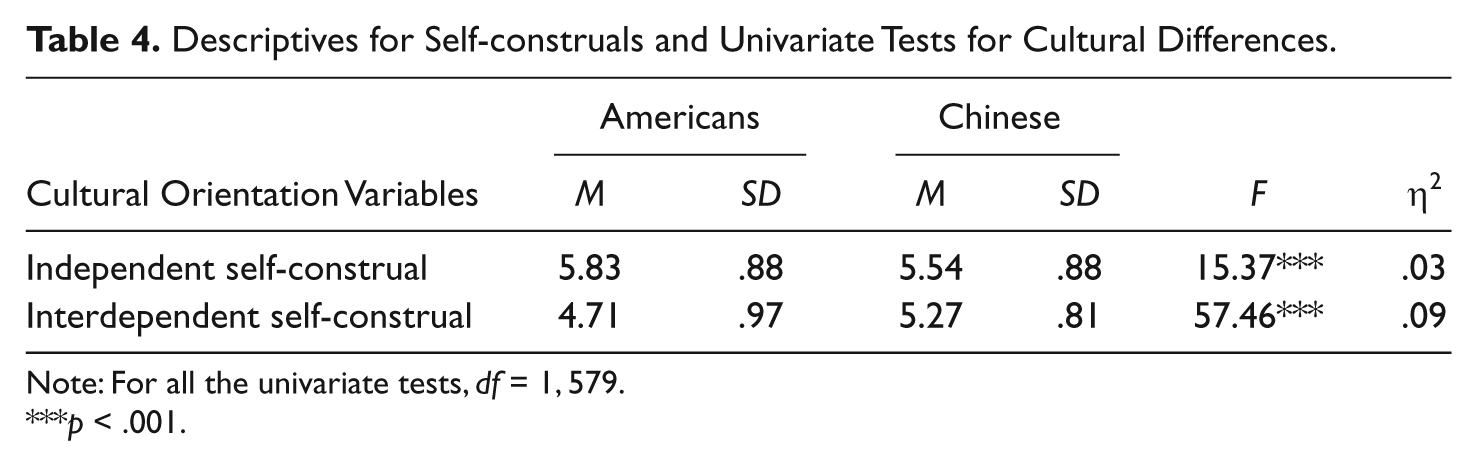
Note: For all the univariate tests, df = 1, 579.
p < .001.
H7 predicted that levels of individualism would moderate the impact of perceived content features on advice responses, and H8 predicted that levels of collectivism would moderate the impact of perceived source characteristics on advice responses. To test these hypotheses, two levels (high vs. low) of individualism and two levels (high vs. low) of collectivism were formed, using median as the cutoff point. MSEM analyses and constrained models were first employed to assess if the links between perceived content features and the two dependent variables differed between the high individualism group and the low individualism group. The multigroup tests did not produce significant differences in chi-square values for either evaluation of advice quality (Δ2c [1] = .11, ns) or intention to implement advice (Δ2c [1] = .83, ns), indicating that levels of individualism did not moderate the associations between perceived content feature and the two dependent variables. Thus, H7was not supported.
MSEM analyses and constrained models were also employed to assess H8. The analyses did not reveal a significant difference in chi-square values for the link between perceived source characteristics and intention to implement advice (Δ2c [1] = .14, ns). However, the difference in chi-square values for the link between perceived source characteristics and advice quality was significant, Δ2c [1] = 6.13, p < .05, with low collectivism showing stronger association between perceived source characteristics and evaluation of advice quality (β = .37, p < .01) than high collectivism(β = .18, p < .01),which was contrary to our prediction. Hence, H8 was not supported.
Discussion
The primary purpose of the current study was to examine how Americans and Chinese are similar and different in their orientation to various factors that may influence individuals’ responses to advice, and to ascertain the extent to which cultural differences, if observed, could be explained by underlying individual differences in individualism-collectivism values. Findings of this study demonstrate that there are substantial similarities and a few significant differences in the ways perceived content and source features of advice influence how Americans and Chinese respond to advice.
Cultural Similarities and Differences in Responses to Advice
Our data revealed substantial cultural similarities between Americans and Chinese in the process through which members of these two cultural groups respond to advice. Specifically, both American and Chinese participants viewed advice that was perceived as efficacious, feasible, and having few limitations more favorably (i.e., reporting higher evaluation of advice quality and stronger intention to implement advice) than advice that was perceived as less efficacious, less feasible, or having more limitations. American and Chinese participants also responded more positively to advice that came from someone who was perceived as an expert, trustworthy, and likable. The latter finding demonstrates that, as a communication behavior, advice giving and receiving is not only a rhetorical and persuasive process, but also a relational process. Also, in both samples, perceived content features of advice exerted a much stronger impact on responses to advice, especially intention to implement advice, than perceived source characteristics of advice. Furthermore, perceived source characteristics of advice influenced American and Chinese participants’ responses to advice through their association with perceived content features of advice. Overall, these findings combine to suggest that there is a high degree of universality with regard to the way individuals from various cultures process advice.
Against the broad baseline of cultural similarities in orientation to perceptions of content and source features of advice, the present study found that the American and Chinese samples differed significantly with regard to the extent to which they were influenced by the two groups of predictors. Compared to the Chinese participants, the American participants relied more heavily on perceived content features of advice in their decision making about whether to follow the advice. In addition, while perceptions of advice giver’s expertise, trustworthiness, and likability had no direct impact on American participants’ intention to implement advice, those factors had a direct, albeit relatively small in magnitude, impact on Chinese participants’ intention to implement advice. These findings are consistent with the theoretical prediction that, in the process of responding to advice, people from individualistic cultures rely more heavily on perceptions of advice content, whereas people from collectivistic cultures are more oriented toward contextual and relational cues.
As many scholars have recognized, one major challenge to cross-cultural research is to empirically assess theoretical links between psychological processes, cultural differences, and behavior, in order to unpack a culture’s influence on behavior (Levine et al., 2003; Mortenson et al., 2006; Singelis, Bond, Sharkey, & Lai, 1999). The current study also experienced this challenge. Although we identified and articulated the theoretical linkage between the broad cultural dimension of individualism-collectivism and possible cultural differences in responses to advice, our data did not generate empirical evidence to support the linkage.
There are several possible explanations for the current study’s failure to detect a significant moderating role of individualism-collectivism on the relationships between the predictors and advice responses. One possibility was that individual differences in individualism-collectivism (i.e., independent and interdependent self-construals) were too small to explain the observed cultural differences in the effects of perceived content and source features on intention to follow advice. Although the American participants exhibited a higher independent self-construal and a lower interdependent self-construal than did their Chinese counterparts, the differences were very small in magnitude. Furthermore, participants in both samples exhibited relatively high levels of independent self-construal. However, these findings might be taken as an indication that the measurement of self-construals employed in the current study failed to capture real existing differences between Americans and Chinese in their self-construals. This is certainly a possibility that cannot be easily dismissed.
However, given that the self-construal scales employed in the current study did appear to have good face validity, exhibited clean structure that was consistent with theorization of cultural differences in self-construals, and were internally coherent, modifying items in the scales might not be the solution to enhancing validity of the scales. Some scholars have argued that commonly used rating methods of value surveys, such as the ones employed in the current study, may have low validity in cross-cultural value comparisons, because participants’ reports about values can be affected by factors such as cultural differences in the meaning of particular value terms as well as the possibility that some value judgments are based on social comparison rather than on direct reading of personal preferences (Peng, Nisbett, & Wong, 1997). Therefore, future research should explore alternative instruments, such as behavioral scenario methods (Peng et al., 1997), for assessing values across cultures so that measures of higher validity can be identified and used to more accurately capture real existing cultural differences in values.
There was an alternative, and perhaps more obvious, explanation for the current study’s failure to detect evidence that self-construals could explain observed cultural differences in orientation toward perceptions of advice content features or source characteristics. That is, factors other than self-construals contributed to the difference between the American and Chinese participants in the extent to which their decision making regarding the received advice was influenced by perceived features of advice content and characteristics of the advice giver. At this point, though, it is unclear what those factors might be. It is possible, as some scholars have suggested, that the processes through which individuals engage in seeking, providing, and responding to social support are influenced to a greater degree by more context-specific cultural norms than general cultural orientations (Dilworth-Anderson & Marshall, 1996). This is a possibility that is worthy of further investigation.
Limitations and Future Directions
Although this study was designed to address a significant limitation (i.e., the past research’s heavy reliance on the use of predominantly European American samples) in previous scholarship, it also has a noteworthy limitation with its samples that suggest directions for further investigation. Despite its use of participants from different cultural groups, this study still used, as most past research did, young college students as participants. Older samples would likely differ in some important ways from younger samples. For instance, past research indicates that older people are more collectivistic and less individualistic than younger generations (Freeman, 1997; Hui & Yee, 1994; Mishra, 1994; Parkes, Bochner, & Schneider, 2001). Therefore, it is an empirical question as to whether these differences in value orientations, or other maturity-related factors, would in turn affect the relative impact of message and source features of advice on advice evaluations. Although this limitation should not affect the validity of findings from the current study because this study used samples that were largely equivalent (i.e., we compared an American college student sample with a Chinese college student sample rather than an old American sample with a young Chinese sample or vice versa), it may affect the generalizability of some of our findings to older or less educated populations in both cultures. For example, it is possible that the impact of perceived advice content features on older Americans and Chinese’ responses to advice may be weaker than it is for young Americans and Chinese; likewise, the impact of perceived source characteristics on older Americans and Chinese’ responses to advice may be stronger than it is for young Americans and Chinese. Therefore, future research can build on the current study by examining the same research questions and hypotheses with older and/or less educated samples of participants from both cultures.
Compared to past advice research that utilized researcher-constructed advice in hypothetical scenarios (e.g., Feng & Burleson, 2008; Goldsmith & MacGeorge, 2000), the current study’s focus on naturally occurring advice episodes that involve a variety of topics and relationship types has its unique strengths, especially in terms of its ecological validity and generalizability of findings. However, this study’s cross-sectional, retrospective self-report design has its limitations as well. In particular, participants’ recall of the advice episode (albeit a recent one) might lack precision and may be affected by what transpired after the recalled episode. This possibility raises concern about the ability of our data to empirically and definitively demonstrate the causal links between perceived content features, source characteristics, and advice responses. Future research should expand our work by employing other research designs (e.g., laboratory, experimental).
Pragmatic Implications
Given the ubiquity of intercultural communication in various domains of social life, our findings of cultural similarities and differences in responses to advice hold several important pragmatic implications for advice giving in intercultural context. To the extent that, across cultures, perceptions of advice content features are a proximal influence on recipient evaluation of advice quality and intention to implement advice, giving advice in intercultural context should focus on recommending a course of action that is likely to be effective at solving or improving the recipient’s problematic situation, that the recipient will be able to accomplish, and that has few limitations or drawbacks (MacGeorge et al., 2008). Meanwhile, given that people from some cultures (e.g., Chinese) tend to be more sensitive to qualities of an advice giver, giving advice to members of those cultures may require some extra consideration. For example, it may be strategically effective to preface advice with verbal and/or nonverbal messages that will likely enhance the recipient’s perceptions of the advice giver (e.g., sharing with the recipient knowledge or past experience in the area under discussion to elicit perceptions of expertise).
Conclusion
Advice is a common component of supportive communication across cultures; yet, little research has examined whether there are cultural differences (and similarities) in how people give and respond to advice. The current study filled this gap by presenting the first cross-cultural examination of an integrated model of advice response, as well as an empirical assessment of potential underlying psychological processes that may unpack culture’s influence on responses to advice. Results revealed that, when evaluating the quality or their intention to implement a piece of advice, American and Chinese college students are largely similar with a few differences in their orientation toward perceived content features of advice and characteristics of advice giver. This study, along with a growing body of recent research, suggests that only by taking into account both cultural similarities and differences can researchers adequately address the influence of culture on communication (Mortenson et al., 2006).
Footnotes
Declaration of Conflicting Interests
The authors declared no potential conflicts of interest with respect to the research, authorship, and/or publication of this article.
Funding
The authors received no financial support for the research, authorship, and/or publication of this article.