



Abstract
By its very nature, relationship commitment is generated in the context of a relationship and becomes relational when it is communicated in some way to the other. This study investigated how expressions of commitment and commitment-related perceptions are interdependently connected among romantic partners. The authors derived and tested a dyadic cyclical model of the everyday expressions of commitment with a sample of 189 romantically involved couples. Results revealed that individual’s level of commitment are associated with her or his own expressions of commitment, those expressions of commitment are noticed by the partners, and the partner’s level of commitment is associated with those perceptions of the other’s expressions of commitment. The research sheds light on the complex ways intimate couples experience and express commitment in their everyday lives.
When romantically involved couples are asked the secret to their success, they often point to their commitment to each other (Clements & Swensen, 2003; Robinson & Blanton, 1993). Commitment is what sustains them through the ups and downs and the good times and the bad times. In fact, commitment helps explain why one relationship ends and another does not (Adams & Jones, 1999). Those individuals with stronger commitment tend to experience higher relationship quality, have greater relational adjustment, and be in more stable relationships (Rusbult, Martz, & Agnew, 1998). Commitment also is a hallmark of long-term, enduring relationships (Clements & Swensen, 2003) and high levels of commitment predict relationship stability over 5-year (Sprecher, 2001), 7-year (Kurdek, 2000), and 15-year time periods (Bui, Peplau, & Hill, 1996).
When asked how they sustain that commitment, couples often point to the everyday things they do to express and reinforce their commitment to each other (Weigel, 2008; Weigel & Ballard-Reisch, 2002). They mention using a variety of behaviors—direct and indirect—to communicate their commitment to their partners, such as telling each other how they feel, providing affection and support, remaining faithful, and working together on relationship problems (e.g., Knapp & Taylor, 1994; Marston, Hecht, Manke, McDaniel, & Reeder, 1998; Weigel, 2008). In this way, the day-to-day manifestations of commitment in ongoing romantic relationships can be found in the everyday behaviors partners use to communicate their commitment to each other.
By its very nature, however, relationship commitment is generated in the context of a relationship and becomes relational when it is conveyed in some way to the other (Knapp & Taylor, 1994). As partners grow increasingly interdependent, they not only develop perceptions of their own commitment but also develop perceptions of their partner’s commitment (Drigotas, Rusbult, & Verette, 1999; Weigel, 2010). Yet we know very little about the nature of this interdependence. For instance, to what degree are partners aware of each other’s expressions of commitment? Is this awareness associated in some way with their feelings of commitment? In what way is the expression of commitment connected with the partner’s level and expressions of commitment? It is important for researchers to move beyond the individual to study the interdependent nature of the expression of commitment in romantic relationships to generate a much more powerful and robust picture of how couples construct and sustain commitment.
The present research has three primary objectives. First, based on an interdependence framework, we investigate a dyadic, cyclical model of the everyday expressions of commitment. Specifically, we examine how the commitment-related perceptions and expressions of one partner are interdependently connected with the perceptions and expressions of the other. Second, we test predictions from the cyclical model in a sample of romantically involved couples. Third, we discuss how the findings shed light on the various ways in which commitment is expressed and experienced in the everyday lives of intimate couples.
Our study is useful for several reasons. First, it advances our understanding of the communication of commitment in romantic relationships. Although a tremendous amount of research has been conducted on relationship commitment over the past two decades, surprisingly little of it has looked at the role everyday expressions of commitment plays in creating and sustaining perceptions of commitment. Second, the study confirms the various ways partners communicate their commitment to each other. It is through communication, both direct and indirect, by which couples construct their realities of commitment, and it is through these displays of commitment, or lack of displays, that partners’ ongoing commitment is sustained or changed (Weigel, 2008). Third, it expands our understanding of the nature of interdependence in the communication of commitment. Rather than viewing the communication of commitment in isolation, this article investigates the complex and intricate ways the perceptions and behaviors of one partner are comingled with the perceptions and behaviors of the other. Such an investigation should yield a more nuanced and complete picture of how couples construct commitment through their everyday relating.
Interdependence Theory and Commitment
Our study is guided by the logic of interdependence theory (Kelley & Thibaut, 1978; Rusbult & Arriaga, 1997; Thibaut & Kelley, 1959). Interdependence theory was developed to create a better understanding of the nature of behaviors, feelings, and interactions in social relationships. The theory emerged out of an exchange perspective and is based on the notion that people act to maximize rewards and minimize costs. When rewards outweigh costs, individuals tend to be more satisfied with their relationships and more willing to remain in them; when costs outweigh rewards, individuals tend to be less satisfied with their relationships and more willing to leave them. However, satisfaction is not enough to produce a stable, committed relationship. Thibaut and Kelley also stressed the importance of dependence. Dependence can be seen as the degree to which a person relies on a partner and relationship for fulfilling important needs when those needs cannot be met elsewhere. In fact, commitment is the subjective experience of this growing dependence (Rusbult & Arriaga, 1997).
It is important to emphasize, however, that interdependence theory goes beyond characterizing relationships as a simple tallying of pros and cons. More important to the study of communication, interdependence theory focuses on the interaction between partners as the essence of close relationships (Kelley & Thibaut, 1978; Thibaut & Kelley, 1959). Interaction yields outcomes for partners in the form of rewards, costs, dependence, and commitment. In this way, commitment becomes a dynamic process in which couples continually construct their relationships through their everyday communication (Ballard-Reisch & Weigel, 1999). Furthermore, interdependence theory makes the argument that to truly understand behavior and feelings in relationships requires knowledge of the nature of interdependence between partners (Rusbult & Arriaga, 1997). The existence of interdependence implies that partners “influence one another’s experiences and need each other to obtain valued relationship outcomes” (Rusbult & Buunk, 1993, pp. 178-179). These two tenets of interdependence theory—the centrality of dyadic interaction and the interdependent nature of close relationships—are especially germane to the present study.
Expanding interdependence theory, Rusbult and her colleagues (e.g., Rusbult, 1983; Rusbult & Buunk, 1993; Rusbult, Wieselquist, Foster, & Witcher, 1999) developed the investment model of commitment. In the investment model, commitment is seen as a product of people’s satisfaction with the relationship, the availability of relationship alternatives, and the degree of investment they have in the relationship. As with interdependence theory, in the investment model satisfaction emerges out of a comparison of the perceived costs and rewards in the relationship; a person feels satisfied with a relationship to the extent that it provides higher rewards than costs. Relationship alternatives might include another relationship, spending time with friends or in leisure activities, or even solitude. People compare these alternatives to the current relationship and when such alternatives are seen more favorably, a person is more likely to leave the relationship. Investments include elements such as the time, emotion, and shared material possessions linked to the relationship. The more investments a person has in a relationship, the more difficult it is to leave it. Thus, persons who are more highly committed to a relationship are satisfied with the relationship, see few appealing alternatives, and are heavily invested in the relationship. In addition, people develop increasingly stronger commitment (i.e., intentions to persist in the relationship, having a long-term orientation, and feeling attached to the person and relationship) as they become more interdependent (Rusbult & Arriaga, 1997).
Although the investment model has not explicitly included communication, one can see a role for it. In terms of communication, because committed individuals are typically highly invested in their relationships (Rusbult, 1983), they should engage in behaviors to ensure that their partners are aware of their commitment so as not to incur the costs of losing that investment by having the relationship end. In fact, Rusbult and colleagues (Rusbult, Olsen, Davis, & Hannon, 2001) maintained that commitment fosters the use of specific strategies in times of relationship stress—what they called interdependence dilemmas. Those researchers identified six pro-relationship strategies that people use when confronted with such relationship dilemmas: (a) tendencies to accommodate to the partner, (b) willingness to sacrifice one’s self-interest for the good of the relationship, (c) ability to forgive betrayal, (d) shifting from an individual to collective orientation, (e) creating positive illusions about one’s relationship in comparison with the relationships of others, and (f) devaluing potential alternative partners and situations. Hence, in times of relationship stress, people with higher commitment tend to engage in specific behaviors to safeguard the relationship.
Everyday Expressions of Commitment
Although much can be learned about commitment in times of relationship stress, Duck argued that the true reality and meaning of relationships is constructed and sustained through everyday relating. In fact, it is “the everyday interactions and conversations that make the relationship what it is” (Duck, 1994, p. 46). In this way, the essence of relationships emerges and is sustained through the everyday relating of partners (Masuda & Duck, 2002). For most couples, the vast amount of relationship time is spent in mundane, everyday interaction—sometimes strategic, more often routine. For instance, Dainton (1998) had couples complete interaction logs over a 7-day period and found that they spent most of their time in conversations around activities such as eating dinner, watching TV, or catching up on the day’s events. Hence, to truly understand how intimate relationships function, Duck contended that greater attention needs to be given to understanding the everyday relating and interaction of couples.
In terms of commitment, the everyday expression of commitment can be seen as the things people regularly say or do to reveal their level of commitment to their partners (Weigel & Ballard-Reisch, 2002). These everyday expressions of commitment can occur in direct conversations around topics such as anticipated future rewards, family and friends, affection and caring, sacrifice, and desirability of alternatives (O’Riordan, 2007). However, rather than through direct conversations about commitment, Knapp and Taylor (1994) found that most communication of commitment occurred indirectly through the things people did and said that conveyed their levels of commitment. In other words, commitment was implied through the routine, everyday interaction of couples. For example, a husband in a study by Weigel (2003) indicated that he expressed his commitment to his wife by making her feel important (i.e., “Treating her like a queen”), giving her respect, asking how her day went, and getting her a glass of milk before bed. His wife reported that she indicated her commitment by regularly leaving her husband notes and messages, showing affection with hugs and holding hands, and starting each day with a goodbye kiss as they go their separate ways to work. Thus, even though there is no direct interaction regarding commitment, it is implied by the nature of the behavior in the context of the relationship.
In this vein, Weigel (2008) identified six general types of indicators that people report using to convey their commitment to their partners. These indicators include reassuring partner of feelings, which involves stating one’s feelings about the partner, asserting one’s commitment, and showing feelings. Being supportive includes behaviors related to listening to partners, encouraging them, treating them with common courtesy, helping them feel better about themselves, and paying attention to their partner’s needs and interests. Offering tangible reminders refers to behaviors such as giving gifts, leaving notes, and doing little things to help partners. Creating a relationship future includes making plans together with the future of the relationship in mind, celebrating relationship milestones and anniversaries, and spending time together. Working on the relationship involves behaviors such as letting a partner know of one’s willingness to work out problems, talking out problems, and working hard to communicate every day. Finally, behaving with integrity captures behaviors such as being honest with one’s partner, keeping promises, and remaining faithful to the relationship. Although these indicators do not always directly deal with commitment, they communicate an underlying message of commitment and partners often interpret the level of commitment from such indicators (Weigel & Ballard-Reisch, 2002).
Although the commitment indictors identified by Weigel (2008) were generated within the context of expressing commitment, they share some similarity with Canary and Stafford’s (1992) relationship maintenance strategies. Behaviors such as offering relational assurances, talking about and working on the relationship, and showing oneself to be faithful should not only express commitment but also act as overall relational maintenance behaviors. As such, both commitment indicators and relationship maintenance strategies are necessary to sustain healthy, committed relationships.
Interdependence and the Everyday Expressions of Commitment
So far, our focus has been on describing everyday behaviors that partners can use to communicate their commitment to one another. Yet to create a more accurate picture of commitment in relationships, it is important to elaborate on the interdependent nature of the expression of commitment in romantic relationships. Although commitment is felt individually, it is also a relational phenomenon (Knapp & Taylor, 1994). Because everyday expressions of commitment occur in the context of a relationship, it is important to identify the connections among behaviors and perceptions of both partners. Merely verifying that people use a variety of everyday behaviors to express their commitment to their partners does not tell us much about the role such behaviors play in romantic relationships. What matters more is how partners’ commitment-related behaviors and perceptions are interrelated.
Interdependence theory provides a framework for understanding the presence of interdependence in close relationships (Kelley, 1979; Kelley & Thibaut, 1978). Interdependence theory focuses on the interrelationships among partners, and the existence of interdependence implies that partners in a close relationship perceive and influence one another’s perceptions and behaviors. In other words, the perceptions and behaviors of one partner are not independent of the partner; rather they are associated with the perceptions and behaviors of the other (Kelley & Thibaut, 1978). Interdependence is revealed in the variety of activities individuals do together, the amount of time they spend together, the degree to which their future plans and goals are intertwined, and how much they rely on one another for love and support (Rusbult & Arriaga, 1997).
Wieselquist, Rusbult, Foster, and Agnew (1999) proposed a dyadic cyclical model to represent the interdependence of commitment-related perceptions and behavior within close relationships. Their mutual cyclical model involved a sequence of steps linking partners’ perceptions and behavior. These steps included (a) Partner A’s commitment, which motivates Partner A’s pro-relationship behavior; (b) Partner B’s observation of Partner A’s pro-relationship behavior, which increases Partner B’s level of commitment; (c) Partner B’s commitment, which motivates Partner B’s pro-relationship behavior; and (d) Partner A’s observation of Partner B’s pro-relationship behavior, which increases Partner A’s commitment. Wieselquist et al. focused on two of the relationship strategies identified by Rusbult et al. (2001) as salient in times of relationship stress—the tendency to accommodate rather than retaliate when a partner behaves poorly and a willingness to sacrifice. In testing their model, Wieselquist et al. indeed found that commitment promoted the use of accommodation and willingness to sacrifice, accommodation and willingness to sacrifice were perceived by the partner, and the perception of those behaviors eventually related to higher levels of heightened commitment. Thus, their cyclical model appears to hold promise as an approach for documenting relationship interdependence.
In the present research we expanded upon Wieselquist et al.’s (1999) work by testing a mutual cyclical model in the use of everyday expressions of commitment. Specifically, we tested the connections between partners’ perceptions of commitment, self-expressions of commitment, and perceptions of partner’s expressions of commitment. Figure 1 presents a schematic representation of the model. We focused on the six everyday expressions of commitment identified by Weigel (2008): reassuring partner of feelings, offering tangible reminders, being supportive, creating a relationship future, behaving with integrity, and regularly working on the relationship. Specifically, we expected that
Hypothesis 1 (H1): Partner A’s commitment motivates her or his expressions of commitment.
Hypothesis 2 (H2): Partner B perceives Partner A’s expressions of commitment.
Hypothesis 3 (H3): Partner B’s observation of Partner A’s expressions of commitment relates to Partner B’s level of commitment.
Hypothesis 4 (H4): Partner B’s commitment motivates her or his expressions of commitment.
Hypothesis 5 (H5): Partner A perceives Partner B’s expressions of commitment.
Hypothesis 6 (H6): Partner A’s observation of Partner B’s expressions of commitment relates to Partner A’s commitment.

Everyday expression of commitment within a mutual cyclical model.
Such an investigation is important because Wieselquist et al. (1999) tested their model in the context of relationship dilemmas; however, it is unknown whether such a process also occurs in the day-to-day relating and communication of commitment. Furthermore, rather than viewing the communication of commitment in isolation, this article investigates the various avenues through which the perceptions and behaviors of partners are intertwined. As such, the investigation should yield a more nuanced and complete picture of how couples interdependently construct their commitment through their everyday expressions of commitment.
Method
Sample
The sample consisted of 189 heterosexual romantically involved couples. Couples were recruited by students enrolled in a graduate-level quantitative research methods class at a Midwestern university. As part of a class project, students solicited dating or married couples to complete a questionnaire. Students were instructed that couples should consider themselves to have been in a committed romantic relationship for at least 1 month. Questionnaires were distributed to students in sealed packets; students invited couples to complete the packets that included separate envelopes of questionnaires for women and men. Directions instructed partners to sign informed consent forms and complete their questionnaires separately, and questionnaires were returned to the researchers in sealed envelopes. Surveys were distributed to 220 couples; usable surveys were returned by 189 couples (85.9%). The study was approved and conducted in accordance with the Human Subjects Institutional Review Board.
The average age of female participants was 35 (ranging from 18 to 86) and 37 for men (also ranging from 18 to 86). The majority of respondents were married (60.3%), followed by dating exclusively but not cohabitating (18.0%), cohabitating (13.2%), engaged (6.3%), and dating casually (1.6%). Couples had been together for a mean of 9.1 years. Only 4.2% of the participants had not completed high school, while 12.4% had completed high school only, 43.7% had some college, and 39.7% had a 4-year college degree or higher. Most of the participants were Caucasian (85.7%), while 4.8% were Asian, 3.2% were African American, 3.2% were Hispanic, and 1.6% chose multiethnic/multiracial to indicate their ethnic background.
Measures
In addition to demographic information, the questionnaire included measures of everyday indicators of commitment and perceptions of relationship commitment. Table 1 presents the means, standard deviations, and reliability coefficients for the measures.
Correlations, Mean, Standard Deviations, and Alphas of Women’s and Men’s Types of Indicators of Commitment.
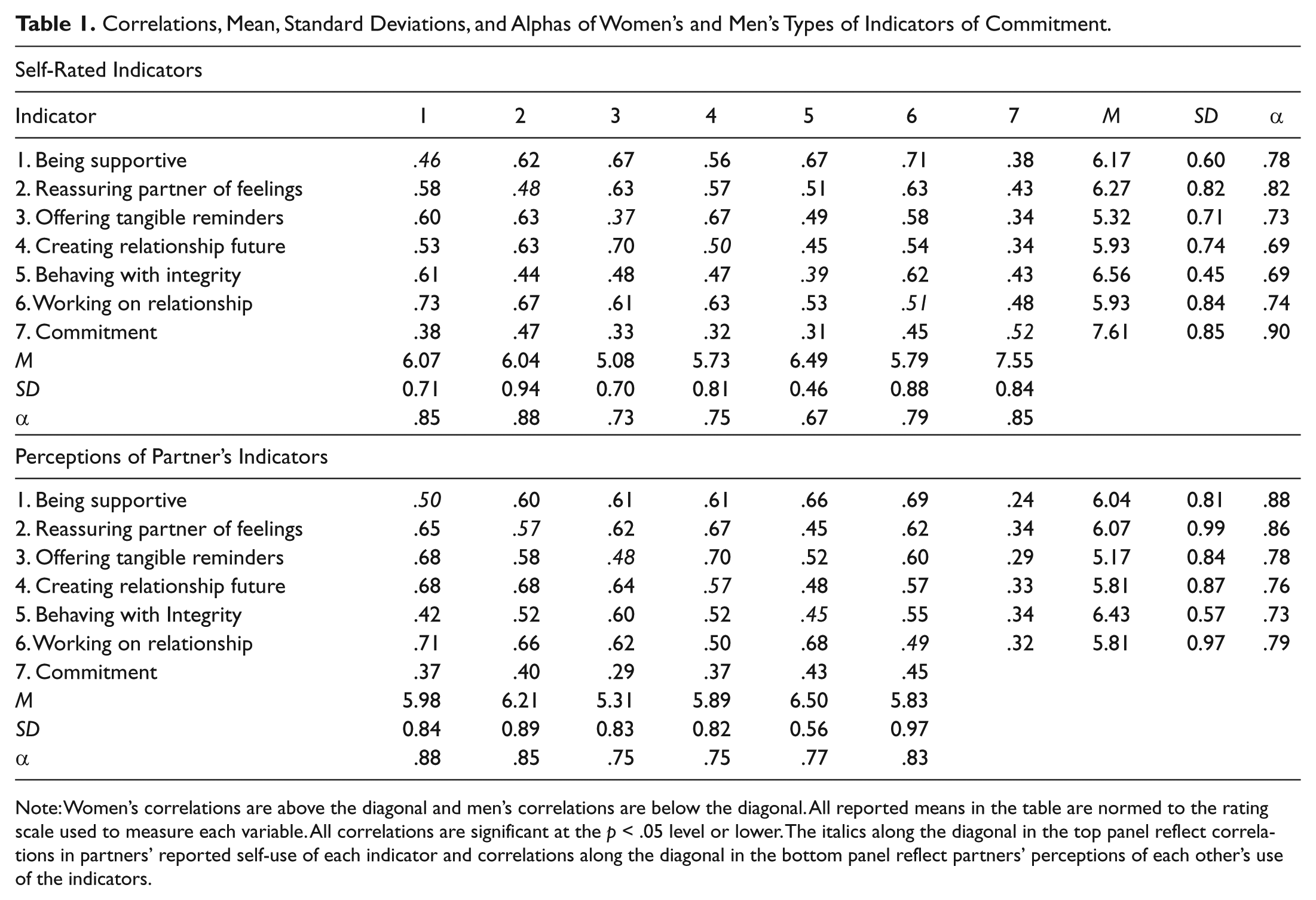
Note: Women’s correlations are above the diagonal and men’s correlations are below the diagonal. All reported means in the table are normed to the rating scale used to measure each variable. All correlations are significant at the p < .05 level or lower. The italics along the diagonal in the top panel reflect correlations in partners’ reported self-use of each indicator and correlations along the diagonal in the bottom panel reflect partners’ perceptions of each other’s use of the indicators.
Indicators of commitment
The everyday expressions of commitment were measured by the Indicators of Commitment Measure (Weigel, 2008). This 29-item measure taps six general classes of everyday expressions of commitment: reassuring partner of feelings (e.g., “Tell my partner how I feel about him/her,” six items), offering tangible reminders (e.g., “Give my partner gifts and surprises,” six items), being supportive (e.g., “Treat my partner with common courtesy,” six items), creating a relationship future (e.g., “Plan day-to-day activities around our relationship,” four items), behaving with integrity (e.g., “Keep my promises to my partner,” four items), and regularly working on the relationship (e.g., “Let my partner know I am willing to work out problems,” four items). Participants rated each item on a scale from 1 = never to 6 = always to indicate how often they did each behavior to communicate commitment to their partner. Participants completed the measure first for how strongly they believed they used the indicators and again for how strongly they believed their partners used the indicators. 1
Relationship commitment level
Rusbult et al.’s (1998) Commitment Scale was used to assess participants’ global level of commitment (i.e., their intent to persist in their relationship for the long term). This 7-item scale included questions such as, “I want our relationship to last forever” and “I am oriented toward the long-term future of my relationship (for example, I imagine being with my partner several years from now).” Participants responded to these questions on a Likert-type scale with response options ranging from 1 (do not agree at all) to 8 (agree completely). Scores were summed across all seven items, with higher scores indicating higher levels of commitment. 2
It is important to note that Rusbult et al.’s (1998) scale is a measure of global commitment. However, partners remain committed to their relationships for a variety of reasons, including personal (e.g., attraction to partner, wanting to stay in the relationship), moral (e.g., feelings of obligation), and structural (e.g., few alternatives, greater investments, social pressure) reasons (Johnson, Caughlin, & Huston, 1999). However, to make our initial test of the dyadic cyclical model more manageable, we chose to focus on global commitment in the present study because of the sheer volume and complexity of testing the various models using additional measures of personal, moral, and structural reasons for commitment.
Results
Preliminary Analyses
Before exploring the proposed model, simple differences between women and men in the reported frequency of use of the six indicators of commitment were examined using a repeated measures MANOVA (Multivariate Analysis of Variance) with sex as the within-subjects variable and the six commitment indicators as the dependent variables. Results revealed an overall main effect for sex, Wilks’ λ = .90, F(6, 179) = 3.23, p < .01, η2 = .10. Univariate differences emerged with women reporting reassuring their partners, offering tangible reminders, creating relationship future, behaving with integrity, and regularly working on the relationship more frequently than did men (see Table 1). A similar repeated-measures MANOVA with perceptions of partner’s use of the six commitment indicators as the dependent variables revealed that men tended to see their partners using reassurances and tangible reminders more often than did women, Wilks’ λ = .91, F(6, 179) = 2.84, p < .05, η2 = .09.
We also examined differences in reported levels of commitment between women and men, but no significant gender differences emerged. In addition, no significant differences were found for relationship status on reported level of commitment, as well as self or partner use of the commitment indicators.
Next, we examined the correlations among participants’ reported use of the commitment indicators (Table 1). Correlations for women are reported above the diagonal, and correlations for men are reported below the diagonal. Significant correlations were obtained within all six women’s self-reported indicators as well as within all six men’s indicators. This finding suggests that when both women and men reported a higher use of one indicator, they reported similar high use of the other five indicators. The same was true for perceptions of partner’s use; when respondents reported that their partners used one type of indicator more often, they tended to report that their partners used the other indicators often as well. Furthermore, women’s and men’s levels of commitment were positively correlated with their respective reported self-use of the indicators, so that the greater their commitment, the more likely they were to report using the commitment indicators. Likewise, women’s and men’s perceptions of their partner’s use of all six indicators were positively associated with perceptions of commitment. Respondents reported greater commitment the more often they reported that their partners used the commitment indicators. 3
Of particular relevance to the current study, evidence for dyadic interdependence also was checked. As seen in italics along the diagonal in Table 1, between-partner correlations in partners’ reported self-use of each indicator ranged from .37 to .51, with all correlations being statistically significant. Correlations among partner’s perceptions of each other’s use of the indicators ranged from .45 to .57, again with all correlations being statistically significant. Thus, the presence of significant cross-partner correlations indicates a degree of interdependence between women and men in terms of reported use of the indicators of commitment.
Testing the Dyadic Cyclical Model
We used structural equation modeling (SEM; AMOS 7.0) to test the model illustrated in Figure 1. We employed the following criteria to evaluate the goodness of fit for the models: χ2/df less than 3.00, CFI (comparative fit index) greater than 0.90, and RMSEA (root mean square error of approximation) less than 0.10. Scale scores were used as observed indicators of latent variables, with the values of the paths from the latent constructs to their observed indicators fixed to equal the square root of the reliability and the measurement error in the observed variable fixed to (1 – α)(σ2) (Loehlin, 2004). We arbitrarily began testing the model with women’s perceptions of commitment; however, since the model is cyclical, one could start at any point in the model. Also, we allowed the error terms for women’s commitment, self-reported use of an indicator, and perception of their partner’s use to covary with their respective male variables. It is important to note that in constructing structural models, one must propose causal links among the variables; however, the causal arrows in Figure 1 follow the Wieselquist et al. (1999) model and are only hypothetical. The cross-sectional data from this study can index the magnitude of the hypothesized paths, but they cannot test any causal assumptions that had to be made in constructing the model. Separate models were conducted for each indicator with the goodness-of-fit results presented in Table 2 and path results in Table 3.
Fit Statistics for Dyadic Cyclical Models.

Note: CFI = comparative fit index; RMSEA = Root mean square error of approximation.
Results of the Path Analyses Testing Hypotheses 1 Through 6 (H1 to H6).
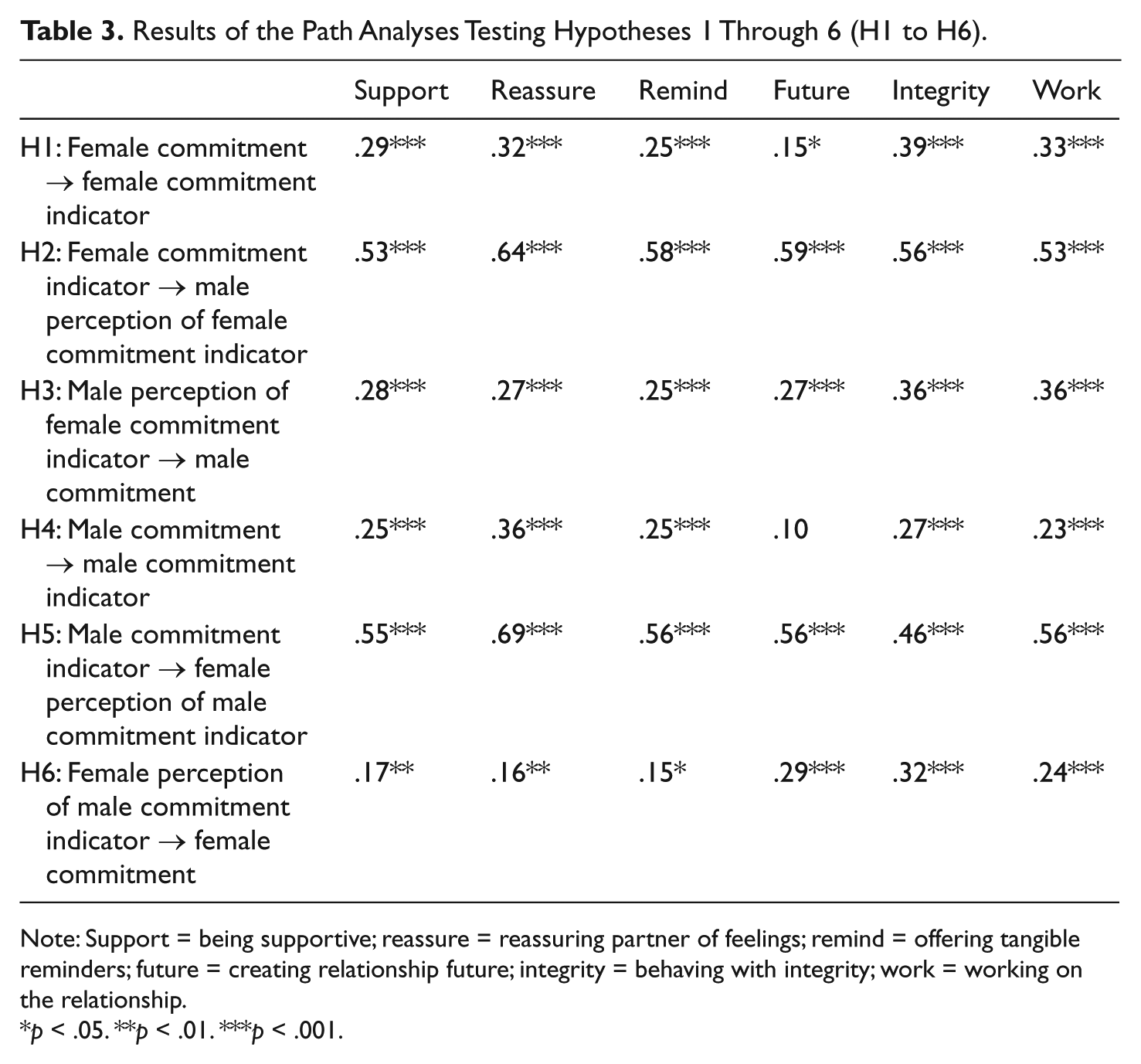
Note: Support = being supportive; reassure = reassuring partner of feelings; remind = offering tangible reminders; future = creating relationship future; integrity = behaving with integrity; work = working on the relationship.
p < .05. **p < .01. ***p < .001.
The first hypothesis predicted that women’s perceptions of commitment would be positively associated with their reported use of the commitment indicators. The results demonstrate that in every instance, the relationship between women’s level of commitment and their use of the specific indicators was positive and statistically significant. The path coefficients ranged from .15 for creating a relationship future to .39 for behaving with integrity. Therefore, H1 was supported in every case.
H2 stated that women’s use of commitment indicators would be positively associated with men’s perceptions of women’s use of the indictors. In other words, men would notice their partner’s everyday expressions of commitment. Results in Table 3 show a positive association between women’s use of commitment indicators and men’s perceptions of that use. All of the paths were significant and moderate to strong, ranging from .53 for being supportive and working on the relationship to .64 for providing reassurance. H2 was supported in that men tended to perceive their partner’s use of the commitment indicators.
The third group of associations concerned men’s perceptions of their partner’s use of indicators and men’s commitment level. Specifically, it was predicted that the more often men believed that women were using the commitment indicators, the higher men’s commitment (H3). The results support this prediction. As seen in Table 3, all paths were statistically significant and ranged from .25 for offering tangible reminders to .36 for behaving with integrity and working on the relationship. Thus, men tended to report higher commitment the more often they believed that their partners were expressing commitment through the commitment indicators.
The fourth hypothesis predicted that the higher men’s level of commitment, the more likely they would be to report using the commitment indicators. With the exception of creating a relationship future, the results support this hypothesis; men tended to report using the commitment indicators more often when they had higher levels of commitment. The path coefficients ranged from .10 for creating a relationship future to .36 for reassuring partner of feelings.
The next set of paths pertained to the associations between men’s use of commitment indicators and women’s perceptions of that use. Specifically, H5 predicted that a positive association would exist between men’s use of commitment indicators and women’s perception of those indicators; that is, women would have a degree of recognition in viewing their partner’s everyday expressions of commitment. The results support H5 (see Table 3). In all cases, the more frequently men reported their use of the commitment indicators the more likely women were to report their partners using those indicators. Path coefficients ranged from .46 for behaving with integrity to .69 for reassuring partner of feelings.
The final hypothesis predicted that the greater women’s perceptions of their partner’s use of the commitment indicators, the higher their overall level of commitment (H6). Indeed, the results demonstrate that in every instance the path between women’s perceptions of men’s use of the commitment indicators and women’s level of commitment indicators was positive and statistically significant. The path coefficients ranged from .15 for offering tangible reminders, to .32 for behaving with integrity. Therefore, H6 was supported with every indicator.
Alternate Models
Although the cyclical model exhibited good fit in nearly all cases and appears to be a useful depiction of couple interdependence in the communication of commitment, due to the correlational nature of the data, other models are possible. For instance, a matching model may exist, whereby one partner tends to match the commitment indicators of the other, such as when one partner expresses commitment via the use of reminders, the other partner reciprocates in kind. Research has shown that couples regularly match and reciprocate communication behaviors and styles (Burgoon, Dillman, & Stern, 1993). In this way, we would expect a direct effect of an individual’s commitment indicators on the partner’s commitment indicators. Therefore, we tested an alternate model in which we specified a direct link between both partners reported use of each commitment indicator, in addition to a sequence linking an individual’s level of commitment, expression of commitment, and perception of partner’s commitment. None of the models achieved an acceptable fit for any of the commitment indicators.
A second alternate model of interdependence could be termed a dissonance explanation, whereby a partner’s expression of commitment feeds into her or his own commitment level, such that those partners who use specific behaviors to indicate their commitment actually become more committed. Then, their own level of commitment to the relationship would lead them to see positive behaviors on the part of their partners (whether they existed to that extent or not), which then have them rate their partners highly on their use of commitment indicators. Therefore, we tested a model in which a person’s use of a communication indicator leads to her or his level of commitment, which in turn leads to perceptions of the partner’s use of the indicator. Once again, none of the models for any commitment indicator achieved an acceptable fit. However, when we added a path from women’s perception of their partners’ indicator to men’s reported use of the indicator and vice versa, the model achieved an adequate fit for offering tangible reminders (χ2 = 8.17, df = 5, p = .147, χ2/df = 1.64, CFI = 0.991, RMSEA = 0.058), though not as strongly as the cyclical model. In addition, the model for behaving with integrity (χ2 = 5.14, df = 5, p = .399, χ2/df = 1.03, CFI = 1.000, RMSEA = 0.012) exhibited a slightly better fit than the cyclical model. Thus, even though the cyclical model tended to fit the data better than the alternate models in most cases, in a couple of instances the dissonance model proved to be satisfactory.
Discussion
In this study, we drew upon interdependence theory to create a more detailed understanding of how couples construct commitment in their relationships through their everyday expressions of commitment. Previous research has shown that commitment is a critical element in healthy, enduring relationships (Bui et al., 1996; Clements & Swensen, 2003; Kurdek, 2000) and people use a variety of everyday behaviors to express that commitment to their partners (e.g., Knapp & Taylor, 1994; Marston et al., 1998; Weigel, 2008). The present study extends this literature by testing a dyadic cyclical model documenting the interdependent nature of the everyday expressions of commitment in romantic relationships. In general, our findings reveal that individual’s level of commitment is associated with her or his own expressions of commitment (H1, H4), those expressions of commitment are noticed by their partners (H2, H5), and their partner’s level of commitment is associated with those perceptions of the other’s expressions of commitment (H3, H6). We discuss the implications of the findings in the following sections.
Implications for Understanding Everyday Expressions of Commitment
This study complements and extends existing work on the communication of commitment through everyday expressions of commitment. Our study confirms that people’s perceptions of commitment are associated with their reported use of commitment indicators. When both women and men had greater commitment, they were more inclined to report using the commitment indicators. This finding is in accordance with prior research (Weigel, 2008; Wieselquist et al., 1999) and might be explained by the fact that highly committed individuals are dependent upon their partners and literally need their relationships (Kelley & Thibaut, 1978; Rusbult et al., 1999). Because of this need, they should use behaviors to make sure their partners are aware of their level of commitment. Also, because committed individuals are typically highly invested in their relationships, they should engage in behaviors to ensure that their partners are aware of their commitment so as not to incur the costs of losing that investment by having the relationship end. Thus, the use of everyday expressions of commitment, or the lack of use, is one way people can ensure that their partners are aware of their commitment.
In addition, it is important to remember that interdependence theory is based on the notion that people act to maximize rewards and minimize costs. When rewards outweigh costs, individuals tend to be more willing to remain in their relationships; when costs outweigh rewards, individuals tend to be more willing to leave them. Many of the expressions of commitment are likely rewarding in themselves, for example, showing affection, spending time together, and giving and receiving reminders. However, some may entail costs (e.g., foregoing other desirable activities or relationships, willingness to defer to partner’s interests, and talking through relationship difficulties) and partners must be willing to incur these costs for the sake of the relationship. For example, Sally is willing to forego activities she would rather do to do things with John, not only because she does not want him to end the relationship, but because she is committed to him and wants to demonstrate that through her willingness to sacrifice her wishes. Beyond merely communicating commitment, it is likely that expressions of commitment also are enacted because people are making the necessary investments and sacrifices to keep their relationships functioning.
The study also expands the landscape on the role of communication in relationship commitment. Little prior research has examined the communication side of relationship commitment. Our results demonstrate that partners do indeed report using a variety of behaviors to communicate their commitment. Even so, the everyday expressions of commitment studied in this investigation are only one piece of the communication of commitment story. We cannot forget that couples do have direct conversations about commitment in which they talk about affection and caring, relationship threats and alternatives, pressures from family and friends, making sacrifices for the relationship, and the future (Knapp & Taylor, 1994; O’Riordan, 2007). Couples also have ordinary conversations on things other than the relationship itself, through which underlying messages of commitment are implied (Knapp & Taylor, 1994). For instance, partners might talk about how a couple in a movie is interacting without ever talking about their own relationship, but their conversation might be informative about their views of commitment in their own relationship. Thus, it is likely that couples construct and sustain their commitment through a combination of direct and indirect commitment conversations and everyday expressions of commitment.
Implications for Understanding Interdependence in Everyday Expressions of Commitment
This study also contributes to our understanding of the interdependent nature of the communication of commitment in romantic relationships, by identifying unique pathways of interdependence. For example, we observed a strong degree of correspondence between people’s ratings of their own use of commitment indicators and their partner’s perceptions of the use of those indicators. In other words, when one partner expressed commitment by using the indicators, the other partner tended to notice it. This type of finding is at the heart of interdependence theory. The existence of interdependence means that partners perceive and influence one another’s perceptions and behaviors (Kelley & Thibaut, 1978). Obviously, when one partner expresses her or his commitment, either directly or indirectly, it is important the other person detects this message.
This finding reinforces the importance of recognition and understanding in the communication of commitment. Since partners do not agree on everything, recognition and understanding become crucial because they can allow more constructive interaction (Acitelli, Kenny, & Weiner, 2001). In such situations, partners should be motivated to infer their partner’s thoughts and behaviors more precisely. Valid perceptions likely reduce relationship uncertainty (Knobloch & Solomon, 1999) and lead to better predictions of the other (Swann, 1984). In this way, recognition of a partner’s expressions of commitment is likely a strong motive in close relationships; indeed, in this study, the strongest path coefficients tended to be in these partner perceptions. Furthermore, only when this path was added to the alternate dissonance model did it achieve an acceptable fit for the use of reminders and behaving with integrity.
We also found that an individual’s perceptions of her or his partner’s expressions of commitment were associated with her or his own perceptions of commitment. Women and men expressed greater commitment when they reported that their partners used everyday behaviors to express their commitment. Individuals infer their partner’s level of commitment through the everyday things those partners do (Marston et al., 1998; Weigel & Ballard-Reisch, 2002). If a partner is affectionate, leaves little reminders, or jointly makes plans for the future, this likely reinforces the committed state of the relationship in the eyes of the beholder. But if the partner is cold and unaffectionate, never leaves reminders, or does not include the other in future plans, these dynamics likely create a sense of uncertainty and doubt about the future of the relationship. Individuals who are more uncertain of their relationships and their partners’ commitment are more likely to report using fewer commitment indicators, have less positive feelings about the quality of their relationships over time, and be in relationships that end than are individuals who are less uncertain (Arriaga, Reed, Goodfriend, & Agnew, 2006; Weigel, Brown, & O’Riordan, 2011).
Although we tested a cyclical model in this study, it is likely that, in reality, expressions of commitment are both cause and consequence of perceptions of commitment. For example, when John leaves an “I Love You” card for Sally as an expression of his commitment, the gesture likely reinforces and strengthens his level of commitment, as well. When Sally sees the card, she likely interprets it as a gesture of John’s commitment, but her current level of commitment might help her better make that interpretation. In this way, commitment levels, use of everyday expressions of commitment, and perceptions of partner’s use are intertwined as instigators and outcomes as couples construct and sustain their commitment.
Gender and Everyday Expressions of Commitment
Our results also identified sex differences in the reported use of everyday expressions of commitment. Women tended to report using reassuring partner of feelings, offering tangible reminders, creating relationship future, behaving with integrity, and working on relationship more frequently than did men. Such findings are consistent with the research that has shown that women tend to be more relationship oriented than men. As a group, women’s self-identities are oriented toward their connections with others (e.g., Cross & Madson, 1997). Women tend to focus on, talk about, and attend to relationship issues more frequently than do men (Acitelli, 1992). Given that a woman’s sense of self is more oriented toward her personal relationships than is a man’s (Cross & Madson), when women are in relationships with others, their identity is at stake, and thus, they may be more inclined to engage in expressions of commitment. Consequently, women may be more motivated than men to engage in behaviors that benefit the best interests of the relationship.
In contrast, men tended to perceive their partner’s use of the commitment indicators, particularly the use of assurances and tangible reminders, more often than women. These results may suggest an evolutionary aspect to the communication of commitment. Research by Haselton and Buss (2000) has shown that women tend to infer less commitment intent in men than is actually present while men tend to infer more sexual intent in women than is actually present. Applying this argument to the present study, it is possible that women would be less likely to notice or interpret men’s use of commitment indicators because they would be less likely to infer commitment from those behaviors. In contrast, men would be more likely to notice or interpret women’s use of the commitment indicators because they would be more likely to infer commitment (or sexual intent) from those behaviors. Indeed, in the present study, men tended to report noticing their partners using reassurances and tangible reminders more often than did women. It is possible that men may be more inclined to report noticing the use of these indicators because the indicators may more strongly imply commitment or sexual intent to them. Additional research is needed to explore gender differences in the day-to-day expression of commitment in romantic couples and the role of socialization and evolutionary factors.
Strengths, Limitations, and Future Directions
The study has several strengths, limitations, and avenues for future research. One strength is that the study broadens the focus of research on relationship commitment to include communication. Much of the research on commitment has looked to explain why people choose to stay or leave relationships. Yet, although commitment is often seen as a desired relational state, as in being in a “committed” relationship, the presence of everyday expressions of commitment implies that commitment is something we do rather than just a state we achieve. In other words, commitment is a process, one that is forged and sustained in the everyday communication and behaviors shared between partners. The present study goes beyond reasons for staying or leaving relationships, to explore how couples actively sustain commitment and the role of everyday communication of commitment.
A second strength of this study is the use of dyadic data. The vast majority of research on relationship commitment has focused on the individual rather than both members of the dyad, so this study marks an important contribution to the literature by considering the interdependence that exists within couples. In this way, the study creates a more complete picture of the communication of commitment in romantic relationships. A third, related strength is that we employed SEM techniques to test the model in Figure 1. An advantage of SEM is that a specific association identified in Figure 1 can be estimated while simultaneously controlling for the other associations depicted in the model (Kenny, 1996).
Despite the strengths of this study, some limitations need to be noted. First, the measurement of the use of the commitment indicators was self-report rather than observation of actual use of the indicators. People may overestimate or underestimate both their own and their partner’s actual use of the commitment indicators. Second, we only measured people’s reports of overall frequency of use of the commitment indicators. It is possible that people use only a few indictors on a regular basis (e.g., giving emotional support or behaving with integrity), while using others on important but less common occasions (e.g., celebrating relationship milestones and anniversaries). Third, although the sample has the advantages of a large size for this type of study, both partners being surveyed, and the inclusion of nonstudent couples, still it is a nonrepresentative sample, which limits the generalizability of the findings. Additional couples from community-generated samples might exhibit different patterns than those found in the present sample.
The results of the study suggest several avenues for future research on the communication of commitment. First, although the study relied on a global measure of commitment, it would be useful to replicate the procedures using multidimensional measures, such as Johnson et al.’s (1999) tripartite measure of personal, structural, and moral commitment. Partners might express their commitment differently depending on whether they wanted to stay in the relationship, felt obligated, experienced social pressure to remain, or viewed few alternatives.
Second, although the patterns obtained in our cross-sectional data are encouraging, the study does not verify cause and effect. To establish cause and effect relationships between perceptions of commitment and everyday expressions of commitment would necessitate measuring the use of commitment indicators and commitment over time. Longitudinal or daily diary methods would allow a better test of the cyclical and causal relationships between everyday expressions of commitment and commitment level.
Third, future research should examine the role of other key elements of interdependence and investment theory, such as satisfaction, investments, and alternatives. For instance, with the inclusion of satisfaction, investments, and alternatives, researchers could address whether the relationship between observations of a partner’s use of commitment indicators is directly related to commitment, or whether the indicators influence satisfaction, investments, or alternatives, which then are related to commitment.
Lastly, it is interesting to note that the weakest link between commitment level and use of a commitment indicator, for both women and men, was for creating a relationship future. Making plans together with the future of the relationship in mind or celebrating relationship milestones and anniversaries likely do not take place as often as other expressions of commitment, and it is possible that people may not see this type of expression as common or as strong an indicator of commitment as the other indicators. Also, celebrating relationship milestones and making plans for the future might take more calculated effort than the other indicators. Future research exploring reasons and attributes people make for using the various expressions would be of value.
Conclusion
Communication and relationship scholars have devoted considerable attention to generating a better understanding of commitment in romantic relationships. Very little research, however, has explored the ways partners communicate their commitment to each other. Even less research has investigated the interdependence in the use of commitment indicators and perceptions of commitment between partners. Our results fill this void by revealing a pattern of interdependence in which an individual’s level of commitment is associated with her or his own expressions of commitment, those expressions of commitment are noticed by their partners, and the partner’s level of commitment is associated with those perceptions of the other’s expressions of commitment. In this way, our findings add to a growing understanding of how couples construct and sustain their commitment through the everyday expression and communication of commitment.
Footnotes
Authors’ Notes
An earlier version of this article was presented at the National Communication Association conference in November 2011 at New Orleans, Louisiana. The authors wish to thank the anonymous reviewers for their helpful comments.
Declaration of Conflicting Interests
The authors declared no potential conflicts of interest with respect to the research, authorship, and/or publication of this article.
Funding
The authors received no financial support for the research, authorship, and/or publication of this article.