



Abstract
This article elaborates the role of interpersonal communication in media effects. Based on an extensive literature review, two lines of arguments are illustrated: the antagonistic and the synergetic position. The literature provides theoretical and empirical support for both positions especially in the field of persuasive media input. To complete the view, two experiments with nonpersuasive media input are presented. The first experiment addresses the role of conversations in cognitive news effects. The synergetic position is supported: conversation leads to elaboration and more profound recall of media content. The second experiment deals mainly with emotional media effects in entertainment. No general impact of conversation on media effects was demonstrated. Nonetheless, the authors find evidence that conversations about the media engender a more critical and reserved stance toward the media content and protagonists. The article concludes with a discussion of the implications for further research into the field.
It is not enough to know that talk matters; we also need to know when and why.
In a recent special issue of Communication Theory that addressed the connections between media campaigns and conversations, the editors, Brian Southwell and Marco Yzer, called for a deeper elaboration of conversation as a key variable within mass media campaign effects. In that special issue, articles focusing primarily on health campaigns and political communication explored diverse variables that affect the relationship between mass mediated campaigns and interpersonal communication. These articles highlighted the fact that there is still much to learn about the role of conversation during and after the processing of mass mediated messages, as well as about conversations that occur in response to media in nonpersuasive formats such as entertainment and news media. This article attempts to fill some of the research gaps in this area by investigating the impact of conversation on the cognitive and emotional effects of these types of media.
We develop two different perspectives on the relationship between conversation and media effects: the antagonistic and the synergetic position. We consider how these two positions are addressed by the literature, with both theoretical and empirical support for each position. Subsequently, two experimental studies are presented providing an initial exploration into the role of conversations regarding cognitive media effects in the context of TV news and emotional media effects in the context of TV entertainment. The article concludes with a discussion of potential implications for a deeper understanding of possible effects of media-stimulated conversations.
Interpersonal Communication as Key Variable in Media Effects
In early communication studies, the relationship between mass and interpersonal communication was a central focus of both theoretical and empirical work. Early studies on media use showed that radio entertainment (Herzog, 1944) and newspapers (Berelson, 1949) were used for later conversations. The ‘People’s Choice’ study by Lazarsfeld, Berelson, and Gaudet (1944) indicated a two-step flow model of mass communication: Information flowed from mass media to opinion leaders, and from them via interpersonal channels to others. The follow-up study ‘Personal Influence’ (Katz & Lazarsfeld, 1955) accentuated the importance of interpersonal communication in the decision-making process, and diffusion studies demonstrated the cooperation of interpersonal and mass communication in information dissemination (DeFleur, 1987; Rogers, 2003). Surprisingly, investigations on the relationship between interpersonal and mass communication gradually faded from focus in the following years. One of the rare exceptions was the ‘Spiral of Silence’ theory by Noelle-Neumann (1974). From this perspective, public opinion presented in the mass media can affect individuals’ willingness to speak about a topic, which in turn can amplify the media effect.
Southwell and Yzer recapitulated the relationship between media campaigns and conversation and noted different ways in which the effects of a media campaign might be augmented through interpersonal communication. The first one was classified as the mediation of media effects through discussion. In this situation, members of the public who receive a message directly from the media pass it on to others who have not yet received the message. This situation is most typically considered in classical communication theories such as the diffusion of innovations (Rogers, 2003) and the two-step flow hypothesis (Lazarsfeld et al., 1944). There is, however, another situation that deserves consideration: the moderation of media effects through interpersonal discussion (Southwell & Yzer, 2007). Here conversations might facilitate, amplify, suppress, or reverse any media effects. The present article focuses on this effect of conversation by contrasting an antagonistic and a synergetic position.
The Antagonistic Position
The antagonistic position of media effects and interpersonal discussion presumes media effects to decrease if interpersonal communication on corresponding topics occurs. This might be traced back to the minimal-effects model (Klapper, 1960) postulating that different phenomena like predispositions, selective exposure, dissonance, and group effects hinder media effects. It seems plausible that conversations might suppress media effects, too. By this argument, media effects compete with the effects of conversation. Confusion has been proposed as one reason for competing effects (Feldman & Price, 2008), and, in this article, we also propose contradiction as a term summarizing other plausible reasons for antagonistic effects.
Effects of contradiction occur when the conversation acts in opposition to the original media effect. The most obvious case is given when counterarguments are articulated in a conversation about persuasive media stimuli. Persuasive arguments theory postulates that group discussion will cause individuals to shift their attitudes in a given direction to the extent that the discussion exposes the individual to arguments in favor of that direction (Burnstein & Vinokur, 1975; Kitayama & Burnstein, 1994; Vinokur & Burnstein, 1974). When we discuss a topic, we are exposed to new arguments, some of which we may not have previously considered, and these arguments might be persuasive. Here the antagonistic position is probable if arguments against the media information are provided and supported in interpersonal communication. Such effects were found in controlled empirical studies involving group discussion of an antidrug message among college students (Kelly & Edwards, 1992) and adolescents’ online chat about an anti-marijuana message (David, Cappella, & Fishbein, 2006). In both of these studies, the direction of an individual’s attitude change was determined by the number and direction of arguments expressed in the group discussion, with negative conversation effects emerging if counterarguments to the message were present in the discussion.
Another type of contradictory effects may be caused by violation of implicit or explicit group norms. Deutsch and Gerard (1955) differentiated between informational and normative influence in conversations. Unlike the informational influence, the normative influence derives from the norms between conversation participants. These norms guide the conversation, similar to the impact of the fear of isolation (Asch, 1956) in the spiral of silence (Noelle-Neumann, 1974), with one difference, however: Only the norms of the conversation partners are relevant, not the majority in a society. Price, Nir, and Cappella (2006) found this normative influence in their study of online political discussions: “Our results suggest that the argumentative ‘climate’ of group opinion affected opinion change indirectly, by shaping the character of individual participants’ own expressed opinions and arguments during the online deliberation” (p. 62). Applied to media effects, the antagonism of media and conversation effects is plausible if the direction of media effects contradicts group norms or conversation climate. David and colleagues’ (2006) study of adolescents’ online chat about antidrug campaigns also gave indications for normative group effects working against the campaign effect.
According to Compton and Pfau, a third antagonistic effect of contradicting information from conversation has to be considered; that is, if the conversation takes place before media reception conversation may cause an inoculation effect. The seminal study of Lumsdaine and Janis (1953) demonstrates that two-sided argumentation creates a resistance against later media effects of counterpropaganda (see also Hovland, Janis, & Kelley, 1953). In consequence, arguments in conversation should be protective against later media effects if these arguments are contrary to the direction of the intended media effect (Compton & Pfau, 2009).
However, not all media effects have a certain intention like those evoked by persuasive media campaigns. In the field of political communication, media effects are more often general. For example, news media can inform the audience, lead to political knowledge, inspire participation, and create consensus about the most important problems of the society. In these cases, antagonistic effects of conversation and media were characterized by Feldman and Price (2008) as confusion. Here, the media information does not compete with dissonant information, but with different, additional information gained via conversation. From this point of view, political information from the mass media creates knowledge about candidates and issues and animates political participation. These effects might be dampened by conversation with dissimilar partners. In such conversations new, unfamiliar and sometimes conflicting information might be given, and a clear position might be replaced by a kind of confusion in which former media effects vanish. Mutz (2002) highlights another antagonistic effect caused by conversations with dissimilar others: cross-pressures. In such cases, the information given by the mass media is in conflict with standard information shared by the conversation partners. In consequence, ambiguity grows and effects of knowledge acquisition and political participation initiated by the mass media decrease.
Similarly, Mutz (1992) postulated different sources for judging issue importance. By this account, the agenda-setting effects of the mass media decrease when issue importance is informed by other sources such as interpersonal communication. This might also be classified as confusion: The relevant issues set by the mass media get confused with other issues set by conversation. Accordingly, several studies have demonstrated that agenda-setting effects for different issues diminish when interpersonal communication occurs (Erbring, Goldenberg, & Miller, 1980; Hügel, Degenhardt, & Weiss, 1989; Rössler, 1999).
The Synergetic Position
In contrast to the antagonistic effect, a synergetic relationship between conversation and media effects is given when the original media effect is amplified or maintained. Different theoretical explanations and empirical support are found for the synergetic argument, including enlightenment (Feldman & Price, 2008) and reinforcement.
In the field of political communication, the synergetic position was labeled as enlightenment in contrast to confusion (Feldman & Price, 2008). The idea arises in the differential gains model by Scheufele (2002; Hardy & Scheufele, 2005). In this model, political conversation overcomes shortcomings in political media coverage. Barnhurst and Mutz (1997) identified a trend toward longer and more complex political media coverage. Conversation about politics might enlighten its context and relevance; “. . . interpersonal discussion plays a role in the reception and processing of political news when it comes to translating mass-mediated messages into meaningful individual actions” (Scheufele, 2002, pp. 57–58). Even though Scheufele’s (2002) initial study confirmed the model, follow-up studies showed mixed results (Feldman & Price, 2008). Hence, Feldman and Price differentiate conversations by homogeneity and consonance of the partners and prove enlightenment effects for conversations with like-minded partners (see also Lenart, 1994). Nonetheless, synergetic effects were also found when conversation partners offered new information and perspectives (Kwak, Williams, Wang, & Lee, 2005; Stromer-Galley & Muhlberger, 2009). Even if this information partially contradicts the initial media input or adds a new perspective, it may enlighten the cognitive media effects via a contextualization of the issue: By talking to others about media information, this information is embedded into existing cognitive structures and networks which in turn leads to a better understanding of the issue. The effects are similar to what Eveland (2001, 2004) describes as elaboration. In his point of view, elaboration not only takes place because of additional information in conversation (as explained above), it also occurs when the recipients anticipate later follow-up conversation and thus pay careful attention to the media to be well prepared for conversation (see also Southwell, 2005; Southwell & Yzer, 2007).
Another instance of a synergy between media effects and conversation occurs when the effects of the media are reinforced through the experience of interpersonal discussion. Some political communication scholars have suggested that the reinforcement of media effects by conversation occurs through a process of replication. Eveland (2004, p. 179) argues that the media effect and the effect of information in conversation are “similar to rereading the paper.” The cognitions and emotions initially experienced in response to the media are retriggered. In addition, only a few of the pieces of information given by the media are remembered by the public, so conversation might recall to mind forgotten information (Eveland, 2004; Eveland & Thompson, 2006).
Moreover, through conversation, one may obtain support for an opinion or emotion by realizing that others think or feel the same way (e.g., shared reality theory, Hardin & Higgins, 1996; social sharing of emotions, Christophe & Rimé, 1997). As humans strive for social comparison and social support and want to hold “correct” attitudes (Petty & Cacioppo, 1986), it seems plausible that recipients often talk to people with similar views about media input. Additionally, personal conversation is often perceived as closer, more committed, and more trustworthy than mass communication (Katz & Lazarsfeld, 1955). Thus, if this familiar mode of communication emphasizes messages from the mass media, media effects are socially validated and consolidated. Binder, Dalrymple, Brossard, and Scheufele (2009) find polarization effects caused by political talk with like-minded others leading to extreme attitudes. Synergetic effects of conversations and media by reinforcement were found in some agenda-setting studies (e.g., McLeod, Becker, & Byrns, 1974; Nguyen Vu & Gehrau, 2010; Weaver, Zhu, & Willnat, 1992; Yang & Stone, 2003), as well as health communication studies (Dunlop, Wakefield, & Kashima, 2008; Durkin & Wakefield, 2006; Hafstad & Aaro, 1997; Valente, Poppe, & Merrit, 1996; Valente & Saba, 2001).
Synopsis
As outlined above, theoretical assumptions imply both antagonistic and synergetic effects of interpersonal communication on media effects, and both positions are supported by empirical evidence.
Typically, the relationship between media and conversation effects has been discussed for media input with substantial positions or persuasive purpose (e.g., David et al., 2006; Kelly & Edwards, 1992). In such cases, antagonistic effects are likely if conversations offer dissonant information or the information presented in the media might be counter to norms of the conversation partners. When, on the other hand, media information is in accordance with what is normative in the target audience, the information encountered in conversation is likely to be consonant with media information. In this case, the media and conversation effects will be synergetic.
Yet we are interested in other kinds of media inputs, specifically televised news and entertainment programs. Under this condition, antagonistic effects by dissonant information seem less likely as the media content offers no direction or valence that could be contradicted. Hence, antagonistic effects are only likely in the case of confusion or dissimilar conversation partners. In contrast, the synergetic effects (such as repetition, enlightenment, social verification) seem as plausible for nonpersuasive media effects as for persuasive media effects.
But for nonpersuasive media effects it is harder to distinguish between the antagonistic and the synergetic position. The antagonistic position arises if a mass media-induced effect on an individual changes after the individual talks to others about the media input. As the message itself has no persuasive purpose this change cannot be expected as a directed change of knowledge, opinion, motivation, or action. Instead, it must be conceptualized as every substantial change in the domain of the media effect. News primarily informs people about issues and activates related thoughts and opinions, while entertainment shows primarily activate emotions toward the show and its candidates. Therefore, an antagonism between media effects and conversation effects would be given if the thoughts, opinions, and emotions related to the media change after conversation occurs. In contrast, the synergetic position negates such changes; the media-related thoughts, opinions, and emotions are not varied by upcoming conversations. The problem is to distinguish synergetic effects from zero effects. In our view the synergetic situation would be given if the media effect is more profound after conversation. Hence, the news-related thoughts and opinions as well as the show-oriented emotions would not change in their substance but would be more intense. Based on these premises, we try to better understand the basis as well as the underlying processes of potential synergetic or antagonistic effects:
Do conversations about a nonpersuasive media stimulus moderate media effects? If they do, do they produce antagonistic or synergetic effects?
Most previous studies examining the relationship between conversations and media effects have relied on cross-sectional studies. These research designs can identify associations between media effects and conversation, but they cannot provide any evidence that conversation modifies media effects. Experimental studies, in contrast, offer the possibility to directly compare participants’ cognitions and emotions during and after either engaging in conversation about some media instance or not, allowing us to understand more about the causal relationships between conversation and media effects.
In this article, we present two experimental studies that focus on the influence of conversations on cognitive and emotional media effects. Both studies share a similar design: an experimental group who talks about a media stimulus (TV news or reality TV show) during or after media reception is compared to a control group who does not talk. Participants in both studies were recruited on university campus and asked to bring along one or two peer-persons (friends, roommates, partners, etc.). In the experimental condition, peers stayed together for the experiment, whereas in the control condition they were separated and tested individually. Hence, conversations about the media stimuli were held in peer constellations as this is the typical setting for such conversations.
Study 1: Conversations and Cognitive Media Effects
The objective of the first study was to explicate the influence of interpersonal communication about TV news on cognitive news effects. According to our reasoning, the effects of talk about news content may be twofold: (a) We may find an enhanced memory and knowledge about the news, or (b) weaker cognitive effects may be apparent after conversation. The impact of conversation will likely depend on the way the conversation participants discuss the news.
Media Input and Background
Due to the specific information function of news, research on news reception has especially focused on cognitive news effects. This research shows that recipients tend to remember poorly what they saw on television. News processing seems to be a highly subjective and heuristic process influenced by motivation and information processing capacity. Recipients select pieces of information that fit their cognitive schemes and relate them to their daily lives (Graber, 1988).
Studies on political communication show that people discuss political issues from the news, particularly at home with their family and close friends but also at work (De Boer & Velthuijsen, 2001; Wyatt, Katz, & Kim, 2000). Research has demonstrated an enhanced memory of news content for people who talk about political issues from the news compared to nontalkers (Robinson & Levy, 1986; Scheufele, 2000, 2002). Investigating the reasons for these effects, mental effort (i.e., attention and anticipation), along with the integrative discussion and elaboration of different perspectives, have been proposed to lead to a deeper understanding and better memory of news issues (Eveland, 2001, 2004; Eveland & Thompson, 2006; Kwak et al., 2005). This is in accordance with the synergetic position: A media input is complemented and consolidated through additional information in conversation in terms of enlightenment and reinforcement processes. However, this seems to be specifically true for conversations among people who are close and often similar to each other in their perceptions, experiences and opinions (Feldman & Price, 2008; Lenart, 1994). Concerning the attitudes toward the news issue and evaluations of the report the mechanisms are less clear. Depending on recipients’ positions and the news coverage, contradictory or confusing influences are as likely as enlightening or reinforcing effects.
Hypotheses
Thus, the following hypotheses were tested in the first study:
Hypothesis 1a (H1a): Discussions about television news will enhance news memory.
Hypothesis 1b (H1b): Discussions about television news will influence evaluations of the news content by either enhancing or attenuating them.
We observed these conversations in order to explore the mechanisms behind their influencing potential. These observations serve as a preliminary insight into processes that are usually not measured but only implied by self-report data.
Research Question 1: How can the effects of conversation be explained by conversation mechanisms?
Sample and Procedure
An experimental study (n = 120) combining survey and observation was conducted at a large university in eastern Germany from 2005 to 2006. Participants were asked to come to the laboratory together with a friend or acquaintance and were randomly assigned to either the experimental or control condition. In the experimental group (n = 40 dyads, that is, 80 individuals), dyads stayed together whereas in the control group (n = 40 individuals), the 20 pairs were separated. All participants were shown a television news report dealing with religious minorities in Germany. The report covered the sixth annual nationwide open house in German mosques, focusing on the discussion about potentially banning the Muslim headscarf in German public service. In a short news excerpt, scenes from a large mosque in Berlin were shown and interviews with people who expressed their opinions pro and contra the headscarf were included.
In the experimental group, dyads watched the report together and were afterwards asked to engage in an informal discussion about it without any special direction given. Each dyad talked for approximately 10 minutes. In the control condition, individuals watched the report without subsequent conversation. Conversations in the experimental condition were recorded in order to further investigate the processes behind the expected differences between the experimental conditions.
Dependent Measures
In both groups recall and recognition of the news were measured. Although both measures are measures of memory, media effects research highlights differences in the underlying processes of these outcomes. Whereas free recall indicates higher mental effort and the integration of information into existing knowledge structures, recognition relies on the accurate factual identification of certain features and details from the stimulus (Shoemaker, Schooler, & Danielson, 1989; Southwell, 2005).
Free recall was assessed by oral interviews and audiotaped. The news excerpt contained 29 informational categories based upon the journalistic “W-questions”: Who? What? Why? When? Where? (see Appendix for details). Each category was coded dichotomously by indicating whether it had been mentioned in the interview or not. The sum of all information categories remembered served as recall measure. The material was coded by two independent coders with satisfying reliability (Cohen’s kappa ranging from .66 to .96). Coder disagreement was discussed until a conjoint decision was reached. Recognition was assessed by a posttask questionnaire including five multiple-choice questions about facts from the news report (see Appendix). In total, eight correct answers could be yielded in the recognition test.
Attitudes toward the news subject—the integration of religious minorities in Germany—were assessed by 11 items, which were all taken from a database containing scales from large public opinion surveys in Germany. Specifically, they measured the exclusion of minorities (three items), costs of immigration (three items), consequences of immigration (three items), and xenophobia (two items; see Appendix for details). Evaluations of the news report were measured by means of eight adjective pairs describing the characteristics of the message. All items were measured using 5-point Likert-type scales.
Conversations were videotaped and verbally transcribed. Transcripts were coded for the same 29 informational categories that were assessed for free recall. Additionally, characteristics of the conversations like evaluations or questions and answers were coded in order to explain the potential differences between experimental conditions (see Appendix for details on coding variables). The unit of analysis for this coding was the dyad. Thus, each conversation was treated as an entity and coded only once for each piece of information and each conversation characteristic no matter how often the single unit had been mentioned and by whom. Conversation contents were matched with free-recall data for comparison.
Results
Comparisons of the experimental and control group indicated a stronger and more accurate recall memory of the news in the experimental group. Participants in the experimental group reproduced significantly more information from the news report under free recall conditions than participants from the control group (F(1,118) = 3.850; p = .05), providing confirmation for H1a. The mean amount of correct answers in the recognition test was a little higher for the experimental group (see Table 1). However, this difference was not significant. Thus, although participants were able to freely retell more about the news report after conversations, their accurate memory of particular facts from the message was largely comparable to that of participants from the control group.
Study 1 News Recall and Recognition in Experimental and Control Groups.
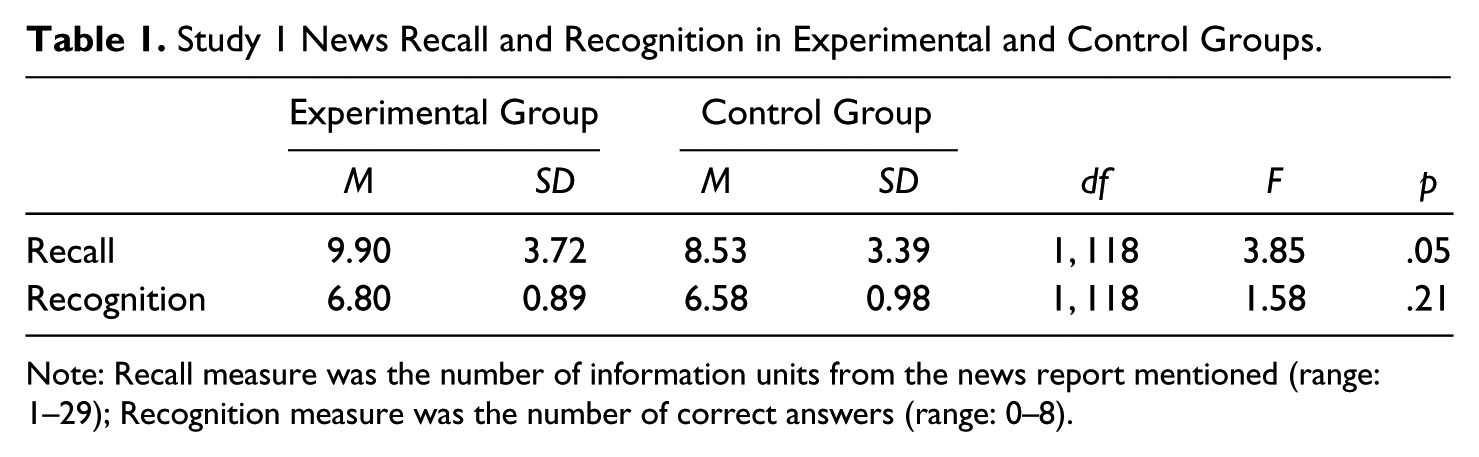
Note: Recall measure was the number of information units from the news report mentioned (range: 1–29); Recognition measure was the number of correct answers (range: 0–8).
Comparisons of attitudes toward the news subject revealed no significant differences between the experimental and control conditions (see Table 2). Perceptions of the news report were also similar in both conditions with one exception: Participants in the experimental group evaluated the news report as significantly less exciting (M = 2.99, SD = 0.771) compared to the control group (M = 3.48, SD = 0.679; F(1,118) =11.512; p < .001). For the other seven characteristics, no difference was found. Consequently, we find no support for both positions in H1b: No change in attitudes in the sense of a clear antagonism can be demonstrated, but intensification in terms of a synergetic effect was not revealed either.
Study 1 Attitudes Toward News Subject in Experimental and Control Groups.
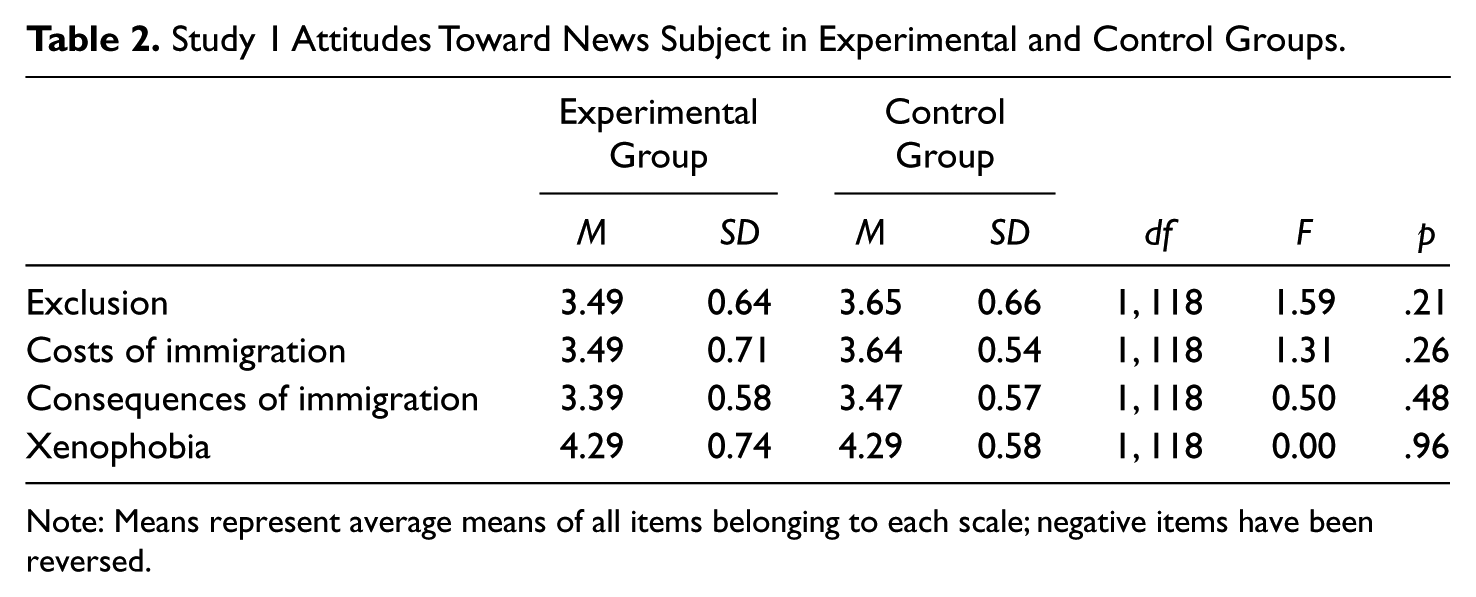
Note: Means represent average means of all items belonging to each scale; negative items have been reversed.
By matching free-recall data with the content of the observed conversations, we found a moderate correlation between the number of information units mentioned in conversations and the number individually recalled by the experimental group at the aggregate level (r = .234, p < .05). Thus, we find reinforcement not only in terms of a replication of the news content but also enlightenment by adding new information for completion and contextualization.
The observations of conversations showed that 80% of the participants in the experimental group asked and answered knowledge questions during conversations (see Table 3). Also, mutual reassurance and adjustment of opinions and evaluations were apparent in 73% of the conversations. In these cases, conversation partners explicitly asked each other for opinions and assessments and answered these questions. Moreover, 90% of the dyads evaluated the news report in their discussions. Additionally, in 90% of the conversations, participants mentioned background information and drew connections to their own lives and experiences.
Study 1 Observed Conversation Mechanisms.

Note: n = 40, unit of analysis: dyads. Each conversation was treated as an entity. Each mechanism was only coded once for its presence/absence.
Discussion
The above results support H1a suggesting that conversations may synergetically enhance news media effects if they enrich and complement media information. Corresponding to the findings by Kwak et al. (2005) and Eveland and Thompson (2006), recipients in the current study engaged in integrative discussions including several perspectives on the news report. By asking and answering questions they checked and revised their understanding and elaborated on the media content by drawing relations to their preexisting knowledge structures and personal experiences. Thus, for the free recall of news, the sharing of perceptions seems to be quite crucial as it provides the necessary orientation in the sense of what we need to know and how we have to understand it correctly, suggesting the need for social comparison and shared reality perceptions. These processes indicate enlightenment as well as reinforcement processes.
The memory effect for recall but not for recognition might indicate that conversations have a stronger impact on the elaboration of news information and its integration into existing knowledge structures than on the pure rehearsal of facts from the news. However, the null effect for recognition may also be due to a ceiling effect as the mean values in both groups are fairly high (6.8 and 6.6 on a scale ranging from 0 to 8), indicating that the questions might have been too easy for the high-attention-reception situation in the laboratory.
Interestingly, although most of the dyads evaluated the news report and its topic and asked for each other’s opinions, we find no differences in attitudes toward the news subject between experimental conditions and only one diverging assessment of the news report indicating a slightly more critical view of the message in the experimental group (see H1b). Thus, peer conversations seem to be quite consonant on the evaluative dimension, elaborating on the content instead of arguing about the issue in a controversial fashion.
Study 2: Conversations and Emotional Media Effects
The objective of the second study was to investigate whether communication about an entertainment media program results in synergetic or antagonistic effects on emotional media effects. As stated by Nabi, So, and Prestin (2011), “exploring this intersection between media consumption and interpersonal communication is a critical, yet often overlooked, area of media and emotion research” (p. 125).
Social psychological research has demonstrated that, following an emotional episode, humans have a basic motivation to share their emotional responses (Christophe & Rimé, 1997). During this social sharing of emotion, individuals talk about their emotional responses with others. In this case, we may expect a reinforcement of the original media effect on emotion, as the emotions may be retriggered. It is also plausible, however, that, through the process of interpersonal discussion, emotions are changed or reduced, which would result in an antagonistic relationship between conversation and media effects.
Media Input and Background
As a genre, reality television has established itself worldwide. This study focuses on the German version of one of the most popular reality television programs around the world, “Deutschland sucht den Superstar” (“German Idol”). On one side, the show’s narrative is emotional on the TV screen. On the other side, the audience is actively engaged in front of the TV set, discussing and evaluating candidates of the show in diverse contexts such as at home and at school (Döveling & Schwarz, 2010). As such, media reception of these shows is not merely an internal process but is implanted in social settings and contexts. Hence, these programs open up questions regarding the consequences of interpersonal communication in the context of an entertaining media input.
Literature pertaining to reality television suggests that reality television viewers are highly sociable and enjoy interacting with others (Nabi, Biely, Morgan, & Stitt, 2003; Reiss & Wiltz, 2004). Groups provide a helpful resource for individuals forming opinions and emotional judgments about media texts. Hence, we consider social sharing of emotional judgments as an integral component of emotional experiences that directly influences one’s own appraisal and reappraisal not only of media-related information but also of one’s own emotional assessment related to mass mediated messages (Döveling & Sommer, in press). Thus, evaluations of emotional experiences within conversations may affect the emotions and the emotional experience might be modified.
Hypotheses
Consequently, two competing hypotheses were tested:
Hypothesis 2a (H2a): Participants in the group-viewing condition will show intensified emotional reactions without changes of the judgments in comparison to participants in the solo-viewing condition (synergetic).
The synergetic constellation between media and conversation effects on emotions seems plausible because in conversation the emotions might be triggered again and they might be intensified by social validation through conversation.
Hypothesis 2b (H2b): Participants in the group-viewing condition will show emotional reactions and judgments differing from those in the solo-viewing condition (antagonistic).
The antagonistic constellation seems plausible if the individual emotions conflict with norms or opinions expressed in conversation or when conversations interrupt the emotional reception.
Sample and Procedure
An experimental study was conducted at a large Eastern German University in 2010. Participants were randomly assigned to either a group-viewing condition (n = 120 with 3 viewers per group) or a solo viewing condition (n = 42). Participants watched a 25-minute clip of “Deutschland sucht den Superstar” (“German Idol”). The clip contained four successful and four unsuccessful auditions. The successful candidates were portrayed positively, described as hardworking, striving for their dreams, and shown in a family setting. The unsuccessful candidates were portrayed and treated in a more disrespectful und morally discreditable manner.
Those in the group-viewing condition were instructed to talk and interact freely with each other while viewing the clip. After the clip, the viewers completed a survey with questions about how they found the clip, perceived likeability of both the most and the least successful candidate, and about their typical viewing habits. In contrast to the first study, this study does not include valid observation data of the conversations. Instead, the survey for the group condition included questions on whether the participant talked while or shortly after viewing the show and on the reasons for talking. According to this, conversations occurred in all coviewing groups and except for one person all indicated that they talked during the show. Eighty-two percent of the participants articulated in the survey that they talked because they wanted to express their opinions and emotions toward the show.
Dependent Measures
Emotional reactions were assessed in a questionnaire with 12 items measuring how participants perceived the clip: amusing, enjoyable, shocking, disgusting, exciting, offensive, inspiring, annoying, realistic, artificial, embarrassing, and depressing. Participants also answered nine questions about their emotional responses to the most successful characters: whether they hoped they achieved their goals, how much they admired them, how much they liked their attitudes (see Appendix for complete questionnaire). All emotional judgments were measured on 5-point Likert-type scales ranging from 1 (strongly disagree) to 5 (strongly agree).
Results
Results concerning the emotional reactions to the media stimulus revealed no general difference between the experimental conditions: Both groups appraised the show as highly embarrassing and somehow shocking and annoying, but at the same time amusing. On the other side, the show was neither offensive nor realistic, exciting, or inspiring (see Table 4). The only difference between the groups was that participants in the conversation condition appraised the show as more artificial.
Study 2 Emotional Reactions to the Show.

Emotional judgments about the most successful candidate were also not systematically different in the single- or group-viewing conditions. Both groups showed hope for the candidate and thought he or she was a good person. On the other hand, they did not admire the candidates nor could they imagine them as friends, but felt ashamed and sorry for them. Differences between the conditions only appeared for happiness: In the solo-viewing condition the viewers were happier for the candidate than in the conversation condition (see Table 5).
Study 2 Emotional Judgments of Most Successful Candidate.

Both general effects seem to contradict the idea of a synergetic mechanism because the emotions do not get more intense or profound when people talk during the show. However, they do not clearly support the notion of antagonistic effects either as the emotional reactions do not generally change when viewers watch the show in a group and talk about it.
Nevertheless, those who watched the show in groups and talked about it found the show significantly more artificial (M = 3.51, SD = 1.03) than those who watched the show on their own (M = 2.92, SD = 1.28; F(1, 159) = 8.77; p =.004; see Table 4). Moreover, single viewers are happier for the best candidate (M = 3.47, SD = 0.08) than the experimental group (M = 3.03, SD = 1.15; F(1, 155) = 4.03; p =.046; see Table 5). Corresponding to H2b, we find some small antagonistic differences between experimental conditions.
Discussion
The results of Study 2 show that the participants in the coviewing condition talked about the show and most of them expressed their emotions and opinions toward the show. But these conversations did not basically change their emotional reactions to the media stimulus. There were few differences in the direction or intensity of the emotions for participants who did or did not engage in conversations. The exception to this pattern of results was that when recipients talked with others, they seemed to develop a more distanced view of the media stimulus. The viewers in the conversation condition were more aware of the artificial character of the show. This might have created distance between the show and its spectators; therefore they were less happy for the preferred candidate and felt less empathy for him. It is plausible that, through conversations, they took on a more detached, critical view toward the emotionally provoking media stimulus. Hence, the results of the second study do not support the synergetic position, as the emotional reactions were not more intense, but some support is given for the antagonistic position.
General Discussion
Limitations
Although these studies are among the first to experimentally explore the effect of conversations on responses to media content, there are both theoretical and methodological limitations. The first study focused primarily on memory and evaluations, which are predominantly cognitive outcomes but also include emotional components. Similarly, the central focus of the second study was emotional appraisal, which integrates cognitive processes such as the evaluation of the media stimulus. Considering current emotion research, we are aware that a strict differentiation between emotion and cognition cannot be made, especially when outcomes are measured using questionnaire methodology. Thus, emotional and cognitive responses to media are likely to be somewhat intermingled. Appraisal theorists argue that the essence of emotions is the elicitation of evaluation, which can be regarded as a cognitive procedure (Scherer, 1993; Scherer, Schorr, & Johnstone, 2001). The critical distance toward the stimulus that was observed in both studies might be understood as a rationalization process of emotional reactions, suggesting that the differentiation between cognitive and emotional effects used in this study for analytical purposes is likely to be a simplification of this issue.
The controlled experimental conditions, along with social desirability concerns, might have reduced the intensity of the conversations and consequently limited their effects on the cognitive and emotional outcomes. However, inspection of the videotaped conversations shows that the conversations were open and natural and similar to conversations one would expect in an everyday context. As Schwarz (1998) argues, this may be due to the highly routinized nature of interpersonal communication, specifically with peers.
The sample sizes in each of the conversation and no-conversation groups were relatively small, and future research should endeavor to replicate these results in larger samples, and also with participants who are not students, in order to generalize the results. Additionally, while we interpreted the between-subject differences as showing some effects of conversation, further research should be conducted longitudinally, measuring cognitive or emotional responses both before and after conversations. This seems to be especially important as survey studies show conversation effects on attitudes for those who regularly talk to others about certain topics from the media. Finally, in the second study we have no valid observation data of the conversations. The answers from the survey yield information about conversation and its reasons. Nevertheless, it would be more accurate to observe the frequency, intensity, and the issue of each conversation and to combine this with data about nonverbal interactions.
Conclusion
Our general aim was to examine whether conversation exerts influence on nonpersuasive media effects in a strict experimental setting, focusing on the elicitation of antagonistic and synergetic effects of conversations. In the antagonistic constellation, the effect of conversation works against the media effect. In the synergetic constellation both effects work together. In the case of persuasive media input, the relationship between the intention of the media input and the direction of the conversation is crucial, with synergetic effects most likely when the intention of the media input is in agreement with the information and norms given in conversation with like-minded partners. In contrast, the antagonistic constellation is most likely if the intention of the media input is contradicted by information and norms given in conversation—most likely with dissimilar partners. As nonpersuasive media input has no intention, the literature did not lead to a clear expectation about nonpersuasive media effects.
In the present article, the results of the first experiment supported the synergetic effect of conversation on cognitive media effects for news media. The opinions and attitudes related to the news issue did not change if conversation about the newscast took place. But the cognitive effect of the media input was more profound if the participants talked about the news. The free recall of the news was better and single aspects were remembered better when these or corresponding aspects were mentioned in conversation. Here, the results replicate enlightenment (Feldman & Price, 2008) and the differential gains model (Scheufele, 2002). Our observation data from the conversations indicate that conversation may lead to deeper elaboration: important information is mentioned again, questions are clarified, and relations to one’s own life are outlined. Therefore, it seems plausible and likely that such synergetic effects of conversation on cognitive media effects of nonpersuasive media input such as news media will be the norm and not the exception if the conversation takes place with similar partners, which appears to be the most frequent situation (e.g., Gehrau & Goertz, 2010; Wyatt et al., 2000).
On the other hand, the results of our second experiment point in the direction of antagonistic effects of conversation on emotional responses to entertainment media. In general, the emotional effects of the show on its spectators did not differ between those with and those without conversation. But we found two important differences in the results of the questionnaire: With conversation the show was seen as more artificial and there was less hoping for the best candidates. As a post hoc interpretation, we regard this finding as a way of rationalization and distance between the media and the users caused by conversation. In other words, the phenomenon we found in the second study might be seen as a kind of distancing from the media input. Accepting this metaphor we see parallels with two positions stated in the literature. One position was described as media skepticism. The idea is that the public is progressively losing confidence in the mass media and its information (e.g., Tsfati, 2003). This might be seen as distance as the public does not automatically believe the media, which in consequence reduces the probability and intensity of media effects. In conversation, this skepticism might be triggered. By this account, this kind of conversation during the show enhances the suspicion that the show is artificial. In consequence, feeling happy for the preferred candidate would be reduced compared to a situation when the single viewers are less aware of the artificial character of the show. Another idea of distance derives from the coviewing literature. Briefly, coviewing studies demonstrate that viewing and talking with others (especially children) helps those not getting captured by strong emotions (e.g., Wilson & Weiss, 1993). One result of our first experiment seems quite similar. The only significant difference between the two experimental groups in the appraisal of the news reception was that the news was evaluated as less exciting with conversation.
The above results open many avenues for future research. Follow-up studies might try to substantiate or disprove the idea of conversations leading to distance between media and user. Future research might also profit from the combination of experimental settings, longitudinal surveys, and observation techniques. Finally, within-person designs and nonverbal interaction data would be helpful in exploring the mechanisms by which conversations might have antagonistic or synergetic impacts on media effects.
Footnotes
Appendix
Acknowledgements
This article has benefited from insightful comments from the reviewers and our colleagues Wolfgang Donsbach and Brian Southwell. We are grateful for their perspectives, which sharpened our ideas and line of argument. We equally want to thank Mike Rolof, the editor, for all his help.
Declaration of Conflicting Interests
The author(s) declared no potential conflicts of interest with respect to the research, authorship, and/or publication of this article.
Funding
The author(s) received no financial support for the research, authorship, and/or publication of this article.