




Abstract
This study examines the effects of informational, interactional, and creative forms of Internet use on behavioral and cognitive indicators of youth democratic engagement. Data from an extensive two-wave panel survey of Swedish adolescents (N = 1,520) were examined. Results show that the effects of informational and interactional Internet use on political participation are indirect, with online political interactions acting as an intervening variable. In addition, creative production was found to be a direct positive predictor of online and offline political participation but negatively related to political knowledge. The effects were statistically significant even when accounting for self-selection and previous levels of democratic engagement. Taken together, these findings contribute novel theoretical insights into the mechanisms by which Internet use may encourage or hinder youths’ democratic engagement.
Evidence from a large body of political socialization research suggests that everyday-life media use is an important means by which youths develop their competence as citizens (McLeod, 2000; McLeod, Shah, & Lee, 2009). The rapid development of digital technology has changed young people’s media environment in a number of ways, with new possibilities for information acquisition, interaction, and expression. Against this background, the question of how Internet use can promote or hinder young people’s democratic engagement has evolved into a key question of contemporary communication research (e.g. Bakker & de Vreese, 2011; Bennett, Wells & Rank, 2009; Buckingham, 2008; Dahlgren, 2009; Livingstone, Bober & Helsper, 2005; Loader, 2007).
Most studies in the literature on Internet use and youth engagement has focused on online news consumption. As with adult citizens (Boulianne, 2009), studies suggest that informational uses of the Internet have positive consequences for adolescents’ civic and political engagement (Bakker & De Vreese, 2011; Pasek et al, 2006; Quintelier & Vissers, 2008). However, information seeking and news consumption are only one way in which young people engage with the range of diverse applications afforded by digital online media. Indeed, current research indicates that even not overtly political uses of the Internet—such as blogging, social interaction, and involvement in other types of user-generated content—offer adolescents skills that are crucial for successful socialization into active forms of citizenship (Bakker & De Vreese, 2011; Lee, Shah & McLeod, 2013; Östman, 2012). Thus there is a need to go beyond the “usual suspects” of online news consumption and visiting political websites (Quintelier & Vissers, 2008, p. 415) when examining the part played by Internet use in youth democratic engagement.
Furthermore, most of this research has focused on behavioral indicators of youth democratic engagement, such as civic and political participation, whereas political knowledge, an established indicator of political development in the political socialization literature (e.g., Atkin & Gantz, 1978), has been less explored.
Finally, research predominantly considers Internet use as an antecedent of youth democratic engagement rather than its consequence. However, with the notable exception of Lee, Shah, and McLeod (2013), longitudinal evidence is scarce in the literature on Internet use and youth democratic engagement.
Against this background, we argue that there is a need to develop a more integrated approach that examines how informational, social, and expressive forms of Internet use affect cognitive as well as behavioral aspects of youth engagement. This seems to be crucial in order to develop theories about the mechanisms by which use of digital online media can encourage or hinder youth democratic development. We also emphasize the advantages offered by longitudinal data in examining such mechanisms.
In what follows, informational use, social interaction, and creative production are defined in terms of three general and distinctive forms of engagement with the media. We argue that the Internet has changed the context for these forms of engagement and, to some extent, made them more easily accessible to the “Internet-generation” which arrived at political maturity in the 2000s. Possible mechanisms connecting these three forms of Internet use and democratic engagement are examined, and empirical hypotheses are formulated. Finally, we test these hypotheses using recent survey data from a two-wave panel study of Swedish adolescents in the 13 to 18 age range.
The Concept of Democratic Engagement in Political Socialization
Established theories in political science mostly agree that democratic engagement is a multidimensional construct comprising a number of cognitive and behavioral dimensions (Dahlgren, 2009; Verba & Nie, 1972; Zaller, 1992). Political socialization research has traditionally focused mainly on the cognitive aspects of political engagement as (temporary) outcomes of the socialization process—predominantly political knowledge and partisanship (e.g., Atkin & Gantz, 1978; Conway et al, 1981; Hively & Eveland, 2009; McDevitt, 2005). This seems logical, as individuals under the age of 18 are not formally allowed to participate in politics in most democratic states. However, there has clearly been a change in focus in socialization research from political cognition to political participation. Current studies examine the consequences of media use for a wide variety of different forms of political participation, including not only traditional forms but also political protests and activism, political consumerism, and other lifestyle-oriented activities (Bakker & de Vreese, 2011; Hirzalla, & van Zoonen, 2008; Lee, Shah & McLeod, 2013; McDevitt & Kiousis, 2007; Shah, McLeod & Lee, 2009).
Political knowledge is sometimes regarded as a precursor to political participation (McLeod, Scheufele & Moy, 1999; Scheufele, 2002). However, a number of recent studies report weak correlations between political knowledge and political participation, among adults as well as adolescents (Ekström & Östman, 2013; Kaufhold, Valenzuela & Gil de Zúñiga, 2010; Littau et al, 2010; McLeod, Scheufele & Moy, 1999). Also, as Polat (2005) observes, there is actually little in established theories of citizen participation to support the notion that well-informed citizens are also citizens who are inclined to participate. Of particular interest, Littau et al (2010) found that different forms of interactive Internet use correlated differently with political knowledge and behavioral outcomes in their sample of U.S. adolescents. Along these lines, the authors proposed that “researchers should conceptualize adolescent political socialization as a complex family of components rather than the relatively linear process commonly found with adults” (Littau et al, 2010, p. 1).
Consequently, in this study we examine political knowledge and political participation as different outcome components, rather than as parts of a sequentially ordered process ultimately concluding with participation. Insofar as Internet use among young people, as we argue, can be understood in terms of a number of relatively distinct forms of activity, it is reasonable to expect that a model of Internet use that predicts different outcome components will reveal important information about the mechanisms by which the Internet plays a part in youth democratic engagement.
Information, Interaction, and Creative Production
We propose that the mechanisms that might promote democratic engagement are to be found in general forms of mediated activities and experiences. In order to be able to understand the part played by the Internet medium in these processes, we have to engage in questions such as “What characterizes various forms of online activities?” “What experiences might be achieved as a result of online activities?” Uses and gratifications research holds that individuals are active in creating particular repertoires of media use (Blumler & Katz, 1974; Ruggiero, 2000), which sometimes cross specific formats, programs, websites, and even different media platforms. The diversity of possible activities on the Internet makes such repertoires even more significant for individuals’ relationships with the media. Though this study does not investigate audience gratifications directly, the uses and gratifications perspective urges us to distinguish forms of use rather than different sites and specific online applications (cf. Pasek, Moore & Romer, 2009). Adapted from previous studies of Internet use among adolescents (Eynon & Malmberg, 2011; Livingstone, Bober & Helsper, 2005) as well as adults (Shah, Kwak & Holbert, 2001), our suggested typology of adolescents’ Internet use differentiates between informational, interactional, expressive, and recreational forms of Internet use, of which previous research suggests that the first three forms are particularly relevant from the point of view of youth democratic engagement.
Information
Keeping oneself informed is one of the basic meanings of media use, emphasized in the literature on uses and gratifications (Katz, Blumler & Gurevitch, 1974, p. 20; McQuail, 1996; Ruggiero, 2000; Shah et al, 2005). Specifically, informational media use has been related to expected gains such as having an orientation to the surrounding society, seeking advice for daily living, satisfying curiosity, learning, and self-education (Ruggiero, 2000). A general feature of the Internet is the great number of constantly developing facilities for information seeking. Such facilities have increased the access, speed, scope, and efficacy of information seeking for individuals who have access to the Internet. The Internet represents a massive overload of information, which has become more complex and easily accessible at the same time (Bimber, 2000). Searching, selecting, evaluating, and processing information are significant aspects of individuals’ engagement with the medium (Beaudoin, 2008). Individuals have different orientations to information on the Internet, related to, for example, the genres and sources selected for information, but also how information oriented individuals are in the first place (e.g. Shah et al., 2005).
Interaction
Social interaction is another basic component of media use in the models developed in uses and gratifications research (McQuail, 1996; McQuail, Blumler & Brown, 1972). Even though “social media” is the overall term often used today to describe a shift in media technologies, the “social” is, of course, not a new aspect of media use at all. More than three decades ago, Lull (1980) explored various aspects of “the social use of television,” one of which was the facilitation of concrete interpersonal communication. Based on ethnographic research, Lull showed how television is used to create common ground in talk about everyday experiences and emotions. TV programs also create what Lull (1980, p. 203) described as “an immediate agenda for talk where there may otherwise be none”. The Internet, however, provides a great variety of services for social interaction. E-mail, MSN, ICQ, Skype, Facebook, chat forums, Twitter, and so on are designed to facilitate different forms of interpersonal communication and, from a commercial point of view, they partly exploit people’s desire for interaction with friends and sometimes also unknown people.
Creative Production
Creative production is not integrated in the traditional models of media use and gratification. This is hardly surprising since these models are based on the concept of mass media audiences and an understanding of active audience with regard to selection and reception, rather than involvement in production per se. This is not to say that audiences’ active participation in the production of content is something entirely new. The literature on media and fan cultures recognized the cultural significance of these practices long before the diffusion of the Internet (Abercrombie & Longhurst, 1998; Jenkins, 1992). Abercrombie and Longhurst (1998, p. 122) argue that the enthusiasm and the skills mobilized by fans in producing material display a distinct mode of media engagement, based on performance and self-expression. A significant aspect of the Internet is the development of interactive services and easily accessible digital technologies for media production (Leung, 2009). In journalism, a participatory trend is manifest in user-generated news stories and the exploration of interactive devices. Blogs and YouTube postings, as well as a variety of accessible facilities for multimedia production, publishing, and public performances, have opened up new forms of media engagement, symbolically articulated in the slogan broadcast yourself (Hartley, 2009; Tolson, 2010; Turner & Tay, 2009). We argue that production and creativity are closely related in such Internet activities (cf. Eynon & Malmberg, 2011).
Models, Mechanisms, and Hypotheses
It is reasonable to assume that the activities described above as informational, interactional, and creative Internet use have different propolitical potentialities. Existing studies on youth engagement and Internet effects, and research in political socialization and communication, clearly indicate that the effects on cognitive and behavioral outcomes must be explained with reference to different types of mechanisms. Below, we derive hypotheses and research questions from three different models of such mechanisms.
1. Informational media use, most notably news consumption via newspapers, was identified as a significant predictor of factual political knowledge in the first studies that examined the role of the media as an agent in the political socialization process (Atkin & Gantz, 1978; Chaffee, Ward & Tipton, 1970; Conway et al, 1981). Cognitive mediation models posit that individual-level motivations to seek societal and political information promote frequency of news consumption, attention to information, and information processing, thereby leading to acquisition of factual knowledge (Eveland, 2002; Eveland, Seo & Marton, 2002). As the Internet has been integrated as a media platform into the repertoire of young people’s media use, the specific applications that offer information services are used by young people to keep themselves informed about society and politics. This could mean that mass-mediated news is being complemented, or even displaced, by online information services as the means by which adolescents seek surveillance gratification. Recent studies report positive effects of informational forms of Internet use on knowledge among adults (Xenos & Moy, 2007) as well as young people (Pasek et al, 2006). Thus we are equipped to formulate the following hypothesis:
Hypothesis 1: Adolescents’ frequency of informational Internet use positively predicts factual political knowledge.
2. Informational uses of the Internet have been linked to political participation among adolescents and young adults in a variety of different contexts (Bakker & de Vreese, 2011; Östman, 2012; Pasek et al, 2006; Quintelier & Vissers, 2008). Although some research regards the effects of online news use on youth political behavior as relatively direct, more sophisticated models have been developed based on the crucial qualifying postulation that it is not information per se that promotes participation but the social exchange of information via political communication in the family and among peers that results from media exposure.
The mediating role of interpersonal political communication is conceptualized and empirically examined within the citizen-communication model (e.g., Lee, Shah, & McLeod, 2013; Shah et al, 2005). This model draws on earlier research examining the part played by communication in mediating the influence of sociodemographic variables and thus understands the causal process as a relatively complex series of indirect mechanisms. A core idea is that use of media for informational purposes offers topics for interpersonal discussion about societal and political issues. Discussion, then, plays a crucial part in translating the information gleaned from media use to the everyday-life reality of citizens because it offers “contact with diverse perspectives, opportunities for issue deliberation, and exposure to civic resources and recruitment” (Shah et al., 2005, p. 537).
Integral to the model is the idea that not only face-to-face talk about politics but also online political discussion is an important mediator. A recent study that extended the model to political socialization reported “strong online pathways to participation” (Lee, Shah, & McLeod, 2013, p. 669), meaning that the indirect effects of informational media use, through political communication, on civic and political participation were substantially stronger for online media use and online political communication, relative to its mass media and offline counterparts.
The citizen-communication model substantially advances the understanding of media effects on political participation, in that it offers a framework within which it is possible to explain why acquisition of political information is relevant to political behavior. In other words, the research on communication as a mediator assumes that what is mediated is first and foremost political and societal information obtained from various media. However, a number of recent studies report direct effects of youths’ interactional and creative online activities on political and civic participation (Bakker & De Vreese, 2011; Östman, 2012; Quintelier & Vissers, 2008). These activities include blogging (Quintelier & Vissers, 2008), contributing to and interacting on Internet forums (Bakker & De Vreese, 2011), and creating videos and music on user-generated content sites (Östman, 2012). Online activities such as these have little to do with information acquisition. Also, because the models estimating these relationships include controls for informational media use, the overall evidence seems to put into question whether political information plays a part at all in these processes. Indeed, this evidence is consistent with the idea that social networking and user-generation sites on the Internet, while not primarily oriented toward politics, can permit and also inspire sharing of political media content, experiences, and ideas through political interactions.
At the same time, recent evidence from studies of the implications of adult citizens’ use of social networking sites suggests that not all types of online networking sites promote pro-civic and pro-political orientations (Pasek, More & Romer, 2009). That is, while some online communities in which youths contribute and interact are favorable for political exchanges, many communities develop more of an orientation toward consumption and private lifestyle activities that push the political aside. Translated into the terms of the citizen-communication model, this could imply that interactional and creative forms of Internet use are favorable for youth political participation only to the extent that these activities contribute to sparking online political interactions. We therefore wish to consider the possibility that it is via the mediating role of interpersonal political communication that interactional and creative forms of Internet use can promote political participation.
Based on the above discussion, we seek to replicate the core elements of the citizen-communication model while at the same time examining its possible extension into noninformational types of Internet use. Thus we propose the following hypotheses and research questions based on the key tenet that political communication mediates the effect of Internet use on political participation.
Hypothesis 2: Adolescents’ frequency of informational Internet use positively predicts political talk with parents and peers, and online political interaction.
Research Question 1: Does adolescents’ frequency of interactional Internet use positively predict political talk with parents and peers, and online political interaction?
Research Question 2: Does adolescents’ frequency of creative Internet use positively predict political talk with parents and peers, and online political interaction?
Hypothesis 3: Political talk and online political interaction positively predict political participation.
3. The literature offers reasons to believe that creative online activities harbor democratic merits that are relatively unique. Jenkins (2006, pp. 245-247) contends that the centrality of performative practices in today’s youth culture is potentially favorable from a participatory-democratic point of view, an analysis shared by a number of theorists (Bennett, Wells & Rank, 2009; Flanagin, Flanagin & Flanagin, 2010; Rheingold, 2002). For instance, Flanagin, Flanagin, & Flanagin (2010) argue that user-contribution environments on the Internet promote “an enhanced perception of individual agency, or the capacity for individuals to act or exert power” (Flanagin, Flanagin, & Flanagin, 2010, p. 185). In a recent study, Östman (2012) demonstrated cross-sectional evidence consistent with the idea that creative Internet use promotes adolescents’ political participation because these types of online activities help youths to develop their general expressive skills and overall orientation toward presenting their views in public. In other words, there is theoretical as well as empirical support for an alternative explanation of the findings of previous research that “non-political” online activities such as blogging are uniquely related to youth political participation (Östman, 2012; Quintelier & Vissers, 2008). It is noteworthy that this explanation posits some distinct mechanisms that cannot be reduced to either cognitive or communicative processes, and these imply a direct relationship between creative Internet use and political participation. Thus we propose the following hypothesis.
Hypothesis 4: Adolescents’ frequency of creative Internet use positively predicts political participation.
Method
Participants and Data Collection
This study uses survey data from the first two waves of a longitudinal research program in political socialization. The study is conducted among people in the 13 to 30 age range in Örebro, a region of approximately 275,000 people in central Sweden. This region is similar to the national average in terms of relevant variables such as unemployment rate, income level, population density, and political leanings. However, the proportion of people with an immigrant background in the 5 to 24 age range is higher than the Swedish average (33% vs. 20%; Statistics Sweden, 2010).
Two adolescent cohorts were included in the present study: junior high school students (aged 13-14) and senior high school students (aged 16-17), with an average age of 15.0 (SD = 1.72) at the first wave of measurement. The target sample comprised all students in these age groups at 13 different schools in the region (10 out of a total of 19 junior high schools and three out of seven senior high schools). Approximately 50% of all the students in the region were included in the target sample. The schools were carefully selected so as to ensure that the sample included both vocational and theoretical study programs, an equal number of female and male participants, and an accurate representation of different social, economic, and ethnic backgrounds relative to the regional demographics.
The data collection took place during regular school hours, the first wave during April and May 2010 and the second wave 12 months later. It was administered by trained research assistants. Each participating year group collectively received a monetary incentive of approximately 100 euros. In accordance with national ethical guidelines, parents of respondents in the younger cohort were given the opportunity to decline participation in the study.
The target sample comprised 2,012 individuals and the participation rate for the first wave was 90% (N = 1,812). With an 84% retention rate for the second wave of measurement, data from N = 1,520 individuals were included in both waves, which corresponds to 76% of the target sample. This is the final sample used in the analyses. When drop out between waves was regressed on gender, non-EU background, age cohort, and socioeconomic status (SES), none of the predictors were significant, suggesting negligible systematic distortion of the Time 1 sample.
The sample thus includes age groups similar to those examined in previous research on Internet effects on youth democratic engagement (e.g., Bakker & de Vreese, 2011; Lee, Shah & McLeod, 2013). The main difference is, however, that the current sample is not a random national sample, but regional and strategic to ensure representativity on significant background variables. The design, based on the participants filling out questionnaires in classrooms during school hours, makes a random national sample impracticable. On the one hand, the nonrandom sample is a limitation and it could raise concerns about generalizability. On the other hand, outstanding response rates across two waves of measurement and on-site administration and monitoring of questionnaire completion are obvious strengths of the design. The target sample also reflects regional and national averages on most key sociodemographic variables, with the exception of ethnic composition of the region versus national averages. Overall, we find few reasons to believe that the results reported from studies of this sample are less generalizable than those reported in previous studies.
Measurement of Internet Use
Young people’s use of the Internet is recognized as complex and heterogeneous (Eynon & Malmberg, 2011), and it is not obvious how patterns of Internet use should be conceptualized and measured (Lee, Shah, & McLeod, 2013; Shah, Kwak, & Holbert, 2001). Indeed, development of appropriate measures is an important challenge in itself, given the constant development of applications and evolving patterns of use. Previous research includes both media-based and activity-based approaches. Media-based approaches have been applied not only in comparisons between news consumption via different channels such as newspapers, television, and online sources but also in research on the use of individual websites (e.g., Pasek, Moore, & Romer, 2009). Most studies in the literature, however, apply activity-based conceptualizations of Internet use. On the level of measurement, activities are in some cases constructed from activity-based indicators (e.g., Eynon & Malmberg, 2011), whereas in other studies they are tapped by questions about visits to specific sites (Bakker & de Vreese, 2011). Eynon and Malmberg (2011) suggested five types of Internet activities among adolescents: communication, information seeking, entertainment, creation, and participation. Adapted from Eynon and Malmberg’s typology, this study employed activity-based measurement in which examples of sites were occasionally offered in individual items.
More specifically, youths rated the frequency of their involvement in 12 Internet-related activities on a response scale ranging from 1 = Never, through 3 = A few times a week, to 5 = Daily (see Table 1 for full descriptive and reliabilities). Using the data from Time 1, all items were submitted to a principal components analysis with oblique rotation. 1 The resulting solution explained 66.2% of the item variance and yielded four factors by Kaiser’s eigenvalue criterion. The first factor (eigenvalue = 3.96, explained variance = 33%) comprised three items describing social and interactional forms of Internet use among friends and acquaintances: stay in touch with and keep informed about friends on Facebook or similar; talk with friends on MSN, MySpace, or similar; and publish information about oneself on Facebook, Bilddagboken [The picture diary] or similar (M = 3.61, SD = 1.05, Cronbach’s α = .77).
Descriptives and Reliabilities of Analysis Variables.
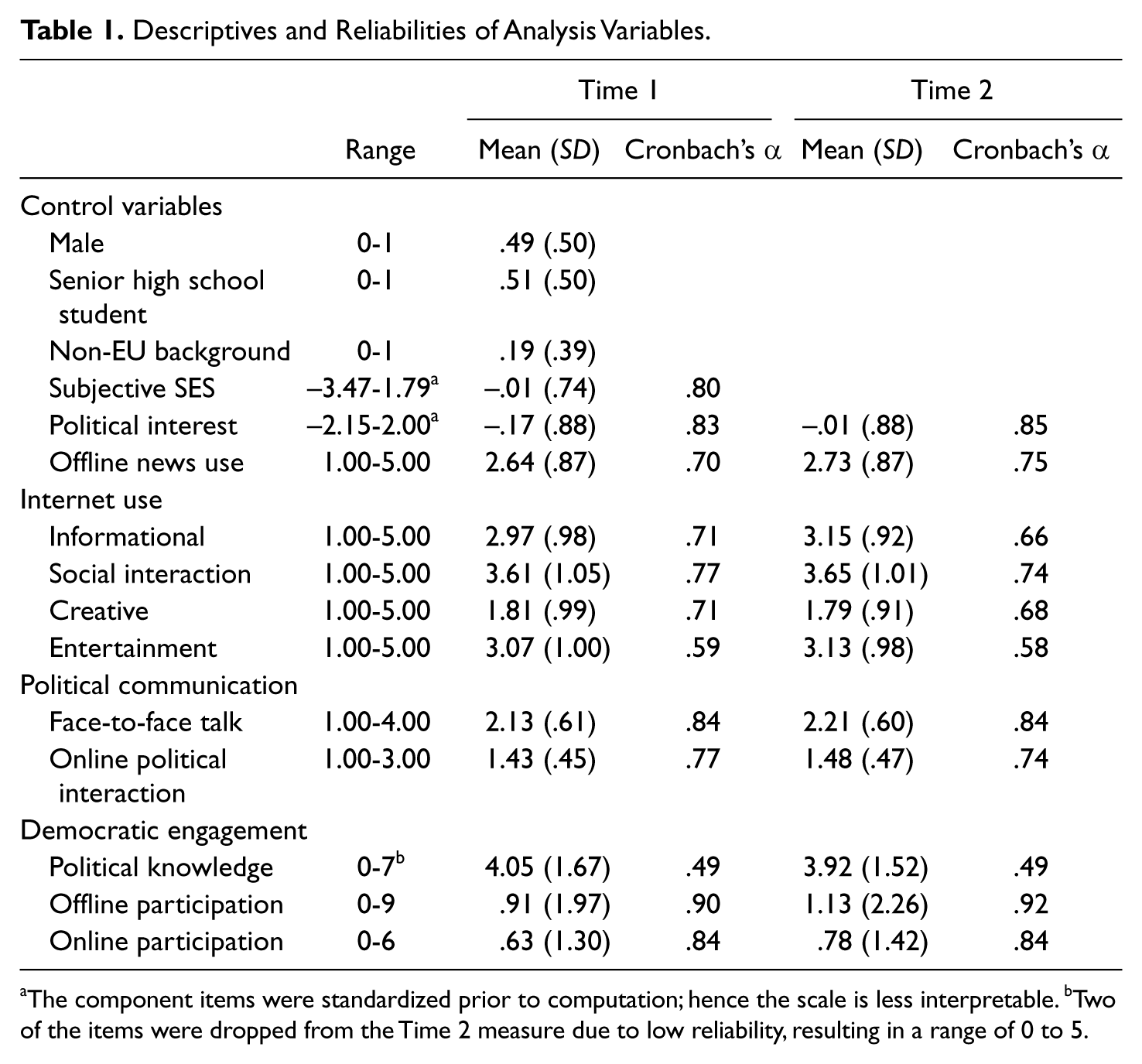
The component items were standardized prior to computation; hence the scale is less interpretable. bTwo of the items were dropped from the Time 2 measure due to low reliability, resulting in a range of 0 to 5.
The second factor (eigenvalue = 1.51, explained variance = 12.5%) comprised three items describing what we define as creative forms of Internet use: produce music and videos; share files with music, film, or video clips; and publish a personal blog (M = 1.81, SD = .94, Cronbach’s α = .71). Obviously, the above activities are supported by many social network sites and other online applications. However, from the point of view of form of activity, it should be observed that creative Internet use has a publishing element to it that is not present in interactional Internet use, which is restricted to friends and acquaintances.
The third factor (eigenvalue = 1.34, explained variance = 11.2%) comprised three items describing news and informational use of the Internet: read the daily newspaper; search for information or facts; and visit sites to learn more about interests (M = 2.97, SD = .98, Cronbach’s α = .71).
Finally, three items formed a fourth factor (eigenvalue = 1.14, explained variance = 9.5%), describing entertainment-oriented forms of online activity: play games; watch movies or video clips; and download music or films (M = 3.17, SD = 1.00, Cronbach’s α = .59).
Overall, factor loadings were clean, with three rotated cross-loadings above .20 and only one of these exceeding .30 (at Time 1 only). These results were replicated on the Time 2 data, yielding an identical factor structure among the items (total explained variance = 63.7%). In all, the results demonstrate that our proposed distinction between three forms of Internet activities—information, social interaction, and creative production—has satisfactory construct validity. Moreover, they are all distinct from recreational or entertainment-oriented forms of Internet use, the fourth factor in the proposed solutions.
Political Communication
Overtly political forms of communication, the proposed mediators in our theoretical models, were operationalized in terms of the frequency with which youths talked or interacted with parents and friends, face-to-face as well as in online settings. Exploratory factor analysis indicated that face-to-face political talk and online political interaction are two distinct but related (r = .39, p < .01) forms of political communication among adolescents.
Political talk: The youths rated how often they talked about a number of topics on a 4-point scale ranging from 1 = Never to 4 = Very often. The three politically oriented topics, which were repeated for talk with parents and with peers, included “Politics and societal issues,” “What you’ve heard on the news about what’s going on in Sweden and the world” and “Environmental issues” (M = 2.13, SD = .61, α = .84).
Online political interaction with friends was measured by four items describing various types of political communication with friends in online settings: linked news to friends; discussed societal or political issues with friends online; talked to friends online about something on the news; and sent music to friends with a good political or social message. The youths were asked whether they had done each of these activities during the past 2 months, using the following response scale: 1 = No, 2 = Yes, once, and 3 = Yes, several times (M = 1.43, SD = .45, α = .77).
Democratic Engagement
Youths’ political participation was measured by exemplifying a range of concrete acts that might be meaningful for young people to carry out in order to influence the political process as well as fellow citizens. Offline as well as online participation was measured. The respondents indicated whether or not they had engaged in each activity during the past 12 months (2 months for online activities), as follows.
Offline participation (range = 0-9, M = .91, SD = 1.96, Cronbach’s α = .90): distributed flyers with political messages (8.7% positive responses); contacted a politician or a civil servant (10.2%); written political messages or painted graffiti on walls (7.2%); worn a badge or a T-shirt with a political message (15.9%); participated in a legal demonstration or a strike (8.1%); participated in an illegal action/demonstration (6%); donated money to support a political group or an organization’s work (14.9%); written an article, for example, in an associational paper (9.8%); and participated in concerts with a political message (10.7%).
Online participation (range = 0–6, M = .63, SD = 1.30, Cronbach’s α = .84): signed a petition online (20.5%); organized an Internet-based protest or boycott (7.4%); participated in an Internet-based protest (13.4%); contacted authorities (6.4%); sent an e-mail to a politician (6.3%); and created a group on Facebook (or similar) about an important societal issue (9.8%).
Adolescents’ factual political knowledge was assessed using seven multiple-choice questions. Correct responses were coded as “1” and summed into an index of political knowledge ranging from 0 to 7 (M = 4.05, SD = 1.67, Cronbach’s α = .49). Nonresponses were coded as incorrect (“0”). Questions were as follows: To which of the following EU institutions are the members elected directly by the citizens in the member states? (51.7% correct); In which U.S. state is the film actor Arnold Schwarzenegger governor? (56.6%); Which of the following countries is not a member of the EU? (50.1%); All except one [of the following] have been the prime minister of Sweden, who? (59.2%); Which three countries have these flags? (90.2%); What does bistånd [foreign aid] mean? (66%); What is allemansrätten? [The legislated Right of Public Access to the countryside of the Nordic countries] (53.3%).
Identical items were used at the second wave of measurement, excluding the by then inaccurate question about California’s former celebrity governor. Unfortunately, the replacement item was unreliable, as was the question about election practices in the EU. Hence they were dropped from the Time 2 construct in order to preserve what internal consistency there was. Therefore, the Time 2 measure of factual political knowledge ranges from 0 to 5.
Control Variables
Gender (51% girls) and age cohort (50% junior high school) are self-explanatory. We also recorded whether the respondents’ parents were born outside of the EU (18.7% of the sample). This is a potentially pertinent ethnic-background variable because the turnout at elections is substantially lower among adult citizens in this group than the national average (Statistics Sweden, 2008, p. 86). Socioeconomic status was measured subjectively with five items on different response scales (e.g., If you compare your family to other families, do you think you have more or less money to buy things with? M = .01, SD = .74, Cronbach’s α = .80). Self-selection was held constant by including a measure comprising responses to three questions about youths’ interest in political and societal issues (M = .17, SD = 88, Cronbach’s α = .83). Finally, we controlled for frequency of news consumption via newspapers, television, and radio, measured on a scale ranging from 1 = Never, through 3 = 1 to 2 days per week, to 5 = At least 5 days a week (M = 2.64, SD = .87, α = .70).
Analysis Plan
Models were estimated in which the Time 2 levels of the outcomes were regressed on Time 2 predictors while holding the initial level of the dependent variable constant in the equations (i.e., a “conditional-change model”; Finkel, 1995). The assumption behind this specification is that the causal lag is short, relative to the 12-month time span between the waves of measurement. This assumption is substantiated by recent panel research suggesting that models defining the effects of communication on political outcomes in the short term receive better empirical support than alternative specifications (cf. Eveland et al, 2005; Eveland & Thomson, 2006). The specification permits the results to be interpreted as immediate effects of the predictors on democratic engagement, over and above what one would expect given previous levels of political engagement. The model thus accounts for the presence of inertia in social behavior as well as the likely tendency among highly active young individuals not to increase their level of knowledge and political participation over the 12-month period (i.e., regression to the mean). By controlling for previous levels of engagement when predicting current engagement, the model also indirectly accounts for unmeasured previous influences on the outcome (Davies, 1994).
The skewed distributions of the indexes of political participation violate the assumption of normally distributed residuals in ordinary least-squares regression (OLS). In addition, the variances of these variables are greater than their means and contain a large proportion of zeros, which indicate the appropriateness of assuming an overdispersed Poisson distribution of the outcomes (Atkins & Gallop, 2007). Thus the equations for political participation were estimated under the generalized linear framework, assuming a negative-binomial count distribution of youth political participation. OLS regression was used to predict political talk, online political interaction, and political knowledge.
Results
The summary regression results shown in the first column of Table 2 demonstrate that offline news use was a positive predictor of political knowledge, but informational Internet use (including news) was not. This is contrary to our expectation that online informational use should contribute uniquely to political knowledge even when traditional news consumption is accounted for. Additional tests showed that informational Internet use was also not related to knowledge when its offline counterpart was excluded from the model (b = .02, SE = .04, p = .47). Nor did it reach a conventional level of significance when political interest was taken out of the equation (b = .06, SE = .04, p = .13). Not until we removed the Time 1 control did it reach significance (b = .12, SE = .05, p < .01; the above results are not shown in the tables). These findings address Hypothesis 1, which received no support.
Predicting Democratic Engagement.
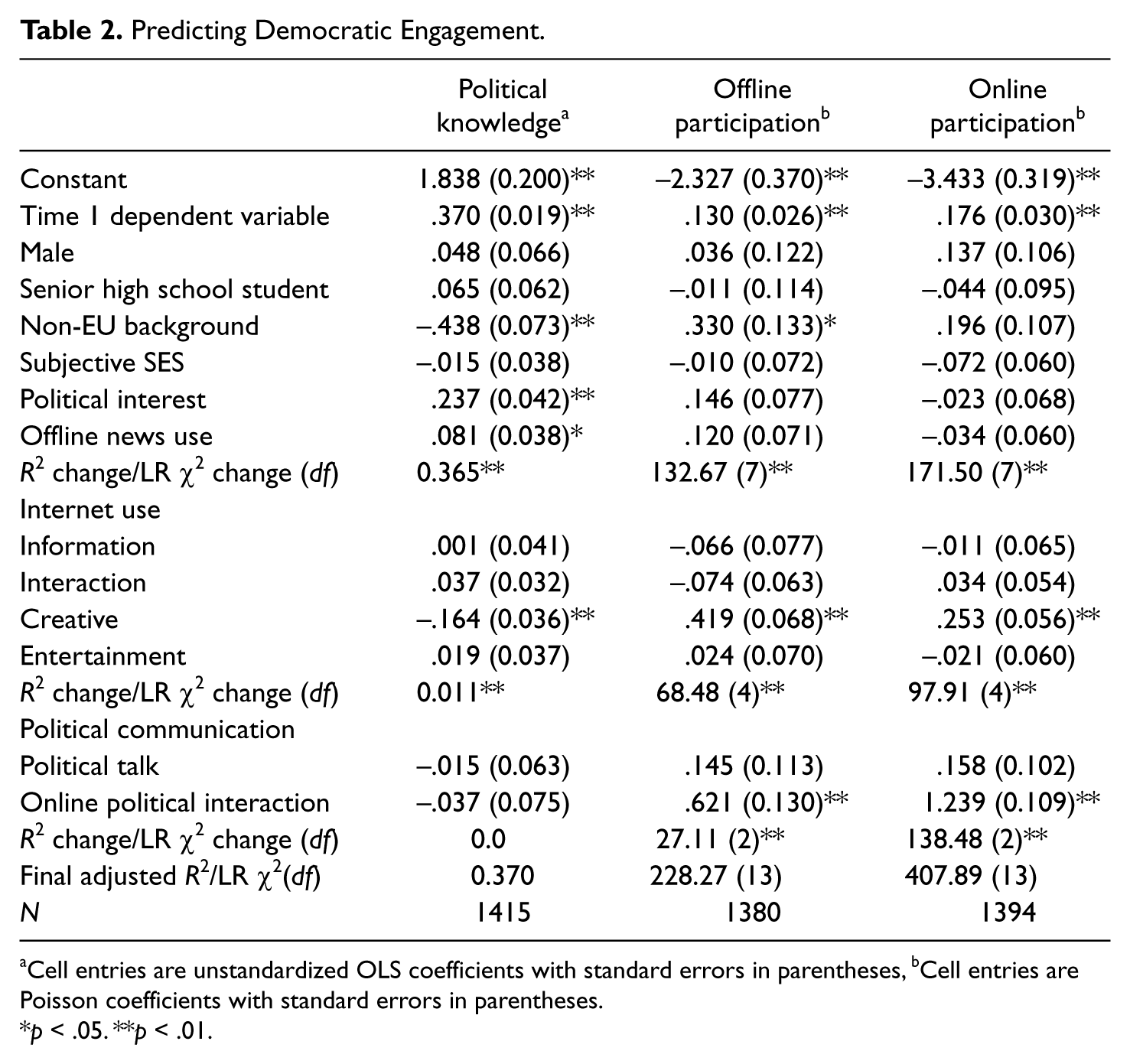
Cell entries are unstandardized OLS coefficients with standard errors in parentheses, bCell entries are Poisson coefficients with standard errors in parentheses.
p < .05. **p < .01.
The second block of Hypothesis 2 and Research Questions 1 and 2 address the effects of informational, interactional, and creative forms of Internet use on political talk and online political interaction. The results, summarized in Table 3, demonstrate that out of the four Internet use variables, informational use was the only significant predictor of political conversations among friends and parents (b = .05, SE = .02, p < .01). By contrast, the effects of informational, interactional, and creative Internet use were all significant, and accounted for no less than 9% of the individual variations in online political interaction, when controlling for the previous level of online political interaction and political interest. Although informational Internet use accounted for most of the variance (5.5%), the contribution of interactional (2.5%) and creative use (1%) is substantial, given the conservative nature of the model. These results support Hypothesis 2 and positively address our two research questions.
Predicting Political Communication.
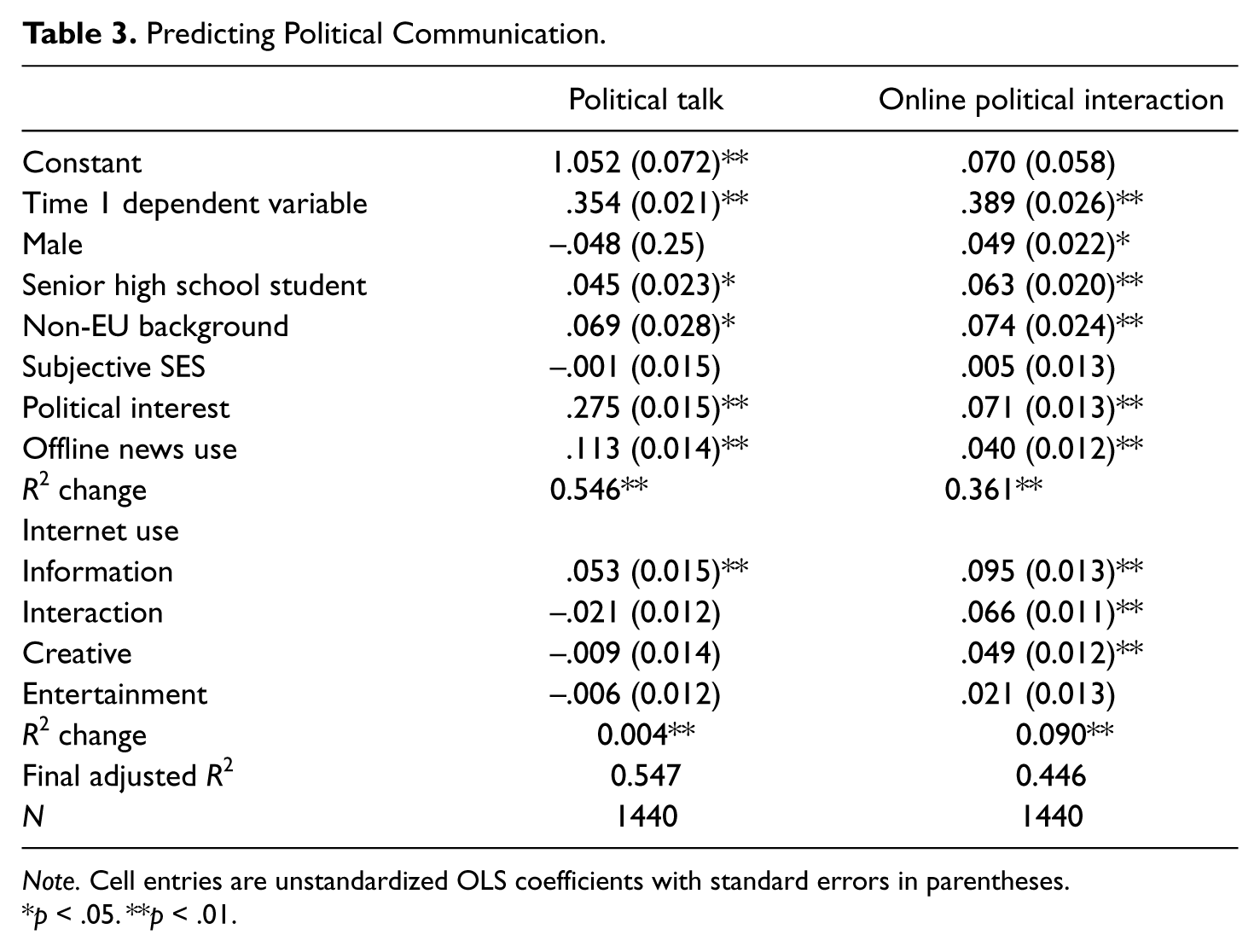
Note. Cell entries are unstandardized OLS coefficients with standard errors in parentheses.
p < .05. **p < .01.
Our third hypothesis stated the expectation that political talk among friends and with parents, and online political interaction, should positively predict youth political participation. The results in Table 2 show positive effects of online political interaction on offline (b = .62, SE = .13, p < .01) as well as online participation (b = 1.24, SE = .11, p < .01). The Poisson estimates suggest that an increase of one standard deviation in online political interaction (0.44) contemporaneously raises the number of offline political activities by 31% (100[e0.621 × 0.44 – 1]) and online activities by 72% (100[e1.239 × 0.44 – 1]). An increase in online political interaction of one unit raises the number of offline and online acts by 86% and 245%, respectively. Contrary to our expectation, however, political talk among friends and with parents was not a unique predictor of political participation.
This result mirrors previous findings suggesting that online political messaging is a stronger predictor of youth political participation than face-to-face conversations (Lee, Shah, & McLeod, 2013). Furthermore, as proposed by the citizen-communication model, the overall results should be viewed in combination with the significant effects of the three forms of Internet use on online political interaction. Employing the joint significance criterion of mediation, 2 they suggest that there are indirect effects of informational, interactional, and creative Internet use on political participation, through online political interaction. There is debate in the statistical literature as to whether or not an initial relationship between independent variable and outcome is indeed a necessary condition for mediation (Hayes, 2009). Even so, we observe that informational Internet use (b = .17, SE = .07, p < .05) and interactional Internet use (b = .12, SE = .06, p < .05) significantly predicted online political participation when online political interaction, the proposed mediator, was removed from the model (these results are not shown in the tables).
The fourth and final hypothesis posited a significant direct effect of creative Internet use on political participation, even with political talk and online political interaction included in the model. The results in Table 2 show that the data supported this expectation. Creative Internet use positively predicted political participation offline (b = .42, SE = .07, p < .01) as well as online (b = .25, SE = .06, p < .01). Specifically, the model predicts that an increase in the frequency of creative Internet use of one standard deviation (0.91) will result in contemporaneous increases in offline and online participation of 46% and 26%, respectively. Further analysis showed that the effects were slightly larger with political talk and online political interaction removed from the models (b = .49, SE = .07, p < .01, and b = .36, SE = .06, p < .01). However, this also seems to suggest that the lion’s share of the effects of creative Internet use on political participation is direct rather than indirect. Finally, we observe that creative Internet use was a significant negative predictor of political knowledge (b = –.16, SE = .04, p < .01).
Finally, it seems worthwhile to illustrate the positive effects of creative Internet use and online political interaction on political participation in a less formal manner. Among the adolescents who reported that they never engage in any creative Internet use (i.e., the 37% of the Time 2 sample who responded “Never” to all survey items in question), only 27% had done one offline political act or more, and only 24% one online act or more. Among the adolescents who reported at least some creative use of Internet-based media, nearly twice as many, 43%, had participated politically, offline and online.
Similarly, the share of active individuals among youths who did not engage in online political interaction (30% of the sample) was 22% and 17%, for offline and online participation, respectively. Participation was more than twice as common among adolescents who reported some online political interaction: 44% and 45%. While these illustrations ignore the other variables in the model, they do suggest that the practical implications of our findings are nontrivial.
Discussion
This study sought to contribute to the growing literature on the part played by Internet use in youth democratic engagement. By examining a number of theoretical ideas about the distinctive merits of three specific forms of Internet use—informational, interactional, and creative—we have promoted an approach based on the assumption that adolescents’ involvement in these forms of use is likely to have differential impacts on political knowledge and political participation. Overall, the empirical results include both replications of previous findings and novel results regarding the relationships of social and creative forms of Internet use with political participation. Viewing the empirical results in aggregate, we believe that the study contributes important insights into the mechanisms by which Internet use can promote youth democratic engagement.
Three main implications are particularly worth highlighting. First, the findings reproduce key elements of the citizen-communication model (Shah et al., 2005) according to which online news use (and other forms of informational media use) indirectly influences political participation through its positive effects on political discussion, both face-to-face and online. Also, in line with previous findings among adolescents within this framework (Lee, Shah & McLeod, 2013), the results suggest that the “online path” from informational media use to political participation is stronger than its offline counterpart.
The fact that informational Internet use seems to promote online political participation via online political interaction is not surprising. It might be partly explained by the proximity and interrelatedness of various online activities. By being active in searching for information and in participating in online discussions, the chance is high that adolescents are also offered relatively undemanding forms of political activity (such as signing a petition). However, the study also included a number of rather demanding activities in the construct of online political participation (such as staging Internet-based protests and boycotts). Furthermore, the study demonstrated positive indirect effects on offline political participation. This clearly indicates that mechanisms other than convenience are at work. As suggested by the citizen-communication model, it is reasonable to suppose that these online activities (information and online discussion) have positive influences on political participation in that they expose young people to diverse perspectives, develop their resources, and also motivate collective activities. Overall, the replication of the citizen-communication framework is a contribution whose merit should not be understated, as the generality of any social scientific model is contingent upon how well it receives support in different sociopolitical contexts.
The second contribution of the study is the evidence suggesting that informational Internet use is not the only form of adolescents’ engagement with online digital media that promotes political participation. Specifically, the results demonstrated positive effects of interactional and creative forms of Internet use on online political interactions. This indicates that adolescents who are actively involved in online social networking with friends and acquaintances, and adolescents who are frequently sharing their own and others’ content online, are more involved in online political interactions than others. The control variables rule out the possibility that these relationships merely reflect a general interest in political issues. They also rule out informational media use as confound since the model accounts for both online and offline news consumption. Finally, the conditional-change specification allows us to disregard the interpretation that this relationship merely reflects the contingency that adolescents who frequently discuss politics online are incidentally more involved in social and creative Internet use in general.
Thus the overall findings seem to suggest that the citizen-communication model should be expanded beyond online news consumption to interactional and creative forms of Internet use and possibly also call into question the centrality placed on informational content in this model. This is consistent with our proposed idea that youths’ engagement in social and expressive activities in online settings, while not necessarily being overtly political in character or intent, increases the likelihood that they are exposed to situations where political topics are discussed on the Internet.
As the third main contribution of the study, the findings establish a strong direct relationship between creative forms of Internet use and political participation. This finding replicates results found in previous studies on involvement in user-generated content among Belgian (Quintelier & Vissers, 2008) and Swedish adolescents (Östman, 2012). These cross-sectional studies demonstrated that the relationship between creative forms of Internet use and political participation held true even when accounting for a host of powerful control variables such as political interest and other forms of media use. They were also able to rule out that the findings were merely attributable to the convenience of the online setting since the correlation also extended to offline political participation. The evidence presented here is even more convincing. In addition to establishing the correlation under the above conditions, the current study demonstrates that the finding is not attributable to incidental acquisition of political information among active content generators. Indeed, this appears highly unlikely considering the negative effect of creative Internet use on factual political knowledge. Furthermore, the positive effect cannot be explained away by the mediation process evidenced by our expanded citizen-communication model because the intervening variable had only marginal effects on the direct relationships. Finally, the conditional-change specification demonstrates that the relationship holds statistically true even when previous levels of political participation are held constant. 3 In other words, although the mechanisms remain to be examined in more detail, these findings are consistent with the proposed idea that the expressive features of online creative production have the potential to encourage youths’ participation in public political activities.
Unexpectedly, we failed to demonstrate a positive relationship between informational Internet use and change in political knowledge. This result deviates from those found in previous studies, most notably findings reported among American adolescents and young adults in Pasek et al. (2006). There are at least two reasons why this relationship was not replicated. First, our study controlled for the lagged values of political knowledge as well as political interest, none of which were included in Pasek et al.’s less conservative model. Indeed, when we removed traditional news consumption and these controls, informational Internet use did reach significance. Second, it is possible that the null finding is attributable to attenuation due to low internal consistency of our knowledge construct (Cronbach’s α = .49). All told, the question of whether or not informational Internet use complements traditional news media in promoting political knowledge among adolescents remains no less open when the current findings are taken into account.
A more overarching implication of the study emerges when these findings are considered as a whole. In the theoretical part of the article, we suggested a conceptualization of Internet use based on general forms of mediated activities and experiences, without neglecting the unique facilities and opportunities of the Internet. While this research is not the first to bring together different theoretical ideas about the political consequences of information, social interaction, and creative production in the Internet literature (see, for example, Anduiza Cantijoch & Gallego, 2009; Flanagin, Flanagin & Flanagin, 2010; Polat, 2005), it is the first to examine these ideas empirically among adolescents and within the context of one and the same study. We have presented evidence indicating that interactional and creative forms of Internet use actualize distinctive mechanisms through which youth democratic engagement can be encouraged as well as hindered. While these expressive and interactive processes are not exclusive to Internet-based media use, they do result from adolescents’ involvement with popular online services that are more likely to be widely taken up by the generations arriving at political maturity in the 2010s than by their fellow adult citizens.
It is noteworthy that one research hypothesis not supported by the results is based on a long-established political communication model according to which transmission, acquisition, and processing of information is the pathway through which media use is believed to have an impact on engagement. Though the explanation of this nonsignificant result might be merely statistical, the evidence of alternative pathways presented here at least suggests that as the Internet generation grows up, and as the practices of Internet-based media use among the citizenry continue to evolve, researchers will have to complement traditional models of political communication when examining the part played by media use in citizen engagement. More specifically, our study strongly suggests that researchers on citizen engagement will be forced to pay less attention to news and political information in the traditional sense, and they will have to pay more attention to forms of media use, which involve young citizens in social interaction and public expression.
Footnotes
Declaration of Conflicting Interests
The authors declared no potential conflicts of interest with respect to the research, authorship, and/or publication of this article.
Funding
The authors disclosed receipt of the following financial support for the research, authorship, and/or publication of this article: This study was made possible by access to data from the Political Socialization Program, a longitudinal research program at YeS (Youth & Society) at Örebro University, Sweden. Professors Erik Amnå, Mats Ekström, Margaret Kerr and Håkan Stattin were responsible for the planning, implementation and financing of the collection of data. The data collection and the study were supported by grants from Riksbankens Jubileumsfond.