



Abstract
This study extends and tests advice response theory (ART) by examining message content, message politeness, and advisor characteristics, along with situational and recipient factors as influences on the outcomes of advice. Participants (N = 244) discussed a real, current problem with a friend, completing measures about the advisor, recipient, and situation prior to the interaction, and assessments of advice message qualities and outcomes immediately after. The findings not only support ART but also indicate the need to consider how evaluations of advice evolve over time.
Advice is a key form of support provided to those who have a problem to resolve or a decision to make (Bonaccio & Dalal, 2006; MacGeorge, Feng, & Thompson, 2008), across topics that range from child rearing (Reid, Schmied, & Beale, 2010), financial planning (Marsden, Zick, & Mayer, 2011), and health concerns (Colon-Ramos et al., 2009) to decisions about relationship partners (Adams & Williams, 2011), consumer goods (Mackiewicz, 2010), and entertainment options (Van Swol, 2011). In some cases, advice elicits one or more favorable responses: recipients may obtain useful information and insight, experience a reduction in distress, be persuaded to undertake an advised action, and feel positively toward the advice giver (Arora, Finney Rutten, Gustafson, Moser, & Hawkins, 2007). However, advice can also increase a recipient’s distress, undermine independent coping efforts, be ignored or rejected, and create negative impressions of the advisor (Servaty-Seib & Burleson, 2007). The ubiquity and potential impact of advice across multiple contexts has stimulated cross-disciplinary attention for close to two decades (Goldsmith, 1994; Harvey & Fischer, 1997), with studies examining a wide range of variables as influences on advice evaluation (for recent reviews, see MacGeorge, Feng, & Burleson, 2011; Van Swol, 2011). Recently, advice response theory (ART) was proposed as a synthesis and extension of this prior work (Feng & Feng, 2013; Feng & MacGeorge, 2010).
Some of ART’s basic claims are well supported because these claims had received considerable testing prior to the articulation of the theory. In particular, there is evidence supporting ART’s claim that certain message features influence advice outcomes. Multiple studies indicate that when advice recipients evaluate the content of advice messages (i.e., the advised actions) as more efficacious, feasible, and not having too many limitations, the advice is viewed as higher in quality, better able to facilitate coping, and more likely to be implemented (e.g., Feng & Burleson, 2008; MacGeorge, Feng, Butler, & Budarz, 2004). Advice that is viewed as more polite also produces more positive outcomes (e.g., Goldsmith & MacGeorge, 2000; MacGeorge, Lichtman, & Pressey, 2002), as does advice that confirms a recipient’s existing plan of action (Feng & MacGeorge, 2010). There is also substantial evidence that advice outcomes are influenced by characteristics of the advisor, including expertise, trustworthiness, likeability, and similarity to the recipient (e.g., Bonaccio & Dalal, 2010; Van Swol, 2011), though these effects of advisor characteristics appear weaker when examined in studies that also assess message features (Feng & MacGeorge, 2010).
However, ART goes well beyond predicting effects for individual advisor characteristics or message features. The focus of the theory is on the ways that advisor, message, and situational factors operate collectively and interactively, and have differential effects on a range of advice outcomes. In particular, ART indicates that (a) message features (as a group) have stronger effects than advisor characteristics, (b) the influence of advisor characteristics is mediated by message features, (c) diverse advice outcomes are differentially predicted by advisor characteristics and message features, and (d) situational factors act to moderate the influence of message features on advice outcomes (Feng & MacGeorge, 2010). To the extent that these claims are supported, the theory replaces variable-by-variable analysis with a more comprehensive framework for understanding how the message, advisor, and situation combine to influence advice recipient outcomes. However, because the theory is new, these claims have received very limited testing, and prior studies exhibit methodological limitations that create concern about the validity of some findings. Accordingly, the current study was designed with an emphasis on testing these more complex claims from ART (while, in the process, replicating tests of the basic claims). The following sections provide further elaboration of this rationale, and present the hypotheses to be tested in the current study.
Advisor Characteristics, Message Features, and Advice Outcomes
ART claims that advice message features (including message content and message politeness) have more influence on advice outcomes than do characteristics of the advisor, and that the influence of advisor characteristics is largely mediated through perceptions of message features (Feng & MacGeorge, 2010). This contention is based on the observations that features of messages should typically be more salient for message evaluations than qualities of the message source and that perceptions of message sources can bias message processing (Petty, Rucker, Bizer, & Cacioppo, 2004). Thus, according to ART, when recipients view advisors more positively (i.e., as more expert, trustworthy, etc.), this prompts more positive evaluations of advice (i.e., as more efficacious, polite, etc.), which in turn improves recipient outcomes (e.g., increases perceived message quality).
In support of these claims, two studies have found that advisor characteristics had weak direct effects on advice outcomes, but exerted greater influence indirectly through their impact on recipient evaluations of message features (content and politeness combined; Feng & MacGeorge, 2010) or message content (Feng & Feng, 2013). However, these studies also shared a key methodological limitation: recipient perceptions of advisor characteristics and message features were assessed well after the advice interactions took place (e.g., in Feng & MacGeorge, 2010, the average time since the advice interaction was 16 days). This raises the possibility that a stronger influence of advisor characteristics on advice evaluation may be distorted by inaccurate recall, and that if advice outcomes were assessed more immediately post-interaction, stronger and more direct effects of advisor characteristics might be observed. Consistent with this reasoning, relatively large effects of advisor characteristics such as expertise and trustworthiness have been observed in experimental, laboratory-based studies where advice utilization was assessed immediately after the advice was given (Sniezek & Van Swol, 2001; Van Swol, 2011). However, these larger effects may also stem from other aspects of these designs, such as advisor characteristics being made especially salient by the experimental manipulations, or recipients’ lack of expertise with regard to the experimental “problems” for which they receive advice. Given these competing accounts, we elected to test the following hypotheses derived from ART:
ART also contends that there are multiple relevant outcomes of advice interactions, and that advisor characteristics and message features have differential effects on these diverse outcomes (Feng & MacGeorge, 2010; MacGeorge, Feng, et al., 2004). Specifically, ART distinguishes between perceptions of advice quality (a global evaluation of the message), facilitation of coping (perception that the advice assists the recipient’s coping), and implementation intention (intention to undertake the advised action). Logically, the nature of an advised action should be especially critical to the decision about whether to perform it. Consequently, Feng and MacGeorge (2010) argued that message content should have a stronger influence on implementation intention than message politeness or advisor characteristics, and that politeness and advisor characteristics should be stronger influences on message quality and facilitation of coping than on implementation intention. Consistent with this contention, Feng and Feng (2013) reported that advisor characteristics had more influence on perceived advice quality than on intention to implement the advice. However, these authors did not assess either facilitation of coping, or the perceived politeness of the advice messages. Accordingly, the current study was designed to test the following hypotheses:
Situational Variation as a Moderator of Message Content Effects
ART draws from dual-process theories of message processing (Burleson, 2009; Petty et al., 2004) and suggests that some aspects of advice recipients’ problem situations can influence the extent to which they systematically process message content, and thus influence the extent to which this message content affects advice outcomes. Feng and MacGeorge (2010) reasoned that advice recipients are more motivated to scrutinize message content when their problems are more serious (and therefore in greater need of resolution), and consequently that advice outcomes are more strongly affected by message content when recipients’ problems are more serious. Their findings supported this contention, but have not yet been replicated. In addition, because Feng and MacGeorge’s data were obtained days or weeks after the advice interactions occurred, their study may underestimate the influence of problem seriousness on evaluation of the advice at the time of the interaction.
If the seriousness of recipients’ problems influences how they respond to advice, then other relevant situational factors may promote or detract from message scrutiny, with similar effects. One likely influence on message scrutiny is the advice recipient’s “solution uncertainty,” defined as uncertainty about actions to take to resolve the specific problem at hand. Essentially, this is a variation on the concept of recipient expertise (Sniezek & Van Swol, 2001), with a focus on expertise specific to problem-solving actions for the recipient’s particular problem, rather than expertise in a broader domain. In some situations, advice recipients have little or no idea of what actions to take to resolve their problems (i.e., high solution uncertainty), whereas in other situations they have considerable knowledge about potential problem-solving actions, and may have even selected a plan of action prior to obtaining advice (i.e., low solution uncertainty; See, Morrison, Rothman, & Soll, 2011). Prior experimental research indicates that advice recipients who have greater expertise in a problem domain (such as history or mathematics) are more likely to ignore or underutilize advice they receive on problems in that domain (Yaniv, 2004). Correspondingly, when advice recipients have lower solution uncertainty (i.e., already have some of their own ideas about what to do), they should scrutinize advice message content more critically than when they have higher solution uncertainty (i.e., are more “desperate” for ideas about what to do). Accordingly, we hypothesized the following:
Gender as a Moderator of Message Content
Although ART attempts to synthesize message, advisor, and situational influences on advice evaluation and outcomes, the theory is currently silent with regard to the potential impact of recipient traits. One recipient trait known to influence behavior and interpretation in supportive interactions is gender. Prior studies have already examined whether gender has a direct effect on advice evaluation (i.e., whether men or women respond more positively to advice). These findings are mixed, with some studies suggesting that men respond more positively (MacGeorge et al., 2002), others showing that women do (Michaud & Warner, 1997), and still others reporting no effect (MacGeorge, Graves, Feng, Gillihan, & Burleson, 2004); all reported effect sizes are small. However, gender may act primarily as a moderator rather than a direct influence on advice outcomes. Recent studies indicate that, on average, women are more able and more motivated to engage in extensive processing of supportive messages, due to greater cognitive complexity (a measure of social information-processing capacity) and expressive orientation (Burleson et al., 2009). Although this prior work has focused on emotional support or comforting messages, it suggests that advice message content may exert a stronger influence on women than on men. Accordingly, we examined the influence of gender on advice outcomes by testing the following hypothesis:
Method
Participants
College students enrolled in communication classes at a large Midwestern university were recruited for a study titled “Interactions With Friends.” Students were instructed to bring a friend to our laboratory. A total of 359 dyads (718 students) participated. The data analyzed in the current paper come from the participants who had the advice recipient role during the study and reported that they actually received advice from their friends during the interaction. Thus, the subsample we examined here consists of 244 advice recipients (166 females, 78 males) with a mean age of 19.6 (standard deviation [SD] = 1.76, range = 18-35). Participants were mostly underclassmen (114 first-years, 45 second-years, 49 third-years, 25 fourth-years, 9 fifth-years and beyond) and were pursuing a variety of majors (94 communication or other liberal arts, 149 outside of liberal arts, 1 unreported). Individuals identified their dyadic partners as best friends (29.9%), good friends (30.7%), casual friends (25.0%), roommates (5.3%), romantic partners (8.6%), or other (0.4%)
Procedures
Because this study is one part of a larger project focused on supportive interactions, the following description concentrates on procedures germane to the current analysis. Additional details are available from the authors. Each participant began by providing informed consent and completing the Current Problems Inventory (CPI), which was created by the authors for the current study. The CPI prompted participants to identify three to five problems in their lives that (a) were currently unresolved, (b) did not directly involve the other participant (friend), and (c) that they were willing to discuss with this friend in the research context. For each problem, participants completed single-item assessments of problem seriousness, level of distress caused by the problem, and the extent to which the problem had already been discussed with the other participant.
Upon completion, a research assistant collected the CPIs and directed participants to separate computers to complete measures that included participant demographic information and measures of trustworthiness, liking, and similarity (each completed these with regard to the other participant). Concurrently, the research assistant reviewed both participants’ CPIs and selected from the set of both participants’ problems the single problem that was rated as most serious from those problems that had not been previously discussed between them. (On the rare occasions that multiple problems met these criteria, the problem that caused the most distress was chosen.) Participants whose problems were selected in this way became the advice recipients in this study, and their friends became the advisors. These labels were not communicated to participants, but determined subsequent procedures. After the roles were determined, the recipient was prompted to complete measures that included the seriousness of the selected problem and the expertise of the advisor. Advisors completed measures unrelated to the current study.
Next, the research assistant separately informed participants that they would be engaging in a 15-minute, face-to-face conversation with each other. The advisor was also given a written statement of the recipient’s problem and asked to initiate conversation on a mundane topic (e.g., plans for the next school break) and subsequently to introduce the recipient’s problem “as naturally as possible, as you would do in a normal conversation with your friend.” (Because of the consent and CPI procedures, recipients were already aware that their problems might be the topic of conversation.) The advisor was not specifically instructed to give the recipient advice; therefore, some conversations included advice, while others did not. Only dyads in which the recipient reported that advice was given were included in the current study. Participants were then seated in the same room and instructed to begin conversation, which was video- and audiotaped. Participants interacted for up to 15 minutes, after which they were directed back to their separate computers to complete a final set of measures. For advice recipients, these included the message content, message politeness, and outcome variables. Advice givers completed questionnaires unrelated to the present study. Upon completion, the advice recipient and giver were debriefed and given confirmation of extra credit (if applicable).
Measures
Unless otherwise noted, all scales utilized 5-point Likert-type items (1 = strongly disagree, 5 = strongly agree). Confirmatory factor analyses (CFAs) and second-order CFAs were conducted in AMOS 20.0 to validate that (a) items loaded on the predicted first-order latent variables, and (b) that the first-order latent variables grouped into the predicted second-order dimensions (Byrne, 2010).
For all structural equation modeling (SEM) analyses, the fit statistics of Comparative Fit Index (CFI), Tucker-Lewis Index (TLI), and Root Mean Square of Approximation (RMSEA) were used to determine acceptable fit for the models, as recommended by Kenny and McCoach (2003). Three second-order CFAs validated overarching concepts of message content, message politeness, and advisor characteristics . First-order CFA was used to validate all other measures. All CFAs showed acceptable fit (i.e., CFI > .90, TLI > .90, RMSEA < .08; Kline, 2005). Variable internal reliability (Cronbach’s αs) exceeded .75, except for feasibility (.70), solidarity (.70), and tact (.66; see Table 1). Complete item sets are available from the authors.
Correlations.

Note. “L” indicates the latent variable score.
p < .06. *p < .05. **p < .01. ***p < .001.
Message content
The second-order variable of message content was composed of advice efficacy, feasibility, absence of limitations, and confirmation. A three-item scale developed by Feng and MacGeorge (2010) assessed perceptions of advice efficacy (e.g., “I thought the advised action could solve my difficulties”). Three-item scales developed by MacGeorge, Feng et al. (2004) were used to assess perceptions of advice feasibility (e.g., “The advice given was something I could do”) and absence of limitations (e.g., “I can see that the advised action has significant disadvantages” [reverse coded]). Confirmation (e.g., “The advised action is something I had already planned to do”) was assessed with three items developed by Feng and MacGeorge.
Message politeness
The second-order variable of message politeness was composed of scales designed to assess three types of politeness distinguished by Lim and Bowers (1991): Solidarity politeness shows that another person is included and liked, approbation conveys that another person is competent and praiseworthy, and tact displays respect for another person’s autonomy. Twelve items were developed by the authors or adapted from prior studies (Feng & MacGeorge, 2010; MacGeorge, Feng, et al., 2004) to measure perceptions of solidarity, approbation, and tact. Four items were written to assess solidarity (e.g., “The advice made me feel good about myself”), three items were intended to assess approbation (e.g., “The advice suggested I was lacking in ability [reverse coded]”), and four items were intended to measure tact (e.g., “The advice left me free to do what I want to do”). The CFA indicated that one of the approbation items did not load with the others, so it was dropped.
Advisor characteristics
The second-order variable of advisor characteristics was composed of assessments of advisor expertise, trustworthiness, similarity, and likeability. Four items were adapted from Feng and MacGeorge (2010) to measure recipients’ perceptions of givers’ expertise in regard to their specific problem (e.g., “My friend has experience dealing with problems like this”). Participants’ perceptions about their friends’ trustworthiness were measured with 10 items from the Individualized Trust Scale (Wheeless & Grotz, 1977) that were measured on 7-point semantic differential scales (e.g., 1 = is untrustworthy, 7 = is trustworthy). Six items from the attitude and background subscales from the Perceived Homophily Scale (McCroskey, Richmond, & Daly, 1975) were used to assess recipients’ perceptions about the degree to which they were similar to their friends, and were measured on 7-point semantic differential scales (e.g., 1 = doesn’t think like me, 7 = thinks like me). Five items from Rubin’s (1970) Liking Scale were used to measure the likeability of the advice givers (e.g., “My friend is one of the most likeable people I know”).
Problem seriousness
Three items used in prior studies of advice (Feng & MacGeorge, 2010) measured recipients’ perceived problem seriousness (e.g., “This is a serious problem”).
Solution uncertainty
Four items developed by the authors assessed the recipient’s solution uncertainty (e.g., “I have no idea how to resolve my problem”).
Advice quality
Recipients evaluated the overall quality of advice by responding to three items assessing perceived helpfulness, supportiveness, and effectiveness. These items have been used in multiple previous studies of advice (Goldsmith & MacGeorge, 2000; MacGeorge, Feng, et al., 2004).
Facilitation of coping
Participants completed eight items (e.g., “I am better able to manage any emotional distress I have from the problem”) developed by MacGeorge, Feng et al. (2004) to assess facilitation of coping.
Implementation intention
Three items developed by MacGeorge, Feng et al. (2004) assessed intention to implement the advised action (e.g., “I plan to follow the advice I was given”).
Results
Descriptive statistics, internal reliability statistics, and bivariate correlations are presented in Table 1. Data were screened for univariate, bivariate, and multivariate normality. Four variables were identified as leptokurtic and four multivariate outliers were identified. Analyses were rerun after transforming the variables and removing the multivariate outliers; the results remained consistent. Therefore, the original variables and outliers were retained.
Structural Model
A maximum likelihood latent composite structural equation analysis was run in AMOS 20.0 to analyze the path model shown in Figure 1 (Stephenson & Holbert, 2003). This path model represents Hypotheses 1 to 4, as well as correlations that were not directly hypothesized, but are consistent with prior theory and research (i.e., evaluations of message content are correlated with judgments of message politeness, and advice outcomes are correlated with one another; MacGeorge, Feng, et al., 2004; MacGeorge et al., 2002). The error variance for the observed indices of the latent variables was fixed to (1 − α) multiplied by the variance of observed variable, so that measurement error could be controlled and the model could be identified (Stephenson & Holbert, 2003).

Hypothesized model.
The fit statistics indicated that the initial structural model did not meet the criteria for acceptable fit, χ2 = 149.43, df = 65, TLI = .87, CFI = .91, RMSEA = .07 (90% confidence interval [CI] = [.058, .089]). The modification indices suggested that the items for efficacy and absence of limitations and for feasibility and approbation should have correlated error terms. Correlating these terms is consistent with the definitions of these constructs, as efficacy and absence of limitations have a related focus on the capacity of the advised action to resolve the problem, whereas feasibility and approbation are related to the recipient’s ability to address the problem. These error terms were correlated and the model was rerun. The fit statistics indicated that the model met the criteria for acceptable fit, χ2 = 120.87, df = 63, TLI = .91, CFI = .94, RMSEA = .06 (90% CI = [.045, .078]).
Tests for statistical significance of each path in the model are shown in Table 2, and Figure 2 displays the statistically significant paths. Consistent with Hypothesis 1, advisor characteristics had no direct influence on any of the three advice outcomes, whereas message content had a positive effect on implementation intention (β = .75, p < .001), and message politeness had a positive effect on advice quality (β = .71, p < .001) and facilitation of coping (β = .51, p < .001). In support of Hypothesis 2, advisor characteristics predicted message content (β = .26, p = .004) and politeness (β = .42, p < .001), explaining 7% and 17% of their variance, respectively. Furthermore, bootstrapping analyses with bias-corrected 90% CIs and a bootstrap sample of 1,000 indicated that advisor characteristics had an indirect influence on advice quality and facilitation of coping, mediated through evaluations of the message content and politeness (see Table 2). Consistent with Hypothesis 3, message content had a positive effect on implementation intention (β = .75, p < .001), whereas there were no significant effects for message politeness (β = −.13, p = .36) or advisor characteristics (β = −.09, p = .26) on this outcome. Supporting Hypothesis 4, message politeness had a positive influence on advice quality (β = .71, p < .001) and facilitation of coping (β = .51, p < .001), but no influence on implementation intention (β = −.13, p = .36). In addition, advisor characteristics had no effect on implementation intention (β = −.09, p = .26), but did have an indirect effect on message quality and facilitation of coping (see bootstrapping analyses reported for Hypothesis 2, above).
SEM Paths and Correlations.
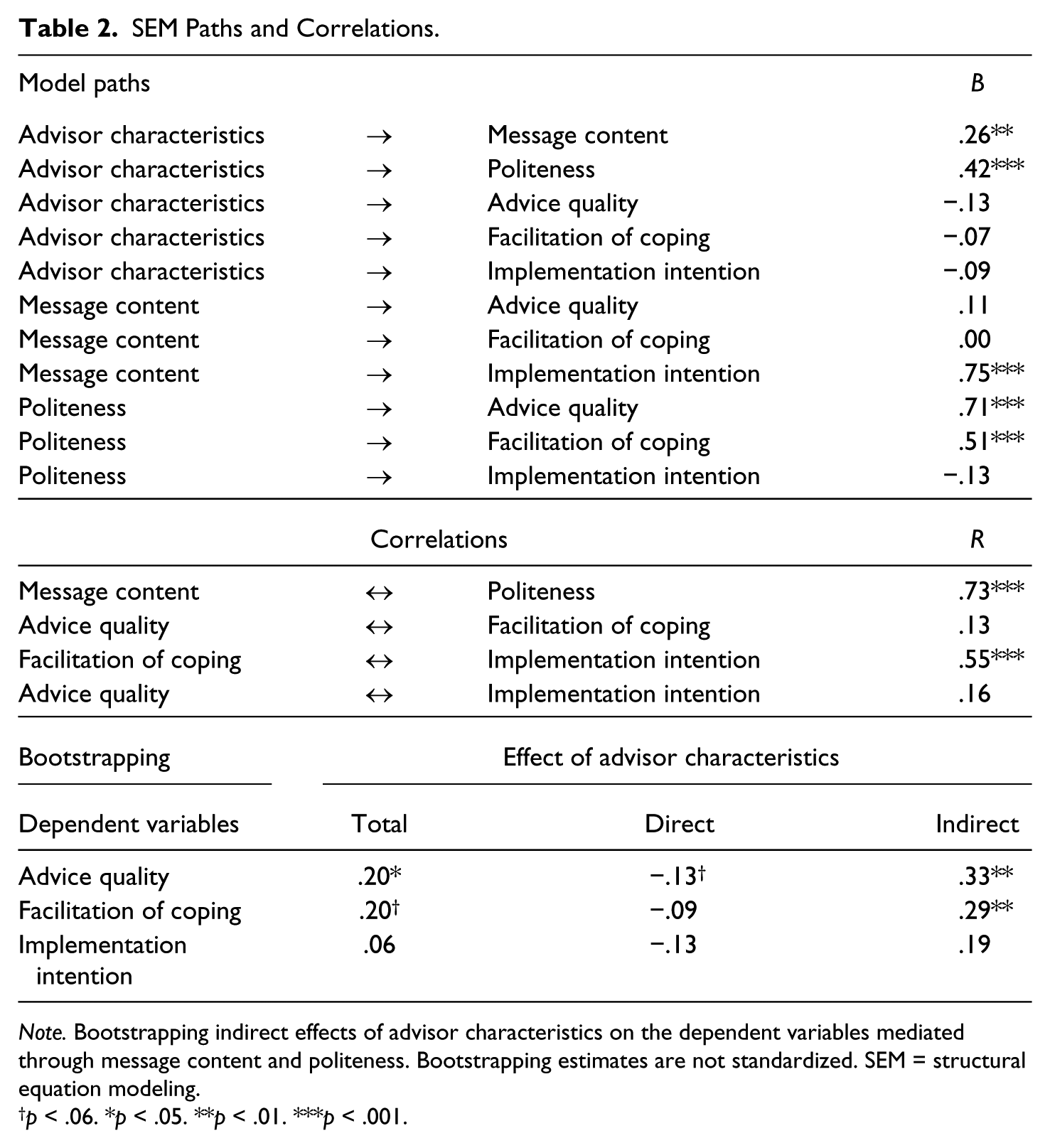
Note. Bootstrapping indirect effects of advisor characteristics on the dependent variables mediated through message content and politeness. Bootstrapping estimates are not standardized. SEM = structural equation modeling.
p < .06. *p < .05. **p < .01. ***p < .001.

Statistically significant model path.
Moderation Analyses
The moderating effects proposed in Hypotheses 5 to 7 were tested using hierarchical linear regression in SPSS 19.0. To represent message content, latent variable scores were computed from the observed variables (efficacy, feasibility, absence of limitations, and confirmation) using the regression imputation option in AMOS (Cziráky, Filipan, & Pisarović, 2003). Following recommended procedures to reduce nonessential multicollinearity (Cohen, Cohen, West, & Aiken, 2003), this message content variable along with problem seriousness, solution uncertainty, and gender were standardized before multiplicative terms were created to represent the hypothesized interactions. In the regression analyses, shown in Table 3, the message content variable and the hypothesized moderators were entered as a set in the first step, and the interaction terms were entered as a set in the second step.
Hierarchical Regression Analysis for Tests of Moderation.
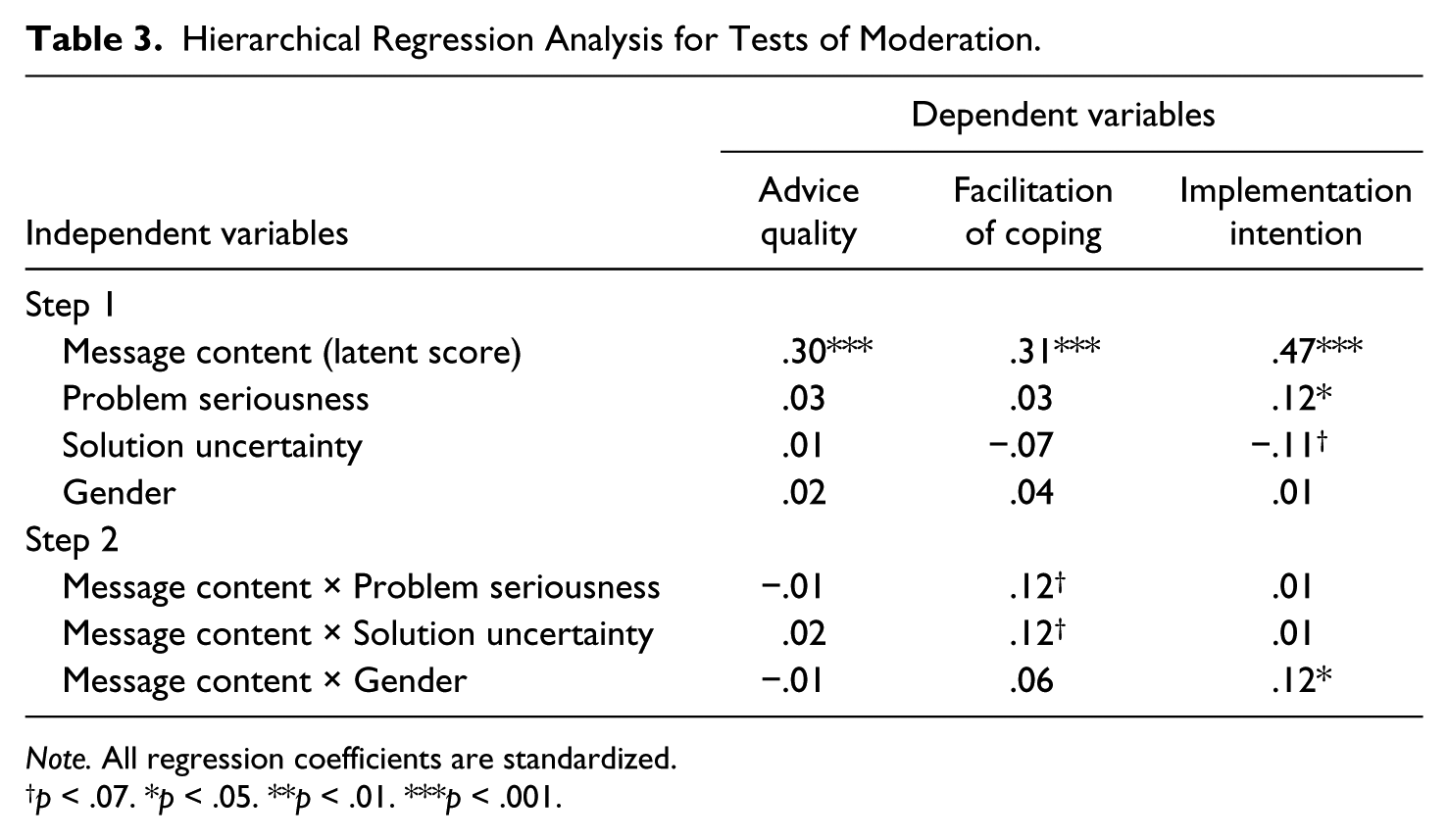
Note. All regression coefficients are standardized.
p < .07. *p < .05. **p < .01. ***p < .001.
The set of interaction terms did not predict any significant variance in advice message quality,
The set of interaction terms did not predict significant variance in implementation intention,
Discussion
The current study was designed to test and extend ART’s claims about how advisor, message, recipient, and situational variables work together to influence multiple advice outcomes. In many respects, the findings support ART’s contentions (Feng & Feng, 2013; Feng & MacGeorge, 2010), but discrepancies between current and prior findings also suggest that the evaluation of advice may vary as a function of when the evaluation occurs.
Message Content and Advisor Characteristics
Based on ART, we hypothesized that message features (content and politeness) would be stronger influences on advice outcomes than advisor characteristics, and that the effect of advisor characteristics would be mediated by message features. However, we also noted that in prior studies, the delay between receiving advice and evaluating it (Feng & Feng, 2013; Feng & MacGeorge, 2010) might have attenuated the influence of advisor characteristics, such that advisor characteristics would exhibit a stronger influence if advice outcomes were assessed more quickly post-interaction. Indeed, such reasoning was suggested by more substantial effects for advisor characteristics in experimental studies that assess advice utilization immediately post-receipt (Jodlbauer & Jonas, 2011; Van Swol, 2011). Consequently, we were somewhat surprised to find that the direct influence of advisor characteristics was not only weaker than the influence of message features (as hypothesized) but also nonsignificant for all advice outcomes. Furthermore, although indirect effects were observed (mediation via message features), this occurred only with the outcomes of advice quality and facilitation of coping, not implementation intention. Thus, these findings not only appear to support ART’s claims about the relative effects of advisor characteristics and message features but also suggest that the effects of advisor characteristics could be weaker and more indirect than previously claimed.
In an effort to interpret these results, we noted that the influence of advisor characteristics may have been attenuated by limited variance in several of our specific variables (expertise, trust, and liking), along with a relatively high average for trust (see Table 1). However, we also compared our means and SDs with those reported by Feng and Feng (2013) for their American sample, because they reported somewhat stronger effects for advisor characteristics (vs. message characteristics), and their measures of advisor characteristics were comparable (though they did not assess similarity). Our means and SDs for expertise and liking were strikingly close (e.g., for expertise, they reported a mean of 3.14 vs. our mean of 3.13, and their SD was slightly smaller at 0.63 rather than our SD of 0.86). Our assessment of trust did have a higher mean (6.14 vs. 5.75) and smaller SD (0.69 vs. 1.11). Thus, our weaker observed effects for advisor characteristics are probably not a result of ceiling effects or limited variance. Nonetheless, it is worthwhile to seek future samples with lower means and greater variance in advisor characteristics.
We also considered how our method may have influenced our results. Arguably, the current study’s protocol has better external validity than many experimental studies conducted with hypothetical advisors and scenarios, or survey studies in which evaluations of real-world advice were obtained well after the advice interactions occurred. However, an alternative view is that these different methodologies represent aspects of real-world variation in advising situations, and how advice recipients respond to characteristics of their advisors in those situations. As modeled in the experimental studies, there are real-world situations in which advice recipients have little prior knowledge of their advisors and restricted ability to evaluate the quality of the advice content (e.g., initial consultations with a financial advisor, lawyer, or doctor); in these contexts, salient characteristics of the advisors may well play a stronger role in determining advice outcomes than they otherwise would (Jungermann & Fischer, 2005). Similarly, there are times when advice recipients do not immediately utilize advice, and evaluations are made regarding advice that was given at some point in the past. In these cases, the specifics of message content may become more difficult to remember, and the perceived quality of the advice may depend more on easily remembered characteristics of the advisor. To further extend and refine ART, these possibilities should be tested in future research. For example, the influence of time since interaction could be examined in a study that obtains immediate and follow-up evaluations of the same advice interactions. If advisor characteristics assessed prior to interaction are weaker predictors of immediate advice outcomes and stronger predictors of outcomes at follow-up, this suggests that discrepant findings from prior studies are due to real shifts in how recipients evaluate advice over time.
Previous studies indicated that message content and politeness and advisor characteristics had somewhat distinctive influences on advice outcomes (Feng & MacGeorge, 2010), with, for example, implementation intention being more strongly influenced by message content than by message politeness or advisor characteristics (MacGeorge, Feng, et al., 2004). The current study’s findings supported our hypotheses, showing that message content had a stronger influence on implementation intention than did message politeness or advisor characteristics, and that advisor characteristics and message politeness had a weaker influence on implementation intention than on message quality and facilitation of coping. However, diverging somewhat from previous studies, the current findings suggest a segregated pattern of influence in which recipients’ implementation intentions are exclusively determined by perceptions of message content, while global perceptions of the message (message quality) and affective outcomes (facilitation of coping) are solely determined by perceptions of message politeness. The precision of these findings may reflect the use of SEM rather than separate regression analyses predicting the three dependent variables (Feng & MacGeorge, 2010; MacGeorge, Feng, et al., 2004); the use of SEM should have resulted in more accurate allocation of variance. However, Feng and Feng’s (2013) study, which also used SEM, still obtained a significant effect of message content on advice quality, albeit smaller than that for implementation intention. Thus, it is also possible that the current findings reflect differences between how advice is evaluated shortly after its receipt rather than days or weeks later, when the advice may have been implemented and the problem may have been resolved. If future research includes immediate and follow-up evaluations of the same advice interactions, and assessments of implementation and problem resolution at the follow-up, it will be possible to examine whether differences between immediate and follow-up evaluations are affected by these factors.
Situational and Recipient Factors as Moderators
Research on advice, including research designed to test ART, has given the greatest attention to the influence of advisors and advice messages on outcomes, and relatively less attention to situational features or recipient traits (Bonaccio & Dalal, 2006). However, examining how key features of situations and recipients affect the relationships specified by ART is important for establishing theoretical validity across the diversity of advice-giving interactions. Indeed, there is growing evidence that certain qualities of situations and recipients are important influences on the process by which advice is evaluated; these include the type and complexity of the decision-making task (Schrah, Dalal, & Sniezek, 2006; Van Swol, 2011) and the expertise of the advice recipient (Yaniv, 2004). For example, Van Swol (2011) found that advisor confidence was a stronger influence on advice implementation when the decision-making task was intellective (there was a single correct answer) rather than judgmental (no single correct answer).
In the current study, we examined problem seriousness, solution uncertainty, and gender as potential moderators of the influence of message content on advice outcomes. Feng and MacGeorge (2010) reported robust interactions between problem seriousness and message content for all three advice outcomes, and interpreted these findings as evidence that more extensive thinking about advice results in stronger influence of message content on outcomes. However, in the current study, the moderating effects of situational factors on the influence of message content were less evident, as they were limited to near-significant influences of problem seriousness and solution uncertainty on facilitation of coping. There was one significant moderating influence of gender, which indicated that women’s intention to implement is more strongly influenced by message content than is men’s. This finding is consistent with prior research indicating that women are more critical evaluators of supportive messages than are men, and more affected by variation in the quality of support they receive (Burleson et al., 2009).
A partial explanation for the lack of significant interactions is the lack of variability in one of the outcome variables, advice quality, which had a very restricted range, M = 4.17, SD = 0.54 (e.g., compared with Feng & Feng, 2013; U.S. sample: M = 4.14, SD = 0.83). Because all the advice given in the current study was exchanged between friends, there may have been less variation in perceived quality, or less willingness to evaluate the advice negatively, than in prior studies that did not restrict advisors to friends. Regardless of its cause, less variance makes it more difficult to detect effects if they exist. It is also possible that the immediate evaluation of the advice is a contributing factor in these findings. In Feng and MacGeorge’s study, participants had days, even weeks, in which problem seriousness might have motivated greater reflection on the advice, and thereby enhanced scrutiny of message content. Having to make an immediate post-interaction evaluation of the advice truncates the time available for scrutiny, potentially reducing the impact of problem seriousness or other situational factors on how advice is evaluated. This supposition could be tested using the previously described approach of obtaining immediate and follow-up evaluations of the same advice interactions. If greater problem severity (or other motivators of message processing) has a stronger moderating effect on the influence of message content in the follow-up evaluations than in the immediate evaluations, the apparently discrepant findings will be resolved.
Limitations
In prior sections, we have pointed to the strengths of our method, but it is essential to note its limitations as well. The conversations we obtained as data are clearly not identical to naturally occurring discussions, but the exact impact of the laboratory setting and recording procedure on the participants’ behaviors and evaluations is unknown. We noted, for example, that there were an unexpectedly large percentage of participants who did not report getting any advice (and whose data therefore had to be excluded from the current analyses). On one hand, this indicates that the current study’s protocol did not force people into giving advice, but it is unclear whether they would have given more advice outside of the research context. In addition to these limitations of the laboratory protocol, it is important to recognize that participants in this study were college students, aged 18 to 22 years, and predominantly Euro-American in ethnicity. A growing number of studies indicate that culture is an important influence on support-seeking processes, including the extent to which advice is viewed as supportive (Chentsova-Dutton & Vaughn, 2011; Feng & Burleson, 2006). Furthermore, advice-giving interactions between college student friends tend to focus on the types of problems experienced by emerging adults in the college setting, such as relationships with dating partners, friends, and parents; academic performance; and career choices. It is unclear the extent to which advice may be evaluated differently by mature adults with problems more typical of that group, but certain that a fuller understanding of advice as a communication process will result from studying its operation within a broad range of cultures, demographics, and contexts.
Applying ART
Across the myriad contexts in which advice is given (e.g., Marsden et al., 2011; Reid et al., 2010), there is a unifying concern with the effectiveness of advice—will it be received positively, will it benefit the recipient, will it be implemented, and will the advisor-advisee relationship remain unharmed? The current study combines with prior research to indicate that advice givers who want recipients to take the advised action need to attend carefully to the content of their messages, including the efficacy, feasibility, and limitations of the advised action. Indeed, convincing a recipient to undertake an advised action may require explicit “arguments” to support its efficacy, feasibility, and absence of limitations (Feng & Burleson, 2008). Furthermore, if the advice is not in line with a recipient’s previously intended course of action, the persuasive challenge becomes greater (Guntzviller & MacGeorge, 2013). The present findings also indicate that giving advice politely, with attention to the recipient’s needs for solidarity, approbation, and tact, will cause recipients to evaluate advice more positively and feel better able to cope with their problems. Even if politeness does not affect the utilization of the advice (or only does so in the long term), viewing advice positively and feeling better able to cope are still important recipient outcomes, perhaps especially within friendships and other close relationships, and where the exchange of advice will recur. Advisor characteristics, such as expertise, trust, similarity, and liking, may not be as influential as message features, but are nonetheless relevant to outcomes because they “bias” how advice is evaluated, with advisors who are rated higher on these characteristics being perceived as giving advice with better content. Finally, the seriousness of recipients’ problems, their uncertainty about how to resolve them, and their gender appear to have only limited influence on advice evaluation and outcomes, so that regardless of variation in these factors, advice givers can be encouraged to focus on giving polite advice with high-quality content, and perhaps to provide evidence of their positive characteristics as advisors (e.g., overt indications of expertise and trustworthiness).
Footnotes
Acknowledgements
The authors thank numerous undergraduates in the Brian Lamb School of Communication for their work as research assistants on the “Interactions With Friends” project, and two anonymous reviewers for their constructive criticism of earlier drafts of this article.
Declaration of Conflicting Interests
The authors declared no potential conflicts of interest with respect to the research, authorship, and/or publication of this article.
Funding
The authors received no financial support for the research, authorship, and/or publication of this article.