




Abstract
Emotion is often treated as unconducive to rationality and informed citizenship. For this reason, journalistic styles that personalize issues and elicit emotion are typically not taken seriously as information sources. The experimental study reported here tested these sentiments through the knowledge gap hypothesis. Eight investigative news stories, arguably important to informed citizenship (e.g., child labor, corruption in public housing administration, lethality of legal drugs), were each presented in two versions. One featured emotional testimony of ordinary people who experienced the issue, and the other did not—resembling the traditional view of news as cold hard facts. Emotional versions were associated with smaller knowledge gaps between higher and lower education groups. Moreover, the size of knowledge gaps varied across three memory measures: free recall, cued recall, and recognition. Contrary to the inimical role that is traditionally assigned to emotion, these findings suggest a facilitative role for emotion in informing citizens.
For close to a century, observers have toiled to explain why liberal democracies are struggling (Berelson, Lazarsfeld, & McPhee, 1954; Campbell, Converse, Miller, & Stokes, 1960; Wolfe, 2006). Ignorance of citizens frequently surfaces as one reason for why this way of governance fails to thrive and, over time, this viewpoint has culminated in vinegary accusations against the populace for their inattentiveness and apathy (Cappella & Jamieson, 1997; Hart, 1999; Lippmann, 1922; Putnam, 2000; Somin, 2009). Blame frequently finds a resting place on the news media for failing to inform citizens (Bennett, 1998, 2003; Patterson, 2000), and scrutiny of journalistic practices has become the focus of a growing body of research. A common underlying concern among these inquiries is an observed shift from the cold-hard-facts-only standard of objectivity to an approach that provokes emotion. According to critics, this inclusion of emotionality is an obstacle to an informed public (Habermas, 1962/1989; Miller, 2005) leading to low levels of political knowledge (Berelson et al., 1954; Converse, 1964; Gilens, 2001; Robinson & Davis, 1990) and persistent knowledge gaps among citizens from different socioeconomic segments of society (Ettema & Kline, 1977; Genova & Greenberg, 1979).
This way of explaining the lack of vigor in the democratic process does not blend comfortably with scholarship in neuroscience (Barry, 2005; Gazzaniga, 1998, 2010), political science (Brader, 2005; Marcus, Neuman, & MacKuen, 2000), sociology (Barbalet, 2002), as well as qualitative (Macdonald, 1998; Rucinski, 1992) and quantitative (Graber, 1990; Hsu & Price, 1993) media research that have advanced the idea that some emotional responses can (under certain circumstances) enable information gain and/or encourage political participation. Given the reported and lamented ignorance and apathy of citizens in democratic systems, it seems time to reconsider the very notion of informed citizenship and political participation. Traditional Enlightenment-inspired idealizations of citizens, who scan news media outlets for cold hard facts in preparation for rationally casting their next vote, need alignment with theoretical insights into the minds and lives of citizens. Indeed, informed and active citizenship might require emotional involvement and personal identification with social issues. The goal of the study reported here is to generate insights into this matter by assessing the informative potential of emotionally personalized news. In doing so, it also contributes to the 40-year-old body of knowledge gap research by testing education-based information acquisition gaps.
Informed Citizenship and Knowledge Gaps: A Pessimistic View
Some historians argue that American democracy was established as a real-world experiment in which the founding fathers put rules in place to create the institutional context for citizens to participate in governance (Starr, 2004). Central to this ideal is informed citizenship, 1 facilitated by governmental responsibilities to sustain infrastructure necessary for efficient, free flowing, and equal diffusion of information. Constitutive decisions to preserve freedom of expression, public access to information, and a postal service (Starr, 2004) exemplify this sensibility (Hamilton, 2005) that has since endured many revisions of democratic theory across the world.
Democratic theorists like Schumpeter (1942) and Barber (1973) see knowledge as a precondition for meaningful participation, 2 and recent evidence shows that public affairs knowledge is a strong predictor of political participation (Delli Carpini & Keeter, 1996; Verba, Schlozman, & Brady, 1995). While the news media’s role in facilitating informed citizenship is embraced in democratic theory (de Tocqueville, 1835; Habermas, 1962/1989), mounting research evidence points to superficial public affairs knowledge among the populace (Norris, 2001) and uneven distribution of knowledge along socioeconomic lines (Bonfadelli, 2002; Curran, Iyengar, Lund, & Salovaara-Moring, 2009). A 40-year-old body of research, mostly employing survey methods, has consistently found education-based knowledge acquisition gaps (Gaziano, 1997; Hwang & Jeong, 2009; Viswanath & Finnegan, 1996). 3 More recently, a few experimental studies have investigated knowledge gap formation at the cognitive level. Message-related variables such as news content (Grabe, Lang, Zhou, & Bolls, 2000) and media platforms (Grabe, Kamhawi, & Yegiyan, 2009; Kim, 2008; Yang & Grabe, 2011) have been examined as possible explanations for this inequity in information gain, linking the knowledge gap to a body of research on learning from the media (Eveland, & Dunwoody, 2002; Neuman, 1976; Neuman, Just, & Crigler, 1992).
Using the limited capacity model of information processing as it applies to media (Lang, 2000), experimental studies of the knowledge gap tested different levels of memory formation, including encoding (recognition tests), storage (cued recall), and retrieval (free recall). Consistent with survey research on knowledge gaps, experimenters used education as an indicator of socioeconomic status and found that lower education groups processed news information less efficiently than higher education groups (Grabe et al., 2009; Grabe et al., 2000; Grabe, Yegiyan, & Kamhawi, 2008; Kim, 2008; Yang & Grabe, 2011). Against the backdrop of macro-level survey and micro-level experimental evidence of persistent knowledge gaps between education groups, the first hypothesis is posed:
Two Journalisms
Tabloid, sensationalism, infotainment, human interest, personalized, and soft news are all terms used to refer to less desirable content and stylistic dimensions of journalism (Gripsrud, 2000). These journalistic forms are seen as falling short of generating information through objective means in service of a rational populace. The Habermasian (1962/1989) notion of a bourgeois public sphere fits this utopian recipe for a democratic way of being. But this line of thinking dates at least as far back as the preoccupation of Hellenic philosophy with protecting reason from becoming infected by emotion (Nussbaum, 1994) and it underlies the Cartesian separation of reason from emotion that served Enlightenment ideals well into the 21st century. Part of this ontological legacy is the problematization of emotion in democratic politics and the insistence on objectivity as the ground rule of conduct for journalistic practice (Schudson, 2001; Van Dijk, 1988). So ingrained is this paradigm that the adoption of every new media technology erupts in bouts of concern about how objectivity in journalism will be affected (Wartella & Jennings, 2000). Indeed, the early histories of radio and television are exemplars of this, observable in public degradation of these emerging media from within the then dominant newspaper industry (Conway, 2009; Gripsrud, 2000). As a newspaper reporter commented during the early adoption years of radio news: “The radio, through the magic inherent in the human voice, has a means of appealing to the lower nerve centers and of creating emotions, which the hearer mistakes for thoughts” (Jackaway, 1995, p. 65). Similarly, shifts in journalistic formats during the Penny Press of the 1830s, yellow journalism at the end of the 19th century, and 1990s tabloid television and newspaper formats stoked the same cycles of concern about objectivity in journalism (Altschull, 1990; Bird, 1992; Grabe, Zhou, & Barnett, 2001). 4
In response to these concerns, scholars have argued that there are confounded definitions and standards in the trepidations to preserve objectivity. Emotion can hardly be seen as the opposite of objectivity (Delli Carpini & Williams, 2001; Peters, 2011; Ward, 2005). Moreover, there is reason to question the cold-hard-facts-only status of journalistic outlets that are celebrated for being prototypes of objectivity. In fact, even the most revered journalistic exemplars employ frames and storytelling devices to suggest to news consumers ways in which to understand the news (Gamson & Modigliani, 1987; Gans, 1979). But perhaps most relevant to the study reported here is the push-back argument that non-valorized news formats, ones that might not meet the objectivity standard, have social and cognitive importance (Atton & Hamilton, 2008; Gripsrud, 2000; Macdonald, 2000; Örnebring & Jönsson, 2004; Tulloch, 2000). At the core of this line of thinking is a shift away from treating emotion as the enemy of informed citizenship and a willingness to consider the informative and engagement potential of emotion.
Some scholars who take this stance argue that there is an emotional deficit in political communication—“a lack of crafted, sustained attention to the emotional needs of the audience” (Richards, 2004, p. 342). Political scientists point to citizens navigating the information tide by paying attention to information that directly impacts their lives (Gamson, 1992; Graber, 1994) or their emotions (Brader, 2005; Marcus et al., 2000). They see promise for revitalizing the democratic processes by engaging emotion during political experiences (Richards, 2004) and thereby overcoming the state of malaise in collective action (Groenendyk, 2011). Emotion is also viewed as a catalyst of political information gain as suggested by the literature on affective heuristics (Lanzetta, Sullivan, Masters, & McHugo, 1985; Sniderman, Brody, & Tetlock, 1991) and affective intelligence theory (MacKuen, Marcus, Neuman, & Keele, 2007; Marcus et al., 2000). Neuro and cognitive scientists offer further support for the idea that emotion serves memory formation (Bartlett, 1932; Blaney, 1986; Damasio, 1994; Gazzaniga, 1998, 2010). Beyond (or perhaps as an explanation of) the discord about emotion’s role in facilitating informed citizenship is the matter of explicating and operationalizing emotion. Put simply, what is meant by emotion-producing news is nebulous.
Emotionalizing the News
There seems to be at least three major ways in which scholars see emotion entering news messages. First, typically referred to as sensationalism, the packaging styles of news have received cross-cultural research attention (Grabe et al., 2001; Grabe et al., 2003; Hendriks Vettehen, Nuijten, & Peeters, 2008; Örnebring, 2008) with evidence that the bells and whistles of attention-grabbing camera and editing techniques might serve information gain, furthering the information function of news. This, despite the widely held assumption that engaging news users emotionally might thwart informed citizenship. Second, arousing content (e.g., violence and catastrophe) has been associated with emotionality in news and shown to enhance memory (Brosius, 1993 5 ; Graber, 1994; Newhagen, 1998), especially for information that appears after negatively compelling material (Newhagen & Reeves, 1992). Message arousal has also been linked to the size of knowledge gaps (Grabe et al., 2008). Combined with titillating packaging, Brader (2005) found that emotional appeals (image and music) in televised political advertising stimulated information seeking and heightened the persuasiveness of messages.
A third apparent source of emotionality in news comes from personalization or exemplification. This typically refers to the inclusion of comments by laypersons that increases the vividness of news through emotional response (Hendriks Vettehen et al., 2008; Lefevere, De Swert, & Walgrave, 2012). It is this journalistic practice of putting an ordinary, non-expert, human face on newsworthy events that is less explored in research on the emotionality of news. It is of special interest to the study reported here.
One historical reference point for the journalistic practice of giving prominence to ordinary citizens is the muckrakers in American journalism during the late 1800s and early 1900s (Gallagher, 2006; Regier, 1957; Swados, 1962). At the time, journalism most centrally served the elite, whereas these investigative reporters focused on the plight of regular people on a wide range of issues including child labor, unemployment, false claims about patent medicine, and other public affairs issues. Through their reporting, they brought attention, political debate, and sometimes policy changes to issues affecting the lives of the non-elite. Another marker in this tradition of focusing on ordinary people is the so-called “vox pop” (vox populi) or voice of the people. It is a widely used production technique (Arpan, 2009; Daschmann & Brosius, 1999) giving voice to people who do not have representative function or expertise (Lefevere et al., 2012).
Personalization—as conceived of in this article—entails more than the mere appearance of ordinary or lay people (see Hendriks Vettehen, Nuijten, & Beentjes, 2005, 2006) in the news. Empathy-producing testimony has to be present in these appearances of ordinary citizens. Thus, their testimony of personal experience of issues is delivered with such emotional poignance that it has the potential to provoke identification and empathy in viewers (Aust & Zillmann, 1996). In this sense, personalization is distinguishable from the other two means (flashy packaging and arousing content) of emotionalization in that it might not provoke the well-documented automatic arousal response (Newhagen, 1998; Newhagen & Reeves, 1992). Instead, personalization is explicated here as potentially inciting emotional activation in a relatively slow-rising trajectory with identification and empathy with ordinary citizens (rather than increased physiological activity) as the end result. Hendriks Vettehen et al. (2008) offer tentative support for this explication. With an index of self-reported arousal items, the authors documented that the presence of a layperson speaking in news stories has a smaller impact than topic or production features like editing pace.
This empathy-producing dimension of personalization is what critics of television see as undermining the information value of news by being subjective (Graber, 2001) or “underdistanced” (Tannenbaum & Lynch, 1960, p. 382). The very idea of eliciting an emotional reaction like empathy is problematized as interfering with the process of becoming a rationally informed citizen. The substance of that line of argumentation is being challenged here but the idea that emotional testimony can provoke empathy in a viewer is not. In fact, drawing from existing bodies of literature, it seems highly likely that emotional testimony in news would trigger emotional responses in viewers.
One such body of evidence is emotional contagion theory (Hatfield, Cacioppo, & Rapson, 1994) that offers evidence of a human tendency to “automatically mimic or synchronize facial expressions, vocalizations, postures, and movements with those of another person and, consequently, to converge emotionally” (Hatfield, Cacioppo, & Rapson, 1992, p. 153). This automatic mechanism is activated with exposure to other people’s faces, voices, and behaviors that in turn lead to viewers adopting similar emotions. In personalized news, as explicated here, viewers would encounter regular citizens who are featured in a close-up (head and shoulders) camera shot that is conventionally used for interviews, testifying to their experiences with issues displaying emotion. It is reasonable to argue that this mediated scenario could facilitate emotional contagion.
Identification is another probable mechanism through which personalized news is likely to spur emotion in the audience. Unlike emotional contagion, identification is built on conscious imagination and empathy that leads to a temporary adoption of the perspective and identity of media characters (Cohen, 2001). Although widely studied in entertainment research, this phenomenon is underexplored in the context of news and other non-fictional media characters (Cohen, 2001). Yet, there is reason to expect that exposure to emotional experiences of ordinary people will invoke similar levels of empathy to what have been found for fictional characters.
Finally, as the exemplification literature (Zillmann, 1991; 2000) suggests, personalization of news might do more than impacting the affective systems of citizens—cognitive mechanisms are entangled with emotional activation. Among the different heuristics that are mobilized in learning public affairs information are base-rates and exemplars. Base-rates are quantitative (typically numerical) descriptions of events that are perceived as more accurate (Zillmann, 1996; Zillmann & Brosius, 2000) and more reliable (Gibson & Zillmann, 1994) than exemplars, which are demonstrations of the characteristics of events through testimony from ordinary people (Zillmann & Brosius, 2000). Exemplars are, however, more salient than base-rates (Busselle & Shrum, 2003), drawing more attention to news stories (Aust & Zillmann, 1996; Perry & Gonzenbach, 1997). 6 The literature on the personalization of news has also attracted attention in qualitative scholarship. In an analysis of British current affairs programming, Macdonald (2000) is cautiously optimistic that journalistic personalization has the potential for knowledge-forming properties because testimony of experiences might contribute to new knowledge. She also argued that personal case studies might open issues up for analysis and perhaps even lead to policy making (Macdonald, 1998).
Drawing on the limited literature that directly addresses personalization and incorporating indirectly relevant bodies of research (i.e., emotional contagion, identification with mediated characters, and exemplification), emotional personalization in news is distinguished from existing operationalizations of sensationalism in news. The key difference is that emotional personalization moves beyond news topics and packaging dimensions which have been shown to elicit automatic attentive responses and thereby facilitate memory-making processes. Emotional personalization is centrally concerned with giving a non-expert face to social issues through the emotional testimony of ordinary citizens who experienced them personally. Cognitively, resource allocation is likely to be more systematic, deployed through empathy and identification with the plight of comparable others. Existing research that provided the scaffolding for explicating emotional personalization in news for this study also enables expectations about the potential of this news format to enhance memory for news. This leads to the second hypothesis:
The influence of news personalization on knowledge gain across different education groups is unknown at this point. The following research question was therefore developed to guide the exploration of a possible interaction effect between emotional personalization and news user education level on knowledge formation outcomes:
The Time Factor
Since Bartlett’s (1932) classic study on memory decay, the idea that human memory records become less vivid and accurate over time has enjoyed substantial research attention. Demographic factors such as education, age, and gender as well as the type of memory (episodic, source, spatial, etc.) and stimuli characteristics (emotional dimensions and level, faces, digits, word pairs, etc.) have been tested for their influence on memory decay. Few of these studies have employed stimuli that resemble news reports.
Dixon, Simon, Nowak, and Hultsch (1982) tested the effect of a week delay on recall of three adult groups and found that although younger participants remembered text materials better than middle-aged and older participants, memory decreased over time for all three age groups. Meeter, Murre, and Janssen (2005) investigated memory for news among 14,000 participants worldwide asking questions about news that ranged from as recent as 2 days to 2 years old. Over time, participants forget information regardless of their initial learning rate. Some evidence point to education as inhibiting forgetting: the higher the education level, the slower the memory decay (Karrasch & Laine, 2003; Morrow & Ryan, 2002). In a knowledge gap study that employed a 48-hour time delay in measures of encoding, storage, and retrieval, Grabe et al. (2009) found evidence of greater memory declines for the low than high education group, across all three measures. This offers some point of traction for Hypothesis 3:
Emotionally arousing information has been show to remain remarkably stable over time (Christianson, 1992; Christianson & Loftus, 1991; Hamann, 2001) and therefore one can expect emotionally personalized story versions to be retained better than non-personalized stories with time delay. Moreover, Grabe et al. (2008) found that 48 hours after exposure to low and medium arousing news messages, the low education group’s recognition memory was better for the more arousing stories while the high education group remembered more information from the low arousing stories. Free recall was similar for the low education group: After 48 hours, they remembered significantly more stories that were at a medium than low arousal level. Story arousal in that study was operationalized in terms of topic—not emotional personalization—and is therefore not a strong fit for comparability to the manipulation used in the present study. Given the paucity of evidence related to audience education level, news personalization, and time delay, the following research question was formulated:
Method
Design
This experimental study employed a mixed factorial 2 (participant education level) × 2 (news story version) × 2 (time) model. Education was a between-subjects factor while the other two (story version and time) were within-subjects factors. To control for potential gender effects, equal numbers of men and women were recruited in each of the two education groups, for a total of 80 subjects. The low education group was made up of participants with no more than 2 years of vocational training whereas the high education group included participants who held a master’s degree at a minimum. The two levels of the news story factor were represented by the presence or absence of emotional personalization of eight news issues. Each participant saw all eight stories—half with and half without emotional personalization. Dependent variables were administered at two time points, 1 week apart, representing the two levels of the time factor. Four different story orders were constructed in a random order to control for the effects of order.
Stimuli
The decision was made to keep the reporter constant across stories to reduce the introduction of unwanted variance. Eight news stories were selected from a pool of 26 stories reported by Brian Ross from ABC news. Selection criteria included the presence of a case study with emotional testimony, the potential of the story to be re-edited into two versions, the civic importance of the story issue, and the potential for it to resonate across gender and socioeconomic groups. A story about off-road recreation vehicle accidents was excluded, for example, based on the argument that it might not draw similar levels of empathy and identification across gender and socioeconomic groups. Moreover, it was deemed a less weighty issue compared to say Toyota’s manufacturing flaws implicated in fatal accidents that also landed an innocent driver in jail. The eight chosen stories featured the following social issues:
Corruption at high levels of the Federal Public Housing Administration
Illegal immigrant child labor in agriculture
Widespread sleep-deprivation among airline pilots because of poor employee benefits
Toyota’s cover-up of malfunctioning brakes in one of their cars
Abusive and illegal debt collection practices
Sexual harassment of teenagers who work in the fast food industry
Animal abuse in the production of milk
A new wave of lethal but legal drugs.
The stories were all in-depth investigative reports that aired and became available on the ABC news website, some with additional material. Each was re-edited into two different versions: one with emotional personalization, the other without. The case study inserted into each story featured a person who had firsthand experience of the issue either as a victim or as close to someone affected by it. Rather than giving opinions on the issue, these non-experts shared lived experiences and displayed emotion. This includes sadness (quivering voice or tears) or anger and disbelief (raised voice, facial puzzlement). Through this emotional testimony, a human face was imposed on the issue. The non-personalized version featured no visual or audio reference to the people who appeared in case study testimony. Yet, both versions featured other experts and potentates in sound bites and the stories were visually, in script, and in every other way identical. All memory questions were drawn from non-personalized versions of stories. At an average, non-personalized versions of stories were shorter in duration at 2 hours 40 minutes, compared with 3 hours 37 minutes for personalized versions. This enables a direct test on the impact of adding personalization to a cold-hard-facts style of reporting.
Dependent Variables
Participant memory was assessed at two points, 1 week apart. At each of these times, three different memory measures (and a host of other dependent variables that served as distractor tasks) were administered. Recognition memory, widely regarded (see Donaldson, 1992) as a sensitive assessment of memory formation and indicative of the encoding stage, was assessed through twelve multiple choice questions per story (each with five options), about the informational content of the news stories. As mentioned above, all these questions were based on information contained in the non-personalized versions of the stories. Half the questions (six) were administered at Time 1; the other half (six) a week later at Time 2.
Cued recall was measured twice, in a different story chronology at different time points, using a prompt that was customized for each story: “What was the main point(s) of the story about (e.g., sexual harassment) that you watched?” Subjects were given about one third of a page to record their answers. In line with procedures used by Graber (2001), these open-ended answers were scored in collaborative coding sessions of 2 hours each, twice a week, over the course of a month. The template for scoring these answers came from agreement among three professional journalists about the main points of each story. Two men and one woman, currently working in broadcast journalism, were asked to watch the non-personalized versions of the stories and identify the main points in the same way that participants were asked to do. From open-ended comments, a high level of agreement about the main points emerged among the three journalists. For each story, there were at least two ideas that all three regarded as a main point and these were used to score participant responses, using the Robinson and Levy (1986) procedure. Every correct observation received one point, for a maximum of three points. Yet, if one of the journalist-identified main points was present in an answer, it was scored 4, regardless of how many other correct pieces of information were present. If both main points were there, a 5 (the maximum score) was recorded. An incorrect answer received −1 whereas no response or pure opinion received 0.
Free recall was measured using the following prompt: “Please list as many of the 8 stories you saw here today as you can remember. Use the space below to write down a sentence or a phrase to describe each.” One week later, when participants returned for further participation, they were asked to do the same. Responses were scored based on any correct identifying information about a given topic. In ambiguous cases (three in total), researchers came to a collaborative decision about the score.
Data Collection
The study was conducted in a small city in the Midwest. Low (n = 40) and high (n = 40) education participants were recruited from the local university community, neighborhood email distribution groups, churches, Craigslist.com, and other local charity organizations. Flyers were also posted publicly in the community. A number of screening questions about age and education were used to select subjects. Thus, age and education were measured during recruitment and again during participation. The high education group was mostly made up of PhD students who had already earned an MA degree but were continuing in doctoral programs, while the low education group had no more than 2 years of vocational training. A lower age limit was set at 25 to allow for higher education to accumulate and the upper limit was 55 years. This age bracket is also a coveted one in the news industry and recently showed increase in television news viewership after decades of decline (Potter, 2011). The average age of participants in this study was 34 (high education = 32; low education = 36). Two participants in the low and seven in the high education group were self-identified with a minority ethnic background.
An a priori power analysis revealed that with 76 subjects, effect sizes of .25 should be detected with .95 power in this experimental design. With 80 participants, this study is therefore adequately powered to detect effects. Data were collected from one subject at a time at two sessions with a 1-week interval. Upon first arrival at the experimental room, a subject was greeted, offered a bottle of water, and seated at a computer screen behind a desk in the room that resembled a study. The experimenter served as a guide through the multiple steps of participation by explaining procedures and being available for questions but was seated at a distance from the subject in the corner of the room in a lounge chair reading.
The first step was to answer a number of questions (paper and pencil) about familiarity with social issues. A participant then watched the eight news stories, pausing between them to answer evaluative questions that served as memory distractors. After completing the viewing, demographic and media use questions followed. Next were the memory measures, in the following sequence: free recall, cued recall, and recognition memory. Upon completion, a participant was thanked and scheduled for the second participation a week later. There were no stimuli to watch at Time 2. The same procedures were followed to collect memory data. The average duration of participation at Time 1 was an hour and 40 minutes. At Time 2, it was about an hour. At the end of the second session, participants were paid US$50, thanked, and debriefed.
Findings
Mixed (between and within subjects) ANOVA procedures were conducted on all memory measures: 2 (education level of participants: higher and lower) × 2 (version: stories are emotionally personalized or not) × 2 (time: immediately after exposure and a week later). Post hoc paired comparisons were done to identify the critical cells in significant models.
Testing the Knowledge Gap
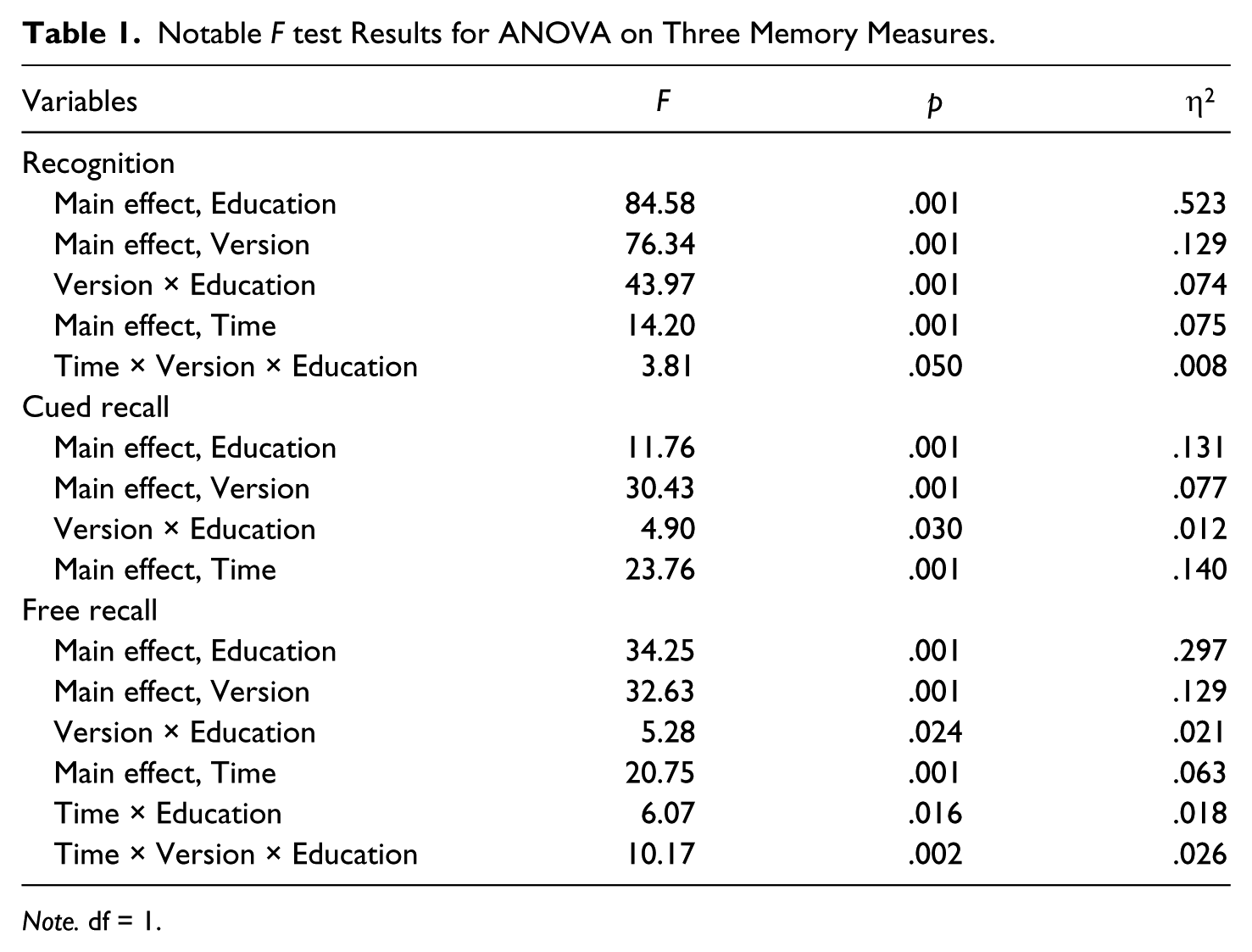
The first hypothesis prompted testing of knowledge acquisition gaps across education groups. Results unambiguously confirmed the knowledge gap across all three memory measures. That offers strong support of Hypothesis 1. Table 1 offers a summary of these findings. In recognition memory tests, people with lower levels of education (M = 5.91; SE = .28) fell behind those with higher levels of education (M = 9.66; SE = .28). Similarly, higher educated participants (M = 12.94; SE = .47) had higher cued recall scores than lower educated participants (M = 10.67; SE = .47). Finally, free recall scores confirmed that the higher (M = 3.50; SE = .07) outperformed the lower (M = 2.89; SE = .07) education group.
Notable F test Results for ANOVA on Three Memory Measures.
Note. df = 1.
Testing the Impact of Emotional Personalization
Hypothesis 2 proposed that emotionally personalized news story versions will have beneficial outcomes for memory formation. As Table 1 shows, there were significant main effects for news story version on all three memory measures, consistently showing that journalistic use of emotional testimony could facilitate knowledge acquisition for news. 7 Hypothesis 2 was fully supported.
Testing at the Junction of the Knowledge Gap and Emotional Personalization
Research Question 1 initiated a sequence of tests to assess the influence of emotion-provoking news personalization on knowledge acquisition across education groups. In short, there were significant interaction effects for version and education on all three memory measures, as depicted in Figures 1 through 3. Overall, the cognitive advantages associated with the emotionally personalized versions of the stories were more pronounced for participants in the low than high education group. Taken together, these findings offer strong support to counter the traditional journalistic practice of avoiding emotionality.

Interaction effect for the education level of participants and news story version on recognition memory.
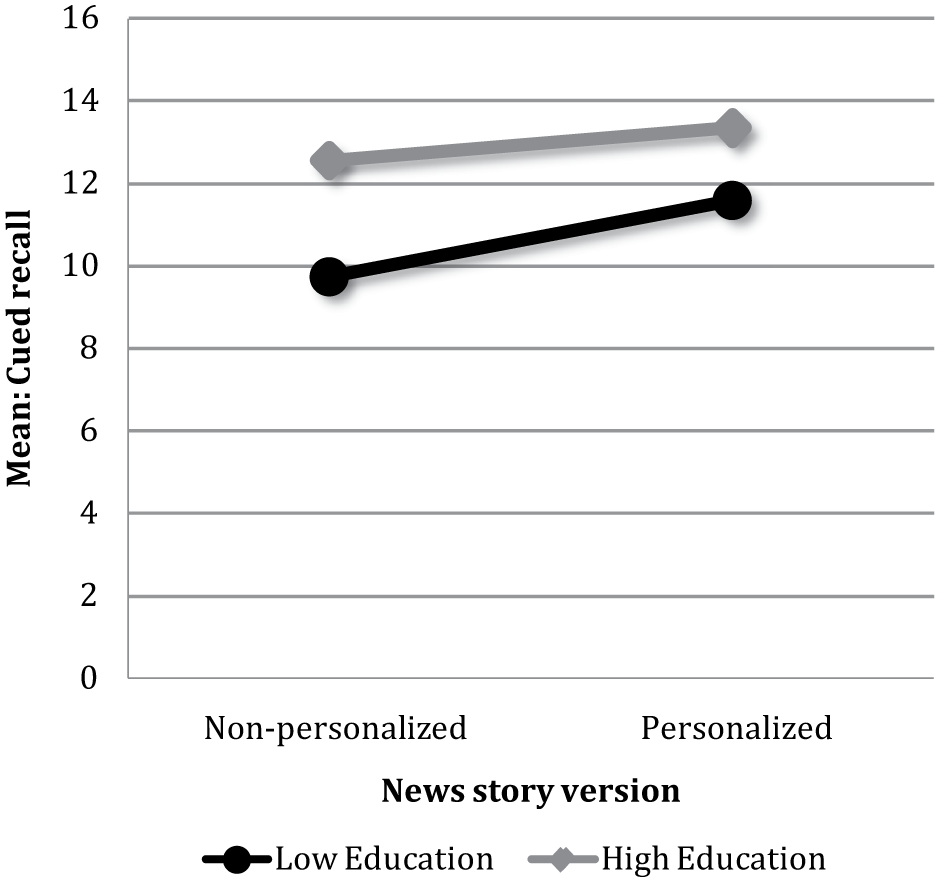
Interaction effect for the education level of participants and news story version on cued recall.
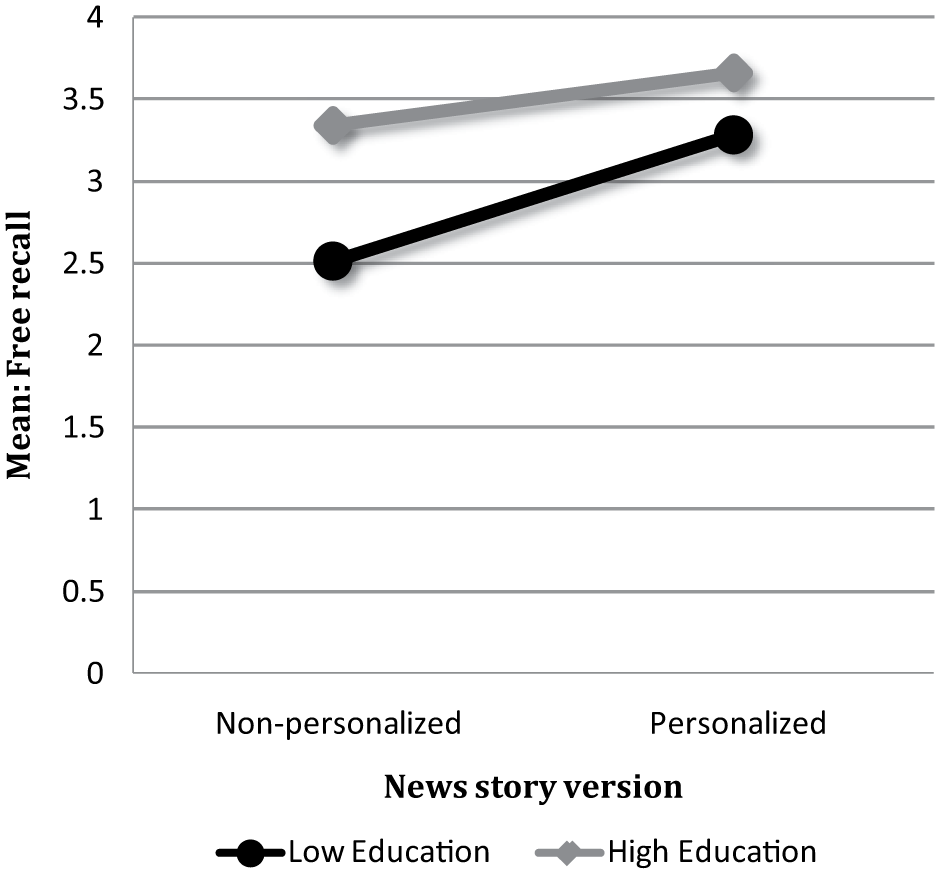
Interaction effect for the education level of participants and news story version on free recall.
Post hoc paired comparisons confirmed that emotional personalization has potential for narrowing the knowledge gap. Encoding data showed a persistent gap between education groups on both personalized, t(78) = −6.80, p = .001, and non-personalized, t(78) = −10.05, p = .001, stories. Yet, from Figure 1 it is clear that the gap narrowed on emotionally personalized story versions. Also relevant here is the non-significant difference, t(39) = −1.56, p = .126, between the high education group’s scores across the two story conditions. The low education group, by contrast, varied significantly t(39) = −10.32, p = .001, as is visually depicted in Figure 1, between story versions.
This pattern persisted for cued recall with significant knowledge gaps between low and high education groups for news with, t(78) = −2.86, p = .005, and without emotional personalization, t(78) = −3.54, p = .001. Yet, as Figure 2 graphically shows, there is a gap-closing trend on the personalized condition. Also worth noting, both education groups 8 scored significantly higher on recognition memory for emotionally personalized than non-personalized stories.
Free recall followed in step with recognition and cued recall data, as is clear from Figure 3. The knowledge gap is smaller for the personalized than non-personalized stories, yet large enough to be statistically significant for both versions: t(78) = −3.37, p = .001, and t(78) = −5.03, p = .001, respectively. Both education groups—low, t(39) = 5.24, p = .00, and high, t(78) = 2.69, p = .010—also recalled significantly more personalized than non-personalized stories.
Testing the Time Factor
Because lasting awareness and knowledge of social issues are conceptually linked to the idea of informed citizenship, the final hypothesis and research question actuated tests of time influence on memory formation for news. There were, as can be expected, main effects for time on all three memory measures (see Table 1) such that memory decayed significantly from Time 1 to a week later at Time 2. 9 Support for the third hypothesis (more memory decay over time for the low education group) was found in one of the three memory measures. Only free recall produced a time by participant education interaction effect, as depicted in Figure 4. Post hoc paired comparisons point to the low education group’s free recall decaying significantly, t(39) = 4.28, p = .001, while the high education group did not quite reach a statistically significant level, t(39) = 1.79, p = .080, of decay over time. It is also clear that there were statistically significant knowledge gaps at both time points, t(78) = −3.35, p = .001, and t(78) = −5.46, p = .001, respectively.

Interaction effect for time and education level of participants on news story free recall.
Finally, statistically significant three-way interactions for time, version, and participant education level on two of the three memory measures offer answers to Research Question 2. Three-way interactions can be hard to disentangle and interpret. Figures 5 and 6 might help to clarify the patterns that emerged for recognition memory and free recall. For both three-way interactions, it is clear that education-based knowledge gaps tend to be smaller for the story versions with emotional personalization than without it.

Three-way interaction effect for the education level of participants, news story version, and time on news story recognition memory.
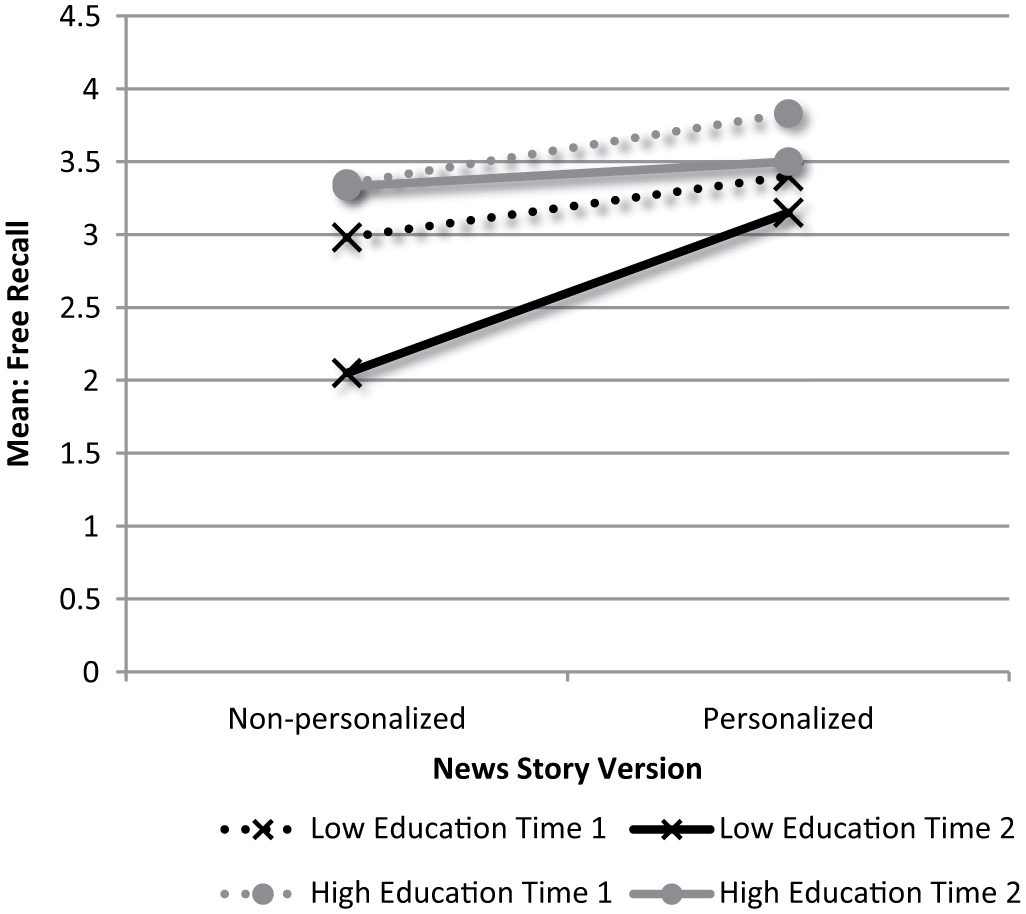
Three-way interaction effect for the education level of participants, news story version, and time on news story free recall.
Recognition test results (see Figure 5) show that the low education group generally had more memory decay than the high education group. Yet, some of the most interesting differences are associated with memory for the personalized story versions. The high education group’s memory for personalized stories increased slightly over time. In fact, the high education group had a significant, t(39) = 2.98, p = .005, gap between Time 1 and Time 2 recognition memory for non-personalized stories, but that gap did not exist for personalized stories, t(39) = 1.68, p = .101. The inverse was found for the low education group. Specifically, for the non-personalized story versions, their recognition scores varied across time at close to significant levels, t(39) = 1.88, p = .067. This gap widened to statistically significant, t(39) = 2.85, p = .007, levels for personalized stories. In this sense, one has to acknowledge that the high education group, over time, benefited more from seeing social issues featured in the emotionally personalized format than the low education group. Yet, this observation has to be contextualized in terms of the low education group’s recognition memory for the non-personalized stories. For Time 1, t(39) = −6.36, p = .001, and Time 2, t(39) = −6.57, p = .001, the low education group performed significantly better in recognition memory for stories with than without personal testimony. Thus, while lower educated participants had memory decay for personalized stories over time, these memory records were still significantly better than for non-personalized story versions. In this sense, the potential benefits of emotionally personalized reporting for citizens with lower levels of education become clear. The high education group, by contrast, did not have better memory for personalized versions at Time 1, t < 1, whereas they did have better memory for personalized versions at Time 2, t(39) = −2.16, p = .037. In conclusion, the benefit of emotional personalization is clear for the high education group, especially in preserving encoded details about news, over time.
Free recall results (see Figure 6) followed a pattern similar to recognition memory findings. Lines are converging for the personalized versions of stories whereas they diverge for non-personalized versions. Yet, there are noteworthy differences between the findings for these two memory measures, which each index a distinct memory-making process: Recognition memory is a measure of encoded information details, whereas free recall is indicative of general memory record retrieval for the news issue. High education participants did not seem to benefit as much from emotional personalization in retaining a general awareness (topical free recall) of the news stories over time as they did retaining detailed information about the issues (recognition memory). In fact, the difference for the high education group between story versions at Time 2 is not significant, t(39) = −1.16, p = .225, whereas that difference is statistically significant at Time 1, t(39) = −3.32, p = .002. This suggests that the high education group was able to form lasting memory for story details that were encoded during exposure to personalized stories but they did not display this cognitive ability in retrieving the topics of personalized stories. In fact, over time, the high education group developed significant free recall decay on personalized stories, t(39) = 2.48, p = .018, while this time gap does not exist for non-personalized stories, t < 1. The low education group also shows differences over time but in the opposite direction as (1) the high education group and (2) their own recognition memory.
First, in contrast to high education participants, the low education group’s memory decay for personalized news stories was not significant, t(39) = 1.43, p = .160, while (unlike the high education group) a significant time gap emerged on non-personalized story free recall, t(39) = 4.69, p = .001. Second, for recognition memory, the low education group had significantly better scores for personalized stories at Time 1. For free recall, there was no time difference for personalized stories. Another noteworthy finding is that the low education group performed better in free recall tests for personalized than non-personalized stories at Time 1, t(39) = −2.21, p = .033, and Time 2, t(39) = −5.73, p = .001. From this, one can conclude that emotionally personalized testimony in news stories might increase the likelihood that news viewers with lower levels of education will develop general awareness of social issues and retain that over time.
Concluding Comments
Broadly seen, this study’s robust main effects for emotional personalization on three different measures of memory formation align with contemporary cognitive and political science as well as media research. The evidence shows that emotional personalization of news increased encoding, storage, and retrieval of news information for citizens positioned at both higher and lower educational segments of society. Yet, the potency of this effect varied across the two education groups, with the lower education group generally benefiting more from emotional personalization than the high educated group. Specifically, the information acquisition gap between these two segments of the population remained significant for both versions of news stories, but the size of this variance narrowed for emotionally personalized stories. These findings confirm that educational levels drive information acquisition gaps. The cognitive capacities of people from high and low segments of society were found to vary, providing counter-evidence to explanations of knowledge gaps as the outcome of motivational or interest-level differences (Ettema, Brown, & Luepker, 1983; Ettema & Kline, 1977).
Knowledge implies information that lingers longitudinally—certainly well beyond experimental exposure. In this regard, the findings of this study offer methodological insights that could be of use in future studies of news information processing. Measuring memory formation immediately after exposure can be misleading if not followed by delayed measures. In fact, measuring delayed memory in experimental investigations of the knowledge gap seems necessary for the generalizability of findings. Memory decay for encoded personalized story details is more pronounced for the low than high education group. In other words, if the knowledge gap is assessed only shortly after exposure, emotional personalization might be seen as a more powerful gap-closer than what is likely to be observed a week later. On the other hand, free recall—a good indicator of news story awareness—produced smaller knowledge gaps over time for emotionally personalized stories. In an age where information is available in practically unlimited volume, 24/7, at fingertips, retaining informational details might become less important. Yet, comprehension and awareness of issues as they evolve require long-term memory for detailed information. Measuring delayed memory enables insights into these retention trends. It is also clear that citizens at lower levels of the social hierarchy retained over time more general topical awareness rather than specific details from personalized stories. The mirror opposite is true for the high education group. They retained details rather more so than low-level awareness of personalized story topics. These documented differences in long-term issue awareness and detailed information retention of the different socioeconomic segments of the society furthers our understanding of the intricacies of the process of knowledge acquisition gaps. By focusing on different stages or kinds of knowledge (formation), we will be better positioned to assess the impact of the new media landscape on knowledge disparities. It might very well be that high education groups habituated to sifting through vast volumes of information by encoding more deeply what compels them. By contrast, citizens with lower levels of education might use a different cognitive style to scan the information-rich environment. They might indeed be overwhelmed by details but extract and retain from the information landscape a more panoramic awareness. These conclusions are speculative and deserve further research attention.
As robust as the knowledge gap has been across studies, including in the one reported here, it does seem vulnerable to shrinkage. Indeed, news presentation styles such as emotional personalization are shown here to have such outcomes. The mechanisms at work in facilitating memory formation for emotionally personalized stories were not within the scope of this study, but are certainly a fertile territory for future research. Specifically, the operationalization of emotional personalization here as (1) identification and (2) empathy with ordinary people who are not fictional characters deserves more attention in studies of informed citizenship. Indeed, identification and empathy with ordinary people in fiction have been shown as not only conceptually related but also affecting cognitive processing of mediated messages (Zillmann, 1991). It is reasonable to expect that news messages would produce similar outcomes. By basing future news research on media fiction scholarship crosses the historical separation of news and entertainment research. Bridging this schism might advance paradigm reform in ways similar to how cognitive and political scientists are softening the separation of emotion from reason. As Damasio (1994) reminds us, on the basis of neurological evidence, humans are not primarily thinking beings who also feel but feeling beings who also think.
Counter to the gist of Enlightenment thinking that separated emotion and reason in binary opposition to each other, these two human affordances are shown here to be complicatedly entangled. In finding this, we add evidence in favor of revising traditional diagnoses for the struggling state of democratic societies. Ignorance of citizens, attributed to either their cognitive limitations or the general state of apathy, is routinely raised as reasons for why democracies fail to deliver on the potential to facilitate a participatory way of life. The way news has been offered to citizens might indeed not be the most effective in achieving information gain or move them to engagement. Putting faces on social issues—thus showing their impact on the lives of ordinary people—might stir emotional involvement that could benefit knowledge formation. Ultimately, this could lead to smaller knowledge disparities between citizens at different layers of the socioeconomic hierarchy. Thus, the traditional commitment of journalism to report cold hard facts only might not be the most effective route to informing the populace. It is certainly time to see the limitations of this journalistic practice in the contemporary media landscape where citizens share highly personalized experiences of everyday life, practically in real time, through mobile audiovisual devices. Yet, what these devices offer in terms of evolving means of political participation deserve scrutiny. Optimism about the ability and popularity of posting, liking, and sharing politically and socially relevant articles and images might be inflated. Pessimistic accounts call this excessive involvement in less effortful online political activities slacktivism, and criticize it for side-stepping offline political engagement (Morozov, 2012). These online activities may have the markers of political activism, yet as relatively non-costly and virtual action, they may not fuel traditional forms of political participation, like voting, attending rallies, and supporting political campaigns. To put it bluntly, old school as voting might be, it remains central in how citizens exercise self-governance. The argument goes that an online click to like a cause is hardly a participatory equal to casting a vote. The matter to tackle then is whether personalization of news fuels more than cognitive involvement: Could it be that putting a human face on social issues would provoke empathy and behavioral engagement with social issues?
Footnotes
Acknowledgements
The authors would like to thank Ozgur Kayhan for his help to build the stimuli for this study.
Declaration of Conflicting Interests
The authors declared no potential conflicts of interest with respect to the research, authorship, and/or publication of this article.
Funding
The author(s) disclosed receipt of the following financial support for the research, authorship, and/or publication of this article: This study was supported by an internal grant-in-aid from Indiana University.