




Abstract
A mathematical function for belief trajectories in response to a series of negative incongruent pieces of information was proposed based on the sequential information integration model (SIIM), and the function was tested in two studies. In Study 1 (N = 167), political candidates’ party affiliation information was given for initial candidate evaluation, and then belief change over time (11 times) in response to a series of negative incongruent information about the candidates was observed. Consistent with the hypothesized mathematical function, in both studies, belief trajectories monotonically decreased. In Study 2 (N = 177), negative incongruent information regarding candidates caused a greater over-time decline in candidate evaluation for those who did not receive initial issue-position information than for those who did receive initial issue-position information, and a greater over-time decline in candidate evaluation for those with weak party identification than for those with strong party identification was observed.
Keywords
Attitudes and beliefs are formed based, at least in part,on information relevant to the target object (Anderson, 1971; Fishbein & Ajzen, 1975). In most cases, the relevant information is not limited to one piece of information given at one time but consists of multiple pieces of information that are given over time. One of the fundamental questions in the study of attitude and belief change is how multiple pieces of information are integrated into an attitude or a belief (Anderson, 1971). Many researchers have proposed models for judgment when multiple messages are integrated (Dawes & Corrigan, 1974; Fishbein & Ajzen, 1975, for general judgments; Hoffman, 1960, for clinical judgments; Kelley & Mirer, 1974, for political judgments such as those involved in voting); however, the best known model for information integration and judgment is information integration theory (IIT, Anderson, 1971, 2009; Anderson & Farkas, 1973). IIT focuses on essential features of external information (i.e., their value and weight) and mathematically delineates the fundamental relationships between input information and judgment. IIT is considered to be an important model of attitude change (Eagly & Chaiken, 1993; Littlejohn, 1989; Petty & Cacioppo, 1996), and dual models of attitude change (i.e., the elaboration likelihood model and the heuristic systematic model) incorporate information integration as part of their models. 1 IIT’s key ideas have also been applied to various communication phenomena (Boster, Mayer, Hunter, & Hale, 1980; Fink & Cai, 2013).
Even though the static processes of information integration (i.e., how input information results in a belief) have been extensively studied, the dynamics of information integration (i.e., how beliefs evolve over time responding to one piece or multiple pieces of new information) have not been extensively studied. Several studies have examined belief trajectories to trace out the over-time change of beliefs (Brehm & Wicklund, 1970; Chung & Fink, 2008; Chung, Fink, & Kaplowitz, 2008; Chung, Fink, Waks, Meffert, & Xie, 2012; Kaplowitz & Fink, 1982; Vallacher, Nowak, & Kaufman, 1994). However, no studies have attempted to predict and test belief trajectories in response to multiple pieces of information. In addition, belief trajectories reflect a person’s initial beliefs. In other words, those receiving the same series of messages respond differently if their initial beliefs were different. The present study predicts and tests belief trajectories to investigate the dynamics of information integration.
Chung et al. (2012) proposed the sequential information integration model (SIIM) by extending IIT to predict belief positions over time. They found support for the SIIM by analyzing participants’ belief trajectories created in response to alternating congruent and incongruent information about political candidates. Congruent information here refers to information that is supportive of a participant’s favored candidate and not supportive of the participant’s unfavored candidate. Incongruent information is the opposite. Chung et al. (2012) tested SIIM’s prediction of the amplitude of oscillatory belief trajectories but did not test the mathematical model with regard to the overall pattern of the experimentally induced belief trajectories. The present study tests the SIIM and predicts belief trajectories of candidate evaluations for individuals whose initial candidate evaluation is formed with different amounts of information. To test the SIIM, the present study used a series of incongruent pieces of information about candidates as input information, which allows predicting the mathematical function of belief trajectories for initial beliefs with different amounts of information.
IIT and the SIIM
IIT
IIT was first proposed by Anderson (1965). Since then, Anderson and his colleagues have deepened and expanded the theory, testing it in various judgment domains (see Anderson, 2008, 2009, for the recent findings and development of the IIT). Anderson proposed a more general version of IIT (i.e., a unified theory of cognition) with the addition of two axioms (i.e., the axiom of purposiveness and the axiom of integration), but the key operations of the model, valuation and integration, remain the same. Valuation is the transformation of an observable stimulus (i.e., input information) into subjective representations that determine the weight, wi, and scale value, si, of information. The scale value, si, is the belief’s location on the approach-avoidance dimension (Anderson, 2008), and the weight is its importance as a determinant of the individual’s beliefs. After valuation is completed, subjective representations of multiple pieces of information are integrated. Integration is the operation by which a belief is determined by the sum of the products of the weights and scale values (i.e., the additive model) or the sum of the products of the relative weights and scale values of the information (i.e., the averaging model). 2 One difference between these two models lies in “opposite effects”: When a medium strength stimulus is integrated with a belief that is based on a high strength stimulus, the averaging model predicts the medium stimulus will lower the belief (i.e., an opposite effect), whereas the additive model does not predict such a lowering. Most previous IIT studies support the averaging model (Anderson, 2008; Gollob & Lugg, 1973).
SIIM
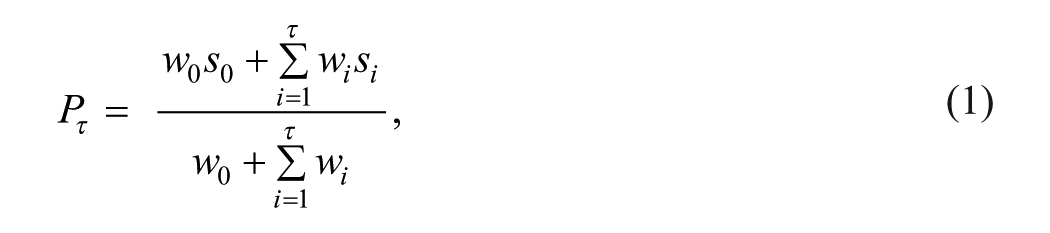
Chung and Fink (2008) extended IIT and proposed the SIIM to predict how beliefs evolve while multiple pieces of information are being received and integrated. The model states that
where
According to Anderson (2008), the weight parameter represents “amount of information in a stimulus” (p. 400). Fink and Cai (2013) stated that the weight of the initial belief can “reflect the number of or involvement with prior messages” (p. 89). Davidson (1995) proposed that the amount of information that a belief or an attitude is based on is reflected in the strength of the belief, indicating that the amount of information is indirectly a strong predictor of behaviors. Furthermore, Eagly and Chaiken (1993) have written that “the most important generalization we can offer about attitudinal resistance is that attitudes are difficult to alter to the extent that they are strong or important” (p. 621), which agrees with Anderson’s (2008) proposition that the weight or the strength of initial beliefs “manifests itself as resistance to change in the averaging law” (p. 176; but see Himmelfarb, 1974). The effect of the weight of initial beliefs on belief change as a result of additional new information is also suggested by other authors (e.g., Saltiel & Woelfel, 1975).
The tendency to resist incongruent information when initial beliefs are formed with a certain level of commitment has also been suggested by cognitive dissonance theory (Aronson, Turner, & Carlsmith, 1963; Festinger, 1957). Aronson et al. proposed that receiving a discrepant or incongruent message is a cause of dissonance. For a high level of discrepancy, receivers tend to counterargue the message or disparage the source, thereby resisting change, to reduce dissonance. This tendency is more evident for those with a high level of ego-involvement, in which the issue is related to the receiver’s important values and the receiver is likely to have a strong commitment to his or her prior beliefs (i.e., a great weight is associated with the prior beliefs). Unlike some models, Equation 1 predicts the effect of the weight of initial beliefs on belief trajectories very precisely.
Based on SIIM, Chung et al. (2012) predicted the patterns of belief trajectories that occur as an individual receives new pieces of information; these trajectories will differ for individuals whose initial beliefs have different weights. Chung et al. examined candidate evaluation trajectories, which were obtained by measuring the evaluations of hypothetical political candidates several times while experimentally presenting alternating congruent and incongruent pieces of information to the participants. They found, as predicted, oscillatory evaluation trajectories. In addition, they predicted the pattern and the amplitudes of evaluation trajectories for individuals who have initial evaluations with different weights: Participants whose initial beliefs were assumed to have a greater weight (i.e., those with strong party identification) generated belief trajectories with smaller amplitudes than those whose initial beliefs were assumed to have lower weight (i.e., those with weak party identification). The difference in amplitudes was also expected for those with initial beliefs based on important initial information versus those with initial beliefs without that information, but that difference was not found.
Equation 1 allows predicting belief positions at different times and thus allows for estimating the equations for entire belief trajectories. The present study predicts different belief trajectories for individuals with different initial beliefs who receive only incongruent information.
Let us consider how to model a belief trajectory. Suppose there are two voters and one political candidate. Before a campaign is officially launched, the two voters know that the candidate is a member of a particular political party toward which both voters have positive attitudes. However, suppose that the first voter considers party identification to be very important, whereas the second voter does not think party identification is important. In this case, the first voter has a greater weight, w0, for the initial evaluation than does the second voter. Suppose that both voters receive a series of negative messages about the candidate, which are incongruent with their initial evaluation. For candidate evaluations responding to this kind of information, Equation 1 generates Figure 1.
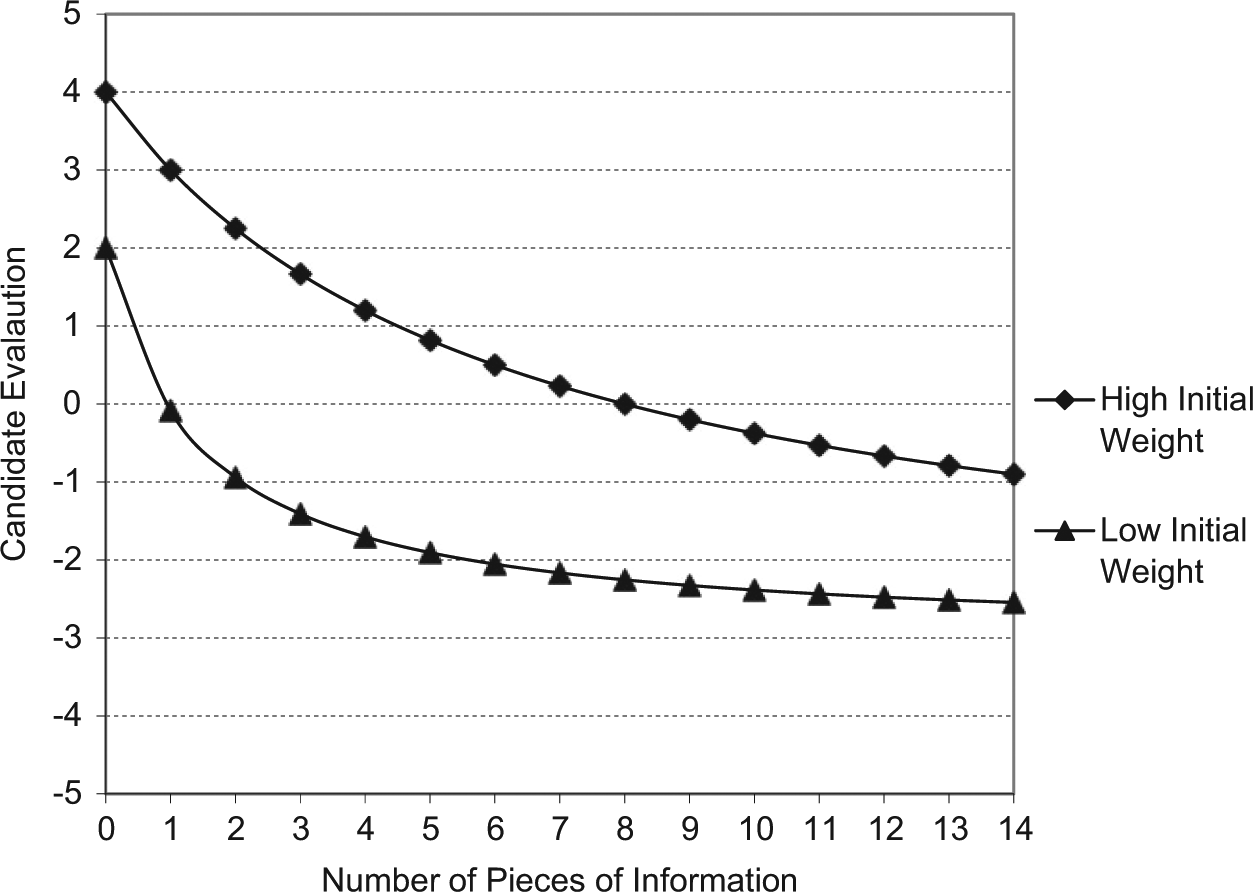
Hypothetical candidate evaluation over time responding to incongruent messages based on the sequential information integration model (for i > 0, wi = 0.50, and si = −3.00 for all conditions; s0 = 4.00 and w0 = 3.00 for high initial weight, and s0 = 2.00 and w0 = 0.70 for low initial weight).
Equation 1 predicts these evaluation trajectories, but it is difficult to test this model unless the weights and scale values of each piece of information are known. However, when the weights of the pieces of information are about equal, and the scale values of the pieces of information are about equal, Equation 1 can be modified to predict candidate evaluation as a function of the number of pieces of information to be processed, τ, by using one common value for the weights, w, and one common value for the scale values, s. 3 Equation 1 can be then written as

where

Equation 3 indicates that the inverse of

When

Equation 5 indicates that, for
To test the SIIM and to predict belief trajectories with a series of pieces of negative incongruent information, two studies were conducted. Both studies involved a hypothetical political election with candidate evaluation trajectories used to test the SIIM.
Study 1
Recipients’ Strength of Party Identification and Candidate Evaluation Trajectories
To test the SIIM, Study 1 uses a political candidate as the target object for a belief and examines how evaluation of the candidate is affected by a series of pieces of information about the candidate. Major types of information about political candidates are information about each candidate’s party affiliation (party information), information about the candidate’s stand on political and social issues (issue information), and the candidate’s background, personality, face, and the judgment about his or her current job performance (person information; Lau & Redlawsk, 2006). Study 1 focuses on a particular situation, one in which individuals have formed an initial evaluation based on information about candidates’ party affiliations and then receive a series of incongruent pieces of person information about the candidates (i.e., the morality and competence of the candidates; see De Bruin & van Lange, 2000). Study 1 investigates how recipients’ strength of party identification and initial candidate evaluation affect the processing of subsequent person information and the candidate evaluation trajectories. Party identification, a sense of emotional attachment to a political party, is one of the major predictors of political beliefs and behaviors such as voting (Campbell, Converse, Miller, & Stokes, 1960; Kelley & Mirer, 1974; Lewis-Beck, Jacoby, Norpoth, & Weisberg, 2008). Both the classical study on voting in the United States (Campbell et al., 1960) and a replication study with contemporary data (Lewis-Beck et al., 2008) found that voting is mainly determined by candidates’ party identification, which is more evident for those with strong party identification than those with weak party identification. In the IIT’s terminology, candidates’ party affiliation has a greater weight for those with strong party identification than for those with weak party identification.
When candidates’ party information is given for initial candidate evaluation, those with strong party identification are expected to have more weight in their initial belief than those with weak party identification, because the party information is more relevant to important values for those with strong party identification. Equation 1 suggests that when a greater weight is given to initial belief, belief trajectories resulting from a series of additional pieces of information show smaller changes than when less weight is given to initial belief. Specifically, when a series of incongruent pieces of information is presented after an initial evaluation is formed, Equation 5 suggests that (a) evaluation of the object decreases nonlinearly (i.e., the amount of decrease by additional pieces of information gets smaller), and (b) the rate of decrease is greater when a smaller weight is given to an initial evaluation than when a greater weight is given. Equations 1 and 5 can be applied to candidate evaluations in which a series of incongruent pieces of person information about candidates is presented after initial candidate evaluation is formed based on candidates’ party affiliation information. Candidate evaluation is then predicted to decrease while the rate of decrease decreases (i.e., it is a decelerating negative relationship) for both voters with strong party identification and those with weak party identification (i.e.,
Method
Design and overview
In a laboratory study, participants played the role of a voter in a hypothetical House of Representatives election. Participants’ strength of party identification (strong party identification vs. weak party identification) was measured and used as an independent variable. Participants’ evaluation of their initially favored candidate was measured 11 times, as described below.
Participants
Participants were recruited from communication courses at a large state university in the United States. In total, 184 undergraduate students participated in the study, but 17 cases were removed from the data set either because of participation in a prior pilot study (6 participants) or because of extreme responses (11 participants). 4 Thus, the total number of cases used in the analyses was 167, with 120 females (72%) and 113 Whites (68%). The number of self-identified Republicans was 47 (28%), the number of self-identified Democrats was 101 (61%), and the number of self-identified Independents or other was 19 (11%). The respondents’ average age was 19.65 (SD = 2.04, Mdn = 19.00, Min = 18, Max = 38). Participants were randomly assigned to either the no pre-election-poll condition (n = 39; 23%) or the pre-election poll condition (n = 128; 77%). However, for hypothesis testing, only participants who took part in the pre-election polls were included in the analyses.
Procedure for participants in the pre-election poll condition
At the beginning of the study, participants were told that they would take the role of a voter during a campaign for Congress; participants were also told that the candidates and the election were not real but hypothetical. Using a computer program (Chung, Meffert, & Park, 2005), participants received and responded to information online: Instructions and experimental materials were presented, participants were randomly assigned to conditions for the pre-election-polls, and candidate evaluations and other relevant variables were measured. The average duration of the online experiment was 14 minutes 43 seconds (SD = 3 minutes, 27 seconds).
After signing a consent form, participants were first presented with brief biographical information about two hypothetical candidates; the information included the candidates’ party affiliations and issue positions. Participants then were asked to indicate their initial candidate choice and evaluation. Next, the participants received a series of pieces of incongruent information about the two candidates; after each piece of information, they were asked their evaluation of the two candidates in a pre-election poll. Participants were then asked to vote in the hypothetical election. Participants next answered questions about their party identification and some demographic information. After all these measures, participants were debriefed.
Initial candidate information
Short biographies about and personal statements by the two hypothetical candidates were given as candidate information for the initial evaluation. Both candidates were reported to be male. Biographical information provided basic information about the candidates: their party affiliation, positions on a couple of issues, current occupation, previous work experience, education, age, hometown, marital status, number of children, and military experience. 5 For candidates’ issue-position information, the Democratic candidate was described as saying, “I strongly support a liberal political agenda such as an increase in funding to protect the environment,” and the Republican candidate was described as saying, “I strongly support a conservative political agenda such as the lifting of gun control laws.”
Campaign information and pre-election polls
After indicating an initial preference, participants read 12 newspaper-style articles about the 2 candidates. These 12 articles were the same as those used in Chung et al. (2012). In the present study, the articles were arranged and presented to participants so that they read only incongruent articles and two neutral articles. Among the 12 articles, 5 were negative articles about the participant’s initially preferred candidate, 5 were positive articles about the initially disapproved candidate, and 2 were neutral articles about both candidates. In the negative articles, the initially preferred candidate was described negatively based on his incompetence or dishonesty. In the positive articles, the initially disapproved candidate was described positively based on the candidate’s competence or morality (see Chung et al., 2012, for the articles). As an example, the first article was a negative article regarding budget issues in reference to the initially preferred candidate. The title of the first article for participants who initially picked Daniel Johnson, the Democratic candidate, was “Citizens Accuse Johnson of Side-Stepping Financial Questions.” 6
A pilot study, using students from the same university as the two studies reported here (n = 57), confirmed that the positive articles were perceived as positive and significantly different from neutral, and the negative articles were perceived as negative and significantly different from neutral (see Chung et al., 2012). Means of scale values (−5 = completely negative; +5 = completely positive) ranged between −2.54 (SD = 1.76) and −3.21 (SD = 1.72) for negative articles and between 3.00 (SD = 2.14) and 3.56 (SD = 1.47) for positive articles. Except for the issue of balancing the federal budget (M = −2.54), there was no significant difference for the articles within the set of negative articles or within the set of positive articles. To minimize potential suspicion about the one-sided messages, participants were told that the presented articles had been randomly selected from a large pool of articles that were published and that covered the last congressional election in the area where the hypothetical election was to take place. Participants were also told that because of random selection, most of them would receive a mix of articles that would include various issues and different perspectives, but some might receive information that would be more limited. All the articles had a headline and were three to five sentences in length. The articles used for both candidates were identical except for the candidates’ names.
Pre-election polls
Before person information was presented for this hypothetical campaign, the instructions told the participants that they may be asked, by a random process, to participate in pre-election polls once or several times. Actually, a pre-election poll was given every time participants processed an article except for the neutral articles and the last valenced article. Thus, each participant participated in nine pre-election polls. After presentation of the last valenced article, participants were asked to cast a vote in a hypothetical election. In the pre-election polls and the final vote, the participants were asked to indicate the degree to which one candidate was preferred over the other as the right person for the position. To examine the potential effect of participation in the pre-election polls on information processing and candidate evaluation, some participants were randomly assigned (in approximately a 1:4 ratio) to receive no pre-election poll.
Evaluation of the initially preferred candidate
Participants were asked to indicate the candidate they preferred to vote for and then asked, “To what degree do you prefer one candidate over the other as the right person for the position?” For this question, a slide bar appeared on the computer screen, and participants indicated their evaluation by moving the slider with a computer mouse. The right end of the bar was labeled “100% Preference for Robert Wilson,” who was the Republican candidate, and the left end of the bar was labeled “100% Preference for Daniel Johnson,” who was the Democratic candidate, and the middle of the bar was labeled “No Preference (50%/50%).” There were 101 points on the slide bar. When participants moved the slider, the preference score appeared for each candidate below the bar. Candidate evaluation for the initially preferred candidate was used as the dependent variable. Meffert, Chung, Joiner, Waks, and Garst (2006) and Chung et al. (2012) used a very similar question and method to measure evaluations about two competing candidates and found systematic and predicted patterns of evaluation change. Participants indicated their evaluations for the initially preferred candidates 11 times (labeled ordinal time) throughout “the campaign”; these evaluations, which were used to create trajectories, were their initial evaluation, the evaluation from the nine pre-election polls, and their final evaluation.
Strength of party identification
Strength of party identification was measured based on participants’ self-reported party identification. Categories that were used in the annual surveys of the American National Election Studies (ANES) were used for party identification: strong Republican; Republican; Independent, leaning toward Republican; Independent; Independent, leaning toward Democrat; Democrat; strong Democrat; and do not know (ANES, 2008). The strong party-identification group was created by combining four groups: strong Republican, strong Democrat, Republican, or Democrat (n = 63; 49% of participants). The weak party-identification group consisted of those who were self-categorized as independent, leaning toward Republican; independent, leaning toward Democrat; independent; or do not know (n = 65; 51% of participants).
Results
In all the analyses that follow, the alpha level was set at .05, two-tailed.
Effect of pre-election polls on evaluation
It is possible that the number of pre-election polls may affect information processing and final judgment. To examine this possibility, the pre-election poll condition (n = 128) and the no pre-election poll condition (n = 39) were compared in terms of the participants’ evaluation between their initial and final preference. The average evaluation change from the initial to final judgment for the initially preferred candidate,
Test of H1: Over-time decline in candidate evaluation
Figure 2 shows the evaluation trajectories for those with strong versus weak party identification.

Observed candidate evaluation trajectories responding to incongruent messages by strength of party identification, Study 1.
H1 proposes that as more pieces of incongruent information regarding the candidates are processed, candidate evaluation decreases, but the rate of decrease in candidate evaluation declines. H1 requires that

where i is the unit (i.e., the participant in the present study), t is time point,
To test Equation 4,
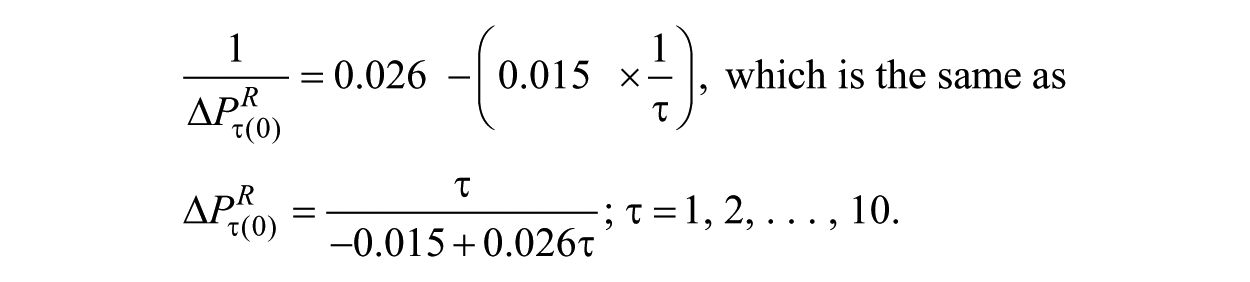
The coefficient for the constant,
For those with strong party identification (excluding the error term),

The coefficient for the constant,
Test of H2: Difference in the rate of decrease
H2 predicts that the rate of decrease differs between those with weak party identification and those with strong party identification. Specifically, H2 predicts
Discussion
Study 1 tested belief trajectories responding to a series of negative pieces of incongruent information about the candidates. Belief trajectories were predicted by the SIIM. Observed belief trajectories were generally consistent with the predicted model: Participants exposed to negative incongruent messages had belief trajectories that decreased monotonically (H1). Study 1 also tested the effect of initial beliefs with different weights on belief trajectories resulting from the receipt of new pieces of information. Information about candidates’ party affiliation was given to participants at the beginning of the experiment to make initial evaluations about the candidates. Individuals with strong party identification were expected to have a greater weight for their initial candidate evaluation than those with weak party identification. When a series of incongruent pieces of information about candidates’ competence or morality were presented, candidate evaluation trajectories were expected to decrease more rapidly for those with weak party identification than those with strong party identification (H2). However, results showed that both those with weak party identification and those with strong party identification had monotonically decreasing trajectories, and the rate of decrease did not significantly differ between these two groups.
In the present study, both candidates’ party affiliation and candidates’ positions on the issues (i.e., environmental protection and gun control) were given for initial candidate evaluation. Candidates’ issue-position information might provide some weight to initial candidate evaluation and might reduce the impact of strength of party identification on belief trajectories. For example, a strong Republican participant who disagreed with gun control policies might choose the Republican candidate but might put little weight on his or her initial evaluation. If no information about candidates’ issue positions were given, the effect of strength of party identification on candidate evaluation trajectories might have appeared. The most important limitation of Study 1 is that the weight for initial beliefs was not manipulated. If the weights for initial beliefs were manipulated, the effect of initial beliefs on belief trajectories could be more directly tested.
Study 2
Study 2 focuses on the effect of initial beliefs on belief trajectories. In Study 1, the strength of party identification was measured and used to predict different trajectories resulting from a series of new pieces of information. Neither the initial belief nor the weight of the initial beliefs was manipulated in Study 1. In Study 2, the weight of the initial belief is manipulated to test the relationship between initial beliefs and belief trajectories more rigorously. According to IIT (Anderson, 1971), the weight of a belief is a function of the number of pieces of information that are used to form the belief. The greater the number of pieces of information used to form an initial belief, the greater the weight of the initial information. Whereas Study 1 used strength of party identification to represent different weights for the initial beliefs, Study 2 uses the amount of information (specific information vs. no information about candidates’ positions on specific issues) for initial beliefs to manipulate the weight of initial beliefs. It investigates how provision of initial issue-position information and strength of party identification affects candidate evaluation trajectories and the processing of subsequent person information.
Provision of Initial Issue-Position Information and Candidate Evaluation Trajectories
Research has shown that the similarity of voters and candidates’ positions on salient issues is an important short-term factor affecting voter decisions (Cook, Jelen, & Wilcox, 1994). Furthermore, many studies of issue voting (e.g., Conover, Gray, & Coombs, 1982) suggest that candidates’ positions on one or two issues can be key determinants of voting decisions. According to IIT, the weight of an initial belief reflects the amount of information that the belief is based on in the study of Anderson (2008). Thus, when specific issue-position information is given, the weight of the recipient’s initial belief, w0, is expected to be greater as compared with when no issue-position information is given. When a series of pieces of incongruent information is presented after an initial evaluation is formed, Equations 1 and 5 suggest that the rate of decrease is greater when no issue-position information is initially given than when specific issue-position information is initially given. That is,
Method
Design and overview
To test the proposed hypotheses, a repeated-measures experimental design (Jones & Kenward, 2003) was used in which provision of initial issue-position information (no initial issue-position information vs. specific initial issue-position information) was manipulated and candidate evaluation, the dependent variable, was measured 11 times. Participants’ strength of party identification (strong party identification vs. weak party identification) was measured and also used as an independent variable.
Participants
Participants were recruited from communication courses at a large state university in the United States, the same university used for Study 1. In total, 192 undergraduate students participated in the study, but 15 cases were removed from the data set either because of participation in a prior pilot study (6 participants) or because of extreme responses (9 participants, using the same procedure as described in Footnote 4). Thus, the total number of cases employed in the analyses was 177, with 112 females (63%) and 110 Whites (62%). The number of self-identified Republicans was 62 (35%), the number of self-identified Democrats was 94 (53%), and the number of self-identified Independents or other was 21 (12%). The average age of the participants was 19.81 (SD = 2.12, Mdn = 19.00, Min = 18, Max = 32).
Procedure, experimental materials, and measures
The procedure for Study 2 was identical to the procedure for Study 1 except all participants in Study 2 took part in pre-election polls. Study 2’s experimental materials were also identical with those of Study 1 except for issue-position information (see below). Candidate evaluation and the strength of party identification in Study 2 were measured as they were in Study 1. The average duration of the online experiment was 16 minutes, 6 seconds (SD = 2 minutes, 47 seconds).
Manipulation of provision of initial issue-position information
Two levels of the provision of initial issue-position information were compared: no initial issue-position information versus specific initial issue-position information. In the no initial issue-position information condition, no information about candidates’ positions on political issues or ideology was given in the candidates’ biographies or personal statements. For the specific initial issue-position information condition, specific information about candidates’ positions on abortion, prayer in schools, and gay rights was presented. In this condition, the Democratic candidate allegedly stated, “I strongly support a liberal political agenda. Specifically, I oppose restrictions on abortions and prayer in schools but support expanded gay rights.” 7 The Republican candidate allegedly stated, “I strongly support a conservative political agenda. Specifically, I support restrictions on abortions and prayer in schools but oppose expanded gay rights.” The computer screen for each candidate’s personal statement that contained candidates’ issue-position information was set to be shown for at least 15 s. Although there was no recall test to check whether participants in the specific initial issue-position information condition had read the initial issue-position information, participants in the specific initial issue-position information condition showed a higher level of confidence in their preference than those in the no initial issue-position information condition, which provides some evidence that participants in the specific initial issue-position information condition were affected by the manipulation. 8
Results
Test of H1: Over-time decline in candidate evaluation by the strength of party identification
Figure 3a shows the evaluation trajectories for those with strong versus weak party identification. H1 suggests that for those with weak party identification and those with strong party identification,

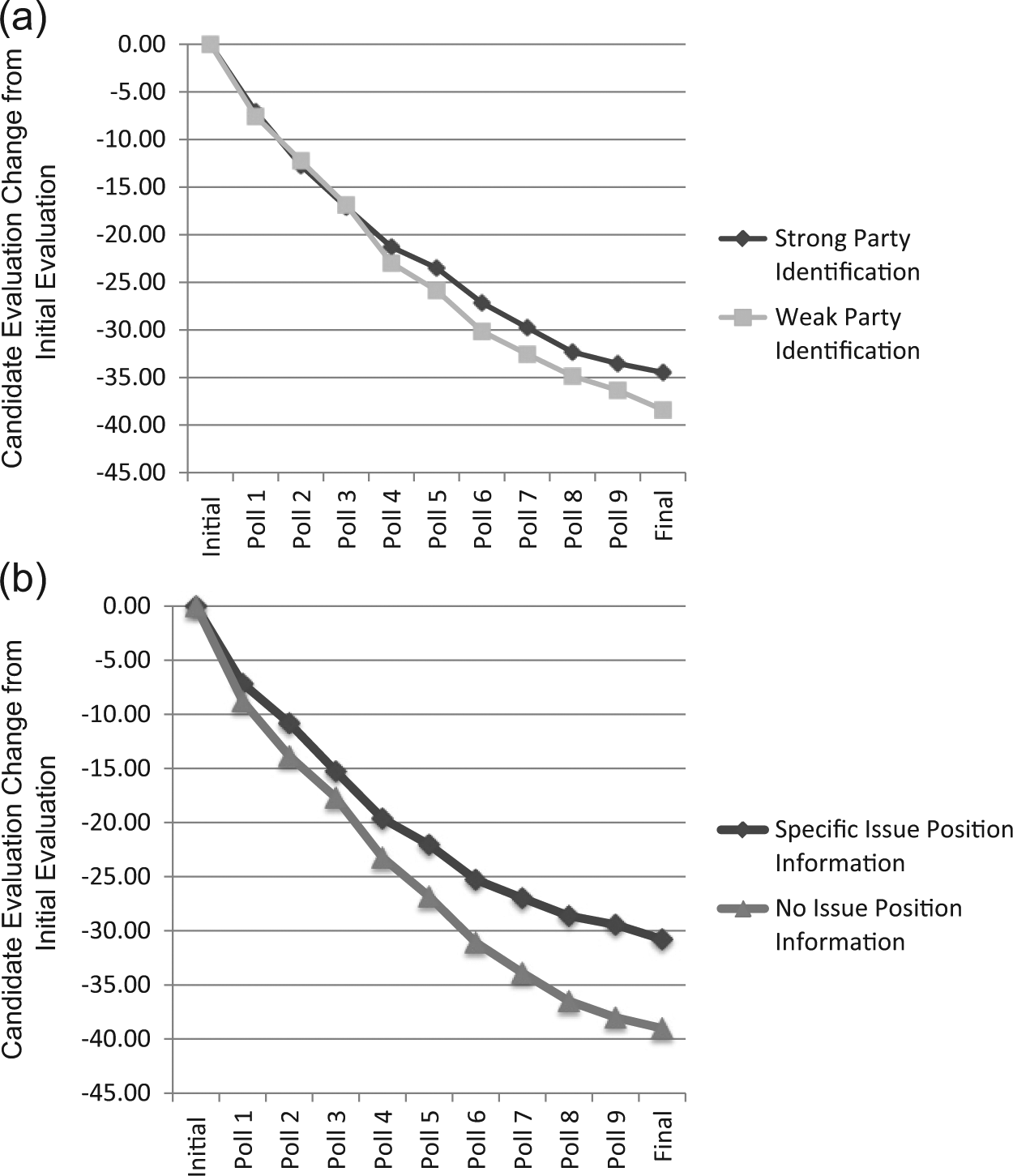
Observed candidate evaluation trajectories responding to incongruent messages by strength of party identification (a) and by initial issue-position information (b), Study 2.
The coefficient for the constant,
For those with strong party identification (excluding the error term),

The coefficient for the constant,
Test of H2: Difference in the rate of decrease by strength of party identification
H2 predicts that the rate of decrease differs between those with weak party identification and those with strong party identification, meaning that
Test of H3: Over-time decline in candidate evaluation by initial issue-position information
Figure 3b shows the evaluation trajectories for those who did and did not receive initial issue-position information. H3 suggests that for both those who do not receive initial issue-position information and for those who do receive initial issue-position information,

The coefficient for the constant,
For those who received initial issue-position information, the corresponding equation is

Both coefficients were found to be statistically significant: The coefficient for the constant,
Test of H4: Difference in the rate of decrease by initial issue-position information
H4 predicts that
Discussion
Study 2 tested the SIIM with belief trajectories representing the evaluations to negative incongruent information about hypothetical candidates. Study 2 focused on the effect of the weight of initial beliefs on belief trajectories. The weight of initial candidate evaluation was manipulated by the provision of initial issue-position information of candidates. Candidates’ party affiliation was given for initial candidate evaluation, and those with strong party identification were assumed to put a greater weight on their initial evaluation than those with weak party identification. As predicted by the SIIM, observed belief trajectories showed trajectories that decreased monotonically. Responding to a series of incongruent pieces of information about candidates, observed candidate evaluation trajectories for those who did not receive candidates’ issue-position information decreased more rapidly than trajectories for those who did receive candidates’ issue-position information. In addition, observed belief trajectories for those with weak party identification decreased more rapidly than observed belief trajectories for those with strong party identification.
General Discussion
Implications for Theories of Information Processing and Belief Change
IIT (Anderson, 1971) is one of the best known models of information processing and belief change (Eagly & Chaiken, 1993; Littlejohn, 1989). However, the time dimension of information processing is absent in this theory. In most of studies about information processing and belief change, the final belief position is the outcome of processing new information, but how beliefs evolve over time while new pieces of information are processed is not investigated. Several studies have examined aspects of belief trajectories (e.g., Chung et al., 2012; Kaplowitz, Fink, & Bauer, 1983; Vallacher et al., 1994), but no study has predicted and tested the mathematical function of belief trajectories responding to multiple new pieces of information. The present study predicted belief trajectories using the SIIM, which incorporates time into IIT.
The predicted belief trajectories were tested using a series of incongruent pieces of information about a hypothetical political candidate. When a series of incongruent pieces of information are presented, belief trajectories were expected to decrease while the rate of decrease was expected to decrease. In both Study 1, in which strength of party identification of participants was the independent variable, and Study 2, in which both strength of party identification of participants and provision of candidates’ issue-position information were independent variables, the predicted belief trajectories were found. The SIIM also predicts different belief trajectories for different weights of initial beliefs. Different trajectories based on different amounts of initial information were found: In Study 2, when candidates’ positions on issues were provided for initial evaluation, the evaluation trajectories showed a slower decrease compared to when no information about candidates’ issue-position information was given. In addition, in Study 2, when information about candidates’ party affiliation was given for initial evaluation, belief trajectories for participants with strong party identification showed a slower decrease than belief trajectories for participants with weak party identification. The different rate of decreases depending on strength of party identification was expected but not found in Study 1.
The SIIM model has been supported in previous research (Chung & Fink, 2008; Chung et al., 2012), but the present study provides stronger support for the SIIM by testing the mathematical function of belief trajectories predicted by the model. The present study found that belief trajectories differ depending on the weight of initial beliefs, which is relevant to the averaging model of information integration (Anderson, 1965; Gollob & Lugg, 1973). Anderson (1965) tested both an additive model and an averaging model of information integration, and his results were mixed. Gollob and Lugg (1973) found some support for the averaging model. Responding to a series of pieces of negative incongruent information after an initial evaluation is formed, the averaging model predicts a nonlinear decrease in belief trajectories; given our assumptions about weight and scale value, the additive model predicts a linear decrease. The present study found that the belief trajectories were nonlinear, which provides strong support for the averaging version of IIT.
Previous studies have found a negative effect of strength of initial beliefs on belief change in response to incongruent information (e.g., Petty & Krosnick, 1995; Saltiel & Woelfel, 1975). When initial beliefs are related to important values (e.g., party identification or issue position), beliefs were less affected by incongruent information. Importantly, the resistance provided by the weight of initial beliefs was found throughout the belief trajectories in the current research. Party identification and candidates’ positions on political issues are known to be key variables in determining candidate evaluation (Campbell et al., 1960). However, only a few studies have investigated how voters with different strengths of party identification and different positions on issues change their evaluation about candidates over time during a campaign (cf. Holbrook, 1996). The present study tested the effect of party identification and candidates’ positions on political issues on over-time changes in candidate evaluation while experimentally controlling other factors. Participants’ strength of party identification and candidates’ issue-position information were found to affect the processing of candidates’ person information (here, information about candidates’ morality and competence) throughout the hypothetical campaign.
Recent studies on motivated reasoning have shown that voters’ information processing and judgments are biased by directional goals such as partisan goals (Lau & Redlawsk, 2006; Redlawsk, 2002; Taber & Lodge, 2006). Taber and Lodge (2006) found that voters pay more attention to attitudinally congruent rather than incongruent arguments about controversial political issues. Several studies have found that voters spend more time reading incongruent arguments than congruent arguments, which may indicate that voters more critically evaluate incongruent information (Redlawsk, 2002; Taber & Lodge, 2006). On the other hand, some researchers have attempted to explain political information processing and judgments from a cognitive perspective (i.e., rationalists or Bayesian updaters; Gerber & Green, 1999). The results of the present study are consistent with the motivated reasoning approach in that the effect of incongruent information on candidate evaluation is weaker for those with strong party identification (i.e., a high level of partisan motivation) than those with weak party identification. On the other hand, belief trajectories for those with strong party identification also showed a gradual decrease according to the value of the additional incongruent information, which is consistent with a cognitive model (i.e., SIIM). This finding suggests that the rules of cognitions play a critical role even in biased information processing.
Limitations and Suggestions for Future Research
To test the causal effects of the valences of a series of new pieces of information and initial beliefs on belief change over time, the present study conducted a laboratory experiment, which is one of the best ways to insure internal validity. If multiple pieces of information are presented in a random order, no specific pattern of belief change can be expected and the model for belief change would require more information to be testable. Thus, the present study intentionally presented only attitudinally incongruent pieces of information, which was expected to generate a monotonically decreasing function of belief change over time. In the experiment, participants took part in several pre-election polls. These artificial features of the experiment may be criticized for a lack of external validity or realism. The present study hid the artificial features from the participants: Participants were told that the articles were randomly selected from a large pool of actual newspaper articles and that the number of pre-election polls was randomly chosen by a computer program. In addition, the effect of pre-election polls was tested. Aronson, Wilson, and Akert (1994) differentiated psychological realism, the extent to which the participant uses the same psychological processes within the experimental setting that the participant generally uses outside of this setting; mundane realism, the extent to which the activities in the experiment are similar to activities that the participant generally is involved in outside of the experimental setting; and experimental realism, the degree to which the participant conscientiously participates in the experiment. The present study may lack mundane realism. However, regarding the causal relationships between information properties and belief change, there is no evidence here for a lack of experimental realism or psychological realism. Nevertheless, generalization of the present findings to actual election situations should be made with some caution.
Participants in the present study were undergraduate students at a Midwestern university. College students are younger, better educated, and less likely to vote compared with the general public (e.g., Lau & Redlawsk, 2006; Sears, 1986). Even though college students are not representative of the voting population in terms of political dispositions and behavior, meta-analyses of information processing and political judgment have shown that student samples do not differ from samples of the general population in their responses to political messages (Kühberger, 1998). The pattern of college students’ information processing found here should be generalizable to the population at large; nevertheless, the generalizability of the results of the present investigation should be investigated.
When information for initial evaluation was manipulated, the rate of decrease in belief trajectories was found to significantly differ depending on the provision of initial information. However, when strength of party identification was used as a surrogate for different weights of candidates’ party identification, the results were mixed: The effect of strength of party identification on the rate of decrease in evaluation trajectories was found to be statistically significant only in Study 2. In Study 2, the effect of strength of party identification on evaluation trajectories was tested with specific (vs. no) candidates’ issue-position information. It may be that when specific issue-position information is given, those with strong party identification pay more attention to issue-position information, thereby giving greater weight to their initial evaluation. Highton (2010, Table 4) found that, after controlling for several variables, party identification and issues, entered in the same probit equations, have separate significant effects of about the same size. However, an interaction of party identification and issue information on the weight of initial evaluation is possible. Because of the limited sample size, the present study could not investigate whether belief trajectories for the participants who have strong party identification and were exposed to specific initial issue-position information differ from other participants. Future research may investigate these possibilities.
Conclusion
Most of studies on information processing and belief change focus on a final belief position even when complex and multiple pieces of information are used for judgment. What is missing in these studies is a belief trajectory that tests a model of information processing over time. The present study used a mathematical model of belief trajectories and tested it with belief positions that were measured several times. Belief trajectories provide vital information about the cognitive processes involved in belief formation and change. Analyzing belief trajectories allows the investigation of these processes and the creation of testable information-processing theories, which are significant goals for the communication scholar and practitioner.
Footnotes
Declaration of Conflicting Interests
The authors declared no potential conflicts of interest with respect to the research, authorship, and/or publication of this article.
Funding
The authors disclosed receipt of the following financial support for the research, authorship, and/or publication of this article: This work was supported by the National Research Foundation of Korea Grant funded by the Korean Government (NRF-2011-330-B00225).