



Abstract
The digital traces of U.S. members of congress on Twitter enable researchers to observe how these public officials interact with one another in a direct and unobtrusive manner. Using data from Twitter and other sources (e.g., roll-call vote data), this study aims to examine how members of congress connect and communicate with one another on Twitter, why they will connect and communicate with one another in such a way, and what effects such connection and communication among members of congress have on their floor vote behavior. The follower-followee and communication networks of members of congress on Twitter demonstrate a high degree of partisan homogeneity. Members of congress prefer to follow or communicate with other members who are similar to them in terms of partisanship, home state, chamber, and public concern. This condition is known as the homophily effect in social network research. However, the magnitude of the homophily effect is mitigated when the effects of endogenous networking mechanisms (i.e., reciprocity and triadic closure) in such networks are controlled. Follower-followee ties can facilitate political discourse among members of congress on Twitter, whereas both follower-followee and communication ties on Twitter increase the likelihood of vote agreement among members of congress. The theoretical, methodological, and practical implications of the findings are addressed.
Introduction
The 2013 U.S. government shutdown has caused the approval rating of the U.S. congress to plummet to a record low (Gallup, 2013) and brought the legislative behavior of members of congress under scrutiny. The legislative behavior of members of congress is “subject to a myriad of formal and informal rules” (Poole & Rosenthal, 1991, p. 228). Social connection and communication among members of congress are argued to be among the rules that can substantially influence legislative behavior (e.g., Caldeira & Patterson, 1987; Cho & Fowler, 2010; Hall & Wayman, 1990; Krutz, 2001).
Members of congress are linked with one another through multiple social ties (Borgatti, Mehra, Brass, & Labianca, 2009), namely, social connection (e.g., follower-followee relationships on Twitter), communication (e.g., retweet and mention on Twitter), and behavioral interactions (e.g., cosponsorship or covoting of legislative bills). Each type of social ties can span a network of its own (Szell, Lambiotte, & Thurner, 2010), such as a follower-followee network, retweet and mention networks, and cosponsorship network. The topology of these networks can emerge from the distribution of the individual attributes of members of congress (Goodreau, Kitts, & Morris, 2009). Moreover, the structures of these networks can influence each other “as networks of one type may act as a constraint, an inhibitor, or a catalyst on networks of another type of relations” (Szell et al., 2010, p. 13636). However, examining the social connection and communication of members of congress in a direct and valid manner has been difficult, if not impossible. This condition limits our understanding of how social interactions among members of congress will affect their legislative behavior.
U.S. members of congress have recently embraced social media, particularly Twitter, as a new means of connecting and communicating with their colleagues and constituents (Glassman, Straus, & Shogan, 2013; Golbeck, Grimes, & Rogers, 2010; Parmelee & Bichard, 2012). The digital traces of members of congress on Twitter enable researchers to observe how these officials connect and communicate with one another unobtrusively and directly. As there is a tension between limited time of members of congress available for communication activities and increasing demand for communication from the constituents (Congressional Management Foundation, 2005, 2011, 2013b), members of congress delegate most of their communication tasks, ranging from replying correspondence to the constituents to managing social media accounts, to their supporting staffers (Congressional Management Foundation, 2005, 2008, 2011). However, these supporting staffers are not autonomous political actors in handling communication tasks on behalf of members of congress (Congressional Management Foundation, 2011). Instead, members of congress and their supporting staffers work together as professionalized institutions (Kampelman, 1954; Romzek, 2000; Romzek & Utter, 1997; Salisbury & Shepsle, 1981). In these institutions, supporting staffers will work at the whim of members of congress (Congressional Management Foundation, 2013a), when members of congress depend on their staffers to run their offices, to brief them about constituents’ sentiment, to help them draft and pass legislation, and to advise them on how to vote (Congressional Management Foundation, 2013b; Lee, 2012). Therefore, it is valid to assume in our study that both communication activities on Twitter and floor vote behavior are representations of the collective interests or concerns of members of congress as institutions, regardless of whether they are implemented by members of congress themselves or by their supporting staffers.
Building upon the assumption and employing data from Twitter and other sources, this study, to the best of our knowledge, is the first to map the structure of the connection and communication networks of members of congress on Twitter. Moreover, this work uncovers the tie-generating mechanisms at the individual, dyadic, and triadic levels. These mechanisms are believed to give rise to such networks. Unlike previous studies that investigated the various social interactions of members of congress in isolation, the study examines the intricate interplay among multiple social ties (i.e., social connection, communication, and behavioral interaction) existing among members of congress.
Generative Mechanisms of the Follower-Followee and Communication Networks: Homophily, Reciprocity, and Triadic Closure
Although nothing is more familiar to human beings than their everyday social interaction (Homans, 1961), uncovering tie-generating mechanisms behind social networks remains an important and complex task as individuals attempt to achieve their goals under multiple constraints (Kossinets & Watts, 2006). The U.S. congress is a structured social context (Knoke, 1990) where members develop contacts with one another. Unraveling the tie-generating mechanisms behind the social contacts of members of congress can advance our understanding of interpersonal communication and legislative politics in the U.S. congress.
The tie-generating mechanisms have been examined mostly from two approaches: one focusing on individual preference for similar others and the other on endogenous network structures (Rivera, Soderstrom, & Uzzi, 2010). Conceptually, these two approaches are interwoven with each other in terms of generating ties among social actors (e.g., Goodreau et al., 2009; Kossinets & Watts, 2009; Wimmer & Lewis, 2010). Individuals will prefer to interact with others who are similar to themselves, a tendency known as homophily. However, the realization of these preferences is subject to the local network structure (e.g., triadic closure and reciprocity). For example, a homogeneous tie that closes a triangle is now more likely than one that does not close a triangle, although each is more likely than its heterogeneous counterparts (Wimmer & Lewis, 2010). Nevertheless, the conceptual interrelationship between these two approaches has not been well operationalized in empirical studies, in which these two approaches tended to progress in relative isolation (Rivera et al., 2010). The isolation between these two approaches has resulted in the overestimation of the power of the homophily mechanism in social networks (e.g., Goodreau, 2007; Snijders, Pattison, Robins, & Handcock, 2006). To understand the theoretical significance of each mechanism better in terms of generating social ties among members of congress, the effect of one mechanism must be studied while controlling for the influence of the other. Our study aims to capture the net effects of these interwoven mechanisms in forming social ties among members of congress by employing a recently developed statistical framework in network analysis.
The homophily phenomenon has been observed in political discourse on social media, such as blogs (e.g., Adamic & Glance, 2005) and Twitter (e.g., Himelboim, 2014; Himelboim, McCreery, & Smith, 2013). Most of these studies exclusively focused on ideology-based homophily, although homophily can refer to any attributes that two individuals may share (McPherson, Smith-Lovin, & Cook, 2001). Moreover, the function of the homophily mechanism has never been applied to account for social interactions among members of congress, even though homophily is claimed to be “one of the most striking and robust empirical regularities of social life” (Kossinets & Watts, 2009, p. 405). This study attempts to examine the function of the homophily mechanism in accounting for social ties formation among members of congress on Twitter. In particular, the effects of five homophily attributes will be considered. These attributes are partisanship, home state, chamber, committee service, and public concern.
Partisanship is the most fundamental homophily attribute that can affect the choice of connection and communication partners by members of congress on Twitter. Partisanship can create explicit social foci (Kossinets & Watts, 2009) among members of congress, which can facilitate the development of their follower-followee relationship and interpersonal communication on Twitter. Members of congress can likewise develop shared concerns in other public domains (e.g., health and social welfare), which can create additional social foci among these officials. These social foci can drive members of congress with shared concerns to develop mutual preferences for one another, which will increase their likelihood of forming a follower-followee relationship and communication ties on Twitter. Additionally, individuals who are living near one another (e.g., within the same city or state) or those having shared institutional environments (e.g., workplaces and committees) are more likely to interact with one another (e.g., Feld, 1981; Kossinets & Watts, 2009; McPherson et al., 2001; Mouw & Entwisle, 2006). This phenomenon can likewise be observed among U.S. members of congress. The candidate-centered electoral institutions of the United States “give individual legislators a powerful incentive to pursue particular benefits for their districts” (Waugh, Pei, Fowler, Mucha, & Porter, 2009, p. 22). A reasonable argument is that members of congress from the same home state are more likely to connect or communicate with one another because of their shared local interests. Furthermore, the U.S. Constitution grants two chambers of the congress with different powers (Cho & Fowler, 2010) and assigns members of congress to various congressional committees with diverse foci. The organizational structure of the U.S. congress produces different genres of social boundaries within which members tend to connect and communicate with other members who belong to the same social category (Moody, 2001; Wimmer & Lewis, 2010). Therefore, this study focuses on five homophily attributes that can capture the fundamental institutional characteristics of the U.S. congress. The homophily mechanism has been widely examined and generally established in empirical studies. Thus, a composite research hypothesis will be proposed concerning the functions of these five homophily attributes in generating follower-followee and communication ties among members of congress on Twitter.
Hypothesis 1 (H1): Members of congress, who are (a) from the same party, (b) with shared concerns, (c) from the same home state, (d) from the same chamber, and (e) with the same committee services, are more likely to follow and communicate with one another on Twitter.
Exploring which homophily attribute will serve a dominant function in generating follower-followee and communication ties among members of congress on Twitter is of theoretical significance. Intuitively, partisanship will be assumed to be the dominant homophily attribute in both follower-followee and communication networks, as the U.S. congress has become increasingly polarized since the 1970s (Poole & Rosenthal, 2014). Nevertheless, users’ choices of partners to follow are different from their choices of partners to communicate with on social media (Golder, Wilkinson, & Huberman, 2007; Huberman, Romero, & Wu, 2009). This difference raises the possibility that the most important homophily attribute that affects tie generation in the follower-followee network will differ from that in communication networks. Given that this possibility has not been fully addressed in the existing literature, two research questions, instead of research hypotheses, are proposed:
Research Question 1 (RQ1): Which homophily attributes will be the most important ones in generating follower-followee and communication ties among members of congress on Twitter?
Research Question 2 (RQ2): Will the most important homophily attribute in the follower-followee network be different from that in communication networks of members of congress on Twitter?
Homophily examines the extent to which the choice of connection and communication partners of members of congress are affected by their individual preferences and intentions. However, the power of homophily mechanism will be overestimated when other endogenous networking mechanisms are not considered (Kossinets & Watts, 2009; Wimmer & Lewis, 2010). Endogenous networking mechanisms examine the extent to which the formation of ties among individuals in a social network is “a consequence of the social-organizational structure in which they are embedded” (Kossinets & Watts, 2009, p. 438).
This study incorporates two well-known endogenous mechanisms, namely, reciprocity and triadic closure, to account for tie formation in the follower-followee and communication networks of members of congress on Twitter. These mechanisms are derived from balance theory, which argues that humans tend to achieve symmetry in their social relations (Heider, 1946). Reciprocity refers to the tendency of an individual to choose another individual when that second individual likewise chooses the first individual. Triadic closure denotes that a triad with two ties tends to form a third tie, which is known as the tendency for friends-of-friends to become friends with one another.
Reciprocity has been argued to be “a way of life” in the U.S. congress (Matthews, 1959, p. 1072). Reciprocity can entail multiple meanings in congressional politics. These meanings include respecting other members and their expertise, willingness to make deals, and members of congress themselves committing to an agreement (Uslaner, 2000). The norm of reciprocity can provide stability for the congress as a networked institution (Rivera et al., 2010; Uslaner, 2000). Empirical studies have indicated the existence of reciprocity in the cosponsorship relationship among members of congress (Bratton & Rouse, 2011; Fowler, 2006a). Although few empirical studies have examined the function of triadic closure in the formation of social ties among members of congress, this mechanism has been identified as a powerful one that can account for various social relations among different groups of individuals in the United States (e.g., Kossinets & Watts, 2009; Moody, 2001; Wimmer & Lewis, 2010). Therefore, we hypothesize the following:
Hypothesis 2 (H3): Two members of congress are more likely to form a tie in their follower-followee/communication networks if such a tie will (a) reciprocate an existing tie or (b) close a triangle in such networks.
Hypothesis 3 (H3): The effect of the homophily mechanism on tie generation in follower-followee and communication networks on Twitter will be mitigated when endogenous networking mechanisms are considered.
Interplay Between Follower-Followee Network, Communication, and Vote Agreement
When a member of congress follows another member on Twitter, he or she receives updates from that official, thus providing multiple opportunities for these officials to communicate with one another (e.g., retweeting the tweets of one another or mentioning other members of congress in their own tweets). However, determining the temporal order between follower-followee tie and communication ties on Twitter is methodologically difficult because Twitter does not enable researchers to track the evolution of follower-followee ties among users. This condition is a general challenge shared by many empirical studies on social media (e.g., Huberman et al., 2009; Kossinets & Watts, 2009; Wimmer & Lewis, 2010). Nevertheless, as most of the follower-followee ties on Twitter are found to be quite stable over time (Kivran-Swaine, Govindan, & Naaman, 2011), we can acceptably assume that the follower-followee ties between members of congress on Twitter existed before their ephemeral communication activities. Therefore, we reasonably hypothesize the following:
Hypothesis 4 (H4): Members of congress who form a tie in their follower-followee network are more likely to form a tie in their communication networks.
Previous studies have attributed the legislative behavior of members of congress to their individual-level attributes (e.g., partisanship), and limited empirical evidence has shown how the connection and communication networks of members of congress affect their floor vote behaviors. When members of congress are linked with one another through more than one type of social tie on Twitter, “they are more likely to receive information about one another than they are to receive information about those from whom they are disconnected” (Heaney, 2014, p. 68). These multiplex social ties enable members of congress to receive the opinions and actions of others through multiple paths, which can create information redundancy and reduce uncertainty among them (Heaney, 2014; Landau, 1969). The reduced uncertainty may help members of congress develop trust and consensus with one another. Gómez-Gardeñes, Reinares, Arenas, and Floría (2012) used a simulation approach and reported that the resilience of cooperation 1 increased remarkably as the layers of multiplex networks increased in number, which implies that the different social ties among individual actors would enhance their cooperative behavior. Therefore, we hypothesize the following:
Hypothesis 5 (H5): Two members of congress who have (a) follower-followee ties or (b) communication ties on Twitter are more likely to reach an agreement on their floor voting behaviors.
Research Methods
This study focuses on 527 members (i.e., 100 senators and 427 house representatives) of the 113th U.S. Congress who have Twitter accounts. Given our assumption that members of congress work closely with their supporting staffers as professionalized institutions in communication activities and floor vote behavior, the unit of analysis in the study is not discrete congress members but member-centered institutions. The dataset is constructed by merging three different databases, namely, (a) approximately 165,000 tweets that were posted by members of congress from April 2013 to mid-November 2013 and their follower-followee lists on Twitter, (b) the roll-call vote data of both chambers that record the voting decisions of members of congress on two legislative bills, and (c) the individual attributes of these members of congress, which include their partisanship, chamber affiliation, home states, committee membership, committee chairmanship, and seniority.
Measurement of Follower-Followee Network, Communication Networks, and Vote Agreement
Twitter enables users to broadcast their tweets to other users who have subscribed to their updates. Subscribing to the tweets of a user is known as “following.” When followed by another user, a user does not necessarily have to follow him or her back, which creates a directed social link among Twitter users. The follower-followee information of members of congress creates a directed and unweighted follower-followee network among these officials.
This study focuses on two communication behaviors among members of congress on Twitter: retweet and mention. Given that these two behaviors are found to induce distinct network topologies in political discourse on Twitter (Conover et al., 2011), this study separately examines the retweet and mention networks. These two networks are directed and weighted. With regard to the retweet network, a one-way directed link from congress member i to congress member j is established when the tweets of j are retweeted by i during the study period, whereas a reciprocal link is established between these two members of congress when they both retweet the tweets of each other. With regard to the mention network, a one-way directed link from i to j is established when j is mentioned in the tweets of i, whereas a reciprocal link is established between these two members of congress when they both mention each other in their tweets during the study period. The links in both networks are weighted by the number of tweets that are retweeted or by the number of mentions between two members of congress during the study period.
The roll-call vote data on two bills, namely, H.J. Res. 59 (labeled as “Bill 1” hereinafter) and H.R. 2775 (labeled as “Bill 2” hereinafter), 2 are retrieved from www.govtrack.us. The roll-call vote data on these two bills are transformed into two rectangular voting matrices. In a voting matrix X, the entry Xik denotes how congress member i votes on bill k. Xik is equal to 1 when congress member i votes yea on bill k, is equal to −1 when he or she votes nay, and is equal to 0 otherwise. The voting matrix is then transformed into an adjacency matrix that maps out the vote agreement among the members of congress on a specific bill. The entry value in the adjacency matrix is equal to 1 when two members of congress make the same decision on one bill and is equal to 0 otherwise.
Measurement of Individual and Homophily Attributes
Five individual attributes of members of congress are included in this study: partisanship, chamber affiliation, home states, committee chairmanship, and seniority. 3 The partisanship of members of congress is coded as a discrete variable, with 0 representing “Democrats,” 1 representing “Independent,” and 2 representing “Republicans.” The chamber affiliation of members of congress is coded as a binary variable, with 0 representing the House and 1 representing the Senate. The home states of 527 members of congress are coded as a discrete variable with 53 categories. The committee chairmanship of members of congress is coded as a binary variable, with 1 denoting that the congress member serves as the chair of a congress committee and 0 denoting otherwise. The seniority duration of members of congress is a continuous variable with an average of nine years, the standard deviation of which is equal to 9. These five individual attributes are considered as exogenous predictors of the follower-followee and communication networks of members of congress on Twitter.
Partisanship, chamber, and home states are used to construct three homophily attributes, namely, same-party, same-chamber, and same-state. Two additional homophily attributes, namely, common committee service and shared public concern, are generated as well. The members of all standing committees in the U.S. congress are retrieved from www.congress.gov. The data are then transformed into an adjacency matrix that describes the common committee service of these members of congress. The entry value in the adjacency matrix is equal to 1 when two members of congress are serving in the same congress committee and is equal to 0 otherwise.
Twitter users can create and follow a discussion thread by prefixing a word with the “#” symbol, which is called a hashtag (Kwak, Lee, Park, & Moon, 2010). These hashtags are used in the study to measure the shared public concerns among members of congress (Yang & Leskovec, 2011). The hashtags used in the tweets of members of congress are extracted to create an adjacency matrix that measures the shared concern among these officials. The entries in the adjacency matrix represent the number of similar hashtags that are used by two members of congress in their tweets. A greater value is entered in the adjacency matrix when two members of congress use more similar hashtags.
Analytical Design
Exponential random graph modeling (ERGM; Goodreau, 2007; Robins, Pattison, Kalish, & Lusher, 2007; Robins, Snijders, Wang, Handcock, & Pattison, 2007) is employed to test the research hypotheses proposed in the study. As a statistical framework for inference with network data, ERGM models several network generative mechanisms that are common and significant to political science at both the structural and individual levels (Cranmber & Desmarais, 2011). The dependent variable in ERGM analysis is the probability of forming a tie within a network. In this study, the dependent variables of ERGM come in the form of probabilities: (a) for two members of congress to form a tie in the follower-followee network, (b) for a congress member to retweet or be retweeted by another congress member in the retweet network, (c) for a congress member to mention or be mentioned by another congress member in the mention network, and (d) for two members of congress to make the same voting decision on a legislative bill. ERGM simultaneously considers the effects of individual attributes, homophily attributes, exogenous covariates, and other balancing mechanisms (e.g., reciprocity and triadic closure).
Analytical Findings
This section is divided into three parts. First, the structural characteristics of the follower-followee and communication networks of members of congress on Twitter are described. Second, the ERGM analytical results are reported for the generative mechanisms that underlie such networks. Third, the ERGM analytical results are reported for the effects of such networks on the vote agreement of members of congress.
Mapping the Structure of Follower-Followee and Communication Networks on Twitter
The follower-followee and communication networks of U.S. members of congress on Twitter show a high degree of partisan homogeneity. The assortative coefficients (Newman, 2002, 2003a) by partisanship for follower-followee, retweet, and mention networks are 0.71, 0.76, and 0.54, respectively (p < .001), suggesting that members of congress prefer to connect and communicate with others from the same party on Twitter. We found that 87% of ties in the follower-followee network exist among members of congress from the same party, with 31% among Democrats and 56% among Republicans. In the retweet network, 88% of all ties exist between members of congress from the same party, with 35% among Democrats and 53% among Republicans. In the mention network, 77% of all ties exist between members of congress from the same party, with 33% among Democrats and 44% among Republicans.
The follower-followee and communication networks of members of congress on Twitter are characterized by short average path length and large clustering coefficients (Watts & Strogatz, 1998). Each network has an average path length of 3, which is consistent with previous findings on the network structure among general Twitter users (Kwak et al., 2010). The global clustering coefficients of follower-followee and communication networks are far greater than the clustering coefficients of the corresponding random networks. Moreover, the global clustering coefficient of the follower-followee network (0.55) is significantly higher than that of the retweet and mention networks (both 0.16). In other words, the social regularity that the friends of a friend tend to become friends is more evident in the follower-followee network than in the communication networks.
The follower-followee network of members of congress is considerably denser than their communication networks. These officials likewise tend to reciprocate their ties in the follower-followee network than in the communication networks. A total of 42,566 ties exist in the follower-followee network. These ties account for 15% of all possible ties among 527 members of congress. However, only 3,226 and 5,899 unique ties exist in the retweet and mention networks, respectively, which account for 1% and 2% of all possible ties in both networks. The follower-followee network has the greatest reciprocity rate (0.33), followed by the mention network (0.23) and the retweet network (0.13).
Table 1 shows the descriptive statistics of the four centrality measures in the follower-followee and communication networks of members of congress on Twitter. The follower-followee network of members of congress on Twitter is more centralized than their communication networks. The degree centralization index of the follower-followee network is 0.39, whereas those for the retweet and mention networks are 0.12 and 0.11, respectively. Paul Ryan (Republican House Representative) and Yvette Clarke (Democratic House Representative) have obtained the highest indegree and outdegree in the follower-followee network, respectively. Meanwhile, Darrell Issa (Republican House Representative) and John Garamendi (Democratic House Representative) have obtained the highest indegree and outdegree in the retweet network, respectively, and Harry Reid (Senate Democratic Leader) and Marsha Blackburn (Republican House Representative) have obtained the highest indegree and outdegree in the mention network, respectively.
Descriptive Statistics of the Centrality Measures of Follower-Followee and Communication Networks.
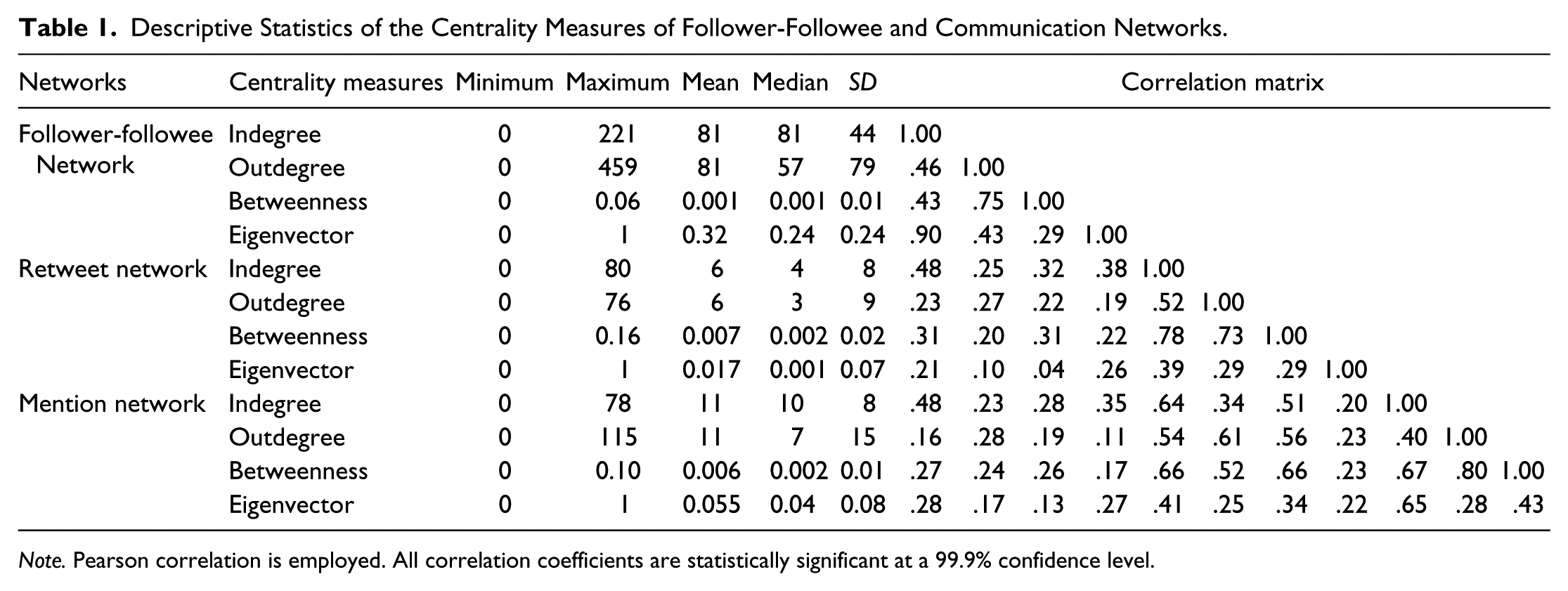
Note. Pearson correlation is employed. All correlation coefficients are statistically significant at a 99.9% confidence level.
The influence of members of congress, as measured by their eigenvector centrality scores (Borgatti, 2005), in both follower-followee and communication networks, is jointly affected by their partisanship and chamber. 4 Figure 1 shows that compared with Democrats, Republican members of congress possess greater influence in both follower-followee and communication networks. Paul Ryan, Sam Graves, and Thomas Massie are Republicans who have obtained the highest eigenvector centrality scores in the follower-followee, retweet, and mention networks, respectively. Kevin McCarthy (House Republican Whip) and Harry Reid (Senate Democratic Leader) are among the top 10 members of congress with the highest eigenvector centrality in the retweet and mention networks, respectively.
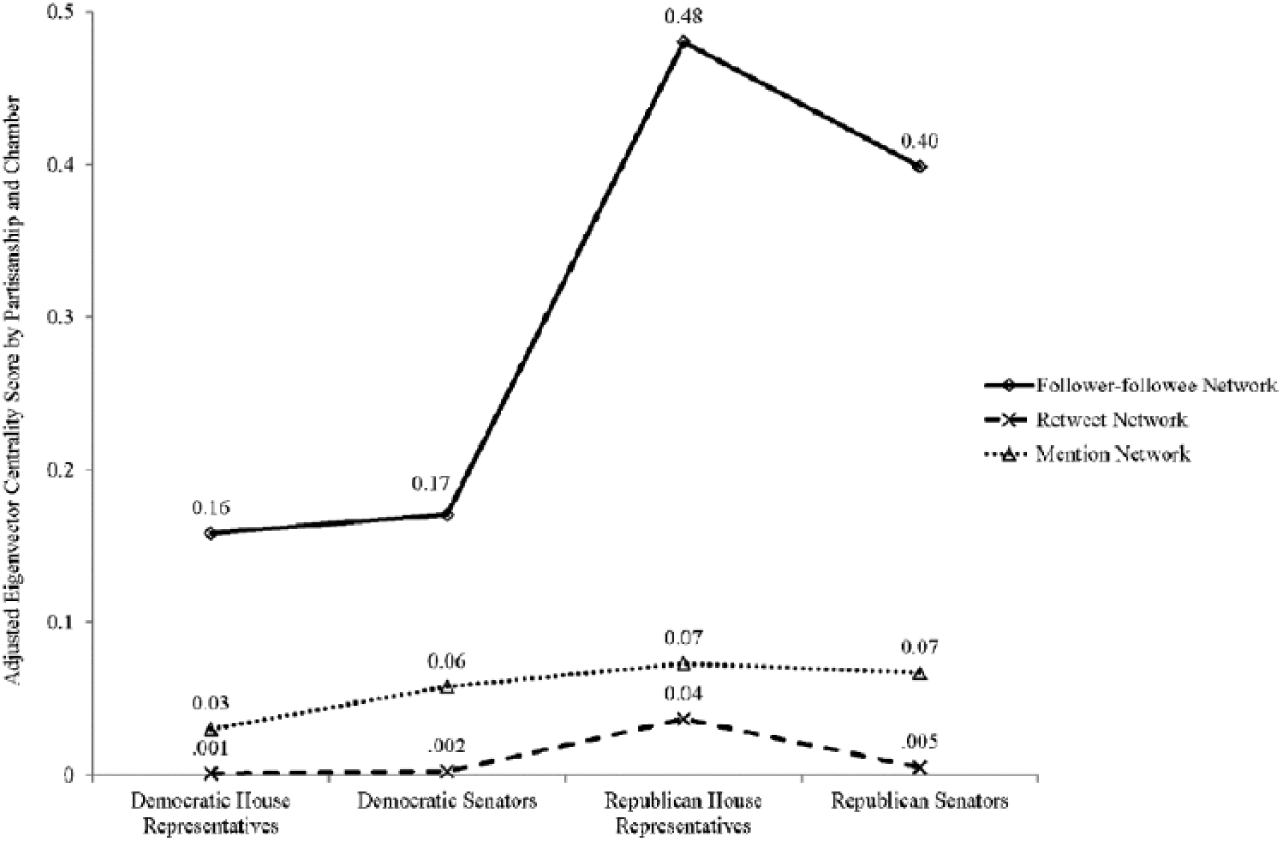
Eigenvector centrality scores of members of congress by partisanship and chamber in follower-followee and communication networks.
No statistically significant difference exists between Republican and Democratic members of congress in terms of their betweenness centrality in both retweet and mention networks. In other words, Republican and Democratic members of congress play equally important roles in bridging information flow (Borgatti, 2005) in their communication networks on Twitter. Darrell Issa and Ileana Ros-Lehtinen (Republican House Representatives) have obtained the greatest betweenness centrality scores in the retweet and mention networks, respectively. Steny Hoyer (House Democratic Whip) and Nancy Pelosi (House Democratic Leader) are among the top 10 members of congress with the highest betweenness centrality scores in the retweet network, whereas Steny Hoyer and Reid Harry are among the top 10 members of congress with the highest betweenness centrality scores in the mention network.
The quadratic assignment procedure (Krackhardt, 1987) is employed to examine the correlation between the follower-followee and communication networks. The retweet and mention networks are moderately correlated with each other (0.38, p < .001), and both are weakly correlated with the follower-followee network of members of congress on Twitter (0.11 and 0.13, p < .001).
ERGM Analysis on Generative Mechanisms of Follower-Followee and Communication Networks
To identify an optimum ERGM that is best suited for the observed follower-followee and communication networks on Twitter, this study adopts an iterative model development approach, which has been proven successful in identifying the models of other complex networks (Goodreau et al., 2009; Papachristos, Hureau, & Braga, 2013; Wimmer & Lewis, 2010). First, a baseline model is used to examine the baseline probability of a tie formation without exogenous and endogenous factors. Second, different blocks of factors are included in the model through a stepwise approach. The goodness-of-fit for all the tested models are assessed by comparing the Akaike Information Criterion (AIC) and the log-likelihood of these models (Hunter, Goodreau, & Handcock, 2008), as well as by examining the other goodness-of-fit indicators of each model (Goodreau, Handcock, Hunter, Butts, & Morris, 2008). Finally, a model that includes factors of theoretical interest and is best suited for the observed data is identified. Table 2 summarizes the estimated results of the two ERGMs that account for the formation of ties in the follower-followee and communication networks. 5 Model 1 in the table emphasizes the contribution of exogenous factors (e.g., individual attributes and homophily attributes) to the formation of ties in each network, whereas Model 2 represents the best approximation of the generation of structures in the follower-followee and communication networks.
ERGM of Follower-Followee and Communication Networks.

Note. NA = not applicable. ERGM = exponential random graph modeling. GWESP = Geometrically Weighted Edgewise Shared Partners. GWOD = Geometrically Weighted Outdegree.
The numbers that are enclosed in parentheses denote the standard errors of the corresponding coefficients.
State is included as a discrete attribute in all ERGMs. A total of 52 coefficients are estimated in each model, which are not reported in this table to save space. Detailed information can be provided upon request.
p < .10. *p < .05. **p < .01. ***p < .001.
Homophily is an influential generative mechanism in both follower-followee and communication networks of members of congress on Twitter. Four out of the five homophily attributes are found to be significant predictors of the formation of ties in the follower-followee and communication networks. Members of congress from the same party, state, and chamber, and those who have shared concerns are more likely to establish a link in the follower-followee network and are more likely to interact with one another in the retweet or mention networks. Therefore, H1(a), H1(b), H1(c), and H1(d) are accepted, whereas H1(e) is rejected.
Different combinations of endogenous mechanisms exist in the follower-followee and communication networks. The presence of positive and significant reciprocity coefficients in Model 2 implies that members of congress are more likely to follow or communicate with one another when they reciprocate the existing ties in their follower-followee and communication networks. Therefore, H2(a) is accepted. The presence of positive and significant triadic closure coefficients in Model 2 implies that the ties that complete the transitive triangles are significantly more likely to form in the corresponding networks. Therefore, H2(b) is accepted.
Outdegree is another endogenous mechanism that operates in both communication networks. The inclusion of outdegree terms in ERGMs can significantly suit a model in the retweet and mention networks except for the follower-followee network of members of congress. Outdegrees are found to exert negative influences on ties formation in the retweet and mention networks of members of congress.
The effects of the four homophily attributes (i.e., same-party, same-state, same-chamber, and shared concern) attenuate from 13% to 65% in Model 2 of the follower-followee and communication networks when endogenous mechanisms are considered, whereas the effect of common committee service in the same model becomes insignificant. Therefore, H3 is accepted in the study. This finding is consistent with those of previous studies, which argue that the effects of homophily attributes are bounded by endogenous balancing mechanisms, such as reciprocity and triadic closure (e.g., Kossinets & Watts, 2009; Moody, 2001; Wimmer & Lewis, 2010).
The ties among members of congress in the follower-followee network significantly and positively influence their communication in their retweet and mention networks. Therefore, H4 is accepted. More interestingly, the influential mechanism of the follower-followee network in the retweet network is different from that in the mention network. In particular, only the asymmetrical ties of the follower-followee network can facilitate communication among members of congress in the retweet network, whereas the mutual ties in the same network for the same communication do not matter. By contrast, both mutual and asymmetrical ties in the follower-followee network can enhance the communication among members of congress in the mention network.
ERGM Analysis on Effects of Follower-Followee and Communication Networks on Vote Agreement
The follower-followee and communication networks of members of congress on Twitter, along with their individual and homophily attributes, are included in the ERGM using a stepwise approach in examining the unique and joint effects of these networks on vote agreement. Table 3 reports the results of the ERGM estimation. Model 3 in Table 3, which considers both follower-followee and communication networks as antecedents of the vote agreement among members of congress, is best suited to the vote agreement relationship. 6 This finding implies that the multiple social ties existing among members of congress can explain the voting decisions of these officials on the floor better than a sole social tie can.
ERGM of Vote Agreement on Two Bills.
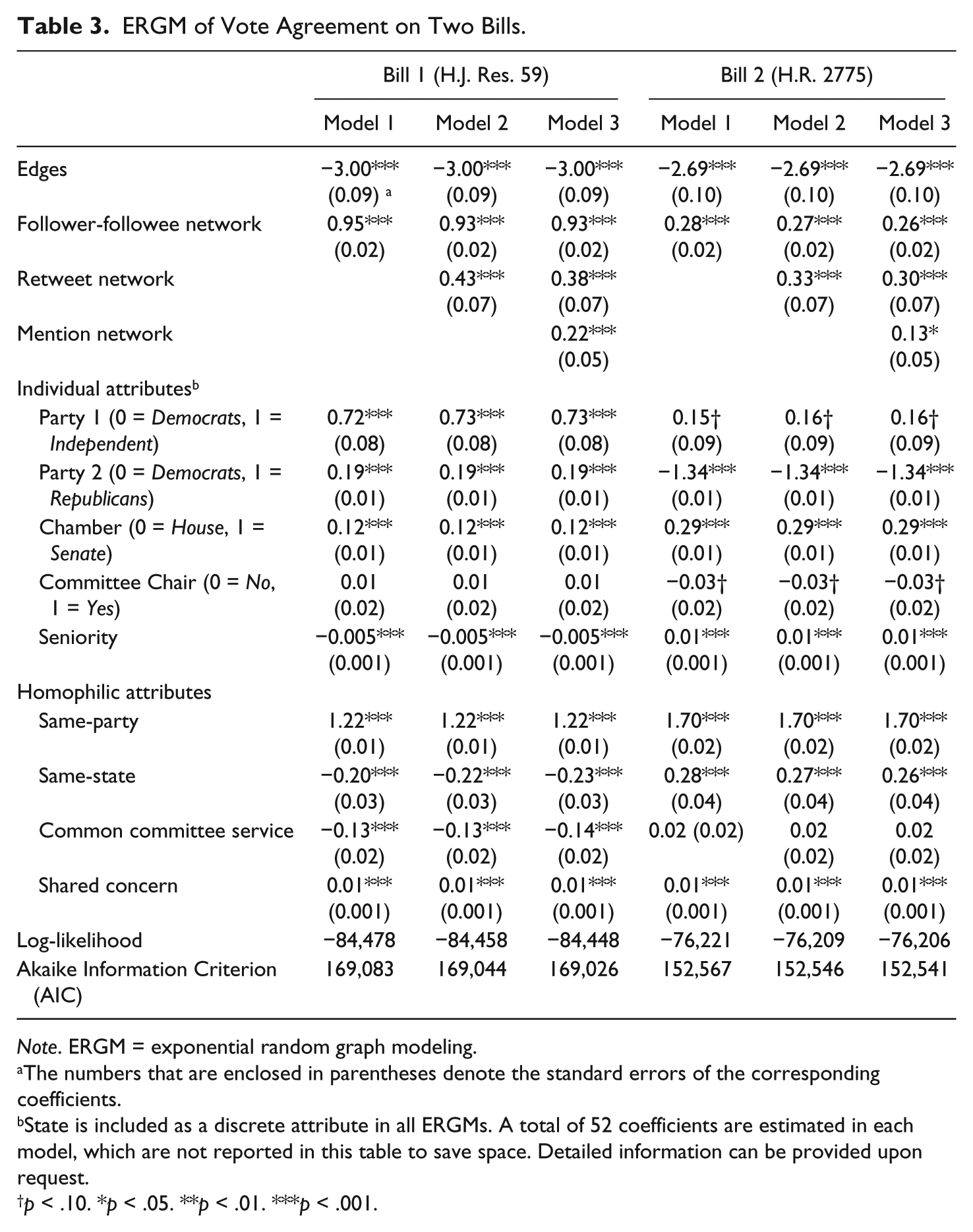
Note. ERGM = exponential random graph modeling.
The numbers that are enclosed in parentheses denote the standard errors of the corresponding coefficients.
State is included as a discrete attribute in all ERGMs. A total of 52 coefficients are estimated in each model, which are not reported in this table to save space. Detailed information can be provided upon request.
p < .10. *p < .05. **p < .01. ***p < .001.
Positive coefficients of the follower-followee and communication networks suggest that when two members of congress have follower-followee or communication ties on Twitter, they are more likely to agree with each other on their vote on two bills. Therefore, H5 is fully accepted. These findings likewise imply that the follower-followee and communication networks jointly affect the vote agreement of members of congress. In particular, when a congressman is tied with another congressman in both networks, the probability for their votes to be in agreement becomes higher.
The individual and homophily attributes of members of congress are included in the ERGM as control variables. The votes of senior members of congress on Bill 1 are less likely to agree with the votes of younger members of congress, whereas their votes on Bill 2 are more likely to agree with the votes of other senior members of congress. Members of congress from the same party and those with a shared concern are more likely to reach an agreement on their votes on the two bills. Members of congress from the same state are more likely to reach an agreement on their votes on Bill 2 but are less likely to reach an agreement on their votes on Bill 1. Members of congress who are serving in the same committee are less likely to reach an agreement on their votes on Bill 1.
Discussion and Conclusion
The various social ties among members of congress constitute the “social glue” (Caldeira & Patterson, 1987, p. 953) that binds them together as an organic system, which can significantly influence the performance of the U.S. legislative body (Caldeira & Patterson, 1987; Cho & Fowler, 2010; Fowler, Heaney, Nickerson, Padgett, & Sinclair, 2011). Considering the importance of these social ties, researchers have employed a network perspective to study the diverse relationships among members of congress. Most of these studies, however, tend to investigate the various social ties among members of congress individually. These ties include friendship (e.g., Caldeira & Patterson, 1987), common committee service (e.g., Porter, Mucha, Newman, & Friend, 2007; Porter, Mucha, Newman, & Warmbrand, 2005), cosponsorship (e.g., Fowler, 2006b), and vote agreement or similarity (e.g., Pei, 2013; Waugh et al., 2009). Limited empirical evidence demonstrates how the various social ties among members of congress affect one another and how these social ties affect their floor vote behavior.
By integrating the digital footprints of members of congress on Twitter with their offline characteristics and behavioral records, this study addresses three research questions about political communication in the U.S. congress: (a) how members of congress connect and communicate with one another on Twitter, (b) why members of congress connect and communicate with one another in such manner, and (c) what effects of such connection and communication among members of congress will have on their floor vote behavior. Our findings are methodologically, theoretically, and practically significant and can thus advance our understanding of social interaction and legislative politics in the U.S. congress.
Methodological and Practical Implications of Descriptive Findings
Descriptive analyses are performed to map the structure of the follower-followee and communication networks of members of congress on Twitter. Similar to that on other social and information networks, the social interactions of members of congress on Twitter give rise to the emergence of small-world networks in which most pairs of members of congress on Twitter are linked by a short path (Newman, 2003b). The follower-followee and communication networks of members of congress on Twitter exhibit highly segregated partisan structures, which is consistent with the findings of previous studies that investigated the political discourse among Twitter users in the United States (Conover, Gonçalves, Flammini, & Menczer, 2012; Conover et al., 2011; Smith, Rainie, Shneiderman, & Himelboim, 2014). The majority of the ties in these networks are observed among members of congress who come from the same parties. Moreover, the partisanship of members of congress is associated with the influence that they have within their respective networks.
Our study demonstrates that the digital footprints of members of congress and other individuals on Twitter can provide communication researchers with a new measurement device to observe the human communication process. Moreover, this new device has some desirable merits, such as the self-initiated nature of behavior, availability of time-stamped textual and behavioral information, and low obtrusiveness in observation. Given that members of congress now establish their presence in multiple online platforms, future research can expand the data pool to other platforms (e.g., Facebook). Given the assumption that different online platforms may fulfill different functions, the expansion of the data pool can examine whether members of congress will have different connection and communication patterns across online platforms. These descriptive findings have practical implications for various interest or lobbying groups who are key players in the American political system. To engage in various lobbying campaigns in congress efficiently, representatives of interest or lobbying groups need to communicate with members of congress either online or offline. Our findings on the structural positions of members of congress in the follower-followee and communication networks, as measured on the basis of various indicators of centrality (i.e., indegree and outdegree, betweenness centrality, and eigenvector centrality), can help representatives understand the specific actors in congress who exert influences over others in the communication process on Twitter, such that they can refine their persuasive campaigns.
Mitigated Homophily Effects and Different Endogenous Mechanisms in Follower-Followee and Communication Networks
This study differentiates the follower-followee network of members of congress from their communication networks and examines the generative mechanisms of these networks. Homophily, reciprocity, and triadic closure are the three shared generative mechanisms that exist in both follower-followee and communication networks. Communication networks have a unique generative mechanism that does not operate in the follower-followee network.
As a basic organizing principle in human society (McPherson et al., 2001), homophily is a significant generative mechanism in the follower-followee and communication networks of members of congress on Twitter. Four homophily attributes, namely, same-party, same-state, same-chamber, and shared public concern, facilitate the development of the follower-followee relationship and of the communication process among members of congress on Twitter. This finding confirms the argument that partisanship and regionalism serve important functions in the interpersonal lives of American legislators (Caldeira & Patterson, 1987) and implies that the offline structural segregation (i.e., home states and chambers) among members of congress, which affects their choices of connection and communication partners on Twitter, can be translated to cyberspace. The shared concern among members of congress, which is measured by the number of similar hashtags that they use on Twitter, increases the likelihood for ties to be formed in their follower-followee and communication networks. The shared concern, which represents some implicit foci among members of congress, has a more general scope when compared with other attributes (e.g., partisanship, home state, and chamber; Kossinets & Watts, 2009). The shared concern can develop a quasi-group identity among members of congress (Mayer, 1966). This identity facilitates social interaction among the members of the quasi-group.
Moreover, the importance of the five homophily attributes in tie generation varies across networks. Same-party preference is found to be the most influential homophily attribute in generating follower-followee ties on Twitter. However, same-state preference interestingly outperforms same-party preference and the other three attributes in generating communication ties on Twitter. In retweet and mention networks, everything else being equal, the link probabilities between two members of congress from the same party are 67% and 58%, respectively, whereas the probability for two members of congress from the same home state are 76% and 80%, respectively. This finding suggests that U.S. members of congress are not purely partisan-driven individuals. Given that the candidate-centered electoral institutions in the United States encourage members of congress to pursue particular benefits for their districts, shared local interests among members of congress outperform their partisanship in facilitating their communication on Twitter.
Reciprocity and triadic closure, which are both derived from balance theory, are two shared endogenous mechanisms in the follower-followee and communication networks of members of congress on Twitter. Despite the popularity of the reciprocity mechanism in the sponsorship of and voting on legislative bills in the U.S. Congress (Martorano, 2004; Matthews, 1959; Stratmann, 1992), this study may be the first to demonstrate that reciprocity can also function as an influential mechanism that accounts for the formation of ties in the follower-followee and communication networks of members of congress.
Carpenter, Esterling, and Lazer (2004) argued that in the United States, “political communication is transitive: holding constant the degree of preference similarity, a lobbyist is more likely to communicate with another lobbyist if their relationship is brokered by a third party” (p. 224). The current study confirms that the triadic closure rule, which is commonly known as “friends of friends are friends,” is likewise applicable among members of congress. The significant effects of triadic closure on the follower-followee and communication networks of members of congress suggest that the decision of one member of congress to connect or communicate with another member considerably depends on the presence of other members of congress (Carpenter et al., 2004).
Outdegree can likewise function as a significant endogenous mechanism in the communication networks of members of congress, but it does not show any significance in the follower-followee network. Huberman et al. (2009) argued that a follower-followee relationship between two users on Twitter does not necessarily imply that an interaction is actively occurring between them. The findings of the current study further suggest that the follower-followee and communication networks on Twitter differ from each other in terms of their endogenous generative mechanisms.
Outdegrees can represent the activeness of these officials in their communication activities on Twitter (i.e., retweeting the tweets of others or mentioning other users in their own tweets). Therefore, the outdegree terms in the ERGM analysis of communication networks capture the extent to which the probability of a tie to be formed in a communication network can be driven by the relationship of a congress member with other highly active members of congress (Papachristos et al., 2013). The negative outdegree terms in the ERGMs of both the retweet and mention networks suggest that members of congress are less likely to communicate with those who are highly active in their communication activities and rather prefer communication partners whose communication activeness on Twitter is approximately similar to theirs. This finding is particularly valuable in understanding political communications on Twitter. Members of congress need to maintain a reasonable degree of activeness on Twitter. Over-activeness on Twitter can result in a backfire effect that can reduce the willingness of others to communicate with them.
Homophily mechanisms and endogenous balancing mechanisms are found to work jointly in affecting tie formation in the follower-followee and communication networks of members of congress. Early social network research gave rise to the assumption that ties are formed independent of one another, such that the functions of balancing mechanisms in tie formation in social networks are masked under the homophily mechanism (for a detailed elaboration, please refer to Wimmer & Lewis, 2010). Scholars have recently recognized the limitation of such assumption and have found that the preference of individuals for similar others does not strongly affect their choices, whereas structural factors strongly determine their actual choices (Goodreau et al., 2009; Kossinets & Watts, 2009; Moody, 2001; Mouw & Entwisle, 2006; Wimmer & Lewis, 2010). By distinguishing the effect of the homophily mechanism from that of the endogenous balancing mechanisms, this study finds that these two mechanisms jointly affect the formation of ties in the follower-followee and communication networks of members of congress. When the endogenous balancing mechanisms are considered, the influential magnitudes of the homophily attributes are substantially mitigated. However, this premise does not necessarily imply that the social lives of U.S. members of congress are less governed by the homophily rule. Homophily remains a significant tie-generating mechanism for members of congress, even after the effects of endogenous balancing mechanisms are controlled. Our finding implies that members of congress are not completely free agents whose behaviors are only determined by their personal preference. Instead, members of congress are social beings whose behavioral decisions are also affected by surrounding structures.
Interplay Between Follower-Followee Network, Communication Networks, and Voting Behavior
Members of congress often engage in more than one type of social interaction that forms a multiplex network with different types of ties. A proper examination of the interplay between the different ties that exist among members of congress can help researchers understand the development of cooperation or defection among these officials (De Kerchove & Van Dooren, 2008; Gómez-Gardeñes et al., 2012), which in turn, can help uncover the principles that shape congress. This study attempts to unravel the intricate interplay among the follower-followee relationships, communication ties, and vote agreement of members of congress, which can advance our understanding of the effects of interpersonal communication, mutual interests, and other structural characteristics on the legislative process (Bratton & Rouse, 2011).
The follower-followee relationships on Twitter can facilitate the communication among members of congress on the social networking platform. Moreover, the influential mechanism of follower-followee relationships differs across the two types of communicative behavior on Twitter (i.e., retweet and mention). Both mutual and one-way follower-followee relationships increase the likelihood for a mentioning tie to develop between two members of congress, whereas only the one-way follower-followee relationship can increase the likelihood for a retweeting tie to develop between two such members.
Such difference may result from the distinct natures of the retweet and mention behaviors on Twitter. A retweet represents a citation of content from another user with an emphasis on the content value of a tweet, whereas a mention represents a public response to the tweet of another user with an emphasis on the name value of a user (Cha, Haddadi, Benevenuto, & Gummadi, 2010). Asymmetric follower-followee relationships may drive a user to retweet the tweets of another user because such relationships can expose the content of the tweets of a member of congress to another. Mutual follower-followee relationships, along with asymmetric follower-followee relationships, can substantially influence a user to mention another user in his or her tweets.
The follower-followee relationships on Twitter can facilitate political discourse and information exchange among members of congress. Such discourse can enrich the social interactions among these officials from a single follower-followee tie to multiple social ties. These ties can likewise increase the likelihood of vote agreement among the members by breeding familiarity and trust among them (Carpenter et al., 2004; Krackhardt, 1992). This study empirically confirms the above-mentioned assumption. The votes of two members of congress who are linked in either follower-followee or communication networks have a higher tendency to agree.
Although political scientists have recognized that personal connections and contacts are often significant in determining the outcome of political events, limited knowledge exists about the benefits of such relationships and social networks (Ringe & Victor, 2013). Our findings demonstrate that online social interaction (i.e., follower-followee and communication) between members of congress on Twitter is significantly and positively linked with offline legislative outcomes. Given that U.S. members of congress are busy people whose time and attention are constantly pressed and sought, civil interaction in legislative politics has declined (Uslaner, 1993). Our findings suggest that Twitter may be a viable interaction platform for members of congress. Such platform can catalyze negotiation, understanding, and coordination among them and can further improve the productivity of congress as a whole.
Limitations and Recommendations for Future Research
Despite the significant findings of this study, a discussion on its limitations and recommendations for future research is warranted. Assessing how the observed partisan homogeneity of Twitter use by congress members is related to political polarization measured with classical DW-Nominate scores in future research is of great methodological value (Poole & Rosenthal, 1991, 2014). If the two measures are correlated, the behavioral information on Twitter may be another alternative measurement of political polarization with some obvious advantages (e.g., availability of longitudinal observation, minimization of subjective bias).
This study assumes that all ties in the follower-followee and communication networks of members of congress on Twitter have a positive connotation. These ties, however, may develop negative connotations in the real context, such as hostile friendships or controversial debates (Easley & Kleinberg, 2010). Future studies can acknowledge the valence of these ties by examining the semantics of political discourse among members of congress.
This study considers the functions of five homophily attributes in tie generation among members of congress on Twitter. We do not intend to claim that these attributes are exhaustive. Future research is necessary to examine the functions of other homophily attributes (e.g., same-race and same-ethnicity) in forming specific type of ties among members of congress on Twitter. Although the importance of the five homophily attributes is found to vary across different networks, future research is needed to identify empirically the conditions in which the effects of homophily mechanisms vary.
The causal direction among follower-followee network, communication networks, and vote agreement can be mutual. In other words, vote agreement between members of congress can affect their follower-followee and communication relationships on Twitter. Longitudinal data that span a longer study period must be collected and analyzed in future studies (Fowler et al., 2011) to facilitate a more comprehensive understanding about the causal interplay among follower-followee network, communication networks, and vote agreement.
Finally, although both follower-followee and communication networks on Twitter significantly influence the legislative behaviors of members of congress, the effects of other networks on such behaviors must also be examined. The links in the follower-followee and communication networks only represent a part of the social ties that link members of congress with one another. Future studies must consider other relevant social ties, such as participation in offline political campaigns and sponsorship of legislative bills. This study likewise examines the vote agreement among members of congress on two bills. Future studies must broaden this scope by including other legislative bills that cover different issues.
Footnotes
Acknowledgements
An earlier version of this article was presented at the 7th Annual Political Networks Workshops & Conference held in Montreal in 2014. The authors would like to thank the reviewers and the editor for their constructive comments.
Declaration of Conflicting Interests
The authors declared no potential conflicts of interest with respect to the research, authorship, and/or publication of this article.
Funding
The authors disclosed receipt of the following financial support for the research, authorship, and/or publication of this article: This project was supported, in part, by a Microsoft-NTU joint R&D grant (M4061358.060) and, in part, by GRF (CityU 154412) from Hong Kong Research Grants Council.